
Breed profile
Markiesje (Dutch Tulip Hound): Price in India, Heat, Health
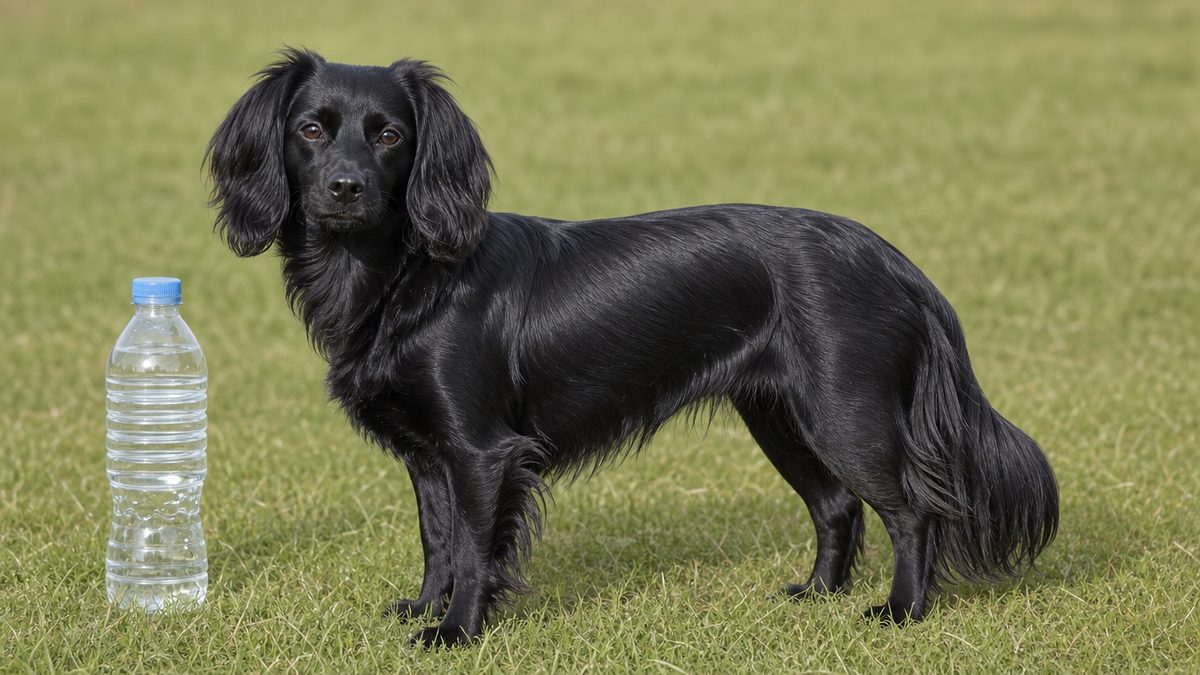
A small black Dutch companion dog rebuilt from Frisian farm dogs in the 1970s, recognised nationally in the Netherlands and by nobody else, whose English nickname comes with an origin story its own country has never told.
Quick answer
No honest markiesje price in india can be quoted, because no Markiesje is offered for sale anywhere in the country. A web search restricted to India returns ten results for the purchase query and not one is an Indian breeder, listing or price, while the same search for a Labrador returns city-by-city price tables. This is a 35 to 37 cm black Dutch companion dog, recognised nationally since 1999 and by the FCI not at all. Bonbeno rates heat tolerance 2 of 5.
This page reports published veterinary research and registry data for general information. It is not a diagnosis and it is not a treatment plan. The juvenile movement disorder described in this breed appears at three to four months and most affected pups are euthanised, and heat stress in a black-coated dog in Indian sun can become an emergency within minutes. Consult a qualified veterinarian in your own city before acting on anything here, and treat any collapsed, cramping, distressed or non-responsive dog as an emergency rather than looking anything up.
Markiesje at a glance
What a Markiesje actually is
The Markiesje is a fine-boned black Dutch companion dog of 35 to 37 cm and 6 to 8 kg, rebuilt from Frisian farm dogs in the 1970s and recognised as a Dutch national breed on 1 May 1999 Nederlandse Markiesjes Vereniging. It is not an old breed in the sense buyers assume. The type is old and the population is 47 years old, and the difference matters when you read a pedigree.
Small black dogs with white markings appear all over seventeenth and eighteenth century Dutch painting, and the Raad van Beheer says so on its own breed page: some are the forerunners of the Cavalier King Charles Spaniel, others look more like the Phalene, and nothing is known of any deliberate breeding programme behind them. That is the honest version of the breed's history. The dogs in the paintings are ancestors of a type, not documented ancestors of these dogs.
The modern animal starts with one sentence. In 1967 the Dutch cynologist P.C.M. Toepoel wrote in *Onze Honden* that although the type was never bred to a standard again, 'one still meets them everywhere' and 'probably this breed can still be restored today';. Mia van Woerden, who also worked on the restoration of the Dutch Smoushond, took that up in the mid-1970s and advertised in Dutch dog papers for spaniel-like little dogs.
The foundation stock was Frisian, not French
Early crosses used the Phalene, the Papillon and the Cavalier King Charles Spaniel, and the breed club says plainly that these were abandoned because the offspring were mongrel in type and carried unwanted breed-specific traits. The programme then switched entirely to Frisian Bykes, small Stabyhouns and mollenhondjes with a hanging tail and a Markiesje-like head, and those became the genetic base.
The first litter bred to the written plan arrived on 2 April 1979, out of Skippy del Campo Albir, a parti-coloured foundling picked up at a Spanish campsite, and Barry, a bitch found in Lelystad. Every dog was assessed before being used, a procedure the club still runs. The Vereniging voor liefhebbers van het Markiesje, later the Nederlandse Markiesjes Vereniging, was founded on 24 June 1979.
What the breed standard specifies
The standard describes an elegant, fine-boned dog with a body slightly longer than tall in a ratio of 10 length to 9 height, light in bone, well muscled, and explicitly 'without traces of dwarfism'. Ideal height at the withers is 37 cm for males and 35 cm for females, with 2 cm more or 3 cm less permitted, which puts a correct dog anywhere between 32 and 39 cm. Weight runs 6 to 8 kg.
The coat is medium length, lying flat against the body, soft, silky and shiny, with a light wave allowed and no undercoat at all. Feathering runs on the ears, the tail and the backs of the legs down to the hock, while the feet are short-coated. Colour is glossy solid black, or black with white markings covering no more than 40 percent, permitted as a white blaze with black cheeks, a white chest, collar, belly, feet and tail tip.
Ears are set high but not above the skull, triangular with a slightly rounded tip, carried hanging along the head, and the tip falls against the cheek when the dog is alert. The tail is fairly long, reaches the hock, and is carried level with the back or gaily but never curled over it. Nothing in the standard is exaggerated, and the standard says so: 'every form of exaggeration is undesirable'.
The Raad van Beheer's own breed page prints a single withers height of 'around 35 cm';. That is the female ideal. Read literally it excludes a correct male, which the standard puts at 37 cm. Bonbeno recorded exactly this failure on the same registry for the Kooikerhondje, where the published range stops at 40 cm while the national standard permits a correct male at 41 or 42 cm. Two breeds, one registry, the same defect.
There is a reason that keeps happening, and the registry states it at the bottom of the page. The Raad van Beheer writes that the breed text was drawn up by the breed clubs, that it has done no content check on it, and that it is not responsible for inaccuracies. The national registry is publishing club copy under its own masthead without editing it. Take the numbers from the standard, not from the summary.
FCI recognition, and why a Dutch national breed still passes the test
The Markiesje is recognised nationally in the Netherlands and by nobody internationally. The Raad van Beheer recognised it on 1 May 1999 and counts it among the nine Dutch national breeds, while the Federation Cynologique Internationale recognises it on neither a definitive nor a provisional basis, checked against both registers with controls present on each document Federation Cynologique Internationale.
Bonbeno's test for whether a breed is genuinely a breed rather than a marketing label has two conditions. A written standard must exist, and a studbook must exist. The Markiesje satisfies both, and an FCI number is not one of them. A judge named Jettie Alberts drew up the standard in 1980 and the Raad van Beheer approved it. Registration of parent dogs, puppies and newcomers began in October 1981. The Voorlopig Register was approved on 7 March 1996, the recognition decision was taken on 3 December 1998, and the first approval round admitted 139 dogs.
The registry maintains a formal category for exactly this situation. Its 'Inschrijven nationaal erkend ras' page explains how a nationally recognised breed that the FCI does not recognise is entered in the Nederlands Hondenstamboek, and names the Markiesje as one. So the studbook is not informal. It is the national studbook, with a separate door.
How the FCI absence was established
The FCI's letter M index carries eleven entries, running MACEDONIAN SHEPHERD DOG KARAMAN, MAGYAR AGAR, MALTESE, MANCHESTER TERRIER, MASTIFF, MASTIN DEL PIRINEO, MASTIN ESPANOL, MASTINO NAPOLETANO, MINIATURE AMERICAN SHEPHERD, MINIATURE BULL TERRIER and MUDI. MARKIESJE would sort between MANCHESTER TERRIER and MASTIFF and is not there. Two of those eleven also sit on the FCI's provisional table, so the index is not definitive-only and the absence covers both statuses.
The provisional register was read separately anyway. It holds twenty breeds, from the AUSTRALIAN STUMPY TAIL CATTLE DOG (351) admitted on 6 July 2005 to four breeds admitted on 11 February 2026, with the LANCASHIRE HEELER (360) present as an in-document control. The Markiesje is absent from that too.
The Raad van Beheer's Markiesje page prints 'FCI groep 9: Gezelschapshonden' and then, three lines below in the same block, 'FCI nummer niet erkend', meaning FCI number not recognised. The page's own URL sits under /fci-groep-9/. An FCI group printed by a national body is that body's filing, not an FCI grant, and this page prints the two claims in the same breath. Only the FCI's own register settles recognition.
Because India is a full FCI member represented by the Kennel Club of India, which issues pedigrees against FCI nomenclature, a breed with no FCI number has no Indian pedigree route either. An Indian buyer cannot register a Markiesje with the KCI, cannot enter one in a CACIB class anywhere, and has no Indian standard to judge a dog against. The Raad van Beheer states the CACIB point directly, naming the Markiesje as an example of a breed that cannot be awarded one.
The open studbook is the other thing a buyer needs to understand. The breed is still being built up, so dogs of unverified parentage can still enter the Voorlopig Register through an assessment that judges whether they conform closely enough to the standard. For those dogs the ancestry has not been checked. Since June 2014 a DNA parentage test has been required before papers are issued for the puppies that follow, and the Raad van Beheer applies that rule to Markiesjes even though the breed is outside the FCI. The club's own FAQ puts the consequence plainly: once a look-alike is approved it formally becomes a Markiesje, and its puppies are Markiesjes.
Compare the Mudi, built the same week as this page, for the opposite case, and the Maneto for a breed whose national recognition runs through an agriculture ministry rather than a kennel club. Recognition is not one question with one answer.
One further check confirms the shape of the absence rather than assuming it. The FCI's Group 1 nomenclature index lists three breeds under THE NETHERLANDS, the Nederlandse Schapendoes 313, the Hollandse Herdershond 223 and the Saarlooswolfhond 311. The FCI holds Dutch breeds, files them by country, and gives them numbers. It simply does not hold this one.
Where 'Dutch Tulip Hound' came from, traced link by link
The English name traces to one answer given to one schoolchild on 16 June 2014, and the tulip story attached to it was invented afterwards by pages that had nothing else to say. Bonbeno opened every link in the chain. No Dutch source, anywhere, connects this breed to tulips.
Start at the end of the chain, because that is what an Indian reader meets first. Animalia, the highest-ranking English aggregator entry for this breed, gives 'Hollandse Tuliphond, Dutch Tulip Hound' as other names and states that the Markiesje 'was developed in the Netherlands as a decorative companion in 1977, from Poodles and British Spaniels', that it is 'nicknamed the guardian of tulips', and that 'the breed was developed near flower farms, where the dogs later helped keep watch over the fields';. Its interesting-facts panel adds that the dogs 'ran between the rows and did not harm the flowers'. Its reference list contains exactly one entry, the English Wikipedia article.
So Bonbeno read the English Wikipedia article, and the raw wikitext behind it. It is a four-sentence stub, last edited on 21 October 2025, with every trait field in its infobox left empty. It gives the alternative names 'Dutch Tulip Dog' and 'Hollandse Tulphond'. The words Poodle, Spaniel, tulip field, flower farm and 1977 do not appear in it. Every specific claim Animalia attributes to its only source is absent from that source.
The single reference behind the name
Wikipedia sources 'Dutch Tulip Dog' to one page, and that page is still live. It is question 34548 on Ik heb een vraag, a Dutch-language public science Q&A platform coordinated by Eos wetenschap. On 16 June 2014 a user recorded as 'mabel, 14 jaar' asked what the English name for the Markiesje is. The question is filed under the category 'kunst', meaning art and language, not biology.
The answer came from Prof. Dr. Stef Craps of Universiteit Gent, who is a professor of English literature and directs the university's Cultural Memory Studies Initiative. He answered the language question correctly and carefully, saying English ordinarily just uses the Dutch name, pronounced 'Mar-keesh', and then adding one sentence: 'Een alternatieve benaming is echter Hollandse Tulphond, en dat vertaal je als Dutch Tulip Hound';. His single supporting link is dogbreedinfo.com.
That page is the root. DogBreedInfo's Markiesje entry gives 'Hollandse Tulphond' and 'Dutch Tulip Hound' as other names, and cites nothing for either. It ranks fourth in Bing India for this breed's purchase query.
| Step | Source | What it adds | Status |
|---|---|---|---|
| 1 | DogBreedInfo.com | 'Hollandse Tulphond / Dutch Tulip Hound', unsourced | Live, no citation |
| 2 | Ik heb een vraag Q34548, 16 Jun 2014 | A literature professor relays it to a 14-year-old | Live, links step 1 |
| 3 | English Wikipedia, same day | Cites step 2 for the name; stub, empty infobox | Live, 2 of its 3 refs dead |
| 4 | Animalia.bio | Adds Poodles, British Spaniels, 1977, flower farms, 9-10 kg | Live, cites only step 3 |
| 5 | Bing India results | Serves step 4 to Indian readers | Live |
Two of Wikipedia's three references no longer work. The raadvanbeheer.nl 'Dutch Breeds' URL now redirects to the houdenvanhonden.nl homepage, and petyourdog.com/breed/Markiesje returns HTTP 404 under the title '404 Not Found';. The one that still resolves is the schoolchild's question.
What the Dutch sources say the name means
The breed club gives two theories for 'Markiesje' and neither involves a flower. The likeliest is a reference to the Marquise de Pompadour, whose small dogs the type resembles in period painting, and the alternative is a derivation from the French *marqueur*. The Raad van Beheer, the Dutch government-supported information centre LICG and the breed club together run to several thousand words on this breed and mention tulips zero times Landelijk InformatieCentrum… Nederlandse Markiesjes Vereniging.
The Poodle claim is not merely unsourced, it is contradicted. The club's own written history names the Phalene, the Papillon and the Cavalier King Charles Spaniel as the crosses that were tried and dropped, and the Frisian Byke as the stock that was kept. The Poodle was never used. The date is wrong too: the reconstruction began in the mid-1970s and the first planned litter was 1979, not 1977.
This matters beyond pedantry. Wikipedia files the breed under Category:Gundogs and DogBreedInfo says it 'loves to be a retriever and gundog'; DogBreedInfo, The Purebred Markiesje, while the Raad van Beheer files it in group 9, companion dogs. A buyer reading the English pages is being sold a small working gundog with a flower-guarding heritage. The Dutch registry is describing a house companion.
Markiesje price in India, and why there is no number to quote
No markiesje price in india exists, and Bonbeno will not manufacture one. A web search restricted to India for the purchase query returns ten results of which not one is an Indian breeder, an Indian listing or an Indian price. The nearest thing to Indian commerce in that result set is an Etsy India listing for a mug with the dog printed on it.
The control is what makes that statement worth anything. The same search, same session, same India restriction, run for the Labrador Retriever, returned Mr n Mrs Pet with a price band of INR 30,000 to 1,20,000 broken out across eight cities, plus Supertails, petzlover, goodpaws and half a dozen more. The instrument finds Indian dog prices when Indian dog prices exist. For this breed it finds a coffee mug.
Puppiezo settles it from the other direction. That site manufactures a product page for breeds it does not stock, and Bonbeno has documented it doing so, yet puppiezo.com/product/markiesje returns HTTP 404 under the title 'Page not found - Puppiezo'. When even a listing site that invents inventory has not bothered to invent this breed, the demand is not there to invent it for.
Google India printed 'About 102 results' for this breed and 'About 196 results' for the Labrador Retriever control on the same endpoint in the same session. The Labrador is the thickest commercial dog query in India. If 102 proved a thin market, 196 would prove one too. Bonbeno reports the number as an observation and rests the argument on what the results contain, not how many there are.
What a Markiesje costs where it exists
In the Netherlands a puppy bought through the breed clubs costs about 1,250 euro, and LICG says so on a page supported by the Dutch agriculture ministry, Utrecht's veterinary faculty and the Dutch animal-protection body. There are waiting lists at the Nederlandse Markiesjes Vereniging and Markiesjes Welzijn, and the same page notes that a purebred Markiesje is almost never found in a shelter.
Bonbeno publishes no rupee conversion of that figure. Converting a euro price into rupees would manufacture exactly the kind of number this site exists to expose, and the playbook behind these pages records Indian breed prices that are US dollar lists divided at 84.38, at 74, at 80 and at 66.67. A euro figure run through today's rate is the same error with a different currency. If you want to know what 1,250 euro is, use a calculator and know that you have done the arithmetic yourself.
Before the price, the product is not agreed
Six published sources describe this dog and no two of them give the same size. That is not a rounding disagreement. The floor runs from 32 cm to 35 cm and the ceiling from 38 cm to 41 cm, and the weight ceiling runs from 8 kg to 10 kg. A buyer told a 10 kg dog is a correct Markiesje is being told something the Dutch standard does not permit.
| Source | What it is | Height given | Weight given |
|---|---|---|---|
| Breed standard, via LICG | The document the registry approved | 37 cm male, 35 cm female, +2/-3 cm | 6 to 8 kg |
| Raad van Beheer | The national registry's own page | 'Around 35 cm', one figure | 6 to 8 kg |
| Eerste Gezelschapshondenclub | One of the three recognised clubs | Circa 35 to 40 cm | About 6 to 8 kg |
| DogBreedInfo | Root of the English name | Up to 41 cm | Up to 10 kg |
| Animalia | Top English aggregator | 34 to 39 cm, and 32 cm on the same card | 9 to 10 kg |
| Embark | DNA testing company | 33 to 38 cm | 5 to 10 kg male, 5 to 9 kg female |
Animalia manages to disagree with itself. Its own specification card prints a withers height of 34 to 39 cm and then, two rows below, a second withers height of 32 cm. Its weight of 9 to 10 kg sits entirely above the Dutch ceiling of 8 kg. Embark's male ceiling of 22 pounds is 9.98 kg, also above it. The English-language consensus is for a heavier dog than the breed standard describes.
Importing one is legal for yourself and illegal to sell
You may import a Markiesje as your own pet and you may not import one to sell or breed. Dogs are Restricted under the DGFT trade notice, which permits entry only for a pet accompanied by a valid pet book in the importer's own name, for research and development with a CPCSEA recommendation, or for Defence and Police use, and states that applications for trading or breeding purposes 'shall be duly rejected'. Entry is limited to seven named ports. The full route is set out in how to import a dog to India.
That, combined with the FCI absence, is why no Indian supply chain can form. There is no lawful commercial import route and no Kennel Club of India pedigree to issue at the far end of one. A breed with 3,300 registrations in its entire history, waiting lists at home, and no legal route into the Indian trade is not going to appear in an Indian kennel. Any seller offering you one is offering you something else.
The two Indian pages that do rank, and what they actually say
Two Indian sources surface around this query and neither prices the breed. Supertails publishes a dog price list for India that runs from about Rs 2,000 for an indie to over Rs 1,50,000 for a KCI-registered show-quality dog, and carries no Markiesje row at all. DogsIndia, the country's oldest breeder directory, serves rare-breed pages normally and prints 'There are no breeders listed currently under this breed' when it has none, which is what a working directory looks like when a breed is genuinely absent. Neither is hiding a price. There is no price.
The one figure the English pages do carry is not an Indian one. Wag! states that vet bills for a Markiesje run 'typically 500 to 1,000 US dollars a year';. That is an American figure for an American market, it is quoted here only as an example of a number attached to a country the dog does not live in, and Bonbeno converts none of it. A breed that is commercially unavailable in India does not acquire an Indian running cost by having an American one.
The third recognised Dutch club adds one more size to the pile. The Eerste Gezelschapshondenclub Nederland gives a withers height of circa 35 to 40 cm and a weight of about 6 to 8 kg, and states in its own words that its text is an informative summary from which no rights can be derived. Three Dutch clubs, three descriptions, and only one of them is the standard.
What a 7 kg dog actually costs to keep in India
Budget Rs 3,000 to Rs 10,000 a month for any dog in India and expect a small, short-coated one to sit near the lower half of that. The Voice of Stray Dogs cost breakdown gives that monthly range and an annual figure of Rs 25,000 to Rs 80,000. The lines below are the parts you can price individually, each from a source that publishes its own rate.
Two warnings about the numbers before you use them. Every figure here is one operator's published price rather than a market average, and the two most-quoted Indian cost pages agree to the rupee on both consultation and vaccination, which means one copied the other and they are a single data point rather than two. Treat the ranges as orientation and ring your own vet.
| Item | Published price | Source |
|---|---|---|
| Puppy core course, four visits | Starts at Rs 6,499 | One clinic chain, 50+ clinics |
| Annual booster | Starts at Rs 3,199 | Same chain |
| Anti-rabies, single dose | Rs 699 | Same chain |
| Kennel cough | Rs 1,349 | Same chain |
| Consultation | Rs 500 to Rs 1,000 | Treat as one data point |
| Bath, small dog | From Rs 934 | Delhi price list |
| Haircut | From Rs 1,359 | Delhi price list |
| Boarding, 24 hours | Rs 899 | Bengaluru operator |
| Delhi MCD registration | Rs 500 a year | Municipal portal |
| Chennai GCC pet licence | Rs 50 | Corporation website |
The vaccination figures come from a chain that prints 'Starts at' beside each one, which is a promotional floor rather than what you will pay. The grooming figures are its Delhi list and the boarding figure is a Bengaluru operator's own overnight rate. Registration is genuinely cheap and genuinely mandatory: Delhi charges Rs 500 for a new pet dog registration and Rs 500 to renew, with a late fee of Rs 100 a month, while Chennai charges Rs 50 and issued 9,115 licences in 2024 Greater Chennai Corporation.
Where a Markiesje costs less than the table suggests
Three lines fall for this breed specifically. Grooming is low, because the country-of-origin sources describe a light weekly brush and no professional trim, so the Rs 1,359 haircut line mostly does not apply. Food is low, because a 6 to 8 kg dog eats roughly a quarter of what a Labrador eats. Parasite cover is low, because the reference retail figure of Rs 1,103 a month is for the 15 to 30 kg NexGard Spectra band and a Markiesje falls two bands below it.
LICG puts Dutch food costs for this breed at about 20 euro a month. Bonbeno does not convert that either. Price an Indian small-breed diet against an Indian pack, and remember that grams per day belongs on the bag rather than in an article.
Where it costs more
Parasite control is not optional in India and it is the line most owners under-budget. A survey of 525 dogs across Delhi, Mumbai, Sikkim and Ladakh found 261 of them, 49.7 percent, positive by PCR for at least one tick-borne pathogen. An Odisha clinic series of 178 dogs found *Ehrlichia canis* in 56, 31.46 percent, with 79 percent of infected dogs carrying a tick history. Read those as what they are, dogs presented at veterinary clinics rather than a random population, and then budget monthly rather than seasonally.
The other honest line is the emergency you cannot price. A dog with no Indian population has no Indian veterinary familiarity behind it, no local breed-club health scheme, and no Indian screening history to compare a result against. Every DNA test this breed needs is performed abroad, and the paroxysmal dyskinesia test is run at Utrecht's own research laboratory. Factor in international courier and turnaround before you assume you can screen an Indian-bred litter.
The cost of ownership in one line
Taken together, the realistic cost of ownership for a 6 to 8 kg single-coated dog in an Indian metro is the low end of the national Rs 3,000 to Rs 10,000 monthly band, because two of the three variable lines fall for this breed. Food is small-dog food, grooming is a bath rather than a groom, and only parasite control stays where it is for every dog in the country. The one-off first-year additions are vaccination, registration and neutering, and none of those is breed-specific.
Heat tolerance in India, measured against Utrecht rather than guessed
Bonbeno rates heat tolerance 2 of 5, and the reason is a single comparison. Chennai's coolest month averages 24.09 C while the Markiesje's homeland's warmest month averages 18.34 C, so the coolest week of an Indian coastal year is 5.75 C warmer than the warmest week this breed was built for.
Every figure below comes from NASA POWER queried by explicit latitude and longitude, with the grid-cell elevation echoed back at each point and checked against the real elevation, because POWER returns a cell rather than a place. Utrecht came back at 3.51 m against a city near 5 m, so the homeland baseline is sound. The Indian plains cells check out too: Delhi 206.37 m against roughly 216 m, Chennai 48.95 m against roughly 6 m, Kolkata 7.35 m against 9 m, Bengaluru 841.72 m against 920 m, Pune 635.99 m against 560 m, Mumbai 97.15 m against 14 m.
Two points had to be discarded. Shimla came back at 897.65 m against a real 2,200 m and Ooty at 784.64 m against 2,240 m, errors of 1,302 m and 1,455 m. Those are the two hill stations an Indian reader would ask about for a cold-climate breed, and POWER cannot describe either. Bonbeno publishes no hill-station figure rather than a wrong one. Separately, Utrecht and De Bilt returned byte-identical series, which means one cell was queried twice and the two cannot be used to distinguish anything.
| Place | Cell elevation | Annual mean | Warmest month | Coolest month | Peak wet bulb |
|---|---|---|---|---|---|
| Utrecht, homeland | 4 m | 10.27 C | 18.34 C (Jul) | 2.60 C (Jan) | 15.48 C (Jul) |
| Bengaluru | 842 m | 23.74 C | 28.37 C (Apr) | 20.22 C (Dec) | 21.86 C (May) |
| Pune | 636 m | 23.86 C | 28.93 C (Apr) | 19.62 C (Dec) | 22.97 C (Jun) |
| Jaipur | 406 m | 25.58 C | 34.57 C (Jun) | 14.51 C (Jan) | 25.33 C (Jul) |
| Delhi | 206 m | 25.60 C | 35.88 C (Jun) | 13.61 C (Jan) | 26.50 C (Jul) |
| Kolkata | 7 m | 25.81 C | 31.53 C (May) | 17.31 C (Jan) | 27.09 C (Jun) |
| Hyderabad | 495 m | 26.10 C | 33.30 C (May) | 20.76 C (Dec) | 23.35 C (Jun) |
| Mumbai | 97 m | 26.77 C | 31.19 C (May) | 23.19 C (Jan) | 25.77 C (Jun) |
| Chennai | 49 m | 27.95 C | 31.51 C (May) | 24.09 C (Jan) | 26.11 C (May) |
Read the annual-mean column against the homeland's warmest month. Every one of those eight Indian cities has an annual mean temperature above 18.34 C, which is the hottest month Utrecht gets. Bengaluru, the mildest, runs 5.4 C above it all year round. Chennai runs 9.6 C above it. There is no Indian plains city where a Markiesje would experience a Dutch summer as anything other than a cool spell.
The humidity finding runs the other way, and it matters
This is the part no page anywhere gets right. The Netherlands is more humid than India, not less. Utrecht's annual mean relative humidity is 83.98 percent, above Kolkata's 73.93, Chennai's 72.39, Bengaluru's 67.94, Mumbai's 67.39, Pune's 66.80, Hyderabad's 60.30, Delhi's 45.56 and Jaipur's 40.94. A Markiesje arrives humid-adapted and heat-naive, which is the opposite of the usual European-breed problem.
That shows up in the wet-bulb column, where the gap narrows. Utrecht's peak monthly-mean wet bulb is 15.48 C against Kolkata's 27.09 C, an 11.6 C gap, where the dry-bulb gap between the same two months is 13.2 C. The consequence is practical rather than reassuring: the coastal monsoon will not be the shock, the pre-monsoon dry heat will be. Delhi in June and Jaipur in June are the conditions this dog has no reference for.
The India Meteorological Department does not consider a heat wave at all until a station's maximum reaches at least 40 C in the plains, and declares one outright at 45 C. A day that India files as ordinary summer weather is roughly 22 C above the mean of the hottest month in this breed's homeland. Heat stroke is defined there as a body temperature of 40 C or more with delirium, seizures or coma, and called 'a potential fatal condition'.
One structural advantage, and it is real
The breed standard specifies no undercoat at all. That is more than most European breeds bring to this climate, and it is why the rating is 2 rather than 1. A medium-length, flat-lying, single coat sheds heat far better than the double coat of a Nordic or herding breed, and the dog is 6 to 8 kg rather than 30, so it has a favourable surface-area-to-mass ratio.
Against that sits the colour. The standard permits glossy solid black, or black with no more than 40 percent white. A black dog in direct Indian sun absorbs radiation a Dutch breeder never had to think about, and the darkest permitted dog is the one with no white at all. If you are choosing between two correct dogs for an Indian home, the one carrying the permitted white blaze, chest, collar, belly, feet and tail tip is the cooler animal.
Indian law backs the caution. Second Schedule Part IV paragraph 21(1) of the Dog Breeding and Marketing Rules 2017 bars keeping in outdoor facilities, without the attending veterinary practitioner's written approval, dogs not accustomed to local temperatures and breeds that cannot tolerate them. A Dutch companion dog in an Indian summer is squarely inside that description, and this breed is an indoor dog in India as a matter of law as well as sense.
Practically, that means air-conditioned or at least fan-cooled indoor space through the pre-monsoon months, walks before 7 am and after 8 pm, no midday pavement, and free water in more than one room. None of that is exotic advice. It is simply the advice nobody writes for this breed, because the one English page that mentions temperature at all says an adult Markiesje 'should do fine with a brisk walk in temperatures of -20 degrees Celsius and warmer' and names no ceiling whatsoever.
The heat risk is exercise, not a parked car
The largest study of canine heat-related illness gives the transferable point, and Bonbeno takes only the transferable point because this breed was never in the model. Across 905,543 UK dogs under primary veterinary care in 2016 there were 395 confirmed heat-related illness events, an incidence of 0.04 percent, with a case fatality of 14.18 percent. In the companion paper on the same cohort, of 1,259 events from 1,222 dogs, 879 had a recorded trigger and 652 of those 879, 74.2 percent, were exertional, against 113 environmental and 46 from vehicular confinement.
Read that as a scheduling instruction. The dominant cause of canine heat illness in that dataset is the dog exercising, not the dog shut in a car, and exercise is the one variable an Indian owner controls completely. The breed-specific odds ratios in those papers cover bodyweight relative to breed mean and dogs over 50 kg, and neither is quoted here, because a 7 kg Dutch companion dog was not among the breeds modelled.
The wet-bulb column in the table above is computed with the Stull 2011 approximation applied to each month's mean temperature paired with that month's mean relative humidity. That is a monthly-mean figure rather than a peak-hour one, and it is applied identically to every point, so the comparison between rows holds even though no individual value describes a worst afternoon.
Temperament and who this dog actually suits
The Markiesje suits a household that is home most of the day and wants a friendly, intelligent, quiet indoor dog that announces the door and then makes friends. LICG describes a gentle, cheerful, sensitive companion that attaches hard to its family, is usually calm indoors, and is playful and sporty with its owner.
Both Dutch authorities describe the same watchdog behaviour and both are careful about it. The Raad van Beheer says the breed is watchful but greets every visitor in a very friendly way afterwards, and LICG says Markiesjes are alert and do announce visitors but then greet them in a friendly manner. This is an announcing dog, not a guarding dog. Anyone buying one for security has bought the wrong animal.
The breed standard is unusually explicit about character and it is worth quoting the shape of it. A Markiesje is to be friendly, calm and intelligent, and must in no case be nervous, fearful, yappy, or show any trace of aggression. A standard that names four disqualifying temperament faults is telling breeders what it is worried about, and a buyer should read it as a checklist for meeting the parents.
Household fit, item by item
- Children. Good, with the ordinary rule attached. LICG says the breed gets on well with children and then says to teach children to respect the dog, not to handle it roughly, not to treat it as a toy, and never to leave dog and child alone.
- Other dogs and cats. Good, given proper socialisation, which LICG names as a condition rather than an assumption.
- Small pets. Watch it. The breed was historically used to catch vermin, and LICG flags rodents specifically. An Indian household with a rabbit or hamster should plan separation rather than hope.
- Time alone. A few hours, if taught stepwise from puppyhood. Both Dutch sources say the dog can stay home alone for a few hours and both say it would rather come with you.
- Apartment living. Suitable. The breed club answers this directly, saying yes provided the dog gets enough movement and attention, which fits Indian metro housing better than most imported breeds.
The English pages agree on the friendly part and add something the Dutch sources do not. Animalia states that Markiesjes 'bond closely with their owners and may become distressed if left alone for a long time';, which is a separation-anxiety warning the Dutch sources do not make in that form. Bonbeno cannot resolve the disagreement from any published study, because no behavioural research on this breed exists. Take the stronger warning and build alone-time deliberately.
Three households should look elsewhere. A household out of the home ten hours a day, because this is a companion breed that wants company and both English and Dutch sources say so. A household wanting a guard dog, because the standard forbids the aggression that would require. And a household in Delhi, Jaipur or Nagpur without reliable indoor cooling from March to June, because a black single-coated dog from a country whose hottest month averages 18.34 C has nothing to fall back on.
One more thing an Indian buyer should weigh. Because the population is roughly 2,000 dogs alive worldwide, there is no Indian owner community, no Indian breed club and nobody down the road who has raised one. Everything you learn about this dog you will learn from Dutch-language sources or from the animal in front of you. That suits an experienced, curious owner and frustrates someone who wants a phone number to ring.
Training a Markiesje, and the one thing it resists
To train a Markiesje, reward what you want, prevent or ignore what you do not, and stay consistent. LICG states plainly that Markiesjes are not difficult to raise and describes exactly that method. The single caveat it adds is the useful one, and it is about boredom rather than stubbornness.
This breed resists repetition, not instruction. LICG's wording is that the Markiesje is an intelligent little dog that learns quickly and can therefore start to bore itself during training, so keep sessions varied and do not go on too long with the same exercise. Read that as a handler instruction rather than a breed fault. A dog that has understood the exercise on the fourth repetition and is asked for a twentieth has been given a reason to disengage.
In practice that means short sessions, three to five minutes, several times a day, ending while the dog still wants more. Change the exercise before the dog changes it for you. An Indian owner has a scheduling advantage here, because the two viable walk windows in most of the year are early morning and late evening, and short training blocks fit neatly into indoor time between them.
Socialisation is a named condition, not a nicety
Every good outcome the Dutch sources describe carries socialisation as a precondition. LICG says the puppy must learn to deal with all sorts of people, children, other dogs and other animals, that this has to start at the breeder, that the owner must continue it for a considerable time at home, and that it should run for at least the first year of life. It also says to take it calmly and not do too much at once, and to give the puppy enough rest.
It names a specific consequence for the breeder. Check that your breeder gives socialisation enough attention, because the work starts before the puppy leaves. For an Indian buyer that check is impossible to run at a distance, which is one more reason this page does not pretend an import is a good idea.
- Book a puppy class rather than teaching alone, which LICG recommends so the owner learns the method while the dog learns the cues.
- Continue into a follow-up course through adolescence, which it names specifically as the way to keep the teenage months in hand.
- Vary every session so a quick learner never gets a fifth identical repetition.
- Add scent games and puzzle work, because LICG says explicitly not to forget mental challenge for a clever dog.
- Train indoors during Indian daytime heat, since a 6 to 8 kg black dog should not be working outside at 40 C.
Nothing about this breed's training needs is exotic, and the honest summary is that a Markiesje is one of the easier small dogs to raise. What it is not is a beginner-proof dog in India, because everything else about keeping one here is hard.
LICG states that no prior experience of keeping dogs is required to keep a Markiesje responsibly, provided the owner informs themselves properly beforehand through the breed clubs. That is a stronger endorsement than most breeds on this site get from any national source, and it is worth stating plainly even on a page that concludes you should not try to acquire one in India.
Socialise on a schedule, not on impulse
Socialise the puppy deliberately from the week it arrives, and keep a written list of what it has met. LICG's instruction is that the puppy must learn to handle all sorts of people, children, other dogs and other animals, that the owner must continue this for a considerable time after the puppy comes home, and that it should run for at least the first year. In an Indian city that list has entries a Dutch list does not: auto-rickshaws, street dogs behind gates, temple bells, firecrackers, monsoon thunder and the building's security guard. Introduce each one at a distance the puppy can cope with, once, calmly, and then leave it alone.
Daily exercise, and what happens without it
A Markiesje needs an average amount of movement, which LICG defines concretely: it likes to walk, it wants to run and play off lead every day, and it needs mental challenge because it is a clever dog. That is roughly 45 to 60 minutes of walking split across two outings, plus off-lead running and a thinking task.
The Dutch sources name the activities they consider suitable, and the list is more athletic than the word 'companion dog' suggests. LICG names flyball, agility, doggy dance, obedience training and scentwork. The Raad van Beheer describes a dog that likes to go everywhere with its owner but can also stay home alone for a few hours. This is a small sporting companion rather than a lap dog, and Wikipedia's own line that the dog 'likes long walks and runs' is one of the few things it gets right.
How that translates to an Indian day
The requirement does not change in India. The timing does. In Delhi, Jaipur, Hyderabad and Nagpur, the window in which a black single-coated dog can safely exercise outdoors from March to June runs from first light to about 7 am, and from around 8 pm once the pavement has released its heat. In Bengaluru and Pune the window is wider because the annual mean sits near 23.8 C. In Chennai and Mumbai the limit is humidity rather than air temperature, with peak monthly-mean wet bulbs of 26.11 C and 25.77 C against the homeland's 15.48 C.
Test the pavement with the back of your hand for five seconds before every walk. If you cannot hold it there, neither can the dog, and a 35 cm dog's body sits far closer to that surface than yours does. The India Meteorological Department does not even call it a heat wave until 40 C in the plains, so an ordinary Indian afternoon is well past the point at which this rule matters.
- Split the daily walking into two shorter outings rather than one long one, so neither falls in the heat.
- Swap distance for scentwork indoors on the worst pre-monsoon days, which satisfies the mental half of the requirement.
- Use a secure enclosed space for the daily off-lead run LICG says the breed wants, since free-roaming dogs make Indian streets a poor choice.
- Watch for the early signs, which are slowing, seeking shade, heavy panting and reluctance, and stop at the first one.
- Carry water on every outing above 30 C, and offer it before the dog asks.
What under-exercise looks like in this breed
No published study describes behaviour problems in under-exercised Markiesjes, and Bonbeno will not invent one. What the sources support is narrower and still useful. LICG says the dog wants daily off-lead running and play and warns twice about mental under-stimulation in a clever small dog, and the breed standard's disqualifying temperament faults include yappiness. A bored, under-walked small dog that barks is the predictable failure mode, and it is the one Indian apartment living punishes hardest.
Grooming a single coat in Indian humidity
Brush a Markiesje lightly once a week and that is most of the job. LICG says the breed does not need much coat care, and names the four places to check for matting, which are the ears, the neck, the tail and the backs of the legs where the hair is longer. The coat is medium length, flat-lying, soft, silky and shiny, with no undercoat in the standard.
One piece of Dutch advice contradicts almost every English grooming page and it is worth following. Do not comb too much, because combing stimulates shedding. That is the opposite of the 'brush daily' instruction most breed pages issue by default, and it comes from the country that wrote the standard.
LICG describes the shedding pattern precisely. The breed has very little undercoat, that little sheds once or twice a year and is best washed out during a bath, and the topcoat sheds a small amount all year round. In practice an Indian household should expect a light continuous shed rather than two heavy seasonal blowouts, and should time baths to the two shedding periods rather than to a fixed calendar.
The Indian modification the Dutch sources do not make
Overseas care guidance is written for an overseas climate, and this is where it needs adjusting. Dry the ears deliberately after every bath and after every monsoon walk. The Markiesje's ears are set high, carried hanging along the head, and well feathered, with the tip falling against the cheek when the dog is alert. That is a warm, closed, hair-lined canal in a climate that is humid for months at a time, and Bonbeno's gundog research has repeatedly found Indian otitis series peaking with the wet season. Neither Dutch source mentions ear drying at all, because a Dutch summer does not require it.
LICG does say to check the ears regularly, keep the nails short, inspect the teeth and keep them clean. Add the drying step to that list and the routine transfers intact.
- Brush once a week, lightly, working the ears, neck, tail and backs of the legs.
- Comb out a starting mat gently rather than cutting it, and comb no more than needed.
- Bathe during the one or two annual undercoat sheds, washing the loose coat out.
- Dry the ear canals after every bath and every wet walk, which is the Indian addition.
- Trim the nails short, since a fine-boned dog on hard urban surfaces has no natural wear.
LICG records that after castration the coat of both males and females can become woollier and coarser, can change colour, and becomes harder to maintain. Almost no English page on any breed says this, and it matters more here because the breed club asks owners to consult before neutering at all, since the population is small and every dog matters to the gene pool.
On cost, the practical consequence is that the professional grooming line in an Indian budget mostly does not apply. A Delhi price list gives a haircut from Rs 1,359 and a bath from Rs 934. A Markiesje needs no haircut at all, so the realistic recurring cost is a bath once or twice a year and nothing else, which puts this among the cheapest coats to keep of any imported breed on this site.
Health, the one paper, and what to screen for
The Markiesje has one paper in the entire world literature, and it describes a fatal juvenile movement disorder. Utrecht University's review of Dutch pedigree populations otherwise found no inherited condition in this breed that currently needs urgent attention because it is common in the Netherlands. Those two facts sit together and both are true.
Start with the good half, because it is unusual. LICG reports that according to recent Utrecht University research, no hereditary conditions can be identified in the Dutch Markiesje population at present that urgently need attention because they occur frequently. Four conditions are named as worth watching rather than as prevalent problems: patella luxation, progressive retinal atrophy in its prcd form, distichiasis and cataract.
Paroxysmal dyskinesia, the one thing that must be tested
A juvenile form of paroxysmal dyskinesia segregates in this breed. The paper is Mandigers and colleagues at Utrecht, published in *Human Genetics* in 2021 rather than in a veterinary journal, and its findings are precise. Affected puppies showed severe tetraparesis, dystonia, cramping and falling over when trying to walk. In most cases the presentation deteriorated within weeks and elective euthanasia was performed. Pedigree analysis indicated autosomal recessive inheritance.
Genome-wide association and homozygosity mapping of 5 affected dogs from 3 litters put the locus on chromosome 31 in the region of SOD1, and sequencing showed the affected dogs were homozygous for a frameshift mutation in the fourth codon. No other dog analysed was homozygous, which the authors read as full penetrance. SOD1 is the amyotrophic lateral sclerosis gene in humans and causes recessive degenerative myelopathy in middle-aged dogs, so a knockout in a puppy is a genuinely notable finding rather than a routine breed defect.
LICG dates the discovery to early 2017, at Utrecht's ExpertiseCentrum Genetica Gezelschapsdieren, working with the breed clubs and the Raad van Beheer, and says the practical result is a DNA test that lets breeders avoid affected puppies. The paper's own conflict-of-interest statement confirms the test is performed at Utrecht's research laboratory for a fee and interpreted by one of the authors. Onset is usually at three to four months, and cramping can be triggered by exertion.
All three Dutch breed clubs require the parent dogs to be tested for patella luxation and hereditary eye disease, but the Eerste Gezelschapshondenclub attaches no consequences to the patella result. Only the Nederlandse Markiesjes Vereniging and Markiesjes Welzijn additionally require the paroxysmal dyskinesia DNA test. From 1 October 2026 the Raad van Beheer requires a patella result below grade 2 and an ECVO eye examination before it issues pedigrees, and its published breeding norms do not include the DNA test at all. So the national registry's own floor is lower than two of the three clubs'.
The breed club runs better surveillance than the registry
The Nederlandse Markiesjes Vereniging states that every dog presented at its young-dog day receives a broad Embark DNA panel alongside the standard health examinations, screening hundreds of genetic conditions, with the results collected centrally so the club can monitor how often known mutations appear and intervene early. The same panel establishes relatedness at DNA level, which the club correctly notes is more accurate than a pedigree calculation. For a breed with an open studbook and unverified-parentage entries, that is the right instrument.
There is a gap in it worth naming. Embark's own Markiesje breed page lists exactly one health condition, Progressive Retinal Atrophy prcd, tested as PRCD Exon 1, and does not list the SOD1 paroxysmal dyskinesia variant. Bonbeno cannot tell from a public page what a breeder-tier panel actually runs, and says so rather than guessing. Ask the club, and ask for the Utrecht test result specifically rather than a panel summary.
There is no OFA data, and that is a finding rather than a gap
The Orthopedic Foundation for Animals holds a breed code for the Markiesje, MAR, read verbatim from its own markup, where the code carries an empty registry-group field, so OFA files the breed under no kennel-club group at all. Its breed page prints three lines: 'Your breed is not yet part of the CHIC program', 'No testing statistics found', and 'The parent club has not initiated a health survey for this breed';. Searching OFA's full published statistics dump case-insensitively returns MARKIESJE zero times against a LABRADOR control of 109. OFA requires 100 hip evaluations, or 50 for its other databases, before a breed appears, and this breed has never come close.
Life expectancy, where four sources give four answers
No mortality study covers this breed, so every figure below is an estimate from a body that keeps dogs rather than one that counts deaths. LICG says about 13 years with some dogs passing 16. The breed club says most live 12 to 15. DogBreedInfo says about 12 to 14. Animalia says 10 to 12, the lowest anywhere and matching no Dutch source. With roughly 2,000 dogs alive worldwide, the breed falls far below the sample sizes the UK life-table and longevity studies work from.
Bonbeno's own reading is that the Dutch figures deserve the weight, because they come from the people who hold the studbook. Plan for 12 to 15 years and treat the sixteen-year outliers as outliers.
Feeding a 6 to 8 kg dog in India
Weigh the food rather than scooping it, because a 7 kg dog has almost no margin for error. A single extra 20 g biscuit is proportionally what a 90 g overfeed would be to a Labrador. The Dutch information centre puts monthly food cost for this breed at about 20 euro and says the figure depends entirely on the type of food chosen.
Bonbeno publishes no rupee conversion of that euro figure, for the same reason it publishes no converted purchase price. Buy an Indian small-breed adult food, read the feeding table on the pack against your dog's actual weight, and weigh the daily ration on a kitchen scale. The number on the pack is the only figure that has been calculated for the product you bought.
Life stages, and the one that matters most
- Weeks 8 to 16. Four meals a day of a small-breed puppy food, kept on whatever the breeder fed for the first fortnight. This window overlaps the three-to-four-month onset of paroxysmal dyskinesia, so watch gait as closely as appetite.
- Months 4 to 8. Three meals a day. A fine-boned dog should stay lean through growth, since the standard describes light bone and moderate angulation rather than substance.
- Months 8 to 12. Two meals a day, moving onto adult food towards the end. Small breeds mature earlier than large ones.
- Adult. Two meals a day, portioned by weight. Ribs should be felt easily under a thin fat cover and the waist visible from above.
- Senior, from about 9 years. Same weight, less energy. Reduce the ration before the dog gains, since a 7 kg frame carries an extra kilo badly.
Body condition beats any feeding chart
Weight control is the single highest-value health intervention available to an Indian owner of this breed, and it is free. The four conditions Utrecht flags for watching include patella luxation, and LICG explains that the condition has a hereditary basis and is influenced by environmental factors such as overloading. Every extra 500 g on a 7 kg dog is a seven percent increase in the load through a knee joint that may already have a shallow groove. There is no Indian legal requirement to test the patella either, since the Dog Breeding and Marketing Rules 2017 never mention it, so the only patella protection an Indian-kept Markiesje gets is the one its owner provides.
Move both meals away from the hottest part of the day, feeding early morning and after dusk, which also aligns with the only two safe walking windows in most Indian cities from March to June. Keep water available in more than one room, and refresh it rather than topping it up, since a bowl standing all day in 35 C air is not something a dog will drink from willingly.
One Indian-specific caution on treats. Training this breed works best in short varied sessions several times a day, which means a lot of small rewards. On a 7 kg dog those add up fast. Take the training allowance out of the measured daily ration rather than adding it on top, and use the dog's own kibble for most of it.
The first year, month by month
Two months of this timeline matter more than the other ten. Months three and four are when paroxysmal dyskinesia appears, and months two to twelve are the socialisation window LICG says must run for at least the first year. Everything else is ordinary small-dog raising.
| Age | What is happening | What you do |
|---|---|---|
| Weeks 0-8 | Litter socialisation at the breeder | Confirm the breeder is doing it. Indian law bars sale under eight weeks under Rule 8(1)(a) |
| Weeks 8-12 | Home, four meals, first fears | Start socialisation calmly, one new thing at a time, with plenty of rest |
| Months 3-4 | The paroxysmal dyskinesia window | Watch gait daily. Cramping, collapse on exertion or falling when walking is an emergency |
| Months 4-6 | Puppy class, three meals | Short varied sessions. A quick learner bores on the fifth repetition |
| Months 6-9 | Adolescence, testing | Follow-up course. LICG names this specifically as worth booking |
| Months 8-12 | Two meals, adult food | Keep lean. A fine-boned dog carries fat badly through growth |
| Month 12 | Coat and frame settling | Recheck weight against 6 to 8 kg, not against a chart |
| Year 1 onwards | Adult | Patella and eye screening if you will ever breed. Municipal registration is annual |
The three-to-four-month watch, stated plainly
Paroxysmal dyskinesia in this breed presents with severe tetraparesis, dystonia and cramping, and affected puppies fall over when they try to walk. LICG adds the trigger detail that muscles can cramp completely on exertion so the pup can no longer walk, and dates onset to usually three to four months. In most published cases the picture worsened within weeks and elective euthanasia followed.
It is autosomal recessive, so two clinically normal carriers can produce it, and there is a DNA test at Utrecht that identifies them before mating. If you have a Markiesje puppy in India and cannot produce the parents' test results, you are watching for this condition rather than having excluded it. Any cramping, collapse or gait failure at that age is a same-day veterinary visit, not a wait-and-see.
Two Indian obligations in the first year
Register the dog. Delhi charges Rs 500 for a new pet dog registration, renewable yearly for Rs 500 with a Rs 100 per month late fee and a one-month grace period tied to the anti-rabies certificate. Chennai charges Rs 50 and issued 9,115 licences in 2024. Both are trivial sums and both are conditions of lawful keeping.
Vaccinate on a written schedule. One Indian clinic chain prices a four-visit puppy core course from Rs 6,499 and an annual booster from Rs 3,199, with anti-rabies at Rs 699 and kennel cough at Rs 1,349. Those are that chain's promotional floors rather than a market average, so ask your own clinic for its schedule and its price before you commit.
Markiesje against the breeds an Indian buyer would actually get
Eight of the nine Dutch national breeds hold an FCI number and the Markiesje is the only one that does not, which is the cleanest way to see where it sits. Bonbeno read every one of those numbers off the FCI's own letter indexes rather than assembling a URL, because an FCI URL resolves on its trailing number and will serve a different breed without erroring.
| Dutch national breed | FCI number | Status |
|---|---|---|
| Wetterhoun | 221 | Definitive |
| Stabijhoun | 222 | Definitive |
| Hollandse Herdershond | 223 | Definitive |
| Drentsche Patrijshond | 224 | Definitive |
| Hollandse Smoushond | 308 | Definitive |
| Saarlooswolfhond | 311 | Definitive |
| Nederlandse Schapendoes | 313 | Definitive |
| Nederlandse Kooikerhondje | 314 | Definitive |
| Markiesje | none | Absent from both FCI registers |
That is not a judgement on the dog. It is a statement about paperwork, and the paperwork is what decides whether an Indian buyer can ever register one. India is a full FCI member represented by the Kennel Club of India, which issues pedigrees against FCI nomenclature, so a breed with no FCI number has no Indian pedigree route.
What you would actually be cross-shopping
Three breeds sit next to this one in a buyer's head, and all three are more obtainable.
- Cavalier King Charles Spaniel, FCI 136. The small black-and-white spaniel type the Markiesje shares its painted ancestors with, tried and abandoned as an outcross during the reconstruction, and available in India. If the look is what you want, this is the one you can buy.
- Kooikerhondje, FCI 314. Another Dutch national breed, also rare, but with an FCI number and therefore a registration route. It is the page where Bonbeno first found the Raad van Beheer publishing a height range that excludes a correct male.
- Indian Pariah Dog. Free, everywhere, and the only dog in this comparison that is genuinely hardy in the climate you are keeping it in. A short-coated native dog needs no heat strategy at all, which is the single largest running advantage on this page.
Two more are worth a look for different reasons. The Drentse Patrijshond is the Dutch national breed with the best published breed-club health surveillance on this site, and the Dutch Shepherd is the Dutch breed an Indian buyer is most likely to actually find. The Dutch Smoushond is the one restored by Mia van Woerden, the same person who began the Markiesje's reconstruction.
If you have read this far because you liked a photograph, buy a Cavalier King Charles Spaniel or adopt an Indian pariah dog. If you have read this far because you want this specific breed, move to the Netherlands or join a waiting list there and import the dog as your own pet under the DGFT pet route. There is no third option that is both legal and real.
What Indian buyers get wrong about this breed
The commonest mistake is buying one at all, because the dog on offer will not be a Markiesje. The next five are what happens if you get past that. Every one of them traces to an English-language page that an Indian reader met before this one.
1. Believing the tulip story
Nobody in the Netherlands calls this dog a Dutch Tulip Hound, and no Dutch source connects it to tulips Landelijk InformatieCentrum… Nederlandse Markiesjes Vereniging. The name traces to one unsourced line on DogBreedInfo, relayed through a 2014 answer on a Belgian science Q&A site and into a Wikipedia stub English Wikipedia, Markiesje. A seller who tells you the flower-guarding story is quoting an aggregator, which tells you what else they are quoting.
2. Accepting a 10 kg dog as correct
The Dutch registry and the standard both cap this breed at 8 kg Nederlandse Markiesjes Vereniging. The top English aggregator gives 9 to 10 kg and Embark gives up to 22 pounds, which is 9.98 kg Embark Veterinary, Markiesje breed page. If you verify one number on a dog you are shown, make it the weight, because it is the easiest to check and the English pages are consistently above the ceiling.
3. Expecting a gundog
Wikipedia files the breed under Category:Gundogs and DogBreedInfo says it 'loves to be a retriever and gundog'; DogBreedInfo, The Purebred Markiesje. The Raad van Beheer files it in group 9, companion dogs. Buy it as a working retriever and you will be disappointed in a way the dog cannot fix. It is an alert companion dog that walks, runs and plays, and the sports its own country recommends are flyball, agility, doggy dance, obedience and scentwork.
4. Combing it every day
LICG's instruction is a light weekly brush and an explicit warning not to comb too much, because combing stimulates shedding. Almost every English grooming page recommends daily brushing by default. Following the English advice on a coat with no undercoat produces more hair on your floor, not less.
5. Taking the temperature advice literally
The English root page tells you an adult Markiesje 'should do fine with a brisk walk in temperatures of -20 degrees Celsius and warmer' and names no upper limit at all. Read as written, that sentence says an Indian June is fine. It is care guidance written for a country whose hottest month averages 18.34 C, and India does not even declare a heat wave until 40 C in the plains National Disaster Management Authority.
6. Assuming a rupee price you saw is real
There is no Indian price for this breed, so any rupee figure you meet was produced rather than observed. Bonbeno's standing tests apply: divide a suspicious figure by 84.38, by 80 and by 74 and see whether it resolves to a round dollar amount, ask whether the quotient is a price a seller would actually print, and check the host country of any 'Rs' figure, because Pakistani and Indian listings share the abbreviation and not the currency. A price that survives all of that can still be a house price point attached to whichever puppy is in stock.
Do not let anyone import a Markiesje for you to sell on. Dogs are Restricted under the DGFT trade notice and applications for trading or breeding purposes 'shall be duly rejected';. Bringing one in as your own pet, on a valid pet book in your own name, is a different route and is lawful. Selling the puppies afterwards is not what that route permits.
Adoption, and the sourcing checks that actually work
Adopt an Indian dog. That is not a consolation prize on this page, it is the only realistic outcome, because there is no Markiesje in India to buy and the breed club records that purebred Markiesjes are almost never found in a shelter even in the Netherlands.
India's shelters and streets hold the Indian Pariah Dog, a short-coated, heat-adapted, genuinely hardy native dog that needs no cooling strategy, no imported DNA test and no import licence. If what drew you to the Markiesje was a small, friendly, intelligent, low-grooming dog that announces the door and then makes friends, an Indian indie will do all of that and survive June.
If you are determined to source the breed itself
There is exactly one lawful route and it runs through the Netherlands. The Nederlandse Markiesjes Vereniging and Markiesjes Welzijn both keep interest lists that you can join, and both also mediate rehoming of adult dogs, with a waiting list for those too. A puppy through the clubs costs about 1,250 euro. You would then import the dog as your own pet under the DGFT route, on a valid pet book in your own name, through one of the six ports the DGFT notice names.
Ask for three documents and accept no substitute. A patella luxation result below grade 2 on both parents, an ECVO eye examination on both parents, and the Utrecht paroxysmal dyskinesia DNA result on both parents Mandigers PJJ, Van Steenbeek FG. The first two are what the Raad van Beheer will require from 1 October 2026 for a pedigree to be issued. The third is required by two of the three clubs and by neither the registry nor, on the evidence of its public breed page, the DNA company the club itself uses.
The verification checklist that works for any dog in India
- Ask for the Kennel Club of India registration number and check it yourself, rather than accepting a photograph of a certificate. For this breed there will not be one, which is itself the answer.
- Visit the litter and see the mother with the puppies, in the place they were bred.
- Request written health-test results for both parents, with the testing laboratory named on them.
- Refuse any puppy under eight weeks, which Rule 8(1)(a) of the Dog Breeding and Marketing Rules 2017 prohibits outright.
- Check that the seller is a registered breeder, since breeding without registration is prohibited under the same Rules.
- Walk away from any seller who offers same-day delivery of a rare European breed, because no lawful supply chain exists that could do that.
The 2017 Rules prohibit in-breeding between relatives of the second to fourth grade within the first four generations and incest breeding between parents and children or brother and sister, in Second Schedule Part II paragraph 6(3). That matters for a breed whose entire population descends from a 1979 reconstruction and whose studbook is still open. A breeding plan that would be normal for a numerically tiny European breed can be unlawful here, and the same Schedule's paragraph 6(8) forbids tail docking, ear cropping, de-barking and de-clawing outright.
One last thing that belongs on an adoption section rather than anywhere else. The breed club asks Dutch owners to consult before neutering, because the population is small and it wants as many dogs as possible available to the gene pool. That request does not transfer to India. A single imported pet dog in Chennai contributes nothing to a Dutch breeding programme, and the ordinary Indian arguments for neutering apply unchanged. Follow your own vet.
Markiesje questions an Indian reader actually has
How much does a Markiesje cost in India?
Nothing, because there is nothing to buy. A web search restricted to India for the purchase query returns ten results and not one is an Indian breeder, an Indian listing or an Indian price, while the identical search for a Labrador returns city-by-city price tables from several Indian sellers. In the Netherlands a puppy through the breed clubs costs about 1,250 euro and comes off a waiting list.
How to buy a Puppy online in India?
Not this one, on the evidence. For any breed, the honest checks are the same: ask for the KCI registration number rather than a photograph of a certificate, visit the litter and see the mother, ask for written health-test results, and refuse any seller offering a pup under eight weeks, which Rule 8(1)(a) of the Dog Breeding and Marketing Rules 2017 prohibits outright.
Is the Markiesje recognised by the FCI?
No, on either basis, and Bonbeno checked both registers rather than one. The FCI's definitive letter M index holds eleven entries and the Markiesje is not among them, with Mastiff 264, Mastino Napoletano 197 and Mudi 238 present on the same document as controls. The provisional register holds twenty entries and the Markiesje is not among those either, with the Lancashire Heeler 360 present as a control.
Why does the Dutch registry list it under FCI group 9 then?
Because that is where the Raad van Beheer files it, not where the FCI has placed it. Its own breed page prints 'FCI groep 9: Gezelschapshonden' and then, three lines below in the same block, 'FCI nummer niet erkend', meaning FCI number not recognised. An FCI group printed by a national body is that body's filing. Only the FCI's own register settles recognition.
Why is it called the Dutch Tulip Hound?
Nobody in the Netherlands calls it that, and the story attached to the name is invented. The Dutch breed club gives two theories for 'Markiesje', a reference to the Marquise de Pompadour or a derivation from the French marqueur, and mentions no flowers at all. The tulip nickname and the tale of dogs patrolling flower plantations appear only in English aggregator pages.
How big does a Markiesje get?
The standard gives an ideal of 37 cm at the withers for males and 35 cm for females, with 2 cm more or 3 cm less permitted, so a correct dog stands between 32 and 39 cm. Weight runs 6 to 8 kg. Note that the Raad van Beheer's own summary page prints a single figure of around 35 cm, which is the female ideal and would exclude a correct male.
Can a Markiesje handle Indian heat?
Poorly, and Bonbeno rates it 2 of 5. The Dutch homeland's hottest month averages 18.34 C while Chennai's coolest averages 24.09 C, so an Indian coastal winter is warmer than a Dutch summer. The one structural advantage is real, though: the breed standard specifies no undercoat, which is more than most European breeds bring to this climate.
What health tests should a Markiesje have?
Three, and only two of them are compulsory everywhere. From 1 October 2026 the Raad van Beheer requires a patella luxation result below grade 2 and an ECVO eye examination before it will issue pedigrees. The third is the DNA test for the juvenile movement disorder: two of the three Dutch breed clubs require it and the third does not, and it is not in the registry's breeding norms either.
What is paroxysmal dyskinesia in a Markiesje?
A fatal juvenile movement disorder that appears at about three to four months. Affected pups show severe tetraparesis, dystonia and cramping and fall over when they try to walk, the picture worsens within weeks, and in most published cases elective euthanasia followed. It is autosomal recessive and traced to a frameshift knockout mutation in the fourth codon of SOD1, so two carriers can produce it while showing nothing themselves.
What is the life expectancy of a Markiesje?
About 13 years, and sometimes over 16, according to the Dutch government-backed information centre, while the breed club says 12 to 15. The top English aggregator says 10 to 12, which is the lowest figure anywhere and matches no Dutch source. None of these is a mortality study, and the breed has no row in the UK life-table work this site normally uses.
Is the Markiesje a good first dog?
Yes, and this is one of the few breeds on this site where a Dutch authority says so outright. LICG states that no prior experience of keeping dogs is needed to keep a Markiesje responsibly, provided you inform yourself first through the breed clubs. It also calls the breed not difficult to raise, with the single caveat that a clever small dog bores easily in training.
How many Markiesjes exist?
Over 3,300 have been registered since the modern breed began, and the breed club estimates more than 2,000 alive in 2025. The whole population descends from a reconstruction begun in the 1970s, with the first planned litter born on 2 April 1979 out of a parti-coloured foundling from a Spanish campsite and a bitch found in Lelystad.
Is the Markiesje studbook closed?
No, and that matters when you assess a pedigree. The breed is still being built up, so the studbook remains open and dogs can enter the Voorlopig Register through an approval procedure that judges whether they conform closely enough to the standard. For those dogs the parentage has not been verified, although since June 2014 a DNA parentage test is required for the pups that follow.
Could I import a Markiesje into India?
As your own pet, yes; to sell or breed, no. Dogs are a Restricted import under the DGFT trade notice, permitted for a pet with a valid pet book in the importer's own name, for research with a CPCSEA recommendation, or for Defence and Police use, and applications for trading or breeding purposes are to be duly rejected. Entry is limited to seven named ports.
What is the temperament of a Markiesje dog?
Friendly, gentle, intelligent and watchful. The Dutch government-supported information centre describes a soft-natured, cheerful, sensitive dog that attaches hard to its family, is usually quiet indoors, and is playful and sporty with its owner. It announces visitors and then greets them in a friendly way. The breed standard bans nervousness, fearfulness, yappiness and any trace of aggression outright.
What kind of dog is a markie?
A Markiesje is a small black Dutch companion dog, filed by the Raad van Beheer in group 9, companion dogs. It stands 35 to 37 cm at the shoulder and weighs 6 to 8 kg. English pages that call it a gundog or a retriever are following DogBreedInfo and Wikipedia rather than the registry that actually recognises the breed.
Are markiesjes good family dogs?
Yes, and unusually so for a rare breed. LICG records that the Markiesje gets on well with children, tolerates other dogs and pets given proper socialisation, and needs no prior dog-keeping experience from its owner. The two cautions it gives are practical: never leave a dog and a small child alone together, and watch the dog around small rodents, because the breed was once used to catch vermin.
How do you pronounce "markiesje dog"?
In Dutch it is roughly mar-KEE-shuh, written in the International Phonetic Alphabet as [mɑrˈkiɕə]. The 2014 answer that gave English the name 'Dutch Tulip Hound' rendered it 'Mar-keesh', while DogBreedInfo writes it 'mar-kees-ye'. The Dutch name is a diminutive, so the -je ending is a soft sound rather than a hard 'jay'.
Compare with similar breeds
Markiesje sits in 2 Bonbeno groups. Each one compares it directly against the breeds it is genuinely an alternative to, on the same figures.