
Breed profile
Dutch Shepherd in India: Price, Heat Tolerance and Real Health Data
A working police and military shepherd that never split into show and working lines, sold in India at prices that span a factor of eight.
Quick answer
The Dutch Shepherd is a Dutch herding and police breed recognised by the FCI as standard 223, one breed carrying three coat varieties rather than three breeds. Males stand 57 to 62 cm and females 55 to 60 cm. Indian sellers ask anywhere from Rs 60,000 to Rs 5,00,000 for the same dog, and OFA records 8.6 percent hip dysplasia across 1,141 evaluations.
This page is a research summary and is not veterinary advice. Screening percentages describe populations, not your dog. Any limp, eye change, sudden weakness, collapse in heat or refusal of food needs a registered veterinarian in person, not a web page. Take a suspected heat emergency to a clinic immediately and begin cooling on the way.
Dutch Shepherd at a glance
What the Dutch Shepherd is, and what its own standard says
The Dutch Shepherd is a medium-sized, middle-weighted, well-muscled Dutch herding dog recognised by the FCI as standard number 223, in Group 1 Section 1, with a working trial attached to its entry. Its Dutch name is Hollandse Herdershond, and the FCI accepted it on a definitive basis on 5 November 1955.
Names first, because Indian listings use four of them. The breed is the Hollandse Herdershond in Dutch, shortened in ordinary Dutch usage to Hollandse Herder, rendered as Dutch Shepherd Dog in the FCI's English text and as Dutch Shepherd by the AKC and by English-language reference works. All four name the same dog, and none of them is a separate breed.
Start with the document rather than the marketing. FCI-Standard 223, in the English text published on 9 January 2020 against a valid official standard dated 21 December 2019, describes "a medium-sized, middle-weighted, well-muscled dog of powerful and well-balanced structure" with "lots of endurance, a lively temperament and an intelligent expression";. The translation was made by the Nederlandse Herdershonden Club and English is the official authentic language of the standard, which is unusual for a continental breed and means there is no translation layer to argue with.
Size, and the weight figure that is not in the standard
Height is the only size figure the standard gives. Males stand 57 to 62 cm at the withers and females 55 to 60 cm. There is no weight anywhere in the document, and that matters, because three separate sources publish three different weights and none of them is the standard.
| Source | Males | Females |
|---|---|---|
| FCI-Standard 223 | Not stated | Not stated |
| Raad van Beheer breed page | About 28 kg | About 23 kg |
| American Kennel Club | 42 to 75 lb, that is 19 to 34 kg, not split by sex | As above |
| A national Indian listing site | 25 to 32 kg | 20 to 30 kg |
The Raad van Beheer, the Dutch kennel club, publishes about 28 kg for males and about 23 kg for females on all three of its variety pages, and states plainly at the foot of each that the text was written by the breed associations and that the Raad van Beheer has not checked it. That is a useful figure and an honest label. The AKC's 42 to 75 pounds is a 15 kg span that covers both sexes at once. Where they disagree, say so rather than averaging.
Proportions, head and the trot
The body is longer than the dog is tall, at a ratio of about 10:9 from point of shoulder to point of buttock, "as suits a trotting dog", and the skull-to-muzzle proportion is 1:1. The head is wedge-shaped seen from above and in profile, without wrinkles, with a flat skull and a stop that is slight but clearly present. Ears are medium sized and carried high and erect when the dog is alert. The tail hangs straight or with a slight curve and reaches to the hock, and in action is carried gracefully upwards, never curled or carried sideways.
The gait clause is the one that tells you what the dog is for. "The Dutch Shepherd Dog is a trotter with free, smooth and supple movement, without exaggerated drive or stride";. Read against the German Shepherd's show ring, that phrase is an argument: this breed never developed the exaggerated rear angulation and flying trot that split its neighbour into show and working camps.
Colour, which is the identification test
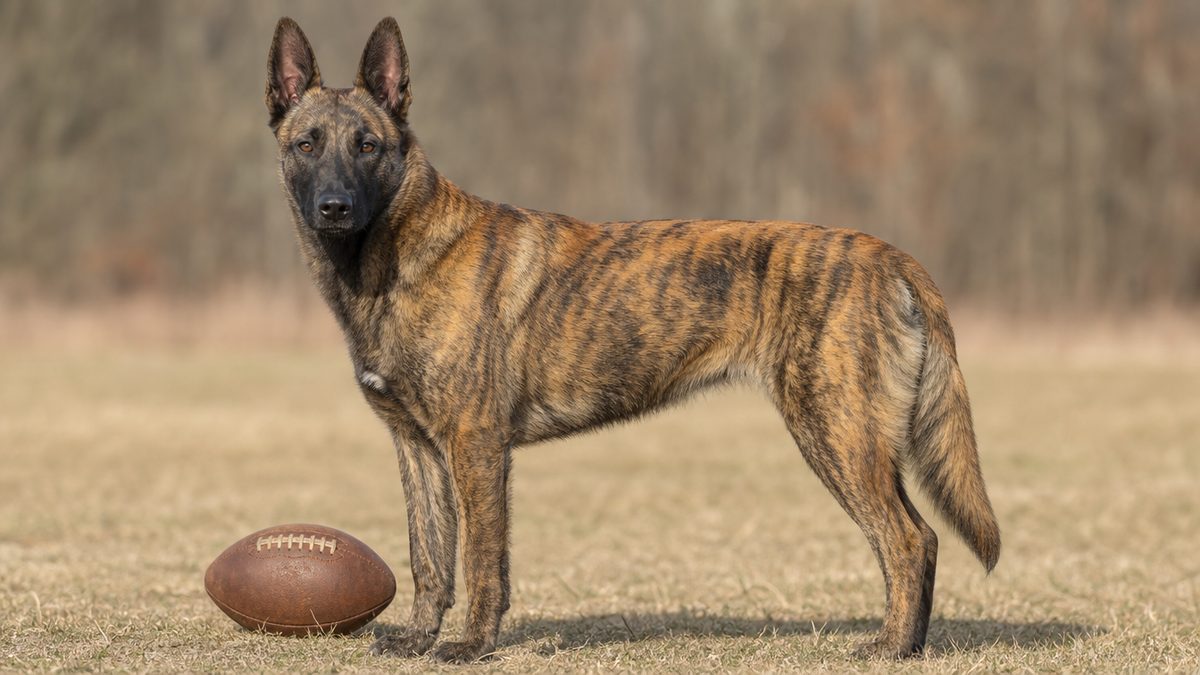
Brindle is the only permitted pattern. The base colour is golden or silver, golden running from light sand to chestnut red, and "the brindle is clearly present all over the body, in the ruff, breeches and tail";. Too much black is undesirable, a black mask is preferable, and heavy white markings on chest or feet are not desirable. That single clause separates the breed from every dog it is confused with, and it is checkable from a photograph before you pay anyone.
History, and why the breed stayed functional
The standard's own history section explains the job. The Dutch Shepherd patrolled the borders of roads and fields to keep flocks off the crops, accompanied flocks to common meadows, markets and ports, kept hens out of the kitchen garden, herded cows for milking and pulled milk carts. Around 1900 the sheep flocks largely disappeared, and rather than being retired the dog moved into dog training, which was then becoming popular, and from there into police work, search and tracking, and guide-dog work. The breed's first standard dates from 12 June 1898.
That transition is the whole reason this breed is interesting. The police dog career arrived while the herding job was still live, so the dog never had a period of unemployment in which a show type could form. The Dutch kennel club still lists it for IPO, tracking, obedience, rescue work, assistance work, agility, flyball, canicross and dogdance, and calls it one of the nine Dutch dog breeds and one of the country's authentic farm-animal breeds.
Three coats, one breed: what the varieties actually mean
The short-haired, long-haired and wire-haired Dutch Shepherds are three varieties of one breed under one standard, not three breeds, and they share one set of size figures. The FCI lists all three under number 223 with a CACIB available to each, which is the registry's way of saying they compete as one breed in three coats.
Read the standard's coat clause and the difference is entirely hair. The short coat is "all over the body, quite hard, close-fitting, not too short coat with woolly undercoat", with ruff, breeches and tail plume clearly visible. The long coat is "long, straight, well fitting, harsh to the touch, without curls or waves and with a woolly undercoat", with feathering on the backs of the forelegs and no fringes at the ears. The wire coat is a "dense, harsh tousled coat and a woolly, dense undercoat all over the body except for the head", with whiskers, beard and two well-defined coarse eyebrows.
Note what all three share: a woolly undercoat. That is the sentence Indian pages skip when they call this a short-coated, heat-tolerant breed. Even the short-haired variety carries insulation under a close-fitting top coat, and no variety is a single-coated dog.
The FCI nomenclature page lists the third variety as "c) Rough-haired" while the standard text calls the same coat "Wire hair" throughout. Both refer to the same dog. Dutch sources use ruwhaar, the AKC uses rough-hair, and older English writing uses wire-haired. If a seller tells you rough-haired and wire-haired are different varieties, they are wrong.
Where the varieties genuinely diverge
The divergence is not in the standard, it is in the breeding populations. A genome-wide study of the breed in the Netherlands used SNP testing and found "genetic isolation and reduced genetic diversity within coat variety subgroups" of the Dutch Shepherd, describing the breed as an example of a population with a small effective size. Its sample gives a sense of scale: parent populations of 13 short-haired, 28 long-haired and 13 wire-haired dogs for the relationship analysis, and 18 short-haired, 46 long-haired and 16 wire-haired for the diversity analysis, plus 25 dogs from long-by-short variety crosses.
The two Dutch breed clubs put numbers on the same problem. Working from puppies born per variety over the past twenty-two years and an assumed average life of eleven years, they estimate that at the end of 2024 the Netherlands held about 1,800 short-haired, 450 long-haired and 380 wire-haired Dutch Shepherds. The Stichting Zeldzame Huisdieren, the Dutch rare-breeds foundation, had already classed all three varieties as endangered in 2009, with the long and the wire coats worst placed.
| Variety | Dutch name | Estimated population in the Netherlands | Trend the clubs report |
|---|---|---|---|
| Short-haired | Korthaar | About 1,800 | The largest share, and genetically dominant for the breed as a whole |
| Long-haired | Langhaar | About 450 | Falling, because fewer litters are born each year |
| Wire-haired | Ruwhaar | About 380 | Falling, and the smallest of the three |
The twenty-year plan the ranking pages do not mention
On 27 November 2025 the Nederlandse Herdershonden Club and the Vereniging voor de Hollandse Herder published Plan van Aanpak 2.0, a variety-crossing programme that came into force on 22 January 2026 and is expected to run fifteen to twenty years. It permits long-haired crossed to short-haired and wire-haired crossed to short-haired, in either direction, and it does not permit long crossed to wire. Offspring are registered in the main Dutch studbook by phenotype, with one exception: if either parent is wire-haired, every pup in the litter is registered as wire-haired.
The plan is built on a 2022 population analysis by Pieter Oliehoek and Jack Windig, whose conclusions the clubs published to their members on 22 October 2022. Two of those conclusions are worth quoting for an Indian buyer, because they cut against the instinct to cross everything. Mean kinship is the most effective long-term measure. And a variety cross that uses only short-haired dogs will raise genetic diversity inside the long and wire populations while lowering it across the breed as a whole, because the short-haired variety dominates the breed genetically, so all three varieties eventually become relatives of each other.
The club that publishes the plan is worth naming, because it is older than most of the registries that quote it. The Nederlandse Herdershonden Club describes itself as the breed association for the short-haired, long-haired and wire-haired Dutch Shepherds, founded in 1898 and therefore one of the oldest breed clubs in the Netherlands. It is a Raad van Beheer recognised association and represents all three varieties, which is the institutional version of the point this section is making.
For a buyer in Chennai or Pune the practical consequence is small but real. A pedigree issued after January 2026 may carry a short-haired grandparent behind a wire-haired dog, entirely legitimately, and a wire-haired registration does not guarantee a wire-haired-looking puppy in every case. Ask which variety the litter is registered as and which the parents are, because those two answers can differ.
Registry status: FCI, AKC, and what the KCI can tell you
The Dutch Shepherd is fully recognised by the FCI as standard 223 on a definitive basis, sits in the AKC's Miscellaneous Class rather than its full roster, and can be registered in India because India is an FCI full member. Those three facts answer almost every recognition question an Indian buyer asks, and the third one is the one that gets misreported.
| Registry | Status | Date | Notes |
|---|---|---|---|
| FCI | Recognised on a definitive basis | 5 November 1955 | Standard 223, Group 1 Section 1, with working trial |
| FCI, current standard | Valid official standard published | 21 December 2019 | English text issued 9 January 2020 |
| Raad van Beheer, Netherlands | One of the nine Dutch dog breeds | Current | Three variety pages, two recognised breed clubs |
| AKC | Foundation Stock Service | April 2012 | Recorded, not fully recognised |
| AKC | Miscellaneous Class | 1 January 2017 | Approved to compete; Herding Group designation assigned |
| AKC parent club | American Dutch Shepherd Association | January 2016 | Recognised as parent club |
| United Kennel Club | Recognised | 1 January 1995 | Reported by a breed database, not checked at source |
Why FCI status answers the India question
India is listed as a member in the FCI's own members and contract partners register, under Asia, Africa and Oceania. The Netherlands and Norway appear on the same register under Europe. Because the Kennel Club of India issues pedigrees against FCI nomenclature, a breed that the FCI recognises definitively is a breed the KCI can register. That is why sellers can honestly advertise a KCI-registered Dutch Shepherd, and it is also why a KCI paper on its own tells you about parentage rather than about health.
The Kennel Club of India's website at kennelclubofindia.org publishes registration forms, a tariff sheet effective 1 April 2024, judge contracts and show applications, and no breed list at all. A search there returns nothing for the Dutch Shepherd and nothing for the Labrador Retriever either. Anyone who tells you the KCI does not recognise this breed because it is absent from the site has read an empty page as evidence.
The AKC position, stated precisely
The AKC records the Dutch Shepherd in its Foundation Stock Service, where it has sat since April 2012, and has allowed it to compete in the Miscellaneous Class since 1 January 2017. It carries a Herding Group designation and the American Dutch Shepherd Association has been the AKC parent club since January 2016. So the breed is on the AKC's books and is not among its fully recognised breeds, and a US-sourced pedigree will say so.
The AKC also publishes registration colour codes that are worth reading against the standard: Gold Brindle 485, Silver Brindle 303 and Yellow 232. Gold and silver brindle match FCI-Standard 223 exactly. Yellow does not appear in the standard at all, which is a small reminder that a registration code is an administrative label rather than a description of a correct dog.
What the registries say about health screening
The AKC's national breed club guidance is unusually specific, and it splits by coat. "Breeders should screen for hip dysplasia in all coat types. The long-haired types should also be screened for thyroid issues, and the rough-haired for goniodysplasia";. The Dutch position differs slightly and is worth setting beside it, because the two registries do not require the same tests.
| Variety | Raad van Beheer, via the breed clubs | AKC national breed club guidance |
|---|---|---|
| Short-haired | VVHH requires hip dysplasia testing; NHC requires goniodysplasia testing | Hip evaluation |
| Long-haired | Club breeding regulations apply; see the club | Hip evaluation plus thyroid |
| Wire-haired | Goniodysplasia required by the club regulations, plus hip dysplasia for VVHH | Hip evaluation plus goniodysplasia |
| All varieties, for a variety cross | Hip dysplasia and elbow dysplasia, as protocolled Raad van Beheer examinations | Not applicable |
The Raad van Beheer added a further layer in 2026. Its breed pages state that breeding norms for this breed were published on 1 July 2026 and that from 1 October 2026 the Raad van Beheer checks at mating registration whether they have been met, with pedigrees issued only if they have. The norms themselves are published as an image on those pages rather than as text, so Bonbeno could read the file name, which is hd-ed, but not the table's contents. That limit is stated here rather than guessed at.
One consequence follows for anyone importing from the Netherlands after October 2026. A Dutch pedigree issued from that date carries an implicit statement that the parents met the published breeding norms, which is a stronger document than a pedigree alone. Ask for the mating registration date, not just the pedigree. Two Dutch breed clubs sit behind those norms, the Nederlandse Herdershonden Club and the Vereniging voor de Hollandse Herder, and each maintains its own breeding regulations.
One further Dutch safeguard is worth knowing because India has no equivalent. Since June 2014 a DNA parentage test is required for all breeds before Dutch pedigree papers are issued, so an FCI pedigree from the Netherlands gives certainty about a puppy's parentage rather than a breeder's word for it.
Importing a Dutch Shepherd into India, and the route that is actually open
Only three lawful purposes allow a dog to enter India at all, and buying a working-line Dutch Shepherd from a Dutch breeder is not one of them. DGFT Trade Notice No. 22/2022-23, dated 19 December 2022, sets the rules, and reading it settles most of what Indian sellers imply about imported bloodlines.
The notice places live mammals under ITC(HS) 01061900 as Restricted, subject to Policy Condition 6 of that chapter. Policy Condition 7 then allows the import of dogs only for three named purposes, quoted here in full because the wording matters: "i. Pet dog with valid pet book and relevant records/documents in the name of importer. ii. Dogs imported by the R&D Organisations for conducting research with the recommendation of CPCSEA. iii. For the internal security by the Defence and Police Force."
Policy Condition 8 closes the commercial door outright: "Import of commercial dogs for breeding or any other commercial activities other than the purposes mentioned above is not permitted";. Paragraph 6 of the same notice states that "any applications for trading/breeding purposes, or applications made on behalf of some another person/ entity shall be duly rejected".
| Situation | What the notice says |
|---|---|
| Up to two pets, permanent import | Allowed as passenger baggage without DGFT authorisation only for a person transferring residence to India after two years of continuous stay abroad |
| More than two pets | Import authorisation from DGFT is required, with justification submitted to DAH&D |
| Temporary import | Import authorisation from DGFT is required |
| Buying a puppy abroad to bring home | Not covered by the baggage route; commercial import for breeding or trade is not permitted |
| Ports | Airports and seaports of Delhi, Mumbai, Chennai, Hyderabad, Bangalore and Kolkata; DAHD added Kochi for pets arriving under the baggage rules in October 2024 |
| Advance NOC | From the Regional Officer or Quarantine Officer at those ports, seven days before travel, relaxable to three |
Policy Condition 7(iii) names internal security by the Defence and Police Force as one of only three lawful import purposes. That is the clause under which a working Dutch Shepherd legitimately enters India, and it explains why the breed's clearest Indian footprint is a government procurement listing rather than a retail pet shop. A private buyer cannot use that route, so a seller offering an imported working-line puppy should be asked which of the three conditions their dog came in under, and for the paperwork that proves it.
What this means for the Indian market you can actually see
Two things follow. Genuine imported stock is scarcer than the listings suggest, because the only open private channel is a returning resident bringing up to two pets as baggage after two years abroad. And an Indian-bred dog is the normal case rather than the compromise, which is exactly what the government marketplace listing shows: country of origin India, local content 100 percent, sourced from established police or military working dog centres in India.
That reframes the phrase "champion bloodline, imported parents" that Indian listing sites attach to their highest price tier. Imported parents are possible, through a returning resident or through a police programme, and they are not a routine commercial supply line. Ask for the import authorisation or the pet book that names the importer.
The two import routes, kept separate
A separate Indian instrument, S.O. 4396(E) of 10 October 2024, permits pet dogs and cats through Cochin International Airport, Kochi, under the Livestock Importation Act, 1898. That runs on different legislation from the DGFT notice, which still names six ports for its own licence route, so the six ports in the table above are quoted from Trade Notice 22/2022-23 as it reads, and a pet arriving under the baggage rules can also land at Kochi, the seventh port. Both lists are right for their own route, as how to import a dog to India sets out.
Dutch Shepherd price in India, and why the published bands disagree
Indian asking prices for a Dutch Shepherd run from Rs 60,000 to more than Rs 5,00,000, a spread of about 8.3 times for one breed, and no source reconciles them. Bonbeno found six published bands, tested every figure against four exchange rates, and is publishing the disagreement rather than an average, because an average of six unreconciled numbers is not a market rate.
| Source | Band or figure | What it claims to describe |
|---|---|---|
| Tiny Little Paws, on Medium | Rs 60,000 to Rs 85,000 | Price by pedigree |
| Tails and Wings, Mumbai page | Rs 70,000 to Rs 1,50,000 | Current price range for Mumbai, 2026 |
| Government e Marketplace, PDC India | Rs 1,30,000 offer against Rs 1,60,000 MRP | A male pup, 8 to 16 weeks, for police procurement |
| Mr n Mrs Pet, basic quality | Rs 1,20,000 to Rs 2,00,000 | Pet quality, no show or breeding rights |
| Mr n Mrs Pet, KCI registered | Rs 2,00,000 to Rs 3,50,000 | KCI certification and verified lineage |
| Mr n Mrs Pet, champion bloodline | Rs 3,50,000 to Rs 5,00,000 | Imported or award-winning parents |
Look at the shape of the disagreement before the numbers. The cheapest published band tops out at Rs 85,000, which is below where the most expensive source even starts, and the whole of the Tiny Little Paws band sits under the bottom of the Mr n Mrs Pet basic tier. A KCI registered puppy is priced at Rs 2,00,000 to Rs 3,50,000 on one national site, while the government marketplace sells a police-quality pup of the same breed for Rs 1,30,000. Nothing on either page explains the gap.
Divide before you believe: the exchange-rate test
Indian pages routinely publish a US dollar figure with a rupee sign in front of it, so every rupee number on this page was divided by four rates that this site has caught before. The result is unusual and it is worth stating precisely.
| Rupee figure | at 84.38 | at 80.00 | at 74.00 | at 66.67 |
|---|---|---|---|---|
| Rs 60,000 | 711.07 | 750.00 star | 810.81 | 899.96 |
| Rs 65,000 | 770.32 | 812.50 | 878.38 | 974.95 |
| Rs 70,000 | 829.58 | 875.00 star | 945.95 | 1,049.95 |
| Rs 85,000 | 1,007.35 | 1,062.50 | 1,148.65 | 1,274.94 |
| Rs 1,20,000 | 1,422.14 | 1,500.00 star | 1,621.62 | 1,799.91 |
| Rs 1,30,000 | 1,540.65 | 1,625.00 star | 1,756.76 | 1,949.90 |
| Rs 1,50,000 | 1,777.67 | 1,875.00 star | 2,027.03 | 2,249.89 |
| Rs 1,60,000 | 1,896.18 | 2,000.00 star | 2,162.16 | 2,399.88 |
| Rs 3,50,000 | 4,147.90 | 4,375.00 star | 4,729.73 | 5,249.74 |
| Rs 5,00,000 | 5,925.57 | 6,250.00 star | 6,756.76 | 7,499.63 |
Zero of the fifteen figures divide cleanly at 84.38, and zero divide cleanly at 74. Ten divide cleanly at a flat 80, and that proves nothing at all, because 1,000 divided by 80 is 12.5, so any rupee figure ending in three zeros passes the 80 test by construction. Read the quotients instead. They include 4,375, 6,250, 1,625, 1,062.50 and 875 dollars, and no seller anywhere prices a dog at $6,250. So these are rupee-native, arbitrary numbers rather than a converted American price list.
Where the dollars do appear, undisguised
One source removes all doubt. A Medium article ranking in India for this term writes that "Puppies can cost between 1,000 and 2,500, while trained adults can cost between 2,500 and 20,000", with no currency named, immediately before giving an Indian band of 60,000 to 85,000. A US breed database publishes the identical band with the currency intact: "Average $1000 - $2500 USD... Puppies can range from $1000 to $2500 Trained adults can range from $2,500 to $20,000";. That is an American price band reprinted in an Indian article with the dollar signs stripped off.
The page ranking first in India for this term shows an empty Dutch Shepherd availability block and eight other puppies beneath it: two Maltipoos, two Poodles, a Cane Corso, a Goldendoodle, a Rottweiler and a Doxiepoo, priced from Rs 76,499 to Rs 1,20,000, three of them at exactly Rs 98,999. None is a Dutch Shepherd. Rs 98,999 is that site's house price point, not this breed's price, and Bonbeno has now recorded it on eleven of its pages.
The one Indian figure with a document behind it
The Government e Marketplace, India's public procurement portal, carries a live Dutch Shepherd listing from Police Dog Centre India with an offer price of Rs 1,30,000 against an MRP of Rs 1,60,000, a 19 percent saving, three in stock and a minimum order of two per consignee. Its specification block reads: type of breed of dogs, Dutch Shepherd; category of dog, pups; gender, male; age, 8 to 16 weeks; country of origin, India; local content 100 percent; source of purchase by seller, established police or military working dog centres in India.
That listing is the most verify-able Indian price on this page, because it is a government catalogue entry with a product id, a stated origin and a stated age band. It also complies with Rule 8(1)(a) of the 2017 Rules, which requires that "pups less than eight weeks in age are not sold". It is worth noting that Brave Search's index showed ten in stock while the live page showed three, so even here the number moves and the live page is the one to read.
None of this is a recommendation to buy at any price, and Bonbeno does not broker sales. The useful conclusion for a buyer is narrower: when you are quoted a puppy price, ask which of these six bands it sits in and why, and treat any seller who cannot answer as pricing by instinct.
Monthly cost of ownership in India, honestly bounded
No Indian cost-of-ownership study exists for the Dutch Shepherd, so this section builds the cost structure from the breed's documented requirements rather than quoting a figure nobody measured. The one Indian number in circulation, Rs 8,000 to Rs 10,000 a month, appears in a paragraph that also compares this dog to "Standard ones", which is leftover Poodle copy.
Say the limit first. Bonbeno could locate no survey, no veterinary cost study and no insurer dataset covering Dutch Shepherd upkeep in India. What exists is one listing site's answer to its own question, "How much does it cost to maintain a Dutch shepherd in India monthly?", which states Rs 8,000 to Rs 10,000 covering quality food, grooming, vet visits and routine care, and then adds that "Dutch shepherds typically cost less to maintain than Standard ones". Standard, Miniature and Toy are Poodle sizes. A sentence that survived from another breed's template is not a costing.
What the breed's own documents force you to spend on
- Food for a 23 to 28 kg working-built dog, at the Dutch kennel club's stated adult weights, fed to a working energy level rather than a companion one.
- Tick and flea control every month, because an outdoor-worked dog in India is exposed year round rather than seasonally.
- Hip and elbow radiographs once, if you intend to breed or simply want to know, priced as a sedated orthopaedic radiograph rather than a routine x-ray.
- An eye examination for a wire-haired dog, because goniodysplasia is the condition the Dutch clubs actually discuss in this variety.
- Hand-plucking twice a year for the wire coat, which is a specialist service, and daily combing during the moult for the other two.
The grooming line is the one Indian buyers underestimate, and it is variety-specific. FCI-Standard 223 states that "The wire hair coat should be hand-plucked on average twice a year";. The AKC gives the same instruction as "the coat is hand-stripped twice per year" and adds that the short-haired types need only occasional brushing while the long-haired should be combed about once a week. Hand-stripping is not a service most Indian salons offer, and clipping a wire coat instead permanently changes its texture.
A national Indian listing site answers its own grooming question with: "Dutch shepherd have dense, curly coats that need trimming every 4-6 weeks to prevent matting." No Dutch Shepherd variety has a curly coat. The FCI standard specifies the long coat as "without curls or waves", and prescribes hand-plucking twice a year for the wire coat rather than clipping every month. Budgeting for a monthly salon appointment on that advice would cost an owner roughly ten unnecessary visits a year.
The costs that scale with the climate rather than the breed
Two Indian cost lines have nothing to do with the Dutch Shepherd and everything to do with where you keep it. The first is cooling: a working dog exercised in an Indian city needs shaded rest, constant water and, in most of the plains, indoor access during the afternoon. The second is the cost of a heat emergency. In the UK VetCompass cohort, exertional heat-related illness carried a 7.6 percent fatality rate and occurred year round, and an Indian summer compresses the same risk into a narrower daily window rather than removing it.
How to build your own number in ten minutes
- Weigh the plan, not the dog: take the Raad van Beheer's about 28 kg for a male and about 23 kg for a female as your feeding basis rather than an aggregator's 19 to 34 kg span.
- Price three local foods at that daily quantity and take the middle one.
- Add twelve months of tick and flea control at your own vet's rate, not a national average.
- Add one annual vaccination and one dental check, plus a contingency of one emergency consultation.
- Add the grooming line for your variety: near zero for short, a weekly comb for long, two hand-plucking sessions for wire.
That method produces a number you can defend to yourself, which is more than any published Indian figure for this breed can do. It also makes the expensive part visible early: for a working-built shepherd in an Indian city, the recurring cost is food and parasite control, and the unpredictable cost is a single heat or orthopaedic event.
One more honest note on the purchase side. The government marketplace listing for a police-quality Dutch Shepherd pup sets a minimum order of two per consignee, which tells you it is a procurement channel for institutions rather than a route for a household. A private buyer's cost structure is therefore the retail one, with all the price disagreement that section already described.
Heat tolerance in India, measured against the breed's homeland
The Dutch Shepherd is not a heat-adapted breed, and the honest way to show that is wet-bulb temperature rather than air temperature, because wet-bulb is what limits a panting dog. Chennai's coolest month runs 5.8 degrees C hotter on wet-bulb than the hottest month in the breed's Dutch homeland, and its warmest month runs 11.3 degrees C hotter.
Air temperature alone misleads in India. A dog cools by evaporating water from its airways, and evaporation stalls as humidity rises, so a 33 degree day in Kochi is harder on a dog than a 38 degree day in Jaisalmer. Wet-bulb temperature combines both into one figure, which is why this page uses it. All figures below come from NASA POWER's twenty-year climatology for January 2001 to December 2020, queried by explicit latitude and longitude so no place name can be substituted.
| Place | Annual mean wet-bulb | Warmest month wet-bulb | Coolest month wet-bulb | Annual mean air temp |
|---|---|---|---|---|
| Utrecht, Netherlands | 8.8 | 16.0 in July | 2.1 in January | 10.3 |
| Bengaluru | 19.8 | 22.7 in May | 16.4 in January | 23.7 |
| Pune | 19.7 | 23.6 in June | 14.3 in January | 23.9 |
| Guwahati | 20.5 | 26.2 in July | 12.3 in January | 22.9 |
| Mumbai | 22.7 | 26.6 in June | 17.1 in January | 26.8 |
| Kolkata | 22.9 | 27.9 in June | 13.6 in January | 25.8 |
| Delhi | 18.0 | 27.7 in July | 6.9 in January | 25.6 |
| Chennai | 24.9 | 27.4 in May | 21.8 in January | 28.0 |
Read the Chennai row against the Utrecht row and the argument closes itself. Chennai's coolest month, January, sits at 21.8 degrees wet-bulb, which is 5.8 degrees above Utrecht's hottest month at 16.0. Chennai in May reaches 27.4, which is 11.3 degrees above the warmest thing this breed's ancestors ever met. There is no month in Chennai that is as easy on a Dutch Shepherd as an average Dutch July.
An Indian breed roundup states that the Whippet, Italian Greyhound, Weimaraner, Belgian Malinois and Dutch Shepherd "are short-coated and heat-tolerant enough for most of India when provided shade, hydration, and indoor access during peak heat". Two problems. The Dutch Shepherd is not simply short-coated: FCI-Standard 223 gives all three varieties a woolly undercoat, and two of the three varieties are not short at all. And the conditions attached to that sentence, shade, hydration and indoor access during peak heat, are doing most of the work in it.
What the best available heat study can and cannot tell you
The strongest dataset on canine heat illness is the UK VetCompass study of 905,543 dogs under primary veterinary care at 886 clinics in 2016, which identified 1,259 heat-related illness events in 1,222 dogs. Of those events, 380 had no trigger recorded, leaving 879 events with a recorded trigger. Among those 879, exertional heat illness accounted for 652 events, or 74.2 percent, followed by environmental at 113 events, or 12.9 percent, and vehicular confinement at 46 events, or 5.2 percent.
Say the denominator carefully, because it is the most misquoted statistic in this subject. The 74.2 percent is 652 of the 879 events that had a recorded trigger. It is not 74.2 percent of 1,259, which would be 934 events, a number that appears nowhere in the paper.
Why the study's breed odds do not transfer to this dog
The word "Dutch" appears nowhere in that paper's breed analysis, so the Dutch Shepherd was not modelled and no breed-specific odds ratio exists for it. What does transfer is the category. The paper reports that the Labrador Retriever had twice the odds of exertional heat illness compared with non-designer crossbred dogs, as did Boxer, Golden Retriever, Border Collie, Pug, and "other purebred", the last defined as breeds with relatively low numbers in the population or fewer than five confirmed cases. A UK Dutch Shepherd would have fallen into that last group.
One nearby figure is genuinely reassuring and should be quoted as what it is. "German Shepherd Dogs showed just one-third of the odds for exertional HRI compared to the Labrador Retriever in the current study";. That is the closest modelled shepherd, and it suggests upright-eared, moderate-muzzled herding types are not the high-risk group. It is still a different breed, and borrowing it as though it were a Dutch Shepherd finding would be exactly the error this page warns about elsewhere.
City by city, what it means in practice
- Bengaluru and Pune are the workable cities, at 19.8 and 19.7 degrees annual mean wet-bulb, with peaks under 24. A conditioned dog can work most mornings for most of the year.
- Delhi is a split problem, at 18.0 annual mean but 27.7 in July. Its dry May is survivable with water and shade; its monsoon July is not a month for hard work at any hour.
- Mumbai, Kolkata and Guwahati punish the monsoon, at 26.6, 27.9 and 26.2 degrees wet-bulb in their worst months, when evaporative cooling barely functions.
- Chennai has no easy season, at 21.8 degrees wet-bulb even in January, and any real conditioning work belongs before 07:00 year round.
The practical rule that follows is simple and it is the same in every one of those cities. Do the dog's real exercise before sunrise, carry water, stop at the first sign of a widened tongue and a slowing pace, and treat the afternoon as rest rather than as a shortened walk. A heat-sensitive working dog in India is not a dog you cannot own; it is a dog whose day starts earlier than yours would like.
Temperament and household fit: who should and should not buy one
Buy a Dutch Shepherd only if you can give it a daily job, because the FCI standard describes a dog that deals independently with any task assigned to it, and a dog that assigns itself tasks in an Indian flat is a destructive dog. The breed suits a working handler, a sport competitor or a rural household with land, and suits almost nobody else.
The standard's temperament clause is short and it is the whole brief. "Very loyal and reliable, always alert, watchful, active, independent, with persistence, intelligence, prepared to be obedient and gifted with the true shepherding temperament. The Dutch Shepherd Dog works willingly together with its owner and he deals independently with any task which is assigned to him";. It closes by noting that when herding larger flocks the dog must be able to work alongside several other dogs.
Three words in that clause do the damage in Indian homes: alert, watchful and independent. Sellers translate them into loyal, protective and smart, which sounds like a family dog. The registry means a dog that notices everything, decides on its own what to do about it, and keeps doing that whether or not you are involved.
What the Dutch registry says the dog is for
The Raad van Beheer's breed pages list the Dutch Shepherd's modern uses in one sentence: sheep herding, plus training disciplines such as IPO, tracking, obedience training, rescue work and assistance work, plus sports including agility, flyball, canicross and dogdance. It calls the dog versatile and says it works gladly with its owner and carries out assigned tasks independently. That list is a set of jobs, not a set of hobbies, and a household that will do none of them is buying the wrong breed.
| Household | Fit | Why |
|---|---|---|
| Working handler, police, security or sport | Strong | The FCI entry carries a working trial and the breed never split into a show type |
| Farmhouse or plot with secure fencing | Strong | Space plus a real perimeter suits a patrolling herder |
| Active family with an adult who trains daily | Workable | Needs one committed handler, not shared good intentions |
| Urban flat, owner out ten hours | Poor | An alert, independent dog with no job invents one |
| First dog, small children, no training experience | Poor | An Indian breed roundup names this breed among those requiring caution around young children |
The Indian first-dog question, answered plainly
An Indian breed roundup that is generally positive about the breed is blunt on this point. It lists breeds to strictly avoid as a first dog and names the Belgian Malinois and Dutch Shepherd among them as "high-drive working dogs that become destructive or reactive without experienced handling";. The same page names both breeds again under breeds requiring caution around young children, and again under breeds where early socialisation is non-negotiable.
Set that beside how the dog is being sold. A national Indian listing site describes the breed as "ideal for experienced pet parents" in one paragraph and, in its own FAQ, recommends buying rather than adopting for "families, therapy use, or allergy concerns" while its own specification table prints hypoallergenic: no Mr n Mrs Pet, Dutch shepherd Puppies…. A page that contradicts itself inside a thousand words is not a guide to household fit.
Everything sellers say about this breed is true and incomplete. It is intelligent, trainable, loyal, athletic and striking. It is also a dog whose own kennel club lists it for tracking, rescue and protection work, whose standard says it acts independently, and which the Indian market is selling to households that will do none of that. Both halves are the breed. Buy the second half too, or do not buy.
With other animals, and on an Indian street
The breed is described as sociable and able to work alongside other dogs, which is a real advantage in a country where a walk means passing free-roaming community dogs several times. It is not the same as low prey drive. A herding dog is built to react to movement, and Indian streets supply moving cats, chickens, cattle and bicycles at close range. Long-line work before off-lead freedom is the sane sequence, and an unfenced compound is not containment.
The final household test is a question rather than a trait. Ask yourself what this dog will be doing at 16:00 on a Wednesday in May. If the honest answer is lying on a floor waiting for you, choose another breed, and if the honest answer is a scent game, a mat exercise or a training session in the shade, this dog will be extraordinary.
Training a Dutch Shepherd, and what this breed resists
Train a Dutch Shepherd by giving it decisions to make, because the standard describes a dog that is prepared to be obedient and that also deals independently with any task assigned to it. It resists repetition without purpose, and it resists a handler who is inconsistent, far more than it resists difficulty.
Start from what the registries claim. The Raad van Beheer says the breed's versatility makes it suitable for training disciplines including IPO, tracking, obedience training and rescue work, alongside agility, flyball, canicross and dogdance. The FCI attaches a working trial to the breed's own nomenclature entry, which means a championship title in FCI countries requires proven work, not conformation alone. Very few breeds carry that condition, and it is the clearest institutional statement that this dog is expected to do something.
The eight-week to fourteen-week window, which is not optional
The socialisation window for a puppy runs roughly from three to fourteen weeks of age, and an Indian breed roundup names the Dutch Shepherd among the breeds for which early exposure during that period is non-negotiable, because herding, guarding and territorial responses become problematic if they are not shaped early. An Indian puppy typically comes home at eight weeks under Rule 8(1)(a), which requires that "pups less than eight weeks in age are not sold";, so a buyer controls only the last six weeks of that window. Plan them before the puppy arrives.
- Expose the puppy to surfaces, sounds and traffic in short sessions, in the cool hours, before full vaccination allows ground contact in busy places.
- Introduce calm adult dogs individually rather than letting a puppy meet a street group.
- Handle ears, feet and mouth daily, because a wire-haired dog will be hand-plucked and every variety will be examined.
- Pair the crate and the mat with food from day one, so that rest is a trained behaviour rather than an imposed one.
- Practise recall on a long line from week nine, not from month nine, because a herding dog's default is to go and check something.
What works with this breed
Short, frequent sessions with a clear job beat long drills. One Indian article gets this right almost by accident when it advises holding brief daily training sessions at the same time so the dog develops a routine, and warns that even an intelligent dog may take several weeks to acquire a new skill. The advice is sound; the article's problem is that most of its other paragraphs are about German Shepherds.
Scentwork suits this breed particularly well in India, and for a climate reason rather than a temperament one. A tracking or search game tires a working shepherd far faster than the equivalent minutes of running, and it can be run indoors at 15:00 in May when a walk cannot. That is the single most useful adaptation an Indian owner can make.
Five minutes of obedience and ten minutes of scentwork indoors, twice a day, plus one real outdoor session before 07:00, will hold a Dutch Shepherd together through a Chennai May far better than a single long evening walk. The dog needs decisions, not distance, and decisions are available in an air-conditioned corridor.
What this breed resists
- Repetition with no outcome. A dog bred to patrol a field boundary all day does not object to work; it objects to work that goes nowhere.
- Inconsistent rules between household members. The standard's word is persistence, and it applies to testing rules as much as to working.
- Heavy-handed correction. The breed is sensitive to its handler's state, and pressure produces avoidance rather than compliance.
- Being left to decide alone for hours. An independent dog with no assignment will assign itself the gate, the doorbell and the neighbours.
One caution about working line dogs specifically. Indian buyers increasingly seek out KNPV-line Dutch Shepherds, the Dutch police-sport lines, because the reputation is compelling. Those lines are selected for drive and hardness in a country with a dense professional handler network. An Indian household without a decoy, a club and a trainer is buying an engine with no gearbox, and the honest advice is to buy a dog bred for the work you will actually do.
The last point is the one that decides outcomes. This breed is trainable to a degree that flatters an average handler for about six months and then requires a real one. Book the trainer before the puppy, not after the first problem.
Daily exercise needs, and what happens without them
A Dutch Shepherd needs roughly an hour to ninety minutes of real work a day, split rather than delivered in one block, and in India that hour has to move to before sunrise for most of the year. Without it the breed does not become lazy; it becomes destructive, reactive and hard to walk.
Published figures cluster tightly for once. A US breed database describes a dog that must be walked or jogged daily and run through a regular drill at least twice a week, and calls it a good jogging companion. An Indian listing site's specification card gives an exercise routine of 90 minutes per day and an energy level of very high. A Medium guide recommends allocating at least one hour a day and suggests splitting it between family members. One hour as a floor and ninety minutes as a working target is a fair reading of all three.
Why the standard's gait clause matters here
FCI-Standard 223 calls the dog "a trotter with free, smooth and supple movement, without exaggerated drive or stride", and sets the body-to-height ratio at about 10:9 "as suits a trotting dog";. A trotting breed is built for duration at a moderate pace, not for sprints. That has a direct Indian consequence: this dog wants forty minutes of steady movement, which is exactly the kind of session heat makes impossible after about 08:00 in most of the country.
| Day slot | Activity | Why it fits |
|---|---|---|
| 05:30 to 06:30, daily | Steady lead walk or trot on soft ground | The only window in most Indian cities where wet-bulb is survivable for sustained work |
| Mid-morning, 10 minutes | Obedience or trick session indoors | Mental load with no thermal cost |
| Afternoon, 15 minutes | Scentwork or food-search indoors | Replaces the walk you cannot take in May |
| Evening, 20 to 30 minutes | Second walk once surfaces have cooled | Check tarmac with the back of your hand first |
| Twice a week | A structured drill: recall chains, directed retrieves, tracking | The regular drill the breed literature specifically calls for |
Surfaces, and a check that costs five seconds
Indian tarmac holds heat long after the air has cooled, and pads burn before an owner notices. Press the back of your hand to the road for five seconds before an evening walk; if you cannot hold it there, the dog cannot walk on it. Grass, packed earth and shaded paving are all better, and a herding breed with a muscular build and hard pads is still working on skin.
In the UK VetCompass cohort, exertional heat-related illness accounted for 652 of the 879 events with a recorded trigger, or 74.2 percent, against 113 environmental events and 46 from vehicular confinement. Exertional events occurred year round and carried a 7.6 percent fatality rate. The dog that gets into trouble in India is usually the fit one being worked, not the one lying in a hot room.
What under-exercise looks like in an Indian flat
- Patrolling the balcony and reacting to every passing scooter and delivery rider.
- Redirecting onto furniture, skirting boards and door frames within the first six months.
- Escalating at the gate, because guarding is the only job on offer and the dog takes it.
- Refusing to settle indoors, which owners read as anxiety and treat with more walking rather than more thinking.
The fix is rarely more distance. A dog that has trotted five kilometres and solved nothing arrives home fitter and no calmer, which is why owners of working breeds describe a treadmill effect where the dog needs more every month. Scentwork, shaping sessions and food puzzles break that cycle, and they are the only tools that work at 15:00 in an Indian summer.
One last note for anyone considering a compound rather than a flat. A garden is storage, not exercise. The FCI entry expects work, the Dutch registry lists tracking and rescue disciplines, and a dog left alone in a yard patrols it. If the plan is a compound and no training, the honest answer is that an Indian street dog will be far happier in that home than this breed will.
Grooming and coat care in Indian humidity
Groom a Dutch Shepherd according to its coat variety, because the three varieties need three different routines and Indian pages describe none of them correctly. The short coat needs occasional combing and daily brushing in the moult, the long coat a weekly comb, and the wire coat hand-plucking on average twice a year.
The FCI standard gives the wire coat its own instruction and gives no other variety one: "The wire hair coat should be hand-plucked on average twice a year";. The Raad van Beheer fills in the rest for Dutch owners: coat care is simple, brush occasionally, comb and brush daily during the moult, and the wire coat does not moult but must be plucked on average twice a year. The AKC adds a middle line, combing the long-haired variety about once a week, or more often depending on work and environment.
| Variety | Routine | Moult | Specialist work |
|---|---|---|---|
| Short-haired | Occasional combing or brushing | Daily brushing in spring and autumn | None |
| Long-haired | Comb about once a week, more with work | Daily during the moult | None |
| Wire-haired | Thorough brush weekly | Does not moult in the usual way | Hand-plucked or hand-stripped, on average twice a year |
A national Indian listing site tells buyers that "Dutch shepherd have dense, curly coats that need trimming every 4-6 weeks to prevent matting" and that regular grooming "keeps them cool in Indian weather". The FCI standard specifies the long coat as "without curls or waves" and prescribes hand-plucking twice a year for the wire coat. A monthly clip is not this breed's routine, and clipping a wire coat permanently softens its texture.
The undercoat nobody mentions
Every variety of this breed carries a woolly undercoat by the standard: the short coat has one under a close-fitting top coat, the long coat has one under straight harsh hair, and the wire coat has a woolly dense undercoat all over the body except the head. That single fact governs Indian coat care, because an undercoat that is packed with dead hair traps moisture against the skin, and moisture against skin in 80 percent humidity is how hot spots start.
So the Indian priority is not trimming, it is de-shedding. A rubber curry or an undercoat rake used two or three times a week through the monsoon removes far more risk than any clip, and it costs nothing. Never shave a Dutch Shepherd for the heat: the double coat insulates against heat as well as cold, and a shaved dog is a sunburn risk with worse thermoregulation, not a cooler dog.
Monsoon skin and ears, in order of likelihood
- Dry the dog properly after every wet walk, especially the ruff, the breeches and the area under the collar, because those are the three places an undercoat holds water longest.
- Check the ears weekly. Erect ears ventilate far better than drop ears, which is a real advantage this breed has over most gundogs in an Indian monsoon, but ventilation is not immunity.
- Plug the ears before a bath and dry them afterwards, rather than letting water sit in the canal.
- Inspect between the toes after off-lead work, where grass seeds and mud collect and where the first sign of a problem is licking.
- Treat for ticks monthly, year round, because an outdoor working dog in India has no low season.
Overseas breed guidance for hard-coated dogs routinely says to towel off and let the dog air dry. That is sound in a Dutch autumn, where the air is cool and dry enough to finish the job. It is poor advice in an Indian monsoon, where ambient humidity above 85 percent means air drying simply does not happen and the undercoat stays damp for hours. Dry this breed with a towel and then with air movement, not with patience.
The Dutch national pet information centre gives a counterintuitive instruction that no Indian page carries: combing too much outside the moulting period disturbs hair growth and produces a permanently shedding dog. It also says the wire coat should not be brushed at all, only coarsely combed, and offers stripping four times a year, removing half the old coat each time, as an alternative to plucking twice. Never shave or clip a wire coat, because that destroys the coat structure and leaves it thin and pale.
The allergy question, answered once
No Dutch Shepherd is hypoallergenic, and two of the pages selling this breed in India agree while implying otherwise. One national listing site prints hypoallergenic: no on its specification card and then recommends buying rather than adopting for buyers with "allergy concerns";. A US breed database also prints hypoallergenic: no Dogbreedslist.info, Dutch Shepherd Dog. The evidence behind that answer is settled: Vredegoor and colleagues measured the major dog allergen Can f 1 across 196 dogs of so-called hypoallergenic breeds against 160 control dogs and found the hypoallergenic group higher, at a geometric mean of 2.26 micrograms per gram of hair against 0.77, and 27.04 against 12.98 in coat samples, with no difference in airborne allergen.
Their conclusion is a single sentence and it applies here: "There is no evidence for the classification of certain dog breeds as being 'hypoallergenic.'";. A double-coated brindle shepherd that the Dutch registry says needs daily combing through the moult was never a candidate anyway.
Finding someone who can hand-pluck in India
Hand-stripping is the one genuine grooming problem an Indian wire-haired owner faces. Most Indian salons clip, because clipping is fast and hand-plucking is slow and skilled, and a clipped wire coat loses the harsh texture the standard asks for and grows back softer and paler each time. If you cannot find a groomer who plucks, learn to do it yourself with a stripping stone over several short sessions rather than accepting a clip.
For the other two varieties the honest summary is that this is a low-maintenance breed in India, and that the maintenance it does need is weekly rather than monthly. A short brindle coat sheds visibly onto every surface and needs no professional attention at all, and a brindle dog shows dust and salt marks less than a solid-coloured one, which is a small mercy in a Delhi April.
Health risks and lifespan, with the sample sizes attached
The Dutch Shepherd's measured health record is better than its reputation and thinner than its buyers assume. OFA records 8.6 percent dysplastic hips across 1,141 evaluations, which is well under the German Shepherd Dog's 20.4 percent across 146,690, and the breed's own Dutch clubs state that no health problem has been scientifically established in the breed at all.
Start with the registry, and start with the code rather than a guess. OFA's breed code for this breed is DS, read directly from the checkbox markup on OFA's own advanced-search page, which carries the attribute data-name="DUTCH SHEPHERD" beside value="DS";. Every figure below was then read off rows printed with the breed name DUTCH SHEPHERD on OFA's disease-statistics page, with the Labrador Retriever's 324,743 hip evaluations used as a working control to prove the query was returning real data.
| Test | Evaluations | Normal | Abnormal | Detail |
|---|---|---|---|---|
| Hips | 1,141 | 90.1% | 8.6% dysplastic | 18.8% excellent, 58.6% good, 12.6% fair; 6.0% mild, 2.5% moderate, 0.2% severe |
| Elbows | 1,006 | 92.9% | 6.9% abnormal | Grade 1 5.6%, Grade 2 1.3%, Grade 3 0.0% |
| Eyes | 346 | 93.4% | 6.6% abnormal | Breeder option 0.0% |
| Degenerative myelopathy, DNA | 91 | 84.6% | 6.6% at risk | 8.8% carriers |
| Inflammatory myopathy, DNA | 58 | 100.0% | 0.0% | 58 of the 61 tests OFA holds for this disease are Dutch Shepherds |
The hip figure, and the breed it is not
The single most useful sentence on this page is that the Dutch Shepherd's hip record is not the German Shepherd's. OFA gives the German Shepherd Dog 20.4 percent dysplastic across 146,690 evaluations and the Dutch Shepherd 8.6 percent across 1,141, so the German figure is 2.4 times the Dutch one. The Belgian Malinois sits lower still at 5.0 percent of 6,833. An Indian page that warns about hip dysplasia in this breed by quoting a German Shepherd number is describing a different dog.
Attach the caveat honestly. 1,141 evaluations is a small denominator by OFA standards, the dogs in it are self-selected by owners who chose to screen, and OFA's own live figures drift as submissions arrive. Quote the percentage with the sample size beside it every time, which is why both are printed above.
An internal inconsistency in OFA's own eye data
OFA's eye summary reports 93.4 percent normal across 346 Dutch Shepherd evaluations. Its detail rows, which use a denominator of 345 tested, give "NORMAL (OTHER .000)" as 259 dogs, which is 75.1 percent. Those two cannot both be the proportion of normal eyes: 93.4 percent of 346 is 323 dogs, not 259, a gap of 64 dogs. The two rows are measuring different things or one of them is wrong, and neither should be quoted alone as "the" normal rate.
The detail rows themselves are more useful than the summary anyway, because they name findings. Across 345 tested Dutch Shepherds OFA records persistent pupillary membranes iris to iris in 10 dogs, 2.9 percent; cataract of unknown significance in 20 dogs, 5.8 percent; punctate nuclear opacity in 9, 2.6 percent; chronic superficial keratitis, that is pannus, in 5, 1.4 percent; retinal dysplasia folds in 3, 0.9 percent; and generalised retinal atrophy in 1, 0.3 percent.
The two Dutch breed clubs wrote in their November 2025 variety-crossing plan that at the time of drafting, no health problems have been scientifically established in the Dutch Shepherd. The one exception they name is goniodysplasia in the wire-haired variety, which they have managed since the 1980s by not breeding from affected dogs. That is a remarkable statement for a breed club to make, and it is more credible than a sales page precisely because it is inconvenient to nobody.
What three independent Dutch sources put on the watch list
Three Dutch sources, none of them a breeder, converge on the same short list. The Dutch national pet information centre states that according to recent University of Utrecht research there are currently no hereditary conditions in the Dutch population of this breed that need urgent attention because they are common, and names hip dysplasia, elbow dysplasia and goniodysplasia with glaucoma in the wire-haired variant as the conditions to keep an eye on. The Utrecht-derived breed guide, built on a data collection covering 2008 to 2012, lists exactly those three.
A Dutch veterinary chain adds one more and, more usefully, adds the caveat this whole section turns on. It calls the Hollandse herder a reasonably healthy breed and immediately explains that this is because little is yet known about its hereditary diseases. Its list is hip dysplasia, elbow dysplasia, goniodysplasia with glaucoma especially in the wire-haired variety, and gastric torsion, which it notes is commoner in large dogs with a deep chest. That last item is a body-shape risk rather than a breed finding, and the standard does describe a chest that is deep and long enough.
The two breed-specific findings in the literature
Only two peer-reviewed findings are specific to this breed. The first is an inflammatory myopathy caused by a mutation in SLC25A12, a leucine to proline substitution at amino acid 349 in the mitochondrial aspartate-glutamate carrier AGC1. Affected dogs showed early-onset muscle weakness, a hunched myopathic stance and muscle wasting. The denominator is very small and should always be stated: five cases from two litters by the same sire and two different dams, with five healthy relatives as controls.
The second is a Von Willebrand disease type I mutation identified by panel screening in Dutch Shepherds in the Netherlands. In 19 dogs tested for both genotype and protein, 9 were wildtype, 8 heterozygous carriers and 2 homozygous mutant. Comparing all three groups gave no significant difference in Von Willebrand factor concentration, at p equal to 0.07, while comparing wildtype against the other two combined did, at p equal to 0.03. The authors' own conclusion is the important part: clinical follow-up did not show a significant association between clinical phenotype and genotype.
Lifespan, and why no figure here is measured
No lifespan study of the Dutch Shepherd exists that Bonbeno could locate. The AKC gives a life expectancy of 11 to 14 years, a US breed database states 12 to 15, one Indian listing site states 12 to 14 and another states 12 to 15. The Dutch national pet information centre gives the shortest and flattest figure of the set, stating that these dogs live on average about 12 years. None cites a survival dataset, and the spread of those five estimates is itself the finding. Treat any Dutch Shepherd lifespan number you are shown, including on this page, as trade convention rather than evidence.
A PubMed check gives the shape of the literature. A search for "Dutch Shepherd dog" returns 25 records, of which one is the SLC25A12 myopathy paper and one the heterozygosity study. A search on the Dutch name "Hollandse Herdershond" returns 20 records, but the query translation collapses to "Hollandse"[All Fields] and the results are about Dutch lakes, wastewater reactors and rabbit gardens. That is a rewritten query, not a literature, and a count without reading the titles would have been worthless.
Screening: what to test, what the Dutch clubs require, and what Indian law adds
Screen a Dutch Shepherd for hips and elbows as the baseline, add a goniodysplasia eye examination for the wire-haired variety, and know that Indian law separately requires breeding dogs to have been tested for a named list of genetic defects. Those three layers do not overlap neatly, and each one asks for something the others do not.
Layer one: what the Dutch breed clubs require
The Dutch position is set out in the November 2025 variety-crossing plan and it is unusually specific. Hip dysplasia and elbow dysplasia examinations, carried out as protocolled Raad van Beheer examinations, are the condition for permitting a variety cross, and the permitted combinations are named outright: HD A may be combined with HD B, HD C may be combined only with HD A, ED-free dogs may be combined, and ED1 may be combined only with ED0. That is a breeding rule you can hold an importer to.
The plan then does something rarer, which is to explain why it does not require an eye test. Goniodysplasia, described as a pectinate ligament abnormality and abbreviated ICAA, is known in the wire-haired variety, and since the 1980s Dutch breeders have deliberately avoided breeding from affected dogs. When an eye test became available it was made compulsory for wire-haired breeding stock for some years and then downgraded to advice, for monitoring.
The clubs write that breeding only with goniodysplasia-free dogs has become impossible and undesirable, because excluding non-free dogs would shrink the available breeding pool far more sharply, and because the genetics are not understood: two free parents can produce non-free offspring and two non-free parents can produce free offspring. Where clinical problems do appear, the ophthalmologist consistently finds secondary glaucoma. So selection on the test result is not written into the club breeding regulations, and the test is advised for monitoring instead.
Set that beside what the Raad van Beheer publishes on its own breed pages, because the two are not identical. For the wire-haired variety the Raad van Beheer records goniodysplasia as a required examination under the breed clubs' breeding regulations, with the Vereniging voor de Hollandse Herder additionally requiring hip dysplasia testing. For the short-haired variety it records that the Vereniging voor de Hollandse Herder requires hip dysplasia and the Nederlandse Herdershonden Club requires goniodysplasia. Two clubs, two rulebooks, one breed.
Layer two: what Indian law requires
Indian law reaches breeders directly and most Indian buyers have never read it. Second Schedule Part III paragraph 8(10) of the Prevention of Cruelty to Animals (Dog Breeding and Marketing) Rules, 2017 reads, verbatim: "The dogs shall have been tested for genetic defects, including hip dysplasia, progressive retinal atrophy, night blindness, hypothyroidism, entropion, ectropion, overshot, undershot jaw (when incisors do not touch or mesh), wry mouth, two or more missing teeth, unilateral cryptorchid or full cryptorchid males";.
Two things follow. The word is "including", so the list is illustrative and a defect is not outside the clause merely because it is unlisted. And the clause bites on this breed in an ordinary way rather than a dramatic one: hip dysplasia is named and matches the Dutch requirement, while the eye items named are progressive retinal atrophy and night blindness rather than goniodysplasia, so an Indian breeder complying with 8(10) to the letter would still not have run the test the Dutch clubs care about most.
| Test | Dutch club requirement | AKC parent club guidance | Named in Indian Rules paragraph 8(10) |
|---|---|---|---|
| Hip dysplasia | Yes, and required for a variety cross | Yes, all coat types | Yes, named |
| Elbow dysplasia | Yes, required for a variety cross | Yes, elbow evaluation | No, not named |
| Goniodysplasia, eye | Required by club regulation for wire-haired; advised for monitoring | Yes, for the rough-haired | No, not named |
| Thyroid | Not required | Yes, for the long-haired | Yes, hypothyroidism is named |
| Progressive retinal atrophy | Not separately required | Not specified | Yes, named |
| Hearing, BAER | Not required | Not specified | No; the words BAER and deaf appear zero times in the Rules |
| Patella | Not required | Not specified | No; the word patella appears zero times in the Rules |
The clause that collides with the breed standard
One Indian provision contradicts FCI-Standard 223 directly. The standard states, under hindquarters, "Dewclaws: None present";. Second Schedule Part II paragraph 6(8) of the 2017 Rules states that "There shall be no tail docking, ear cropping, de-barking, de-clawing, branding, dyeing, injecting substances to enhance visual appeal, performing a surgery or procedure to camouflage or hide any defect or infirmity or any other kind of mutilation of any body part of the pup and any change of appearance by artificial means is strictly forbidden".
So an Indian breeder who removes hind dewclaws to make a litter conform to the standard is doing precisely what paragraph 6(8) prohibits. The resolution is straightforward and worth stating on the page: in India, a Dutch Shepherd born with hind dewclaws keeps them, and a judge or a buyer who penalises that is asking for an offence to be committed. The same paragraph is why an Indian-bred Dutch Shepherd must never appear with cropped ears or a docked tail, neither of which the standard asks for anyway.
What to ask for, in order
- Screen the parents' hips and elbows and ask to see the certificates, with the grading scheme named.
- Ask for a goniodysplasia examination if either parent is wire-haired, and accept a non-free result with an explanation rather than treating it as disqualifying.
- Request the breeder's answer to paragraph 8(10) item by item, because a breeder who has never read the clause has not bred to the Indian standard.
- Refuse any offer to remove dewclaws, crop ears or dock a tail, and say which paragraph you are relying on.
- Record everything in writing before payment, because none of it is retrievable afterwards.
Feeding a Dutch Shepherd in India, by life stage
Feed a Dutch Shepherd to a body condition score rather than to a chart, because the breed has no published weight in its own standard and the three sources that do publish one disagree by up to 15 kg. Use the Dutch kennel club's about 28 kg for males and about 23 kg for females as your working target and adjust from what you can feel.
The starting problem is that there is no authoritative weight. FCI-Standard 223 gives height and no weight at all. The Raad van Beheer gives about 28 kg for males and about 23 kg for females. The AKC gives 42 to 75 pounds, that is 19 to 34 kg, without splitting by sex. A US breed database gives 50 to 70 pounds, 23 to 32 kg. Feeding to the wrong end of that range for a year is how an Indian Dutch Shepherd ends up either ribby or heavy.
Run your palm flat along the ribs with light pressure. You should feel each rib the way you feel your own knuckles through the back of your hand, with a thin covering. Look down from above for a waist behind the ribs, and from the side for an upward tuck of the belly, which the standard describes as a slight tuck up. If you have to press to find ribs, cut portions by ten percent and re-check in three weeks.
Puppy, eight weeks to twelve months
Feed a Dutch Shepherd puppy four meals a day to about four months, three meals to about six months, and two thereafter. Use a large-breed puppy formulation, not an adult food and not a small-breed puppy food, because controlled calcium and a moderate growth rate matter for a dog that will carry a muscular working frame on a medium skeleton. Slow growth is protective for joints and there is no advantage to a fast-growing shepherd puppy.
Vaccination timing sets the practical feeding calendar in India. The 2017 Rules note that "All pups shall be vaccinated which can start at the age of seven-eight weeks, and are usually completed at the age of eighteen weeks";, which is also the window in which appetite dips and gut upsets are common. Change foods over five to seven days, never overnight, and never during the week of a vaccination.
Adult, one to seven years
| Situation | Adjustment | Why |
|---|---|---|
| Working or sport dog, cool season | Baseline | The Dutch kennel club notes the breed makes no special demands of its food |
| Peak summer, exercise curtailed | Reduce by 10 to 15 percent | Calorie need falls with the workload, not with the heat |
| Monsoon, activity indoors | Hold, but split into two meals | Weight creeps in the wettest weeks of an Indian year |
| Entire male at maturity | Watch the ribs monthly | Working males gain quietly once growth stops |
| After neutering | Reduce by about 10 percent and re-check | Maintenance energy falls; the appetite does not |
Split the day's food rather than giving one large meal, and leave at least an hour between food and hard work in either direction. Deep-chested dogs of this build are the classic bloat shape, and although no Dutch Shepherd bloat data exists, the precaution costs nothing.
Water, and the one Indian mistake that matters
Water is the feeding decision most Indian owners get wrong, because they ration it after exercise. A dog that has worked in Indian heat should have free access to cool water, not iced water and not a measured cup. The evidence on how heat illness actually starts points the same way: in the UK VetCompass cohort, exertion was the trigger in 652 of the 879 events with a recorded trigger, or 74.2 percent, against 113 environmental and 46 vehicular. Hydration is part of managing exertion, not a reward for it.
Senior, seven years and older
Move a senior Dutch Shepherd to two smaller meals, keep protein up rather than cutting it, and watch the hindquarters. The breed's OFA degenerative myelopathy record shows 6.6 percent at risk and 8.8 percent carriers across only 91 tests, a sample far too small to describe the breed, but large enough to justify taking a slow, painless loss of hind-limb coordination in an older dog to a vet rather than calling it age.
One Indian availability note. Large-breed puppy and adult formulations from the major international brands are widely stocked in Indian metros and patchy elsewhere, so if you live outside a metro, pick a food you can actually buy every month rather than the best food you can buy once. Consistency beats optimisation for a dog that will eat the same thing for a decade.
Finally, ignore any Indian page that tells you what this breed costs to feed without telling you what it weighs. A monthly figure quoted against a 15 kg weight uncertainty is not a budget, and the one Indian figure in circulation appears in the same paragraph as a comparison to Poodle sizes.
The first year, month by month, in Indian conditions
Plan a Dutch Shepherd's first year around two clocks: the socialisation window that closes at about fourteen weeks, and the Indian heat calendar that decides what is possible outdoors on any given day. Everything else in the year is negotiable; those two are not.
| Age | Priority | Indian-specific note |
|---|---|---|
| 8 weeks, arrival | Crate, mat, name, four meals a day | Lawful earliest age under Rule 8(1)(a); refuse a younger pup |
| 8 to 14 weeks | Socialisation window: surfaces, sounds, calm adult dogs, handling | Do it in the cool hours; carry the pup where the ground is unsafe |
| 9 to 18 weeks | Vaccination course | The Rules note vaccination usually completes at about eighteen weeks |
| 3 to 4 months | Long-line recall, loose-lead walking, mat settle | Short sessions; the first Indian summer is not a training season |
| 4 to 6 months | Down to three meals; begin scentwork | Scentwork replaces the walks the afternoon takes away |
| 6 to 9 months | Adolescence: rules tighten, expectations do not | Heat plus adolescence is when most Indian owners quietly stop training |
| 9 to 12 months | Two meals; build steady trotting distance | Only before sunrise, and check tarmac temperature by hand |
| 12 to 18 months | Hip and elbow radiographs if you intend to breed | The Dutch clubs require both before approving a variety cross |
Weeks eight to fourteen: the part you cannot redo
The receptive socialisation window runs from about three to fourteen weeks, and an Indian breed roundup names the Dutch Shepherd among the breeds for which exposure during it is non-negotiable, because herding and territorial responses become problematic without it. Because Rule 8(1)(a) fixes the earliest lawful sale at eight weeks, a buyer controls roughly six weeks of that window. Use them deliberately.
- Socialise the puppy to tiled floors, gravel, grass, metal grating and stairs, a few minutes each, so it arrives at adolescence already socialised to Indian surfaces.
- Play recordings of traffic, firecrackers and doorbells at low volume alongside food, well before Diwali.
- Introduce three or four calm adult dogs individually, never a street group.
- Handle ears, feet, mouth and tail daily so that a future examination is boring.
- Carry the puppy through busy places until vaccination allows ground contact, so the exposure happens on time.
Months four to nine: adolescence in an Indian summer
Adolescence in this breed arrives with confidence rather than nervousness, which is what makes it deceptive. The dog appears to have learned everything and then stops offering any of it, and Indian owners often coincide that phase with April and May, when outdoor sessions become impossible and training quietly lapses. The answer is to move the work indoors rather than to reduce it: shaping, scent games, mat duration and impulse-control exercises all run in an air-conditioned room.
An adolescent Dutch Shepherd will keep working past the point of safety because drive overrides discomfort, which is exactly the population the UK study describes. Exertional heat illness accounted for 652 of the 879 events with a recorded trigger, or 74.2 percent, and carried a 7.6 percent fatality rate. Stop the session on the clock, not on the dog's willingness.
Months nine to twelve: building the adult dog
Steady trotting distance can be built from about nine months, on soft ground, before sunrise. Avoid repetitive jumping and hard turns on tile until growth plates close, which for a medium working breed is generally around twelve to eighteen months. The standard's own description of a trotter without exaggerated drive or stride is the fitness model to aim at: endurance at a moderate pace rather than explosive speed.
This is also the point at which coat variety starts to matter for grooming. A wire-haired puppy's coat comes in properly during this period, and the first hand-plucking is easier if the dog has already accepted daily handling. The FCI standard sets the routine at hand-plucking on average twice a year, and the first session is a training exercise as much as a grooming one.
What to record during the year
Keep a one-page record from the day the puppy arrives: weight monthly, vaccination dates, deworming and tick treatment dates, the food brand and quantity, and any limp or eye change with its date. That record is what turns a vague concern at eighteen months into a diagnosis, and it is the only thing that lets you tell whether a slow hind-limb change is growth, an injury or something the OFA degenerative myelopathy figures should make you ask about.
Dutch Shepherd against the breeds Indian buyers cross-shop
Compare the Dutch Shepherd against the Belgian Malinois and the German Shepherd on screening data rather than on reputation, because the three read almost identically in marketing copy and separate cleanly in the registries. The table below uses one source, the OFA statistics tables, so every row is measured the same way.
| Measure | Dutch Shepherd | Belgian Malinois | German Shepherd Dog | Labrador Retriever |
|---|---|---|---|---|
| Hip evaluations | 1,141 | 6,833 | 146,690 | 324,743 |
| Hips dysplastic | 8.6% | 5.0% | 20.4% | 11.3% |
| Elbow evaluations | 1,006 | 5,523 | 68,158 | 148,619 |
| Elbows abnormal | 6.9% | 8.8% | 18.7% | 9.9% |
| Eye evaluations | 346 | 2,697 | 2,739 | 101,336 |
| Eyes abnormal | 6.6% | 3.0% | 7.6% | 4.3% |
| Degenerative myelopathy, at risk | 6.6% of 91 | 2.9% of 310 | 14.8% of 18,158 | 2.1% of 2,972 |
Read the hip row first, because it is the one Indian pages get wrong. The German Shepherd Dog's 20.4 percent is 2.4 times the Dutch Shepherd's 8.6 percent, and it rests on 146,690 evaluations against 1,141. An Indian page that writes "like all shepherds, prone to hip dysplasia" and then quotes a German Shepherd figure has not described this dog at all.
Read the elbow row second, because it reverses the direction. On elbows the Dutch Shepherd is the better of the two working shepherds at 6.9 percent abnormal against the Malinois at 8.8 percent, while the German Shepherd sits at 18.7 percent. Nothing about being a shepherd predicts an elbow result. The registry does.
Where the three separate on the page, not in the vet's file
| Feature | Dutch Shepherd | Belgian Malinois | German Shepherd Dog |
|---|---|---|---|
| Permitted colour | Brindle only, on a golden or silver ground | Fawn with black overlay | Several, including black and tan |
| Coat varieties in the standard | Three: short, long, wire | One, in the Malinois variety | Two coat lengths |
| FCI standard number | 223 | 15 | 166 |
| Working trial attached to the FCI entry | Yes | Yes | Yes |
| Height, males | 57 to 62 cm | Not compared here | Not compared here |
Colour settles it. The FCI standard permits brindle and nothing else, on a base of golden or silver, with a black mask preferable and too much black undesirable. A solid fawn dog with a dark face is a Malinois. A dog with a black saddle over tan is a German Shepherd. Yet a widely-linked English breed database lists this breed's colours as blue, brindle, golden, grey, salt and pepper, silver and yellow, five of which appear nowhere in the standard.
An Indian page that compares monthly upkeep between this breed and "Standard ones" is comparing Poodle sizes, not shepherds. That exact phrase appears in the maintenance answer on a national Indian listing site's Dutch Shepherd page, alongside a claim that the breed has dense curly coats needing trimming every four to six weeks. Neither statement describes any Dutch Shepherd variety.
What the comparison means for an Indian buyer
- Choose on temperament load, not on hips. All three are high-drive working breeds, and the screening gap between them is smaller than the gap between a working home and a flat.
- Ask for the parents' own scores, never the breed average. A registry percentage describes a population; a hip score describes your puppy's sire and dam.
- Check the colour against the standard before you pay a premium. A seller charging a rarity premium for a colour the standard forbids is selling you a fault.
- Compare like with like on sample size. A 6.6 percent eye figure resting on 346 evaluations is a far weaker number than 4.3 percent resting on 101,336, and both are on the table above.
One honest limit belongs here. The Dutch Shepherd does not appear in OFA's patella or thyroid tables at all, while the German Shepherd and Labrador do. OFA's own threshold is 100 hip evaluations, or 50 for its other databases, before a breed is listed, so the absence means too few Dutch Shepherds have been tested rather than that the breed is clear. Absence of data is not data.
Mistakes Indian owners actually make with this breed
The commonest Dutch Shepherd mistake in India is buying the dog from a page that is not describing a Dutch Shepherd. Six errors recur, and four of them start before the puppy arrives. Each one below is tied to a document you can check yourself.
1. Believing an Indian price page that is really about another breed
A Medium article titled "Dutch Shepherd Price Guide", which ranks in India for this term, states that the price of a Dutch shepherd in India ranges from 60,000 to 85,000, and immediately before that says puppies cost between 1,000 and 2,500 and trained adults between 2,500 and 20,000. Those second figures are US dollars with the dollar signs removed. A US breed database prints the identical band as "Puppies can range from $1000 to $2500 Trained adults can range from $2,500 to $20,000";.
The same article then spends six paragraphs on "the cost of a German Shepherd", on male and female GSDs, and on "white coats and other uncommon colours" costing more than "the standard black and tan". Black and tan does not exist in the Dutch Shepherd standard, which permits brindle only. That is German Shepherd body copy under a Dutch Shepherd headline.
2. Reading a puppy carousel as a price
The page holding position one in India for "dutch shepherd dog price in india" shows an empty "Available Dutch Shepherd Puppies For Sale" block and, beneath it, eight animals under "Other Available Pets": two Maltipoos at Rs 98,999 and Rs 98,999, two Poodles at Rs 92,599 each, a Cane Corso at Rs 94,999, a Goldendoodle at Rs 1,20,000, a Rottweiler at Rs 76,499 and a Doxiepoo at Rs 98,999. Zero of the eight are Dutch Shepherds. Rs 98,999 is a house price point that Bonbeno has now recorded on eleven pages of that site attached to whichever puppy is in stock, and it is not any breed's price.
Before you accept any Indian rupee figure for an imported breed, divide it by 84.38, then by 74, then by 66.67, and look at the quotient. Fifteen published Dutch Shepherd figures were tested this way and not one divided cleanly at 84.38 or at 74. Ten divided at a flat 80, which proves nothing, because any figure ending in three zeros divides cleanly at 80 by construction, and the quotients included 4,375 and 6,250 dollars. No seller anywhere prices a dog at $6,250.
3. Importing the German Shepherd's hip figure
Owners arrive at the vet expecting hip dysplasia because the internet told them shepherds get it. OFA records 8.6 percent dysplastic across 1,141 Dutch Shepherd evaluations and 20.4 percent across 146,690 German Shepherd Dog evaluations. Borrowing the German number overstates the risk by a factor of 2.4 and, worse, distracts from the screening that actually matters for this breed, which is the eye examination for the wire-haired variety.
4. Treating the three coat varieties as three breeds
Indian sellers advertise "types" of Dutch Shepherd by price tier: Basic, KCI Registered, Champion Bloodline, with height and weight identical across all three. The real division in this breed is coat, and it is a division the FCI keeps inside one breed standard with one set of size figures. Meanwhile a genome-wide study found the coat varieties to be genetically isolated subgroups with reduced diversity inside each, which is a real distinction nobody is selling.
5. Skipping the socialisation window because the dog seems confident
The FCI standard describes a dog that is always alert, watchful and independent, and that deals independently with any task assigned to it. Indian owners read confidence as "no work needed". An Indian breed roundup names Dutch Shepherds among the breeds where early socialisation is non-negotiable and puts the receptive socialisation window between three and fourteen weeks of age. Miss it and you get a reactive adult that is very hard to walk on an Indian street.
6. Working the dog at the wrong hour
The UK VetCompass study of heat-related illness found exertion to be the leading trigger, at 652 of the 879 events with a recorded trigger, or 74.2 percent, against 113 environmental and 46 from vehicular confinement. Exertional events happened year round and carried a 7.6 percent fatality rate. In India that translates into one rule: the dog's real exercise goes before sunrise, and midday is for shade, water and a mat.
Ask for the sire and dam's hip and elbow results in writing, ask which coat variety the litter is registered as, ask to see the parents in daylight so you can check that brindle is actually present, and ask the seller to explain their own price against three other published Indian bands. A seller who can do all four is worth talking to.
Adoption, responsible sourcing and what to verify
Adopt before you buy, and if you buy, verify four documents rather than four photographs. A Dutch Shepherd is a working breed that adults surrender when the work is not provided, so the second-hand supply in India is real even though the rescue channel for the breed is not organised.
The adoption route in India, honestly described
No breed-specific Dutch Shepherd rescue exists in India that Bonbeno could locate. What does exist is a route through general shelters and through the breed's own online community: the largest Indian group for the breed describes itself as a community of hobbyists, enthusiasts, trainers and owners and bans sale and purchase posts outright, which makes it a plausible place to hear about a rehome and a poor place to shop. Ask any Indian rescue you approach to note the coat variety on intake, because a wire-haired dog needs a different grooming plan from a short-haired one.
The strongest argument for adoption on this page is arithmetic. Indian sellers ask between Rs 60,000 and Rs 5,00,000 for a puppy whose health screening you cannot verify, in a market where the top-ranked page for the breed's own price term is showing you Maltipoos. An Indian dog of unknown breeding costs nothing, is already hardy in this climate, and arrives with a temperament you can meet before you commit.
Four documents to verify before money moves
- Hip and elbow results for both parents, in writing, with the scoring scheme named. The Dutch breed clubs require both before they will approve a variety cross, and set the permitted combinations explicitly: HD A with HD B, HD C only with HD A, ED free with ED free, ED1 only with ED0.
- The coat variety the litter is registered under. In the Dutch scheme, if either parent is rough-haired then every pup in the litter is registered as rough-haired, whatever it looks like.
- An eye examination for a wire-haired dog. Goniodysplasia is the one condition the Dutch clubs discuss openly in this breed, and the Raad van Beheer records it as a mandatory test for the rough-haired variety under one club's breeding regulations.
- The pedigree, and which registry issued it. India is a full member of the FCI, so a Kennel Club of India pedigree runs against FCI nomenclature, and FCI standard 223 is the document the dog should answer to.
The KCI website at kennelclubofindia.org publishes registration forms, a tariff sheet and show paperwork, and no breed list at all. So a search there returns nothing for the Dutch Shepherd and nothing for a Labrador either. That is a limit of the website, not a finding about the breed, and anyone who tells you the KCI does not recognise this breed on that basis has misread an empty page.
The forms the KCI does publish are the ones a buyer should ask to see: a litter registration form, a single dog registration form, a transfer of ownership form and a declaration or certificate of opinion, alongside a revised tariff sheet effective 1 April 2024. A breeder who cannot produce a completed transfer of ownership is not handing you a registered dog, whatever the pedigree looks like.
What Indian law requires of the breeder
Indian law sets a floor that a great many sellers ignore. Rule 8(1)(a) of the Prevention of Cruelty to Animals (Dog Breeding and Marketing) Rules, 2017 requires that "pups less than eight weeks in age are not sold";. Second Schedule Part III paragraph 8(10) requires that "The dogs shall have been tested for genetic defects, including hip dysplasia, progressive retinal atrophy, night blindness, hypothyroidism, entropion, ectropion, overshot, undershot jaw (when incisors do not touch or mesh), wry mouth, two or more missing teeth, unilateral cryptorchid or full cryptorchid males";. The word is "including", so the list is illustrative and not closed.
Two more clauses bear directly on this breed. Second Schedule Part II paragraph 6(8) states that "There shall be no tail docking, ear cropping, de-barking, de-clawing, branding, dyeing, injecting substances to enhance visual appeal, performing a surgery or procedure to camouflage or hide any defect or infirmity or any other kind of mutilation of any body part of the pup and any change of appearance by artificial means is strictly forbidden";. Second Schedule Part II paragraph 6(3) prohibits in breeding and incest breeding, naming uncle to niece, nephew to aunt, cousin to cousin and grandparent to grandchild within the first four generations, and parent to child or brother to sister.
FCI-Standard 223 says of the hindquarters, in full, "Dewclaws: None present." Indian law forbids de-clawing in terms, in Second Schedule Part II paragraph 6(8). A breeder who removes hind dewclaws from an Indian-bred litter to match the standard is committing exactly what paragraph 6(8) names. The correct reading is that a Dutch Shepherd born in India with hind dewclaws keeps them, and a breeder offering to "tidy" a puppy should be refused.
Where the paperwork usually fails
The gap between what the Rules require and what an Indian buyer is shown is wide, and you can measure it in one question. Ask the seller which of the eleven defects named in paragraph 8(10) the parents were tested for, and for what result. A breeder who has never heard of the clause is telling you the litter was not bred to the Indian standard, whatever their pedigree says. A breeder who answers precisely has already done the work you are trying to verify.
One absence is worth knowing because it changes what you should ask for. Across all fourteen pages of the 2017 Rules, the words "BAER" and "deaf" do not appear once, and neither does "patella";. So nobody can tell you that Indian law mandates a hearing test or a patella grade for this breed. If you want either, ask for it as a private condition of sale.
Dutch Shepherd questions Indian buyers actually ask
What is the Dutch Shepherd price in India?
Published Indian asking prices run from Rs 60,000 to more than Rs 5,00,000 for the same breed, which is a spread of about 8.3 times. Bonbeno found no source that reconciles them, so treat every published band as one seller's asking price rather than a market rate.
Is a Dutch Shepherd good for Indian weather?
The short-haired variety copes better than most imported shepherds, but the claim that it is heat-tolerant enough for most of India ignores two things. The FCI standard gives every variety a woolly undercoat, and Chennai's coolest month sits 5.8 degrees C above the warmest month in the breed's homeland on wet-bulb temperature.
How much does a Dutch shepherd cost in India?
Four Indian sources give four different answers: Rs 60,000 to 85,000 from one Medium guide, Rs 70,000 to 1,50,000 for Mumbai, Rs 1,30,000 on the government procurement marketplace and Rs 1,20,000 to 5,00,000 from a national listing site. Publish the disagreement rather than averaging it.
Is the Dutch Shepherd recognised by the Kennel Club of India?
India is a full member of the FCI, and the FCI recognises the Dutch Shepherd on a definitive basis as standard 223, so KCI pedigrees run against FCI nomenclature. The KCI itself publishes no breed list on its website, so no query there can confirm or deny any individual breed.
What is the difference between a Dutch Shepherd and a Belgian Malinois?
Colour is the reliable difference. The Dutch Shepherd standard permits brindle only, on a golden or silver ground, while the Malinois is fawn with a black mask and black overlay. On OFA hip records the Malinois shows 5.0 percent dysplastic of 6,833 and the Dutch Shepherd 8.6 percent of 1,141.
Do Dutch Shepherds have hip dysplasia like German Shepherds?
No, and importing the German Shepherd figure is the commonest error on this breed. OFA records 8.6 percent dysplastic hips across 1,141 Dutch Shepherd evaluations against 20.4 percent across 146,690 German Shepherd Dog evaluations, so the German figure is 2.4 times the Dutch one.
Are the three Dutch Shepherd coat types separate breeds?
No. The FCI lists short-haired, long-haired and rough-haired as three varieties of one breed under one standard, with one set of size figures. The Dutch breed clubs do manage them as separate breeding populations, which is why their population counts differ, but the standard does not.
How long do Dutch Shepherds live?
No lifespan study of the breed exists that Bonbeno could locate. The AKC states 11 to 14 years and two Indian retail pages state 12 to 15, neither citing anything. Treat all of them as trade estimates rather than measured survival data.
Do Dutch shepherd require professional grooming?
Only the wire-haired variety, and not the way Indian listing pages describe it. The FCI standard says the wire coat should be hand-plucked on average twice a year. One national Indian site instead tells buyers the breed has dense curly coats needing trimming every four to six weeks, which describes no Dutch Shepherd variety.
How much does it cost to maintain a Dutch shepherd in India monthly?
Bonbeno found no Indian cost study for this breed. One listing site states Rs 8,000 to Rs 10,000 a month in a paragraph that also compares the dog to Standard ones, which is leftover Poodle copy, so the figure carries no weight. Build your own estimate from food, vaccination, tick control and grooming.
Are Dutch Shepherds used as police dogs in India?
The Government e Marketplace, India's public procurement portal, carries a Dutch Shepherd police dog listing from Police Dog Centre India at Rs 1,30,000 against an MRP of Rs 1,60,000, with country of origin India and a source given as established police and military working dog centres in India. That is the clearest evidence the breed is in Indian working-dog use rather than only in pet listings.
Can I import a Dutch Shepherd into India?
Only as a personal pet, not for breeding or resale. DGFT Trade Notice 22/2022-23 places live dogs under Restricted import and states that applications for trading or breeding purposes shall be duly rejected, which is why a genuine imported working line is rarer here than the listings suggest.
What health tests should a Dutch Shepherd breeder show me?
Ask for hip and elbow scores at minimum, because the Dutch breed clubs require both before they will approve a variety cross, and add a goniodysplasia eye examination if the dog is wire-haired. Indian law separately requires testing for genetic defects including hip dysplasia and progressive retinal atrophy.
Is the Dutch Shepherd a rare breed?
In its homeland, yes. The two Dutch breed clubs estimate about 1,800 short-haired, 450 long-haired and 380 rough-haired dogs alive in the Netherlands at the end of 2024, and the Dutch rare-breeds foundation classed all three varieties as endangered as far back as 2009.
Is a Dutch Shepherd a good family dog?
For an active family with an adult who trains daily, yes; for a first dog with small children, no. The registry's own words are alert, watchful and independent, meaning a dog that notices everything and decides for itself what to do about it. An Indian breed roundup names the Dutch Shepherd among breeds to strictly avoid as a first dog and among those requiring caution around young children, and it needs an hour a day as a floor and ninety minutes as a working target.
Is a Dutch Shepherd the same as a Malinois?
No, they are separate FCI breeds and colour settles it at a glance. The Dutch Shepherd is FCI standard 223 and its standard permits brindle only, on a golden or silver ground; a solid fawn dog with a black mask is a Belgian Malinois. On OFA screening the Malinois shows 5.0 percent dysplastic hips across 6,833 evaluations against the Dutch Shepherd's 8.6 percent across 1,141, while on elbows the Dutch Shepherd is the better of the two at 6.9 percent against 8.8.
Why are Dutch Shepherds so rare?
Because the job that made them ended around 1900, when the Dutch sheep flocks largely disappeared, and the breed survived by moving into police, tracking and guide-dog work rather than into pet homes. The two Dutch breed clubs estimate only about 1,800 short-haired, 450 long-haired and 380 rough-haired dogs alive in the Netherlands at the end of 2024, managed as three separate breeding populations, and the Dutch rare-breeds foundation classed all three varieties as endangered in 2009. In India, import for breeding is refused outright, so genuine imported lines are rarer still.
What is the difference between a Dutch Shepherd and a German Shepherd?
Colour, build and the hip record. The Dutch Shepherd is brindle only, while a dog with a black saddle over tan is a German Shepherd. Its standard calls it a trotter with free, smooth movement without exaggerated drive or stride, so it never developed the German Shepherd's exaggerated rear angulation. On OFA data the Dutch Shepherd shows 8.6 percent dysplastic hips across 1,141 evaluations against the German Shepherd Dog's 20.4 percent across 146,690, and 6.9 percent abnormal elbows against 18.7.
Compare with similar breeds
Dutch Shepherd sits in 2 Bonbeno groups. Each one compares it directly against the breeds it is genuinely an alternative to, on the same figures.