
Dog breed profile
Drentse Patrijshond Price in India and the Dutch Health Data
A 55 to 63 cm Dutch pointing dog whose breed association surveys every three-year-old and six-year-old in the country, publishes the answers in Dutch and English, and has now put a number on epilepsy, hip dysplasia, elbow dysplasia and eye disease in the same table.
Quick answer
No verifiable Drentse Patrijshond price in India exists, because the breed is not bred here and cannot lawfully be imported to breed or sell. The verifiable price is Dutch, at 1,100 to 1,600 euro for a puppy with an FCI pedigree. What makes this breed worth a page is its health data: the Dutch breed association surveys every three-year-old and six-year-old Drent in the country and publishes the counts, and the 2022 round covers 726 dogs born in two years.
This page summarises published breed-standard text, kennel club and breed association health data, government notifications and peer-reviewed veterinary research for general information. It is not a diagnosis and it is not treatment advice. Consult a registered veterinarian near you about your own dog before acting on anything here. Two points are worth acting on rather than watching: a first seizure in a dog of this breed between six months and six years of age needs a veterinary work-up rather than reassurance, and any unexplained bleeding after a wound or before surgery should be raised with your vet because von Willebrand disease type 1 is present in this breed and has a DNA test.
Drentse Patrijshond at a glance
What a Drentse Patrijshond actually is
The Drentse Patrijshond is a Dutch continental pointing dog of spaniel type, standing 58 to 63 cm at the withers for males and 55 to 60 cm for females and weighing 30 to 35 kg and 25 to 31 kg respectively, recognised by the Federation Cynologique Internationale as standard 224 on a definitive basis since 4 March 1960 FCI-Standard N 224 DRENTSCHE PATRIJSHOND.
The name is spelled two ways and both are correct. Drentsche Patrijshond is the form the FCI and the Dutch Kennel Club use; Drentse Patrijshond is the modern Dutch spelling, and Google India auto-corrects the second into the first. In English the breed is the Dutch Partridge Dog, and Dutch owners simply say Drent. Four names for one dog matters more than it sounds, and the health section explains why.
Where it came from
The FCI standard is unusually specific about origin. In the 16th century the breed arose from the Spioenen, also called Spanjoelen, which came to the Low Countries via France from Spain. In the Netherlands they were called Partridge dogs, and in the east of the country, especially in the province of Drenthe, these dogs were kept purebred and not mixed with foreign breeds as they were elsewhere.
That isolation is the whole story of the breed. The Dutch pet information centre makes the same point, noting that Drenthe was cut off from the rest of the country for a long time, so there was little exchange with other types of dog and a fairly uniform breed emerged early.
The dates are firm. The breed was officially recognised by the Raad van Beheer op Kynologisch Gebied in Nederland on 15 May 1943, strongly promoted by Baroness Van Hardenbroek, Mr Van Heek Jr and Mr Quartero. The breed club, the Nederlandse Vereniging De Drentsche Patrijshond, was founded on 5 June 1948. The standard names the Small Munsterlander and the Epagneul Francais as related breeds.
The job it was bred for, and the two extra jobs
A Drent hunts within range of the gun, and the FCI standard says keeping in touch with the hunter is apparently an innate quality. A breed characteristic is that the tail moves in a circular motion while searching, especially when the dog picks up scent. On approaching game the dog points as solid as a rock and waits for the hunter, and if that takes a long time it will look back for its master.
It was never only a gundog, and the Dutch Kennel Club calls that combination the reason the Drent is versatile and unique among Dutch breeds. Dutch farming families in Drenthe wanted one dog that could do several jobs, so the Drent guarded the yard, drove cattle to the shed, and even pulled the milk cart. That combination of all-round gundog, yard dog and family dog is what the Dutch Kennel Club calls the breed's unique selling point.
What it looks like
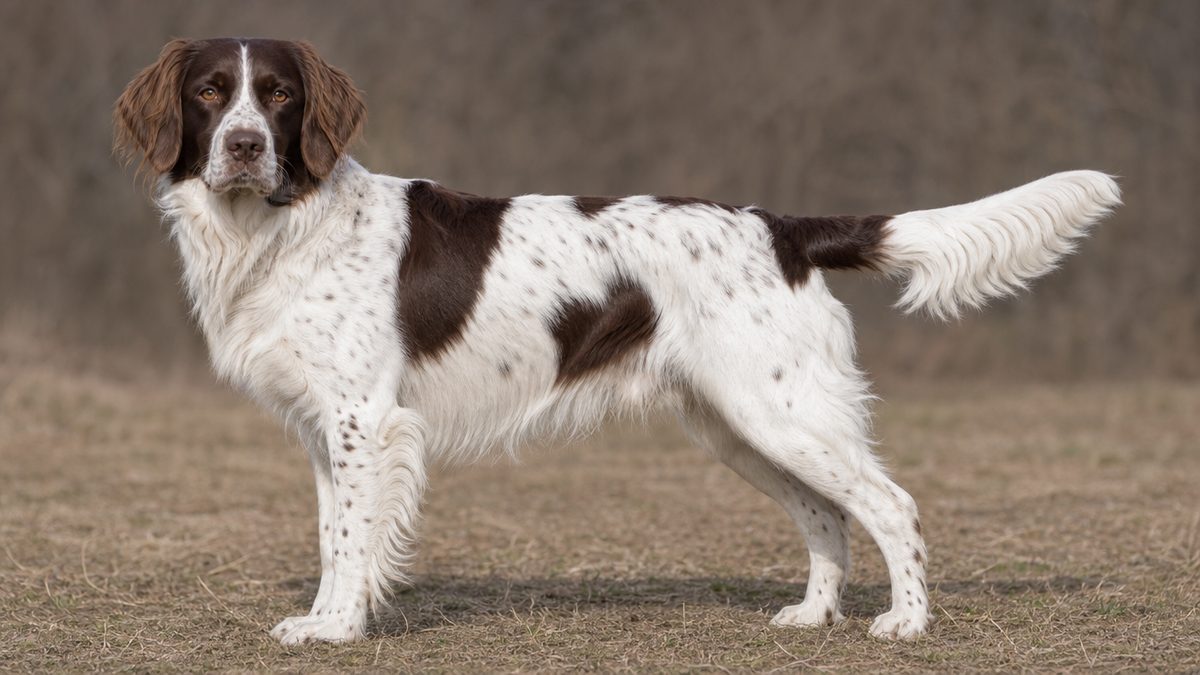
The standard asks for a well proportioned, dryly muscled and clean-cut dog, powerfully muscular without being heavy whose body shows power and the ability to develop the speed a gundog needs. The head is slightly wedge-shaped, the muzzle a little shorter than the skull and rather dry, without hanging lips.
- Coat: dense, not curly, a straight coat with a water-resistant undercoat. Not really long on the body, but longer on the neck and forechest, with well feathered ears, feathered legs and a bushy tail, which together give the impression of a long coat.
- Colour: white with brown markings, with or without spots or ticking. Roan is not permitted, meaning brown and white hairs mixed all over the body, and a mantle is less desired. The ears are brown, as is the hair around the eyes.
- Eyes: wide apart, oval, of moderate size, and the desired colour is amber, neither dark nor the pale colour of a bird of prey.
- Ears: not heavy, set high, hanging close to the head without any fold, and long enough that drawn forward they reach within three fingers' breadth of the nose tip.
- Tail: carried in continuation of the topline, reaching approximately to the hock, never curled over the back, richly feathered on all sides except at the root. The standard describes no docking, so an Indian owner should expect a full natural tail.
At 30 to 35 kg a male Drent is roughly the weight of a Labrador and taller at the withers than most of them, with a substantially longer coat. Anyone picturing a spaniel should picture a setter instead. The Raad van Beheer gives the weight range for the breed simply as 25 to 35 kg, while the FCI standard splits it by sex, so the two are consistent rather than conflicting FCI-Standard N 224 DRENTSCHE PATRIJSHOND.
Reading the standard closely, and where it meets Indian law
The current FCI standard for this breed was published on 4 April 2016 and carries six disqualifying faults, two of which are about white markings in specific places, and one of which collides with the genetic-defect clause of Indian breeding law.
The disqualifying faults
- Aggressive or very shy dogs, and any dog clearly showing physical or behavioural abnormalities.
- A white or a partially white ear. The ears must be brown.
- White marks around one or both eyes.
- Bite: over- or undershot.
- Dogs that are clearly untypical for the breed.
The two white-marking clauses are the ones a buyer should carry into a conversation, because they are the easiest to check on a photograph and the hardest for a seller to talk around. A Drent with a white ear or a white patch around an eye is not a rare marking commanding a premium; it is a disqualifying fault in the breed's governing standard.
Where the bite clause meets Indian law
The standard disqualifies an over- or undershot bite. Indian breeding law names the same defect, and the clause is worth reading in full because it also names conditions this breed genuinely has. Second Schedule Part III paragraph 8(10) of the Prevention of Cruelty to Animals (Dog Breeding and Marketing) Rules, 2017 reads, verbatim from the gazette:
"(10) The dogs shall have been tested for genetic defects, including hip dysplasia, progressive retinal atrophy, night blindness, hypothyroidism, entropion, ectropion, overshot, undershot jaw (when incisors do not touch or mesh), wry mouth, two or more missing teeth, unilateral cryptorchid or full cryptorchid males.";
Four items in that list land squarely on this breed. Hip dysplasia is one of the two screenings both Dutch breed associations already require. Progressive retinal atrophy is one of the two eye conditions where a Dutch breeding dog must be free or provisionally free to be bred at all. Entropion appeared once in the association's own 2022 survey. And two or more missing teeth matters because the same survey recorded nine dogs with missing dental elements across two birth years.
Note the word including. The list is illustrative rather than closed, so a defect is not outside the clause merely because it is unlisted.
What the standard does not contain, and who fills the gap
The nine-page standard contains no life expectancy, no epilepsy, no health screening requirement and no coat-care instruction. That is normal for an FCI standard, and it matters here only because the pages ranking in India treat the standard as though it were a health document. One of them attributes an average life expectancy to the Federation Cynologique Internationale, which publishes none for this breed.
The Dutch fill that gap themselves and they fill it well. Both breed associations require hip dysplasia screening and an ECVO eye examination of the parent dogs before a litter can be registered, and Vereniging de Drentsche Patrijshond additionally requires elbow dysplasia screening. For progressive retinal atrophy and cataract the result must be free or provisionally free to breed; for the other eye conditions no breeding restrictions are attached yet.
The rules are being tightened right now
The Raad van Beheer published revised breeding norms for this breed on 1 July 2026, deliberately in advance so breeders can prepare, and from 15 December 2026 it will check at mating registration whether those norms have been met. It describes the current norms as a first step, to be evaluated periodically against available protocolled examinations, DNA tests, scientific insight and collected data.
A Dutch pedigree for this breed is not a piece of paper attesting to ancestry. It attests that the parents were hip-scored and eye-examined, and in one association's case elbow-scored, before the mating was allowed. That is what an Indian buyer is actually paying for when a price of 1,100 to 1,600 euro is quoted, and it is what an Indian listing offering the breed cannot supply.
How rare the Drent really is, and how fast that changed
Ninety-two Drentse Patrijshond puppies were born in the Netherlands in 2024, down from 466 in 1995, a fall of 80 percent, and the breed's own club paper calls that a post-war low.
That figure comes from the Raad van Beheer's own database as reproduced in the club magazine Onze Drent, and it is the number no English-language page about this breed prints.
| Breed | 1995 | 2024 | Change |
|---|---|---|---|
| Markiesje | 21 | 97 | +362 percent |
| Smoushond | 58 | 138 | +138 percent |
| Stabijhoun | 199 | 265 | +33 percent |
| Wetterhoun | 63 | 44 | -30 percent |
| Saarloos wolfhond | 68 | 43 | -37 percent |
| Kooikerhondje | 467 | 211 | -55 percent |
| Schapendoes | 466 | 137 | -71 percent |
| Hollandse herder | 390 | 88 | -77 percent |
| Drentsche Patrijshond | 466 | 92 | -80 percent |
We checked every row against its own two counts and all nine reproduce exactly, so the table is sound. The Drent has the steepest fall of the nine, and the paper says it and the Hollandse Herder currently take the crown as the most vulnerable Dutch breeds.
The population, and what it needs to stand still
- Around 1970 there were as many as 7,000 Drents. Numbers then fell, revived in the 1980s, and after 2002 entered what the paper calls a free fall, with only the pandemic years showing a small rise.
- Today there are an estimated 2,600 Drents in the Netherlands.
- Replacement needs 260 puppies a year, about 45 litters, simply to make up for the dogs that die annually.
- 2024 produced 92, which is 35 percent of the replacement rate.
- If nothing changes, the paper's first scenario projects about 1,500 dogs by 2035 and about 1,000 by 2045.
One number in that paper does not reproduce, and we say so
The same article reports that across all roughly 350 pedigree breeds in the Netherlands, puppy births fell from about 68,000 in 1995 to about 28,000 in 2024, and calls that nearly 70 percent. Divide it out and 40,000 of 68,000 is a fall of 58.8 percent, not nearly 70. To reach 70 percent the 2024 figure would need to be about 20,400.
That is a rounding slip in one sentence of an otherwise careful document, and it does not touch the breed table, every row of which checks out. We print it because a page that quotes a source's good figures and quietly passes on its bad one is not doing the reader any favours.
Why the decline matters more than the number
A small population is survivable; this one has a second problem. The club paper says the genetic diversity of the breed is now alarmingly low, that the breed is not simply back where it was in 1950 but genetically further behind, and that there are clear risks of increasing hereditary conditions and further genetic impoverishment.
It also names the causes, and they are worth an Indian reader's attention because most of them are not about the dog. The poor health image of pedigree dogs generally, a perception that crossbreeds and imported street dogs are healthier, impatient puppy buyers, two-income households with less time, less space at home, and hunters switching to retrievers because roughly 95 percent of modern hunting is retrieving rather than pointing.
The paper says a Dutch television programme portrayed inbreeding and epilepsy as ruining the breed, and that an animal-rights website presents the Drent very negatively, leaving potential buyers with the impression that the breed is a bad choice. Its response is not denial: it says those signals must be taken to heart if the facts are right, and points to the association's outcross project as an attempt in that direction, adding that after three years it is not really progressing Drentsche Patrijshonden Club Nederland.
Drentse Patrijshond price in India: the honest answer
No verifiable Drentse Patrijshond price in india exists, because the breed is not bred here and cannot lawfully be imported to breed or sell. The one verifiable price for this breed anywhere is Dutch, at 1,100 to 1,600 euro for a puppy with an FCI pedigree.
That Dutch figure comes from the Landelijk InformatieCentrum Gezelschapsdieren, the Dutch pet information centre, on the same page that sets out the breed's hereditary conditions. It also puts food at about 40 euro a month and reminds buyers that municipal dog tax varies by council.
What that price is actually buying
A Dutch pedigree is not a certificate of ancestry alone. Both breed associations require the parent dogs to have been hip-scored and to have passed an ECVO eye examination before a litter can be registered, and one of the two additionally requires elbow scores. For progressive retinal atrophy and cataract the parents must be free or provisionally free. Since June 2014 every Dutch pedigree for every breed also requires a DNA parentage test before papers are issued.
So the euro figure prices a screened litter from a supervised programme. An Indian rupee figure for this breed, if one existed, would price none of that.
The dollar figures ranking in India, and what they are
Two North American pages rank on the Indian query and both quote dollars. A Canadian pet-insurance affiliate page says a puppy usually costs between 1,000 and 2,500 US dollars. A United States breeder marketplace answers the same question with nationally, prices usually range from 2,900 to 3,000 US dollars, where nationally means the United States.
Neither is an Indian price. What matters is what happens next, because converting one is how an Indian price gets manufactured.
| Rate | USD 1,000 becomes | USD 2,500 becomes | USD 3,000 becomes |
|---|---|---|---|
| 84.38 | Rs 84,380 | Rs 2,10,950 | Rs 2,53,140 |
| 80.00 | Rs 80,000 | Rs 2,00,000 | Rs 2,40,000 |
| 74.00 | Rs 74,000 | Rs 1,85,000 | Rs 2,22,000 |
| 66.67 | Rs 66,670 | Rs 1,66,675 | Rs 2,00,010 |
Look at the third row, first column. Rs 74,000 is not a hypothetical. It is the exact figure this site has already documented appearing for nineteen unrelated breeds on a single Indian directory's price table, where 453 of 463 rupee values divide to a whole number of dollars at 74.00. A dollar figure of 1,000 run through that rate is where such numbers come from.
Why this page publishes no rupee figure
Bonbeno does not convert the Dutch euro price into rupees, and the reason is the table above. A conversion produces a number that looks like an Indian market price, that no Indian transaction stands behind, and that would be quoted back at us within weeks as though it were one. The euro figure is published as a euro figure, for a Dutch litter, under Dutch breeding rules.
Anyone quoting you a rupee price for a Drentse Patrijshond in India is quoting for a dog that must have been flown in as somebody's personal pet, since import for breeding or sale is not permitted. Ask them which of the two Dutch associations registered the litter, and for the DGFT licence and quarantine clearance The Kennel Club of India. There is no third answer.
What is actually ranking for this query, and why none of it is about India
Google India returns about 28,900 results for this breed's price, and page one contains one generated directory category serving two different cities, a Canadian insurance affiliate, a United States marketplace, a Pinterest pin, a British product listing at 32 dollars, a YouTube video and a page that prints the price as Unknown.
Finding one: Google does not recognise the spelling most people type
The results page opens with Including results for drentsche patrijshond price in india, offering a Search only for link back to the spelling actually typed. The modern Dutch spelling is Drentse; the kennel-club spelling is Drentsche; Google indexes the second. That is the same fragmentation this page found in the veterinary literature, showing up in a search engine.
Finding two: one generated category, two cities, one results page
The first organic result and one of the last are the same Justdial category, nct-13797841, once for Dollars 2nd Stage in Bangalore at 4.6 from 586 ratings and once for C Scheme in Jaipur at 5.0 from 36. A single category identifier serving two cities on the same page is the template mechanism visible without opening either page.
The first result's Google snippet is a customer review reading The prices are very reasonable, which is a big plus for me. That is a review of a shop. It is presented, in a price query, as though it said something about the price of this dog.
Finding three: the second-ranked page is AI-assembled
The Canadian affiliate page ranking second illustrates itself with images served from an AI image generator, with the word dream in the image URLs. Its content is a mixture of correct and incorrect in a way that is characteristic.
- Correct: it names hereditary stomatocytosis, which is genuinely a disease first described in this breed, and progressive retinal atrophy, which is genuinely one of the two screened eye conditions.
- Incorrect: it states that the American Kennel Club recognises the breed. The AKC has recorded the breed in its Foundation Stock Service since May 2010 and assigned it the Sporting Group designation, which is a recording programme rather than full recognition.
- Missing: epilepsy. The condition Utrecht University research identifies as the most important hereditary condition in the Dutch population appears nowhere on the page, including in its health FAQ.
- Untethered: it gives exercise as 60 to 90 minutes and lifespan as 12 to 14 years with no source for either.
Finding four: a product listing wearing a breed guide's title
A British site ranks with a page titled Dutch Great Hunt Dog All About Drentse Patrijshond Breed, and Google's own product markup for it reads 32 US dollars, 1 piece, in stock, rated 4.9 from 50. A page whose title is about a dog breed and whose schema is about a 32-dollar item is not a breed guide, and its price is the cheapest number on the results page by two orders of magnitude.
Finding five: the most honest page prints Unknown
A breed-list site ranking on page one gives the price field for this breed as Average (Unknown). On a results page where every other price is a foreign currency, a shop review or a product SKU, the page that declines to guess is the accurate one.
Finding six: the People also ask box is about other breeds
Google's three People also ask questions for this query are How much does a Czech Wolf Dog cost in India?, What is the price range for a Rajapalayam dog breed in India? and How much does an Affenpinscher dog cost in India? Not one mentions the Drent. All three are answered from Indian content farms with rupee bands.
Read that as a signal rather than an accident. Google has concluded that a person asking about this breed's Indian price is really asking what any rare imported dog costs in India, and it is not wrong, because there is no Indian answer to give.
No AI Overview fired for this query. For the Drever, an equally obscure imported breed, one did, and it quoted a monthly food cost 2.5 times higher than the page it cited. An absent answer box is a better outcome than a confident wrong one.
The lawful route into India, and the one that does not exist
Importing a Drentse Patrijshond into India for breeding or sale is not permitted. DGFT Trade Notice No. 22/2022-23 of 19 December 2022 classifies dogs under ITC(HS) 01061900 as Restricted and limits import to three named purposes.
Policy Condition (7): "Import of dogs is allowed only for the following specific purposes: - i. Pet dog with valid pet book and relevant records/documents in the name of importer. ii. Dogs imported by the R&D Organisations for conducting research with the recommendation of CPCSEA. iii. For the internal security by the Defence and Police Force." Policy Condition (8): "Import of commercial dogs for breeding or any other commercial activities other than the purposes mentioned above is not permitted.";
Paragraph 6 of the same notice closes the obvious workaround, stating that any applications for trading or breeding purposes, or applications made on behalf of another person or entity, shall be duly rejected. So no Indian kennel can lawfully import this breed to found a line, and with no domestic population there is nothing to breed from.
The personal route, step by step
- Qualify. Up to two pets may come as passenger baggage without a DGFT authorisation, but only for a person transferring residence to India after more than two years of continuous stay abroad. Authorisation is required if the stay was shorter, if the pet is not travelling as baggage, or if it cannot come under the baggage rules.
- Start two months early. The notice tells applicants to begin the import authorisation application at least two months before travel.
- Use a listed port. Import of pet animals is allowed only through the airports and seaports of Delhi, Mumbai, Chennai, Hyderabad, Bengaluru and Kolkata and, since October 2024, Kochi airport, with quarantine at that port's government station where required.
- Get the advance NOC. An Advance No Objection Certificate from the Regional or Quarantine Officer of that port is needed seven days before travel, relaxable up to three days, on submission of the DGFT licence and the exporting country's health certificate.
- Test before you fly. The disease testing prescribed in the health certificate must be done in the exporting country and all reports must travel with the animal.
A separate instrument, S.O. 4396(E) of 10 October 2024, added Cochin International Airport, Kochi as a point of entry for pet dogs and cats under the Livestock Importation Act, 1898. That sits on the pet route rather than on the DGFT notice, which still names six ports for its own licence route, so a pet arriving under the baggage rules can land at seven ports today and a licence-route import plans on the DGFT's six. Both lists are right for their own route, as how to import a dog to India sets out.
Registering the dog once it lands
India is a Full member of the Federation Cynologique Internationale, represented by the Kennel Club of India at Anna Nagar, Chennai. That is why FCI recognition answers the Indian recognition question in practice: the kennel club of india issues pedigrees against FCI nomenclature, and this breed holds FCI standard 224 on a definitive basis since 4 March 1960.
Registering an imported dog with the KCI costs Rs 2,500 including GST under the tariff effective 1 April 2024, with a four-generation certified pedigree a further Rs 1,000. The paperwork is the harder part: the KCI's checklist requires the export pedigree in original, the airway bill in original, the air ticket in original, the boarding pass, the DGFT licence, customs clearance, quarantine clearance, a pet passport and a notarised affidavit.
The Dutch paperwork you would also need
Dutch law adds requirements an Indian buyer will not have met before. Chipping and registration are compulsory there, puppies must be registered in the breeder's name, and every dog born, imported or changing owner after 1 November 2021 must have an EU pet passport. The Dutch guidance is blunt: a dog offered without a chip, without registration in the seller's name, or without an EU passport means the seller is breaking the law, and buying it makes the buyer an offender too.
A Drentse Patrijshond can enter India in exactly one way: as the pet of someone moving home, with a pet book in their own name, through one of seven named ports, with two months of lead time and a Dutch EU pet passport behind it. It cannot lawfully be imported to breed or sell. Any Indian listing offering one is describing something other than what it claims.
Cost of ownership: the Dutch figures, and why we do not convert them
The only sourced running cost for a Drentse Patrijshond is Dutch: about 40 euro a month for food, plus municipal dog tax that varies by council, plus training courses, routine veterinary care and neutering if chosen.
There is no Indian cost-of-ownership figure for this breed, because there is no Indian population of it to observe. Bonbeno publishes no rupee monthly cost estimate here for the same reason it publishes no rupee purchase price: a converted number would be indistinguishable from a measured one within a month of being published.
What is published and fixed
| Item | Published fee | Source |
|---|---|---|
| KCI registration of an import dog, inclusive of GST | Rs 2,500 | KCI tariff effective 1 April 2024 |
| KCI certified pedigree, four generations | Rs 1,000 | Same tariff |
| KCI transfer of ownership, dog over 12 months | Rs 1,000 | Same tariff |
| KCI export pedigree, if the dog ever leaves | Rs 2,000 | Same tariff |
| Dutch food cost, for comparison | About 40 euro a month | LICG |
Everything above those lines, the flight, the DGFT authorisation, the port quarantine and the exporting country's health testing, varies by origin and cannot be quoted as a range without inventing one.
The three cost drivers specific to this breed
- Ear care, continuously. Pendulous ear carriage carries 1.76 times the odds of otitis externa, and Indian humidity keeps a canal wet. This is a recurring line item, not a one-off.
- Joint screening and joint disease. Both Dutch associations require hip screening and one requires elbow screening, and in the 2022 survey 24 of 144 hip-scored dogs graded worse than HD-A and 13 of 83 elbow-scored dogs had some degree of elbow dysplasia. Arthrosis in a 30 kg dog is an expensive old age.
- Lifelong antiseizure medication, if epilepsy appears. The association notes that treatment often has to be lifelong, that medication sometimes has to be changed when results are insufficient, and that regular blood-level and organ-function monitoring is advised because of side effects. At an incidence of 2.2 percent this is a real budget scenario rather than a remote one.
The cost that is genuinely low
Grooming. The Dutch Kennel Club puts the requirement at little, with occasional brushing and a moult twice a year, and the coat needs no professional trim, no hand-stripping and no salon schedule Landelijk InformatieCentrum…. For an imported breed in India that removes the largest recurring grooming cost most long-coated dogs carry here.
Feeding is also unremarkable. The Dutch Kennel Club says no specific demands are placed on the food. A 30 kg dog eats what a 30 kg dog eats, and there is no breed-specific diet to buy.
The recurring cost of this breed would be ordinary for its size, driven by ear care and parasite control rather than by grooming or feed. The costs that are not ordinary are the joint and seizure scenarios, both of which have real published frequencies behind them rather than being hypothetical. Budget for a large dog and keep a contingency for a neurological or orthopaedic diagnosis.
Heat tolerance: comparing wet-bulb, not just air temperature
No breed developed in Drenthe is heat-tolerant in an Indian sense, and the size of the gap is worth measuring rather than asserting. Assen, in the breed's home province, has an annual mean wet-bulb temperature of 8.29 C and a warmest month of 15.83 C.
Air temperature alone understates the problem, so this page compares wet-bulb as well. A dog has no useful sweating. It cools by evaporating water from the respiratory tract while panting, and the floor for any purely evaporative cooling is the wet-bulb temperature, the temperature a wet surface reaches in moving air. Two places at the same air temperature can be very different for a dog if one is dry and one is humid.
All figures below come from NASA POWER's 1991-2020 climatology, queried by explicit latitude and longitude rather than by place name, so that no other location can be served by accident.
The reference point
Assen sits at 52.9967 N, 6.5625 E, in the province the breed is named after. Its annual mean air temperature is 9.65 C, its warmest month is July at 17.92 C, and its coldest is January at 1.86 C. In wet-bulb terms the annual mean is 8.29 C, running from 1.30 C in January to 15.83 C in July.
So the whole climatic envelope this breed was selected in spans about 1 to 16 C wet-bulb, and its hottest month is cooler than most Indian cities are in their coldest.
How many Indian months fall inside that envelope
| Place | Annual mean wet-bulb | Coolest month wet-bulb | Months at or below 15.83 C |
|---|---|---|---|
| Assen, Drenthe | 8.29 C | 1.30 C (Jan) | All twelve |
| Delhi | 17.76 C | 6.85 C (Jan) | Five: Jan, Feb, Mar, Nov, Dec |
| Shillong, Meghalaya | 15.94 C | 7.76 C (Jan) | Five: Jan, Feb, Mar, Nov, Dec |
| Pune | 19.50 C | 14.11 C (Jan) | Three: Jan, Feb, Dec |
| Kolkata | 22.73 C | 13.55 C (Jan) | Two: Jan and Dec |
| Bengaluru | 19.71 C | 16.29 C (Jan) | None, and January misses by 0.46 C |
| Mumbai | 22.60 C | 16.94 C (Jan) | None |
| Chennai | 24.87 C | 21.68 C (Jan) | None, and January is 5.85 C above |
Three readings are worth pulling out. Chennai's coolest month is 5.85 C hotter in wet-bulb terms than a Drenthe July. Bengaluru misses by less than half a degree, which makes it the closest large Indian city to this breed's upper limit. And Delhi has five months inside the envelope, more than any other metro here, because its winter is genuinely dry as well as cool.
The finding nobody else prints
Shillong, in Meghalaya, has an annual mean wet-bulb of 15.94 C, which is 0.11 C above Assen's single hottest month. In other words, the average day of the year in Shillong is climatically about as demanding for this dog as the hottest month in its home province, and Shillong's November to March sits comfortably inside the Dutch range.
That is the honest answer to where in India this breed could work, and it is not a metro. The northeastern hill stations, not Delhi or Bengaluru, are the parts of the country that resemble the climate this coat was built for.
The FCI standard calls for a dense coat with a water-resistant undercoat, longer on the neck and forechest, with feathered ears, feathered legs and a richly feathered tail. That is Dutch winter and Dutch water equipment on a 30 to 35 kg dog. Do not shave it in India: a clipped double coat loses the guard-hair layer that reflects heat and protects skin, and the dog gains nothing thermally because it does not cool through its skin in the first place.
Temperament: gentle, sensitive, stubborn, and not a kennel dog
The Drentse Patrijshond is a cheerful, soft, affectionate dog that attaches hard to its family, is sensitive to its owner's mood, and is simultaneously described by every Dutch source as independent enough to be difficult.
Those two halves are the breed, and Dutch sources hold them together without embarrassment. The Dutch Kennel Club summarises the character as sensitive, intelligent, curious, cheerful, attached but headstrong, and says that headstrongness makes the dog not always easy to train, requiring real patience, especially during adolescence when it tests the limits of what its owner allows.
What the standard asks for
The FCI standard describes a dog that keeps in touch with the hunter as an innate quality, that can be reserved in the beginning but never fearful, and that is loyal and intelligent, which together with good upbringing makes it a highly esteemed family pet as well as a valuable companion for the hunter.
Dutch owners describe the everyday result as an even-tempered dog indoors once its head and legs have had a job. Note the two-part construction. The standard does not say family pet instead of hunting dog, and neither does any Dutch source. The Dutch pet information centre says the breed is still used as a hunting and sporting dog but is above all an affectionate and active house dog today.
The traits that surprise Indian owners
- It follows you. The breed likes being with its owner and tends to want to follow them around the house. Dutch advice is explicitly to discourage this and to practise being alone from puppyhood in small steps.
- It is cautious with strangers. Usually enthusiastic with people it knows and often initially reserved with people it does not, though generally fine with other dogs.
- It barks at the gate. Because of its former job as a yard guard, it will bark at visitors and when it notices something amiss. This is selected behaviour, not a training failure.
- It is not a kennel dog. The Dutch centre says so directly: it wants to be with its family too much.
- It stays juvenile for a long time. The breed remains playful and is only mentally adult at about three years of age.
The prey drive, and the Indian version of it
The hunting instinct makes living with small pets difficult, and outdoors the dog will happily chase interesting smells, small game and birds, but also joggers and cyclists. In a Dutch village that is a nuisance. On an Indian road it is a traffic risk, and it is the specific reason a Drent needs a long line or a secure enclosure rather than trust.
What owners actually say
The association's 2019 survey collected free-text comments from 24 owners of six-year-olds and 48 owners of three-year-olds, and published them. Most were positive. What is more useful is that the association also published the negative ones.
The recurring themes are anxious and insecure behaviour, unfriendliness towards other dogs, and fear of loud noises, with fireworks and gunshots named repeatedly. One owner describes a dog extremely fearful of strangers, barking from a distance, doing everything to get away even on the lead, and urinating from fear, which made hunting training unmanageable, while still being a sweet and well-raised dog at home.
The 2020 round says the same thing a year earlier and says it more bluntly. Nineteen owners of six-year-olds and 22 owners of three-year-olds commented, and the association's own summary of the younger group is that it is reported unfortunately too often that the dog is insecure and anxious, and that many dogs are very sensitive to stimuli. Two consecutive years of owner free text naming the same trait is a pattern rather than an anecdote.
Several Dutch owners named fireworks as the trigger their dog could not cope with, in a country where fireworks are concentrated into one night of the year. In most Indian cities, festival fireworks run for days and start well before the festival. A breed with a documented pattern of noise sensitivity meets that far more often here than in Drenthe, and it is worth planning for rather than discovering.
Training: the one breed standard that tells you how not to do it
Train a Drentse Patrijshond softly and consistently, because the FCI standard states that its gentle character makes forceful training methods harmful, and the Dutch guidance repeats that in three different places.
The breed is highly trainable in the ordinary sense and quick to ruin in the other. This is the only breed standard on this site that gives a training instruction rather than a description, and it is worth quoting rather than paraphrasing. The standard says the breed's characteristics are innate and therefore need little training, and that because of their gentle character it is harmful to use forceful training methods.
What works
- Reward what you want. Dutch guidance is to reward good behaviour so that it pays, and to prevent or ignore unwanted behaviour rather than correcting it.
- Use your voice, not your hand. The breed is described as sensitive to the owner's voice, which is the lever that works on it.
- Vary the sessions and do not apply pressure. The explicit Dutch advice is patience, variety, and no pressure, because the dog enjoys working with you and learns willingly but sometimes needs time to process.
- Teach a stop-barking cue early. Dutch guidance names this specifically: teach the dog to stop barking on your signal.
- Do a puppy course and then a follow-up course, the second one specifically to steer the dog through adolescence, when it will test boundaries.
The socialisation point, which is breed-specific
Good socialisation matters for every puppy. For this one the Dutch centre says it is extra important, because the breed's cautious disposition means a poorly socialised Drent can become fearful. That work must begin at the breeder, so a buyer should check the breeder is doing it, and continue for a long time at home.
The pacing advice is unusual and worth following. Take it calmly, do not do too much in a row, and give the puppy enough rest, while continuing to seek out new situations for at least the first year of life.
The Indian socialisation list is different from the Dutch one
A Dutch puppy is socialised to cyclists, trams, other dogs and village noise. An Indian puppy of this breed needs the same work done on a different list: autos and horns, street dogs, cattle and buffalo in the road, market crowds, doorbells and delivery riders, polished tile floors, and festival fireworks. The last of those deserves deliberate desensitisation given what Dutch owners report about noise.
What you will not train out
You will not train away the drive to follow a scent or to chase movement, and the Dutch advice is to spend extra attention on teaching the dog not to go after game, joggers or other moving things. Note the phrasing: extra attention, not a solution. Assume a long line for life in any unfenced Indian space.
Do the arousal work, the retrieving drills and the long tracking sessions in the coolest hour available. Exertional heat illness was the trigger in 652 of the 879 UK heat-illness events with a recorded trigger, 74.2 percent, and 372 of the 551 exertional events with a specified activity followed a walk rather than any intense sport. A 30 kg long-coated dog doing enthusiastic retrieve work at a Chennai wet-bulb of 27.29 C is not training, it is a risk.
Exercise: a working dog's requirement, in a climate that will not allow it
A Drentse Patrijshond needs a great deal of exercise and mental challenge, enjoys going out in poor weather, and becomes bored without variety, which in most of India means rebuilding the whole programme around scent work indoors.
The Dutch description is of a dog that was originally a working animal and needs both movement and thinking. Its owners are told to let it walk, run beside a bicycle, swim, retrieve balls, or run and play with other dogs, to keep it varied or the dog will get bored, and to add tracking and searching games because physical work alone is not enough. Given enough of that, the breed is calm indoors.
The suggested activities are hunting training, tracking and retrieving as the natural fits, plus long walks, agility, canine triathlon and obedience. The Dutch Kennel Club adds running and cycling as things the dog will greatly enjoy.
The single English figure, and why it is unsourced
The Canadian page ranking second in India puts it at 60 to 90 minutes daily with no source. That is not obviously wrong for a working gundog, and it is not obviously right either. This page prints it as what it is: a number on a content farm, next to the Dutch description of what the breed actually needs, which is qualitative and comes from the people who keep them.
The Indian timing rule
Two facts decide the schedule. Exertional heat illness was the trigger in 652 of the 879 UK events with a recorded trigger, 74.2 percent, and within the exertional group, of the 551 events where an activity was specified, 372, or 67.5 percent, followed a walk rather than running, cycling, play or competition. Ordinary exercise is what puts dogs in a clinic.
Lay the wet-bulb figures over an Indian day and the working window is narrow.
| City | Months at or below 15.83 C wet-bulb | Practical verdict |
|---|---|---|
| Shillong | November at 13.48, December at 9.83, January at 7.76, February at 9.09, March at 12.18 | Five months of genuine working weather, and the closest Indian climate to Drenthe |
| Delhi | November at 12.50, December at 7.80, January at 6.85, February at 9.43, March at 13.22 | Five months, then a July wet-bulb of 27.72 that ends outdoor work entirely |
| Pune | December at 15.10, January at 14.11, February at 14.91 | Three months |
| Kolkata | December at 14.82, January at 13.55 | Two months |
| Bengaluru | None; January is 16.29 | Mild all year but never Dutch, and no month qualifies |
| Mumbai | None; January is 16.94 | No working window |
| Chennai | None; January is 21.68 | No working window at any time of year |
What to do in the months that are not in that table
- Move the work indoors and make it nasal. Tracking and searching games are already what the Dutch recommend, and they tire a pointing breed properly while generating almost no heat load.
- Split the outing. Two short walks at first light and after dark beat one long one at any other hour.
- Use water carefully. Swimming suits the breed and its water-resistant coat, but dry the ear flaps afterwards, because pendulous ear carriage already carries 1.76 times the odds of otitis externa.
- Retire the bicycle in summer. Running beside a bicycle is standard Dutch advice and it is the single worst thing to do with this dog in an Indian April, because the dog cannot set the pace.
- Protect growing joints. Do not let a dog that has not finished growing play too wildly or chase balls endlessly, which is the Dutch centre's own advice given hip dysplasia in the breed.
A Drent in Shillong or in Delhi's winter can have most of the life it was bred for. A Drent in Chennai or Mumbai has none of it outdoors and needs its entire exercise programme rebuilt around the nose. Neither is impossible. Both are a long way from the 60 to 90 minutes a content farm suggests NASA Prediction Of Worldwide Energy….
Grooming: easier than it looks, except at the ears and between the toes
Coat care for a Drentse Patrijshond is a weekly brush with extra attention to the longer feathering, and the Dutch guidance is that washing is needed only when the dog has rolled in something or swum in an algal ditch.
The coat is dense, straight and not curly, with a water-resistant undercoat. It is not really long on the body, but it is longer on the neck and forechest, with well feathered ears, feathered fore and hind legs, and a richly feathered tail, and that is what makes it look long. The Dutch Kennel Club puts grooming need at little, with occasional brushing and a moult twice a year.
The routine, as the Dutch describe it
- Brush through once a week, with extra attention to the longer sections. Brush more often during the moult to pull out the loose hair.
- Check daily for twigs and grass seeds in the coat. In an Indian context grass awns after monsoon growth are the same problem under a different name.
- Let mud dry, then brush it out. Dutch advice is that dried mud brushes out easily and the white comes back white, which saves a lot of unnecessary bathing.
- Trim excess hair between the toes. The standard says the feet are well covered with hair between the toes, and that hair collects everything.
- Pluck long ear hair and old dead hair when it gets too long. Old hairs show as lighter patches in the dark coat and may be plucked out.
The ears, which are the actual job
Ears set high and hanging close to the head without a fold trap warmth and moisture against the canal. In UK primary-care data, breeds with pendulous ear carriage carried 1.76 times the odds of otitis externa, and breeds with V-shaped drop ears 1.84 times, against a one-year period prevalence of 7.30 percent across a random sample of 22,333 dogs.
The Dutch instructions here are more precise than most veterinary advice an Indian owner will get, and they transfer without modification.
- Clean the ear flap with a cotton pad, not cotton wool, because loose fluff comes off.
- Do not go into the canal itself with pads or cotton buds.
- Do not use a cleaner without asking your vet first.
- Trim excess hair in front of the canal entrance so air can reach the ear.
- Do not pull hairs out of the canal. The Dutch guidance says this causes damage and inflammation, particularly in a dog that has already had one ear infection.
Indian seasonality then loads the problem further. A cross-sectional series in and around Durg, Chhattisgarh, examined 281 dogs and found 51 otitis cases, distributed 21 in summer, 17 in the rainy season and 13 in winter, which is 41.18, 33.33 and 25.49 percent of cases and sums to exactly 100.
The Durg study's age table is headed Prevalence (%) but its percentages are computed on the 51 cases rather than on the dogs examined in each age band. It reports 23 cases in dogs aged five and over at 45.10 percent, which is 23 of 51. The real prevalence in that band is 23 of the 81 dogs examined, which is 28.4 percent. The seasonal rows reconcile correctly and are used as printed.
The rest, in one line each
- Nails: kept short, which the Dutch list alongside checking that the teeth look clean and healthy.
- Teeth: brushed, and worth noting that Indian law's genetic-defect clause names two or more missing teeth while the association's own 2022 survey recorded nine dogs with missing dental elements Vereniging de Drentsche Patrijshond.
- Ticks: checked daily after any outdoor work, given that ticks were found on 278 of 525 dogs examined across four Indian cities.
- No shaving. A clipped double coat loses its protective guard-hair layer and the dog gains nothing thermally.
Health: a breed whose own club counts, and publishes the count
The Drentse Patrijshond has better published health data than almost any breed on this site, because its Dutch association surveys the owners of every three-year-old and six-year-old Drent in the country every year and publishes the results in Dutch and English.
That is worth stating plainly before any condition is named, because it changes what a reader can know. For most rare breeds this site can offer a standard, a registry count and a scattering of case reports. For this one there is a table with counts and denominators in it, refreshed annually.
How the survey works
Every year the owners of Drents who are then three or six years old receive a request to take part. The association describes the survey as, alongside its register and the official health survey examinations, the most important way of collecting information about the health of the breed, and says the outcomes are published after analysis. Its own estimate is that this reaches about 25 to 30 percent of all dogs.
The numbers are then supplemented from four other streams: reports from owners, breeders, conformation judges and litter inspectors, and the official hip, elbow and ECVO eye results held by the Raad van Beheer.
The association's own warning about its own data
This is the part that makes the data trustworthy. The 2022 report states, in English, that the results are not representative for the breed as a whole, because the association does not have addresses for all owners, not everybody is willing to complete the survey, and data is especially missing for dogs born abroad and dogs from breeders within the other association.
A breed club that publishes its counts and then tells you why the counts understate the problem is doing something almost no breed club does. Every figure in the sections that follow is read with that caveat attached.
What the breed's health picture actually is
| Condition | Named by | Evidence available |
|---|---|---|
| Idiopathic epilepsy | Utrecht University research via LICG, the association, the Raad van Beheer's clubs | A 1986 prevalence estimate, a 2006-2011 incidence figure, a 2023 genome-wide association study and annual survey counts |
| Hip dysplasia | Both breed associations, screening compulsory | Official Raad van Beheer scores in the annual survey |
| Elbow dysplasia | One breed association, screening compulsory | Official Raad van Beheer scores in the annual survey |
| Von Willebrand disease type 1 | LICG and the association | DNA test results in the annual survey, plus an association discussion paper |
| Distichiasis and membrana pupillaris persistens | LICG and ECVO examinations | ECVO counts in the annual survey |
| Familial stomatocytosis with hypertrophic gastritis | A 1991 Utrecht case series | Eight dogs from two families, and two follow-up papers |
| Allergies and missing dental elements | The association's own summary | Described as relatively common in the 2022 round |
The association's plain-language summary of the 2022 round is the honest headline: hip dysplasia, elbow dysplasia and epilepsy are still important problems, and allergies and missing dental elements also occur relatively often.
One thing this breed does not have data for
There is no median lifespan for the Drentse Patrijshond in the 155-breed longevity table behind the largest recent survival analysis. Our own extraction of that table on 27 August 2026 returns zero hits for Drent, Drentsche, Patrijs and Dutch, against a hit for Munsterlander, its close relative, which shows the table is not blind to continental pointing breeds.
If you own this breed in India, the useful document is not an English breed guide. It is the association's bilingual survey PDF, which prints its condition counts with the English translation beside every Dutch label, so a vet who reads no Dutch can still read the table.
Idiopathic epilepsy, the condition that defines this breed's health debate
Idiopathic epilepsy is the most important hereditary condition in the Dutch population of the Drentse Patrijshond, it has been reported in the breed since 1986, and the two published prevalence figures are 1.4 percent and 2.2 percent against 0.62 to 0.82 percent in dogs generally Beckers E, Bhatti SFM, Van Poucke M.
Those three numbers are the whole argument, so they are worth laying out with their sources rather than summarising.
| Population | Figure | Source as cited |
|---|---|---|
| Dogs generally | 0.62 to 0.82 percent | Three studies cited in the 2023 paper's introduction |
| Dutch Partridge Dog, 1986 | At least 1.4 percent | Bobbert and Reekers, Utrecht University, 1986 |
| Dutch Partridge Dog, 2006-2011 | 2.2 percent incidence | Mandigers, Tijdschrift voor Diergeneeskunde, 2017 |
| Threshold the veterinary task force treats as supporting a genetic basis | Above 2 percent | International Veterinary Epilepsy Task Force |
At 2.2 percent the breed sits at roughly 2.7 to 3.5 times the general canine rate, and above the threshold the International Veterinary Epilepsy Task Force treats as supporting a genetic cause. The 1986 study also produced a narrow-sense heritability of 0.33 to 0.47.
Bonbeno has not opened the 1986 Utrecht thesis or the 2017 Dutch-language journal article. Both figures are quoted here as the 2023 peer-reviewed paper reports them, and both primary sources are named so a reader can go further. That is a weaker chain than reading the originals and it is labelled as such.
What the 2023 genetic study did and found
Researchers at Ghent University, working with Utrecht, recruited dogs through Belgian and Dutch breeder organisations and independent breeders and collected blood from 292 dogs between November 2015 and February 2018. Questionnaires went to the owners of 46 epileptic dogs, supplemented by telephone interviews, with seizure videos assessed by a trained neurologist where available.
A dog counted as a case only if six criteria were met, including muscle contractions, an age of onset between 6 months and 6 years, at least two autonomic signs such as salivation, urination, defecation or loss of consciousness, a post-ictal phase, no neurological signs between seizures, and no head trauma.
- The genome-wide association study used 16 cases and 43 controls, genotyped for 172,115 markers. Controls had to be at least six years old, healthy, and never to have shown a seizure.
- A new risk locus on chromosome 12 was identified, marker BICF2G630119560, with a raw p value of 4.4 times ten to the minus seven and an adjusted p value of 0.043.
- Sequencing of the GRIK2 candidate gene within that region revealed no variants of interest.
- A variant in CCDC85A on chromosome 10, c.689C>T, was found by whole-exome sequencing of one family. Dogs homozygous for it had an odds ratio of 6.0 for developing epilepsy, 95 percent confidence interval 1.6 to 22.6, and the variant was classified as likely pathogenic under ACMG guidelines.
- The authors' own conclusion: further research is necessary before the risk locus or the CCDC85A variant can be used for breeding decisions.
That last line matters for a buyer. There is no epilepsy DNA test for this breed that a breeder can hand you, and any seller claiming one is claiming something the researchers themselves say does not yet exist.
One more study puts the breed's epilepsy burden in perspective, and it is not a genetics paper. A Dutch and Belgian survey collected 402 questionnaires representing 402 epileptic dogs across 99 breeds, of which 253 were male and 149 female. Only fourteen breeds had enough cases to calculate breed-specific quality-of-life scores, and the Drentsche Patrijshond was one of them at n equal to 14, ahead of the Beagle at 7, the Australian Shepherd at 8, the Chihuahua at 9 and the Dachshund at 13. For a breed producing fewer than a hundred puppies a year in its home country, having more epilepsy cases in a national cohort than the Beagle or the Dachshund is the finding, not the score.
The abstract says fourteen breeds totalling 177 dogs and then names twelve of them with their counts. Those twelve sum to 165, leaving 12 dogs across two unnamed breeds, one of which the text mentions later as the Boxer. The sex split does reconcile: 253 plus 149 is 402. We print the Drentsche Patrijshond's own n of 14, which is stated directly.
The seizure picture itself
The association's own register puts real ages on that range. The 2020 survey recorded two new epilepsy reports, one bitch born in 2014 whose first seizure came at three and a half years and one dog born in 2017 whose first seizure came at two years, both on medication. The 2019 survey recorded two more, both males born in 2013, and both had their first seizure at three years of age. Four dogs is not a distribution, but every one of the four fell inside the six months to six years window the case definition uses.
Epilepsy in this breed has a broad range in age at onset, frequency and duration, and most affected dogs showed focal seizures evolving into generalised seizures. The association's own page adds the practical framing: a seizure has three phases, the aura in which the dog is restless and seeks attention, the ictus in which it is unconscious with muscle cramps, and the post-ictal phase in which it may be confused, see poorly, and be very hungry or thirsty.
You cannot stop a seizure once it has begun, so stay calm, make sure the dog cannot injure itself, and speak quietly. Do not hold the dog, because it can move unexpectedly and clash its jaws and you can be injured. See a vet afterwards. If a dog has had more than two seizures, or one very long one, a full physical and neurological examination plus blood work to exclude a reactive cause is the right next step.
The 2022 health survey in full, with the arithmetic done
The Dutch association's 2022 health survey covers 726 dogs born in two years, 358 born in 2015 and 368 in 2018, and it is the single richest health document published about any rare breed on this site.
The table below reproduces the association's own counts, and every percentage beside them is our division of those counts rather than a figure the association printed. Where the denominator is uncertain we say so instead of inventing one.
| Item | Born 2015 | Born 2018 | Combined, and what it divides to |
|---|---|---|---|
| Dogs born | 358 | 368 | 726 |
| Deceased by the survey date | 15 | 6 | 21 of 726, which is 2.9 percent |
| Surveys returned | 89 | 97 | 186 of 726, which is 25.6 percent |
| Epilepsy | 6 | 5 | 11 of 726 born dogs, which is 1.5 percent |
| Hip dysplasia, officially scored | 61 | 83 | 144 dogs, which is 19.8 percent of those born |
| Hips graded worse than A | 10 | 14 | 24 of 144 scored, which is 16.7 percent |
| Hips graded C or worse | 3 | 7 | 10 of 144 scored, which is 6.9 percent |
| Elbow dysplasia, officially scored | 26 | 57 | 83 dogs, which is 11.4 percent of those born |
| Elbows graded ED 1, 2 or 3 | 4 | 9 | 13 of 83 scored, which is 15.7 percent |
| ECVO eye examinations recorded | 127 | 89 | 216 examinations |
| Progressive retinal atrophy found | 0 | 0 | Zero in either cohort |
| Membrana pupillaris persistens | 4 | 4 | 8 of 216 examinations, which is 3.7 percent |
| Von Willebrand type 1, dogs DNA tested | 4 | 25 | 29 tested |
| vWD carriers | 1 | 8 | 9 of 29 tested, which is 31.0 percent |
| vWD affected | 1 | 0 | 1 of 29 tested, which is 3.4 percent |
| Missing dental elements | 6 | 3 | 9 dogs |
| Umbilical hernia | 13 | 2 | 15 dogs, 3.6 percent of the 2015 cohort against 0.5 percent of the 2018 |
| Patellar luxation | 0 | 2 | 2 dogs |
Reading the epilepsy row correctly
Eleven epilepsy cases across 726 born dogs is 1.5 percent, and that is a floor rather than a prevalence. Only 186 surveys came back, the association says the results are not representative, and dogs born abroad and dogs from the other association's breeders are under-recorded. So the true figure is at least 1.5 percent and plausibly nearer the 2.2 percent incidence reported for 2006 to 2011.
The association publishes how many forms it sent and how many came back, which is how a reader can judge the 2022 counts. In 2018 the two cohorts returned 41 and 44 percent. In 2019 it was 85 of 315 sent, 27 percent, and 112 of 291, 38.5 percent, and both reproduce exactly. The 2020 report is the exception: it prints 92 returned of 255 sent as 32.24 percent and 82 of 247 as 32.15 percent, where the divisions actually give 36.1 and 33.2 percent. Note that 32.15 percent is exactly 82 of 255, the other row's denominator, which looks like a spreadsheet column referencing the row above. The counts themselves add up in both rows.
It is also worth noting that these dogs were three and seven years old at the survey. Hereditary epilepsy in this breed usually appears before the third year of life, so the 2015 cohort had passed through the whole risk window while the 2018 cohort had only just entered it. That is one reason the younger cohort shows five cases rather than more.
Reading the joint rows correctly
The hip and elbow rows have a different structure, because they come from official Raad van Beheer scores and therefore cover only dogs that were actually screened. 144 of 726 dogs were hip-scored and 83 were elbow-scored, which is 19.8 and 11.4 percent of the born population.
That is a screened subset, not a random sample, and it is likely to be enriched for dogs intended for breeding. Within it, 24 of 144 scored worse than HD-A and 10 of 144 scored C or worse, and 13 of 83 had some degree of elbow dysplasia. The elbow grades are also worth separating: all four affected dogs in the 2015 cohort were ED 1, the mildest grade, while the 2018 cohort included two at ED 2 and four at ED 3.
The most interesting row is the empty one
Progressive retinal atrophy appeared zero times in 216 ECVO examinations across both cohorts. PRA is one of only two eye conditions for which a Dutch Drent must be free or provisionally free in order to be bred at all, and it is named explicitly in the Indian genetic-defect clause.
Two zeros in 216 examinations is not proof that PRA has gone. It is what a screening programme looks like when it has been working, and it explains why the association put a proposal to its 2025 general meeting to stop subsidising eye examinations on PRA grounds. A page that reports the conditions found and skips the condition that has stopped being found is only telling half of what the data says.
For most rare breeds this site can tell you what a club says. For this one it can tell you what a club counted, in how many dogs, in which birth years, with the club's own statement of why the count understates the truth. If every breed club published like this, breed pages would need far less forensics and far more arithmetic.
Von Willebrand type 1, and a breed club arguing with itself in public
Von Willebrand disease type 1 is present in the Drentse Patrijshond, nine of 29 DNA-tested dogs in the 2022 survey were carriers, and the breed association openly disputes whether the available DNA test is even valid for this breed.
The condition itself is mild. Von Willebrand factor is a protein involved in clotting, and in type 1 less of a normally functioning protein is produced, so clotting still works but more slowly. The association compares it to a person on blood thinners. It is inherited autosomal recessively, dogs with two copies can but need not have reduced clotting, and dogs with one copy are usually completely symptom-free.
The numbers, small but real
In the 2022 survey, 29 dogs across the two birth years had a vWD type 1 DNA result recorded: 9 carriers, 1 affected and 19 clear, which is a carrier frequency of 31.0 percent and an affected frequency of 3.4 percent among tested dogs. Two further dogs in the 2015 cohort were reported with clotting problems that might be due to vWD.
Twenty-nine dogs is a small number and testing is voluntary, so the tested group is self-selected. This page reports it as what it is: the only per-dog vWD data anyone publishes for this breed.
The dispute, which the club publishes rather than hides
The association's own page is titled, in Dutch, Von Willebrand type 1 in the Drentsche Patrijshond: problem or paper tiger?. It sets out both sides.
- The case for concern: the gene appears relatively common in the breed, and a small number of Drents are known to have had bleeding that was difficult to stop, in a few cases fatally. The association says that although these are exceptions, they show the risk is not purely theoretical.
- The case against concern: type 1 is the mildest form, many dogs with the genetic predisposition go through life without a problem, and heterozygotes are generally symptom-free.
- The methodological objection: some experts question whether the available DNA test applies to this breed at all, because it was developed and validated in other breeds. The association's own view is that this doubt rests mainly on assumption rather than evidence, and that the debate sometimes has the character of an urban legend.
- The policy: there is no testing obligation in the association's current breeding policy. It promotes awareness and knowledge sharing instead.
The association even proposes a threshold for deciding when a hereditary condition is worth acting on, suggesting that if fewer than 0.5 percent of dogs show serious clotting signs, that might be called an acceptable risk. Whether or not one agrees, publishing the reasoning is what makes it checkable.
What an Indian owner should do about it
The practical advice is short and it is the same in Amsterdam or Ahmedabad. Tell your veterinarian, in writing, before any surgery or dental procedure, that this breed carries von Willebrand type 1. Where a DNA test shows a dog is a carrier or affected, the association suggests also measuring the actual von Willebrand factor concentration by blood test, so the vet has a real bleeding-risk figure rather than a genotype.
If you do test, check that you are ordering the type 1 test and not a generic von Willebrand panel, because three types exist and different breeds carry different variants. The association names VHLgenetics, Laboklin, Embark and Orivet as laboratories offering breed-specific tests, and advises asking the laboratory to explain what homozygous positive, heterozygous and clear mean on your particular report.
The disease that was named in this breed, and the spelling problem that hides it
Familial stomatocytosis with hypertrophic gastritis was first described as a new disease in 1991, in the Drentse patrijshond, and almost no English-language page about this breed mentions it because the paper spells the breed a fourth way.
Researchers at the University of Utrecht described the syndrome in two families of dogs, giving it the provisional name familial stomatocytosis-hypertrophic gastritis, abbreviated FSHG. The affected dogs were 8 in number, 3 females and 5 males, aged 3 to 19 months with a mean of 9.5 months at admission.
What it does
- The presenting problems were diarrhoea, jaundice, and ataxia and weakness of the hind limbs.
- The blood findings were abnormal red cell shape, which is what stomatocytosis means, increased osmotic fragility, haemolytic anaemia, and raised liver enzymes and serum bilirubin.
- The stomach findings on gastroscopy and histopathology were hypertrophic gastritis resembling Menetrier's disease in humans.
- The liver findings suggested progressive liver disease, and cysts were found in the kidneys of the five oldest patients.
- Electroneurography in two dogs revealed polyneuropathy.
- The parents of two patients, themselves a sister and brother, had no clinical or laboratory abnormalities, which pointed to a recessive pattern. The authors suspected an autosomal recessive hereditary defect of lipid metabolism.
Two follow-up papers from the same Utrecht group pursued that lipid hypothesis. The first re-examined the red blood cells of the same eight dogs and found abnormal osmotic fragility alongside normal cation content and normal cation fluxes, with cholesterol decreased inside the cell and increased in plasma, phosphatidylcholine decreased and sphingomyelin increased. Normal red cells transfused into affected dogs then had a shortened half-life, which pointed at the plasma rather than the cell.
Three conclusions followed, and the third is the one worth carrying. Not all hereditary stomatocytosis involves an intrinsic defect of the red cell membrane, since the shape change here was induced by abnormal plasma composition. FSHG is a disorder of lipid metabolism. And by consequence, abnormal lipid metabolism might be involved in the pathogenesis of Menetrier's disease in humans. A rare Dutch gundog produced a hypothesis about a human stomach disease, which is not a sentence most breed pages get to write. A second follow-up on the phospholipids of the gastric mucosa is named here but was not opened.
Why almost nobody reports it
Because the breed has four spellings and the literature is split across all of them. This page found FSHG only by searching for the disease, not the breed.
| Query | Records | How many are about this dog |
|---|---|---|
| "Dutch Partridge Dog" | 2 | 2 |
| Drentsche[Title/Abstract] OR Drent[Title/Abstract] | 11 | 1 |
| stomatocytosis Drentse | 2 | 1 |
| All three spellings as exact phrases combined | 0 | 0 |
| Control: Labrador retriever hip dysplasia | 126 | n/a |
| Control: idiopathic epilepsy dog breed prevalence | 23 | n/a |
Three things in that table are worth spelling out. The eleven-record query is mostly noise: Drent is a common Dutch surname and the Drentsche A is a stream valley, so the results included macro-invertebrates in grasslands, palladium catalysts, prokaryote nomenclature and Black Brent geese. PubMed also silently dropped the Dutch Partridge Dog term from that query's translation, which is visible only if you read the translation line rather than the count.
And the combined exact-phrase query returned zero, even though one of those phrases appears in an indexed title. So a zero from that query is an artefact of phrase matching, not evidence of absence, and this page draws no conclusion from it.
The 1991 abstract's title reads Drentse patrijshond and its first sentence reads Drentse partrijshond, with an extra r. So the founding paper for a disease named in this breed misspells the breed in its own abstract. Anyone searching a database for this dog should expect to run at least four queries and to find that none of them is complete.
What this means for a buyer
FSHG presented in young dogs, from three months, and killed or crippled them. It has not been reported as a current breeding problem by either Dutch association, and it does not appear in the association's 2022 survey table at all. This page therefore treats it as a documented breed-specific disease with a small, historical case series rather than a live prevalence figure, and says so rather than converting eight dogs from 1991 into a risk percentage.
Life expectancy: one Dutch figure, one content-farm figure, and no study
The Dutch pet information centre says these dogs live on average about twelve years, and that is the only life expectancy for this breed from a source that is not selling anything.
| Source | Figure | Evidence cited |
|---|---|---|
| Landelijk InformatieCentrum Gezelschapsdieren | About 12 years on average | None stated, but it is the Dutch national pet information body |
| Emma.ca, ranking second in India | 12 to 14 years | None |
| FCI-Standard N 224 | No figure at all | Not applicable |
| McMillan and colleagues 2024, 155 breeds | Breed absent from the table | Not applicable |
The largest recent longevity analysis covers 155 breeds and its published breed table is freely available. Our own extraction of that three-page table on 27 August 2026 returns zero occurrences of Drent, Drentsche, Patrijs or Dutch, against one hit for Munsterlander, this breed's named relative in the FCI standard. So no UK-cohort median lifespan exists for it, and any page quoting one from that work is quoting something that is not there.
What the breed's own data says about dying
The association's survey does not report ages at death, but it does report deaths. Of the 358 dogs born in 2015, 15 had died by the 2022 survey, when the cohort was about seven years old. Of the 368 born in 2018, 6 had died by the same date, at about four years old. Together that is 21 of 726, or 2.9 percent, across two cohorts of very different ages.
Those are not mortality rates and this page does not present them as such, because the two cohorts were exposed for different lengths of time and the survey is not representative of the breed. They are the only per-cohort death counts anyone publishes for this breed.
The one death cause the association names
In the 2019 survey, the single death recorded in the 2013 cohort was attributed to kidney failure, and the single death in the 2016 cohort to a road accident. Two deaths is not a pattern. It is worth noting only because kidney cysts were among the findings in the 1991 stomatocytosis case series, in the five oldest of eight affected dogs, and because publishing single causes at all is more than most clubs do.
What Bonbeno publishes
This page uses about twelve years as the working figure, attributed to the Dutch national pet information centre and labelled as an average without a study behind it. We do not average it with the content-farm range, and we do not upgrade it to a median. If you are planning a dog's life, plan for a large gundog rather than for a long-lived small breed, and note that a breed whose principal inherited condition typically appears before the third year front-loads its risks rather than back-loading them.
The Netherlands has the survey infrastructure to produce a real survival curve for this breed. It surveys three-year-olds and six-year-olds annually, it records deaths, and it has done so for years. What is missing is not data collection; it is the analysis. A breed club sitting on a decade of cohort-linked death records is one statistician away from the best longevity figure any rare breed has.
Feeding a Drentse Patrijshond in India
Feed a Drent to stay lean through a long adolescence, because the breed's two commonest joint findings are hip and elbow dysplasia and both are worsened by rapid growth and by carrying weight.
The Dutch Kennel Club states the simplest version: no specific demands are placed on the food of this breed. There is no breed-specific diet, no exotic requirement and no reason to pay a premium for one. What matters is the amount and the timing.
The growth rule, which is the one that counts
Hip dysplasia has a hereditary basis but is influenced by environmental factors, and the Dutch centre names them explicitly: a high growth rate, overloading through wrong or excessive exercise, and overweight. Its advice is to give a growing dog good-quality food so that bones and muscles build properly, and not to let a dog that has not finished growing play too wildly or chase balls endlessly.
In the association's 2022 survey, of 144 dogs with official hip scores, 24 graded worse than HD-A and 10 graded C or worse, and of 83 dogs with elbow scores, 13 had some degree of elbow dysplasia. Those are screened dogs rather than a random sample, but they are the breed's own numbers and they justify caution during growth.
The Indian modifiers
- Heat suppresses appetite. A dog in Chennai, where the annual mean wet-bulb is 24.87 C, eats less willingly in the afternoon than the same dog in Assen at 8.29 C. Move the larger meal to the cooler part of the day rather than reducing the ration.
- Weight is a heat-load multiplier. Exertion is the dominant heat-illness trigger, and every extra kilogram is extra work done in air the dog cannot cool itself in.
- Feed away from hard exercise. A deep-chested 30 kg dog is the body type in which timing around exercise is worth being conservative about, whatever the local vet's view on gastric torsion.
- Water, shaded and constant. Panting is the entire cooling system and panting spends water.
- Do not supplement calcium in a dog already on a complete commercial food, which is the standard veterinary position for any large growing breed.
Life stages
Growth is long in this breed. It stays playful and is only mentally adult at about three years of age, and the physical timetable is not far behind. Keep a growing Drent visibly lean, avoid stair work and long forced lead walks in the first year, and reassess condition monthly rather than seasonally, because Indian appetite swings with the weather.
In adulthood the target is what the standard describes: dryly muscled and clean-cut, with a deep chest reaching the elbows, a good spring of rib that is neither flat nor barrel-shaped, and only a slight tuck-up. Ribs you can feel without pressing, and a waist visible from above.
In old age, plan around joints. The Dutch describe older dogs with hip dysplasia showing signs consistent with arthrosis, including stiffness on rising, difficulty getting up and pain after heavy exertion. Weight control is the cheapest intervention available for that and it starts years earlier.
Nothing about this breed requires a specialist diet. A large-breed complete food from any of the brands widely sold in India will do, and the real dietary requirement is a number on a weighing scale rather than a label on a bag.
The first year, month by month
A Drentse Patrijshond puppy's first year runs on the same developmental clock as any dog's, with four breed-specific additions: the eight-week legal floor, an extra-long socialisation requirement, a joint-protection rule during growth, and a seizure risk window that opens at six months.
| Age | What is happening | What you do |
|---|---|---|
| 0 to 8 weeks | With the breeder. Indian law forbids sale below this age under Rule 8(1)(a). Dutch socialisation should already have begun in the nest | Refuse any pup offered earlier. Ask the breeder what socialisation they have done |
| 8 to 12 weeks | Socialisation window wide open. Vaccination course begins | Work the Indian list: autos, horns, street dogs, cattle, crowds, tiled floors. Start ear handling now |
| 3 to 4 months | Nose comes online. Teething. Curiosity mixed with caution | Begin scent games indoors. Build recall on a long line. Go calmly, not too much at once, and give real rest |
| 4 to 6 months | Growth plates open. Body lengthening | No stairs as exercise, no endless ball chasing, no forced running. This is the joint-protection window |
| 6 months | The seizure risk window opens; primary epilepsy in this breed typically starts between 6 months and 6 years | Know what a seizure looks like in all three phases and what not to do during one |
| 6 to 12 months | Adolescence. The dog tests limits, especially this breed | Do the follow-up course. Expect recall to degrade and do not test it near traffic |
| 12 to 18 months | Filling out. First hot season survived | Fix the walk-timing habit permanently around the coolest hour. Hip and elbow screening becomes relevant if breeding is ever contemplated |
| Up to 3 years | Not yet mentally adult | Keep socialising. Keep the dog lean. Most of the epilepsy risk window is still open |
The four breed-specific jobs of year one
Socialise for longer than you think. Because of the breed's cautious disposition, the Dutch advice is that early exposure to all sorts of people, animals, sounds and new things is extra important, that it must begin at the breeder, and that new situations should keep being sought out for at least the whole first year. A poorly socialised Drent becomes fearful, and the association's own owner comments show what that looks like in adulthood.
Build the ear routine before there is a problem. Weekly lifting, looking and drying, started at eight weeks, makes a lifetime of ear care a non-event in a breed carrying 1.76 times the odds of otitis externa on its ear shape alone.
Protect the joints during growth. Do not let a young dog play too wildly, chase balls repeatedly or take other loading activities before it has finished growing, and feed for steady rather than rapid growth.
Teach being alone, deliberately. This breed does not enjoy being left, so practise it young and build it up in small steps, and do not let the puppy follow you from room to room.
What to ask the breeder before the puppy comes
- The parents' hip and ECVO eye results, which are conditions of Dutch registration rather than optional extras.
- The elbow result, if the litter is registered through Vereniging de Drentsche Patrijshond, which requires it.
- Whether either parent has a vWD type 1 DNA result, remembering that testing is not compulsory in the association's current policy.
- Whether epilepsy is recorded anywhere in the pedigree, and note that the association asks owners to report every case to it, so the register exists to be asked.
- Proof of chip, registration in the breeder's name and an EU pet passport, all three of which are legal requirements in the Netherlands.
If a litter is ever bred in India, the Second Schedule requires that breeding dogs have been screened for a named set of genetic defects including hip dysplasia and progressive retinal atrophy, that female dogs are not mated after the age of eight years, and that every breeding female is up to date with vaccination boosters and de-worming before mating. Ask for that documentation rather than for a photograph of the parents.
Indian law, quoted rather than paraphrased
Three clauses of the Prevention of Cruelty to Animals (Dog Breeding and Marketing) Rules, 2017 bear on this breed, and all three are quoted verbatim from the gazette here rather than summarised, because paraphrases of this document circulate with invented rule numbers attached.
One structural point first. The Second Schedule opens with the words "[See rules 5(2) and 6]", which is why so many summaries misname its paragraphs as Rules. Rule 6 does exist in the main Rules and is titled Requirements to be met by breeders and establishments; what it does is give the Second Schedule force. The Schedule's own paragraphs are not Rules and should not be cited as such.
Breeding techniques: Second Schedule Part II paragraph 6(3)
"(3) The following two mating techniques are not permitted and are prohibited under these rules, namely:- (i) in breeding ... breeding between relatives of the 2nd to 4th grade in straight or side line within the first four generations e.g. uncle to niece, nephew to aunt, cousin to cousin, grandparents to grandchildren; (ii) incest breeding - mating between parents and children or between brother and sister, i.e. 1st grade relatives";
This clause matters here more than for most breeds. The Drent's own club paper says the genetic diversity of the breed is now alarmingly low, that dogs are becoming ever more related, and that there are clear risks of increasing hereditary conditions and further genetic impoverishment. A breeder working with 92 puppies a year across a national population of 2,600 is operating in exactly the territory this clause regulates.
It is worth noting what the clause does not do. It restricts close matings; it does nothing to require outcrossing, which is the measure the Dutch association has actually attempted and which its own paper says has not really progressed after three years.
Appearance and mutilation: Second Schedule Part II paragraph 6(8)
"(8) There shall be no tail docking, ear cropping, de-barking, de-clawing, branding, dyeing, injecting substances to enhance visual appeal, performing a surgery or procedure to camouflage or hide any defect or infirmity or any other kind of mutilation of any body part of the pup and any change of appearance by artificial means is strictly forbidden.";
Three words in that clause bite on this breed specifically. Tail docking is prohibited, and the FCI standard describes a full natural tail reaching approximately to the hock and richly feathered on all sides, so a docked Drent in India is doubly wrong. De-barking is prohibited, and the breed barks at visitors because it was a yard guard, which makes noise a decision to take before purchase rather than after. And dyeing is prohibited, which matters because a white ear and white marks around the eyes are disqualifying faults, and therefore exactly what someone might be tempted to colour over.
New breeds and unusual looks: Second Schedule Part II paragraph 6(9)
"(9) Breeding to create new breeds of dogs or unusual looks shall be strictly prohibited.";
One sentence, and it closes the obvious workaround. A Drent-lookalike produced in India by crossing a long-coated spaniel type with a pointer, in order to sell the look, would fall inside it. The Dutch have a word for such dogs, look-alikes, meaning breed dogs without an official pedigree, and the Raad van Beheer flags them on its own breed pages.
What the Rules do not contain
Across all fourteen pages of the gazette, the words patella and luxation appear zero times, dental appears zero times, and BAER and deaf appear zero times. The only dentition hook anywhere is the phrase "two or more missing teeth" inside paragraph 8(10).
That absence is worth naming because the association's own 2022 survey recorded two cases of patellar luxation and nine dogs with missing dental elements. Indian law reaches the teeth and not the patella, which is arbitrary from a veterinary point of view but is what the text says. Anyone told that Indian law mandates a patella grade for this or any breed is being told something that is not in the document.
The breed-ban question, since it will be asked
The Drentse Patrijshond has never appeared on any Indian breed list. For completeness: the circular of 12 March 2024 that named a set of breeds was quashed by the Karnataka High Court on 10 April 2024 and set aside by the Delhi High Court on 16 April 2024, and Bonbeno has not seen the circular itself, only second-hand reproductions that disagree on whether it named 19, 23, 24 or 25 breeds. No Indian law in force today bans owning, breeding or selling any dog breed.
Drentse Patrijshond compared with the breeds an Indian buyer can actually get
An Indian buyer drawn to a Drent wants a large, gentle, long-coated gundog that lives with the family, and three breeds already available in India deliver that with a supply chain behind them.
| Breed | Puppies born in the Netherlands, 1995 to 2024 | Weight in the FCI standard | Screening its parent club requires | Availability in India |
|---|---|---|---|---|
| Drentse Patrijshond | 466 to 92, a fall of 80 percent | Males 30-35 kg, females 25-31 kg | Hips and ECVO eyes, plus elbows in one of the two clubs | No breeding population, no lawful import to breed or sell |
| Golden Retriever | Not in the Dutch-breeds table | Not compared here | Varies by country | Widely available, real Indian market |
| Labrador Retriever | Not in the Dutch-breeds table | Not compared here | Varies by country | The most registered breed in Sweden for 15 years and freely available in India |
| Kooikerhondje, a Dutch sibling | 467 to 211, a fall of 55 percent | Not compared here | Set by its own Dutch club | Effectively absent from India |
| Stabijhoun, a Dutch sibling | 199 to 265, a rise of 33 percent | Not compared here | Set by its own Dutch club | Effectively absent from India |
Those Dutch figures come from the Raad van Beheer's own database as reproduced in the breed's club magazine, and every percentage in the table reproduces exactly from the two counts beside it.
The comparison inside the Netherlands is the interesting one
Nine Dutch breeds were tabulated together, and they did not move in the same direction. The Markiesje rose from 21 puppies to 97, a gain of 362 percent, and the Smoushond from 58 to 138, a gain of 138 percent. The Stabijhoun rose 33 percent. Against that, the Drentse Patrijshond fell 80 percent and the Hollandse Herder 77 percent, and the club paper says those two currently take the crown as the most vulnerable.
So this is not simply a story about pedigree dogs going out of fashion, although that is happening too. Two Dutch breeds in the same table grew while this one shrank by four fifths.
If what you want is the temperament
The qualities that draw people to a Drent are gentleness, sensitivity, a strong attachment to family and a willingness to work. The Golden Retriever and the Labrador Retriever deliver most of that, have genuine Indian populations, have Indian veterinary familiarity behind them, and are the two breeds a Dutch club paper specifically names as ones hunters switch to because retrieving is most of what modern hunting involves.
The trade-off is honest and worth stating. Neither retriever gives you the pointing instinct, the circular tail signal, or the yard-dog alertness that made the Drent a farm dog as well as a gundog.
If what you want is a dog suited to the climate
The Indian Pariah Dog is the only dog on this site selected by Indian heat rather than adapted to it, and it is the animal actually waiting in shelters. For a working hound with an Indian breeding programme behind it, the Mudhol Hound and the Rajapalayam both exist here lawfully and affordably.
The Netherlands produced 92 Drent puppies in the whole of 2024, and the breed's own club paper says at least 260 a year are needed simply to replace the dogs that die. A breed producing 35 percent of its own replacement rate has no puppies spare for an export market, and India cannot lawfully import one for breeding anyway. The realistic choice is not between a Drent and a retriever. It is between a retriever and nothing.
What Indian owners would get wrong with this breed
The mistakes that would matter with a Drent in India cluster around three things: assuming a gundog can be trained like a working line, assuming the coat is a problem when the ears are, and reading an English-language health list that leaves out the breed's main inherited condition.
One: training it firmly
The FCI standard says this outright, and it is the only breed standard on this site that gives a training instruction: because of their gentle character, it is harmful to use forceful training methods. The Dutch pet information centre says the same thing three different ways, calling the breed sensitive to its owner's mood, needing a soft but consistent hand, and warning that pressure during training backfires.
That is the opposite of how large gundogs are commonly handled in India, where a big, headstrong-looking dog attracts a firm approach by default. A Drent handled that way becomes fearful rather than obedient.
Two: exercising it in the heat
Exertional heat illness was the trigger in 652 of the 879 UK heat-illness events with a recorded trigger, 74.2 percent, and within the exertional group, of the 551 events where an activity was specified, 372 followed a walk. Owners assume heatstroke happens to dogs shut in cars; it mostly happens to dogs taken out.
This breed's home province has a warmest-month wet-bulb of 15.83 C. A 30 to 35 kg dog with a water-resistant undercoat exercising at a Chennai wet-bulb of 27.29 C is doing something it has no physiological history of doing.
Three: trusting an English-language health list
The page ranking second in India names progressive retinal atrophy and hereditary stomatocytosis, which is creditable, and never mentions epilepsy. Idiopathic epilepsy is what Utrecht University research identifies as the most important hereditary condition in the Dutch population of this breed. An owner who read only that page would not know to take a first seizure seriously.
Four: grooming the coat and ignoring the ears
The coat is easy. Once-weekly brushing with extra attention to the longer parts is what the Dutch advise, more often during the moult. The ears are the recurring job, because ear carriage that hangs close to the head without a fold traps moisture, and pendulous ear carriage carries 1.76 times the odds of otitis externa in a VetCompass sample of 22,333 dogs.
The Dutch guidance here is unusually precise and transfers well. Clean the ear flap with a cotton pad rather than cotton wool, do not go into the canal itself, do not use a cleaner without asking your vet, trim excess hair in front of the canal entrance so air can reach the ear, and do not pull hairs out of the ear canal, because that causes damage and inflammation, especially in a dog that has already had one ear infection.
Five: leaving it alone all day
The breed is described as so attached that it follows its owner around the house and does not enjoy being left alone, and the Dutch advice is to practise being alone from puppyhood in small steps and not to let the dog follow you everywhere indoors. It is explicitly called unsuitable for kennel life. In an Indian household where everyone leaves for work, that is the first practical objection.
Six: buying on a converted price
Two North American pages ranking on this India query quote 1,000 to 2,500 dollars and 2,900 to 3,000 dollars. Neither is an Indian price and neither should be converted into one. The price forensics section shows what happens when someone does.
Three of the six above exist because the best information about this breed is in Dutch and the ranking pages are in English. The Dutch breed association publishes its health survey results in both Dutch and English, free, and that document is the single most useful thing an owner of this breed can read.
Adoption and responsible sourcing
No Drentse Patrijshond is available for adoption in India, and the honest route for anyone drawn to the breed is either to adopt the dog that is actually here or to accept that this one arrives only with a person moving home.
Start from the supply position, because it is stark. The Netherlands registered 92 Drent puppies in the whole of 2024, which the breed's own club paper calls a post-war low, against 466 in 1995. There are an estimated 2,600 Drents alive in the Netherlands, and the club paper's own preservation scenario says at least 260 puppies a year, about 45 litters, are needed just to replace the dogs that die each year.
What the law permits, in order
- A pet moving with its owner. Import is allowed for a pet dog with a valid pet book and records in the importer's name, and for R&D with CPCSEA recommendation or Defence and Police use. Nothing else.
- Never for breeding or sale. Import of commercial dogs for breeding or any other commercial activity is not permitted, and applications for trading or breeding purposes shall be duly rejected.
- Never a pup under eight weeks. Rule 8(1)(a) of the Dog Breeding and Marketing Rules 2017 requires that pups less than eight weeks in age are not sold.
- Papers or nothing. The Kennel Club of India's import checklist demands the export pedigree in original, the airway bill, the air ticket, the boarding pass, the DGFT licence, customs clearance, quarantine clearance, a pet passport and a notarised affidavit.
How to verify a dog offered to you as a Drent
- Ask which of the two Dutch associations registered the litter. There are exactly two, Vereniging de Drentsche Patrijshond and Drentsche Patrijshonden Club Nederland, and a real pedigree names one.
- Ask for the parents' hip and eye results, and for the elbow result if the litter came through Vereniging de Drentsche Patrijshond, because those screenings are conditions of registration rather than optional extras.
- Check the DNA-parentage claim. Since June 2014 every Dutch pedigree for any breed requires a DNA test of parentage before papers are issued.
- Look at the ears and eyes. A white or partially white ear, or white marks around either eye, are disqualifying faults.
- Ask for the DGFT licence and quarantine clearance. A dog that entered India lawfully has both.
The rehoming route, which is the realistic one in the Netherlands
Dutch practice is worth knowing because it is the opposite of the Indian assumption. Adult Drents rarely reach shelters, because breeders generally take back a dog they sold if it needs rehoming, and the breed associations help find a herplaatser, a dog needing a new home. Anyone genuinely committed to this breed and living in Europe should start there rather than with a litter.
What to adopt in India instead
The dogs that need homes here are indies. The Indian Pariah Dog is short-coated, heat-adapted, and the only dog on this site that Indian conditions selected rather than merely tolerated. If the appeal is a large, gentle, family-oriented gundog, the Golden Retriever and Labrador Retriever both have real Indian rescue networks, and retriever rescue is one of the few breed-specific rescue systems that actually functions in Indian metros.
Register the dog with the Kennel Club of India as an import at Rs 2,500, and give your veterinarian two things in writing before you need them: that idiopathic epilepsy is the breed's principal inherited condition with onset typically between six months and six years, and that von Willebrand disease type 1 is present in the breed and matters before any surgery. Most Indian vets will never have seen this breed, and a printed line is worth more in an emergency than anything else you can prepare.
Drentse Patrijshond questions Indian buyers actually ask
What is the Drentse Patrijshond price in India?
No verifiable Indian price exists, because the breed is not bred here and cannot lawfully be imported to breed or sell. The only verifiable price is Dutch, at 1,100 to 1,600 euro for a puppy with an FCI pedigree, which buys a litter whose parents were hip-scored and eye-examined as a condition of registration. Bonbeno does not convert that into rupees.
How much does a Czech Wolf Dog cost in India?
Google puts this question in the People also ask box for the Drentse Patrijshond, and answers it with Rs 50,000 to Rs 1,50,000 from an Indian content farm. Neither the question nor the answer is about this breed. Google is signalling that it has no Indian answer for the Drent and is offering the nearest rare-breed price question instead.
What is the price range for a Rajapalayam dog breed in India?
This is the second question Google offers instead of an answer about the Drentse Patrijshond, and it is the more useful substitution, because the Rajapalayam is an Indian breed with a real Indian supply chain, real Indian breeders and no import barrier. Bonbeno covers it on its own page rather than inside a Dutch breed's FAQ.
How much does an Affenpinscher dog cost in India?
The third of Google's three substitute questions for this query, answered on the results page with Rs 70,000 to Rs 1,50,000 from an Indian content farm. Like the other two it concerns a different breed. Not one of the three People also ask questions for this query mentions the Drentse Patrijshond.
Is Drentse Patrijshond or Drentsche Patrijshond correct?
Both are used and the difference matters. Drentsche Patrijshond is the form the FCI and the Dutch Kennel Club use, Drentse Patrijshond is the modern Dutch spelling, and Google India auto-corrects the second into the first. The veterinary literature is split across those two plus Drent and Dutch Partridge Dog, so no single database query finds all of it.
Does the Drentse Patrijshond really have an epilepsy problem?
Yes, and it is measured rather than rumoured. A 1986 Utrecht study estimated a prevalence of at least 1.4 percent and a heritability between 0.33 and 0.47, and a later study reported a 2.2 percent incidence for 2006 to 2011, against 0.62 to 0.82 percent in dogs generally. Above 2 percent is the threshold the international veterinary epilepsy task force treats as supporting a genetic cause.
Is there a DNA test for epilepsy in this breed?
No. A 2023 study found a risk locus on chromosome 12 and a CCDC85A variant carrying an odds ratio of 6.0 in homozygous dogs, but its authors state plainly that further research is necessary before either can be used for breeding decisions. Any seller offering an epilepsy DNA test for this breed is offering something the researchers say does not yet exist.
What health tests do the parents need?
In the Netherlands both breed associations require hip dysplasia screening and an ECVO eye examination of the parent dogs, and Vereniging de Drentsche Patrijshond additionally requires elbow dysplasia screening. For progressive retinal atrophy and cataract the result must be free or provisionally free to breed at all. Ask for those results by name.
Can a Drentse Patrijshond live in Chennai or Mumbai?
Only with its outdoor exercise programme replaced by indoor scent work. Chennai's coolest month sits at a wet-bulb of 21.68 C and Mumbai's at 16.94 C, against a warmest month of 15.83 C in the breed's home province of Drenthe. Neither city has a single month inside the range this coat was built for.
Where in India would this breed actually be comfortable?
Shillong, and the northeastern hills rather than any metro. Shillong's annual mean wet-bulb of 15.94 C is only 0.11 C above the hottest month in Drenthe, and five of its months sit at or below that Dutch peak. Delhi also has five qualifying months, but its July wet-bulb of 27.72 C closes outdoor work completely.
How long do Drentse Patrijshonds live?
About twelve years on average, according to the Dutch national pet information centre, which is the only figure from a source that is not selling anything. The breed does not appear in the 155-breed table behind the largest recent longevity study, so no median lifespan from a research cohort exists for it.
Is the Drentse Patrijshond recognised by the American Kennel Club?
Not fully. It has been recorded in the AKC Foundation Stock Service since May 2010 and assigned the Sporting Group designation, which is a recording programme rather than full recognition. The page ranking second in India states that the AKC recognises the breed, which overstates it.
How rare is the breed?
Ninety-two puppies were born in the Netherlands in the whole of 2024, down from 466 in 1995, which the breed's own club paper calls a post-war low. About 2,600 Drents are alive in the Netherlands, and at least 260 puppies a year are needed simply to replace the dogs that die, so the breed is producing 35 percent of its own replacement rate.
Do Drentse Patrijshonds bark a lot?
They bark at visitors and when they notice something wrong, because the breed was a farmyard guard as well as a gundog. This is selected behaviour rather than a fault, and de-barking is prohibited in India under Second Schedule Part II paragraph 6(8) of the Dog Breeding and Marketing Rules 2017. Dutch guidance is to teach a stop-barking cue early.
Compare with similar breeds
Drentse Patrijshond sits in 2 Bonbeno groups. Each one compares it directly against the breeds it is genuinely an alternative to, on the same figures.