
Dog breed profile
Drever Price in India, Rarity and the Real Health Question
A 30 to 38 cm Swedish scenthound built at a 1:1.5 body ratio, 586 puppies registered in Sweden in 2025, one documented breed disease that is triggered by hard exercise, and no published disc-disease genotype at all.
Quick answer
No verified Drever price in India exists, because the breed is not bred or sold here. The one Indian page that prints a figure, Rs 25,000 to Rs 40,000, sits on a template whose health list omits the only disease this breed actually has. The numbers worth knowing are Swedish: 586 puppies registered in 2025, fourteenth of twenty breeds, and a lung oedema rate the breed club puts at about 4 percent, triggered by hard exercise.
This page summarises published breed-standard text, kennel club registration statistics, breed club breeding strategy documents, government notifications and peer-reviewed veterinary research for general information. It is not a diagnosis and it is not treatment advice. Consult a registered veterinarian near you about your own dog before acting on anything here. One point is worth acting on rather than watching: in this breed, coughing, rapid breathing, refusing to lie down or sitting up with the head stretched forward after exercise is a respiratory emergency and needs a vet the same hour, not the next morning.
Drever at a glance
What a Drever actually is
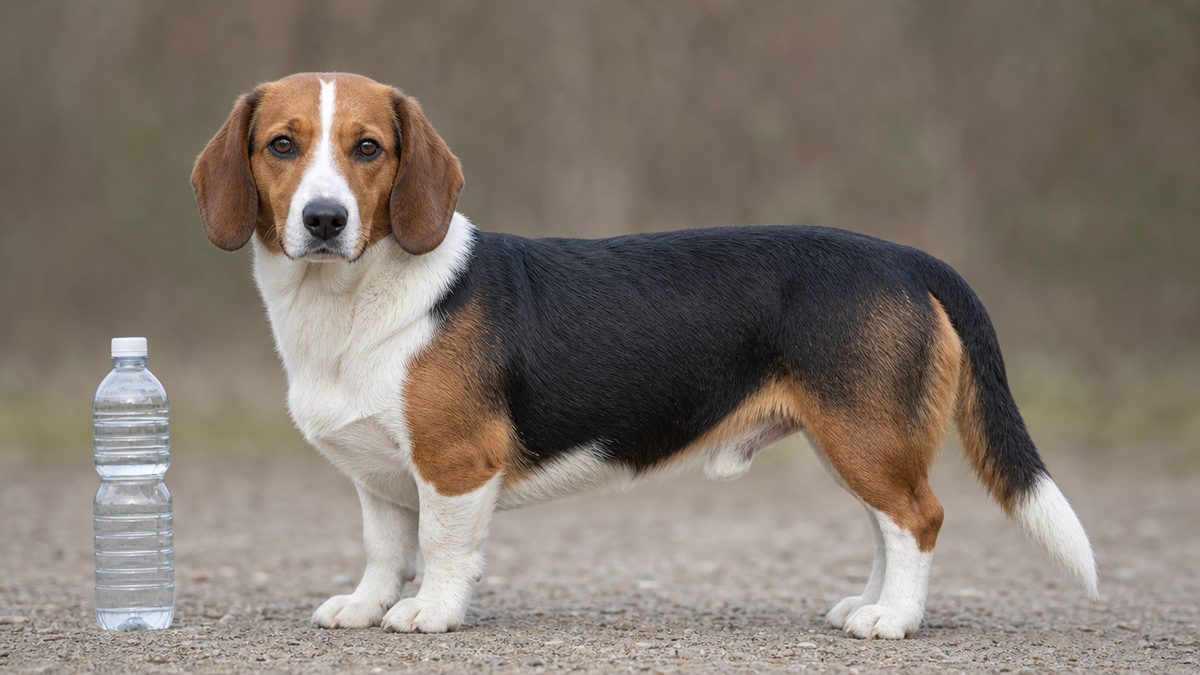
The Drever is a short-legged Swedish scenthound bred to drive roe deer slowly enough that the deer circles back to the hunter, standing 32 to 38 cm at the withers for males and 30 to 36 cm for females, and recognised by the Federation Cynologique Internationale as standard 130 on a definitive basis since 1 April 1955.
Everything else about the breed follows from that job description. A long-bodied, short-legged hound that drives game at a slow, steady pace needs stamina rather than speed, a voice loud enough to tell the hunter where it is, and a nose good enough to hold a line through Swedish forest. The FCI standard says so directly, calling for a dog that is robust and strong rather than elegant and speedy, with proud carriage, well developed muscles and an agile appearance.
The measurements that matter
Two numbers in the standard do more work than the height range. The first is the proportion: the distance between the ground and the sternum should be 40 percent of the height at the withers. The second comes from the breed club rather than the standard, and it is the body ratio, which the Swedish Drever Club's breeding strategy gives as 1:1.5 to 1.6 and lists as something the breed needs to watch, because dogs are drifting longer than that.
Read those together and you get a dog that is not what most Indian readers will picture. At 35 cm tall with 40 percent ground clearance, a male Drever's chest sits 14 cm off the ground, and its body is one and a half times its height rather than twice. That is a materially different animal from a Dachshund or a Dandie Dinmont Terrier, and the difference matters for the spine question this page answers later.
Head, ears, coat and tail
The standard describes a hound built for scent work and nothing else. The head is longish and tapering, with the muzzle equal to the skull in length and a black nose with well-developed, wide-open nostrils. The ears are set fairly low, medium long and broad, hanging without folds close to the cheeks, with rounded tips. Those ears are the one piece of conformation that costs an Indian owner money, and the reason is covered in the health sections.
The coat is harsh, straight and lying close to the body, shorter on the head, ears and lower legs, longer on the neck, back and backs of the thighs. The Swedish Kennel Club adds a detail the FCI text leaves out, describing it as a double coat with short hard guard hairs over a soft, dense undercoat. That undercoat is a Scandinavian feature and it is the second thing that does not transfer to India.
Colour is unusually permissive. All colours in combination with white markings are allowed, and the only excluded colours are predominant white, merle and liver brown, all three of which are disqualifying faults. White markings should preferably form a blaze, a full necklace, and appear on legs, feet and tail tip, with symmetrical markings preferred.
Where it came from, and the two versions of the story
The FCI standard and the Swedish Kennel Club tell the history slightly differently, and both are worth having. The FCI says the small-sized German hound, the Westphalian Dachsbracke, was imported to Sweden in 1910, that the first dogs were registered in 1913, and that little is known about the breed before 1930, after which it built a reputation as a very good tracker of deer.
The Swedish Kennel Club pushes the origin further back and further south, saying the dachsbracke was bred on the continent in the mid-1850s, in southern Germany, Tyrol and Switzerland, and imported to southern Sweden during the 1910s. It also explains the original name, which was meant to show the mixture in the breed's ancestry: the short-legged der Dachshund and the taller der Bracke.
Royal Canin's India page adds a third variation, saying the Westphalian Dachsbrackes were imported into Sweden and Denmark around 1910. We print all three rather than picking one. The dates that are not in dispute are 1913 for the first Swedish registrations, 1944 for the founding of the Swedish Dachsbracke Club, 1947 for the renaming to Drever, and 1953 for recognition as a Swedish breed.
The FCI standard records that in 1947 the larger Swedish variety of the Bracke, two centimetres higher at the withers, was the one given the name Drever. So the breed was defined by choosing the taller of two closely related types, which is a useful thing to know before assuming it belongs in the same category as the very low-slung breeds.
Reading the breed standard closely, including the clause that collides with Indian law
The current FCI standard for the Drever is dated 07.09.2021, with the official valid standard published 27.07.2021, and it marks its latest amendments in bold characters, which lets you see exactly what the FCI changed.
Three passages are printed in bold in that document, and one of them creates a direct collision with Indian breeding law that no other page about this breed has noticed.
The tooth clause
The bolded amendment reads that lack of PM1 and M3 should no longer be considered as a disqualifying fault, and that a level bite is permissible. In plain terms, the FCI decided that a Drever missing its first premolars and third molars is still a correct Drever.
Now read paragraph 8(10) of the Second Schedule Part III of the Prevention of Cruelty to Animals (Dog Breeding and Marketing) Rules, 2017, which sets out what an Indian breeder must have tested a breeding dog for. It reads, verbatim from the gazette:
"(10) The dogs shall have been tested for genetic defects, including hip dysplasia, progressive retinal atrophy, night blindness, hypothyroidism, entropion, ectropion, overshot, undershot jaw (when incisors do not touch or mesh), wry mouth, two or more missing teeth, unilateral cryptorchid or full cryptorchid males.";
Two or more missing teeth is named as a genetic defect in Indian law. A Drever missing both PM1s and both M3s is missing four teeth, and its own governing standard says that is not even a fault worth disqualifying on. Anyone breeding this breed in India has to reconcile those two texts, and the honest answer is that the Rules require testing rather than exclusion, so the clause bites as a documentation obligation rather than a ban. It is still the sort of thing a breeder should know before being asked about it.
Note the word including in that clause. The list is illustrative, not closed, so a defect is not outside the paragraph merely because it is unlisted.
What the standard does not contain
The FCI standard for this breed prints a heading reading SIZE AND WEIGHT and then gives only height. There is no weight figure anywhere in the seven-page document. That matters because the American Kennel Club's Foundation Stock Service page prints a weight of 35 to 40 pounds, roughly 15.9 to 18.1 kg, as though it were a breed standard figure. It is not in the standard the AKC's own page refers to.
The standard also contains no life expectancy, no colour percentage, and no coat-length measurement. Royal Canin India's page says its key facts and characteristics are sourced from the FCI while printing an average life expectancy of 12 to 14 years. That figure is attributed to a document that does not contain it.
Disqualifying faults, and why the colour ones matter in India
- Aggressive or overly shy dogs, and any dog clearly showing physical or behavioural abnormalities.
- One or both eyes blue, which rules out the merle-associated eye colour.
- Pronounced over- or undershot bite, and faulty position of a lower canine that can damage the upper gum or palate when the mouth is shut.
- Kinked or otherwise deformed tail.
- Predominant white coat, merle or liver brown colour, printed in bold as a recent amendment.
- Under- or oversized, meaning outside the 32-38 cm and 30-36 cm ranges.
The colour disqualifications are the ones an Indian buyer should carry into a conversation. A merle Drever is not a rare colour variant commanding a premium; it is a disqualifying fault in the breed's governing standard. Google's own related-search strip for this query offers White drever dog price in india and Red drever dog price in india, and predominant white is specifically excluded.
Two colours the breed club wants banned outright
The Swedish Drever Club goes further than the FCI. Its breeding strategy sets short-term goals of making long hair a disqualifying fault and grey colour a disqualifying fault, and it explains why. Grey arises from a double dose of the dilution allele, and the grey coat can be associated with colour dilution alopecia, which thins the coat or causes hair loss and leaves the dog unprotected against injury and cold in the forest.
DNA tests already exist within the breed for long hair, liver colour and grey dilution, and the club's rule is that a carrier of an undesirable or disqualifying defect testable by DNA may be bred if the other parent is confirmed clear, while a dog that has liver colour, long hair or grey colour must not be bred at all.
How common the Drever really is, and the claim that gets copied everywhere
The Drever was the fourteenth most registered breed in Sweden in 2025, with 586 puppies out of 39,304 dogs registered with the Swedish Kennel Club that year, which is 1.5 percent of the national total.
That single line settles a claim that appears on almost every English-language page about this breed. The American Kennel Club's page states plainly that the Drever is Sweden's most popular dog. The Swedish Kennel Club's own registration statistics say otherwise, and they say it in a table anyone can open.
| Rank | Breed | 2025 registrations | 2024 |
|---|---|---|---|
| 1 | Labrador retriever | 2,899 | 2,805 |
| 2 | Golden retriever | 1,702 | 1,595 |
| 3 | German shepherd dog | 1,235 | 1,399 |
| 4 | Jamthund | 1,117 | 974 |
| 5 | Cocker spaniel | 987 | 965 |
| 9 | Danish-Swedish farmdog | 743 | 840 |
| 14 | Drever | 586 | 595 |
| 20 | Australian shepherd | 492 | 464 |
The Labrador retriever has been the most popular breed within the Swedish Kennel Club for the fifteenth year running, and at 2,899 registrations it outnumbers the Drever by a factor of 4.9. Even the Jamthund, Sweden's own elkhound, is registered at nearly twice the Drever's rate.
The trend is downward, and the breed club says so
The Swedish Drever Club's breeding strategy sets a long-term goal of reaching 1,000 registrations a year in Sweden and states openly that the breed is not there yet. At 586 in 2025, it is 41 percent short of its own target. The club's own table records 1,050 Swedish registrations in 2000, so the 2025 figure is a 44 percent fall across twenty-five years.
The shorter trend is worse. The club's table ends at 870 for 2021; the Swedish Kennel Club's published figures give 595 for 2024 and 586 for 2025 Svenska Kennelklubben. That is a 33 percent fall in four years. The club names two threats to the Drever as the hunter's first choice, and neither is what an Indian reader would guess: short-driving hound breeds, and the growing wolf population.
The breed is Nordic, not just Swedish
The Drever exists in meaningful numbers in three countries. The breed club's table gives 2021 registrations of 870 in Sweden, 351 in Norway and 412 in Finland, a Nordic total of 1,633, and it notes that only isolated individuals exist in Denmark. A male may be used for up to 15 litters nationally and a maximum of 125 puppies at Nordic level, and only after his offspring reach a 30 percent prize rate on hunting trials.
So the entire global gene pool of this breed sits in three Nordic countries and produces on the order of 1,600 puppies a year. That number, not any rupee figure, is the honest answer to how easy it is to obtain one in India.
What the breed is not
The Drever is rare outside Scandinavia and it is a working animal inside it. The Swedish Kennel Club's breed page says the breed is a pronounced hunting dog and does not suit as a companion dog alone, and that it suits an owner who has access to hunting grounds. The FCI standard makes the same point more bluntly, saying the breed is strictly kept as a hunting dog and is hardly ever heard of as just a companion dog.
The AKC line that the Drever is Sweden's most popular dog is repeated across the breed's English-language coverage, and one page even compares its Swedish status to the Labrador's status in America. The Swedish Kennel Club publishes its top-20 table every January and it takes one minute to read. In 2025 the Drever was fourteenth.
Drever price in India: what exists, what does not, and what the arithmetic says
No verified Drever price in India exists, because there is no Indian breeding population and no lawful commercial import route for one. Exactly one page in the Indian search result set prints a figure, Rs 25,000 to Rs 40,000, and Google's AI Overview repeats it as fact.
That is the whole Indian price in india evidence base for this breed. It is one number from one page. Before anyone treats it as a market rate, it is worth running the tests this site runs on every suspicious rupee figure.
The conversion tests, and why they cannot settle it
Indian breed pages routinely publish a United States dollar price run through one exchange rate. Four rates have been caught doing this. Here is what each does to the two Drever figures.
| Rate | Rs 25,000 becomes | Rs 40,000 becomes | Verdict |
|---|---|---|---|
| 84.38 | USD 296.28 | USD 474.05 | No clean match |
| 74.00 | USD 337.84 | USD 540.54 | No clean match |
| 80.00 | USD 312.50 | USD 500.00 | Passes by construction, and 312.50 is not a price |
| 66.67 | USD 375.00 | USD 600.00 | Passes by construction, because both figures are multiples of 200 |
The two apparent matches are worthless and it is worth saying why. Dividing by 80 means multiplying by 0.0125, so any rupee figure ending in three zeros divides cleanly at 80. Dividing by 66.67 is dividing by 200/3, so any multiple of 200 divides cleanly. Both 25,000 and 40,000 are multiples of 1,000, so they pass both tests automatically and neither test carries information.
The strong test is 84.38, and both figures fail it. So these are rupee-native round numbers, not a converted dollar list. The same page's monthly costs confirm it: Rs 2,200 and Rs 3,750 divide to 26.07 and 44.44 at 84.38, and to 27.50 and 46.88 at 80. Nobody prices anything at those numbers in any currency.
So what does Rs 25,000 to Rs 40,000 actually mean
It means someone chose the two roundest numbers in a plausible band. It is not evidence of a transaction, a breeder, a litter or a market. Bonbeno publishes it as what one page says, because it is the only figure that exists, and we do not restate it as a price.
The other rupee figures on page one, in order
- Rs 356 on Etsy, for Drever Dog Vector Art, a downloadable clip-art bundle rated 4.9 from 813 reviews. This is a real price for a real product and the product is a file.
- Rs 25,000 to Rs 40,000 on the one breed page that prints a price, tested above.
- Rs 50 crore, from an Instagram reel about a Bengaluru breeder acquiring a wolfdog hybrid named Cadaboms Okami. It has nothing to do with this breed and it ranks on page one of an India query for it.
- Rs 2,000, a booking charge on a Varanasi kennel's uploaded price chart whose Google snippet names Pom, German Shepherd, Labrador, Pug and Doberman. A snippet is not a row, so no Drever price is claimed from it.
Three of those four figures are not prices for this dog. That is the state of the market, and it is more useful to a buyer than any number would be.
If anyone in India offers you a Drever puppy at any price, ask for the export pedigree in original, the DGFT licence, the airway bill and the quarantine clearance document. Those are not Bonbeno's inventions; they are four of the ten items on the Kennel Club of India's own checklist for registering a dog as import status. A seller who cannot produce them is not selling you what they say they are.
The template seam, and the AI Overview that misquotes its own source
Both Indian pages that rank for this breed are generated templates rather than written articles, and the seams are visible in their own markup. The more serious finding is downstream: Google India's AI Overview for this query prints a monthly food cost 2.5 times higher than the page it names as its source.
Finding one: the AI Overview inflates the figure it cites
Google's AI Overview for drever dog price in india opens by saying a Drever puppy usually costs between Rs. 25,000 and Rs. 40,000 in India, attributed to Happy Pet Care, which is correct: that page prints exactly those numbers. It then adds a Monthly Maintenance Costs block saying to expect around Rs. 3,000 to Rs. 5,000 per month on quality dog food, attributed to the same page.
Open that page and its monthly food expense line reads Rs 1,200 to Rs 1,800. The overview's lower bound is 2.5 times the source's lower bound and its upper bound is 2.8 times the source's upper bound.
The source page's own arithmetic is internally consistent, which makes the gap harder to explain away. Its basic monthly total of Rs 2,200 is food Rs 1,200 plus veterinary Rs 300 plus grooming Rs 700, and its premium total of Rs 3,750 is Rs 1,800 plus Rs 750 plus Rs 1,200. Both add up exactly. The AI Overview's food figure alone exceeds the source page's entire basic monthly budget.
An Indian buyer reading Google's answer box takes away a monthly cost roughly two and a half times what the only source says. Nothing in the presentation signals a departure from the citation. This is how a figure nobody wrote becomes the consensus answer for a breed, and it is worth checking any answer box against the page it names.
Finding two: the first-ranked page is running default template headings
The page that ranks first, and that the AI Overview cites, carries three headings in the form a template fills from the URL slug rather than from anything a person wrote. They read Prerequisites to pet a Drever, Healthcare Tips for Drevers and Common Health Issues in Drevers. That is the same default-heading signature this site has documented on other breeds, and it identifies assembled pages rather than written ones.
The content confirms it. The page's Common Health Issues chips are bloat, canine distemper, hip dysplasia, heartworm, kennel cough, parasites, parvovirus and Lyme disease. Six of those eight are infectious diseases or parasite categories that apply to every dog in the world. Not one of the eight is the condition the Swedish Kennel Club and the Swedish Drever Club both name as the breed's largest health problem.
Its vaccination table recommends a Lyme disease vaccine at 16 to 18 weeks. Lyme disease is not a core Indian canine vaccination, and the tick-borne pathogens actually found in Indian dogs are a different set entirely, covered later on this page.
Finding three: the directory page's own filename gives it away
The Justdial category page titled Pet Shops For Drever Dog in Khanna lists ten businesses, three of them in Khanna and seven in Mohali, Ambala, Mandi, Dehradun, Roorkee, Delhi and Jammu. One of the three Khanna entries is a Rottweiler kennel. No listing states that it holds the breed.
The seam is in an image filename. One padding entry's photograph is served from a path reading pet-shops-for-dutch-smoushond-dog, so the same photograph is doing duty on the site's Dutch Smoushond category page. The page's own meta description cross-sells Pet Shops For Labrador Dog and Pet Shops For German Shepherd Dog, and one listing's Website field reads royalcanin.com, which is a food brand rather than that shop.
Its body copy then calls the Drever a medium-sized breed that makes a great companion for families. The Swedish Kennel Club says the breed does not suit as a companion dog alone, and the FCI puts males at 32 to 38 cm.
What we take from all three
Cite such pages as evidence of how the query is being answered, never for a fact about the dog. That is how they are cited here.
The lawful route into India, and the one that does not exist
Importing a Drever into India for breeding or sale is not permitted, and the instrument that says so is DGFT Trade Notice No. 22/2022-23 of 19 December 2022, which classifies dogs under ITC(HS) 01061900 as Restricted.
That notice sets out two policy conditions in terms an importer cannot read around.
Policy Condition (7): "Import of dogs is allowed only for the following specific purposes: - i. Pet dog with valid pet book and relevant records/documents in the name of importer. ii. Dogs imported by the R&D Organisations for conducting research with the recommendation of CPCSEA. iii. For the internal security by the Defence and Police Force." Policy Condition (8): "Import of commercial dogs for breeding or any other commercial activities other than the purposes mentioned above is not permitted.";
Paragraph 6 of the same notice closes the loop, stating that any applications for trading or breeding purposes, or applications made on behalf of another person or entity, shall be duly rejected. So no Indian kennel can lawfully import a Drever in order to found a breeding line, and with no Indian population to breed from, no lawful domestic supply chain can form.
What the personal route requires
One route exists and it is narrow. A person transferring residence to India after more than two years of continuous stay abroad may bring up to two pets as passenger baggage without a DGFT authorisation. Import authorisation from DGFT is required if the stay abroad was under two years, if the pet is not travelling as passenger baggage, or if the pet cannot come under the baggage rules at all.
- Start early. The notice tells applicants to begin the import authorisation application at least two months before the travel dates.
- Use a listed port. Import of pet animals is allowed only through the airports and seaports of Delhi, Mumbai, Chennai, Hyderabad, Bengaluru and Kolkata and, since October 2024, Kochi airport, and animals may be quarantined at the government quarantine station of that port.
- Obtain the advance NOC. An Advance No Objection Certificate from the Regional or Quarantine Officer of that port is needed seven days before travel, relaxable up to three days, after submitting the DGFT import licence and the exporting country's health certificate.
- Test in the exporting country. The disease testing prescribed in the health certificate must be done before departure and all test reports must accompany the animal.
A separate instrument, S.O. 4396(E) of 10 October 2024, added Cochin International Airport, Kochi as a point of entry for pet dogs and cats under the Livestock Importation Act, 1898. That sits on the pet route rather than the DGFT notice, which still names six ports for its own licence route, so a pet arriving under the baggage rules can land at seven ports today and a licence-route import plans on the DGFT's six. Both lists are right for their own route, as how to import a dog to India sets out.
Registering the dog once it lands
India is a Full member of the Federation Cynologique Internationale, represented by the Kennel Club of India at Anna Nagar, Chennai. That is what makes FCI recognition the practical answer to whether a breed is recognised in India: the kennel club of india issues pedigrees against FCI nomenclature, and the Drever holds FCI standard 130 on a definitive basis.
Registering an imported dog with the KCI costs Rs 2,500 including GST under the tariff effective 1 April 2024, and a four-generation certified pedigree is a further Rs 1,000. The paperwork is the harder part. The KCI's own checklist requires the export pedigree in original, the airway bill in original, the air ticket in original, the boarding pass, the DGFT licence, the customs clearance document, the quarantine clearance document, the pet passport and a notarised affidavit.
A Drever can lawfully enter India in exactly one way: as the pet of someone moving home, with a pet book in their own name, through one of seven named ports, with two months of lead time. It cannot lawfully be imported to breed or sell. Any Indian listing offering one is therefore describing something other than what it claims.
Cost of ownership: what is knowable, and what nobody can honestly tell you
No reliable Indian cost-of-ownership figure exists for the Drever, because there is no Indian population of the breed to observe. What is knowable is the fixed regulatory cost, which is published, and the breed-specific cost drivers, which are different from those of any other small hound.
Two monthly cost figures circulate for this breed in India and they disagree with each other by a factor of two and a half. The one page that prints costs gives food at Rs 1,200 to Rs 1,800 a month, veterinary at Rs 300 to Rs 750, and grooming at Rs 700 to Rs 1,200, totalling Rs 2,200 basic and Rs 3,750 premium. Google's AI Overview, citing that page, gives food alone at Rs 3,000 to Rs 5,000 a month. Neither figure is grounded in an observed Indian Drever.
Bonbeno publishes no monthly rupee estimate for this breed. Inventing one would be the same act the two sources above performed, and it is the failure this page exists to correct.
The costs that are published and fixed
| Item | Published fee | Source |
|---|---|---|
| KCI registration of an import dog, inclusive of GST | Rs 2,500 | KCI tariff effective 1 April 2024 |
| KCI certified pedigree, four generations | Rs 1,000 | Same tariff |
| KCI transfer of ownership, dog over 12 months | Rs 1,000 | Same tariff |
| KCI duplicate registration certificate | Rs 1,000 | Same tariff |
| KCI export pedigree, if the dog ever leaves | Rs 2,000 | Same tariff |
Those are the only Drever-related rupee figures on this page that come from the organisation that charges them. Everything above them, the flight, the DGFT authorisation, the quarantine period at the port and the exporting country's health testing, varies by origin and cannot be quoted as a range without inventing one.
The three cost drivers that are specific to this breed
- Ear care, continuously. Pendulous ear carriage carries 1.76 times the odds of otitis externa compared with erect ears, from a VetCompass sample of 22,333 UK dogs. This is a recurring cost in a humid climate, not a one-off.
- Emergency respiratory care, unpredictably. The breed's one documented disease presents as acute respiratory distress within minutes of hard exercise and needs a vet immediately. Budget for the possibility of an out-of-hours emergency rather than for a monthly line item.
- Tick-borne disease prevention, year round. Ticks were found on 278 of 525 dogs examined across four Indian cities, and 261 of those 525 were positive by PCR for at least one tick-borne pathogen. A hound that works through undergrowth meets more ticks than a dog that walks on pavement.
What is cheap about this breed
Grooming is genuinely low. The Swedish Kennel Club describes the short double coat as easy to care for and bathed as needed, and the FCI standard describes a harsh, straight coat lying close to the body with no furnishings to maintain. There is no hand-stripping, no clipping schedule and no professional salon requirement, which removes the largest recurring grooming cost that small long-coated breeds carry in India.
Feed volume is also modest. A dog of 32 to 38 cm at the withers eats far less than the retrievers that dominate the Indian pedigree market, and the Swedish Drever Club's whole concern with body condition is that the dog stays fit for a working day rather than that it stays slim for a show ring.
The recurring cost of a Drever in India would be low, driven mainly by ear care and parasite control rather than by grooming or feed. The unpredictable cost is the one that matters, and it is an emergency the ranking pages do not mention. Anyone quoting you a tidy monthly figure for this breed in rupees is quoting a number no one has measured.
Heat tolerance: comparing wet-bulb, not just air temperature
The Drever's home climate is roughly 20 C cooler than India's, but air temperature understates the problem, because a dog sheds heat almost entirely by evaporation and evaporation is limited by the wet-bulb temperature rather than the air temperature.
No breed developed in southern Sweden is heat-tolerant in an Indian sense, but the size of the gap is worth measuring rather than asserting. A dog has no useful sweating. It cools by evaporating water from the respiratory tract while panting, and the theoretical floor for any purely evaporative cooling is the wet-bulb temperature, the temperature a wet surface reaches in moving air. Two places at the same air temperature can therefore be very different for a dog if one is dry and one is humid. Comparing air temperature alone is the standard mistake on breed pages and it flatters humid coastal India.
So this page compares both. All figures below come from NASA POWER's 1991-2020 climatology, queried by explicit latitude and longitude rather than by place name, so that no other location can be served by accident.
The reference point: where the breed actually works
Vaxjo in Kronoberg, in the Smaland deer country of southern Sweden, sits at 56.8777 N, 14.8091 E. Its annual mean air temperature is 6.38 C, its warmest month is July at 16.43 C, and its coldest is January at -2.67 C.
The wet-bulb figures are the ones that matter. Vaxjo's annual mean wet-bulb is 5.33 C, and its highest monthly wet-bulb is July at 14.60 C. Swedish deer and hare hunting runs roughly from August into January, and across those months Vaxjo's wet-bulb runs from 14.17 C in August down to -2.98 C in January. That is the envelope this breed was selected in.
The comparison that decides the question
| Place | Annual mean wet-bulb | Coolest month wet-bulb | Warmest month wet-bulb |
|---|---|---|---|
| Vaxjo, Sweden | 5.33 C | -2.98 C (Jan) | 14.60 C (Jul) |
| Stockholm, Sweden | 5.20 C | -3.54 C (Jan) | 15.29 C (Jul) |
| Bengaluru | 19.71 C | 16.29 C (Jan) | 22.55 C (May) |
| Pune | 19.50 C | 14.11 C (Jan) | 23.48 C (Jun) |
| Delhi | 17.76 C | 6.85 C (Jan) | 27.72 C (Jul) |
| Mumbai | 22.60 C | 16.94 C (Jan) | 26.45 C (Jun) |
| Kolkata | 22.73 C | 13.55 C (Jan) | 27.76 C (Jun) |
| Chennai | 24.87 C | 21.68 C (Jan) | 27.29 C (May) |
Read the two right-hand columns against Vaxjo's 14.60 C. Chennai's coolest month is 7.08 C hotter in wet-bulb terms than Vaxjo's hottest month. Bengaluru, the mildest of the six Indian cities on annual mean, still runs 1.69 C above a Swedish July in its own January. In wet-bulb terms, most of urban India never has a Swedish summer.
The exception, and it is a real one
Delhi is the outlier, and in the useful direction. Its wet-bulb swings 20.87 C across the year, from 6.85 C in January to 27.72 C in July. December at 7.80 C and February at 9.43 C sit in the same band. All three are below Vaxjo's July wet-bulb, and inside the range the breed hunts in.
Pune's January, at 14.11 C, is marginally under a Swedish July. Nowhere else in this set comes close in any month.
There are about three months a year, in Delhi and the dry north, when the outdoor conditions a working Drever was bred for actually exist in India. Everywhere else, and for the other nine months, the dog is being asked to do its job in air it cannot cool itself in. That is not a reason nobody should keep one. It is the single fact that should shape how one is kept.
Temperament: what Sweden says versus what the ranking pages say
The Drever is an even-tempered, loyal, socially easy hound in the house and a driven, vocal working dog outside it, and the Swedish Kennel Club states plainly that the breed does not suit as a companion dog alone.
That last clause is the single biggest disagreement between the breed's home authority and the pages ranking for it in India, and it is worth putting the two side by side.
| Source | What it says |
|---|---|
| Svenska Kennelklubben | The breed is a pronounced hunting dog and does not suit as a companion dog alone. It suits an owner with access to hunting grounds, and needs care and activity all year, not only in the hunting season. |
| FCI-Standard N 130 | The breed is strictly kept as a hunting dog and is hardly ever heard of as just a companion dog. |
| Svenska Dreverklubben | The Drever today is a perfect family dog with a calm, harmonious temperament, and should be the hunter's first choice for small-game hunting as well as a loved family member. |
| The page ranking first in India | Yes, Drevers are friendly, affectionate and great with families. |
Note that the disagreement is not simply India versus Sweden. The breed club itself calls the Drever a perfect family dog with a calm harmonious temperament, while stating in the same document that the breeding goal is a kind, healthy dog with excellent hunting drive. The kennel club and the standard both push the other way FCI-Standard N 130 DREVER.
The reconciliation is in the club's own phrasing. It says the Drever should be the hunter's first choice as well as a loved family member, not instead of. Nobody in Sweden is describing a dog that lives as a pet and never works.
What the standard requires of temperament
The FCI standard asks for a keen and even-tempered hound that is never aggressive, nervous or shy, and it makes aggressive or overly shy dogs a disqualifying fault. The breed club adds that the general view among Drever people is that the breed used to have a sharper mentality that has been bred out, that isolated individuals still behave badly in show rings and at trials, and that a hereditary connection is often visible.
Its short-term goals are correspondingly direct: do not breed animals that are aggressive or shy, report unacceptable behaviour, and encourage judges to award a Disqualified quality grade on temperament grounds where justified.
The voice, and what it means in an Indian flat
The Drever is bred to bark while working. The FCI standard's own historical summary describes a dog that tracks deer, and the Swedish Kennel Club is specific: the breed has a dense and good bark during the drive, to mark where the game is. The breed club adds that relative to its size the Drever often has a particularly well-sounding voice.
That is a selected trait, not a training failure. A dog bred for a carrying voice in forest will use it in a stairwell. Anyone in a shared building should treat the noise question as the first practical objection to this breed, ahead of size, cost or grooming.
The slow-driver temperament, and why it is unusual
The Drever is a langsamdrivare, a slow driver, and the Swedish Kennel Club explains why that matters: the game is not stressed unnecessarily and loops back nicely to the hunter. A scent hound selected for patience rather than speed is a genuinely different animal from a fast-running hound, and it shows in the house as a dog that settles rather than one that paces.
Set against that, the breed club's short-term worry is the opposite of what a pet buyer would expect. It reports concern from local trial committees that three working traits may be deteriorating: search, voice, and driving style, specifically dogs with a careless driving style.
Training a scenthound in India, and the one trait you will not train out
Train a Drever the way you would train any scenthound, by accepting that the nose outranks you and building recall around that fact rather than against it. This is an independent working breed, not a biddable one, and its hunting instinct is the trait the whole breed exists for.
Start from what Sweden actually selects for. To be recommended for breeding, a Drever should have reached at least a 2nd prize on a hunting trial and at least Very Good at a show, and every dog used in breeding must be qualified on both. For a male to go past seven litters and reach fifteen, his offspring must achieve a 30 percent prize rate across all offspring regardless of age.
Read that as a description of temperament and it tells you what you are buying: a dog whose entire selection history rewards independent decision-making on a scent line, out of sight of the handler, for long periods.
What works
- Pay the nose. Use scent games and tracking as the reward rather than treating scent as the distraction. A hidden-food trail across a terrace tires this dog more than a walk does.
- Train recall on a long line first. A dog bred to work out of sight will not come off a fresh line at ten months because you asked politely. Build the behaviour where you can enforce it.
- Start early. Royal Canin's own key facts for the breed list training should start early, and it is one of only three key facts the page gives.
- Socialise deliberately. Indian street dogs, cattle, autos and market crowds are all novel to a breed developed in empty forest, and the socialisation window closes on the same schedule regardless of breed rarity.
- Manage the voice from week one. Reward silence, name the bark so you can ask for it and then stop it, and never let barking be the thing that gets a door opened.
What you will not fix
You will not train out the drive to follow a scent line, and you should not try. The Swedish Kennel Club describes the breed as requiring an outlet for what it was bred to do, and says it needs care and activity all year rather than only in the hunting season. A Drever without that outlet is the problem dog, and the barking, digging and door-dashing that follow are symptoms rather than the disease.
Off-lead freedom in an Indian city is the specific risk. A hound following a line does not check traffic, and the prey drive that makes it good at its job makes it dangerous near a road. Assume a long line or a secure enclosure for the dog's whole life.
The training constraint nobody else mentions
There is one training rule specific to this breed and it comes straight from its disease. Because the documented condition is triggered by hard exercise and by excitement, high-arousal training in heat is not merely unproductive, it is the exact load the syndrome runs on. The proposed 2003 mechanism was high catecholamine levels present during hunting due to the stress of excitement and exercise.
Do your arousal work, your chase games and your long tracking sessions in the coolest hour you have, and keep them short. Excitement and exertion are the same input as far as this breed's lungs are concerned, and in most Indian cities the wet-bulb temperature never falls to what a Swedish August offers Egenvall A, Hansson K, Sateri H, Lord PF.
Everything else about this dog is straightforward. It is trainable in the ordinary sense, food-motivated, not sharp, and easy to live with once its head has had a job.
Exercise: how much, and the timing rule that outranks the amount
A Drever needs daily work all year, and in India the hour you exercise it matters more than the distance, because the same exertion that satisfies the dog is the documented trigger for its one breed disease.
Sweden is explicit about the quantity. The breed requires an outlet for what it was bred to do, needs a great deal of regular exercise and stimulation, and needs care and activity all year and not only during the hunting season. That last clause is aimed at Swedish owners who work the dog for four months and let it idle for eight, and it applies with more force to an Indian owner who never works it at all.
The English-language pages give a much smaller number. The first-ranked Indian page puts the exercise routine at 30 to 60 minutes and the energy level at medium, while Royal Canin's key facts say the breed needs moderate exercise. Both are lower than what the breed's home authority describes, and this page prints the disagreement rather than splitting it.
The timing rule
The rule that matters is not how long but when. Exertional heat-related illness accounted for 652 of the 879 UK events with a recorded trigger, 74.2 percent, and within the 551 exertional events with a specified activity, 372, or 67.5 percent, followed a walk rather than any intense sport. Ordinary exercise is what puts dogs in a clinic.
Now lay the wet-bulb numbers over an Indian day. Chennai's mildest month, January, still sits at a wet-bulb of 21.68 C, above anything the breed's home range ever reaches, and its May peak is 27.29 C. Kolkata in June reaches 27.76 C and Delhi in July 27.72 C.
| City | Months at or below a Swedish July wet-bulb of 14.60 C | Practical verdict |
|---|---|---|
| Delhi | December at 7.80, January at 6.85, February at 9.43 | Three months of genuine working weather |
| Pune | January at 14.11 | One marginal month |
| Kolkata | January at 13.55, December at 14.82 is just above | One month, borderline |
| Bengaluru | None, January is 16.29 | Mild but never Swedish |
| Mumbai | None, January is 16.94 | No working window |
| Chennai | None, January is 21.68 | No working window |
What to do in the nine or twelve months that are not in that table
- Move the work indoors. Scent games on a floor tire a hound properly and generate almost no heat load. Hide food, hide a scented cloth, and make the dog search rather than run.
- Split the walk. Two short outings at first light and after dark beat one long one at any other hour.
- Stop at the first sign. Coughing, rapid breathing, refusing to lie down or sitting with the head stretched forward means stop and call a vet, not slow down.
- Do not let excitement substitute for heat. The 2003 mechanism implicates the stress of excitement alongside exercise, so a high-arousal game indoors in a hot room is not a safe swap for a walk.
- Skip the swim as a cooling strategy unless you dry the ear canal afterwards, because pendulous ears carry 1.76 times the odds of otitis externa.
A Drever kept in Delhi can have three months a year of the outdoor life it was bred for and nine months of managed indoor work. A Drever kept in Chennai has none, and needs its entire exercise programme rebuilt around scent rather than distance. Neither is impossible. Both are a long way from the 30 to 60 minutes the ranking page suggests.
Grooming: the easiest thing about this breed, and the one part that is not
Coat care for a Drever is close to trivial, because the harsh close-lying coat needs brushing and occasional bathing and nothing else. Ear care is the exception and it is where the whole grooming budget goes in Indian humidity.
The FCI standard describes hair that is harsh, straight and lying close to the body, shorter on the head, ears and lower legs and longer on the neck, back and backs of the thighs, and bushy on the underside of the tail without forming a fringe. The Swedish Kennel Club adds that this short coat is a double coat, with short hard guard hairs over a soft dense undercoat, that it is easy to care for, and that the dog is bathed as needed.
There is no hand-stripping, no clipping schedule, no professional trim and no salon dependency. For an Indian owner that removes the single largest recurring grooming cost that small imported breeds carry here.
The undercoat in Indian heat
One thing does not transfer. A dense undercoat is Scandinavian equipment, and it goes on insulating in a climate where insulation is the problem. Expect heavier and less seasonal shedding than a Swedish owner would describe, and groom with an undercoat rake through the year rather than in spring and autumn bursts.
Do not shave it. A double coat that has been clipped short loses the guard-hair layer that reflects heat and protects skin, and the dog gains nothing thermally because it does not cool through its skin in the first place. The breed club's argument against the grey coat makes the same point from the other direction: it wants grey disqualified because a thin coat, or actual hair loss from colour dilution alopecia, leaves the dog unprotected against injury and cold. Coat is protection, not a blanket to be removed.
The ears, which are the actual job
Ears set low and hanging without folds close to the cheeks trap warmth and moisture against the canal. In UK primary-care data, breeds with pendulous ear carriage carried 1.76 times the odds of otitis externa and breeds with V-shaped drop ears 1.84 times, against a one-year period prevalence of 7.30 percent across 22,333 dogs.
Indian conditions add seasonality. The Durg series found otitis cases distributed 41.18 percent in summer, 33.33 percent in the rainy season and 25.49 percent in winter across 51 cases from 281 dogs.
- Look weekly. Lift the flap, look, and smell. A yeasty smell precedes a visible problem by days.
- Dry after every bath and every swim. Overseas breed-care advice that says to towel off and let the dog air dry was written for a climate where things dry. It does not transfer.
- Do not flush routinely. Cleaning a healthy ear with liquid on a schedule can macerate the canal. Clean when there is something to clean.
- Treat a head-shake as a vet visit, not a grooming task, once it repeats over two days.
The rest of the routine, in one line each
- Nails: short, because a working hound's foot is meant to be firm with well-knit toes and a long nail splays it.
- Teeth: brushed, and worth noting that Indian law's genetic-defect clause names two or more missing teeth while the FCI standard now tolerates absent PM1 and M3.
- Ticks: checked daily during any outdoor work, given that ticks were found on 278 of 525 dogs examined across four Indian cities.
- Skin folds: none to manage, which is one fewer monsoon problem than most short-coated Indian favourites.
Health: how much is actually known about this breed
The entire peer-reviewed literature on the Drever is five papers. A PubMed search on 27 August 2026 for Drever in the title or abstract, combined with dog, returned exactly five records, with the query translation reporting no term dropped or expanded, against a control search that returned 126.
That number is worth stating before any health issues are discussed, because it sets the ceiling on what anyone can honestly claim. Five papers is not nothing. For a breed of roughly 1,600 Nordic puppies a year it is more than most, and one of the five is a 2024 study from a university teaching hospital. But it is small enough that you can list all of them.
| Year | Study | What it covers | Sample |
|---|---|---|---|
| 2024 | Viitanen and colleagues, Acta Veterinaria Scandinavica | Whether hunting-associated pulmonary oedema is caused by faulty lung surfactant | 7 affected Drevers, 7 healthy controls |
| 2015 | Rortveit and colleagues, Veterinary Pathology | Collagen type III glomerulopathy, a kidney disease | One Drever litter, plus 10 affected dogs from two strains |
| 2008 | Gavrilovic and colleagues, Theriogenology | Reproductive patterns, season, litter size and whelping | 2,717 SKK litters 1995-2006, plus one kennel |
| 2004 | Egenvall and colleagues, Veterinary Record | Inheritance of pulmonary oedema | 266 offspring of Drever dams and sires |
| 2000 | Egenvall and colleagues, Preventive Veterinary Medicine | Age pattern of mortality across eight insured breeds | Eight breeds, over 50,000 dogs a year |
Three of the five are about one condition. That is the honest shape of this breed's health picture, and it is nothing like the eight generic conditions the ranking page lists.
What the Swedish authorities say
The Swedish Kennel Club's breed page gives the whole of its health section in two clauses: the breed has few health problems, but within the breed there occur breathing problems after or in connection with hunting, and abnormal tiredness, so-called jaktodem.
The Swedish Drever Club's fifteen-page breeding strategy is blunter. It says the Drever is on the whole a very healthy breed, that the risk of veterinary treatment is 0.77 relative to the average breed on the Agria insurance breed profile for 2006-2011, and then that lung oedema is the largest disease problem for the Drever and that despite great efforts the club is not sure the problem has decreased.
The same document names three further inherited conditions that occur in the breed: progressive retinal atrophy, colour dilution alopecia linked to grey colour, and collagen type III glomerulopathy. Nothing else.
The tension worth publishing rather than resolving
Two Swedish datasets point in different directions and this page prints both. The Agria veterinary-care profile for 2006-2011 puts the breed's treatment risk at 0.77 of the average, meaning Drevers are treated less than the average dog. The 1996 Swedish life-insurance cohort put the Drever's probability of survival to five years at 83 percent, tied with the Bernese Mountain Dog and German Shepherd for the lowest of the eight breeds studied.
Those are different companies, different decades, different products and different outcomes, so they are not directly comparable and neither cancels the other. But a breed that is treated below average and dies above average is a pattern worth a reader's attention, and it is consistent with a condition that kills suddenly during exercise rather than accumulating vet visits.
There is no OFA screening scheme for this breed, no published hip or elbow statistics, and no Indian data of any kind. Where this page has no figure, it says so rather than borrowing one from a Dachshund or a Beagle.
Hunting-associated pulmonary oedema: the disease this breed actually has
Hunting-associated pulmonary oedema affects almost exclusively Drevers, runs at about 4 percent in the breed by its own club's 2020 health survey, and is triggered by hard exercise, which is precisely the variable an Indian climate makes worse.
The 2024 University of Helsinki paper opens by describing the syndrome as one that affects almost exclusively drevers, a Swedish chondrodystrophic hunting dog breed, with cases also documented in other breeds of similar body conformation and hunting style. No other breed on this site has a disease described that way.
What it looks like
The Swedish Drever Club describes the presentation in terms an owner can use. Typical symptoms are coughing, tiredness, the dog being unable to lie down after hunting, sitting up with rapid breathing and the head stretched upward. During a chase, the dog may fall silent mid-drive.
The clinical description matches. Signs begin during or within minutes after hunting and include rapid breathing, coughing, laboured breathing and lethargy. Chest radiographs typically show infiltrates in the caudo-dorsal lung fields, which clear without specific treatment, and the heart looks normal on echocardiography.
A Drever that coughs, breathes fast, refuses to lie down, or sits up with its head stretched forward after exercise needs a veterinarian the same hour. Lung histopathology in dogs euthanased during breathlessness has confirmed pulmonary oedema as the cause of the signs, so this is fluid in the lungs, not fatigue.
How common, and at what age
The breed club's autumn 2020 health survey led its breeding committee to conclude that the frequency of lung oedema is about 4 percent. Two Nordic clubs, a Swedish university and the University of Helsinki began a joint research programme in 2021, and a first licentiate study by Tiina Nikupetteri analysed data previously collected in Sweden and Finland.
That analysis found males fall ill younger than females. The median age at onset was 29.8 months in males and 43.3 months in females. Coughing as a symptom was more frequent in males, and dogs with a cough fell ill younger than those without, which the club reads as coughing marking a more severe picture because the fluid has risen high enough to irritate the cough receptors.
The clinical case definition used at Helsinki is stricter and worth knowing: recurrent respiratory distress associated with hunting, with a first episode at or before six years of age, and no other cardiorespiratory disease that could explain it.
It is inherited, and the numbers are unusually good
A 2004 study questioned the registered owners of Drever dams and sires in Sweden with offspring born in 1992 or 1994, then followed 266 offspring.
- Dam affected: odds ratio 4.4 for breathing difficulties after hunting in the offspring, 95 percent confidence interval 1.8 to 10.8.
- Sire affected: odds ratio 3.9, 95 percent confidence interval 1.2 to 11.1.
- Male offspring: odds ratio 2.4, 95 percent confidence interval 1.1 to 5.7, matching the younger onset in males found sixteen years later.
- Heritability: 0.34 estimated from the dogs born in 1992 and 0.28 from those born in 1994.
One note on that sire odds ratio. The published abstract prints it as 3-9, with a hyphen where a decimal point belongs, and the confidence interval of 1.2 to 11.1 brackets 3.9 rather than any two-figure value. We read it as 3.9 and flag the typography rather than passing it on silently.
Fifty-one years, four proposed mechanisms, and why India makes it worse
Nobody knows what causes hunting-associated pulmonary oedema. Four mechanisms have been proposed since the syndrome was first described in 1975 and none has been established, which is unusual for a condition this well documented in a single breed.
| Year | Proposed mechanism | Evidence base | Status |
|---|---|---|---|
| 1975 | Neurogenic oedema, probably induced by hypoglycaemia | Three hunting dogs, clinical and radiographic | Superseded, not disproved |
| 2003 | High catecholamine levels from the stress of excitement and exercise, causing acute cardiac and pulmonary lesions | 16 dogs, plus postmortems in seven more | Still the leading account |
| 2023 | Alpha and beta adrenergic overstimulation, treated with sympathetic blockers | Two dogs in France | Worked in one dog, failed in the other |
| 2024 | Impaired biophysical properties of alveolar surfactant | 7 affected Drevers, 7 controls | Tested and excluded |
The 1975 paper described three hunting dogs and concluded the cause was probably neurogenic and probably induced by hypoglycaemia. The 2003 study characterised the syndrome properly in 16 Swedish hunting dogs, found radiographic pulmonary infiltrates in the acute stage that regressed after five to fourteen days in 12 of them, and at postmortem found subendocardial necrosis and pulmonary oedema in four further dogs with recurrent breathlessness after hunting and myocardial fibrosis in three more. None of those changes appeared in dogs with no history of breathlessness after hunting.
In 2023 two dogs in France with recurrent hunting-associated respiratory distress were treated on the adrenergic-overstimulation hypothesis. Sympathetic blockers stopped the episodes in the first dog and failed in the second, where large numbers of red blood cells in the lavage fluid suggested exercise-induced pulmonary haemorrhage, as described in racing horses, and furosemide prevented further episodes instead.
In 2024 the surfactant hypothesis was tested directly and rejected. Surfactant isolated from seven affected Drevers reduced surface tension on compression no differently from seven healthy control dogs, and the authors concluded the cause is not an underlying surfactant dysfunction.
What survives all four
One thing is constant across every account: hard exercise is the trigger. Maximal exercise is itself a condition that favours oedema formation, because pulmonary blood pressure rises, large numbers of pulmonary capillaries are recruited, and the pressure and surface area available for fluid to cross both increase. Normally the extra fluid entering the lung interstitium during exercise is balanced by a sharp rise in lymphatic flow, which prevents clinical oedema.
That is the sentence an Indian owner needs. The mechanism is unknown, but the load that sets it off is not.
The Indian multiplier
Exercise is also the dominant trigger of heat-related illness in dogs generally, and the best data on that comes from a VetCompass study of 905,543 UK dogs under primary veterinary care in 2016. It identified 1,259 heat-related illness events from 1,222 dogs. 380 of those events had no trigger recorded, leaving 879 with a recorded trigger, and of those 879, exertional heat-related illness accounted for 652, which is 74.2 percent, ahead of environmental at 113 and vehicular confinement at 46.
The detail inside that 652 is the one that should change behaviour. The type of exercise was unspecified for 101 events. Of the remaining 551, 372 followed a walk, which is 67.5 percent, against 97 after running or cycling, 76 after play and 6 after canine competitions. The trigger is not extreme sport. It is a walk.
The Drever was not in that UK study, and the seven breed types the authors found with greater odds of exertional heat illness than Labrador retrievers were the Chow Chow, Bulldog, French Bulldog, Greyhound, English Springer Spaniel, Cavalier King Charles Spaniel and Staffordshire Bull Terrier. No odds ratio from that paper applies to this breed. What transfers is the general finding that exertion is the dominant trigger, laid alongside the separate, breed-specific finding that exertion triggers this breed's own documented disease. Two independent facts pointing the same way is not the same as one measurement, and this page does not present it as one.
Put the two together and the Indian case is straightforward. A breed with a 4 percent rate of exercise-triggered pulmonary oedema, selected to work at a wet-bulb temperature of roughly -3 to 14 C, is being asked to exercise in a country where most metros never drop below a Swedish July NASA Prediction Of Worldwide Energy….
Intervertebral disc disease: the question everyone asks, and the answer the data actually supports
No published FGF4 retrogene genotype exists for the Drever, so no one can currently say what this breed's intervertebral disc disease risk is. It is absent from both of the two published genotype datasets, and its own breed club's fifteen-page breeding strategy does not mention the spine at all.
This is the question a short-legged breed always attracts, and it deserves a proper answer rather than an assumption. Since 2017 the answer for any breed has had a specific genetic form. A retrogene copy of the FGF4 gene inserted on canine chromosome 12 is responsible for chondrodystrophy and for disc disease, and it carried an odds ratio of 51.23 for disc disease, with a 95 percent confidence interval of 46.69 to 56.20.
So the modern question is not whether a breed has short legs. It is which retrogene produced them. A second retrogene on chromosome 18 also shortens limbs but does not carry the disc risk, which is why short-legged breeds such as the Cairn Terrier and West Highland White Terrier, which carry only the chromosome 18 copy, are rarely reported to have disc disease.
What we checked, and what we found
- Dickinson and Bannasch 2020, Table 1, gives FGF4 retrogene allele frequencies and genotype counts for 55 breeds. A case-insensitive search of the full article text returns zero occurrences of Drever.
- Batcher and colleagues 2019 genotyped 569 surgical disc-disease cases from 61 breeds plus 127 mixed-breed dogs, the largest such series published. A case-insensitive search returns zero occurrences of Drever, against 57 for Dachshund and 7 for Beagle.
- The control that makes the absence meaningful: the Danish Swedish Farmdog does appear in Table 1, with 29 dogs and a chromosome 12 allele frequency of 0.10, so the table is not blind to small Nordic breeds.
Two studies, 55 and 61 breeds, and the Drever is in neither. That is not evidence of low risk. It is evidence that nobody has measured it, and those are different statements that this page keeps separate.
What the breed's own people say
The Swedish Drever Club's breeding strategy runs to fifteen pages and covers population, hunting traits, everyday mentality, health and conformation. Its health section names lung oedema, progressive retinal atrophy, colour dilution alopecia and collagen type III glomerulopathy. Its conformation section lists four things the club is watching: short upper arm, a keel-shaped chest where the standard wants an oval one, proportions running too long, and ground clearance.
Disc disease appears nowhere in the document. For a breed whose club runs a named breeding restriction against one disease and DNA-tests for three coat and colour alleles, that silence is informative.
The build is genuinely different, and here are the numbers
| Breed | Length to height ratio | Source of the ratio |
|---|---|---|
| Drever | 1:1.5 to 1.6, with ground clearance at 40 percent of withers height | Swedish Drever Club breeding strategy and FCI-Standard 130 |
| Dandie Dinmont Terrier | Length not more than twice the height, preferably 1 to 2 inches less | Royal Kennel Club standard, as recorded on this site |
A dog at 1.5 times its height with its chest 40 percent of its height off the ground is a different lever from a dog at nearly twice its height sitting low. The Drever is short-legged, and the 2024 Helsinki paper does describe it as a chondrodystrophic breed, but it is not built at the extreme the disc-disease breeds are.
Treat the Drever's back the way you would treat any long-backed dog's, because the precaution costs nothing and the evidence is absent rather than reassuring. Discourage sofa and bed jumping, use a ramp into a car, keep the dog lean, and put a mat down on polished vitrified tiles. Do not pay a premium for a supposedly disc-tested Drever; there is no established breed screening scheme for it.
The kidney disease, the eyes, and the two problems India adds
Beyond lung oedema, the Swedish Drever Club names three inherited conditions in the breed, and India adds two more that have nothing to do with genetics and everything to do with where the dog is standing.
Collagen type III glomerulopathy, with a real denominator
Collagen type III glomerulopathy is a rare kidney disease of unknown cause in which collagen accumulates massively in the glomeruli. A 2015 paper from the Norwegian University of Life Sciences describes a Drever litter affected by an early-onset variant, in which 4 of 9 puppies developed renal failure within 50 days of age.
That is one litter, not a breed prevalence, and this page does not turn it into one. What the study adds beyond the case description is mechanism: immunohistochemistry across ten affected dogs from two strains, the Drever dogs and a mixed-breed strain, showed the deposited glomerular collagen is a mixture of collagen III and collagen V, with collagen III dominating, and nine dogs also showed collagen III deposition around the liver sinusoids. It was the first report of either finding in dogs.
The practical point for a buyer is narrow and useful. This variant kills puppies before eight weeks of age, which is before Indian law allows a pup to be sold at all under Rule 8(1)(a) of the Dog Breeding and Marketing Rules 2017. A buyer would never meet an affected pup. A breeder would, and the club's rule covers it: where a genetically transmissible disease appears in a litter and cannot be shown by an available DNA test, the affected dog, both parents, its offspring and its littermates are all excluded from breeding.
Progressive retinal atrophy and colour dilution alopecia
Both are named as occurring in the breed, and neither has a published prevalence. Progressive retinal atrophy is one of the conditions Indian law explicitly names in the genetic-defect testing clause, so an Indian breeder of any breed must have screened for it.
Colour dilution alopecia is tied to the grey coat, which arises from a double dose of the dilution allele. The club wants grey made a disqualifying colour precisely because the thin coat or hair loss leaves the dog unable to get through a working day. A DNA test for the dilution allele already exists in the breed, so this is a question a buyer can ask and a breeder can answer on paper.
What India adds, one: those ears
The FCI standard calls for ears set fairly low, medium long and broad, hanging without folds close to the cheeks. That conformation carries a measured cost. In a VetCompass random sample of 22,333 dogs from 905,554 under UK primary veterinary care in 2016, the one-year period prevalence of otitis externa was 7.30 percent, and breeds with pendulous ear carriage had 1.76 times the odds of otitis externa compared with erect-eared breeds, 95 percent confidence interval 1.48 to 2.10.
Two scenthounds sit near the top of that study's breed list: the Basset Hound at an odds ratio of 5.87 and the Beagle at 2.54. The Drever is not named in the study, so no odds ratio is imported onto it, but it shares the ear.
Indian seasonality then loads it further. A cross-sectional study in and around Durg, Chhattisgarh, examined 281 dogs and found 51 otitis cases, split by season as 21 in summer, 17 in the rainy season and 13 in winter, which is 41.18, 33.33 and 25.49 percent of cases and sums to exactly 100.
The Durg study's age table is headed Prevalence (%) but its percentages are computed on the 51 cases, not on the dogs examined in each age band. It reports 23 cases in dogs aged five years and over at 45.10 percent, which is 23 of 51. The actual prevalence in that band is 23 of the 81 dogs examined, which is 28.4 percent. The seasonal rows reconcile correctly and can be used as printed.
What India adds, two: ticks
A hound that puts its nose down in undergrowth meets more ticks than a dog that walks on pavement. Across 525 dogs in four Indian cities, 261 were positive by PCR for at least one tick-borne pathogen, which is 49.7 percent, and ticks were found on 278 of the dogs examined, 53 percent. Hepatozoon canis led at 30 percent, followed by Ehrlichia canis at 20.6 percent, Mycoplasma haemocanis at 12.2, Anaplasma platys at 6.5, Babesia vogeli at 5.5 and Babesia gibsoni at 0.2. Co-infection with more than one pathogen occurred in 39 percent of cases.
Life expectancy: three published figures, none of them from a study
Three different life expectancies are published for the Drever and not one of them cites a source. The only breed-specific mortality data that exists is a Swedish insurance cohort from 1996, and it is less cheerful than any of the three.
| Source | Figure | Evidence cited |
|---|---|---|
| American Kennel Club | 15 years | None given |
| Royal Canin India | 12 to 14 years | Attributed to the FCI, which publishes no lifespan for this breed |
| Happy Pet, the page ranking first in India | 12 to 15 years | None given |
| FCI-Standard N 130 | No figure at all | Not applicable |
| McMillan and colleagues 2024, 155 breeds | Breed absent from the table | Not applicable |
The American Kennel Club prints a life expectancy of 15 years as a single number. Royal Canin's India page prints 12 to 14 years while stating that its key facts are sourced from the Federation Cynologique Internationale, and the FCI standard for this breed contains no lifespan anywhere in its seven pages. The first-ranking Indian page prints 12 to 15.
The breed is missing from the big longevity study
The largest recent longevity analysis covers 155 breeds and its published breed table is available in full. Our own extraction of that three-page table on 27 August 2026 returns zero occurrences of Drever, against one each for Beagle and Labrador and two for Dachshund. So no UK-cohort median lifespan exists for this breed, and any page quoting one from that work is quoting something that is not there.
What does exist, and it is Swedish
A study of dogs insured for life with a Swedish insurance company in 1996 analysed age at death across eight breeds together representing over 50,000 dogs each year, and the Drever was one of the eight, alongside the Beagle, Bernese Mountain Dog, Boxer, Cavalier King Charles Spaniel, German Shepherd Dog, Mongrel and Poodle.
The headline figure for this breed is stark. The probability of survival to five years of age was 83 percent for the Drever, tied with the Bernese Mountain Dog and the German Shepherd Dog for the lowest of the eight, against 94 percent for the Cavalier King Charles Spaniel and the Poodle. Yearly breed-specific mortality risk across the eight ranged from 1.7 percent in the Poodle to 6.5 percent in the Bernese Mountain Dog.
Three limits matter. The dogs were insured for life, which is a self-selected population. Cover ran only to ten years of age, so the study cannot speak to what happens after that. And the data is from 1996, three decades old. None of that makes 83 percent wrong; it makes it the only breed-specific mortality measurement anyone has, and it sits well below what a 15-year headline implies.
What Bonbeno publishes
This page publishes no single life expectancy for the Drever. Three unsourced figures and one thirty-year-old insurance cohort do not add up to one, and averaging them would produce a number that describes nothing. If you want a working assumption for planning, use the Swedish survival curve rather than the American headline, and expect an active hound rather than a long-lived toy breed.
Feeding a Drever in India
Feed a Drever to stay lean and fit for work rather than to a fixed rupee budget, because the one thing that reliably worsens an exercise-triggered respiratory problem is carrying weight into the heat.
Nobody publishes a validated feeding requirement for this breed, and this page will not invent one. What is knowable is the body it should end up with and the constraints an Indian owner is feeding under.
The target is a working body, not a show body
The FCI standard asks for a dog whose appearance is robust and strong rather than elegant, with well developed muscles, a well developed oval chest clearly reaching below the elbows, ribs well developed to the rear, and a slightly tucked-up belly. The Swedish Drever Club's whole conformation concern is that dogs stay fit to complete a hunting day.
A muscular, tucked-up dog with a visible waist from above and ribs you can feel without pressing is the target. There is no breed-standard weight to aim at, because the FCI standard prints none, and the 35 to 40 pound figure on the AKC page is not from that standard FCI-Standard N 130 DREVER.
The two monthly figures in circulation, and why we use neither
The page ranking first in India gives monthly food at Rs 1,200 to Rs 1,800, with calories of 800 a day for puppies and 1,200 for adults and a macronutrient split of 30 percent protein, 15 percent fat and 40 percent carbohydrate. Google's AI Overview, citing that page, gives Rs 3,000 to Rs 5,000 a month for food alone.
Neither figure was measured on a Drever. The calorie numbers in particular sit on no stated bodyweight, which makes them unusable: a daily requirement without a weight attached is not a requirement.
What actually shapes the ration in India
- Heat suppresses appetite. A dog in Chennai, where the annual mean wet-bulb is 24.87 C, eats less willingly in the afternoon than the same dog in Vaxjo at 5.33 C. Feed the larger meal in the cooler part of the day.
- Weight is a heat-load multiplier. Exertion is the dominant heat-illness trigger and this breed's own disease runs on exertion, so every extra kilogram is extra work done in air the dog cannot cool itself in.
- Do not feed immediately before or after hard exercise. The 1975 account of this syndrome concluded the oedema was probably neurogenic and probably induced by hypoglycaemia, which is the one proposed mechanism that touches feeding directly. It has been superseded rather than disproved, and steady blood sugar around exertion costs nothing.
- Keep fresh water available and shaded. Panting is the entire cooling system, and panting spends water.
Life stages, briefly
Growth in a short-legged breed is the period worth being conservative in. Keep a growing Drever on the lean side, avoid supplementing calcium in a dog on a complete commercial diet, and do not add stair work or long lead walks to a puppy that is still filling out. The Swedish Drever Club's own breeding rule for adults is not to breed before two years of age, which is a useful marker for when this breed is finished rather than merely grown.
In adulthood, feed to condition and reassess monthly rather than seasonally, because Indian appetite swings with the weather. In old age, the Swedish insured cohort is the sobering context: probability of survival to five years was 83 percent for this breed, so a Drever's senior planning should start earlier than a 15-year headline suggests.
Nothing about this breed requires a specialist diet. A small-breed or medium-breed complete food from any of the brands widely sold in India will do, and the Drever's real dietary requirement is a number on a weighing scale rather than a label on a bag.
The first year, month by month
A Drever puppy's first year in India runs on the same developmental clock as any dog's, with three breed-specific additions: the eight-week legal floor, the scent-work habit that has to be built early, and the fact that the breed's own disease has a median onset in males of under two and a half years.
One piece of published data shapes the start of this timeline, and it is Swedish. A retrospective study of Swedish Kennel Club registry data for the Drever from 1995 to 2006, covering 2,717 litters, plus a private kennel with 285 matings and 224 whelpings, found that most matings took place in winter and fewest in summer, so most whelpings fell in winter and spring, and the largest litters were born in spring.
That is a Nordic breeding calendar tied to a Nordic light and temperature cycle. An Indian owner importing a pet will be handed a puppy on the exporter's schedule, not on a schedule that suits an Indian summer.
The abstract reports that of the 285 mated bitches, 78.6 percent whelped, 6.25 percent experienced dystocia and 5.36 percent underwent caesarean section. Only the first of those three is computed on 285: 224 divided by 285 is 78.6 percent. The other two resolve on the 224 whelpings, where 14 of 224 is exactly 6.25 percent and 12 of 224 is exactly 5.36 percent, whereas on 285 neither would be a whole number of dogs. The denominator shifts mid-sentence.
| Age | What is happening | What you do |
|---|---|---|
| 0 to 8 weeks | With the breeder. Indian law forbids sale below this age under Rule 8(1)(a) | Refuse any pup offered earlier, whatever the reason given |
| 8 to 12 weeks | Socialisation window wide open. Vaccination course begins | Expose to Indian street noise, autos, cattle, crowds and tiled floors. Start ear handling now |
| 3 to 4 months | Nose comes online. Teething | Begin scent games indoors. Build the recall on a long line, never off it |
| 4 to 6 months | Growth plates open. Voice deepens | No stairs as exercise, no forced runs. Name and manage the bark before it is a habit |
| 6 to 9 months | Adolescence. Recall degrades | Expect the dog to stop listening on a scent line. Do not test it near traffic |
| 9 to 12 months | Body filling out. First hot season survived | Fix the walk timing habit permanently around the coolest hour |
| 12 to 30 months | Not yet finished. Median lung-oedema onset in males is 29.8 months | Watch every hard session for cough, rapid breathing or refusal to lie down |
The three breed-specific things to do in year one
Build the ear routine before there is a problem. Weekly lifting, looking and drying, started at eight weeks, makes a lifetime of ear care a non-event in a breed carrying 1.76 times the odds of otitis externa on its ear shape alone.
Build the scent habit instead of the distance habit. In most Indian cities there is no month with a Swedish working wet-bulb, so a Drever that learns to be exercised by its nose indoors has a life, and one that learns to be exercised by walking does not.
Write the emergency line down. The median age at first episode is 29.8 months in males and 43.3 months in females, so the risk window opens well inside a dog's second and third years. Give your vet the condition's name, its trigger and its caudo-dorsal radiographic pattern in writing before you need them.
What Indian law requires the breeder to have done
If a puppy is ever bred in India, the Second Schedule requires that breeding dogs have been screened for a named set of genetic defects, that female dogs are not mated after the age of eight years, and that every breeding female is up to date with vaccination boosters and de-worming before mating. Ask for that documentation rather than for a photograph of the parents.
Indian law, quoted rather than paraphrased
Three clauses of the Prevention of Cruelty to Animals (Dog Breeding and Marketing) Rules, 2017 bear on this breed, and all three are quoted here verbatim from the gazette rather than summarised, because paraphrases of this document circulate with invented rule numbers attached.
The Second Schedule opens with the words "[See rules 5(2) and 6]", which is why so many summaries misname its paragraphs as Rules. Rule 6 does exist in the main Rules and is titled Requirements to be met by breeders and establishments; what it does is give the Second Schedule force. The Schedule's own paragraphs are not Rules and should not be cited as such.
Breeding techniques: Second Schedule Part II paragraph 6(3)
"(3) The following two mating techniques are not permitted and are prohibited under these rules, namely:- (i) in breeding ... breeding between relatives of the 2nd to 4th grade in straight or side line within the first four generations e.g. uncle to niece, nephew to aunt, cousin to cousin, grandparents to grandchildren; (ii) incest breeding - mating between parents and children or between brother and sister, i.e. 1st grade relatives";
This clause has direct force for any Drever bred in India, because the global population is small and Nordic. The Swedish Drever Club's own ceiling is an inbreeding coefficient of no more than 2.5 percent calculated over five generations, a figure it lowered from a previous plan to align with Swedish Kennel Club guidance. That is stricter than the Indian clause and a useful benchmark: a breeder who cannot state a coefficient has not done the arithmetic.
Appearance and mutilation: Second Schedule Part II paragraph 6(8)
"(8) There shall be no tail docking, ear cropping, de-barking, de-clawing, branding, dyeing, injecting substances to enhance visual appeal, performing a surgery or procedure to camouflage or hide any defect or infirmity or any other kind of mutilation of any body part of the pup and any change of appearance by artificial means is strictly forbidden.";
Two words in that clause matter for this breed specifically. De-barking is prohibited, and the Drever is a breed selected for a dense carrying voice that it will use. Anyone who cannot live with the noise has no lawful surgical option in India, which makes the barking question a decision to take before purchase rather than after. Dyeing is prohibited, which matters given that predominant white, merle and liver brown are disqualifying colours in the standard and therefore the colours someone might be tempted to disguise.
New breeds and unusual looks: Second Schedule Part II paragraph 6(9)
"(9) Breeding to create new breeds of dogs or unusual looks shall be strictly prohibited.";
One sentence, and it closes the obvious workaround. A Drever-lookalike produced by crossing a short-legged dog with a hound in order to sell the look would fall inside it.
What the Rules do not contain
Across all fourteen pages of the gazette, the words patella and luxation appear zero times, dental appears zero times, and BAER and deaf appear zero times. The only dentition hook anywhere is the phrase "two or more missing teeth" inside paragraph 8(10).
So there is no Indian patella-testing requirement, no dental requirement and no hearing-test requirement for any breed, and anyone told otherwise about a Drever is being told something that is not in the document.
The breed-ban question, since it will be asked
The Drever has never appeared on any Indian breed list. For completeness: the 12 March 2024 circular that named a set of breeds was quashed by the Karnataka High Court on 10 April 2024 and set aside by the Delhi High Court on 16 April 2024, and Bonbeno has not seen the circular itself, only second-hand reproductions that disagree on whether it named 19, 23, 24 or 25 breeds. No Indian law in force today bans owning, breeding or selling any dog breed.
Drever compared with the breeds Indian buyers actually cross-shop
An Indian buyer looking at a Drever is almost always looking at a Beagle, a Dachshund or a Basset Hound in the same session, and the four differ on exactly the measures that matter: disc genotype, ear risk, availability and what each breed's documented disease actually is.
| Breed | CFA12 FGF4 frequency (dogs genotyped) | Otitis externa odds ratio vs crossbred | Sweden 2025 registrations | Signature documented risk |
|---|---|---|---|---|
| Drever | Not measured, absent from both published tables | Not modelled | 586, rank 14 | Hunting-associated pulmonary oedema, about 4 percent |
| Beagle | 1.00 (29 dogs) | 2.54 | Outside the top 20 | Disc disease genotype at ceiling |
| Dachshund | 0.97 (509 dogs) | Not named among predisposed or protected breeds | 508 for the normal-size wire-haired variety, rank 18 | Disc disease genotype at near-ceiling |
| Basset Hound | 0.66 (38 dogs) | 5.87, the highest in the study | Outside the top 20 | Ear disease |
| Dandie Dinmont Terrier | 0.88 (28 dogs) | Not named | Outside the top 20 | Disc disease and glaucoma |
The genotype column is from a 55-breed table, the odds ratios from a VetCompass sample of 22,333 UK dogs, and the registrations from the Swedish Kennel Club's published 2025 list O'Neill DG, Volk AV, Soares T, Church DB Svenska Kennelklubben.
Reading the table
The Beagle carries the chromosome 12 retrogene at an allele frequency of 1.00 across 29 genotyped dogs, meaning every dog tested carried two copies. The Dachshund sits at 0.97 across 509 dogs, the largest single-breed sample in the table. Both are, genetically, disc-disease breeds in a way that has been measured.
The Drever's cell in that column is empty, and this page will not fill it by analogy. An unmeasured breed is not a low-risk breed; it is an unmeasured one.
On ears, the Basset Hound at 5.87 is the highest odds ratio in the published study and the Beagle at 2.54 is well above crossbreds. The Drever's ear is the same shape as both. Treat that column as a warning it shares rather than a number it owns.
The comparison that decides it for most Indian buyers
Availability is the difference nobody prints. A Beagle or a Dachshund can be bought in any Indian metro this week, from a market with real prices, real litters and, for the Beagle, a genuine Indian population large enough that a vet has seen one. A Drever cannot lawfully be imported to India for breeding or sale at all, and the global population is roughly 1,600 Nordic puppies a year.
So the honest comparison is not Drever versus Beagle on temperament. It is a dog you can obtain lawfully against a dog you almost certainly cannot.
If what you actually want is a short-legged hound in India
Two of the alternatives above give you the scenthound character with a supply chain: the Beagle for the voice and the nose, and the Basset Hound if you want the extreme version and will accept the ear bill. If what appeals is a hardy hound suited to Indian heat rather than a Nordic one, the Mudhol Hound and the Rajapalayam were selected in this climate rather than despite it.
The Danish Swedish Farmdog is the other small Scandinavian breed in the same genotype table, at a chromosome 12 frequency of 0.10 across 29 dogs, and it is far more numerous in Sweden than the Drever at 743 registrations in 2025 against 586 Svenska Kennelklubben. If the appeal is Nordic and small rather than specifically a scenthound, it is the easier dog to actually find.
What Indian owners get wrong with this breed
The mistakes that matter with a Drever in India are not the usual small-dog mistakes. They cluster around exercise timing, the ears, and believing a health list that omits the breed's only real disease.
One: walking the dog at the wrong hour
Exertional heat illness was the trigger in 652 of the 879 UK events with a recorded trigger, 74.2 percent, and within the exertional group, of the 551 events where an activity was specified, 372 followed a walk. Owners assume heatstroke happens to dogs shut in cars. It mostly happens to dogs taken out for a walk.
For this breed the stakes are doubled, because hard exercise is also the trigger for its own documented pulmonary oedema. Walk before sunrise, and treat 4 pm in May in Chennai, where the wet-bulb reaches 27.29 C, as indoors weather.
Two: reading a generic health list and stopping there
The page ranking first in India lists eight common health issues for this breed and not one of them is lung oedema. An owner who has read only that page has no idea that coughing and refusing to lie down after exercise is an emergency. It is the single most consequential omission on the Indian internet about this breed.
Three: bathing without drying the ear canal
Pendulous ear carriage carries 1.76 times the odds of otitis externa, and Indian humidity keeps a wet canal wet. Overseas breed-care guidance written for Scandinavian air routinely says to towel off and let the dog dry naturally; that instruction does not transfer. Dry inside the ear flap deliberately after every bath and after any swim.
Four: believing a 15-year life expectancy
Three sources publish three different lifespans for this breed and none cites a study Royal Canin India. The only measurement anyone has put the probability of survival to five years at 83 percent in a Swedish insured cohort. Planning a dog's life around an unsourced 15 is how owners get blindsided.
Five: buying on a price that was never a price
Rs 25,000 to Rs 40,000 is one page's figure, it fails the strong conversion test at 84.38, and it passes the weak tests at 80 and 66.67 only because both figures are round multiples. Meanwhile Google's own answer box quotes a monthly food cost 2.5 times what its cited source prints. A buyer anchoring on either number is anchoring on nothing.
Six: treating the barking as fixable
The dense, carrying voice during a drive is a selected working trait, not a behaviour problem Svenska Dreverklubben and Svenska…. It can be managed and it cannot be removed. Anyone who needs a quiet dog for a shared building should stop at this line rather than at the price.
Seven: assuming a hunting breed will settle for a park
The Swedish Kennel Club says the breed needs an outlet for what it was bred to do, requires care and activity all year and not only in the hunting season, and suits an owner with access to hunting grounds. In an Indian city that means building a scent-work habit deliberately, because nothing about a flat and a park supplies it.
Two of the seven above exist because the sources an Indian buyer meets first are wrong. A generated breed page and an answer box built on it are not the buyer's failure. The defence is cheap: open the Swedish Kennel Club's own breed page, which is two clicks away and free, before trusting any English-language summary of a Swedish breed.
Adoption and responsible sourcing
No Drever is available for adoption in India, and the honest advice is to adopt the dog that is actually in front of you rather than to hunt an import that cannot lawfully arrive for the purpose.
Start from the supply position. The breed exists in meaningful numbers in three countries, at roughly 1,633 Nordic registrations in the club's most recently tabulated year, and only isolated individuals in Denmark. India is not a market, a breeding population or a rescue source for it.
What the law permits, in order
- A pet moving with its owner. Import is allowed for a pet dog with a valid pet book and records in the importer's name, and for R&D with CPCSEA recommendation or Defence and Police use. Nothing else.
- Never for breeding or sale. Import of commercial dogs for breeding or any other commercial activity is not permitted, and applications for trading or breeding purposes shall be duly rejected.
- Never a pup under eight weeks. Rule 8(1)(a) of the Dog Breeding and Marketing Rules 2017 requires that pups less than eight weeks in age are not sold.
- Papers or nothing. The Kennel Club of India's own import checklist demands the export pedigree in original, the airway bill, the air ticket, the boarding pass, the DGFT licence, customs clearance, quarantine clearance, a pet passport and a notarised affidavit.
How to verify a dog that is offered to you as a Drever
Four checks separate a real imported Drever from something else being sold under the name.
- Ask for the export pedigree in original, not a photograph, and check that the issuing body is a Nordic kennel club. This is item two on the KCI's own checklist.
- Ask for the DGFT licence and the quarantine clearance document. A dog that entered lawfully has both, and a seller who cannot produce them did not import lawfully.
- Measure the dog. Males stand 32 to 38 cm and females 30 to 36 cm at the withers, and under- or oversized is a disqualifying fault. A short-legged hound of 45 cm is something else.
- Look at the colour. Predominant white, merle and liver brown are disqualifying. A merle dog offered as a rare Drever is not one.
What to adopt instead, honestly
The dogs that need homes in India are indies. The Indian Pariah Dog is the animal actually waiting in shelters, and it is the only dog on this site selected by the Indian climate rather than adapted to it. If the appeal of a Drever is a small, hardy, low-grooming hound with a nose, an indie delivers three of those four for the cost of a vaccination course.
If the appeal is specifically the scenthound job, the Beagle has a real Indian population and real Indian rescues, and beagle-specific rescue is one of the few breed-rescue networks that genuinely functions here. If it is the sighthound version of a working Indian dog you want, the Mudhol Hound and the Rajapalayam both have Indian breeding programmes behind them.
If you have moved to India with a Drever, register it with the Kennel Club of India as an import at Rs 2,500, and tell your veterinarian about hunting-associated pulmonary oedema in writing before you need to. Most Indian vets will never have seen the breed, and a printed line naming the condition, its trigger and its radiographic pattern is worth more in an emergency than anything else you can prepare.
Drever questions Indian buyers actually ask
What is the Drever price in India?
No verified Drever price in India exists. Exactly one page in the Indian result set prints a figure, Rs 25,000 to Rs 40,000, and Google's AI Overview repeats it. That figure fails the strong conversion test at 84.38 and passes the weak tests at 80 and 66.67 only because both numbers are round multiples, so it is a rupee-native round number rather than evidence of a transaction.
Which dog is under RS 5000?
No Drever is, at any price, because there is no Indian breeding population and no lawful commercial import route for one. The only figures under Rs 5,000 attached to this breed in Indian search results are Rs 356 for an Etsy clip-art bundle and a Rs 2,000 booking charge on a Varanasi kennel's uploaded price chart. Neither is a dog of this breed.
Which dog is under RS 10,000?
Not this one. Importing a Drever means an international flight, a DGFT process begun two months ahead, quarantine at one of seven named ports and Rs 2,500 just to register the dog with the Kennel Club of India, before any purchase price. Any Indian listing offering a Drever inside a five-figure budget is describing something other than what it claims.
Which dog price is 2000?
The Rs 2,000 that appears alongside this breed in Indian search results is a booking charge on a Varanasi kennel's uploaded price chart, whose own Google snippet names Pom, German Shepherd, Labrador, Pug and Doberman. A snippet is not a row, so this page claims no Drever price from it, and no Drever has ever been sold in India at that figure.
Which dog costs 20 crore?
No dog on this page costs anything remotely like that. The crore-scale figure circulating in Indian search for this query comes from a social media reel about a Bengaluru breeder acquiring a wolfdog hybrid, which ranks on page one of a Drever query while having nothing to do with the breed. Bonbeno does not treat a reel as a price record.
Is the Drever really Sweden's most popular dog?
No. The Swedish Kennel Club registered 39,304 dogs in 2025, and the Drever was fourteenth with 586 puppies. The Labrador retriever was first with 2,899 and has held that position for fifteen consecutive years, outnumbering the Drever by a factor of 4.9. The claim appears on the American Kennel Club's page and is copied widely from there.
Does the Drever get intervertebral disc disease like a Dachshund?
Nobody knows, and that is the honest answer. The Drever is absent from both published FGF4 retrogene datasets, a 55-breed table and a 61-breed surgical series, so its disc-disease genotype has never been measured. Its own breed club's fifteen-page breeding strategy does not mention the spine, and its build is 1:1.5 to 1.6 rather than the near 2:1 of the classic disc breeds.
What is jaktodem, and should an Indian owner worry about it?
Jaktodem is hunting-associated pulmonary oedema, the fluid-in-the-lungs syndrome that affects almost exclusively Drevers and runs at about 4 percent in the breed. It begins during or within minutes of hard exercise, with coughing, rapid breathing, lethargy and the dog refusing to lie down. Exercise is the trigger, which is exactly the variable Indian heat makes harder to manage.
Can a Drever live in Chennai or Mumbai?
Only with its exercise programme rebuilt around scent work indoors. Chennai's coolest month sits at a wet-bulb of 21.68 C and Mumbai's at 16.94 C, both above the 14.60 C peak of a Swedish July in the breed's home region. Delhi from December to February is the one window in urban India that falls inside the range this breed was selected in.
How long does a Drever live?
Three sources publish three different answers and none cites a study. The American Kennel Club says 15 years, Royal Canin India says 12 to 14 while attributing its facts to a standard that contains no lifespan, and the top-ranking Indian page says 12 to 15. The only real measurement, a 1996 Swedish insured cohort, put survival to five years at 83 percent.
Is the Drever a good family dog?
The sources disagree and both halves are worth hearing. The Swedish Kennel Club calls it a stable dog that suits a family with children and states in the same section that it is a pronounced hunting dog and does not suit as a companion dog alone. The FCI standard says it is strictly kept as a hunting dog and hardly ever heard of as just a companion.
Do Drevers bark a lot?
Yes, and it is a selected trait rather than a fault. The breed is bred to give a dense, carrying voice during a drive so the hunter knows where the game is, and its club notes that relative to its size the Drever often has a particularly well-sounding voice. De-barking is prohibited in India, so anyone in a shared building should treat noise as the deciding objection.
How do I check that a dog offered to me is really a Drever?
Ask for the export pedigree in original, the DGFT licence and the quarantine clearance document, which are three of the ten items on the Kennel Club of India's own import checklist. Then measure the dog: males stand 32 to 38 cm and females 30 to 36 cm, and under- or oversized is a disqualifying fault. Merle and predominant white are also disqualifying.
Is a Drever recognised by the Kennel Club of India?
Effectively yes. India is a full member of the Federation Cynologique Internationale, represented by the Kennel Club of India in Chennai, so the KCI issues pedigrees against FCI nomenclature. The Drever holds FCI standard 130 in Group 6 on a definitive basis since 1 April 1955, and registering an imported dog costs Rs 2,500 inclusive of GST.
Compare with similar breeds
Drever sits in 1 Bonbeno group. Each one compares it directly against the breeds it is genuinely an alternative to, on the same figures.