
Breed profile
Hamiltonstövare: Price in India, Heat Tolerance and the Records That Disagree
A Swedish hare and fox hound named for the man who founded the Swedish Kennel Club, with no Indian market, two papers in the world literature filed under two different names, and two kennel clubs that describe its coat differently.
Quick answer
There is no verifiable Hamiltonstovare price in India, because no Indian breeder, marketplace or listing site sells the breed. A control search that returned ten Indian Labrador seller pages in the same session returned none for this hound. Sweden registered 1,881 in ten years and the UK 63, with zero in three of those years, so the realistic Indian route is import, not purchase.
This page reports published veterinary research and registry data for general information. It is not a diagnosis and it is not a treatment plan. Heat-related illness, tick-borne disease and ear infection all move fast in Indian conditions, so consult a registered veterinarian about your own dog before acting on anything here, and treat any collapse, unsteadiness or temperature above 40 degrees Celsius as an emergency.
Hamiltonstövare at a glance
What a Hamiltonstövare actually is
A Hamiltonstövare is a Swedish tricolour scent hound, FCI breed number 132, bred to hunt hare and fox alone rather than in a pack, and named in 1921 after Count Adolf Patrik Hamilton, the man who founded the Swedish Kennel Club FCI-Standard N° 132, HAMILTONSTÖVARE. It is a medium-large, rectangular, short-coated working dog of about 53 to 61 cm, and in India it is effectively unobtainable.
The FCI register records the breed under Group 6, Scent hounds and related breeds, Section 1.2, Medium-sized hounds, with a working trial requirement, country of origin Sweden, and acceptance on a definitive basis dated 6 January 1955. That date is printed as 1/6/1955 in the American month-first form the FCI uses throughout, and the same column proves its own format: neighbouring rows in the identical table read 9/25/2018 and 9/16/2019, and neither 25 nor 16 can be a month. English is the official authentic language of the standard, which matters later on this page, because it means the coat description cannot be blamed on a translation.
The history, and the century two ranking pages get wrong
The breed traces to a single pair of dogs shown in 1886, not to the 1700s. Scent hounds have been known in Sweden since the 16th century, and hunting with hounds was a privilege of royalty and gentry until 1789, after which the ban preventing the peasantry from hunting was lifted and hounds spread beyond the nobility. At the first dog show in Sweden in 1886 some 189 scent hounds were exhibited, among them a dog and a bitch named Pang and Stella, owned by Count Adolf Patrik Hamilton, and that couple is considered the origin of the breed, which was initially called the Swedish hound. The name Hamiltonstövare was given in 1921 in homage to Hamilton The Royal Kennel Club (UK), Breed Standard, and the Swedish breed club repeats the same year and the same pair.
Notice what the ranking set does not carry. The UK pet-food brand guide holding position four in the Indian result set runs twelve section headings covering personality, history, ideal owner, exercise, space, feeding, grooming, training, family life and fun facts, and not one of them touches climate, heat, price or India. That is the shape of the whole result set rather than a failing of one page.
Two of the pages ranking for this breed in India get that timeline wrong in opposite directions. Wamiz writes that the Count assembled the breed in the late eighteenth century, which is roughly a hundred years before the show that produced it. Pets4Homes dates the name to 1933, where the FCI standard, the Royal Kennel Club standard and the Swedish breed club's own breeding strategy all say 1921. The correction is not pedantry. A reader who believes the breed is 240 years old will also believe its gene pool is deeper than it is.
What the dog is built to do
The FCI standard is unusually direct about the job, and the job explains the dog. It states that the Hamiltonstövare is a scent hound that gives tongue and is used for hunting hare and fox, that it is not a pack hound, and that it is never used for hunting deer. The Swedish breed club adds the working expectation behind that sentence: a stövare's hunting day runs at least five hours, the dog should be able to hunt two full days in succession, and the desired driving style is calm and precise on the track rather than fast, because excessive speed drives the quarry too hard.
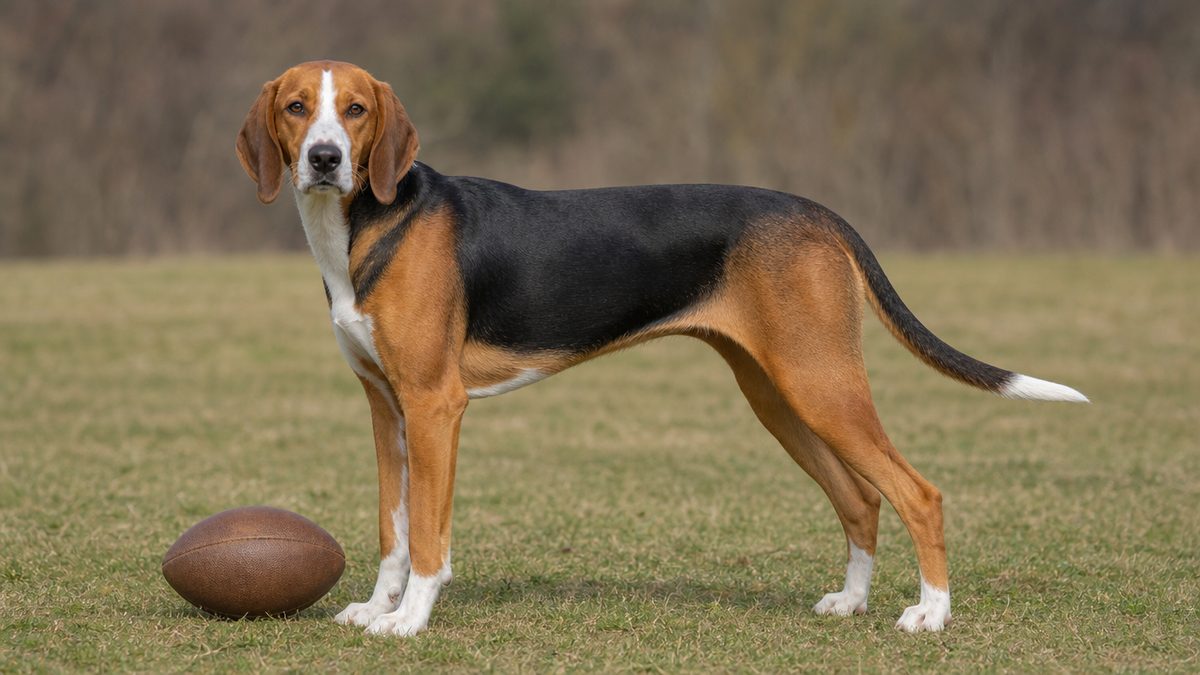
Appearance follows function. The general appearance is rectangular, well proportioned, giving an impression of great strength and stamina, never heavy, with clearly defined sexual dimorphism and a tricolour coat. The black forms a mantle over the body continuing onto the upper side of the neck and the upper side of the tail, tan sits on the head, ears, legs, sides of the neck, shoulders, under the body, thighs and under the tail, and white appears as a blaze, on the throat, brisket, tail tip, lower legs and feet. Two-coloured dogs, yellow-white, black-white or black-tan, are a disqualifying fault, as are blue eyes and any height outside the standard's limits.
Males stand 53 to 61 cm with an ideal of 57 cm, females 49 to 57 cm with an ideal of 53 cm. Neither the FCI standard nor the Kennel Club standard states a weight at all. The weights in circulation come only from secondary sites and they disagree: the American Kennel Club prints 40 to 75 pounds, roughly 18 to 34 kg, while two ranking pages print 50 to 60 pounds and 51 to 60 pounds. Treat any single weight figure for this breed as an estimate someone made, not as a standard.
Two kennel clubs, one breed, and a coat that is either single or double
The Kennel Club and the FCI describe this dog's coat differently, and for an Indian owner the difference is the whole grooming and heat plan. The Royal Kennel Club's UK breed standard states that the coat consists of two layers, with an undercoat that is short, close and soft and especially thick during winter. The FCI standard for the same breed, in English, which is its authentic language, describes only harsh hair, not too short, lying very close to the body, and mentions no undercoat anywhere.
Publish the disagreement rather than averaging it, because the two documents are both primary and both current. The FCI text is dated 02.10.2017 with the official valid standard dated 22.08.2017; the Kennel Club page is marked last updated 1 November 2025. The Swedish Kennel Club's own summary sides with the FCI, saying the coat should be coarse and closely lying, short on the head, ears and the fronts of the legs and a little longer under the tail and on the backs of the thighs, with no undercoat mentioned.
| Point | FCI-Standard 132, English original | Royal Kennel Club standard |
|---|---|---|
| Coat layers | Harsh, not too short, lying very close to body. No undercoat mentioned | Coat consists of two layers. Undercoat short, close and soft, especially thick during winter |
| Chest proportion | Deep, long, well developed and reaching elbows | Depth of chest equal to half height at withers |
| Tail set | Set in line with back | Set on low, in line with croup |
| Ear set | Ears to be raised at set on, only very slightly to reach top of skull when alert | Set fairly high |
| White markings | Tolerated as blaze, throat, collar, brisket, tail tip, lower legs, feet | Lack of white markings highly undesirable, full white collar undesirable |
| Disqualifying faults | Listed, including two-coloured, blue eyes and out-of-limit size | No disqualifying-fault list |
| Height, males | 53 to 61 cm, ideal 57 cm | 53 to 61 cm, ideal 57 cm |
| Height, females | 49 to 57 cm, ideal 53 cm | 49 to 57 cm, ideal 53 cm |
Note what agrees. Both documents give identical heights for both sexes, and both open the general appearance with the word rectangular. Where two registries agree to the centimetre, the figure is about as solid as breed data gets, and this page treats those heights as settled.
Which coat description should an Indian owner plan around
Plan around the undercoat existing, because the cost of being wrong runs one way. If the Kennel Club is right and there is a thick winter undercoat, then a dog living in Chennai or Delhi carries insulation into a climate that never asks for it, sheds heavily twice a year, and needs the dead coat brushed out rather than left to mat. If the FCI is right and the coat is a single harsh layer, that grooming routine costs you ten minutes a week and nothing else. The asymmetry decides it.
There is a second reason to lean that way. The Royal Kennel Club's own breed summary lists coat length as short and sheds as yes, and Pets4Homes describes a dense double coat needing weekly brushing and seasonal heavy shedding management. Against that, one ranking page rates the breed 1 star for shedding and tells readers it will shed a negligible amount and is recommended for owners who do not want to deal with dog hair in their cars and homes. That page and the Kennel Club cannot both be describing this dog.
The Swedish Kennel Club contradicts the standard it hosts
One more disagreement is worth recording because it is easy to check. The SKK breed page describes the Hamiltonstövare as squarely built, kvadratiskt byggd in the Swedish, while the FCI standard the same organisation hosts as a PDF on that very page opens the general appearance with rectangular and lists rectangular body under important proportions. The breed club's own breeding strategy also calls the dog medium-sized and rectangular. Square and rectangular are not stylistic variants; they describe different dogs. Three documents say rectangular and one summary page says square, so this page follows the three.
Any FCI nomenclature URL resolves on its trailing number and discards the breed name before it, so an assembled link returns a complete, correct, error-free page for whichever breed owns that number. Every FCI figure above was taken only after confirming that the returned document prints HAMILTONSTÖVARE and the number 132 on its own face.
How rare is the Hamiltonstövare, in numbers rather than adjectives
The Hamiltonstövare is common in Sweden and close to invisible everywhere else. Sweden registered 1,881 of them in the ten years to 2025 while the United Kingdom registered 63, and the UK register recorded zero in three of those ten years.
Both series come from registry documents rather than from breed directories, and both are complete for the same decade, so they can be set beside each other honestly.
| Year | Sweden, SKK registrations | United Kingdom, Kennel Club registrations |
|---|---|---|
| 2016 | 234 | 8 |
| 2017 | 262 | 7 |
| 2018 | 184 | 12 |
| 2019 | 237 | 9 |
| 2020 | 155 | 0 |
| 2021 | 221 | 10 |
| 2022 | 195 | 10 |
| 2023 | 123 | 0 |
| 2024 | 122 | 7 |
| 2025 | 148 | 0 |
| Ten-year total | 1,881 | 63 |
Read the Swedish column as a decline rather than a plateau. Registrations fell from 234 in 2016 to 122 in 2024, a drop of 48 percent, before recovering to 148 in 2025. The breed club's stated long-term goal is 300 registered puppies a year and its short-term goal is to raise registrations by 10 percent a year, which puts the target above anything the breed has achieved in the whole decade, since the best year in the table is 262.
The UK column carries a different message. Nought in 2020, nought in 2023 and nought in 2025 is not a rounding artefact, and the Kennel Club's separate quarterly publication confirms it independently: the four quarters of 2025 read 0, 0, 0 and 0, and the first quarters of 2026 read 0 as well. Two documents, produced on different schedules, agree.
A note on why those registration statistics can be trusted here
Kennel Club registration statistics have been shown on this site to disagree between the club's web tables and its group PDFs, with known bad cells in the Terrier and Toy groups. The Hound group is not one of them, and this build checked rather than assumed. All 40 breed rows in the 2016 to 2025 hound table were summed against the printed group total in every one of the ten year columns, and every column reconciled exactly, from 15,533 in 2016 to 20,841 in 2025. The 2025 total of 20,841 also matches the sum of the four quarterly hound figures printed in a different document, 4,813 plus 5,460 plus 5,111 plus 5,457. Agreement is being reported here because it was found, not because it was expected.
The Swedish breeding population is smaller than the registration count suggests
Look at the number of litters rather than the number of puppies. Across 2016 to 2025 the breed produced between 16 and 38 litters a year, and the number of stud dogs used ranged from 11 to 32. In 2023, the lowest year, 123 puppies came from 16 litters bred to 11 males. The club's own controls exist for that reason: a maximum inbreeding coefficient of 2 percent on any single mating, a cap of five litters per male followed by a registration stop, a maximum of three litters per bitch, and an evaluation list a male joins after three litters counted across Sweden and Norway together. Achieved inbreeding has stayed between 0.6 and 1.3 percent across the decade.
India does not appear in either register. A Hamiltonstövare in India would be an imported dog registered by the Kennel Club of India against an FCI pedigree, and there is no breeding population here to draw a second dog from. Plan for a single dog and a long-haul flight, not for a local litter.
Hamiltonstövare price in India
There is no Hamiltonstövare price in India, because no Indian breeder, marketplace or classified site offers the breed. That is the answer, it is the first line of this section rather than the last, and it was tested rather than assumed.
The test matters more than the conclusion. An India-localised search for Hamiltonstövare puppies for sale returned ten results, of which the top five were the UK Kennel Club, the US adoption portal Petfinder, the American Kennel Club, a British breed directory and a UK pet-food brand. The remaining five were a YouTube video, a UK pedigree-breeder site, a US breed list, a UK breed page and a European breeder index. Not one was an Indian seller. The same tool, in the same session, run against Labrador Retriever puppies for sale in India, returned ten Indian pages carrying real rupee bands, including one printing INR 30,000 to INR 1,20,000 and city-by-city tables for Hyderabad, Bangalore, Delhi, Chennai, Lucknow, Mumbai, Jaipur and Pune. A control that returns a full Indian market for a common breed and nothing for a rare one has told you something real.
Two raw search instruments failed their own controls in the same session and neither is used as evidence anywhere on this page. Google India returned a Verifying your request interstitial for the breed query, then failed on every engine for the Labrador control. Bing India returned HTTP 200, the correct page title and About 54,500 results for hamiltonstovare price in india, and served ten Chinese-language Apple App Store, Alibaba and Zhihu pages; the Labrador Retriever price in india control on the same endpoint returned ten French-language sports-supplement pages. When the control is substituted the same way the query was, the instrument is broken and nothing has been learned about the breed.
The only prices that exist anywhere, and what they are worth
Two published figures exist, both British, and they disagree by a factor of two or three. Wamiz prints 950 pounds for Kennel Club registered dogs. Pets4Homes writes that puppies are rare in the UK, typically require registration on waiting lists, and start from around 300 to 500 for well-bred pedigree pups, printing no currency symbol at all. Bonbeno does not convert either figure into rupees. A converted foreign price is not an Indian price, and this site has documented Indian price tables that turned out to be entire American price lists divided by a single exchange rate.
The practical Indian number is therefore not a purchase price but an import cost, and it is not one this page can quote, because it depends on the country of origin, the airline, the crate size, the quarantine period at the port of entry and the Kennel Club of India registration fees for an imported dog. What can be said precisely is what the process requires, and that is set out in the adoption and import section below.
Why no Indian supply chain can form
Indian import policy closes the commercial route completely. Dogs sit under ITC(HS) 01061900 as Restricted, and DGFT Trade Notice 22/2022-23 permits import only for a pet dog with a valid pet book in the importer's own name, for research organisations with a CPCSEA recommendation, and for Defence and Police internal security use. Policy Condition 8 states that import of commercial dogs for breeding or any other commercial activity outside those purposes is not permitted, and the notice adds that any application for trading or breeding purposes, or one made on behalf of another person or entity, shall be duly rejected.
Put that beside the absence of any Indian breeding stock and the conclusion follows without needing a market study. A breed with no dogs in the country and no lawful way to import breeding dogs cannot develop a puppy price here, however many pages print one.
The one rupee figure in the Indian result set, and where it went
One Indian search result did carry rupee figures for this breed, and the live page no longer contains them. The snippet advertised that owning a Hamiltonstovare in India costs roughly 1,050,400 rupees over its lifetime and about 62,200 rupees a year, including around 31,900 rupees of food and 19,900 rupees of routine veterinary care.
Fetching the URL settles it. The India path redirects to a general breed profile, the page is served with a noindex tag, and its own body text reads that no cohort value is assigned to this breed, that the current source has not been safely matched to Hamiltonstovare, that PawCosts does not transfer a similar breed's number or a fuzzy match, and that country defaults remain unavailable until a dated local source supports them. The page also stamps itself mapping: unmatched, with a page data version of 18 August 2026.
That is the correct behaviour by the publisher and the wrong behaviour by the search index, which is still serving text the address no longer returns. Read the general lesson rather than the specific one. A search snippet is drawn from a crawler's own store and can be months stale, and it is convincing precisely because the text really did appear at that address once.
Running the division tests on the withdrawn figures anyway
Test the numbers rather than trusting or dismissing them, because this site has caught four separate mechanisms that manufacture Indian prices. The commonest is a US dollar list divided by one exchange rate.
| Figure as printed | Divided by 84.38 | Divided by 80.00 | Divided by 74.00 | Reads as a real price? |
|---|---|---|---|---|
| ₹10,50,400 lifetime | 12,448.21 | 13,130.00 | 14,194.59 | No |
| ₹62,200 a year | 737.14 | 777.50 | 840.54 | No |
| ₹31,900 food | 378.05 | 398.75 | 431.08 | No |
| ₹19,900 routine vet | 235.84 | 248.75 | 268.92 | No |
Only one of twelve quotients is a whole number, and it is 13,130 dollars, which no seller anywhere would print. That pattern rules out conversion and points at the other mechanism this site has documented, in which the rupee figures are native and arbitrary, generated by a cost model rather than observed in a market. The publisher's own withdrawal notice says exactly that, which is the rare case of a source agreeing with the forensic result.
The currency symbol that was simply removed
A second mechanism is visible on the deepest UK page in the set, and it is worth showing an Indian reader because the same trick is what makes fabricated Indian prices readable. The Pets4Homes price section prints six money figures and not one of them carries a currency symbol: prices starting from around 300 to 500, insurance approximately 5.60 per month rising to around 10.00 monthly, feeding costs averaging 40-50 per month, routine veterinary care totalling 1200 annually, and a monthly maintenance budget given as about 100 to 70 monthly.
The last range runs backwards. A budget quoted as 100 to 70 monthly cannot have been read by anyone before publication, and a page that will print a descending range will also print a stripped currency symbol. Strip the symbol from a set of British figures and republish them under an Indian heading and you have manufactured an Indian price table without doing any arithmetic at all, which is why division tests alone never settle these questions.
None of this means the Pets4Homes figures are dishonest. It means they are unusable, and that an Indian reader who reads 1200 annually as 1,200 rupees for a year of veterinary care will underbudget by an order of magnitude. Real Indian care costs are in the next section, sourced to Indian price lists.
What a Hamiltonstövare actually costs to keep in India
Budget for a 23 to 27 kg active hound rather than for a breed, because none of the recurring costs of ownership in India are breed-specific. Indian vaccination, boarding, feeding and consultation prices are published, they are real, and they apply to any dog of this size and energy living here.
The vaccination cost is the easiest to pin down and the one most often understated. A published Indian per-dose table gives DHPP at 800 INR, rabies at 350 INR, leptospirosis at 150 INR, Bordetella for kennel cough at 200 INR, canine influenza at 800 INR and Lyme disease at 700 INR. Those are vaccine prices only. A clinic consultation or injection charge sits on top of each visit, and published Indian estimates for a complete puppy course range from roughly ₹2,500 to ₹8,000 depending on the clinic and the city, which is a spread wide enough that a single quoted figure should always be treated as one clinic's price rather than the national one.
| Item | Published Indian figure | Where it comes from |
|---|---|---|
| DHPP vaccine, per dose | ₹800 | Indian retailer price table |
| Rabies vaccine, per dose | ₹350 | Indian retailer price table |
| Leptospirosis vaccine, per dose | ₹150 | Indian retailer price table |
| Bordetella, kennel cough, per dose | ₹200 | Indian retailer price table |
| Boarding, 21 to 40 kg, air-conditioned | ₹950 per day | Chennai kennel tariff, 2026 |
| Boarding, 21 to 40 kg, non air-conditioned | ₹850 per day | Chennai kennel tariff, 2026 |
| Boarding, under 20 kg, air-conditioned | ₹850 per day | Chennai kennel tariff, 2026 |
| Boarding, 41 to 50 kg, air-conditioned | ₹1,050 per day | Chennai kennel tariff, 2026 |
A Hamiltonstövare falls in the 21 to 40 kg band, so the Chennai rate is 950 rupees a day with air conditioning and 850 without. The hundred-rupee gap between those two lines is the most India-specific number on this page. For a Nordic hound in a Chennai May it is not a choice.
The same published tariff defines its giant band as over 50 kg in the air-conditioned list and over 45 kg in the non air-conditioned list, while the non air-conditioned large band runs 41 to 50 kg. A 47 kg dog therefore falls inside two bands at once. That does not affect a Hamiltonstövare, which sits comfortably in the medium band either way, but it is a reminder to read the kilogram figures rather than the words beside them when you compare kennels.
The monthly cost, assembled honestly
Assemble the monthly cost from the parts rather than quoting a single number, because the parts are sourced and the single number never is. Food dominates. Royal Canin India's own feeding table for a large-breed adult begins at 26 kg and gives 276 g a day at low activity, 319 g at medium and 363 g at high, and this breed sits at the high-activity end of that scale on the Kennel Club's own exercise rating of more than two hours a day. A dog eating at the high-activity rate consumes about 32 percent more food than the same dog at low activity, and over a year that difference alone is roughly 32 kg of dry food.
- Food is the largest recurring line, and the high-activity feeding rate is the one to budget from for this breed.
- Vaccination repeats annually for the core boosters, at the per-dose figures above plus consultation.
- Ectoparasite control runs year-round in most of India rather than seasonally, because tick pressure does not stop.
- Boarding at ₹950 a day for the air-conditioned medium band adds ₹6,650 for a week away.
- Ear care is a genuine recurring cost for a drop-eared hound in a monsoon climate, not an optional extra.
What this page will not do is add those into a single lifetime figure. The one page that published such a figure for this breed has since withdrawn it and said plainly that no dated local source supports it, and inventing a replacement would repeat exactly the error that page corrected.
Heat tolerance: what Swedish numbers look like next to Indian ones
A Hamiltonstövare has low heat tolerance for the simple reason that no month in most of India is as cool as the warmest month in its homeland. Chennai's coolest month averages 24.1 degrees Celsius while Stockholm's warmest averages 18.4, so the Indian winter is 5.7 degrees hotter than the Swedish summer this dog was selected in.
Every figure below was queried from NASA POWER by explicit latitude and longitude rather than by place name, because place-name climate pages have repeatedly served this project a complete, correctly formatted document for the wrong city. Coordinates cannot hand you another town by accident. One column also needs a label rather than an assumption. The record-high column is NASA POWER's T2M_MAX, the hottest reading the climatology holds for that month across the whole period. It is an extreme, not an average afternoon, so compare it with other record highs and never with a monthly mean.
The grid-cell problem, echoed rather than hidden
NASA POWER returns a grid cell, not a point, and the cell's mean elevation can miss the town underneath it badly. Because air temperature falls at roughly 6.5 degrees Celsius per 1,000 metres, an elevation miss is a temperature miss. Each query below therefore echoes back the elevation the model reported alongside the coordinates, and compares it to the town's real altitude.
| Place | Cell elevation | Real town elevation | Annual mean | Hottest month mean | Hottest month record high | Coolest month mean |
|---|---|---|---|---|---|---|
| Stockholm | 27 m | ~28 m | 6.9 °C | 18.4 °C (Jul) | 31.8 °C | -3.1 °C (Jan) |
| Örebro | 140 m | ~34 m | 5.8 °C | 17.1 °C (Jul) | 32.5 °C | -4.8 °C (Jan) |
| Chennai | 49 m | ~6 m | 27.9 °C | 31.5 °C (May) | 42.7 °C | 24.1 °C (Jan) |
| Mumbai | 97 m | ~14 m | 26.8 °C | 31.2 °C (May) | 44.9 °C | 23.2 °C (Jan) |
| Delhi | 206 m | ~216 m | 25.6 °C | 35.9 °C (Jun) | 48.8 °C | 13.6 °C (Jan) |
| Pune | 636 m | ~560 m | 23.9 °C | 28.9 °C (Apr) | 43.2 °C | 19.6 °C (Dec) |
| Bengaluru | 842 m | ~920 m | 23.7 °C | 28.4 °C (Apr) | 40.4 °C | 20.2 °C (Dec) |
Those seven cells are all within about 106 metres of the towns they stand for, which at the standard lapse rate is under 0.7 degrees of error, so the figures can be used as printed. The hill stations cannot.
For Gangtok, NASA POWER reported a cell elevation of 3,240 metres against a town sitting at roughly 1,650 metres, so the cell stands about 1,590 metres too high and reads roughly 10 degrees Celsius too cold. Its cell annual mean of 7.5 degrees looks like a near-perfect Swedish analogue and is not one. For Shimla the error runs the other way: the cell sits at 898 metres against a town at roughly 2,200 metres, about 1,302 metres too low, so its cell annual mean of 21.1 degrees reads roughly 8.5 degrees too warm and makes a genuinely cool hill station look subtropical. Leh's cell sits at 4,533 metres against a town near 3,500. Anyone using gridded climate data to argue that an Indian hill station suits a Nordic breed has to check the elevation first, and this page publishes the divergence rather than the cell.
Humidity, which is the half nobody rates
Humidity decides how well panting works, and panting is the only cooling system this dog has. Chennai runs an annual mean relative humidity of 72.4 percent and 64.5 percent even in its hottest month, and Mumbai 67.4 percent annually. Delhi is drier at 45.6 percent annually and 36.4 percent in June, which is why a Delhi 45 degrees and a Chennai 38 degrees are not comparable problems. A dog cools by evaporating water from its respiratory tract, and evaporation slows as the surrounding air fills with water. Sweden's own figures are humid too, at 85.3 percent annual mean relative humidity in Stockholm, but at 6.9 degrees that humidity costs the dog nothing.
What the heat research does and does not say about this breed
The largest study of heat-related illness in UK dogs found that exertion, not confinement, is the dominant trigger. Of the 879 events that had a trigger recorded, 652 were exertional, which is 74.2 percent, against 113 environmental and 46 from vehicular confinement. The companion paper from the same 905,543-dog cohort reports that dogs at or above the mean bodyweight for their breed and sex carried an odds ratio of 1.42, with a 95 percent confidence interval of 1.12 to 1.80.
Be precise about what transfers. The Hamiltonstövare is far too rare in the United Kingdom to have met either paper's inclusion threshold, so it was not modelled and no breed-specific odds ratio for it exists. What transfers is the mechanism and the bodyweight finding, which applies to any dog heavy for its own breed and sex. What does not transfer is the over-50-kilogram odds ratio, because this dog is nowhere near 50 kg.
The practical translation for India is a rule about clocks rather than thermometers. A breed rated at more than two hours of exercise a day is a breed whose owner will be tempted to walk it in the afternoon, and afternoon is exactly when the exertional risk is highest. Move the work to before sunrise and after dark, carry water, and treat unsteadiness, bright red gums or a temperature above 40 degrees as an emergency rather than as tiredness.
Second Schedule Part IV paragraph 21(1) of the Prevention of Cruelty to Animals (Dog Breeding and Marketing) Rules 2017 provides that dogs shall not be kept in outdoor facilities, unless specifically approved in writing by the attending veterinary practitioner, where they are dogs not accustomed to the temperatures prevalent in the area or region in question, or breeds that cannot tolerate them, such as long-haired breeds in high temperature locations, or sick, infirm, aged or young animals. A Swedish hound imported into a Chennai summer meets the first limb of that test on the day it lands. Cite it as a Second Schedule paragraph and never as Rule 21, because the Rules stop at Rule 13 and the string Rule 21 appears nowhere in the gazette.
Temperament and household fit
A Hamiltonstövare is friendly and even-tempered with people and difficult to live with as a flat dog, and both halves of that sentence come from the same source. The FCI standard gives the temperament in four words, friendly and even-tempered, and lists aggression, shyness and severe aloofness among the disqualifying faults.
The Swedish breed club fills in what a working line actually produces. It describes the breed as calm, not easily stressed, friendly and social, with a pronounced calm temperament typical of the Hamilton type, and it treats that mentality as something to be maintained rather than improved. The Swedish Kennel Club adds the warning that matters most, saying plainly that the breed is not suitable purely as a companion dog because of its strong desire to track and drive game.
That is an unusually blunt thing for a national kennel club to publish about one of its own national breeds, and it should carry more weight with an Indian buyer than any temperament star rating. It is a statement that the dog's friendliness is not the constraint. The prey drive is.
Who this breed suits in India
- A household with a securely fenced outdoor space, because the RKC's own summary puts this breed in a large house with a large garden, in the country rather than the town.
- An owner who will work the nose, through tracking, scent games or canine sport, since a scent hound with nothing to track invents its own project.
- A family with older children, given a boisterous, athletic dog of Labrador height.
- Someone home for much of the day, because a breed developed to work alongside a handler does not settle well alone for long stretches.
Who it does not suit
- A flat without a garden, which is the majority of Indian urban housing for this income bracket.
- A household with cats or small pets, because a hare-and-fox hound is selected for exactly that response.
- An owner who needs off-lead reliability, since a dog on a scent is not being disobedient, it is working.
- Anyone who wants a quiet dog. The standard's own utilisation line says the breed gives tongue, meaning it bays on the track, and that voice is a bred-in feature rather than a training failure.
The vocal question deserves a sentence of its own in an Indian context, because Indian housing is dense and neighbours are close. A hound bred to be audible to a handler at distance across Swedish forest is loud in a way a Labrador is not, and one ranking page describes the breed as tending to be very vocal and more of a crooner than a barker. In a Mumbai apartment block that is a housing-society complaint waiting to happen.
Every source consulted agrees the breed is good with people and not a guard dog. Wamiz rates it a bad watchdog, unlikely to defend property, and the Kennel Club's Breed Watch entry records no points of concern specific to the breed for judges to watch The Royal Kennel Club (UK), Breeds A to Z. If you want a deterrent, this is not the dog.
Training a scent hound that was bred to work away from you
Train recall and settle first, and accept that recall will never be reliable on a fresh scent. The Swedish Kennel Club states that although the breed is easy to train it requires patience and consistent upbringing, and that it is independent in its work, which is a precise description of a dog that will learn a cue quickly and then decline it when the nose wins.
Start from what the breed was selected for, because the selection is recent and deliberate. Swedish breeding recommendations require a male to hold at least a first prize in open-class hunting trials and a female at least an open-class result before either is used, so every generation is filtered for independent working drive. A dog whose grandparents were all chosen for their willingness to leave the handler and work a line alone is not going to be a heeling dog.
The training order that works
- Socialise early and widely. In Indian cities that means traffic, two-wheelers, free-roaming dogs, cattle, festival noise and lifts, all before sixteen weeks.
- Build a settle before you build obedience. A hound that cannot switch off in a flat is a hound that will be rehomed.
- Train recall on a long line for the first year, and never off it in an unfenced space. Treat the long line as permanent equipment rather than a stage to pass through.
- Pay for engagement, not for compliance. Reward the dog for checking in with you while a scent is available, which is the behaviour you actually need.
- Give the nose a legitimate job. Scatter feeding, tracking games and hidden-article searches use the same drive that otherwise takes the dog over a wall.
- Train the vocal cue deliberately. A quiet cue taught in the first year is far easier than a bark habit corrected in the third.
Reward-based methods are what the ranking pages recommend and what the breed's own history supports. Pets4Homes describes food-praise reward methods and short engaging sessions as what works, and nothing in the breed's documentation suggests a hard-handled dog. The FCI standard is explicit that only functionally and clinically healthy dogs with breed-typical conformation should be bred, and that shyness is a disqualifying fault, so a nervous Hamiltonstövare is an outlier rather than a norm to be trained around.
The Indian complication nobody writes about
Training a scent hound in an Indian city runs into a problem the Swedish and British guides never face, which is the density of competing scent. A Swedish forest track is a comparatively clean signal. An Indian street carries food waste, free-roaming dogs, cattle, poultry and open drains, all at nose height, and a dog selected for a nose will engage with every one of them. Expect early walks to be slow, expect the dog to be genuinely unable to hear you at times, and plan the route rather than the correction.
Heat compounds it. The hours when a hound's nose works best, early morning and late evening when the ground is cool and damp, are also the only hours it is safe to work this breed hard in most of India, so the training window and the safe-exercise window happen to coincide. That is the one piece of good luck in this breed's Indian situation, and it is worth building the whole routine around.
Exercise needs, and why the Indian clock decides everything
A Hamiltonstövare needs more than two hours of exercise a day, which is the Royal Kennel Club's own published rating for the breed and the top band it uses. In India that requirement does not change, but the hours in which it can safely be met shrink to roughly two windows a day.
Understand where the number comes from before deciding whether to halve it. The Swedish breed club describes the working expectation as a hunting day of at least five hours, with the dog able to hunt two full days in succession, and it says correct construction is what gives a stövare a long active working life. Two hours a day is not an inflated pet-owner figure. It is a conservative domestic translation of a dog built for five-hour days.
What the safe window actually looks like
In Chennai the hottest month averages 31.5 degrees Celsius with 64.5 percent relative humidity, its highest reading on the twenty-year record is 42.7 degrees, and even the coolest month averages 24.1 degrees. In Delhi June averages 35.9 degrees and the record for the month stands at 48.8. Neither city offers a midday in which an athletic hound can work. What both offer is an early morning before the surface heats and a late evening after it releases, and in a Delhi January there is a genuine full day available, which is worth planning holidays around.
- Split the requirement, roughly 75 to 90 minutes before sunrise and 45 to 60 minutes after dark, rather than attempting one long session.
- Check the ground with your hand, because tarmac and concrete hold heat long after the air cools and paw burns are an Indian city injury.
- Carry water on every walk, not only on long ones.
- Substitute nose work when the weather closes the window. Twenty minutes of scent searching tires a hound more than an hour of lead walking.
- Swim where clean water is available and safe, and dry the ears afterwards every single time.
What under-exercise produces in this breed specifically
An under-exercised scent hound does not become calm. It becomes an escape artist and a digger. Wamiz records that the breed has a tendency to run away and will make its escape if not carefully fenced, and that it can become chewy or diggy if lonely, under-exercised and under-stimulated. The Kennel Club's household requirements are consistent with that, calling for a large house with a large garden in a country rather than a town setting.
That combination is the reason this page is sceptical about the breed in Indian cities. The exercise requirement is high, the safe hours are few, the escape drive is real and the boundary standard needed is a genuine fence rather than a compound wall with a gate that opens onto traffic.
A farmhouse or plantation property with fenced acreage, in a location where December to February gives a full usable day, is a setting where a Hamiltonstövare could live well. Pune's coolest month averages 19.6 degrees Celsius and Bengaluru's 20.2, both mild enough for real work through the cool season. The breed's problem in India is April to June, not the whole year, and an owner who plans for a hard four months rather than a hard twelve is planning realistically.
Grooming and coat care in Indian humidity
Brush a Hamiltonstövare weekly and more often through its moults, and check its ears after every wet walk. The Royal Kennel Club rates grooming for this breed at once a week and lists the coat as short and shedding as yes, and the ear checking is the part no overseas guide emphasises because no overseas guide is writing for a monsoon.
The coat itself is genuinely low maintenance whichever standard is right about its layers. The Swedish Kennel Club says the coat requires normal care and bathing when needed, and no source in any language describes trimming, stripping or clipping for this breed. There is no professional grooming bill here.
The double coat question, applied
Assume there is an undercoat and groom accordingly. The Kennel Club standard describes two layers with an undercoat that is short, close and soft and especially thick during winter, while the FCI standard for the same breed describes only a harsh, close-lying outer coat and never mentions an undercoat. Pets4Homes calls it a dense double coat needing weekly brushing and seasonal heavy shedding management. If an undercoat is present, brushing it out is the single most useful thing an Indian owner does for the dog's comfort, and if it is absent, the brushing costs ten minutes a week and harms nothing.
One ranking page tells Indian readers the opposite, rating the breed 1 star for shedding and describing minimal shedding, a negligible amount, recommended for owners who do not want to deal with dog hair in their cars and homes. That statement is not compatible with the Kennel Club's own Sheds: Yes on the same breed, and a buyer who plans a household around it will be surprised twice a year.
Shaving a coated dog to cool it removes the layer that traps air away from the skin and exposes skin that has never been sun-adapted. On a breed where two registries disagree about whether an undercoat even exists, shaving is a decision taken without knowing what is being removed. Brush the dead coat out instead, and if the shedding load in an Indian summer is unmanageable with a weekly brush, increase the frequency rather than reaching for clippers.
Ears, which are the real Indian grooming task
The standard describes ears that are soft, hanging flat with the fore edge close to the cheek. A flap lying flat against the head over a warm, humid month creates a sealed canal that stays wet, and drop-eared working dogs are exactly the population in which otitis externa is repeatedly reported. Indian veterinary series on canine ear disease are published largely in Indian journals that international databases do not index, so the literature is thinner in a PubMed search than it is in reality, and this page treats the absence of indexed Indian otitis studies as an indexing artefact rather than as evidence that the problem is small.
- Lift and look after every swim, bath and monsoon walk, and dry the outer canal with cotton wool rather than a cotton bud.
- Plug the ears before bathing, because water entering the canal during a bath is a named cause of ear disease.
- Learn the smell. A yeasty odour is usually the first sign, days before head shaking.
- Do not air dry in the monsoon. Overseas breed-club grooming advice that says to towel a dog and let it air dry is written for a dry temperate climate and does not transfer to an Indian July.
Ticks, which are a grooming task in India and not elsewhere
Run a tick check into the daily brush rather than treating it as a separate seasonal job. A scent hound works with its head down in vegetation, which is where ticks wait, and Indian tick pressure is a year-round rather than a summer problem across most of the country. Check the ear margins, between the toes, the armpits, the groin and under the collar, and keep a preventive running continuously rather than starting it when a tick is found.
Feeding a Hamiltonstövare in India
Feed a Hamiltonstövare as a medium to large adult of 23 to 27 kg at a high activity level, and check the bag's own weight range before buying it. Royal Canin India's Maxi Adult feeding table begins at a 26 kg dog and runs to 44 kg, so most dogs of this breed sit at or below the bottom of that product's range and the large-breed bag is usually the wrong purchase.
Work from activity level rather than from breed, because the activity difference inside this one breed is larger than the difference between breeds. At the bottom of that same published table, a 26 kg dog is fed 276 grams a day at low activity, 319 grams at medium and 363 grams at high. A Hamiltonstövare meeting the Kennel Club's more than two hours a day is a high-activity dog, and the gap between the low and high columns is 87 grams a day, about 32 percent, or roughly 32 kilograms of food over a year.
Life-stage feeding
- Eight to sixteen weeks. Four meals a day, on the food the breeder or exporter used, changed slowly over a week if you change it at all.
- Four to six months. Three meals a day. Keep the puppy lean through the fastest growth phase rather than pushing weight on.
- Six to twelve months. Two meals a day. Growth in a medium-large hound continues past the point the dog looks adult.
- Adult. Two meals a day, and weigh the food rather than scooping it, because a hound that will not stop working will also not stop eating.
- Senior. Two meals, reduced portion, and a body-condition check monthly rather than a weight check.
Split the daily ration into two meals rather than one for a deep-chested dog, and leave a gap between a meal and hard exercise in both directions. That is standard advice for any deep-chested breed and it costs nothing to follow.
Body condition beats the scale
Judge condition by hand, because no weight standard exists for this breed to check against. Neither the FCI standard nor the Kennel Club standard states a weight at all, and the secondary figures in circulation disagree, with the American Kennel Club printing 40 to 75 pounds against 50 to 60 pounds and 51 to 60 pounds on two ranking pages. Ribs should be easy to feel under light pressure, there should be a visible waist from above, and there should be an abdominal tuck from the side.
The largest UK study of heat-related illness found that dogs at or above the mean bodyweight for their own breed and sex carried an odds ratio of 1.42, with a confidence interval of 1.12 to 1.80. That finding applies to any dog carrying extra weight for its own breed, and it means that on this breed in this climate, keeping the dog lean is a heat-safety measure rather than a cosmetic one.
What is available in India
Feeding this breed in India is easy, because nothing about it is unusual. Large and medium-breed adult ranges from the major international brands are sold nationally, Indian brands cover the same segment, and no ingredient or formulation on any veterinary record for the breed calls for a prescription diet. The one genuine Indian consideration is storage. A 15 kg bag of dry food in a humid coastal city goes stale and can grow mould, so buy smaller bags more often through the monsoon and keep the food in a sealed container rather than in its own bag.
Health issues, hip dysplasia and the life expectancy nobody has measured
The Hamiltonstövare has no frequent breed-specific disease and no published life expectancy, and those two facts should be read together rather than separately. The Swedish breed club states that the breed has no single defect or illness that is frequent, and the Swedish Kennel Club calls it a healthy breed without breed-specific diseases while noting that hip dysplasia occurs Svenska Kennelklubben.
Set against that, the breed screens fewer than one in five of its own puppies. Adding the breed club's own tables, 299 dogs born between 2016 and 2024 were hip-scored against 1,673 born in the same years, which is 17.9 percent. The club says so itself, writing that far too few dogs are radiographed, that it is desirable to double the number sent for hip screening, and that it has suspended the use of a hip index for the time being because the low numbers make the index requirements harder and harder to meet. Its stated target is to raise the proportion radiographed to 35 percent over the next five years.
A breed with almost no reported disease and almost no screening is not the same as a breed with almost no disease. It is a breed that has not looked. That is a reason for an Indian buyer to insist on seeing an actual hip result for both parents rather than a reason to assume the worst, and it is why this page reports the screening rate next to the health claim every time.
The hip data, and the arithmetic inside it
The hip figures below are computed from the five year columns in the breed club's own table that balance exactly against their own totals. Four of the nine columns do not balance, and the reasons are printed on the page.
| Hip grade | Dogs | Share of the 90 screened |
|---|---|---|
| A | 23 | 25.6% |
| B | 35 | 38.9% |
| C | 29 | 32.2% |
| D | 3 | 3.3% |
| E | 0 | 0.0% |
| C or worse | 32 | 35.6% |
Read the C row rather than the D and E rows. Just over a third of screened dogs graded C or worse across those five years, which is why the club's breeding rule is that C dogs must be mated upwards, to an A or a B, and that D and E dogs are excluded from breeding altogether. Hip dysplasia in this breed is a breeding-management problem rather than a clinical one, and the club is explicit that it does not see individuals with clinical symptoms from the hips.
The 2016 column prints a hip A count of 69 against a year total of 51 examined, which is impossible, while the percentage printed beside it, 17.6, is exactly 9 of 51. The 2020 column prints hip C as 13.4 percent where 16 of 46 is 34.8 percent. The 2021 column prints hip C as 33.3 percent where 13 of 52 is 25.0 percent, and its grades sum to 44 against a printed total of 52. The 2017 column sums to 55 against 60. This page therefore computes only from the columns that reconcile, and reports the discrepancy rather than quietly using the whole table or quietly dropping it.
The other conditions the breed club names
- Epilepsy, at what the club calls a very low frequency, with a breeding rule that an affected dog is not bred, a dog that has produced affected offspring is used with caution, and a dog with one or both parents affected is not bred.
- Cryptorchidism, sporadic, with a stated aim of holding it below 1 percent.
- Skin problems, described as unexplained itching, patchy hair loss and atopic eczema.
- Upper respiratory and throat infections, which the club records as occurring without a known cause, adding that it can only speculate.
- Patent ductus arteriosus, a heart defect, in isolated cases.
- Tumours, listed among the conditions present at low frequency.
None of those carries a published prevalence, and this page does not supply one. The itching and eczema entry is the one an Indian owner should note, because atopic skin disease behaves differently in a hot humid climate than in a Swedish one and a dog predisposed to it will express it more here.
What the American screening registry holds
The Orthopedic Foundation for Animals issues this breed a code but publishes no statistics for it. Its advanced-search markup carries the entry HAMILTONSTOVARE against the code HAM, filed under the AKC Hound Group, the UKC Scenthound Group and the Kennel Club Hound Group. A full retrieval of OFA's disease-statistics tables, roughly 2.2 million characters covering about 270 printed breed labels, returns no Hamiltonstövare row at all, in a retrieval where a Labrador Retriever control matched 109 times. The correct description is that the breed has no row in OFA's published statistics tables, not that it is absent from the database, because OFA requires 100 hip evaluations, or 50 for its other registries, before a breed is published.
Life expectancy, and why this page publishes none
No cohort study gives a life expectancy for the Hamiltonstövare. The published Dogs Trust table of median life expectancy for 155 breeds and crossbred groups contains no Hamiltonstövare row, in a search where Labrador Retriever, Norwegian Elkhound and Foxhound all returned normally. The American Kennel Club prints 14 to 17 years on its breed page, a figure with no visible source and one that would make this hound longer-lived than every breed of comparable size in that life table, where the Norwegian Elkhound sits at 12.9 years and the Foxhound at 13.0. Two ranking pages print 11 to 13 years and about 12 years instead Wamiz UK, Hamiltonstövare breed page, and the Kennel Club's own summary says only over 10 years.
Bonbeno therefore publishes no lifespan figure for this breed. Four sources give four answers, the widest and most quoted of them is unsupported, and the one dataset that would settle it does not contain the breed.
Two papers in the world literature, and the name that hides the second one
The Hamiltonstövare has two papers in the indexed world veterinary literature, and you only find both if you search under both of its names. A PubMed search for Hamiltonstovare returns a single record, against a Labrador Retriever hip dysplasia control returning 126 in the same session. A separate search for Hamilton hound returns a second, different paper that the first query never sees.
This section first said the breed appeared exactly once in the literature. That was wrong, and it was caught by cross-checking a sibling page on this site, which cited a 2014 Norwegian tularaemia case report about a Hamilton Hound. The claim was verified against the paper's own abstract before this page was corrected. The lesson generalises: a breed with a native name and an English name has its literature split across both, and a search on one of them produces an absence that is an artefact of the query rather than a fact about the breed.
The second paper, and the risk it describes
Norwegian researchers reported that a Hamilton Hound and its owner both developed tularaemia after hunting an infected mountain hare, Lepus timidus. The dog showed lethargy, anorexia and fever two to four days after the hunt and then recovered fully, with antibody titres rising 32-fold between one and three weeks after exposure before declining and levelling off at moderate positive values a year later. The authors believe it to be the first case report of clinical Francisella tularensis subspecies holarctica infection in a European dog.
The same paper tested 33 further Norwegian dogs after a lemming irruption in Finnmark. Among dogs exposed to lemmings, 10 of 11 that became sick and 3 of 12 that stayed healthy carried antibodies, while none of the 10 Oslo control dogs did. That contrast between an exposed group and an unexposed control is what makes the finding solid rather than anecdotal.
Tularaemia is not a common Indian concern and this page does not claim it is. The transferable point is narrower and it applies directly to a hare-and-fox hound anywhere: the animal this breed is designed to catch and mouth is the animal that carries the pathogen, so in any country the quarry is the exposure route. In India that route leads to different organisms rather than to none.
The first paper, and why it matters more in India than in Sweden
The record that the breed's own name returns is a 1998 University of Liverpool study of naturally occurring vertical transmission of Neospora caninum in dogs. Its retrospective arm was built on litters from six bitches of the Hamiltonstövare breed, studied after clinical disease was diagnosed in puppies. Across 13 seropositive dams in the retrospective studies, 32 of 61 puppies tested were themselves seropositive, which is 52 percent, and 22 of 88 puppies born developed clinical signs compatible with neosporosis, which is 25 percent. In the prospective arm, involving other breeds, only 4 of 118 puppies tested from 17 seropositive bitches were seropositive.
Those percentages reconcile against their own counts, which is worth stating because this site checks. The authors' conclusion was that vertical transmission alone is too infrequent to sustain infection in a dog population, so post-natal infection must be occurring, and overall 80 percent of puppies born to seropositive dams were not infected.
Why an Indian reader should care about a Swedish hound's parasite
Neospora caninum cycles between dogs and cattle, and India has both in close and constant contact. Dogs are a definitive host, cattle are the intermediate host that suffers the abortions, and the transmission runs through faecal contamination of cattle feed. The first Indian survey of the parasite in dogs, published in 2008, tested 184 dogs in Punjab and found antibodies in 16.8 percent, with rural dogs at 21.4 percent, 27 of 126, against city dogs at 6.9 percent, 4 of 58. Those three figures reconcile exactly against one another.
The cattle side is larger and better quantified. A South Indian study of 176 crossbred dairy cows found an overall true prevalence of 23.5 percent, rising with age from 7.7 percent under one year to 40.5 percent above six years, and 41.1 percent among cattle that had aborted against 20.6 percent among those that had not. Herds where dogs were present with the cattle were 3.59 times more likely to acquire neosporosis than herds without, and the authors put the annual economic loss in an aborted herd of eleven animals at 0.23 million INR.
A scent hound is a dog that works with its nose on the ground across open country, and in India open country means cattle country. The one disease this breed has ever been studied for is the one disease an Indian working environment would most reliably expose it to, and the exposure runs both ways: an infected dog shedding oocysts near a dairy herd is the risk the Indian studies are measuring. No ranking page for this breed connects those two literatures, and it is the single most India-relevant health fact about the dog.
What to actually do about it
- Do not feed raw bovine tissue, especially placenta, foetal membranes or aborted material, which is the classic route by which a farm dog acquires the infection.
- Keep the dog away from calving and abortion sites on any property that keeps cattle.
- Pick up and dispose of faeces rather than leaving them in grazing or fodder areas, which is the step that protects the cattle rather than the dog.
- Raise it with your veterinarian before breeding, since the whole point of the 1998 study was that an infected bitch can pass the parasite to successive litters.
Note what this section deliberately does not claim. There is no evidence that the Hamiltonstövare is unusually susceptible to Neospora caninum. The six bitches in that study were simply the population the researchers had access to after an outbreak, and a single 1998 case series is not a breed predisposition. The reason it appears on this page is that it is half of all the research that exists on the breed, and that an Indian reader is better served by understanding what the parasite is than by being told the breed has almost no literature and left there.
The first year, month by month, in Indian conditions
Plan the first year around two things a Swedish or British puppy guide will not mention, which are the season the puppy lands in and the point at which its exercise needs outgrow the safe hours of an Indian day. Everything else follows the ordinary developmental clock.
- Weeks 8 to 10. Indian law requires that pups under eight weeks are not sold, under Rule 8(1)(a) of the 2017 Rules. An imported puppy will normally be older, because the flight and quarantine add weeks. Keep it indoors, on the exporter's food, and let it sleep.
- Weeks 10 to 12. Begin the vaccination course with your own veterinarian and start house socialisation. Indian published per-dose prices put DHPP at 800 INR and rabies at 350 INR, plus a consultation charge each visit.
- Weeks 12 to 16. The socialisation window closes around sixteen weeks and it does not reopen. Traffic, two-wheelers, lifts, free-roaming dogs, cattle and festival noise all belong in this month, in short, positive, unhurried exposures.
- Months 4 to 5. Start long-line recall now, before the nose matures. Three meals a day. Keep the puppy lean.
- Months 5 to 7. Adolescence and the first real recall failures. Expect the dog to start hearing scent over your voice, and treat it as development rather than disobedience.
- Months 7 to 9. Growth in a medium-large hound continues past the point it looks finished. Build duration rather than intensity, on soft ground where possible, and avoid repetitive hard-surface running.
- Months 9 to 12. Move to two meals a day. Introduce structured nose work, which is the outlet that will keep this dog sane for the next decade.
- Month 12 onward. Now build toward the adult requirement of more than two hours a day, split across the cool ends of the day.
The season the puppy arrives in changes the first six months
A puppy landing in Chennai in October has a usable cool season ahead of it, roughly through February, in which to do its socialisation walks. A puppy landing in March has none, and its owner will be trying to complete the socialisation window in a month averaging 31.5 degrees Celsius, in a city whose record for that month is 42.7. If the import timing is within your control, land the dog in the cool half of the year. That single decision affects the dog for life more than any training choice in the list above.
The Swedish breed club recommends breeding assessment between 12 and 24 months, and its own tables record a mean age at hip radiography ranging from 13 to 31 months across recent years. If you intend ever to breed the dog, or simply want to know what it has, book the radiographs in that window rather than later.
One caution on the club's own numbers before you use them for planning. The breed club's litter-size table prints values from 6.1 in 2024 to 7.5 in 2023, while the sentence directly beneath it says litter sizes have stayed on average between 5.9 and 7.0 puppies. Neither 5.9 nor 7.5 appears in the table it describes. The registration and hip tables in the same document are the load-bearing ones on this page and they were checked separately.
Hamiltonstövare against the hounds an Indian buyer can actually get
Compare the Hamiltonstövare against the Beagle first, because the Beagle is the scent hound an Indian buyer can actually buy and the two dogs want the same job done differently. The Royal Kennel Club's own ten-year hound table settles the scale question in one line: 63 Hamiltonstövare against 18,374 Beagles between 2016 and 2025, so the Beagle is 292 times more numerous in the register both breeds sit in.
The table below draws every registration figure from a single document, the Royal Kennel Club's comparative table of hound registrations for 2016 to 2025 inclusive, so the numbers are directly comparable rather than assembled from different sources with different definitions. Its 40 breed rows sum exactly to the printed group total in all ten year columns, which is worth stating because this site has documented cells elsewhere in the same publication series that do not reconcile.
| Point of comparison | Hamiltonstövare | Beagle | Norwegian Elkhound | Basset Hound |
|---|---|---|---|---|
| UK registrations 2016-2025 | 63 | 18,374 | 440 | 4,430 |
| Years in that decade recording zero | 3 | 0 | 0 | 0 |
| UK registrations in 2025 | 0 | 1,044 | 30 | 298 |
| In the Dogs Trust 155-breed life table | Absent | Present | Present | Present |
| Median life expectancy, that table | None published | 12.5 years | 12.9 years | 12.5 years |
| 95 percent confidence interval | None published | 12.3 to 12.7 | 12.4 to 14.1 | 12.2 to 12.7 |
| Individuals behind that median | None | 4,678 | 145 | 2,013 |
| Deceased individuals behind it | None | 1,552 | 64 | 883 |
The bottom five rows all come from one published life table, and the last two matter more than the medians above them. A median resting on 145 dogs and 64 deaths, as the Norwegian Elkhound's does, is a different kind of number from one resting on 4,678 dogs and 1,552 deaths, which is what sits behind the Beagle's, and the Norwegian Elkhound's confidence interval is correspondingly four times wider. The Hamiltonstövare has no row in that table at all, so it does not even have a wide interval. It has nothing.
Against the Beagle, which is the real decision
The Beagle wins on availability and loses on almost everything else an Indian owner will notice. A Beagle is a pack hound bred to hunt in company and it is sold in India through an established supply chain, so a buyer can see puppies, meet parents and compare litters. A Hamiltonstövare is explicitly not a pack hound. The FCI standard states that it is used for hunting hare and fox, that it is not a pack hound, and that it is never used for hunting deer. That single line changes the household maths, because a dog bred to work alone at distance for a five-hour hunting day is not a dog that entertains itself in a flat while you are at the office.
Size is the other split. A Hamiltonstövare male stands 53 to 61 cm with an ideal of 57 cm, and a female 49 to 57 cm with an ideal of 53 cm. That is roughly Labrador height on a lighter, rectangular frame. A Beagle is a third shorter. In an Indian two-bedroom flat that difference is the difference between a dog that can turn around in a passage and one that cannot.
Against the Drever, the other Swedish hound on this site
Both breeds are Swedish, both are scent hounds, and both are effectively absent from India, so the comparison is about which absence is better documented. The Drever has a genuine breed-specific disease with published Swedish insurance data behind it. The Hamiltonstövare has no breed-specific disease at all according to its own kennel club, which writes that the breed is considered a healthy breed without breed-specific illnesses and that hip dysplasia occurs. Read those two sentences together and the honest summary is that the Hamiltonstövare's health record is thin rather than clean, because a breed screening under a fifth of its own puppies cannot know what it has.
Against an Indian pariah dog, which is the comparison nobody makes
An Indian pariah dog is heat-adapted, locally available at no purchase price, and free of the import paperwork described further down this page. The Hamiltonstövare offers one thing the pariah does not, which is a documented nose bred over 140 years for a single job, and that is worth something only if you intend to use it. If the plan is a family companion in a Chennai flat, the honest recommendation is the local dog, and this page would rather say so than sell an imported hound into a climate its own registries never considered.
Mistakes Indian owners make with a Hamiltonstövare
The first mistake is buying a dog that is not a Hamiltonstövare, because no Indian seller stocks the breed and any Indian listing using the name is describing something else. The remaining mistakes follow from treating a Swedish working hound as a short-coated dog that will therefore cope with Indian heat.
- Accepting a listing that uses the name. An India-localised search that returned ten Indian Labrador seller pages in the same session returned no Indian seller for this breed at all, only UK and US directories and two merchandise listings. Ask for the export pedigree, the airway bill and the Kennel Club of India import-status paperwork before any money moves.
- Reading short coat as heat-proof. The Kennel Club's own breed standard says the coat consists of two layers, with an undercoat that is short, close and soft and especially thick during winter. A dog carrying an undercoat in Chennai is carrying insulation it cannot switch off.
- Shaving the dog to cool it. Shaving removes the layer that holds air away from the skin and exposes skin that has never seen an Indian sun. Brush the undercoat out instead, weekly and more often in the moult, which is what the Royal Kennel Club's own care summary asks for.
- Exercising at the wrong hour. The Royal Kennel Club rates this breed at more than two hours a day. In Delhi June averages 35.9 degrees Celsius and has recorded 48.8, and the largest UK study of heat-related illness in dogs found exertion, not a parked car, behind most cases.
- Skipping the ear check after every wet walk. The standard describes ears hanging flat with the fore edge close to the cheek. A flat-hanging ear over a humid monsoon month is a sealed, warm, wet space.
- Assuming the AKC lifespan. The American Kennel Club prints 14 to 17 years for this breed. No cohort study supports it, and the breed is absent from the 155-breed life table that does publish medians.
- Feeding from the large-breed bag. Royal Canin India's Maxi Adult feeding table starts at a 26 kg dog, and most Hamiltonstövare sit at or under that weight, so the Maxi line is usually the wrong product.
- Treating a working nose as a training problem. A hound that stops responding on a scent is doing its job. Manage it with a long line and a fenced space rather than with correction.
Keeping this dog in an outdoor run through an Indian summer is not merely unkind. Second Schedule Part IV paragraph 21(1) of the Prevention of Cruelty to Animals (Dog Breeding and Marketing) Rules 2017 bars keeping in outdoor facilities, without the attending veterinary practitioner's written approval, dogs not accustomed to the temperatures prevalent in the area and breeds that cannot tolerate them, naming long-haired breeds in high temperature locations as the example. The provision is a Second Schedule paragraph, not a Rule. The Rules themselves stop at Rule 13, so any citation reading Rule 21 is wrong by construction.
The mistake this page cannot fix
Several Indian readers will arrive here after seeing a rupee figure attached to this breed in a search result. That figure came from a page that no longer serves it. The India path on that site now redirects to a general breed profile, the page carries a noindex tag, and its own text states that no cohort value is assigned to this breed and that country defaults remain unavailable until a dated local source supports them. A number you can still see in a search snippet is not a number that still exists.
Adoption, import and how to verify a Hamiltonstövare in India
Adopt rather than import if what you want is a hound-shaped family dog, because no Hamiltonstövare rescue exists in India and the breed's own UK rescue pipeline is empty for the same reason its register is. Wamiz's adoption panel for the breed reads that there are no Hamiltonstövare adoption profiles at the moment, and that is the normal state, not a bad week.
The only lawful route into India
Import a Hamiltonstövare as your own pet or do not import one at all. DGFT Trade Notice 22/2022-23 of 19 December 2022 places mammals under ITC(HS) 01061900 as Restricted and permits import of dogs only for a pet dog with a valid pet book and relevant records in the name of the importer, for research and development organisations with a CPCSEA recommendation, and for internal security by the Defence and Police forces. Policy Condition 8 states that import of commercial dogs for breeding or any other commercial activity outside those purposes is not permitted, and paragraph 6 says that any application for trading or breeding purposes, or made on behalf of another person or entity, shall be duly rejected.
- Start the import authorisation at least two months before you travel, which is what the notice itself advises.
- Route the animal through one of the seven permitted entry points. The notice allows import of pet animals only through the airports and seaports of Delhi, Mumbai, Chennai, Hyderabad, Bangalore and Kolkata, with quarantine at the government station of that port where required. DAHD added a seventh port, Cochin International Airport at Kochi, for pets arriving under the baggage rules in October 2024. The full route is set out in how to import a dog to India.
- Obtain the Advance No Objection Certificate from the Regional or Quarantine Officer of that port after submitting the DGFT licence copy and the health certificate.
- Register the dog with the Kennel Club of India as an import. Its checklist asks for the export pedigree in original, the airway bill in original, the air ticket, the boarding pass, the DGFT licence, the customs clearance document, the quarantine clearance document, the pet passport and a notarised affidavit.
- Expect the pedigree to be an FCI pedigree. India is a full member of the FCI represented by the Kennel Club of India, so a Swedish or British export pedigree for FCI 132 is the document that will be recognised.
Verifying a dog someone offers you
Verify the paperwork before the dog, because the paperwork is checkable and the dog is not. A genuine imported Hamiltonstövare carries an export pedigree naming the Svenska Kennelklubben or the Royal Kennel Club and a breed number that resolves to 132 on the FCI's own nomenclature page. Check the printed breed name on whatever document you are handed rather than the URL or the file name, because an assembled link on the FCI site resolves on its trailing number and will serve a complete, correct page for a different breed without erroring.
- Ask which registry. A Swedish pedigree should trace to SKK registrations, and the breed club publishes exactly how many puppies were registered each year, 148 in 2025 and 122 in 2024.
- Ask for the hip result. Hip screening is a requirement before mating under the Swedish breeding recommendations, and Indian law independently requires that a breeding dog has been tested for genetic defects including hip dysplasia, under Second Schedule Part III paragraph 8(10).
- Ask the age. Rule 8(1)(a) of the same Rules requires that pups less than eight weeks in age are not sold.
- Look at the ears and tail. Second Schedule Part II paragraph 6(8) forbids tail docking, ear cropping, de-barking and de-clawing outright. This breed's standard describes neither, so a cropped or docked animal is a warning about the seller, not about the breed.
If the appeal is a friendly, hardy, tricolour hound with a good nose and a loud voice, an Indian shelter can offer you a heat-adapted dog with the same working temperament and none of the import paperwork. That is not a consolation prize. It is the recommendation.
Hamiltonstövare questions Indian buyers actually ask
What is the Hamiltonstovare price in India?
No verifiable Hamiltonstovare price in India exists, because no Indian breeder, marketplace or classified listing offers the breed. An India-localised search for the breed returned only UK and US directories and two merchandise listings, while the same tool returned ten Indian seller pages with real rupee bands for a Labrador Retriever in the same session.
Is the Hamiltonstovare recognised by the FCI?
Yes. The Hamiltonstovare is FCI breed number 132, in Group 6, Scent hounds and related breeds, Section 1.2, Medium-sized hounds, with a working trial requirement. The register records its country of origin as Sweden and its acceptance on a definitive basis on 6 January 1955, with English as the official authentic language of the standard.
Is the Hamiltonstovare recognised by the Kennel Club in the UK?
Yes. The Royal Kennel Club publishes a full breed standard for the Hamiltonstovare in the Hound group, last updated 1 November 2025, and lists the breed in its Breeds A to Z with a Breed Watch category of 1, meaning no points of concern specific to the breed have been identified for judges.
How rare is the Hamiltonstovare in the UK?
The Kennel Club registered 63 Hamiltonstovare across the ten years from 2016 to 2025, and recorded zero in three of those years, in 2020, 2023 and 2025. Its separate quarterly publication shows zero in all four quarters of 2025 and zero again in the first quarters of 2026.
How long do Hamiltonstovare live?
No cohort study has measured it. The breed has no row in the published Dogs Trust table of median life expectancy for 155 breeds, the American Kennel Club prints an unsourced 14 to 17 years, two ranking pages print 11 to 13 years and about 12 years, and the Kennel Club says only over 10 years. Bonbeno publishes no figure.
Can a Hamiltonstovare handle Indian heat?
Poorly. Chennai's coolest month averages 24.1 degrees Celsius while Stockholm's warmest averages 18.4, so the Indian winter is warmer than the Swedish summer this breed was selected in. Delhi's June averages 35.9 degrees and its record for the month is 48.8. Work the dog only in the two cool windows at either end of the day.
Does the Hamiltonstovare have a double coat?
The two registries disagree. The Kennel Club standard says the coat consists of two layers with an undercoat that is short, close and soft and especially thick during winter. The FCI standard, in English, which is its authentic language, describes only harsh close-lying hair and mentions no undercoat. Groom as though the undercoat exists.
Does the Hamiltonstovare shed a lot?
The Kennel Club records shedding as yes and grooming as once a week, and one UK page describes a dense double coat with seasonal heavy shedding to manage. A ranking page telling Indian readers the breed sheds a negligible amount contradicts the breed's own kennel club and should not be relied on.
What health issues does the Hamiltonstovare have?
Its Swedish kennel club calls it a healthy breed with no breed-specific diseases while noting that hip dysplasia occurs. The breed club additionally names epilepsy, cryptorchidism, skin problems, upper respiratory infections, patent ductus arteriosus and tumours, all at low frequency and none with a published prevalence figure.
How much hip dysplasia is there in the breed?
Across the five year columns of the Swedish breed club's own table that reconcile against their own totals, 90 screened dogs graded 25.6 percent A, 38.9 percent B, 32.2 percent C and 3.3 percent D, so just over a third graded C or worse. Only 17.9 percent of puppies born were screened at all.
Is the Hamiltonstovare in the OFA database?
It holds an OFA breed code, HAM, read from the registry's own advanced-search markup, but it has no row in OFA's published statistics tables. OFA requires 100 hip evaluations, or 50 for its other registries, before a breed is published, and this breed has not reached that threshold.
How much exercise does a Hamiltonstovare need?
More than two hours a day, which is the Kennel Club's top exercise band and its published rating for this breed. The Swedish breed club describes the working expectation behind that figure as a hunting day of at least five hours, with the dog able to hunt two full days in succession.
Can I import a Hamiltonstovare into India?
Only as your own pet. DGFT Trade Notice 22/2022-23 places dogs under a Restricted line and permits import for a pet dog with a valid pet book in the importer's own name, for CPCSEA-recommended research, or for Defence and Police use. Applications for trading or breeding purposes shall be duly rejected.
Is the Hamiltonstovare good for apartment living in India?
No. The Kennel Club places the breed in a large house with a large garden in a country rather than a town setting, and rates its exercise at more than two hours a day. The Swedish Kennel Club states plainly that the breed is not suitable purely as a companion dog because of its drive to track and drive game.
Are Hamiltonstovares good family dogs?
Friendly with people and difficult as a flat dog, and both halves come from the same sources. The FCI standard gives the temperament in four words, friendly and even-tempered, and disqualifies aggression, shyness and severe aloofness; the Swedish breed club describes a calm, not easily stressed, friendly and social dog. The Swedish Kennel Club then states plainly that the breed is not suitable purely as a companion dog because of its strong desire to track and drive game, so it suits a family with older children, a securely fenced outdoor space, an owner who will work the nose, and someone home for much of the day.
What breed is Hamilton's dog?
The Hamiltonstövare, a Swedish tricolour scent hound, FCI breed number 132, named in 1921 after Count Adolf Patrik Hamilton, the man who founded the Swedish Kennel Club. At the first dog show in Sweden in 1886 some 189 scent hounds were exhibited, among them a dog and a bitch named Pang and Stella owned by Count Hamilton, and that couple is considered the origin of the breed, which was initially called the Swedish hound. It is a medium-large, short-coated working dog of about 53 to 61 cm bred to hunt hare and fox alone rather than in a pack.
Compare with similar breeds
Hamiltonstövare sits in 1 Bonbeno group. Each one compares it directly against the breeds it is genuinely an alternative to, on the same figures.