
Breed profile
Danish-Swedish Farmdog: The Complete India Guide
A 34 cm Scandinavian farm dog with a rat-catching job, a jointly Danish and Swedish passport, and almost no presence in India.
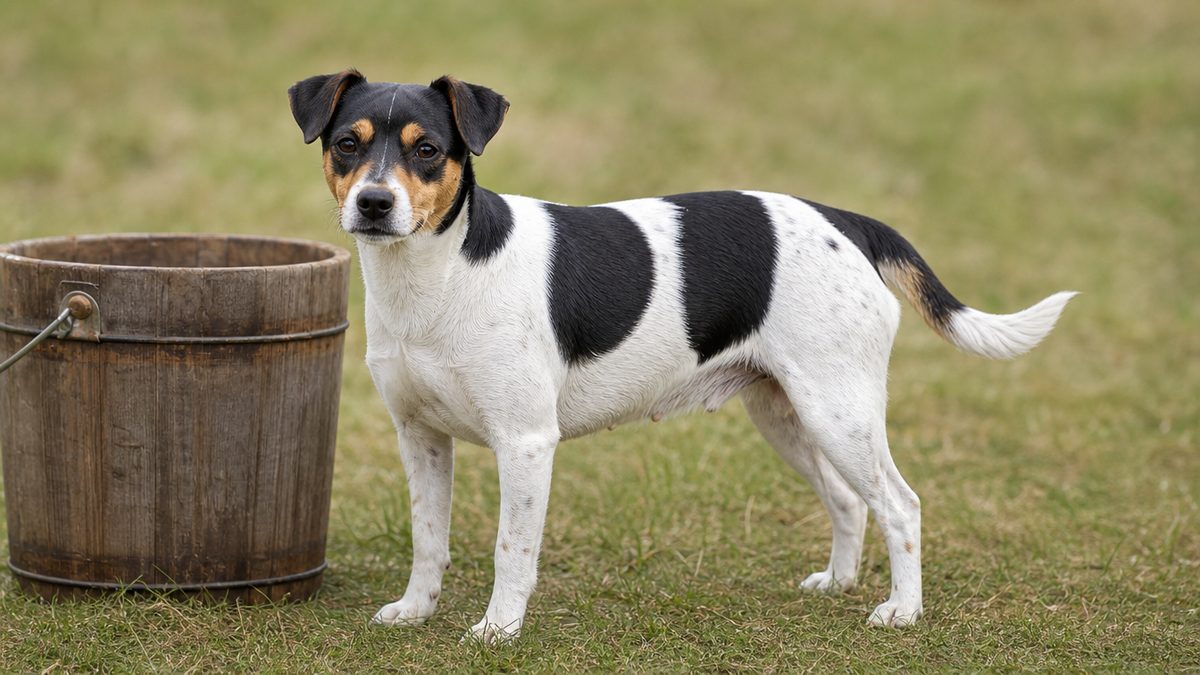
Quick answer
The Danish-Swedish Farmdog is a 34 cm Scandinavian farm working dog, FCI standard 356, jointly Danish and Swedish in origin and classified in Group 2 as a pinscher rather than a terrier. Sweden registered 743 in 2025, its ninth most popular breed. India has none. The two rupee prices circulating for it belong to a Dandie Dinmont Terrier article and to a Maltipoo.
This page summarises published breed-standard text, national kennel club rules, insurance-derived registry statistics, government notifications and peer-reviewed veterinary research for general information. It is not a diagnosis and it is not treatment advice. Consult a registered veterinarian near you about your own dog before acting on anything here. Two things are worth raising the same day rather than watching. A red, cloudy, watery or suddenly painful eye in this breed needs an intraocular pressure reading within hours, because primary lens luxation causes glaucoma and can blind an eye quickly. And a dog that strains to urinate, passes blood, or postures repeatedly without producing urine needs seeing immediately, because a cystine stone can obstruct the urinary tract.
Danish-Swedish Farmdog at a glance
What the Danish-Swedish Farmdog is, and what the register actually says
The Danish-Swedish Farmdog is a small, compact, slightly rectangular farm working dog jointly native to Denmark and Sweden, recognised by the Federation Cynologique Internationale as standard number 356 and filed in Group 2 under Section 1.1, Pinscher type. Its official FCI name is not the English one. It is Dansk-Svensk Gardshund.
Two countries own this breed at once, which is rare enough to be worth stating first. The FCI register prints the country of origin of the breed as DENMARK, SWEDEN, on one line, and the standard itself opens with ORIGIN: Denmark and Sweden FCI-Standard No 356. That is not a courtesy. The Swedish Kennel Club records that when the breed was recognised in 1987 it was recognised with both nations' names inside the breed name, and that the first challenge certificates were awarded in September of that year at a show in the grounds of Sofiero Palace. Denmark and Sweden had independently arrived at the same dog, agreed it was one breed, and put both flags on it.
The recognition dates, in order
Four dates matter and they are frequently collapsed into one. Read them off the register rather than off an aggregator.
| Date | What happened | Source |
|---|---|---|
| February 1986 | 107 dogs gathered in Sweden and the evenness of type was judged adequate for a breed of its own | Svenska Kennelklubben |
| 1987 | Recognised in Denmark and Sweden under the joint breed name Danish-Swedish Farmdog | FCI standard 356, brief historical summary |
| 5 July 2008 | Accepted by the FCI on a provisional basis | FCI register, standard 356 |
| 10 December 2018 | Date of publication of the official valid standard | FCI standard 356 |
| 29 April 2019 | Accepted by the FCI on a definitive basis; breed status now Recognized on a definitive basis | FCI register, standard 356 |
| 6 May 2019 | English-language standard published, header 06.05.2019/EN | FCI standard 356 PDF |
| 2025 | Recognised as a breed by the American Kennel Club, placed in the Working Group | American Kennel Club |
Note one disagreement rather than smoothing it, because it has a likely explanation. The FCI's own English standard carries the header 06.05.2019/EN and the register's table gives the publication date as 6 May 2019 FCI-Standard No 356. The Danish Kennel Club's breed lexicon instead says the FCI approval and standard were published on 19 May 2019. The FCI's own breed-education document, written jointly by the Danish and Swedish breed clubs, reproduces the superseded standard and dates it 19.05.2009. So a real 19 May date exists in this breed's paperwork, on the 2009 standard rather than the 2019 one. We print all three and let the reader see what probably happened.
What the breed standard describes
The FCI breed standard describes a small, compact and slightly rectangular dog known to mature late, with a body ratio of 9:10 and a chest depth to withers height ratio of 1:2. Behaviour is given in three words, alert, attentive and lively. The utilization line reads farm and companion dog, and the brief historical summary says the farmdog is used as a watchdog, ratter and companion.
- Height at withers, males 34-37 cm and females 32-35 cm, with a tolerance of plus or minus 2 cm.
- Coat short and smooth, harsh on the body, with white dominating and patches of black, tan, yellow, brown, badger and all shades of fawn permitted.
- Ears rose or button, with the fold just above the skull. Prick ears are listed as a fault.
- Tail either long or naturally short, a stumpy tail, carried straight, with a slight curve or like a sickle.
- Head triangular and a bit small in proportion to the body, with a well defined stop.
- Disqualifying faults limited to aggressive or overly shy behaviour and any physical or behavioural abnormality.
Dansk-svensk gardshund translates as Danish-Swedish farm dog, and gard means farmyard rather than farmland. The Finnish name recorded by the Nordic Kennel Union, tanskalais-ruotsalainen pihakoira, makes the same point, since piha is the yard. This is a yard dog, not a field dog, and the distinction explains the job it was kept for.
One more name is worth recording because it appears only in the American veterinary literature. PetMD's breed page, reviewed by a veterinarian, says the breed is often mistaken for a terrier though they are actually most closely related to pinschers like the Doberman, and adds that farmdogs used to be called Danish Pinschers. We have found that former name nowhere in the FCI, Danish or Swedish registers, so treat it as an American usage rather than a register name.
How big is it really, and why every published weight disagrees
The FCI breed standard for the Danish-Swedish Farmdog prints no weight at all, anywhere in its text. That single omission explains why every published weight for the breed differs from every other, and it is why a measured figure is worth more here than on almost any other breed page.
Height is settled and weight is not. The standard gives males 34-37 cm at the withers and females 32-35 cm, with a tolerance of plus or minus 2 cm, and it stops there. No weight, no range, no guidance. The FCI's own judging document adds only that despite the generous height tolerance, the overall impression must remain that of a small, compact dog.
A measured figure, from the Swedish screening database
Sweden happens to weigh these dogs, and somebody published the numbers. Body weight is recorded for every dog radiographed under the Swedish Kennel Club's hip screening programme, and a 2019 degree project at the Swedish University of Agricultural Sciences used that database to track ten breeds, including the Dansk svensk gardshund, across 2007 to 2016. The whole dataset ran to 38,566 registrations after cleaning, and only breeds with more than 200 radiographed individuals were eligible for inclusion.
| Source | Males | Females |
|---|---|---|
| Measured, SKK radiograph database 2007 (n = 79 males, 88 females) | 8.86 kg (SD 1.56) | 7.52 kg (SD 1.57) |
| Measured, SKK radiograph database 2016 (n = 82 males, 128 females) | 8.89 kg (SD 1.40) | 7.29 kg (SD 1.34) |
| FCI standard 356 | Not given | Not given |
| Dansk Kennel Klub breed entry | 7-12 kg | 7-12 kg |
| American Kennel Club | 15-20 lb (6.8-9.1 kg) | 15-20 lb (6.8-9.1 kg) |
| Puppiezo, Indian dealer page | 5-8 kg | 5-8 kg |
Three things follow, and none of them appears on any page ranking for this breed in India.
- The breed is sexually dimorphic by roughly 1.4 kg, and not one of the four published ranges shows that, because all four give a single figure for both sexes.
- The measured Swedish means sit at the bottom of the Danish range, inside the American one, and above the Indian dealer's, whose upper bound of 8 kg is a figure the average Swedish male exceeds.
- Neither sex changed significantly in weight across the decade, with p-values of 0.891 for males and 0.276 for females, so this is a stable population rather than one drifting in size.
These are dogs radiographed for hip screening, at a mean age between about 18 and 25 months, not a random sample of pet farmdogs. The thesis itself notes that owners who radiograph tend to be breeders or experienced handlers, who may keep their dogs leaner than average. So read 8.9 kg for a male and 7.3-7.5 kg for a female as a fit young adult weight rather than as a population mean.
What the proportions mean when you look at a dog
Check the shape rather than the scale, because this breed is defined by ratios. The standard requires a slightly rectangular body at 9:10, and a chest depth to withers height ratio of 1:2, which means the chest should reach halfway down the dog. The judging document translates that plainly: the dog should be slightly longer than tall, and must not give the impression of either long or short legs. Low on legs is listed as a fault, and so is an elegant general appearance.
Two of the standard's faults are the ones an Indian buyer looking at photographs can actually use. Prick ears are a fault, and the breed education document calls upright ears a serious fault FCI Breed by Breed Education. So is a curled tail or a tail carried flat on the back. A photograph of a small white-and-patched dog with fully erect ears and a tightly curled tail is not showing you a good example of this breed, whatever the caption says.
It is not a terrier, and the register says so twice
The Danish-Swedish Farmdog is a pinscher, not a terrier, and both the international register and the Danish national kennel club state it directly. The confusion is understandable, because the breed's own pre-recognition Swedish name was Skansk Terrier, and because it does a terrier's job. Neither fact changes what it is.
Start with where the FCI files it. The register places the breed in Group 2, Pinscher and Schnauzer, Molossoid breeds, Swiss Mountain and Cattle Dogs, Section 1.1, Pinscher Type, without working trial FCI-Standard No 356. Terriers are Group 3, a separate group with its own list. There is no ambiguity in the filing and no shared section between the two.
Then read what the Danish Kennel Club prints in its own breed lexicon, in Danish, in the origin paragraph. The sentence is worth quoting because no English-language page carries it.
Gardhunden er ikke nogen terrier, men en pinscher, som var uundvaerlig paa enhver landejendom til at holde stalde og lader fri for rotter og mus og som alarmklokke, naar nogen naermede sig. In English: the farmdog is not a terrier, but a pinscher, which was indispensable on every farm to keep stables and barns free of rats and mice, and as an alarm bell when someone approached.
That is the national kennel club of one of the two countries of origin, going out of its way to correct a specific mistake, on the breed's own page. It is the single most direct answer available and it is written in a language almost no Indian breed page reads.
The FCI's own judging document warns against terrier type five times
The FCI hosts a breed-education presentation for this breed, written jointly by the Danish and Swedish breed clubs and used to teach judges what the breed is. It returns to the terrier question five separate times, which is not something a document does by accident.
- On the history: once the Danish and Swedish kennel clubs compared notes, it became obvious that the breed for one thing was the same in both countries, and for another, that it was indeed not a terrier, but a pinscher.
- On the classification: it is important to note that the farmdog is a pinscher type, rather than a terrier type.
- On the skull: narrow skull or flat cheeks is untypical, and gives a terrier-like expression.
- On the tail: if the tail is set too high, the croup is too flat, and this gives impression of terrier-type.
- On the topline and on similar breeds: the topline must not be too straight or flat, too terrier like, and it should never give impression of terrier type.
The same document also names the breeds it gets confused with, which is a useful shopping list for anyone verifying a photograph. A less than perfect Danish-Swedish Farmdog can look almost identical to a less than perfect Smooth Fox Terrier, Jack Russell Terrier, Parson Russell Terrier or Terrier Brasileiro.
Where the terrier idea came from
The terrier framing has three real roots, and none of them is a classification. Take them in order.
- The old name. Before recognition in 1987 the breed was known in Sweden as Skansk Terrier, the Skane Terrier, after the southern Swedish county where it originates.
- The ancestry. The Swedish Kennel Club describes the type as Pinscher-Fox Terrier and says it probably derives from crosses between the Pinscher and the Fox Terrier.
- The job. It was kept to clear stables and barns of rats and mice, which is a terrier's job description almost word for word.
All three are true and cited to the Swedish and Danish registers Dansk Kennel Klub. None of them makes the dog a terrier, any more than a Dachshund becomes a hound because it goes to ground. Classification follows type and ancestry as the register judges them, and the register judged pinscher. The comparison section below runs the test that settles it, using four FCI ratting breeds filed across three different groups.
Two registers, two groups, neither of them terrier
The American Kennel Club recognised the breed in 2025 and put it in the Working Group, not the Terrier Group. So the two registries that classify this dog disagree with each other, placing it in Group 2 and in Working respectively, and agree only on the negative: it is not a terrier in either system. The AKC page also records that the breed entered the AKC Foundation Stock Service in 2011 and ranked 170 of 210 by 2025 registrations.
Royal Canin India is where the terrier framing reaches Indian readers with a brand behind it. Its India breed page says the morphology of Danish-Swedish Farmdogs is reminiscent of some of the greatest of the terriers, including Jack Russells and fox terriers, and credits the FCI as the source of its key facts. Morphology reminiscent of is a fair sentence. The same page then prints Country: Denmark, dropping Sweden from a breed whose FCI entry reads DENMARK, SWEDEN and whose name contains both. When the source is credited and the source disagrees, check the source.
How a farmyard dog became a registered breed, and where the sources disagree
The Danish-Swedish Farmdog existed for centuries before anyone registered it, and its recognition took from the early 1960s to 2019. The two countries that made it disagree about one thing, whether the fox terrier is in its foundation or was added later, and that disagreement is worth seeing.
The FCI's own breed-education document, written jointly by the Danish and Swedish breed clubs, opens with a frank admission. No one knows the origin of the breed with certainty, but the breed is very old, and dog skeletons found in Viking burial sites are similar to farmdog types. It adds that typical farmdogs have been found across all of the old Denmark, from Scania to Schleswig-Holstein and even Normandy, and that until the 1960s this little dog could be found all over the countryside of Denmark and southern Sweden.
Nearly lost to industrialisation
Industrialisation almost ended it. As small farms disappeared in Denmark and Scania the farmdog population fell with them, and only a few country people kept breeding, entirely unorganised. Through the 1970s people involved in Danish Kennel Club work began to notice the dogs, and during the 1980s the DKK's committee for national and forgotten breeds concluded it was important to save the breed. Attention then turned to southern Sweden, which had been part of the old Danish farming country.
The Swedish records were kept under a different name
Sweden had already been recording the dogs, informally, for two decades. Some generations had been entered in a non-official registry whose hand-written records date back to the early 1960s, and in those records the dogs are entered as Scania Terrier. The Swedish Kennel Club's own breed entry uses the Swedish form, Skansk Terrier, and says the breed was known by it before recognition in 1987. When the two kennel clubs finally compared their records, two things became clear at once: the dogs were the same breed in both countries, and they were not terriers.
The recognition sequence, with the counts
| When | What happened |
|---|---|
| Early 1960s | Hand-written Swedish records begin, under the name Scania Terrier |
| February 1986 | A gathering of 107 dogs; the Swedish Kennel Club holds its first certification and around 100 dogs are approved into the SKK pedigree |
| 1987 | The first 130 farmdogs are entered in the Danish Kennel Club's X-register; both countries recognise the breed under the joint name |
| September 1987 | The first challenge certificates are awarded at a show in the grounds of Sofiero Palace |
| 1989 | The breed is shown officially for the first time in Denmark, at the World Dog Show in the Bella Center |
| 2005 | The Swedish pedigree closes to new certifications |
| 2008 | Provisional FCI acceptance, on 5 July |
| 2016 | Certifications of unregistered dogs still occurring in Denmark, in very limited numbers |
| 2019 | Definitive FCI acceptance, on 29 April |
One line in that table is easy to skim past and it matters for anyone assessing a pedigree. The Swedish studbook closed to new certifications in 2005, while the Danish one stayed open and was still admitting unregistered dogs as late as 2016. The Danish Kennel Club still runs the route today, saying a Dansk Svensk Gardhund can be presented to the breed club and gain approval for studbook entry that way. So a Danish pedigree and a Swedish pedigree of the same age are not built from identical populations.
Where the two registers disagree about ancestry
The Swedish Kennel Club and the joint breed-club document give different accounts of where the fox terrier fits, and both are published by bodies with standing. Print both.
| Source | What it says |
|---|---|
| Svenska Kennelklubben, Nordic dog breeds entry | Dogs of this Pinscher-Fox Terrier type have been known around the Baltic since the late 19th century and probably derive from crosses between the Pinscher and the Fox Terrier |
| FCI breed-education document, written by both breed clubs | The breed was not developed from other breeds known as such today, but has origin in some old pinscher type probably from before the Viking era. Fox terrier and a hound variety were mixed in in more current time and were not part of the origin |
| Dansk Kennel Klub, breed lexicon | Archaeological excavations show the type spread from Skane across Denmark to North Germany well over a thousand years ago |
The disagreement is real and it is not trivial. One account makes the fox terrier a founder, the other makes it a later contaminant, and the difference decides whether the terrier resemblance is ancestral or recent FCI Breed by Breed Education Dansk Kennel Klub. We do not know which is right and we have found no genetic study of the breed's ancestry that would settle it.
The FCI education document reproduces a photograph taken in 1902 at a hunt at Skabersjo castle in Scania, with Crown Prince Gustav, later King Gustav V of Sweden, standing in the centre of the stairs and farmdog-type dogs in the group. Whatever the ancestry argument settles on, dogs of this type were on Scanian estates well before anyone thought to write a standard for them.
The Indian page that ranks for this breed is about a different dog
One Indian page carries almost all of this breed's Indian search visibility, and its editorial content is about the Dandie Dinmont Terrier. This section documents exactly what it is, because an Indian reader who does not know that will take a price, a climate band and a health list from it and act on all three.
The page sits at happypet.care/dog-breeds/danish-swedish-farmdog and returns HTTP 200 with everything a correct page should have. Its H1 reads Danish-Swedish Farmdog. Its origin block shows two flags, Denmark and Sweden, which is right where Royal Canin India shows one. Its three photographs are genuine Danish-Swedish Farmdogs and the alt text describes them accurately, down to the erect ears and the white, black and tan patching. Its page title is A Comprehensive Guide To Danish-Swedish Farmdog Breed.
Then the body starts, and it is about a Scottish Borders terrier.
| Heading as printed | Which breed it names |
|---|---|
| Overview of the Dandie Dinmont Terrier | Dandie Dinmont Terrier |
| Adopt/Shop and Price of Dandie Dinmont Terrier Breed | Dandie Dinmont Terrier |
| Prerequisites to pet a Danish-Swedish Farmdog | Danish-Swedish Farmdog |
| Nutrition Guide for the Dandie Dinmont Terrier | Dandie Dinmont Terrier |
| Healthcare Tips for your Danish-Swedish Farmdog | Danish-Swedish Farmdog |
| Some common health conditions in Danish-Swedish Farmdogs | Danish-Swedish Farmdog |
| Grooming for Dandie Dinmont Terrier | Dandie Dinmont Terrier |
| Senior Dog Care Guide: Dandie Dinmont Terrier | Dandie Dinmont Terrier |
What it actually is, established by a control
The page is a template whose breed-name variable resolved correctly and whose editorial payload did not. Scrape a second breed on the same site and the mechanism becomes visible. The Rajapalayam page carries hand-written headings that name the breed and read like SEO titles, Rajapalayam Dog Price in India, Rajapalayam Dog Medical Care, Rajapalayam Dog Grooming Guide, and its body text is genuinely about Rajapalayams. So the site does produce correct per-breed pages when someone writes one.
On the farmdog record, three headings survived in the template's default form, Prerequisites to pet a {breed}, Healthcare Tips for your {breed}, Some common health conditions in {breed}s, and those three filled from the URL slug. Every heading a human retyped says Dandie Dinmont Terrier. The split is not random. It is the seam between what the software filled in and what a person pasted.
The section headed Healthcare Tips for your Danish-Swedish Farmdog is not about the Danish-Swedish Farmdog. It carries the Dandie Dinmont Terrier payload under a farmdog heading, and it names neither primary lens luxation nor cystinuria, which are the two conditions the Danish and Swedish registers actually act on in this breed. Our own Dandie Dinmont Terrier page documents the same page from the opposite side, where it likewise omits intervertebral disc disease and glaucoma.
The health list is generic, and the control proves it
Its Common Health Issues chips read bloat, hip dysplasia, parasites, parvovirus, heartworm, Lyme disease, canine influenza and kennel cough, with panosteitis and rabies added in the prose below. Six of those eight also appear on the Rajapalayam page, a breed with no shared ancestry, no shared size and no shared country. The two pages also print an identical grooming line of Rs 700 to Rs 1,200 a month. This is a fixed vocabulary being dealt out, not a breed being described.
Check that list against Indian evidence and it gets worse. A PCR survey of 525 dogs in Delhi, Mumbai, Sikkim and Ladakh found 261 of them, 49.7 percent, infected with at least one tick-borne pathogen: Hepatozoon canis in 30 percent, Ehrlichia canis in 20.6 percent, Mycoplasma haemocanis in 12.2 percent, Anaplasma platys in 6.5 percent and Babesia vogeli in 5.5 percent, with Rhipicephalus ticks on 53 percent of the dogs examined. In Delhi alone Ehrlichia canis reached 39.5 percent. None of those five pathogens appears on the Indian page's health list, while Lyme disease and canine influenza, which that survey did not even include in its panel, both do.
And the comparison strip nominates four toy breeds
The page's Compare with similar breeds strip offers a Poodle, a Pomeranian, a Maltese and a Chihuahua. Not one is a farm working dog, not one is FCI Group 2, and the shortest useful description of the actual breed, a 34 cm ratter that jumps very high and digs for voles, rules all four out as comparators. Whatever selected them, it was not the breed.
None of this is obscure. On 27 August 2026 this page held position six in Google India for the price query, and its Rs 15,000 to Rs 35,000 was one of the two numbers Google's own AI Overview used to build an Indian price band for the breed. We do not cite it for a single fact about the Danish-Swedish Farmdog. We cite it as a documented example of how Indian breed content is manufactured.
Danish-Swedish Farmdog price in India: there isn't one
No verified Danish-Swedish Farmdog price in india exists, because no verified Danish-Swedish Farmdog exists in India. Two rupee figures circulate, both are traceable, and neither describes this breed. What follows is the arithmetic on both, and the genuine international prices for comparison.
Search the price query from an Indian IP on 27 August 2026 and the top three organic results are a puppy dealer, a book on Flipkart and a book on Amazon.in. Two of the three pages that Google India considers most relevant to buying this dog are paperbacks about training it. That is what a market with no supply looks like from the outside.
Figure one, Rs 15,000 to Rs 35,000
This band sits on the page whose overview, price, nutrition and grooming sections are all headed Dandie Dinmont Terrier. It is printed under a Cost of buying label on a spec card whose H1 says Danish-Swedish Farmdog, which is why it reads as a farmdog price and gets quoted as one. Run the conversion tests this site uses on suspicious rupee figures and it fails all of them.
| Rupee figure | Divided by 84.38 | Divided by 80 | Divided by 74 |
|---|---|---|---|
| Rs 15,000 | USD 177.77 | USD 187.50 | USD 202.70 |
| Rs 35,000 | USD 414.79 | USD 437.50 | USD 472.97 |
Nothing divides to a whole dollar at 84.38 or at 74. Both figures do divide at 80, but that proves nothing, because 1,000 divided by 80 is 12.5, so any rupee number ending in three zeros passes at 80 by construction. The quotients are the tell. Nobody prices a dog at 187.50 dollars or 437.50 dollars. So this is not a converted American price list; it is a rupee-native figure typed in beside the wrong breed's article.
Figure two, Rs 98,999
Rs 98,999 is the price of a Maltipoo. It appears on the page ranking first in Google India for this breed, in a carousel headed Available Danish-swedish Farmdog Puppies For Sale. Here is everything that carousel actually contained on 27 August 2026.
| Name | Breed as labelled by the seller | Price |
|---|---|---|
| Fizey | Maltipoo | Rs 98,999 |
| Kuzo | Poodle | Rs 92,599 |
| Dugu | Poodle | Rs 92,599 |
| Kazuka | Cane Corso | Rs 94,999 |
| Doir | Goldendoodle | Rs 1,20,000 |
| Samy | Maltipoo | Rs 98,999 |
| Tugi | Rottweiler | Rs 76,499 |
| Yoki | Doxiepoo | Rs 98,999 |
Zero Danish-Swedish Farmdogs. Rs 98,999 is attached to three different animals on one page, none of them this breed, and Rs 98,999 divided by 84.38 is 1,173.25, so it is not a converted figure either. It is a house charm price that follows whichever puppy is in stock. The same page also claims the breed is Recognized as the national Dog of Denmark, which no register we opened supports.
What Google India then does with those two numbers
Google's AI Overview for this query builds an Indian price range out of exactly those two contaminated figures, and credits them. It reports an Estimated Local/Online Range of Rs 15,000 to Rs 35,000 for general listings, sourced to Happy Pet Care, and Imported/KCI Registered: Up to Rs 98,000 or higher, sourced to Puppiezo. So the Dandie Dinmont Terrier's number has become India's low end and the Maltipoo's number has become India's import price.
Rs 15,000 to Rs 35,000 belongs to an article about a different breed. Rs 98,999 belongs to a Maltipoo called Fizey. There is no third Indian figure. Any Indian page or answer engine quoting a Danish-Swedish Farmdog price is quoting one of these two, or a derivative of them.
What the breed actually costs where it exists
Genuine prices are published and they are an order of magnitude higher. PetMD's veterinarian-reviewed breed page states that the cost varies by breeder but that you can generally expect to pay at least USD 3,000 for a puppy, and points readers at the Danish-Swedish Farmdog Club of America's regional breeder directory. Google's overview of the international question adds USD 3,000 to USD 3,800 for companion puppies, USD 4,500 or more for a started puppy, and EUR 1,200 to EUR 3,000 in Europe where the breed is common, and warns that listings at USD 500 to USD 700 are often scams or puppy mills.
Hold that warning next to the Indian number. Rs 15,000 is USD 177.77 at 84.38, which is roughly a quarter of the figure already flagged as a scam signal in the United States and about six percent of the American floor. An Indian price that low for a breed with no Indian breeding population is not a bargain, and it is not even a plausible fake. It is a figure that was never about this dog.
The scarcity behind those prices is quantified too. PetMD estimates that fewer than 500 Danish-Swedish Farmdogs live in the United States. Set that against Sweden registering 743 puppies in a single year and the shape of the world market becomes clear: this is a common Scandinavian dog and a genuinely rare one everywhere else.
Cost of ownership, and why we publish no monthly rupee total
Bonbeno publishes no monthly cost of ownership total in rupees for the Danish-Swedish Farmdog, because no verified Indian cost data for this breed exists and the only Indian figures available sit on a page about a different breed. What this section does instead is set out the cost structure honestly and name the three lines that are unusual.
The Indian monthly figures in circulation are Rs 2,200 basic and Rs 3,750 premium, broken into food at Rs 1,200 to Rs 1,800, veterinary at Rs 300 to Rs 750 and grooming at Rs 700 to Rs 1,200. The arithmetic is internally consistent, which is why it looks credible. It sits on the page whose nutrition and grooming sections are both headed Dandie Dinmont Terrier, and its grooming line is identical, to the rupee, to the grooming line on the same site's Rajapalayam page, a dog two to three times the weight. A number that does not change when the dog changes is not a cost estimate.
The ordinary lines
Budget as you would for any active small dog in an Indian city. Food for a 7 to 12 kg dog, core vaccination and the annual booster, deworming, year-round ectoparasite prophylaxis, nail trimming, and an emergency reserve. None of that is breed-specific and every Indian owner already knows the local price of it better than a national page can.
Three lines that are unusual for a small dog
Three cost lines on this breed are genuinely different from a generic small-dog budget, and all three come out of the Scandinavian registry record rather than out of anything Indian.
- A primary lens luxation DNA test, once, for life. The UC Davis Veterinary Genetics Laboratory prices it at USD 58 as a single test per animal, or USD 27 when added to another health test on the same animal, with at least 15 business days turnaround.
- Tick prophylaxis at a level Scandinavian owners never budget for. A 525-dog Indian survey found Rhipicephalus or Haemaphysalis ticks on 53 percent of dogs examined and at least one tick-borne pathogen in 49.7 percent.
- Urinary monitoring. Cystinuria in this breed has no DNA test and no established mode of inheritance, so the only screening available is clinical, which means urinalysis rather than a one-off genetic result.
The DNA test line is worth taking seriously despite the price, because it is once per dog and it answers a question nothing else can. It also lets you check a breeder's claim rather than believe it. Note that in Denmark the equivalent obligation falls on the breeder, not the buyer: offspring can only be entered in the studbook if at least one parent is registered genetically free of PLL, and where both parents are free the pup is registered free by ancestry. A Danish-bred puppy therefore arrives with the question already settled.
The line that dwarfs the others
The import itself is the dominant cost and it is not a fee you can simply pay. Only three categories of dog may lawfully enter India at all: a pet dog with a valid pet book in the importer's own name, a dog imported by a research organisation with a CPCSEA recommendation, and dogs for internal security by the Defence and Police Force. Nobody can import one for you, and paragraph 6 of the notice says applications made on behalf of some another person or entity shall be duly rejected. So for almost every Indian reader the correct cost estimate for acquiring this breed is not a number at all.
Three things. A population of Danish-Swedish Farmdogs actually living in India, Indian veterinary invoices for that population, and Indian food and grooming quotes taken against a dog of this size and coat. None of the three exists. Until they do, a monthly total here would be a number we invented, and inventing one is how the pages above this one in the search results got where they are.
One cost that is lower than you would expect
Grooming should be cheap, and this is the one place the breed is genuinely undemanding. The Danish Kennel Club says the coat is short, hard and smooth and requires as good as no care in itself, and the American Kennel Club calls the breed an easy dog to groom and very low maintenance, needing occasional brushing and a bath. There is no hand-stripping, no clipping schedule and no salon dependency here. If an Indian quote for this breed includes a monthly salon visit, it was written for a different coat.
Set against that, the shedding cost is real but it is not a grooming bill. It is a vacuum cleaner and a lint roller, twice a year, because the Danish Kennel Club notes the coat sheds heavily twice annually and the stiff hairs bore vertically into furniture and up into the soles of your feet.
Heat tolerance in India, measured in wet-bulb rather than air temperature
The Danish-Swedish Farmdog's heat tolerance is low for Indian conditions, and the cleanest way to show it is wet-bulb temperature rather than air temperature. Chennai's coolest month sits 5.7 C above the hottest month the breed's own home county records. The two ranges do not overlap in any month of the year.
Use wet-bulb temperature because that is the number a panting dog is up against. A dog sheds heat mainly by evaporating water from its respiratory tract, and the wet-bulb temperature is the theoretical floor that evaporative cooling can reach in a given air mass. Air temperature alone flatters humid Chennai and unfairly condemns dry Delhi. All figures below come from NASA POWER's 2001-2020 climatology, queried by explicit latitude and longitude so no place name can resolve to the wrong city.
The breed's home climate
Malmo in Skane, the Swedish county the breed originates in, sits at 55.605 N, 13.004 E and records an annual mean air temperature of 8.99 C and an annual mean wet-bulb of 7.77 C, with its hottest wet-bulb month, August, reaching 16.11 C and its coldest, February, at 0.19 C. Copenhagen, 55.676 N and 12.568 E, is functionally identical: annual mean 8.98 C, annual mean wet-bulb 7.76 C, August wet-bulb 16.01 C. The joint origin is a joint climate, twelve kilometres apart across the Oresund.
The comparison, month by month
| Location | Annual mean wet-bulb | Coolest month wet-bulb | Warmest month wet-bulb |
|---|---|---|---|
| Malmo, Skane (55.605 N, 13.004 E) | 7.77 | 0.19 (Feb) | 16.11 (Aug) |
| Copenhagen (55.676 N, 12.568 E) | 7.76 | 0.18 (Feb) | 16.01 (Aug) |
| Chennai (13.083 N, 80.271 E) | 24.94 | 21.77 (Jan) | 27.36 (May) |
| Mumbai (19.076 N, 72.878 E) | 22.73 | 17.06 (Jan) | 26.55 (Jun) |
| Bengaluru (12.972 N, 77.595 E) | 19.80 | 16.43 (Jan) | 22.66 (May) |
| Pune (18.520 N, 73.857 E) | 19.66 | 14.28 (Jan) | 23.56 (Jun) |
| Delhi (28.614 N, 77.209 E) | 18.03 | 6.86 (Jan) | 27.74 (Jul) |
Read the Chennai row against the Malmo row and the answer is arithmetic. Chennai's coolest four weeks of the year, January at 21.77 C wet-bulb, are 5.66 C hotter than the hottest four weeks Malmo ever gets. There is no month in which a Danish-Swedish Farmdog in Chennai would experience conditions its home county produces even at peak summer. Mumbai is the same story with a smaller gap: its January, 17.06 C, still exceeds Malmo's August.
Bengaluru is not the exception people assume
Bengaluru's mildness helps less than its reputation suggests. Its coolest month, January at 16.43 C wet-bulb, is level with Malmo's hottest month at 16.11 C, and by May it reaches 22.66 C. So India's most temperate large city gives this breed a permanent Scandinavian August as its best case. That is liveable, and it is genuinely the easiest Indian city on the list, but it is not cool.
Delhi splits the year in half, and that is useful
Delhi is the one Indian city where this breed gets real relief, and also the one where it faces the worst peak. Delhi's January wet-bulb of 6.86 C is below Malmo's annual mean, so a Delhi winter is genuinely cooler in evaporative terms than a Swedish summer. Then July arrives at 27.74 C wet-bulb, the highest figure in the table, and June's monthly mean air temperature reaches 35.9 C, with 48.8 C as the hottest June reading in the twenty-year record rather than a routine afternoon. A Delhi owner therefore has roughly four workable months and four dangerous ones, which is a far more useful planning statement than a blanket verdict.
Exertional heat illness, not confinement, is what threatens a dog like this. In 1,259 heat-related illness events from 1,222 UK dogs, 380 had no trigger recorded; of the 879 events that did have one, 652, which is 74.2 percent, were exertional, against 113 environmental and 46 from vehicular confinement. Young male dogs had greater odds of exertional heat illness, and dogs at or above their breed and sex mean bodyweight had higher odds than lighter ones. The Danish-Swedish Farmdog was not one of the breeds modelled in that study, so no odds ratio here belongs to it, but the risk profile does: a young, keen, self-motivated dog that will keep working past the point at which it should stop.
That study is UK data on UK dogs and its named breeds are common British ones. Nothing in it is a Danish-Swedish Farmdog figure and we do not present it as one. What transfers is the mechanism. The Swedish Kennel Club describes this breed as agile, quick, able to jump very high and a great sporting dog that enjoys working physically and mentally, which is precisely the temperament that produces exertional cases. A lazy dog in Chennai is at less risk than an eager one.
One caution about the Indian sources. The page ranking for this breed prints an Ideal Weather band of 10 to 25 C. Set aside that the band sits on an article about a different breed; taken at face value it would rule out every city in the table above for most of the year, which is a stronger conclusion than the page itself appears to intend.
Temperament, and who should not get one
The Danish-Swedish Farmdog is alert, attentive and lively by its own breed standard, and the two national kennel clubs add that it is people-loving, confident with strangers, and an energy bundle that demands occupation. Buy one only if you want a working temperament in a 34 cm body.
The FCI standard gives temperament in three words and disqualifies only two things, aggressive or overly shy behaviour and any physical or behavioural abnormality. That is a short list, and it tells you the breed was not selected for guarding hardness. It was selected for alertness.
The Danish Kennel Club fills the gap with a paragraph the Indian pages never translate. It describes a dog that is opvagt, opmaerksom og livlig, alert, attentive and lively, that throws itself with enthusiasm into every kind of play, especially with children, that loves people and actively seeks company, and that is curious, forthright, happy and secure with strangers rather than suspicious of them. It also says the breed is a festlig selskabshund, a convivial companion dog, that thrives fine in groups and travels well.
The Swedish register adds a caveat the Danish one does not
The Swedish Kennel Club describes a very sweet and loyal family dog and then adds that, having an origin as a farm dog, the breed might be slightly wary of strangers. Set that beside the Danish text above, which says the opposite. Two national kennel clubs of the two countries of origin do not agree on how this breed meets a stranger.
The document that resolves it is the one both breed clubs wrote together for the FCI, to teach judges. It is unusually blunt. A reserved and shy farmdog has a completely untypical temperament, which we consider strongly unwanted and disapprove of; it must be friendly, and greeting with a high lifted and wagging tail. It goes further on the guarding question: even though the farmdog was originally used as a guard dog, it must never show aggression when it barks at strangers approaching, and the barking is strictly a door bell function, meant to notify about the stranger's presence, not to chase him away.
So the joint official position sides with the Danish text. Wariness is not the breed type; it is a fault the clubs actively disapprove of. Read the Swedish sentence as a description of what does occur in some individuals rather than as a description of the ideal, and treat a shy or reserved farmdog puppy as a reason to look at another litter.
The prey drive is the trait that decides Indian suitability
Take the prey drive seriously, because it is the trait that will actually shape your daily life. The Danish Kennel Club calls the breed an eminent rat hunter that willingly and eagerly digs after moles and water voles, warns that garden owners would be wise not to be too precious about their planting, and says the hunting instinct is very well preserved. The FCI's own historical summary lists ratter as one of three named jobs.
In an Indian city that drive meets squirrels, mynas, cats, rodents and the neighbourhood free-roaming dogs, and it meets them on a leash. The Danish text is explicit that the garden needs to be fenced, while noting the dog is not inclined to roam and keeps close contact throughout. That combination, high drive plus strong handler focus, is what makes it a good sport dog and a demanding pet.
A household with a fenced compound, a person at home for most of the day, an appetite for dog sport, and either a hill-station address or a hard commitment to pre-dawn exercise for eight months a year. Anyone who wants an alert, small, low-grooming companion that will settle quietly in a flat all day should read the exercise section before going further.
Who should not get one
- Anyone buying on looks. A dog that resembles a Jack Russell in photographs is not thereby a starter dog, and this one has more stamina than most terriers its size.
- First-time owners in a small flat with long working hours. The breed will fill an empty day itself, and digging and barking are its two default projects.
- Households wanting a quiet dog. It was kept as an alarm bell, in the Danish Kennel Club's own phrase, and alarm dogs bark at the lift.
- Anyone with free-roaming small pets. A ratter with a very well preserved hunting instinct is not a rabbit's housemate.
- Buyers who cannot socialise a puppy properly. Two registers disagree about how this breed meets strangers, which means socialisation carries more weight here than in a breed where the answer is settled.
The temperament claim on the Indian pages
The Indian result set reduces all of that to five words. The first-ranking dealer page lists the Top 5 Traits as alert, friendly, agile, hardy and intelligent, and the page at position six gives energetic, playful, intelligent, loyal and fearless. Neither is wrong, exactly, and neither is useful. Neither mentions the digging, the hunting instinct or the fence.
Formal temperament assessment exists for this breed and is worth asking a breeder about. The Swedish breed club runs and reports BPH, the Swedish Kennel Club's standardised behaviour and personality description, and the Danish Kennel Club publishes a mentalbeskrivelse document for the breed Dansk Kennel Klub. A Scandinavian-bred dog can come with a documented temperament assessment, which is more than almost any Indian-sourced puppy of any breed will.
Training a farmdog, and the one thing the Danish register warns about
Train this breed early and fast, because the Danish Kennel Club's own guidance says it is so eager to learn that it can be hard to steer, and that a handler who is slow with cues and praise will be overtaken. Willingness is not the problem here. Timing is.
The Danish Kennel Club puts the training issue in one sentence, and it is not the sentence most breed pages write. It says the dansk/svensk gardhund is a quick and easily taught dog that genuinely wants to cooperate, and that it can be so eager to learn that it becomes difficult to control, so you must be very fast with your directions and your praise, or the dog will overtake you and be off doing something else. That is a description of a latency problem, not a stubbornness problem.
What that means in practice
- Mark behaviour within about half a second. A clicker or a consistent verbal marker earns its keep on this breed more than on a slower one.
- Keep sessions short and end them while the dog still wants more, because a dog that has mentally moved on has already started its own project.
- Train before the walk rather than after it, since a mentally worked dog walks better and a physically tired one learns less.
- Use food and movement rather than pressure. Nothing in either register describes a breed that needs correcting.
- Proof the recall against live prey specifically, not against a treat in your hand, because the hunting instinct is described as very well preserved.
Where it will resist you
Expect resistance in exactly one place, the recall around small moving animals. The breed's job was to find and kill rats and mice in barns, and the Danish register adds that it digs willingly and eagerly after moles and voles. In an Indian context that means squirrels on a compound wall, rats in a drain, and cats. A recall that works in a park at 6 am is not the same skill as a recall that works when a squirrel crosses a wall, and the second one takes months of deliberate work.
Digging is the second resistance point and it is not disobedience. It is the job. If your compound has soil, expect holes. The practical answer used by working-breed owners everywhere is to designate a digging area and pay the dog for using it, rather than to try to extinguish a behaviour the breed was selected for over a thousand years.
It is late-maturing, and that changes the timeline
The FCI standard says the breed is known to mature late, in the general appearance paragraph, which is an unusual thing for a standard to say at all. The joint breed-club education document puts a number on it that no other source carries. Farmdogs develop slowly, and the breed is not fully developed until the age of three to four years, in some cases even later for males. It adds that proportions must be correct in young dogs, but that they generally appear less compact than dogs over four.
Read that as a training instruction. A twelve-month-old farmdog is not a finished dog physically or mentally, and judging your training by eighteen months rather than twelve will save you a lot of unnecessary worry. The Swedish breed club's outcross criteria make the same assumption from another direction, requiring a stud dog to be at least four years old and preferably older before its offspring can be evaluated.
What to train it for
Give it a sport, because the Swedish evidence is that this breed does them all. The Swedish breed club runs annual awards in agility, obedience, brukshund working trials, freestyle, heelwork to music, nosework, rally obedience and blood tracking, alongside conformation. The American Kennel Club lists eligibility in agility, barn hunt, flyball, herding, lure coursing, nosework, obedience, rally and tracking. That breadth is unusual for a breed this small and it is the clearest signal of what the dog wants from its week.
Nosework and scent games are the single best fit for Indian conditions, because they are indoor, air-conditionable, mentally exhausting and physically gentle. A dog that has spent thirty minutes finding hidden scent articles in a flat has had a harder day than one that walked four kilometres, and it has had it without meeting a 27 C wet-bulb afternoon.
Socialise deliberately rather than casually, and start in the first sixteen weeks. Two national kennel clubs disagree about whether this breed is forthright with strangers or slightly wary of them Svenska Kennelklubben / Nordic Kennel…, which means the outcome is not predetermined and your input matters. In India that also means deliberate, calm exposure to free-roaming dogs, autorickshaws, temple crowds and lift lobbies, none of which exist in a Skane farmyard.
Exercise needs, and whether an Indian city can meet them
Plan for a working dog's day, not a small dog's walk. Royal Canin's own key facts for this breed read requires minimal grooming and needs a lot of exercise, and the Swedish Kennel Club calls it a great sporting dog that is agile, quick and able to jump very high. The honest Indian answer is that the physical half is manageable and the mental half is where most owners will fail.
Nobody publishes a validated daily minute figure for this breed, and the two Indian pages that do give one disagree with each other. The dealer page says 45 minutes per day at a medium energy level; the page at position six says 30 to 60 minutes at a high energy level. Neither cites anything. What the actual registers say is qualitative and more useful. Royal Canin's India page, sourcing its key facts from the FCI, prints needs a lot of exercise. The Danish Kennel Club calls the breed an energibundt, an energy bundle, that demands both attention and occupation. The Swedish Kennel Club says it enjoys working both physically and mentally and requires some activation.
Split the requirement in two
Treat physical exercise and mental work as separate budgets, because in India only one of them is weather-dependent. The physical half is genuinely modest for a dog of this drive, because a 34 cm dog covers ground cheaply and does not need the distance a working gundog does. The mental half is not modest at all, and it is the half that keeps the dog sane in a Chennai May.
| Slot | Cool months | Hot months |
|---|---|---|
| Pre-dawn | 30-45 min walk with sniffing time | 30-45 min walk, non-negotiable, before first light |
| Mid-morning | Short training session, 5-10 min | Indoor training or scent work, 10-15 min |
| Afternoon | Free play in a fenced area | Indoor only. Puzzle feeder, chew, rest |
| Evening | Second walk plus a sport session | Post-sunset walk only, on shaded surfaces |
| Twice weekly | Agility, nosework or rally class | Nosework indoors, or a barn-hunt style scent game |
Check the ground temperature, not the air temperature, before an evening walk. Delhi's June air temperature averages 35.9 C and has touched 48.8 C on the twenty-year record, and Chennai's May averages 31.5 C and has touched 42.7 C, and asphalt holds that heat well past sunset. A dog 34 cm at the withers has its whole body inside the layer of hottest air above a road, which is a size problem the large-breed advice does not cover.
What happens without it
An under-exercised farmdog builds its own job, and the two it picks are named in the register. It digs, because the Danish Kennel Club records that it digs willingly and eagerly after moles and voles, and it barks, because it was kept as an alarm bell when someone approached. In a Skane farmyard both are useful. In a Mumbai flat, digging becomes upholstery and barking becomes a society complaint. Neither is a behaviour problem in the dog. Both are unemployment.
The Swedish Kennel Club specifically records that this breed is able to jump very high. Indian balcony grilles, low parapets and terrace walls are designed around larger, heavier, less athletic dogs. Assess the vertical, not just the gaps, before you let one loose on a terrace.
Sport is the realistic outlet, and India has some of it
Agility and obedience clubs operate in most Indian metros and both suit this breed exactly. The Swedish breed club awards Dog of the Year titles in agility, obedience, working trials, freestyle, heelwork to music, nosework, rally obedience and blood tracking, and the American Kennel Club lists it as eligible in agility, barn hunt, flyball, herding, lure coursing, nosework, obedience, rally and tracking. Of that list, nosework and rally obedience are the two an Indian owner can run indoors year-round with almost no equipment.
Be honest about the working drive question
Ask yourself directly whether the working drive has any outlet where you live, because for most Indian city buyers the answer is no. There is no barn, no vermin job, no cold season long enough to run a dog hard for six months, and in a flat there is no fenced ground it can dig in. What is left is a substitute, and substitutes work: scent work, food puzzles, trick training and a class twice a week genuinely satisfy a dog like this. But they are a daily commitment rather than a weekend one, and an owner who is not going to make it should choose a breed that does not need it. That is not a criticism of the dog. It is the difference between a farm dog and a companion dog, and this breed's own standard lists it as both.
Grooming a short harsh coat in Indian humidity
Grooming this breed costs almost nothing in time or money, and the Danish Kennel Club says the coat requires as good as no care in itself. The two things that do need managing in India are the twice-yearly shed and the skin under a white coat in monsoon humidity.
The FCI standard describes the coat in six words. Hair short and smooth, harsh on body. Colour is white dominating, with patches of black, tan, yellow, brown, badger and all shades of fawn permitted, patches allowed on the head, and flecking permissible. There is no undercoat described, no furnishings, no stripping and no trimming anywhere in the text. The American Kennel Club calls it an easy dog to groom, care for and maintain, very low maintenance, needing occasional brushing and a bath.
The shed is real and the Indian pages understate it
Expect a heavy shed twice a year and plan for it. The Danish Kennel Club's own care text says the coat sheds a great deal twice annually, and that the stiff hairs have an irritating ability to bore vertically down into furniture and up into the soles of your feet, where they are difficult to remove from either. That is a specific, physical warning about a harsh short coat, and it is the opposite of the Indian page's description of a low-shedding breed. The dealer page, to its credit, prints Shedding: YES.
Indian houses make this worse rather than better. Ceiling fans distribute short stiff hairs across a whole room, and floor seating and cotton furnishings collect them. A rubber curry brush or a grooming mitt used outdoors two or three times a week during a shed is worth more than any salon appointment.
What actually needs doing
- Brush twice a week normally and daily through a shed, with a rubber brush rather than a slicker, since there is no undercoat to rake.
- Bathe only when the dog is dirty or smells, because frequent bathing on a harsh coat strips the natural oils that keep it weather-resistant.
- Dry the ears after every bath and after every swim, and never leave a wet ear to air dry in monsoon humidity.
- Trim nails on a schedule rather than by eye, since the standard describes small, oval, almost tightly knit feet that hide overgrowth.
- Check the skin on white areas after sun exposure, because unpigmented skin under white hair burns.
The ear rule, and why it is not the Scandinavian rule
Do not follow northern-European air-dry advice on ears in an Indian monsoon. This is a general finding across imported breeds on this site rather than one specific to the farmdog, and it matters here because the breed has rose or button ears whose fold sits just above the skull, creating a partly covered canal that holds moisture. A dropped or folded ear plus 85 percent humidity plus a bath is a different situation from the same ear in Skane, where the annual mean air temperature is 8.99 C. Dry the canal entrance with cotton wool after every wetting, and treat any head-shaking as a reason to see a vet rather than to buy a cleaner.
White coat, unpigmented skin, Indian sun
Watch the sun exposure on a dog that is mostly white. The standard requires white to dominate and permits patches, with the nose colour following the patch colour, and it lists a head that is all white as a fault rather than a disqualification. That means a typical dog carries substantial areas of white hair over lightly pigmented skin. Indian ultraviolet exposure at these latitudes is materially higher than at 55 degrees north, and the practical consequences are the ordinary ones: keep the dog off open terraces in the middle of the day, and raise any persistent pink, scaly or thickened patch on the belly, muzzle or ear margins with a vet promptly rather than treating it at home.
There is no salon dependency in this breed. If an Indian quote for a Danish-Swedish Farmdog includes a monthly professional grooming appointment, check what it thinks the coat is. The identical Rs 700 to Rs 1,200 monthly grooming figure appears on the same Indian site's page for the Rajapalayam, a dog two to three times the weight with a different coat entirely, which tells you the number is a template value rather than a quote.
One last coat note that belongs here rather than in health. Nothing in the FCI standard, the Danish register or the Swedish register describes this breed as hypoallergenic, low-allergen or suitable for allergy sufferers, and no Indian page ranking for it makes the claim either. That is the correct silence. There is no evidence for classifying any dog breed as hypoallergenic, and a short harsh coat that sheds heavily twice a year would be a poor candidate for the claim even if the concept held up.
Health issues and life expectancy, from Swedish insurance data
The Danish-Swedish Farmdog is a genuinely healthy breed by the best population evidence available anywhere, which is Swedish pet-insurance data. Its Swedish and Danish breed clubs agree it has no major breed-related health problems, and the Swedish Kennel Club thought highly enough of its health to choose it as one of three breeds to outcross into the Cavalier King Charles Spaniel.
Understand what the evidence is before reading the numbers. Agria Djurforsakring publishes Breed Profiles built from Swedish insurance claims, expressing morbidity and mortality per 10,000 dog-years-at-risk, with the whole database covering more than 1.58 million years at risk across about 180 breeds. A Novus survey in 2020-21 found 94 percent of registered Swedish dogs insured and Agria holding about 43 percent of those. Crucially, any diagnostic category in which fewer than eight dogs had a compensable event is not reported at all. That suppression threshold is what makes some of the findings below readable as absences.
What the breed clubs conclude
The Swedish breed club states it plainly. The Danish-Swedish Farmdog is a sound breed, RDSG and the Danish breed club DSGK agree the breed has no major breed-related health problems, and this can also be read out of the Agria Breed Profile disease statistics. The club then adds the caveat that a page selling a dog would leave out: that the absence of widespread breed-specific genetic disease does not mean individual cases do not occur, only that none is common enough to be considered breed-specific.
What is genuinely elevated, and it matters more in India than in Sweden
Three things run above the all-breeds average, and the club names all three itself.
- Stomach and intestinal problems appear somewhat more often than in the average of all breeds.
- Accidents appear much more often than in the average of all breeds, specifically snake bite, insect bite, claw trauma, and being struck by vehicles of various kinds. The club's own explanation is that the breed is a curious dog.
- Unspecified upper urinary tract disease is the only cause of death more common in this breed than in the average of all breeds.
That accident finding is the single most important line on this page for an Indian reader, and it is buried in a Swedish club page nobody translates. Agria's own diagnostic table confirms that its Injury category explicitly contains snake and insect bite, skin trauma, foreign body in the stomach or intestine, and poisoning. So a breed that is already above average for envenomation and road trauma in Sweden, a country with one venomous snake species and orderly traffic, is being proposed for a country with several medically important snakes and Indian road conditions. The elevated risk is a behavioural trait, and behaviour travels.
The two Swedish findings that transfer worst are the accident category and the upper urinary tract mortality. Curiosity plus a very well preserved hunting instinct in a country with snakes, open drains and traffic is not the same risk it is in Skane. Neither is chronically concentrated urine in a breed whose only above-average cause of death is upper urinary tract disease.
Why the snakebite line is the one to act on
Take the envenomation finding seriously, because the veterinary literature explains it in the same terms the Swedish club does. A 2026 review in Frontiers in Veterinary Science reports that snake envenomation is recognised as a leading cause of intensive care unit admissions among companion animals, that between 150,000 and 300,000 animals are bitten by venomous snakes in the United States alone each year with dogs and cats accounting for an estimated 150,000 cases, and that the worldwide veterinary total likely reaches into the millions annually, especially in regions of high incidence such as South America, Africa and Asia.
Its explanation of why dogs are among the two most affected veterinary species is the sentence that matters here. Dogs and horses lead the literature, the review says, most likely due to their inquisitive nature and sharing of habitat with areas that are common for snakes. The Swedish breed club reached the same conclusion independently about this breed, in Swedish, from insurance claims: because the Danish-Swedish Farmdog is a curious dog, it is not surprising that they suffer accidents such as snake bites much more often than the average of all breeds. Two sources, two methods, one mechanism.
The review also notes that treatment is expensive, with multiple antivenom vials and mechanical ventilation contributing to significant costs, and calls for more affordable options. That is a budget line an Indian owner of this breed should think about before it is needed, not after.
The American Kennel Club's parent-club text says the same thing in softer language, describing the breed as having proven to be a healthy breed free of commonly reoccurring health issues, genetic or otherwise. PetMD's veterinarian-reviewed page goes further and says no special health concerns have been reported, listing only periodontal disease and patellar luxation as ordinary small-dog issues. Both are club-level claims rather than datasets, and both omit the one condition a national kennel club actually gates registration on. The Swedish figures in the next section are the dataset.
Life expectancy, orthopaedic risk, and the outcross that settles the argument
Published life expectancy for the Danish-Swedish Farmdog runs from 10 to 15 years across four sources, with no cohort study behind any of them. What is measured, rather than estimated, is its orthopaedic risk, and that is exceptionally low.
The musculoskeletal figures, quantified
The movement-apparatus picture is the best-quantified part of this breed's health record. Quoting Agria data inside its own Rasspecifik avelsstrategi adopted in 2021, the Swedish breed club reports an 18 to 85 percent lower relative risk than all breeds across the movement apparatus as a whole, a 19 percent lower relative risk specifically for hip, thigh and pelvis, and a 75 percent lower relative risk of dying or being euthanised because of movement-apparatus problems.
It then adds the detail that carries the argument. Fewer than eight Danish-Swedish Farmdogs died or were euthanised for specific movement-apparatus problems such as hip dysplasia across the whole of 2011 to 2016, so no statistics can be shown at all. That is not vagueness. It is Agria's eight-dog suppression threshold reported honestly, and it means the true count sits somewhere between zero and seven over six years of insured Swedish dogs. Serious orthopaedic disease in this breed is rare enough to be statistically invisible.
The strongest independent verdict on its health
On 16 June 2023 the Svenska Kennelklubben central board approved an outcross programme to rescue the Cavalier King Charles Spaniel from two diseases, the heart condition myxomatous mitral valve disease and the neurological condition syringomyelia, having concluded jointly with the Cavalier society that their spread was too great and the genetic variation too small for selective breeding to be enough on its own.
The selection criteria were published. The outcross partner had to have a good mentality for companion purposes, be of similar size, and preferably belong to a different breed group, in order to maximise the increase in genetic variation. On those criteria three breeds were chosen: the Lhasa Apso, the Japanese Spitz and the Dansk-svensk gardshund. All three breed clubs were contacted and all three responded positively.
A national kennel club, selecting genetic material to repair one of the most health-compromised breeds in the world, put this breed on a shortlist of three. No marketing sentence about a hardy breed carries that weight, and this one comes with a dated board decision behind it. Our Cavalier King Charles Spaniel page covers the same programme from the receiving end.
The mechanics show how seriously it is run. Offspring of generations one to three after an outcross go into the Swedish Kennel Club's X-register rather than the studbook, because they do not satisfy the FCI requirement of three generations of the same breed; generation four can enter the studbook. Stud dogs offered from this breed must be at least four years old, must have no siblings, offspring or parents that have produced a lasting genetic defect such as cystinuria or Legg-Perthes, must carry a heart certificate clear after three years of age and less than a year old, and must not have a stumpy tail.
Life expectancy, where the sources disagree
No cohort study of lifespan in this breed exists that we could find, so every published figure is an estimate rather than a measurement. Print the disagreement rather than an average.
| Source | Life expectancy | Basis given |
|---|---|---|
| American Kennel Club | 11-13 years | None stated |
| Royal Canin India | 10-15 years | Key facts credited to the FCI |
| Puppiezo, Indian dealer | 12-15 years | None stated |
| Happy Pet Care, Indian page | 12-15 years | None stated, and printed on an article about a different breed |
| FCI standard 356 | Not stated | Breed standards do not give lifespan |
The spread runs from 10 to 15 years, and the two Indian sources sit at the optimistic end while carrying no basis at all Puppiezo, Danish-Swedish Farmdog Puppies… Happy Pet Care, the page served…. Treat 11 to 13 as the most conservative published figure. A breed with this much low-risk signal in Swedish insurance data plausibly lives long, but plausibly is not a measurement and we will not print an estimate as though it were one.
The best confirmation that no measurement exists is that the breed's own club is currently trying to make one. The Danish breed club is running an open survey headed Hvor gammel blev din gardhund, How old did your farmdog become, alongside a form for reporting age and disease. When the people who own the studbook are still collecting longevity data by questionnaire, no published lifespan figure for the breed rests on anything firmer than opinion. Check back with the club rather than with an aggregator.
One Indian adjustment is worth stating against all four figures. Every one of them describes a dog living in Denmark, Sweden or the United States. None accounts for a breed that is already above the all-breeds average for snake bite, insect bite and vehicle trauma in Sweden being moved somewhere those three risks are substantially higher. Expected lifespan is a function of environment as well as genetics, and this breed's excess risk sits in exactly the category that Indian conditions worsen.
The two conditions that are screened for, and what Indian law demands instead
Screen for primary lens luxation before anything else, because it is the one condition in this breed with a DNA test and the one the Danish Kennel Club makes a condition of registration. Cystinuria is the second concern and it has no test at all. Indian law then mandates a different list entirely, and the mismatch is worth understanding.
Primary lens luxation, the one with a test
Primary lens luxation is a painful, potentially blinding inherited eye disease in which the lens moves out of position, causing inflammation and glaucoma, and it can lead to blindness rapidly if untreated. It is autosomal recessive, caused by a single base change in ADAMTS17 at c.1473+1, and it appears spontaneously, typically between three and eight years of age, not necessarily in both eyes at once. The University of California Davis Veterinary Genetics Laboratory lists the Danish-Swedish Farmdog by name among the breeds appropriate for testing.
The underlying research is well established. Farias and colleagues mapped the locus to a 664 kb segment of canine chromosome 3 and identified the causal mutation as a G to A transition at c.1473+1 that destroys the splice donor recognition site in intron 10, confirmed by exon skipping in RNA from PLL-affected eyes. Gould and colleagues then screened 121 dogs of 30 different breeds that were clinically affected, and found at least one homozygous affected dog in 14 further breeds, concluding the mutation is present at high frequency within most breeds where it segregates and that heterozygous carriers themselves carry a low but real risk Online Mendelian Inheritance in Animals. That last point is why the Danish rules are written as they are rather than simply excluding affected dogs.
The Danish-Swedish Farmdog does not appear in OMIA's curated breed list for this variant, which names 25 breeds and does not include it. It does appear on the UC Davis laboratory's breeds-appropriate-for-testing list, and the Danish Kennel Club mandates a result. So the breed carries a registration mandate and a commercial test without, as far as we could find, a published study naming it. We have found no allele frequency for this breed, and we publish none.
What does exist in the breed's own paperwork is an active programme. The Danish breed club runs a PLL list for Denmark, published a PLL mapping project for 2022 and 2023, and publishes instructions for registering a PLL result in Hundeweb, the Danish Kennel Club's records system. No club builds that machinery for a disease it has never seen.
| Genotype | Meaning | Breeding consequence |
|---|---|---|
| N/N | No copies. Dog is normal | Cannot transmit the variant |
| N/PLL | One copy. Carrier, at slight risk of developing PLL | Transmits to 50 percent of offspring |
| PLL/PLL | Two copies. Affected or at risk of becoming so | Transmits to all offspring |
Two carriers bred together are predicted to produce 25 percent affected puppies. The Danish Kennel Club therefore makes it a registration condition rather than a recommendation. Offspring can only enter the studbook if at least one parent is recorded genetically free of PLL with DKK, the DNA test is valid for life, and where both parents are free the pup is registered free by ancestry. From 1 July 2025 the club tightened its Basis+ pedigree rules further, so both parents must have a known PLL status and only one may be a carrier.
Cystinuria, the one with no test
Cystinuria in this breed is not caused by any known mutation, which is an unusual and important finding. It causes recurrent urinary stones when reabsorption of the amino acid cystine from urine back into the blood fails. Cystine dissolves poorly in acidic urine, so crystals and stones form and can block the urinary tract, with severe pain, risk of kidney failure and, at worst, death. There is no cure, and a diagnosis means lifelong management.
In February 2018 several affected Danish-Swedish Farmdogs were tested alongside healthy controls and healthy close relatives for the SLC7A9 mutation that causes cystinuria in several other breeds, working with Laboklin and a veterinary research group. Every dog tested negative, and the breed had already tested negative for both known SLC3A1 mutations. The club's conclusion is flat: cystinuria in this breed is not caused by any of the known mutations. Mode of inheritance remains unestablished, and the Norwegian breed club opened a research project with scientists in 2025.
When it mapped affected dogs, the club found that most of them had been fed food containing high protein values. Because there is no way at present to DNA test for cystinuria in this breed, it says preventing the environmental factor is the preferable approach, and it commissioned a nutritionist to write up the feeding side. That is a rare thing to see a breed club publish, and it converts an untestable disease into a manageable one.
Ask a breeder for the PLL certificate and the cystinuria history in the line, in that order. The first is a document. The second is a conversation, and the Swedish club says it depends on breeders and stud-dog owners being open about confirmed cases so that predispositions are not unknowingly combined. A breeder who cannot discuss cystinuria has not read their own breed's literature.
Hip screening, the other tracked conditions, and what Indian law actually mandates
Indian law mandates a screening list that misses both of this breed's real concerns and demands one its own breed club successfully argued should be voluntary. This section sets out the Swedish position on hips, the conditions the club tracks beyond PLL and cystinuria, and the exact wording of the Indian requirement.
Hip screening is voluntary in Sweden, on purpose
The breed sits at health programme level 1 for hip dysplasia in Sweden, which means there is no requirement for radiographed parents in order to register offspring, while radiographs remain voluntary and can still be recorded with the Swedish Kennel Club. The club had run a level 2 programme for many years, evaluated it, and asked to move down.
The reasoning it published is worth reading because it is a population-genetics argument rather than a convenience one. A level 2 programme requires a centrally registered result for the specific disease, which makes foreign breeding animals hard to use, and the club records that this happened. In practice the programme eliminated Swedish breeding animals and so reduced the breeding base, even though no specific test result was actually being demanded of them. It also made it very difficult to use older, unradiographed Swedish males of high breeding value. Simplifying the use of dogs from neighbouring Denmark, the club argued, would widen the breeding base for both countries. An external assessor signed off the revised strategy at Mariefred on 9 November 2021, calling it very ambitious and its conclusions well founded.
The full list the breed club tracks
Six conditions have their own pages on the Swedish breed club's health menu, which is a fair proxy for what the breed actually watches.
- Primary lens luxation, with a DNA test and a Danish registration mandate behind it.
- Cystinuria, with no DNA test, no established inheritance and an observed feeding association.
- Hip dysplasia, at voluntary health programme level 1.
- Patellar luxation.
- Legg-Calve-Perthes disease.
- Amelogenesis imperfecta, an enamel defect, and chondrodystrophy (CDDY).
Two of those six are singled out elsewhere. The Cavalier outcross criteria name cystinuria and Legg-Perthes specifically as the lasting genetic defects a candidate stud dog's siblings, offspring and parents must be clear of. When a club has to pick which defects matter enough to gate a national breeding programme, the two it picks are the two to ask about.
What Indian law requires, verbatim
Second Schedule Part III paragraph 8(10) of the Prevention of Cruelty to Animals (Dog Breeding and Marketing) Rules, 2017 sets the Indian screening requirement, and it reads: The dogs shall have been tested for genetic defects, including hip dysplasia, progressive retinal atrophy, night blindness, hypothyroidism, entropion, ectropion, overshot, undershot jaw (when incisors do not touch or mesh), wry mouth, two or more missing teeth, unilateral cryptorchid or full cryptorchid males.
This provision is Second Schedule Part III paragraph 8(10), not Rule 8(10). Rule 6 of the main Rules is what gives the Second Schedule its force, which is why the Schedule's paragraphs bind but are not themselves Rules. The distinction matters for anyone who tries to look the requirement up.
The mismatch, stated plainly
Read the word including and the list is illustrative rather than closed, so nothing in the clause excludes primary lens luxation. But note what the clause does and does not do for this breed. It mandates testing for hip dysplasia, which is the one condition whose Swedish screening requirement was deliberately relaxed because serious hip disease in this breed is statistically invisible. It says nothing at all about lens luxation, which is the one condition here with a definitive DNA test, a lifetime-valid result and a foreign registration mandate behind it. And it mandates hypothyroidism and a set of eye and jaw defects that have no particular association with this breed.
Two absences in the gazette are worth recording because they are citable rather than assumed. Across the whole document the words patella and dental appear zero times, and deaf and BAER appear zero times. So there is no Indian patellar screening requirement to lean on for a breed whose own club tracks patellar luxation, and no Indian dental requirement to lean on for a breed whose own club tracks amelogenesis imperfecta. The only dentition hook anywhere in the Rules is the phrase two or more missing teeth inside 8(10) itself.
The practical consequence for an Indian owner is simple. Indian law will not get you the test you need, so ask for it yourself. A PLL result from a recognised laboratory, valid for the dog's lifetime, is the one document that changes what you know about a Danish-Swedish Farmdog puppy.
Feeding, and the one protein warning that is specific to this breed
Feed this breed a complete diet at a body condition you can feel the ribs through, and do not push protein at it. The Swedish breed club found that most of its cystinuria cases had been fed food containing high protein values, and because no DNA test for cystinuria exists in this breed, managing the diet is the only prevention available.
Start with the finding, because it is the one thing about feeding this breed that no other page carries. When the Swedish breed club mapped its cystinuria cases, it reported that most of the affected dogs had been fed food containing among other things high protein values, and it states directly that since there is currently no way to DNA test for cystinuria, preventing the environmental factor is preferable. The club commissioned nutritionist Bo Edoff to write up the feeding side in a separate article.
That is an observational association from a breed club's own case mapping, not a controlled trial, and it should be read as one. It is still the most specific dietary guidance published anywhere for this breed, it comes from the people holding the case list, and the mechanism is coherent: cystine has low solubility in acidic urine, and a high-protein diet acidifies urine and increases the cystine load presented to the kidney.
Indian dog feeding culture runs high on protein by default. Chicken and rice, boiled egg, paneer, mutton and high-protein performance kibble marketed for active dogs are all standard, and they are what an owner reaches for when they read that their dog is a working breed. On this breed specifically, that instinct points the wrong way.
Water is the other half, and India makes it harder
Keep this dog drinking, because dilute urine is the second lever on stone formation and Indian heat works against it. A dog exercised before dawn and then kept indoors through a Chennai afternoon at 27 C wet-bulb is losing water through panting all day. Multiple water bowls, water added to food, and a habit of offering water after every training session are cheap. So is watching what comes out. Straining, frequent small urinations, blood in the urine or a male dog that repeatedly postures without producing anything are all reasons to see a vet the same day.
Remember why this matters more here than the general advice suggests. Unspecified upper urinary tract disease is the only cause of death that runs above the all-breeds average in this breed in Swedish insurance data, and Agria's own diagnostic table places urinary stones of the upper urinary tract, nephritis and uraemia inside that same category. The breed's one elevated mortality signal and its one untestable inherited disease sit in the same organ system.
Life-stage feeding
| Stage | Meals per day | What to watch |
|---|---|---|
| 8-16 weeks | 4 | Steady growth, formed stools, no rapid weight gain |
| 4-9 months | 3 | Ribs easily felt; do not feed for size in a late-maturing breed |
| 9-18 months | 2 | Body condition through the growth plateau; adult food when growth slows |
| Adult, 18 months on | 2 | Weight against the breed and sex mean, and urine output |
| Senior, 9 years on | 2 | Renal and urinary parameters at the annual check |
Two of those rows carry breed-specific reasoning rather than generic advice. The late-maturing note comes from the FCI standard itself, which says the breed is known to mature late in its general appearance paragraph, so a dog that looks unfinished at twelve months is on schedule and should not be fed to catch up. The adult weight row comes from Hall's heat-illness work, which found that dogs at or above their breed and sex mean bodyweight had higher odds of heat-related illness than lighter dogs. In Indian conditions, keeping this dog at the lean end of its range is a thermoregulation decision as much as a joint one.
What weight to feed to
Feed to condition rather than to a number, because there is no number to feed to. The FCI standard prints no weight at all, and the three bodies that do publish one disagree: the Danish Kennel Club gives 7-12 kg, the American Kennel Club gives 15-20 pounds which is 6.8-9.1 kg, and the Indian dealer page gives 5-8 kg Dansk Kennel Klub American Kennel Club Puppiezo, Danish-Swedish Farmdog Puppies…. Those ranges only overlap between about 7 and 8 kg. Body condition scoring by hand beats any of them.
Indian availability
Feeding this breed in India is not a supply problem. A 7 to 12 kg adult on a complete small-breed or all-breed diet is served by every brand sold here, and nothing in the standard or the registers calls for a specialised formula. The only product decision that matters is protein level, and the only one to avoid is a high-protein performance food chosen because the dog is described as a working breed. Where a dog has actually been diagnosed with cystinuria, the club notes that specialised food plus medical treatment can reduce stone reformation and in some cases dissolve existing crystals, and that castration is often recommended for affected males. All of that is a veterinarian's decision, not a shelf decision.
The first year, month by month
Plan the first year around three fixed points: the eight-week legal minimum for transfer, the socialisation window that closes around sixteen weeks, and the fact that this breed is described in its own standard as maturing late. Everything else follows from those three.
| Age | What happens | What you do |
|---|---|---|
| Under 8 weeks | Legally may not be sold. Rule 8(1)(a) requires that pups less than eight weeks in age are not sold | Refuse any offer of an earlier transfer, in writing |
| 7-8 weeks | Core vaccination may begin. The Rules say vaccination can start at seven to eight weeks | Confirm the vaccination record before collection |
| 8-12 weeks | Home, settling, house training, crate | Verify the PLL certificate. Begin controlled socialisation indoors |
| 12-16 weeks | The socialisation window is closing | Lifts, autorickshaws, traffic sound, other dogs, cattle, crowds, all calm and paired with food |
| 16-18 weeks | Vaccination usually completed by eighteen weeks | First outdoor free walking. Start recall around low-level distraction |
| 4-6 months | Teething, testing, high energy | Short daily training. Begin the dig-here area if you have soil |
| 6-9 months | Prey drive comes online properly | Proof recall against live prey specifically. Fence audit, including the vertical |
| 9-12 months | Adolescence, and a dog that looks adult but is not | Two structured sessions a week. Start a sport class |
| 12-18 months | Still maturing, since the standard says the breed matures late | Judge progress at eighteen months, not twelve |
The legal floor, and why it is the number to hold
Eight weeks is not a guideline in India. Rule 8(1)(a) of the Prevention of Cruelty to Animals (Dog Breeding and Marketing) Rules, 2017 requires that every breeder ensure that pups less than eight weeks in age are not sold. Note that this one is a genuine Rule rather than a Second Schedule paragraph, so Rule 8(1)(a) is the correct form of citation. Rule 8(1)(b) adds that dogs over six months in age are not to be sold without first being sterilised, unless the buyer is another licensed breeder, which is worth knowing if anyone offers you an older dog.
Second Schedule Part III paragraph 8(9) sets the vaccination expectation alongside it, saying all pups shall be vaccinated, which can start at the age of seven to eight weeks and is usually completed at the age of eighteen weeks. A puppy offered at six weeks with a completed vaccination card is describing two impossibilities at once.
The socialisation window is the one you cannot redo
Socialise hard between eight and sixteen weeks, because two national kennel clubs disagree about how this breed meets strangers and that disagreement means the outcome is not fixed. The Danish register describes a dog that is curious, forthright, happy and secure towards strangers; the Swedish register says that, having an origin as a farm dog, the breed might be slightly wary of them Svenska Kennelklubben / Nordic Kennel…. Where the registers of the two countries of origin diverge, your input in those eight weeks is what decides which description your dog fits.
A Skane farmyard contains none of what an Indian puppy must learn to ignore. Build a list and work through it: lift doors, marble and vitrified tile, horns, temple loudspeakers, festival crackers, free-roaming dogs seen at distance, cattle, cyclists, and people in unfamiliar dress. Do each one at a distance the puppy can eat at, and stop before it stops eating.
Heat management in the first summer
Treat the first Indian summer as a training problem rather than a survival one. A puppy will not self-regulate exertion, and the transferable finding from the UK heat-illness data is that young dogs had greater odds of exertional heat illness than older ones, and that exertional cases outnumbered every other trigger. Where a growing farmdog is concerned, the risk is not that you overwork it. It is that it overworks itself in a garden while you are indoors. Restrict outdoor free time to before sunrise and after dark through the hot months and accept that the mental work has to carry the day.
What to have settled by twelve months
- A PLL result on file, since it is valid for life and answers a question nothing else will.
- A recall that holds against a squirrel, not just against a treat.
- A designated digging spot, if you have any soil at all.
- A fence audit that accounts for a dog able to jump very high.
- A twice-weekly mental workload that survives the hot season without going outdoors.
- A baseline urinalysis at the first annual check, given where this breed's one elevated mortality signal sits.
Danish-Swedish Farmdog compared with the dogs Indian buyers actually reach for
Compare the Danish-Swedish Farmdog against the Jack Russell Terrier and the Indian Pariah Dog, because those are the two dogs an Indian buyer is realistically choosing between when this breed catches their eye. One of the three is available here, screened here and adapted here, and it is not the Scandinavian.
Start with the register, because the classification comparison is the one that settles the terrier question. The FCI runs four ratting breeds across three different groups, and the group each sits in has nothing to do with whether it kills rats.
| Breed | FCI standard | Group | Group name |
|---|---|---|---|
| Danish-Swedish Farmdog | 356 | 2 | Pinscher and Schnauzer, Molossoid and Swiss Mountain and Cattledogs |
| Ratonero Bodeguero Andaluz | 371 | 3 | Terriers |
| Gos Rater Valencia | 370 | 3 | Terriers |
| Prazsky Krysarik (Prague Ratter) | 363 | 9 | Companion and Toy Dogs |
Read the FCI's own file names and the point is unarguable. The standard PDFs on the register are named 356g02, 371g03, 370g03 and 363g09, and the two digits after the g are the group number. Two Spanish rat dogs are terriers, one Czech rat dog is a companion breed, and the Scandinavian rat dog is a pinscher. Ratting is a job, not a taxonomy.
The buyer comparison, on the things that decide it
| Danish-Swedish Farmdog | Jack Russell Terrier | Indian Pariah Dog | |
|---|---|---|---|
| Height in the FCI standard | Males 34-37 cm, females 32-35 cm, tolerance 2 cm | See its own FCI standard | No FCI standard exists |
| Weight in the FCI standard | None given at all | See its own FCI standard | No FCI standard exists |
| FCI group | Group 2, Pinscher type | Group 3, Terriers | Not FCI recognised |
| Registered in Sweden 2025 | 743, ninth most popular breed | 562, fifteenth | Not a Swedish breed |
| Verified units for sale in India | Zero found on 27 August 2026 | Widely available | Free, at every shelter |
| Carries the ADAMTS17 PLL mutation | Yes, listed for testing | Yes, one of the three founding breeds | No published evidence either way |
| Adapted to Indian heat | No, bred at 8.99 C annual mean | No, British origin | Yes, by several thousand years |
The Swedish registration figures are the honest ones to compare, because both breeds are registered by the same club under the same rules in the same year. The Danish-Swedish Farmdog took ninth place with 743 puppies; the Jack Russell Terrier took fifteenth with 562. In Sweden the farmdog is the more popular dog. In India the Jack Russell is the one you can actually buy, which tells you the ranking you are looking at is a supply chain rather than a preference.
Where the Jack Russell comparison genuinely helps
Use the Jack Russell as your health proxy, not as your temperament proxy. Both breeds appear on the UC Davis Veterinary Genetics Laboratory list for primary lens luxation, and the Jack Russell Terrier was one of the three breeds in which the ADAMTS17 c.1473+1 G>A mutation was originally characterised Gould D, Pettitt L, McLaughlin B, Holmes N. An Indian vet who has seen a lens luxation in a Jack Russell has seen the emergency you would be watching for in a farmdog. That is a real, transferable piece of local clinical experience and it is worth asking about.
The comparison nobody runs
Put the Danish-Swedish Farmdog beside the Indian Pariah Dog and the exercise gets uncomfortable. Both are small-to-medium, short-coated, alert, hardy, high prey drive village dogs that were shaped by working around human settlements rather than by a show ring. One of them was shaped at a latitude of 55 degrees north and one of them was shaped here. If the Scandinavian type appeals to you, the honest question is which of its qualities you actually want, because almost all of them are available locally, free, and pre-adapted.
If you want an alert, compact, energetic, short-coated ratter that suits Indian conditions, adopt an Indian Pariah Dog. If you specifically want a Dansk-svensk gardshund, you are looking at an import route that Indian law closes to anyone who is not moving house from abroad.
Two other breeds are worth naming because Indian listings confuse them with this one. The Miniature Pinscher is the other small Group 2 pinscher and shares the classification but not the coat pattern or the farm job. The Andalusian Terrier is the Ratonero Bodeguero Andaluz above, a genuine terrier doing the identical job in a hotter country, and it is a better climate analogue than anything Scandinavian if what you like is the look.
Six mistakes Indian buyers make with this breed
Avoid these six mistakes, because every one of them is already being made on the Indian pages that rank for this breed. Five are about money and paperwork and one is about the dog itself.
1. Treating any rupee price you find as a real price
Never act on a rupee figure for this breed, because the only two in circulation both come from pages that are not describing a Danish-Swedish Farmdog. The Rs 15,000 to Rs 35,000 band sits on a page whose overview, price, nutrition and grooming sections are all headed Dandie Dinmont Terrier. The Rs 98,999 sits beside a photograph of a Maltipoo called Fizey. Google India's AI Overview then presents those two numbers as a single Indian price range. A quoted price with no dog behind it is a lead-capture device.
2. Assuming an import can be arranged if you pay enough
You cannot lawfully import this dog to buy it, however much you are willing to pay. Trade Notice 22/2022-23 places dogs under ITC(HS) 01061900 as Restricted, and Policy Condition 7 permits import only for a pet dog with a valid pet book in the importer's own name, for research organisations with a CPCSEA recommendation, or for the Defence and Police Force. Policy Condition 8 says import of commercial dogs for breeding or any other commercial activity is not permitted, and paragraph 6 says applications for trading or breeding purposes, or made on behalf of another person, shall be duly rejected. A seller offering to arrange one is describing a transaction the notice already refuses.
3. Reading a naturally short tail as a docked tail
Do not assume a short-tailed farmdog has been mutilated, because the breed carries a natural bobtail. The FCI standard says the tail is a long tail or naturally short, a stumpy tail, and both are correct. The Danish Kennel Club states plainly in its registration rules that the breed can be born stumpy-tailed. The distinction is not cosmetic in India. Second Schedule Part II paragraph 6(8) of the Dog Breeding and Marketing Rules 2017 says there shall be no tail docking, ear cropping, de-barking, de-clawing, branding, dyeing, injecting substances to enhance visual appeal, performing a surgery or procedure to camouflage or hide any defect or infirmity or any other kind of mutilation of any body part of the pup, and any change of appearance by artificial means is strictly forbidden. Born short is legal. Cut short is not.
4. Feeding it like a small dog that needs building up
Do not push protein at this breed on the assumption that a working dog needs more of it. When the Swedish breed club mapped its cystinuria cases, it found that most affected dogs had been fed food containing high protein values, and because no DNA test exists for cystinuria in this breed the club's stated preference is to manage the environmental factor instead. Add Indian heat, which suppresses water intake relative to need for eight months a year in most of the country, and you are concentrating the urine of a breed whose only above-average cause of death in Swedish insurance data is unspecified upper urinary tract disease.
5. Buying the low-shedding claim
Expect this dog to shed, and expect it twice a year at volume. The Danish Kennel Club's own care text says the coat sheds heavily twice a year and that the stiff hairs have an irritating ability to bore vertically into furniture and up into the soles of your feet. The Indian page ranking for the breed calls it a low-shedding breed, and the same page's own spec card elsewhere records moderate shedding, so it contradicts itself within one screen. A short coat is not a low-shedding coat, and a harsh short coat is the worst kind to get out of upholstery.
6. Buying a small dog and planning a small dog's day
Plan a working dog's day for this dog even though it is 34 cm tall. The FCI standard's stated utilization is farm and companion dog, and the Danish Kennel Club calls it an energibundt, an energy bundle, that demands both attention and occupation, and an eminent rat hunter that will dig eagerly for moles and voles Dansk Kennel Klub. The Swedish Kennel Club adds that it is agile, quick, able to jump very high, and a great sporting dog. None of that is optional temperament decoration. It is the description of a dog that will find its own job in your flat if you do not give it one.
Every one of these errors comes from reading Indian pages about this breed instead of Danish and Swedish ones. The two countries that made this dog publish its registration statistics, its breeding conditions and its insurance-based health record in the open. None of that reaches the Indian search results, and what fills the gap is a template with the wrong breed pasted into it.
One further mistake is worth naming because it is a legal one rather than an editorial one. The first-ranking Indian page advertises a replacement guarantee, offering to replace your pet if it perishes from a covered health concern within the guarantee period. Whatever you think of that commercially, treat it as a signal about the seller rather than a benefit, and read it next to Rule 8(1)(a), which requires that pups less than eight weeks in age are not sold, and Rule 8(1)(b), which requires that dogs over six months in age are not sold without first being sterilised unless the buyer is another licensed breeder.
Adoption, and the only lawful ways this dog reaches India
Adopt an Indian dog if what you want is this breed's qualities, because there is no adoption route to a Danish-Swedish Farmdog in India and only one narrow lawful import route. This section sets out both honestly, and tells you exactly what to verify if you are moving to India with one.
There is no Indian rescue population to adopt from
No Indian rescue holds this breed, because no Indian population exists to surrender from. Sweden registered 743 of them in 2025 and Denmark's kennel club listed eight puppies for sale on its own puppy portal on the day this page was researched. India registered none that anyone publishes. A breed with no founding stock produces no rescues, and any Indian listing claiming to rehome one deserves the same scepticism as one claiming to sell one.
The one lawful route in, stated precisely
Import one only as your own pet when you are moving your residence to India, and only under the conditions the Directorate General of Foreign Trade actually printed. Trade Notice 22/2022-23 of 19 December 2022 sets these out.
- Import as passenger baggage without a DGFT authorisation is allowed only to persons transferring their residence to India after two years of continuous stay abroad, for up to two pets.
- Import authorisation from DGFT is required if the stay abroad was under two years, if the pet is not travelling as passenger baggage, or if more than two pets are involved.
- Mandatory documents for a permanent import are a vaccination book, pet passport or pet book, a certificate for emotional support, and a passport of the pet.
- Entry is permitted only through the airports and seaports of Delhi, Mumbai, Chennai, Hyderabad, Bengaluru and Kolkata and, since October 2024, Kochi airport, with quarantine at the government quarantine station of those ports where required. The full route is set out in how to import a dog to India.
- An advance No Objection Certificate from the Regional or Quarantine Officer of that port is needed seven days before travel, relaxable to three days.
- Start the application at least two months before you travel, on the DGFT advice.
Note what that list does not contain. It contains no route for a breeder, a dealer or a friend acting on your behalf, because paragraph 6 says any applications for trading or breeding purposes, or applications made on behalf of some another person or entity, shall be duly rejected. Between that and the absence of any founding stock, no lawful supply chain for this breed can form in India at all.
What to verify on a dog you are bringing with you
Verify four things on the pedigree before you fly, because three of them are conditions the Danish Kennel Club itself imposes and one is Indian law Ministry of Environment.
- PLL status. Danish registration requires that at least one parent is recorded genetically free of primary lens luxation; where both are, the pup is registered free by ancestry.
- Pedigree depth. Dogs without a full three-generation FCI pedigree may only be mated to dogs that have one, so check which document you are actually holding.
- Testicle status for a male, which the club requires be documented by a veterinary certificate or a show grading.
- Age at transfer, since Rule 8(1)(a) of the Dog Breeding and Marketing Rules 2017 requires that pups less than eight weeks in age are not sold.
Adopt the dog that already does this job here
Adopt an Indian Pariah Dog if the appeal of the farmdog is the alert, hardy, compact, prey-driven village dog rather than the passport. The Indie is short-coated, heat-adapted, available free from every Indian shelter, and carries no import problem, no fabricated price and no lens luxation risk anyone has published. It is also, unlike the farmdog, a dog whose ancestors solved the Indian climate rather than the Scandinavian one.
Denmark's other native breeds are covered here too. The Broholmer is the large Danish mastiff and the Danish Spitz is a different small northern dog. Both face the same import wall, and reading those pages beside this one shows how consistent the Indian availability picture is for Nordic breeds generally.
How to spot the fake listing
Treat three signals as decisive. First, a carousel of puppies that are not the breed you searched for, which is exactly what the first-ranking Indian result serves. Second, a claim of KCI registration for a breed whose pedigrees would have to trace to Danish or Swedish FCI stock that has never lawfully entered the country. Third, any price at all, because the only two rupee figures published for this breed anywhere in the Indian result set are attached to a different breed and to a Maltipoo respectively Puppiezo, Danish-Swedish Farmdog Puppies…. If a seller can quote you a price for a dog that does not exist here, the price is the product.
Danish-Swedish Farmdog, questions Indian buyers actually ask
How much does a Danish-Swedish Farmdog puppy cost?
A Danish-Swedish Farmdog puppy costs at least USD 3,000 from a reputable American breeder, USD 3,000 to USD 3,800 for companion quality, and EUR 1,200 to EUR 3,000 in Europe where the breed is common. No verified Indian price exists, because no verified Indian population exists.
Which dog is 20 crore price in India?
No dog verifiably sells for 20 crore in India, and this breed is nowhere near any such figure anywhere in the world. The genuine international range for a Danish-Swedish Farmdog is roughly USD 3,000 to USD 4,500, which is a few lakh rupees, not crores.
Which dog is under 4000?
Not this one, in any country. The only sub-Rs 4,000 dog available in India is an adopted Indian street dog, which costs nothing beyond vaccination and sterilisation, and which is far better adapted to Indian heat than any Scandinavian farm breed.
What is the no. 1 costly dog?
Bonbeno does not publish a most-expensive-dog ranking, because those lists are built from unverifiable single sales. What we can say about this breed is that its lowest genuine international price, around USD 3,000, is roughly seventeen times the Rs 15,000 Indian pages quote for it.
Is the Danish-Swedish Farmdog a terrier?
No. The Federation Cynologique Internationale files it in Group 2, Section 1.1 Pinscher type, while terriers are Group 3. The Danish Kennel Club states it directly in its own breed lexicon: the farmdog is not a terrier, but a pinscher. The American Kennel Club places it in the Working Group.
Why is it called Danish and Swedish?
Because both countries recognised it at the same time, in 1987, and agreed to put both nations' names inside the breed name. The FCI register prints the country of origin as DENMARK, SWEDEN on one line, which is unusual. The breed's own Swedish name is Dansk-svensk gardshund.
Can I import a Danish-Swedish Farmdog to India?
Only as your own pet, and only if you are transferring your residence to India after two years of continuous stay abroad, with a valid pet book in your own name. Import for trading or breeding is not permitted, and applications made on behalf of another person shall be duly rejected.
What health problems does a Danish-Swedish Farmdog have?
Two matter. Primary lens luxation, which has a DNA test and which the Danish Kennel Club makes a registration condition, and cystinuria, which causes urinary stones and has no DNA test in this breed at all. Swedish insurance data otherwise shows an unusually healthy breed.
How big does a Danish-Swedish Farmdog get?
Males stand 34 to 37 cm at the withers and females 32 to 35 cm, with a tolerance of 2 cm either way. The FCI breed standard gives no weight at all, which is why published weights disagree, running from 5 kg on an Indian page to 12 kg at the Danish Kennel Club.
Can a Danish-Swedish Farmdog live in an Indian apartment?
Physically yes, practically only with work. It is small, clean and low-grooming, but it digs, barks and needs daily mental work. In Chennai or Mumbai it also needs pre-dawn exercise every month of the year, because the wet-bulb temperature never falls to its home range.
Do Danish-Swedish Farmdogs shed?
Yes, heavily, twice a year. The Danish Kennel Club specifically warns that the stiff short hairs bore vertically into furniture and up into the soles of your feet and are hard to remove from either. Any Indian page calling this a low-shedding breed is describing a different dog.
Is the Danish-Swedish Farmdog recognised by the Kennel Club of India?
Indirectly. India is a full FCI member represented by the Kennel Club of India in Chennai, so the KCI issues pedigrees against FCI nomenclature, and the breed is FCI standard 356 recognised on a definitive basis. That is a paper answer, not a supply answer, since no lawfully imported founding stock exists here.
Is a short-tailed Danish-Swedish Farmdog docked?
Not necessarily. The breed carries a natural bobtail, and the FCI standard permits either a long tail or a naturally short stumpy tail. The Danish Kennel Club states in its registration rules that the breed can be born stumpy-tailed. Docking itself is strictly forbidden in India.
Compare with similar breeds
Danish-Swedish Farmdog sits in 2 Bonbeno groups. Each one compares it directly against the breeds it is genuinely an alternative to, on the same figures.