
Breed profile
Cavalier King Charles Spaniel: The India Guide
Quick answer
The Cavalier King Charles Spaniel is a 5.4 to 8 kg English toy spaniel defined by two conditions rather than by its size. Mitral valve disease runs from 9 percent of dogs under a year to 100 percent at ten, and causes 37 percent of deaths under ten. Syringomyelia reaches 70 percent on MRI by six years, though 93 percent of dogs symptom-free at six stay that way. Denmark's mandatory scheme cut murmur odds by 73 percent. Heat tolerance rates 2 of 5.
This page summarises published breed-standard text, registry statistics, government notifications and peer-reviewed veterinary research for general information. It is not a diagnosis and it is not treatment advice. Consult a registered veterinarian near you about your own dog before acting on anything here. Two things on this page warrant a same day appointment rather than a wait: a new cough, laboured breathing or a sudden drop in exercise tolerance in a Cavalier of any age, which is how mitral valve disease usually announces itself, and any collapse, unsteadiness or dusky tongue during exertion in heat. Persistent scratching at the neck or shoulder, a yelp on being picked up, or a dog that flinches when its collar is touched should be raised with your vet as a neurological question and not treated as a skin problem.
Cavalier King Charles Spaniel at a glance
What the Cavalier King Charles Spaniel is, and what FCI-136 actually says
The Cavalier King Charles Spaniel is a British toy spaniel of 5.4 to 8.2 kg, registered by the FCI as standard number 136 in Group 9, Section 7, English Toy Spaniels, and accepted on a definitive basis on 20 January 1955. It is a companion dog with sporting ancestry, a long silky coat, and two inherited diseases that dominate every honest account of the breed.
Read the FCI standard and the first thing you notice is how little it asks for. The breed is described as "active, graceful and well balanced, with gentle expression", and its temperament as "sporting, affectionate, absolutely fearless. Gay, friendly, non-aggressive; no tendency towards nervousness";. There is no height figure anywhere in the document. The only size instruction is a weight: 5.4 to 8 kg (12 to 18 lbs), followed by the note that "a small, well-balanced dog well within these weight desirable".
The head is where the breed's problems live, and the standard is precise about it. The skull is "almost flat between ears", the stop is "shallow", and the muzzle is specified by measurement: "length from base of stop to tip of nose about 1 1/2 ins. (3,8 cm)";. That 3.8 cm figure is the single most consequential number in the document, because it is the muzzle length that puts this dog in the brachycephalic band of UK veterinary epidemiology, and because the same skull that produces the sweet expression is the skull implicated in chiari-like malformation.
Four colours, and one that only exists in the marketing
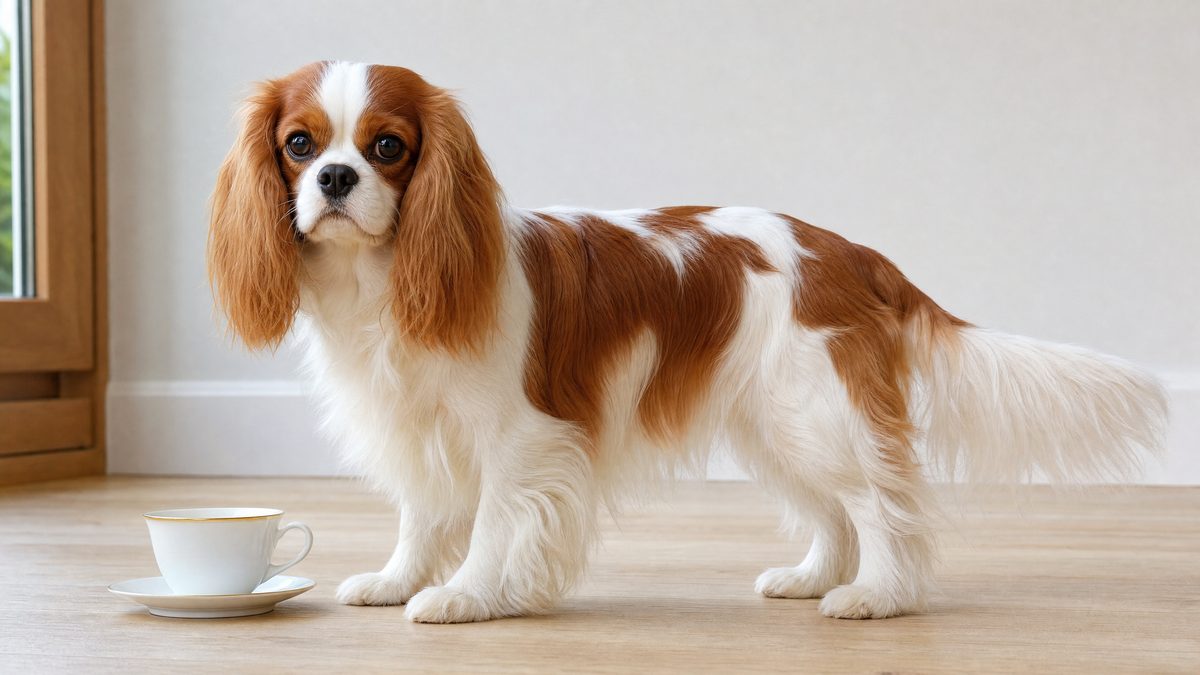
The breed standard recognises exactly four colours. Black and Tan is "raven black with tan markings above the eyes, on cheeks, inside ears, on chest and legs and underside of tail". Ruby is "whole coloured rich red". Blenheim is "rich chestnut markings well broken up, on pearly white ground", with the markings "evenly divided on head, leaving room between ears for much valued lozenge mark or spot (a unique characteristic of the breed)". Tricolour is "black and white well spaced, broken up, with tan markings over eyes, cheeks, inside ears, inside legs, and on underside of tail";.
One Delhi seller lists the breed's colours as "Blenheim, Black & Tan, Black & White, Ruby";. Black and White is not a recognised colour in any of the three standards. The fourth recognised colour is Tricolour, which is black and white with tan markings; a black and white dog without the tan is not a tricolour. Under the AKC standard that difference is not cosmetic, because "dogs not of an allowed color shall be disqualified". The Royal Kennel Club runs the breed at Colour Watch Category 1, meaning more than 0 and up to 2 percent of registrations are in non-breed-standard colours, and names those colours as chocolate and tan and chocolate tricolour.
| Colour | Ground | Defining detail |
|---|---|---|
| Blenheim | Pearly white | Rich chestnut markings, evenly divided on the head, with the lozenge mark or spot between the ears |
| Tricolour | White | Black and white well spaced and broken up, plus tan over eyes, cheeks, inside ears and legs, and under the tail |
| Black and Tan | None, whole colour | Raven black with bright tan markings; white marks undesirable |
| Ruby | None, whole colour | Whole coloured rich red; white markings undesirable |
The lozenge mark is worth knowing about because it is the one cosmetic feature the standard calls "a unique characteristic of the breed", and because an Indian seller charging a premium for a "rare" colour is charging for something the standard either does not recognise or actively penalises.
Where the breed sits, in numbers
The Cavalier is the twelfth most popular breed of 210 on the American Kennel Club's registration ranking, and the AKC recognised it in 1995. In the United Kingdom it made up 2.92 percent of the purebred dogs in a 584,734-dog longevity dataset, the eighth most common pure breed in that sample. In India it is available but uncommon: one national listing platform returned 41 results for the breed on the day we pulled it, against 650 Shih Tzu, 549 Siberian Husky, 487 Golden Retriever, 454 Labrador Retriever and 412 German Shepherd in its own most-popular-breeds sidebar.
This is the most evidence-heavy breed page on Bonbeno, because the Cavalier is the rare breed where the evidence is genuinely good. There are national breeding schemes with published protocols and measured outcomes, imaging studies with real denominators, and a published registry you can check yourself. The job of this page is to give you those numbers straight, tell you which of them apply in an Indian flat, and tell you which parts of the screening system you can actually buy in Bengaluru or Delhi.
Three registries, three different dogs: where the FCI, the Kennel Club and the AKC disagree
The three standards that govern this breed disagree on its height, its weight ceiling, the shape of its skull, the depth of its stop, and whether you may cut off part of its tail. An Indian buyer who reads only the American figures, which is what most Indian listings reprint, is being sold a dog described by the one registry whose standard India's own law contradicts.
Start with size, because that is the number every Indian listing copies. The FCI gives a weight of 5.4 to 8 kg and no height at all. The Royal Kennel Club gives 5.4 to 8.2 kg and, again, no height. The AKC gives "Height 12 to 13 inches at the withers; weight proportionate to height, between 13 and 18 pounds";. Thirteen pounds is 5.9 kg, so the American floor is a full pound above the British and European floor, and the American standard is the only one of the three that tells a judge how tall the dog should be.
| Point | FCI-136 (valid 04.11.2008) | Royal Kennel Club (April 2025) | AKC (effective 29 March 2023) |
|---|---|---|---|
| Height | Not stated | Not stated | 12 to 13 inches at the withers |
| Weight | 5.4 to 8 kg (12 to 18 lbs) | 5.4 to 8.2 kg (12 to 18 lbs) | 13 to 18 pounds (5.9 to 8.2 kg) |
| Skull | "Almost flat between ears" | "Almost flat between ears" | "Slightly rounded, but without dome or peak; it should appear flat because of the high placement of the ears" |
| Stop | "Shallow" | "Shallow" | "Moderate, neither filled nor deep" |
| Muzzle length | About 3.8 cm from stop to nose | About 3.8 cm from stop to nose | About 1 and a half inches from stop to nose |
| Tail docking | "Docking previously optional when no more than one-third was to be removed" | Same past-tense wording | "Docking is optional. If docked, no more than one third is to be removed" |
| Dewclaws | Not mentioned | Not mentioned | "Dewclaws may be removed" |
| Off colours | "Highly undesirable" | "Unacceptable" | "Dogs not of an allowed color shall be disqualified" |
The skull disagreement is the one that matters
Two of the three registries describe a skull that is genuinely flat. The FCI and the Kennel Club both say "almost flat between ears" and both call the stop "shallow"; The Royal Kennel Club. The AKC says the skull is "slightly rounded, but without dome or peak", that it "should appear flat because of the high placement of the ears", and that the stop is "moderate";. That is not a translation difference. One standard asks for a flat skull; the other asks for a rounded skull that looks flat because of where the ears sit.
It matters because the shape of this breed's skull is the anatomical basis of chiari-like malformation, and because a Dutch study that re-evaluated 1,249 screenings of 1,020 Cavaliers found chiari-like malformation present in every single dog, which its authors said suggests the malformation "has become a breed-specific characteristic". When a conformational trait is universal in a breed, the wording of the standard that selects for it stops being a matter of taste.
The docking clause an Indian breeder cannot follow
The FCI and the Kennel Club have both moved the docking sentence into the past tense: "docking previously optional when no more than one-third was to be removed"; The Royal Kennel Club. The AKC has not. Its current standard, approved on 10 January 2023, still reads "Docking is optional. If docked, no more than one third is to be removed", and adds that "dewclaws may be removed";.
In India both are prohibited outright. Paragraph 6(8) of Part II of the Second Schedule to the Prevention of Cruelty to Animals (Dog Breeding and Marketing) Rules 2017 states that "there shall be no tail docking, ear cropping de-barking, de-clawing, branding, dyeing, injecting substances to enhance visual appeal, performing a surgery or procedure to camouflage or hide any defect or infirmity or any other kind of mutilation of any body part of the pup and any change of appearance by artificial means is strictly forbidden";. So an Indian breeder following the AKC standard on this point would be breaking Indian law, and an Indian buyer offered a docked Cavalier is being offered a dog that was mutilated in contravention of the Rules.
Every Indian source we opened prints the American numbers. Mr n Mrs Pet gives "Height: 12 - 13 inches" on all three of its quality tiers, and Petsworld's characteristics table gives "Height Male: 12-13 inches (30- 33 cm)" and "Weight Male: 13- 18 pounds"; Petsworld, Adopt King Charles Spaniel…. Neither names the FCI or the Kennel Club. If your breeder quotes you a height, you are being quoted a figure that two of the three registries governing this breed do not publish.
History: a breed reconstructed backwards, and the recognition dates that do not agree
The Cavalier King Charles Spaniel was deliberately bred backwards in the 1920s to recreate the longer-muzzled toy spaniel of the 17th century, after the fashion for flat faces had reshaped the King Charles Spaniel into something else. That reconstruction is why the breed exists, and it is also why its history is the one part of the story every Indian listing gets wrong.
The Royal Kennel Club's own account starts in the 16th century. Toy spaniels "can be traced back to at least the 16th Century and, as with many other of the toy breeds, it is likely that they were bred down from sporting breeds". Queen Elizabeth I had a "spaniel gentle" as a comforter. The spaniel belonging to Mary, Queen of Scots "was found hidden in her petticoats after she was beheaded". The type became established in the courts of Charles I and Charles II, from whom the breed takes its name.
The colours are named after the people who fixed them. The first Duke of Marlborough developed "the Blenheim spaniel, a rich red and white dog which retained its sporting instincts and was adept at flushing game", named for his residence, Blenheim Palace. The Duke of Norfolk kept the Blenheim type but developed the black and tan variety. The tricolours were called the Prince Charles. Ruby was the last colour to be developed.
The 1920s reconstruction
Until the late 19th century the toy spaniels kept "the fairly long muzzle and the flattish skull of the sporting spaniels". Then, as the Kennel Club puts it, "the fashion for shorter muzzles in the toy breeds, as seen in the Pug and the Pekingese, lead to the domed skull and shorter muzzle becoming more popular and more successful in the show ring";. A group of breeders objected. At Crufts between 1926 and 1930 special prizes were offered for "Blenheim spaniels of the old type", and the word "Cavalier" was chosen to distinguish that older type from the flatter-faced King Charles.
This is the single most useful fact about the breed's origin, and it cuts both ways. The Cavalier exists because a group of people in the 1920s thought a flat face was a mistake and set out to undo it. And yet a century later a 905,543-dog UK primary-care study still classifies the finished breed as brachycephalic. The reconstruction moved the muzzle out, and it did not move it out far enough.
Three recognition dates, and none of them agree
The Cavalier King Charles Spaniel Club was formed in 1928. On when the breed was recognised in its own right, the sources split. The Royal Kennel Club states plainly that "The Kennel Club did not recognise the Cavalier as a separate breed until 1945";. Wikipedia states that "on 5th December 1944 the Kennel Club first recognised the breed in its own right as the Cavalier King Charles Spaniel", and adds that leading breeders then examined the registration lists and identified up to 200 dogs of Cavalier type, 60 of which had been born during the War.
We report both and take neither as settled. A December 1944 decision and a 1945 effective date are easy to reconcile as the same event described at two ends, but no source we opened says so, and inventing that bridge would be exactly the kind of tidying this site exists to avoid.
| Source | Claim | Status |
|---|---|---|
| Royal Kennel Club | "The Kennel Club did not recognise the Cavalier as a separate breed until 1945" | The registry's own breed page |
| Wikipedia | "On 5th December 1944 the Kennel Club first recognised the breed in its own right" | Cited to a secondary book source |
| American Kennel Club | "The Cavalier King Charles Spaniel was recognized as a breed by the AKC in 1995", repeated as "The Cavalier became fully recognized by the AKC in 1995" | The registry's own breed page, stated twice |
| Petsworld (India) | "On 1st January 1996, it was recognized as the 140th breed by the AKC" | Contradicts the AKC's own page, which is the primary source |
| FCI | "Date of acceptance on a definitive basis by the FCI: 1/20/1955" | The FCI's own nomenclature entry, standard number 136 |
The Indian page that ranks first for the commercial query gets more than the date wrong. Petsworld writes that the breed "has been descended from the Cavalier King Charles spaniel" and that "in the late 1600s, King Charles spaniels were bred with the pugs, and this resulted in a smaller dog version with upturned faces, flatter noses, protruding eyes and rounded heads";. That reverses the actual sequence. The King Charles Spaniel is the flat-faced descendant; the Cavalier is the later reconstruction of the older type. The same page files the breed under "Size Type: Large dog breeds" and "Breed Group: Working dog breeds (AKC)", when the AKC places it in the Toy Group American Kennel Club.
You are about to read a long section on two inherited diseases. The history explains why they are there. Every feature that makes a Cavalier look like a Cavalier, the large round eyes, the shallow stop, the short muzzle and the small domed head, is a feature that was selected for in a show ring. None of it is an accident of nature, which means none of it is beyond changing, which is exactly what the Danish breeding data later on this page demonstrate.
The word no Indian seller uses: UK veterinary data class the Cavalier as brachycephalic
The Cavalier King Charles Spaniel is classified as brachycephalic in the largest UK study of heat-related illness in dogs, and it is named there as one of five brachycephalic breeds among the nine at significantly increased risk. None of the three breed standards uses the word. Exactly one of the India-facing pages does, and it is a pet food manufacturer rather than a registry or a seller.
The study is Hall, Carter and O'Neill 2020, which reviewed the de-identified clinical records of 905,543 dogs under primary veterinary care in the UK in 2016 and identified 395 confirmed heat-related illness events. Purebred dogs were categorised by skull shape into brachycephalic, mesocephalic and dolichocephalic groups. In its discussion the paper states that "five of the nine breeds with significantly increased odds of HRI were brachycephalic (Bulldog, French Bulldog, Dogue de Bordeaux, Cavalier King Charles Spaniel and Pug)";.
That classification is a judgement, not a measurement, and the authors say so: "although the breeds assigned to each skull type category could reasonably be challenged, changing the specific breeds listed in each category is unlikely to change the overall inferences drawn from the analysis";. So treat it as one defensible reading rather than a settled fact. But it is the reading used by the largest dataset anyone has on this question, and it is the reading that produced the breed-level result in the next section.
What the anatomy actually is
The measurement the standards do give is the muzzle. The FCI and the Kennel Club both specify "length from base of stop to tip of nose about 3.8 cms (1 1/2 ins)" and the AKC gives "about 1 and a half inches"; The Royal Kennel Club American Kennel Club. On a dog of 12 to 13 inches at the withers, a 3.8 cm muzzle is short. For comparison the same standards ask for large round eyes "spaced well apart", a shallow or moderate stop, and a skull that is flat or looks flat. Every one of those is a feature that shortens and broadens the front of the head.
None of the three standards uses the word brachycephalic, and none of them warns about heat. The FCI standard's only health language is the closing note that "only functionally and clinically healthy dogs, with breed typical conformation should be used for breeding", and its faults clause, which asks that any departure be weighed "in exact proportion to its degree and its effect upon the health and welfare of the dog";.
The second consequence: pressure inside the skull
The same head shape has a neurological consequence that has nothing to do with breathing. Chiari-like malformation is a mismatch between a brain that is too large and a skull that is too small, which can block the opening from the skull to the spine and alter the flow of cerebrospinal fluid around the spinal cord. A professor of anaesthesia and radiology at the Norwegian University of Life Sciences put it this way when Norway's Supreme Court banned breeding the breed: "There's too little space for the nervous system, which causes the dogs pain. On CT and MRI scans, we can see that the shape of the skull means that the brain has too little space";.
The Dutch re-evaluation of 1,249 screenings found chiari-like malformation in all 1,020 dogs, and estimated its heritability at only 0.02 to 0.03, "due to the lack of phenotypic variance". Read that carefully, because it is counter-intuitive. A heritability near zero here does not mean the trait is not genetic. It means every dog in the breed already has it, so there is no variation left for a breeder to select against.
Two things. First, a Cavalier is not a heat-tolerant small dog just because it is small, and the next section gives the odds ratios that show why. Second, one India-facing page states this plainly and deserves credit for it. Royal Canin India tells Indian readers that Cavaliers "belong to the 'brachycephalic' family. This means that their physical features include a flat face and short nose, due to the shape of their skull, and these anatomical attributes can cause some potential health issues", and advises buyers "to choose a dog with physical features that are not over-exaggerated";. Not one of the five Indian puppy listings we opened says anything of the kind. When a seller tells you the short face is purely cosmetic, the manufacturer of the food they will recommend to you disagrees.
Cavalier King Charles Spaniel price in India: three published bands that disagree by 22 times
Cavalier King Charles Spaniel price in India runs from Rs 20,000 to Rs 4,50,000 across the three sellers that publish a figure, a twenty-two-fold spread on one breed, and the two ends are not describing different quality tiers because the cheapest source's ceiling sits below every other source's floor.
Unlike most breeds this site covers, the Cavalier has a real Indian market. It is small. One national listing platform returned 41 results for the breed on the day we pulled it, against 650 Shih Tzu, 549 Siberian Husky, 487 Golden Retriever, 454 Labrador Retriever, 412 German Shepherd, 274 Beagle, 263 Poodle, 162 Rottweiler, 136 Pomeranian and 134 Cane Corso in its own most-popular-breeds sidebar. So the breed is obtainable here, at roughly one sixteenth the availability of a Shih Tzu.
Three sources publish a puppy price. Two more sell the breed and publish none.
| Source | Published band | What the page says it covers |
|---|---|---|
| Petsworld | Rs 20,000 to Rs 50,000 | "Cavalier King Charles spaniel cost varies from Rs 20,000-Rs 50,000", Delhi, NCR and Noida |
| Mr n Mrs Pet, basic quality | Rs 90,000 to Rs 1,50,000 | "suitable for families looking for a loyal and protective companion, but without show or breeding rights" |
| Mr n Mrs Pet, KCI registered | Rs 1,50,000 to Rs 2,50,000 | "Kennel Club of India certification, verified lineage, complete vaccinations, and a vet health check" |
| Mr n Mrs Pet, champion bloodline | Rs 2,50,000 to Rs 3,50,000 | "from imported or award-winning parents, offering superior genetics for breeding, shows, and advanced training" |
| Happy Pet Care | Rs 2,50,000 to Rs 4,50,000 | stated as the cost of buying, with no tier breakdown |
| Dav Pet Lovers (Delhi NCR) | No price published | Sells the breed as "KCI-REG"; its product markup carries og:price:amount 0.00 |
| The Dog Farm | No price published | "All are from Healthy and Authentic Bloodlines", enquiry by phone only |
The distance between the ends is the story. Petsworld's ceiling of Rs 50,000 is below Mr n Mrs Pet's basic floor of Rs 90,000, and Happy Pet Care's ceiling of Rs 4,50,000 is nine times Petsworld's ceiling and twenty-two and a half times its floor Happy Pet Care, Cavalier King Charles…. No page explains the gap. Google's own AI Overview on the Indian results page adds a fourth band, "₹25,000 to over ₹1,00,000", which sits inside none of the three published ranges completely and overlaps all of them partially.
What actually drives the difference, on the seller's own numbers
Only one variable in the published tiers can be checked by a buyer, and it is the Kennel Club of India paper. Mr n Mrs Pet's own breakdown prices KCI registration as the step from Rs 90,000-1,50,000 to Rs 1,50,000-2,50,000, so on that seller's own arithmetic the certificate is being priced at roughly Rs 60,000 to Rs 1,00,000. That is a very large premium for a registration document, and it buys you a pedigree, not a heart.
Everything above that tier is unverifiable at the point of sale. "Champion bloodline", "imported parents" and "superior genetics for breeding" are seller assertions unless a heart certificate and an MRI report are put in front of you, and this is the breed where those two documents matter more than in any other. A Rs 3,50,000 puppy whose parents have never been auscultated by a cardiologist is worse value than a Rs 90,000 puppy whose parents have current heart grades, because 57.6 percent of the Cavaliers graded under the Kennel Club's own heart scheme carry mitral valve prolapse.
The city table shows almost no regional variation, which is itself informative. Mr n Mrs Pet quotes Rs 95,000 to Rs 3,50,000 in Hyderabad, Bangalore and Chennai, and Rs 90,000 to Rs 3,50,000 in Delhi, Lucknow, Mumbai, Jaipur and Pune. A five thousand rupee spread across eight cities is a pricing policy, not a market.
Every figure above is a published editorial price reported as content. Bonbeno does not sell animals, does not link listings and does not recommend breeders. If a seller quotes you a number outside the Rs 20,000 to Rs 4,50,000 range above, that does not make it wrong; it makes it unpublished. Ask what the number is attached to before you ask whether it is fair, and read the next section before you accept any of these figures as real.
Testing every rupee figure, and the Indian page that prices the dog below the adoption fee
Every Indian Cavalier price we found is rupee-native rather than a converted dollar figure, which is unusual and worth saying plainly. The forensic problem on this breed is different: the page ranking first in India for the commercial query prints a purchase price of Rs 7,500 and an adoption cost of Rs 10,500 on the same line, using two different and both incorrect exchange rates.
Indian breed pages routinely publish "prices" that are an American figure run through one exchange rate. The test is simple: divide the rupee figure by the rates in circulation and see whether the answer is a number a seller would actually print. Here are all nine published Indian figures for this breed against the three rates.
| Rupee figure | Divided by 84.38 | Divided by 74 | Divided by 80 |
|---|---|---|---|
| Rs 20,000 (Petsworld floor) | 237.02 | 270.27 | 250.00 |
| Rs 50,000 (Petsworld ceiling) | 592.56 | 675.68 | 625.00 |
| Rs 90,000 (Mr n Mrs Pet floor) | 1,066.60 | 1,216.22 | 1,125.00 |
| Rs 95,000 (Mr n Mrs Pet, southern cities) | 1,125.86 | 1,283.78 | 1,187.50 |
| Rs 1,50,000 (tier boundary) | 1,777.67 | 2,027.03 | 1,875.00 |
| Rs 2,50,000 (tier boundary) | 2,962.79 | 3,378.38 | 3,125.00 |
| Rs 3,50,000 (Mr n Mrs Pet ceiling) | 4,147.90 | 4,729.73 | 4,375.00 |
| Rs 4,50,000 (Happy Pet Care ceiling) | 5,333.02 | 6,081.08 | 5,625.00 |
The verdict is clean. Not one figure divides to a plausible printed price at 84.38 or at 74. Every figure divides exactly at 80, and that proves nothing, because a rupee number ending in four zeros divides cleanly by 80 by construction. The quotients it produces, 250, 625, 1,125, 1,187.50, 1,875, 3,125, 4,375 and 5,625, are not numbers a seller anywhere would advertise. So these Indian bands are rupee-native, typed by a human in rupees. That is a better result than this site usually finds, and it is worth saying so rather than manufacturing a conversion story.
The Petsworld line that refutes itself
Petsworld ranks first in India for the query "cavalier king charles spaniel price in india". Its breed characteristics table contains this row, verbatim: "Puppy price: An average price of King Charles spaniel puppy is US$ 1250 or Rs. 7500, adoption cost is US $ 175 or Rs. 10500";. Four numbers, two currencies, one sentence, and it does not survive a calculator.
- Rs 7,500 divided by USD 1,250 is an implied exchange rate of exactly 6.00 rupees to the dollar.
- Rs 10,500 divided by USD 175 is an implied exchange rate of exactly 60.00 rupees to the dollar.
- The two conversions in the same sentence therefore differ by a factor of ten, and neither has ever been a real rate.
- At 84.38, USD 1,250 is Rs 1,05,475. The page's Rs 7,500 understates that by a factor of 14.06.
- The adoption cost, Rs 10,500, is quoted as 40 percent higher than the purchase price, Rs 7,500, of the same animal on the same line.
That is not a conversion error in the ordinary sense. It is a set of numbers that were never checked against each other, published on the page an Indian buyer is most likely to read first, and left standing beside a headline claim of Rs 20,000 to Rs 50,000 that the same page never reconciles with its own table.
What the listings without a price are doing
Two Indian sellers advertise the breed and publish no figure at all. Dav Pet Lovers markets "KCI-REG Cavalier King Charles Spaniel pup for sale in Delhi NCR" and its product markup carries og:price:amount 0.00 with og:price:currency INR, so the page is structurally a product listing with the price field left empty; the only route to a number is WhatsApp or a phone call. The Dog Farm's page says "All Puppies are 100% Healthy and active" and "All are from Healthy and Authentic Bloodlines", and routes you to an enquiry form. Price on request is a negotiating position, not a market rate, and you should treat any number produced on a phone call as the seller's read of you.
This site has repeatedly caught the figure Rs 98,999 attached to whichever puppy happens to be in stock on one Indian listing carousel, on pages for breeds that seller does not stock at all. We searched all five Indian Cavalier pages for it and for its usual companions, Rs 92,599, Rs 94,999, Rs 76,499 and Rs 1,20,000. None of them appears on any Cavalier page. The Indian Cavalier bands are their own numbers, whatever else is wrong with them.
What a 7 kg Cavalier costs to keep in India, bounded honestly
Two Indian sources publish a monthly running cost for this breed and they land close together, at Rs 3,000 to Rs 7,000 and Rs 3,300 to Rs 5,400. Both figures describe a healthy dog. Neither includes the cardiac monitoring this breed specifically needs, and no Indian source we could open prices the heart medication a Cavalier is statistically likely to need in its last years.
Start with what is published. Happy Pet Care breaks its monthly figure into three lines and the arithmetic checks: food Rs 1,200 basic and Rs 1,800 premium, veterinary Rs 900 and Rs 1,800, grooming Rs 1,200 and Rs 1,800, giving Rs 3,300 basic and Rs 5,400 premium. Mr n Mrs Pet gives a wider band: "on average, monthly expenses for a Cavalier King Charles Spaniel range from INR 3,000-INR 7,000. This includes quality food, grooming, vet visits, and routine care";.
For a sanity check from outside the retail sector, the Voice of Stray Dogs sanctuary states that "the average cost of a dog's upkeep is over ₹5,000/US$ 40/ per month" at the scale it operates, which is 1,800 or more dogs on a seven-acre facility with its own veterinary infrastructure. A shelter operating at that scale spending over Rs 5,000 a month per dog is a useful floor, not a ceiling, for a household dog with grooming and boarding costs on top.
| Line | Basic | Premium | Source and note |
|---|---|---|---|
| Food | Rs 1,200 | Rs 1,800 | Happy Pet Care; the same page puts the adult requirement at 550 kcal a day |
| Veterinary | Rs 900 | Rs 1,800 | Happy Pet Care; routine care only, no cardiology |
| Grooming | Rs 1,200 | Rs 1,800 | Happy Pet Care; a feathered coat in Indian humidity |
| Stated monthly total | Rs 3,300 | Rs 5,400 | Happy Pet Care, and the three lines sum correctly |
| Alternative monthly band | Rs 3,000 | Rs 7,000 | Mr n Mrs Pet, "quality food, grooming, vet visits, and routine care" |
| Annual cardiac echocardiogram | Rs 3,000 | Rs 8,000 | Voice of Stray Dogs, for an echocardiogram by a veterinary cardiologist at an Indian specialist centre |
| Cardiac medication once needed | Not published | Not published | No Indian veterinary source we opened publishes a rupee price for canine cardiac drugs |
The line every Indian budget for this breed leaves out
None of the published Indian monthly figures includes cardiac monitoring, and on this breed that is the line that decides whether the budget is real. Every source above is describing a well dog. The relevant question is what happens after a murmur is heard.
Two things become recurring costs at that point. The first is echocardiography, which in India runs Rs 3,000 to Rs 8,000 at a specialist centre and which a cardiologist will typically want repeated to track progression: "a repeat echocardiogram six months after starting medication can show whether the heart's measurements have stabilized, improved, or continued to progress";. The second is medication. A UK primary-care cohort put the mean age at which degenerative mitral valve disease was diagnosed at 9.52 years and the median survival after diagnosis at 25.4 months, so a dog diagnosed on schedule is looking at roughly two years of treatment, not two months.
We could not price that second line. We searched for a published Indian rupee figure for canine cardiac medication and for veterinary MRI and found neither, in searches that in the same session returned Indian echocardiogram pricing without difficulty. That is an absence we are reporting rather than filling with a guess.
The one-off costs at purchase
Budget separately for the things you pay once. Sterilisation is effectively compulsory for a pet-quality dog under Indian law, because Rule 8(1)(b) of the 2017 Rules requires that "dogs over six months in age are not sold without first being sterilised, unless they are being sold to another licensed breeder". Vaccination runs on the schedule any Indian vet will follow, beginning at seven to eight weeks and usually complete by eighteen weeks, which the same Rules set out at paragraph 8(9) of the Second Schedule.
Take the published Rs 3,300 to Rs 5,400 as your monthly baseline for a well dog, add one echocardiogram a year from about four years old at Rs 3,000 to Rs 8,000, and then set aside a contingency you do not spend. The Cavalier is not an expensive dog to feed. It is a dog with a high probability of an expensive middle age, and a household that can afford the purchase price but not the cardiology is buying the wrong half of the commitment.
What screening you can actually buy in India, and what you cannot
An Indian owner can obtain the cardiac half of this breed's screening and cannot easily obtain the neurological half. Echocardiography by a veterinary cardiologist is available in Indian metros at Rs 3,000 to Rs 8,000. No Indian veterinary source publishes a rupee price for an MRI of a dog, and there is no Indian equivalent of the UK heart grading scheme, the BVA syringomyelia grading, or the public register that makes either of them useful to a buyer.
Take the two halves separately, because their availability is completely different.
Cardiac screening: obtainable, affordable, and worth asking for
The test the UK scheme is built on is an auscultation plus an echocardiogram, and both parts exist in India. An Indian veterinary source, medically reviewed by a veterinary officer holding BVSc, MVSc and PhD, states that "in India, an echocardiogram performed by a veterinary cardiologist at a specialist centre typically ranges from Rs. 3,000 to Rs. 8,000 or more, depending on the city, the facility, and the expertise of the specialist performing the test", and adds that "clinics in metropolitan areas with dedicated cardiology units tend to be at the higher end of this range";.
The same source names this breed specifically in the group where pre-symptomatic screening is advised: "certain breeds have a high genetic predisposition to heart disease, Cavalier King Charles Spaniels, Dobermans, Boxers, and Maine Coons, among them. Breed clubs and veterinary cardiologists often recommend routine echocardiographic screening in these dogs even before symptoms appear";. It also sets a practical trigger you can use: "a grade 3 or higher murmur in a small breed dog, or any murmur in a large breed, typically warrants echocardiographic investigation";.
Two practical details matter. Most dogs do not need sedation, and the scan takes 20 to 45 minutes with the dog lying on its side on a table with a cut-out section. So this is a morning appointment, not a procedure. And the measurement that decides treatment is the left atrium to aortic ratio, the LA:Ao, which cardiologists use "to determine exactly which stage a dog is at and therefore which treatments are appropriate";. Ask for that number on the report.
MRI: available somewhere, priced nowhere
We could not find a single Indian veterinary source publishing a rupee price for a dog MRI. One Indian hospital, in Faridabad, advertises pet MRI and lists its applications as including "Central Nervous System (Brain and Spinal cord)", but publishes no price and does not mention syringomyelia or Chiari-like malformation anywhere on the page. Searches run in the same session returned Indian echocardiogram pricing without difficulty and returned US dog MRI pricing in volume, so the apparatus was working; the Indian veterinary MRI rate simply is not published.
For scale, the UK figures are on record. The BVA and Kennel Club's own syringomyelia project states that "the cost of an MRI typically ranges from £1,100 to £4,500", and that project subsidises participants down to £200, being £150 paid to the scanning centre against an £850 subsidy plus £50 to the BVA for the reduced screening fee. Outside that project, a submission to the BVA Chiari malformation and syringomyelia scheme costs £100, which "does not include the veterinary and MRI scan costs";.
The three things an Indian buyer can genuinely obtain
- An echocardiogram and auscultation by a veterinary cardiologist, in an Indian metro, at Rs 3,000 to Rs 8,000, on both parents before you buy and on your own dog from about two years old.
- The two DNA tests, for curly coat and dry eye and for episodic falling, which the Royal Kennel Club lists as good practice for this breed and which its own testing service sells as a package of three tests "valued at £190 for just £150" including a DNA profile. These are swab tests sent by post, so geography is not the obstacle.
- A grading of an Indian MRI by the BVA, in principle. The scheme's own page says "the Scheme is open to all dogs, including crossbreeds" and describes submission by "the veterinary surgeon who carried out the MRI scan". Confirm with the BVA before you rely on this, because the page does not address overseas submissions.
There is no Indian approved-cardiologist list, no Indian traffic-light breeding grade, and no Indian public register where you can look up another dog's result. In the UK the Kennel Club publishes CKCS heart-tested dogs quarterly and runs a Health Test Results Finder covering every dog on its register. In India you are dependent on whatever paper the breeder hands you, from whichever clinic they chose, with nothing to check it against. That is the real gap, and it is not a money gap.
Heat tolerance: the Cavalier has 3.45 times a Labrador's odds of heat-related illness
The Cavalier King Charles Spaniel had 3.45 times the odds of heat-related illness of a Labrador Retriever in the largest UK study of the question, the sixth highest of any breed analysed, and it is one of only nine breeds whose risk reached statistical significance. That number is the most decision-relevant fact on this page for an Indian buyer, and it appears on none of the pages ranking for this breed in India.
The study reviewed the records of 905,543 dogs under UK primary veterinary care in 2016 and identified 395 confirmed heat-related illness events. The estimated 2016 incidence was 0.04 percent, with an event fatality rate of 14.18 percent (95 percent CI 11.08 to 17.96). One in seven dogs that developed heat-related illness died of it.
In the final multivariable model, compared with Labrador Retrievers, nine breeds had significantly higher odds. The Cavalier sits sixth.
| Breed | Odds ratio | 95% CI | p |
|---|---|---|---|
| Chow Chow | 16.61 | 6.21 to 44.44 | <0.001 |
| Bulldog | 13.95 | 8.01 to 24.29 | <0.001 |
| French Bulldog | 6.49 | 3.62 to 11.63 | <0.001 |
| Dogue de Bordeaux | 5.31 | 1.99 to 14.21 | 0.001 |
| Greyhound | 4.26 | 1.88 to 9.70 | 0.001 |
| Cavalier King Charles Spaniel | 3.45 | 1.86 to 6.42 | <0.001 |
| Pug | 3.24 | 1.67 to 6.29 | <0.001 |
| English Springer Spaniel | 2.74 | 1.25 to 6.01 | 0.012 |
| Golden Retriever | 2.65 | 1.40 to 5.01 | 0.003 |
| Boxer | 2.26 | 0.95 to 5.34 | 0.064, not significant |
| Labrador Retriever | Base |
The breed also placed sixth on raw incidence. Breeds with the highest one-year incidence of heat-related illness were the Chow Chow at 0.50 percent, Bulldog 0.42 percent, French Bulldog 0.18 percent, Dogue de Bordeaux 0.17 percent, Greyhound 0.15 percent and Cavalier King Charles Spaniel at 0.12 percent (95 percent CI 0.08 to 0.18). For context, the incidence across all brachycephalic breeds together was 0.08 percent.
Which risk bands actually apply to this dog, and which do not
This matters because it is easy to get wrong in both directions. Two of the study's structural variables are relevant.
Skull shape applies. Brachycephalic dogs had 2.10 times the odds of heat-related illness compared with mesocephalic dogs (95 percent CI 1.68 to 2.64), and the Cavalier is in the brachycephalic group in this dataset.
Bodyweight does not apply the way you would expect. The protective band in this study is under 10 kg, which is the reference category. A Cavalier at its breed standard weight of 5.4 to 8.2 kg sits inside that protective band. But the paper explicitly says it does not: "the Lhaso Apso, Shih tzu and Chihuhua had the lowest odds of HRI despite all being brachycephalic breeds. These breeds all typically weigh under 10 kg. In comparison, French bulldogs and Cavalier King Charles Spaniels typically weigh over 10 kg, whilst Pugs typically weigh around 10 kg; the HRI odds for these three breeds appears to be proportional to their typical bodyweights";.
Read that sentence twice, because it contains the most useful practical instruction on this whole page. The breed standard caps the Cavalier at 8.2 kg. The UK primary-care population of Cavaliers typically exceeds 10 kg. The gap between those two numbers is fat, and the study measured what it costs: dogs at or above the mean adult bodyweight for their breed and sex had 1.42 times the odds of heat-related illness compared with dogs below it (95 percent CI 1.12 to 1.80, p = 0.004).
A Cavalier kept at its standard weight moves from the 10 to 20 kg band into the under 10 kg reference band and drops the relative-bodyweight penalty of 1.42 at the same time. You cannot change the skull. You can change the weight, and on this breed it is the single highest-value thing an Indian owner does, because it lowers heat risk and takes load off a heart that is statistically likely to leak later.
One further finding reframes the whole risk. In the companion paper on the same population, exertional heat-related illness was the trigger in 74.2 percent of the 879 events with a recorded trigger, environmental heat in 12.9 percent and confinement in a vehicle in only 5.2 percent. Hot cars are not the main way dogs overheat. Exercise is.
City by city: how many months a year an Indian city sits inside the band this breed is sold on
The one Indian care page written for this breed states the Cavalier's ideal weather as 15 to 25 degrees Celsius. Measured against NASA's climatology for seven Indian cities, Bengaluru spends nine months a year inside that band, Pune eight, and Chennai two. That single table is the most useful climate answer this page can give, because the claim being tested is the seller's own.
Happy Pet Care's specification block for this breed prints "Ideal Weather 15º-25ºC";. We took that at face value and tested it. Monthly mean two-metre air temperatures come from NASA's POWER climatology API, queried by explicit latitude and longitude for each city, with the coordinates the API returned checked against the coordinates sent.
| City | Months in band | Coolest month mean | Warmest month mean |
|---|---|---|---|
| Bengaluru | 9 | 20.2 C (December) | 28.4 C (April) |
| Pune | 8 | 19.6 C (December) | 28.9 C (April) |
| Hyderabad | 5 | 20.8 C (December) | 33.3 C (May) |
| Delhi | 4 | 13.6 C (January) | 35.9 C (June) |
| Kolkata | 4 | 17.3 C (January) | 31.5 C (May) |
| Mumbai | 3 | 23.2 C (January) | 31.2 C (May) |
| Chennai | 2 | 24.1 C (January) | 31.5 C (May) |
| London, for reference | 3 | 4.1 C (January) | 17.6 C (July) |
London is in that table deliberately, and it is the row that stops this becoming a cheap argument. The breed's home city also spends only three months a year inside 15 to 25 degrees, because it spends the other nine below the band rather than above it. A narrow band is narrow at both ends. What the table actually establishes is not that India is hot and Britain is comfortable, but that Bengaluru and Pune are the two Indian cities where this dog spends most of the year in the temperature range it is sold on, and Chennai and Mumbai are the two where it almost never does.
The comparison that does the work
Here is the one to remember. London's warmest month, July, averages 17.6 degrees Celsius. Bengaluru's coolest month, December, averages 20.2 degrees. India's most temperate large metro, in its coldest month, is 2.6 degrees warmer than the breed's home city at its hottest. Delhi's June mean is 35.9 degrees, more than double London's July mean.
Humidity is the part nobody prices
Temperature is only half of it, because a panting dog cools by evaporation and evaporation stalls as humidity rises. The monsoon numbers are severe in exactly the cities where the temperature looks survivable. Pune averages 91 percent relative humidity in August, Mumbai 90 percent in July and August, Kolkata 89 percent in August and September, and Bengaluru 81 percent in October. A 27 degree afternoon at 90 percent humidity is harder on a short-muzzled dog than a 32 degree afternoon at 35 percent, and no Indian breed page distinguishes the two.
| City | Peak monthly mean relative humidity | Month | Mean temperature that month |
|---|---|---|---|
| Pune | 91 percent | August | 23.3 C |
| Mumbai | 90 percent | July and August | 26.6 C and 26.0 C |
| Kolkata | 89 percent | August and September | 28.2 C and 27.7 C |
| Chennai | 82 percent | November | 25.8 C |
| Bengaluru | 81 percent | October | 22.5 C |
| Hyderabad | 83 percent | September | 25.2 C |
| Delhi | 75 percent | August | 29.8 C |
Bengaluru and Pune, on this evidence, and by a clear margin. Hyderabad next. Delhi is workable for five months and hostile for four. Mumbai and Chennai are the hardest, not because they are the hottest, Delhi is far hotter, but because neither has a cool season: Chennai never drops below a 24.1 degree monthly mean and Mumbai never below 23.2. A Cavalier in Chennai lives its entire life above the band it is sold on.
The routine that keeps an Indian Cavalier out of trouble, and why the trigger is exercise
Exercise, not hot cars, is what puts dogs in a veterinary clinic with heat-related illness, and the evidence is one-sided: exertional heat-related illness was the trigger in 74.2 percent of UK events against 5.2 percent for vehicular confinement. So the routine that protects an Indian Cavalier is built around when you walk it, not around what you do on the rare day you leave it in a car.
The numbers come from 1,259 heat-related illness events in 1,222 dogs, drawn from the same 905,543-dog UK population. Exertional heat-related illness accounted for 74.2 percent of the 879 events with a recorded trigger, environmental heat for 12.9 percent, and vehicular confinement for 5.2 percent. Young male dogs had the greatest odds of the exertional type; older dogs and dogs with respiratory compromise had the greatest odds of the environmental type. Brachycephalic dogs had greater odds of all three compared with mesocephalic dogs.
That last split matters for a breed with a cardiac problem. A young Cavalier gets into trouble by running. An old Cavalier with a murmur gets into trouble by lying in a warm room, and the study identifies exactly that profile, older dogs with respiratory compromise, as the environmental-risk group. Two different dogs, two different failure modes, in the same household ten years apart.
What the British guidance actually asks for, and how it transfers
The Royal Kennel Club puts this breed's exercise requirement at "up to 1 hour per day", lists its size of home as "Flat/ Apartment", its garden as "Small/ medium", and says it suits town or country either way. The Indian care page puts the exercise routine at 30 to 60 minutes. Those two are compatible, and neither is wrong. What neither addresses is when.
An hour of walking is an hour of walking in Southwell in April. In Chennai in May, with a monthly mean of 31.5 degrees and 65 percent humidity, the same hour split across two sessions before sunrise and after dark is a completely different physiological proposition from the same hour at four in the afternoon. The instruction to import is the duration. The instruction to discard is the time of day.
The routine
- Walk before sunrise and after dark, in two sessions, for a combined 30 to 60 minutes. In Delhi in May and June, when the monthly mean is 35 to 36 degrees, treat the morning session as the main one and keep the evening one short.
- Test the pavement with the back of your hand for five seconds before you set off. A dog of 12 to 13 inches at the withers has its whole body in the layer of air heated by the road surface, which is a disadvantage a taller dog does not have.
- Cool the dog with water on the belly, groin and paws, not by covering it in a wet blanket, which traps heat against a coat the standard describes as long and silky with plenty of feathering.
- Never let a Cavalier off the lead to run itself out, which the AKC advises for a different reason: "Cavaliers should not be allowed off leash because they retain scenting and hunting instincts, and they may not come when called". In an Indian summer, the recall problem and the heat problem are the same problem.
- Weigh the dog monthly and keep it inside 5.4 to 8.2 kg, because dogs at or above the breed and sex mean carried 1.42 times the odds of heat-related illness The Royal Kennel Club.
- Move the indoor resting place, not just the outdoor routine. The environmental-risk group in the UK data is older dogs indoors, and an Indian flat with a west-facing balcony reaches its peak internal temperature in the late afternoon, when nobody is watching the dog.
Do not shave the coat
The coat is "long, silky, free from curl" with "plenty of feathering", and it is a single coat rather than the dense double coat of a northern breed. Clipping it does not make the dog cooler in any way the evidence supports, and the AKC standard treats coat alteration as a serious fault: "specimens where the coat has been altered by trimming, clipping, or by artificial means shall be so severely penalized as to be effectively eliminated from competition";. The useful trim is the one the AKC does allow, of the "hair growing between the pads on the underside of the feet", which in Indian conditions keeps grit and moisture out of the interdigital spaces.
Excessive panting that does not settle within a few minutes of rest, reluctance to move, a stumbling or unsteady gait, bright red or very pale gums, and vomiting. One in seven UK dogs that reached a vet with heat-related illness died. Begin cooling with water on the way, and telephone the clinic before you arrive so they are ready. This page is general information and not a substitute for veterinary advice; a suspected heatstroke is an emergency for a veterinarian, not for the internet.
Temperament and household fit: an affectionate dog that will not guard your flat
The Cavalier King Charles Spaniel is a companion breed with no guarding instinct, no aloofness with strangers, and a low tolerance for being left alone. All three breed standards describe the same dog in almost identical words, and the one temperament failure they name is not aggression but shyness.
The FCI standard describes the behaviour as "sporting, affectionate, absolutely fearless. Gay, friendly, non-aggressive; no tendency towards nervousness";. The Kennel Club uses the same words. The AKC goes further and makes the failure mode explicit: "gay, friendly, non-aggressive with no tendency towards nervousness or shyness. Bad temper, shyness, and meanness are not to be tolerated and are to be severely penalized as to effectively remove the specimen from competition";.
Read those three together and the picture is unusually consistent for a breed standard. This is a dog selected to be gentle and graceful with everyone, which is exactly what makes it a good flat dog and exactly what makes it a poor security purchase.
It is not a watchdog, and one Indian source says so plainly
The Indian page ranking first for the commercial query gets the breed's history badly wrong but gets this right: "when someone (an intruder or a stranger) comes to the gate, spaniels may or may not bark. So, they should not be chosen as a protector, guardian or a watchdog";. That is worth quoting because the Indian toy-dog market often sells small breeds on an alerting function they do not reliably have. The AKC's own trait card lists "Watchdog/Protective Nature" among the sixteen traits it rates, and this is not the breed's strength.
Separation is the temperament risk in an Indian household
The behavioural problem this breed actually presents in a two-income urban flat is being left alone. The Indian care page is direct: "Cavaliers are social dogs and prefer not to be left alone for long periods. They may develop separation anxiety if left alone frequently";. A UK insurer's breed FAQ lists "can Cavalier King Charles Spaniels be left alone" among the five questions it thinks buyers most need answered.
This is a real constraint and it is not solved by a bigger flat. A Cavalier that has learned that departures are safe, through short absences built up deliberately from eight weeks, is a different animal from one that has learned that departures are abandonment. Build that in the first three months or spend years undoing it.
Who should buy one, and who should not
| Household | Fit | Why |
|---|---|---|
| Bengaluru or Pune flat, someone home most of the day, budget for annual cardiology | Good | Nine and eight months a year inside the temperature band the breed is sold on, and the separation problem is solved by presence |
| Family with school-age children, adult supervision, an air-conditioned room | Good | The standards describe a gentle, non-aggressive, patient dog, and the AKC penalises shyness heavily |
| First-time owner who wants an easy small dog | Conditional | Easy to live with, not easy to own. The health commitment is real and the section below sets out what it costs |
| Anyone buying a dog to alert or guard | Poor | No guarding instinct; one Indian source says outright it should not be chosen as a protector |
| Household out of the flat 10 to 12 hours a day | Poor | Separation anxiety is the named behavioural risk for this breed |
| Chennai or Mumbai household without cooling | Poor | The dog would live its whole life above the stated ideal band, with 3.45 times a Labrador's odds of heat-related illness |
| Anyone who cannot obtain or afford an echocardiogram | Poor | Rs 3,000 to Rs 8,000 a year is the entry price of owning this breed honestly |
Every source agrees this is one of the most affectionate small companion dogs there is, and nothing on this page disputes that. What the sources do not say, and what an Indian buyer needs, is that the temperament is the easy part. Nobody returns a Cavalier because it was difficult. The reasons this breed goes wrong for a household are a heart, a spinal cord and a summer, and those are what the rest of this page is about.
Training a biddable dog with an unreliable recall, on an Indian timetable
Train a Cavalier by rewarding the behaviour you want, in short sessions, indoors during the hot months, and never rely on recall off a lead. The breed is easy to teach and hard to call back, because it is a companion dog carrying the scenting instincts of a working spaniel, and the AKC says so in as many words.
The AKC's own account is unambiguous on both halves. On the easy half: "they are smart and train easily, and Cavaliers excel in a number of canine sports including obedience, rally, and agility. With their sweet nature they also make fantastic therapy dogs";. On the hard half: "Cavaliers should not be allowed off leash because they retain scenting and hunting instincts, and they may not come when called if they've found an interesting trail to follow or a creature to pursue. A fenced yard is recommended";.
The Indian commercial page agrees on the first half, calling the breed "very intelligent" and saying "they perform very well in the competitive obedience training";. It does not mention the recall problem at all, which is the omission that matters in a country where fenced yards are rare and most walking happens on a shared street.
The window opens at eight weeks, because the law says it cannot open earlier
You cannot legally take an Indian puppy home before eight weeks. Rule 8(1)(a) of the Prevention of Cruelty to Animals (Dog Breeding and Marketing) Rules 2017 requires every breeder to ensure that "pups less than eight weeks in age are not sold";. A seller offering you a six-week-old Cavalier is breaking the law and telling you something about the rest of their operation at the same time.
Vaccination runs alongside the socialisation you want to be doing. Paragraph 8(9) of the Second Schedule states that "all pups shall be vaccinated which can start at the age of seven-eight weeks, and are usually completed at the age of eighteen weeks";. That leaves roughly ten weeks in which the puppy needs a great deal of controlled social exposure and cannot yet be walked freely in public. Solve it in the flat and on the arms of visitors, not by waiting.
A twelve-week plan that fits an Indian summer
- Weeks 8 to 10. Name, house training, crate as a safe place, and short deliberate absences of two to ten minutes. Socialise with three or four different adults a week inside the home. Handle the ears and feet daily so grooming is never a fight later.
- Weeks 10 to 12. Sit, down, and a hand-touch. Introduce the lead indoors. Add lift journeys and stairwells, which in an Indian building are the two environments a small dog most needs to be relaxed about.
- Weeks 12 to 16. Begin outdoor walks once your vet clears them, before sunrise and after dark. Start recall on a long line and keep it on a long line for the next year.
- Weeks 16 to 24. Teach a settle on a mat, which is the single most useful behaviour for a dog that will spend Indian afternoons indoors. Build absences to two hours.
- Six months onward. Train the veterinary handling you will need for life: standing still on a table, lying on the right side, and tolerating a hand and a cold probe on the chest. A dog that accepts this makes an unsedated echocardiogram straightforward, and most dogs do not require sedation for one.
Two things to train differently because of this breed's health
First, train an alternative to jumping. Affected dogs with syringomyelia "may yelp and are often reluctant to jump and climb", so a household that has taught the dog to use a ramp or a step onto the sofa has removed a source of pain and removed a confounder at the same time. A dog that never jumps cannot tell you it has stopped jumping.
Second, do not train through scratching. Phantom scratching at the neck and shoulder, "as there is generally no contact of the foot with the skin of the neck", is a recognised clinical sign, not a habit. Correcting it teaches the dog to suppress the one signal you most need to see.
In Delhi the monthly mean climbs from 23.6 degrees in March to 35.9 in June, and in Hyderabad from 28.7 to 33.3. Those are the months to move training indoors entirely: scentwork with treats hidden in a room, a settle on a mat, handling practice, and shaping games. A Cavalier is a companion dog, so mental work in a cool room is not a poor substitute for a walk. It is often the better session.
The daily exercise requirement, and why a Cavalier that stops wanting walks is a clinical finding
A Cavalier King Charles Spaniel needs up to an hour of walking a day, split into two sessions and taken outside the heat of the day in India. The more important instruction concerns the opposite case: in this breed, a dog that becomes reluctant to walk, jump or climb is showing a recognised sign of two separate diseases, and should be examined rather than indulged.
The Royal Kennel Club puts the requirement at "up to 1 hour per day";. The Indian care page gives an exercise routine of 30 to 60 minutes and rates the breed's energy level as medium. The AKC describes the honest range: "although the Cavalier was bred to be a beloved lap dog, he is descended from sporting dogs and does enjoy moderate exercise and outdoor activities. He will happily go on walks with his owner and also performs well in a number of canine sports, but he's just as glad to stay on the sofa all day";.
One Indian seller says the opposite, that the breed "is easy to maintain and needs lot of exercises";. That is not what any registry says and it is a bad instruction to follow in an Indian April, because exertional heat-related illness accounts for 74.2 percent of heat events in dogs.
| Season | Morning | Evening | Indoors |
|---|---|---|---|
| Cool months (December to February in most of India) | 25 to 35 minutes, any time before 9 am | 25 to 35 minutes after sunset | Optional |
| Pre-monsoon heat (March to June) | 20 to 25 minutes, before sunrise | 15 to 20 minutes, well after dark | 20 minutes of scentwork or shaping, mandatory |
| Monsoon (July to September) | 20 minutes, watching for the humidity rather than the temperature | 20 minutes | Ear check after every wet walk |
| Post-monsoon (October to November) | 30 minutes | 30 minutes | Optional |
Reluctance to exercise is a symptom in this breed, in two different systems
This is the section's real content, and no ranking page carries it. Two of the Cavalier's characteristic diseases present first as a dog that does less.
The neurological one is explicit. The BVA lists "unable or unwilling to exercise" as the first sign of Chiari malformation and syringomyelia, and the Kennel Club's project page adds that "affected dogs may yelp and are often reluctant to jump and climb"; The Royal Kennel Club and British…. The cardiac one is equally clear. An Indian veterinary source lists "breathing difficulty or exercise intolerance" among the reasons a dog needs an echocardiogram: "if your dog tires quickly on walks, breathes heavily at rest, or seems to struggle with activities they previously enjoyed, these can be cardiac signs";.
So the sentence "he's just as glad to stay on the sofa all day", which is true of the breed and is repeated on every page about it, is also the sentence that lets a household ignore the first sign of a painful spinal condition or a failing valve for a year. The distinction is change. A Cavalier that has always preferred the sofa is a Cavalier. A Cavalier that used to want the walk and now does not is a dog that needs a stethoscope on it.
What under-exercise looks like
Without its walks a Cavalier does not become destructive in the way a working breed does. It becomes heavier, which is the specific thing you cannot afford: dogs at or above the mean adult bodyweight for their breed and sex carried 1.42 times the odds of heat-related illness in the UK data. And it becomes clingier, feeding the separation problem that is already this breed's named behavioural risk.
If your dog has a diagnosed heart murmur or any cardiac medication, the exercise plan is your veterinarian's to set, not this page's and not the Kennel Club's. Staging in dogs with mitral valve disease turns on echocardiographic measurements, particularly the left atrium to aortic ratio, and the appropriate activity level follows from the stage. Ask for it in writing at the same appointment as the scan.
Grooming a silky single coat in Indian humidity, and the trimming the standard forbids
Brush a Cavalier more than once a week, bathe it occasionally, and do not trim the coat. All three breed standards prohibit trimming outright, and the AKC penalises an altered coat severely enough to remove the dog from competition. The work in Indian conditions is not the body coat, which is easy; it is the feathering, the feet and the ears.
The FCI describes the coat as "long, silky, free from curl. Slight wave permissible. Plenty of feathering. Totally free from trimming";. The AKC adds where the feathering sits and how seriously it takes the rule: "feathering on ears, chest, legs and tails should be long, and the feathering on the feet is a feature of the breed. No trimming of the dog is permitted. Specimens where the coat has been altered by trimming, clipping, or by artificial means shall be so severely penalized as to be effectively eliminated from competition";. It carves out exactly one exception: "hair growing between the pads on the underside of the feet may be trimmed";.
The Royal Kennel Club rates the grooming requirement at "more than once a week", the coat length as medium, and answers the shedding question with a single word: "Sheds: Yes";. The Indian care page rates it as moderate shedding and budgets Rs 1,200 to Rs 1,800 a month for grooming.
What changes in Indian conditions
The British guidance assumes a dog that gets damp and dries. Between July and September, Pune averages 91 percent relative humidity in August, Mumbai 90 percent in July and August, and Kolkata 89 percent in August and September. In that air a feathered coat does not dry on its own, and the places it stays wet longest are the ear feathering, the trousers behind the hindlegs, and between the toes.
| Task | Frequency | Why it matters here |
|---|---|---|
| Brush through the body coat and feathering with a pin brush, then comb | Three times a week, daily in monsoon | The Kennel Club asks for more than once a week; humidity makes mats form faster in the feathering |
| Dry the ear feathering, trousers and feet after every wet walk | Every wet walk | A damp feathered ear over a covered canal is the exact setup for otitis externa |
| Check ears for smell, redness and discharge | Weekly, per the AKC | Otitis externa affected 9.2 percent of Cavaliers in a UK primary-care sample of 1,749 |
| Trim only the hair between the pads | Monthly | The one trim the AKC standard permits; keeps grit and moisture out of the interdigital spaces |
| Trim nails | At least monthly, per the AKC | Overgrown nails "can cause pain and structural problems" |
| Bathe | Occasionally, and only when the dog can be dried fully | The standard asks for an untrimmed silky coat, which needs drying rather than air-drying in monsoon air |
| Clean the face and under the eyes | Every few days | The standard asks for cushioning under the eyes and a well filled face, which traps tear staining |
The hypoallergenic question has one answer and it is no
This breed is not marketed as hypoallergenic as heavily as the poodle crosses are, and the sources are unusually consistent about it. Google's knowledge panel for the breed answers "Hypoallergenic: No". One Indian seller's own specification table prints "HYPOALLERGENIC: No";. A UK insurer devotes an FAQ heading to the question.
The underlying evidence settles it for every breed, not just this one. Vredegoor and colleagues measured the major dog allergen Can f 1 in hair and coat samples from 196 dogs of so-called hypoallergenic breeds against 160 control dogs. The hypoallergenic group came back higher, not lower: hair 2.26 against 0.77 micrograms per gram, coat 27.04 against 12.98, with no difference in airborne levels between breeds. The authors conclude that "there is no evidence for the classification of certain dog breeds as being hypoallergenic";. If anyone offers you a Cavalier or a Cavalier cross on an allergy claim, that claim is unsupported.
Nothing about grooming a Cavalier is hard. There is no undercoat to strip, no clipping schedule, no professional appointment you cannot skip. Ten minutes three times a week and a towel by the door covers it. Say that plainly, because it is one of the few places where the marketing and the evidence agree, and because it makes the contrast with the health sections below sharper rather than softer.
The ears: 9.2 percent otitis externa in practice, and fluid behind the eardrum in a third of dogs over three
Ear infections affected 9.2 percent of Cavaliers in a UK primary-care sample, the fourth most common specific disorder recorded in the breed. Behind the eardrum, a Dutch imaging study found middle ear effusion in 19 to 21 percent of Cavaliers under three years old and 32 to 38 percent of those over three. The first number is what you will see in an Indian monsoon; the second is what an MRI finds when nobody was looking.
Start with the conformation, because it explains both numbers. All three standards ask for ears that are "long, set high, with plenty of feather"; The Royal Kennel Club. The AKC adds that the leather should be "wide enough so that when the dog is alert, the ears fan slightly forward to frame the face";. A long, heavily feathered ear lying flat over the canal is a lid on a warm damp space, and in Pune in August the air outside that lid is at 91 percent relative humidity.
The outer ear: what actually presents at a clinic
The VetCompass study of Cavaliers in English primary-care practice reviewed clinical records for 1,749 dogs. Otitis externa, inflammation of the outer ear canal, was recorded in 161 dogs, 9.2 percent, the fourth most common specific disorder after heart murmur, diarrhoea of unspecified cause and dental disease. That is a British population in a British climate, with none of the humidity load an Indian monsoon adds.
| Disorder | Dogs affected | Percent of study group |
|---|---|---|
| Heart murmur | 541 | 30.9 |
| Diarrhoea of unspecified cause | 193 | 11.0 |
| Dental disease | 166 | 9.5 |
| Otitis externa | 161 | 9.2 |
| Conjunctivitis | 131 | 7.4 |
| Anal sac infection | 129 | 7.4 |
Grouped by body system, the five most common disorder categories were cardiac at 31.7 percent of dogs, dermatological at 22.2 percent, ocular at 20.6 percent, gastrointestinal at 19.3 percent and dental or periodontal at 15.2 percent. The authors' conclusion is worth quoting because it is more measured than the internet's version of this breed: "many of the disorders commonly affecting CKCSs are largely similar to those affecting the general dog population presented for primary veterinary care in the UK. However, cardiac disease (and MVD in particular) continues to be of particular concern in this breed";.
The middle ear: a finding you cannot see from outside
Behind the eardrum is a separate problem, and it is common. The Dutch re-evaluation of 1,249 MRI screenings of 1,020 Cavaliers found middle ear effusion, also called primary secretory otitis media, in 19 to 21 percent of dogs younger than three years and 32 to 38 percent of dogs older than three. The Kennel Club's syringomyelia project describes it plainly: "this is when fluid builds up in the middle part of the ear, which can cause discomfort or affect hearing";, and records it as one of the additional data points its scrutineers report from every scan.
This is the reason the neurological and the aural sections of this breed's story keep meeting. A Cavalier that scratches at its neck, shakes its head, or seems uncomfortable around the ears may have an outer ear infection you can smell, a middle ear effusion you cannot see without imaging, or a syrinx in its spinal cord. Those three are treated completely differently, and only one of them responds to ear drops.
The Indian monsoon routine
- Dry the ear feathering and lift the ear leather after every wet walk and every bath, before the dog shakes and before you put the towel away.
- Check weekly for smell, redness, brown discharge and head shaking, which is the frequency the AKC specifies.
- Do not pour cleaner into a canal you have not looked into, and do not use a cotton bud below the level you can see.
- Treat repeated head shaking with normal-looking ears as a reason to ask about imaging, not as a reason to buy stronger drops.
- Ask your vet to look at the ears at the same appointment as the annual heart check, so the whole head gets examined once a year by the same person who knows the dog.
Because on this breed the ear is where three different problems surface, and because the Indian monsoon adds a humidity load that none of the UK figures above include. A 9.2 percent otitis rate measured in England is a floor for a Cavalier kept in Mumbai or Pune, not a ceiling. Nothing here diagnoses your dog; a painful or smelly ear is a veterinary appointment.
Mitral valve disease: 57.6 percent of graded dogs have it on a scan, 20.1 percent have a murmur
Mitral valve disease is the Cavalier King Charles Spaniel's defining health problem, and the Kennel Club's own published grading data show why a stethoscope is not enough to find it. Across the 2,279 Cavaliers graded under the scheme since 2019, 57.6 percent carry some degree of mitral valve prolapse on echocardiogram while only 20.1 percent have an audible mitral murmur. Two out of three affected dogs are silent to a stethoscope.
The disease itself is straightforward to describe. Mitral valve disease "is a type of heart disease that is caused by one of the valves in the heart leaking. This leaking valve can get worse over time and can cause the heart to become enlarged and less effective";. It is common in older dogs of every breed. What is specific to the Cavalier is that it starts far earlier and runs far higher.
The Kennel Club's Heart Scheme grades each dog twice, once by stethoscope and once by scan. "The cardiologist will begin by using a stethoscope to listen to your dog's heart for signs of a heart murmur. They will use their findings to give your dog a murmur grade. After this they will carry out an echocardiogram to scan your dog's heart valves and give a mitral valve prolapse grade";. Mitral valve prolapse is "ballooning of the mitral valve secondary to a structural abnormality of the valve", and the scheme notes that "this can happen before the dog has a murmur";.
What the published grading data actually show
The Royal Kennel Club publishes an annual report of every dog graded under the scheme since it began in 2019. The 2025 report, calculated to 31 December 2025, is a seven-by-four grid of murmur grade against prolapse grade. The report does not print a total. Summing the grid gives 2,279 dogs, and that total reproduces every percentage the report prints: 925 of 2,279 is 40.6 percent, 782 is 34.3 percent, 126 is 5.5 percent and 51 is 2.2 percent, all matching the published figures exactly.
| Murmur grade | MVP 0 | MVP 1 | MVP 2 | MVP 3 | Row total |
|---|---|---|---|---|---|
| 0 | 925 | 782 | 108 | 5 | 1,820 (79.9%) |
| 1 | 34 | 126 | 58 | 4 | 222 (9.7%) |
| 2 | 6 | 36 | 55 | 19 | 116 (5.1%) |
| 3 | 1 | 6 | 18 | 25 | 50 (2.2%) |
| 4 | 0 | 2 | 10 | 51 | 63 (2.8%) |
| 5 | 0 | 0 | 1 | 7 | 8 (0.4%) |
| 6 | 0 | 0 | 0 | 0 | 0 |
| Column total | 966 (42.4%) | 952 (41.8%) | 250 (11.0%) | 111 (4.9%) | 2,279 |
Four figures come out of that grid and none of them is published anywhere else.
- 57.6 percent of graded Cavaliers have mitral valve prolapse of grade 1 or worse. Only 966 of 2,279 dogs scored MVP grade 0.
- 20.1 percent have an audible mitral murmur. 459 of 2,279 dogs scored murmur grade 1 or worse.
- Only 40.6 percent are clean on both measures, the 925 dogs in the top left cell.
- 895 dogs, 39.3 percent of the whole scheme, had prolapse on the scan with no murmur at all. That is the number that decides how you buy this breed: on auscultation alone those 895 dogs are normal.
The same nineteen-fold gap appears in the American register
The Orthopedic Foundation for Animals runs two separate cardiac databases and the Cavalier appears in both. On basic cardiac examination, which is an auscultation, the breed records 12,230 evaluations at 99.0 percent normal and 0.7 percent abnormal. On advanced cardiac examination, which is an echocardiogram by a cardiologist, the same breed records 9,817 evaluations at 82.2 percent normal, 4.3 percent equivocal and 13.4 percent abnormal, ranking it fifth worst of all breeds on that register.
Nineteen times more abnormal findings on the scan than on the stethoscope, in the same breed, on the same register. The two OFA databases and the two halves of the Kennel Club grid are telling you the same thing by different routes. A Cavalier that passed a heart check is only as reassuring as the instrument that checked it.
"Has the sire or dam had an echocardiogram, not just a stethoscope, and what was the mitral valve prolapse grade?" If the answer is that the vet listened and heard nothing, you have learned almost nothing, because 39.3 percent of the dogs in the Kennel Club's own scheme had prolapse on the scan and no murmur. This page is general information; your veterinarian is the person to interpret any specific dog's result.
Mitral valve disease by age: 9 percent under one year, 56 percent at four, 100 percent at ten
Murmur prevalence in this breed climbs from 9 percent in dogs under one year to 56 percent at four years and 100 percent in dogs of ten and over, measured by stethoscope on 394 American Cavaliers. In a separate study of 126 Cavaliers aged eight or more, every single dog had echocardiographic evidence of mitral valve disease, while only 19 percent had clinical signs.
The age-stratified figures come from Beardow and Buchanan, who analysed stethoscopic examinations on 394 Cavalier King Charles Spaniels in the United States between 1987 and 1991. Left apical systolic heart murmurs were found in 22 percent of dogs overall. "The prevalence ranged from 9 percent in dogs less than 1 year old to 100 percent in those 10 years or older; prevalence was 56 percent in dogs 4 years or older";.
The same study followed 79 of those dogs for a year and found an incidence of new murmurs of 21 percent, so roughly one Cavalier in five that was clear at the start of the year had a murmur by the end of it. And it established the age gap that defines the breed: among 128 referral hospital cases of chronic mitral valve disease, the mean age at presentation was 6.25 years in 17 Cavaliers against 12 years in other breeds.
| Age group | Finding | Prevalence | Sample and instrument |
|---|---|---|---|
| Under 1 year | Left apical systolic murmur | 9 percent | 394 US dogs, stethoscope, Beardow and Buchanan 1993 |
| All ages combined | Left apical systolic murmur | 22 percent | Same 394 dogs |
| 4 years and over | Left apical systolic murmur | 56 percent | Same 394 dogs |
| 10 years and over | Left apical systolic murmur | 100 percent | Same 394 dogs |
| 6 years exactly | Heart murmur | 53 percent (46 percent females, 61 percent males) | 150 Swedish six-year-olds examined by auscultation, Lundin and Kvart 2010 |
| 8 years and over | Systolic murmur | 89 percent | 126 dogs, physical examination, Prieto Ramos et al 2021 |
| 8 years and over | Echocardiographic evidence of mitral valve disease | 100 percent | Same 126 dogs, echocardiogram |
| 8 years and over | Clinical signs reported | 19 percent | Same 126 dogs |
The elderly cohort, and the finding that stops this being a death sentence
The most important row in that table is the last one. A prospective study included 126 Cavaliers aged eight years or more, all of which had a physical and echocardiographic examination. A systolic murmur was detected in 89 percent, echocardiographic evidence of mitral valve disease was described in 100 percent, and clinical signs were reported in only 19 percent. Despite that universal prevalence, 44.4 percent of the dogs were clear of echocardiographic signs of cardiac remodelling.
The authors' conclusion is the part every alarmist account of this breed leaves out: "our results showed that a proportion of elderly CKCS with confirmed MMVD did not undergo advanced stages of this pathology";. Having the disease and being ill with it are not the same event, and in this breed a large minority of old dogs have the first without the second.
Why prevalence and severity are separate questions
The Kennel Club's scheme is built on that distinction. Its grading system takes age into account explicitly: "as mitral valve disease develops as a dog ages, dogs might develop a murmur or mitral valve prolapse as they get older. The traffic light system therefore takes into account the age of the dog. A dog with higher murmur and/or prolapse grades as a young dog would be considered more of a concern than an older dog with the same grades";.
That is why the scheme publishes three separate grading charts, at two, four and six years of age, and why it will not certify a dog under 18 months at all. A grade 2 murmur in a six-year-old is close to expected. The same grade in a two-year-old is a breeding disqualification, and the Danish scheme in the next section turned exactly that distinction into a measured 73 percent reduction.
Not a diagnosis, a schedule. On the published age curve, a Cavalier is very unlikely to have a murmur at one year, roughly even odds by four, and near certain to have valve changes on a scan by eight Prieto Ramos J, Corda A, Swift S. So the sensible Indian plan is an echocardiogram at about two years to establish a baseline, another at four, and annually from six, at Rs 3,000 to Rs 8,000 a time. That is not screening for a disease you might avoid. It is timing an event that is probably coming, so that treatment starts when the measurements say it should.
The Danish scheme cut murmur odds by 73 percent. The Swedish one changed nothing. The difference is that one was mandatory
Denmark's mandatory cardiac breeding scheme reduced the odds of a mitral regurgitation murmur by 73 percent in dogs bred under it over eight to ten years. Sweden's voluntary programme, running over the same period, found 52 percent murmur prevalence in six-year-olds in 2007 and 55 percent in 2009, with no significant difference. That contrast is the single most useful thing on this page for anyone choosing a breeder.
The Danish study examined 997 purebred Cavaliers in the Danish Kennel Club's mandatory breeding scheme between 2002 and 2011, with each dog evaluated one to four times for a total of 1,380 examinations. Every examination combined auscultation with echocardiography. The result: "in 2010-2011, the odds of having mitral regurgitation murmur were 0.27 if dogs were a product of the breeding scheme compared with dogs in 2002-2003, reflecting a 73 percent decreased risk (P < .0001)";.
The control arm is what makes it convincing. Dogs examined in 2010-2011 that were not products of the scheme, meaning at least one parent had unknown cardiac status, showed no difference in odds compared with 2002-2003 (P = .49). Same country, same years, same examiners, same breed. The dogs bred under the rules improved and the dogs bred outside them did not.
What the Danish protocol actually required
The scheme's criteria are specific enough to copy, and worth setting out because no Indian source describes them. Dogs had to be at least 1.5 years old at first examination and registered with a verified pedigree. Auscultation graded the mitral regurgitation murmur from 1 to 6. Echocardiography graded mitral valve prolapse by measurement: grade 0 at 1.5 mm or less, grade 1 above 1.5 and up to 4.5 mm, grade 2 above 4.5 and up to 7.5 mm, and grade 3 above 7.5 mm, taken as the sum of the maximum protrusion of the cranial, caudal and coaptation points relative to the annulus plane.
| Element | Requirement |
|---|---|
| Minimum age at first examination | 1.5 years |
| Examination | Auscultation plus echocardiography, by one of eight trained clinical observers |
| Approval period | Approved for breeding until 4 years of age; re-examination required to continue after 4 |
| Additional restriction from January 2007 | A further re-examination after 6 years of age for male dogs |
| Passing criteria | A mitral regurgitation murmur of grade 1 at most combined with MVP grade 2 at most; or a grade 2 murmur combined with MVP no worse than grade 1 |
| Automatic exclusion | MVP grade 3 (a criterion from 2007), or a mitral regurgitation murmur of grade 3 or worse |
| Accepted without penalty | Ejection murmurs, that is physiological flow murmurs, diagnosed by their crescendo-decrescendo configuration and minimal mitral regurgitation on colour flow Doppler |
| Dogs excluded across the whole period | 78 of 1,380 examinations, 5.7 percent |
Look at that last row, because it changes what the reader thinks a breeding scheme has to be. The Danish criteria excluded only 5.7 percent of examinations across ten years. That is a mild filter, not a purge. Applied consistently and made compulsory, it produced a 73 percent reduction in murmur odds.
The Swedish comparison, and why it matters more than a success story
Sweden introduced a breeding programme with the same aim in 2001. An evaluation selected 353 Cavaliers as a sample of the population and examined 150 of them by auscultation as they reached six years of age, in 2007 and again in 2009. "In 2007, the prevalence of heart murmurs was 52 percent (50 percent for females and 54 percent for males) and in 2009, the prevalence was 55 percent (44 percent for females and 67 percent for males). No significant difference was found in the prevalence of heart murmurs between 2007 and 2009 (P=0.8)";.
Across both years the prevalence of a heart murmur in six-year-old Swedish Cavaliers was 53 percent, which the authors note "is higher than previous Swedish investigations". We publish that alongside the Danish result rather than picking the encouraging one. Two Scandinavian countries with similar veterinary infrastructure ran cardiac breeding programmes over the same decade and got opposite answers, and the design difference the Danish authors emphasise in their own conclusion is compulsion: "a mandatory breeding scheme based on auscultation and echocardiography findings significantly decreased the prevalence of MMVD over the 8- to 10-year period. Such a breeding scheme therefore is recommended for CKCS";.
Because it proves the disease is tractable. A 73 percent reduction in murmur odds inside a decade, achieved by excluding 5.7 percent of examined dogs, is a genuinely encouraging result and it is the strongest argument on this page for buying from a breeder who screens. The Cavalier's heart is not a fixed feature of the breed. It is a consequence of which dogs get bred, and Denmark measured what happens when that changes.
How to read a heart certificate, and the breeding restriction the Kennel Club actually enforces
A Kennel Club heart certificate carries two grades and an expiry date, and it resolves into a green, amber or red breeding recommendation that takes the dog's age into account. What it does not do is stop anybody breeding. The only breed-specific restriction the Kennel Club enforces on Cavalier registrations is about coat colour, not about hearts.
The scheme is run by approved cardiologists, supported by the Veterinary Cardiovascular Society, and "in most cases your local vet will not be able to assess your dog for this scheme";. You bring the dog's Kennel Club registration certificate and its microchip identification, and you leave with a form carrying a mitral murmur grade of 0, 1, 2 or 3 and above, and a separate mitral valve prolapse grade from the scan.
Age brackets and expiry, which is the part buyers miss
Certificates are not permanent. "Dogs must be at least 18 months old to participate in the scheme", and the scheme "strongly recommends that dogs are assessed at 2 years, 4 years, and 6 years of age to gain the maximum benefit". Critically, "certificates are only valid for the dog's current age bracket and will expire on the dog's birthday at the start of the next bracket";.
| Bracket | Recommended testing age | Certificate expires |
|---|---|---|
| 18 months to 4 years | 2 years | On the dog's 4th birthday |
| 4 to 6 years | 4 years | On the dog's 6th birthday, if tested from 45 months onward |
| 6 to 8 years | 6 years | On the dog's 8th birthday, if tested from 69 months onward |
| 8 years and over | Over 8 years | No expiry date |
So a breeder showing you a heart certificate for a five-year-old sire that was issued when he was two is showing you an expired document. Read the date, not the grade.
The traffic lights
The two grades combine, against the dog's age, into one of three recommendations.
- Green. "These dogs have the lowest risk of developing clinical MVD and the lowest risk of passing the condition on to any offspring."
- Amber. "These dogs have a higher risk of developing and/or passing on the condition to offspring. Only amber dogs that are in excellent health, and have good results from other screening schemes, may be used cautiously for breeding, and only with a mate categorised as green, preferably at 4 years of age or older."
- Red. "These dogs have the greatest risk of passing the condition to offspring and so should not be used for breeding."
Two refinements are worth knowing. A dog judged to have an innocent murmur, meaning one not related to mitral valve disease or another significant defect, "should be scored as green under the traffic light system". A dog with another significant heart defect, such as a congenital one, "should be scored as red";. And the scheme states its own limit honestly: "even if used responsibly, this guidance cannot guarantee that a puppy from two green parents will be free from MVD";.
The restriction the Kennel Club actually enforces
Here is the finding that reframes the whole system. The Royal Kennel Club's breed page has a section headed "Breeding restrictions", which explains that "there are a number of The Kennel Club's rules and regulations that may prevent a litter from being registered". For the Cavalier King Charles Spaniel, the entire breed-specific restriction reads: "it is genetically proven that two blenheim parents can only produce blenheim puppies. Therefore, with effect from 16 April 2007, puppies produced from two blenhiem parents will only be accepted for Kennel Club registration if they are blenhiem".
That is the whole of it. The Kennel Club will refuse to register a Cavalier puppy over a coat-colour inconsistency and will register a litter from two parents that have never been near a cardiologist. Heart screening for this breed sits under "Good Practice schemes and tests", introduced with the words "we strongly recommend that breeders, at a minimum, conduct these tests before breeding";. Strongly recommend is not require, and the Danish result in the previous section is precisely a measurement of the difference between those two verbs.
The Kennel Club of India is the FCI's member body for India, and no Indian equivalent of the heart scheme, the traffic lights or the published register exists. So a Cavalier bred in India is bred under a system that is voluntary in the country that invented the screening and absent in the country you are buying in. The practical response is not despair, it is paperwork: ask for a dated echocardiogram report on both parents, taken within the last two years, from a named veterinary cardiologist, with the prolapse grade or the measurements written on it.
What happens after diagnosis: 25.4 months median survival, and a disease that is 33 to 67 percent heritable
Dogs diagnosed with degenerative mitral valve disease in UK primary-care practice had a median survival of 25.4 months from detection, at a mean age at diagnosis of 9.52 years. Cavaliers specifically had higher hazards of death than crossbreeds in the same cohort. The disease is also strongly heritable, which is why the breeding schemes work.
The survival figures come from a retrospective cohort study of the electronic records of 111,967 dogs attending 93 English veterinary practices between January 2010 and December 2011. Four hundred and five dogs were diagnosed with degenerative mitral valve disease, a prevalence of diagnosed disease of 0.36 percent, and a further 3,557 were classified as possible cases on the basis of a heart murmur consistent with it. Together, 3,962 dogs, or 3.54 percent of the whole population, were murmur cases.
| Group | Incident cases | Mean age at detection | Died during study | Median survival |
|---|---|---|---|---|
| Diagnosed cases | 116 of 405 (28.6%) | 9.52 years (95% CI 8.98 to 10.14) | 58 (50.0%) | 25.4 months (95% CI 20.4 to 34.4) |
| Possible cases, murmur only | 121 of a 407 sample (29.7%) | 9.73 years (95% CI 9.02 to 10.44) | 49 (40.5%) | 33.8 months (95% CI 23.7 to 43.1) |
In the multivariable survival analysis, "Cavalier King Charles Spaniels and other purebreds had higher hazards of death than crossbreds", and dogs weighing 20 kg or more and older dogs also carried increased hazard. Those are all-cause mortality figures across every breed, so read the median as a general benchmark and the Cavalier's position within it as the breed-specific finding.
One further figure puts the burden in proportion. Summarising Swedish animal insurance data from 1995 to 2006, the Danish breeding-scheme authors state that mitral valve disease "accounts for 37 percent of the total mortality among CKCS less than 10 years of age";. In a breed whose measured median lifespan is 11.8 years, more than a third of the deaths that happen before ten are from this one valve.
How heritable it is, which is the reason schemes work at all
The same paper summarises the genetic evidence. "Based on data from the United Kingdom, a high heritability for MMVD in CKCS has been estimated. The heritability for having a mitral regurgitation murmur and for the grade of murmur intensity was estimated to 0.33 and 0.67 respectively". It also notes that in Cavaliers "a positive association between parental heart status and mitral regurgitation murmur intensity in 5 year-old offspring has been reported", and that a genome-wide association study "found 2 gene loci on chromosomes 13 and 14 that differ between CKCS with early and late onset of MMVD", while a similar study with fewer dogs found no association.
A heritability of 0.67 for murmur intensity is high for a complex disease. It means that most of the variation in how badly an individual Cavalier is affected is inherited, which is exactly why a mild, consistently applied breeding filter produced a 73 percent reduction in Denmark, and why parental heart status is the most predictive single piece of information a buyer can obtain.
The disease that does not travel with it
One thing this breed's two headline conditions do not do is co-segregate. A study of 55 Cavaliers, 40 with syringomyelia and 15 without, used MRI and echocardiography together and found "no significant difference in LVIDDN and LA/Ao between CKCS with or without SM", concluding that "an association between MMVD and SM was not confirmed in this cohort of CKCS, indicating that MMVD and SM do not co-segregate".
Counter-intuitively, dogs with symptomatic syringomyelia had significantly smaller left ventricular and left atrial dimensions than dogs with asymptomatic syringomyelia and than dogs without it at all. Whatever the mechanism, the practical reading is simple and important: a clean heart certificate tells you nothing about the spinal cord, and a clean MRI tells you nothing about the valve. These are two separate purchases of information.
Roughly one Cavalier in three that reaches a UK vet has a cardiac disorder recorded. Of elderly Cavaliers with the disease on a scan, 44.4 percent showed no cardiac remodelling at all. Median survival after a diagnosis is over two years. This is a serious, common, progressive disease that most affected dogs live with for years rather than die of quickly. Treat it as a monitoring commitment, take the advice of your own veterinarian on staging and medication, and do not let either the marketing or the horror stories set your expectations.
Syringomyelia and chiari-like malformation: what the conditions are and how they are graded
Chiari-like malformation is a brain too large for the skull that holds it, and syringomyelia is the fluid-filled cavity that can form in the spinal cord as a result. Both are diagnosed only by MRI, both are graded 0 to 2 by the BVA and Kennel Club scheme, and the most common sign is not the famous air-scratching but intermittent neck pain.
The British Veterinary Association's definition is compact and worth having exactly: "Chiari malformation is characterised by a mismatch in size between the brain (which is too large) and the skull (which is too small). This may block the opening from the skull to the spine and alter the flow of cerebrospinal fluid around the spinal cord. As a result, fluid-filled cavities called syrinxes can develop within the spinal cord, this condition is called syringomyelia. These conditions can result in intense pain and have serious effects on the health, welfare and behaviour of dogs";.
The Kennel Club's project page adds the mechanism: "the most common reason for the fluid build-up is that there is an abnormality where the skull joins onto the vertebrae in the neck, causing fluid in the brain to be forced down the centre of the spinal cord, where it causes the tissues to become distended and cavities to form";.
The signs, in the order the sources rank them
The Kennel Club lists the symptoms in order of frequency, and the first one surprises most owners.
- "The most common symptom that develops is intermittent neck pain, although back pain is also possible."
- "Affected dogs may yelp and are often reluctant to jump and climb. They may feel sensations like pins and needles (referred to as hyperaesthesia)."
- "Another common sign is scratching of the neck and shoulder region called phantom scratching, as there is generally no contact of the foot with the skin of the neck."
- "Occasionally dogs become weak or wobbly if there is significant damage to nerves within the spinal cord."
The BVA's own list adds three signs that an Indian owner might otherwise misread as behaviour or as a skin problem: "unable or unwilling to exercise", "increased sensitivity to touch, especially around the head, neck, shoulders and breast bone", "rubbing the face repeatedly" and "excessively licking their paws";. A Cavalier that has started licking its paws in an Indian summer will usually be treated for an allergy, and usually that will be right. The point is that it is not always right in this breed.
The grading, exactly as the scheme defines it
The BVA scheme grades an MRI on two separate scales, and "the lower the grade the better, the best grade is 0 and the worst is 2";.
| Scale | Grade 0 | Grade 1 | Grade 2 |
|---|---|---|---|
| Chiari-like malformation | No Chiari malformation | Cerebellum indented, not rounded | Cerebellum impacted into, or herniated through, the opening at the rear of the skull, the foramen magnum |
| Syringomyelia | Normal, no central canal dilation, no pre-syrinx, no syrinx | Central canal dilation less than 2 mm in diameter | Syringomyelia or separate syrinx, pre-syrinx with or without central canal dilation |
The grade also carries an age letter, because the condition progresses: "a = more than 5 years; b = 3 to 5 years of age; c = 1 to 3 years of age";. So a grade of SM0a on a seven-year-old is a far stronger result than SM0c on an eighteen-month-old, and reading the letter is not optional.
Who else gets it, and how it is confirmed
The scheme states that "Chiari malformation/syringomyelia has been shown to be inherited in the Cavalier King Charles Spaniel and the Griffon Bruxellois and is suspected to be inherited in the King Charles Spaniel", and lists Affenpinschers, Boston Terriers, Chihuahuas, Havanese, Maltese, Papillons, Pomeranians and Yorkshire Terriers among other breeds reported with the condition. Several of those are sold in India.
Diagnosis is by MRI and by nothing else. The Kennel Club states it plainly: "diagnosis for syringomyelia is by MRI scan";. There is no blood test, no DNA test and no clinical examination that substitutes. On treatment the BVA is equally direct: "there is no one specific treatment for Chiari malformation and syringomyelia. Pain relief can be prescribed and surgery is an option";.
The BVA scheme's appeal route re-evaluates the images by "two further scrutineers who are unaware of the original score, and then reviewed by the Chief Scrutineer", so "the final appeal score is therefore based on the professional opinion of five scrutineers";. A scheme that builds in five expert readings is telling you that grading these images is genuinely difficult. An Indian report from a clinic that does not routinely read canine neuroimaging should be read in that light, and this page is not the place to interpret any individual scan.
70 percent, 15.4 percent, 1.6 percent: three real syringomyelia numbers that measure three different things
Syringomyelia is an MRI finding in 70 percent of asymptomatic Cavaliers aged six years or more, a clinically apparent problem in 15.4 percent of a whole national six-year-old cohort, and a recorded diagnosis in 1.6 percent of Cavaliers attending UK primary-care practice. Every one of those figures is real and correctly measured. They are not versions of the same statistic, and conflating them is the commonest error made about this breed.
Take them in order, with what each study actually did.
70 percent: what a scan finds in a dog with no symptoms
Parker and colleagues investigated a sample population of 555 Cavalier King Charles Spaniels. Every dog was "declared by their owners to be showing no clinical signs of syringomyelia", and every dog underwent MRI. Logistic regression tested sex and age, and only increased age mattered. "The prevalence of syringomyelia was 25 per cent in dogs aged 12 months, increasing to a peak of 70 per cent in dogs aged 72 months or more".
That is a prevalence of an imaging finding in dogs their owners believed were well. It is the number most often quoted about this breed, and it is the number least often labelled correctly.
15.4 percent: what an owner can see, in a whole national cohort
Thøfner and colleagues took a different population entirely: all 240 Cavaliers registered in the Danish Kennel Club in 2001, investigated at six years of age by questionnaire, validated by telephone interview and by clinical investigation of the signs. "The cross-sectional study estimated a prevalence of symptomatic SM at 15.4 percent in the population".
The same study ran a litter arm, and its results explain the gap between the two numbers. Thirteen symptomatic and nine asymptomatic siblings were scanned: "spinal cord syringes were confirmed in 21 of 22 littermates (95 percent)". Syrinx diameter and the mean syrinx to spinal cord ratio "were significantly correlated with clinical signs (P < .01)". Estimated heritability of symptomatic syringomyelia was 0.81. Symptomatic syringomyelia motivated euthanasia in 20 percent. And, crucially, "dogs with syringes, which expressed no clinical signs at the age of 6, remained asymptomatic in 14/15 cases (93 percent)".
1.6 percent: what a vet actually records
The third number comes from VetCompass, the UK primary-care records programme, covering all dogs in the database between September 2009 and June 2014. "The period prevalence of symptomatic CM/SM was 0.05 per cent for all breeds. The period prevalence in the Cavalier King Charles Spaniel was 1.6 per cent (95 per cent CI 1.2 to 2.06)".
That study also found something that should give any reader pause about all three figures: "insured dogs had 4.6 times the odds (95 per cent CI 2.95 to 7.17) of having a diagnosis of CM/SM compared with uninsured dogs", and its authors note that "financial implications could impede the diagnostic process and lead to underestimation of the true prevalence". Where a diagnosis requires an MRI, the diagnosis rate measures wallets as well as spinal cords. In India, where no veterinary MRI rate is even published, that effect will be larger, not smaller.
| Figure | Population | What was measured | Source |
|---|---|---|---|
| 25 percent at 12 months, 70 percent at 72 months or more | 555 Cavaliers whose owners reported no clinical signs | A syrinx visible on MRI | Parker et al 2011 |
| 39 percent | 1,020 Dutch Cavaliers, 1,249 screenings over twelve years | A syrinx on MRI under the BVA and Kennel Club scheme | Wijnrocx et al 2017 |
| 50.5 percent | 386 Australian breeding Cavaliers with no clinical signs, 2008 to 2024 | Fluid accumulation in the spinal cord of 1.0 mm diameter or more on MRI | McLeay and Child 2026 |
| 15.4 percent | All 240 Cavaliers registered with the Danish Kennel Club in 2001, at six years old | Clinical signs of syringomyelia, by validated questionnaire | Thofner et al 2015 |
| 1.6 percent | Cavaliers in UK primary-care practice, 2009 to 2014 | A recorded veterinary diagnosis of symptomatic CM/SM | Sanchis-Mora et al 2016 |
One further measurement puts the severity in proportion. In the Dutch and Danish screened population, "the mean fluid filled cavity in affected CKCS was 2.03 ± 1.47 mm and ranged from 0.5 to 9 mm, with a median of 1.5 mm";. A median syrinx of 1.5 mm is a small cavity, and it sits directly alongside Thøfner's finding that syrinx diameter correlates with whether the dog shows signs.
A majority of older Cavaliers have something on a scan. A minority of those are in visible pain, and among dogs that reach six years with a syrinx and no signs, 93 percent stay that way. But when it does become symptomatic it is a chronic pain condition, it led to euthanasia in one in five affected dogs in the Danish cohort, and 77.4 percent of the symptomatic dogs in UK practice were on analgesics. Neither "most Cavaliers are in agony" nor "it is only a scan finding" survives the evidence.
Sixteen years of voluntary MRI screening moved Australian prevalence not at all
Voluntary syringomyelia screening has a poor record. Sixteen years of MRI screening in New South Wales produced no significant change in prevalence or severity. Twenty years of screening in the Netherlands and Denmark moved prevalence from 38 percent to 27 percent, which the authors themselves call a minimal decrease. The cardiac schemes in the previous sections did far better, and the difference is what the schemes require.
The Australian study is the starkest. A retrospective observational study examined 386 Cavaliers undergoing voluntary MRI screening in New South Wales from 2008 to 2024, all with no clinical signs of syringomyelia or chiari-like malformation, with syringomyelia defined as fluid accumulation in the spinal cord of 1.0 mm diameter or more. "Syringomyelia was detected in 50.5 percent of dogs. No significant change in prevalence or severity was observed over the 16-year period. Syringomyelia prevalence increased with age (P < 0.001)";.
The authors' own conclusion names the problem: "syringomyelia was highly prevalent in Australian CKCS, with no significant improvement over time despite voluntary screening and breeding recommendations. Greater emphasis on MRI screening beyond 3 years of age and stricter breeding practices may be necessary to reduce disease prevalence and severity in the breed";.
That study also found an association nobody had reported in Australia before: "coat colour was associated with both prevalence and severity, with black and tan dogs more severely affected than Blenheim dogs (P = 0.007)";. One observation from one population, so do not over-read it, but it is checkable and it is the kind of finding an encyclopedia should record.
The Dutch and Danish result: real, measured, and modest
MRI scans of 2,125 purebred Cavaliers were analysed to test whether screening had worked. "The mean prevalence of SM decreased slightly from 38 percent (2010-2014) to 27 percent (2015-2019) in the screened population of CKCS (p = 4.3e-07)", with the two groups at mean ages of 2.8 and 2.4 years respectively. The authors summarise it as "MRI-based screening and selection against SM led to a minimal decrease in the prevalence of SM in the Dutch and Danish CKCS population".
They also quantified what breeding from affected dogs costs: "breeding with two affected parents increased the odds ratio with 3.08 for producing affected offspring (95 percent CI 1.58-6.04) compared with breeding with unaffected parents". And they gave two concrete recommendations: "MRI-based screening for all CKCS is recommended at an age of 3 years or older, and to reduce SM more effectively, CKCS affected with SM should not be used for breeding".
| Programme | What it screened | Compulsory? | Measured change |
|---|---|---|---|
| Danish Kennel Club MMVD scheme, 2002 to 2011 | Auscultation plus echocardiography, 997 dogs, 1,380 exams | Mandatory | Odds of a mitral regurgitation murmur fell 73 percent in dogs bred under it; no change in dogs bred outside it |
| Swedish MR breeding programme, from 2001 | Auscultation of six-year-olds, 150 dogs examined | Voluntary | 52 percent in 2007, 55 percent in 2009, no significant difference (P=0.8) |
| Dutch and Danish MRI screening, 2004 and 2015 onward | MRI, 2,125 dogs | Voluntary | 38 percent (2010-14) to 27 percent (2015-19), described by the authors as minimal |
| New South Wales MRI screening, 2008 to 2024 | MRI, 386 breeding dogs | Voluntary | No significant change in prevalence or severity over 16 years |
The current UK project, and what it costs
The BVA and Kennel Club are running a five-year syringomyelia project aiming "to screen 500 dogs over a five-year period", targeting dogs born between 2013 and 2018 that have produced at least three litters and have the highest genetic relationship to recent generations, with the goal of contributing to estimated breeding values for the condition. Its grading is the BVA scale of 0 to 2, its scrutineers are named, DNA is collected by cheek swab from every participating dog, and results "will not be published until the end of the 5-year project";.
The economics are the interesting part for an Indian reader. The project states that "the cost of an MRI typically ranges from £1,100 to £4,500", and brings the participant's cost down to £200 through an £850 subsidy from the Kennel Club Charitable Trust, the breed rescue and club, and the participating centres. In other words, the only way a national scheme could get 500 Cavaliers scanned was to pay for roughly 80 percent of it.
Nobody is subsidising MRI screening in India, no Indian source publishes a veterinary MRI price, and sixteen years of voluntary screening in a wealthy country with cheap access did not move the prevalence. So the realistic Indian position is that you will not get an MRI-screened Cavalier, and a breeder who claims otherwise should be asked for the report, the grading scale used, the scrutineer's name and the dog's age at scanning. Meanwhile the cardiac half of the screening is obtainable here for Rs 3,000 to Rs 8,000, so it is the half to insist on.
The orthopaedic registers, where this breed is unremarkable, and the register that has no table for it at all
On the Orthopedic Foundation for Animals register the Cavalier is average: 76th on hips with 16.2 percent dysplastic in 13,092 evaluations, and 81st on patellas with 2.2 percent abnormal in 18,481. It is fifth on advanced cardiac. And the register carries no syringomyelia table for any breed, so the condition that defines this dog cannot be looked up there at all.
Here are every Cavalier King Charles Spaniel row we could read off the OFA disease-statistics tables, with the breed name printed on each row and the sample size published beside each percentage, because a live register moves.
| Database | Rank | Evaluations | Normal % | Abnormal % |
|---|---|---|---|---|
| Advanced cardiac (echocardiogram) | 5 | 9,817 | 82.2 | 13.4, plus 4.3 equivocal |
| Basic cardiac (auscultation) | 10 | 12,230 | 99.0 | 0.7, plus 0.3 equivocal |
| Congenital cardiac | 13 | 18,287 | 97.5 | 1.6, plus 0.8 equivocal |
| Hips | 76 | 13,092 | 81.9 | 16.2 dysplastic |
| Patella | 81 | 18,481 | 97.8 | 2.2 |
| Elbow | 133 | 1,903 | 98.0 | 1.6 |
| Eyes (CAER) | 90 | 45,030 | 94.6 | 5.3 |
| Dentition | 33 | 226 | 94.2 | 5.8 |
| Thyroid | 122 | 184 | 97.3 | 0.0 autoimmune thyroiditis, 2.7 equivocal |
The hip row breaks down as 4.9 percent excellent, 54.6 percent good and 22.4 percent fair, summing to the 81.9 percent normal, against 12.1 percent mild, 3.6 percent moderate and 0.6 percent severe dysplasia. The patella row is 1.4 percent grade 1, 0.6 percent grade 2 and 0.1 percent grade 3. Neither is a crisis. Both are the tests the American parent club asks for.
The four tests the American club recommends, against what the register says
The AKC lists the "Recommended Health Tests From the National Breed Club" for this breed as exactly four items: Patella Evaluation, Hip Evaluation, Cardiac Exam, Ophthalmologist Evaluation. Compare that list with the register.
- Patella evaluation. The breed ranks 81st on OFA's patella table at 2.2 percent abnormal. A useful baseline test on an unremarkable joint.
- Hip evaluation. The breed ranks 76th at 16.2 percent dysplastic. Again middling.
- Cardiac exam. Unspecified. The AKC does not say echocardiogram, does not say cardiologist, and does not set an age schedule, where the Kennel Club scheme requires all three and the Danish scheme required them plus a pass mark.
- Ophthalmologist evaluation. Sensible, and the eye section below sets out what it finds.
- No MRI. The same AKC page's own prose names "a neurological condition called syringomyelia" among the health issues Cavaliers are prone to, and then does not include imaging for it in the recommended list.
The absence, with a control
We searched the full OFA disease-statistics dump, which contains 1,179 tables covering every breed and every condition OFA tracks. It contains zero occurrences of "syringomyelia", zero of "Chiari", zero of "mitral" and zero of "myxomatous". The same file contains six occurrences of "deaf" and three of "BAER", and returns 109 hits for "Labrador" and 64 for "Bullmastiff", so the search worked.
The reading is that OFA runs no syringomyelia or Chiari database at all, and that its cardiac coverage for this breed is the generic basic, advanced and congenital cardiac examinations rather than anything mitral-specific. An American breeder can be fully CHIC-compliant without ever having a Cavalier's spinal cord imaged.
The tests Indian law does require, against the same register
Indian law mandates testing for a list of genetic defects, and three of them are on the OFA register for this breed. Hip dysplasia sits at 16.2 percent of 13,092. Progressive retinal atrophy has been DNA-tested in 54 Cavaliers, of which 98.1 percent were normal, 1.9 percent carriers and none affected. Hypothyroidism appears as the thyroid table, with 184 evaluations, 97.3 percent normal and zero autoimmune thyroiditis Ministry of Environment.
So on this breed, two of the three conditions Indian law makes compulsory to test for have essentially no signal in the largest available register, while the two conditions that define the breed are not on the list at all. That is not a small point and the Indian law section below returns to it.
Every figure above is a voluntary submission. Owners who dislike a result are not obliged to submit it, so a voluntary register is biased optimistic by construction, and the OFA numbers should be treated as floors. The sample sizes are printed beside every percentage on this page precisely so that a later reader can see whether the register has moved, and so that nobody quotes a bare decimal from a live database as though it were fixed.
What 45,030 eye examinations found, and the commonest finding no breed page mentions
The commonest eye finding in Cavaliers on the American register is distichiasis, extra eyelashes growing from the eyelid margin, recorded in 4,214 of 44,946 dogs at 9.4 percent. The Royal Kennel Club's health section for this breed names cataract and multifocal retinal dysplasia and does not mention distichiasis at all.
The Cavalier is the 90th ranked breed on OFA's eye database with 45,030 evaluations, 94.6 percent normal and 5.3 percent abnormal. Underneath that summary sits a set of per-condition tables reporting how many of 44,946 tested dogs carried each specific finding, and they are far more informative than the headline.
| Finding | Dogs affected | Percent |
|---|---|---|
| Normal, no abnormality coded | 30,493 | 67.8 |
| Distichiasis (eyelids 25.110) | 4,214 | 9.4 |
| Corneal dystrophy, epithelial or stromal (cornea 70.700) | 3,740 | 8.3 |
| Other, suspected as not inherited (other 900.110) | 2,058 | 4.6 |
| Retinal dysplasia, folds (fundus 120.170) | 1,552 | 3.5 |
| Cataract, significance unknown (lens 100.210) | 1,460 | 3.2 |
| Retinal dysplasia, geographic (fundus 120.180) | 744 | 1.7 |
| Persistent pupillary membranes, iris to iris (uvea 93.710) | 566 | 1.3 |
| Exposure keratopathy syndrome (cornea 70.220) | 445 | 1.0 |
Below one percent, and worth knowing because two of them are named in Indian law or in the breed's own DNA testing, the register records entropion in 165 dogs (0.4 percent), keratoconjunctivitis sicca or dry eye in 122 dogs (0.3 percent), retinal atrophy generalised in 43 dogs (0.1 percent) and retinal dysplasia with detachment in 67 dogs (0.1 percent).
Two findings that trace straight back to the head shape
Exposure keratopathy syndrome, at 1.0 percent, is the one to understand. It is the corneal damage that follows when a prominent eye in a shallow orbit is not fully protected by the lids, and it is a characteristically brachycephalic problem. The standards ask for eyes that are "large, dark, round but not prominent" with "cushioning under the eyes which contributes to the soft expression"; American Kennel Club. The words "but not prominent" are doing a great deal of work in that sentence, and 445 dogs on the register are the measure of how often the qualifier is not met.
Distichiasis, at 9.4 percent, is mechanical rather than conformational, and it is the single commonest coded finding in the breed. Extra lashes emerging from the eyelid margin rub the cornea. It is often mild and sometimes needs treatment, and it is exactly the kind of thing that gets missed in an Indian household as "the dog's eyes water a bit".
Where the Kennel Club's account and the register diverge
The Royal Kennel Club states that "the main inherited genetic eye conditions in Cavaliers are cataract (congenital and juvenile) and multifocal retinal dysplasia. Fortunately both diseases are now much less common, as reputable breeders test their stock prior to breeding";. The register supports part of that and complicates it. Retinal dysplasia across its three coded forms totals 3.5 plus 1.7 plus 0.1, or roughly 5.3 percent, and cataract of unknown significance is 3.2 percent. Both are real. Neither is the largest finding, and the largest finding is not mentioned.
Eye testing sits under the Kennel Club's "Best Practice" tier for this breed, using the BVA, Kennel Club and ISDS eye scheme, one tier below the heart scheme and the two DNA tests. In UK primary-care practice, ocular disorders as a category affected 20.6 percent of Cavaliers, and conjunctivitis specifically affected 131 dogs, 7.4 percent of a 1,749-dog sample.
What this means in Indian conditions
Dust and glare are the two Indian additions. A dog with distichiasis or a marginally prominent eye has less corneal reserve to spend on a dusty pre-monsoon afternoon in Delhi, where the monthly mean relative humidity falls to 23 percent in May. The practical routine is unglamorous: look at both eyes in good light every few days, note any squinting, pawing at the face, a change in the amount or colour of discharge, or a dull patch on the surface of the cornea, and treat any of those as a same-week veterinary appointment rather than something to watch.
Congenital keratoconjunctivitis sicca with ichthyosiform dermatosis, known as dry eye curly coat syndrome, is a different animal from ordinary dry eye. It "manifests as a rough coat present at birth, with keratoconjunctivitis sicca apparent on eyelid opening at 10-14 days, followed by hyperkeratinisation of footpads and distortion of nails";. It has a DNA test, the Kennel Club lists it as good practice for this breed, and a puppy with a rough coat at birth should be seen before it is sold, not after.
The two DNA tests you can post from India, and the breed's own private genetic diseases
Two of this breed's inherited diseases have single-gene DNA tests, for episodic falling and for dry eye curly coat syndrome, and both were mapped in one study using only five dogs for sequencing. Those tests are cheek swabs sent by post, so an Indian owner or breeder can obtain them, which makes them the most accessible screening this breed has.
The mapping study used a genome-wide association analysis on 31 episodic falling cases, 23 dry eye curly coat cases and a common set of 38 controls, then resequenced the associated regions in just five dogs. It found "a 15,724 bp deletion spanning three exons of BCAN associated with EF and a single base-pair exonic deletion in FAM83H associated with CKCSID";. Neither gene had been linked to an equivalent disease in any other species.
Episodic falling, and why it is mistaken for a seizure
Episodic falling is described as "a paroxysmal exertion-induced dyskinesia", "characterised by episodes of exercise-induced muscular hypertonicity and abnormal posturing, usually occurring after exercise or periods of excitement";. In plain terms the dog's muscles stiffen and it collapses into an abnormal posture after running or getting excited, and then recovers. It is not a seizure and the dog is not unconscious, which is the distinction an Indian owner most needs when describing it to a vet on the phone.
Dry eye curly coat syndrome, visible at birth
Congenital keratoconjunctivitis sicca and ichthyosiform dermatosis "is a congenital disorder that manifests as a rough coat present at birth, with keratoconjunctivitis sicca apparent on eyelid opening at 10-14 days, followed by hyperkeratinisation of footpads and distortion of nails that develops over the next few months";. That timeline matters commercially: the rough coat is present at birth and the dry eye is apparent by two weeks, both well before the eight-week minimum sale age Indian law sets.
What the DNA register actually holds
OFA's DNA tables give the carrier rates, and two of them are almost entirely Cavalier data.
| Test | Evaluations | Normal % | Carrier % | Abnormal % |
|---|---|---|---|---|
| Episodic falling | 1,268 | 94.4 | 5.2 | 0.4 |
| Dry eye curly coat syndrome | 1,254 | 97.2 | 2.8 | 0.0 |
| Medium chain acyl-CoA dehydrogenase deficiency (MCADD) | 87 | 73.6 | 24.1 | 2.3 |
| Macrothrombocytopenia | 74 | 87.8 | 12.2 | 0.0 |
| Muscular dystrophy | 381 | 100.0 | 0.0 | 0.0 |
| Degenerative myelopathy | 873 | 43.2 | 33.6 | 23.3 |
| Progressive retinal atrophy | 54 | 98.1 | 1.9 | 0.0 |
Two observations. The Cavalier holds rank 1 on both the episodic falling and the dry eye curly coat tables, and the all-breeds totals are 1,280 and 1,263 against the breed's 1,268 and 1,254, so roughly 99 percent of every test ever run for these two conditions has been run on a Cavalier. These are the breed's own private diseases in the most literal sense.
The degenerative myelopathy row needs a caution rather than an alarm. It reports 23.3 percent of 873 dogs in the at-risk genotype, which is high. But that column reports a genotype, not a diagnosis, and we found no clinical prevalence of degenerative myelopathy in this breed in any source we opened. Do not read a genotype frequency as a disease rate, and do not let a seller do it either.
What this costs and how to get it from India
The Royal Kennel Club lists the DNA test for curly coat and dry eye and the DNA test for episodic falling as Good Practice tests for this breed, the tier it introduces with "we strongly recommend that breeders, at a minimum, conduct these tests before breeding, as evidence indicates these conditions are a significant concern in the breed". It sells them as a breed-specific package: "3 essential tests valued at £190 for just £150", covering curly coat and dry eye, episodic falling and a DNA profile, with the episodic falling test run by an external laboratory. It also publishes quarterly lists of tested dogs for each test.
Everything else on this page is limited by what an Indian clinic can do. A DNA test is not. It is a cheek swab in an envelope, the result is a genotype rather than a judgement, and it does not expire the way a heart certificate does. If you are buying a Cavalier in India and can get only one document out of the breeder, make it a dated echocardiogram on both parents. If you can get two, make the second one a DNA result for curly coat and dry eye and for episodic falling.
Life expectancy: a measured median of 11.8 years on 6,879 deaths, against seven different published claims
The Cavalier King Charles Spaniel's median survival is 11.8 years, with a 95 percent confidence interval of 11.7 to 11.9, measured on 6,879 deaths in a UK dataset of 584,734 dogs. That is only 0.2 years below the crossbreed median of 12.0, which is a far less alarming result than this breed's reputation, and it is below every life expectancy figure the breed is sold on.
The measurement comes from the largest published analysis of companion dog longevity in the UK. Its supplementary tables give the Cavalier a median survival of 11.8 years (95 percent CI 11.7 to 11.9) and a hazard ratio against crossbreeds of 1.07 (95 percent CI 1.04 to 1.09, p < 0.001).
Building the sentence on the death count, because the sample sizes disagree
Two of that paper's supplementary tables report the Cavalier's sample differently. Table S3 gives the breed 13,782 dogs. Table S6's alive and deceased columns give 6,987 plus 6,879, which is 13,866, a gap of 84 dogs. The death count is identical in both tables at 6,879. The same disagreement appears on the crossbreed row, where S3 gives 111,053 against S6's 38,764 plus 72,445, or 111,209, and again the death count of 72,445 is identical in both.
We do not know what the discrepancy is and we are not going to average it away. The median and its confidence interval rest on the deaths, the deaths agree, so the sentence to quote is: median survival 11.8 years, measured on 6,879 deaths, with the breed's total sample given as either 13,782 or 13,866 depending on which supplementary table you read.
| Breed | Deaths | Median survival | 95% CI | Hazard ratio vs crossbreed |
|---|---|---|---|---|
| Crossbreed | 72,445 | 12.0 years | 12.0 to 12.1 | Reference |
| Cavalier King Charles Spaniel | 6,879 | 11.8 years | 11.7 to 11.9 | 1.07 (1.04 to 1.09) |
| Pug | 2,782 | 11.6 years | 11.4 to 11.8 | 1.34 (1.29 to 1.4) |
| French Bulldog | 2,495 | 9.8 years | 9.4 to 10.1 | 2.22 (2.13 to 2.31) |
| Affenpinscher | 204 | 9.3 years | 7.4 to 10.8 | 1.70 (1.48 to 1.94) |
That table is the corrective this page owes the reader. A breed with 57.6 percent mitral valve prolapse on the Kennel Club's own grading and a 70 percent MRI syringomyelia rate at six years still lives, on average, within two and a half months of a crossbreed. The Cavalier's problem is not primarily how long it lives. It is what the last few years cost, in medication, in monitoring and in pain.
Seven published life expectancies, none of them 11.8
Now compare the measurement with what the breed is sold on. Not one of the sources below is below the measured median, and the spread between them is seven years.
| Source | Claim |
|---|---|
| McMillan et al 2024, measured | Median survival 11.8 years on 6,879 deaths |
| American Kennel Club | 12 to 15 years |
| Royal Kennel Club | Over 12 years |
| Google knowledge panel for the breed | 9 to 14 years |
| The Wikipedia description inside that same Google panel | "The lifespan is usually between eight and twelve years" |
| Happy Pet Care, specification block | 12 to 15 years |
| Happy Pet Care, body text and FAQ on the same page | "With good care, Cavaliers usually live 9-14 years" and "on average 9-14 years with proper care" |
| The Dog Farm (India) | "Average life span is 12 to 15 years" |
| Dav Pet Lovers (India) | 10 to 12 years |
| Petsworld (India) | 9 to 15 years |
Two of those are worth pausing on. Google's own knowledge panel prints "Life expectancy: 9 - 14 years" a few lines above a Wikipedia-sourced description saying the lifespan "is usually between eight and twelve years", so the same box carries two different answers. And Happy Pet Care prints 12 to 15 years in its specification block and 9 to 14 years in its own body text and FAQ. When a page cannot agree with itself, it is copying rather than measuring.
Plan for a dog that will probably reach eleven or twelve, will probably have valve changes on a scan from about eight, and may need daily medication for its last two years Prieto Ramos J, Corda A, Swift S Mattin MJ, Boswood A, Church DB. That is a normal small-dog lifespan with an expensive tail on it. Budget for the tail, and do not let a 15-year figure on a sales page set your expectation, because no dataset supports it.
The Indian health risks no British source has to think about, and the literature that does not exist
PubMed contains 445 records for the Cavalier King Charles Spaniel and zero for the breed in India. Everything on this page about its heart and its spinal cord comes from Britain, Denmark, Sweden, the Netherlands, the United States and Australia. What India adds is a tick burden those countries do not carry, and it lands on top of a dog that already has a compromised heart.
We ran the absence properly rather than assuming it. A PubMed E-utilities search for "cavalier king charles" returned 445 records. The same phrase combined with India returned zero, with the query correctly translated to include the India MeSH term. In the same session, control searches returned 52 records for Labrador retriever and hip dysplasia and 109 for dogs, India and tick, so the search apparatus was working.
That is a finding, not a gap. Every prevalence, every odds ratio and every survival figure on this page describes a Cavalier living somewhere else. None of it is wrong for India, but none of it was measured here.
The tick burden, measured in India
The Indian addition to this breed's risk profile is vector-borne disease, and there are real Indian numbers for it. A study of 230 stray dogs in Tamil Nadu found that 229 of them, 99.6 percent, were infested with ticks, at a mean intensity of 5.65 ticks per dog, with Rhipicephalus sanguineus sensu lato identified on 98.3 percent of infested dogs.
| Pathogen | Prevalence in dogs |
|---|---|
| Any of the pathogens tested | 67.8 percent (156 dogs) |
| Hepatozoon canis | 37.8 percent |
| Anaplasma platys | 22.6 percent |
| Ehrlichia canis | 16.1 percent |
| Babesia vogeli | 10 percent |
| Co-infection with H. canis and A. platys | 8.3 percent |
| Anaplasma phagocytophilum | 0.4 percent |
| Babesia gibsoni | 0.4 percent |
| Leishmania species | 0 percent, all animals negative |
Read that as a ceiling rather than a household rate. These were stray dogs with no acaricide and no shelter. A separate study of 442 dogs in Andhra Pradesh looked specifically at co-infections and found combined rates of 1.81 percent for Babesia plus Ehrlichia plus Hepatozoon, 9.28 percent for Babesia plus Ehrlichia, 0.69 percent and 0.90 percent for the other two combinations, and identified "young age (less than one year), females, mongrels, rural dogs, kennel dogs and presence of ticks" as risk factors.
Two details from that second study transfer straight into a household routine. Kennel dogs were a risk group, which matters when you are choosing where to board a Cavalier while you travel. And "the incidence of infection was less in rainy season, especially in dogs with a previous acaricidal treatment", which is a direct measured benefit of keeping tick control current rather than seasonal.
Why this stacks badly on this particular breed
Anaemia and fever from a tick-borne infection are hard on any dog. On a Cavalier they land on a cardiovascular system that, on the Kennel Club's own grading data, has a 57.6 percent chance of already carrying valve changes. A dog whose heart is compensating for a leaking mitral valve has less reserve for the extra cardiac work anaemia demands. Nobody has measured that interaction in this breed, so we are not putting a number on it, but it is the reason tick prevention on a Cavalier in India is not the same routine chore it is on a mongrel of the same weight.
The Indian routine, in order of value
- Keep acaricidal treatment continuous, not seasonal. Prior acaricidal treatment was associated with lower infection incidence in the Andhra Pradesh cohort. Ask your veterinarian which product and interval, because the choice depends on your city and on the dog's weight.
- Run a hand through the ear feathering, the neck and the armpits daily, which is where a feathered coat hides an engorging tick.
- Ask about the boarding kennel's tick protocol before you book, given that kennel dogs were an identified risk group.
- Treat unexplained lethargy, pale gums or fever as urgent, because in this breed those overlap with cardiac signs and the two need telling apart by a vet, not by an owner.
- Do not import a British parasite calendar. Nothing in the Kennel Club or AKC care advice for this breed is written for a country where 99.6 percent of sampled street dogs carried ticks.
There is no Indian study of this breed, no Indian cardiac register, no Indian MRI price and no Indian syringomyelia data. Everything specific to India on this page is either climate arithmetic we did ourselves, Indian law we read ourselves, Indian prices we opened ourselves, or general Indian canine research applied with the caveat attached. Anyone telling you what a Cavalier's health outcomes are in India is extrapolating, including this page, and this page at least says so. Talk to your own veterinarian about your own dog.
Feeding a Cavalier in India: three meals to six months, two after
Feed a Cavalier puppy three meals a day until six months and two meals a day after that, on a small-breed formulation with a kibble size matched to a small mouth. The published Indian energy figures are 500 kcal a day for a puppy and 550 for an adult, and the industry designs its adult food for this breed around the heart.
The meal schedule comes from the manufacturer's own India-facing guidance: "it is recommended to split the daily allowance into three meals a day until they are six months old, then to switch to two meals per day";. The reason is physiological rather than arbitrary. As Purina India puts it, "small dogs have a fast metabolism, meaning they burn energy at a high rate, although their small stomachs mean that they must eat little and often. Small-breed foods are specifically designed with appropriate levels of key nutrients and smaller kibble sizes to suit smaller mouths";.
| Stage | Age range | What changes |
|---|---|---|
| Baby | Birth to 2 months | With the dam; Indian law prohibits sale below eight weeks |
| Puppy | 2 to 10 months | Three meals daily to six months, then two; immune system developing until 10 months |
| Adult | 10 months to 8 years | Two meals daily; calorie control becomes the priority |
| Mature | 8 to 12 years | Cardiac support nutrients emphasised; this is also when murmurs become near universal |
| Senior | 12 to 20 years | Adjusted phosphorus, higher antioxidants, softer kibble as teeth deteriorate |
The published Indian numbers
The one India-written care page gives a daily energy figure of 500 kcal for puppies and 550 kcal for adults, a macronutrient split of 25 percent protein, 15 percent fat, 45 percent carbohydrate and 5 percent each of fibre, vitamins and minerals, and a monthly food budget of Rs 1,200 to Rs 1,800. Treat those as published guidance rather than as a prescription for your own dog: energy requirement varies with age, neuter status, activity and the individual, and your veterinarian is the person to set it.
It also names three products available in India, including a breed-specific formulation: "Royal Canin Cavalier King Charles Adult (specially designed for this breed), Farmina N&D Ancestral Grain Small Breed, Hill's Science Diet Small Breed";. The existence of a breed-named kibble is a marketing fact, not a clinical one. What matters is the small-breed formulation and the calorie control, not the name on the bag.
The nutrients this breed's guidance singles out
Royal Canin's adult and senior recommendations for the Cavalier both name the same short list "to help support good cardiac function": an adjusted content of minerals, EPA and DHA, taurine, L-carnitine and antioxidants. That is a manufacturer's formulation claim rather than a clinical trial result, and this page will not represent it as more than that. What it does tell you is that the industry designs its adult food for this breed around the heart, which is a useful signal about what the breed's dominant problem is.
For the puppy, the same source emphasises highly digestible proteins because "their digestive system is not mature yet", prebiotics such as fructo-oligosaccharides to support the intestinal flora, and antioxidants including vitamin E while the immune system develops to ten months. For the dog over eight, it makes a point worth repeating because it contradicts a common assumption: "contrary to a widely held misconception, lowering the protein content in food brings little benefit in limiting kidney failure because older dogs are less efficient at using dietary protein than younger dogs. Reducing the phosphorus content is a good way of slowing down the gradual deterioration of kidney function";.
Water, which is the Indian addition
The one line in the manufacturer's guidance that lands differently in Chennai than in Cheshire is this: "clean and fresh water should be available at all times to support your dog's urinary health. In hot weather and especially when out exercising, bring water along for your dog's frequent water breaks";. In a city where no month averages below 24.1 degrees, that stops being a seasonal instruction and becomes a permanent one, and a collapsible bowl belongs in the same bag as the lead.
Reward with kibble taken from the daily allowance rather than with extra treats, which is Royal Canin's own instruction and the only way calorie control survives a household that loves the dog. And if your dog is ever prescribed cardiac medication, stop taking dietary advice from this page or any other: "if your dog has health problems, please consult your veterinarian who will prescribe an exclusive veterinary diet";. Sodium and mineral content matter in cardiac patients in ways a general breed page cannot responsibly cover.
Weight, teeth and gut: the three things a food bowl decides in this breed
Bodyweight is the single most consequential thing an Indian Cavalier owner controls, because it moves the dog between heat-risk bands and takes load off a valve that is statistically likely to leak. Behind it sit the two disorders a food bowl also touches: dental disease, recorded in 9.5 percent of Cavaliers in UK practice, and unexplained diarrhoea, recorded in 11.0 percent.
Every registry warns that this breed gains weight. The AKC says "some Cavaliers are prone to getting overweight, so watch your dog's calorie consumption and weight level";. Royal Canin says they "can also be prone to a bit of weight gain as they age";. The Indian care page gives weight gain its own FAQ.
Here is what the warning is worth in numbers. Dogs at or above the mean adult bodyweight for their breed and sex carried 1.42 times the odds of heat-related illness in a 905,543-dog UK study (95 percent CI 1.12 to 1.80, p = 0.004), and the same study observed that Cavaliers in UK primary care typically weigh over 10 kg against a breed standard ceiling of 8.2 kg The Royal Kennel Club.
| Reading | What it means | Action |
|---|---|---|
| 5.4 to 8.2 kg | Inside the breed standard, and inside the protective under-10 kg heat band | Weigh monthly and hold it |
| 8.2 to 10 kg | Above the standard, still inside the protective heat band | Reduce the daily allowance by a small margin and re-weigh in four weeks |
| Over 10 kg | The band the UK primary-care population actually sits in, and the 10 to 20 kg heat band | Discuss a weight plan with your veterinarian rather than improvising one |
| Losing weight without a plan | Not a success | A veterinary appointment, because unexplained weight loss in a Cavalier over eight has cardiac causes on the list |
Teeth: the third most common disorder in the breed
In UK primary-care practice dental disease was recorded in 166 of 1,749 Cavaliers, 9.5 percent, the third most common specific disorder after heart murmur and diarrhoea, and the dental and periodontal category affected 15.2 percent of dogs. Royal Canin's guidance responds directly: "gingivitis is a common problem in the Cavalier King Charles Spaniel. An inflammation of the gums that is caused by plaque, it can also lead on to gum recession and periodontal disease", with daily brushing named as "the best way to remove plaque", and kibble shape and calcium chelators as supporting measures.
OFA's dentition table for the breed is small but not empty: 226 evaluations, 94.2 percent normal, 5.8 percent abnormal, ranking the Cavalier 33rd on that register. The AKC standard asks for "a perfect, regular and complete scissors bite" and lists "undershot bite, weak or crooked teeth, crooked jaws" as faults, so a jaw that closes badly is a conformational as well as a dental question.
The gut, and the Indian habit that tests it
Diarrhoea of unspecified cause was the second most common specific disorder in that same UK sample, affecting 193 dogs at 11.0 percent, and gastrointestinal disorders as a category affected 19.3 percent. Eleven percent of a breed presenting with unexplained diarrhoea is a strong argument for changing food gradually over a week rather than overnight, and for resisting the Indian household habit of feeding from the table.
The AKC is explicit on that last point: "give table scraps sparingly, if at all, especially avoiding cooked bones and foods with high fat content";. The Indian care page publishes a standard avoid-list including alcohol, almonds, avocados, cherries, cinnamon, coffee and tea, dairy, fruit seeds, garlic, grapes, lemon, milk products, mushrooms, onions, salt and sugar, several of which appear in an ordinary Indian kitchen every day.
Once a week, on the same day: weigh the dog, brush its teeth, and look at what has been going into the bowl that did not come out of the bag. That is under ten minutes and it addresses the first, second and third most common disorder categories in the breed after the heart. Nothing on this page replaces a veterinary examination, and a dog that is losing or gaining weight without a change in feeding needs one.
What Indian law makes a breeder test for, and the two conditions it never mentions
Indian law names eleven genetic defects an Indian dog breeder must test for, and not one of them is mitral valve disease, syringomyelia or chiari-like malformation. A breeder can comply fully with the Prevention of Cruelty to Animals (Dog Breeding and Marketing) Rules 2017 and never once put a stethoscope on a Cavalier's heart.
The provision is paragraph 8(10) of Part III of the Second Schedule, and it reads in full: "the dogs shall have been tested for genetic defects, including hip dysplasia, progressive retinal atrophy, night blindness, hypothyroidism, entropion, ectropion, overshot, undershot jaw (when incisors do not touch or mesh), wry mouth, two or more missing teeth, unilateral cryptorchid or full cryptorchid males";.
Note the word "including", which leaves the list open rather than exhaustive. On a careful reading a cardiologist's examination would fall within "genetic defects". But nothing in the Rules names a cardiac or a neurological test, sets an age at which testing must happen, specifies an instrument, or defines a result that disqualifies a dog from breeding. The Danish scheme did all four, and measured a 73 percent reduction in murmur odds for its trouble.
The mandated list against what the register actually finds in this breed
Here is every condition Indian law names, checked against the largest available register for the Cavalier King Charles Spaniel.
| Condition named in Indian law | What the register holds for Cavaliers | Signal |
|---|---|---|
| Hip dysplasia | 16.2 percent dysplastic in 13,092 evaluations, breed ranked 76th | Real, and middling for a dog breed |
| Progressive retinal atrophy | 54 DNA tests, 98.1 percent normal, 1.9 percent carrier, none affected | Almost none |
| Night blindness | No separate table for this breed in the register | None |
| Hypothyroidism | 184 thyroid evaluations, 97.3 percent normal, zero autoimmune thyroiditis | None |
| Entropion | 165 of 44,946 eye examinations, 0.4 percent | Small |
| Ectropion | 5 of 44,946 eye examinations, 0.0 percent | Negligible |
| Overshot and undershot jaw, wry mouth, missing teeth | Dentition table, 226 evaluations, 5.8 percent abnormal | Small |
| Cryptorchidism | Not separately tabulated | Not measurable here |
| Mitral valve disease | Not named in the Rules at all | 13.4 percent abnormal on 9,817 advanced cardiac examinations, breed ranked 5th worst |
| Syringomyelia | Not named in the Rules at all | 70 percent MRI prevalence at six years or more in 555 asymptomatic dogs |
| Chiari-like malformation | Not named in the Rules at all | Present in all 1,020 dogs in a Dutch screening population |
Read the bottom three rows against the top eight. Indian law compels an Indian Cavalier breeder to test for a thyroid condition the register records at zero in this breed and a retinal disease it records in none of 54 tested dogs, and says nothing at all about the two conditions that between them define the breed worldwide Parker JE, Knowler SP, Rusbridge C Wijnrocx K, Van Bruggen LWL, Eggelmeijer W Ministry of Environment.
What the Rules do give an Indian buyer, and it is more than nothing
The sale conditions are genuinely useful and almost nobody enforces them, because almost nobody knows them. Rule 8 requires every breeder to ensure that:
- "pups less than eight weeks in age are not sold", at Rule 8(1)(a);
- "dogs over six months in age are not sold without first being sterilised, unless they are being sold to another licensed breeder", at Rule 8(1)(b);
- "only dogs in good health, that have been provided the medical inoculations, are sold", at Rule 8(1)(d);
- "each pup sold is micro-chipped and complete record of treatment and vaccination is maintained", at Rule 8(1)(e);
- "pups are not displayed in public places for the purpose of immediate sale", at Rule 8(1)(f);
- "receipt for sale is provided to each purchaser and copy thereof is retained with the micro-chip number of the pup sold and name, address and phone number of the purchaser", at Rule 8(1)(g).
Rule 8(2) goes further and puts an obligation directly in your hands: "the breeder shall furnish to the purchaser in writing, details of feeding, dates of inoculations and de-worming of the pup and the name and address of the veterinary practitioner who was attending to it";. And paragraph 8(4) of the Second Schedule requires that "health records (or a copy) shall accompany all animals upon transfer of ownership", with individual health records maintained "of all animals above the age of eight weeks" under paragraph 8(3), backed by a monthly medical examination of every dog under paragraph 8(2).
A microchip number on a receipt. Written feeding, inoculation and de-worming details. The name and address of the veterinary practitioner who attended the puppy. And the puppy's health records, which the breeder is required to maintain monthly and to hand over on transfer. Ask for all four by name and by rule number. A seller who cannot produce them is not a seller with poor paperwork; they are a seller in breach of Rule 8 and of the Second Schedule.
The breeding rules an Indian Cavalier kennel must satisfy, and the one Norway decided was not enough
Indian law prohibits in-breeding within four generations, prohibits tail docking and every other cosmetic alteration, sets a minimum breeding age of eighteen months, and caps a bitch at five litters. It says nothing about screening a Cavalier's heart or spine. Norway's Supreme Court, facing the same gap, banned breeding the breed outright.
Paragraph 6 of Part II of the Second Schedule permits only two breeding techniques: "out breeding, the mating of dogs, which are not at all related to one another", and "line breeding, mating between dogs that are marginally related to each other";.
Two are prohibited, and paragraph 6(3) defines them precisely. In-breeding is "mating between dogs that are related, which means that at least one ancestor of either is present on the side of both sire and dam, and in breeding is breeding between relatives of the 2nd to 4th grade in straight or side line within the first four generations e.g. uncle to niece, nephew to aunt, cousin to cousin, grandparents to grandchildren". Incest breeding is "mating between parents and children or between brother and sister, i.e. 1st grade relatives";.
| Provision | Where it sits | What it says |
|---|---|---|
| Minimum breeding age, females | Second Schedule Part II para 5(2) | "Only normal, healthy, mature female dogs that have reached their eighteenth month shall be bred", certified healthy by a veterinary practitioner at least ten days before |
| Minimum breeding age, males | Second Schedule Part II para 5(7) | Not used for breeding "until he has reached his eighteenth month", certified healthy at least ten days prior |
| Litter frequency | Second Schedule Part II para 5(3), 5(4) and 5(5) | No two consecutive breeding seasons; no litter before twelve months from the last; only one litter in one year; artificial insemination and rape stands prohibited |
| Lifetime litter cap | Second Schedule Part II para 5(6) | "No female dog shall be exploited to give birth to more than five litters of pups during her lifespan" |
| Maximum breeding age | Second Schedule Part II para 6(4) | "Female dogs shall not be mated after the age of eight years" |
| In-breeding and incest | Second Schedule Part II para 6(3) | Prohibited, within the first four generations |
| Docking, cropping and mutilation | Second Schedule Part II para 6(8) | "Strictly forbidden", including "any change of appearance by artificial means" |
| Breeding for unusual looks | Second Schedule Part II para 6(9) | "Breeding to create new breeds of dogs or unusual looks shall be strictly prohibited" |
| Genetic defect testing | Second Schedule Part III para 8(10) | Eleven named conditions, none of them cardiac or neurological |
The clause that should apply to this breed and probably never has
Paragraph 6(9) is the interesting one. "Breeding to create new breeds of dogs or unusual looks shall be strictly prohibited";. The Cavalier's defining features are a shallow stop, a flat or flat-looking skull, a 3.8 cm muzzle and large round eyes, and those features are selected for. A Dutch study found chiari-like malformation in every one of 1,020 screened Cavaliers and attributed the near-zero heritability estimate to "the lack of phenotypic variance", meaning there is no unaffected variation left to breed towards. A Norwegian professor of anaesthesia put the selection pressure bluntly: "one of the problems with this Cavalier breed is that the dogs selected for breeding are chosen based on their appearance, with a small skull";.
Whether paragraph 6(9) reaches an established breed standard, as opposed to a novel cross, is a question for an Indian court rather than for this page. We record only that the clause exists, that its language is broad, and that we found no instance of it being applied to any recognised breed.
What Norway did with the same question
On 10 October 2023 the Supreme Court of Norway ruled that breeding Cavalier King Charles Spaniels violates section 25 of the Norwegian Animal Welfare Act, which prohibits "breeding which negatively affects the animal's functioning or reduces the possibility of natural behaviour". The court "stated that specific breeding programmes show no evidence of significant improvements for the breed in the short term", and further breeding of the breed in Norway is therefore prohibited.
Two details keep this from being a simple headline. The same judgment upheld the Court of Appeal's decision that breeding English Bulldogs remains permitted, "provided breeders follow a specific breeding programme", so the court was not banning brachycephalic breeds as a class; it was assessing each breed's evidence separately. And the decision "has been handed down under dissent. Two judges have a different view of the threshold and believe that it has not been crossed for Cavaliers either";.
Nothing about the Norwegian judgment is Indian law, and owning, importing or keeping a Cavalier is entirely lawful in India. What the judgment does is set the outer edge of the argument, and it does so on evidence rather than sentiment. The useful response for an Indian buyer is not to be scared off, it is to ask the questions the Norwegian court thought a breeding programme should be able to answer: what were the parents' cardiac grades, at what age, and by whom.
Importing a Cavalier into India, and what the "imported champion bloodline" tier is actually claiming
Dogs are a Restricted import into India and may lawfully enter only three ways: as a pet with a valid pet book in the importer's name, for research with a CPCSEA recommendation, or for internal security by the Defence and Police forces. Commercial import for breeding is not permitted, and applications made for it "shall be duly rejected".
The governing document is Trade Notice No. 22/2022-23 of the Directorate General of Foreign Trade, dated 19 December 2022. Under ITC (HS) 01061900, mammals other than those separately listed, the import policy is Restricted, subject to Policy Condition 6 of the chapter.
Policy Condition (7) sets out the only permitted purposes: "import of dogs is allowed only for the following specific purposes: (i) pet dog with valid pet book and relevant records/documents in the name of importer; (ii) dogs imported by the R&D Organisations for conducting research with the recommendation of CPCSEA; (iii) for the internal security by the Defence and Police Force". Policy Condition (8) closes the door on everything else: "import of commercial dogs for breeding or any other commercial activities other than the purposes mentioned above is not permitted";.
The route for a person actually moving to India
For up to two pets on a permanent move, "import is allowed as passenger baggage, without DGFT authorisation, only to persons transferring their residence to India after two years of continuous stay abroad. Only cats and dogs can be imported under baggage rules";. A DGFT authorisation becomes necessary if "the period of continuous stay abroad is less than 2 years", or "the pet is not being transported as passenger baggage", or "pet cannot be imported under the baggage rules". For more than two pets, authorisation is required in every case, with applications examined by the Department of Animal Husbandry and Dairying.
| Requirement | Detail |
|---|---|
| Documents, permanent import | Vaccination book, pet passport or pet book; certificate for emotional support; passport of the pet |
| Documents, temporary import | The same three, plus a copy of the return ticket or expected date of return, plus an undertaking from a local host |
| Where to apply | DGFT website, Services, Import Management System, Import Authorisation of Restricted Items |
| Application form | ANF-2M, against the applicant's IEC, or the permanent IEC No. IIHIE0153E for personal-use imports |
| Lead time | "Pet owners travelling to India are advised to initiate the import authorisation application process at least 2 months in advance of the travel dates" |
| Ports of entry | Airports and seaports of Delhi, Mumbai, Chennai, Hyderabad, Bangalore and Kolkata only, with quarantine at those ports where required; DAHD added Kochi for pets arriving under the baggage rules in October 2024 |
| Advance NOC | Required from the Regional Officer or Quarantine Officer of the Animal Quarantine and Certification Service, after submitting the DGFT licence and the veterinary health certificate |
| Rejected outright | "Any applications for trading/breeding purposes, or applications made on behalf of some another person/entity shall be duly rejected" |
What the champion bloodline tier is claiming, read against that
One Indian seller's top price band, Rs 2,50,000 to Rs 3,50,000, is described as "champion bloodline Cavalier King Charles Spaniels are from imported or award-winning parents, offering superior genetics for breeding, shows, and advanced training". Another advertises "imported King Charles spaniel puppies are available for sale in Delhi/NCR";.
Read that against Policy Condition (8) and paragraph 6 of the trade notice. Importing a dog for breeding is not permitted and an application saying so is to be rejected. That does not make an imported-parent claim impossible: a dog can enter lawfully as a pet, in its owner's name, and be bred from afterwards, and dogs also arrive as show imports through routes this trade notice does not address. What it does mean is that "imported parents" is a claim with a documentary trail behind it, and the trail is checkable.
If a breeder charges a premium for imported parents, ask which of the three permitted purposes the dog entered under, and through which of the seven permitted ports. Both facts exist on paper, because the import authorisation, the advance NOC from the quarantine service and the veterinary health certificate all name them. A seller who cannot say is not necessarily lying, but they are charging you for a fact they cannot evidence, and on a breed where the useful documents are cardiac rather than geographic, that is the wrong premium to be paying. The full route is set out in how to import a dog to India.
The first year, month by month, in an Indian household
A Cavalier puppy arrives at eight weeks because Indian law forbids earlier, finishes its vaccination course by about eighteen weeks, reaches adult status at ten months on the manufacturer's own life-stage table, and becomes eligible for its first cardiac grading at eighteen months. Everything else in the first year is socialisation, weight control and heat management.
| Age | What happens | What you do |
|---|---|---|
| Birth to 8 weeks | With the dam. Dry eye curly coat syndrome, if present, is visible as a rough coat at birth and as dry eye on eyelid opening at 10 to 14 days | Nothing. A seller offering a puppy before eight weeks is in breach of Rule 8(1)(a) |
| 8 weeks | Legal minimum sale age. Vaccination can start at seven to eight weeks | Collect the microchip receipt, the written feeding and inoculation details, the de-worming record and the attending vet's name, all required by Rule 8 |
| 8 to 12 weeks | Fear-sensitive socialisation, before public walking is safe | Visitors indoors, lift and stairwell exposure, daily handling of ears and feet, short deliberate absences |
| 12 to 18 weeks | Vaccination course completing, "usually completed at the age of eighteen weeks" under paragraph 8(9) | First outdoor walks once your vet clears them, before sunrise and after dark |
| 4 to 6 months | Teething. Three meals a day continue to six months | Switch to two meals at six months. Begin tooth brushing now, while the dog is tolerant |
| 6 months | Sterilisation becomes legally relevant: a dog over six months may not be sold unless sterilised | Discuss timing with your veterinarian, and record the dog's weight monthly from here |
| 6 to 10 months | Growth completing. Adult status begins at ten months on the manufacturer's life-stage table | Move to adult food. Hold the weight inside 5.4 to 8.2 kg |
| 10 to 12 months | Recall is unreliable in this breed for life, so the long line stays | Establish the settle-on-a-mat behaviour that will carry the dog through Indian afternoons |
| 12 to 18 months | Nothing dramatic. This is the quiet year | Teach veterinary handling: standing on a table, lying on the right side, tolerating a probe on the chest |
| 18 months | Eligible for the Kennel Club Heart Scheme, and the minimum breeding age under Indian law for both sexes | Book the first echocardiogram at about two years, which is the age the UK scheme recommends |
The three things that go wrong in an Indian first year
Heat, in the fourth to sixth month. A puppy born in December reaches its most active phase in April and May, when Delhi averages 30.4 and 35.0 degrees and Hyderabad 31.7 and 33.3. Puppies do not self-regulate activity well, and exertional heat-related illness is the trigger in 74.2 percent of canine heat events. Move play indoors before you think you need to.
Separation, in the second and third month. The named behavioural risk for this breed is separation anxiety, and Royal Canin scores the Cavalier at 1 out of 5 for "can stay alone" while scoring it 5 out of 5 for apartment living and 5 out of 5 as a family pet. A puppy that never experiences a calm short absence learns that absences are catastrophic.
Weight, from the sixth month. This is the window where an Indian household's affection turns into an extra kilogram, and an extra kilogram on this breed is the difference between the protective under-10 kg heat band and the 10 to 20 kg band.
What not to expect in the first year
Do not expect to see the breed's headline diseases. Murmur prevalence in Cavaliers under one year was 9 percent in an American auscultation series, and MRI syringomyelia prevalence at twelve months was 25 percent in an asymptomatic UK sample. So a clean first year is the normal outcome and proves very little. The Kennel Club will not even grade a heart before eighteen months, and the Dutch and Danish screening study recommends MRI "at an age of 3 years or older" precisely because younger scans miss what develops later Limpens C, Smits VTM, Fieten H.
Put the first echocardiogram in the calendar at about two years old, before anything is wrong, at Rs 3,000 to Rs 8,000 at an Indian specialist centre. A baseline scan on a healthy young dog is the most useful cardiology money you will ever spend on this breed, because every later scan is read against it. Ask your own veterinarian to refer you rather than booking blind.
Cavalier against the small breeds India actually cross-shops
Measured against crossbreeds the Cavalier's 11.8-year median looks fine. Measured against the small breeds an Indian buyer is actually choosing between, it is the second shortest: a Shih Tzu lives a year longer, a Poodle or a Lhasa Apso two years and two months longer, on the same dataset and the same table.
Google India's own "people also search for" panel for this breed offers the Cavapoo, the King Charles Spaniel, the English Cocker Spaniel and the Bichon Frisé. The Indian care page offers comparisons against the Poodle, the Pomeranian, the Maltese and the Chihuahua. And the Indian listing platform's most-popular-breeds sidebar puts the Shih Tzu at 650 listings against the Cavalier's 41. Those are the real alternatives.
| Breed | Deaths | Median survival | 95% CI | Hazard ratio vs crossbreed |
|---|---|---|---|---|
| Poodle | 2,399 | 14.0 years | 13.8 to 14.1 | 0.64 (0.61, 0.67) |
| Lhasa Apso | 2,723 | 14.0 years | 13.9 to 14.2 | 0.62 (0.59, 0.64) |
| English Cocker Spaniel | 7,584 | 13.3 years | 13.2 to 13.3 | 0.75 (0.74, 0.77) |
| Maltese | 666 | 13.1 years | 12.6 to 13.5 | 0.93 (0.86, 1) |
| Shih Tzu | 5,894 | 12.8 years | 12.6 to 12.9 | 0.94 (0.91, 0.96) |
| Beagle | 1,552 | 12.5 years | 12.3 to 12.7 | 0.95 (0.91, 1), p = 0.07 |
| Bichon Frise | 2,900 | 12.5 years | 12.3 to 12.7 | 0.92 (0.89, 0.96) |
| Pomeranian | 1,170 | 12.2 years | 12.0 to 12.5 | 1.03 (0.97, 1.09), p = 0.37 |
| Crossbreed | 72,445 | 12.0 years | 12.0 to 12.1 | Reference |
| Cavalier King Charles Spaniel | 6,879 | 11.8 years | 11.7 to 11.9 | 1.07 (1.04, 1.09) |
| Chihuahua | 3,848 | 11.8 years | 11.5 to 11.9 | 1.17 (1.13, 1.21) |
| Pug | 2,782 | 11.6 years | 11.4 to 11.8 | 1.34 (1.29, 1.4) |
That table refines what the lifespan section said rather than contradicting it. Against a crossbreed the Cavalier loses 0.2 years. Against the small breeds it competes with on an Indian shortlist it loses between one year and two years and two months, and only the Pug does worse. Both readings are true; the second is the one that belongs in a buying decision.
Head to head on the things that actually differ
| Cavalier | Shih Tzu | Beagle | Poodle | |
|---|---|---|---|---|
| Median survival | 11.8 years | 12.8 years | 12.5 years | 14.0 years |
| Heat-related illness odds vs Labrador | 3.45 (1.86 to 6.42), sixth highest of all breeds | Among the lowest odds of any breed in the same study | Not among the nine at significantly increased odds | Not among the nine at significantly increased odds |
| Defining inherited disease | Mitral valve disease and syringomyelia | Not covered on this page | Not covered on this page | Not covered on this page |
| Screening obtainable in India | Echocardiogram yes, MRI no published rate | Not covered on this page | Not covered on this page | Not covered on this page |
| Indian listings on one platform | 41 | 650 | 274 | 263 |
| Guarding or alerting | None; "they should not be chosen as a protector, guardian or a watchdog" | Not covered on this page | Not covered on this page | Not covered on this page |
The heat row is the one to sit with. The study that put the Cavalier sixth of all breeds for heat-related illness observed that "the Lhaso Apso, Shih tzu and Chihuhua had the lowest odds of HRI despite all being brachycephalic breeds. These breeds all typically weigh under 10 kg";. Three flat-faced small dogs came out safest, and the Cavalier did not, and the explanation the authors give is bodyweight rather than muzzle.
The Cavapoo, and the hybrid vigour claim
The Cavapoo is a Cavalier crossed with a Poodle and it is heavily marketed on the idea that crossing fixes the health problems. It has been measured. A cross-sectional survey collected owner-reported disorder data on 9,402 dogs covering the Cavapoo, Cockapoo and Labradoodle against their progenitor breeds, and compared the odds of the 57 most common disorders across 342 comparisons.
The result: "the odds did not differ statistically significantly between the designer-crossbreeds and their relevant progenitor breeds in 86.6 percent (n = 296) of health comparisons. Designer-crossbreeds had higher odds for 7.0 percent (n = 24) of disorders studied, and lower odds for 6.4 percent (n = 22)". The authors conclude that this challenges "widespread beliefs in positive hybrid vigour effects for health", while also noting the study "did not suggest that designer-crossbreeds have poorer health as has also been purported";.
On the largest dataset available, a Cavapoo is neither healthier nor less healthy than a Cavalier across the great majority of common disorders. The authors' own recommendation is the sensible one: owners "could more appropriately base acquisition decisions between designer-crossbreeds and their purebred progenitors on other factors important to canine welfare such as breeding conditions, temperament, conformation and health of parents";. Health of parents. Which brings you back to the echocardiogram.
Twelve mistakes Indian owners make with this breed
Almost every mistake made with a Cavalier in India comes from treating it as a small easy lap dog rather than as a brachycephalic-leaning companion breed with two inherited diseases. These twelve are the ones this page's sources support, each with the evidence attached.
- Accepting a stethoscope as a heart check. Across the 2,279 Cavaliers graded under the Kennel Club scheme, 895 dogs, 39.3 percent of the whole scheme, had mitral valve prolapse on the scan and no murmur at all. On the American register the same breed comes back 0.7 percent abnormal on auscultation and 13.4 percent abnormal on echocardiogram. Ask for the scan.
- Reading an expired heart certificate as current. Kennel Club certificates "are only valid for the dog's current age bracket and will expire on the dog's birthday at the start of the next bracket". A certificate issued at two years is dead by the dog's fourth birthday.
- Treating reluctance to walk as laziness. "Unable or unwilling to exercise" is the first sign the BVA lists for chiari-like malformation and syringomyelia, and exercise intolerance is a listed reason for an echocardiogram. A Cavalier that used to want the walk and now does not is a clinical finding, not a personality.
- Correcting the scratching. Phantom scratching at the neck and shoulder "as there is generally no contact of the foot with the skin of the neck" is a recognised sign. Training it out removes the signal.
- Letting the dog reach 10 kg. The breed standard ceiling is 8.2 kg, and the UK study observed that Cavaliers in primary care "typically weigh over 10 kg", which moves them out of the protective under-10 kg heat band; dogs at or above their breed and sex mean carried 1.42 times the odds of heat-related illness.
- Walking at four in the afternoon in April. Exertional heat-related illness is the trigger in 74.2 percent of canine heat events, and the case fatality rate for heat-related illness was 14.18 percent Hall EJ, Carter AJ.
- Shaving the coat to keep the dog cool. All three standards prohibit trimming, and the AKC penalises an altered coat "so severely as to be effectively eliminated from competition". The only permitted trim is the hair between the pads.
- Letting the ears dry on their own in monsoon. Otitis externa affected 9.2 percent of Cavaliers in UK primary-care practice, in a climate with none of Pune's 91 percent August humidity NASA Langley Research Center.
- Paying a premium for a rare colour. The standards recognise four colours and the AKC disqualifies anything else. One Delhi seller lists "Black & White" as a colour, which is not one of the four.
- Buying a Cavapoo to avoid the health problems. Across 342 disorder comparisons on 9,402 dogs, 86.6 percent showed no significant difference between the designer crosses and their progenitor breeds.
- Leaving the dog alone all day. Royal Canin scores the breed 1 out of 5 for "can stay alone" while scoring it 5 out of 5 for apartment living, and separation anxiety is its named behavioural risk Happy Pet Care, Cavalier King Charles….
- Taking the seller's price band as a market rate. The published Indian bands run from Rs 20,000 to Rs 4,50,000, a twenty-two-fold spread, and the page ranking first for the commercial query prints a purchase price of Rs 7,500 alongside an adoption cost of Rs 10,500 Happy Pet Care, Cavalier King Charles….
Every item above is drawn from a source this page opened rather than from experience or opinion, and each carries its citation so you can check it. The next section audits the India-facing pages themselves, because three of the pages an Indian buyer reads first get the breed's own facts wrong.
Auditing the pages an Indian buyer reads first
Three of the India-facing pages ranking for this breed contradict the primary registry documents, and two of them contradict themselves on the same page. Naming the specific errors is more useful than warning generally about the internet, because it shows you the pattern to recognise.
The mistake the sources themselves make
Three of the pages an Indian buyer will read first get the breed's own facts wrong, and it is worth naming them so you can recognise the pattern rather than the page.
| Page and claim | The primary source |
|---|---|
| Petsworld: "Size Type: Large dog breeds" and "Breed Group: Working dog breeds (AKC)" | The AKC places the Cavalier in the Toy Group, at 12 to 13 inches and 13 to 18 pounds |
| Petsworld: the breed "has been descended from the Cavalier King Charles spaniel", and King Charles Spaniels were crossed with pugs in the late 1600s to produce it | The Kennel Club's account is the reverse: the Cavalier was reconstructed in the 1920s from the older, longer-muzzled type after the flat face became fashionable |
| Petsworld: "On 1st January 1996, it was recognized as the 140th breed by the AKC", and Royal Canin India: "only accepted in America as recently as 1996" | The AKC's own breed page states twice that recognition was in 1995 |
| Royal Canin India: "Other names: Cavie, English Toy Spaniel" | The same page's own FAQ says "the King Charles Spaniel and the Cavalier King Charles Spaniel are two distinct breeds"; the English Toy Spaniel is the other breed |
| Purina India need-to-know bullet: "Guard dog. Barks and alerts" | The same page's personality text: "they are no guard dogs however, as they greet most people warmly" |
| Royal Canin India: "a longish lifespan, and a top age of 20" | Measured median survival is 11.8 years on 6,879 deaths |
| Happy Pet Care spec block: life expectancy 12 to 15 years | The same page's body text and FAQ: 9 to 14 years |
| Mr n Mrs Pet: "Weight: 8.9 - 8.2 kg", printed on all three quality tiers | A range whose floor is above its ceiling, and above the Kennel Club's 8.2 kg maximum. It is the AKC's 13 to 18 pounds with a digit wrong |
None of those errors is malicious. They are what happens when a page is assembled from other pages instead of from the registry documents, and they are why this page quotes the FCI standard, the Kennel Club scheme, the OFA tables, the gazette and the journals directly. When two sources disagree, open the one that made the rule.
Adoption and responsible sourcing: why an adult Cavalier is the better-evidenced buy
Adopting or rehoming an adult Cavalier of four years or older is the only way to buy this breed with its cardiac and neurological status visible rather than predicted. A dog that reaches six with a syrinx and no clinical signs stays asymptomatic in 93 percent of cases, and a dog of four whose heart has been scanned tells you something a puppy never can.
| Age at acquisition | What can be measured | What is still a probability |
|---|---|---|
| 8 to 16 weeks | Almost nothing. Murmur prevalence under one year is 9 percent and MRI syringomyelia at 12 months is 25 percent | The heart, the spinal cord, adult size, adult temperament |
| 18 months to 2 years | First heart grading becomes possible under the Kennel Club scheme; a baseline echocardiogram is meaningful | Whether disease develops later, which is when most of it does |
| 3 years and over | MRI screening is recommended from this age by the Dutch and Danish study | Progression |
| 4 to 6 years | Murmur prevalence is already 56 percent at four; a clean auscultation and scan at this age is real information | The last third of life |
| 6 years and over | A dog with a syrinx and no signs at six stayed asymptomatic in 14 of 15 cases | Very little that matters to a buyer |
The 93 percent figure is worth restating because it is the strongest argument for an older dog anywhere in this breed's literature. In the Danish litter cohort, "dogs with syringes, which expressed no clinical signs at the age of 6, remained asymptomatic in 14/15 cases (93 percent)";. A six-year-old Cavalier that is comfortable is, on that evidence, very likely to stay comfortable.
The Indian reality of finding one
Be realistic about supply. The breed is uncommon here: one national listing platform showed 41 Cavaliers against 650 Shih Tzu and 549 Siberian Huskies. A rare breed produces a rare rescue population, and we found no Indian breed-specific rescue for the Cavalier, though the AKC links to a dedicated rescue trust for the breed in the United States and the Royal Kennel Club runs a find-a-club service that includes rescue organisations The Royal Kennel Club.
The realistic Indian routes are the general ones: city rehoming groups, veterinary clinic noticeboards, and owners rehoming directly. Petfinder frames the general case in one line on its Cavalier page: "why buy a dog for sale when you can adopt";. On this breed the answer has an unusual amount of evidence behind it.
The verification list, for a breeder or for a rehoming
- A dated echocardiogram report on both parents, from a named veterinary cardiologist, within the last two years, with the mitral valve prolapse grade or the measurements written on it. This is the one document that separates a good Indian Cavalier breeder from a good story.
- The four items Indian law entitles you to: the microchip number on a sale receipt, written feeding, inoculation and de-worming details, the name and address of the attending veterinary practitioner, and the puppy's health records.
- Proof the puppy is at least eight weeks old, because Rule 8(1)(a) prohibits sale below that, and paperwork that cannot establish a date of birth cannot establish compliance.
- A dog with a natural, undocked tail and natural dewclaws. Docking and "any other kind of mutilation" are strictly forbidden under Second Schedule Part II paragraph 6(8), whatever the AKC standard still permits American Kennel Club.
- Sight of the dam, with the litter, in the place they were reared. Nothing in any document substitutes for this.
- A straight answer on which of the four recognised colours the puppy is. Blenheim, Tricolour, Ruby or Black and Tan. Anything else is outside every standard and disqualified under the AKC's.
- DNA results for curly coat and dry eye and for episodic falling if available, which the Royal Kennel Club lists as good practice for this breed and which are postal swab tests. And ask what the breeder will do if the dog develops mitral valve disease. There is no right answer, but the question tells you a great deal about who you are dealing with.
One thing adoption does not solve
An adopted Cavalier still lives in an Indian summer, still has 3.45 times a Labrador's odds of heat-related illness, and still needs the annual echocardiogram from about six Voice of Stray Dogs. Adoption changes what you know at the point of acquisition. It does not change the climate, the anatomy or the running cost.
The Cavalier King Charles Spaniel is one of the most affectionate companion dogs there is, its coat is easy, it suits a flat, and it is not hard to live with. It also has a 57.6 percent rate of mitral valve prolapse on the Kennel Club's own grading, a 70 percent MRI syringomyelia rate at six years, the sixth highest heat-related illness odds of any breed, and a measured median lifespan a year shorter than a Shih Tzu's. Those are all the same dog. If you can afford an annual echocardiogram, live somewhere Bengaluru-like, and want a companion rather than a watchdog, it is a good choice made with your eyes open. If any of those three is missing, the honest answer is a different breed.
Common questions
What is the Cavalier King Charles Spaniel price in India?
There is no reliable single figure, and the disagreement between sellers is the finding. One national platform quotes Rs 90,000 to Rs 3,50,000 across Delhi, Mumbai, Pune, Jaipur and Lucknow, another retailer's ceiling of Rs 50,000 sits below that platform's floor, and a third quotes up to Rs 4,50,000, nine times the second. On the first seller's own tier breakdown, a KCI certificate is being priced at roughly Rs 60,000 to Rs 1,00,000 of that difference.
Do all Cavaliers get heart disease?
Effectively yes, if they live long enough, but the age curve is the part that matters. Measured prevalence runs from 9 percent in dogs under one year to 56 percent at four years and older and 100 percent at ten and over. That is why a Danish scheme refuses to certify a dog under 18 months and grades at two, four and six years instead of once.
Does screening actually reduce the disease?
Yes, and this is the single most useful number on this page. Denmark ran a mandatory breeding scheme over 997 Cavaliers and 1,380 examinations between 2002 and 2011 and measured a 73 percent reduction in the odds of a murmur. The authors' own conclusion is that such a breeding scheme is therefore recommended for the breed.
How common is syringomyelia, really?
Three different numbers are all correct because they measure different things. On MRI, prevalence rises from 25 percent at twelve months to 70 percent at six years and older. Far fewer dogs show signs, and among those that reach six years with a syrinx and no symptoms, 93 percent stay symptom-free. Chiari-like malformation is different again: a Dutch re-evaluation of 1,020 dogs found it in every single one.
Can I get a Cavalier heart and MRI screened in India?
Half of it, yes. An echocardiogram is obtainable in Indian metros at Rs 3,000 to Rs 8,000, and that is the test that matters most for this breed. MRI screening for syringomyelia is a different proposition: the BVA and Kennel Club scheme quotes GBP 1,100 to 4,500 for the scan itself, subsidised only for project participants, and no equivalent Indian pathway exists.
What does Indian law make a breeder test for?
Not the two conditions that define this breed. Paragraph 8(10) of Part III of the Second Schedule names hip dysplasia, progressive retinal atrophy, night blindness, hypothyroidism, entropion, ectropion, overshot and undershot jaw among others. It says nothing about mitral valve disease or syringomyelia, while compelling a test for a thyroid condition the register records at zero cases in this breed.
How long does a Cavalier live?
The measured median is 11.8 years, on a death count of 6,879 that is identical in both of the source study's supplementary tables. Indian sellers print wider and less consistent figures, including one page giving 12 to 15 years in its specification block and 9 to 14 in its own body text.
Is the Cavalier brachycephalic?
It is classified that way in the largest study of canine heat-related illness, which reviewed 905,543 dogs and named the Cavalier as one of five brachycephalic breeds with significantly increased odds. The authors are explicit that the classification is a judgement rather than a measurement, and say that reassigning breeds would be unlikely to change the overall inference.
How well does a Cavalier cope with Indian heat?
Poorly, and the ear compounds it. It carries increased heat-illness odds on skull shape, and all three standards ask for a long, high-set, heavily feathered ear, which is a lid over a warm damp canal. In Pune in August the air under that lid sits at 91 percent relative humidity. Delhi in May is the opposite problem at 23 percent, which is a corneal rather than an aural one.
Is a docked Cavalier legal in India?
No. The FCI and Kennel Club standards have both moved docking into the past tense, describing it as previously optional when no more than one third was removed. Paragraph 6(8) of Part II of the Second Schedule prohibits tail docking, ear cropping and any other mutilation outright, so a docked dog offered in India represents a procedure that should not have happened here.
What should I ask an Indian breeder for?
A written heart status for both parents from an echocardiogram rather than a stethoscope, with the dog's age at examination, since a clear result before 18 months means very little on this breed's age curve. Rule 8(2) separately obliges the breeder to give you written feeding, inoculation and deworming details and the attending veterinarian's name and address, and paragraph 8(4) requires health records to travel with the dog.
Do the three registries describe the same dog?
Not quite. The FCI gives 5.4 to 8 kg and no height at all, the Kennel Club gives a weight and no height, and only the AKC sets a height, at 12 to 13 inches. Indian sellers reprint the AKC's inch figures across all their price tiers, which is a sign the specification was copied rather than measured.
Does syringomyelia cause the heart disease, or the other way round?
Neither, on the evidence available. A study of 55 Cavaliers, 40 with syringomyelia and 15 without, used MRI and echocardiography together and found no significant difference in the cardiac measurements between them, concluding that an association was not confirmed in that cohort. Counter-intuitively, dogs with symptomatic syringomyelia had smaller left-heart dimensions.
Is every old Cavalier in heart failure?
No, and this is the part alarmist accounts leave out. A study of elderly Cavaliers with confirmed disease concluded in its own words that a proportion of them did not undergo the advanced stages of the pathology. Plan for a dog that will probably reach eleven or twelve, will probably show valve changes on a scan from about eight, and may need daily medication for its last two years.
Should I buy a Cavalier in India at all?
Only with an echocardiogram on both parents and a realistic budget for cardiac care in the dog's last years. The breed is genuinely affectionate and genuinely suited to indoor life, and it is also the breed on this site whose defining risks are least covered by Indian breeding law and least visible in Indian sellers' listings.
Is the cavalier king charles spaniel available in India?
Yes, but thinly and inconsistently. One national listing platform returned 41 results for the breed on the day we pulled it, against 650 Shih Tzu, 454 Labrador Retriever and 412 German Shepherd in its own most-popular list. Availability is concentrated in Delhi, Mumbai, Pune, Bangalore, Hyderabad, Chennai, Jaipur and Lucknow, and the sellers who list it disagree with each other about price by a factor of nine.
What are the negatives of the cavalier king charles spaniel?
Two are serious and measurable. Mitral valve disease reaches 100 percent by ten years of age and accounts for 37 percent of deaths under ten. Syringomyelia reaches 70 percent on MRI by six years, although most of those dogs never show signs. Add a 9.2 percent rate of otitis externa in primary practice, increased heat-illness odds on skull shape, and the fact that Indian breeding law requires testing for neither of the two defining conditions.
Why are King Charles cavaliers so expensive?
In India, largely because of paperwork rather than the dog. On one seller's own tier breakdown, moving from its unregistered tier to its KCI-registered tier costs roughly Rs 60,000 to Rs 1,00,000, which is what the certificate is being priced at. Elsewhere the spread is simply unexplained: one retailer's ceiling of Rs 50,000 sits below another's floor of Rs 90,000, and a third quotes up to Rs 4,50,000.
What is the nicest calmest dog breed?
By temperament the Cavalier is a strong candidate, and that is precisely why the health section matters. All three standards describe an affectionate, gentle and fearless companion with no guarding instinct, and the breed is genuinely suited to indoor life. The honest advice is that temperament is not the constraint here; screening is. A calm dog with an unscreened heart is still a dog with a 37 percent chance of dying of that heart before ten.
Do the brand and content pages get this breed right?
Mostly on temperament and rarely on medicine. A pet-food brand profile of the breed, typical of the category, describes the companion history and the coat accurately while giving the health burden a fraction of the space that the measured prevalences would justify. Read those pages for what the dog is like to live with, and registry and veterinary sources for what it is likely to die of.
Compare with similar breeds
Cavalier King Charles Spaniel sits in 2 Bonbeno groups. Each one compares it directly against the breeds it is genuinely an alternative to, on the same figures.