
Breed profile
Bolognese in India: Price, the Hypoallergenic Myth and Full Breed Guide
What a Bolognese costs in India, why the allergy claim on every listing is unsupported, and what a flocked white coat actually costs in Chennai humidity.
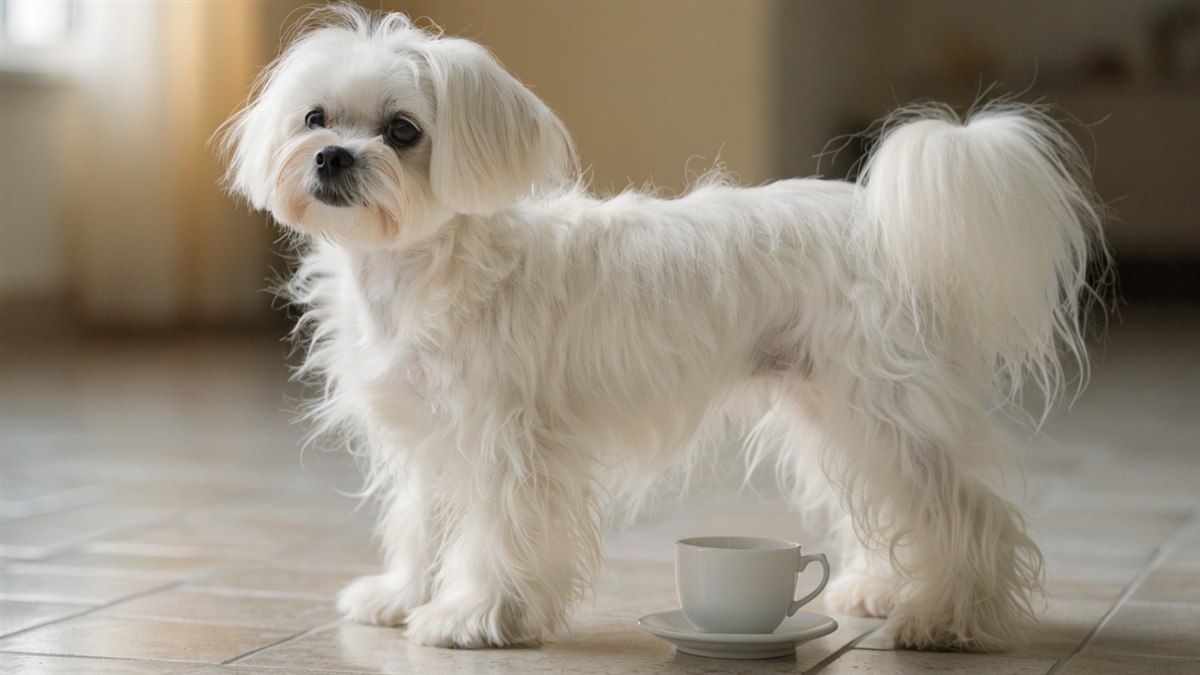
Quick answer
Bolognese dog price in India runs Rs 22,000 to Rs 95,000, and only two published sources give a figure at all. The breed is genuinely rare, at 36 Royal Kennel Club registrations in 2025 against 3,224 Cavaliers. Its hypoallergenic claim is unsupported by the evidence, and its long flocked white coat needs a professional groom every four to seven weeks in Indian heat.
This guide is general information for Indian pet owners and is not a diagnosis. Always consult a registered veterinarian near you before acting on anything you read here, and treat any sudden change in your dog's breathing, gait or appetite as urgent.
Bolognese trait ratings for Indian homes
What a Bolognese actually is
A Bolognese is a small white Italian companion dog of the bichon family, standing 25 to 30 cm at the withers and weighing 2.5 to 4 kg under FCI Standard number 196. The FCI places it in Group 9, Companion and Toy Dogs, Section 1, Bichons and related breeds, with no working trial, and its nomenclature entry carries the same classification.
The breed standard describes a dog built in a square, where the length of the body equals the height at the withers, with the head reaching one third of that height. Males measure 27 to 30 cm and females 25 to 28 cm. Both sexes weigh 2.5 to 4 kg, which makes an adult Bolognese lighter than most cats kept in Indian homes.
Three details in the standard do real work later on this page. The coat is long all over the body, from head to tail, from the top line to the feet, shorter only on the muzzle, and it forms long flocks that have the same texture all over the body, rather off-standing coat thus not falling flat and tight, never shows fringes. The colour is pure white, with very slight shades of ivory tolerated. Any other colour, and any patches or flecks, disqualify the dog outright.
The standard says nothing about shedding
Neither the English nor the Italian text of FCI Standard 196 uses the word shed, non-shedding, hypoallergenic, allergy or undercoat anywhere. The coat section runs to four sentences and describes texture, carriage and colour only. That silence matters, because every Indian page selling this breed rests its pitch on a claim the governing standard never makes. ENCI, FCI Standard N 196 Bolognese
On temperament the standard is blunt and short. It calls the Bolognese very serene, generally not very active, and adds that the dog is eventful but calm and very faithful to his master and his entourage. The Italian original is a shade sharper still, describing a dog that is molto quieto, generalmente poco vivace.
The tail must be whole
A shortened tail disqualifies a Bolognese in the show ring, whether the shortening is natural or artificial, and so does having no tail at all. The correct tail is set on the line of the croup and carried curved over the back. This lines up with Indian law rather than fighting it, because the Prevention of Cruelty to Animals (Dog Breeding and Marketing) Rules 2017 forbid tail docking outright. Any Indian seller offering a docked Bolognese is offering a dog that fails the standard and a procedure that Indian law prohibits. Prevention of Cruelty to Animals
Where the breed comes from
The Bolognese shares its distant ancestry with the Maltese, and the standard says so directly, tracing both to the small dogs Aristotle called canes melitenses. Cosimo de Medici sent no fewer than eight of them to Brussels as gifts to Belgian noblemen in the fifteenth century. Philip II of Spain, on receiving two from the Duke d'Este, wrote back that these little dogs are the most royal gifts one can give to an emperor. The breed appears in paintings by Titian, by Pieter Bruegel the Elder and by Goya. Ente Nazionale della Cinofilia Italiana
Published sizes do not agree
Three organisations publish three different adult sizes for the same breed, and the spread is wide enough to change what you should expect in the crate.
| Source | Height | Weight | Weight in kg |
|---|---|---|---|
| FCI Standard 196 (governing standard) | Males 27-30 cm, females 25-28 cm | 2.5-4 kg | 2.5-4.0 |
| American Bolognese Club (AKC parent club) | 10-12 inches (25.4-30.5 cm) | 6-10 pounds | 2.7-4.5 |
| PawsIndia (ranks position 2 in India) | 9-12 inches (22.9-30.5 cm) | 8-14 pounds | 3.6-6.4 |
The parent club's ceiling of 10 pounds converts to 4.5 kg, which sits above the standard's 4 kg limit. The Indian page's ceiling of 14 pounds converts to 6.4 kg, which is 60 percent above the standard's maximum and describes a different dog entirely. If an Indian seller shows you a 6 kg white dog and calls it a Bolognese, the FCI standard says it is not one. PawsIndia, Bolognese breed page Federation Cynologique Internationale
PawsIndia ranks second in India for this query. Its own meta description reads that the distinctive musculature of this breed is one of its most recognisable characteristics, and that the thick, double-coated, medium-length fur is often a mix of shades of brown ranging from light to dark. The Bolognese is a pure white dog in which any other colour is a disqualifying fault. That description belongs to some other breed and was never corrected.
How rare the Bolognese really is, in numbers
The Bolognese is one of the rarest breeds in the toy group anywhere, and the registration figures say so plainly. The Royal Kennel Club recorded 36 Bolognese registrations in the United Kingdom in 2025, against 3,224 Cavalier King Charles Spaniels in the same table for the same year.
One familiar breed in the same table makes that number readable. For every Bolognese registered with the Royal Kennel Club in 2025, roughly 90 Cavalier King Charles Spaniels were registered. Against the Pug, a breed most Indian buyers can picture, the ratio in 2025 was 23 to one, and that is after the Pug's own collapse from 10,408 registrations in 2016 to 834 in 2025.
| Breed | 2016 | 2020 | 2023 | 2025 | Change 2016 to 2025 |
|---|---|---|---|---|---|
| Bolognese | 158 | 65 | 47 | 36 | down 77 percent |
| Bichon Frise | 875 | 400 | 344 | 217 | down 75 percent |
| Havanese | 542 | 468 | 353 | 284 | down 48 percent |
| Maltese | 1,094 | 885 | 748 | 490 | down 55 percent |
| Pug | 10,408 | 6,033 | 1,994 | 834 | down 92 percent |
| Cavalier King Charles Spaniel | 1,414 | 2,279 | 3,528 | 3,224 | up 128 percent |
| Whole toy group | 27,237 | 18,085 | 13,767 | 10,500 | down 61 percent |
Two things stand out. The Bolognese has fallen 77 percent in a decade, from 158 to 36, and it is now the smallest entry in a shrinking group. In 2025 the breed accounted for 36 of 10,500 toy registrations, which is one dog in every 292. The Royal Kennel Club's quarterly file gives the same 2024 totals for the breeds around it, with Bichon Frise at 308, Maltese at 724, Pug at 1,316 and the whole toy group at 11,842, which is what makes the ten-year table trustworthy rather than a single unchecked source.
The breed is not fully recognised in America either
The American Kennel Club has not admitted the Bolognese to its stud book. The breed sits in the Foundation Stock Service and was approved to compete in the Miscellaneous Class effective 26 June 2024, with the American Bolognese Club serving as parent club. Foundation Stock Service breeds do not appear in AKC popularity rankings, so there is no published American registration total to compare.
Italy keeps a studbook but does not publish the number in text
ENCI, the Italian national kennel club, maintains the Bolognese in its Libro genealogico under FCI code 196 and publishes a ten-year registration chart on the breed's own page. Bonbeno could read the chart's axis, which runs from 2015 to 2024 with a vertical scale topping out at 600, but the underlying yearly values load from a script that this build could not resolve, so no Italian figure is published here. The Royal Kennel Club table above is used instead, because its numbers are printed as text in a document anyone can open.
A breed producing 36 registered puppies a year in an entire country does not have a spare export population. Anyone in India offering Bolognese puppies at short notice, from stock, is describing a supply chain that the registration figures do not support. Ask which studbook the parents are in and ask for the numbers, not the word.
The rarity also explains most of the health-data gaps further down this page. Epidemiological studies set minimum sample sizes before they report a breed, and the Bolognese falls below almost all of them. That is not a sign of a healthy breed. It is a sign of a small one.
Bolognese dog price in India
Bolognese dog price in India runs Rs 22,000 to Rs 95,000 across every published Indian figure Bonbeno could find, and there are only two of them. Three of the six pages ranking for this query print no price at all, which is the more useful finding. Tegha Kennel (Online Dogs Sale)
Start with what actually exists. Dogbreedo, which ranks third in India, gives a puppy price band of Rs 22,000 to Rs 90,000 across three grades it calls basic, KCI certified and show quality. Tegha Kennel carries a single live listing at Rs 95,000 for a two-month-old pure white puppy. That is the whole published Indian market. Tegha Kennel (Online Dogs Sale)
| Source | SERP position | Price published | What the page actually shows |
|---|---|---|---|
| Mr n Mrs Pet | 1 | None visible | Prints '3 Result Found' and renders no Bolognese. Price sits behind a sign-up form. |
| PawsIndia | 2 | None | Template page. Says only that a purebred Bolognese costs more than many other breeds. |
| Dogbreedo | 3 | Rs 22,000 to Rs 90,000 | Article published October 2020, last modified December 2022. |
| Tegha Kennel | 5 | Rs 95,000 | One puppy, age 2 months, listed 18 October 2024, still live. |
| Dog Breeds List (US) | 6 | USD 1,000 to 2,500 | American figure, not an Indian one. |
| Breed n Breeder | 8 | None | Lead form and a phone number. No puppy on the page. |
The exchange-rate test comes back negative this time
Indian breed pages routinely publish a rupee price that turns out to be a dollar figure run through one exchange rate, and dividing by 84.38 exposes it in seconds. Bonbeno ran that test on every rupee figure here and it failed to catch anything. Rs 22,000 divides to 260.73 dollars, Rs 90,000 to 1,066.60 and Rs 95,000 to 1,125.86, and none of those is a round dollar amount. Running it the other way, the American band of 1,000 to 2,500 dollars converts to Rs 84,380 to Rs 210,950, which does not sit inside the Indian band either. The Indian numbers appear to be genuinely Indian rather than converted. Dogbreedo, Bolognese Dog Price in India
What KCI registration actually costs
A puppy price sold on paperwork should be checked against the price of that paperwork. The Kennel Club of India's tariff sheet, effective 1 April 2024, charges a breeder Rs 750 per puppy to register a litter within 60 days of birth, Rs 1,200 between 61 and 120 days, and Rs 2,000 between 121 and 180 days. Registering an imported dog costs Rs 2,500, and a certified four-generation pedigree costs Rs 1,000.
So the entire documentary difference between a KCI-registered puppy and an unregistered one is roughly Rs 750 to Rs 1,750 of fees. Any seller pricing KCI registration as a jump of tens of thousands of rupees is charging for the paper, not paying for it. Ask for the litter registration number and the sire and dam registration numbers, and check that the litter was registered inside the 60-day window rather than at 180 days.
A KCI pedigree needs registered parents. With 36 Bolognese registered across the whole of the United Kingdom in 2025, and no published Indian breeding population, a seller claiming a KCI-registered Bolognese litter has to be able to name the sire and dam and say how they entered India. If the answer is vague, treat the price as a price for a white puppy of unknown breeding.
Bonbeno reports these bands as editorial content. We do not broker sales, we do not recommend breeders, and none of the figures above is an offer.
Availability in India, and what sellers are actually offering
Availability in India is close to nil, and the pages selling this breed give that away themselves once you read past the headline. Bonbeno opened all six ranking commercial pages in August 2026 and found one live Bolognese listing between them. Tegha Kennel (Online Dogs Sale)
The number one result in India for this query is a Mr n Mrs Pet listing page headed Bolognese Puppies For Sale. It prints the line 3 Result Found. It then renders no Bolognese card whatsoever. The only puppy cards on the page sit beneath the heading Similar breeds at other locations, and all three are French Bulldogs, in Tanuku, Delhi and Guwahati. Price is hidden behind a View Price link that routes to a sign-up form.
The second result is a PawsIndia breed page with no price, no listing and a specification table. Its own meta description describes a thick, double-coated, medium-length brown coat and distinctive musculature, which is not a Bolognese.
The eighth result is a Breed n Breeder page headed Healthy Bolognese Puppies for Sale Avaliable, spelling included. It contains a dropdown of roughly 250 breed names, a state and city selector, a phone number and the line that Mr. Vansh will connect with you to discuss the Bolognese puppies price. There is no puppy on it. The identical page exists for every one of those 250 names.
The one real listing is nearly two years old
Tegha Kennel carries the only genuine Indian Bolognese listing Bonbeno found. It is a two-month-old pure white puppy at Rs 95,000, filed under the site's categories Dogs, Hypoallergenic Dog and Smallest Dog, and it closes with the line that this cutie will not be available for long. It was published on 18 October 2024 and was still live when this page was written in August 2026. The related products beside it are a Yorkshire Terrier, an American Barbet, a Tamaskan and an Afghan Hound.
A control, so the absence is real
An empty search result proves nothing on its own, so Bonbeno checked the absence against a page that lists live Indian stock. Premium Pet House publishes a dog price list with named puppies, cities, prices and phone numbers. Searching it returns 27 mentions of Maltese and 15 of Shih Tzu, and zero mentions of Bolognese. The search works. The breed is simply not there.
There is no lawful commercial import route
Import cannot quietly fill the gap either. Under DGFT Trade Notice 22/2022-23, dogs sit at ITC(HS) 01061900 with an import policy of Restricted. Policy Condition 7 permits import only for a pet dog with a valid pet book in the importer's own name, for research organisations with a CPCSEA recommendation, or for internal security by the Defence and Police Force. Policy Condition 8 states that import of commercial dogs for breeding or any other commercial activity is not permitted, and paragraph 6 adds that applications for trading or breeding purposes shall be duly rejected. Entry is limited to the airports and seaports of Delhi, Mumbai, Chennai, Hyderabad, Bengaluru and Kolkata and, since October 2024, Kochi airport. Department of Animal Husbandry… The full route is set out in how to import a dog to India.
Put the two facts side by side. India has no visible domestic Bolognese breeding population and no lawful route to import breeding stock. A seller who can produce a Bolognese puppy quickly is therefore describing something that does not fit either fact, and the most common explanation is a white Maltese, a white Shih Tzu cross or a small Bichon Frise sold under a rarer name. Ask to see both parents, in person, on the premises.
None of this makes the breed a bad dog. It makes the Indian market for it thin enough that verification matters more than price.
Every page above was opened and read in August 2026 rather than judged from a search snippet. No People Also Ask box could be captured on the day this page was built. A rendered Google India result on 18 September 2026 did carry one, 4 questions, and the FAQ below answers 4 of them verbatim. The ranking set itself was pulled through a search API restricted to India.
Monthly cost of a Bolognese in India, with the coat priced in
Grooming, not food, sets the monthly cost of a Bolognese in India. At published Indian salon rates and the grooming interval its own parent club recommends, the clip alone runs Rs 900 to Rs 1,400 a month before a single kilogram of food is bought.
Work it from the interval. The American Bolognese Club says most pet owners choose a shorter companion trim and that companion dogs are typically groomed every four to seven weeks. Four weeks gives 13 grooms a year, seven weeks gives roughly 7.4, and five weeks gives about 10.4.
Now price a groom. A Bangalore salon chain publishes Rs 1,499 for its Spa and Basic Grooming package on a long coat, against Rs 1,199 for the same package on a short coat, a long-coat surcharge of Rs 300 or 25 percent. A Mumbai at-home service publishes Rs 1,600 for Full Grooming with haircut and styling, and Rs 1,250 for haircut only. Patmypets, Dog grooming packages at home…
| Interval | Grooms per year | At Rs 1,499 (Bangalore, long coat) | At Rs 1,600 (Mumbai, at home) |
|---|---|---|---|
| Every 4 weeks | 13.0 | Rs 19,487 a year, Rs 1,624 a month | Rs 20,800 a year, Rs 1,733 a month |
| Every 5 weeks | 10.4 | Rs 15,590 a year, Rs 1,299 a month | Rs 16,640 a year, Rs 1,387 a month |
| Every 7 weeks | 7.4 | Rs 11,093 a year, Rs 924 a month | Rs 11,840 a year, Rs 987 a month |
The ranking page's own budget does not survive its own advice
Dogbreedo puts the monthly maintenance cost of a Bolognese at Rs 3,000 to Rs 4,000 and, in the same section, says the dog must be bathed at least once every two weeks. Twenty-six baths a year at the Bangalore long-coat spa rate of Rs 899 comes to Rs 23,374 a year, which is Rs 1,948 a month. That single line item consumes 65 percent of the low end of its own budget and 49 percent of the high end, before food, vaccination, deworming or a vet visit. The same page then contradicts itself in its FAQ, where it says to bathe the dog once every month. Pet Warehouse, Pet grooming packages…
What the rest of the budget looks like
Supertails, writing in March 2026, puts the average monthly maintenance cost of a dog in India at Rs 3,000 to Rs 11,000, and in its own summary box at the top of the same article puts monthly upkeep at Rs 3,000 to Rs 18,000. It budgets Rs 80,000 to Rs 2,00,000 for a first year including purchase, vaccinations, food, training and supplies, and notes that Mumbai and Delhi run 15 to 30 percent above other cities. Bonbeno reports both of its figures rather than choosing one.
A 2.5 to 4 kg dog sits at the cheap end of that range on food and at the expensive end on grooming. Two costs specific to this breed are worth planning for. Eye and eyelid care is a recurring line, because the breeds screened alongside the Bolognese carry a real burden of inherited eye disease and the parent club asks for an annual eye examination. Dental work is the second, because small dogs carry higher odds of periodontal disease than large ones. O'Neill DG, Mitchell CE, Humphrey J
Before paying for a Bolognese puppy, phone two groomers near you, describe a long single-length coat that must not be blown straight or sculpted, and ask what they charge and how long they need. If the answer is a 45-minute slot at the short-coat rate, you have found a groomer who will clip the dog short. That may be the right outcome in Chennai, but you should choose it, not discover it.
Is the Bolognese hypoallergenic? The honest answer
No dog breed is hypoallergenic, and the Bolognese is not an exception. The largest measurement study of the claim compared 196 dogs of so-called hypoallergenic breeds against 160 control dogs and found the hypoallergenic group carried more of the major dog allergen, not less.
Vredegoor and colleagues measured Can f 1, the major dog allergen, in hair samples, in coat samples, in settled floor dust and in the air of the dogs' homes. In hair the hypoallergenic group averaged 2.26 micrograms per gram against 0.77 for the controls. In coat samples the figures were 27.04 against 12.98. Settled floor dust was lower for Labradoodles only, and there was no difference in airborne allergen between any of the groups. The paper's conclusion is one sentence long: There is no evidence for the classification of certain dog breeds as being hypoallergenic.
The Bolognese was not one of the breeds tested
Bonbeno will not overstate this. The four breeds Vredegoor's team sampled as hypoallergenic were the Labradoodle, the Poodle, the Spanish Waterdog and the Airedale Terrier, tested against Labrador Retrievers and a control group. The Bolognese was not among them. What the study establishes is that the category itself does not hold up when measured, including in breeds marketed on exactly the same coat argument used for the Bolognese, and that within-breed variation swamped between-breed differences. It does not establish a Bolognese-specific allergen level, because nobody has published one.
The breed standard makes no such claim
Check what the governing document says, because it is short and it is free. FCI Standard 196 devotes four sentences to the coat. It says the hair is long all over the body, shorter on the muzzle, forms long flocks of the same texture throughout, stands rather off the body, and never shows fringes. The words shed, shedding, non-shedding, allergy, allergen, hypoallergenic and undercoat appear nowhere in either the English or the Italian text. The standard that defines the breed does not sell the feature the market sells. ENCI, FCI Standard N 196 Bolognese
The parent club says it too
The American Bolognese Club is the AKC parent club for the breed. Asked in its own FAQ whether Bolognese dogs are hypoallergenic, it answers No dog is completely hypoallergenic, then adds that the breed is low-shedding, which may make them more suitable for some individuals with allergies, and that reactions vary from person to person. That is a fair description. It is also not what Indian buyers are being told.
What Indian buyers are told instead
The only live Indian Bolognese listing Bonbeno found sits in a website category literally named Hypoallergenic Dog, at Rs 95,000. The page ranking third in India asks Are Bolognese Dogs Hypoallergenic? and answers Yes. The Bolognese are hypoallergenic, then repeats it in a second FAQ entry claiming they are hypoallergenic and have little to no shedding at all. The American aggregator ranking sixth prints Hypoallergenic: Yes in its specification table and rates shedding one star out of five. None of the three cites anything. Dog Breeds List, Bolognese dog price
A continuously growing coat holds loose hair inside itself instead of dropping it on the sofa, which is a housekeeping benefit and a real one. It is not an allergen benefit. Can f 1 travels in dander, saliva and urine, and the study above found no difference in airborne allergen between hypoallergenic and control breeds. Less hair on the floor and less allergen in the air are two different things.
If someone in your household is allergic to dogs, the only useful test is the individual dog. Spend several hours with that specific puppy, in a closed room, before any money changes hands, and speak to your own doctor. Do not pay a premium for a word on a listing page.
Heat tolerance: what the coat and the origin climate actually imply
Bonbeno rates the Bolognese 2 out of 5 for heat tolerance in India, and the argument runs through the coat rather than the body size. The breed comes from a city whose hottest month averages 26.07 degrees Celsius. Chennai is warmer than that in eight months out of twelve.
Every figure below comes from one source on one methodology, NASA POWER's MERRA-2 climatology for 2001 to 2020, queried by explicit latitude and longitude so that no city can be substituted for another by accident. Bologna sits at 44.495 north, 11.343 east.
| City | Annual mean | Hottest month | Coldest month | Months above Bologna's July mean of 26.07 C |
|---|---|---|---|---|
| Bologna, Italy | 14.22 C | July, 26.07 C | January, 3.46 C | 0 |
| Chennai | 27.95 C | May, 31.51 C | December, 24.41 C | 8 |
| Mumbai | 26.77 C | May, 31.19 C | December, 23.33 C | 7 |
| Delhi | 25.60 C | June, 35.88 C | January, 13.61 C | 6 |
| Bengaluru | 23.74 C | April, 28.37 C | December, 20.22 C | 3 |
Read the last column first, because it is the whole argument. The origin climate never exceeds a monthly mean of 26.07 C. Chennai exceeds it for eight months of the year, Mumbai for seven, Delhi for six and Bengaluru for three. Chennai's annual mean sits 13.73 C above Bologna's, Mumbai's 12.55 C above, Delhi's 11.38 C above and Bengaluru's 9.52 C above. Delhi's June mean of 35.88 C stands 9.81 C above the hottest month this breed was ever selected in.
The coat is an insulating layer by design
The FCI standard does not describe a coat that lies flat. It requires hair that is long over the entire body from the top line to the feet, forming long flocks, and specifically rather off-standing coat thus not falling flat and tight. A coat held off the skin traps a layer of still air against the dog, which is the classic arrangement for retaining body heat. That is a design feature for northern Italian winters, where Bologna's January mean is 3.46 C. NASA POWER, MERRA-2 climatology
Two Italian sources disagree about the undercoat
Whether there is an undercoat underneath those flocks is genuinely contested, and Bonbeno publishes the disagreement rather than picking a side. FCI Standard 196 never mentions an undercoat and says only that the hair has the same texture all over the body. ENCI's own breed introduction, taken from Le razze italiane, describes the opposite, calling the coat uno specialissimo e raro connubio di pelo (forte) e sottopelo (morbido), a very special and rare marriage of strong outer hair and soft undercoat. An American aggregator adds a third answer, calling it a distinctive white single coat. All three are published, and they cannot all be right. Dog Breeds List, Bolognese dog price
The size argument cuts the other way, and that matters
The largest primary-care study of heat-related illness in dogs examined 905,543 UK dogs in 2016 and identified 395 confirmed events, an incidence of 0.04 percent with a case fatality rate of 14.18 percent. Its risk factors were brachycephaly, bodyweight above the breed and sex mean, age over two years, and weighing more than 50 kg. Small dogs were not flagged. A 2.5 to 4 kg body is therefore not itself a heat liability, and any page claiming otherwise is guessing.
What that study does point at is coat. The Chow Chow, the thickest-coated breed in it, carried the highest odds of any study breed at 16.17. The Golden Retriever carried 2.67 times the odds of the Labrador Retriever despite matching it on size, temperament and purpose, and the authors name the thicker coat as the plausible tipping factor. They then state plainly that other double coated breeds may also have increased risk, however the current study was under-powered to fully explore these pre-dispositions due to low numbers of these breeds. No Bolognese figure exists, and the study explains why.
One thing genuinely runs in the breed's favour. The coat must be pure white, and a white surface reflects far more solar radiation than a dark one, so a Bolognese in direct Indian sun absorbs less than a black dog of the same size. That helps outdoors in daylight. It does nothing at all indoors at night, where a trapped-air coat still slows heat loss.
Monsoon, humidity, ticks: where overseas advice stops working
A dense long coat in a humid Indian monsoon is a drying problem before it is a grooming problem. Mumbai averages 89.56 percent relative humidity in July and 90.36 percent in August, against 51.01 percent in Bologna in July.
| City | Annual mean | Wettest month | Driest month |
|---|---|---|---|
| Bologna, Italy | 71.59 percent | December, 87.31 | July, 51.01 |
| Mumbai | 67.39 percent | August, 90.36 | February, 44.45 |
| Chennai | 72.39 percent | November, 82.33 | May, 64.52 |
| Bengaluru | 67.94 percent | October, 81.01 | March, 43.53 |
| Delhi | 45.56 percent | August, 74.90 | May, 23.38 |
Bologna is at its most humid in December, when it is also at its coldest, and at its driest in July, when it is warmest. Mumbai reverses that. It is hottest and wettest in overlapping months, so a Bolognese there faces heat and humidity together rather than one at a time. Delhi is the outlier in the other direction, dropping to 23.38 percent in May, which brings its own problem of a dry, static, brittle coat.
Never let this coat air-dry in India
Overseas grooming advice for long-coated companion breeds routinely tolerates towelling and air-drying, because it is written for climates where a coat dries. It does not transfer to a Mumbai August at 90 percent humidity, where a coat left damp against the skin stays damp. Dry a Bolognese to the skin with a dryer after every bath and after every monsoon walk, and part the coat with your fingers to confirm the skin underneath is dry rather than the surface. Drying the coat thoroughly is not the same thing as blowing it straight, which the parent club says a show coat must never be.
One in five apparently healthy Indian dogs carries a dermatophyte
This is not a theoretical risk. A study of 1,501 healthy companion animals in and around Kolkata between 2011 and 2013 found dermatophytes on direct examination in 253 of 1,209 dogs, which is 20.93 percent, and in 109 of 292 cats, which is 37.33 percent. The three predominant species were Microsporum canis, Microsporum gypseum and Trichophyton mentagrophytes, all of which pass to humans. The dogs sampled were healthy, so the coat was hiding it. On a long white coat that mats, you will not see the skin unless you look.
The breed club's parasite advice is written for Britain
The Bolognese Dog Club UK publishes health advice on parasites, and it is competent advice for Britain. It explains that fleas are now a year-round problem because of central heating, that ticks are seasonal and found in long grass where sheep or deer graze, and that the most common tick-borne disease in this country is Lyme disease. Read that in India and almost none of it lands. Indian homes do not have central heating, the tick is not a pasture tick, and Lyme is not the headline pathogen.
What Indian evidence shows instead is a household tick. Of 230 dogs sampled in Tamil Nadu, 229 were tick-infested, which is 99.6 percent, with Rhipicephalus sanguineus sensu lato, the brown dog tick, on 98.3 percent of the infested animals. Some 156 of the 230 dogs, or 67.8 percent, carried at least one vector-borne pathogen: Hepatozoon canis in 37.8 percent, Anaplasma platys in 22.6 percent, Ehrlichia canis in 16.1 percent and Babesia vogeli in 10 percent. Those dogs were strays, so the percentages are not a figure for an owned apartment dog, but the pathogen mix and the vector are the ones your dog meets on an Indian pavement.
Fourteen brown dog tick populations collected from dogs in Andhra Pradesh were tested against the two most commonly used drugs. Thirteen of the fourteen were resistant to cypermethrin and six of the fourteen to ivermectin, the first report of ivermectin resistance in this tick in India. Bonbeno notes that the paper's own abstract reports the first figure as 92.6 percent, while 13 of 14 divides out to 92.9 percent, so the counts are quoted here rather than the percentage. Ask your vet which class of product is still working locally instead of buying what is on the shelf.
Practical routine in the monsoon months. Dry to the skin every time. Run your fingers over the whole dog daily, because a tick on this coat is found by touch and never by sight. Keep the ears dry after a bath and after rain, and clip the hair under the tail short enough to stay clean.
The coat the standard requires, and the coat care it costs
Coat care on a Bolognese is a daily job, not a weekly one, because the standard requires a long flocked coat that grows continuously and never stops. The American Bolognese Club describes it as a long, continuously growing coat that requires regular brushing to prevent tangles and maintain its natural texture. Federation Cynologique Internationale
The standard sets the target. Hair long over the whole body from head to tail and from the top line to the feet, shorter on the muzzle only, forming long flocks of one texture throughout, standing rather off the body so that it does not fall flat and tight, and never forming fringes. Colour is pure white, and patches or flecks disqualify.
Even the Italians argue about what the flocks should look like
The Italian text of the standard says the coat forma lunghi bioccoli, forms long flocks. ENCI's own breed introduction, published in Le razze italiane, then rejects that reading, insisting the coat should be densely and finely waved, mai e poi mai bioccolature, never ever in flocks like a Bergamasco Shepherd. That is the national kennel club's essay contradicting the national kennel club's standard, on the single question a groomer needs answered. Bonbeno reports both.
Two legitimate finishes, and only one is realistic in India
The parent club sets out two approaches. A companion trim, which most pet owners choose, is a shorter maintenance cut redone every four to seven weeks, and even then it says to leave the hair on the head, muzzle, ears and tail longer and keep a soft natural outline. A show groom keeps the coat natural and rustic, and the club is explicit that it should not be blown straight or sculpted into an artificial shape and that trimming must not create an illusion.
That second instruction is the one that collides with Indian salon practice, and the next section prices it out. A companion cut is not a compromise the club disapproves of. It says so in writing.
Brushing and bathing, where the sources disagree
Published brushing advice for this breed ranges from twice a week to daily, and published bathing advice ranges from fortnightly to monthly. Bonbeno sets out the spread rather than averaging it.
| Source | Brushing | Bathing | Professional grooming |
|---|---|---|---|
| American Bolognese Club (parent club) | Regular, to prevent tangles and keep coat texture | Not specified | Every 4 to 7 weeks for a companion cut |
| Dogbreedo, maintenance section | Up to 2 times a week | At least once every 2 weeks | Optional |
| Dogbreedo, FAQ on the same page | Once or twice a week | Once every month | Not specified |
| PawsIndia | Adult coat 20 to 30 minutes a week | Not specified | Not specified |
| PawsIndia, on puppies | Possibly daily, 5 to 30 minutes | Not specified | Not specified |
The one page that gives two different bathing answers gives them 900 words apart, in the same article, and neither is sourced. Where the sources agree is that the puppy coat needs more work than the adult coat, which is the reverse of what most buyers expect. PawsIndia puts adult grooming at 20 to 30 minutes a week if you are lucky, and puppy grooming at possibly daily.
What actually goes wrong
The coat mats at friction points first, and on this breed those are the armpits, behind the ears, the ruff under the collar and the trousers behind the hind legs. A matted patch traps moisture against the skin, and in an Indian monsoon that patch stays wet. Brush to the skin with a slicker and then comb through with a metal comb to prove there is nothing left, because a slicker alone glides over the top of a mat and leaves it in place.
Two extra jobs come with a white face. Tear staining shows on this coat in a way it never shows on a Shih Tzu with darker markings, so wipe the inner corners of the eyes daily with plain water and dry them. Keep the hair around the eyes trimmed short enough that it does not sit on the cornea, and keep the hair under the tail short enough to stay clean.
A companion clip that leaves half an inch is a sensible Indian choice and the parent club endorses a shorter trim. Taking a white dog down to bare skin is a different decision, because it removes the shading over thin, tightly fitted skin that the standard describes and gives you a sunburn problem instead of a matting one. Ask for a short even length, not a shave.
Can an Indian groomer actually finish this coat?
Most Indian salons can bathe and clip a Bolognese competently, and very few are set up to give it the natural, unsculpted, unstraightened finish its parent club describes. Bonbeno checked the published packages rather than assuming, and the packages themselves show why. American Bolognese Club (AKC Parent Club)
Take a mainstream Bangalore chain with four branches. Its published menu prices by coat length, short or long, not by coat type. Spa only costs Rs 799 short coat and Rs 899 long coat. Spa and Basic Grooming costs Rs 1,199 short coat and Rs 1,499 long coat. Spa and Premium Grooming is listed at Rs 2,199 with a short-coat price only and no long-coat price at all.
Every package, from the Rs 799 tier upward, lists the same twelve steps, and two of them matter here. Blow Drying appears in all three tiers, and Deshedding and Dematting appears as a single bundled line item in all three. A menu built that way is built for a Labrador that sheds and a Shih Tzu that tangles. It is not built for a coat that must come out of the session looking rustic and natural.
The breed merchandising gives it away
The same chain sells food and accessories organised by breed, and it names seven: Golden Retriever, Labrador, Pug, Indie, Husky, Shih Tzu and German Shepherd. Not one bichon-type breed appears. Its own grooming FAQ answers the question of whether grooming helps with shedding by explaining that regular brushing removes loose and dead hair. That is the right answer for the market it serves and the wrong frame entirely for a coat whose selling point is that it does not drop hair.
At-home services price a Bolognese like a Pug
A Mumbai at-home groomer publishes four dog packages: Fresh Pack at Rs 850, Pampered Pack with a minor haircut at Rs 1,250, Full Grooming with haircut and styling at Rs 1,600, and Hair Cut Only at Rs 1,250. There is no long-coat tier and no coat-type distinction anywhere on the price list, and the FAQ advises that dogs ought to have a haircut once a month. Flat pricing on a coat that takes three times as long to finish resolves one of two ways. Either the groomer absorbs the time, or the dog comes back shorter than you asked for.
| Service | City | Price | Coat type priced separately? |
|---|---|---|---|
| Spa only, short coat | Bangalore, salon | Rs 799 | Length only |
| Spa only, long coat | Bangalore, salon | Rs 899 | Length only |
| Spa and Basic Grooming, short coat | Bangalore, salon | Rs 1,199 | Length only |
| Spa and Basic Grooming, long coat | Bangalore, salon | Rs 1,499 | Length only |
| Full Grooming, haircut and styling | Mumbai, at home | Rs 1,600 | No |
| Hair Cut Only | Mumbai, at home | Rs 1,250 | No |
How to brief an Indian groomer for this breed
- Book the long-coat tier and the longest available slot, because a 45-minute short-coat slot forces a short clip.
- Ask for one even length across the body, roughly half an inch, with head, muzzle, ears and tail left longer.
- Ask for no straightening. Say the coat should be dried to the skin and left with its natural wave rather than blown out flat.
- Ask for no sculpting. Refuse the round scissored head outline used on a Bichon Frise, because it is a different breed.
- Ask for the eye corners trimmed and wiped, and the hair under the tail taken short.
- Check the skin yourself before you leave, parting the coat at the armpits and behind the ears.
Keep a show coat and you are committing to daily work in a climate that fights you. Keep a short even companion clip and you lose the flocked look this breed is bought for, but you get a dog that stays dry, stays cool and stops matting. The parent club endorses the companion cut in writing, so this is a choice between two correct answers rather than a failure.
Temperament, apartment living, and who should not buy one
A Bolognese is a serene indoor companion that wants to be with its person almost all the time, and the breed standard says so in six words. It calls the dog very serene, generally not very active, then adds that he is very faithful to his master and his entourage.
Apartment living suits this breed better than almost any other arrangement, and for once the sources agree. A dog that is generally not very active, weighs 2.5 to 4 kg and was selected for centuries to sit in a room with people is a good fit for a Mumbai two-bedroom or a Bengaluru flat. One American aggregator rates it five out of five for apartment friendliness and notes it will do okay without a yard. Dog Breeds List, Bolognese dog price
The attachment is the trait that decides the purchase
The parent club is direct about the constraint. Bolognese dogs bond closely with their owners and do best in homes where they are included in daily life, and they are not typically well-suited for households where they are left alone for long hours on a regular basis. An Indian household where both adults commute and the flat is empty from nine to seven is exactly the household this breed struggles in.
The ranking pages put numbers on the same point, and the numbers are unsourced but consistent. One says not to leave a Bolognese alone for more than four hours or it can develop separation anxiety and become destructive. Another says the breed is best suited to retirees or a household where at least one adult works from home. PawsIndia, Bolognese breed page
The sources flatly contradict each other on barking
Ask whether a Bolognese barks and you get three different answers from three ranking pages. Dogbreedo says they are not prone to barking but will alert their owner to any change in the surroundings. PawsIndia lists under Cons that more than most other breeds, Bolognese dogs bark a much, typographical error included. Dog Breeds List rates barking three out of five and calls it occasional, while rating watchdog ability four out of five. Bonbeno publishes the disagreement, because in an Indian apartment block with shared walls it is a question worth a straight answer that nobody has published. Dog Breeds List, Bolognese dog price
Small dog syndrome is a training failure, not a breed trait
Because of the breed's size, Bolognese are described as prone to small dog syndrome, a set of human-induced behaviours where the dog believes he is pack leader, producing separation anxiety and timidity. That description names the cause accurately. A 3 kg dog that is carried everywhere, never asked to walk on its own feet and never told no becomes a difficult dog, and the fix is ordinary consistent handling from week nine.
Who should buy one
- Households with someone home most of the day, including retired couples and people who work from home.
- Apartment owners who want a quiet indoor dog rather than a running companion.
- Owners willing to book and pay for a groomer every four to seven weeks for twelve years.
- Buyers who can wait months for a verifiable puppy rather than buying the first white dog offered.
Who should not
- Households empty for ten hours a day, where separation distress is close to guaranteed.
- Families with toddlers, because a 2.5 kg dog is injured by ordinary rough handling.
- Anyone buying for allergy reasons, since the evidence does not support that purchase.
- Anyone unwilling to dry the coat to the skin after every bath through the monsoon.
- Buyers who want an outdoor or guard dog, which this breed is not and was never bred to be.
Dog Breeds List describes the Bolognese as slightly more reserved and shy than its cousin the Bichon Frise. If you have met a Bichon and found it too outgoing, that is the direction this breed moves in. If you found the Bichon about right, the Bolognese may read as withdrawn.
How to train a Bolognese, and the one thing it resists
To train a Bolognese, use short varied sessions and reward-based methods, and never repeat the same drill until the dog switches off. Repetition is the specific thing this breed resists. PawsIndia puts it plainly: although Bolognese are simple to teach, endless repetition of drills quickly grows boring.
The published guidance is unusually consistent on method. Positive reinforcement, mild training techniques and consistency get good results, and the breed does not take yelling or rudeness well. Dogbreedo says the same from the other direction, calling the Bolognese stubborn in the sense that it does not respond to punishment or harsh handling, and adding that it does not favour loud noises or shouting.
That has a practical Indian edge. A great deal of dog training sold in Indian metros still runs on corrections, choke chains and prong collars. On a 3 kg dog with a windpipe the diameter of a pencil, that is both ineffective and physically risky, and the section on borrowed health data below explains why a collar is the wrong tool on any toy breed.
A realistic timeline
| Age | Focus | What good looks like |
|---|---|---|
| 8 to 12 weeks | Handling, name, crate, grooming table | Stands still for a brush and a comb, tolerates paws and ears being held |
| 12 to 16 weeks | Socialisation to Indian street noise, lifts, horns, doorbells | Recovers within seconds from a startle rather than freezing |
| 4 to 6 months | House training, alone-time in five-minute steps, harness walking | Settles alone for 30 minutes without vocalising |
| 6 to 12 months | Recall, polite greeting, vet and groomer rehearsals | Walks into a salon and onto a table without being carried |
| 12 months onward | Maintenance, new tricks for variety | Still learning, because repetition alone will bore this dog |
Socialise deliberately, because this breed defaults to reserved
One aggregator describes the Bolognese as slightly more reserved and shy than the Bichon Frise, and advises getting them accustomed to people and noises at an early age. Indian street life supplies more noise than most, so make the exposure planned rather than accidental. Short daily outings to a lift lobby, a gate and a quiet street corner do more than one long overwhelming trip.
Train the groomer visits, not just the commands
The single highest-value training project for this breed is not sit. It is teaching the dog to stand calmly on a raised surface while somebody brushes, combs, clips nails and works around its eyes and ears. You will be asking for that every four to seven weeks for the rest of the dog's life, so rehearse it at home from week nine with a towel on a table and thirty seconds of brushing followed by a treat.
House training in an Indian apartment
Small dogs have small bladders and Indian apartments often mean a lift ride between the dog and the ground. Plan for a puppy that cannot wait out a five-minute descent, and set up an indoor toilet area from day one rather than after the first accident. One ranking page claims Bolognese are typically very easy to potty train, which is optimistic for any toy breed and worth treating as marketing rather than evidence.
Keep training sessions to about two minutes and finish while the dog still wants more. Three two-minute sessions a day beat one ten-minute session on a breed that is documented to lose interest in repeated drills.
Exercise needs, and when it is too hot to walk
A Bolognese needs roughly 20 to 45 minutes of walking a day, split across two or three short outings, plus indoor play. PawsIndia puts a suitable stroll at 20 to 25 minutes a few times each day, or several short 10-minute walks instead.
The standard sets expectations lower than most buyers assume. It describes a dog that is generally not very active, with free, energetic movement and a noble head carriage, which is a description of a dog that trots briskly for a short distance rather than one that covers ground. An aggregator rates exercise needs two out of five while still insisting on a daily walk, and warns that dogs which do not get daily walks are more likely to display behaviour problems. Dog Breeds List, Bolognese dog price
The Indian constraint is the clock, not the distance
In Chennai, May averages 31.51 C and eight months of the year run hotter than the hottest month in the breed's home city. In Delhi, June averages 35.88 C. Those are monthly means of air temperature, so midday readings sit well above them, and a 25 cm dog walks in the hottest layer of air, closest to a pavement that has been absorbing sun all day. Walk this breed early and late, and treat the middle of an Indian day as indoor time from March through October.
| City | Hardest months | Suggested pattern |
|---|---|---|
| Chennai | March to October, eight months above 26.07 C | Two walks of 15 minutes, before 07:00 and after 19:30, indoor play at midday |
| Delhi | April to September, peaking at 35.88 C in June | One walk before 06:30, one after 20:00, plus indoor work in the dry summer months |
| Mumbai | March to July, with 90 percent humidity in August | Short walks either side of the heat, and dry the coat to the skin after monsoon outings |
| Bengaluru | March to May only, three months above 26.07 C | The easiest Indian city for this breed. Normal morning and evening walks work most of the year |
Signs you have walked too long
- Panting that does not settle within five minutes of coming indoors.
- Lagging behind or sitting down and refusing to move, which on a toy breed happens before collapse.
- Bright red gums, thick ropey saliva, or an unsteady gait.
- Lifting paws off hot ground, which means the surface is already too hot to walk on.
Heat-related illness in dogs is uncommon but not survivable by default. The largest primary-care study found an incidence of 0.04 percent in a year across 905,543 dogs, with 14.18 percent of confirmed events proving fatal. That is roughly one death in seven cases, which is why the sensible response to any of the signs above is shade, water and a vet call rather than pushing on.
Indoor exercise that actually works
Indoor play covers much of this breed's requirement, which is the reason it suits apartments. Scatter-feed part of the daily ration across a room so the dog has to hunt for it. Teach short trick chains, which suit a dog that bores of repetition. Use a hallway for two-person recall games. None of that replaces a daily walk, which supplies the sniffing and the social exposure that a room cannot.
Walk every toy breed on a well-fitted harness. A collar concentrates pulling force on the windpipe of a dog whose trachea is already the diameter of a pencil, and the section below sets out what the published tracheal collapse data shows about small breeds. A harness costs a few hundred rupees and removes the mechanism entirely.
Health issues: what three registries independently screen for
Three separate authorities screen the Bolognese for the same two things, patellar luxation and inherited eye disease, and they arrived there independently. That convergence is the strongest health signal this breed has, and no Indian page reports it. American Bolognese Club (AKC Parent Club) Orthopedic Foundation for Animals
ENCI, the Italian national kennel club, runs a scheme called Riproduzione Selezionata for breeds it considers worth selecting deliberately. For the Bolognese it sets a minimum age of 18 months, requires the grade Eccellente in the show ring for both dogs and bitches, and names exactly two conditions to be screened. Patologia 1 is Lussazione della rotula: 0/1, patellar luxation graded zero or one. Patologia 2 is Oculopatie ereditarie, hereditary eye disease.
The American Bolognese Club, the AKC parent club, approved a health statement on 17 September 2025 asking responsible breeders to screen sire and dam by evaluation of patellas by a veterinarian at one year of age or older, an annual CAER eye examination, and a PRA/prcd test. It also recommends regular dental care and grooming to maintain oral health, coat and skin.
The Orthopedic Foundation for Animals, which publishes statistics for roughly 292 breeds across many registries, holds Bolognese data in exactly two of them, patella and eye, and in none of the others. Two clubs on two continents and one American registry all landed on the same pair.
The OFA patella numbers, with the sample size attached
Bonbeno read the Bolognese registry code, BOL, out of OFA's own advanced-search markup, where the checkbox carries data-name="BOLOGNESE" and value="BOL", rather than guessing it, and then confirmed the breed name printed on every row before taking a figure. Retrieved on 21 August 2026, the patella table gives the Bolognese 83 evaluations, 94.0 percent normal and 6.0 percent abnormal, broken down as Grade 1 at 3.6 percent, Grade 2 at 1.2 percent and Grade 3 at 1.2 percent.
| Measure | Value | Dogs behind it |
|---|---|---|
| Evaluations in the database | 83 | 83 |
| Normal | 94.0 percent | about 78 |
| Abnormal, all grades | 6.0 percent | about 5 |
| Grade 1 | 3.6 percent | about 3 |
| Grade 2 | 1.2 percent | about 1 |
| Grade 3 | 1.2 percent | about 1 |
Read that with care, because 83 evaluations is a small database and the whole abnormal group is five dogs. The three grade percentages sum to exactly 6.0, so the arithmetic is internally consistent, but a five-dog numerator means one more affected dog would move the headline figure by more than a percentage point. OFA numbers also move as evaluations are added, so treat 6.0 percent of 83 as a snapshot dated 21 August 2026 rather than a fixed property of the breed.
The one verified lifespan figure, and it is 14.9 years
McMillan 2024 gives the Bolognese a median survival of 14.9 years, with a lower 95 per cent confidence bound of 14.0 and an upper bound the model could not estimate, from 32 recorded deaths, at a hazard ratio of 0.49 (0.35 to 0.70) against the crossbred group. Read the sample before the number. Thirty-two deaths is one of the thinnest rows in the table, and an unestimable upper bound means the survival curve never fell far enough to fix one, so treat 14.9 as a well-evidenced direction rather than a precise age. Four other sources give four life expectancy bands and none of them cites anything: Dogbreedo says 12 to 15 years, PawsIndia 12 to 14, Dog Breeds List 13 to 15, and the parent club 12 to 14 years or more, so every one of them sits below the only measured figure. An earlier version of this page said the 155-breed table could not be obtained from the publisher's static-content URLs. It can be: the file is 41598_2023_50458_MOESM8_ESM.docx, it holds 156 data rows, and the Bolognese is one of them.
Ask for the sire's and dam's patella grades, dated and signed by a veterinarian at one year or older, and their most recent annual eye certificate. Both clubs ask for exactly that, so a breeder who cannot produce them is below the standard their own parent club sets.
Eyes: the one place this breed has real numbers
Eyes are the best-documented part of Bolognese health, with 358 OFA eye examinations on record and one Italian clinical series that covers the breed by name. Persistent pupillary membranes are the commonest OFA finding, in 51 of 358 dogs, or 14.2 percent.
OFA's summary eye row for the Bolognese gives 358 evaluations, 98.3 percent normal and 1.7 percent abnormal, which is the pass rate for certification. The per-condition tables underneath are more useful, because they record every finding an examiner noted rather than only the disqualifying ones. Each figure below is out of the same 358 dogs.
| Finding | Dogs affected | Percent |
|---|---|---|
| Persistent pupillary membranes, iris to iris | 51 | 14.2 |
| Distichiasis (extra eyelashes on the lid margin) | 18 | 5.0 |
| Corneal dystrophy, epithelial or stromal | 8 | 2.2 |
| Other, suspected as not inherited | 5 | 1.4 |
| Cataract, significance unknown | 3 | 0.8 |
| Vitreous degeneration, syneresis | 3 | 0.8 |
| Gland prolapse of the third eyelid | 2 | 0.6 |
| Imperforate lacrimal punctum | 2 | 0.6 |
| Vitreous degeneration into the anterior chamber | 2 | 0.6 |
| Retinal dysplasia, geographic | 1 | 0.3 |
| Persistent hyaloid artery | 1 | 0.3 |
| No abnormality recorded | 268 | 74.9 |
Every percentage above divides out correctly against 358, which is worth stating because these tables are frequently copied without checking. Fifty-one over 358 is 14.25 percent, eighteen over 358 is 5.03 percent, and 268 over 358 is 74.86 percent.
An Italian series that names the breed
Guandalini and colleagues examined every dog of three small Italian breeds presented to a Rome ophthalmology referral centre between 1994 and 2015: the Maltese, the Bolognese and the Italian Greyhound. Of 462 dogs, 306 were affected by at least one eye disorder known or presumed to be inherited, which is 66.2 percent with a 95 percent confidence interval of 61.8 to 70.4.
Across the whole population the five commonest findings were cataract in 122 dogs, entropion in 56, keratoconjunctivitis sicca in 33, retinal dysplasia in 24 and persistent pupillary membrane iris to iris in 21. Within the Bolognese specifically, the commonest finding was cataract at 24.2 percent.
The paper defines its percentages as the rate on the total number of inherited eye disorders recorded, not as a prevalence among dogs. So 24.2 percent means cataract accounted for roughly a quarter of the eye disorders found in Bolognese in that series, not that a quarter of Bolognese had cataracts. The abstract does not publish the per-breed denominator, and Bonbeno could not obtain the full text, so no Bolognese cataract prevalence is quoted here. This is also a referral population, which is sicker than the general one by construction.
The two datasets agree on one thing
Persistent pupillary membrane, iris to iris, sits in the Italian series' top five findings and is the single commonest OFA finding in the breed at 14.2 percent. Two unrelated datasets, one Italian and clinical, one American and voluntary, both point at the same lesion. That is about as much corroboration as a breed this rare will ever produce. Orthopedic Foundation for Animals
The practical consequence in India is short. Book an annual eye examination with a veterinarian, which both clubs already ask for, and take the dog in immediately for any squinting, cloudiness, persistent tear overflow or rubbing at the face. On a white-faced dog, a change in the amount or colour of tear staining is often the first thing an owner notices.
Bladder stones, and the only other paper that names this breed
The Bolognese was identified as a breed at risk of purine bladder stones in a Hungarian study that had not expected to find it there, and that finding matters more in India than in Hungary. Heat, low water intake and concentrated urine push in the same direction.
Bende and colleagues analysed 2,543 canine uroliths submitted to the Budapest Urolith Centre between 2001 and 2012, using logistic regression to compare each breed against crossbred dogs. Their headline conclusion names four breeds not previously reported at risk, and the Bolognese is one of them, listed alongside the Bichon Frise and the Tibetan Terrier for purine stones, and the Bernese Mountain Dog for struvite. The average cumulative incidence of urolithiasis across the Hungarian dog population came to 1.76 per 10,000 dogs per year.
Purine stones form when urate crystallises out of urine. The two levers an owner controls are dilution and diet, and dilution is the one that Indian conditions attack.
Why this is an Indian problem specifically
A dog that drinks less than it loses produces more concentrated urine. In Chennai, eight months of the year run hotter than the hottest month in the breed's home city, and Delhi's May humidity falls to 23.38 percent, which drives water loss through the airway during panting. A 3 kg dog has a small total water reserve to start with, so the margin is thin.
- Keep two or three water bowls in different rooms and refill them at least twice a day.
- Add water or unsalted broth to dry food, which raises daily water intake without changing the diet.
- Watch for straining, frequent small urinations, or blood, and treat any of those as a same-day veterinary problem.
- Ask your veterinarian before switching to a high-purine diet such as one heavy in organ meat or certain fish.
- Weigh the dog monthly, because an overweight toy breed drinks and moves less.
One case report exists, and it is a single dog
The only other paper in the veterinary literature that centres on a Bolognese is a case report. A 10-year-old male Bolognese presented with five months of painful bilateral nodular and ulcerative pyogranulomatous dermatitis of the ear flaps with apparent destruction of the ear cartilage, and auricular chondritis of unknown cause was suspected. Pain and lesions resolved on immunosuppressive doses of prednisolone, but both ear flaps and both ear canals were left deformed.
Bonbeno reports this case because it is one of only three papers in the indexed literature that genuinely concerns this breed, and because an owner searching for Bolognese ear problems will find it. It is a sample of one. It establishes nothing about breed risk, and no Indian owner should read it as a reason to expect ear cartilage disease.
What the case does support is a habit worth having anyway. This breed carries long, hanging, high-set ears with a rigid base, so the ear canal sits under a flap of coat in a humid climate. Look inside both ears weekly, smell them, and go to a veterinarian for any discharge, odour, head shaking or pain on touch rather than treating at home.
Toy-breed risks, and which figures are borrowed rather than breed-specific
Four conditions get attached to every toy breed sold in India, and for the Bolognese not one of them has a breed-specific published figure. Bonbeno labels each one below as borrowed and says which breed the number actually came from, because transferring a Maltese figure silently onto a Bolognese is how bad breed pages get written.
The absence is real rather than a failed search. Bonbeno ran paired PubMed queries in one session, each with a control that returned results. Bolognese with trachea returned zero while tracheal collapse with dog returned 49. Bolognese with portosystemic or shunt returned zero while portosystemic shunt with dog returned 125. Bolognese with patella or luxation returned zero while patellar luxation with dog returned 117. Bolognese with periodontal or dental returned zero while periodontal disease with dog and breed returned 34. The controls all worked, so the zeros are findings.
| Condition | Bolognese-specific figure? | Best available figure, and whose it is | Does the transfer look reasonable? |
|---|---|---|---|
| Patellar luxation | Yes, partly | OFA gives 6.0 percent abnormal from 83 Bolognese evaluations. UK primary care puts population prevalence at 1.30 percent, with the Pomeranian at 6.5 times the odds of crossbreds | The breed figure stands on its own, but the sample is small |
| Tracheal collapse | No | A Korean series of 110 small-breed dogs found the top four affected breeds were Maltese, Pomeranian, Poodle and Chihuahua | Plausible on size, unproven for this breed |
| Portosystemic shunt | No | Havanese 3.2 percent, Yorkshire Terrier 2.9 percent, Maltese 1.6 percent, against 0.05 percent in mixed-breed dogs | Uncertain. The nearest relatives are high, but the study excluded breeds with under 100 accessions |
| Periodontal disease | No | 1-year prevalence 12.52 percent across 22,333 UK dogs, with odds falling as adult bodyweight rises | Reasonable, because the mechanism is body size rather than breed |
Patellar luxation, where the transfer is least needed
The UK primary-care study covered 210,824 dogs across 119 practices and put diagnosed patellar luxation at 1.30 percent, with a 95 percent confidence interval of 1.21 to 1.39. Of 751 incident cases, 293 or 39.0 percent were managed medically, 99 or 13.2 percent had surgery and 28 or 3.7 percent were referred. Eleven breeds carried raised odds against crossbreds, led by the Pomeranian at 6.5, the Chihuahua at 5.9, the Yorkshire Terrier at 5.5 and the French Bulldog at 5.4. The Bolognese is not among them, because there are not enough of them in England to model.
One line from that study transfers directly and matters in India. Dogs weighing below their breed and sex mean carried 1.4 times the odds of diagnosis. Indian sellers market small as premium, and this is a case where smaller is measurably worse.
Tracheal collapse, borrowed from four other breeds
A Korean referral series of 110 small-breed dogs diagnosed by fluoroscopy between 2022 and 2024 found the top four affected breeds were the Maltese, Pomeranian, Poodle and Chihuahua. The finding worth acting on is not the breed list. It is that 97.2 percent of affected dogs had a body condition score of 4 or above, that collapse grade was associated with high body condition score and low bodyweight, and that clinical signs improved in 86.6 percent of cases after weight reduction, environmental change and medication. Keep a Bolognese lean and walk it on a harness.
Portosystemic shunt, where the transfer is genuinely uncertain
Tobias and Rohrbach reviewed 2,400 dogs with congenital portosystemic shunts from teaching hospitals over 22.2 years. Shunts were reported in 0.18 percent of all dogs and 0.05 percent of mixed-breed dogs, and 33 breeds carried significantly raised risk. The highest proportions were the Havanese at 3.2 percent, Yorkshire Terrier at 2.9 percent, Maltese at 1.6 percent, Dandie Dinmont Terrier at 1.6 percent and Pug at 1.3 percent. Odds ratios were only calculated for breeds with at least 100 accessions, which is exactly the threshold a breed registering 36 dogs a year in Britain will never reach, so the Bolognese could not have appeared whatever its true risk.
The Dog Breeding and Marketing Rules 2017, Second Schedule Part III paragraph 8(10), require breeding dogs to be tested for genetic defects including hip dysplasia, progressive retinal atrophy, night blindness, hypothyroidism, entropion, ectropion and jaw faults. Patellar luxation, the one condition that both the Italian and the American club screen for in this breed, is not on that list. An Indian breeder can comply with the law in full and still never grade a patella.
Feeding a Bolognese in India, by life stage
Feed a Bolognese puppy three meals a day until roughly six to seven months, then move to two meals a day for life. An adult weighs 2.5 to 4 kg, so the daily ration is small enough that measuring it by weight rather than by scoop changes the outcome. Federation Cynologique Internationale
Published feeding advice for the breed is thin and mostly generic. Dogbreedo recommends a compact, nutrient-dense diet high in protein such as chicken and fish, with omega-3 fatty acids for the coat, plus vegetables and easily digestible grains, and notes that commercial pet food can be part of the diet. It also says to consult a veterinarian before changing meal frequency. Bonbeno passes that on as what exists rather than as evidence, because none of it is sourced.
Body condition is the number that actually matters
Three separate studies point at bodyweight, and they do not all point the same way, which is why a target condition beats a target weight.
| Finding | Direction | Source population |
|---|---|---|
| 97.2 percent of small dogs with tracheal collapse had a body condition score of 4 or above, and signs improved in 86.6 percent after weight reduction and environmental change | Overweight is worse | 110 small-breed dogs, Korea, 2022 to 2024 |
| Dogs below their breed and sex mean bodyweight had 1.4 times the odds of diagnosed patellar luxation | Underweight is worse | 210,824 dogs, UK primary care |
| Increasing adult bodyweight was associated with progressively decreasing odds of periodontal disease | Small size is a dental disadvantage | 22,333 dogs, UK primary care |
Read together, those say the same practical thing. Aim for a lean, correctly conditioned dog inside the standard's 2.5 to 4 kg, not the smallest possible dog and not a soft one. You should feel ribs easily under a thin layer, and see a waist from above. Weigh the dog monthly on a kitchen scale, because a 300 gram gain on a 3 kg dog is ten percent of its bodyweight. O'Neill DG, Mitchell CE, Humphrey J
Water is a feeding decision in India
Because this breed was flagged for purine bladder stones, water intake is part of the diet rather than an afterthought. Add water or unsalted broth to dry food, keep bowls in more than one room, and refill them at least twice a day. Ask your veterinarian before feeding a diet heavy in organ meat or purine-rich fish.
Availability in Indian cities
Small-breed and toy formulations are widely stocked in Indian metros. A single Bangalore retailer lists Pedigree, Royal Canin, Farmina, Drools, IAMS, Purina, Acana, Arden Grange, Applaws, Purepet and Chappi across its dog food range, so supply is not the constraint that it is for some imported breeds. Choose a small-breed kibble size, because a 3 kg dog with crowded teeth struggles with large pieces.
Feeding around the heat
Feed the main meal in the cool part of the day, early morning or after dark, and leave a gap before and after a walk. In Chennai and Delhi summers a dog will often eat less for weeks at a time, which is normal if bodyweight and energy hold steady and abnormal if either drops. Any dog that stops eating for more than 24 hours needs a veterinarian, and a 3 kg dog has far less reserve than a Labrador.
Periodontal disease was diagnosed in 12.52 percent of UK dogs in a single year, and odds rose as bodyweight fell, which puts a 3 kg dog at the wrong end of that gradient. The parent club specifically recommends regular dental care. Brush the teeth daily from week nine, before the dog decides it is optional.
Bolognese puppy timeline, month by month
A Bolognese puppy should not leave its litter before eight weeks, and the first year splits into three jobs: socialisation to Indian noise, grooming tolerance, and learning to be alone. Litter size runs about three puppies on average, with larger litters of six or seven reported. Dog Breeds List, Bolognese dog price
The published litter size figures agree unusually well for this breed. Dog Breeds List gives six to seven puppies with an average of three, PawsIndia gives three to seven, and Dogbreedo gives an average of three rising to six or seven in some cases. A three-puppy average is one more reason the supply is thin. PawsIndia, Bolognese breed page Dogbreedo, Bolognese Dog Price in India
| Age | What is happening | What you do |
|---|---|---|
| 8 to 9 weeks | Legal earliest sale age. First vaccinations begin around now under the 2017 Rules | Collect the dog, start crate and toilet routine, brush for 30 seconds a day on a towel-covered table |
| 10 to 12 weeks | Socialisation window is open and closing | Lift lobby, gate, doorbell, horns, pressure cooker, three new safe things a week. Book the first vet visit |
| 3 months | Vaccination course continuing, usually completed by about 18 weeks | Introduce a harness. Never a collar for walking. First short outdoor walks once your vet clears them |
| 4 months | Teething begins, puppy coat still soft and prone to tangling | Daily brushing now becomes non-negotiable. First professional groomer visit, booked as a bath and tidy only |
| 5 to 6 months | Alone-time tolerance is set or lost in this window | Build from 5 minutes to 45 minutes alone in graded steps. Start daily tooth brushing |
| 6 to 7 months | Move from three meals a day to two | Ask your veterinarian to time the change. Weigh monthly on a kitchen scale |
| 8 to 10 months | Adult coat starts coming through under the puppy coat | The heaviest matting period of the dog's life. Comb to the skin daily, not just brush |
| 12 months | Adult size reached, 2.5 to 4 kg and 25 to 30 cm | First patella evaluation is possible from one year of age. Book the first annual eye examination |
The coat change nobody warns Indian buyers about
The heaviest grooming month is not the first one. Published guidance says the adult coat is coarser and easier to brush than the softer puppy coat, and that grooming a puppy may be necessary more or less daily, taking anywhere from 5 to 30 minutes, while an adult may take only 20 to 30 minutes a week. Dogbreedo describes the same transition from the other side, saying adult Bolognese have coarser fur that needs real commitment while puppies require less maintenance until the adult coat comes in. The two agree that a transition happens and disagree about which end is harder, so plan for daily work from month four to month ten regardless. Dogbreedo, Bolognese Dog Price in India
Two things to get right in the first fortnight
First, rehearse the groomer. Put the puppy on a towel on a table, brush for thirty seconds, give a treat, and stop. Repeat daily. A dog that has done this 200 times by six months will stand for a clip for the next twelve years. Second, teach alone-time before you need it, because this breed is documented to bond hard and to struggle when left for long hours.
A Bolognese puppy sleeping 12 to 14 hours a day is normal and is not a sign of illness, though any puppy that is difficult to rouse, off its food or unsteady needs a veterinarian the same day. Toy-breed puppies have very little energy reserve.
Keep every record from week one. Date of birth in the breeder's own register, vaccination card, deworming dates, microchip or registration number if there is one, and the sire and dam identification. On a breed this rare in India, the paperwork is the only thing that will later tell you what you actually bought.
The eight-week rule, quoted from the gazette
Indian law prohibits selling a puppy under eight weeks old, and the clause is short enough to memorise. Rule 8 of the Prevention of Cruelty to Animals (Dog Breeding and Marketing) Rules 2017, headed Conditions for sale, reads: (1) Every breeder shall ensure that (a) pups less than eight weeks in age are not sold.
Bonbeno extracted that text itself from the machine-readable gazette copy published by the Animal Welfare Board of India, notified as G.S.R. 496(E) by the Ministry of Environment, Forest and Climate Change in New Delhi on 23 May 2017. Say which clause you mean when you cite it, because the same document numbers things twice. There is a Rule 8, Conditions for sale, which is the one above, and separately a Second Schedule, Part III, paragraph 8, Veterinary care, which is a different provision entirely. Quoting one and calling it the other is how this rule gets reported as missing.
Indian listings advertise puppies below that age routinely
This is not a theoretical breach. Premium Pet House, publishing a live dog price list, advertises a Golden Retriever in Delhi at Rs 53,500 described as a 45 days old puppy, a Siberian Husky pair in Goa at Rs 49,000 described as 45 days old, and a Shih Tzu in Delhi at Rs 38,000, again 45 days old, each with doorstep delivery offered. Forty-five days is six weeks and three days, eleven days inside the statutory floor.
The pattern reaches the Bolognese query itself. On the Mr n Mrs Pet page that ranks first in India for bolognese dog price in india, one of the three French Bulldog cards that render in place of any Bolognese is described as 45 to 60 Days old available French Bulldog puppies for sale in Guwahati. The lower end of that range is under eight weeks.
The same Rules require that pups be vaccinated starting at seven to eight weeks with the course usually completed by eighteen weeks, at Second Schedule Part III paragraph 8(9). A puppy sold at 45 days has usually left its litter before the first vaccination and before it has finished learning bite inhibition from its siblings. On a 2.5 kg toy breed the physical margin is thin as well as the behavioural one.
Four more provisions worth knowing before you buy
- Sterilisation before sale over six months. Rule 8(1)(b) requires that dogs over six months are not sold without first being sterilised, unless the buyer is another licensed breeder.
- No docking, cropping or dyeing. Second Schedule Part II paragraph 6(8) forbids tail docking, ear cropping, de-barking, de-clawing, branding, dyeing, injecting substances to enhance visual appeal, and any other mutilation or change of appearance by artificial means. On a pure white show breed, the ban on dyeing is not incidental.
- No breeding for unusual looks. Second Schedule Part II paragraph 6(9) prohibits breeding to create new breeds of dogs or unusual looks, which covers anything sold to you as a teacup or miniature version of this breed.
- Mature dams only. Second Schedule Part II paragraph 5(2) permits breeding only from normal, healthy, mature female dogs that have reached their eighteenth month, certified healthy by a veterinary practitioner at least ten days before mating, and paragraph 5(3) forbids litters in two consecutive breeding seasons.
Two of those line up with the breed standard rather than fighting it. A shortened tail, natural or artificial, is a disqualifying fault under FCI Standard 196, and so is any colour other than white. Indian law and the Italian standard happen to agree that a Bolognese should arrive whole and undyed. Prevention of Cruelty to Animals
Ask any seller for their State Animal Welfare Board registration certificate for the establishment, and ask to see the puppy's date of birth in the breeder's own records rather than on a WhatsApp message. If the puppy is under eight weeks, the sale is not lawful, whatever else is on offer.
Bolognese compared with the small white dogs Indian buyers cross-shop
Against the four bichon-type breeds it is confused with, the Bolognese is the rarest by a wide margin and the least documented. Every figure in the table below comes from the same OFA pull and the same Royal Kennel Club table, so the columns are genuinely comparable rather than assembled from different places. The Royal Kennel Club
| Breed | OFA patella evaluations | Patella abnormal | OFA eye evaluations | Eye abnormal | RKC 2025 registrations |
|---|---|---|---|---|---|
| Bolognese | 83 | 6.0 percent | 358 | 1.7 percent | 36 |
| Coton de Tulear | 2,751 | 5.2 percent | 2,045 | 2.2 percent | 78 |
| Maltese | 1,878 | 4.8 percent | 646 | 7.3 percent | 490 |
| Havanese | 11,354 | 3.4 percent | 16,302 | 3.1 percent | 284 |
| Bichon Frise | 5,220 | 3.3 percent | 4,245 | 4.0 percent | 217 |
| Shih Tzu (Utility group in the UK) | 3,378 | 2.2 percent | 2,442 | 4.4 percent | not in the toy table |
Two calibration rows are worth adding, because 6.0 percent means nothing on its own. In the same OFA patella table the Pomeranian sits at 29.1 percent abnormal from 3,497 evaluations and the Yorkshire Terrier at 17.0 percent from 3,177, while the Labrador Retriever sits at 1.1 percent from 4,771. The Bolognese at 6.0 percent is therefore mid-range for a toy breed, better than the two worst offenders and much worse than a large breed, on a sample one fortieth their size.
The sample-size column is the real story
Read the second column down. The Havanese has 11,354 patella evaluations behind its figure and the Bolognese has 83. The Havanese has 16,302 eye examinations and the Bolognese has 358. Any statement about Bolognese health rests on roughly one fortieth of the evidence available for its nearest relative. That is not a reason to avoid the breed. It is a reason to distrust anyone who speaks confidently about it. Orthopedic Foundation for Animals
India's small white dog market is three breeds deep
Supertails publishes a 40-plus breed Indian price list for 2026. Searching it returns the Maltese at Rs 25,000 to Rs 80,000, the Bichon Frise at Rs 30,000 to Rs 80,000, the Shih Tzu at Rs 20,000 to Rs 80,000 and the Lhasa Apso at Rs 10,000 to Rs 40,000. It returns nothing for Bolognese, nothing for Havanese and nothing for Coton de Tulear. The search works, since it finds four of the seven, so those three absences are real.
| Breed | In the Indian 40-breed price list? | Published Indian band |
|---|---|---|
| Maltese | Yes | Rs 25,000 to Rs 80,000 |
| Bichon Frise | Yes | Rs 30,000 to Rs 80,000 |
| Shih Tzu | Yes | Rs 20,000 to Rs 80,000 |
| Lhasa Apso | Yes | Rs 10,000 to Rs 40,000 |
| Bolognese | No | Rs 22,000 to Rs 95,000 from two isolated pages |
| Havanese | No | Not published in that list |
| Coton de Tulear | No | Not published in that list |
How to tell them apart in a photograph
The three look alike to a buyer and different to a groomer. A Maltese carries a long straight single coat that parts down the spine and hangs flat, sometimes to the floor. A Bichon Frise carries a curly coat over a soft undercoat and is conventionally scissored into a rounded, sculpted outline. A Bolognese carries long flocks that stand off the body, are never scissored into a shape, and never form fringes. If the dog in the listing photograph has a perfectly round head outline, you are looking at Bichon Frise grooming, whatever the caption says. American Bolognese Club (AKC Parent Club)
If what you want is a small white companion dog in an Indian city, the Maltese and the Bichon Frise are available, documented, priced and served by groomers who have handled hundreds of them. Choose a Bolognese because you specifically want this breed and can verify one, not because a listing offered you a rarer-sounding name at a higher price.
Ten mistakes Indian Bolognese owners actually make
The commonest Indian mistake with this breed is buying it for a benefit it does not deliver. Every other mistake on this list follows from the coat, the climate or the fact that almost nobody in India has handled one before.
- Buying it as a hypoallergenic dog. The measurement study found so-called hypoallergenic breeds carried more Can f 1 in hair and coat than controls, and no difference in airborne allergen. The breed's own AKC parent club opens its answer with the words that no dog is completely hypoallergenic. Paying a premium for that word is paying for nothing.
- Assuming low shedding means low grooming. A coat that holds its shed hair instead of dropping it is a coat that mats. That is the trade, and the parent club prices it at a professional groom every four to seven weeks for the dog's whole life.
- Letting the coat air-dry. Mumbai averages 90.36 percent humidity in August. A dense coat towelled and left will stay damp against the skin. Dry to the skin with a dryer every time, then part the coat and check.
- Booking the short-coat grooming slot. Indian salons price by coat length, not coat type, and a 45-minute short-coat slot forces a short clip. Book the long-coat tier and say what finish you want before the clippers come out.
- Walking on a collar. In a series of 110 small-breed dogs with tracheal collapse, collapse grade tracked body condition score and low bodyweight. A harness removes the mechanism and costs a few hundred rupees.
- Letting the dog get heavy. In that same series 97.2 percent of affected dogs had a body condition score of 4 or above, and signs improved in 86.6 percent after weight reduction and environmental change.
- Chasing the smallest puppy in the litter. Dogs below their breed and sex mean bodyweight carried 1.4 times the odds of diagnosed patellar luxation. In India small is marketed as premium, and here the evidence runs the other way.
- Skipping the annual eye examination. Both the Italian and the American breed authorities screen this breed for hereditary eye disease, and OFA's own tables record findings in one in four Bolognese examined. It is the cheapest health check on the list.
- Walking at midday from March to October. Chennai runs hotter than the breed's home city in eight months of the year, and a 25 cm dog walks in the hottest layer of air, closest to the pavement.
- Not checking for ticks by touch. On a dense white coat you will never see a tick. In Tamil Nadu, 229 of 230 sampled dogs were tick-infested, almost all with the brown dog tick, and thirteen of fourteen tick populations tested in Andhra Pradesh were resistant to cypermethrin.
Two further errors are about buying rather than keeping, and they cost more than all ten above put together.
Paying before verifying the breed
India has no visible domestic Bolognese breeding population and no lawful commercial import route, so a puppy produced quickly deserves scrutiny rather than a deposit. The most likely substitutions are a white Maltese, a small white Shih Tzu cross or a Bichon Frise clipped into a different shape. Ask to see both parents on the premises, in person, and match them against the standard's requirements of a pure white coat, a black nose, black eyelid rims and a full tail carried curved over the back. Federation Cynologique Internationale
Accepting a puppy under eight weeks
Rule 8(1)(a) of the 2017 Rules states that pups less than eight weeks in age are not sold, and Indian listings still advertise puppies at 45 days with doorstep delivery. Refuse it. A puppy that leaves its litter at six weeks has usually missed the first vaccination and the last fortnight of bite inhibition, and on a 2.5 kg breed there is no margin for either. Premium Pet House, Dog Price List in India
Run your hands over the whole dog, to the skin, once a day. Ninety seconds. It finds mats before they tighten, ticks before they engorge, hot spots before they spread, and lumps early. On a breed whose coat hides everything, touch is the diagnostic tool you actually own.
Adoption, and how to verify a Bolognese seller in India
Adoption is the realistic route to a small white companion dog in India, and it is the one Bonbeno recommends first. Indian shelters do not hold Bolognese, but they hold small white dogs of exactly the temperament most buyers of this breed are actually looking for.
Be clear about what adoption can and cannot deliver here. A breed producing about three puppies a litter and 36 registrations a year across the whole United Kingdom does not generate a rescue population anywhere, let alone in India. What an Indian shelter or a city rescue group does hold is small mixed-breed dogs, including white ones, many of them already past the destructive months and already house-trained. If the qualities you want are quiet, small, affectionate and apartment-suited, that is a match on every axis except the pedigree.
Start with the Indie
The Indian street dog is the best-adapted dog in the country for the Indian climate, needs a fraction of the grooming, costs nothing to acquire, and appears in the same 2026 Indian price list at Rs 2,000 for a native breed against over Rs 1,50,000 for a KCI-registered show-quality import. Read the Indian Pariah Dog guide before deciding that a 3 kg Italian companion is the only option.
If you still want this breed, verify in this order
- Ask for the State Animal Welfare Board registration certificate for the breeding establishment, which the 2017 Rules require, and check it is current.
- Ask for the date of birth from the breeder's own register, not a message, and confirm the puppy is at least eight weeks old as Rule 8(1)(a) requires.
- See both parents, in person, on the premises. A seller who will only show photographs of the parents is showing you photographs of somebody's parents.
- Check both parents against the standard. Pure white with no patches or flecks, a black nose, black eyelid rims, dark ochre iris, ears set high and hanging with a rigid base, and a full tail carried curved over the back.
- Ask for the sire's and dam's patella grades, signed by a veterinarian at one year of age or older, which is what both breed clubs ask for.
- Ask for the most recent annual eye certificate for both parents, since hereditary eye disease is the second screened condition in every scheme.
- Ask for the KCI litter registration number and check it against the tariff, where registration within 60 days costs the breeder Rs 750 per puppy.
- Walk away from any docked tail, cropped ear or whitened coat, all of which are prohibited under Second Schedule Part II paragraph 6(8) and all of which disqualify under the standard.
Three red flags specific to this breed in India
First, a hypoallergenic claim used as a selling point, since the breed's own parent club will not make it. Second, a listing that has been live for over a year while insisting the puppy will not be available for long, which is what Bonbeno found on the single genuine Indian listing. Third, a page that offers the breed but shows a different one, which is what the number one Indian search result does when it prints three results found and renders three French Bulldogs. Tegha Kennel (Online Dogs Sale) Mr n Mrs Pet, Bolognese Puppies For Sale…
We name no breeders and link no listings. The prices on this page are reported from published sources as editorial content and are not offers. If a seller cannot answer the eight questions above, the answer to the ninth question, whether to buy, has already been given.
One last point on sourcing. If you adopt or buy an adult rather than a puppy, you skip the hardest grooming window, which on this breed runs from roughly month four to month ten while the adult coat comes through. For a first-time owner of a long-coated breed in an Indian city, that is a real advantage rather than a compromise.
Bolognese questions Indian buyers actually ask
How much do Bolognese dogs cost?
Bolognese dog price in India runs Rs 22,000 to Rs 95,000 across the only two published Indian figures, one an article giving Rs 22,000 to Rs 90,000 and one live listing at Rs 95,000. Three of the six pages ranking in India print no price at all. An American aggregator quotes 1,000 to 2,500 dollars, which converts to Rs 84,380 to Rs 210,950 and does not match the Indian band.
Are Bolognese dogs hypoallergenic?
No. No dog breed is hypoallergenic, and the breed's own AKC parent club opens its answer with those words. A study of 196 dogs of so-called hypoallergenic breeds against 160 controls found more of the major dog allergen in their hair and coat, not less, and no difference in airborne allergen at all. The Bolognese was not one of the four breeds tested.
Do Bolognese dogs shed a lot?
They shed less onto your floor than most breeds, because a continuously growing coat holds loose hair inside itself. That is a housekeeping benefit and it is real. It is not an allergy benefit, and the FCI breed standard makes no claim about shedding anywhere in its text, in English or in Italian.
Are Bolognese dogs healthy?
Two conditions are screened by every authority that publishes on this breed, patellar luxation and hereditary eye disease. OFA records 6.0 percent abnormal patellas from 83 evaluations and eye findings in about one in four of 358 dogs examined. Beyond those, the breed is too rare to have generated much evidence, and no verified lifespan figure exists.
How often should I bathe my Bolognese?
Published advice ranges from once every two weeks to once a month, and the same ranking page gives both answers in the same article. What matters more in India than frequency is drying. Dry the coat all the way to the skin with a dryer every time, because Mumbai averages 90 percent humidity in August and a damp coat against the skin stays damp.
Do Bolognese dogs need clipping?
Yes, most pet Bolognese are clipped. The AKC parent club says most pet owners choose a shorter companion trim, groomed every four to seven weeks, leaving the head, muzzle, ears and tail longer. A show coat instead stays natural and rustic and must never be blown straight or sculpted into an artificial shape.
How long can you leave a Bolognese dog alone?
Not long, and this is the breed's weakest point. The parent club states plainly that Bolognese are not typically well-suited to households where they are left alone for long hours on a regular basis. One ranking page puts the ceiling at four hours before separation anxiety and destructive behaviour become likely.
Do Bolognese dogs bark a lot?
The published sources contradict each other outright. One says the breed is not prone to barking but will alert you to changes, another lists heavy barking under its Cons, and a third rates barking three out of five and calls it occasional. Nobody has published evidence, so assume moderate barking and train early if you share apartment walls.
Are Bolognese dogs hard to train?
No, but they bore easily. Published guidance agrees that Bolognese are simple to teach yet resist endless repetition of drills, and that they respond to positive reinforcement and do not take yelling or rudeness well. Keep sessions to about two minutes, vary them, and finish while the dog still wants more.
What does a Bolognese dog look like?
A Bolognese is a small, square, compact, pure white dog of 25 to 30 cm and 2.5 to 4 kg, with a long coat that forms flocks standing off the body rather than lying flat, hair shorter on the muzzle, a black nose, black eyelid rims, a dark ochre iris, long hanging ears and a full tail carried curved over the back.
Are Bolognese good pets?
For the right household, yes. The breed standard calls them very serene and generally not very active, and they suit apartment living, retired owners and people who work from home. They are a poor fit for empty flats, for families with toddlers who might injure a 3 kg dog, and for anyone unwilling to pay for grooming every four to seven weeks.
Are Bolognese dogs good for novice owners?
Only if the novice is realistic about the coat. The temperament is easy and the exercise requirement is small, which suits a first-time owner. The grooming is the hardest of any breed Bonbeno rates, at five out of five, and in India the added problem is finding a groomer who has handled the coat type before.
Is the Bolognese available in India?
Barely. Bonbeno found one live Indian listing in August 2026, no Bolognese entry in India's 40-plus breed price list that does carry the Maltese, Bichon Frise and Shih Tzu, and no lawful route to import breeding stock, since DGFT rejects import applications made for trading or breeding purposes.
Can a Bolognese handle Indian heat?
It manages indoors and struggles outdoors in summer. Bologna's hottest month averages 26.07 degrees Celsius, and Chennai runs hotter than that in eight months of the year while Delhi peaks at 35.88 degrees in June. Walk early and late, never at midday from March to October, and treat panting that will not settle as urgent.
What are common problems with Bolognese dogs?
Two health conditions and two lifestyle ones. Patellar luxation and hereditary eye disease are screened by every authority that publishes on the breed: OFA records 6.0 percent abnormal patellas from 83 evaluations, mid-range for a toy breed, and eye findings in about one in four of 358 dogs examined. The lifestyle problems are separation, since the parent club says the breed is not suited to households that leave it alone for long hours, and the coat, which Bonbeno rates the hardest to groom of any breed at five out of five.
Are Bolognese dogs high maintenance?
On the coat, yes; on everything else, no. The temperament is very serene and not very active by its own standard, the exercise need is small, and it suits apartment living, but the long flocked coat is the hardest to groom of any breed Bonbeno rates. Most pet owners choose a shorter companion trim groomed every four to seven weeks, and in India the added problem is finding a groomer who has handled the coat type. It also does poorly left alone for long hours on a regular basis.
What is the difference between a Maltese and a Bolognese dog?
The coat, the numbers and the availability. A Maltese carries a long straight single coat that parts down the spine and hangs flat, while a Bolognese carries long flocks that stand off the body and are never scissored into a shape. On identical OFA sources the Maltese has 1,878 patella evaluations at 4.8 percent abnormal against the Bolognese's 83 at 6.0 percent, and in 2025 the Royal Kennel Club registered 490 Maltese against 36 Bolognese in the United Kingdom. In India the Maltese is on the national price list at Rs 25,000 to Rs 80,000 and the Bolognese is not on it at all.
Compare with similar breeds
Bolognese sits in 2 Bonbeno groups. Each one compares it directly against the breeds it is genuinely an alternative to, on the same figures.