
Dog breed profile
Andalusian Terrier (Ratonero Bodeguero Andaluz): India Guide
Spain's sherry-cellar rat catcher, provisionally recognised by the FCI in 2024 and described by three official documents that disagree about what it weighs. What the standards actually say, how it handles Indian heat, and why the one Indian price is a currency conversion.
Quick answer
The Andalusian Terrier, or Ratonero Bodeguero Andaluz, is a small Spanish working ratter that the FCI accepted on a provisional basis on 3 September 2024 as Standard No. 371 in Group 3, Terriers. It is effectively unavailable in India. No genuine Indian price data exists, no Indian breeder was found, and commercial import for breeding or sale is not permitted.
This guide is general information for Indian pet owners and is not a diagnosis. Consult your nearby vet, a registered veterinarian who has examined your dog, before acting on anything you read here, and treat any sudden change in your dog's condition, especially collapse or laboured breathing in hot weather, as an emergency.
Andalusian Terrier at a glance, rated for India
What the Andalusian Terrier actually is
The Andalusian Terrier is a small Spanish working ratter from the sherry cellars of Jerez de la Frontera, and since 3 September 2024 it has been recognised by the Fédération Cynologique Internationale on a provisional basis as Standard No. 371, in Group 3 Terriers, Section 1, Large and medium sized Terriers. Its Spanish name is Ratonero Bodeguero Andaluz. The FCI publishes it in English as Andalusian Terrier and Sherry Terrier.
Three words in the Spanish name carry the whole job description. Ratonero means rat-catcher, bodeguero means of the wine cellar, and andaluz places it in Andalusia. The FCI standard states the purpose without decoration, calling it a good working Terrier with abilities to hunt rats, mice and all vermin, and adding that it can also be used for rabbit and hare hunting. That is the animal. Everything a buyer needs to predict about noise, prey drive and daily energy follows from a dog selected for two centuries to kill rodents in a dark warehouse.
The published Spanish literature records a long list of local names for the same dog, including Bodeguero Jerezano, Fusteri, Ratonero Andaluz, Perrillo Ratero, Matarratas, Perro de Cuadras and Terrier Español. If you meet the breed in Spanish sources under any of those labels, it is this breed.
A plain-English gloss helps here. Ratonero means rat hunting, bodeguero means of the wine cellar, and the breed's own history begins with the club that wrote its first standard, the Club Nacional del Perro Andaluz Ratonero Bodeguero, organised in 1993.
Where the breed came from
The FCI standard traces the breed to old Smooth Fox Terrier lines introduced by British wine import companies trading between the United Kingdom and Jerez during the nineteenth century, which then blended with native dogs from villages of that region. The fullest published Spanish account is more specific and slightly older. It places the first small terriers arriving with the workers of the big English wine companies, and the mining companies, in southern Iberia at the end of the eighteenth century and the beginning of the nineteenth, crossed onto the rat-killing dogs kept by sailors and dock workers on the southern Spanish coast, with a further infusion of smooth-coated Fox Terrier blood in the early twentieth century, possibly to increase size for small-game work.
Both accounts agree on the mechanism and disagree on the century of first arrival. Bonbeno prints both rather than picking one. The practical consequence is the same either way. The Andalusian Terrier and the Jack Russell Terrier are cousins built from the same Fox Terrier stock for two different jobs, one for going to ground after fox in Devon and one for killing rats among sherry butts in Cádiz.
What the dog looks like, by the standard
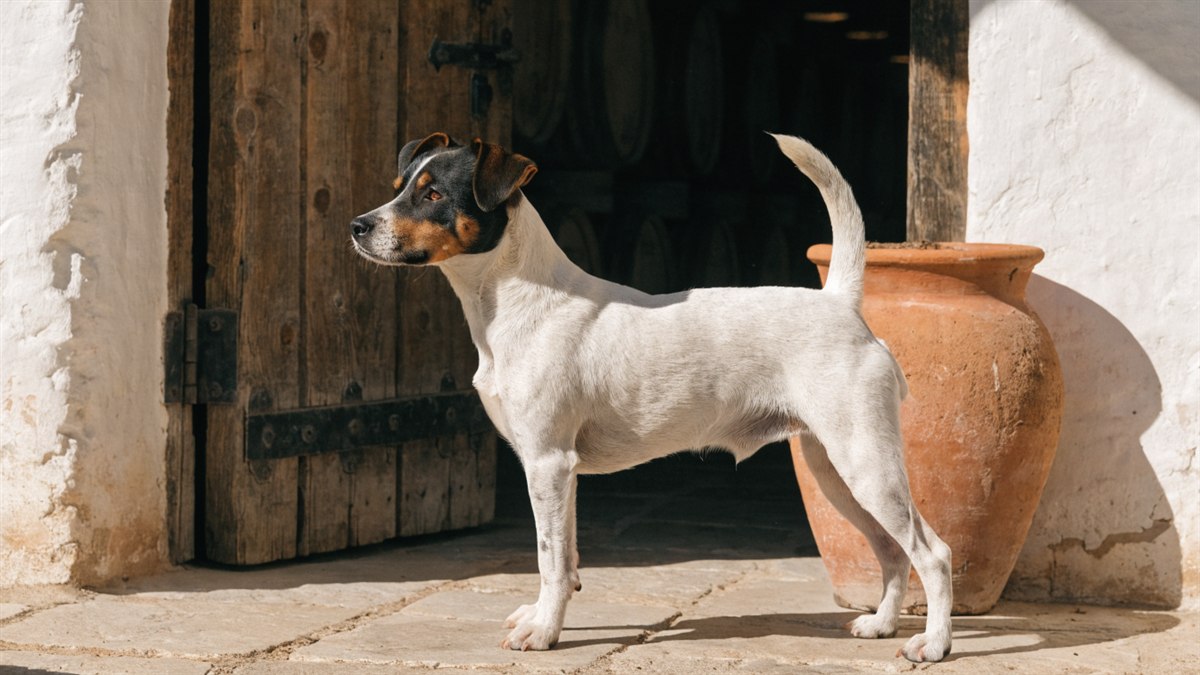
The FCI standard describes a medium-sized dog of medium proportions with a body length to height ratio of 1:1, a very short coat, and a predominantly pure white coat carrying black spots mainly on the head and the beginning of the neck, complemented by tan points on the face, cheeks and above the eyes. The two tan spots above the eyes are the breed's signature and Spanish sources call a dog carrying them cuatro ojos, four eyes. Nose, eye rims, lip rims and pads are black.
| Measure | Males | Females |
|---|---|---|
| Height at withers | 37 to 43 cm, ideal 40 cm | 35 to 41 cm, ideal 38 cm |
| Height tolerance | 2 cm either way, if free of faults | 2 cm either way, if free of faults |
| Weight | 10 to 12 kg | 8 to 10 kg |
Ears are triangular with a wide base, set medium-high at the level of the occiput, folded forward in a button shape when the dog is attentive and folded back in a rose ear at rest. Both fully upright prick ears and fully hanging ears are disqualifying faults. Nothing in this standard invites cropping, which matters in India, and the section on adoption below sets out why.
The tail is the most misreported thing about this breed
The standard describes a medium-high set tail carried perpendicular to the croup and pricked, then adds that tailless specimens, or specimens with a variable length of tail, are born. The Spanish authentic text is stronger and quantified. Both the RSCE standard and the 2001 Spanish state prototype say natural bobtails of variable length are born en un porcentaje muy alto, in a very high percentage. The FCI English translation drops that phrase.
This is not a pedantic point. One of the ranking pages tells readers that pups born with a full tail may be docked to about a quarter of their true length. In India, tail docking is expressly forbidden. A short tail on this breed is usually something the dog was born with, and an Indian reader should not be taught to expect a knife.
Recognition, in one line each
- Spain, kennel club. The Real Sociedad Canina de España recognised the breed on 21 September 2000 and its breed page now heads the entry 'Estándar FCI Nº: 371 / 03.09.2024 / E' and classifies it in Grupo 3, Terriers, Sección 1 Real Sociedad Canina de España.
- Spain, the state. The Ministerio de Agricultura, Pesca y Alimentación added the Ratonero-Bodeguero Andaluz to the annex of Real Decreto 558/2001 as a Spanish canine breed, with its official racial prototype printed in full, by the Order of 2 August 2001.
- Andalusia, the region. Anexo VIII of the Orden de 19 de abril de 2010 lists exactly three dogs in the inventory of native companion-animal breeds of Andalusia, and this is one of them.
- International. The FCI accepted the breed on a provisional basis on 3 September 2024. Its status on the FCI's own list still reads 'Recognized on a provisional basis'; Fédération Cynologique Internationale.
- United States. The breed does not appear anywhere in the American Kennel Club's breed directory.
No page ranking for this breed prints the three official descriptions of it side by side, and they disagree. The breed standard you are shown depends entirely on which document the writer opened. The recognition section below sets out all three, with the weight gap that nobody has published.
Andalusian Terrier price in India, and why the one published figure is arithmetic
There is no Andalusian Terrier price in India, because there is no Indian market for the breed. Bonbeno searched for this breed against Indian marketplaces, Indian breeders and Indian listing sites and found no offer, no litter and no verifiable transaction. One Indian domain publishes a rupee range. That range is a currency conversion of a United States figure, and the arithmetic proves it.
This section answers the query honestly instead of satisfying it. A reader searching a price in india for a rare foreign breed usually lands on a confident band of rupees. For the Andalusian Terrier, the only such band Bonbeno could trace collapses the moment you divide it.
The only Indian rupee figure, taken apart
The single Indian-domain page ranking for this breed states that Indian buyers can expect to pay INR 10,125 to INR 12,657 from quality breeders, and that prices can rise to INR 67,504 or even INR 126,570 because the dogs are hard to find outside Spain. A global breed blog on the same result page states that puppies cost USD 800 to 1,500. Divide the four rupee figures by 84.38 and three of them come out to a whole dollar amount exactly, at 150, 800 and 1,500, while the fourth lands on 119.99.
| Rupee figure published | Divided by 84.38 | What it actually is |
|---|---|---|
| INR 10,125 | USD 120 | A round dollar figure |
| INR 12,657 | USD 150 | A round dollar figure |
| INR 67,504 | USD 800 | The bottom of the USD 800 to 1,500 range |
| INR 126,570 | USD 1,500 | The top of the USD 800 to 1,500 range |
Four figures, one exchange rate, zero Indian dogs. Nothing in that table describes an Indian transaction. It describes a spreadsheet. Bonbeno prints the division rather than repeating the range, and reports the finding as the finding.
If a seller quotes you rupees for an Andalusian Terrier puppy in India, the question is not how much. It is which dog, from where, and under what import authorisation. Given the import position set out below, a domestically advertised Andalusian Terrier is far more likely to be a white-and-tan Indian mixed-breed, a Jack Russell Terrier cross, or an unrelated small terrier than the breed on the RSCE register.
What the ranking set actually offers an Indian buyer
- A United States sale page with a false credential. One result advertises the breed for sale by certified American Kennel Club breeders. The AKC breed directory contains no Andalusian Terrier, no Ratonero Bodeguero Andaluz and no Sherry Terrier, so no AKC breeder of this breed exists to be certified.
- A page ranking on the wrong dog entirely. One long-standing template site ranks for this query while describing the Andalusian Hound, a separate Spanish breed. A buyer who reads it comes away with the wrong size, the wrong coat and the wrong job.
- Template database entries with a costing block and no source. One result carries a 'Food & Costing' section on a page that cites nothing at all.
- No Indian marketplace at all. India's puppy-listing sites carry the breeds that actually move here. None of them lists this one.
Why no lawful Indian supply chain can form
India's import policy makes dogs a Restricted item under ITC (HS) 01061900, and permits import only for a pet dog with a valid pet book and relevant records in the name of the importer, for research organisations with a CPCSEA recommendation, or for internal security by the Defence and Police Force. The same trade notice states that import of commercial dogs for breeding or any other commercial activity is not permitted, and that applications for trading or breeding purposes shall be duly rejected. Entry is limited to the airports and seaports of Delhi, Mumbai, Chennai, Hyderabad, Bengaluru and Kolkata and, since October 2024, Kochi airport. The full route is set out in how to import a dog to India.
Read that against a breed whose entire world population sits in Spain. A commercial importer cannot bring in breeding stock. A returning resident can bring in a personally owned pet, up to two animals, after two years of continuous stay abroad, with the pet book in their own name. That is the only lawful door, and a door that admits one family's dog at a time does not build a market.
The registry question, and where this breed differs from the Alano
Bonbeno's Alano Español page reached a flat conclusion: not FCI-listed, therefore not registrable with a full FCI-recognised pedigree in India. The Andalusian Terrier is a different case, and the difference is worth stating precisely. The FCI accepted this breed on a provisional basis on 3 September 2024, and its own rule for provisional breeds is that pedigrees issued to those dogs have to carry the FCI logo, while the dogs are not eligible for the CACIB until definitive recognition. So the paperwork route is not closed the way the Alano's is.
It is simply empty. The kennel club of india registered 33,880 pure-bred dogs with its studbook in 2025, from 7,412 litters, taking its cumulative total since inception to 1,425,001 dogs. For an Andalusian Terrier to appear among those studbook registrations, a lawfully imported, FCI-pedigreed dog would first have to arrive, and Bonbeno found no evidence that one ever has. India also ran only two CACIB all-breed shows in the latest reported year, and this breed could not compete for the CACIB at either of them anyway.
What the breed costs where it does exist
In Spain the breed is neither scarce nor a luxury. The RSCE studbook recorded 1,221 registrations across the eight years 2004 to 2011, an average of 153 dogs a year. Bonbeno found no published, sourced, current Spanish price it could verify, and will not invent one. The Indian-domain page quotes 300 to 400 euros with papers and 200 to 300 euros from pet shops and private sellers, but that page also produced the converted rupee figures above, so Bonbeno reports the claim and attaches no weight to it.
The honest comparison is with breeds Bonbeno has actually been able to price here. The Jack Russell Terrier has a real Indian market with multiple published, conflicting sources, and Bonbeno compares those sources on its own page. Do not borrow that figure for this breed. A Jack Russell price tells you what Jack Russells cost in India. It tells you nothing about a dog that is not sold here.
Recognition: provisional at the FCI, and three official documents that disagree
The Andalusian Terrier is recognised at four levels, and the four descriptions do not match. The FCI holds it as Standard No. 371, accepted on a provisional basis on 3 September 2024. The Real Sociedad Canina de España recognised it on 21 September 2000. The Spanish state published an official racial prototype in 2001. Andalusia lists it in a regional inventory of native companion breeds. Their measurements differ.
This is the part of the page that no competitor has written, so it is worth reading slowly if you are trying to work out which numbers to trust.
What provisional FCI recognition actually changes
The FCI's nomenclature entry for the breed prints its status as 'Recognized on a provisional basis', with the date of acceptance on a provisional basis given as 3 September 2024, the group as n°3 Terriers, the section as Large and medium sized Terriers, the country of origin as Spain, and the official authentic language as Spanish. The FCI's list of provisionally recognised breeds states the consequence in one sentence: such breeds are not eligible for the CACIB until they are recognised on a definitive basis, but are eligible for the FCI titles, and the pedigrees issued to dogs of these breeds have to carry the FCI logo.
Three practical readings follow. A provisional breed has a real, internationally portable pedigree. It cannot win the international beauty certificate that feeds an FCI International Champion title. And its position can change, in either direction, at a future FCI General Assembly. On the same provisional list the Australian Stumpy Tail Cattle Dog has been waiting since 2005.
The breed club and the kennel club currently contradict each other
Bonbeno's Alano Español page established that the RSCE publishes Spanish breeds the FCI does not recognise under a heading reading 'Grupo 11: Razas no reconocidas por la FCI', so Spanish national recognition and FCI non-recognition can sit side by side. The Andalusian Terrier sat in exactly that place until 2024, and one of the two Spanish sources still says so.
| Publisher | Classification printed | Page state |
|---|---|---|
| Real Sociedad Canina de España | Estándar FCI Nº: 371 / 03.09.2024 / E. Grupo 3 - Terriers, Sección 1 | Current |
| Asociación Española del Ratonero Bodeguero Andaluz | Grupo 11: Razas no reconocidas por la FCI | Last modified 10 April 2024 |
AERBA credits the RSCE as the source of its text, and the body of the standard on both pages is word for word the same Spanish Real Sociedad Canina de España. Only the header differs. The club's page carries a last-modified timestamp of 10 April 2024 in its own content record, five months before the FCI accepted the breed, which explains the stale heading without anyone having to guess. Bonbeno flags it because a reader who lands on the club site will otherwise conclude that the FCI does not recognise this dog, and that is no longer true.
Where the three official descriptions disagree
The Spanish state prototype of 2001 and the RSCE standard now carried by the FCI are not the same document. They describe the same dog with different numbers. The Andalusian regional inventory then points back at the older one.
| Point | BOE prototype, 2 August 2001 | RSCE and FCI Standard 371 |
|---|---|---|
| Weight | 7 to 8 kg, no split by sex | Males 10 to 12 kg, females 8 to 10 kg |
| Height, males | 37 to 43 cm, ideal 40 cm | 37 to 43 cm, ideal 40 cm |
| Height, females | 35 to 41 cm, ideal 38 cm | 35 to 41 cm, ideal 38 cm |
| Height tolerance | 1 cm either way | 2 cm either way |
| Cranio-facial lines | Convergentes, converging | Paralelas, parallel |
| Rear dewclaws | Disqualifying fault | Disqualifying in the Spanish text, absent from the FCI English list |
| Slate, grey, blue or dalmatian-spotted coat | Named as a disqualifying fault | Covered only by the general 'another coat colour' clause |
The weight line is the one that matters to a buyer. The Spanish state describes a 7 to 8 kg dog. The FCI describes a male of 10 to 12 kg and a female of 8 to 10 kg. Top of range against top of range, that is 12 kg against 8 kg, 50 percent heavier for the same breed, in two documents both issued under Spanish authority. Bonbeno does not average them, and neither should anyone else.
A fourth figure is now circulating in the ranking set, and it matches neither official document. One breed database publishes the weight as 5 to 8 kg, split as 7 to 8 kg for males and 5 to 6 kg for females, and prints the FCI group as 'Not Recognized' in its fact sheet while its own introduction on the same page says the breed has held provisional FCI recognition since 2024. A page that contradicts itself within one screen is not a source for a weight.
The regional layer makes the split sharper rather than resolving it. Anexo VIII of the Orden de 19 de abril de 2010 lists the inventory of native companion-animal breeds of Andalusia. It names exactly three dogs: the Perro de Aguas Español, the Podenco Andaluz and the Ratonero-Bodeguero Andaluz. For this breed it states that the racial prototype is the one established in the Order of 2 August 2001. The lighter, older figure is the one the breed's home region still points to.
The FCI English translation softens the Spanish at two points
The FCI names Spanish as the official authentic language for this breed standard, which means the Spanish text governs where the two differ. Two differences are worth an Indian reader's attention.
- Temperament. The Spanish reads 'Alegre, inquieto, cariñoso, simpático, valiente y con genio'. The FCI English renders that stretch as 'Happy, inquisitive, affectionate, bold and brave, with excellent temperament'. In ordinary Spanish, tener genio describes a dog with spirit and a temper, not a dog with an excellent temperament, and inquieto means restless rather than inquisitive. The 2001 state prototype uses the same phrase and then illustrates it, describing a dog that is valiente y con genio above all when facing enemies bigger than itself, foxes and badgers among them Fédération Cynologique Internationale Orden de 2 de agosto de 2001 por la que se….
- Climate. The Spanish says the breed is 'adaptable a condiciones ambientales muy diversas', adaptable to very diverse environmental conditions. The FCI English says 'suitable for all types of climates';. Those are not the same claim, and the climate section below explains why the difference is not academic in an Indian summer.
There is a smaller wrinkle on working trials. The published English standard prints 'Working trial optional' under the FCI classification, while the FCI's own nomenclature entry for the breed reads 'Subject to a working trial only for the countries having applied for it'; Fédération Cynologique Internationale. The English text also carries several plain typographical errors, including 'Pastner' for pastern and 'mor elongated' for more elongated, which is a reasonable reason to prefer the Spanish when precision matters.
For anything involving pedigree, showing or international paperwork, use FCI Standard No. 371 in its Spanish text. For anything involving Spanish or Andalusian official status, the 2001 state prototype is the instrument still cited by the regional inventory. When a seller quotes you a weight, ask which one they are quoting.
Monthly cost of ownership in India, and the one line that does not transfer
Monthly cost for an Andalusian Terrier in India has to be modelled rather than quoted, because no Indian owner base exists to survey. The nearest honest proxy is the published Indian cost structure for a small working terrier of the same weight, which runs Rs 1,200 to Rs 1,800 a month on food and Rs 300 to Rs 750 a month on routine veterinary care. One line in that structure does not transfer to this breed at all, and it is the grooming line.
Bonbeno states the source of every number below and says which ones are borrowed. Nothing here is a survey of Andalusian Terrier owners in India, because there is no such population to survey.
| Line | Published Indian figure | Does it transfer to this breed? |
|---|---|---|
| Food | Rs 1,200 to Rs 1,800 | Yes. Same weight band, same activity level |
| Routine veterinary care | Rs 300 to Rs 750 | Yes, and probably at the upper end because of tick exposure |
| Professional grooming | Rs 700 to Rs 1,200 | No. A very short single coat needs no salon at all |
| Parasite prevention | Not separately published | Budget for it every month, not seasonally |
Strip the salon line and the realistic recurring cost of this dog in an Indian city sits below that of most imported companion breeds. That is a genuine argument in the breed's favour and one no ranking page makes, because none of them separates the grooming assumption from the coat.
The real cost of this breed in India is the acquisition, not the upkeep
For a breed with no domestic supply, the money is spent before the dog arrives. India permits import of a pet dog only with a valid pet book and relevant records in the importer's own name, and requires a DGFT import authorisation whenever the owner's continuous stay abroad has been less than two years, whenever the animal is not travelling as passenger baggage, or whenever more than two animals are involved. Applications must be started at least two months before travel, entry is restricted to Delhi, Mumbai, Chennai, Hyderabad, Bengaluru, Kolkata and, since October 2024, Kochi, quarantine at a government station at those ports may be required, and an advance No Objection Certificate has to be obtained from the port's quarantine officer seven days before travel, relaxable to three days Department of Animal Husbandry….
Bonbeno publishes no rupee total for that process, because no official schedule of the full end-to-end cost was found that could be verified. What can be said with confidence is that airline crate charges, an export health certificate with the tests the certificate prescribes, the DGFT application and any quarantine period are all real line items, and that they dwarf any plausible purchase price for a Spanish working ratter.
Parasite prevention is not an optional line in India
A survey of 525 dogs sampled across Sikkim, Ladakh, Delhi and Mumbai found that 261, or 49.7 percent, carried at least one tick-borne pathogen by PCR, and that potential tick vectors were found on 278 dogs, 53 percent of those examined. Hepatozoon canis was commonest at 30 percent, followed by Ehrlichia canis at 20.6 percent. Concurrent infection with more than one pathogen occurred in 39 percent of cases.
A short-coated dog that pushes through undergrowth and hunts at ground level collects ticks efficiently, and a white coat at least makes them easy to see. Budget monthly, not seasonally, and check the dog by hand after every off-lead outing rather than relying on a product alone.
The upfront kit, and what a working terrier actually needs
- A fixed-length lead and a well-fitted harness. A retractable lead is the wrong tool for a dog bred to launch at movement. Buy once, buy properly.
- A secure boundary, or an honest plan without one. This breed leaves through gaps. If the gate does not close, the dog is a road-traffic statistic waiting to happen.
- Puzzle feeders and rat-simulating toys. Cheap, and the difference between a settled dog and a destructive one.
- A tick comb and a monthly preventive. Recurring, not one-off.
- A rubber curry brush. Ten rupees of tool covers the entire grooming requirement of this coat.
You will find lifetime cost totals for this breed on template sites. They are generated, not measured. Bonbeno gives you the two published Indian lines that genuinely apply, names the third that does not, and leaves the import bill open rather than inventing a figure.
Heat tolerance and the Indian climate
The Andalusian Terrier scores 4 out of 5 on Bonbeno's Indian heat tolerance scale, which is the highest rating any imported European breed has earned on this site. Three things earn it: a very short single coat, a normal-length muzzle rather than a flattened one, and a bodyweight that sits in the lowest-risk band of the published heat-illness evidence. It does not earn a 5, because the thing most likely to overheat this dog is its own job.
The FCI standard makes a large claim on this exact point. It says the breed is a loyal companion, an ideal pet, suitable for all types of climates, and extremely clean. The authentic Spanish is narrower: adaptable a condiciones ambientales muy diversas, adaptable to very diverse environmental conditions. Bonbeno treats a breed-standard sentence as a description of the animal's origins rather than a clinical finding, and tests it against the evidence.
What genuinely helps this dog in Indian heat
- The coat is as thin as a working coat gets. The standard describes hair that is very short and dense, uniform and abundantly distributed over the whole body, with skin that is thin and very close to the body. No undercoat is described anywhere in the Spanish or the English text. This is the opposite of the double-coated northern breeds that fail in India.
- The head is a normal head. The standard specifies parallel axes of skull and muzzle, a straight nasal bridge and a defined but not very pronounced stop. That is a mesocephalic dog. In 905,543 UK dogs under primary veterinary care in 2016, brachycephalic dogs had 2.10 times the odds of heat-related illness compared with mesocephalic dogs. This breed sits in the reference group, not the risk group.
- Small size is protective, and the sexes fall in different bands. In the same study, dogs weighing under 10 kg were the base category with the lowest odds, and every band above 10 kg carried significantly higher odds, starting at 1.82 for 10 to under 20 kg. A female Andalusian Terrier at 8 to 10 kg sits in the base band. A male at 10 to 12 kg steps into the 1.82 band. That is a small, real and rarely stated difference between the sexes of the same breed.
- It comes from a hot place. The breed was made in the sherry country around Jerez de la Frontera in Cádiz, working in cellars, warehouses, stables and tanneries. Southern Spanish summers are not gentle.
Why the rating is 4 and not 5
Anatomy is not what kills dogs in the heat. Behaviour is. In a study of 1,259 heat-related illness events from 1,222 UK dogs, exertional heat-related illness was the predominant trigger at 74.2 percent of the 879 events where a cause was recorded, followed by environmental heat at 12.9 percent and confinement in a vehicle at 5.2 percent. In the United Kingdom, exertion affects more dogs and kills more dogs than a hot car does.
Now apply that to a dog whose standard describes outstanding functionality, toughness and aptitude for hunting rodents, with a preferred gait of trot and a great capacity to turn and jump. A working ratter does not pace itself. It works until the rat is dead or the handler stops it. In a Chennai June, the handler is the thermostat, and there is no other one.
Two more findings sharpen the point. Dogs with bodyweight equal to or greater than their breed and sex mean had 1.42 times the odds of heat-related illness, so an overweight Andalusian Terrier throws away most of the size advantage described above. And purebred dogs had 1.86 times the odds of crossbred dogs in the same model, which is one more reason the Indian Pariah Dog remains the most heat-competent dog a family in this country can own.
Dry heat, wet heat, and why the difference matters
A dog cools by evaporating water from the respiratory tract. Dry heat lets that work. Humid heat does not, because saturated air will not accept much more water vapour. Andalusia gives this breed a Mediterranean summer with low humidity. Chennai, Mumbai, Kolkata and coastal Kerala give it high temperature and high humidity together, which is a materially harder problem than the one the breed was selected in.
| Setting | The real constraint | What to change |
|---|---|---|
| Coastal humid, such as Chennai, Mumbai, Kolkata | Panting works poorly when humidity is high | Walk before 6.30 am and after sunset. No midday off-lead work, ever, from March to September |
| Dry extreme, such as Delhi, Jaipur, Nagpur | Air temperature above body temperature, plus radiant heat from paving | Test the pavement with your palm. Shift all exertion to night. Water available at all times |
| Temperate plateau, such as Bengaluru, Pune | Almost none for most of the year | Normal routine. Watch the April to May peak |
| Hills, such as Shimla, Darjeeling, Ooty | None. This is the breed's easiest Indian setting | Enjoy it, and secure the boundary instead |
Monsoon, sun and the white coat
The monsoon is easier on this coat than on almost any other. A very short single coat towels dry in minutes, so the wet-dog skin problems that plague thick-coated and drop-eared breeds are less likely here, and the standard's rose or button ear leaves the ear canal less enclosed than a fully hanging ear does. Dry the ears after any swim or heavy soaking rather than letting them air dry, and the monsoon largely takes care of itself.
Direct sun is the other side of it. The coat is predominantly pure white over thin skin, so prolonged midday sun on a sparsely covered belly and muzzle is worth avoiding on general veterinary advice, which also names obesity, old age and intense exercise as factors that make heat stroke more likely. Bonbeno found no breed-specific study of sun-related skin disease in this breed and does not pretend one exists.
Severe panting, difficulty breathing, vomiting and collapse are the published warning signs of heat stroke in dogs. Move the dog to a cool place, wet it, and get to a clinic. In the UK primary-care data, the event fatality rate for heat-related illness was 14.18 percent. Consult your nearby vet immediately rather than waiting to see whether it settles.
Temperament, prey drive and household fit
The Andalusian Terrier is an affectionate, owner-attached, extremely alert small dog with a prey drive that is not negotiable. The Spanish state prototype describes it as restless, with a very expressive and intelligent gaze, in constant attention to any noise or movement, using sight and scent interchangeably to locate its quarry, and brave and spirited above all when facing enemies larger than itself. Read that sentence twice before deciding it is a flat dog.
Bonbeno's terrier cluster has one finding that repeats on every page in it, and this breed does nothing to overturn it. Prey drive is the defining trait, noise is a working feature rather than a fault, and size predicts how much space the dog needs but never how much training it needs.
Prey drive is inherited, not installed
In an analysis of 14,020 dogs in the C-BARQ dataset, the mean among-breed heritability across 14 behavioural traits was 0.51, with a range of 0.27 to 0.77. Trainability was the most heritable at 0.73 and chasing came in at 0.62. Behaviour of this kind is substantially a breed-level inheritance, not a product of upbringing. This breed is not in that dataset, and Bonbeno says so rather than implying it is, but the general finding is what matters here: you do not train chasing out of a dog selected for it across two centuries.
The FCI standard describes the job as hunting rats, mice and all vermin, with rabbit and hare as a secondary use. The 2001 prototype adds the detail that the dog throws itself onto its quarry with extremely coordinated, agile and fast movements. A pet rabbit, a hamster, a resident cat and a neighbourhood squirrel all read as quarry to a system built that way, and the one ranking page that addresses this states it plainly, warning that the breed cannot distinguish between vermin and a pet rabbit or cat and that a multi-pet household needs careful thought.
The noise is the job, not a defect
A dog kept to find rats in a dark cellar has to tell a human where the rat is. Constant attention to any noise or movement is written into the official Spanish description of the breed's temperament, and the standards make shyness a fault while excessive shyness or aggression is disqualifying Real Sociedad Canina de España. Boldness and reactivity were selected for. So this is a vocal dog by design, and one that will bark at the lift, the doorbell, the crow on the parapet and the delivery rider, especially in a flat where all four happen within ten metres.
That has a specific Indian consequence. Barking is the single commonest source of neighbour conflict in Indian apartment societies, and it is also the behaviour most likely to be punished by an owner who was told they were buying a quiet small dog. The published warning about this breed is that an under-exercised, under-stimulated individual develops barking, digging and destructive behaviours. Manage the cause. Do not silence the symptom, and never consider a surgical fix, which is separately forbidden in India and covered in the adoption section below.
Softer than a Jack Russell, and the Spanish literature says so
The most useful comparison in the published Spanish work is a direct one. Comparing the Andalusian Terrier with the Jack Russell, the author records that both are active, friendly and always alert, but that the Jack Russell is a dog of more character than the Andalusian. Comparing it with the Fox Terrier, the same work finds both restless and constantly attentive, with the Andalusian more attached to its owner.
That is a meaningful distinction for a first-time terrier owner. Alongside the Jack Russell Terrier, this breed reads as somewhat more biddable and more handler-focused, while carrying the same prey drive and the same need for a job. It is a difference of degree, not of kind.
Who this breed suits in India
- An active household with a secure outdoor space. A fenced terrace, a walled garden or a genuinely closable gate. A dog selected to follow a rat into a gap will follow a cat through one.
- People who are home, or who work from home. A tenacious dog with nothing to do finds work. You will not like the work it finds.
- Owners who want a dog that trains. Terrier independence is real, but the standard credits this breed with an intelligent expression and Spanish sources describe it as owner-attached. It is trainable if you are consistent.
- Families with school-age children. Robust, playful, small enough not to knock a child over. Supervise, as with any dog, and teach the child not to grab a busy terrier.
Who should not take one on
- Anyone with a cat, rabbit, hamster or bird already in the home. Early socialisation helps and does not guarantee. The failure mode here is fatal for the smaller animal.
- Anyone who needs a quiet flat. See above. This is not a fixable trait, only a manageable one.
- Anyone away from home ten hours a day. Boredom in this breed is not sadness, it is demolition.
- Anyone buying on looks. The white-and-tan face with the four-eyes markings is charming, and it is attached to a working ratter.
This is a small dog with a large job description. It is affectionate, clean, agile and easy to live with when its needs are met, and genuinely difficult when they are not. Nothing about its size makes it a low-effort pet.
Training an Andalusian Terrier, and the one thing it will refuse
To train an Andalusian Terrier, keep sessions short, pay well, and accept from day one that recall around live prey is the hardest thing you will ever ask of this dog. The breed is bright and owner-attached, and the published Spanish comparison rates it as a dog of slightly less hard character than the Jack Russell. That makes it trainable. It does not make it obedient near a squirrel.
Trainability is the most heritable behavioural trait measured across dog breeds, at an among-breed heritability of 0.73 in a 14,020-dog C-BARQ analysis. What that means in practice is that you are working with a temperament you inherited, not one you author. The job is to shape it.
What works
- Short sessions, five to eight minutes, several times a day. A restless dog described in its own standard as in constant attention to any noise or movement will not sit through a twenty-minute drill.
- Reward-based methods, consistently applied. The one ranking page that discusses training reaches the same conclusion, recommending good puppy socialisation plus reward-based training, and warning that this breed will seize any relaxation of boundaries.
- Work that looks like the job. Scent games, a flirt pole, find-the-treat searches and a permitted digging area convert drive into cooperation instead of conflict.
- Train indoors during the hot months. Exertion drove 74.2 percent of heat-related illness events in a large UK dataset, and an over-motivated terrier in a Delhi afternoon will not stop itself.
- Socialise deliberately and early. Indian streets carry free-roaming dogs, cattle, cats and monkeys. A dog that meets all of them calmly at twelve weeks is a different animal at twelve months.
What it resists
Repetition without payoff, long formal drills, and anything that looks like a contest of wills. The breed's disqualifying faults include excessively shy or aggressive character, and its minor faults include a timid character. Boldness is the selected trait, so a handler who tries to win by intimidation is training against two hundred years of selection and will lose.
The genuinely hard case is recall in sight of prey. Chasing carries an among-breed heritability of 0.62, and this breed's own standard describes a dog with a great capacity to turn and jump that hunts rodents by preference and rabbit and hare as a secondary use. Bonbeno's position, consistent across the terrier cluster, is that you build the best recall you can and still use a fixed-length lead near roads. Treat off-lead freedom as something that happens in enclosed spaces, not as a default.
A realistic first-year timeline
| Age | Focus | Realistic outcome |
|---|---|---|
| 8 to 16 weeks | Socialisation, name response, crate, handling, first vaccinations | Confident with people, traffic, cattle and other dogs |
| 4 to 6 months | Loose lead, sit and down, settle on a mat, impulse control games | Reliable indoors, unreliable outdoors, which is normal |
| 6 to 9 months | Recall on a long line, leave it, structured scent work | Recall good in low distraction, still poor near live prey |
| 9 to 12 months | Proofing in real environments, adolescent boundary testing | A dog that listens most of the time and tests you weekly |
| 12 to 24 months | Maintenance, plus a real outlet for drive | Settled adult, provided the outlet continues |
Nobody finishes training this breed at a year. The published advice is that training continues throughout the dog's life, and that expectations slipping is what creates the problem dog. Bonbeno agrees.
There is no working-trial route for this breed in India
The FCI records the breed as subject to a working trial only for the countries that have applied for it, and the published standard prints the working trial as optional Fédération Cynologique Internationale. India held two CACIB all-breed shows in the latest year the FCI reports, and a provisionally recognised breed cannot compete for the CACIB at them in any case Fédération Cynologique Internationale. So there is no formal Indian outlet, and an owner has to build one. Scent work, canine parkour on safe surfaces, and a sanctioned digging pit in a corner of the terrace do the job that a Spanish bodega used to.
Daily exercise requirement, and what happens without it
No breed club or kennel club publishes a minute figure for the Andalusian Terrier, and Bonbeno will not invent one. The nearest published Indian guidance for a small working terrier of the same weight is 30 to 60 minutes a day, and Bonbeno treats that as a floor rather than a target for this breed, because the standard describes an athletic dog whose preferred gait is the trot and whose defining ability is to turn and jump.
Say plainly what is borrowed. The 30 to 60 minute figure is published for the Jack Russell Terrier in India, not for this breed. It is used here because the two dogs share a weight band, an ancestor and a job, and because the alternative is a made-up number.
What the daily requirement actually looks like
- Two structured outings a day, not one long one. A morning walk before the sun is up and an evening session after it sets. In the hot months, that is not a preference, it is the whole safety plan.
- Twenty minutes of that should be work, not walking. A lead walk exercises the legs and leaves the head untouched. Scent searches, a flirt pole and retrieve games tire this dog properly.
- Free running in an enclosed space, whenever you can get it. The published advice for the breed is plenty of outdoor, preferably off-lead exercise. Enclosed is the operative word.
- A daily digging or shredding outlet. Cardboard boxes with treats inside cost nothing and save furniture.
What happens if you skip it
The failure mode is documented and specific. An Andalusian Terrier whose exercise and mental stimulation needs are not met develops bad habits including barking, digging and destructive behaviour. In an Indian flat those three translate into a noise complaint from the floor below, a ruined balcony planter and a chewed sofa, usually in that order and usually within a fortnight.
There is a second-order cost too. An under-exercised dog is a dog that gains weight, and dogs at or above their breed and sex mean bodyweight carried 1.42 times the odds of heat-related illness in the UK primary-care data. Skipping walks in April to avoid the heat therefore makes the dog less heat-safe in May, not more.
Timing the day around Indian heat
| Season | Morning window | Evening window | Midday |
|---|---|---|---|
| March to June | Before 6.30 am | After 7.30 pm | Indoors only. No exceptions |
| July to September, monsoon | Any cool break | After sunset | Watch humidity, not just temperature |
| October to February | Flexible | Flexible | Fine in most of the country |
Exertional heat-related illness accounted for 74.2 percent of the heat-related illness events with a recorded trigger in that UK dataset, 652 of 879, and Indian summer conditions are harsher than the ones that produced that figure. The dog will not tell you when to stop. Carry water, watch for heavy panting, and end the session early rather than late.
A 10 kg dog fits in a Mumbai one-bedroom without difficulty. The constraint is not the square footage, it is the sixty minutes you spend outside it and the twenty minutes of head-work you do inside it. An owner who delivers both can keep this breed in an apartment. An owner who cannot should not.
Grooming and coat care in Indian humidity
To groom an Andalusian Terrier, run a rubber curry brush over it once a week for ten minutes and check the ears, nails and teeth while you are there. That is the whole job. The standard specifies a very short, dense coat, uniform and abundantly distributed over the whole body, over thin skin held close to the body, which makes this the lowest-maintenance short coat of any breed Bonbeno has profiled from Europe.
No stripping, no clipping, no salon, no seasonal blow-out. If a groomer proposes a package for this dog, the package is for their business rather than for the coat.
The weekly ten minutes
- Brush. A rubber curry mitt or a soft bristle brush, against the lie and then with it. Lifts dead hair and spreads skin oil.
- Ears. The standard describes ears folded forward in a button shape at attention and folded back in a rose at rest, and disqualifies both fully upright and fully hanging ears. A half-folded ear is far better ventilated than a drop ear, which is a real advantage in a monsoon. Wipe the visible part. Do not push anything into the canal.
- Nails. The standard calls for very strong nails and hard pads on cat-like feet. Those wear down on Andalusian farmyard ground and do not wear down on Indian floor tile. Trim every three to four weeks.
- Teeth. The Spanish standard requires complete dentition closing in a scissor bite, and any bite other than a scissor bite is disqualifying. India's own breeding rules require dogs to be tested for genetic defects including two or more missing teeth and overshot or undershot jaw. Brush two or three times a week from puppyhood.
- Skin check. White coat, thin skin, ground-level work. You will find ticks before you find anything else.
Why an overseas grooming guide does not transfer here
Care advice written for a European climate assumes a dog dries in cool, dry air. India does not supply that for four months of the year. The good news for this breed is that the mismatch is small, because a short-coated dog with a half-folded ear towels dry in a couple of minutes and does not hold water against the skin the way a spaniel or a retriever does.
The rule that still applies is simple. After a bath, a swim or a soaking in the rain, dry the ears with cotton wool rather than letting them air dry, and dry the dog rather than leaving it damp in front of a fan. Bonbeno's gundog pages carry the full monsoon otitis evidence, and while a rose-eared terrier is at much lower risk than a drop-eared spaniel, wet plus warm plus enclosed is the same equation everywhere.
Shedding, and the white-hair problem
The FCI standard calls the breed extremely clean, and it is, in the sense that it does not carry mud or odour the way a heavy-coated dog does. It still sheds. Short white hairs weave into dark upholstery and car seats and are harder to remove than long ones. Weekly brushing outdoors is the answer, and a lint roller is the second answer.
The breed is not hypoallergenic. No dog is, and one ranking page states the position correctly, noting that a short coat sheds moderately and that dander remains. If allergy is the reason you are considering a small dog, spend time with one before committing.
Two things not to do
- Do not clip this coat. There is nothing to clip, and the standard disqualifies long, curly or wired hair, so a coat that looks clippable is not this breed.
- Do not let anyone remove rear dewclaws for cosmetic reasons. The Spanish standard treats their presence as a disqualifying fault, which creates a temptation. India's Dog Breeding and Marketing Rules forbid tail docking, ear cropping, de-barking, de-clawing and any other kind of mutilation of any body part of the pup, and any change of appearance by artificial means. A show fault in Spain is not a licence to cut in India. Consult your nearby vet if a dewclaw is genuinely injured, which is a medical question rather than a cosmetic one.
The published Indian grooming line for a small terrier runs Rs 700 to Rs 1,200 a month. For this coat you can strike it out entirely and replace it with one rubber brush and a nail clipper. That is a genuine, repeating saving over almost every other imported breed.
Health risks and lifespan: what is actually known, which is very little
No cohort study of Andalusian Terrier health exists. No published lifespan figure for the breed exists. No breed-wide screening scheme exists. Bonbeno searched the biomedical literature, the OFA screening database and the UK life tables and came back with nothing breed-specific, and the honest thing to do with that result is to print it rather than to fill the gap with another breed's numbers.
This section will be shorter than the health section on a popular breed. That is the correct outcome, not a failure of research. A page that has no data and writes as though it does is worse than a page that says so.
One: the veterinary literature has no study of this breed
A search of Europe PMC returns zero records for 'Andalusian Terrier' and fourteen for 'Bodeguero Andaluz'. Every one of those fourteen is a clinical study of something else, from canine mammary tumours to laparoscopic ovariectomy to mesenchymal cell wound healing, in which a Bodeguero Andaluz happened to be one patient among a mixed-breed caseload. Not one is a study of the breed. The single substantial published work about the Andalusian Terrier itself is a 42-page comparative morphology paper that sets the breed against other Spanish ratters and FCI terriers, and it reports no health data at all.
Two: no OFA screening table could be obtained
The Orthopedic Foundation for Animals publishes cumulative breed screening tables for hips, elbows, patellae, eyes, cardiac and thyroid. Bonbeno could not retrieve one for this breed. The disease-statistics page loads as a shell reading 'Searching Database, Please wait' and pulls its data from a separate host, wp.ofa.org, which refused connections from our environment. So Bonbeno publishes no OFA percentage here, and specifically does not guess a breed code, because a guessed OFA code returns a complete and entirely plausible table for a different breed.
Independently of the outage, a Spanish breed provisionally recognised in 2024 with almost no North American population is very unlikely to have accumulated enough evaluations to appear in those tables at all. Absent is a legitimate finding. A number that could not be read is not.
Three: the UK life tables do not contain this breed
The largest published life-table study of companion dogs analysed 30,563 dogs that died between 1 January 2016 and 31 July 2020 and reported life expectancy at age 0 of 11.23 years overall, with the Jack Russell Terrier highest at 12.72 years and the French Bulldog lowest at 4.53 years. The Andalusian Terrier is not among the breeds it covers, because there is no meaningful UK population of it. Its 12.72-year cousin's number is not this breed's number, and no honest page can lend it.
What fills that vacuum is worth seeing. One breed database publishes a life expectancy of 8 to 18 years for this breed. A ten-year span is not a measurement, it is the width of the entire plausible range for any small dog, and it tells a buyer nothing.
The only ranking page that names conditions for this breed states its own position first, saying there are few statistics relating to health problems specifically linked to the breed, and then adds that given its heritage it is not unreasonable to assume certain issues in common with Fox Terriers and Jack Russells. It then lists Legg-Calve-Perthes disease, luxating patellae and fight wounds. Bonbeno will not repeat that as this breed's health profile. Ancestry is a hypothesis. It is not a prevalence.
What can honestly be said
- The standard itself sets a health condition on breeding. Both the FCI and RSCE texts close with the instruction that only functionally and clinically healthy dogs, with breed-typical conformation, should be used for breeding.
- Several disqualifying faults are health matters, not beauty matters. Monorchidism and cryptorchidism, any bite other than a scissor bite, and upper or lower prognathism are all disqualifying in the Spanish text. India's own rules require breeding dogs to be tested for overshot and undershot jaw, wry mouth, two or more missing teeth and unilateral or full cryptorchidism, among other defects. The two lists overlap almost exactly, which is unusual and useful.
- The conformation carries no built-in problem. There is no extreme in this breed. No shortened muzzle, no exaggerated skin, no dwarfed limbs, no oversized head. The standard describes a 1:1 body, medium bone, correct angulation and a functional trot. Whatever else is unknown, the shape is not the risk.
- The population is small and was shrinking. RSCE studbook registrations ran 160, 185, 145, 218, 177, 92, 119 and 125 across 2004 to 2011, a total of 1,221 dogs, with the 2011 figure 43 percent below the 2007 peak. Bonbeno found no published inbreeding-coefficient study for this breed and does not assume one from the population size.
The health risks that are real in India regardless of breed
For a dog that will actually live in this country, the environmental risks are better evidenced than anything breed-specific. A survey of 525 dogs across Sikkim, Ladakh, Delhi and Mumbai found 261, or 49.7 percent, positive by PCR for at least one tick-borne pathogen, with Hepatozoon canis at 30 percent, Ehrlichia canis at 20.6 percent, Mycoplasma haemocanis at 12.2 percent, Anaplasma platys at 6.5 percent and Babesia vogeli at 5.5 percent. Ticks were present on 53 percent of the dogs examined.
Heat illness is the second. The 2016 UK incidence of heat-related illness was 0.04 percent with an event fatality rate of 14.18 percent, and 74.2 percent of events in the companion study were exertional rather than environmental. India is hotter than the population those figures came from, and this is a breed that works itself hard.
What to ask a breeder, if you ever meet one
- Show me the parents' pedigrees. For a provisionally recognised FCI breed, the pedigree has to carry the FCI logo. A pedigree without it is something else.
- Show me the veterinary record. India requires a consultant veterinary practitioner attached to any registered breeding establishment, with a medical examination of each dog at least once a month, recorded in writing.
- Show me the genetic-defect testing. India's rules name hip dysplasia, progressive retinal atrophy, night blindness, hypothyroidism, entropion, ectropion, jaw defects, missing teeth and cryptorchidism. Deafness and BAER testing appear nowhere in those rules, so ask separately if it matters to you.
- Ask which weight standard they breed to. A breeder who cannot tell you whether they are working to the 7 to 8 kg state prototype or the 10 to 12 kg FCI figure has not read either.
There is no published life expectancy for the Andalusian Terrier, no published prevalence for any condition in it, and no screening scheme to enrol in. Anyone quoting you a lifespan range for this breed is quoting a template. Consult your nearby vet about screening for the individual dog in front of you, which is the only evidence that exists.
Feeding and nutrition, and why you cannot feed to this breed's standard
Feed an Andalusian Terrier to its body condition, not to a number in a breed standard, because the two official standards for this breed disagree about what it should weigh. The Spanish state prototype says 7 to 8 kg. The FCI standard says 10 to 12 kg for males and 8 to 10 kg for females Fédération Cynologique Internationale. An owner who picks the wrong document underfeeds or overfeeds by a wide margin, and the dog pays.
This is the practical consequence of the recognition mess set out above, and it is the reason that section is on the page. A 12 kg male bred to the FCI standard is a correct dog. A 12 kg dog bred to the 2001 prototype is 50 percent over. You cannot tell which you have from the paperwork alone, so you have to read the dog.
Body condition scoring, in thirty seconds
- Ribs. You should feel them easily under a thin layer, without pressing. On a short-coated white dog you can often see the last rib in motion, which is normal.
- Waist. Looking down, there is a clear tuck behind the ribs. The standard describes a belly softly tucked up at the level of the elbow, so the tuck is written into the breed.
- Profile. From the side, the underline rises from chest to belly. A straight underline means too much weight.
- Movement. The standard's preferred gait is a trot that is agile, elegant and coordinated with great capacity to turn and jump. A dog that has lost the turn has usually gained weight.
Getting this right is not cosmetic. Dogs at or above the mean bodyweight for their breed and sex carried 1.42 times the odds of heat-related illness in a study of 905,543 UK dogs, and general Indian veterinary guidance names obesity alongside old age and intense exercise as a factor that makes heat stroke more likely. In an Indian summer, a lean terrier is a safer terrier.
What to feed, by life stage
| Stage | Meals per day | What matters most |
|---|---|---|
| 8 to 16 weeks | 4 | A complete small-breed puppy formula. Consistency over variety |
| 4 to 6 months | 3 | Growth without speed. Do not push size |
| 6 to 12 months | 2 to 3 | Transition to adult food towards the end of this window |
| 1 to 7 years | 2 | Adjust to activity, not to the bag's chart |
| 7 years and older | 2 | Watch teeth, watch weight, keep the walks |
Complete small-breed dry food is widely stocked across Indian metros and online, and the published Indian monthly food spend for a terrier of this weight runs Rs 1,200 to Rs 1,800. That figure is borrowed from a breed with an Indian market and is used here because no Andalusian Terrier owner base exists in India to survey.
Home-cooked food, honestly
Many Indian households feed rice, curd, chapati and vegetables alongside or instead of commercial food. That can work, and it frequently does not, because a growing working terrier needs a calcium to phosphorus ratio and a protein level that rice and curd do not supply on their own. Bonbeno's position is not that home food is wrong. It is that a home diet has to be formulated rather than assembled. Consult your nearby vet or a qualified veterinary nutritionist before switching a puppy off a complete food.
Heat, appetite and timing
- Feed at the cool ends of the day. Appetite drops in the afternoon heat across most of India, and a missed hot-afternoon meal is not a clinical event.
- Water available at all times. India's own breeding rules require an adequate supply of fresh, clean drinking water in a safe receptacle available at all times, which is a reasonable minimum for a pet home too.
- Do not feed immediately before or after hard exercise. Standard advice for any deep-chested active dog.
- Watch the treat budget during training. A terrier trained with food and exercised too little gains weight quickly at 10 kg.
You will find daily gram figures for this breed on template sites. None of them is derived from a feeding study of Andalusian Terriers, because none exists. Start from the manufacturer's guidance for the dog's current weight, then adjust every fortnight against the body condition checks above.
Andalusian Terrier puppy: the first year, month by month
An Andalusian Terrier puppy cannot lawfully be sold in India before eight weeks of age, must be micro-chipped at sale, and should already have started a vaccination course that begins at seven to eight weeks and is usually completed by eighteen weeks. Those three facts come from India's own breeding rules and they set the outer frame of the first year. Everything else below is what to do inside it.
Read this section as the plan you would follow if a lawfully imported dog ever reached an Indian home. Given the import position set out above, that will be rare, and the legal floors still apply to any puppy from any breeder in this country.
| Age | What is happening | What you do |
|---|---|---|
| Birth to 8 weeks | With the litter. Natural bobtails are visible now, and are normal in this breed | Nothing. A pup offered to you before eight weeks is an unlawful sale |
| 8 to 10 weeks | Home. Vaccination course under way | Crate, name, toilet routine, four meals a day. Meet three new safe things a day |
| 10 to 14 weeks | Peak socialisation window | Traffic, lifts, cattle, autos, umbrellas, other dogs. Carry the pup where vaccination is incomplete |
| 14 to 18 weeks | Vaccination course completing | First ground-level walks. Loose lead from the very first walk |
| 4 to 5 months | Teething. Chewing peaks | Rotate chew items. Start tooth brushing now, not later |
| 5 to 7 months | Prey drive switches on properly | Long-line recall work. Stop trusting the dog off lead near roads |
| 7 to 9 months | Adolescence. Boundaries get tested | Hold the line calmly. Increase structured work, not corrections |
| 9 to 12 months | Close to adult height, filling out | Move to adult food. Two meals. Confirm the weight target with your vet |
| 12 to 18 months | Mentally still adolescent | Keep training. This is where owners relax and problems start |
Four things to check on the day you see the litter
- The tail was not cut. Natural bobtails of variable length are born in this breed in a very high percentage, so a short tail is usually natural. A freshly docked tail is a different matter. Tail docking is strictly forbidden in India, and a breeder who has docked has told you what else they are prepared to do.
- The ears are natural. The standard requires a button or rose ear and disqualifies both fully upright and fully hanging ears. Nothing here invites cropping, and ear cropping is prohibited in India in the same clause as docking.
- The pedigree carries the FCI logo. For a provisionally recognised breed the FCI requires that logo on the pedigrees issued to those dogs.
- The paperwork is complete. India requires the breeder to furnish written details of feeding, inoculation and de-worming dates, and the name and address of the attending veterinary practitioner, plus a receipt carrying the pup's micro-chip number.
Summer puppies need a different schedule
A puppy brought home in April or May in Delhi, Chennai or Nagpur has a smaller safe window than the timetable above assumes. Do socialisation outings at dawn and after dark, and do the indoor half of the curriculum during the day. Exertional heat-related illness accounted for 74.2 percent of heat events in a large UK dataset, and a puppy with no off-switch is the exact profile that produces one. Keep sessions to a few minutes, carry water, and stop before the dog wants to.
Sterilisation and the six-month rule
India's rules state that dogs over six months in age are not sold without first being sterilised, unless they are being sold to another licensed breeder. For a pet home that is a useful safeguard, and the timing of neutering for an individual dog is a clinical decision. Talk it through with your vet rather than following a rule of thumb from a foreign breed forum.
Pups may not be displayed in public places for the purpose of immediate sale, and a receipt with the micro-chip number, the purchaser's name, address and phone number must be retained by the breeder. A puppy handed over in a car park, in cash, with no chip and no paperwork is not a bargain. Walk away.
Andalusian Terrier compared with the terriers Indians actually buy
Buyers cross-shop this breed against the Jack Russell Terrier, the Fox Terrier and the Rat Terrier, and one ranking page sets up exactly that comparison in its own headings DogPack, Andalusian Terrier. The short answer is that the Andalusian Terrier is the squarer, slightly heavier, slightly softer cousin of the Jack Russell, sitting in a different FCI section, with no Indian market at all while the others have one.
The registry position, which is where the real differences start
| Breed | FCI classification | FCI status | AKC |
|---|---|---|---|
| Andalusian Terrier | Group 3, Section 1, large and medium sized terriers | Provisional since 3 September 2024, Standard 371 | Not listed |
| Jack Russell Terrier | Group 3, Section 2, small terriers, with working trial | Definitive since 25 October 2000 | Listed as Russell Terrier |
| Fox Terrier | Group 3, Section 1, large and medium sized terriers | Definitive | Listed, smooth and wire |
| Rat Terrier | Not an FCI breed | Not applicable | Listed |
The Jack Russell sits in Section 2 because it is a small terrier and the Andalusian sits in Section 1 with the Fox Terrier because it is a medium one. That is not bureaucratic trivia. It reflects a genuine build difference recorded in the Spanish comparative literature, which notes that the Jack Russell is longer than tall while the Andalusian tends to the square, at a height to length ratio of 1:1 Fédération Cynologique Internationale. The AKC column comes straight from the AKC's own breed directory, which lists the Russell Terrier, the Smooth Fox Terrier and the Rat Terrier and contains no entry for this breed under any of its three names.
Andalusian Terrier against Jack Russell Terrier, point by point
The published Spanish comparison is unusually detailed and it is the best evidence available on this question.
| Point | Andalusian Terrier | Jack Russell Terrier |
|---|---|---|
| Overall proportion | Tends to square, 1:1 height to length | Rectangular, longer than tall |
| Skull | Slightly subconvex | Flat |
| Stop | Soft, not very pronounced | More defined |
| Ears | Folded forward without covering the ear canal | Semi-dropped or dropped forward, covering the ear canal |
| Neck | Longer | Strong but shorter |
| Dentition | Complete dentition required | Very strong scissor bite |
| Character | Active, friendly, always alert | A dog of more character than the Andalusian |
The ear line deserves an Indian footnote. An ear that does not cover the ear canal is better ventilated than one that does, and in a country with a four-month monsoon that is a small structural advantage in the Andalusian's favour. Bonbeno has no Indian otitis series broken down by breed to quantify it, and does not pretend otherwise.
Andalusian Terrier against the Fox Terrier that made it
The Fox Terrier is the Andalusian's ancestor, not its rival. The FCI standard says the breed descends from old Smooth Fox Terrier lines brought to Jerez by British wine importers, and the Spanish literature adds a second infusion of smooth Fox Terrier blood in the early twentieth century, possibly to add size. Comparing the two, the same source finds them very similar in general appearance, with the Fox Terrier the more compact dog and the Andalusian somewhat longer and heavier, and finds both restless and constantly attentive with the Andalusian more attached to its owner.
Both sit in Group 3, Section 1. The distinction the Spanish author draws is that the Fox Terrier's classification carries an optional working trial while the Andalusian's, as the RSCE classified it, carried none. The FCI now records this breed as subject to a working trial only for the countries that have applied for it.
The number nobody publishes: what Spain actually registers
The most revealing comparison is not morphological. It is the studbook. Across the eight years 2004 to 2011, the Real Sociedad Canina de España registered the following, and the trend inside the totals is the story.
| Breed | 2004 | 2011 | Eight-year total |
|---|---|---|---|
| Fox Terrier, wire and smooth combined | 253 | 186 | 2,167 |
| Jack Russell Terrier | 20 | 544 | 1,949 |
| Ratonero Bodeguero Andaluz | 160 | 125 | 1,221 |
| Gos Rater Valencià | 19 | 127 | 650 |
| Parson Russell Terrier | 52 | 45 | 483 |
In 2004 the native Andalusian ratter out-registered the imported Jack Russell eight to one in Spain. By 2011 the Jack Russell out-registered it more than four to one. The Andalusian's own figure peaked at 218 in 2007 and fell to 125 by 2011, a drop of 43 percent, while the Jack Russell rose without a single down year. A breed can be a national treasure at home and still be losing to an import in its own country. That is the context in which FCI recognition in 2024 matters.
For an Indian buyer, the comparison that decides it
| Breed | Indian market | Indian price data | Realistic route |
|---|---|---|---|
| Andalusian Terrier | None found | None. The one rupee range is a dollar conversion | Personal import as a pet, under DGFT rules |
| Jack Russell Terrier | Real and active | Multiple published, conflicting sources | Buy locally, verify against Indian law |
| Indian Pariah Dog | Free to adopt, everywhere | Not applicable | Adopt |
| Indian Spitz | Real and active | Published | Buy or adopt locally |
If what attracts you is a compact, short-coated, agile, alert dog that suits Indian heat better than most imports, the Indian Pariah Dog delivers that profile, costs nothing, and is available in every city in the country. If what attracts you specifically is a terrier, the Jack Russell Terrier and the Indian Spitz both have real Indian markets and real published data. The Andalusian Terrier has neither.
Ten mistakes Indian buyers make with this breed
The commonest mistake with the Andalusian Terrier in India is buying one at all, because almost nothing sold under that name here is that breed. The other nine below follow from reading a foreign page and applying it to an Indian street, an Indian flat and an Indian May.
1. Believing the Indian rupee price you were shown
The only Indian-domain price for this breed converts to exactly 120, 150, 800 and 1,500 US dollars at one exchange rate. It is not a market observation. If a seller quotes rupees for this breed, ask which dog, imported when, under what authorisation, and with which pedigree.
2. Reading 'suitable for all types of climates' as permission
That phrase is in the FCI English standard. The authentic Spanish says adaptable to very diverse environmental conditions, which is a weaker claim. Neither sentence was written with a Chennai afternoon in mind, and neither is a clinical finding. Heat tolerance in this breed is genuinely good and is not unlimited.
3. Assuming small means low effort
This is the terrier cluster's most repeated finding and it applies here without modification. Size predicts how much space a dog needs. It predicts nothing at all about training load. A 10 kg ratter needs more structured work than most 30 kg companion breeds.
4. Punishing the barking instead of fixing the boredom
Constant attention to any noise or movement is written into the breed's official temperament description, and barking, digging and destruction are the documented consequences of unmet exercise and stimulation needs in this breed. Punishment addresses the noise. Work addresses the cause. And a surgical fix is not available to you in any case, because de-barking is strictly forbidden under Indian law.
5. Accepting a docked puppy, or asking for one
Tail docking is expressly forbidden in India, in the same clause as ear cropping, de-barking and de-clawing. It is also unnecessary here, because natural bobtails of variable length are born in this breed in a very high percentage Orden de 2 de agosto de 2001 por la que se…. One ranking page nonetheless tells readers that full-tailed pups may be docked to about a quarter of their length. Do not carry that advice into India.
6. Keeping one with a cat, rabbit or bird already in the home
Chasing has an among-breed heritability of 0.62, and this breed's entire selection history is killing small animals in enclosed spaces. The published warning is explicit: the breed cannot distinguish between vermin and a pet rabbit or cat. Early socialisation reduces the risk and does not remove it.
7. Walking on a retractable lead near Indian traffic
A dog bred to launch at movement, on a lead that pays out three metres before it locks, beside a road with two-wheelers passing at a metre. Use a fixed-length lead and a well-fitted harness. This is the single cheapest safety decision on the page.
8. Feeding to the wrong weight standard
The Spanish state prototype says 7 to 8 kg and the FCI standard says 10 to 12 kg for males Fédération Cynologique Internationale. Owners who pick a number and feed to it get it wrong in one direction or the other. Feed to body condition and check every fortnight, because dogs at or above their breed and sex mean weight carried 1.42 times the odds of heat-related illness.
9. Treating tick prevention as a monsoon-only job
Half the dogs in a four-city Indian survey carried at least one tick-borne pathogen, and ticks were found on 53 percent of the dogs examined. A short-coated dog working at ground level collects them year round. Prevent monthly and check by hand after every outing.
10. Borrowing a Jack Russell's health record
The Jack Russell Terrier holds the longest life expectancy at age 0 of any breed in the UK life tables, at 12.72 years. That is a Jack Russell fact. There is no published lifespan, no prevalence figure and no screening scheme for the Andalusian Terrier, and the one ranking page that lists conditions for it openly says it is assuming them from ancestry. An assumption inherited from a cousin is not a health record.
Every error above comes from treating a foreign page as if it were written for India. Bonbeno's rule is simple. Where a care instruction from another country does not transfer, we say so and cite the Indian evidence. Where no Indian evidence exists, we say that instead of guessing.
Legality, import reality and the adoption route
To acquire an Andalusian Terrier lawfully in India, you would have to bring your own dog with you, because commercial import for breeding or sale is not permitted and no domestic population exists to buy from. For almost every reader that closes the question, and the useful part of this section is what Indian law requires of any dog purchase here, and what to adopt instead.
The import position, stated exactly
India classifies dogs under ITC (HS) 01061900 as Restricted, subject to policy condition 6. Policy Condition 7 permits import of dogs only for a pet dog with a valid pet book and relevant records or documents in the name of the importer, for dogs imported by R&D organisations with a CPCSEA recommendation, and for internal security by the Defence and Police Force. Policy Condition 8 states that import of commercial dogs for breeding or any other commercial activity other than those purposes is not permitted.
The operative paragraph for anyone hoping to start a line here is paragraph 6 of the same trade notice, which states that any applications for trading or breeding purposes, or applications made on behalf of some other person or entity, shall be duly rejected. Entry is allowed only through the airports and seaports of Delhi, Mumbai, Chennai, Hyderabad, Bengaluru and Kolkata and, since October 2024, Kochi airport, quarantine may be required at those ports, and an advance No Objection Certificate must be obtained from the port quarantine officer seven days before travel.
- Transfer of residence. Up to two pets, as passenger baggage, without DGFT authorisation, only for a person transferring residence after two years of continuous stay abroad.
- Less than two years abroad, or more than two animals. A DGFT import authorisation is required, examined with supporting justification by the Department of Animal Husbandry and Dairying.
- Start early. The trade notice advises beginning the process at least two months before travel.
- Breeding stock. Not available to you. See paragraph 6.
What Indian breeding law requires, and where a European breed club can put you wrong
The Prevention of Cruelty to Animals (Dog Breeding and Marketing) Rules, 2017 were notified as G.S.R. 496(E) on 23 May 2017 and prohibit breeding of dogs without registration with the State Animal Welfare Board. The document numbers its clauses twice, so it is worth naming which is which. Rule 8 is 'Conditions for sale'. The Second Schedule then has its own numbered paragraphs across Parts I, II and III.
| Provision | Where it sits | What it says |
|---|---|---|
| No sale under eight weeks | Rule 8(1)(a) | Pups less than eight weeks in age are not sold |
| Micro-chip and receipt | Rule 8(1)(e) and 8(1)(g) | Each pup sold is micro-chipped, with the chip number on the retained receipt |
| No public display for immediate sale | Rule 8(1)(f) | Pups are not displayed in public places for the purpose of immediate sale |
| Sterilisation over six months | Rule 8(1)(b) | Dogs over six months are not sold without first being sterilised, unless sold to another licensed breeder |
| No docking, cropping, de-barking, de-clawing | Second Schedule, Part II, para 6(8) | All are strictly forbidden, along with any other mutilation and any change of appearance by artificial means |
| No in-breeding or incest breeding | Second Schedule, Part II, para 6(3) | Uncle to niece, cousin to cousin, grandparent to grandchild, parent to child and sibling matings are all prohibited |
| No breeding for new breeds or unusual looks | Second Schedule, Part II, para 6(9) | Strictly prohibited |
| Genetic-defect testing | Second Schedule, Part III, para 8(10) | Includes hip dysplasia, progressive retinal atrophy, night blindness, hypothyroidism, entropion, ectropion, jaw defects, two or more missing teeth and cryptorchidism |
Two of those rows deserve a sentence each. The docking and cropping prohibition matters because this breed's short tail is usually natural and a docked one therefore signals a breeder who cut without even a tradition to hide behind. The in-breeding prohibition matters because breed clubs managing very small European populations sometimes recommend close matings to hold a type together. Whatever a foreign club advises, uncle-to-niece and cousin-to-cousin matings are prohibited in India, and line breeding between marginally related dogs is the closest permitted technique. Check any foreign breeding guidance against that clause before following it.
Verifying a breeder in India, in five questions
- Are you registered with the State Animal Welfare Board? Breeding without registration is prohibited. Ask for the number.
- Can I see the consultant veterinary practitioner's visit records? Registered establishments must have one, with a monthly medical examination of each dog recorded in writing.
- Where did the founding dogs come from, and can I see the FCI-logo pedigrees? Provisionally recognised breeds must have that logo on their pedigrees.
- Which weight standard are you breeding to? The correct answer names one of the two documents and explains why.
- Will you take the dog back? Any breeder who will not is telling you something.
One further check applies specifically to rare breeds. Published breed commentary advises researching a dog's pedigree to confirm it traces to Spain, because some registries require little or no verification before recording a dog as being of a given breed. For a breed with roughly 150 registrations a year in its home studbook, a certificate from an unfamiliar registry proves membership of that registry and nothing else.
What to adopt instead
If the appeal of this breed is a compact, short-coated, agile, weatherproof dog that suits Indian conditions, that dog is already here in very large numbers. The Indian Pariah Dog is the most heat-adapted dog in the country, costs nothing to adopt, and carries none of the import problem. In the UK primary-care data, purebred dogs had 1.86 times the odds of heat-related illness compared with crossbred dogs, which is a rare case of the ethical choice and the practical one pointing the same way.
Indian shelters and municipal adoption drives in Bengaluru, Mumbai, Delhi, Chennai and Pune routinely rehome small white-and-tan terrier-type dogs of exactly the size and build described in this standard. They will not have a pedigree. They will have a temperament you can meet before committing, which is worth more than any document. If you want a recognisable Indian breed instead, the Indian Spitz and the Rajapalayam both have real Indian populations and real Bonbeno pages.
This page names no breeder, links no listing and endorses no seller. It reports published prices, published registry positions and published law as editorial content. Where Bonbeno could not verify something, it says so on the page instead of filling the space.
Andalusian Terrier questions, answered from the registries
Is the Andalusian Terrier recognised by the FCI?
Yes, on a provisional basis. The FCI's own nomenclature records the Ratonero Bodeguero Andaluz as Standard No. 371, accepted provisionally on 3 September 2024, in Group 3 Terriers, Section 1, with Spain as the country of origin and Spanish as the official authentic language.
What does provisional FCI recognition actually mean?
It means the pedigrees issued to these dogs must carry the FCI logo, and that the breed is not eligible for the CACIB until it is recognised on a definitive basis, although it remains eligible for FCI titles such as World Dog Show Winner.
How much does an Andalusian Terrier puppy cost?
In India, no verifiable price exists. The only Indian-domain figures, INR 10,125, 12,657, 67,504 and 126,570, divide by roughly 84.38 to give exactly 120, 150, 800 and 1,500 US dollars, which is the range a United States blog quotes. That is a currency conversion, not an Indian market.
What is the Andalusian Terrier price in India?
There is none. Bonbeno found no Indian breeder, no Indian listing and no verifiable Indian transaction for this breed. India's import policy also bars commercial import of dogs for breeding or sale, so no lawful domestic supply chain can form and no genuine price band can exist.
Can I import an Andalusian Terrier into India?
Only as your own pet. A pet dog may be imported with a valid pet book and records in the importer's name, but applications for trading or breeding purposes shall be duly rejected, and entry is limited to seven ports: Delhi, Mumbai, Chennai, Hyderabad, Bengaluru, Kolkata and, since October 2024, Kochi.
Are Andalusian Terriers good apartment dogs?
A 10 kg dog fits an Indian flat comfortably, so space is not the constraint. The constraints are the two structured outings a day it needs and the barking, which is a selected working feature rather than a training failure and will be audible to your neighbours.
Do Andalusian Terriers get along with cats?
Usually not. The breed was selected to kill small animals in enclosed spaces, and the published warning is that it cannot distinguish between vermin and a pet rabbit or cat. Early socialisation reduces the risk without removing it, and the failure mode is fatal for the smaller animal.
Are Andalusian Terriers hypoallergenic?
No. No dog breed is genuinely hypoallergenic. This breed has a very short coat that still sheds moderately, and dander remains regardless of coat length, so anyone with a dog allergy should spend time with the breed before committing to one.
How intelligent is the Andalusian Terrier?
Bright and biddable by terrier standards. The Spanish state prototype describes a very expressive and intelligent gaze, and the published Spanish comparison rates it as a dog of slightly less hard character than the Jack Russell Terrier, which makes it easier to train while leaving its prey drive intact.
How long does an Andalusian Terrier live?
Nobody has published a figure. There is no cohort study, no life-table entry and no breed survey for this breed anywhere in the accessible literature, so any lifespan range you see quoted for it is a template value. Bonbeno declines to borrow a cousin breed's number.
Can an Andalusian Terrier handle Indian heat?
Better than most European imports. It is short-coated, mesocephalic and small, and dogs under 10 kg were the lowest-risk band in a study of 905,543 UK dogs. The risk is exertional rather than anatomical, since 74.2 percent of heat-illness events in the companion study were triggered by exercise.
Why do some Andalusian Terriers have no tail?
Because they are born that way. Both the RSCE standard and the 2001 Spanish state prototype record that tailless dogs, and dogs with tails of variable length, are born in this breed in a very high percentage. A cut tail is a different matter, and tail docking is strictly forbidden in India.
Is the Andalusian Terrier the same as a Jack Russell Terrier?
No, although they share Fox Terrier ancestry and a history of ratting work. The Jack Russell is rectangular and sits in FCI Group 3 Section 2 for small terriers, while the Andalusian tends to the square at a 1:1 ratio and sits in Section 1 for large and medium terriers.
Does the American Kennel Club recognise the Andalusian Terrier?
No. The AKC breed directory contains no entry for the Andalusian Terrier, the Ratonero Bodeguero Andaluz or the Sherry Terrier, so any seller advertising AKC-certified breeders of this breed is describing a credential that does not exist.
What is the temperament of an Andalusian Terrier?
Affectionate, owner-attached and extremely alert, with a prey drive that is not negotiable. The Spanish state prototype describes a restless dog with a very expressive and intelligent gaze, in constant attention to any noise or movement, and brave and spirited above all when facing enemies larger than itself. The FCI job description is hunting rats, mice and all vermin, so a pet rabbit or resident cat reads as quarry.
What does an Andalusian dog look like?
A small, square, very short-coated white dog with a black-and-tan head. The FCI standard gives males 37 to 43 cm at the withers and females 35 to 41 cm, a body as long as it is tall, a very short dense coat over thin skin, and a predominantly pure white coat with black spots mainly on the head and the start of the neck plus tan points on the face, cheeks and above the eyes.
Compare with similar breeds
Andalusian Terrier sits in 2 Bonbeno groups. Each one compares it directly against the breeds it is genuinely an alternative to, on the same figures.