
Breed profile
Basque Shepherd Dog (Euskal Artzain Txakurra): India Guide
The Basque Country's own sheepdog, recognised by Spain as two separate racial prototypes eleven months apart, kept in a studbook the national kennel club does not hold, and refused by the FCI's nomenclature entirely. What the four official documents say, how each variety handles Indian heat, and why no Indian price exists.
Quick answer
The Basque Shepherd Dog, or Euskal Artzain Txakurra, is a Basque herding breed in two varieties, the short-coated Gorbeiakoa and the rough-coated Iletsua. The FCI does not recognise it in any form. Spain recognised the two varieties eleven months apart, and the Basque Government, not Spain's kennel club, holds the official studbook. It is unavailable in India and no Indian price exists.
This guide is general information for Indian pet owners and is not a diagnosis. Consult your nearby vet, a registered veterinarian who has examined your dog, before acting on anything you read here, and treat any sudden change in your dog's condition, especially collapse or laboured breathing in hot weather, as an emergency.
Basque Shepherd Dog traits, rated for Indian conditions
What the Basque Shepherd Dog is, and why it comes in two
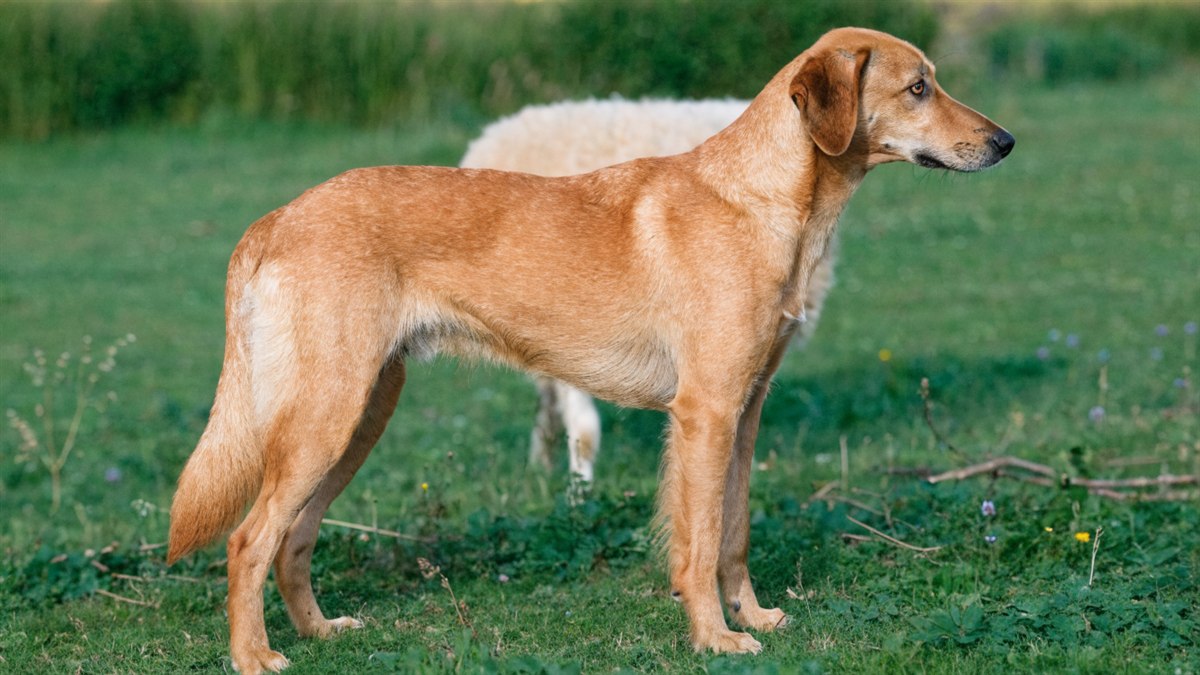
The Basque Shepherd Dog, Euskal Artzain Txakurra in Basque and Perro de Pastor Vasco in Spanish, is a medium to large herding breed native to the Basque Country, recognised by the Spanish state in two separately defined varieties, the short-coated Gorbeiakoa and the rough-coated Iletsua. It is a working sheep dog, not a guardian, and both official prototypes give its use in one word, pastoreo, herding.
Start with the thing every ranking page gets wrong. This is not one breed with a coat option. It is one breed whose two varieties were written into Spanish law as two separate racial prototypes, on two different dates, in two different instruments, and the numbers in those two documents do not line up with each other.
The two varieties, side by side
The Gorbeiakoa takes its name from Gorbeia, the mountain massif on the Bizkaia and Araba border. The Iletsua takes its name from the Basque word for hairy. Everything below comes from the racial prototypes published in the annex to Real Decreto 558/2001, which is the Spanish state's own text.
| Point | Gorbeiakoa | Iletsua |
|---|---|---|
| Coat, verbatim | Moderadamente largo, de textura suave. Pelo liso y corto | Moderadamente largo, áspero, de aspecto rústico |
| Coat, in plain English | Moderately long, soft in texture. Smooth and short hair | Moderately long, harsh, rustic in appearance |
| Colour | Fire red in its various tones, called rojillo, plus blond or fawn | Blond or fawn, and cinnamon |
| Ears | Medium, drop, semi-folded tolerated in some dogs | Medium, triangular, set above the eye line, sometimes folded back |
| Head profile lines | Cranio-facial lines coincident, pyramidal head | Cranio-facial lines divergent, elongated trunco-pyramidal head |
| Height, dogs | 47 to 61 cm | 47 to 63 cm |
| Height, bitches | 46 to 59 cm | 46 to 58 cm |
| Weight, dogs | 18 to 36 kg | 18 to 33 kg |
| Weight, bitches | 17 to 29 kg | 17 to 30 kg |
| Entered the state annex | 25 May 2001, with the Real Decreto itself | 17 April 2002, by Orden APA/880/2002 |
Read the weight row again. The Spanish state permits a Gorbeiakoa dog anywhere from 18 kg to 36 kg. That is a doubling. A 36 kg dog is not a bigger version of an 18 kg dog, it is a different animal with different joints, a different feeding bill and a different heat problem. The Andalusian Terrier page on this site reported a 50 percent disagreement between two official Spanish documents about one breed's weight. Here the 100 percent spread sits inside a single sentence of a single document.
Almost every figure published about this breed online merges the two varieties and then merges the sexes, producing a single tidy range that describes nothing. One ranking database gives 40 to 75 pounds, 18 to 34 kg, which matches neither variety's dog range nor either variety's bitch range. When a source quotes you a size for a Basque Shepherd Dog, the first question is which variety and which sex.
The breed's job, in the standard's own words
Both prototypes describe a trotter. The Gorbeiakoa is eumetric and longilinear with a long, straight, broad back, a croup angled between 15 and 30 degrees, stifles at about 120 degrees, and the note that the typical gait is the trot. The Iletsua is described with the angulations of a trotter, a smooth, broad, easy trot with good rear drive and the head carried in prolongation of the body. Neither is built to sprint. Both are built to keep moving for hours over broken hill country, which is exactly what a herding instinct looks like translated into bone.
Temperament splits by variety too, and the split is sharper than the coat. The Gorbeiakoa is described as having a typical disposition for herding, self-assured, sociable, of balanced temperament. The Iletsua is described as a dog that forms a close bond with its owner to whom it is unconditionally faithful, with clear and marked territoriality. One of those descriptions belongs to an easy-going working dog. The other belongs to a one-person dog that guards its patch.
The history, and the one date worth remembering
Dogs of this type appear in Basque mythology, in frescoes in Basque churches and monasteries from the sixteenth century onward, and later in the work of artists including Luis Paret y Alcázar, Gustave Doré and Adolfo Guiard, whose 1874 engraving is captioned Berger Basque. In the 1950s Basque shepherds took dogs of this kind with them to the United States when they went to work as herders.
The modern history runs through the trial field rather than the show ring. The first provincial sheepdog championships were held at Oñati in 1955, then Bizkaia in 1956, Araba in 1957, and Gipuzkoa and Nafarroa in 1968. The first Basque Country Championship was held at Mañaria in 1967. In those trials a dog is judged on whether it can move sheep on the shepherd's command, and nothing else.
The date worth remembering is 2022. In the early years of the championship various breeds were accepted. From 2022 the organisers decided to prioritise native sheepdog breeds. The academic survey of the breed puts the reason plainly: the breed now most used as a working sheepdog in the Basque Country is the Border Collie, and the veto of that breed in Euskal Herria's sheepdog trials is one of the best-known initiatives to promote native breeds. A rare native breed had to be given its own competition back because an import had taken the job.
Bonbeno's Border Collie guide covers the breed that displaced this one at home. The Australian Kelpie guide covers a breed whose working and show populations are separately registered under contradictory standards. The Belgian Shepherd guide covers four varieties held inside a single FCI standard. The Basque Shepherd Dog is a fourth arrangement again: two varieties, one studbook that does not tell them apart, and no FCI standard at all.
Recognition: no FCI standard, two state prototypes, and a studbook the kennel club does not hold
The Basque Shepherd Dog is not recognised by the Fédération Cynologique Internationale in any form, neither definitively nor provisionally, and it has no FCI standard number. It is recognised by the Real Sociedad Canina de España, by the Spanish state as two separately dated racial prototypes, and by the Basque Government, which authorises the official studbook. Those four positions do not agree with each other, and this section reads each one from its own document.
This is the part of the page that no competitor has written. It matters to an Indian reader for one blunt reason: recognition is what makes a pedigree portable, and a breed with no FCI standard cannot be registered with the Kennel Club of India as an FCI-pedigreed dog at all.
The FCI does not recognise this breed, read from the FCI's own two lists
Bonbeno checked both FCI lists rather than one, because a breed can be absent from the definitive nomenclature and still be provisionally accepted. The Andalusian Terrier is exactly that case, and its Bonbeno page reports it.
The FCI's Group 1, Section 1 Sheepdogs nomenclature lists 37 breeds. Exactly one of them is Spanish, the Catalan Sheepdog at Standard No. 87. Euskal Artzain Txakurra does not appear, and neither does Pastor Vasco. The same list carries Border Collie at 297, Australian Kelpie at 293 and Belgian Shepherd Dog at 15, which is the control that proves the page returned is the real sheepdog list and not something else.
The FCI's provisional list is the one that catches agents out, because a decoy URL on the same site returns a complete English Setter page under a provisional-sounding path. The real list sits at /nomenclature/provisoire.aspx, and its own heading reads 'Breeds recognised on a provisonal basis', typo included. On 20 August 2026 it held 20 breeds, the highest standard number being 378, with four breeds added on 2 November 2026. The Basque Shepherd Dog is not among them. The Ratonero Bodeguero Andaluz is, at 371, accepted on 3 September 2024, which is the second control confirming the page is the list it claims to be.
So the position is flat, and it is not the Andalusian Terrier's position. That breed has a real, internationally portable FCI pedigree and is barred only from the CACIB until definitive recognition. This breed has no FCI paperwork route of any kind. An independent academic survey of the breed reaches the same conclusion in one sentence, that the breed is not recognised by the FCI.
What the FCI would require, and why the arithmetic is against it
Annex 5 of the FCI Regulations sets out what a new breed has to show. Bonbeno read these criteria in the Zaragoza veterinary survey rather than in the FCI's own PDF, because the FCI file we attempted returned zero bytes and we do not cite a document we could not open.
- Population structure. A minimum of eight family groups, each with at least two dogs and six bitches, from two different litters per family group, born across a five-year period, with no common ancestors over three generations.
- Effective population size. Generally between 50 and 100 for healthy short-term reproduction. Below an effective size of 50, international recognition is not recommended.
- Origin. A breed may be a regionally or nationally recognised population, but it cannot be the result of a direct cross between two FCI-recognised breeds.
- Submission route. Recognition information has to come from the national canine organisation of the country of origin, even where that body is not FCI-affiliated.
- Time. A breeding programme planned with excellence, additional testing, and a minimum of fifteen years of registration in a national kennel club.
Hold that third-generation clause against what the genetics actually show. When the breed's own genetic project removed closely related individuals from its sample, 200 dogs collapsed to 74 Gorbeiakoa and 42 Iletsua. Eight unrelated family groups is a demanding requirement in a population that small.
The RSCE recognises it, and its two pages contradict each other
Spain's FCI member body, the Real Sociedad Canina de España, publishes the breed. It does not publish it once. It publishes two separate breed pages, one per variety, and their classification headers are not the same.
| RSCE page | Classification header, verbatim | Capture read |
|---|---|---|
| Perro Pastor Vasco Gorbeiakoa | Clasificación rSCE: Grupo 1º - Sección 1º - Perros de Pastor - Sometido a pruebas de trabajo | 12 November 2025 |
| Perro Pastor Vasco lletsua | Clasificación RSCE: Grupo 1 Perros de pastor y perros boyeros (excepto perros boyeros suizos) - Sección 1 Perros de pastor | 7 December 2025 |
Three things follow, and each is checkable. The Gorbeiakoa page says the variety is subject to working trials and the Iletsua page does not, although the breed regulation sets one aptitude test for the breed as a whole Real Sociedad Canina de España Euskal Artzain Txakurraren Adiskideak. Neither page carries an 'Estándar FCI Nº' line, because there is no number to print. And both pages nonetheless use the FCI's own group and section numbering, Grupo 1, Sección 1, for a breed the FCI has never numbered.
That last point is the trap. A reader who lands on the RSCE page sees an FCI-shaped classification and reasonably concludes the breed is FCI-recognised. It is not. The Andalusian Terrier page on this site found the mirror image of this problem, where the breed club still filed a newly FCI-accepted breed under 'Grupo 11: Razas no reconocidas por la FCI' months after acceptance. Here the kennel club uses FCI furniture for a breed that has never been through the door.
The RSCE recognition date itself is disputed. The Zaragoza survey and the breed association both give 1995. Wikipedia gives January 1996, citing a print breed encyclopedia. Bonbeno could not reach rsce.es directly to settle it, publishes both, and averages neither.
The Spanish state recognised the two varieties eleven months apart
Spain's official livestock breed catalogue does not cover dogs at all. Anexo I of Real Decreto 2129/2008, the Catálogo Oficial de Razas de Ganado de España, runs through cattle, sheep, goats, pigs, horses, donkeys, poultry and a closing category holding the Canary camel and two rabbits. There is no canine species in it.
Dogs run through a separate instrument. Real Decreto 558/2001 defines Spanish canine breeds as pure breeds originating in Spain, with a defined prototype and aptitudes, traditionally linked to livestock farming through herding and stock handling, guarding, hunting, companionship and other uses, and listed in its annex. The consolidated annex names 33 Spanish breeds. Two of the entries are this one, listed as 'Euskal Artzain Txakurra variedad Iletsua' and 'Euskal Artzain Txakurra variedad Gorbeiakoa', each with its own full racial prototype.
That annex is a living list. It has been amended at least eight times since 2001, and the mechanism is always the same: a ministerial order names the breeds being added and prints a full racial prototype for each. The Orden of 2 August 2001 shows it working, adding five breeds at once, among them the Ratonero-Bodeguero Andaluz, after the Comité de Razas de Ganado de España proposed and admitted them at its meeting of 18 June 2001.
The dates for this breed are not the same as each other. The Gorbeiakoa prototype came in with the Real Decreto itself, approved on 25 May 2001, published on 14 June 2001 and in force from 4 July 2001. The Iletsua arrived separately, through exactly the mechanism described above. Orden APA/880/2002 of 17 April 2002 carries a single operative article headed 'Inclusión de una variedad de una raza canina española', and it adds exactly one thing, the Iletsua variety, with its own prototype text.
The operative clause of the 2002 order spells the variety «lletsua», with a lower-case L in place of the capital I, while the prototype heading immediately below it spells it ILETSUA correctly. The Real Sociedad Canina's page heading today reads 'Perro Pastor Vasco lletsua', carrying the same typo. Two documents, one transcription error, twenty-four years apart. It is a small thing, and it is the cleanest available evidence of which text is the source and which is the copy.
The Basque Government holds the studbook, and that is the law working as designed
The official Libro Genealógico for this breed is not kept by Spain's kennel club. It is kept by the Euskal Artzain Txakurraren Elkartea, authorised by Eusko Jaurlaritza, the Basque Government. For comparison, on the same official table the studbooks of the Ratonero Bodeguero Andaluz, Podenco Andaluz, Perro de Agua Español and Sabueso Español are all held by the RSCE itself.
That is not an accident of politics. Article 3.1 of Real Decreto 558/2001 states that for Spanish canine breeds, official recognition of the bodies that keep the studbook falls to the competent organ of the autonomous community in which the breed originates, weighing the technical, sociocultural and historical evidence submitted. Where an origin is shared across communities, it goes to the one holding the greater number of censused, registered and graded dogs. The breed is Basque, so the Basque Government decides.
The studbook runs on the regulation approved by the Basque Government's Order of 9 December 2003, under articles 5.6 and 6.4 of Decreto 373/2001. It has three registers, and the entry bars are unusually explicit.
| Register | Who goes in | Bar to clear |
|---|---|---|
| Registro Fundacional (RF) | Founder dogs showing the breed's ethnic characteristics | Dogs at least 14 months, bitches at least 2 years, racial grading of at least 65 points for dogs and 60 for bitches |
| Registro de Nacimientos (RN) | Offspring of dogs already in the RF or RD | Breed characteristics, no defects, reproductive control of the bitch, application filed before weaning |
| Registro Definitivo (RD) | Dogs promoted from the RN | Bitches at 3 years, dogs at 30 months, having passed the morphological grading at 60 and 65 points respectively |
One clause in that regulation deserves an Indian reader's attention, because it is stricter than anything a commercial registry writes. Breeding dogs of either sex, and their offspring, must be struck from the Registro Definitivo where hereditary conditions of low fertility, low fecundity or deficient maternal qualities can be observed. A studbook that removes producing animals on maternal grounds is a conservation instrument, not a sales channel.
There is also a working gate that no ranking page mentions. Once a dog is registered as a Euskal Artzain Txakurra, the owner may enter the breed championship only after passing an aptitude test. The test is short and specific: standing in an allotted spot in front of the judges' table, the handler must send the dog to a small flock at the side of the field, enter it without roughness and gather it without biting, with a second bite bringing disqualification, then recall the dog to the shepherd's feet and have it stay, halting on a whistle from the judge in both directions, all inside a maximum of one minute and thirty seconds, scored simply apto or no apto.
Where the association's published text and the gazette disagree
Bonbeno compared the breed association's published reglamentación against the gazette text word by word, because the association is the body that keeps the studbook and its text is what a Spanish buyer will actually read. The two differ at two measurable points, both in the Gorbeiakoa.
| Point | EATA published text | BOE gazette text |
|---|---|---|
| Skull to face ratio | La relación cráneo/cara es de 1/1 | En hembras la relación cráneo/cara es de 1/1,3 y en machos de 1/1,6 |
| Where the short face hair also sits | así como en la parte posterior de las extremidades, con flecos en la parte posterior de las mismas | así como en la parte anterior de extremidades, con flecos en la parte posterior de las mismas |
The second row is self-refuting in the association's version, which puts the very short hair and the feathering on the same rear surface of the same leg. The gazette version is coherent: short in front, feathered behind Real Decreto 558/2001, de 25 de mayo. The Iletsua carries a smaller version of the same problem, with the association giving the skull to face ratio as 5/4 where both the gazette and the RSCE give 5/5 Real Decreto 558/2001, de 25 de mayo Real Sociedad Canina de España.
None of this changes what the dog looks like. It changes which document you should quote, and the answer is the gazette. Where a Spanish breed's prototype is disputed, the text published in the Boletín Oficial del Estado is the instrument with legal effect, and it is the text the RSCE reproduces.
Basque Shepherd Dog price in India, and the figure that does not exist yet
There is no Basque Shepherd Dog price in india, because there is no Indian market for the breed. Bonbeno searched Indian marketplaces, Indian breeder pages and Indian listing sites and found no offer, no litter and no verifiable transaction. Unusually for a rare breed, we also found no Indian domain publishing a rupee figure at all. Every number on the result page is in United States dollars.
That absence is worth more to you than a range would be. On most rare-breed queries an Indian page has already invented a band. Here nobody has bothered yet, which means you can still recognise the fake when it arrives.
The only two published figures, and what they are
The page ranking first for this breed publishes a purchase price of USD 800 to 1,500 and an annual cost of USD 1,200 per year, with no method, no sample, no currency date and no country. A template breed database publishes USD 1,200 to 1,800, describing it as a rough estimate for a dog from a reputable breeder. Neither figure is sourced. Neither is Indian.
Bonbeno checked whether the first of those is simply a house number applied to every breed, because that pattern is common on template sites. It is not. The same site gives USD 500 to 1,500 for the Australian Kelpie, USD 800 to 2,000 for the Border Collie and USD 500 to 1,000 for the Armant. The bands vary by breed, so they are at least breed-specific guesses rather than one repeated cell. They remain unsourced guesses.
Run the 84.38 test forwards, so you can spot the fake before it is published
Bonbeno has now caught three separate Indian pages publishing a rupee 'price' that turned out to be a US dollar figure run through one exchange rate of about 84.38 to the dollar, on the Airedale Terrier, the Ariegeois and the Andalusian Terrier. The normal use of the test is to take a suspicious rupee figure and divide it. There is nothing here to divide, so we ran it the other way.
| Published dollar figure | Multiplied by 84.38 | What you would see |
|---|---|---|
| USD 800 | Rs 67,504 | The likely bottom of a fabricated band |
| USD 1,500 | Rs 1,26,570 | The likely top of a fabricated band |
| USD 1,200 | Rs 1,01,256 | A plausible-looking 'annual cost' |
| USD 1,800 | Rs 1,51,884 | The top of the other published dollar band |
Look at the first two rows and then at Bonbeno's Andalusian Terrier page. Rs 67,504 and Rs 1,26,570 are the exact rupee figures already found published as an Indian price for that completely different Spanish breed, because the same USD 800 to 1,500 band was converted at the same rate. If a rupee price for the Basque Shepherd Dog appears on an Indian site, those are the two numbers most likely to be in it, and a calculator will tell you what they are in ten seconds.
The question is not how much. It is which dog, from where, under what import authorisation, and with which variety's paperwork. Given the import position below, a dog advertised in India as a Basque Shepherd Dog is far more likely to be an Indian mixed-breed of the right size and colour, a Belgian Shepherd cross, or a fawn Border Collie cross than a registered Euskal Artzain Txakurra. Nothing about a fawn, drop-eared, medium-coated dog is hard to imitate.
Why no lawful Indian supply chain can form
India's import policy classes dogs under ITC (HS) 01061900 as Restricted, subject to Policy Condition 6 of the chapter. Policy Condition 7 permits the import of dogs for three purposes only, a pet dog with a valid pet book and relevant records in the name of the importer, dogs imported by R&D organisations for research on the recommendation of CPCSEA, and dogs for internal security by the Defence and Police Force. Policy Condition 8 states that import of commercial dogs for breeding or any other commercial activity beyond those purposes is not permitted.
Paragraph 6 of the same trade notice removes the remaining ambiguity. Any application for trading or breeding purposes, or made on behalf of another person or entity, shall be duly rejected. Paragraph 7 limits entry to the airports and seaports of Delhi, Mumbai, Chennai, Hyderabad, Bangalore and Kolkata, with quarantine at those ports where required. DAHD added a seventh port, Cochin International Airport at Kochi, for pets arriving under the baggage rules in October 2024. The full route is set out in how to import a dog to India.
The one door that is open is narrow and personal. Up to two pets may enter as passenger baggage without DGFT authorisation, and only for a person transferring residence to India after two years of continuous stay abroad. Anything else needs an import authorisation, applied for on form ANF-2M against the importer's IEC or the permanent personal-use code IIHIE0153E, with the application recommended at least two months before travel and an Advance No Objection Certificate from the port's quarantine officer seven days before the date of travel.
A door that admits one family's own dog at a time does not build a market. Read that against a breed whose entire population sits in the Basque Country and Navarre, and the conclusion is not that the breed is expensive in India. It is that it is not for sale here.
The registry route is closed too
The Kennel Club of India registered 33,880 pure-bred dogs with its studbook in 2025, from 7,412 litters, taking its cumulative total since inception to 1,425,001 dogs. For a Basque Shepherd Dog to appear among those studbook registrations as an FCI-pedigreed dog, an FCI standard would first have to exist. None does. India also ran two CACIB all-breed shows in 2025, and this breed could not have competed at either.
That is a harder position than the Andalusian Terrier, whose FCI pedigrees exist and are internationally portable even while the breed waits for definitive recognition. It is closer to the Alano Español, which sits outside the FCI entirely.
The same FCI statistics page reports India's approximate total number of dogs, pure-bred or not, as 17,111,342 in 2025, and the approximate total number of dog owners as 38,128,500. That is more than twice as many owners as dogs. National canine organisations supply these figures themselves and the FCI prints them as received. Bonbeno reports the studbook rows, which are the organisation's own count of its own work, and treats the national estimates as unusable.
What the breed costs where it does exist
Bonbeno found no published, sourced, current Spanish or Basque price for this breed that it could verify, and will not invent one. The breed is not sold through a commercial pipeline in the way an imported pet breed is. Its studbook is a conservation register with removal clauses for poor fertility and poor mothering, its championship is a working trial, and its association is a non-profit whose stated purpose is the survival of the breed.
The honest comparison is with breeds Bonbeno has actually been able to price in India. The Border Collie has a real Indian market with editorial sources at Rs 20,000 to Rs 60,000 and seller pages at Rs 3,50,000 to Rs 7,00,000, a spread Bonbeno compares on its own page. Do not borrow that figure for this breed. A Border Collie price tells you what Border Collies cost in India. It tells you nothing about a dog that has never been sold here.
Cost of ownership in India, described as a structure because no figure exists
Bonbeno publishes no monthly rupee cost of ownership for the Basque Shepherd Dog, because no verified Indian figure exists for a breed with no Indian population. What can be described honestly is the cost structure a 18 to 36 kg working herding dog imposes in an Indian city, and which lines of it change depending on which variety you have.
Every ranking page that gives a running cost gives one number for one country and no method. The first-ranked page publishes USD 1,200 a year with no breakdown and no currency date. A template database carries a 'Food & Costing' heading with no sourced figure under it. Converting either into rupees would manufacture exactly the kind of number the price section above teaches you to catch.
The five recurring lines, and what drives each one
- Food, driven by the weight you actually have. The state prototype allows a Gorbeiakoa dog of 18 kg or 36 kg. Those two dogs do not eat the same amount, and any single quoted feeding cost for the breed is meaningless until the individual dog is weighed. Cost scales roughly with metabolic body size, so budget from your dog, never from the breed.
- Grooming, driven by which variety you have. The Gorbeiakoa's coat is described as smooth and short with feathering behind the legs. The Iletsua's is moderately long, harsh and rustic in appearance. The Iletsua needs real brushing time in humid weather and the Gorbeiakoa needs far less, so the same breed produces two different grooming budgets.
- Parasite prevention, which is the line Indian owners underestimate. A survey of 525 dogs across four Indian cities found 261 of them, 49.7 percent, carrying at least one tick-borne disease pathogen on PCR, and ticks on 278 of the dogs examined. Year-round tick control is not optional here, and it is a recurring, not a one-off, cost.
- Ear care, which is not the same for the two varieties. Ear disease is common in Indian practice. A Durg study of 281 dogs found otitis externa in 51 of them, a prevalence of 18.14 percent. A drop-eared Gorbeiakoa carries the ventilation problem that a semi-erect Iletsua largely does not.
- Veterinary care with no breed baseline. Because there is no published literature on this breed at all, no insurer, breed club or study can tell you what conditions to budget for. Budget as you would for a medium-large active dog and expect the surprises to be individual rather than breed-typical.
The one-off costs that only exist because the breed is not here
If a lawfully imported dog ever arrives, it arrives through the personal route, not a purchase. That route carries its own costs and its own timetable. An import authorisation is applied for on form ANF-2M, at least two months before travel on DGFT's own advice, followed by an Advance No Objection Certificate from the port quarantine officer seven days before the date of travel, with disease testing performed in the exporting country and every test report travelling with the animal. Entry is limited to seven ports, with quarantine at those ports where required Department of Animal Husbandry….
None of that is a price. It is a process, and it belongs to someone relocating with a dog they already own, not to a buyer.
If what appeals is a mid-sized, fawn, rustic-coated, hardy herding-type dog that thrives in Indian heat, the Indian Pariah Dog already is that dog, is free to adopt in every Indian city, and has thousands of years of local heat adaptation behind it rather than none. That is not a consolation prize. It is the same functional animal without the import problem.
Heat tolerance in India, rated from the standard's own coat description
Bonbeno rates the Basque Shepherd Dog 2 out of 5 for heat tolerance in Indian conditions as a breed, and splits the rating by variety: 3 out of 5 for the short-coated Gorbeiakoa and 2 out of 5 for the rough-coated Iletsua. The split comes from one clause in the official prototypes, the coat description, and the whole-breed figure takes the lower value because no register distinguishes the varieties, so most owners cannot prove which dog they have.
Every other breed page you will read hedges this. Bonbeno shows the mechanism, so you can check the reasoning rather than trust the number.
Six mechanical facts, taken from the standard and the literature
- Neither variety's standard describes an undercoat. Bonbeno searched the full Spanish text of both prototypes, in the state gazette and on both RSCE pages, for subpelo, borra, lanilla and doble. All four terms return zero occurrences Real Sociedad Canina de España. This is not a declared double coat breed the way a Border Collie is, and that is the single biggest point in its favour in an Indian summer.
- Both varieties have thick skin. The Gorbeiakoa's skin is 'más bien gruesa, sin flacidez alguna', rather thick with no looseness, tight to body and head. The Iletsua's is 'más bien gruesa, ajustada a los planos musculares', rather thick, fitted to the muscle planes. Thick, tight skin is an insulator and it works against the dog in heat, in both varieties equally.
- The coat lengths genuinely differ. The Gorbeiakoa is 'de textura suave. Pelo liso y corto', soft in texture, smooth and short. The Iletsua is 'áspero, de aspecto rústico', harsh and rustic, and its own general description calls it more bristly than the Gorbeiakoa's. A harsher, longer, rustic coat traps more still air against thick skin. That is the whole basis of the one-point split.
- The head is a good head for cooling. Both varieties are long-muzzled, with the Gorbeiakoa described as pyramidal with an elongated fine muzzle and the Iletsua as elongated trunco-pyramidal. Neither is brachycephalic. In the UK VetCompass series, brachycephalic dogs with heat-related illness had three times the odds of a fatal outcome compared with mesocephalic dogs. This breed sits on the right side of that line.
- The body mass is on the wrong side. In the same series, compared with dogs under 10 kg, dogs weighing 10 to under 20 kg had 2.71 times the odds of severe heat-related illness, 95 percent CI 1.17 to 6.28. The 20 to under 30 kg band came in at 2.41 with a confidence interval of 0.99 to 5.87, which crosses 1 and is therefore not statistically significant, and Bonbeno reports it that way rather than rounding it into a claim. This breed's declared range of 17 to 36 kg sits in and above those bands.
- Its job is the highest-frequency trigger there is. Of 1,259 heat-related illness events in 905,543 UK dogs, 879 had a recorded trigger, and 652 of those, 74.2 percent, were exertional. Environmental accounted for 113, or 12.9 percent, and vehicular confinement for 46, or 5.2 percent. Exertional events carried a 7.6 percent fatality rate, and the odds of death did not differ between exertional, environmental and vehicular heat-related illness. A dog whose standard describes the angulations of a trotter is a dog that will run itself into that category.
The number that reframes the whole question
The median ambient temperature on days when UK dogs developed heat-related illness was 16.9 °C, and the median maximum daily wet bulb globe temperature for exertional events was 16.5 °C. Read that twice. Dogs were collapsing at an ambient temperature that an Indian city sees only on a cold winter morning in the north, and never at all in Chennai or Mumbai.
That is what acclimatisation and exposure duration do, and it is why importing a European working standard of exercise to India is the actual risk, not the breed's coat. A Basque hill in September and a Pune evening in April are not the same environment, and a dog bred for the first has no experience of the second.
| Factor | Gorbeiakoa | Iletsua | Direction |
|---|---|---|---|
| Undercoat named in the standard | None | None | Helps both |
| Outer coat | Soft, smooth, short | Harsh, rustic, moderately long | Helps Gorbeiakoa |
| Skin | Rather thick, tight | Rather thick, tight | Hurts both |
| Skull shape | Long muzzle, mesocephalic | Long muzzle, mesocephalic | Helps both |
| Declared weight range | 18 to 36 kg dogs, 17 to 29 kg bitches | 18 to 33 kg dogs, 17 to 30 kg bitches | Hurts both |
| Work pattern in the standard | Trot, sustained | Trot, sustained | Hurts both |
| Bonbeno rating out of 5 | 3 | 2 | Whole breed rated 2 |
City by city, what this actually means
- Mumbai, Chennai, Kolkata, Kochi. The problem here is humid heat, not dry heat. Evaporative cooling by panting loses efficiency as humidity rises, so the dog's one cooling system works worst exactly when it is needed most. The Iletsua's rustic coat over thick skin is a poor combination in coastal humidity, and an Iletsua in these cities is a dog living permanently below its design conditions.
- Delhi, Jaipur, Ahmedabad, Nagpur. Dry heat with extreme afternoon peaks. The dog can shed heat more efficiently than on the coast, but the peak temperatures are far higher. Work and walks move to before sunrise and after dark, and the middle of the day becomes indoor time from March to July.
- Bengaluru, Pune, Hyderabad. The least punishing Indian option for this breed, with a Gorbeiakoa managing reasonably on a sensible schedule. This is still not a Basque hill, and a dog here still needs shade, water and a hard stop on midday exertion.
- Shimla, Dehradun, Gangtok, Ooty, Darjeeling. Hill stations come closest to the breed's home climate and are the only Indian locations where an Iletsua would be genuinely comfortable year-round. They are also the places where a working herding dog might have something resembling a job.
The instinct to shave a long-coated dog in Indian summer is understandable and wrong. The coat also blocks solar radiation and protects skin that has no pigment defence of its own, and a shaved dog gains sunburn risk without gaining a reliable cooling benefit. Purina India's advisory names heavy-coated dogs among those at greater risk of heat stroke and directs owners to shade, hydration, cool-hour exercise and avoiding direct sun rather than to clippers. Brush the Iletsua out properly instead, so air can move through the coat. If your dog is genuinely heat-distressed, that is a veterinary emergency, not a grooming decision.
Bonbeno's siblings in this cluster all sit at 2 out of 5 for heat, the Border Collie, the Australian Kelpie and the Belgian Shepherd. The Gorbeiakoa earns its extra point on one specific ground, that its standard names no undercoat while theirs describe insulating coats. It does not earn it for being an easier dog.
Temperament and household fit, which is not the same for the two varieties
The Basque Shepherd Dog's temperament is defined twice in Spanish law, once per variety, and the two definitions describe different dogs. The Gorbeiakoa is 'seguros de sí mismos, sociables y de temperamento equilibrado', self-assured, sociable, of balanced temperament. The Iletsua 'establece un estrecho vínculo con su dueño al que le es fiel incondicionalmente. De clara y marcada territorialidad', forms a close bond with its owner to whom it is unconditionally faithful, with clear and marked territoriality.
Nobody writing about this breed in English separates those two sentences, and they are the most decision-relevant text in either prototype. One variety is described as sociable. The other is described as territorial and bonded to one person.
What each description means in an Indian flat
A sociable, balanced herding dog with a strong work drive is a demanding but manageable household animal, provided the work drive is met. A territorial one-person dog in a building with shared corridors, a lift, delivery riders, a housekeeper, a milk delivery and neighbours' children is a different proposition entirely. Marked territoriality is a working virtue on a Basque farmstead, where the standard notes the breed has also been used to guard farmhouses. It is a liability in a Mumbai society block.
Bonbeno does not tell you to avoid the Iletsua. It tells you that the official text describes it as territorial, that the ranking pages do not mention this at all, and that if you are choosing between the varieties, this sentence should weigh more with you than the coat does.
What the breed is not
One ranking database lists this breed's purpose as 'Protection' and its ancestry as Mastiff, Pyrenean Mountain Dog, Spanish Mastiff and Pyrenean Sheepdog. Both official prototypes give the utilisation as pastoreo, herding, and describe a longilinear trotting dog of 17 to 36 kg with a light head 'liviana con respecto al tronco', light in relation to the body. A livestock guardian is a different animal with a different head, a different mass and a different job. Nothing in the Spanish state text supports the mastiff ancestry claim, and Bonbeno found no source for it.
This distinction has consequences. A buyer expecting a guardian will get a dog that wants to move stock, and a herding dog with nothing to herd finds something. In Indian homes that usually means children, scooters, joggers and autorickshaws.
The genetics complicate the picture, honestly
The breed's own genetic project, run by the Euskal Artzain Txakurraren Adiskideak association with the BIOMICs group at the University of the Basque Country under an agreement signed on 20 November 2018, sampled 200 dogs, 127 Gorbeiakoa and 73 Iletsua. A structure analysis on 13 breed-differentiation markers found the two varieties do separate into two clusters, which is real support for treating them as distinct.
It also found something the breed clubs do not advertise. No individual in the Gorbeiakoa cluster was fully assigned to it, at least eight dogs labelled Gorbeiakoa clustered with the other variety, two labelled Iletsua clustered with the first, and many were admixed. Compared against other breeds, numerous individuals carried components clearly related to other breeds, specifically the cluster associated with the German Shepherd and the one abundant in the Belgian Shepherd Ruiz de Gordoa Zulaika.
So a dog registered as one variety may not genetically be one, and a proportion of the registered population carries other shepherd ancestry. For temperament, that means the two official descriptions are tendencies within an admixed population rather than guarantees about an individual. Meet the parents. Watch how the dam behaves around a stranger.
It suits someone with a hill-station or high-plateau home, hours of daily outdoor time, previous experience of a working herding breed, and no expectation of a placid indoor companion. It does not suit a first-time owner, an apartment household with heavy footfall, a family who leave the dog alone through a working day, or anyone in coastal humidity. Those are the same conditions Bonbeno applies to the Border Collie and the Australian Kelpie, and this breed has less published evidence behind it than either.
Training a Basque Shepherd Dog, and the aptitude test that defines what it is for
To train a Basque Shepherd Dog, work with the herding motor pattern rather than against it, and use the breed's own aptitude test as the syllabus. That test is set out in the Basque Government's breed regulation and it is the clearest published statement of what this dog is expected to be able to do.
Most breed pages describe training in adjectives. This breed has an actual examination, with a time limit and a disqualification rule, so we can describe it in specifics instead.
The official aptitude test, step by step
- Handle from a fixed position. The owner stands in an allotted spot in front of the judges' table and does not move from it.
- Send the dog to the flock. The handler must guide the dog to a small flock of sheep placed at one side of the field.
- Enter and gather without roughness. The dog must enter the flock without brusqueness and group the sheep without biting them. A second bite disqualifies.
- Recall and settle. On the judge's signal, the handler brings the dog back alone to the shepherd's feet, where it must stay still.
- Stop on a whistle, both ways. On the outrun and on the return, the judge signals with a whistle and the handler must stop the dog at that moment.
- Finish inside 90 seconds. The whole test allows a maximum of one minute and thirty seconds, and the result is apto or no apto, pass or fail.
Read that as a training plan and four requirements fall out. The dog must take direction at distance. It must stop instantly on a whistle. It must recall off livestock. And it must inhibit the bite. Every one of those is teachable, and every one of them is far easier taught early than repaired late.
What the breed resists
The disqualification list for the working test is itself a list of the breed's failure modes, published by the same authority. Dogs fail for lack of typicality and lack of attention to the handler, for going too far from the sheep, for biting twice or attacking the flock, for disobedience, for lack of character, for having no real inclination to herd, for refusing to enter the flock, and for exceeding the time.
Two of those matter in a pet home. 'Alejarse mucho de las ovejas', working too wide, describes a dog that self-directs instead of taking instruction, and in a city that is the dog that stops listening on a walk. 'Falta de atención al conductor', lack of attention to the handler, is the same problem named from the other end. Build engagement early and hold it, and the rest of the training becomes ordinary.
A realistic Indian timeline
| Period | Focus | The failure this prevents |
|---|---|---|
| 8 to 16 weeks | Socialise deliberately with lifts, corridors, delivery riders, horns, autorickshaws and household staff | The territoriality the Iletsua prototype names becomes reactivity |
| 3 to 6 months | Name response, hand-fed engagement, a stop cue on a whistle, recall paid every single time | A self-directing dog that works too wide |
| 6 to 12 months | Impulse control around moving things, settle on a mat, calm alone-time in short blocks | Chasing scooters, joggers and cyclists |
| 12 to 24 months | A real outlet, scent games, structured retrieves, obedience or herding-style exercises | A bored herding dog inventing a job indoors |
| Throughout | Reward-based methods only, short sessions, early morning and after dark in summer | Heat-related illness during training itself |
Exertion is the trigger behind 74.2 percent of heat-related illness events with a known cause, and those events carried a 7.6 percent fatality rate. Training sessions are exertion. Move them to before sunrise and after dark from March to October in most of India, and stop early on humid days rather than finishing the plan.
Bonbeno has found no published training study, behavioural survey or working-trial dataset specific to this breed, so everything above is derived from the breed's own regulation and from general canine evidence, clearly labelled as such. Where a page gives you confident breed-specific training claims for the Basque Shepherd Dog, ask what it is citing.
Daily exercise requirement, and what happens without it
A Basque Shepherd Dog needs to exercise for well over an hour a day in structured, varied work, not a walk on a lead, because both official prototypes describe a sustained-trotting working dog rather than a companion. In India that requirement collides directly with the heat, and the collision is the central practical problem of keeping this breed here.
Bonbeno has no breed-specific exercise study to cite, because none exists. What it does have is the standard's own description of the animal's construction, which is a legitimate basis for an estimate and is more than any ranking page offers.
What the construction tells you
The Iletsua is described as having the angulations of a trotter, with a smooth, broad, easy trot with good rear drive and the head carried in prolongation of the body. The Gorbeiakoa carries stifles at about 120 degrees, shoulders and thighs at 45 degrees, a long straight back of broad development and an appreciably tucked-up abdomen. Both are athletic, both are muscular, and both are built for range rather than for bursts.
The croup angles differ between the varieties, 15 to 30 degrees in the Gorbeiakoa and 30 to 40 degrees in the Iletsua. A steeper croup shifts the propulsion geometry. In practice both varieties want the same thing, which is distance at a trot over uneven ground.
A workable Indian schedule
- Before sunrise, 45 to 60 minutes. Off-lead where it is safe and legal, on varied ground, with recall and stop work built in rather than bolted on.
- Midday, nothing outdoors from March to October. Indoor scent work, food puzzles, chew time and a settle routine replace the walk entirely on hot days.
- After dark, 30 to 45 minutes. A second real outing, plus five to ten minutes of training so the dog finishes the day thinking.
- Weekly, one longer outing. A hill walk, a beach at dawn out of season, or a long trail. This is the outing that empties a working dog properly.
What happens without it
An under-exercised herding dog does not become calm. It redirects the motor pattern onto whatever moves, which in Indian conditions means scooters, cyclists, joggers, children and street dogs. Add the Iletsua prototype's marked territoriality and the redirection can arrive with a guarding flavour rather than a playful one. The second-order costs show up as destructiveness indoors, vocalisation that annoys neighbours, and a dog that cannot settle.
The owner who compensates for a skipped morning walk with a long midday one is making the single most dangerous substitution available. Exertional heat-related illness accounted for 652 of the 879 UK events with a known trigger, 74.2 percent, and carried a 7.6 percent fatality rate, with no difference in the odds of death between exertional, environmental and vehicular events. The median ambient temperature on UK heat-illness days was 16.9 °C. Missing a walk costs you a restless evening. Replacing it with a hot one can cost the dog.
The comparison with Bonbeno's other working breeds is close but not identical. The Border Collie and the Belgian Shepherd both carry a Royal Kennel Club requirement of more than two hours a day, published by a body that has assessed those breeds for decades. No comparable authority has ever published a figure for the Basque Shepherd Dog, so Bonbeno gives a reasoned estimate and says so, rather than borrowing a neighbour's number and presenting it as this breed's.
Grooming and coat care in Indian humidity, which differs by variety
To groom a Basque Shepherd Dog in India, work out which variety you have first, because the official prototypes describe two different coats and they need two different routines. The Gorbeiakoa's is soft, smooth and short. The Iletsua's is moderately long, harsh and rustic in appearance, and described in its own general clause as more bristly than the Gorbeiakoa's.
Both varieties share one feature that matters more in India than anywhere in Europe. Both have feathering, flecos, on the rear of the limbs, and the Gorbeiakoa additionally carries long hair on the tail, which passes the hock. Feathering on the back of the legs is where a tick sits and where a burr lodges, and in a country with the tick pressure India has, that is a health matter and not a cosmetic one.
The routine, by variety
| Task | Gorbeiakoa, short-coated | Iletsua, long-coated |
|---|---|---|
| Brushing | Twice a week with a rubber curry or short-bristle brush | Every second day minimum, more in monsoon, with a slicker plus a comb through the feathering |
| Feathering and tail | Comb the leg feathering and the tail weekly | Comb the leg feathering at least twice a week, checking for mats behind the elbow and hock |
| Tick check | Daily in season, using the brush session for it | Daily in season, and slower, because the coat hides them |
| Bathing | Only when genuinely dirty, then dry fully | Only when genuinely dirty, then dry fully and to the skin |
| Ears | Check weekly, drop ears trap moisture | Check weekly, semi-erect ears ventilate better |
| Clipping | Never | Never |
The overseas advice that does not transfer
Care guidance written for a Basque or northern European climate assumes a dog dries in cool moving air. India does not supply that. Water left in a coat in Chennai in August sits at skin temperature against thick skin and does not evaporate for hours. So the instruction to towel a dog and let it air dry, standard in European breed guidance, needs changing here rather than repeating.
Dry to the skin, not to the touch. Towel hard, then use a dryer on cool or low, working against the lie of the coat, particularly through the leg feathering, behind the elbows, in the groin and around the base of the tail. Those are the places a rough-coated dog stays damp, and damp plus warmth is the whole recipe for skin and ear trouble.
Ears, and why the two varieties are not the same risk
The most-cited health page for this breed reasons about ear infections from the premise that the Basque Shepherd Dog is a floppy-eared breed, citing the humid environment and lack of airflow in the ear canal. That reasoning is sound, and it applies to one variety. The Gorbeiakoa's ears are 'medianas, caídas', medium and drop, with semi-folded tolerated in some dogs. The Iletsua's are set above the eye line, medium and triangular, sometimes with a fold in the proximal third that tips them backward. Those are not the same ear, and they are not the same ventilation.
So the advice splits. A drop-eared Gorbeiakoa in Indian coastal humidity needs a genuine weekly ear routine and careful drying after every bath and every swim. A semi-erect Iletsua carries less of that risk from ear carriage, and more of it from a coat that holds water. Neither variety benefits from routine cleaning of a healthy ear, which strips the canal's own defences. Check, do not scrub.
Treat every brushing as a body check. Run your hands over the ribs to check body condition, look inside both ears, part the feathering behind the legs, look between the toes, and lift the tail. On a breed with no published health data at all, the owner's hands are the only surveillance system there is, and a weekly habit catches things a monthly one misses.
Health, lifespan and the fact that no breed-specific data exists
There is no published veterinary research on the Basque Shepherd Dog. Bonbeno searched Europe PMC's full life-sciences index for both 'Euskal Artzain Txakurra' and 'Basque Shepherd Dog' and both returned zero results, in the same session in which control searches returned 2,560 results for Border Collie and 120 for Australian Kelpie. The search works. The literature is empty.
That is the single most important health fact on this page, so it is stated first rather than buried. Every specific health claim you will read about this breed elsewhere is an assertion, not a finding, and this section shows you which assertions fail when you check them.
PubMed appears to have hundreds of papers. It has none
This is worth showing in detail, because it is exactly how a confident wrong answer gets manufactured. A PubMed search for 'Euskal Artzain Txakurra' returns 1,809 results. Read the query translation and it has silently discarded the phrase and searched for 'euskal' alone, returning papers on organic electrochemical transistors, TLR7 variants in COVID-19 and forage plant ecology.
A search for 'Basque Shepherd' returns 12 results. Its translation expands to Basque people OR Basque OR Basques AND shepherd OR shepherds, and the twelve records include the SuperCam instrument suite on the NASA Mars 2020 rover, a malaria drug-target paper, and a 1975 study of hydatid disease transmission in California among Basque sheepherders. Not one is about the dog. Control searches in the same session returned 276 for Border Collie and 65 for Belgian Shepherd, so PubMed itself was working.
Anyone quoting a hit count without opening the records would report that this breed is well studied. It has not been studied at all.
The 12 to 15 year lifespan claim, checked
Two ranking pages give a life expectancy of 12 to 15 years, one of them adding that the breed is a landrace and therefore 'far less prone to the genetic diseases of many of today's modern breeds';. Neither cites anything.
Set that against the largest relevant dataset that exists. UK VetCompass life tables built on 30,563 dogs that died between 1 January 2016 and 31 July 2020 give a life expectancy at age 0 of 11.23 years across all dogs, 95 percent CI 11.19 to 11.27. Broken down by breed, the longest-lived was the Jack Russell Terrier at 12.72 years, 95 percent CI 12.53 to 12.90, and the shortest the French Bulldog at 4.53 years.
So a claimed range topping out at 15 years would place an unstudied breed above every one of the breeds in that study, by more than two years. It might be true. Nothing published supports it, and Bonbeno therefore publishes no lifespan figure for this breed.
The Zaragoza veterinary survey filtered its register data by removing dogs born before 2007, on the stated basis that the mean life of dogs of this breed is 15 years. That is an analytical assumption used to clean a dataset, not a measured lifespan, and it should never be quoted as one. It is a plausible route by which a 15-year figure entered circulation.
What the genetics actually show, with its provenance stated
The one real body of work on this breed's health is the EATAG project, run by the breed association with the BIOMICs group at the University of the Basque Country, using a 19-marker Canine Genotypes Panel and the 13-marker CaDNAP panel developed for breed differentiation, with samples also sent to the Institute of Legal Medicine at the Medical University of Innsbruck.
Its first results found certain markers showing observed heterozygosity below what a randomly mating population would give, consistent either with close relatives in the sample or with inbreeding in the breed. A relatedness analysis confirmed related individuals, and removing them cut 200 sampled dogs to 74 Gorbeiakoa and 42 Iletsua. Some markers then lost the heterozygote deficit and others still indicated inbreeding.
The survey also reports inbreeding coefficients of 0.7277 for the Gorbeiakoa and 0.7546 for the Iletsua, describing the values as undoubtedly high. Bonbeno reports those numbers with their full provenance rather than as established facts. They come from a bachelor's degree dissertation, which in turn attributes them to a video published on the association's website, not to a peer-reviewed paper. The same document also states that 148 dogs were analysed and then gives the split as 98 Gorbeiakoa and 51 Iletsua, which sums to 149. A one-dog discrepancy is trivial in itself and it is a reminder that this chain has not been through peer review.
The qualitative finding is the robust part and it is enough to act on. This is a small, partly admixed population with documented relatedness, in which dogs were crossed for herding ability without regard to breed or kinship for many years. Treat pedigree depth and unrelatedness as the first health question you ask about any individual, not the last.
The three conditions the ranking set names, examined
- Hip dysplasia. Named without a source or a prevalence figure. No screening scheme publishes numbers for this breed, and there is no breed entry to check. What Bonbeno can say is that India's own law requires breeding dogs to have been tested for genetic defects including hip dysplasia, so any breeder in India who ever produced this breed would be under that obligation.
- Chronic ear infections. Reasoned from floppy ears, which describes the Gorbeiakoa and not the Iletsua. The underlying risk is real in India regardless of breed, and the grooming section above splits the advice by variety.
- Bloat. Described as most common in larger, deep-chested dogs. The official prototypes describe the Gorbeiakoa's chest as of medium breadth, deep, reaching the elbow, and the Iletsua's as moderately wide, rather deep. That is a moderate chest, not the narrow deep-chested conformation the risk description assumes. Bonbeno neither confirms nor dismisses the risk, and notes that the stated reasoning does not fit the standard.
What Indian law requires you to screen for
This is the one place where a concrete, enforceable list exists, and it applies in India regardless of what any overseas club recommends. Second Schedule Part III paragraph 8(10) of the Prevention of Cruelty to Animals (Dog Breeding and Marketing) Rules 2017 requires that dogs shall have been tested for genetic defects including hip dysplasia, progressive retinal atrophy, night blindness, hypothyroidism, entropion, ectropion, overshot and undershot jaw where the incisors do not touch or mesh, wry mouth, two or more missing teeth, and unilateral or full cryptorchid males.
Note what that list does mean for this breed specifically. The Spanish prototype makes absence of more than two premolars, loss of incisors or canines, and prognathism disqualifying defects, and requires two fully developed testicles in the scrotum. Indian law and the Spanish standard are asking for the same examination from two different directions, which is unusual and convenient.
Two Indian risks that outrank anything inherited
For any dog living in India, the environment carries more measurable risk than the pedigree does, and here the evidence is real and Indian.
A survey of 525 dogs across four Indian cities found 261, or 49.7 percent with a 95 percent CI of 45.4 to 54.1, infected with at least one tick-borne pathogen by PCR. Hepatozoon canis was the most common at 30 percent, followed by Ehrlichia canis at 20.6 percent, Mycoplasma haemocanis at 12.2 percent, Anaplasma platys at 6.5 percent, Babesia vogeli at 5.5 percent and Babesia gibsoni at 0.2 percent, with 39 percent of infected dogs carrying more than one pathogen. Ticks, most often Rhipicephalus, were found on 278 of the dogs examined, 53 percent.
One detail from that study should change how you talk to your vet. Blood smear microscopy detected only Hepatozoon gamonts, in 12 of the 525 dogs, 2.3 percent, while PCR found 49.7 percent. A clear smear is not a clear dog. If your dog has the signs and the smear is negative, ask about PCR.
Where Bonbeno's own sources disagree about ear disease
Bonbeno's gundog pages report an Indian otitis series peaking in the monsoon. A Durg study of 281 dogs found otitis externa in 51, a prevalence of 18.14 percent, and distributed those 51 cases across the seasons as 21 in summer, 41.18 percent, 17 in the rainy season, 33.33 percent, and 13 in winter, 25.49 percent. That is a summer peak, not a monsoon peak, and Bonbeno prints the disagreement rather than picking the convenient side.
Read the table carefully, though, because the paper labels a case distribution as a prevalence. Those percentages are the share of the 51 positive dogs falling in each season, not the proportion of dogs examined in each season that were affected. Without seasonal denominators, the honest reading is that ear disease occurs in every Indian season and is common enough in summer to make a mockery of the idea that it is only a monsoon problem. Age mattered more clearly in the same data, with 23 of the 51 cases, 45.10 percent, in dogs of five years and over.
There is no lifespan figure, no screening dataset and no prevalence study for this breed. Bonbeno says so three times rather than borrowing a number once from the Border Collie or the Belgian Shepherd, whose figures appear on this page only as clearly labelled contrasts. What exists is a genetic project showing a small, related, partly admixed population, and Indian environmental risks that are measured and serious. Consult your nearby vet before acting on anything in this section.
Feeding and nutrition, anchored to the dog rather than the breed
To feed a Basque Shepherd Dog correctly, feed the individual animal to a lean body condition and ignore any breed-level portion table, because the state prototype permits a range from 17 kg to 36 kg within one breed. A guideline written for 'a Basque Shepherd Dog' is describing a dog that could be twice the size of yours.
No breed-specific nutrition study exists, in common with everything else about this breed's health. What follows is standard large-active-breed practice with the Indian specifics attached, and it is labelled as exactly that.
Body condition is the only measure that matters
You should feel the ribs easily under a thin layer of fat without pressing, see a waist from above and a tucked abdomen from the side. Both prototypes describe the abdomen as tucked up, appreciably so in the Gorbeiakoa and slightly so in the Iletsua, so a straight underline on this breed is a weight problem showing itself in the outline.
Weight control is not cosmetic here. The UK VetCompass work found bodyweight associated with severe heat-related illness, and separately identified overweight dogs among those at greater risk of developing it. In an Indian climate, every extra kilogram is an extra heat problem carried permanently.
Life-stage practicalities
- Puppy to 12 months. A large-breed growth formulation, fed across three meals to six months and two thereafter, aiming for steady growth rather than fast growth. Rapid growth in a medium-large breed loads developing joints.
- Adult, 1 to 7 years. Two meals a day, portioned from the dog's actual weight and workload, adjusted every few weeks against what you feel over the ribs rather than what the bag says.
- Senior, 7 years and older. Lower calories, maintained protein, and closer attention to weight, because a working-bred dog that slows down keeps its appetite. Ear disease in the Durg data was most common in dogs of five years and over, so senior checks earn their place.
- Around exercise. Do not feed a large meal immediately before or after hard work, and give water freely but not in a single flood after exertion.
The Indian availability question
Large-breed dry diets from mainstream manufacturers are widely available across Indian cities and online, so nothing about feeding this breed is logistically hard. The genuine Indian variables are heat and storage. Kibble in a humid coastal kitchen goes stale and can grow mould faster than the bag's shelf life suggests, so buy smaller bags more often and keep them sealed and cool. Wet food left down in 35 °C spoils within the hour.
For a heat-vulnerable working dog in India, constant access to cool, clean water is a more consequential daily decision than the brand of food. Purina India's heat stroke guidance places hydration alongside shade, ventilation and cool-hour exercise as the core preventive measures. Put out more bowls than you think you need, in more rooms than you think you need.
The first year, month by month
A Basque Shepherd Dog puppy needs its socialisation window spent on Indian urban life and its first year spent building a stop, a recall and an off switch, because the breed's own aptitude test rewards exactly those three things. This timeline is built from that test, from the studbook's age thresholds, and from Indian law.
Bonbeno has no breed-specific developmental study to cite, and says so rather than dressing up general puppy advice as breed research. The dates below that are hard dates come from documents.
| Age | What matters | Source of the date |
|---|---|---|
| Under 8 weeks | The pup stays with its dam. Selling a pup under eight weeks is prohibited in India | Rule 8(1)(a) of the 2017 Rules |
| 7 to 8 weeks | Vaccination can begin, usually completing by 18 weeks | Second Schedule Part III para 8(9) |
| 8 to 16 weeks | Socialisation window. Lifts, corridors, delivery riders, horns, traffic, household staff, other dogs, handling of ears and feet | General canine practice |
| 3 to 5 months | Name response, whistle stop, recall paid every time, crate and settle work, daily tick checks become habit | Derived from the breed aptitude test |
| 5 to 8 months | Impulse control around moving things. Growth-appropriate exercise, no forced distance running | General canine practice |
| 8 to 12 months | Real mental work. Scent games, structured retrieves, obedience. Heat protocol becomes non-negotiable in summer | Hall EJ, Carter AJ |
| 14 months | The earliest age a dog can enter the founder register in the breed's own studbook | Registro Fundacional rules |
| 18 months | The minimum age at which a dog of either sex may be bred in India, with veterinary certification ten days before | Second Schedule Part II paras 5(2) and 5(7) |
| 24 months | The earliest age a bitch can enter the founder register | Registro Fundacional rules |
| 30 months and 3 years | The ages at which dogs and bitches respectively can move to the definitive register, on a 65 and 60 point grading | Registro Definitivo rules |
The two months that decide the next ten years
Between eight and sixteen weeks, an Indian urban puppy has to meet the things that will otherwise frighten it for life. That list is longer here than in Europe. Lifts and stairwells, security guards, delivery riders arriving at speed, cattle on the road, festival noise, monsoon thunder, and the constant near presence of free-roaming dogs. For a variety whose official description names marked territoriality, this window is not optional.
First, a pup under eight weeks of age cannot lawfully be sold, and that is Rule 8(1)(a) of the main Rules, not a Second Schedule paragraph. Second, tail docking, ear cropping, de-barking, de-clawing, branding, dyeing and any other mutilation or change of appearance by artificial means is strictly forbidden under Second Schedule Part II paragraph 6(8). On this breed the Spanish standard agrees with Indian law, making amputated ears and an amputated tail disqualifying defects in both varieties. Any dog presented to you with cropped ears or a docked tail fails on both counts at once.
Basque Shepherd Dog against the breeds you would actually be choosing between
Nobody in India is cross-shopping a Basque Shepherd Dog against another Basque Shepherd Dog, so the useful comparison is against the working herding breeds that are genuinely available here. On availability, evidence base and paperwork, this breed loses every one of those comparisons, and the table below shows by how much.
Two of the columns matter more than the rest. The recognition row decides whether you can register the dog at all. The published-evidence row decides whether anything you read about it is checkable.
| Point | Basque Shepherd Dog | Border Collie | Australian Kelpie | Belgian Shepherd |
|---|---|---|---|---|
| FCI standard number | None, not recognised in any form | 297 | 293 | 15 |
| Varieties, and who defines them | Two, defined separately by the Spanish state in 2001 and 2002 | One | Working and show populations, separately registered | Four, inside a single FCI standard |
| Registrable with the KCI as an FCI pedigree | No | Yes | Yes | Yes |
| Europe PMC papers on the breed | 0 | 2,560 | 120 | Studied, see the Belgian Shepherd guide |
| Verifiable Indian price | None found, in any currency | Rs 20,000 to Rs 60,000 editorial, far higher on seller pages | One Indian source only | Rs 26,700 to Rs 1,50,000 published |
| Bonbeno heat tolerance rating | 2 of 5, or 3 for the Gorbeiakoa | 2 of 5 | 2 of 5 | 2 of 5 |
| Declared weight span in the standard | 17 to 36 kg across varieties and sexes | Moderate, narrower band | Moderate, narrower band | About 25 to 30 kg for males |
| Realistically obtainable in India | No | Yes | Difficult | Yes |
The Europe PMC row is the one to sit with. That zero was produced by a search that returned 2,560 and 120 for the two control breeds in the same session, so it is a finding rather than a failed query.
Where each comparison actually lands
- Against the Border Collie. This is the honest head to head, because the Border Collie is the breed that displaced the Basque Shepherd Dog in its own homeland, to the point that the Basque championship began prioritising native breeds from 2022 Ruiz de Gordoa Zulaika. In India the Border Collie is available, registrable, and backed by thousands of published papers. It is also a declared double-coated breed, which is where the Gorbeiakoa's coat has an edge.
- Against the Australian Kelpie. Both are hard-working herding dogs that are difficult to obtain in India. The Kelpie's split is between working and show populations under contradictory standards. This breed's split is between two coat varieties under a single studbook that does not record which is which. The Kelpie has 120 papers behind it. This breed has none.
- Against the Belgian Shepherd. The instructive contrast is administrative. The FCI holds four Belgian varieties inside one standard, number 15, with clear rules about how they interact. Spain holds two Basque varieties as two dated prototypes, the RSCE publishes them as two pages with mismatched headers, and no register distinguishes them at all Real Sociedad Canina de España Ruiz de Gordoa Zulaika. The Belgian arrangement is a system. The Basque one is three bodies each doing something slightly different.
- Against the Indian Pariah Dog. For an Indian household that wants a hardy, medium-sized, fawn, low-maintenance dog, this comparison ends quickly. One is free, locally adapted, available in every city and needs no import authorisation. The other cannot lawfully be bought here at all.
What Indian readers get wrong about this breed, and what the ranking pages get wrong
The commonest mistake with the Basque Shepherd Dog in India is believing you have found one. The second is trusting a page that merged its two varieties into a single set of numbers. Seven specific errors are listed below, each with the document that corrects it.
- Assuming the breed is FCI-recognised because the RSCE prints an FCI-style classification. Both RSCE pages head the breed 'Grupo 1... Sección 1 Perros de pastor', which is the FCI's own numbering, and neither carries an FCI standard number, because there is none Real Sociedad Canina de España Fédération Cynologique Internationale.
- Treating a hit count as literature. PubMed's apparent 1,809 results for 'Euskal Artzain Txakurra' come from the search silently discarding the phrase and matching 'euskal' alone. Open the records before you count them.
- Quoting a single weight or height for the breed. The state prototypes give four separate ranges across two varieties and two sexes, spanning 17 to 36 kg and 46 to 63 cm. A single merged figure such as 18 to 34 kg describes no real group of dogs.
- Believing the breed is a guardian. One database gives the purpose as 'Protection' with a mastiff ancestry. Both official prototypes give the utilisation as herding and describe a light-headed longilinear trotter.
- Reading the ear-infection advice as breed-wide. It is written from floppy ears, which the Gorbeiakoa has and the Iletsua does not.
- Accepting a rupee price. No Indian domain publishes one for this breed today. If one appears, check it against Rs 67,504 and Rs 1,26,570, which is what the published USD 800 to 1,500 band becomes at 84.38 to the dollar.
- Assuming a breeder could import breeding stock. Applications for trading or breeding purposes shall be duly rejected, and import of commercial dogs for breeding or any other commercial activity is not permitted.
The population mistake, which even the good sources make
Every English page that gives a population gives a different one, and the breed's own association says none of them can be right.
| Figure | What it actually counts | Source |
|---|---|---|
| 8,536 dogs, Basque Country, August 2022 | Dogs a vet recorded as this breed at microchipping, after filtering deaths and dogs born before 2007 | REGIA, via the Zaragoza survey |
| 1,534 dogs, Navarre | The same kind of microchip record in a second region | Navarre companion animal register, via the same survey |
| Fewer than 1,000 | Dogs registered as pure with the RSCE, roughly 10 percent of those microchipped as the breed | The Zaragoza survey |
| 547 registrations, 2013 to 2021 | New LOE and RRC entries across nine years, from 31 in 2014 to 108 in 2017 | RSCE data, via the Zaragoza survey |
| About 500 in 2009 | An estimate of both varieties combined | A print breed encyclopedia, via Wikipedia |
The association's own answer is the one to quote. It states plainly that no figure, not even an approximate one, can be given for the number of Euskal Artzain Txakurra, because no specialised census exists for the purpose. It explains why both registers fail. The RSCE counts only dogs presented to a judge for breed registration, which most of these dogs never are. REGIA is built from what a vet enters at microchipping, and it is not a vet's job to know a breed standard or a dog's ancestry, so many entries are crossbred descendants. Neither register removes dogs that have died, and neither distinguishes Gorbeiakoa from Iletsua.
That is a conservation association arguing against the number that would help its own case, and it is the most credible sentence anyone has written about this breed's population.
One ranking page states the breed is a landrace and therefore 'far less prone to the genetic diseases of many of today's modern breeds';. The only genetic work ever done on the breed found heterozygote deficits at several markers, confirmed related individuals in the sample, and reported inbreeding coefficients its own authors called undoubtedly high. A small closed population is not automatically a healthy one, and genetic diversity is exactly the thing this breed's own scientists are worried about.
Adoption and responsible sourcing, when the breed is not here to source
You cannot adopt a Basque Shepherd Dog in India, because there is no Indian population to surrender one from. What you can do is verify hard if someone offers you one, support the breed properly if you live where it exists, and adopt the dog that actually needs a home here.
If someone offers you one in India, verify these five things
- The import authorisation. Ask to see the DGFT import authorisation or the transfer-of-residence baggage documentation, plus the Advance NOC from the quarantine officer at one of the seven permitted ports. A dog that entered India lawfully has a paper trail. A dog that did not, does not.
- The variety, named. Ask whether the dog is Gorbeiakoa or Iletsua and how that was determined. A seller who cannot answer, or who says the breed has no varieties, has not read a single official document about it.
- The studbook entry. The official Libro Genealógico is kept by the Euskal Artzain Txakurraren Elkartea under the Basque Government, not by Spain's kennel club and not by any Indian registry. Ask which register the dog sits in, RF, RN or RD, and at what grading score.
- The absence of an FCI pedigree. No genuine FCI pedigree for this breed exists, because the FCI does not recognise it. Anyone producing an 'FCI pedigree' for a Basque Shepherd Dog is producing something that cannot be real.
- Natural ears and tail. Amputated ears and a docked or congenitally short tail are disqualifying defects in the Spanish standard for both varieties, and the procedures are strictly forbidden in India.
If you live where the breed does exist
The route in the Basque Country and Navarre runs through the breed association rather than a marketplace. The Euskal Artzain Txakurraren Adiskideak association is a non-profit whose stated purpose is the survival of the breed, it holds the official studbook, and it runs the EATAG genetic project whose whole point is identifying genetically healthy, unrelated dogs for breeding Euskal Artzain Txakurraren Adiskideak Ruiz de Gordoa Zulaika. A dog acquired through that structure comes with a pedigree, a grading and a place in a conservation programme. A dog acquired outside it comes with none of those things.
Why Indian breeding of this breed would be unlawful as well as unwise
Suppose two imported dogs somehow reached India. Breeding from them would collide with Indian law almost immediately. Second Schedule Part II paragraph 6(3) of the 2017 Rules prohibits in breeding, defined as mating between dogs where at least one ancestor is present on both the sire's and the dam's side, covering second to fourth grade relatives in straight or side line within the first four generations, and it prohibits incest breeding between parents and children or brother and sister. Only out breeding and line breeding are permitted.
Now read that against the population. The genetic project found confirmed relatedness in its sample and reported high inbreeding coefficients, in a breed where dogs were crossed for herding ability without regard to kinship for many years. A two-dog Indian founding population would be in breach of paragraph 6(3) by the second generation. This is the same collision Bonbeno documented on the Ariege Pointer, where the parent club's own recommendations are unlawful in India.
The adoption that is actually available
India has one of the world's largest populations of dogs needing homes, and the Indian Pariah Dog is functionally the animal most people are describing when they say they want a hardy, mid-sized, fawn, low-maintenance, intelligent dog. It is heat-adapted by thousands of years of selection rather than by none, needs no import paperwork, costs nothing to acquire, and is available from every municipal shelter and rescue network in the country.
If it is specifically herding work that appeals, the Border Collie and the Australian Kelpie are obtainable here and both come with real evidence bases. Bonbeno's advice on this breed is not that it is a bad dog. It is that admiring a rare working breed and importing one are different acts, and only one of them helps the breed.
Nothing, in India. This is one of the few breeds where the honest recommendation is to leave it where it is. Its population is small enough that its own association will not name a number, its two varieties are already blurring into each other genetically, and its conservation depends on Basque shepherds keeping working dogs in Basque hills Ruiz de Gordoa Zulaika. An Indian owner adds nothing to that and removes one dog from it.
Basque Shepherd Dog: questions Indian readers and the ranking pages actually ask
Is the Basque Shepherd Dog recognised by the FCI?
No. The Basque Shepherd Dog has no FCI standard number and appears on neither FCI list. Its Group 1 Section 1 Sheepdogs nomenclature names 37 breeds with the Catalan Sheepdog as the only Spanish entry, and the real provisional list at /nomenclature/provisoire.aspx held 20 breeds on 20 August 2026 without this one.
What makes the Basque Shepherd Dog different from other herding breeds?
It exists in two officially defined varieties that Spain recognised eleven months apart, its studbook is kept by a regional breed association under the Basque Government rather than by the national kennel club, and it is the only breed in Bonbeno's working cluster with zero published veterinary literature behind it.
What is the difference between the Gorbeiakoa and the Iletsua?
Coat, head and temperament. The Gorbeiakoa has a soft, smooth, short fire-red coat, coincident cranio-facial lines and drop ears, and is described as sociable and balanced. The Iletsua has a moderately long, harsh, rustic coat, divergent head lines, ears set above the eye line, and marked territoriality.
What is the price of a Basque Shepherd dog?
Two unsourced dollar bands circulate, USD 800 to 1,500 on the first-ranking page and USD 1,200 to 1,800 on a template database. Neither cites a method, a sample or a date. No verified price exists in any currency, and no rupee figure is published by any Indian domain.
Can I buy a Basque Shepherd Dog in India?
No. There is no Indian population, no Indian breeder and no Indian listing. India's import policy makes dogs Restricted, permits entry only for a personally owned pet, CPCSEA-recommended research or Defence and Police use, and states that applications for trading or breeding purposes shall be duly rejected.
Do Basque Shepherd Dogs adapt well to apartment living?
Poorly. This is a working herding dog whose standard describes the angulations of a trotter and a sustained working gait, and one of its two varieties is officially described as markedly territorial. Corridors, lifts and constant footfall work against both the exercise requirement and the temperament.
Are Basque Shepherd Dogs prone to any specific health issues?
Nobody knows, and that is the honest answer. Europe PMC returns zero papers on the breed in a session where Border Collie returned 2,560. The three conditions named by ranking pages, hip dysplasia, ear infections and bloat, are asserted without any prevalence figure or source.
How long do Basque Shepherd Dogs live?
No published lifespan study exists for this breed, so Bonbeno gives no figure. The widely repeated 12 to 15 years is unsourced, and it would place an unstudied breed above every breed in a UK study of 30,563 deaths, where the longest-lived was the Jack Russell Terrier at 12.72 years.
How do Basque Shepherd Dogs handle being left alone?
Badly, on the evidence of the standard rather than of any study. The Iletsua prototype describes a dog that forms a close bond with its owner to whom it is unconditionally faithful, which is the classic profile for separation difficulty in a high-drive working breed left through an Indian working day.
What kind of jobs do Basque Shepherd Dogs excel at?
Herding small livestock, which is the single word both official prototypes give for the breed's utilisation. Its own aptitude test requires the dog to be sent to a flock, enter without roughness, gather without biting, recall to the shepherd and stop on a whistle, all inside 90 seconds.
How many Basque Shepherd Dogs are left?
The breed's own conservation association states plainly that no figure, not even an approximate one, can be given, because no specialised census exists. Published figures range from about 500 in 2009 to 8,536 in the Basque microchip register in 2022, and fewer than 1,000 registered as pure with the RSCE.
Can a Basque Shepherd Dog be registered with the Kennel Club of India?
Not as an FCI-pedigreed dog, because no FCI standard exists for the breed to be registered against. The KCI registered 33,880 pure-bred dogs with its studbook in 2025, and an FCI standard number is the prerequisite for a breed to enter that system at all.
Is the Basque Shepherd Dog good in Indian heat?
Only in hill stations, and better in one variety than the other. Bonbeno rates the short-coated Gorbeiakoa 3 of 5 and the rough-coated Iletsua 2 of 5, because neither standard names an undercoat but the Iletsua's harsh rustic coat traps more air over the same thick skin.
Why is the Border Collie banned from Basque sheepdog trials?
From 2022 the Basque Country Sheepdog Championship organisers decided to prioritise native sheepdog breeds, after decades in which various breeds were accepted. The academic survey of the breed names the Border Collie as the breed now most used for herding there, and the veto as a conservation initiative.
Are Basque Shepherds rare?
Yes, and nobody can say how rare. The breed's own conservation association states that no figure, not even an approximate one, can be given because no specialised census exists. Published counts range from about 500 dogs in 2009 to 8,536 in the Basque microchip register in 2022, with fewer than 1,000 registered as pure with the RSCE, and the breed has no FCI standard, no Indian population and no Indian breeder.
Are Basque Shepherd dogs good family dogs?
It depends on the variety, because Spanish law defines the temperament twice. The Gorbeiakoa prototype describes a self-assured, sociable dog of balanced temperament; the Iletsua prototype describes a dog that forms a close bond with one owner to whom it is unconditionally faithful, with clear and marked territoriality. Both are working herding dogs of 17 to 36 kg that suit an experienced owner with hours of daily outdoor time, not a first-time family in an apartment with heavy footfall.
Compare with similar breeds
Basque Shepherd Dog sits in 2 Bonbeno groups. Each one compares it directly against the breeds it is genuinely an alternative to, on the same figures.