
Breed profile
Catalan Sheepdog: The Complete India Guide
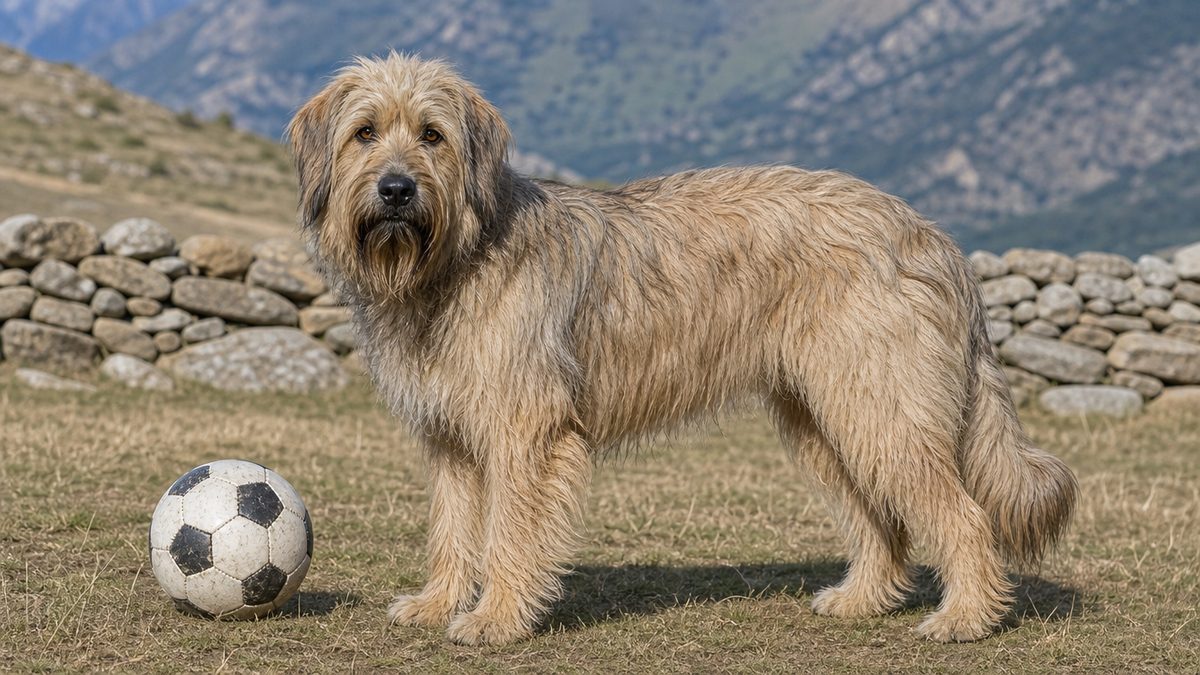
Catalonia's flock-driving dog, FCI standard 87 since 1982: one of only two Spanish breeds in the FCI's sheepdog nomenclature, carrying a heavy double coat, obligatory double hind dewclaws, and a breed standard that claims it is very resistant to heat.
Quick answer
The Catalan Sheepdog is Catalonia's flock-driving dog, 47 to 55 cm for a male under FCI standard 87, and one of only two Spanish breeds in the FCI's sheepdog nomenclature. Its own standard calls it very resistant to heat, which was written about Catalan summers, not Indian ones. Heat tolerance rates 2 of 5. No Indian price exists.
This page summarises published breed-standard text, government notifications, registry data and peer-reviewed veterinary research for general information. It is not a diagnosis and it is not treatment advice. Consult a registered veterinarian about your own dog before acting on anything here, and treat collapse, unsteadiness, vomiting during exertion or a tongue that turns dusky in heat as an emergency.
Catalan Sheepdog at a glance
What the Catalan Sheepdog actually is
The Catalan Sheepdog is a medium-sized flock-driving dog from the Catalan Pyrenees, 47 to 55 cm at the withers for a male and 45 to 53 cm for a female, carrying a long rough coat over a dense undercoat and a pair of obligatory double dewclaws on the hind feet. It is one of only two Spanish breeds the Federation Cynologique Internationale lists among its sheepdogs, and its own standard describes it as very resistant to heat, cold and all atmospherics.
Start with the document, because on this breed the document is unusually clear. FCI-Standard No. 87 is headed GOS D'ATURA CATALA (Catalonian Sheepdog), gives the origin as Spain, Catalonia, and records the date of publication of the official valid standard as 26.05.1982. It classifies the breed in Group 1 Sheepdogs and Cattle Dogs (except Swiss Cattle Dogs), Section 1 Sheepdogs, without working trial. The current document is dated 13.09.2004 and is an English translation by Mrs Peggy Davis from the official language, which is Spanish.
The standard's description of the job is worth reading in the original, because it explains the temperament section better than any breed profile does. It says that it is in the driving of flocks that the true essence of this breed manifests itself, because not only does he obey the shepherd, but in numerous cases he shows his initiative, directing the flock with marvellous ease, preventing any animal from separating from the others. This is a herding dog selected to make decisions without being told, which is a very different animal from one selected to take instruction.
| Measure | Figure | Source document |
|---|---|---|
| Height, male | 47 to 55 cm | FCI-Standard No. 87 |
| Height, female | 45 to 53 cm | FCI-Standard No. 87 |
| Height, male (inches) | 18.5 to 21.5 in | UKC standard, revised 2009 |
| Weight | No figure in any standard | FCI, RD 558/2001, Royal Kennel Club, UKC |
| Body proportion | Slightly longer than high, 9 to 8 | FCI-Standard No. 87 |
| Skull to muzzle proportion | 4 to 3 | FCI-Standard No. 87 |
| Ear width to length | 8 to 10 | FCI-Standard No. 87 |
| Scapular-humeral angle | About 110 degrees | FCI-Standard No. 87 |
| Hock angle | About 140 degrees | FCI-Standard No. 87 |
| Hind dewclaws | Double, bony, joined by a membrane | FCI-Standard No. 87 |
| FCI group and section | Group 1, Section 1, no working trial | FCI nomenclature |
| Official valid standard published | 26 May 1982 | FCI nomenclature |
The three things that make it recognisable
Three features separate this breed from every other shaggy European herder, and all three are load-bearing. The first is the double dewclaws on the hind feet, which the FCI standard specifies as bony, low set, joined together and joined to the first toe by a membrane, and whose absence is a disqualifying fault. The Royal Kennel Club goes further and calls strong, firmly set double dewclaws on the hindlegs a breed characteristic of utmost importance. The United Kennel Club makes complete lack of rear dewclaws a disqualification and lack of bone in the dewclaws a fault.
The second is the two-stage moult, which the standard describes as a typical phenomenon: the moult occurs in two times, first affecting the coat on the front part, giving the impression of two halves of dogs with different coats, then the hind part, after which everything becomes uniform again. That is not decorative trivia. It is the single most useful thing an Indian owner can know about this coat, and it is covered in the grooming sections below.
The third is the tail, which the FCI standard says may be long and going beyond the hock, or short and measuring less than 10 cm, and adds that there are also tailless subjects. A short tail on this breed can be entirely natural. That matters in India in a way it does not matter in Europe, and it gets its own section.
The FCI standard states that the Catalan Sheepdog is very vigilant, very resistant to heat, cold and all atmospherics, and that a very frugal alimentation is sufficient for him to work in extreme conditions. Royal Canin's India-facing page repeats the heat sentence word for word, the Royal Kennel Club standard calls the breed hardy and adaptable to all climates, and the British breed club says it copes no matter the weather, including boiling hot. Nobody says what heat they mean. The climate sections on this page put a number on it.
Colour is one of the harder things to describe in this breed and the standard is honest about why. Seen from a distance the dog appears unicolour, and seen close up the colour turns out to come from a mixture of hairs of different tone: fawn, brown more or less reddish, grey, black and white. The resulting basic colours are fawn in light, medium or dark tones; sable with chestnut, fawn, white and black hairs; and grey made up of white, grey and black going from silver grey to black grey. White or black spots are not admitted, though a few white hairs in a star shape on the chest are tolerated. The Royal Kennel Club records the breed standard colours as black and tan, grey, fawn and sable.
Gos d'Atura: what the names tell you, and what the FCI's own translations disagree about
The Catalan name Gos d'Atura means, literally, the dog that stops, from the Catalan verb aturar, and Catalan shepherds explain the name as the job: to stop the flock entering sown fields, to steer it between vineyards and market gardens, and to hold it to the edge the shepherd has marked. The Spanish name is Perro de Pastor Catalan, and English uses both Catalan Sheepdog and Catalonian Sheepdog.
The functional origin of the name is set out by the Catalan account most directly connected to the shepherds themselves. Writing in the Annals del Centre d'Estudis Comarcals, Xavier Gasol and Ferran Miralles explain that the work of the gos d'atura is precisely to aturar the flock so it does not enter the sown fields, to lead it between vineyards and vegetable plots, to chase and bring back escaping sheep, and to fer vores, which means not letting the flock cross the boundary the shepherd has marked because it borders a path or is the patch of grass being saved for tomorrow.
That is a job description, not a poetic name, and it explains a Catalan peculiarity. The same article contrasts Catalonia with the Castilian transhumance run by the Mesta, arguing that Catalan flocks had to move through broken, forested country and a complex mosaic of gardens, sown ground and vines, which generated one concrete need: to stop and control the movements of the flock. The breed is named after the constraint that produced it.
| Name | Language | Where it is the official form |
|---|---|---|
| Gos d'Atura Catala | Catalan | FCI nomenclature, all three FCI language versions |
| Perro de Pastor Catalan | Spanish | RSCE breed page, annex to Real Decreto 558/2001 |
| Catalonian Sheepdog | English | FCI English translation, United Kennel Club |
| Catalan Sheepdog | English | Royal Kennel Club, Wikipedia, most English breed pages |
| Chien de Berger Catalan | French | FCI French translation |
| Ca d'arrest | Catalan | Catalan Wikipedia, as an alternative Catalan name |
The FCI's own three versions do not say the same thing about where the breed comes from
Here is a small discrepancy that nobody has published, and it is checkable in ninety seconds. All three FCI language versions of standard 87 carry the same document date, 13.09.2004, and the same official publication date, 26.05.1982. The English version gives ORIGIN: Spain, Catalonia. The Spanish version, which is the official language of the standard, gives ORIGEN: Espana, with no mention of Catalonia. The French version gives ORIGINE: Espagne, likewise.
The Real Sociedad Canina de Espana's own breed page reproduces the Spanish text and gives the origin as Espana. So the word Catalonia in the origin field exists only in the English translation of a document whose authoritative language is Spanish. Both versions carry the same brief historical summary, that the breed originates from the Catalan Pyrenees and has propagated to all other pastoral zones of Catalonia, so nothing substantive turns on itFederation Cynologique Internationale. It is worth knowing anyway, because an answer engine reading only the English field will report a region of origin the source document does not state.
If you ever need to look this breed up in a database, search Catalonian Sheepdog as well as Catalan Sheepdog. Europe PMC returns the two 1992 Jordana genetics papers under Catalonian Sheepdog and returns nothing relevant under Catalan Sheepdog. One spelling finds the only real literature this breed has; the other finds a mastectomy series and an otitis trial.
One further naming trap is worth flagging because it produces a wrong dog rather than a wrong word. DogBreedsList, ranking on page one of an India-located search, gives the origin as Spain and Andorra. No standard mentions Andorra. The FCI, the Royal Kennel Club, the United Kennel Club and the Spanish national annex all give SpainThe Royal Kennel Club, Breed StandardUnited Kennel Club, Breed StandardsReal Decreto 558/2001, de 25 de mayo. Andorra sits inside the Pyrenean range the breed came from, so the claim is geographically plausible and documentarily unsupported, which is the most common way a breed page goes wrong.
From 1929 to near-extinction and back: what the Catalan record actually says
The Catalan Sheepdog was the first Spanish dog breed to be recognised as a breed, its first standard was written in 1929 from two show winners, it then nearly disappeared between the 1930s and 1970, and it was rebuilt from a handful of farm dogs by one breeder in the 1970s and a club founded in 1982. That sequence is documented in Catalan sources and mangled in English ones.
Gasol and Miralles put the founding moment precisely. In Spain, they write, it was not until 1929 that the first canine breed was recognised nationally and internationally: the gos d'atura catala. The two dogs chosen as the representative specimens were Tac and Iris, bred by Joan Pascual and winners of the VII Exposicio Canina Internacional de Barcelona, and the first official standard of the breed was drafted from them. Catalan Wikipedia carries the same pair and the same 1929 date for the standard.
What followed was not a success story. The same account says that despite that moment of glory in 1929, very few gos d'atura were seen in the following years, and those that were seen were of highly variable and heterogeneous quality; that until 1970 very few specimens were entered in the LOE, the Spanish studbooks; and that those that were entered lacked any recorded parentage, being isolated cases of recovery with no continuity and no part in any express programme of selection.
Why it collapsed, in the shepherds' own terms
The collapse had a specific mechanism and it is worth understanding because it recurs. As tourism opened up the Pyrenees, foreign breeds arrived with it, and the native dog entered a process of crossbreeding in which its type was diluted and lost. For most Catalans at the time, foreign breeds were simply prettier, because other countries had begun selectively breeding their own dogs earlier, while the Catalan dog was regarded as the ordinary farm dog, the rustic countryman's dog. Mixed with other breeds and abandoned by dog breeders, the gos d'atura practically disappeared.
Greenfield Puppies, ranking in India, tells the same story in one line, saying the breed almost disappeared after the Second World War. The British breed club dates the crash to the 1950s and 1960s, when farms closed and people moved to the towns, so demand for the Catalan's skills fell and the breed dwindled to just a few dogs. The Catalan account, which names the mechanism as crossbreeding rather than simple decline, is the more useful one.
| Year | Event | Source |
|---|---|---|
| 1929 | First standard drafted from Tac and Iris at the VII Barcelona international show | Annals del Centre d'Estudis Comarcals |
| 1957 | First doctoral thesis on the breed, by Joaquim Capdevila i Pons of Les Llosses | Annals del Centre d'Estudis Comarcals |
| After 1957 | Madrid veterinary faculty sets up an experimental kennel from Ripolles and Girona dogs | Annals del Centre d'Estudis Comarcals |
| 1970s | Angel Jorba begins rigorous selective breeding under the Laketania affix from dogs found in Solsones and Bergueda | Annals del Centre d'Estudis Comarcals |
| 1972 | Angel Jorba and Maria Gudayol present Tina and Menut in Barcelona | Catalan Wikipedia |
| 1982 | Club del Gos d'Atura Catala founded; a new standard is drafted | Annals del Centre d'Estudis Comarcals, Institut d'Estudis Catalans |
| 26 May 1982 | FCI official valid standard published | FCI nomenclature and FCI-Standard No. 87 |
| 24 November 1989 | Generalitat de Catalunya creates the breed's studbook | DOGC num. 1227 |
| 1 July 2006 | United Kennel Club recognition | UKC breed standard |
The 1982 date matters more than it looks, because it reconciles two things English sources treat separately. The Catalan account says the club was created in 1982 and that a new standard was drafted at that point. The Institut d'Estudis Catalans independently dates the Club del Gos d'Atura Catala to 1982. The FCI's official valid standard is dated 26 May 1982. Three sources, one year, one event. English Wikipedia instead says a new standard was prepared in 1982 and modified at the time of the formation of the club in 1984, which splits one event into two and gets the club's year wrong.
Several ranking pages state that the breed served as a messenger and sentry during the Spanish Civil War, including the British breed club and Greenfield PuppiesGreenfield Puppies. Enciclopedia.cat, a Catalan reference work, instead singles out the breed's use during the First World War. Neither claim is sourced to a primary record in any document this page could open, and the two are not the same war. Bonbeno reports both attributions and asserts neither.
Exactly what recognition this breed holds, and from whom
The Catalan Sheepdog holds full FCI recognition as standard number 87 in Group 1 Section 1, a place in the annex of Spain's Real Decreto 558/2001, a studbook created by the Generalitat de Catalunya in 1989, a Royal Kennel Club breed standard in the Pastoral group, and United Kennel Club recognition from 1 July 2006. That is an unusually complete ladder for a rare breed, and every rung was checked against its own document.
Take the FCI first, because it is the rung most often stated loosely. The FCI's Group 1 nomenclature lists sheepdogs country by country. Under country 15, SPAIN, there are exactly two entries: GOS D'ATURA CATALA (87), the Catalan Sheepdog, and CA DE BESTIAR (321), the Majorca Shepherd Dog, both valid from 26 May 1982. There is no third Spanish sheepdog. This page's sibling guide to the Carea Leones reports the same two entries from the same list, and this build re-read the page and reproduces it independently.
| Rung | Status | Instrument |
|---|---|---|
| FCI definitive nomenclature | Recognised, standard 87 | FCI Group 1, Section 1, country 15 SPAIN |
| FCI official valid standard | Published 26 May 1982 | FCI-Standard No. 87, current document 13.09.2004 |
| FCI working trial | Not subject to one | FCI-Standard No. 87 |
| Spanish national list of canine breeds | Listed, 12th of 33 | Annex to Real Decreto 558/2001, consolidated 2020 |
| Spanish national prototype | Printed in full, pages 12 to 14 | Annex to Real Decreto 558/2001 |
| Catalan register of the breed | In force from 16 April 1986 | Resolucio cited in DOGC num. 1227 |
| Catalan studbook | Created 24 November 1989 | ORDRE, DOGC num. 1227 of 4 December 1989 |
| Royal Kennel Club | Recognised, Pastoral group, own standard | RKC breed standard, updated 1 April 2025 |
| United Kennel Club | Recognised 1 July 2006, Herding Dog Group | UKC breed standard, revised 2009 |
| RSCE breed page | Published with the FCI-recognised Spanish breeds | RSCE Razas Espanolas index |
The Spanish national rung, and one detail the FCI page hides
Spain lists its own dog breeds in the annex to Real Decreto 558/2001, and the consolidated text last modified 27 July 2020 opens that annex with an alphabetical list of 33 Spanish canine breeds. Gos d'Atura Catala (Perro de Pastor Catalan) is the twelfth, sitting between Galgo Espanol and Gos Rater Valencia. Unlike the Carea Leones, which is listed without a prototype, this breed gets a full printed prototype in the same annex, running from page 12 to page 14 and reproducing what is recognisably the 1982 standard in Spanish.
One detail on the FCI's own list is worth reading carefully, because it is the beginning of the answer to the disputed Cerda question. In the FCI's Group 1 markup, the Ca de Bestiar row is followed by a varieties table listing a) SHORT-HAIRED and b) LONG-HAIRED. The Gos d'Atura Catala row carries no varieties table at all. Both breeds were admitted on the same day from the same country, and the FCI recorded two varieties for one of them and none for the other.
English Wikipedia states that the first breed standard was drawn up in 1929 and was adopted by the FCI when it definitively accepted the breed in 1954. The FCI's own nomenclature gives the Gos d'Atura Catala a validity date of 26 May 1982, and its standard document prints 26.05.1982 as the date of publication of the official valid standard. Those are different questions, since a breed can be accepted long before its current standard is published, and the FCI's public nomenclature does not publish an earlier acceptance date for this breed. Bonbeno reports the FCI's date as the FCI states it and flags that Wikipedia's 1954 is not visible in any FCI document this build could open.
The Real Sociedad Canina de Espana publishes the breed among the Spanish breeds the FCI recognises, on its own page, giving Estandar FCI N 87 / 13.09.2004 / E, the Group 1 Section 1 classification, and the full Spanish standard text. That page sits in the first block of the RSCE's Razas Espanolas index, ahead of the ethnic groups and the breeds in recovery. So the Spanish kennel club, the Spanish state and the FCI agree on this breed, which is not something that can be said of most Spanish native dogs.
The Gos d'Atura Cerda: four Catalan sources, four different answers
The short-haired Gos d'Atura Cerda is contested, and the contest is real rather than a matter of loose writing. FCI standard 87 and Spanish national law do not mention it at all, one Catalan encyclopedia calls it a variety of the breed, the Institut d'Estudis Catalans calls the short-haired and the Cerda the same thing, Catalan Wikipedia treats them as two separate unrecognised subgroups, and a bibliography from a Barcelona veterinary geneticist lists them as separate breeds.
Every English page ranking for this breed offers one uncited sentence on the question. Wikipedia says there is also a short-haired variety of this breed, but it is nearly extinct, and DogBreedsList reproduces that sentence word for word. Neither names the variety, cites a source, or gives a figure. The Catalan record is far richer and far less settled.
Position one: the documents in force say nothing
FCI-Standard No. 87 contains no variety at all. It describes one coat: long, flat or very slightly wavy, rough, with abundant undercoat on the whole of the posterior third of the body. The Spanish and French versions of the same standard likewise describe a single coatFederation Cynologique Internationale. The FCI's Group 1 nomenclature attaches no varieties row to this breed, while attaching one to the Ca de Bestiar in the same country block.
Spanish national law is equally silent. A search of the full 73-page consolidated text of Real Decreto 558/2001 returns zero occurrences of the string Cerd anywhere in the document, and the printed prototype for the Perro Pastor Catalan describes one coat. That absence is not an artefact of a decree that cannot handle varieties: the same annex lists Euskal Artzain Txakurra variedad Iletsua and Euskal Artzain Txakurra variedad Gorbeiakoa as two separately named entries, and the Ca de Bestiar prototype says in terms that the long coat creates a sub-breed. Spanish law knows exactly how to record a variety. It has not recorded one here.
Positions two, three and four: the Catalan sources
| Source | Position | Distinguishing features given |
|---|---|---|
| FCI-Standard No. 87 | Does not exist as a variety | One coat only |
| Real Decreto 558/2001 annex | Does not exist; zero occurrences of Cerd | One coat only |
| Enciclopedia.cat | A variety of the gos d'atura | Longer tail, shorter coat |
| Institut d'Estudis Catalans, 2019 | One of two varieties; short-haired and Cerda are the same thing | Long-haired and short-haired or Cerda |
| Catalan Wikipedia | Two separate unrecognised subgroups, plus an Aranese one | Cerda and short-haired listed as different subgroups |
| AgroCultura list of Catalan breeds | Separate entries in a breed list | Gos d'atura de pel curt and Gos d'atura de Cerdanya listed separately |
Enciclopedia.cat, in its natural history of the Catalan Countries, describes the gos d'atura and then adds, in one sentence, that a variety exists, the gos d'atura cerda, with a longer tail and shorter coat. Two morphological features, one variety, no population figure. That same encyclopedia records three coat varieties for the Ibizan Hound and a smooth-faced variety of the Pyrenean Sheepdog, so it does record varieties where it thinks they exist.
The Institut d'Estudis Catalans, in a 2019 volume co-authored by the Universitat Autonoma de Barcelona veterinary geneticist Jordi Jordana, states flatly that the Gos d'Atura Catala has two varieties, de pel llarg i de pel curt o cerda, long-haired and short-haired or Cerda. That formulation makes short-haired and Cerda synonyms.
Catalan Wikipedia disagrees with that synonymy. It says that within the Pyrenean group it has been possible to select isolated subgroups such as the gos d'atura aranes, the gos d'atura cerda and the gos d'atura catala de pel curt, though none of them holds any official recognition. Read literally, that is three subgroups, with the Cerda and the short-haired listed as different things.
A list of Catalan native breeds published in AgroCultura and republished on Jordi Jordana's own site goes furthest, printing Gos d'atura catala, Gos d'atura de pel curt, Gos d'atura de Cerdanya and Gos d'atura aranes as four separate line entries in a table of Catalan breeds. On that reading they are not varieties of one breed at all.
What can honestly be said about the Cerda, and the one time anyone measured it
One study has actually sampled the Cerda, and it found the Cerda and the ordinary Catalan Sheepdog almost genetically indistinguishable at the loci tested. Jordana, Piedrafita and Sanchez took 93 Gos d'Atura blood samples in their 1992 biochemical study and split them into two subpopulations, GA1 Tipico with 59 dogs and GA2 Cerda with 34, and the average genetic distance between those two subpopulations came out at 0.003.
Table I of the 1992 Genetics Selection Evolution paper is explicit. The ten Spanish breeds sampled comprised 484 blood samples in total, and the Gos d'Atura contributed 93, the largest single breed sample in the study, distributed as GA1 Tipico (59) and GA2 Cerda (34). Twenty-one structural genic loci coding for blood-soluble proteins and enzymes were analysed by electrophoresis, of which eleven proved polymorphic and ten were monomorphic across all populations.
Now the number that settles what the question can and cannot be. Table V of the same paper gives the average Nei genetic distance among subpopulations of the same breed. For the Gos d'Atura the value is 0.003, with a range of 0.003 to 0.003, because there are only two subpopulations and therefore only one pairwise comparison. Set that against the paper's own scale: the average distance between different Spanish breeds was 0.0197 with a standard deviation of 0.0128, running from 0.000 for the Gos d'Atura and Podenco Iberico pair to 0.051 for the Mastin Espanol and Ca de Bestiar pair.
| Comparison | Nei genetic distance | What it is being compared with |
|---|---|---|
| Gos d'Atura tipico against Gos d'Atura Cerda | 0.003 | The two subpopulations of one breed |
| Average between any two Spanish breeds | 0.0197 | Ten breeds, all pairs |
| Mastin Espanol against Ca de Bestiar | 0.051 | The most distant pair in the study |
| Gos d'Atura against Podenco Iberico | 0.000 | The least distant pair in the study |
| Mastin del Pirineo, within-breed average | 0.023 | A breed whose subpopulations do differ |
| Podenco Ibicenco, within-breed average | 0.019 | A breed whose subpopulations do differ |
| Sabueso Espanol, within-breed average | 0.015 | A breed whose subpopulations do differ |
The comparison inside that table is the interesting part, and the paper draws it itself. For three of the ten breeds studied, the Mastin del Pirineo, the Sabueso Espanol and the Podenco Ibicenco, the genetic distance between subpopulations of the same breed was in some cases greater than the distance between different breeds, which the authors attribute mainly to genetic drift in small subpopulations. The Gos d'Atura is not one of those three. Its two subpopulations sit at 0.003, which the paper places in the group where genetic differentiation among subpopulations of the same breed is nearly null.
On the evidence available in 2026, the Gos d'Atura Cerda is a named Catalan population that existed in sufficient numbers to be sampled in 1992, that carried a shorter coat and, on one encyclopedia's account, a longer tail, and that at 21 protein and enzyme loci was almost indistinguishable from the ordinary Catalan Sheepdog. It holds no recognition from the FCI, from Spanish national law, from the Royal Kennel Club or from the United Kennel ClubReal Decreto 558/2001, de 25 de mayoThe Royal Kennel Club, Breed StandardUnited Kennel Club, Breed Standards. Whether it survives today is not answerable from any source this page could open, and Bonbeno publishes no population figure for it.
Two further points keep the question open rather than closing it. First, the 1992 distance was measured on protein and enzyme variation, not on the microsatellite or genome-wide markers that a modern study would use, and the same paper concedes that these loci are deliberately chosen for known polymorphism, which biases the estimates. A coat-length difference is a single-locus trait and would not necessarily show up at all in that panel. Second, Catalan Wikipedia notes that its population count of more than 4,000 excludes the pel curt and cerdana varieties that fall outside the canons the club currently fixes for the breed, which is a statement that they still exist and are simply not counted.
For an Indian reader the practical consequence is short. Any dog offered anywhere as a short-haired or Cerda Catalan Sheepdog is, under every standard in force, outside the breed as recognised, and could not be registered as a Catalan Sheepdog by the FCI, the Royal Kennel Club or the United Kennel ClubThe Royal Kennel Club, Breed StandardUnited Kennel Club, Breed Standards. That is a documentary fact about paperwork, not a judgement about the dog.
Catalonia's own instruments: a 1986 register, a 1989 studbook, and a hip-screening mandate
Catalonia regulates this breed directly, and it has done so since the 1980s. A register of the gos d'atura came into force by resolution of 16 April 1986, an order of 24 November 1989 created the breed's studbook, and article 3 of that order requires the genealogical documentation of any gos d'atura used for breeding to carry a veterinary radiological diagnosis of hip dysplasia.
The instrument is short enough to read in full and important enough to quote precisely. ORDRE de 24 de novembre de 1989, per la qual es crea el llibre genealogic del gos d'atura catala was issued by the Departament d'Agricultura, Ramaderia i Pesca, published in the Diari Oficial de la Generalitat de Catalunya number 1227 of 4 December 1989 under control number 89326041, and signed by the conseller Josep Miro i Ardevol. The Portal Juridic de Catalunya records it as in force.
It has three articles. Article 1 creates the studbook of the gos d'atura catala. Article 2 provides that dogs of this breed used for reproduction within the territory of Catalonia must be entered in the studbook. Article 3 provides that the genealogical documentation of gos d'atura used for reproduction shall carry the radiological diagnosis of hip dysplasia carried out by a veterinarian.
Dozens of English breed pages state that Catalan Sheepdogs are prone to hip dysplasia, and none of them cites anything. Wikipedia's health section for this breed is one sentence long and carries no reference for it. What does exist is this: in 1989 the Catalan government made a veterinary hip radiograph a condition of the breeding paperwork for this specific breed. That is not a prevalence figure and this page does not present it as one. It is, however, the oldest hard evidence that the people responsible for the breed took hip dysplasia seriously enough to legislate about it.
The order's preamble also dates the rung below it. It records that it takes account of the data held in the register book of the gos d'atura brought into force by the Resolution of 16 April 1986, published in DOGC number 692. So Catalonia had a register of this breed three years before it had a studbook, which is the same two-step pattern Spanish autonomous communities have used for other native breeds.
The one dog among fourteen Catalan native breeds
The Institut d'Estudis Catalans lists fourteen recognised autochthonous breeds of Catalonia, entered on the Spanish agriculture ministry's ARCA database on the strength of data from the breed associations and the Catalan agriculture department. Thirteen are livestock: the Bruna dels Pirineus, Albera and Pallaresa cattle, the Aranesa, Ripollesa and Xisqueta sheep, the Blanca de Rasquera goat, the Cavall Pirinenc Catala, the Ase Catala, and four poultry breeds. The fourteenth is the Gos d'Atura Catala, and it is the only dog on the list.
Read the entries side by side and one difference stands out. Every livestock entry names the year its studbook was regulated and cites the DOGC number: the Bruna dels Pirineus in 1990 at DOGC 1349, the Ripollesa sheep in 1991 at DOGC 1413, the Ase Catala in 2002 at DOGC 3608, the Cavall Pirinenc Catala in 2008 at DOGC 5122. The Gos d'Atura entry names only the club, founded in 1982, and no DOGC studbook reference at all.
That is a gap in the summary rather than a gap in the law, and this page can close it, because the 1989 order exists and is in force. It is worth naming the discrepancy because it is exactly the kind of silence a reader would take as an absence. The Catalan dog does have a legally created studbook. It simply predates every livestock studbook on that list by at least a year, and the 2019 summary did not record it.
| Instrument | Date | What it does |
|---|---|---|
| Resolucio | 16 April 1986 | Brings a register book of the gos d'atura into force, DOGC 692 |
| ORDRE | 24 November 1989 | Creates the studbook, DOGC 1227 of 4 December 1989 |
| Article 2 of that order | 24 November 1989 | Makes studbook entry compulsory for breeding dogs in Catalonia |
| Article 3 of that order | 24 November 1989 | Requires a veterinary hip-dysplasia radiograph on the breeding papers |
| ARCA listing | Current | The breed is one of 14 recognised Catalan autochthonous breeds |
One caveat belongs on the record. The Portal Juridic de Catalunya states that its consolidated texts do not have official character. The text quoted above is the published text as the portal serves it, under the heading TEXT PUBLICAT, and the portal records one subsequent affectation on the document. Anyone relying on this order for a legal purpose should read the official DOGC issue rather than this page.
The breed standard in numbers, and the one number no standard gives
Four breed standards govern this dog, and all four give height and none gives weight. FCI-Standard No. 87 sets 47 to 55 cm for males and 45 to 53 cm for females, with more than 3 cm over or under those limits a disqualifying fault, and Spain's national annex, the Royal Kennel Club and the United Kennel Club all reproduce the same height band in their own units.
The FCI numbers are the reference point everything else is measured against. Height at withers is from 47 to 55 cm for dogs and from 45 to 53 cm for bitches. Body proportion is slightly longer than high, approximately 9 to 8. The skull-muzzle proportion is 4 to 3, the ear width to length ratio is 8 to 10, the scapular-humeral angle about 110 degrees, the humeral-radial angle about 135 degrees, the coxal-femoral angle about 115 degrees, the femoral-tibial angle about 120 degrees and the hock angle about 140 degrees.
| Standard | Males | Females | Tolerance |
|---|---|---|---|
| FCI-Standard No. 87 | 47 to 55 cm | 45 to 53 cm | More than 3 cm over or under is a disqualifying fault |
| Annex to Real Decreto 558/2001 | 47 to 55 cm | 45 to 53 cm | More than 3 cm over or under is an eliminating fault |
| Royal Kennel Club | 47 to 55 cm (18.5 to 21.5 in) | 45 to 53 cm (17.75 to 20.5 in) | None stated; ideal height only |
| United Kennel Club | 18.5 to 21.5 in | 17.5 to 20.5 in | More than one inch over or under is an eliminating fault |
The weight every English page prints, and where it comes from
No breed standard for the Catalan Sheepdog gives a weight. The FCI standard's SIZE section contains height only. The Spanish national prototype in the annex to Real Decreto 558/2001 gives height only. The Royal Kennel Club's SIZE section gives ideal height only. The United Kennel Club's Height and Weight section, despite its name, gives height only.
Four different weight figures nonetheless circulate on the pages ranking for this breed in India. English Wikipedia gives 47 to 55 cm and 20 to 25 kg for males, 45 to 53 cm and 17 to 21 kg for females, in a section headed Size and weight that cites no source for the weights. DogBreedsList reproduces exactly those figures, converted to 44 to 55 pounds and 37 to 46 pounds. Purina UK gives 16 to 20 kg with no sex split. Those two ranges barely overlap: Purina's ceiling is below Wikipedia's floor for a male.
Treat every published weight for a Catalan Sheepdog as an estimate somebody made, because that is what it is. If a seller or a page quotes you 25 kg as the breed weight, ask which standard it comes from, and the honest answer is none of them. The useful anchor is height, which four independent bodies agree on to the centimetre, plus body condition score, which is what your vet will actually assess. A 50 cm herding dog in working condition is a lean dog you can feel the ribs of under a heavy coat, and the coat is exactly why owners of this breed overfeed it.
Two further constraints in the standard are worth carrying to a viewing. The nose must be black, and a brown nose is a disqualifying fault, as is lack of pigmentation of the lips, nose, eyelids and palate. Blue eyes are a disqualifying fault, and the eyes should be round and dark amber with black rims. The United Kennel Club adds albinism and lack of complete black pigment of the eye rims to its disqualification list. So a Catalan Sheepdog with pale eyes and a pink nose is not a rare colour variant; it is a dog outside every standard.
The teeth requirement is stricter than most people expect. The FCI standard disqualifies a dog missing more than 2 PM or any two teeth, and makes 2 PM missing a serious fault. It also notes that blunt canines are admitted in working dogs, which is a concession to dogs that have spent years gripping livestock. The United Kennel Club repeats both the fault and the disqualification in the same terms.
Four standards, four rulebooks, and where they part company
The four standards governing this breed agree on height and disagree about mutilation, faults and what counts as a defect. The FCI and the United Kennel Club both accept cropped ears in working dogs and a docked tail; the Royal Kennel Club drops both permissions and says only that the dog may be born tailless; and Spain's national prototype omits four of the FCI's disqualifying faults and contains two outright translation errors.
Diffing them line by line is the single most useful thing anyone can do with this breed's paperwork, and nobody has published the result. Here is what changes.
| Element | FCI 87 | Royal Kennel Club | United Kennel Club |
|---|---|---|---|
| Cropped ears | Accepted for working dogs | Not mentioned at all | Acceptable in working dogs |
| Docked tail | Admitted for working dogs | Not mentioned at all | Listed among acceptable tails |
| Naturally short tail | Under 10 cm, accepted | Not mentioned | Naturally bobbed, accepted |
| Taillessness | Tailless subjects exist | May be born tailless | Tailless accepted |
| Rear dewclaws | Double; absence disqualifies | Double, of utmost importance | Double; complete lack disqualifies |
| Blue eyes | Disqualifying fault | Not listed | Disqualification |
| Aggressive or overly shy | Disqualifying fault | Not listed | Viciousness or extreme shyness disqualifies |
| Albinism | Not listed | Not listed | Disqualification |
| Size deviation | More than 3 cm disqualifies | None stated | More than one inch eliminates |
| Other colours | White or black spots not admitted | Any other colour unacceptable | White or black spots disqualify |
The mutilation clauses are the ones that matter to an Indian reader and they are covered in their own section below. The direction of travel is clear enough here: the FCI text, written in Spain in 1982 for a working population, accommodates cropping and docking; the Royal Kennel Club standard, last updated 1 April 2025 in a jurisdiction that has restricted docking, simply does not contain them, saying of the tail only that it is low set, reaches below the hock, and may be born tailless.
Two errors in the Spanish national text, and the control that proves they are errors
Spain's national prototype in the annex to Real Decreto 558/2001 is a Spanish rendering of the same 1982 standard, and it contains two negations that reverse the meaning. Where the FCI text says the BODY is slightly elongated, strong, muscled, giving an impression of power and agility, the Spanish annex prints ligeramente alongado, fuerte, musculoso, no da impresion de potencia y agilidad, which says it does not give an impression of power and agility. Where the FCI text says the gallop is only obtained in very large spaces, the Spanish annex prints Galope solo logrado en espacios muy cortos, very short spaces.
The control that settles this is the Real Sociedad Canina de Espana's own Spanish text of the same standard, which reads dando sensacion de fuerza y agilidad and El galope solo se obtiene en espacios muy grandes. So the Spanish kennel club and the FCI agree, and the national decree's annex is the odd one out on both clauses. It is a drafting slip in a legal text rather than a different breed description, but it is in the Boletin Oficial del Estado and it has been there since 2001.
The FCI standard's disqualifying-fault list contains thirteen items. The annex to Real Decreto 558/2001 reproduces nine of them and omits four: aggressive or overly shy, any dog clearly showing physical or behavioural abnormalities, lack of dewclaws or interdigital membranes, and all the nails whiteReal Decreto 558/2001, de 25 de mayo. The RSCE's current Spanish text carries all four. The most consequential omission is the dewclaw one, since the double hind dewclaw is the breed's signature feature and its absence disqualifies under the FCI, the RSCE and the United Kennel Club, but not under the text printed in Spanish national lawReal Sociedad Canina de EspanaUnited Kennel Club, Breed Standards.
The United Kennel Club's height band is the FCI's converted to inches, and the conversion narrows it slightly at both ends. 18.5 inches is 46.99 cm against the FCI's 47, and 21.5 inches is 54.61 cm against the FCI's 55Federation Cynologique Internationale. For bitches, 17.5 inches is 44.45 cm against 45, and 20.5 inches is 52.07 cm against 53. Nothing turns on a few millimetres, but a judge working to inches and a judge working to centimetres are not applying identical limits.
Registration figures, year by year, and what they add up to
The Royal Kennel Club registered 8 Catalan Sheepdogs in the United Kingdom in 2024 and 14 in 2025, and none at all in the first two quarters of 2026. Both annual totals were checked by summing the printed quarters, and both sum exactly. Against 10,442 Pastoral-group registrations in 2024, that is 0.077 percent of the group.
The Royal Kennel Club publishes quarterly breed registration statistics as a one-page PDF per group, and the Pastoral sheet carries the Catalan Sheepdog. The 2024 and 2025 sheet gives the breed 1, 6, 1 and 0 across the four quarters of 2024 against a printed year total of 8, then 1, 3 and 10 for the first three quarters of 2025. The 2025 and 2026 sheet completes the year, giving 1, 3, 10 and 0 for 2025 against a printed year total of 14, and 0 in each of the first two quarters of 2026.
Both tables were checked by arithmetic rather than trusted. 1 plus 6 plus 1 plus 0 is 8, matching the printed 2024 total, and 1 plus 3 plus 10 plus 0 is 14, matching the printed 2025 totalThe Royal Kennel Club. The group rows sum correctly too: the Pastoral quarters of 2024 are 2,416, 2,860, 2,576 and 2,590, which sum to the printed 10,442, and the all-groups grand total of 187,772 is the sum of 44,592, 53,190, 48,910 and 41,080.
| Breed or group | 2024 | 2025 | 2026 to Q2 |
|---|---|---|---|
| Catalan Sheepdog | 8 | 14 | 0 |
| Bergamasco (Imp) | 3 | 9 | 1 |
| Briard | 63 | 28 | 38 |
| Bearded Collie | 209 | 158 | 117 |
| Australian Shepherd | 356 | 364 | 192 |
| Border Collie | 1,463 | 1,292 | 688 |
| German Shepherd Dog | 4,817 | 4,278 | 2,078 |
| Pastoral group total | 10,442 | Not yet published | Not yet published |
| All groups grand total | 187,772 | Not yet published | Not yet published |
Put those next to each other and the scale is clear. In 2024 the United Kingdom registered one Catalan Sheepdog for every 602 German Shepherd Dogs and one for every 183 Border Collies. The breed accounted for 0.077 percent of Pastoral registrations and 0.0043 percent of all Kennel Club registrations that year. In a country with a functioning breed club, an active show scene and a published breed standard, this is a dog that produces roughly one litter a year.
Why the 2026 zeros are not necessarily bad news
A breed registering 8 then 14 then 0 and 0 is not collapsing; it is a population small enough that a single litter moves the annual figure by half. The 2025 third quarter alone carried 10 registrations, which on a breed this size is one large litter reaching paperwork. Reading two consecutive empty quarters as a decline would be over-reading, and reading a jump from 8 to 14 as growth would be over-reading in the other direction. What both years establish reliably is the order of magnitude: single digits to low tens per year in a country that is not the breed's home.
These numbers were read on 25 August 2026 from the Royal Kennel Club's current quarterly sheets, and the 2026 rows are incomplete by design, since the sheet stops at the second quarter. Registration tables are revised as late paperwork lands, so a reader checking these figures in a year should expect the 2026 row to have filled in and should not assume this page's numbers are the current ones.
In Spain, the picture is harder to see, because the Real Sociedad Canina de Espana does not publish per-breed registration figures on the pages this build could open. The breed club's own records give a different kind of series: the Club del Gos d'Atura Catala held its XXXIX Monografica at Banyoles on 16 November 2019 with 62 dogs entered, and the club's own report notes that the historical average entry at the Monografica is 69 dogs. The club publishes yearbooks for 2017, 2018, 2019, 2022 and 2023, so the series is documented but not continuous.
How many exist: 4,000, about 6,000, or nobody has counted the ones that matter
Two Catalan sources give a total population and they do not agree. The Institut d'Estudis Catalans puts it at about 6,000 specimens with half in Catalonia and half abroad, while Catalan Wikipedia counts more than 4,000 and says explicitly that the count is low because it excludes farm dogs and the short-haired and Cerdana varieties. Neither figure is a census.
The higher figure comes with the most detail. The Institut d'Estudis Catalans, writing in 2019, says the Gos d'Atura Catala is found throughout Catalonia with a predominance in the central and northern comarques, that there are about 6,000 specimens, and that 50 percent are in Catalonia and 50 percent outside it, principally in Spain, France, Germany, Sweden, Finland, Holland, Great Britain, Italy, Switzerland and Hungary. It names the Club del Gos d'Atura Catala, founded 1982, as the breed association.
Catalan Wikipedia gives the lower figure and, unusually, says what it leaves out. It records more than 4,000 specimens, then adds that these are figures on the low side because the count excludes specimens that are not from specialist breeding and still exist on farms, and excludes the pel curt and cerdana varieties which fall outside the canons the club currently fixes for the breed. On that basis it concludes the breed is now out of danger.
| Figure | Source | What it includes |
|---|---|---|
| About 6,000 specimens | Institut d'Estudis Catalans, 2019 | Worldwide; half in Catalonia, half abroad |
| More than 4,000 specimens | Catalan Wikipedia | Excludes farm dogs and the short-haired and Cerdana varieties |
| 8 registered in 2024 | Royal Kennel Club | United Kingdom registrations that year only |
| 14 registered in 2025 | Royal Kennel Club | United Kingdom registrations that year only |
| 62 dogs entered | Club del Gos d'Atura Catala, 2019 | One monographic show at Banyoles |
| 69 dogs | Club del Gos d'Atura Catala | Historical average entry at the Monografica |
| 93 blood samples | Jordana et al., 1992 | The largest breed sample in a ten-breed Spanish study |
The two figures are not measuring the same thing
Do not average them. The gap between 4,000 and 6,000 is 50 percent, and the sources describe different populations. The Wikipedia figure is explicitly a count of dogs inside the club's current canons, in Catalonia. The IEC figure is explicitly worldwide, with half the dogs outside Catalonia in ten named countries. If the IEC's half-in, half-out split is right, its Catalan population is about 3,000, which sits below Wikipedia's more than 4,000 for the same territory. The two are not reconcilable as stated, and this page reports both.
The number the Catalan sources are anxious about is not the pet population, it is the working one. Gasol and Miralles argue that twenty years after the 1982 recovery the breed had taken two very different paths, one successful as a companion dog, consolidated, bred, spread and internationally recognised, and the other much less fortunate in the world of work. They describe Catalan shepherds turning to the Border Collie, the appearance of crossbreds they call Border d'Atura and Gossos Collie, and a club project, Projecte Pardu, that gives gos d'atura puppies to shepherds free and runs training courses to try to reverse it. Their line is blunt: of Border Collies there will always be purebred ones in England, but if the few remaining working gos d'atura are lost they cannot be recovered.
One thing the Royal Kennel Club settles is that this is not a breed anyone officially classes as endangered in Britain. The Kennel Club's breed page records Vulnerable native breed: No, which is the correct answer, because that designation applies only to breeds native to the United Kingdom and Ireland. A reader should not take it as a statement that the breed is numerous.
What the published genetics on this breed actually found
Three peer-reviewed papers have studied this breed's genetics, all from the same Barcelona group in 1992, and all three are about where it sits among Spanish breeds rather than about its health. The largest sample was 93 Gos d'Atura blood samples across 21 protein and enzyme loci, and the study placed the breed alone in the ancestral trunk Canis familiaris metris-optimae.
Absence is a strong claim, so here are the searches and the controls, all run in one session on 25 August 2026. PubMed returns zero records for Catalan Sheepdog, where the query translation shows it searched catalan people combined with sheepdog, and zero for Catalonian Sheepdog. Those are genuine zeros with the translation recorded. Europe PMC returns the two 1992 Jordana papers under the term Catalonian Sheepdog, which is why the spelling matters.
Two apparent hits are noise and illustrate the trap this project keeps hitting. Searching Gos d'Atura in PubMed returns 7,170 records, because the query translation shows it actually ran glob surg as a journal name OR the token gos, discarding the rest. Searching Pastor Catalan returns 128, because PubMed mapped pastor to the MeSH term clergy. A result count is not evidence that your search ran.
| Query | PubMed count | Europe PMC hits | What it means |
|---|---|---|---|
| "Catalan Sheepdog" | 0 | 12 | Zero in PubMed with translation recorded; Europe PMC hits are unrelated |
| "Catalonian Sheepdog" | 0 | 3 | Europe PMC surfaces the 1992 Jordana papers here |
| "Gos d'Atura" | 7,170 | 4 | Noise; PubMed ran a journal name and the token gos |
| "Pastor Catalan" | 128 | 2 | Noise; pastor mapped to clergy |
| "Perro de Pastor Catalan" | 1 | 0 | Noise; same clergy mapping |
| Control: "Labrador Retriever" | 1,107 | 5,946 | Phrase preserved, results on topic |
| Control: "Border Collie" | 276 | 2,569 | Phrase preserved, results on topic |
| Control: "Spanish Water Dog" | 9 | 111 | Phrase preserved, results on topic |
| Control: "Pyrenean Shepherd" | 4 | 43 | Phrase preserved, results on topic |
| Control: "livestock guardian dog" | 80 | 12 | Both databases working |
Every control preserved its phrase and returned on-topic canine literature, so both tools were working when they returned nothing for this breed's name in PubMedEurope PMC REST search. That combination, a genuine PubMed zero and a real Europe PMC record set under one specific spelling, is the honest description of this breed's presence in the indexed literature.
What the 1992 papers found
The morphological paper analysed 32 morphological characters across ten Spanish breeds, nine of them then FCI-recognised plus the unrecognised Podenco Iberico. Its headline distance was that the average morphological distance between breeds was 4.228 with a standard deviation of 0.681, and the most distant pair in the entire study was the Gos d'Atura and the Sabueso Espanol at 5.099, with a mean character difference of 0.8125. The closest pair was the two mastiffs at 1.732.
The same paper assigns the breed to an ancestral trunk. Comparing morphology with European breeds of known phylogeny, it places the Gos d'Atura as the only Spanish representative of Canis familiaris metris-optimae, alongside the Berger de Brie and the Cane da Pastore Bergamasco. That is the same grouping Purina reaches for informally when it says the breed likely shares roots with the Briard, the Picardy Sheepdog, the Pyrenean Sheepdog and the Beauceron.
The biochemical paper found something different and said so. Its enzyme-based tree put the Gos d'Atura closest to the Podenco Iberico, at a Nei distance of 0.000, and next to the Galgo Espanol, which is a sighthound grouping rather than a sheepdog one. The correlation between morphological and enzymatic distances across the whole study was 0.07 and non-significant. The authors' conclusion is worth quoting for what it means to a buyer: the large morphological variability among dog breeds has no correspondence with differences at the protein and enzymatic levels, where the genetic differences among breeds are very small.
Genetic diversity now: the one modern figure, and it is not reassuring
The most recent peer-reviewed finding on this breed's genetic diversity is that none of its Kennel Club registered males born in 2015 were used for breeding at all. Ilska, Ryan and Tolhurst examined all 222 Kennel Club breeds between 1990 and 2021 and named the Catalan Sheepdog among nine breeds where the figure was zero, against a pooled 6.3 percent across 177 breeds.
The 2025 Kennel Club and Roslin Institute study is the largest thing of its kind and it looked at every breed rather than the popular ones. Its pooled estimate across 177 breeds with at least 10 males in the litter register born in 2015 was that 6.3 percent of registered males were used in breeding, with a confidence interval of 5.8 to 6.9 percent and significant variability between breeds.
The lowest percentage was found in nine breeds where none of the registered males born in 2015 were bred from, and the Catalan Sheepdog is one of the nine, alongside the Bouvier des Flandres, the Belgian Shepherd Dog (Groenendael), the Hungarian Puli, the Kooikerhondje, the Polish Lowland Sheepdog, the Portuguese Podengo, the Swedish Vallhund and the Xoloitzcuintle Standard. The breed is also marked in the paper's figure 2 as one of the extreme values at its census size.
It does not mean no Catalan Sheepdogs were bred in Britain. It means that of the male dogs of this breed registered with the Kennel Club and born in the single year 2015, not one had produced a registered litter by the study's cut-off. On a breed registering single figures a year that can happen with a single unlucky cohort, so it is a weak signal taken alone. It is a real signal taken with the registration numbers, because a breed that registers 8 dogs in a year and uses none of one cohort's males is running on a very small number of sires.
The paper's broader findings put that in context. The Kennel Club registered pedigree dog population as a whole is declining in size, the percentage of dogs used in breeding is low, and the number of imported dogs and their use in breeding have increased over time, particularly after the 2012 amendments to the Pet Travel Scheme. Its conclusion is that the significantly high variability between breeds does not support treating pedigree dogs as one population, and that management strategies must be tailored to each breed.
What the 1992 F statistics said about inbreeding across Spanish breeds
For the older picture, the third Jordana paper analysed the same ten Spanish breeds using F statistics on 21 structural loci, of which 11 were polymorphic. It estimated the deficit of heterozygotes at 4.0 percent at subpopulation level, 6.5 percent at breed level and 11.2 percent at ancestral-trunk level, with a deficit of about 17 percent in the whole population. The proportion of genetic variability attributable to differences between subpopulations, breeds and ancestral trunks was 14.2, 9.9 and 6.9 percent respectively.
Those are pooled figures across ten breeds, not a Catalan Sheepdog inbreeding coefficient, and this page does not present them as one. What they establish is the scale the group was working at: a set of Spanish native breeds with modest but real heterozygote deficits, in which the authors identified the Ca de Bestiar, the Podenco Canario and the Perdiguero de Burgos as breeds that had passed through important bottlenecks, and did not put the Gos d'Atura in that group.
The Real Sociedad Canina de Espana, Wisdom Panel and Royal Canin are running what the RSCE describes as the largest genetic study in history dedicated exclusively to Spanish autochthonous breeds and canine ethnic groups, and the RSCE is still recruiting owners to submit dogs, screening candidates on a three-generation pedigree and a photograph to avoid close relatives. No results from it were published anywhere this build could reach on 25 August 2026. Anyone researching this breed's diversity in a year or two should look there first.
The Kennel Club's own breeding guidance for this breed reflects the same concern without naming a number. Its pre-breeding health screening section lists prioritising genetic diversity as the single Good Practice item, above the eye and hip schemes it classes as Best Practice. For most breeds that slot holds a disease test. For this one, the club is telling breeders the gene pool itself is the first problem to manage.
Catalan Sheepdog price in India: there is not one, and here is what you get instead
No Indian price for a Catalan Sheepdog exists. An India-located search for the breed plus price and puppy returned no Indian seller, no rupee figure and no listing for the dog, while the same search route returned a complete three-tier Indian price market for a Labrador Retriever control in the same session. The only rupee figure the search surfaced was 2,991 for a 3D-printed figurine.
Say the negative first, because it is the most useful thing on this page for a buyer. A Firecrawl web search run with location India on 25 August 2026 for catalan sheepdog price in india puppy returned fifteen results, of which the top ten were United States and United Kingdom breed pages, a US puppy-listing site, two YouTube videos and one Etsy listing. No Indian breeder, no Indian marketplace listing and no rupee price for a live dog appeared anywhere in the result set.
The control run in the same session settles that this is a real absence rather than a broken search. Labrador retriever price in india puppy returned a full Indian market: Mr n Mrs Pet publishes a three-tier table giving Basic quality at INR 30,000 to 60,000, KCI Registered at INR 60,000 to 90,000 and Champion Bloodline at INR 90,000 to 1,20,000, with identical city rows for Hyderabad, Bangalore, Delhi, Chennai, Lucknow, Mumbai, Jaipur and Pune. Supertails, Pets Lifestyle, TradeIndia and Marshalls Petzone all returned Indian rupee ranges for the same control.
| Query | Indian sellers in the result set | Rupee figures returned |
|---|---|---|
| catalan sheepdog price in india puppy | None | Rs 2,991, for a 3D-printed figurine on Etsy |
| Control: labrador retriever price in india puppy | Mr n Mrs Pet, Supertails, Pets Lifestyle, TradeIndia, Marshalls Petzone, PetsWorld | Rs 8,000 to Rs 1,20,000 across sources |
The dollar prices that do exist, and the conversion test
Two of the pages ranking in India do publish a price, and both are in dollars for a different market. DogBreedsList gives an average of USD 1,200 to USD 1,500 and adds that the cost of a well-bred, Kennel Club registered Catalan Sheepdog pedigree puppy does not go below USD 1,200, and that with a low number of Catalan Sheepdogs in the United States you have to go on a waiting list. Lancaster Puppies gives a starting figure of around USD 1,000 in its search snippet.
Run those through the exchange rates this site uses as fabrication detectors and note what they produce, because a reader will see these numbers converted somewhere. USD 1,200 at 84.38 is Rs 1,01,256, and at 74 it is Rs 88,800. USD 1,500 at 84.38 is Rs 1,26,570, and at 74 it is Rs 1,11,000. A flat 80 gives Rs 96,000 and Rs 1,20,000. Any Indian page quoting a Catalan Sheepdog at roughly one lakh has almost certainly done exactly this arithmetic to an American figure, and is not reporting an Indian transaction.
If you meet Rs 98,999 attached to this breed on an Indian listing site, it is not a Catalan Sheepdog price. That exact figure has been caught on ten separate breed pages of one Indian listing site, three times on a single page, attached to whichever puppy is in stock, including breeds the site does not stock at all. It divides to USD 1,173.25, so it is not even a conversion; it is a rupee-native charm price. The same carousel prints Rs 92,599, Rs 94,999, Rs 76,499 and Rs 1,20,000 beside it.
Two more of the pages ranking in India are worth naming for what they do not have. DogsPlanet devotes a whole subheading to the question What is the Price of a Catalan Sheepdog, alongside 27 further subheadings covering climate, coat, grooming and whether the breed is hypoallergenic. Scrumbles, a British pet-food brand, publishes a full breed guide with sections on grooming, health and the best food for the breed. Neither carries an Indian price, an Indian seller or an Indian source, because there is none to carry. What an Indian buyer is actually being offered by the ranking set is a British and American market described in English. Anything presented to you here as an unregistered Catalan Sheepdog, or as one whose papers are coming later, is a dog with no verifiable lineage in a breed whose entire value to a buyer is that its paperwork is unusually complete.
The reason no Indian price exists is structural rather than accidental, and it is set out in the import section below. There is no lawful route to import a dog into India for breeding or trading purposes, so no Indian breeding population of this breed can form legally, so there is nothing for an Indian seller to sell. A price would require a supply chain, and the supply chain is closed at its first link.
The only lawful way this dog reaches India
One route exists, and it is not a purchase. DGFT Trade Notice 22/2022-23 makes dogs a Restricted import and permits entry only as a pet with a valid pet book in the importer's name, for research with a CPCSEA recommendation, or for Defence and Police use, states that applications for trading or breeding purposes shall be duly rejected, and limits entry to six named ports.
The Directorate General of Foreign Trade issued Trade Notice No. 22/2022-23, Guidelines for import of Pet Animals, from Vanijya Bhawan, New Delhi, dated 19 December 2022. It is five pages and this page's account is taken from the extracted text of the notice itself, not from a summary of it.
The notice sets out the import policy for ITC (HS) 01061900, other mammals including pet cats and dogs, as Restricted subject to Policy Condition 6 of the chapter. Policy Condition 7 allows import of dogs only for three specific purposes: a pet dog with a valid pet book and relevant records in the name of the importer; dogs imported by R&D organisations for research with the recommendation of the CPCSEA; and dogs for internal security by the Defence and Police Force. Policy Condition 8 states that import of commercial dogs for breeding or any other commercial activities other than those purposes is not permitted.
Paragraph 6 of the notice puts it beyond argument: any applications for trading or breeding purposes, or applications made on behalf of some other person or entity, shall be duly rejected. Paragraph 7 limits import of pet animals to the airports and seaports of Delhi, Mumbai, Chennai, Hyderabad, Bangalore and Kolkata, six entry points in all, with quarantine at a government station where required. DAHD added a seventh port, Cochin International Airport at Kochi, for pets arriving under the baggage rules in October 2024. Permanent import of up to two pets as passenger baggage without DGFT authorisation is available only to persons transferring their residence to India after two years of continuous stay abroad, and pet owners are advised to start the authorisation process at least two months before travel. The full route is set out in how to import a dog to India.
| Route | Permitted? | What it does not allow |
|---|---|---|
| Buying a puppy from a Spanish or British breeder and importing it | No | Import for trading or breeding is duly rejected |
| Bringing your own dog when you transfer residence to India | Yes, with conditions | Requires a valid pet book in the importer's name |
| Importing a pair to start Indian breeding | No | This is the case the notice names and rejects |
| Research and development import | Yes, with CPCSEA recommendation | Not a pet-ownership route |
| Defence and Police use | Yes | Not available to a private buyer |
The registry side of the same wall
Even a lawfully imported pet dog runs into a paperwork problem. India's Kennel Club is an FCI member and the FCI publishes its statistics year by year: 33,880 pure-bred dogs entered the Indian studbook in 2025, from 32,219 puppies and 7,412 litters, with 126 CAC all-breed shows, 2 CACIB shows, 28 FCI judges, 80 member clubs and 1,425,001 dogs registered since the studbook began. That is a working registry.
It is also a shrinking one. Pure-bred registrations peaked at 89,571 in 2021 and fell to 33,880 in 2025, a decline of 62 percent in four years, and puppy registrations fell from 88,261 to 32,219 over the same period. A registry contracting that fast is not one that will build a new breed's presence quickly.
Two rows in that same FCI table are not usable. The approximate total number of dogs in India is given as 157,500,000 in 2017 and 15,794,584 in 2018, a tenfold discontinuity that is a change in reporting rather than in the dog population, and the dog-owner row drops from 68,628,500 to 38,128,500 between 2024 and 2025 in the same way. The studbook rows are internally consistent and are the only ones this page uses.
The practical consequence for a reader is simple and worth stating plainly. If you already own a Catalan Sheepdog abroad and are moving to India, there is a route and this page's climate, grooming and health sections are written for you. If you are in India and want to buy one, there is no lawful supply chain that ends in your house, and anything offered to you as a Catalan Sheepdog puppy in India is a claim you should treat with extreme scepticism until DNA and paperwork say otherwise.
Natural bobtail, cropped ears, and exactly what Indian law prohibits
A short tail on a Catalan Sheepdog can be entirely natural, and Indian law does not care what a European standard permits. The United Kennel Club standard is the only one that spells out the difference, listing tails that may be long, naturally bobbed, docked or tailless, and Second Schedule Part II paragraph 6(8) of India's Dog Breeding and Marketing Rules 2017 strictly forbids tail docking and ear cropping.
Start with what the standards actually permit, because this breed is unusual in permitting a great deal. FCI-Standard No. 87 says the tail is rather low set and may be long, going beyond the hock, or short, measuring less than 10 cm, that there are also tailless subjects, and that for the working dogs a docked tail is admitted. On ears it says that for the working dogs cropped ears are accepted.
The United Kennel Club is the standard that separates the natural from the surgical in one sentence. Its tail clause reads that tails may be long, going past the hock, or naturally bobbed, docked or tailless, and its ear clause opens with Natural ears are set high and are triangular before adding that cropped ears are acceptable in working dogs. That wording is the one an Indian reader needs, because it names natural bobbing as a distinct thing.
The Royal Kennel Club takes the third position. Its tail clause says the tail is low set and reaching below the hock, describes the hook and the sabre carriage, and ends with four words: May be born tailless. There is no docking permission, no short-tail option and no mention of cropping anywhere in the standard. A standard written in a jurisdiction that restricts docking has simply dropped the clauses.
| Feature | FCI 87 | UKC | Royal Kennel Club | India, Rules 2017 |
|---|---|---|---|---|
| Long tail past the hock | Accepted | Accepted | The described norm | No issue |
| Naturally short tail under 10 cm | Accepted | Accepted as naturally bobbed | Not mentioned | No issue, it is not a procedure |
| Born tailless | Accepted | Accepted | Accepted | No issue |
| Docked tail | Admitted for working dogs | Listed as acceptable | Not mentioned | Strictly forbidden |
| Cropped ears | Accepted for working dogs | Acceptable in working dogs | Not mentioned | Strictly forbidden |
| Removal of the double dewclaws | Disqualifies the dog | Disqualifies the dog | Contradicts a feature of utmost importance | A mutilation of a body part |
What the Indian rule says, in its own words
Second Schedule Part II paragraph 6(8) of the Prevention of Cruelty to Animals (Dog Breeding and Marketing) Rules 2017, notified as G.S.R. 496(E) on 23 May 2017, provides that there shall be no tail docking, ear cropping, de-barking, de-clawing, branding, dyeing, injecting substances to enhance visual appeal, performing a surgery or procedure to camouflage or hide any defect or infirmity or any other kind of mutilation of any body part of the pup, and that any change of appearance by artificial means is strictly forbidden. The Second Schedule is headed See rules 5(2) and 6, and Rule 6 makes it binding on every breeder.
Note the paragraph number carefully, because it is the Second Schedule's paragraph 6(8) and not a Rule 6(8). The Rules' own Rule 6 is a different provision, headed Requirements to be met by breeders and establishments used for breeding or housing dogs for breeding, and what it does is make the Second Schedule mandatory. Citing it as Rule 6(8) misdirects anyone who looks it up.
If you bring a Catalan Sheepdog into India as a pet under DGFT Trade Notice 22/2022-23, you may well be bringing a dog with a naturally short tail, and that is not an issue: a natural bobtail is not a procedure and paragraph 6(8) prohibits proceduresUnited Kennel Club, Breed Standards. What you must not do is have anything done to a puppy here. The breed's own standard treats the double hind dewclaws as compulsory, and the FCI and the United Kennel Club both disqualify a dog that lacks them, so nobody should be removing them eitherUnited Kennel Club, Breed Standards. A vet who suggests taking off the hind dewclaws on this breed has not read the standard, and the Rules describe removal of a body part as mutilation.
One more clause bears on any Indian breeder tempted to select for the short tail. Second Schedule Part II paragraph 6(9) prohibits breeding to create new breeds of dogs. Selecting a bobtail line out of a breed whose recognised standard describes several tail forms is not obviously within that prohibition, but it is close enough to it that anyone contemplating it should take legal advice rather than a breeder's word.
Indian breeding law against this breed's own rulebooks
Indian law is stricter than any of this breed's standards on two points that matter to a tiny population. Second Schedule Part II paragraph 6(3) prohibits in-breeding, defined as mating dogs with at least one common ancestor within four generations, and Part III paragraph 8(10) mandates testing for eleven named genetic defects including hip dysplasia and progressive retinal atrophy.
Paragraph 6 of Part II of the Second Schedule sets out four common breeding techniques and then divides them. Out breeding, the mating of dogs which are not at all related to one another, and line breeding, mating between dogs that are marginally related and chosen for special attributes to obtain certain types, are permitted and accepted. In breeding and incest breeding are not permitted and are prohibited.
The definition is the part that bites. In breeding is defined as mating between dogs that are related, which means that at least one common ancestor exists within four generations, and the examples given are uncle to niece, nephew to aunt, cousin to cousin and grandparents to grandchildren. Incest breeding is mating between parents and children or between brother and sister. Paragraph 6(4) adds that female dogs shall not be mated after the age of eight years.
The United Kingdom registered 8 Catalan Sheepdogs in 2024 and 14 in 2025The Royal Kennel Club, and a peer-reviewed study of all 222 Kennel Club breeds found that none of this breed's registered males born in 2015 were bred from at all. In a population that small, a four-generation common-ancestor rule excludes a large share of the possible matings. Any Indian breeding programme built on a handful of imported dogs would collide with paragraph 6(3) within two or three generations, and there is in any case no lawful route to import the founders.
The screening India mandates, and how it lines up with Catalonia and Britain
Second Schedule Part III paragraph 8(10) provides that the dogs shall have been tested for genetic defects, including hip dysplasia, progressive retinal atrophy, night blindness, hypothyroidism, entropion, ectropion, overshot and undershot jaw, wry mouth, two or more missing teeth, and unilateral or full cryptorchid males. Eleven named conditions, and hip dysplasia is the first of them.
That is a striking convergence. Catalonia required a veterinary radiological hip-dysplasia diagnosis on the breeding papers of this specific breed by order of 24 November 1989. The Royal Kennel Club lists the BVA/KC Hip Dysplasia Scheme and the BVA/KC/ISDS Eye Scheme as Best Practice pre-breeding tests for this breed. India mandates hip dysplasia and progressive retinal atrophy testing for any registered breeder. Three jurisdictions, thirty-six years apart, land on the same two organs.
| Requirement | Catalonia, 1989 | United Kingdom | India, 2017 |
|---|---|---|---|
| Hip dysplasia screening | Radiological diagnosis on the papers | BVA/KC scheme, Best Practice | Mandated by para 8(10) |
| Eye screening | Not required | BVA/KC/ISDS scheme, Best Practice | PRA and night blindness mandated |
| Genetic diversity | Not addressed | Good Practice, the top item | Four-generation in-breeding ban |
| Studbook entry for breeding dogs | Compulsory in Catalonia | Not compulsory | Registration of the breeder is compulsory |
| Minimum sale age | Not addressed | Not in the standard | Rule 8(1)(a), eight weeks |
| Docking and cropping | Not addressed | Absent from the standard | Strictly forbidden, para 6(8) |
The eight-week rule sits in a different place in the document and is worth citing correctly. Rule 8(1)(a), headed Conditions for sale, provides that every breeder shall ensure that pups less than eight weeks in age are not sold. Rule 8(1)(b) adds that dogs over six months in age are not sold without first being sterilised, unless they are being sold to another licensed breeder. Those are Rules, not Second Schedule paragraphs, and the document numbers its clauses twice, so always say which of the two you are quoting.
One further provision applies to a breed whose standard permits a great deal of variation. Paragraph 6(9) prohibits breeding to create new breeds of dogs, and paragraph 6(8) closes with a ban on any change of appearance by artificial means. Read together, they leave no room for an Indian breeder selecting for a coat length or a tail form that the recognised standard does not describe.
Cost of ownership, honestly bounded
Nobody can give you a credible monthly rupee figure for keeping a Catalan Sheepdog in India, because no verified Catalan Sheepdog is being kept in India and no Indian cost study of the breed exists. What can be bounded is the shape of the cost: a 47 to 55 cm double-coated working dog eats like a medium dog, grooms like a large one, and carries an import-only acquisition cost.
Be clear about what is missing before offering any structure. There is no Indian price for the dog, no Indian breeder to quote a first-year package, no Indian breed club, and no Indian cost guide for this breed anywhere in an India-located search. Every rupee figure you will ever see attached to this breed in India will therefore be either a converted foreign figure or a guess. Treat both accordingly.
The cost structure, which can be described without inventing a total
- Food. The standard's own line is that a very frugal alimentation is sufficient for him to work in extreme conditions, which is a statement about efficiency rather than about a bag size. A dog in the 47 to 55 cm band eats broadly as a Border Collie or a Bearded Collie does, and Indian pricing for that size class is published on any Indian retailer's site.
- Grooming. This is where the breed costs more than its size suggests. The Royal Kennel Club records grooming once a week, which is a British estimate for a British climate. The two-stage moult described in the standard means two intense periods a year when the load is far higher, and Indian humidity adds drying time that no European guide budgets for.
- Veterinary baseline. Core vaccination, deworming and an annual health check are the same for this breed as for any medium dog in India. What is not the same is the tick and flea burden, covered in the health sections below.
- Screening. If you own one and intend to breed, Catalonia's own instrument requires a hip radiograph and Indian law mandates testing for eleven genetic defects. Hip radiography under sedation is a real line item and it is not optional.
- Cooling. In every Indian plains city this dog will need an air-conditioned or actively cooled space for the hottest months. That is an electricity cost, and on this breed it is not a luxury.
Bonbeno publishes no monthly rupee total for this breed. Several ranking pages give first-year cost tables for popular Indian breeds, and those are real because those breeds are really kept here. Copying that structure onto a breed with no Indian population would produce a number that looks researched and means nothing. If you need a working figure, price a Border Collie or a Bearded Collie in your own city and add the cooling and drying costs this page describes.
One acquisition figure can be reported honestly because it exists in its own market. DogBreedsList gives a United States range of USD 1,200 to USD 1,500 and says a Kennel Club registered pedigree puppy does not go below USD 1,200, with a waiting list because of the low number of dogs in the country. That is an American price for an American buyer. It is not an Indian price and converting it does not make it one.
The Royal Kennel Club's own care estimates for this breed are worth quoting for what they assume. It gives exercise as up to one hour per day, size of home as a small house, size of garden as a small or medium garden, and town or country as either. Every one of those assumes a British day in which a dog can be outdoors at any hour. Two of them, the one-hour exercise figure and the garden assumption, do not transfer to an Indian summer, and the exercise section below explains why.
Heat tolerance: testing the claim the breed's own standard makes
FCI-Standard No. 87 says the Catalan Sheepdog is very resistant to heat, and that claim is not empty, because Catalonia genuinely gets hot. It is also not transferable, because the hottest month in the breed's home valleys averages 16.37 C while every month of the year in Chennai averages above 24 C. Heat tolerance rates 2 out of 5.
The claim is in the document, twice over. The FCI standard's behaviour section states that the breed is very vigilant, very resistant to heat, cold and all atmospherics, and that a very frugal alimentation is sufficient for him to work in extreme conditions. The Spanish national prototype carries the same sentence, muy resistente al calor, al frio y a todas las inclemencias atmosfericas. Royal Canin's India-facing page reprints it word for word as the first thing an Indian reader sees. The Royal Kennel Club standard puts it differently and just as broadly: hardy and adaptable to all climates.
The British breed club goes furthest of all. It says the breed is very resistant to hot or cold weather conditions, that they are what can be called an all-weather dog, and that your Catalan does not care a jot if it is raining, snowing, frosty or boiling hot, they just cope no matter the weather. That is a British club writing about British weather, and it is the single most consequential sentence about this breed on the English internet.
What heat the standard was actually written about
NASA POWER's MERRA-2 climatology, queried by explicit latitude and longitude so no other place can be served by accident, gives the following for the breed's home range. La Seu d'Urgell, in the Alt Urgell in the Catalan Pyrenees, returned coordinates 1.459 and 42.358 at a grid-cell elevation of 1,643.9 m: an annual mean of 6.56 C, a hottest month of July at 16.37 C, a coolest month of February at -1.79 C, annual relative humidity of 75.86 percent and an annual all-sky UV index of 1.00.
Puigcerda, in the Cerdanya, the valley the disputed Cerda variety is named after, returned 1.929 and 42.433 at 1,769.29 m and is colder still: an annual mean of 5.70 C and a hottest month of July at 15.48 C. Neither location has a single month whose mean reaches 20 C.
But the breed did not stay in the mountains, and this is where the standard's heat claim earns its keep. The standard itself says the breed originates from the Catalan Pyrenees and has propagated to all other pastoral zones of Catalonia. Those zones include the plains. Barcelona returned 2.169 and 41.387 at 302.35 m, with an annual mean of 15.56 C, a hottest month of July at 24.67 C and a highest monthly maximum of 38.20 C in June. Vic, in Osona, returned 2.255 and 41.930 at 566.93 m, with a hottest month of July at 23.09 C and a highest monthly maximum of 39.53 C in June.
| Place | Annual mean C | Hottest month C | Coolest month C | Months at or above 20 C |
|---|---|---|---|---|
| La Seu d'Urgell, Catalan Pyrenees | 6.56 | 16.37 (Jul) | -1.79 (Feb) | 0 |
| Puigcerda, Cerdanya | 5.70 | 15.48 (Jul) | -2.69 (Feb) | 0 |
| Vic, Osona | 13.54 | 23.09 (Jul) | 5.36 (Jan) | 3 |
| Barcelona | 15.56 | 24.67 (Jul) | 7.44 (Jan) | 4 |
| Chennai | 27.95 | 31.51 (May) | 24.09 (Jan) | 12 |
| Mumbai | 26.77 | 31.19 (May) | 23.19 (Jan) | 12 |
| Kochi | 27.31 | 29.42 (Mar) | 25.91 (Aug) | 12 |
| Bengaluru | 23.74 | 28.37 (Apr) | 20.22 (Dec) | 12 |
| Delhi | 25.60 | 35.88 (Jun) | 13.61 (Jan) | 9 |
| Srinagar | 9.13 | 19.01 (Jul) | -2.33 (Jan) | 0 |
Bengaluru's coolest month is hotter than the Catalan Pyrenees' hottest month. December in Bengaluru averages 20.22 C; July in La Seu d'Urgell averages 16.37 CNASA POWER Climatology API. Bengaluru is the mildest big city in India for a heavy-coated dog, and its best month is nearly four degrees above the best this breed's home valley ever gets. In Chennai the gap is larger still: the coolest month there, January at 24.09 C, is 7.7 degrees hotter than the hottest month in the Pyrenees.
So the honest reading of the standard's claim is this. The Catalan Sheepdog is genuinely more heat-hardened than a purely alpine breed, because half its working range is Mediterranean and Barcelona's June can touch 38 C. What it has never met is duration. Barcelona has four months at or above a 20 C mean; Chennai, Mumbai, Kochi and Bengaluru each have twelveNASA POWER Climatology API. A dog built to shed heat for one hot season and then rebuild an undercoat through a cold one has no cold one to rebuild through here.
City by city, and the difference between a hot month and a hot year
Delhi and Ahmedabad beat Catalonia on peak temperature and lose on duration; Chennai, Mumbai, Kochi and Bengaluru lose on peak and win on duration, which is the harder problem for a double-coated dog. The only Indian places whose annual profile resembles the Catalan Pyrenees sit above 2,000 metres, and the NASA grid cell has to be read carefully before trusting a hill-station figure.
Peak temperature is the number people quote and the wrong one to worry about. Delhi returned 77.209 and 28.614 at 206.37 m with a highest monthly maximum of 48.79 C in June, and Ahmedabad returned 72.571 and 23.023 at 46.53 m with 48.58 C in May. Both exceed anything in Catalonia. But Delhi's January mean is 13.61 C and its February mean is 17.40 C, so Delhi genuinely has a season in which this dog is comfortable.
The southern and coastal cities are the harder case precisely because they are milder. Chennai peaks at 42.70 C in May, which is below Delhi, and never drops below a 24.09 C monthly mean. Kochi peaks at only 37.58 C, lower than Barcelona's June maximum of 38.20 C, and its coolest month is August at 25.91 C with annual relative humidity of 78.83 percentNASA POWER Climatology API. A dog in Kochi never gets a recovery season at all.
| City | Annual mean C | Peak monthly max C | Annual humidity % | Practical verdict |
|---|---|---|---|---|
| Leh | -2.75 | 24.70 | 52.19 | Colder than the breed's home; a different problem |
| Gangtok | 7.45 | 22.33 | 73.79 | Closest Indian match by temperature |
| Srinagar | 9.13 | 32.24 | 55.17 | The nearest Indian analogue to the Catalan Pyrenees |
| Shimla | 21.15 | 43.87 | 50.32 | Read the caveat below before trusting this row |
| Bengaluru | 23.74 | 40.38 | 67.94 | The best plains option, and still every month above 20 C |
| Pune | 23.86 | 43.20 | 66.80 | Workable with dawn and night routines only |
| Delhi | 25.60 | 48.79 | 45.56 | Three tolerable months, seven punishing ones |
| Kolkata | 25.81 | 46.81 | 73.93 | Heat plus humidity; poor |
| Hyderabad | 26.10 | 45.00 | 60.30 | Poor |
| Mumbai | 26.77 | 44.91 | 67.39 | Poor, and July and August humidity reaches 90 percent |
| Kochi | 27.31 | 37.58 | 78.83 | Mildest peak, worst year; poor |
| Ahmedabad | 27.57 | 48.58 | 48.32 | Poor |
| Chennai | 27.95 | 42.70 | 72.39 | Worst annual mean of the cities tested |
NASA POWER returns a grid cell, not a town, and for hill stations the cell elevation can be far from the town's. The Shimla query returned a cell elevation of 897.65 m, well below the town's real altitude, so its annual mean of 21.15 C and its peak of 43.87 C describe the valley below Shimla rather than Shimla itself. The Gangtok query returned a cell elevation of 3,239.61 m, well above the town, so its 7.45 C annual mean is too cold rather than too hot. The Srinagar cell at 2,630.66 m and the Leh cell at 4,532.61 m have the same caveat. Every coordinate and elevation returned is published here so a reader can see exactly what was queried.
Srinagar is the row worth dwelling on. Its annual mean of 9.13 C sits between Puigcerda's 5.70 and Vic's 13.54, its hottest month is July at 19.01 C against La Seu d'Urgell's 16.37, and its coolest month is January at -2.33 C against Puigcerda's -2.69NASA POWER Climatology API. On temperature alone that is the closest thing in India to the climate this breed was selected in. It is also, for most Indian readers, not a place they can simply choose to live.
The practical rule for anyone who does bring one here is duration-based rather than peak-based. In Bengaluru and Pune, plan the dog's year around eleven or twelve months of dawn-and-dark exercise, and expect no season in which a midday walk is safe. In Delhi, use December to February properly, because they are the only months you will get. In Chennai, Mumbai, Kochi, Kolkata, Hyderabad, Ahmedabad and Jaipur, plan on continuous management and accept that the dog will spend most of its life indoors and cooled.
The coat, the sun, and the argument nobody has made
Catalan shepherds selected the long coat partly as sun protection, and India's ultraviolet load is roughly double Catalonia's. The all-sky surface UV index for the breed's home valley averages 1.00 across the year and peaks at 2.00 in July, while Bengaluru averages 2.08 across the whole year and Ahmedabad reaches 2.75 in May.
The selection argument comes from the Catalan side and it is unusually specific. Gasol and Miralles list the physical traits Catalan shepherds fixed and give a reason for each: medium to small size to be more agile and to eat less, long coat to protect the dog's skin from solar radiation in the mountains, from rain and from snow, dark colour to identify it quickly among the sheep, and double dewclaws to keep balance on steep and slippery ground.
That single clause changes what the coat is for. A coat selected as radiation protection is not surplus insulation to be removed in a hot country; it is the dog's sunscreen. And the sun it was protecting against is measurably weaker than India's.
| Place | Annual UV index | Peak monthly UV index |
|---|---|---|
| La Seu d'Urgell, Catalan Pyrenees | 1.00 | 2.00 (July) |
| Puigcerda, Cerdanya | 1.00 | 2.00 (July) |
| Barcelona | 1.03 | 2.03 (July) |
| Bengaluru | 2.08 | 2.54 (April) |
| Kochi | 2.04 | 2.50 (March) |
| Chennai | 1.95 | 2.40 (April) |
| Hyderabad | 1.88 | 2.45 (May) |
| Ahmedabad | 1.89 | 2.75 (May) |
| Mumbai | 1.79 | 2.53 (May) |
| Leh | 1.68 | 2.84 (July) |
| Delhi | 1.36 | 2.06 (May) |
Bengaluru's annual average ultraviolet index, 2.08, is higher than the peak July value in the Catalan Pyrenees, 2.00NASA POWER Climatology API. Every day of the year in Bengaluru delivers, on average, more surface ultraviolet than the sunniest month of the year where this coat was selected. Ahmedabad in May and Leh in July both exceed 2.7, which is roughly 40 percent above anything Catalonia records.
The practical consequence is the clearest single instruction on this page. Never clip or shave a Catalan Sheepdog in India. The impulse is understandable, the coat looks like the problem, and every summer Indian groomers shave double-coated dogs on exactly that reasoning. On this breed the coat is doing two jobs the standard and the Catalan record both describe: it carries a dense undercoat that insulates in both directions, and it was selected to shield the skin from solar radiation. Remove it in a country with double the ultraviolet load and you expose skin that has never been exposed, in sunlight stronger than the coat was designed for.
There is one narrow exception and it is medical rather than seasonal. If a veterinarian needs to clip a patch for a skin condition, a wound or a procedure, that is a clinical decision and not a summer haircut. What follows a clip is the owner's problem: a clipped area on a light-coloured dog needs shade and needs watching, and the dog should not be put in direct midday sun until the coat has regrown.
What to do instead of clipping
- Strip the undercoat, not the topcoat. An undercoat rake removes the dead insulating layer and leaves the guard hairs that carry the sun protection.
- Move the day. Dawn and after dark are the workable windows in every Indian plains city for most of the year, on the duration figures above.
- Cool from underneath. A wet mat, a tiled floor or a cooling pad works on a dog whose coat resists water reaching the skin; a hose over the topcoat mostly wets the topcoat.
- Watch the tongue and the gait. A dusky tongue, a wobble or vomiting during exertion is an emergency in any dog and more so in one carrying this much coat.
- Give shade with airflow. Shade alone is not enough at 90 percent humidity, which is what Mumbai and Pune reach in July and August.
One qualifier belongs on the record. No study of ultraviolet-related skin disease in this specific breed exists, and none was found in PubMed or Europe PMC under any of its namesEurope PMC REST search. The argument above rests on two verifiable things, the Catalan selection rationale and the measured ultraviolet difference, and not on a clinical series. It is a reason not to shave the dog, not a diagnosis.
Temperament, and who this dog would actually suit
The Catalan Sheepdog is a decision-making herder that is devoted to its own household and wary of strangers, and its own standard says so in terms. FCI-Standard No. 87 describes a very sedate dog, active and intelligent, with a hardy and pleasant character, really devoted to the shepherd and flocks entrusted to him, wary of strangers, which at times makes him seem unsociable.
Read the standard's utilisation clause and the temperament clause together, because they describe one animal. The utilisation clause says that not only does he obey the shepherd, but in numerous cases he shows his initiative, directing the flock with marvellous ease and preventing any animal from separating from the others. The temperament clause says he is very vigilant and wary of strangers, which at times makes him seem unsociable.
The Catalan account puts the same thing in the shepherds' language. Gasol and Miralles note that a lot has been written about the gos d'atura being not a shepherd's dog but a shepherding dog, meaning that rather than taking orders it is a dog with a great instinct to understand and take decisions, and they say there is something true in that. Shepherds describe it as a dog that works more by its natural instinct, a lively and tireless dog, one that goes in hard and makes noise because in a forested, broken and enclosed country the livestock has to believe it.
| Source | Description | Household consequence |
|---|---|---|
| FCI-Standard No. 87 | Wary of strangers, at times seems unsociable | Doorbells and visitors are the training problem |
| Royal Kennel Club standard | Excellent family dog; can initially be wary of strangers | Fine with its own people; slow to accept new ones |
| United Kennel Club standard | Extremely devoted to his master and to the flocks, but wary of strangers | Bonds narrowly and deeply |
| Catalan account, Annals | Takes the initiative, does what it thinks best, then tells the owner | Not a biddable dog; it will have opinions |
| British breed club | Protective of the family in an intelligent, watchful way, as opposed to aggressive | Watchfulness is the default, not aggression |
| Greenfield Puppies | High prey drive; naturally wary of strangers | Assume a chase response until proven otherwise |
The three household questions this breed forces
Strangers. A dog whose standard names wariness of strangers as a breed characteristic is a poor fit for an Indian apartment corridor with a stream of unfamiliar people passing the door. The British breed club is careful to say the friendly temperament does not extend to strangers, of whom they are naturally watchful and wary until trust has been established. That is manageable with early, deliberate socialisation and is not manageable by hoping.
Children. The Royal Kennel Club standard calls it an excellent family dog, Royal Canin's India page lists patient with children and other animals as a key fact, and the British club says Catalans are energetic but usually gentle playmates of the children, especially if correctly socialised from an early age. DogBreedsList rates child friendliness at four stars out of five. The qualifier that runs through all of them is socialisation, and it is doing real work.
Other animals. Greenfield Puppies leads its fact list with the statement that Catalan Sheepdogs have a high prey drive, while the British club says they are generally recognised as good with other dogs and pets if socialised early. Those are not contradictory so much as differently weighted. This is a driving breed whose value to a shepherd was that it would not ignore a moving animal, and the safe household assumption is a strong chase response that has to be managed rather than assumed away.
Answer these before anything else. Can you give ninety minutes a day of real work, split across dawn and after dark, for eleven or twelve months a year? Can you tolerate a dog that decides things and then informs you? Do you have a household with few unfamiliar visitors, or the patience to socialise one that does not? And can you keep a heavy double coat dry and tick-free through an Indian monsoon? Four yeses and this is a superb dog. One no and it is the wrong dog, and there is no version of it that is a low-maintenance apartment pet.
One temperament note has no evidence base and should be treated accordingly. No behaviour study of this breed exists in PubMed or Europe PMC under any of its namesEurope PMC REST search. Every description above is a breed standard, a club account or a shepherd's observation. They agree with each other, which is worth something, and none of them is a measurement.
Training a dog bred to decide for itself
Train this breed by giving it problems rather than commands, because it was selected to solve them. Every standard and club rates it highly trainable, DogBreedsList gives trainability five stars out of five and watchdog ability five out of five, and the Catalan record describes a dog that takes the initiative and then reports back to its owner.
Front-load the useful bit. To train a Catalan Sheepdog, set up tasks with a beginning, a middle and an end, and let the dog work out the middle. That is what the FCI standard describes it doing with a flock, showing his initiative and directing the flock with marvellous ease, and it is what the Catalan shepherds describe when they say the dog takes the initiative, does what it thinks most convenient, and afterwards, slyly, explains it to the owner.
The ratings across the ranking set are unusually consistent. The Royal Kennel Club standard calls it alert, loyal and easily trainable. DogBreedsList gives trainability five stars out of five and notes that the Gos d'Atura can compete in agility, obedience, showmanship, flyball, tracking and herding events, and that herding instincts and trainability can be measured at non-competitive herding tests. The British breed club recommends obedience first and then obedience trials, agility, heelwork to music, treibball and flyball.
- Socialise hard and early, on strangers specifically. The standard names wariness of strangers as a breed characteristic, so the socialisation window is not a general good idea here, it is targeted work on one trait.
- Teach a recall before anything else. The Catalan description of a dog that stays attentive to its owner and comes at a whistle is a description of a well-managed dog, not an automatic one.
- Give it a job with a shape. Scent work, treibball, retrieve chains and problem boxes suit a dog selected to work out the middle. Repetition drills do not.
- Train indoors during the Indian hot season. In Bengaluru and Pune there are eleven or twelve months a year with no safe midday window, so most training will happen in a cooled room.
- Do not use force. Nothing in any standard suggests this breed needs it, and a dog selected for initiative will simply stop offering behaviour.
The good one is attention. Catalan owners describe a dog you can walk off lead because it is always checking where you are and comes back at a whistle. The bad one is noise. Shepherds prize a dog that goes in hard and makes noise so livestock will believe it in enclosed country, and DogBreedsList still rates barking tendencies at only two stars, occasional. In a Catalan valley that voice is an asset. In a Mumbai flat with shared walls it is the thing that gets you a complaint, and it has to be trained rather than hoped away.
One more thing distinguishes it from the herding breeds an Indian buyer would cross-shop. The FCI classifies this breed in Group 1 Section 1 without working trial, where the Border Collie is subject to one. That is a classification decision about how the FCI assesses the breed and not a statement that the dog cannot work. It does mean there is no international working qualification standing behind an individual dog's herding ability, so an owner assessing a working line has less paperwork to lean on than a Border Collie buyer does.
Finally, expect the training arc to be long rather than steep. Purina's breed page frames the breed as one that will work its socks off for someone it loves, trusts and respects, and says there is not a job the Catalan cannot do if you and they put your minds to it. Read that as a claim about relationship rather than about speed. A dog bred to make decisions in a shepherd's absence takes longer to convince and stays convinced longer.
Exercise: what a driving dog needs when there is no flock
Plan for about ninety minutes a day split across two heat-timed sessions, weighted towards scent work and problem-solving rather than distance. The Royal Kennel Club's figure of up to one hour a day is a British estimate for a British day, and in every Indian plains city the hour it assumes does not exist for most of the year.
The club figures first. The Royal Kennel Club gives exercise as up to one hour per day, size of home as a small house and size of garden as small or medium. DogBreedsList rates exercise needs at three stars out of five and says the breed will need daily exercise to maintain its shape, with committed and active owners enjoying fitness activities with it. The British breed club is blunter, saying Catalan Sheepdogs are working dogs and as such need to expend their excess energies, and suggesting long walks or a couple of hours of playtime.
Those three ranges, one hour, three stars and a couple of hours, are the honest spread and Bonbeno's ninety minutes sits inside it. What none of them addresses is when. In Bengaluru every month of the year averages above 20 C and April averages 28.37 C. In Pune eleven months average above 20 C. In Chennai the coolest month is 24.09 C. A one-hour figure written for a British afternoon has to become two thirty-to-forty-five-minute sessions at dawn and after dark.
| Session | When | What | Why it suits this breed |
|---|---|---|---|
| Morning, 35 to 45 min | First light | Brisk walk plus recall and direction work | Coolest hour of the day in every city tested |
| Evening, 35 to 45 min | After dark | Scent games, retrieve chains, problem boxes | Uses the decision-making the breed was selected for |
| Twice a week | Either session | Treibball or an obstacle sequence | Structured tasks with an end point |
| Once a week | Cool weather only | A long off-lead session in safe ground | The trot is the breed's natural working gait |
| Daily, indoors | Any time | Ten minutes of nose work on a mat | Substitutes for physical work on the worst days |
Why distance is the wrong lever
The standard describes the movement as supple and typical of shepherd dogs, with the gallop only obtained in very large spaces and the typical gait in the ring being a short trot, with that gait peculiar to all dogs with dewclaws. A dog whose working gait is a sustained trot cannot be tired out by walking further, and in an Indian city you cannot try. The lever that works is cognitive load, which is why the sessions above are weighted towards scent and problem-solving.
It does not look like a bored Labrador. A herding dog with nothing to steer starts steering what is available: children who run, cyclists, the vacuum cleaner, other dogs in a lift lobby. Greenfield Puppies puts high prey drive first in its list of eight facts about the breed, and the FCI standard's own account of a dog preventing any animal from separating from the others describes exactly the instinct that gets redirected. If your Catalan Sheepdog has started herding the household, the answer is a job, not a correction.
Apartment living is possible and demanding. This is a 47 to 55 cm dog, not a large one, so the floor area itself is workable, and the Royal Kennel Club's small-house rating reflects that. The two problems are the corridor of unfamiliar visitors passing a dog the standard calls wary of strangers, and the fact that the garden the British guidance assumes is doing exercise work that an Indian owner will have to do on foot at dawn instead.
One caution about heat and exertion together. The combination that hurts a double-coated dog is not a hot day, it is a hot humid day plus exercise. Mumbai and Pune reach 90 and 91 percent relative humidity in July and August, and Kochi runs at 89 percent through the monsoon. Evaporative cooling fails at those humidities, so a dog that copes with 35 C in dry Delhi air can be in trouble at 30 C in coastal air. Time the sessions by humidity as well as by temperature.
Grooming a double coat that moults in two halves
This breed moults in two distinct stages, front half first and hind half second, so that a moulting Catalan Sheepdog looks like two different dogs joined in the middle. Three independent standards describe the phenomenon, the Royal Kennel Club's breed page nonetheless records Sheds: No, and an Indian owner needs to know which of those to believe.
The FCI standard describes it as a typical phenomenon and spells out the sequence. During the moult it occurs in two times: first it affects the coat on the front part, giving the impression of two halves of dogs with different coats, then it is the turn of the hind part and everything becomes uniform again. The Spanish national prototype in Real Decreto 558/2001 carries the same passage, and the United Kennel Club standard says that when the Catalonian Sheepdog sheds its coat it loses the coat on the front half of the body first, then on the back half.
Greenfield Puppies, ranking in India, makes it the eighth of its eight facts about the breed, under the heading that the Catalan Sheepdog undercoat sheds in phases. So four sources describe a two-stage moult of a dense undercoat.
The Royal Kennel Club's breed profile lists Sheds: No in its breed characteristics panel, alongside grooming once a week. Set that against the same organisation's own breed standard, which describes a fine, dense undercoat, and against three standards describing a dramatic two-stage moultReal Decreto 558/2001, de 25 de mayoUnited Kennel Club, Breed Standards. DogBreedsList rates shedding level three stars out of five and says moderate shedding, routine brushing will help, be prepared to vacuum often. Bonbeno reports the disagreement and follows the standards: this dog sheds, in two heavy phases, and an Indian owner who plans for no shedding will be overwhelmed twice a year.
The coat, described precisely
The FCI standard gives the coat as long, flat or very slightly wavy, rough, with abundant undercoat on the whole of the posterior third of the body, with a beard, moustaches, tuft and eyebrows on the head that do not affect the sight, and the tail and all extremities well covered. The Royal Kennel Club says rough coated, of medium length, straight or slightly wavy, with a fine, dense undercoat, denser on the hindquarters. Purina describes the coat as rough and harsh and of medium length.
Note where the undercoat sits. Both the FCI and the Royal Kennel Club place the densest undercoat on the rear third of the body. That is where an undercoat rake earns its keep, and it is also why the two-stage moult is so visible: the half that carries most of the undercoat is the half that drops second.
| Task | Royal Kennel Club estimate | Indian reality |
|---|---|---|
| Brushing | Once a week | Two to three times a week outside the moult |
| Undercoat raking | Not specified | Daily for two to three weeks in each moult phase |
| Beard and face | Not specified | Wipe and dry after every meal and every drink |
| Ears | Not specified | Check and dry weekly; more often in the monsoon |
| Feet | Not specified | Check between the toes and the interdigital webs weekly |
| Bathing | Not specified | Only when needed, and always dried actively to the skin |
| Clipping the coat | Not mentioned | Never, outside a veterinary need |
One feature the standards insist on needs handling every week rather than every month. The FCI standard specifies the forefeet as oval with interdigital membranes neat and well covered with hair, and makes lack of interdigital membranes a disqualifying fault; the United Kennel Club says the toes are webbed with interdigital membranes and disqualifies their absence. Webbed, hairy feet trap water and grit, which in an Indian monsoon is where interdigital problems start. Check and dry between the toes.
The same applies to the double hind dewclaws, which are joined to each other and to the first toe by a membrane. That is a fold of skin low on the leg, close to the ground, in a country with a long wet season. It needs looking at, drying and keeping clear of matted hair, and its nails need trimming because they never touch the ground to wear down.
The monsoon, the undercoat, and the advice that does not transfer
Overseas breed guidance for this coat assumes it will dry on its own, and in an Indian monsoon it will not. Mumbai and Pune reach 90 and 91 percent relative humidity in July and August, Kochi holds 89 percent through the same months, and a dense undercoat under a rough topcoat at that humidity stays wet at the skin for hours.
The humidity figures are the whole argument. NASA POWER's climatology gives Mumbai at 90 percent relative humidity in July and August, Pune at 89 percent in July and 91 percent in August, Kochi at 89 percent in July and August, and Kolkata at 87 and 89 percent. Bengaluru holds 77 to 81 percent from June through November. Against that, the breed's home valley runs at 63 percent in July and August, its two driest months.
So a coat that dried in a 63 percent July is being asked to dry in a 91 percent August. It does not, and the part that does not dry is the part nearest the skin.
British and American guidance for rough-coated herding breeds routinely says to towel the dog and let it air dry, and for a British summer that is correct. In Mumbai in August it is not, because there is no drying air. Dry this coat actively, to the skin, with a stand dryer or a high-velocity blaster on a cool setting, every time it gets wet. That includes rain walks, baths and swims. The undercoat sits densest on the rear third of the body, which is exactly where a towel does not reach.
The five places water hides on this breed
- The rear third, where the standard puts the densest undercoat.
- The beard and moustache, which the standard requires and which soak up every drink.
- Behind and inside the ears, which hang close to the head and are covered with long hair ending in fringes.
- Between the toes, in the interdigital membranes the standard requires and disqualifies the absence of.
- Around the double hind dewclaws, joined to each other and to the first toe by a membrane.
Ticks belong in the grooming section on this breed rather than only in the health section, because the coat is what makes them hard to find. A survey of canine tick-borne disease across four Indian cities found potential tick vectors, most commonly Rhipicephalus and Haemaphysalis, on 278 of 525 dogs examined, which is 53 percent. On a short-coated dog you see them. On a rough-coated dog with a dense undercoat and fringed ears, you find them only if you go looking with your fingers.
| Where | Why here | What you are feeling for |
|---|---|---|
| Inside and behind the ears | Thin skin, fringed hair, warm | A small firm lump under the fringes |
| Under the collar line | Rubbing keeps the hair open | Attachment points along the neck |
| Armpits and groin | Thin skin, low airflow | Clusters rather than singles |
| Between the toes and the webs | Ground contact, hairy membranes | Grit, moisture and attached ticks together |
| Around the hind dewclaws | A skin fold close to the ground | Matting, damp and attachment |
| The rear third and tail base | Densest undercoat, hardest to see through | Anything that is not hair |
One grooming decision follows from the fact that this dog will be indoors more than it would be in Catalonia. A dog living in air conditioning through an Indian summer moults less predictably than one going through a real seasonal cycle, so the tidy two-stage moult the standards describe may arrive as a longer, messier, year-round drift. That is not a defect in the dog, it is what an artificial photoperiod and a constant temperature do to a seasonal coat, and the answer is the same rake, used more often and for longer.
Finally, resist the two Indian summer shortcuts. The first is shaving, covered in the ultraviolet section above and ruled out thereNASA POWER Climatology API. The second is frequent bathing to cool the dog down, which wets a coat that cannot dry and achieves very little cooling because the topcoat resists water reaching the skin. Cool from underneath with a wet mat or a cooling pad instead.
Health: what is screened, what is mandated, and what nobody has measured
Two organs drive every health instrument that touches this breed: hips and eyes. Catalonia has required a veterinary hip radiograph on the breeding papers since 1989, the Royal Kennel Club lists the BVA/KC Hip Dysplasia Scheme and the BVA/KC/ISDS Eye Scheme as Best Practice for the breed, and India mandates hip dysplasia and progressive retinal atrophy testing. No prevalence figure for this breed exists anywhere.
Take the absence first, because it is the most important fact in this section. The Catalan Sheepdog does not appear in the Orthopedic Foundation for Animals disease statistics at all. A full retrieval of OFA's statistics page, 2,225,910 characters of markdown holding every breed and every disease table, returns zero case-insensitive matches for CATALAN, for CATALONIAN and for ATURA.
That absence is controlled. The same dump returns 109 matches for LABRADOR, 43 for PYRENEAN SHEPHERD, 36 for BRIARD, 35 for SPANISH WATER DOG and a verifiable BERGAMASCO hip row reading 105 evaluations, 75.2 percent normal and 24.8 percent dysplastic. The search works; this breed is simply not in the database. OFA's own threshold explains why: a breed needs 100 hip evaluations, or 50 for other databases, to appear at all.
| Breed | Hip evaluations | Normal % | Dysplastic % |
|---|---|---|---|
| Catalan Sheepdog | Not listed | Not listed | Not listed |
| Pyrenean Shepherd | 346 | 85.3 | 13.9 |
| Briard | 3,145 | 84.7 | 14.0 |
| Bergamasco | 105 | 75.2 | 24.8 |
What the instruments actually require
Catalonia, since 1989. Article 3 of the order creating the breed's studbook provides that the genealogical documentation of gos d'atura used for reproduction shall carry the radiological diagnosis of hip dysplasia carried out by a veterinarian. That is a legal requirement attached to this breed by name, and it is the oldest documented evidence that hips were considered the priority.
The United Kingdom, now. The Royal Kennel Club's pre-breeding health screening for the Catalan Sheepdog lists prioritising genetic diversity as the single Good Practice item, and eye testing using the BVA/KC/ISDS Eye Scheme and hip testing using the BVA/KC Hip Dysplasia Scheme as Best Practice. It records that no breed-specific DNA testing package exists for this breed, and Breed Watch places it in category 1, meaning no points of concern specific to the breed have been identified for special attention by judges.
India, since 2017. Second Schedule Part III paragraph 8(10) of the Dog Breeding and Marketing Rules 2017 requires that dogs shall have been tested for genetic defects including hip dysplasia, progressive retinal atrophy, night blindness, hypothyroidism, entropion, ectropion, overshot and undershot jaw, wry mouth, two or more missing teeth and cryptorchidism.
Wikipedia's entire health section for this breed reads that Catalan sheepdogs are prone to hip dysplasia and that their average life span is 12 to 14 years, with no reference attached to either claim. DogBreedsList repeats the hip sentence verbatim and rates health issues at two stars. There is no published prevalence figure for hip dysplasia in this breed in OFA's statistics, in PubMed or in Europe PMCEurope PMC REST search. What does stand behind the claim is that two kennel clubs and one regional government have all put hip screening in front of anyone breeding this dogThe Royal Kennel Club, Breeds A to ZMinistry of Environment. That is a strong reason to screen and it is not a prevalence figure, and this page will not turn it into one.
On lifespan, three sources give 12 to 14 years: Royal Canin India as an average life expectancy, DogBreedsList as a life span, and Wikipedia as an averageDogBreedsList, Catalan SheepdogWikipedia, Catalan Sheepdog. The Royal Kennel Club gives the vaguer over 10 years. None of them cites a study, and no breed-specific mortality data exists for the Catalan Sheepdog in any database searched hereEurope PMC REST search. Read 12 to 14 years as a widely repeated industry estimate rather than a measurement.
The Indian disease pressure this breed has never met
Tick-borne disease is the health risk an imported Catalan Sheepdog faces in India that it faces nowhere in its home range. A four-city Indian survey found ticks on 53 percent of the 525 dogs examined and one or more tick-borne pathogens by PCR in 49.7 percent of them, and a heavy double coat with fringed ears and webbed feet is the hardest coat in which to find a tick.
The Indian baseline comes from the largest published survey of its kind. Abd Rani and colleagues used conventional and molecular diagnostics on 525 dogs across four Indian cities, and found that 261 of 525, or 49.7 percent with a confidence interval of 45.4 to 54.1, were infected with one or more canine tick-borne pathogen by PCR. Ticks, most commonly Rhipicephalus and Haemaphysalis, were found on 278 of 525 dogs, 53 percent.
The pathogen breakdown matters because the treatments differ. Hepatozoon canis was the commonest at 30 percent, followed by Ehrlichia canis at 20.6 percent, Mycoplasma haemocanis at 12.2 percent, Anaplasma platys at 6.5 percent, Babesia vogeli at 5.5 percent and Babesia gibsoni at 0.2 percent. Concurrent infection with more than one pathogen occurred in 39 percent of cases, and the authors advise Indian practitioners that finding one pathogen raises the potential for multiple infections needing different management.
| Pathogen | Prevalence | Denominator |
|---|---|---|
| Any tick-borne pathogen | 49.7% | 261 of 525 dogs |
| Hepatozoon canis | 30% | 525 dogs |
| Ehrlichia canis | 20.6% | 525 dogs |
| Mycoplasma haemocanis | 12.2% | 525 dogs |
| Anaplasma platys | 6.5% | 525 dogs |
| Babesia vogeli | 5.5% | 525 dogs |
| Babesia gibsoni | 0.2% | 525 dogs |
| Ticks found on the dog | 53% | 278 of 525 dogs |
| Co-infection | 39% | of infected cases |
A more recent northern Indian study narrows the babesiosis picture. Kumari and colleagues screened 216 dogs by microscopy and PCR and found an overall babesiosis prevalence of 12.5 percent, 27 of 216, by microscopy and 27.78 percent, 60 of 216, by PCR, with Babesia vogeli the predominant species at 22.22 percent against Babesia gibsoni at 5.55 percent. Both parasites significantly reduced haemoglobin, red cell count, packed cell volume and platelet count, and treatment differed by species.
Nothing in this breed makes it more susceptible to tick-borne disease. What makes it worse placed is detection. The FCI standard requires a coat that is long, rough and abundantly undercoated on the rear third, ears hanging close to the head and covered with long hair ending in fringes, feet with hairy interdigital membranes, and double hind dewclaws joined by a membrane. Every one of those is a place a tick attaches and a place an owner does not look. On a dog like this the tick check has to be a daily habit done with fingers, not a glance.
The other Indian pressures worth naming
Skin at high humidity. A dense undercoat that stays damp at 90 percent relative humidity in Mumbai and Pune, or 89 percent in Kochi, is an environment for hot spots and secondary infection. The management is drying rather than medicating, and it is covered in the monsoon section above.
Ears. The standard's fine, hanging, long-haired ear carried close to the head reduces airflow to the canal by design. In an Indian monsoon that is the classic setup for otitis, and the rule is to plug the ears before any bath and dry them afterwards.
Heat and exertion together. Covered at length in the climate sections. The practical marker is that evaporative cooling fails at high humidity, so a coastal 30 C day can be more dangerous than a dry 35 C one.
Body condition. A dog under this much coat can gain a great deal of weight before an owner sees it, and there is no breed weight in any standard against which to checkUnited Kennel Club, Breed StandardsReal Decreto 558/2001, de 25 de mayo. Body condition scoring by hand, with your vet, is the only reliable method available for this breed.
One thing this breed does not carry into India is a breed-specific inherited-disease burden that anyone has documented. There is no breed health survey, no DNA test panel offered by the Royal Kennel Club for it, and no entry in OFA's statisticsOrthopedic Foundation for Animals. An Indian owner's health plan for this dog is therefore an environmental plan, not a genetic one, and the two screening schemes that do apply, hips and eyes, are things a breeder should have done before you ever met the puppyDepartament d'Agricultura.
Feeding a frugal working dog in an Indian household
The breed's own standard says a very frugal alimentation is sufficient for him to work in extreme conditions, and Catalan shepherds selected small size partly so the dog would eat little. In an Indian household that has one practical consequence: this is a dog that gains weight easily and whose coat hides it, so feed to body condition rather than to a chart.
The claim is explicit in three documents. FCI-Standard No. 87 states that a very frugal alimentation is sufficient for him to work in extreme conditions, the Spanish national prototype says una comida muy escasa es suficiente para que el trabaje en condiciones extremas, and Royal Canin's India page reprints the sentence in English.
The Catalan record explains where it came from. Gasol and Miralles list the traits shepherds fixed and give medium to small size so the dog would be more agile and at the same time would not eat much as one of them. Shepherds describe a dog that, without eating much and at minimum expense, works from sunrise to sunset, and that concentrates maximum energy in the minimum size.
A dog selected to do a full working day on very little food, living in an Indian flat doing ninety minutes of exercise, is a dog that will put on weight on a normal ration. No breed standard gives a weight for the Catalan Sheepdog, so there is no number to check againstThe Royal Kennel Club, Breed StandardUnited Kennel Club, Breed StandardsReal Decreto 558/2001, de 25 de mayo. And a long rough coat with a dense undercoat hides a waistline completely. Score body condition with your hands every fortnight, feeling for ribs under the coat, and let that set the ration.
| Stage | Approach | The check |
|---|---|---|
| Puppy to 4 months | Four meals a day, a growth diet for medium breeds | Steady growth, no rapid gain; hips are the concern |
| 4 to 12 months | Three meals, then two | Feel the ribs weekly through the coat |
| 12 to 18 months | Two meals, transition to adult | The adult coat arrives; do not read fluff as condition |
| Adult | Two meals, ration set by body condition | Fortnightly hands-on score, not a bathroom scale alone |
| Indian hot season | Feed the larger meal after dark | Do not exercise around a full meal in heat |
| Senior | Two meals, joints and weight the priority | Weight control is the cheapest joint intervention |
Availability in India, honestly
There is no breed-specific diet for the Catalan Sheepdog and no need for one. Royal Canin's own India page for the breed sells nothing breed-specific and links only to general puppy and lifetime-health content. Any complete Indian food formulated for a medium-breed dog in the 47 to 55 cm range will do, and the choice should be made on protein quality, digestibility and what your dog actually thrives on rather than on a breed name on the bag.
Two Indian-specific adjustments are worth making. First, feed the larger meal after dark, because that is when the dog will be exercising in most Indian cities for most of the year. Second, watch water intake and the beard. The standard requires a beard and moustaches, and in a hot country a bearded dog drips water across the house and carries a permanently damp face into a humid day, which is a skin problem waiting to happen. Wipe and dry the beard after drinks.
One claim that does not apply to this breed can be dealt with in a line. Nobody markets the Catalan Sheepdog as hypoallergenic, and DogBreedsList explicitly records Hypoallergenic: No DogBreedsList, Catalan Sheepdog. Given a dense undercoat that moults in two heavy phases, that is the right answer, and no reader should be persuaded otherwise.
The first eighteen months, against two rulebooks
A Catalan Sheepdog puppy in India is governed by two documents at once: the breed standards that describe what it should become, and the Dog Breeding and Marketing Rules 2017 that govern what may lawfully be done to it. The first says nothing may be sold before eight weeks; the second says nothing may be docked, cropped or otherwise altered at any age.
Set the legal markers first because they are fixed. Rule 8(1)(a) provides that pups less than eight weeks in age are not sold. Rule 8(1)(b) provides that dogs over six months are not sold without first being sterilised, unless being sold to another licensed breeder. Second Schedule Part II paragraph 6(8) forbids tail docking, ear cropping and any other mutilation at any point. Part III paragraph 8(9) notes that vaccination can start at seven to eight weeks and is usually completed at eighteen weeks.
| Age | What is happening | What to check |
|---|---|---|
| 0 to 8 weeks | With the breeder; sale before 8 weeks is unlawful | Rule 8(1)(a); confirm double hind dewclaws are present and intact |
| 8 to 12 weeks | Home, vaccination course, first socialisation | Stranger socialisation starts now, not later |
| 3 to 5 months | Socialisation window; teething | Complete dentition and a scissor bite are standard requirements |
| 5 to 8 months | Coat begins to lengthen; energy rises | Do not force-exercise a growing herding dog on hard floors |
| 8 to 12 months | Adolescent testing; wariness of strangers emerges | Keep meeting new people in controlled settings |
| 12 to 15 months | Adult coat and the first real moult | Learn the undercoat rake before the moult, not during it |
| 15 to 18 months | Physical maturity approaching | Hip screening becomes possible; Catalonia requires it for breeding |
| Beyond 18 months | Adult | Annual eye and, if breeding, hip screening under the RKC schemes |
Look at the hind feet. The FCI standard requires double, bony dewclaws, set low, joined together and joined to the first toe by a membrane, and makes their absence a disqualifying fault; the United Kennel Club disqualifies complete lack of rear dewclaws and faults lack of bone in them or a single dewclaw; and the Royal Kennel Club calls them a breed characteristic of utmost importanceThe Royal Kennel Club, Breed Standard. A Catalan Sheepdog puppy without double hind dewclaws is either not typical of the breed or has had them removed, and removal is a mutilation of a body part under paragraph 6(8).
Two things the Indian climate changes about the first year
The socialisation window falls in the heat. A puppy arriving at eight weeks in an Indian city will spend its critical socialisation period unable to be outdoors for most of the day, in every city tested except during a short winter. That has to be planned around: carry the puppy to see the world at dawn and after dark, use car trips and covered spaces, and do not let the heat quietly cost you the window on a breed whose standard names wariness of strangers as a characteristic.
The first moult may not look like the textbook. The standards describe a clean two-stage moult, front half then rear half. A dog raised in air conditioning without a real seasonal cycle may instead drift, shedding steadily rather than in two phases. Do not read a messy first moult as a coat problem.
One paperwork note for the first year. If your puppy came in as a pet under DGFT Trade Notice 22/2022-23, keep the pet book and the import documentation together with the vaccination record, because the notice requires the pet book and relevant records to be in the importer's name and those papers are the only proof of lawful entry. The Kennel Club of India's studbook took in 33,880 pure-bred dogs in 2025 and holds 1,425,001 since its creation, and the FCI's table does not break those figures down by breed, so nothing there can confirm or deny a Catalan Sheepdog entry. Your import papers are the documentation you will actually be asked for.
Head to head against the dogs you would actually be choosing between
Nobody in India is choosing between a Catalan Sheepdog and another rare Spanish breed, because neither is available. The real comparison is against the medium herding dogs an Indian buyer can lawfully obtain, and against the two Pyrenean relatives this breed is genuinely confused with.
The comparison table below mixes two kinds of row on purpose. The first group is the dogs that are actually available in India and would do the job you want a Catalan Sheepdog for. The second is the breeds this one is confused with in the literature, which is useful if you are trying to identify a dog rather than buy one.
| Breed | Height, male | Available in India? | OFA hip data | Heat tolerance |
|---|---|---|---|---|
| Catalan Sheepdog | 47 to 55 cm | No lawful route to buy one | Not listed | 2 of 5 |
| Border Collie | Comparable medium herder | Yes, a real Indian market exists | Listed in OFA statistics | Also a coated herder; plan the same way |
| German Shepherd | Larger | Yes, the commonest Indian pedigree | Listed in OFA statistics | Coated; the same heat problem, more dog |
| Indian Pariah Dog | Medium | Yes, free from any shelter | Not applicable | 5 of 5; built for this climate |
| Pyrenean Shepherd | Smaller than the Catalan | No | 346 evaluations, 13.9% dysplastic | Same mountain origin |
| Briard | Larger | No | 3,145 evaluations, 14.0% dysplastic | Same ancestral trunk in the 1992 study |
| Bergamasco | Larger, corded | No | 105 evaluations, 24.8% dysplastic | Same ancestral trunk in the 1992 study |
The two breeds this one is genuinely related to
The 1992 morphological study placed the Gos d'Atura as the only Spanish representative of the ancestral trunk Canis familiaris metris-optimae, assimilated to the Berger de Brie, which is the Briard, and the Cane da Pastore Bergamasco. Purina reaches the same neighbourhood informally, saying the breed is likely to share roots with the Briard, the Picardy Sheepdog, the Pyrenean Sheepdog and the Beauceron. Enciclopedia.cat says it seems to descend from the Pyrenean Sheepdog, though it is somewhat larger.
The FCI standard settles which breeds a judge actually confuses it with, and it does so in the disqualifying-fault list. One of the thirteen disqualifying faults is a head like a Pyrenean shepherd or a Briard. The Spanish national prototype carries the same fault, cabeza como la de un pastor de los Pirineos o un Briard, and the United Kennel Club is the only one of the four standards that omits it. Two breeds get named in a rule about mistaken identity, and they are the same two the 1992 study grouped this breed with.
The traits people fall for in a Catalan Sheepdog are a medium, agile, shaggy herder that makes its own decisions and stays attentive to its owner. An Indian Pariah Dog gives you the intelligence, the agility, the independence and the attention, in a short coat evolved for exactly this climate, from a shelter, today, with no import notice involved. A Border Collie gives you the herding drive and the trainability in a breed that has a real Indian market and published health data. Neither is a Catalan Sheepdog. Both are dogs you can actually have.
Against the other Spanish breeds this site covers, the contrast is about paperwork rather than about the dogs. The Carea Leones is listed in Spain's national annex but the FCI does not recognise it at all; the Cantabrian Water Dog is likewise outside the FCI; and the Basque Shepherd Dog sits in the RSCE's Grupo 11 of breeds the FCI does not recognise. The Catalan Sheepdog is the one Spanish herding breed that cleared every rung, which is why it has a British club, an American registry and a published quarterly registration figure while its siblings have none of those.
One practical consequence of that difference is worth stating. Because the Catalan Sheepdog is FCI-recognised, a dog imported into India as a pet with FCI-lineage papers has, in principle, a breed the Kennel Club of India's parent body already recognises, which is not true of the Carea Leones or the Cantabrian Water DogReal Sociedad Canina de Espana. That does not create a supply chain, because Trade Notice 22/2022-23 still rejects any import for breeding or trading. It does mean the paperwork problem is smaller by one step.
Mistakes Indian readers actually make with this breed
The mistakes cluster around three things: believing the heat claim in the standard, believing the shedding claim on a kennel club breed page, and believing that a dog described as a variety can be registered as the breed. Each has a specific, checkable correction.
- Reading very resistant to heat as very resistant to Indian heat. The FCI standard's phrase describes a dog whose hottest home month averages 16.37 C in the Pyrenees and 24.67 C in BarcelonaNASA POWER Climatology API. Chennai's coolest month is 24.09 C and its annual mean is 27.95 C. The standard is not wrong; it is about a different climate.
- Believing Sheds: No. The Royal Kennel Club's breed profile says it, and three breed standards including that club's own describe a dense undercoat and a two-stage moultFederation Cynologique InternationaleUnited Kennel Club, Breed Standards. Plan for two heavy moults a year.
- Shaving the coat in April. The coat was selected as protection against solar radiation at altitude, and India's annual ultraviolet load in Bengaluru exceeds the Catalan Pyrenees' July peakNASA POWER Climatology API. Rake the undercoat instead.
- Towel-drying and letting the rest air dry. At 90 percent August humidity in Mumbai or 91 percent in Pune there is no drying air. Dry to the skin, actively, every time.
- Taking a published weight as the breed weight. No standard gives one, and the figures in circulation range from 16 to 25 kg for a malePurina UK, Catalan Sheepdog Dog Breed…Wikipedia, Catalan Sheepdog. Use height and body condition.
- Treating a short tail as evidence of docking. The FCI standard accepts a tail under 10 cm and tailless dogs, and the United Kennel Club names naturally bobbed tails explicitlyUnited Kennel Club, Breed Standards. What Indian law forbids is the procedure, not the phenotype.
- Buying a short-haired one as a rare variety. No standard in force recognises a short-haired or Cerda varietyThe Royal Kennel Club, Breed StandardUnited Kennel Club, Breed Standards, and Catalan Wikipedia says plainly that the subgroups hold no official recognition.
- Skipping the tick check because the dog looks clean. Ticks were found on 53 percent of 525 dogs in a four-city Indian survey, and this coat is the hardest one to see through.
- Exercising at the same time all year. In Bengaluru and Pune there is no safe midday window for eleven or twelve months. Move the sessions to dawn and after dark and keep them there.
- Assuming a herding dog will settle in a corridor flat without work. The standard describes a dog that shows initiative and directs a flock; with no flock it will find something else to direct.
Paying a rupee price for a dog described as a Catalan Sheepdog in India. There is no lawful import route for breeding or trading, so no legitimate Indian breeding population can exist. An India-located price search returned no Indian seller and no rupee figure for the breed at all, while the same search route returned a complete three-tier price market for a Labrador control in the same sessionMr n Mrs Pet, Labrador Retriever Puppies…. If somebody is offering you one, ask for the import documentation in the importer's name that Trade Notice 22/2022-23 requires, and read what the papers actually say.
One correction is aimed at writers rather than buyers, because it propagates. Wikipedia's statement that the FCI definitively accepted the breed in 1954 is not visible in any FCI document this build could open, and the FCI's own nomenclature and standard both carry 26 May 1982Federation Cynologique InternationaleFederation Cynologique Internationale. Anyone citing 1954 should say which FCI record it comes from, because the two public ones say something else.
The last mistake is the quiet one. Assuming a rare breed is a healthy breed. This breed has no OFA statistics, no breed health survey, no DNA test panel from the Royal Kennel Club and no published prevalence figure for anything. Absence of data is not absence of disease. What it means is that a buyer has less information than they would have on a Labrador, not that there is less to know.
Adoption, and the honest answer to wanting this dog
You cannot adopt a Catalan Sheepdog in India, because there are none here to adopt. What you can do is adopt the dog that has the traits you actually want, verify any animal offered to you as this breed against documents rather than photographs, and if you already own one abroad, bring it under the one lawful route and manage it for the climate.
Start with the position, plainly. No Indian rescue, breed rescue or shelter listing for a Catalan Sheepdog appeared anywhere in an India-located search on 25 August 2026, and no Indian seller or rupee price for the breed appeared either. There is no lawful route to import one for breeding or trading, so no Indian population is forming. A breed rescue cannot exist where a breed does not.
What to do instead, in order
- Adopt an Indian Pariah Dog. Medium, agile, intelligent, independent, short-coated, and evolved in exactly the climate that this breed's coat was not. Free from any Indian shelter.
- Look at a Border Collie if the herding drive is the point. It has a real Indian market, published health data and an FCI working-trial classification the Catalan Sheepdog does not carry.
- Look at a Bearded Collie or a Briard if the shaggy herder look is the point. The Briard shares the 1992 study's ancestral trunk with this breed and has 3,145 OFA hip evaluations behind it.
- If you are moving to India with your own dog, read the climate, grooming and health sections above and plan the year before you arrive.
- If somebody offers you one in India, ask for the DGFT import authorisation or baggage-rule documentation and the pet book in the importer's name, and treat a refusal as an answer.
One, double bony dewclaws on both hind feet, joined to each other and to the first toe by a membrane; their absence disqualifies under the FCI and the UKC. Two, height inside 47 to 55 cm for a male and 45 to 53 cm for a female, since more than 3 cm outside disqualifies. Three, a black nose and dark amber eyes, since a brown nose and blue eyes are both disqualifying faults. Four, a long rough coat with a beard, moustaches and eyebrows, not a smooth one. Five, paperwork that names the breed and the importer, because none of the first four proves provenance on its own.
For anyone who does own one here, the responsible-ownership checklist is short and specific. Screen the hips, because Catalonia has required a veterinary radiograph on this breed's breeding papers since 1989 and India mandates hip-dysplasia testing for registered breedersMinistry of Environment. Screen the eyes, under the scheme the Royal Kennel Club lists as Best Practice for the breed. Do not breed unless you can satisfy the four-generation in-breeding rule in Second Schedule Part II paragraph 6(3), which on a population this size is very hardIlska J.J., Ryan P.B. and Tolhurst D.J..
And support the thing that is actually keeping this breed alive, which is not the pet market. The Catalan account is explicit that the breed has succeeded as a companion and is being displaced in its working role by the Border Collie, to the point where crossbred Border d'Atura and Gossos Collie are appearing, and that the club's Projecte Pardu gives puppies to shepherds free and runs training courses to reverse it. The Club del Gos d'Atura Catala publishes its yearbooks openly and runs an annual Monografica that drew 62 dogs in 2019 against a historical average of 69Club del Gos d'Atura Catala.
The honest summary is this. The Catalan Sheepdog is a superb, intelligent, decision-making herding dog with a complete recognition record, a documented Catalan legal history and almost no published health data. It is also a heavy double-coated mountain and Mediterranean dog with no lawful route into India, in a country whose mildest big city is warmer year-round than its home valley's best monthNASA POWER Climatology API. Wanting one is entirely reasonable. Getting one here is not currently possible, and forcing it would be worse for the dog than for you.
Catalan Sheepdog: the questions people actually ask
What is the price of a Catalan Sheepdog in India?
There is no price for a Catalan Sheepdog in India. An India-located search for the breed plus price and puppy returned no Indian seller, no listing and no rupee figure for a live dog, while the same search route returned a complete three-tier Indian price market for a Labrador Retriever control in the same session. The only foreign figure in circulation is USD 1,200 to USD 1,500.
Is the Catalan Sheepdog recognised by the FCI?
Yes. The Catalan Sheepdog is FCI standard number 87, in Group 1 Sheepdogs and Cattledogs, Section 1 Sheepdogs, without working trial, with an official valid standard published on 26 May 1982. It is one of only two Spanish breeds in that section, the other being the Ca de Bestiar, admitted on the same day.
How big is a Catalan Sheepdog?
Males stand 47 to 55 cm at the withers and females 45 to 53 cm, and more than 3 cm outside those limits is a disqualifying fault under the FCI standard. No breed standard anywhere gives a weight, so every weight figure you see published for this breed is somebody's estimate rather than a standard requirement.
How much does a Catalan Sheepdog weigh?
No breed standard gives a weight for this breed. The FCI, Spain's national annex, the Royal Kennel Club and the United Kennel Club all give height only. Wikipedia publishes 20 to 25 kg for males and 17 to 21 kg for females without a source, and Purina publishes 16 to 20 kg, which barely overlaps. Use height and body condition instead.
Is there a short-haired Catalan Sheepdog?
The short-haired Gos d'Atura Cerda is contested rather than settled. FCI standard 87 and Spanish national law describe one coat and never mention it, Enciclopedia.cat calls it a variety with a longer tail and shorter coat, the Institut d'Estudis Catalans treats short-haired and Cerda as the same variety, and Catalan Wikipedia treats them as two separate unrecognised subgroups.
Can a Catalan Sheepdog handle Indian heat?
Poorly, despite its standard calling it very resistant to heat. The hottest month in its Pyrenean home averages 16.37 C and Barcelona's hottest averages 24.67 C, while Bengaluru's coolest month averages 20.22 C and Chennai's coolest averages 24.09 C. The problem is duration rather than peak: Barcelona has four months above a 20 C mean and Chennai has twelve.
Do Catalan Sheepdogs shed?
Yes, heavily and in two distinct phases. Three breed standards describe a moult that takes the front half of the coat first and the rear half second, so the dog looks like two dogs joined in the middle. The Royal Kennel Club's breed profile nonetheless records Sheds: No, which contradicts that club's own breed standard describing a fine dense undercoat.
How long does a Catalan Sheepdog live?
Three sources give 12 to 14 years and the Royal Kennel Club gives the vaguer over 10 years, and none of them cites a study. No breed-specific mortality data exists for the Catalan Sheepdog in PubMed or Europe PMC under any of its names, so read 12 to 14 years as a widely repeated industry estimate rather than a measured figure.
Are Catalan Sheepdogs prone to hip dysplasia?
No prevalence figure exists for this breed anywhere. What exists is that three jurisdictions all put hip screening in front of anyone breeding it: Catalonia required a veterinary hip radiograph on the breeding papers in 1989, the Royal Kennel Club lists the BVA/KC Hip Dysplasia Scheme as Best Practice, and Indian law mandates hip-dysplasia testing.
Can I import a Catalan Sheepdog to India?
Only as your own pet. DGFT Trade Notice 22/2022-23 makes dogs a Restricted import and allows entry only for a pet dog with a valid pet book in the importer's name, for research with a CPCSEA recommendation, or for Defence and Police use, and states that applications for trading or breeding purposes shall be duly rejected.
Why does a Catalan Sheepdog have double dewclaws?
Catalan shepherds selected double dewclaws to help the dog keep its balance on steep and slippery ground. The FCI standard requires double bony dewclaws on the hind feet joined to each other and to the first toe by a membrane, the Royal Kennel Club calls them of utmost importance, and the FCI and the United Kennel Club both disqualify a dog that lacks them.
Is a short tail on a Catalan Sheepdog natural or docked?
It can be either, and only the United Kennel Club standard spells out the difference, listing tails that may be long, naturally bobbed, docked or tailless. The FCI standard accepts a tail under 10 cm and tailless dogs. In India, docking and ear cropping are strictly forbidden under Second Schedule Part II paragraph 6(8) of the Dog Breeding and Marketing Rules 2017.
How many Catalan Sheepdogs are there?
Two Catalan sources disagree. The Institut d'Estudis Catalans puts it at about 6,000 worldwide with half in Catalonia and half abroad in ten named countries, while Catalan Wikipedia counts more than 4,000 and says the count excludes farm dogs and the short-haired and Cerdana varieties. Neither figure is a census and this page reports both.
Should I shave my Catalan Sheepdog in summer?
Never, outside a veterinary need. Catalan shepherds selected the long coat partly to protect the dog's skin from solar radiation at altitude, and India's ultraviolet load is roughly double Catalonia's: Bengaluru's annual average index of 2.08 exceeds the Catalan Pyrenees' July peak of 2.00. Rake out the dead undercoat instead and leave the guard hairs.
Is the Catalan Sheepdog a good family dog?
Yes, for an active household that can socialise it hard. The Royal Kennel Club standard calls it an excellent family dog that can initially be wary of strangers, Royal Canin lists patient with children and other animals, and DogBreedsList rates child friendliness four stars out of five. Every source attaches the same qualifier about early socialisation.
What is the best climate for a Catalan Sheepdog?
A climate with a real cold season, which India mostly does not have. The nearest Indian analogue by annual temperature profile is Srinagar, whose annual mean of 9.13 C and July mean of 19.01 C sit close to the Catalan Pyrenees. Every Indian plains city tested has at least nine months averaging above 20 C, and four of them have twelve.
How much do Catalan Sheepdogs cost?
In the one market where a figure exists, USD 1,200 to USD 1,500. DogBreedsList gives that United States range and says a Kennel Club registered pedigree puppy does not go below USD 1,200, with a waiting list because of the low number of dogs in the country. That is an American price for an American buyer; in India there is no price at all, because an India-located search for the breed plus price and puppy returned no seller and its only rupee figure was Rs 2,991 for a 3D-printed figurine on Etsy.
What is the temperament of a Catalan Sheepdog?
Vigilant, independent and wary of strangers, by its own standard. FCI-87 says the dog not only obeys the shepherd but in numerous cases shows his initiative, directing the flock with ease, and that he is very vigilant and wary of strangers, which at times makes him seem unsociable. The Royal Kennel Club calls it an excellent family dog, and the British breed club adds that the friendly temperament does not extend to strangers until trust is established. No behaviour study of the breed exists, so every description is a standard or a club account rather than a measurement.
Compare with similar breeds
Catalan Sheepdog sits in 2 Bonbeno groups. Each one compares it directly against the breeds it is genuinely an alternative to, on the same figures.