
Breed profile
Croatian Sheepdog (Hrvatski ovcar): The India Guide
A critically endangered Croatian herding breed with 130 registered animals at home, no lawful supply chain into India, and a curled black coat built for a climate India does not have.
Quick answer
The Croatian Sheepdog, or Hrvatski ovcar, is a medium-sized black herding breed from eastern Slavonia, recognised as FCI Standard 277 at 45 to 50 cm for males and 43 to 48 cm for females, with a 6 to 14 cm curly double coat. Croatia's own gene bank classifies it as critically endangered, with 130 breeding animals and 13 registered owners in 2025, and no lawful commercial supply chain into India exists.
This page summarises published breed-standard text, government notifications, registry data and peer-reviewed veterinary research for general information. It is not a diagnosis and it is not treatment advice. Consult a registered veterinarian about your own dog before acting on anything here, and treat collapse, unsteadiness, vomiting during exertion or a tongue that turns dusky in heat as an emergency.
Croatian Sheepdog at a glance
What the Croatian Sheepdog is
The Croatian Sheepdog is a medium-sized, all-black, curly-coated herding dog from the plains of eastern Slavonia in Croatia, recognised by the Federation Cynologique Internationale as Standard 277 under Group 1, Section 1, Sheepdogs, without a working trial.
Its own name is the first thing to get right, because two different names appear on official documents. The FCI's nomenclature entry is headed HRVATSKI OVCAR (277), and the English name printed on the same page and on the standard itself is Croatian Shepherd Dog. The English-speaking dog world, including the American Kennel Club and the United Kennel Club, calls it the Croatian Sheepdog United Kennel Club. Both names describe the same dog. Search on either.
The confusion runs one step deeper and it costs money. The Tornjak, a large livestock guardian from the same region, carries the official English FCI name Bosnian and Herzegovinian - Croatian Shepherd Dog as breed number 355 in Group 2, Molossian type, mountain type, accepted on a definitive basis on 7 November 2017. It is a completely different animal in a different FCI group. If a seller offers you a Croatian Shepherd Dog, establish which of the two is meant before anything else, because one is a 45 to 50 cm black herding dog and the other is a mountain guardian roughly twice its weight.
The dog in one paragraph
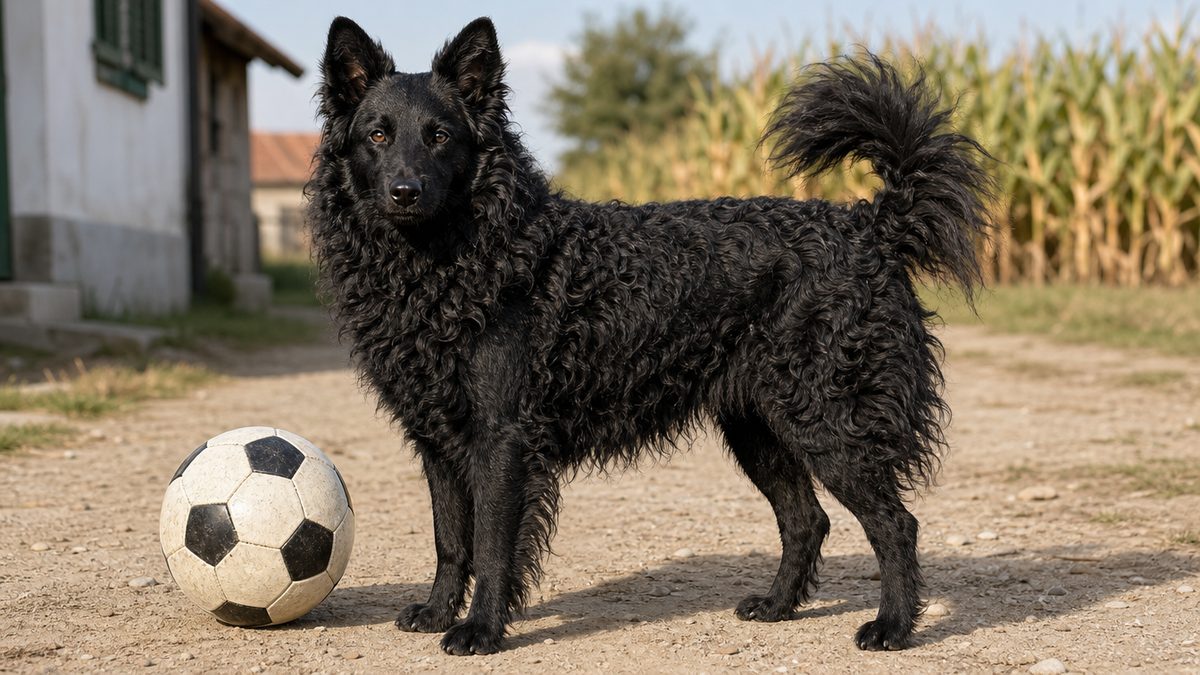
Picture a black, fox-faced, spitz-shaped herding dog about the size of a Border Collie, with a curled body coat and a short-haired head. FCI Standard 277 describes a medium-sized dog of spitz type with a rustic appearance and a fox-like expression, giving the impression of a proud, agile, strong and compact dog that is on no account coarse. The body is rectangular, longer than tall, by 8 to 10 percent in males and 8 to 12 percent in females. Height to the elbow is exactly half the height at the withers, which is the proportion that makes the dog read as leggy and quick rather than low-slung.
| Point | What the source says | Source |
|---|---|---|
| FCI standard | No. 277, Group 1 Section 1 Sheepdogs, without working trial | FCI |
| Country of origin | Croatia | FCI |
| Official authentic language of the standard | German | FCI |
| Height, males | 45 to 50 cm, plus or minus 3 cm tolerated | FCI 277 |
| Height, females | 43 to 48 cm, plus or minus 3 cm tolerated | FCI 277 |
| Weight | The standard gives none | FCI 277 |
| Colour | Black only; chest white marking up to 5 cm permitted | FCI 277 |
| Body coat | 6 to 14 cm, wavy to curly, over a dense undercoat | FCI 277 |
| Head and lower-leg coat | 1 to 1.7 cm, straight | FCI 277 |
| Ears | Pricked or semi-pricked; dropped ears disqualify | FCI 277 |
| Croatian breeding population, 2025 | 70 males, 60 females, 13 registered owners | Croatian gene bank |
| Croatian endangerment status | Critical | Croatian gene bank |
Two rows on that table are the reason this page exists. The weight row is blank because the governing standard genuinely prints no weight, and the population rows come from Croatia's national animal gene bank, run by its Ministry of Agriculture, which classifies the breed as critically endangered. Neither fact appears on any English page ranking for this breed.
What it was bred to do
It was bred to move livestock in a farmyard, not to guard a mountain flock. The standard calls it a breed with combined habits, usable for herding livestock as well as a guard dog or companion, and says that one hundred years of breeding in the valley of eastern Slavonia, near house and yard, have formed a dog well adjusted to all conditions. That phrase, near house and yard, is worth holding on to. This is a close-quarters farm dog with an inherited instinct to work stock, which is a different job from the long-range outrun of a hill collie and a different job again from standing guard over sheep at night.
The 1374 origin claim, checked
The 1374 record is not a document anyone has published, and the correct way to state the claim is that FCI Standard 277 reports it as a hypothesis contained in a 1719 manuscript that refers back to it, a chain in which the earlier document has never been shown to the public.
Almost every English page prints the date as fact. The AKC page states flatly that Petar Horvat, the bishop of Djakovo, wrote in 1374 that Croats had brought a shepherd dog along on the move to their new land, and referred to the dog as Canis pastoralis croaticus. Sites that follow the AKC repeat it in the same words.
What the governing standard actually says
Read the standard's own wording carefully, because it hedges twice. The Brief Historical Summary in FCI Standard 277 reads that the breed was most probably developed over several centuries out of the descendants of the so-called Pfahlbauhund, and then, verbatim, that according to the hypothesis in the manuscript of Bishop Petar Bakic in the year 1719, which again refers to an earlier manuscript of the Bishop Petar of the year 1374, immigrants brought this breed into the homeland. The Croatian Kennel Club's own 37-page commentary on the standard reproduces that sentence unchanged. So the two bodies with the most to gain from a fourteenth-century pedigree both call it a hypothesis, and both attribute it to a document written 345 years later.
Who found the manuscripts
One man found all of them, and he is the same man who created the breed. The Croatian Sheepdog Foundation's own project document states that the 1374 record was found in the archives of the Djakovo diocese by prof. dr. Stjepan Romic, and that Romic, a veterinarian by profession, also found the further important documents of 1719, 1737, 1742 and 1752 in the same archive. Romic is the person who began the systematic selective breeding of the modern Croatian Sheepdog in 1935. The finder of the historical evidence and the founder of the breed are one person, and no page in the ranking set mentions it.
No published source gives an archival shelf-mark, a catalogue number, a folio reference, a transcription or a facsimile for the 1374 document. The Croatian records that are quoted at length, in 1719, 1737, 1742, 1752 and 1854, are all reproduced from Romic's readings rather than from an independent scholarly edition. The breed foundation's own history page closes by noting that the records from several hundred years later rely on the same source and cite it, changing its form while keeping the description almost identical.
Where the sources disagree with each other
The bishop's name is not stable across the sources. The Croatian Sheepdog Foundation names him Petar Horvat, bishop of Djakovo, and the AKC follows that. The Foundation's own DNA project document, written by the same organisation, calls him only the Djakovo bishop Petar. FCI Standard 277 also gives no surname, writing only the Bishop Petar of the year 1374. Wikipedia declines to name him at all, says a manuscript from 1374 in the archives of the Archdiocese of Djakovo-Osijek reportedly mentions sheepdogs, and sources the sentence to the breed foundation's project document rather than to any archive catalogue. When four sources describing one document cannot agree on the author's name, the document has not been read by four people.
The 1719 attribution is checkable in a way the 1374 one is not. Bishop Petar Bakic is a real, well-documented figure, appointed bishop of Bosnia or Djakovo in 1716 and dying in 1749, and a 42-page peer-reviewed biography of him appeared in the theological journal Diacovensia in 2017. That biography's published abstract describes his organised economic improvement of the estate across viticulture, farming and livestock breeding, and says nothing about a manuscript on dogs. That silence is not proof of absence, and it is fair to say only this much: the manuscript that carries the whole claim is not among the things his biographer chose to summarise.
The one piece of hard evidence, and its limits
Archaeology gives a genuinely independent data point, and it is older than 1374 by three thousand years. A craniometric study from the Department of Anatomy at the University of Zagreb's veterinary faculty measured 7 crania and cranial fragments and 10 half lower jaws of Early Bronze Age dogs excavated at Vucedol in East Slavonia, the breed's own home region. The skulls came out dolichocephalic, with no significant difference in size or proportion between individuals, and the authors concluded that the height and form correspond to a smaller dog breed, in the first place a type of Croatian sheepdog or Hungarian Mudi. Read that precisely. It establishes that small dogs of roughly this build lived in eastern Slavonia in the Bronze Age. It does not establish descent, and the authors name two modern breeds, not one.
History: a breed made in 34 years, from 1935 to 1969
The modern Croatian Sheepdog was assembled between 1935 and 1969 by one veterinarian working with black farm dogs around Djakovo, and the documented history that matters to a buyer starts in 1935, not in 1374.
Stjepan Romic started the systematic breeding of the Croatian Shepherd Dog in 1935, and the four dates that follow are printed in the standard itself. The breed was first publicly presented at the first state dog show on 29 and 30 October 1949 in Zagreb. Dr. Otto Rohr wrote the first breed standard in 1951. The standard was published by the FCI on 31 January 1969. Croatia's national gene bank prints exactly the same sequence, in Croatian, on its official breed page.
Thirty-four years is fast, and that is the point
A breed built in 34 years from a regional landrace is a young registry population sitting on an old local one. Romic did not invent the dogs. Black, curly-coated farm dogs were already common across the Slavonian plain, which is why the 1854 record attributed to Dr. Franjo Bertic, a district veterinarian in Djakovo, describes all the village dogs of the Djakovo district as Croatian sheepdogs apart from the reddish-yellow hunting dogs. What Romic did was select, close and register. Everything about the breed's present genetic position follows from how few founders that selection used.
What the breed descends from, according to its own standard
The standard names a specific ancestor and hedges it. It says the breed was most probably developed over several centuries out of the descendants of the so-called Pfahlbauhund, given the Latin name Canis familiaris palustris, in the area of eastern Slavonia. Pfahlbauhund is the German term for the small dog type recovered from Neolithic and Bronze Age lake-dwelling sites across central Europe. The breed foundation's project document adds an earlier claim, that the type came from Asia, attributing it to Mr. sc. Ratimir Orban, and illustrates it with a second-century dog's head from an underwater site near Nin whose only cited source is a photobucket image link. Treat the Pfahlbauhund line as a plausible morphological hypothesis rather than a genetic finding, because nobody has published a genome that tests it.
The science that is under way, and what it has not yet produced
Croatian institutions are actively working on this breed, and no results have been published yet. A project run by the Drustvo prijatelja Hrvatskog ovcara in Karlovac names Prof. Anamaria Ekert Kabalin of the Faculty of Veterinary Medicine, University of Zagreb as lead of a programme titled the taking of samples and DNA analysis of Croatian sheepdogs, planning analysis of 19 microsatellite loci using the Thermo Scientific Canine Genotypes Panel 1.1 recommended by the International Society for Animal Genetics, with up to 400 blood samples stored at minus 80 C for ten years in the faculty's Laboratory for the Improvement of Animal Production and Health. Separately, a conservation project run with the Faculty of Agrobiotechnical Sciences in Osijek and the University of Bologna states that the breed has been genomically analysed for the first time using advanced sequencing.
The Karlovac document is a project proposal, written in the future tense, and it publishes no allele counts, no heterozygosity figure and no inbreeding coefficient. Until those results appear in a journal, this page carries no genetic-diversity number for the Croatian Sheepdog, and any page that gives you one has invented it.
The one thing an owner can take from all of this today is the population arithmetic, which is published and official, and which the next section sets out in full.
Recognition: which registries accept it, and what that means in India
The Croatian Sheepdog is recognised on a definitive basis by the FCI as Standard 277, by the United Kennel Club since 1 July 2006, and it is registrable in India through the Kennel Club of India as an import, because India sits inside the FCI system.
The FCI's own nomenclature entry carries two dates that get conflated everywhere, and both are correct. The date of acceptance on a definitive basis by the FCI is 30 August 1967, and the date of publication of the official valid standard is 3 November 2014. The standard's own historical summary and Croatia's gene bank both say the standard was published by the FCI on 31 January 1969 Banka gena domacih zivotinja. Wikipedia says the breed was definitively accepted in 1967; the AKC says it was recognised by the FCI in 1969 after 34 years of work. Nobody is wrong. Acceptance and publication are two separate events, 1967 and 1969, and this page publishes both rather than averaging them into one.
Where it sits in the FCI register
Croatia has exactly one breed in the sheepdog section, and this is it. The FCI's Group 1 Section 1 register lists HRVATSKI OVCAR (277) (CROATIAN SHEPHERD DOG) as the sole Croatian entry, with a validity date of 3 November 2014, eligible for the CACIB, and carrying no working-trial requirement. That last detail is a small but real signal. The Border Collie in the same section carries a working trial and this breed does not, which means FCI conformation titles for the Croatian Sheepdog do not require a demonstrated working qualification.
The United Kennel Club and the American Kennel Club
The UKC recognised the breed on 1 July 2006 and places it in the Herding Dog Group, with its standard last revised on 1 May 2017. The AKC maintains a full breed page with height, weight and life-expectancy figures and a breed-standard link. Neither American registry changes anything for an Indian owner except in one respect covered later on this page: the UKC standard contains a tail clause that Indian law prohibits.
The India question, answered properly
India is inside the FCI system, so FCI recognition is the answer to the India recognition question. The FCI's members register lists India as a member represented by the Kennel Club of India in Chennai, which is why the KCI issues pedigrees against FCI nomenclature. Do not read anything into a search of the KCI website for this breed name. The KCI publishes no public breed list for any breed, so a query there returns nothing for the Croatian Sheepdog and nothing for the Labrador Retriever either. That is a broken instrument, not a finding about the breed.
What the KCI does publish is a tariff and a checklist, and both are specific. Registration of an import dog costs Rs 2,500 inclusive of GST with effect from 1 April 2024, an export pedigree costs Rs 2,000, and a certified four-generation pedigree costs Rs 1,000. The import checklist requires the single-dog registration form, the export pedigree in original, the airway bill in original, the air ticket in original, the boarding pass, the DGFT licence, the customs clearance document, the quarantine clearance document, the pet passport and a notarised affidavit. If a seller cannot produce that stack, the dog is not a registrable imported Croatian Sheepdog, whatever the advertisement says.
Recognition of a different kind
Croatia has now protected the breed as heritage rather than only as livestock. On 19 December 2025 the Uprava za zastitu kulturne bastine of the Ministarstvo kulture i medija entered the tradition of breeding and living with the Croatian Sheepdog into the Register of Intangible Cultural Goods of the Republic of Croatia, on the initiative of the Maticni klub hrvatski ovcar of Djakovo, with the Karlovac and Zagreb clubs as co-bearers. The listing covers Slavonia, Baranja and Srijem, the breed's home area.
Size and weight: what the breed standard does and does not give
FCI Standard 277 gives height at the withers of 45 to 50 cm for males and 43 to 48 cm for females, tolerates plus or minus 3 cm in dogs of excellent type and conformation, and gives no weight at all.
Read the tolerance as a separate number, not folded into the range. The standard's Size and Weight section prints the two ranges and then adds, on its own line, that a height difference of plus or minus 3 cm in males and females of excellent type and conformation is tolerated. A 42 cm bitch of outstanding type is inside the standard; a 42 cm bitch of ordinary type is not. Height at the withers outside the standard is a disqualifying fault, which is what the tolerance sits against.
The weight that does not exist
No governing document for this breed publishes a weight. FCI Standard 277 runs to ten pages, prints a Size and Weight heading, and then gives height only. The UKC standard gives height for both sexes as 16 to 20 inches and prints no weight either, adding only that height under 16 inches or over 20 inches is an eliminating fault. Wikipedia, unusually for a breed page, also declines to give a weight.
The AKC prints 29 to 44 pounds, which is 13.2 to 20.0 kg. That figure is not in any standard. It may be a fair observational average and it may not; what can be said with certainty is that it has no governing document behind it, and that a co-ranking page repeating it as the breed weight is repeating the AKC rather than a source. The closest relative tells the same story from the other direction: FCI Standard 238 for the Mudi also prints height alone and no weight. Two Pannonian herding breeds, two standards, zero kilograms between them.
| Document | Males | Females | Tolerance | Weight |
|---|---|---|---|---|
| FCI Standard 277 (country of origin) | 45 to 50 cm | 43 to 48 cm | Plus or minus 3 cm for excellent type | None given |
| UKC standard, revised 2017 | 16 to 20 in (40.6 to 50.8 cm) | 16 to 20 in (40.6 to 50.8 cm) | None; outside is an eliminating fault | None given |
| AKC breed page | 16 to 20 in | 16 to 20 in | Not stated | 29 to 44 lb (13.2 to 20.0 kg) |
The two registries disagree about sex differences, and the disagreement is real rather than a rounding artefact. The FCI splits the sexes by 2 cm at each end; the UKC applies one identical 16 to 20 inch band to both United Kennel Club. A 50 cm bitch is 2 cm over the FCI limit before tolerance and comfortably inside the UKC band. If you are buying against a pedigree, know which standard the breeder's club judges to.
Proportions, which matter more than the height figure
The shape is the identifying feature, and the standard fixes it in ratios. The body outline is rectangular, with body length exceeding height at the withers by 8 to 10 percent in males and 8 to 12 percent in females. Height to the elbow is 50 percent of height at the withers. The skull is slightly longer than the muzzle, and skull width is not more than half the total length of the head. Body length shorter than the height at the withers is a disqualifying fault, as is a low-legged dog of achondroplastic type.
Measure the elbow. In a correct Croatian Sheepdog the distance from the ground to the elbow is half the total height at the withers. A dog that is visibly low on the leg for its length fails a disqualifying clause of its own standard, and that check needs nothing but a tape and takes ten seconds.
Where the breed's own standards contradict each other
Three registries publish standards for this breed and they disagree on eye colour, dentition and the tail, and one of those disagreements would make an Indian owner break the law.
The tail clause that Indian law prohibits
The United Kennel Club standard tells owners the tail is customarily docked. Its Tail section reads that puppies may be born without tails, or they are customarily docked to be approximately one inch in length. FCI Standard 277, written in the country of origin, contains no docking permission of any kind. It describes a full tail that reaches the hock joint or about 2 to 3 cm past it, carried below the topline at rest in a sabre or hook shape and above it in a sickle, ring or roll when the dog is alert, and adds only that there are also dogs born tailless or with a short tail, which is permitted.
In India the governing provision is Second Schedule Part II paragraph 6(8) of the Prevention of Cruelty to Animals (Dog Breeding and Marketing) Rules 2017. It states that there shall be no tail docking, ear cropping, de-barking, de-clawing, branding, dyeing, injecting substances to enhance visual appeal, performing a surgery or procedure to camouflage or hide any defect or infirmity or any other kind of mutilation of any body part of the pup, and that any change of appearance by artificial means is strictly forbidden. Cite it as a Schedule paragraph, not as Rule 6(8); Rule 6 of the main Rules is a different provision about requirements for breeders and establishments, and writing Rule will send anyone who checks to the wrong clause.
A short-tailed Croatian Sheepdog in India should be a naturally bobtailed dog, which both the FCI and the UKC recognise as occurring in the breed United Kennel Club. A tail cut to an inch is an offence here regardless of what an American standard permits. The UKC itself notes that cropping and docking are forbidden in some countries and that no dog in a UKC event shall be penalised for a full tail or natural ears, so nothing is lost by keeping the tail.
Eye colour: the two standards disqualify opposite things
The FCI disqualifies blue eyes and any form of strabismus, and requires eye colour from black to dark chestnut brown with completely black-pigmented eyelids; unpigmented eyelids disqualify even when only slightly unpigmented. The UKC requires eyes that are brown or black and disqualifies yellow eyes, saying nothing about blue. A yellow-eyed dog passes the FCI list and fails the UKC one. Neither registry has changed its mind; they simply wrote different lists.
Dentition: a tolerated absence and a disqualifying one
Count the teeth against the right document. FCI Standard 277 desires a complete bite of 42 teeth and then states that the missing of premolars PM1 and molars M3 is not taken into account, with other missing teeth undesirable. The UKC disqualifies any missing teeth other than the first premolars, which puts a missing M3 on the disqualifying list. The same dog is a tolerable FCI specimen and a disqualified UKC one.
Why this matters to an Indian buyer specifically
Indian law names three of these features as genetic defects a breeding dog must have been tested for. Second Schedule Part III paragraph 8(10) of the 2017 Rules states that the dogs shall have been tested for genetic defects, including hip dysplasia, progressive retinal atrophy, night blindness, hypothyroidism, entropion, ectropion, overshot, undershot jaw when incisors do not touch or mesh, wry mouth, two or more missing teeth, unilateral cryptorchid or full cryptorchid males. FCI Standard 277 independently disqualifies an undershot or overshot mouth, a wry mouth, and eyelids showing any sign of entropion or ectropion, so on those points the breed standard and Indian law point the same way. Note the word including: that statutory list is illustrative, not closed, so a defect is not outside the clause merely because it is unlisted.
Coat is the fourth disagreement and it gets its own section, because it is the one that decides whether this dog can live in Chennai.
Population census: a breed with 130 breeding animals
Croatia's national animal gene bank, run by the Ministry of Agriculture, classifies the Hrvatski ovcar as critically endangered and records 70 males, 60 females and 13 registered owners in 2025, giving an effective population size of 129.23.
This is the single most important fact about the breed and it appears on no English page. The Banka gena domacih zivotinja publishes a year-by-year table of breeding population size, effective population size and FAO 2013 endangerment class for every Croatian indigenous breed, and the Croatian Sheepdog's row set reads as follows.
| Year | Registered owners | Males | Females | Ne | Status |
|---|---|---|---|---|---|
| 2020 | not published | 520 | 480 | 998 | Endangered |
| 2021 | not published | 70 | 60 | 129.23 | Critical |
| 2022 | not published | 70 | 60 | 129.23 | Critical |
| 2023 | not published | 70 | 60 | 129.23 | Critical |
| 2024 | 16 | 60 | 55 | 114.78 | Critical |
| 2025 | 13 | 70 | 60 | 129.23 | Critical |
The arithmetic checks out, and the 2021 drop does not
Every Ne value in that table is internally consistent. Effective population size on the standard formula is four times males times females divided by their sum, so 70 and 60 give 4 times 70 times 60 divided by 130, which is 129.23, and 60 and 55 give 13,200 divided by 115, which is 114.78. Those match the published figures exactly, which is a useful sign that the table was computed rather than typed.
The 2020 to 2021 fall is a different matter. The counted breeding population drops from 1,000 animals to 130 in a single year, an 87 percent fall. Dogs do not die at that rate, and the gene bank publishes no note explaining the change. The likeliest reading is a change in what the register counts, from something like all known animals to actively registered breeding animals, but the source does not say so and this page will not pretend it does. Both numbers are published here so a reader can see the discontinuity rather than inherit whichever one suits an argument.
What critically endangered means in practice
An effective population size near 130 is small enough that every mating decision is a conservation decision. The Croatian classification is the state's own, applied under the FAO 2013 framework, and it has held at Critical for five consecutive years. Thirteen registered owners in 2025 is the figure to hold on to when a website tells you the breed is becoming increasingly popular.
A gene pool of this size is the reason the adoption section on this page argues against importing a fertile animal. It is also why no reliable Indian price exists: there is no exportable surplus to price.
Genetic diversity: what is not yet known
No published inbreeding coefficient or heterozygosity figure exists for this breed. The microsatellite programme planned by the University of Zagreb's veterinary faculty would produce exactly those numbers, using 19 loci on the ISAG-recommended panel, but the document setting it out is a proposal rather than a results paper. Until that work is published, the honest statement about this breed's genetic diversity is that the census numbers are known, the genetics are not, and anybody quoting a coefficient of inbreeding for the Croatian Sheepdog should be asked for the paper.
Price in India: there is no Indian price, and that is the finding
No Indian rupee price exists for the Croatian Sheepdog, because no lawful Indian supply chain can form for it, and the only published prices anywhere are foreign ones of about USD 1,000 to 1,200 or GBP 1,000 to 1,200.
Start with the direct check, because absence has to be earned rather than assumed. A 50-plus breed Indian price list that publishes rupee puppy prices and monthly costs for everything from the Labrador Retriever to the Cane Corso was searched for this breed on 27 August 2026. It returned zero occurrences of sheepdog and zero of ovcar, and the one occurrence of Croatian on the page is a language name inside a Google Translate dropdown. The same table prints the Border Collie at Rs 30,000 to 90,000 and the Indian Spitz at Rs 5,000 to 20,000, so the table is populated and working; this breed simply is not in it.
Why no Indian price can exist
Two published facts close the question between them. First, the DGFT permits import of dogs only for a pet with a valid pet book in the importer's own name, for R&D organisations with a CPCSEA recommendation, and for internal security by the Defence and Police forces, and states that import of commercial dogs for breeding or any other commercial activity is not permitted. Second, Croatia's own gene bank counts 70 males and 60 females in the whole 2025 breeding population, held by 13 registered owners. A breed with 130 breeding animals in its homeland and a statutory ban on commercial import into India has no route to an Indian price tag.
The foreign prices, for reference only
| Source | Price published | What it is |
|---|---|---|
| DogBreedsList | Average $1000 - $1200 USD | US-facing aggregator, no breeder named |
| Wamiz UK | Between GBP 1,000 and GBP 1,200 | UK breed page, also gives GBP 50-100 a month |
| Indian 50-breed price list | No row for the breed | Border Collie Rs 30,000-90,000 in the same table |
| Croatian breeders | No public price found | 13 registered owners nationally |
Convert those honestly and the numbers stay uncomfortable. USD 1,000 is roughly Rs 84,000 at 84.38 to the dollar, and that is before the airfare, the crate, the veterinary certification, the quarantine and the registration. The usual forensic test for a fake Indian price cannot even be run here, because there is no rupee figure to divide. Where this site normally catches a US dollar list converted at 84.38 or 74, this breed offers nothing to catch, which is a cleaner signal than a suspicious number would be.
Searching for this breed with an India locale surfaces a Flipkart product page headed Buy Croatian Sheepdog by unknown at Low Price in India. It is a print-on-demand book, not a dog. Treat any Indian commerce result for this breed name as a book, a template page or a different breed until the export pedigree proves otherwise.
What the Indian price actually buys, if you pursue it
The honest figure is the total landed cost, and it has four components you can price. A puppy from a Croatian or European breeder sits near the foreign band above Wamiz UK, Croatian Shepherd Dog. International transport with an IATA crate, an export health certificate and a veterinary attendance is the second. Quarantine clearance at one of the seven permitted ports is the third Department of Animal Husbandry…. And Kennel Club of India registration as an import is Rs 2,500 inclusive of GST. Any Indian seller quoting you a single all-in rupee figure without those four line items has not imported a dog. The full route is set out in how to import a dog to India.
The import route, step by step
Importing a Croatian Sheepdog into India is legal only as your own pet, only through seven named ports, and only if you are transferring residence after two years abroad or you hold a DGFT authorisation.
The controlling document is DGFT Trade Notice No. 22/2022-23 of 19 December 2022, and it is short enough to read in full. Dogs sit under ITC (HS) 01061900 as Restricted, subject to Policy Condition 6. Policy Condition 7 permits import only for a pet dog with a valid pet book and relevant records in the name of the importer, for R&D organisations with a CPCSEA recommendation, and for internal security by the Defence and Police forces. Policy Condition 8 states that import of commercial dogs for breeding or any other commercial activity other than those purposes is not permitted.
The five gates you have to clear
- Eligibility. Import as passenger baggage without DGFT authorisation is open only to a person transferring residence to India after two years of continuous stay abroad, and only cats and dogs qualify under the baggage rules.
- Authorisation. A DGFT import authorisation is required if the stay abroad was under two years, if the pet is not travelling as passenger baggage, or for more than two pets. Applications for trading or breeding purposes, or made on behalf of another person or entity, shall be duly rejected.
- Timing. Apply at least two months before the travel date, which is the DGFT's own advice.
- Port. Import is allowed only through the airports and seaports of Delhi, Mumbai, Chennai, Hyderabad, Bengaluru and Kolkata and, since October 2024, Kochi airport, with quarantine at the government station of that port where required Department of Animal Husbandry….
- Advance NOC. Obtain the No Objection Certificate from the Regional or Quarantine Officer of that port seven days before travel, relaxable to three days, after submitting the DGFT licence and the exporting country's veterinary health certificate. Disease testing must be done in the exporting country and every test report must travel with the animal.
Then the registration, which is a separate process
India is a full member of the FCI, represented by the Kennel Club of India in Chennai, which is why a Croatian FCI pedigree is convertible here at all. Registration of an import dog costs Rs 2,500 inclusive of GST with effect from 1 April 2024. The KCI checklist requires the single-dog registration form, the export pedigree in original, the airway bill in original from the country of import to the final destination, the air ticket in original, the boarding pass with payment, the DGFT licence, the customs clearance document, the quarantine clearance document, the pet passport and a notarised affidavit.
Do not search the KCI site for the breed and read the empty result as non-recognition. The KCI publishes no public breed list at all, so the same query returns nothing for the Labrador Retriever either. The route that works is the FCI one: India is a full member of the FCI, so a breed with an FCI standard has a registration path here, and the Croatian Sheepdog has FCI Standard 277.
The realistic supply side
Croatia produces litters, and not many. The Croatian Kennel Club's rolling litter register dated 4 August 2026 lists 549 litters across all breeds, of which eight are Hrvatski ovcar litters whelped between February and May 2026, totalling 47 puppies from breeders in Karlovac, Djakovo, Slavonski Brod, Stari Mikanovci and Sikirevci. That is a snapshot of a few months rather than an annual total, and it should not be read as one. What it does show is that the breed is bred in single figures of litters at a time, overwhelmingly in Slavonia, by a handful of named people. You will be joining a waiting list, not shopping.
Cost of ownership in India, bounded honestly
No breed-specific Indian cost figure exists for the Croatian Sheepdog, so the defensible way to budget is to price it as a 15 to 20 kg medium herding dog and add the import line items, which lands most owners between Rs 5,000 and Rs 10,000 a month before veterinary emergencies.
Take the proxy openly rather than inventing a number. The Indian 50-breed price list that has no row for this breed does have one for the Border Collie, a medium herding dog of comparable size and drive, at a monthly cost of Rs 5,000 to Rs 10,000. That band is a reasonable starting point for a dog of this weight and appetite in an Indian city, and it is labelled here as a proxy because that is exactly what it is. The UK figure for this breed specifically, GBP 50 to GBP 100 a month covering vet bills, insurance and food, comes from a page that contradicts itself four times over on temperament and reliability, so it is quoted for completeness and leaned on for nothing.
A quick test on whether the rupee figures are real
Indian price tables are often a US dollar list run through one exchange rate, and this one is not. Rs 30,000 divided by 84.38 is 355.5 dollars and divided by 74 is 405.4, neither of which is a price a seller would print. The bands are round rupee thousands, which is what a human typing Indian prices produces. The figures are therefore treated here as rupee-native rather than converted, which is the only reason this page is willing to borrow the Border Collie row as a proxy at all.
| Line | Basis | Note |
|---|---|---|
| Monthly total, medium herding dog | Rs 5,000 to 10,000 | Border Collie row, used as a size and drive proxy |
| Food | Largest single line | Body condition scored, not measured by cup |
| Grooming tools | One-off | Undercoat rake, slicker, comb; no clipper |
| Professional grooming | Optional | This coat is owner-maintainable |
| Tick and flea prevention | Year-round | Not seasonal in India, see the health section |
| Vaccination and deworming | Annual | Core protocol plus rabies |
| KCI import registration | Rs 2,500 once | Inclusive of GST, from 1 April 2024 |
The one-off costs are where this breed differs
Almost everything unusual about the budget sits in year zero. The purchase price is foreign, roughly USD 1,000 to 1,200 or GBP 1,000 to 1,200 Wamiz UK, Croatian Shepherd Dog. Then come the airfare and IATA crate, the exporting country's veterinary health certificate with every prescribed test report accompanying the animal, quarantine at one of the seven permitted ports, and the Advance No Objection Certificate obtained seven days before travel Department of Animal Husbandry…. Then Rs 2,500 to register the dog with the KCI as an import. After that the dog costs what any 15 to 20 kg dog costs.
There is no honest single rupee number for a Croatian Sheepdog in India, and any page that prints one has either converted a foreign figure or invented it. The four-part landed cost above is the closest thing to a real answer, and it is deliberately left as components rather than a total, because the transport and quarantine legs vary by port, airline and season.
One recurring cost is genuinely lower than the imported-breed average, and it is grooming. This coat needs tools and time rather than a salon, which the grooming section sets out.
Heat tolerance: the homeland climate, measured
The Croatian Sheepdog comes from a place whose hottest month averages 23.56 C, which is cooler than the coolest month in Chennai, so heat tolerance is the first thing to settle before anything else about this breed matters in India.
The breed's home is Djakovo in eastern Slavonia, and its climate is measurable rather than arguable. Queried by explicit latitude and longitude at 45.3081 N, 18.4108 E, NASA's POWER climatology gives Djakovo an annual mean temperature of 11.69 C across the twenty years from January 2001 to December 2020. July is the hottest month at 23.56 C and August is second at 23.33 C. January averages minus 0.45 C.
| Month | Djakovo | Chennai | Mumbai | Bengaluru | Delhi |
|---|---|---|---|---|---|
| January | -0.45 | 24.09 | 23.19 | 21.10 | 13.61 |
| April | 11.60 | 30.51 | 30.73 | 28.37 | 30.44 |
| May | 16.54 | 31.51 | 31.19 | 26.97 | 35.05 |
| July | 23.56 | 29.70 | 26.63 | 23.54 | 32.27 |
| October | 11.98 | 27.40 | 26.22 | 22.54 | 25.18 |
| Annual mean | 11.69 | 27.95 | 26.77 | 23.74 | 25.60 |
The single line that settles it
Djakovo's hottest month is cooler than Chennai's coldest. July in Djakovo averages 23.56 C; January in Chennai, the coolest month Chennai has, averages 24.09 C. There is no month of the Chennai year that the breed's homeland has ever experienced. Count the months instead of comparing peaks and the same picture appears: Djakovo has three months at or above a 20 C mean and zero months at or above 25 C, while Chennai has twelve and ten, Mumbai twelve and nine, and Kolkata ten and eight.
What the dog is not naive about
Give the breed credit for the heat it does know. Djakovo's twenty-year climatology records a maximum temperature of 40.13 C in July and 40.61 C across the year, which is a real Pannonian heatwave and hotter than Bengaluru ever gets at 40.38 C. So a Croatian Sheepdog is not a dog that has never felt 40 C. What it has never felt is 40 C arriving in April and not leaving until October, which is the Delhi pattern, where June averages 35.88 C and the record maximum reaches 48.79 C.
City by city, honestly
- Bengaluru is the least bad option, with an annual mean of 23.74 C and only three months at or above 25 C, and a hottest month of 28.37 C in April.
- Pune is close behind at an annual mean of 23.86 C with four months at or above 25 C, and it is the other city where dawn walks are workable most of the year.
- Delhi is survivable in winter and hostile from April to September, with a summer mean above 32 C for three straight months.
- Mumbai, Chennai and Kolkata run 26 to 28 C annual means with no cool season at all, and are the three cities where this coat has no recovery window.
- Hill stations are the only Indian locations that resemble the origin climate, and even there the wet season inverts the humidity pattern described in the next section.
Walk this dog at first light and after dark, every month of the year, in every Indian city on that list. That is not a generic caution. It follows directly from a homeland whose warmest month sits below the coldest month of the warmest Indian metro.
Heat tolerance is only half of the climate problem for this particular dog, and the smaller half. The coat argument is the one nobody has made, and it is next.
The humidity inversion: why this coat has the wrong seasons
The Croatian Sheepdog's curled double coat evolved where the wettest air is cold and the warmest air is dry, and India reverses both halves of that, which is the specific mechanism behind the coat and skin trouble this breed meets here.
Start with the coat the standard actually describes, because it is not the short coat the summaries promise. FCI Standard 277 specifies a topcoat that is wavy to curly, 6 to 14 cm long, stand-off and elastic, over an undercoat that is dense, compact and soft, and says the two together form an excellent protecting cover for the dog. Short hair of 1 to 1.7 cm is confined to the muzzle, forehead, ears, around the eyes, the cheeks, the front of the forelegs, the carpus and metacarpus, and from the rear pastern to the hock. Hair on the withers shorter than 4 cm is a disqualifying fault, as are completely straight hair, woolly hair, and a long felted or corded coat. This is a genuine double coat with a curl in it, not a smooth-coated dog with fringing.
Now put that coat against the two humidity regimes
Djakovo's air is wettest in the cold and driest in the heat. NASA POWER gives it monthly relative humidity of 91.1 percent in December, 90.8 in January and 87.3 in February, when mean temperatures are 0.79 C, minus 0.45 C and 1.46 C. Its driest months are July at 56.8 percent and August at 55.8 percent, which are also its hottest. In other words, this coat has never had to dry itself in warm wet air, because in its homeland warm air is dry air.
| Place | Wettest month | Relative humidity | Mean temperature that month |
|---|---|---|---|
| Djakovo | December | 91.1% | 0.79 C |
| Djakovo | January | 90.8% | -0.45 C |
| Mumbai | August | 90.4% | 26.05 C |
| Pune | August | 90.8% | 23.30 C |
| Kolkata | September | 89.3% | 27.69 C |
| Bengaluru | October | 81.0% | 22.54 C |
| Chennai | November | 82.3% | 25.76 C |
Read the right-hand column. Djakovo reaches 90 percent humidity at about freezing; Mumbai reaches it at 26 C and Pune at 23 C. A dense undercoat under 90 percent humidity at zero degrees traps a dry, warm layer, which is what it is for. The same undercoat under 90 percent humidity at 26 degrees traps a wet, warm layer against the skin, which is what causes trouble.
The second half of the inversion
The dry-heat half is just as skewed. Djakovo's driest month, August at 55.8 percent, is drier than every single month in Chennai, whose lowest is 64.4 percent in June. So the breed's summer is a dry summer by Indian standards, and its winter is a wet winter at temperatures where nothing grows on skin. India offers this dog neither of those combinations at any point in the year.
Expect the trouble to concentrate where the coat is longest and the air moves least. FCI Standard 277 says the longest coat sits at the culottes on the hind legs and near the root of the tail, which are exactly the low-airflow sites. In a Mumbai or Pune monsoon those are the places to check daily, and the grooming section sets out how.
The colour compounds it
Black is the only permitted colour, and there is no light variety to escape into. FCI Standard 277 permits black alone, allowing only a few evenly spread white hairs that are hardly visible and a chest marking of at most 5 cm; white markings larger than 8 cm on the chest, or white anywhere else, are disqualifying faults. The undercoat is definitely black too, and the standard notes it often goes greyish or shows a brown tinge during shedding, which is not a fault. A solid black dog under Indian sun absorbs more radiant heat than a pale one, and unlike most breeds this one has no fawn or grey line to choose instead. Compare the Mudi, whose standard permits seven colours including white and ash. Where the Mudi buyer can pick a pale dog, the Croatian Sheepdog buyer cannot.
Temperament, and who should not get one
The Croatian Sheepdog is a lively, balanced, intensely owner-focused working dog that its own standard describes as easy to train and neither aggressive nor nervous, and the households it fails in are the quiet ones that wanted a low-maintenance black dog.
The standard is unusually specific about character, so start there. FCI Standard 277 says the breed has a lively temperament and balanced disposition, is fond of and devoted to his owner, must be neither aggressive nor nervous, and has to be interested in everything that happens in his surroundings. It names the breed's characteristics as astuteness, courage, liveliness, endurance, patience and level-headedness during work, records an inherited sense for work with domestic animals, and closes with the sentence that the breed is easy to train. Aggressive or overly shy dogs are a disqualifying fault.
The UKC standard compresses the same picture into four adjectives, calling the breed lively, attentive, modest and easy to train. Royal Canin's Croatian-language page adds a manufacturer's read of the same dog, listing it as gentle, confident, friendly, intelligent, quiet and sociable, while noting that it needs a lot of behavioural training and a lot of exercise. Put those documents side by side and the breed comes out highly trainable, deeply loyal to one household and relentlessly energetic, which is three separate demands on an owner rather than three compliments.
The co-ranking English pages describe roughly the same dog and source almost none of it. One structures a comprehensive guide around temperament, socialisation and family compatibility without citing a standard, a second organises the breed under headings for temperament, activity requirements and owner experiences, and a third opens with an unsourced claim that this is an ancient herding breed. Where this page disagrees with them, it is because it is quoting FCI Standard 277 and they are not.
The trait the marketing pages leave out
This is a wary dog with a strong need for human company, and both halves matter in a flat. The Croatian Sheepdog Foundation's own description calls it an extremely intelligent dog of great energy and self-sacrifice, with a certain measure of caution and a strong need for human society. The report on its cultural-heritage listing describes a very intelligent animal with a strong need for human company, a well-developed herding instinct and an excellent guarding aptitude. Put those together and you get a dog that watches the door, announces the lift, and cannot be left alone for a nine-hour working day.
Who this breed suits
- Households with someone home most of the day, because the need for human company is the trait every Croatian source names first.
- Owners who want a training project, since the standard's own claim that the breed is easy to train is an invitation, not a reassurance.
- People in Bengaluru, Pune or a hill station, where dawn and evening work is possible for most of the year.
- Families with older children who can be taught not to run past a dog with a herding instinct.
- Owners already doing a dog sport, because this breed's Croatian clubs report results in agility, flyball, canicross and search and rescue.
Who should not get one
- Anyone who wants a quiet apartment dog, because a guarding breed that is interested in everything in its surroundings will tell you about all of it.
- First-time owners buying on looks, since the black curly coat is the least demanding thing about the dog.
- Households out of the house all day, which is the single clearest mismatch.
- Anyone in Chennai, Mumbai or Kolkata without air conditioning, for the reasons the climate sections set out.
- Buyers who cannot verify a pedigree, because in India a dog sold as this breed almost certainly is not one.
A UK breed page for this dog contradicts itself four times in its own layout, heading a section Has a moderate tendency to run away above body text reading Very unlikely to run away, and heading another Highly recommended for a first-time owner above body text reading First-time dog owners should look elsewhere. The same page tags the breed simultaneously as Small, Medium and Large. Temperament claims from that source are not used anywhere on this page, and the standard's own wording is used instead.
Training: easy to train is not the same as easy to live with
Train this breed early and in short daily sessions, because its own standard calls it easy to train while Royal Canin's breed page says in the same breath that it needs a lot of behavioural training, and both statements are true at once.
Take the standard's claim at face value and then read the second half of it. FCI Standard 277 states plainly that the breed is easy to train, and describes patience and level-headedness during work as breed characteristics. Royal Canin's Croatian page lists needs a lot of behavioural training as one of its three headline care facts, alongside minimal grooming and a lot of exercise. A dog that learns fast learns the wrong things fast too, which is the whole of the training problem here.
The realistic timeline
- Weeks 8 to 16. Socialise hard and daily. Indian streets supply autos, horns, cattle, cyclists, lifts and construction noise, and a wary breed that meets them at ten weeks handles them at ten months.
- Months 4 to 6. Fix the recall before the herding instinct switches on. Reward-based recall in a fenced space, twice a day, two minutes at a time.
- Months 6 to 12. Redirect the herding instinct onto an object. Chasing a ball, a flirt pole or a herding-ball is the substitute for chasing children and scooters.
- Months 12 to 24. Add a discipline that requires decisions, not just obedience. Croatian clubs report the breed doing well in agility, flyball, canicross, bikejoring, search and rescue work and sport working trials.
- Lifelong. Keep two short sessions a day rather than one long one, because the standard's endurance is physical and the attention span is not.
What this breed resists
It resists boredom and heavy handling, in that order. A dog selected for astuteness and courage that is asked to repeat a known exercise twenty times will start editing the exercise. Harsh correction is the other failure mode, because the disqualifying fault at the bottom of the standard is not disobedience but shyness, and a wary breed pushed hard gets more wary, not more compliant.
Barking, and the Indian flat
Plan for an alarm barker and train an off switch from week ten. The breed is used as a guard dog by the standard's own account of its utilisation, and Croatian sources describe it as an excellent guarding dog with a strong watch instinct. In an Indian apartment building with a shared lift lobby, a delivery every hour and a security guard's whistle at night, that instinct fires continuously unless it is given a rule. Teach a single alert bark followed by a recall to a mat, and reward the silence rather than the bark.
The FCI does not require a working trial for this breed, which sounds like a downgrade and is actually useful for an Indian owner. It means you are free to build the dog's working life around whatever India can offer, which is sport and scent work, rather than around a livestock qualification you could never obtain here.
Exercise: you cannot tire this dog by walking further
Give this breed about ninety minutes a day split across two heat-timed sessions and weight it towards problem-solving rather than distance, because its own standard says the trot is the gait that tires it least.
The standard contains the sentence that decides how to exercise this dog. Under Gait and Movement, FCI Standard 277 states that the reach is substantial with a strong drive, and that the trot is the preferred gait, as it tires the dog the least when working with livestock. A dog engineered to cover ground economically all day is a dog you cannot exhaust with a longer walk. Adding kilometres builds fitness, which makes the problem worse.
The published requirement runs to an hour or more. A UK breed page for the Croatian Sheepdog specifies sixty minutes of high-energy walks and runs every day, and Royal Canin's Croatian page lists needing a lot of exercise as one of its three headline facts. Treat sixty minutes as the physical floor and ninety as the workable target once mental work is included.
The Indian timing problem
Both sessions have to happen in the dark for most of the Indian year. In Chennai every month of the year averages at or above 24 C and ten months average at or above 25 C; in Mumbai twelve months sit at or above 20 C and nine at or above 25 C. Djakovo, by contrast, has zero months at or above a 25 C mean. So the midday walk that a Croatian owner takes for granted for eight months a year does not exist for an Indian owner at any point.
| City | Annual mean | Months at or above 25 C | Practical window |
|---|---|---|---|
| Djakovo (origin) | 11.69 C | 0 | Most of the day, most of the year |
| Bengaluru | 23.74 C | 3 | Dawn and after dark; midday possible Jun to Jan |
| Pune | 23.86 C | 4 | Dawn and after dark; midday possible Jul to Dec |
| Delhi | 25.60 C | 7 | Dawn only Apr to Sep; wide window Nov to Feb |
| Kolkata | 25.81 C | 8 | Dawn and after dark year-round |
| Mumbai | 26.77 C | 9 | Dawn and after dark year-round |
| Chennai | 27.95 C | 10 | Dawn and after dark year-round |
What happens without it
An under-exercised herding dog does not become calm, it becomes inventive. The predictable list is barking at the corridor, herding the children by circling and nipping heels, chasing scooters and cats through a gate, redirecting onto furniture legs, and the pacing and door-scratching that get labelled separation anxiety. None of that is a temperament fault in a breed the standard describes as courageous, lively and enduring. It is a job vacancy.
The weight discipline that goes with it
Keep the dog at or below its own adult mean weight, and there is a specific reason to. The largest UK study of canine heat-related illness, covering 905,543 dogs, found that being at or above the mean bodyweight for the breed and sex carried an odds ratio of 1.42 for heat-related illness, with a 95 percent confidence interval of 1.12 to 1.80. That study did not model this breed, and the reason is set out in the health section, but bodyweight relative to a dog's own breed mean is a factor that transfers.
The other half of the exercise answer is what to do with the dog's mind, and in India that is the harder half.
What a herding dog actually does all day in an Indian city
India has almost no sheep-herding work within reach of a city flat, so the honest answer is that you manufacture the job, and the four substitutes that work are scent work, sport, task chains and a real herding ball.
Say the uncomfortable part first. This breed was formed to move livestock near house and yard in eastern Slavonia across a hundred years of selection, and it retains what the standard calls an inherited sense for the work with domestic animals. An Indian apartment offers none of that. Sheep herding as a hobby sport barely exists in India, there is no FCI herding-trial infrastructure to enter here, and the breed does not even carry an FCI working-trial requirement to organise around. The job has to be invented, deliberately, by you.
Four substitutes that actually hold a herding dog
- Scent work, daily. Hide ten pieces of food across two rooms and let the dog find them. Fifteen minutes of searching tires a working dog roughly as much as forty minutes of walking, and it is the one activity that works at 34 C indoors with a fan.
- A sport with decisions in it. Croatian breed clubs report their dogs achieving good results in agility, flyball, canicross, bikejoring, search and rescue, and sport working trials. Agility clubs now operate in Bengaluru, Pune, Mumbai, Delhi and Hyderabad, and flyball and canicross need almost no infrastructure.
- Task chains around the house. Teach the dog to fetch named objects, close doors, put toys into a box and carry a bag to a room. Chained tasks use the decision-making the herding instinct is built on.
- A herding ball. A 55 to 75 cm inflated ball that the dog pushes and circles is the closest available substitute for driving stock, and it works on a terrace at dawn.
The mental-stimulation arithmetic
Budget the day rather than the walk. Ninety minutes of physical exercise plus thirty minutes of split-up mental work is the target, and the mental half is what makes an Indian summer survivable, because it can happen indoors at any hour. Two ten-minute scent sessions and one ten-minute training session cost nothing, need no equipment and can be done in a two-bedroom flat while the outside temperature sits above 35 C.
A Croatian Sheepdog can live in an Indian apartment, and it is a demanding way to keep one. At 45 to 50 cm the dog fits the floor area easily, and Royal Canin correctly describes it as among the smallest of medium-sized dogs. The two real constraints are the corridor of unfamiliar visitors passing a watchful breed, and two hours of daily work that has to be timed around the heat.
What to do on the worst days
Plan for the weeks when outdoor exercise is unsafe at any hour. In Delhi, June averages 35.88 C and the twenty-year record maximum is 48.79 C. On days like those the dog gets scent work, a frozen stuffed toy, a training session and a nap, and nothing outdoors between an hour after sunrise and an hour after sunset. Owners who insist on a run in that weather are the ones who create the exertional heat cases described next, because in the UK study of heat-related illness, exertion was the recorded trigger in 652 of the 879 events that had a trigger recorded at all.
Grooming a curled double coat in Indian humidity
Brush this coat twice a week and daily through a monsoon, work an undercoat rake through the culottes and the tail root where the hair is longest, and never clip it, because the 6 to 14 cm curled topcoat sits over a dense undercoat that is doing a job.
Two respectable sources describe this coat in opposite terms, and the disagreement is worth resolving before you buy a brush. Royal Canin's Croatian-language breed page lists requires minimal coat grooming as one of three headline care facts, and an aggregator rates grooming at 2 out of 5. FCI Standard 277 describes a profuse, dense topcoat of 6 to 14 cm, wavy to curly, stand-off and elastic, over a dense, compact, soft undercoat, with long hair on the neck as a mane, on the back, croup and rib area, fringes on the back of the forearms, culottes on the hind legs and a flag on the tail. Both are defensible. Minimal grooming is true in Slavonia, where the wettest months sit near freezing. It is not true in a Mumbai August at 90.4 percent humidity and 26 C.
Where the coat is long, which is where the trouble goes
The standard tells you exactly where to look. It states that the longest coat is at the culottes and near the root of the tail, that the parting between the short forehead hair and the longer hair at the back of the skull measures around 3.5 cm, and that the short 1 to 1.7 cm hair covers only the muzzle, forehead, ears, the area around the eyes, the cheeks, the front of the forelegs, the carpus and metacarpus, and on the hind legs the feet and the stretch from rear pastern to hock. Everything else is long. Females usually carry slightly shorter and less profuse coats than males, which is a small practical argument for a bitch in a humid city.
| Period | Frequency | Tool and focus |
|---|---|---|
| Cool dry months | Twice a week | Slicker over the body, comb through the mane |
| Pre-monsoon shed | Every other day | Undercoat rake, culottes and tail root first |
| Monsoon | Daily check, brush every other day | Dry the culottes and belly after every walk |
| Peak summer | Twice a week | Rake out dead undercoat; do not clip |
| After any bath | Same day | Dry to the skin at the culottes and tail root |
Do not clip, and here is the reason in the standard's own words
The standard describes the topcoat and undercoat together as forming an excellent protecting cover for the dog, and hair on the withers shorter than 4 cm is a disqualifying fault. Clipping a double coat removes the sun barrier without improving heat loss, because dogs shed heat by panting rather than through the skin. Rake the dead undercoat out instead, which is the part that traps moisture, and leave the guard coat standing.
Shedding and the moult
This dog moults, and the standard describes what the moult looks like. It notes that the undercoat is definitely black, and that during the shedding of the coat the undercoat often goes greyish or sometimes shows a brown tinge, which is not a fault. So a Croatian Sheepdog that looks rusty or grey at the roots in April is moulting, not fading. An aggregator rates shedding at 3 out of 5, which is a fair middle position for a black double-coated dog on a dark floor.
Dry the dog after a bath and after a wet walk, to the skin, at the culottes, the tail root and the belly. In a monsoon those areas do not air-dry, because the air is already at 90 percent. Overseas breed advice that says to towel a dog and let it air dry was written for a climate where that works, and it does not transfer here.
One monsoon worry this breed largely escapes is the ears, and the reason is conformation rather than luck. That evidence sits in the health sections below.
Health: what is actually known, which is very little
No peer-reviewed study of Croatian Sheepdog disease exists, the breed does not appear in OFA's statistics or in the largest UK longevity study, and the one real veterinary dataset is a 2008 Zagreb paper on blood groups and blood chemistry.
Prove the absences before reporting them, because absence is a strong claim. A PubMed search for the phrase Croatian sheepdog, run on 27 August 2026, returned one record, and PubMed's own query translation shows it silently broadened the phrase into an AND search of croatian and sheepdog. That single record is a craniometric study of Bronze Age dog skulls, not a clinical paper. A phrase search for Croatian shepherd dog returned one unrelated paper about Hepatozoon in Hungarian foxes, and hrvatski ovcar returned zero. Controls run in the same session behaved normally, with Labrador Retriever and hip dysplasia returning 126 records and Bergamasco and dog returning 13, so the tool was working. The honest finding is zero clinical literature on this breed.
Orthopedic Foundation for Animals: absent, with a control
OFA has no data on this breed either. A retrieval of OFA's complete disease-statistics page on 27 August 2026 returned 2,208,182 characters of breed tables and contained zero case-insensitive matches for Croatian, against 109 for the control term Labrador and one for Bergamasco. So there is no published hip, elbow, patella, eye or thyroid figure for the Croatian Sheepdog anywhere in the OFA system.
Lifespan: four numbers, none of them a study
Every published life expectancy for this breed is an editorial estimate. DogBreedsList gives 12 to 14 years, Wamiz gives 12 to 14, Royal Canin's Croatian page gives 12 to 14, and the AKC gives 13 to 14. Three agree and one is a year higher at the bottom, and not one of them cites a mortality dataset.
The dataset that would have settled it explicitly leaves the breed out. McMillan and colleagues analysed 584,734 UK dogs including 284,734 deceased animals across 155 breeds, and reported an overall median life expectancy of 12.5 years, 12.7 for purebreds and 12.0 for crossbreds. Their supplementary nomenclature table lists Croatian Shepherd Dog with an inclusion flag of N and every data column set to NA, meaning the breed was considered and excluded because it did not appear in the UK data at all. That is a stronger and more useful statement than a bare absence, and no figure from that paper may be attached to this breed.
The one real veterinary dataset
A 2008 paper from the Clinic for Internal Diseases at the University of Zagreb's Faculty of Veterinary Medicine studied 95 pure-bred Croatian Sheepdogs, 48 females and 47 males aged 1 to 12 years. It measured urea, creatinine, total proteins, glucose, total bilirubin, AST, ALT, alkaline phosphatase, creatine kinase, amylase, calcium and phosphorus, and found the average values showed no changes against reference expectations. In 30 dogs from that group it also typed blood group DEA 1.1 and ran a standard haemogram, and reported that 27 dogs, 90.0 percent, were DEA 1.1 positive, which the authors describe as a significantly higher percentage than in all investigations to date. Haematological values were within physiological parameters.
Several pages call this a very healthy breed and name elbow dysplasia, arthritis and patellar luxation as its common illnesses. The page making that claim contradicts its own headings four times over, cites nothing, and belongs to a breed with zero clinical literature, zero OFA records and no longevity data Orthopedic Foundation for Animals McMillan KM, Bielby J, Williams CL. A breed nobody has studied is not the same as a breed with no problems, and this page will not convert one into the other.
What to screen for anyway
Screen against the standard and against Indian law, since neither needs a breed study. FCI Standard 277 disqualifies an undershot or overshot mouth and a wry mouth, requires eyelids that show no sign of entropion or ectropion, disqualifies blue eyes and any form of strabismus, and closes with the note that only functionally and clinically healthy dogs with breed-typical conformation should be used for breeding. Second Schedule Part III paragraph 8(10) of the 2017 Rules requires that breeding dogs shall have been tested for genetic defects, including hip dysplasia, progressive retinal atrophy, night blindness, hypothyroidism, entropion, ectropion, overshot, undershot jaw when incisors do not touch or mesh, wry mouth, two or more missing teeth, and unilateral or full cryptorchidism. Ask any breeder for hip and elbow scores and an eye certificate even though no breed-average exists to compare them against, because the first Croatian Sheepdog screening dataset has to start somewhere.
The Indian health risks that do apply
The three Indian risks worth planning for are tick-borne infection, exertional heat illness and skin trouble under the long coat, and one of them, ear disease, is a risk this breed's erect ears actually reduce.
Tick-borne disease, the largest Indian risk
Half of Indian dogs sampled in the reference survey carried at least one tick-borne pathogen. Abd Rani and colleagues sampled 525 dogs across four climatic zones, Sikkim, Ladakh, Delhi and Mumbai, and found that 261 of 525, or 49.7 percent, were PCR positive for at least one tick-borne pathogen. Ticks were present on 278 dogs, 53 percent, and 39 percent of infected dogs carried more than one organism.
| Pathogen | Prevalence | 95% confidence interval |
|---|---|---|
| Hepatozoon canis | 30.0% | 26.0 to 34.0 |
| Ehrlichia canis | 20.6% | 17.2 to 24.3 |
| Mycoplasma haemocanis | 12.2% | 9.5 to 15.3 |
| Anaplasma platys | 6.5% | 4.5 to 8.9 |
| Babesia vogeli | 5.5% | 3.7 to 7.8 |
| Babesia gibsoni | 0.2% | 0.01 to 1.06 |
Two of those organisms cause anaemia severe enough to need a transfusion, and that is where the Zagreb blood-group finding becomes practical. In a breed where 90 percent of dogs typed were DEA 1.1 positive, a Croatian Sheepdog is a poor source of blood for the DEA 1.1 negative dogs who most need it, and any dog of this breed receiving blood should be typed or cross-matched first. Discuss it with your own veterinarian rather than acting on this paragraph.
Heat illness, with the breed-specific caveat
The best data on canine heat illness does not cover this breed, and saying so is more useful than borrowing a number. Hall, Carter and O'Neill studied 905,543 UK dogs across 886 clinics, finding an overall incidence risk of 0.04 percent, 1,222 prevalent cases, and an event fatality rate of 14.18 percent among 395 events in 2016. Breed types entered the model only if they had at least 5 heat-related illness cases or at least 5,000 dogs in the study population, and no Croatian breed appears anywhere in the paper. So this page claims only the factors that transfer, chiefly bodyweight at or above the breed and sex mean, odds ratio 1.42, 95 percent confidence interval 1.12 to 1.80, and age of 12 years or more, odds ratio 1.75.
The companion paper is the one that changes Indian behaviour. Of 1,259 prevalent heat-related illness events, 380, or 30.2 percent, had no trigger recorded, and among the remaining 879 the predominant trigger was exertion in 652 events, 74.2 percent, ahead of environmental heat at 12.9 percent and vehicular confinement at 5.2 percent. Read that correctly: 74.2 percent is the share of the events that had a trigger recorded, not of all events. The practical conclusion still holds, which is that the dog you exercise in the heat is at greater risk than the dog left in a warm room. Note also that the highest case fatality in that study, 33.3 percent, belonged to building confinement, with an odds ratio of 6.06 against exertional cases, which matters for anyone leaving a dog in a closed flat during a power cut.
Ears: where this breed is genuinely lucky
Erect ears are protective, and this breed has them. In a random sample of 22,333 UK dogs from a population of 905,554, the one-year period prevalence of otitis externa was 7.30 percent. Against erect ear carriage, pendulous ears carried an odds ratio of 1.76 and V-shaped drop ears 1.84. The Border Collie, the closest erect-eared herding analogue, was one of only four breeds significantly protected, with an odds ratio of 0.34 against crossbreds. FCI Standard 277 requires pricked or semi-pricked ears and disqualifies completely dropped ears, so the Croatian Sheepdog sits in the protected conformation class.
This page's wider gundog and spaniel coverage warns hard about monsoon ear disease, and that warning does not transfer here. The otitis study modelled ear carriage and found erect ears protective; it did not model coat type at all. So for a Croatian Sheepdog the monsoon risk sits in the skin under the long culottes and tail root, not in the ear canal. Check the ears weekly anyway, and check the culottes daily.
Feeding: score the body, do not measure the cup
Feed a Croatian Sheepdog to a body condition score of 4 or 5 on the nine-point WSAVA scale rather than to a weight target, because no breed standard publishes a weight for this dog and every kilogram figure in circulation is somebody's estimate.
The absence of a standard weight changes how you feed. FCI Standard 277 prints height and no weight, and so does the Mudi standard next door Federation Cynologique Internationale. The figures in circulation disagree in a way that shows they are estimates: the AKC and DogBreedsList give 29 to 43 or 44 pounds, roughly 13 to 20 kg, while a UK page gives 33 to 44 pounds, about 15 to 20 kg, for both sexes Wamiz UK, Croatian Shepherd Dog. Two kilograms of disagreement at the bottom of a small dog's range is a lot to build a feeding chart on.
Score the dog instead. On the WSAVA nine-point body condition scale, 4 and 5 are ideal, with ribs easily palpable under minimal fat, a waist visible from above and an abdominal tuck in profile. Run your hands over the ribs weekly. On a black dog carrying a 6 to 14 cm curled coat you cannot see body shape at all, which makes hands the only honest instrument.
Life-stage feeding
- Puppy, 8 weeks to 4 months. Four meals a day of a complete puppy food, adjusted every fortnight by body condition rather than by the bag's chart.
- Puppy, 4 to 9 months. Three meals a day. This is the fastest growth period and the easiest time to over-condition a working breed.
- Junior, 9 to 15 months. Two meals a day, moving onto adult food as growth slows.
- Adult. Two meals a day, split around the two heat-timed exercise sessions rather than before them.
- Senior, from about 8 years. Two meals, lower calorie density, and closer attention to the ribs, because age of 12 years or more carried an odds ratio of 1.75 for heat-related illness.
The Indian heat adjustment
Move the meals, not the quantity. Feed at least an hour after the morning walk and at least an hour before the evening one, because a full stomach and exertional heat are a bad combination and exertion was the recorded trigger in 652 of the 879 events with a trigger recorded in the UK heat-illness data. Keep water available in more than one room. In a Chennai or Mumbai summer, where every month averages above 24 C and 26 C respectively, many dogs eat less in the afternoon and make it up after dark, which is normal and needs no intervention as long as the body condition holds.
Availability in India
Nothing about this breed needs a specialist diet. A 15 to 20 kg medium-breed adult food from any of the major brands sold in India covers it, and Royal Canin publishes a breed page for the Hrvatski ovcar without offering a breed-specific formula for it. Spend the money on a good undercoat rake and a tick preventive instead, because those two are where the Indian risk actually sits.
The first year, month by month
Plan the first year around three deadlines, which are socialisation before week 16, a reliable recall before month 6, and a herding-instinct outlet before month 9, and time every outdoor session around the heat from the day the puppy lands.
Weeks 8 to 12
Nothing legal reaches you before eight weeks. Rule 8(1)(a) of the Prevention of Cruelty to Animals (Dog Breeding and Marketing) Rules 2017 states that every breeder shall ensure that pups less than eight weeks in age are not sold, and this one is a Rule of the main Rules rather than a Schedule paragraph, so cite it as Rule 8(1)(a). Vaccination in the same instrument is described as starting at seven to eight weeks and usually completed by eighteen weeks. Start socialisation the week the puppy arrives, indoors and in the arms if the vaccination course is incomplete.
Weeks 12 to 16
Spend this month on people, surfaces and noise. An Indian street offers everything a wary breed needs to meet, and the standard's requirement is a dog that is interested in everything that happens in its surroundings without being nervous. Ten short outings a week beat two long ones. Introduce the brush and the undercoat rake now, on a puppy coat that does not need them, so the adult coat is groomable later.
Months 4 to 6
Fix the recall and start the coat routine properly. The adult coat begins coming through around this age, and the mane, culottes and tail flag that the standard describes will follow over the next several months. Ears may go up, down and up again through teething; the standard permits pricked or semi-pricked ears in the adult and disqualifies only completely dropped ears and inadequately firm ears that bend during action, so nothing is settled at five months.
Months 6 to 9
Redirect the herding instinct before it picks its own target. This is when circling, heel-nipping and scooter-chasing appear in a breed the standard credits with an inherited sense for work with domestic animals. Give it a ball, a flirt pole or a herding ball, and reward the dog for bringing the object rather than the child. Croatian clubs report the breed doing well in agility, flyball, canicross, bikejoring and search and rescue, and this is the month to find a club.
Months 9 to 12
Grow the exercise, and grow it in the cool hours. Work up towards the adult target of about ninety minutes across two sessions, with the physical load rising and the timing staying at dawn and after dark. Keep the dog lean through this phase; bodyweight at or above the breed and sex mean carried an odds ratio of 1.42 for heat-related illness in the largest study available.
| Age | Checkpoint | Why |
|---|---|---|
| 8 weeks | Earliest lawful sale in India | Rule 8(1)(a), Rules 2017 |
| 7 to 18 weeks | Vaccination course | Second Schedule Part III para 8(9) |
| 16 weeks | Socialisation window closing | Wary breed, Indian street environment |
| 6 months | Reliable recall | Before the herding drive matures |
| 6 months | Sale without sterilisation restricted | Rule 8(1)(b), Rules 2017 |
| 9 months | Herding outlet established | Prevents self-selected targets |
| 12 months | Adult coat and adult workload | Mane, culottes and tail flag in |
Rule 8(1)(b) of the 2017 Rules states that dogs over six months in age are not sold without first being sterilised, unless they are being sold to another licensed breeder. An Indian seller offering an entire eight-month-old dog of any breed is outside that clause, and for a breed with no lawful Indian supply chain the offer deserves more scepticism than most.
Croatian Sheepdog compared with the breeds buyers cross-shop
Compared head to head, the Croatian Sheepdog sits between the Mudi and the Border Collie in size and far below both in availability, and the honest comparison for an Indian buyer is not against another imported herding dog at all but against the free, heat-adapted native dog already in the street.
The Mudi is the comparison the ranking pages themselves reach for, and one of them poses it as a question subheading. The two breeds overlap geographically across the Pannonian plain, and the FCI register puts them in the same group and the same section. The numbers separate them cleanly. FCI Standard 238 gives the Mudi 41 to 47 cm for males and 38 to 44 cm for females, with ideal heights of 43 to 45 and 40 to 42. FCI Standard 277 gives the Croatian Sheepdog 45 to 50 cm for males and 43 to 48 cm for females. So the Croatian breed is the larger of the two, by roughly four centimetres at the top of the range.
The coat is where the gap actually matters in India. The Mudi's body coat is 3 to 7 cm. The Croatian Sheepdog's is 6 to 14 cm. At the long end that is double. The Mudi standard draws a direct conclusion from its own figure, saying that because of the relatively short coat and excellent adaptability the breed can be kept in the house too. FCI Standard 277 makes no equivalent claim for the Croatian Sheepdog, and an Indian buyer should not import one on the Mudi's behalf.
| Point | Croatian Sheepdog | Mudi | Border Collie | Indian Pariah Dog |
|---|---|---|---|---|
| FCI standard number | 277, Group 1 Section 1 | 238, Group 1 Section 1 | 297, Group 1 Section 1 | None, no FCI standard |
| Height at withers, males | 45 to 50 cm | 41 to 47 cm, ideal 43 to 45 | See FCI 297; not quoted here | No standard figure exists |
| Body coat length in the standard | 6 to 14 cm, wavy to curly | 3 to 7 cm, wavy to slightly curly | Not compared here | Short, no standard |
| Weight in the standard | None given | None given | Not compared here | None |
| Colours permitted | Black only | Seven, including merle | Not compared here | Any |
| Ear carriage | Pricked or semi-pricked | Prick only, drop ears disqualify | Not compared here | Usually erect |
| Availability in India | No lawful supply chain | No lawful supply chain | Present, imported lines | Free, everywhere |
Two rows in that table deserve a second look. Neither standard gives a weight. The Croatian document runs to ten pages and prints height alone; the Mudi document runs to eight and does the same. Every English page that prints a kilogram figure for either breed got it from somewhere other than the governing standard. The AKC's 29 to 44 pounds for the Croatian Sheepdog is the widely copied example.
The Border Collie is the breed an Indian buyer actually ends up looking at, because it is the herding dog with real Indian availability. It is a separate breed with its own standard, FCI 297, published on 24 June 1987 and carrying both CACIB and a working trial, which the Croatian Sheepdog does not. Nothing published about Border Collie temperament, drive, coat or heat tolerance transfers to the Croatian Sheepdog, and this page deliberately imports none of it. If you want the herding-breed comparison in Indian conditions, read the Border Collie and Australian Kelpie pages on their own terms.
Set the Croatian Sheepdog beside the Indian Pariah Dog rather than beside another European herder. The pariah is free, is already acclimatised to the exact city you live in, carries a short coat that dries in an hour, and is available from any municipal shelter this afternoon. The Croatian Sheepdog offers a curly black coat built for a place whose hottest month averages 23.56 C, and an import pathway that begins with two years of continuous residence abroad.
Against the Catalan Sheepdog and the Bergamasco Shepherd, the Croatian breed is the smaller and the shorter-coated of the three, and the only one of the three whose home population its own government classifies as critically endangered. That is the fact that should shape the comparison. You are not choosing between three similar dogs at similar prices. You are choosing between two breeds you can realistically obtain and one you almost certainly cannot.
What Indian owners get wrong with this breed
The commonest mistake is buying a dog advertised as a Croatian Sheepdog in India at all, because no lawful route exists for a seller to have one, and the six mistakes below follow from that first one.
1. Believing a seller who offers one
Treat any Indian listing for this breed as a different dog until proved otherwise. The DGFT permits import only for a pet with a valid pet book in the importer's own name, for research organisations with a CPCSEA recommendation, and for Defence and Police use, and states that applications made for trading or breeding purposes or on behalf of another person shall be duly rejected. Croatia's own gene bank counted 13 registered owners and 130 breeding animals in 2025. A commercial Indian supply chain cannot form out of those two facts. Ask for the export pedigree, the DGFT licence and the airway bill, all of which the Kennel Club of India requires before it will register a dog as an import.
2. Quoting the 1374 date as settled history
State the chain, not the date. FCI Standard 277 describes the 1374 record as a hypothesis contained in a 1719 manuscript that refers back to it, which is a second-hand report across 345 years. The breed's own foundation records that Prof. Stjepan Romic, the veterinarian who created the modern breed from 1935, is the person who found all of those archival documents. An owner who repeats 1374 as a fact is repeating one man's unpublished archival claim.
3. Treating it as short-coated because the head and legs are
Groom the body coat on the assumption that it is long, because the standard says it is. The short 1 to 1.7 cm hair sits only on the muzzle, forehead, ears, around the eyes, on the cheeks, on the front of the forelegs and from the rear pastern down. Everywhere else carries 6 to 14 cm of wavy to curly topcoat over a dense undercoat, and hair shorter than 4 cm on the withers is a disqualifying fault. Owners who brush this dog like a Mudi will find matting behind the elbows and in the culottes within one monsoon.
4. Clipping the coat off in April
Do not shave a double-coated dog to cool it, and do manage the undercoat instead. The undercoat is what the standard calls part of an excellent protecting cover, and it works in both directions. Clipping removes the barrier against direct sun without removing the dog's need to lose heat by panting. Strip the dead undercoat out with a rake and an undercoat comb, keep the guard coat, and move the walks to first light.
5. Assuming a herding dog will settle for a walk
Give this dog a task, not a distance. FCI Standard 277 records an inherited sense for work with domestic animals and names astuteness, courage, liveliness, endurance, patience and level-headedness during work as the breed's characteristics. India has almost no sheep-herding demand within reach of a city flat, so the work has to be manufactured. Owners who skip that step get the barking, the door-charging and the ankle-nipping that a bored herding dog invents for itself.
6. Docking the tail because an American standard says so
Never dock, and know that one of the breed's own standards will tell you to. The United Kennel Club standard states that puppies may be born without tails or are customarily docked to be approximately one inch in length. FCI Standard 277, written in the country of origin, never mentions docking at all and simply permits dogs born tailless or with a short tail. In India the governing provision is Second Schedule Part II paragraph 6(8) of the Prevention of Cruelty to Animals (Dog Breeding and Marketing) Rules 2017, and it is a Schedule paragraph rather than a Rule, so writing it as Rule 6(8) will send anyone who checks to the wrong clause. The paragraph states that there shall be no tail docking, ear cropping, de-barking, de-clawing, branding, dyeing or any other kind of mutilation, and that any change of appearance by artificial means is strictly forbidden.
7. Skipping the blood-type conversation
Ask your vet about DEA 1.1 before you ever need to. In 30 Croatian Sheepdogs typed at the University of Zagreb, 27, or 90 percent, were DEA 1.1 positive, which the authors call a significantly higher percentage than in all investigations to date. That matters in a country where tick-borne anaemia is common and canine blood banks are scarce.
Adoption, and how to verify anything you are offered
Adopt rather than import, because for this breed in India the adoption route is the only route that reliably ends with a real dog, and the verification checklist below is what separates a genuine imported Croatian Sheepdog from a black mixed-breed puppy with a story attached.
Start with the shelter, not the search engine. India has no breed-rescue network for the Hrvatski ovcar, because there is no population here to rescue from. What Indian shelters do have, in every city, is medium-sized black dogs of roughly this size with erect ears, short coats and a working temperament, which is the physical description an Indian buyer is chasing when they type this breed's name. Municipal shelters, Instagram-run city rescues and the volunteer networks around Mumbai, Bengaluru, Delhi and Pune rehome those dogs free, vaccinated and sterilised.
If you still intend to import, verify in this order
- Confirm the FCI export pedigree names the breed as HRVATSKI OVCAR, standard 277, and carries the Hrvatski kinoloski savez stamp.
- Confirm your own eligibility, because import as passenger baggage without a DGFT authorisation is open only to a person transferring residence to India after two years of continuous stay abroad, and is capped at two pets.
- Confirm the port, because import is allowed only through the airports and seaports of Delhi, Mumbai, Chennai, Hyderabad, Bengaluru and Kolkata and, since October 2024, Kochi airport Department of Animal Husbandry….
- Obtain the Advance No Objection Certificate from the Regional or Quarantine Officer seven days before travel, relaxable to three days.
- Register the dog with the Kennel Club of India as an import, which costs Rs 2,500 inclusive of GST and requires the original export pedigree, airway bill, air ticket, boarding pass, DGFT licence, customs clearance, quarantine clearance, pet passport and a notarised affidavit Kennel Club of India.
Apply at least two months before travel, which is the DGFT's own advice to pet owners. Nothing in that sequence can be shortened by a middleman, and a seller offering to handle it for you is describing a transaction the trade notice says shall be duly rejected.
The conservation argument against importing one
Leave the breeding animals in Croatia. The Croatian Ministry of Agriculture's gene bank classifies the Hrvatski ovcar as critically endangered and records an effective population size of 129.23 in 2025, built from 70 males and 60 females held by 13 registered owners. In December 2025 the Uprava za zastitu kulturne bastine entered the tradition of breeding and living with the Croatian Sheepdog in Croatia's register of intangible cultural goods, on the initiative of the Maticni klub hrvatski ovcar in Dakovo. A breed at that population size does not have surplus animals to export as pets, and removing a fertile dog from a gene pool of 130 is not a neutral act.
An Indian listing for this breed is most often one of three things. It is a black mixed-breed puppy photographed against the FCI standard's own illustration. It is an auto-generated shell page that exists identically for every breed name, with the price slot filled from a template. Or it is not a dog at all: an India-located search for this breed returns a Flipkart product page titled Buy Croatian Sheepdog by unknown at Low Price in India, which is a print-on-demand book.
If you want a black, medium-sized, high-drive dog that will actually thrive in an Indian city, the honest shortlist is a shelter dog, an Indian Pariah Dog, or an Indian Spitz if you want a small, established, locally bred pedigree. Each of those is obtainable this month, at a fraction of the cost, without a two-year residency abroad and without taking an animal out of a population of 130.
Croatian Sheepdog questions Indian buyers actually ask
What is the average price of a Croatian Sheepdog puppy?
No Indian rupee price exists for this breed. The only published figures are foreign, at an average of USD 1,000 to 1,200 on one aggregator and GBP 1,000 to 1,200 on a UK breed page. A 50-plus breed Indian price list carries no row for the breed at all, while listing the Border Collie at Rs 30,000 to 90,000.
What is the expected average size and weight for an adult Croatian Sheepdog?
FCI Standard 277 gives height at the withers of 45 to 50 cm for males and 43 to 48 cm for females, with a tolerance of plus or minus 3 cm for dogs of excellent type. It gives no weight at all. The AKC prints 29 to 44 pounds and a UK page prints 33 to 44, and neither figure appears in any breed standard.
How do Croatian Sheepdogs compare to Mudis?
The Croatian Sheepdog is the larger of the two and carries roughly double the coat. FCI Standard 238 gives the Mudi 41 to 47 cm for males against 45 to 50 cm here, and a body coat of 3 to 7 cm against 6 to 14 cm. The Mudi comes in seven colours including merle; the Croatian Sheepdog is black only.
What are the common health issues encountered in Croatian Sheepdogs?
Nobody knows, and that is the accurate answer. PubMed returns zero clinical studies of the breed against working controls, OFA's complete disease-statistics tables contain zero rows for it, and the largest UK longevity study lists the breed and excludes it because it was absent from the data. Pages naming elbow dysplasia or patellar luxation cite nothing.
How much exercise does a Croatian Sheepdog typically require?
Around ninety minutes a day across two sessions, weighted towards problem-solving rather than distance. A UK breed page specifies sixty minutes of high-energy walks and runs daily as the floor. The standard names the trot as the gait that tires the dog least, so walking further does not settle a dog built to cover ground economically.
What are the characteristics of a Croatian Sheepdog's temperament?
FCI Standard 277 describes a lively temperament and balanced disposition, a dog fond of and devoted to its owner, neither aggressive nor nervous, and interested in everything around it. It names astuteness, courage, liveliness, endurance, patience and level-headedness during work, and says the breed is easy to train. Croatian sources add a wary streak and a strong need for human company.
Is the Croatian Sheepdog available in India?
No lawful commercial route exists. DGFT Trade Notice 22/2022-23 permits importing a dog only as your own pet with a valid pet book in your name, for research with a CPCSEA recommendation, or for Defence and Police use, and states that applications for trading or breeding purposes shall be duly rejected. Croatia counted 130 breeding animals in 2025.
Can a Croatian Sheepdog survive an Indian summer?
It can be kept safely only with heat-timed management, and Bengaluru or Pune are the least hostile Indian cities. NASA POWER records the breed's homeland at an annual mean of 11.69 C with zero months at or above a 25 C mean, against ten such months in Chennai and nine in Mumbai. Walks belong at first light and after dark, every month.
Did a bishop really write about this breed in 1374?
The claim is a hypothesis reported at second hand, not a document anyone has published. FCI Standard 277 says the 1374 record is a hypothesis contained in Bishop Petar Bakic's 1719 manuscript, which refers back to it. The breed's own foundation records that Prof. Stjepan Romic, who created the modern breed from 1935, found every one of those archival documents himself.
Is the Croatian Sheepdog the same as the Tornjak?
No, and the confusion is built into the official names. The Croatian Sheepdog is FCI 277 in Group 1, a 45 to 50 cm black herding dog. The Tornjak is FCI 355 in Group 2, a large livestock guardian whose official English FCI name is Bosnian and Herzegovinian - Croatian Shepherd Dog. Check the FCI number before you check anything else.
What is the average lifespan of a Croatian Sheepdog?
Three sources say 12 to 14 years and the AKC says 13 to 14, and none of them cites a mortality study. The dataset that would settle it, covering 584,734 UK dogs across 155 breeds, lists Croatian Shepherd Dog with an inclusion flag of N and every column set to NA, because the breed did not appear in the data.
Do Croatian sheepdogs shed much?
It sheds seasonally and noticeably, because the standard specifies a dense undercoat under a 6 to 14 cm topcoat. The undercoat is black and the standard notes it often turns greyish or takes a brown tinge during the moult, which is not a fault. Rake the dead undercoat out through the pre-monsoon shed rather than clipping the coat off.
Do Croatian Sheepdogs get ear infections in the monsoon?
Less than most breeds, because erect ears are protective. In a UK sample of 22,333 dogs the one-year period prevalence of otitis externa was 7.30 percent, and against erect ear carriage pendulous ears carried an odds ratio of 1.76 and drop ears 1.84. This breed's standard requires pricked or semi-pricked ears and disqualifies dropped ones.
Is the Croatian Sheepdog a rare breed?
It is officially classified as critically endangered by its own government. Croatia's national animal gene bank records 70 males, 60 females and 13 registered owners in 2025, an effective population size of 129.23, and a status of Critical held for five consecutive years. The Croatian Kennel Club's rolling litter register showed eight litters between February and May 2026.
Are Croatian sheepdogs good pets?
Yes for a household that can give the dog a job, and a demanding choice for anyone wanting a quiet apartment dog. FCI Standard 277 describes a lively, balanced dog fond of and devoted to its owner, neither aggressive nor nervous, easy to train and interested in everything around it, which also makes it an alarm barker with a strong watch instinct. It needs around ninety minutes of work a day, timed around the Indian heat, and suits families with older children who can be taught not to run past a herding dog.
Compare with similar breeds
Croatian Sheepdog sits in 2 Bonbeno groups. Each one compares it directly against the breeds it is genuinely an alternative to, on the same figures.