
Extinct breed
Old Croatian Sighthound: The Dog Two Vets Named After It Was Already Gone
Every page ranking for this breed repeats the same four facts from one Wikipedia stub. The paper underneath that stub says the authors coined the name themselves, that the last pair were called Bili and Bilica, and that the rescue litters stopped looking like sighthounds within two generations. Here is what the primary documents actually say, and what an Indian reader is being sold when this name appears on a listing.
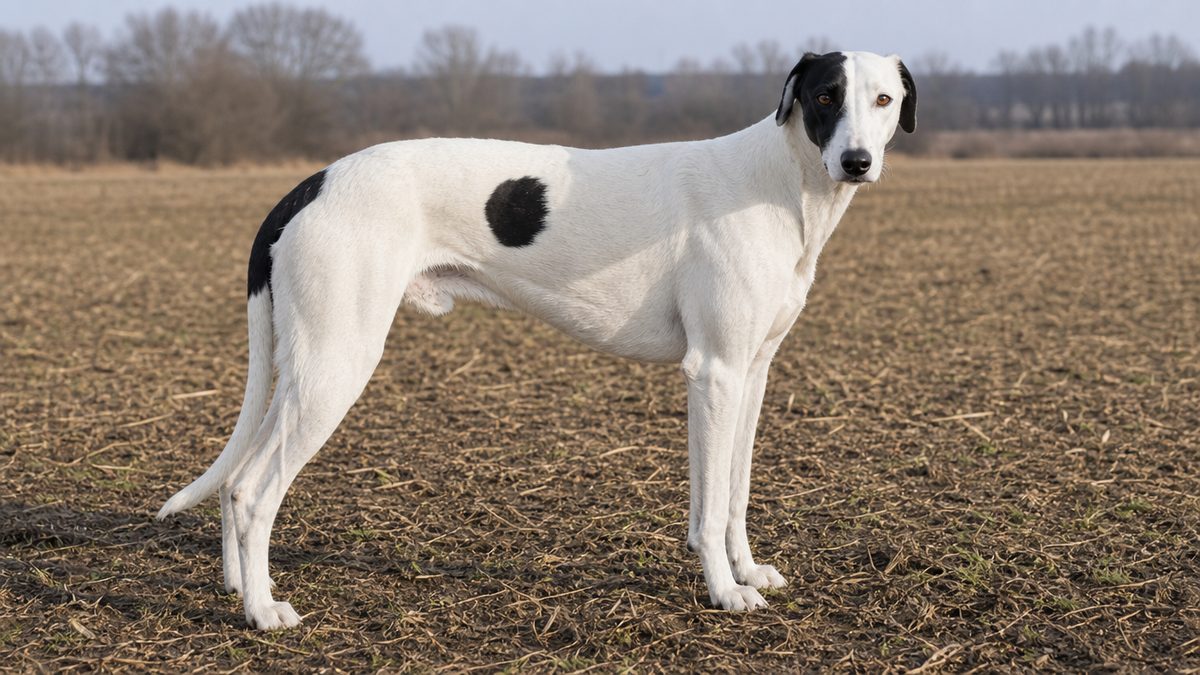
Quick answer
The Old Croatian Sighthound is extinct and was never entered in any studbook, so it cannot be bought in India or anywhere else. It was a white, patched, short-coated coursing dog of the Sava valley around Orasje, and the English name was coined in 2008 by the two Zagreb vets who kept the last pair. Locally the dogs were just called hrti, the ordinary Croatian word for greyhounds.
This guide summarises a single veterinary journal paper, two national kennel club registers, Indian breeding and import law, Indian parasitology surveys and satellite climate data as general information for Indian pet owners. It is not a diagnosis and it is not treatment advice. No health screening data exists for this dog and none is invented here. For any decision about a live animal in your care, consult a registered veterinary practitioner who has examined that animal.
Old Croatian Sighthound trait ratings, and what can honestly be rated
What the Old Croatian Sighthound actually was, and who named it
The Old Croatian Sighthound was a white, patched, short-coated coursing dog of the Sava valley around Orasje in north-eastern Bosnia, and its English name was invented in 2008 by the two Zagreb veterinary scientists who had kept the last surviving pair. Locally nobody called it that. The people of Orasje called these dogs hrti, which is simply the Croatian plural of hrt, the ordinary word for a greyhound.
That single fact reorders everything else on this page. Bauer and Lemo's 2008 paper in Revue de Medecine Veterinaire contains the sentence 'We have conditionally termed them Old Croatian Sight Hounds';. A conditional term coined by researchers in a journal article is not a breed name handed down through a population, and the thirteen-year gap between the last dogs and the naming is the reason no registry anywhere holds the label.
Bonbeno did not read that paper through a search snippet. The publisher's own copy is dead, so the file was pulled from an Archive Team capture of 9 March 2021, downloaded as 586,129 bytes across six pages, and extracted with pypdf, because a fetch tool's summary of a document is not the document.
The two-condition test: a written standard anywhere, a studbook anywhere
A name becomes a breed when two documents exist. The first is a written standard, meaning a published description a judge or a breeder could apply. The second is a studbook, meaning a register in which individual animals are entered with parentage. The Old Croatian Sighthound has neither, and both halves were checked against open registers with in-document controls rather than inferred.
| Register opened | Control that passed inside the same document | Result for this dog |
|---|---|---|
| FCI Group 10, Sighthounds, all three sections | Greyhound 158, Whippet 162, Saluki 269, Azawakh 307 all present | Absent. Thirteen breeds listed, none Croatian or Bosnian |
| FCI definitive nomenclature, letter H | HRVATSKI OVCAR (277) present between HOVAWART and HYGENHUND | Absent. No HRVATSKI HRT, no entry reading HRT |
| FCI definitive nomenclature, letter O | OGAR POLSKI, OLD ENGLISH SHEEPDOG, OTTERHOUND present | Absent under the English name too |
| FCI provisional register, 20 breeds | MACEDONIAN SHEPHERD DOG KARAMAN (378) newest entry | Absent. No Croatian or Bosnian breed on it |
| Hrvatski kinoloski savez, autochthonous breeds | Mali medimurski pas holds a full published standard there | Absent. Seven breeds listed and not one is a sighthound |
Three of those five rows are worth spelling out, because an absence is only worth anything when the document that produced it is the right document. The FCI indexes definitive breeds under their original-language names, so letter H is the decisive one: it holds eleven entries and HRVATSKI OVCAR sits among them between HOVAWART and HYGENHUND, which proves Croatian breeds are indexed there under Croatian names. A HRVATSKI HRT would sort immediately beside it, and there is no such entry and no entry reading HRT. Letter O was checked as well because the English name begins with Old, and it holds only OGAR POLSKI, OLD ENGLISH SHEEPDOG and OTTERHOUND. The provisional register, twenty breeds deep and headed by the Macedonian Shepherd Dog Karaman at number 378, carries no Croatian or Bosnian breed at all, so the dog is not waiting in a queue either.
The Croatian control matters more than the FCI one. The Croatian Kennel Club, founded in 1891 and today made up of 135 member clubs, publishes its own list of autochthonous breeds, and it runs to exactly seven: Hrvatski ovcar, Tornjak, Dalmatinski pas, Istarski kratkodlaki gonic, Istarski ostrodlaki gonic, Posavski gonic and Mali medimurski pas. A national registry that does not hold a breed is a stronger finding than absence from the FCI, because the national body is the one with a reason to hold it.
The club is also demonstrably willing to carry a breed the FCI does not. It publishes a complete written standard for the Mali medimurski pas, covering origin, proportions, head, stop, muzzle, dentition, eyes, ears, neck, body, tail, limbs, gait, skin, coat, colour, a height of 28 to 33 cm and a fault list, while that breed is absent from the FCI letter M index. So the Croatian route is open, live, and used. It was simply never used for the hrt.
On the two-condition test the Old Croatian Sighthound fails both halves. No body has ever written a standard for it and no studbook has ever held an entry. What the sources describe is a regional coursing type that died before anyone tried to formalise it, and the English name is a 2008 research label rather than a breed title. That makes this an unrecognised type rather than an unrecognised breed, and the distinction is not pedantry: an unrecognised breed has a standard somebody declined to accept, while this has no standard for anyone to accept.
Physical appearance, and where the two accounts disagree
Two published descriptions exist and they do not fully agree, so both are printed here rather than averaged. Wikipedia's stub, resting on Bauer and Lemo plus a 2001 Desmond Morris dictionary entry, gives males 60 to 70 cm with bitches 5 to 10 cm shorter, a short coat, and a predominantly white dog with black, brown, red or yellow patches. The Croatian-language AgroPortal account carries the fuller morphology and contradicts the English sources on the ears.
| Feature | Bauer and Lemo 2008 | AgroPortal, Croatian |
|---|---|---|
| Ears | Rose ears, as in an English Greyhound | Carried to the side and back, folded double, larger than a Greyhound's, never raised |
| Coat | Short | Short, coarse and hard, longer under the tail and on the upper rear thighs |
| Constitution | Not stated | More enduring than English Greyhounds and much more resistant to cold |
| The last pair | Transferred to Zagreb in the second half of the 1980s | Named Bili and Bilica, arriving in 1979 |
| Skull | Sighthound head | Broader across the forehead and occiput than an English Greyhound |
The disagreement is not a defect in the research. It is what happens when a lean, muscular, hardy landrace is written up twice, decades apart, by people working from different memories of the same handful of dogs. Any page that prints one tidy description of this animal's physical appearance has quietly chosen a side, and the history of the two accounts explains why they diverge: Bauer and Lemo wrote from the Zagreb faculty's own records, while the Croatian account draws on unpublished local testimony from Orasje.
The dogs were hunted on hare and run against each other at parish feasts, which is what a coursing dog was for in that landscape. Bauer and Lemo argue that these hrti stand behind the Dalmatian, the two Istrian hounds and in part the Posavac Hound, a hypothesis no genetic study has tested because no samples survive.
Inside Croatia the extinction is not disputed. A Croatian English-language guide to the country's breeds simply heads its final entry 'Old Croatian Sighthound (now extinct)';, and the paper itself states flatly that there have been no such dogs in the area since 1995.
Old Croatian Sighthound price in India: there is none, and here is what is being sold instead
No Old Croatian Sighthound price exists in India or anywhere else, because no dog of the type has existed since 1995 and none was ever registered. Any figure printed against this name is describing something else. Bonbeno found zero Indian for-sale listings under the name while a Labrador Retriever control search in the same session returned a full page of genuine Indian sellers, so the absence is measured rather than assumed.
Say the negative first and the reader is protected immediately. Every rupee figure this page could have printed would have been invented, converted from a foreign currency, or copied off a template, and all three are visible in this breed's own search results.
The commercial pages ranking for this name, and what they actually contain
Two of the ten results on page one are aggregator profiles built by software, and both attach commerce to a dog that does not exist. Creatures.com concedes in its own prose that the label is thinly documented and that claims about appearance and pedigrees should stay conservative, then lists 56 coat colours for it, including albino, blue merle, harlequin, leucistic, piebald, roan and tuxedo, against two published descriptions that both say white with patches. The same page offers a herdbook, a breeder directory, a marketplace and a community profile whose counters all read zero, plus a gestation calculator preset for the breed, and its Featured Listings panel opens with a blue pullet in Ravenna, Texas.
Dogell goes further and it is the cleaner example, because its structure is visible in its headings alone. For a dog last seen in 1995 it publishes a Price Range, an Availability rating, a Vet Care Frequency, a Food Consumption rating, a Bite Strength Rating, a Service Dog Capability, a Therapy Work Suitability, a Search and Rescue Potential, a Maritime Work Ability, a Draft Work Capability, a Puppy Litter Size, a Pregnancy Duration and a Breeding Frequency. None of those can be observations. They are template fields filled for whatever slug is in the URL.
Bing India's own AI summary for the sibling Sardinian breed asserts a specimen count and a daily exercise requirement in minutes, attributing them to a Wikipedia page that carries neither figure. The same machinery runs on this breed. A number gains no credibility by appearing in a generated answer, and tracing it back to the page it came from usually ends at a template field.
The search evidence behind that zero was taken from two engines, not one. Bing India returned ten genuinely on-topic organic results and no People Also Ask box, while its Labrador control returned a live PAA box with four questions. Brave Search with the India country parameter returned no question module for this breed while the same control returned a six-entry one, so the instrument was working in both sessions. Google refused every scraping engine and DuckDuckGo served an anomaly challenge, so neither supports a claim in either direction.
Why no lawful supply chain can form in India even in principle
Two independent facts close the question. There is no source population anywhere, and India's import policy for dogs would not admit one if there were. Under Policy Condition 7 the import of dogs is allowed only for a pet dog with a valid pet book and records in the importer's name, for research and development organisations holding a CPCSEA recommendation, and for internal security by the Defence and Police forces. Policy Condition 8 states that import of commercial dogs for breeding or any other commercial activity is not permitted.
Bonbeno could not open that notice on the DGFT server, which returned HTTP 403, so the text above is cited from a compliance publisher's reproduction and is labelled as one rather than presented as the instrument itself.
- Check what the seller is actually offering, because a listing under an extinct name is a different dog, most often a Greyhound cross or an Indian sighthound.
- Trace any quoted price to the page it came from and confirm the figure appears in that page's own markup, since a citation can be real while the number is invented.
- Divide any suspicious rupee figure by 84.38 and by 74, and ask whether the quotient is a price a seller would actually print.
- Treat a herdbook, a breeder directory or a gestation calculator on an extinct breed's page as evidence of a template, not evidence of a population.
- Walk away from any breeder who claims a line of this dog, because the last generation ended at F2 in Zagreb and left nothing behind.
The one honest page in the ranking set deserves naming, because a site-level verdict is not evidence about a page. iDogNames heads its own sections 'A Croatian sighthound in outline, not a neat studbook breed', 'Evidence boundary', 'No modern availability claim' and 'No modern kennel standard', and it declines to attach a price, a litter size or a screening schedule. That is the correct handling and it is rare.
If the reason you arrived here was a large white coursing dog rather than this specific name, the living options in India are real and cheap to research: the Rampur Greyhound, the Mudhol Hound and the Chippiparai are all extant, all Indian, and all adoptable.
What a dog of this size actually costs to keep in India, per month and per year
A 25 to 30 kg short-coated sighthound costs roughly Rs 6,000 to Rs 12,000 a month to keep well in an Indian metro, and every line below comes from a named Indian clinic, retailer or municipal fee table rather than from a breed price. This section exists because the breed price is the one number that cannot honestly be given, while the running costs are real, published and identical for any dog of this build.
Two different questions get confused on breed pages. What a dog costs to buy is a market fact and there is no market here. What a dog costs to keep is a care fact, and it applies to a 70 cm coursing-built dog living in Chennai whether or not the breed exists.
Vaccination, and why three Indian schedules disagree
Indian vaccination pricing has no single answer, so four sources are printed rather than one. Vetic, a clinic chain running 14 branches in Bengaluru alone plus clinics across Delhi, Gurgaon, Mumbai, Pune, Hyderabad, Chennai, Kolkata, Noida, Ghaziabad and Faridabad, publishes a full puppy course from Rs 6,499 against a struck-through Rs 8,111, an annual booster from Rs 3,199, anti-rabies from Rs 699, Puppy DP from Rs 849, 9-in-1 DHPPiL from Rs 899, Canine Corona from Rs 899 and Kennel Cough from Rs 1,349. Those are promotional floors from one chain, not a market average, and they sit well above the editorial schedules.
| Source | Full puppy course | Anti-rabies, single | Annual booster |
|---|---|---|---|
| Vetic, clinic chain card price | From Rs 6,499 | From Rs 699 | From Rs 3,199 |
| Dog With Blog | Rs 3,000 to Rs 6,000 | Rs 300 to Rs 600 | Rs 1,000 to Rs 2,000 |
| Omelo | Rs 2,500 to Rs 6,000 | Rs 300 to Rs 800 | Rs 1,000 to Rs 3,000 |
| PetYaari | Rs 2,500 to Rs 4,500 | Rs 250 to Rs 500 | Not stated |
The spread is the finding. A puppy course quoted anywhere from Rs 2,500 to Rs 6,499 is a fourfold range on one procedure, and the reason is that a clinic chain's card price and an editorial estimate are measuring different things PetYaari, 'Dog Vaccinations In India. Omelo also records the single largest variable in an Indian owner's real bill, which is that government veterinary hospitals often provide rabies vaccines free or at minimal cost.
Registration is a legal requirement, not an optional cost
In Delhi every dog owner must register the animal with the Municipal Corporation under section 399 of the Delhi Municipal Corporation Act 1957. New registration costs Rs 500, renewal costs Rs 500, and a late renewal carries Rs 100 per month after a one-month grace period tied to the anti-rabies certificate's expiry. Surrender is free. Chennai charges far less. A Greater Chennai Corporation pet licence costs Rs 50, an online licensing system was launched in the same year, and 9,115 pet animal licences were issued during 2024.
The same portal publishes numbers no breed page anywhere quotes, and they are worth seeing. Delhi has issued 18,958 pet dog certificates from 2021 to date. In financial year 2026-27 it has taken 1,006 applications, 787 new and 219 renewals, of which 426 are approved, 509 remain under process and 71 were rejected. A rejection rate of 71 in 1,006 is the practical warning: the paperwork fails often enough to plan for.
| Line | Published figure | Per year |
|---|---|---|
| Core vaccination, adult booster | From Rs 3,199 (Vetic card price) | Rs 3,199 upward |
| Municipal registration, Delhi | Rs 500 new or renewal | Rs 500 |
| Municipal pet licence, Chennai | Rs 50 | Rs 50 |
| Anti-rabies at a Chennai Corporation pet clinic | Free of cost, six clinics | Rs 0 |
| Routine consultation, private clinic | Rs 500 to Rs 1,000 per visit | Rs 2,000 to Rs 4,000 at four visits |
| Parasite cover, NexGard Spectra 15-30 kg | Rs 3,308 per 3 tablets, Rs 1,103 a month | About Rs 13,236 |
Two figures needed a warning and one of them had to be dropped. The Rs 500 to Rs 1,000 consultation band appears byte-identical on a dog sanctuary's site and on a general insurer's blog, along with an identical Rs 1,500 to Rs 3,000 vaccination band, and two unrelated organisations agreeing exactly on two separate quantities is not two confirmations, so it is treated here as one data point. The widely repeated Rs 1,500 to Rs 2,500 microchipping range is not printed at all, because 1,500 divided by 74 is 20.27 and 2,000 divided by 80 is exactly 25.00, which maps onto the standard US twenty-to-twenty-five-dollar microchip price. Chennai's Corporation instead microchips the free-roaming dogs it catches for sterilisation, and its own pet clinics give treatment and anti-rabies vaccination to owned animals free of charge.
For a 25 to 30 kg dog, NexGard Spectra in the 15 to 30 kg band runs Rs 3,308 for three tablets against an MRP of Rs 3,375, which is Rs 1,103 a month and covers the tick, flea, roundworm, hookworm, whipworm and heartworm role in one chew. Drontal Plus costs Rs 754 for six tablets against an MRP of Rs 838, dosed one per 10 kg, so a deworming for this size of dog is Rs 251 to Rs 377. On a thin-skinned short-coated dog in India that is not a discretionary spend.
Heat tolerance: the home valley freezes in January and Chennai never gets that cool
This dog would have coped badly with Indian heat, and the comparison is stark enough to state as arithmetic rather than opinion. Orasje in Bosnian Posavina averages 12.18 C across the year with January at 0.03 C, while Chennai's coolest month averages 24.09 C, which is warmer than Orasje's hottest month at 24.00 C NASA POWER climatology for Chennai.
Read that once more, because it is the whole climate argument in one line. The coldest month a Chennai dog will ever experience is warmer than the hottest month the Orasje dogs ever experienced. There is no season in Chennai that resembles this animal's home range.
The figures come from NASA POWER queried by explicit latitude and longitude, not from a place-name lookup, because climate sites serve the wrong city at HTTP 200 with alarming regularity. Orasje was queried at 44.8817 N, 18.6939 E, and the returned grid cell reports 142.76 m against a real town elevation near 85 m, a 58 m difference that is well inside lowland tolerance and needs no lapse-rate correction.
| Place | Annual mean | Coldest month | Warmest month | Mean humidity |
|---|---|---|---|---|
| Orasje, Bosnian Posavina | 12.18 C | January, 0.03 C | July, 24.00 C | 74.06 percent |
| Chennai | 27.95 C | January, 24.09 C | May, 31.51 C | 72.39 percent |
| Delhi | 25.60 C | January, 13.61 C | June, 35.88 C | 45.56 percent |
Delhi is the more interesting comparison and the more dangerous one. Its January mean of 13.61 C sits close to Orasje's annual mean, so a Delhi winter is genuinely survivable for a dog of this constitution. Its June mean of 35.88 C with a climatological daily maximum of 48.79 C is not, and the cell reports 206.37 m against a real elevation near 216 m, so the model is standing on the city rather than on a hill nearby.
The only published constitution claim points the wrong way
Nobody has ever described these dogs as heat-adapted. The single published claim about their constitution runs in the opposite direction: the Croatian account states that they were more enduring than English Greyhounds and much more resistant to cold. A dog selected for endurance in a valley that freezes carries no evidence of heat tolerance, and inventing one would be the easiest fabrication on this page.
That is why the heat tolerance rating here is 1, the floor. It is an inference from origin climate plus one constitution claim, and it is labelled as an inference rather than an observation, because no dog of this type has been observed anywhere since 1995.
What Indian law says about keeping a heat-intolerant dog outdoors
The statutory hook is specific and most Indian pages miss it. Second Schedule Part IV paragraph 21(1) of the Prevention of Cruelty to Animals (Dog Breeding and Marketing) Rules 2017 bars keeping in outdoor facilities, without the attending veterinary practitioner's written approval, dogs not accustomed to local temperatures, breeds that cannot tolerate them such as long-haired breeds in high temperature locations, and sick, infirm, aged or young animals.
The first of those three limbs is the one that matters here. A dog bred for a valley at 12 C annual mean is by definition not accustomed to local temperatures in Chennai, so outdoor housing would require written veterinary approval on the face of the Rules. Note the citation form: this is a Second Schedule paragraph, not a Rule. The Rules themselves stop at Rule 13, so any citation reading 'Rule 21' is wrong by construction, and the string 'Rule 21' appears zero times in the gazette.
A UK study of 905,543 dogs under primary veterinary care in 2016 recorded 1,259 heat-related illness events in 1,222 dogs. Of the 879 events with a recorded trigger, 652, or 74.2 percent, were exertional rather than environmental, with 113 environmental and 46 following vehicular confinement. A running dog does not need a hot car to overheat; it needs a hot afternoon and permission to run. Bodyweight at or above the breed and sex mean carried an odds ratio of 1.30 for exertional illness in that paper.
Bonbeno cites that figure carefully because the site has been wrong about it before. The percentages are computed on the 879 events with a recorded trigger, not on the 1,259 total, and the paper is the Animals one rather than the Scientific Reports paper of the same year using the same cohort with a different case definition. This breed appears in neither paper's model, so nothing here is a breed-specific odds ratio.
Humidity is the underrated half. Orasje at 74.06 percent mean relative humidity is not a dry place, so the Indian problem for this dog is heat rather than humidity as such. Delhi at 45.56 percent is drier than the home valley and Chennai at 72.39 percent is almost identical to it.
Temperament: what one Croatian sentence supports and what every other page invented
Almost nothing about this dog's temperament is knowable, and the honest total is three claims from two sources. The dogs were independent coursing hounds with a very high prey drive, they were run loose in village farmyards, and they were described as more enduring than English Greyhounds. Everything beyond that on any ranking page is template fill.
The reason to say so plainly is that temperament is where breed pages fabricate most freely, because nobody can check it. Dogell prints a Personality Traits block, a Sensitivity Level, an Impulse to Wander or Roam, an Affection Level, a Social Needs rating, a Watchdog Rating, a Barking Frequency, a Playful Nature score, a Cat Friendly rating, a Child Compatibility rating and a Stranger Friendly rating for this dog. None of those can rest on an observation, because the last observer died with the last dogs.
The three claims that do have a source
- High prey drive, evidenced by function. These were hare-coursing dogs run competitively at parish feasts, which is a selection pressure on chase behaviour and nothing else.
- Endurance above an English Greyhound's, stated directly in the Croatian account alongside the cold-resistance claim.
- Village tolerance, evidenced by housing. The dogs lived loose around farmyards in the Sava valley rather than in kennels, which implies workable tolerance of people and other animals in that specific setting.
Each of those is an inference from how the dogs were kept and used, and each is labelled as one. What is not available is any claim about trainability, separation tolerance, noise sensitivity, behaviour with children, or suitability as a watchdog, and the absence of those is itself the useful content.
Why the household-fit question cannot be answered for this dog
Household fit is a comparison between a breed's observed behaviour and a home. One half of that comparison does not exist. No dog of this type has lived in an apartment anywhere, in India or in Croatia, so the apartment rating on this page sits at the floor for honesty rather than as a judgement.
The nearest legitimate substitute is the behaviour of living coursing sighthounds, and Bonbeno covers those on their own pages rather than borrowing their traits onto this one. A reader weighing an independent, high-prey-drive, low-maintenance running dog for an Indian home should read the Greyhound, the Whippet and the Rampur Greyhound pages, where the temperament claims rest on populations that exist.
Never substitute a related breed's numbers. A page with no lifespan study, no screening data and no standard should say so three times rather than borrow once. Where a trait cannot be sourced for this dog it is left blank here, and the blank is stated rather than filled from a Greyhound.
What the restoration attempt revealed about the type
One behavioural fact does emerge from the Zagreb programme, and it is about form rather than character. The last pair were deliberately bred in the closest kinship, the programme reached only the second generation, and by F2 the puppies were already losing sighthound proportions, growing coarser bone and shorter bodies, with one descendant carrying hair over six centimetres long on its tail. A type that dissolves in two generations under deliberate selection was never a fixed breed to begin with.
That result also explains why no revival is possible. There is no founder stock, no register to breed back toward, and no standard to breed toward. The programme's own outcome is the argument against every claimed line.
Training a coursing hrt, and the training language this breed's pages should avoid
To train a dog of this type you would work with the chase and never against it, because a hare-coursing hound selected for independent decision-making at speed does not take direction while running. That is a statement about coursing sighthounds generally, and it is offered here as transferable context rather than as an observation of this dog, because no one has trained one since the 1980s.
The distinction matters and one ranking page makes it explicitly. iDogNames heads a section 'Training language to avoid' and another 'Coursing lessons without pretending revival', which is exactly the right frame. You can describe how coursing dogs are handled without implying that anyone can go and handle one of these.
What transfers from the coursing record
- Recall competes with sight. A dog bred to run down a hare across open ground has been selected for exactly the behaviour that beats a recall cue, so off-lead freedom in an unfenced Indian park is not a training problem to solve but a risk to design around.
- Motivation runs on movement. Chase games, lure work and short sprints reward this build in a way that food-first obedience drilling does not.
- Sessions stay short. A sprinting hound holds effort in seconds and minutes, not in the long working sessions a retriever tolerates.
- Handling stays gentle. Thin skin, light bone and a low body-fat frame make heavy physical correction both cruel and counterproductive on any sighthound.
None of that is breed-specific to the hrt and this page does not pretend otherwise. The honest sentence is that a village coursing dog in 1980s Bosnia was not trained in any modern sense at all. It was kept, fed, and run.
The Indian legal frame around what these dogs were for
The activity this breed existed for is the same activity that killed it. Yugoslavia banned coursing with sighthounds and also banned hunting with dogs not registered in a kennel club pedigree registry, and Bauer and Lemo record that hunters and veterinarians in the area were then obliged to kill these dogs as hunting-ground pests. A breed with no studbook had no lawful standing the moment registration became the test.
An Indian reader should notice the symmetry rather than the difference. Registration is again the operative test here, though for a different purpose: in Delhi a pet dog must be registered with the municipal corporation under section 399 of the DMC Act 1957, and 71 of 1,006 applications in the current financial year were rejected.
The Zagreb programme deliberately bred the last pair and their offspring in the closest kinship. In India that is unlawful. Second Schedule Part II paragraph 6(3) of the 2017 Rules prohibits two named techniques: in breeding, defined as breeding between relatives of the 2nd to 4th grade within the first four generations, with uncle to niece, nephew to aunt, cousin to cousin and grandparent to grandchild given as examples; and incest breeding, mating between parents and children or between brother and sister. A rescue programme run the Zagreb way would break Indian law.
That clause is a Second Schedule paragraph and not a Rule, and the difference is not pedantry. The Rules run 1 to 13 and Rule 6 is a different provision headed 'Requirements to be met by breeders and establishments', which is what gives the Schedule its force. Citing paragraph 6(3) as 'Rule 6(3)' misdirects any reader who looks it up.
Socialisation, and why the window argument survives the breed's absence
Early socialisation is a puppy-development fact rather than a breed fact, so it transfers cleanly. An Indian owner of any sighthound-type puppy is working against a specific local reality: free-roaming dogs, dense street traffic, and monsoon months that make outdoor exposure harder to schedule. A dog of this build in Chennai would need its socialisation walks moved to the two hours after sunrise, given that May averages 31.51 C with a climatological daily maximum of 42.70 C.
Bonbeno covers real training protocols on the pages for breeds that exist. For a comparable living hound the Magyar Agar page is the closest match, since it is the Pannonian coursing sighthound from the same plain and the same tradition that did reach a register.
Exercise: what a 70 cm coursing hound needed, and when an Indian day permits it
A dog of this build needed daily hard running in short bursts rather than long-distance walking, and in India the binding constraint is not the dog's appetite for exercise but the hours in which running is safe. On Chennai figures that is roughly two windows a day, early morning and after dark.
Start with what the record supports. These were dogs run competitively on hare at parish feasts and described as more enduring than English Greyhounds. That is a sprint-and-recover animal with an unusually good recovery, which is a different exercise profile from a herding dog's sustained trot.
The Indian timing problem, stated in degrees
Chennai's warmest month averages 31.51 C with a climatological daily maximum of 42.70 C, and its coolest month still averages 24.09 C. Delhi runs cooler in winter at 13.61 C in January but reaches a June mean of 35.88 C with a daily maximum of 48.79 C. A dog whose home valley averaged 12.18 C annually has no acclimatisation to any of that.
| City and season | Published temperature | Practical exercise window |
|---|---|---|
| Delhi, December to February | January mean 13.61 C | Most of the day; closest India comes to the home climate |
| Delhi, May to July | June mean 35.88 C, max 48.79 C | Pre-dawn only, and hard running is inadvisable at all |
| Chennai, December to February | January mean 24.09 C | Early morning and after dark; still warmer than Orasje's July |
| Chennai, April to June | May mean 31.51 C, max 42.70 C | Pre-dawn walking only, no sprint work |
That table is the single most useful thing this page can give an Indian reader thinking about any large short-coated running dog, and it is why the climate work was done by explicit latitude and longitude rather than by looking up a city name.
Why exertional heat illness is the specific danger
The risk profile for a running dog is not the one most owners picture. In a UK cohort of 905,543 dogs, 652 of the 879 heat-related illness events with a recorded trigger, or 74.2 percent, were exertional rather than environmental, against 113 environmental and 46 following vehicular confinement. The dog that overheats is usually the one that was allowed to run, not the one left in a car.
Applying that to a dog the study never modelled would be fabrication, so this page claims only the transferable direction of the finding and prints no breed-specific odds ratio.
- Move all hard running to the ninety minutes after sunrise, and keep evening sessions to walking until the surface has cooled.
- Test the ground with the back of your hand before any sprint work, because a coursing dog's pads take the full contact load at speed.
- Carry water on every outing longer than fifteen minutes, and offer it before the dog looks like it needs it.
- Fence the run rather than trusting recall, since prey drive beats a cue at distance on any coursing breed.
- Stop the session at the first sign of a widened, squared-off pant rather than waiting for staggering.
If the exercise profile above is what attracted you, three living Indian sighthounds deliver it and can be adopted rather than imported. The Rampur Greyhound, the Mudhol Hound and the Chippiparai were all bred for coursing on Indian ground, in Indian heat, and their heat tolerance is an observation rather than an inference.
One more point on the record. The Zagreb pair were kept at a veterinary faculty rather than run, and the paper records only that they died in advanced age with no figure attached. So even the working lifespan of a hard-run hrt is unrecorded, and nothing here should be read as a documented exercise requirement for this specific dog.
Grooming a short, coarse coat in Indian humidity, where the real job is ticks
Coat care for this dog would take minutes a week, and that is the easy half. The hard half in India is that a short single coat over thin skin is the most difficult kind to keep free of ticks, not the easiest, which is why this page rates coat maintenance at 2 rather than 1.
The coat itself is described twice and the two accounts differ slightly. Wikipedia gives simply a short coat, predominantly white with black, brown, red or yellow patches. The Croatian account adds texture the English sources omit, calling it short, coarse and hard, with slightly longer hair under the tail and on the upper rear of the thighs. A coarse short coat sheds dirt well and needs no stripping, clipping or de-matting at all.
Why a short coat is the worst coat for Indian tick pressure
Tick burden in India is not a background risk, it is the dominant parasitic pressure, and the published range is enormous. A four-location survey of 525 dogs found 278, or 53 percent, tick-infested on visual inspection, with Mumbai at 80 percent of 162 dogs and Delhi at 75.3 percent of 162, against Sikkim at 17 percent of 101 and Ladakh at 11 percent of 100. A Tamil Nadu series found 229 of 230 dogs infested, or 99.6 percent, at a mean intensity of 5.6 ticks per dog.
Those two figures, 11 percent in Ladakh and 99.6 percent in Tamil Nadu, are the real range an Indian owner faces, and no single national number describes it. Both studies sampled clinic or survey populations rather than random ones, so the honest framing on a public page is dogs examined in veterinary settings.
| Finding | Four-location survey, n=525 | Tamil Nadu series, n=230 |
|---|---|---|
| Dogs tick-infested | 278 of 525, 53 percent | 229 of 230, 99.6 percent |
| Mumbai | 80 percent of 162 | Not sampled |
| Delhi | 75.3 percent of 162 | Not sampled |
| Ladakh | 11 percent of 100 | Not sampled |
| Hepatozoon canis | 30 percent | Co-infection with Anaplasma platys 8.3 percent |
| Ehrlichia canis | 20.6 percent overall, 39.5 percent in Delhi | Not separately reported |
The dominant genus in both series is Rhipicephalus, and Rhipicephalus sanguineus sensu lato was identified on 98.3 percent of infested dogs in the Tamil Nadu work. Ehrlichia canis ran at 39.5 percent in Delhi and 27.2 percent in Mumbai against zero in both Sikkim and Ladakh, which is the clearest evidence that tick-borne disease pressure in India is a location question before it is a breed question.
Second Schedule Part IV paragraph 27 of the 2017 Rules requires that regular de-ticking be practised at the time of grooming. On a short-coated dog that is genuinely easy to comply with, because every tick is visible against the skin without parting a coat, and a five-minute check after every walk is realistic. That accessibility is the one real grooming advantage a coat like this has in India.
The routine, and one piece of overseas advice that does not transfer
- Brush weekly with a rubber curry or hound glove; a coarse short coat needs nothing more.
- Check for ticks daily in the monsoon and after every walk in Mumbai, Delhi, Chennai or any lowland city, working the ears, groin, armpits and between the toes.
- Bathe only when actually dirty, since frequent bathing on thin skin over light muscle causes more trouble than it solves.
- Dry the ears deliberately after any bath rather than letting the dog air dry, because letting a wet dog dry itself is advice written for a temperate climate.
That last item is worth stating as a correction rather than a tip. Overseas breed clubs routinely tell owners to towel a dog and let it air dry, which is sound in a cool northern summer and poor practice in an Indian monsoon. The relevant Indian evidence on ear disease seasonality is thinner than this site would like, and Bonbeno states that rather than inventing a prevalence figure to fill the gap.
Skin colour is also a practical point on a predominantly white dog. A largely white, short-coated animal carries unpigmented skin under thin hair, and in Indian sun that is a burn and long-term skin-damage risk on the nose, ear tips and belly that a pigmented dog does not carry to the same degree.
Health and lifespan: no screening scheme, no cohort, no published lifespan, and why that is the answer
No health data of any kind exists for this dog, and the correct response is to say so rather than to borrow a Greyhound's figures. There is no screening scheme, no registry to hold results, no cohort study, and no published lifespan. Every number circulating under this breed's name was copied from another breed or invented.
That claim is only worth making if the search behind it was proved to work, so it was. PubMed returned zero records for 'Old Croatian Sighthound', 'Old Croatian Sight Hound', 'Old Bosnian Sighthound', 'stari hrvatski hrt', 'hrvatski hrt', 'Croatian sighthound' and 'Croatian greyhound'. The database broadened every one of those queries rather than narrowing them, dropping the quoted phrase and AND-ing terms across all fields, and still found nothing, which makes the absence stronger rather than weaker. Controls run in the same session returned 126 records for Labrador Retriever with hip dysplasia, 87 for Dalmatian with urate, and 831 for greyhound in title or abstract.
Why no lifespan figure appears anywhere on this page
The largest UK longevity study of companion dogs covers recognised breeds with recorded deaths, and neither name used for this dog appears in its breed tables, so no median life expectancy from that source can honestly be attached to it. The two documented individuals lived at the Zagreb veterinary faculty and are recorded only as having died in advanced age, with no figure given.
Meanwhile an aggregator publishes an Average Lifespan for this dog under its own heading, alongside a Vet Care Frequency and a Health Concerns block. Those cannot be measurements of anything.
| Evidence type | Where it was looked for | Result |
|---|---|---|
| Peer-reviewed literature | PubMed, seven name forms, three passing controls | Zero records under every form |
| Breed lifespan | McMillan 2024 UK longevity tables | Breed absent; no median can be quoted |
| Screening scheme | FCI, Croatian Kennel Club | None exists; no register to hold results |
| Written standard | FCI Group 10, letters H, M and O, provisional list | None; nothing to screen against |
| Heat-illness modelling | Hall 2020, Animals, 905,543-dog cohort | Breed not in the model; only the general direction transfers |
The risks that are real for any short-coated sighthound living in India
Nothing above means an Indian reader has nothing to act on. It means the actionable risks are environmental and Indian rather than inherited and breed-specific, and those are well evidenced.
- Tick-borne disease, the dominant risk. Hepatozoon canis at 30 percent, Ehrlichia canis at 20.6 percent overall and 39.5 percent in Delhi, Mycoplasma haemocanis at 12.2 percent, Anaplasma platys at 6.5 percent, Babesia vogeli at 5.5 percent and Babesia gibsoni at 0.2 percent, across 525 dogs in four locations.
- Exertional heat illness, at 74.2 percent of the 879 triggered events in a 905,543-dog cohort, which is the running dog's characteristic emergency.
- Sun damage on unpigmented skin, a direct consequence of a predominantly white short coat in Indian light.
- Traffic and roaming injury, the practical consequence of a high prey drive in an unfenced Indian city.
Those tick prevalences come from the four-location survey and are quoted with its denominator rather than as national rates.
Second Schedule Part III paragraph 8(10) of the 2017 Rules requires that breeding dogs be tested for genetic defects including hip dysplasia, progressive retinal atrophy, night blindness, hypothyroidism, entropion, ectropion, overshot, undershot jaw, wry mouth, two or more missing teeth, and unilateral or full cryptorchidism. Sighthounds are the one breed group in which a low thyroid reading is the normal finding rather than a disease, so an Indian breeder screening any coursing hound needs a vet who knows to interpret the result against sighthound reference ranges. Note the word 'including': the list is illustrative, not closed.
The gazette also does not mention deafness anywhere. Across the whole document 'BAER' appears zero times and 'deaf' appears zero times, and the single occurrence of 'hearing' is an appeal hearing before the Secretary, Animal Husbandry. So there is no Indian statutory hearing-test requirement, which matters on a predominantly white breed where deafness would ordinarily be the first screen a buyer asks about.
Vaccination is where an Indian owner's health spend actually goes, and the schedules disagree. A full puppy course runs from Rs 2,500 to Rs 6,499 across four published Indian sources, with anti-rabies alone from Rs 250 to Rs 699 PetYaari, 'Dog Vaccinations In India.
Feeding a lean 25 to 30 kg running dog in India, with real bag prices
Feed a coursing-built dog to a visible waist and two or three palpable ribs, not to a weight chart, and budget separately for parasite cover, which on Indian tick pressure runs about Rs 1,103 a month for a dog in the 25 to 30 kg band. Body condition is the operative measure on this build, because a lean, dry-muscled sighthound at correct weight looks underfed to anyone used to a Labrador.
Diet and nutrition for this build come down to one principle and one Indian constraint. The principle is that a coursing hound is condition-scored rather than weighed. The constraint is that a large-breed food supply chain is reliable in the metros and thin outside them, which matters more for a 30 kg dog than any brand choice does.
Bauer and Lemo record the last pair at about 70 cm and about 60 cm at the withers, and a dog of that height on sighthound proportions sits in the 25 to 30 kg band. That is the band the figures below are worked for.
Why this page prints no monthly kibble figure, and what happened when it was re-checked
Bonbeno's own Indian care-cost reference recorded a 15 kg bag of Royal Canin Maxi Adult at Rs 9,548 against an MRP of Rs 11,000, or Rs 636.53 per kilogram. Re-checked for this page, that URL now serves a different product: a Maxi Adult dry and wet combo of 4 kg dry plus twenty 140 g wet sachets, listed at Rs 4,593 down from Rs 6,010 against an MRP of Rs 6,830, with a unit price of Rs 85 per 100 g.
So no monthly kibble cost is published here. The old figure cannot be re-verified at its own address, and a monthly number was always arithmetic rather than a quoted price, since no retailer prints one. An Indian reader budgeting for a 25 to 30 kg dog should read the grams per day off the pack they actually buy and multiply by that week's shelf price, which is the only method that survives a retailer changing a listing.
| Stage | Approach | Indian complication |
|---|---|---|
| 8 weeks to 4 months | Large-breed puppy food, four meals, free growth without pushing | Sale below eight weeks is prohibited under Rule 8(1)(a) of the 2017 Rules |
| 4 to 9 months | Three meals, controlled growth, no supplementary calcium | Puppies should be fully vaccinated before group socialisation; a course runs Rs 2,500 to Rs 6,499 across four published Indian sources |
| 9 to 18 months | Two meals, adult transition, weight held lean | Deworming interval matters more than food brand at this age |
| Adult | Two meals, condition-scored monthly | Kibble price moves; parasite cover at Rs 1,103 a month does not |
| Senior | Two meals, protein maintained, joints monitored | No breed-specific senior guidance exists for this dog |
The eight-week floor is a genuine Rule rather than a Schedule paragraph, and it is worth citing precisely: Rule 8(1)(a) of the 2017 Rules provides that pups less than eight weeks in age are not sold.
Deworming and parasite cover are part of the feeding budget in India
For a dog in this weight band, NexGard Spectra in the 15 to 30 kg presentation runs Rs 3,308 for three tablets, which is Rs 1,103 a month, and it covers the tick and flea role together with roundworm, hookworm, whipworm and heartworm in one chew of afoxolaner 75 mg with milbemycin oxime 15 mg. Drontal Plus runs Rs 754 for six tablets dosed at one per 10 kg, so a single deworming for a 25 to 30 kg dog costs Rs 251 to Rs 377.
Given tick infestation rates of 53 percent across four Indian locations and 99.6 percent in a Tamil Nadu series, that Rs 1,103 a month is not an optional line for a short-coated dog in a lowland Indian city.
Every published weight range for this dog traces back to two individuals measured at a veterinary faculty in the 1980s. There is no breed weight standard because there is no standard. Feed to a waist visible from above, an abdominal tuck visible from the side, and ribs you can feel under light pressure without seeing them from across a room. And treat every retail figure on any breed page as perishable. One of the food prices this site recorded a day earlier no longer exists at its own URL.
Indian availability of large-breed food is genuinely good in the metros and thinner elsewhere, which is a real constraint for a 30 kg dog. A reader outside Delhi, Mumbai, Bengaluru, Chennai, Hyderabad, Pune or Kolkata should confirm a reliable supply line for a 15 kg bag before committing to any dog of this size, because switching foods abruptly on a lean dog costs condition quickly.
One thing this page will not do is print a breed-specific feeding requirement in grams. No feeding trial, no body-condition study and no breeder guidance exists for this dog, and the two documented individuals were kept by a veterinary faculty that published no diet.
The first year, and the one litter record that actually exists
No month-by-month development record exists for this dog, and the only litters ever documented are the two generations bred at Zagreb in an attempt to save it. What follows separates the three things that are recorded from the general first-year timeline that applies to any large sighthound-type puppy in India, and it labels which is which.
What the Zagreb litters actually showed
Bauer and Lemo record a deliberate inbreeding programme run on the last pair that reached only the second generation. By F2 the puppies were already losing sighthound proportions, growing coarser bone and shorter bodies, and one descendant grew hair over six centimetres long on its tail. That is the entire documented reproductive record for the breed: two generations, a visible loss of type, and a stop.
It is also the reason no revival claim should be believed. A type that dissolves under deliberate selection inside two generations had no fixed genetic basis to preserve, which is a different thing from a breed that simply ran out of numbers.
Second Schedule Part II paragraph 6(3) of the 2017 Rules prohibits in breeding, defined as breeding between relatives of the 2nd to 4th grade in straight or side line within the first four generations, and incest breeding between parents and children or brother and sister. The Zagreb programme was breeding in the closest kinship by design. An Indian reader who reads a rescue-breeding account approvingly should check it against paragraph 6(3) before repeating it.
The general first-year timeline, and where India changes it
| Age | What is happening | The Indian complication |
|---|---|---|
| 0 to 8 weeks | With the dam; sale before this point is unlawful | Rule 8(1)(a) provides that pups less than eight weeks in age are not sold |
| 8 to 12 weeks | Primary socialisation, first vaccinations | A full puppy course runs Rs 2,500 to Rs 6,499 across four published Indian sources |
| 3 to 5 months | Rapid growth, second and third vaccinations | Monsoon months make daily outdoor socialisation harder to schedule |
| 5 to 8 months | Leg length outruns coordination; no forced exercise | Heat forces all activity to the ninety minutes after sunrise in most cities |
| 8 to 12 months | Muscle fills in; adult coat and full height | Municipal registration and annual booster both fall due in this window |
| 12 months on | Adult condition; lean weight held deliberately | Tick cover at Rs 1,103 a month becomes a permanent line |
Every row above is a general large-sighthound timeline attached to a verified Indian fact, and none of it is a claim about this breed. That distinction is the whole point of the section. The eight-week floor is a genuine Rule of the 2017 Rules rather than a Second Schedule paragraph, and the vaccination band spans four published Indian schedules that disagree Omelo, 'Dog and Cat Vaccination Schedule….
What a template will tell you instead
An aggregator profile for this breed publishes a Puppy Litter Size, a Pregnancy Duration and a Breeding Frequency. Those three fields describe a reproductive programme that ended in the early 1990s after two generations and was never recorded in the terms those fields imply. Treat any breeding statistic offered for this dog as a template default, and ask what population it could possibly have been measured on.
Head to head against the sighthounds a reader is really choosing between
Nobody is cross-shopping an Old Croatian Sighthound against anything, because it cannot be bought. The comparison that matters is between the four living coursing hounds an Indian reader reaches for after finding this name, and the honest answer is that three of them are Indian and one of them is the Greyhound this dog was always compared to.
| Breed | Written standard | Studbook | Available in India | Heat adaptation |
|---|---|---|---|---|
| Old Croatian Sighthound | None, from any body, ever | None, anywhere | No; extinct since 1995 | None; homeland freezes in January |
| Greyhound | Yes, FCI 158 | Yes, worldwide | Yes, and imported to Orasje to replace the hrti | Poor, but managed successfully in India |
| Magyar Agar | Yes, FCI 240 | Yes | Rare, but a real registered population exists | Poor; Pannonian plain origin |
| Rampur Greyhound | Indian, contested | Limited | Yes, in north India | Bred in Indian heat |
| Mudhol Hound | Indian, KCI-recognised | Yes, in India | Yes, with state breeding support | Bred in Deccan heat |
Read the first row across and the argument writes itself. The Old Croatian Sighthound loses on every column that matters to a buyer, and it loses on the first two by definition rather than by degree, because those two columns are the two-condition test.
The Greyhound comparison is the one the sources actually make
Both published descriptions of the hrt are written against the Greyhound. Wikipedia calls the dog almost identical to the Greyhound although slightly smaller, while the Croatian account says the ears were larger and folded rather than rose, the skull broader across the forehead and occiput, the coat coarser, and the dog more enduring and much more resistant to cold. So the sources agree the comparison is to a Greyhound and disagree about which direction the differences run.
There is a bleak coda. Imported Greyhounds replaced the surviving hrti in Orasje, so the comparison breed is also the replacement breed. A reader who wants what this dog was should read the Greyhound page, because that is literally what the region ended up with.
Why the Magyar Agar is the closest structural comparison
The Magyar Agar is the Pannonian coursing sighthound from the same plain and the same feast-day racing tradition, and it holds FCI number 240 in Group 10, Section 3. It is the counterfactual: a regional coursing hound of the Danube basin that got a standard and a studbook and therefore still exists. The Magyar Agar page is the natural next read for anyone interested in why one survived and the other did not.
The same lesson sits closer to home for the hrt. The Croatian Sheepdog got its first written standard from Dr Otto Rohr in 1951 and FCI publication on 31 January 1969. That is the path this dog never took, and the sheepdog page shows what taking it looks like.
- For a large coursing dog in north India, read the Rampur Greyhound page.
- For a coursing dog with state breeding support and a KCI route, read the Mudhol Hound page.
- For a south Indian sighthound of the same build, read the Chippiparai page.
- For the closest registered European analogue, read the Magyar Agar page.
- For another extinct dog whose status as a breed was disputed by the people who saw it, read the Norfolk Spaniel page.
One more comparison is worth naming because this site is building it in parallel. The Levriero Sardo is Sardinia's coursing hound, it also has no written standard and no studbook, and unlike this dog it is not extinct. The two pages together are the clearest illustration on the site of what the two-condition test does and does not tell you about a population's survival.
Six mistakes Indian readers make with this name
The commonest error is treating this as a rare breed you might acquire rather than an extinct type you cannot, and every other mistake follows from it. Below are the six that actually cost Indian readers money or credibility, in the order they usually happen.
1. Reading a template's price as a market
An aggregator publishes a Price Range and an Availability rating for this dog under its own headings. Those are template fields, not observations. Bonbeno's own search for Indian for-sale listings under this name returned zero while a Labrador control returned a full page of genuine Indian sellers in the same session, which is what an absence looks like when it has been measured.
2. Trusting an AI summary as a source
Generated answers are already restating aggregator invention as fact for breeds in this family, including specimen counts and exercise requirements in minutes that do not appear in the pages they cite. A number gains no credibility by appearing in an answer box. Trace it to the page and confirm the figure is in that page's own markup.
3. Believing an FCI group printed by somebody other than the FCI
This one is subtle and this site has been caught by it elsewhere. The Croatian Kennel Club's record for the Mali medimurski pas prints a row reading 'KLASIFIKACIJA FCI - a: Grupa 1, Sekcija 1, Bez radnog ispita' for a breed that is absent from both FCI registers. That row is the club's own filing using FCI vocabulary, not an FCI grant. Only the FCI's own register settles recognition, and only with a control breed visible on the same document.
4. Assuming absence from the FCI means absence everywhere
The opposite error is just as common. A breed can be held nationally and never reach the FCI at all, which is exactly what the Mali medimurski pas demonstrates: a full written standard published by the Croatian club, covering everything from stop to fault list, for a dog the FCI does not hold. So the Croatian register had to be opened separately, and it is the register whose silence actually settles this breed.
5. Copying a Greyhound's health and lifespan figures across
There is no lifespan for this dog. The largest UK longevity study's breed tables do not contain either name it carries, PubMed returns zero under seven name forms against three passing controls, and the two documented individuals are recorded only as having died in advanced age. Borrowing a Greyhound median and printing it under this name is the single most common fabrication in this breed's search results.
6. Planning outdoor housing for a cold-climate dog in an Indian summer
The legal point is specific. Second Schedule Part IV paragraph 21(1) of the 2017 Rules bars outdoor housing, without written veterinary approval, of dogs not accustomed to local temperatures and of breeds that cannot tolerate them. A dog from a valley averaging 12.18 C annually is not accustomed to a Delhi June averaging 35.88 C with a daily maximum of 48.79 C NASA POWER climatology for Delhi.
Before accepting that any name is a breed, ask two questions. Has any body anywhere published a written standard for it? Has any studbook anywhere held an entry for it? Then open the registers yourself, including the national registry of the country of origin, and confirm a control breed is visible in the same document. On this dog the answer to both questions is no, and the Croatian register's silence is the stronger half of the finding.
Adoption: the sighthounds you can actually give a home to in India
You cannot adopt an Old Croatian Sighthound, and the useful version of this section is the list of coursing dogs you can. India has three native sighthound breeds in living populations plus a steady supply of Greyhound and lurcher types in rescue, and every one of them is available without an import licence.
Adoption is not a consolation prize here. It is the only route to the thing a reader wanted, which was a lean, independent, short-coated running dog, and the Indian versions of that dog are better adapted to Indian heat than a European coursing hound would ever have been.
The Indian sighthounds, and where they sit
- Rampur Greyhound, the large north Indian coursing hound, the closest Indian analogue in size and build to what the hrti were.
- Mudhol Hound, the Deccan sighthound with genuine state breeding support and a KCI route, which makes provenance easier to verify than for most Indian breeds.
- Chippiparai, the south Indian sighthound, lighter framed and well adapted to Tamil Nadu heat.
- Kanni, the closely related south Indian type, rarer and harder to source honestly.
- Indian free-ranging dogs of sighthound build, which turn up constantly in municipal and NGO rescue and cost nothing to adopt.
The Rampur Greyhound, Mudhol Hound, Chippiparai and Kanni pages carry the price, care and health detail for each, and unlike this page they rest on populations that exist.
What responsible sourcing looks like in India, concretely
- Verify the seller against the 2017 Rules before anything else, because breeding without registration is prohibited and a breeder who cannot show registration is operating unlawfully.
- Refuse any pup under eight weeks, which Rule 8(1)(a) prohibits from being sold at all.
- Reject a docked tail or cropped ears outright, since Second Schedule Part II paragraph 6(8) forbids tail docking, ear cropping, de-barking, de-clawing, branding, dyeing and any change of appearance by artificial means.
- Ask what the parents were tested for, and expect the paragraph 8(10) list including hip dysplasia and hypothyroidism, remembering that a low thyroid reading is normal in sighthounds.
- Register the dog with your municipal corporation, which costs Rs 500 in Delhi and Rs 50 in Chennai and is a legal obligation rather than a formality.
Each of those clauses was read from the gazette rather than paraphrased from a summary, because this document is routinely misquoted with tidy rule numbers it does not contain. Note the citation form throughout: paragraphs 6(8), 6(3) and 8(10) are Second Schedule paragraphs, while 8(1)(a) is a genuine Rule. The Rules stop at Rule 13.
The public-sector route most Indian readers do not know about
Municipal veterinary services are real and cheap. The Greater Chennai Corporation runs six veterinary pet clinics that provide all treatment and anti-rabies vaccination free of cost for pet animals, alongside five Animal Birth Control centres and sixteen dog-catching vehicles, and it caught 20,296 stray dogs in 2024 under the Animal Birth Control Rules 2023. For a household adopting an Indian sighthound rather than buying one, that is a materially different cost base from the Rs 6,499 puppy course a private chain quotes.
An extinct breed page earns its place by protecting a reader from a purchase that cannot exist and pointing at one that can. The Old Croatian Sighthound has no standard, no studbook and no living population, and it never had the first two even when it had the third. If the dog in your head is a lean white coursing hound, adopt an Indian one. It will handle the heat better, it can be verified, and it is actually there.
One last note on how this page was built, because it is the reason to trust it. Every register named here was opened and read with a control breed visible inside the same document, every legal clause was extracted from the gazette rather than summarised, every climate figure was queried by explicit latitude and longitude, and every Indian price was re-checked against the seller's own page. One of those re-checks failed, and that failure is published in the feeding section rather than hidden.
Old Croatian Sighthound questions people actually ask
Is the Old Croatian Sighthound extinct?
Yes. Bauer and Lemo, the two Zagreb veterinary scientists who kept the last pair, write that there have been no such dogs in the area since 1995. The population lived around Orasje in Bosnian Posavina, and the paper says any individuals surviving into the 1990s are likely to have been killed in minefields during the war.
Was the Old Croatian Sighthound ever a recognised breed?
No, and not by any body at any time. The FCI holds thirteen sighthound breeds and none is Croatian or Bosnian. The Croatian Kennel Club lists seven autochthonous breeds and none is a sighthound. There is no written breed standard from any registry, and the English name itself was coined in a 2008 journal paper.
What does hrt mean in Croatian?
Hrt is simply the ordinary Croatian word for a greyhound, and hrti is its plural. Bauer and Lemo record that the people of Orasje called these dogs hrti, which is a description rather than a breed name. It is also why searching the term in Croatian returns the national broadcaster, Hrvatska radiotelevizija, which uses HRT as its initials.
How much does an Old Croatian Sighthound cost in India?
There is no price, because there is no dog. Bonbeno found zero Indian for-sale listings under this name while a Labrador Retriever control search in the same session returned a full page of genuine Indian sellers. Any Indian listing using this name is describing something else, and no figure quoted against it should be treated as a breed price.
What did the Old Croatian Sighthound look like?
Predominantly white with a small number of dark patches, most often on the head and one ear, the tail root, and the thorax or loin. Males stood 60 to 70 cm and females five to ten centimetres less. The two documented individuals were a 70 cm male with black patches and a roughly 60 cm female with ochre-yellow ones.
Why did the Old Croatian Sighthound die out?
Because it was in no studbook. Yugoslavia banned coursing with sighthounds and also banned hunting with dogs not registered in a kennel club pedigree registry, and Bauer and Lemo write that hunters and veterinarians in the area were then obliged to kill these dogs as hunting-ground pests. Imported Greyhounds replaced the survivors.
Is the Old Croatian Sighthound related to the Dalmatian?
That is the claim the paper was written to make, and it is a hypothesis rather than a settled result. Bauer and Lemo argue that Dalmatian-type spotting appeared in these dogs and that the old Celtic greyhound gave rise to the Dalmatian, the Istrian hounds and in part the Posavac Hound. No genetic study has tested it, because no samples survive.
Could the Old Croatian Sighthound be brought back?
Not from anything that now exists, and the one attempt is instructive. The Zagreb programme deliberately inbred the last pair and reached only the second generation, at which point the puppies were already losing sighthound proportions, growing coarser bone and shorter bodies, and one descendant grew hair over six centimetres long on its tail.
Can you import an Old Croatian Sighthound into India?
No, on two separate grounds. There is no source population anywhere to import from, and India's import policy for dogs permits entry only for a pet with a valid pet book in the importer's name, for research with a CPCSEA recommendation, or for Defence and Police use, with commercial import for breeding not permitted.
What is the Old Croatian Sighthound's life expectancy?
Unknown, and no page should print one. There is no registry, no cohort and no published study. The two documented individuals lived at the Zagreb veterinary faculty and are recorded only as having died in advanced age. Numbers you will see quoted for this dog are copied from Greyhound figures or invented outright.
How would an Old Croatian Sighthound have coped with the Indian climate?
Badly, on the only evidence there is. The single published constitution claim is that these dogs were much more resistant to cold than English Greyhounds. Their home valley averages 12.18 C across the year and freezes in January, while Chennai's coolest month is warmer than Orasje's hottest. Nothing in the record suggests heat adaptation.
Are there photographs of the Old Croatian Sighthound?
Two published images exist that can be traced to the dogs themselves: figure 3 in the Bauer and Lemo paper, captioned Old Croatian Sight Hound, and the photograph on the AgroPortal article. The pictures search engines return under this name are mostly other breeds, including Whippets and Italian Greyhounds.
What is the name of the famous Croatian dog breed?
The Dalmatian, listed by the Croatian Kennel Club as Dalmatinski pas among its seven autochthonous breeds. It is also the breed this page's extinct hound is most often tied to: Bauer and Lemo, the two Zagreb vets who kept the last pair of hrti, argue that Dalmatian-type spotting appeared in these dogs and that the old Celtic greyhound gave rise to the Dalmatian, the Istrian hounds and in part the Posavac Hound. That remains a hypothesis, because no samples survive to test it.
What dog breeds are native to Croatia?
Seven, on the Croatian Kennel Club's own list of autochthonous breeds: Hrvatski ovcar, the Croatian Sheepdog; Tornjak; Dalmatinski pas, the Dalmatian; Istarski kratkodlaki gonic and Istarski ostrodlaki gonic, the two Istrian hounds; Posavski gonic, the Posavac Hound; and Mali medimurski pas. None of the seven is a sighthound, and the club, founded in 1891 and made up of 135 member clubs, never held the Old Croatian Sighthound at all.
What are some rare sighthound breeds?
The Magyar Agar is the closest registered analogue to this extinct hound: the Pannonian coursing sighthound from the same plain and the same feast-day racing tradition, FCI number 240 in Group 10, Section 3, rare but with a real registered population. In India, three native coursing sighthounds exist in living populations and can be adopted rather than imported: the Rampur Greyhound in the north, the Mudhol Hound of the Deccan with state breeding support and a KCI route, and the Chippiparai of Tamil Nadu, with the Kanni rarer still.
Compare with similar breeds
Old Croatian Sighthound sits in 3 Bonbeno groups. Each one compares it directly against the breeds it is genuinely an alternative to, on the same figures.