
Indian breed profile
Rampur Greyhound: Price, Care and Full Breed Guide for India
North India's royal sighthound, bred by the Nawabs of Rampur and put on an India Post stamp in 2005. Published prices for the same breed differ by more than Rs 1,25,000, and almost nothing about it is measured.
Quick answer
The Rampur Greyhound costs anywhere from Rs 5,000 to Rs 1,30,000 in India, and that spread is real rather than a typo: published sources disagree more about this breed than about almost any other Indian dog. It is a large, lean, short-coated sighthound from Rampur in Uttar Pradesh, rare to the point of near-disappearance, superbly heat-adapted and genuinely cold-sensitive in a North Indian winter.
This guide is general information for Indian pet owners and is not a diagnosis. Always consult a registered veterinarian near you before acting on anything you read here, and treat any sudden change in your dog's condition as urgent.
Rampur Greyhound at a glance
What the Rampur Greyhound is
The Rampur Greyhound is a large Indian sighthound native to the Rampur region of northern Uttar Pradesh, in the country between Delhi and Bareilly. It is also called the Rampur Hound, the Rampur Dog and the North-Indian Greyhound, and it is a short-haired, powerfully built hound that resembles the Sloughi rather than the racing Greyhound.
The breed is believed to descend from early Tazys, with its present-day appearance the result of extensive crosses to the English Greyhound during the 19th century to improve speed. The man usually credited is the Nawab of Rampur, Ahmad Ali Khan, who wanted a hound that could take jackal, deer and wild boar across open plains. One Indian breed reference dates the work to the reign of Ahmed Ali Khan Bahadur in the early 20th century and describes the cross as Tazis, Afghans and English Greyhounds. A US breed-heritage site describes the same cross and notes the nickname it earned, the Greyhound of the Orient.
Two things follow from that mixed ancestry. The Rampur is heavier and more substantially built than an English Greyhound, and it kept the Tazy's toughness while gaining Greyhound speed. It is also rarely seen outside India, where it is retained as a coursing dog and is rarely kept as a companion. Every source that classifies it does so the same way: this is a hunting dog first and a household dog second, and the living conditions it needs follow from that rather than from its calm behaviour indoors.
Published measurements do not agree
No kennel club standard for this breed is publicly available in a form Bonbeno could retrieve, and the consequence is visible below. Every source measures a different dog. Treat the whole span as the honest answer and any single figure as one publisher's estimate.
| Source | Height | Weight |
|---|---|---|
| Wikipedia | 56 to 76 cm (22 to 30 in) | 23 to 32 kg (51 to 71 lb) |
| GoofyTails | Male 60 to 75 cm, female 55 to 70 cm | Male 27 to 35 kg, female 22 to 30 kg |
| Dog Breed Info | Male 24 to 30 in, female 22 to 24 in | Both sexes about 27 to 29 kg |
| HubPages | Male 24 to 29 in, female 22 to 27 in | Male 27 to 30 kg, female 22 to 26 kg |
| Best For Pets | 26 to 32 in | 55 to 95 lb (25 to 43 kg) |
| Black Star Kennels | 24 to 30 in (61 to 76 cm) | 55 to 75 lb (25 to 34 kg) |
The useful summary is that a Rampur Greyhound is a tall, lean, muscular dog of roughly 22 to 32 kg, and that the 43 kg upper figure in one source sits well outside every other published range. A dog at that weight is either exceptional or not a Rampur.
Appearance
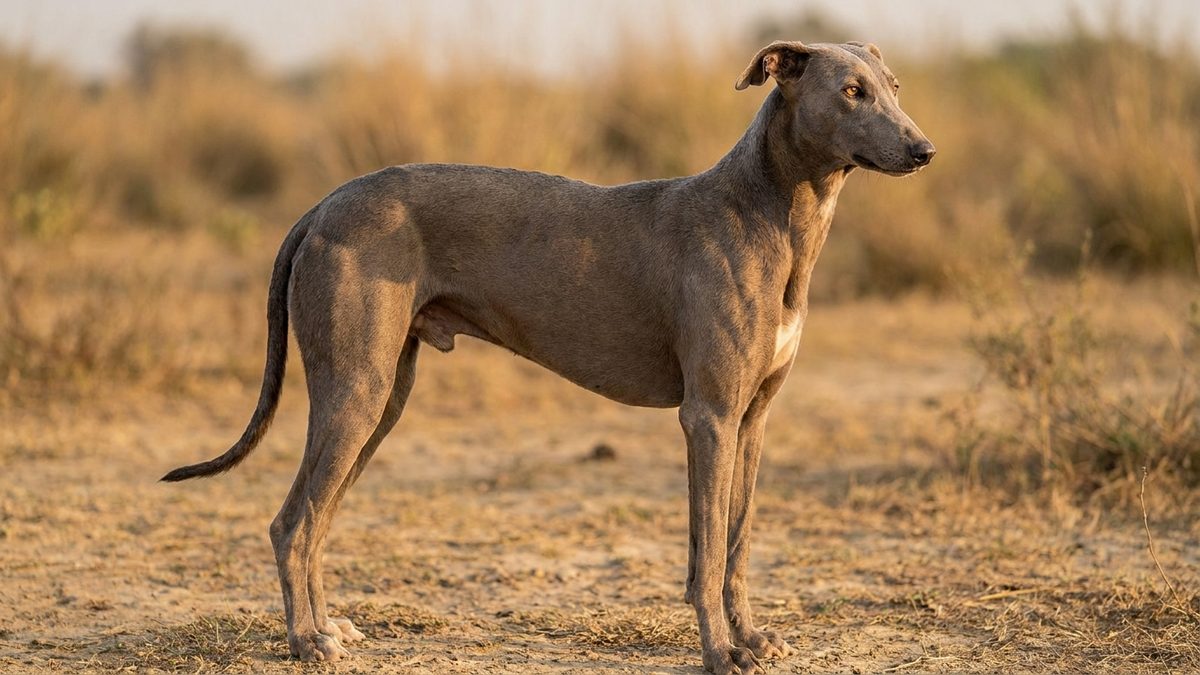
The Rampur is sleek and athletic with tall legs, a long snout and a narrow torso, a thin whip-like tail reaching almost to the ankles, a scissor bite and large oval eyes. The coat is short, flat and smooth, and it comes in solid black, white, tan or grey, in spotted patterns, and in brindle. The India Post description adds a long wide head that is flat between the ears, powerful jaws with a scissor bite, and slightly oval brown to dark amber eyes, with brindle and mouse grey given as the usual colours. Modern Indian sources add rose-shaped ears, a deep chest and a tucked abdomen.
The 270 degree vision claim
Two sources state that the Rampur's eye placement on a long tapering skull gives it a field of vision of roughly 270 degrees National Purebred Dog Day. Bonbeno could not find a measurement study behind that figure, and one of the two sources presents it as something people say rather than something recorded. Read it as breed folklore that is probably directionally right for any long-skulled sighthound, not as a measured number.
Three named types, one thin source
A single heritage site records a claim that the breed comes in three types: the Reza, which hunts smaller animals, the Kesari, said to be the rarest, and the Sahi Shikari, strongly built and temperamental. That same source flags the claim as unverified and explicitly asks breed experts for correction. Bonbeno found no second source for these names. If a seller quotes a premium for a Kesari, there is no published basis for it.
The 2005 stamp and the Rustum-e-Rampur
India Post issued the Rampur Hound on a postage stamp on 9 January 2005, in a se-tenant set of four indigenous breeds alongside the Himalayan Sheepdog, the Mudhol Hound and the Rajapalayam, printed by the India Security Press in Nashik in a quantity of 3.0 million per design. The Department of Posts text calls the Rampur the most well-known Indian breed, notes that it is featured in Mughal miniatures, records that Jahangir's kennel is said to have held 4,000 of them, and describes an annual mela in Rampur at which the best hound exhibited is given the title Rustum-e-Rampur. The Jahangir figure is presented in that text as tradition rather than as an archival count, and Bonbeno reports it the same way.
Why the breed collapsed, in order
The Rampur Greyhound lost its two supports within a generation, and the dates are worth having straight because sellers rarely give them.
- The patron went first. Rampur State existed as a princely state from 1774 until it merged into India in 1949, after which the territory became part of Uttar Pradesh. One breed reference dates the fall from popularity to 1947, when the Maharajas were no longer in power, and notes that the change directly influenced how the breed was bred thereafter.
- Then the job went. One Indian source dates the loss of popularity to 1967 and attributes it to hunting prohibition. India's Wild Life (Protection) Act was enacted by Parliament on 9 September 1972 and prohibits the hunting of protected species, so the legal date is 1972 and the 1967 figure appears to describe a state-level or informal decline. Bonbeno reports both rather than picking one.
- Then the gene pool blurred. Many lines were bred with English hounds, which is precisely what makes a genuinely purebred Rampur Greyhound hard to find today.
One long-standing breed reference describes the Rampur Greyhound as near extinction, with the breed only recently beginning to regain popularity and very few animals alive. This is the single most important fact for a buyer, and it is the reason the price section below reads the way it does. A breed that is genuinely scarce cannot also be freely available in eight metros at a fixed price.
Rampur Greyhound price in India
A Rampur Greyhound costs between Rs 5,000 and Rs 1,30,000 in India depending entirely on which source you read. That is not a normal price band, it is a disagreement of more than Rs 1,25,000 about the same breed, and understanding why it exists is worth more to a buyer than any single number.
Bonbeno compared every source currently publishing a Rampur price figure. They fall into two camps that barely overlap.
| Source | Stated range | Scope |
|---|---|---|
| Top Pet Products | Rs 5,000 to Rs 10,000 | India-wide average |
| HubPages | Rs 5,000 to Rs 12,000 | India-wide, indigenous breed listing |
| Best For Pets | Rs 5,000 to Rs 15,000 or more | India-wide |
| Black Star Kennels | Rs 10,000 to Rs 20,000 | Good quality |
| Black Star Kennels | Rs 20,000 to Rs 25,000 | KCI certified |
| Mr n Mrs Pet | Rs 45,000 to Rs 70,000 | Basic quality |
| Mr n Mrs Pet | Rs 70,000 to Rs 1,00,000 | KCI registered |
| Mr n Mrs Pet | Rs 1,00,000 to Rs 1,30,000 | Champion bloodline |
| Premium Pet House | Rs 60,000 to Rs 90,000 | India-wide average |
| Premium Pet House, same page | Rarely goes beyond Rs 15,000 | Stated in the benefits section of the identical article |
The gap is structural, not random. The low camp treats the Rampur as what it historically is, an indigenous working hound bought locally in Uttar Pradesh, Punjab and Haryana for a few thousand rupees. The high camp is a national marketplace quoting delivered, vaccinated, KCI-paperwork prices at metro demand levels, listing the identical band of Rs 45,000 to Rs 1,30,000 for Hyderabad, Bangalore, Delhi, Chennai, Lucknow, Mumbai, Jaipur and Pune alike. A single price that is identical in Lucknow and Chennai is a catalogue price, not a market observation.
The last two rows of that table come from the same article. Premium Pet House states an average Rampur Hound price of Rs 60,000 to Rs 90,000, gives a city-by-city table running from Rs 60,000 in Mumbai to Rs 75,000 in Delhi, and then, in its list of reasons to buy the breed, writes that the Rampur Hound price in India rarely goes beyond Rs 15,000. Both sentences are on one page. This is the clearest available evidence that published Indian prices for this breed are assembled rather than observed, and it is why Bonbeno publishes the disagreement instead of averaging it into a number that would look authoritative and mean nothing.
Two sources price a KCI-registered Rampur very differently: Rs 20,000 to Rs 25,000 in one and Rs 70,000 to Rs 1,00,000 in the other. Both are describing Kennel Club of India paperwork on the same breed. Registration certifies claimed pedigree. It does not certify health, temperament or heat tolerance, and it is not worth a four-fold price difference on its own.
The substitution problem that drives real losses
The costliest mistake with this breed is not overpaying, it is buying a different dog. The author of one Indian breed price guide, answering a reader in his own comments, warns plainly that Rampur hounds are available with Delhi breeders but that many breeders from Delhi and nearby are selling Caravan Hounds under the Rampur name. The Caravan Hound is the Mudhol Hound, a real and excellent Indian sighthound from Karnataka, but it is a different breed with a different origin, and a buyer paying Rs 1,00,000 for a Rampur is entitled to receive one.
This is why the breed's rarity matters commercially. When a breed is close to extinction but marketplaces list it in eight metros simultaneously, the supply has to come from somewhere. Ask where.
What Bonbeno would actually pay
- Buy near the source. Uttar Pradesh, Delhi, Punjab, Haryana and Rajasthan are where the working population sits, and the India Post breed note lists exactly those states as where Rampur Hounds abound.
- Treat Rs 5,000 to Rs 25,000 as the indigenous-breed reality unless a seller can show you something specific that justifies more.
- Refuse a champion-bloodline premium you cannot verify. Ask to see the registration of both parents with the Kennel Club of India directly rather than a photocopy.
- Discount every price quoted with doorstep delivery across India. A rare hound flown to a metro is a logistics product, and the markup is logistics, not breeding quality.
Bonbeno reports published price ranges as editorial content. We do not broker puppy sales and we do not recommend individual breeders.
Monthly cost of owning a Rampur Greyhound
A Rampur Greyhound is affordable to keep by the standards of any large dog, because the coat needs almost nothing, the breed is climate-adapted and no professional grooming is ever required. The only published monthly figure Bonbeno could find puts upkeep at Rs 3,000 to Rs 7,000 for food, vet visits, grooming and basic care.
That figure comes with no stated method, no sample and no city breakdown, so read it as an indication rather than a budget. Bonbeno's own verified owner cost survey across Indian metros is in progress and will be published with its sample size and collection date attached.
One seller page does at least itemise its estimate, which makes it easier to sanity-check line by line even though the source has a commercial interest in the answer.
| Line item | Stated cost | Bonbeno's read |
|---|---|---|
| Food | Rs 500 to Rs 2,000 per month | Low for a 25 to 32 kg dog on a quality food. Budget higher |
| Veterinary care | Rs 10,000 per year | Reasonable for routine care. Excludes emergencies |
| Home grooming kit | Rs 1,500, one-off | Realistic, and this is the only grooming spend the breed needs |
| Professional grooming session | Rs 1,000 to Rs 3,000 | Avoidable. Most owners of this breed never use a groomer |
| Professional training | Rs 5,000 to Rs 10,000 | Worth it for a first-time sighthound owner |
A widely-linked Indian price guide gives the monthly food cost for this breed as Rs 2,000 to Rs 40,000. A twenty-fold range is not an estimate, it is a placeholder, and the same page's other figures (healthcare Rs 1,000 to Rs 2,000, grooming Rs 500 to Rs 1,000, training Rs 2,500 to Rs 5,000) should be treated with the same caution. Bonbeno reproduces it here only so you recognise it when you meet it elsewhere.
Where the money actually goes
- Food. A lean 25 to 32 kg sighthound eats less than a blockier dog of the same height, and this stays the largest recurring line anyway.
- Preventive veterinary care. Core vaccination, boosters, deworming, and year-round tick and flea control, which in most of India is a twelve-month cost rather than a seasonal one.
- Exercise provision. The real hidden cost of this breed. A coursing hound needs a secure enclosed space to run flat out, and in a metro that usually means paid access rather than a public park.
- Secure fencing. Not optional. One source records this breed as capable of jumping fences over six feet, which sets the specification for any boundary you rely on.
- Bedding. A genuine line item for a dog with this little body fat, for reasons covered in the grooming section.
- Grooming. Effectively nil. The short flat coat does not require much grooming, and bathing with mild soap and warm water when necessary is the whole job.
- A winter coat. A recurring North Indian cost that owners of double-coated breeds never think about.
Against an imported double-coated breed the saving is real and compounding. No professional grooming appointment across a life of nine to fifteen years, no summer clipping, and no coat-driven skin work in the monsoon adds up to more than the purchase price difference for many owners.
Heat tolerance and the Indian climate
The Rampur Greyhound is one of the best heat-adapted dogs available in India, developed on the hot dry plains of Rohilkhand and historically found across Rajasthan, Uttar Pradesh, Punjab and Haryana. One Indian breed reference records its heat tolerance in three words: basks in it.
The physiology is straightforward. A short, flat, sparse coat with no undercoat and a lean body sheds heat far better than the dense double coats of the imported breeds Indian buyers usually consider. Purina India's veterinary guidance lists heavy-coated breeds such as Huskies alongside short-faced breeds as the animals at particular risk of heat stroke. The Rampur is in neither group.
Adaptation is not immunity
Every dog can suffer heat stroke if conditions are right, and vigorous exercise in warm weather can produce it in as little as 30 minutes. That matters more for this breed than for a placid one, because a Rampur asked to run will run past its own limit. The published warning signs are severe panting, difficulty breathing, severe salivating, vomiting, diarrhoea, a temperature of 40.5 C or above, blood in the urine, nose bleeds, and ultimately collapse and coma.
- Run the dog in the early morning or the evening, which is the standard veterinary recommendation for hot days and warm humid nights.
- Keep fresh water and shade permanently available, since lack of water and enclosed space are two of the named risk factors.
- Never leave the dog in a parked car. At an outside temperature of 26 C a car interior reaches 32 C in five minutes and 43 C in 25 minutes.
- Cool with cool water rather than ice, wetting the belly and inside the legs, and stop cooling at 39.4 C to avoid tipping the dog into hypothermia.
- Watch humidity, not just temperature. Excessive humidity is a listed risk factor, which is why a 33 C day in Mumbai or Kolkata can be harder on a dog than a 40 C day in Jaipur.
The North Indian winter is the real problem
Cold is where this breed is genuinely vulnerable, and almost no page covering it says so. The same Indian breed reference that records the Rampur as basking in heat records its tolerance to cold as needing warmth, and the coat is described as short, sparse and carrying no undercoat at all. A sighthound with minimal body fat and no undercoat has almost nothing between it and a January night.
This is not an abstract risk in the breed's own home range. Rampur sits in the North Indian plains, and a dog kept in Delhi, Lucknow, Kanpur, Chandigarh or anywhere in the Punjab belt is exposed to a genuine winter every year. A Rampur needs a fitted coat for winter walks, a bed off the floor and away from draughts, and indoor sleeping through the cold months. Owners who correctly identify this as a hot-weather breed frequently fail it in December.
In Delhi, Lucknow and Chandigarh, plan for both extremes: dawn runs from April to September and a coat plus indoor sleeping from December to February. In Mumbai, Chennai and Kolkata the heat is survivable but the humidity is the constraint, so shorten sessions rather than shifting them. In Bengaluru and Pune the climate suits the breed year round and the limiting factor is finding a secure enclosed space to run in.
Temperament and household fit
The Rampur Greyhound is a reserved, quiet, one-person dog that is deeply loyal to its own household and typically shy with everyone else. Sources describe it as timid by default, extremely loyal to its handler, gentle with the children it lives with, and unreliable around other household animals because it was built to hunt them.
One Indian breed guide puts the social structure plainly: Rampurs are pack animals and will mostly listen to one person in the family whom they see as their master. Another describes them as reserved one-man dogs that do not welcome other pets and do not like strangers touching them. That is a consistent picture of an aloof, undemonstrative, intensely bonded dog.
Where the sources genuinely disagree
Not every page agrees, and the disagreement is worth showing rather than smoothing over, because it changes who should buy this breed.
| Source | Position |
|---|---|
| Dog Breed Info | Typically shy dogs, extremely loyal to their leader, must be socialised to get along with others |
| HubPages | Reserved one-man dogs that do not welcome other pets or being touched by strangers |
| DogExpress | Friendly and thriving on human companionship, fiercely loyal, can attack to defend its owner |
| Pawgy Pets | Calm and dignified, less aloof than other sighthounds, generally good with children and other pets |
| GoofyTails | Loyal, independent, confident, calm indoors, often reserved around strangers |
| Black Star Kennels | Not ideal for first-time owners; benefits from experienced handlers |
The two outliers are worth naming. The friendliest description comes from a first-person owner account of a single dog, which is genuine experience but not breed-level evidence. The most defensive description, a dog that can attack if required to help its owner, sits alongside the same page's claim that the breed is friendly, so it is describing protectiveness rather than aggression. Weigh the majority: expect a reserved dog, and treat a confident, outgoing Rampur as a happy outcome rather than the default.
These dogs were meant to hunt small animals, so this is not the best dog if you have other animals in the house. Sighthounds spot movement at distance and chase before any command registers, and their instinct to chase often overrides other commands entirely. A household with free-roaming cats, rabbits or poultry should choose a different breed rather than plan to manage it.
Who this breed suits
- Good fit. Experienced owners, houses with high secure fencing, semi-rural or suburban properties, quiet households, people who want a calm indoor dog that runs hard outdoors.
- Poor fit. First-time owners, homes with cats or small pets, anyone who needs reliable off-lead recall, households wanting a sociable greeter.
- Worth knowing. The breed barks very little, which makes it an unusually good neighbour and a poor alarm dog.
- Watch the size around toddlers. These dogs run fast and can easily knock over small children.
Training a Rampur Greyhound
Train a Rampur Greyhound with short, patient, reward-based sessions and accept from day one that recall will never be fully reliable. The breed is intelligent and learns quickly, but it is an independent thinker, and repetitive drilling produces refusal rather than compliance.
Sighthound training differs from general dog training in specific, well-documented ways. Sighthounds were bred to hunt at distances where their owner was leagues away, which produced independence, and they tend to be gentle animals that do not respond well to harsh corrections. They are also less motivated by food rewards than most breeds, which is why an owner who has only ever trained a Labrador finds the first month baffling.
Recall is management, not trust
Recall training is particularly challenging with sighthounds because their prey drive and visual motivation mean that when they spot movement in the distance, the instinct to chase overrides other commands. The published advice is to move slower than you would with another breed, build a foundation indoors before adding distractions, progress to a garden and then a gated field, use a long line for longer than you would with another breed, and consider a muzzle. One Indian source is blunt about the stakes: this breed is really fast and can meet with accidents if recall is not trained well.
Bonbeno's position is stricter than that. Treat recall as a management problem you never solve. Use a long line permanently in any area with traffic, livestock or wildlife, and regard a Rampur that comes back reliably as a dog that has not yet seen something worth chasing.
- Reward with movement. Sighthounds often respond especially well to a small fluffy toy that is moving, which imitates the thrill of hunting.
- Keep sessions short and varied, and build confidence and mental stimulation rather than drilling repetitions.
- Never correct harshly. Harsh corrections produce avoidance in a sensitive sighthound, and this breed is described as needing gentle handling for exactly that reason.
- Swap sit for down. Sighthounds often struggle with the sit command because of their anatomy, and a down or stay serves the same purpose more comfortably.
- Train one handler first. A dog that listens mostly to one person learns faster if that person leads the early work, then generalises to the household.
Because Rampurs are naturally timid, they must be socialised in order to get along with others. Early exposure to varied environments, people and animals prevents the shyness from hardening into fear-based reactivity. A reserved adult is normal for the breed. A frightened one is a training failure, and it is very hard to undo.
Realistic timeline: house training is straightforward and usually settles inside a few weeks. Lead manners take two to three months of consistent work. A dependable stay in a low-distraction setting is achievable by six months. Off-lead reliability around moving animals is not a timeline item, because it does not arrive.
How much exercise a Rampur Greyhound needs
An adult Rampur Greyhound needs a daily walk or jog plus regular opportunities to sprint flat out in a secure enclosed area. Published guidance describes high exercise requirements met through daily walks or runs, sprinting in secure enclosed spaces, lure coursing, hiking and interactive play, and a breed that is in its glory when allowed to romp and play.
The distinction that matters is between walking and running. A coursing hound that only ever walks on a lead is not adequately exercised however many kilometres it covers, because the thing it is built for is a short, explosive, full-speed chase. A single genuine free run each week does more for a Rampur's behaviour than an extra hour of daily lead walking, and daily exercise without that weekly release still leaves a frustrated dog.
Sources disagree about intensity. One rates the breed's energy level as medium while also describing exercise requirement as lots, another calls the breed high-energy and unsuited to apartment living, and a third notes that although athletic outdoors, the breed is often calm and relaxed indoors after exercise. All three are describing the same animal from different angles. The reconciliation is that the calm-indoors reputation is earned outdoors and is not a property of the breed at rest.
| Stage | Guidance |
|---|---|
| Under 12 months | Short play sessions on soft ground. Avoid jumping, forced running and stairs while joints develop |
| 12 to 18 months | Build gradually toward the adult load. Introduce controlled free running in an enclosed space |
| Adult | Daily walk or jog plus a weekly full-speed free run in a secure enclosed area |
| Adult, peak summer | Early morning and evening only, because vigorous exercise in heat can cause heat stroke in 30 minutes |
| Adult, North Indian winter | Keep the sessions, add a coat. The dog needs warmth |
| Senior | Shorter and gentler, but kept daily. Sighthound joints stiffen fast when work stops |
The fence specification nobody publishes
One source records that Rampur Hounds are capable of jumping over six-foot-high fences. Bonbeno could not find a second source or a measured trial for that figure, so treat it as a claim rather than a specification. It is still the most useful number on this page for anyone planning a compound wall, because designing to a claim that may be exaggerated costs you a few thousand rupees and designing below it costs you the dog.
Lure coursing is named specifically as a suitable activity for this breed, and the Rampur is retained in India as a coursing dog. Where organised coursing is not available, a long straight enclosed run with a flirt pole gives a similar release. Mental work matters too, but no amount of puzzle feeding substitutes for a sprint.
Grooming a Rampur Greyhound in Indian humidity
Grooming a Rampur Greyhound takes minutes a week. Because of its short flat coat this dog does not require much grooming, and bathing with mild soap and warm water when necessary is the entire bathing routine. Weekly brushing to remove loose hair, occasional bathing, routine ear cleaning, nail trimming and dental care complete the job.
The coat is short, flat and smooth with no undercoat and sparse hair density, the breed sheds lightly through the year, and it does not drool. Visits to a professional groomer are rated low, and baths are rated rare. Over a full life that is a meaningful saving against any double-coated import kept in an Indian city.
One large Indian pet marketplace states in its own Rampur Hound FAQ that the breed has a dense, curly coat needing trimming every four to six weeks to prevent matting, and that its curly coat offers natural insulation from heat and cold. That is wrong on every count. The Rampur is a short, flat, smooth-coated sighthound with no undercoat DogExpress, Rampur Hound breed profile. It has no curl, it never needs clipping, and it has close to no insulation. If you have been quoted a recurring grooming package on that basis, you are paying for a service this breed cannot use.
Skin is the real grooming risk in India
The breed is described as prone to skin problems, and a second source lists skin sores among its common issues. Thin, sparsely-coated skin over a lean frame is easy to cut on scrub and fencing, slow to be noticed under no coat to speak of, and quick to infect in monsoon humidity. Weekly brushing is really a weekly skin inspection with a brush in your hand.
- Brush weekly with a soft brush or rubber grooming mitt, checking the skin as you go.
- Check ears weekly for dirt, wax or signs of infection, and clean with a damp cotton ball or a vet-recommended cleaner.
- Trim nails regularly, which matters more in a running breed than a sedentary one.
- Avoid overbathing and use a mild dog shampoo, because frequent washing strips a thin coat and irritates the skin underneath.
- Dry the dog properly in the monsoon. A short coat looks dry long before the skin beneath it is.
- Keep tick control running all year. In most of India this is not a seasonal task.
Bedding is a grooming item in this breed
A sighthound carries almost no fat over its elbows, hocks and hips, so hard tile or stone floors produce pressure calluses that thicken, crack and occasionally infect. In Indian homes, where hard flooring is close to universal, this is one of the most common preventable problems in any lean hound, and it is not mentioned on a single page currently ranking for this breed. The whole intervention is a thick bed placed where the dog already chooses to lie, and a second one in the cool spot it moves to in summer. Inspect the bony points every week alongside the brush-through.
Health, lifespan and the anaesthesia warning
The Rampur Greyhound is generally described as a healthy, hardy breed, and the honest caveat is that no breed-level disease prevalence data exists for it at all. There is no Rampur equivalent of the cohort studies published for popular Western breeds, so any source quoting you a precise percentage for this breed is extrapolating from other dogs.
What the sources do agree on is a short list of structural risks that follow from being a large, deep-chested, very lean sighthound.
Sighthound anaesthesia sensitivity
Tell every veterinarian, before every procedure, that your dog is a sighthound. Three independent Rampur sources flag anaesthesia sensitivity GoofyTails, Rampur Greyhound breed profile DogExpress, Rampur Hound breed profile, and one notes specifically that the breed does not respond well to the anaesthesia commonly given during a caesarean section.
None of those pages explains what the veterinarian is supposed to do differently, which makes the warning close to useless in a consulting room. The peer-reviewed literature does explain it, and it is worth carrying into the clinic.
A review of sighthound anaesthesia published in Clinical Techniques in Small Animal Practice identifies four separate idiosyncrasies in this group of breeds, all consequences of selection for high-speed pursuit by sight. First, a nervous demeanour that can produce stress-induced complications including hyperthermia. Second, a lean body conformation with a high surface-area-to-volume ratio, which predisposes these dogs to hypothermia while anaesthetised. Third, haematological differences, specifically a higher packed cell volume and lower serum protein than other breeds, which can complicate the interpretation of pre-anaesthetic blood work. Fourth, impaired biotransformation of drugs by the liver, producing prolonged recovery from certain intravenous anaesthetics and an increased risk of drug interactions.
The published protocol that follows is specific. Thiopental, or any other thiobarbiturate, should not be used in these dogs. Propofol, a ketamine and diazepam combination, and methohexital are the recommended intravenous alternatives. Co-administration of agents that inhibit drug biotransformation, such as chloramphenicol, should be avoided. Isoflurane inhalation is the preferred maintenance technique, sedative premedication and appropriate analgesia should be used to minimise perioperative stress, and core body temperature should be monitored closely both during anaesthesia and into recovery.
The mechanism behind the liver finding is now well characterised. Peer-reviewed work published in Scientific Reports traced slow recovery in Greyhounds to a deficiency in the liver enzyme cytochrome P450 2B11, showing that Greyhound livers metabolise CYP2B11 substrates more slowly and carry lower amounts of the protein, and that Greyhounds had the highest frequency of the low-expressing CYP2B11-H3 haplotype among 63 dog breeds compared. The older clinical explanation, prolonged thiopental recovery caused by a lack of body fat, is part of the same picture rather than a competing one.
Two caveats matter for a Rampur owner. This work was done on English Greyhounds and on sighthounds as a group, not on Rampur Greyhounds specifically, so it is an inference from the breed that contributed heavily to the Rampur's ancestry rather than a finding about the Rampur itself. And a general Indian practice may never have anaesthetised a sighthound. Saying the words out loud, before the dog is on the table, is the entire intervention, and the four points above are what to say.
The same lean build with a high surface-area-to-volume ratio that predisposes an anaesthetised sighthound to hypothermia is why a Rampur needs a coat in a North Indian winter. The theatre risk and the December risk have one cause. If you remember only one thing from this page, remember that this dog loses heat far faster than it looks like it should.
| Issue | Named by | What it means practically |
|---|---|---|
| Anaesthesia sensitivity | Four sources GoofyTails, Rampur Greyhound breed profile DogExpress, Rampur Hound breed profile Black Star Kennels | The best-supported risk on this list. Flag it before every procedure |
| Bloat, gastric torsion | Three sources GoofyTails, Rampur Greyhound breed profile Black Star Kennels | Deep-chested build. Split meals, avoid hard exercise around feeding |
| Skin problems and sores | Two sources DogExpress, Rampur Hound breed profile | Thin coat over lean frame. Weekly inspection, prompt treatment in humidity |
| Hip dysplasia | Three sources Pawgy Pets, Everything you need to know… Black Star Kennels | Claimed without breed data. Screening of parents is still sensible |
| Joint injuries from intense activity | One source | Plausible for a sprinting breed. Warm up, avoid hard surfaces at speed |
| Osteosarcoma, cardiomyopathy, PRA | One source | Extrapolated from Western Greyhounds, not observed in Rampurs. Unverified |
Osteosarcoma and dilated cardiomyopathy appear on exactly one Rampur page and read as Greyhound literature transplanted onto an Indian breed. They may well be relevant given the shared ancestry, and there is no Indian evidence either way. Bonbeno's position is to name them as unverified rather than to repeat them as breed facts or to hide them.
Lifespan: six sources, six answers
| Source | Stated lifespan |
|---|---|
| Dog Breed Info | About 9 to 15 years |
| GoofyTails | 10 to 14 years |
| Mr n Mrs Pet | 10 to 14 years |
| DogExpress, breed panel | 10 to 13 years |
| DogExpress, body text | 13 to 14 years |
| Black Star Kennels | Around 10 to 12 years |
| HubPages | 12 to 14 years |
One source contradicts itself on its own page, which tells you how much of this is copied rather than observed. The defensible statement is that a Rampur Greyhound generally lives somewhere between 10 and 14 years, and that no cohort study underwrites any narrower claim.
The top-speed question, answered honestly
Bonbeno will not publish a top speed for this breed, because no measured study exists. What the sources offer is: known to be one of the fastest dogs in the world and able to reach speeds above 40 mph; the fastest-running dog in India, up to 40 mph; one of the fastest dogs in the world at over 40 mph or 60 km/h; and, most honestly stated, there are those who claim to have seen a Rampur run at about 60 kilometres per hour, or 37 mph. The last phrasing is the accurate one. These are eyewitness claims repeated between websites, not timed runs. The Rampur is unquestionably a very fast dog. How fast is not known.
Asked for the breed's bite force, one Indian page answers 200 to 300 PSI and then immediately adds that no one knows for sure, and that the figure is an estimate made by looking at dogs that resemble Rampur Greyhounds. That is exactly the right way to publish an unmeasured number, and it is rarer than it should be. Bonbeno's position is the same and slightly stricter: an estimate derived from other breeds is not a fact about this one, so do not repeat 200 to 300 PSI as a Rampur measurement.
Feeding a Rampur Greyhound
Feed a Rampur Greyhound to a visibly lean sighthound body condition, split across two or more meals a day. Ribs lightly covered, a clear waist and a pronounced tuck are correct for this breed, and they look underfed to anyone whose reference point is a Labrador.
This is the most common feeding error with every Indian sighthound. A well-meaning owner reads the lean frame as undernourishment, feeds up to a shape that looks reassuring, and lands the dog with joint loading it was never built to carry. One Rampur source names the problem directly, noting that these are naturally lean dogs which gain weight easily without enough exercise, and that overfeeding leads to obesity and other health problems Best For Pets, Rampur Greyhound Price…. Maintaining a lean body condition is listed as one of the things that supports long-term health in this breed.
- Feed to body condition, not to a chart. Correct sighthound condition differs visibly from a retriever's at the same height.
- Split the daily intake across two or more meals, which is standard practice for deep-chested breeds at risk of bloat.
- Separate feeding from hard exercise. Avoid vigorous activity immediately around meals, which is the published bloat precaution for this build.
- Match intake to workload, feeding more in weeks with real running and less in rest weeks.
- Expect appetite to drop in peak summer and adjust rather than force. Persistent inappetence is a veterinary matter, not a preference.
- Choose a food that meets the dog's nutritional needs and skip table scraps, which is the published guidance for this breed.
Puppy feeding
Puppies need more frequent, smaller meals than adults, moving from three or four feeds a day down to two by around six months. One Indian breed guide offers a specific homemade regime for puppies under 50 to 55 days, feeding three times daily with roughly seven-hour gaps. Bonbeno reproduces the meal frequency because it is sound and does not endorse that page's specific food list, which mixes commercial puppy food with human breakfast cereal and bread. Ask your own veterinarian to set the diet.
Lack of water is a named risk factor for heat stroke. For a breed that runs this hard in this climate, constant access to fresh water is part of the daily feeding routine rather than an afterthought, and a bowl that is refilled twice a day in Nagpur or Jaipur is not enough.
Bonbeno reviews Indian pet food brands separately and tests products first-hand before publishing a verdict. See our testing method for what a Bonbeno food review does and does not claim.
Rampur Greyhound puppy: the first two years
A Rampur Greyhound puppy needs two things above all in its first year: structured socialisation and restraint on exercise. Litters run to six to nine puppies, and the two mistakes that cost most in this breed are missing the socialisation window and running a growing hound too hard.
- 8 to 12 weeks. Buy at eight to nine weeks rather than earlier, which allows proper development before the move. Start the vaccination course. Begin structured socialisation immediately, because a naturally timid breed must be socialised to get along with others. Three to four small meals daily.
- 3 to 6 months. Peak socialisation period. Expose the puppy to varied environments, people and animals to prevent shyness hardening into fear-based reactivity. Introduce lead work and full-body handling, including feet and ears, so grooming and vet checks are never a fight. Keep exercise to short play sessions and avoid stairs and jumping.
- 6 to 9 months. Sexual maturity arrives somewhere between six and nine months in this breed, and reserve toward strangers becomes visible around the same time. Keep socialising rather than withdrawing. Prey drive sharpens noticeably, so lead discipline and a secure boundary stop being optional.
- 9 to 12 months. Add duration and distraction to training, still on a long line. Introduce a proper bed if you have not already, because pressure calluses start on hard floors long before an owner notices them. Move to two meals a day.
- 12 to 18 months. Build gradually toward the adult exercise load and introduce controlled free running in an enclosed space. Expect a lanky, unbalanced-looking adolescent. Resist the urge to feed the leanness away.
- 18 to 24 months. Physically mature. Full adult work, including weekly full-speed running and lure coursing where available. Temperament is now largely set by what you did before month six.
Register the anaesthesia sensitivity on the dog's file at the very first appointment, long before any procedure is planned Martinez SE et al.. Neutering, dentals and emergency surgery all involve anaesthesia, and a note already sitting in the record is worth more than a conversation you try to have in a crisis.
One further note on the first year. This breed barks very little, so a Rampur puppy that suddenly becomes vocal is telling you something. Investigate rather than correct it.
Rampur Greyhound vs Mudhol Hound
Choose a Mudhol Hound over a Rampur Greyhound if you want an Indian sighthound you can actually find, verify and afford, and choose a Rampur if you are in North India and specifically want this breed. The two are the country's best-known indigenous sighthounds, both appeared on the same 2005 India Post stamp set, and they are routinely confused, substituted and sold for each other.
| Factor | Rampur Greyhound | Mudhol Hound |
|---|---|---|
| Origin | Rampur, Uttar Pradesh, North Indian plains | Mudhol, Bagalkot district, Karnataka |
| Also called | Rampur Hound, North-Indian Greyhound | Caravan Hound, Karwan Hound, Pashmi |
| Ancestry | Tazy stock crossed to English Greyhound in the 19th century | Indian landrace revived by the Ghorpade family of Mudhol |
| Coat | Short, flat, smooth, no undercoat | Smooth, plus a feathered Pashmi variety |
| Availability in India | Rare, near extinction | Widely available, most well-known Indian sighthound |
| Published price | Rs 5,000 to Rs 1,30,000, sources in open disagreement | Rs 6,000 to Rs 15,000 in the same indigenous-breed survey |
| Institutional backing | None beyond the 2005 stamp | Indian Army interest for surveillance and border protection |
| Speed and stamina | Faster over a sprint by reputation | Slower than the Rampur but better stamina for a long chase |
| Heat tolerance | Excellent, North Indian plains | Excellent, Deccan plateau |
| Cold tolerance | Poor, needs warmth | Poor, same lean build |
| Substitution risk | High. Caravan Hounds are sold as Rampurs | Lower. Buyers rarely pay a premium for the reverse swap |
The honest trade is verifiability against provenance. A Mudhol buyer can go to Bagalkot district, see a working population and a documented breeding history, and pay a price the whole market agrees on. A Rampur buyer is dealing with a breed that has no comparable institutional base, a price the market cannot agree on within a factor of twenty-six, and a live substitution problem in exactly the region where the breed is supposedly available.
Ask about geography first. A genuine Rampur lineage traces to Uttar Pradesh, Rohilkhand, Punjab, Haryana or Rajasthan; a Mudhol traces to Bagalkot in Karnataka or to Maharashtra. Then look at the head: the Rampur carries a long, wide skull that is flat between the ears with a heavier, more powerful build than a racing Greyhound GoofyTails, Rampur Greyhound breed profile, while the Mudhol is a narrower, lighter, more Saluki-like hound. A seller in Delhi offering a Karnataka-bred Rampur is describing a Caravan Hound.
For most Indian households the Mudhol is the more sensible purchase. The case for a Rampur is a genuine one, but it is a case about heritage and about North India, and it is worth making honestly rather than dressing up as a value comparison.
Mistakes Indian Rampur Greyhound owners actually make
These repeat consistently and are ranked by what they cost the dog.
- Not warning the vet about anaesthesia sensitivity. Four Rampur sources flag it and peer-reviewed work on Greyhound CYP2B11 explains it, yet it is the single detail a general practice is least likely to check unprompted.
- Trusting recall. Chase overrides commands in any sighthound, and this breed is fast enough that a mistake near traffic is usually final.
- Under-building the boundary. A hound reported to clear six-foot fences is not contained by a garden gate.
- Buying a Caravan Hound as a Rampur. Warned about explicitly by an Indian breed writer describing Delhi-area sellers, and it is the most expensive error on this list.
- No winter coat in North India. The breed needs warmth and has no undercoat at all. Owners get the summer right and the winter wrong.
- Skipping socialisation because the puppy seems calm. A naturally timid breed must be socialised to get along with others, and calm at ten weeks is not the same as confident at ten months.
- Feeding to a retriever's shape. Lean is correct, and this breed gains weight easily when exercise drops.
- Walking instead of running. Long walks do not satisfy a coursing hound that needs to sprint in a secure enclosed area.
- Hard floors and thin bedding. Pressure calluses on elbows and hocks are near-universal in lean hounds kept on Indian tile and almost absent in well-bedded ones.
- Paying for a grooming package. Prompted by a marketplace FAQ that wrongly describes this smooth-coated breed as needing curly-coat trimming every four to six weeks.
- Exercising hard at midday in summer. Heat stroke can develop in as little as 30 minutes of vigorous exercise in hot weather.
- Keeping the dog with cats or rabbits. These dogs were meant to hunt small animals and are not the best choice with other animals in the house.
Almost every error on this list comes from reading the Rampur as a calm, quiet, low-maintenance dog, which it genuinely is indoors. The calm is a consequence of the running, the thin coat that saves you grooming money is the same coat that fails in December, and the intelligence that makes training look easy is the same independence that makes recall unreliable. Every convenient trait in this breed has a cost attached on the other side.
Sourcing, verification and adoption
Source a Rampur Greyhound from North India, verify the breed before you verify the paperwork, and consider seriously whether adoption of an Indian sighthound cross serves you better. Because the breed is close to extinction with very few alive, responsible sourcing here means more scrutiny than for any common breed, not less.
Verification checklist
- Start in the right geography. Rampur Hounds are historically found across Rajasthan, Uttar Pradesh, Punjab and Haryana. A litter offered from Karnataka or coastal Andhra deserves a specific explanation.
- See both parents and the litter together. Photographs prove nothing about a breed with a live substitution problem.
- Check the build against the breed description, which is a long wide head flat between the ears, powerful jaws with a scissor bite, brown to dark amber oval eyes, a long tapering tail and a short firm coat.
- Verify Kennel Club of India registration with the KCI directly rather than accepting a photocopy, and remember that registration certifies claimed pedigree rather than health. The KCI publishes its own forms, including litter registration, single dog registration and transfer of ownership, plus a revised tariff sheet in force from 1 April 2024, so a seller claiming registration should be able to name which form was filed and when.
- Buy at eight to nine weeks or older, allowing proper development before the move.
- Ask specifically about temperament around other animals, given the prey drive.
- Deal with the breeder rather than a middleman, because reseller markup is a documented driver of Indian dog prices.
- Walk away from a champion-bloodline quote you cannot verify. The gap between the cheapest and dearest published band for this breed is over Rs 1,25,000 Mr n Mrs Pet, Rampur Hound Puppies…, and nothing on the dog itself explains it.
Adoption
Adoption is a real route for this breed type even though a papered Rampur almost never reaches a shelter. Indian sighthounds and sighthound crosses turn up regularly in North Indian rescues, usually surrendered when an owner underestimated the exercise requirement or the prey drive. An adult brings the two things a buyer of a rare breed can never get from a puppy: a known temperament around other animals, and a known adult size and build.
There is a second argument for adoption that applies specifically here. A market that pays Rs 1,00,000 for a rare indigenous hound creates exactly the incentive that produces mislabelled litters, and one Indian breed writer is already warning buyers that it is happening. Adopting an adult sighthound cross sidesteps that market entirely.
The Mudhol Hound is the same kind of dog with better availability, documented breeding and a price the market agrees on. The Indian Pariah Dog has far lower exercise demands, the same excellent heat tolerance, better cold hardiness and is free to adopt. Both are indigenous, both are hardy, and neither carries the substitution risk that follows the Rampur name.
One last word on preserving the breed
The Rampur Greyhound survived three centuries because a specific job kept it useful and a specific court kept it funded. Both ended. What is left is a genuinely remarkable indigenous sighthound that is hard to find, easy to fake and expensive to get wrong. Buying one carefully, from the right region, with your eyes open about what is verified and what is repeated, is a better contribution to the breed than paying a premium for a certificate.
Rampur Greyhound questions Indians actually search
How much does a Rampur Greyhound cost in India?
Published sources disagree enormously. Indigenous-breed surveys put a Rampur Greyhound at Rs 5,000 to Rs 15,000, one Indian kennel quotes Rs 10,000 to Rs 20,000 and Rs 20,000 to Rs 25,000 for KCI certification, and a national marketplace lists Rs 45,000 to Rs 1,30,000 depending on quality tier. Bonbeno treats Rs 5,000 to Rs 25,000 as the indigenous-breed reality and regards higher quotes as metro delivery pricing rather than breed value.
How much does a Rampur Hound cost in India?
Rampur Hound and Rampur Greyhound are the same breed, so the same disagreement applies. The lowest published figure is Rs 5,000 and the highest is Rs 1,30,000 for a claimed champion bloodline. Buy near the breed's home range in Uttar Pradesh, Punjab, Haryana or Rajasthan, verify the breed itself before the paperwork, and refuse any premium you cannot check with the Kennel Club of India directly.
Where does Rampur Greyhound come from?
The Rampur Greyhound comes from the Rampur region of northern India, in the country between Delhi and Bareilly in Uttar Pradesh. It was developed by the Nawabs of Rampur in the erstwhile Rohilkhand region. India Post records the breed as historically abundant across Rajasthan, Uttar Pradesh, Punjab and Haryana.
What breeds make up a Rampur Greyhound?
The Rampur Greyhound descends from early Tazys, with its modern appearance produced by extensive crosses to the English Greyhound during the 19th century to improve speed. Indian and heritage sources describe the Nawab's cross as combining Tazi, Afghan Hound and English Greyhound stock, which produced the Tazi's toughness with Greyhound speed.
Are Rampur Greyhounds friendly?
Rampur Greyhounds are typically shy and reserved rather than outgoing, and they are extremely loyal to their own household. Several sources describe them as one-man dogs that do not welcome strangers touching them. One owner account describes a calm, affectionate family dog, so individual variation exists, but expect reserve as the breed default and socialise heavily from eight weeks.
Are Rampur Greyhounds good family dogs?
Rampur Greyhounds are gentle with the children they live with and bond deeply with their own family, so they can be good family dogs in the right home. Two conditions apply. They are a poor choice for households with cats, rabbits or other small pets because of prey drive, and their speed and size mean they can easily knock over a toddler at play.
How much do Rampur Greyhounds weigh?
Published weights range from 22 kg to 35 kg depending on the source and sex. Wikipedia gives 23 to 32 kg, one Indian breed listing gives males 27 to 30 kg and females 22 to 26 kg, and a retailer page gives males 27 to 35 kg. A figure of 43 kg appears on one page and sits outside every other published range. Treat 22 to 32 kg as the workable band.
How long do Rampur Greyhounds live?
Published lifespans for the Rampur Greyhound range from 9 to 15 years, with most sources clustering at 10 to 14 years. One source contradicts itself on its own page, giving 10 to 13 years in its data panel and 13 to 14 years in its text. No cohort study exists for this breed, so 10 to 14 years is the defensible answer and anything narrower is guesswork.
How strong is a Rampur Greyhound?
The Rampur Greyhound is powerfully built for a sighthound, noticeably heavier and more substantial than an English Greyhound, and it was bred to take deer, jackal and wild boar. One source reports the breed clearing fences over six feet, which is the most practical measure of its power. No measured strength or bite testing exists for the breed.
Why are Rampur Greyhounds so popular in India?
The Rampur Greyhound carries unusual cultural weight for a breed that is now rare. India Post called it the most well-known Indian breed and issued it on a stamp in January 2005, it appears in Mughal miniatures, and an annual mela in Rampur still awards the best hound the title Rustum-e-Rampur. Its actual population is small, so the fame considerably outruns the availability.
What is the difference between Rampur Greyhound and Mudhol Hound?
They are separate breeds from opposite ends of India. The Rampur Greyhound comes from Rampur in Uttar Pradesh and carries English Greyhound ancestry from 19th century crosses, giving it a heavier build and a long wide skull. The Mudhol Hound, also called the Caravan Hound, comes from Bagalkot district in Karnataka, is a lighter, more Saluki-like landrace, and is far easier to find and verify.
Which is better Rampur Greyhound or Mudhol Hound?
The Mudhol Hound is the better buy for most Indian households, because it is widely available, priced consistently at roughly Rs 6,000 to Rs 15,000, and backed by a documented breeding history and Indian Army interest. Choose a Rampur Greyhound if you are in North India, want that specific heritage, and can verify the lineage, since Caravan Hounds are reportedly sold under the Rampur name.
What is Rampur Greyhound?
The Rampur Greyhound is a large Indian sighthound native to Rampur in Uttar Pradesh, also known as the Rampur Hound and the North-Indian Greyhound. It is short-haired, powerfully built and resembles the Sloughi rather than the racing Greyhound. It is rarely seen outside India, where it is kept as a coursing dog and only rarely as a companion.
Compare with similar breeds
Rampur Greyhound sits in 3 Bonbeno groups. Each one compares it directly against the breeds it is genuinely an alternative to, on the same figures.