
Indian breed profile
Mudhol Hound: Price, Care and Full Breed Guide for India
Karnataka's sighthound, gifted to King George V a century ago and now serving with the Indian Army, the Air Force and the Prime Minister's security detail. The only Indian breed with a state-funded research centre behind it.
Quick answer
The Mudhol Hound costs Rs 3,000 to Rs 30,000 in India, with pet-quality puppies at the low end and KCI-registered dogs at Rs 15,000 to Rs 25,000. It is a lean sighthound from Bagalkot district, Karnataka, and the first Indian breed inducted into the Indian Army. It suits active owners with secure space and handles Indian heat far better than any imported breed.
This guide is general information for Indian pet owners and is not a diagnosis. Always consult a registered veterinarian near you before acting on anything you read here, and treat any sudden change in your dog's condition as urgent.
Mudhol Hound at a glance
What the Mudhol Hound is
The Mudhol Hound is an Indian sighthound from Mudhol in Bagalkot district, Karnataka, in the border region between Karnataka and Maharashtra. Kennel-club convention and popular writing also call it the Caravan Hound, the Kathewar Dog and the Mahratta Hound, and call the silkier-coated variety the Pashmi. Those equivalences are conventional rather than settled. ICAR breed lists have printed Caravan Hound and Mudhol Hound as separate entries in the same sentence, the microsatellite study of the breed uses neither alternative name, and the ICAR-NBAGR registration records Mudhol Hound with no synonyms attached. Bonbeno publishes a separate guide to the Mahratta Hound for the same reason.
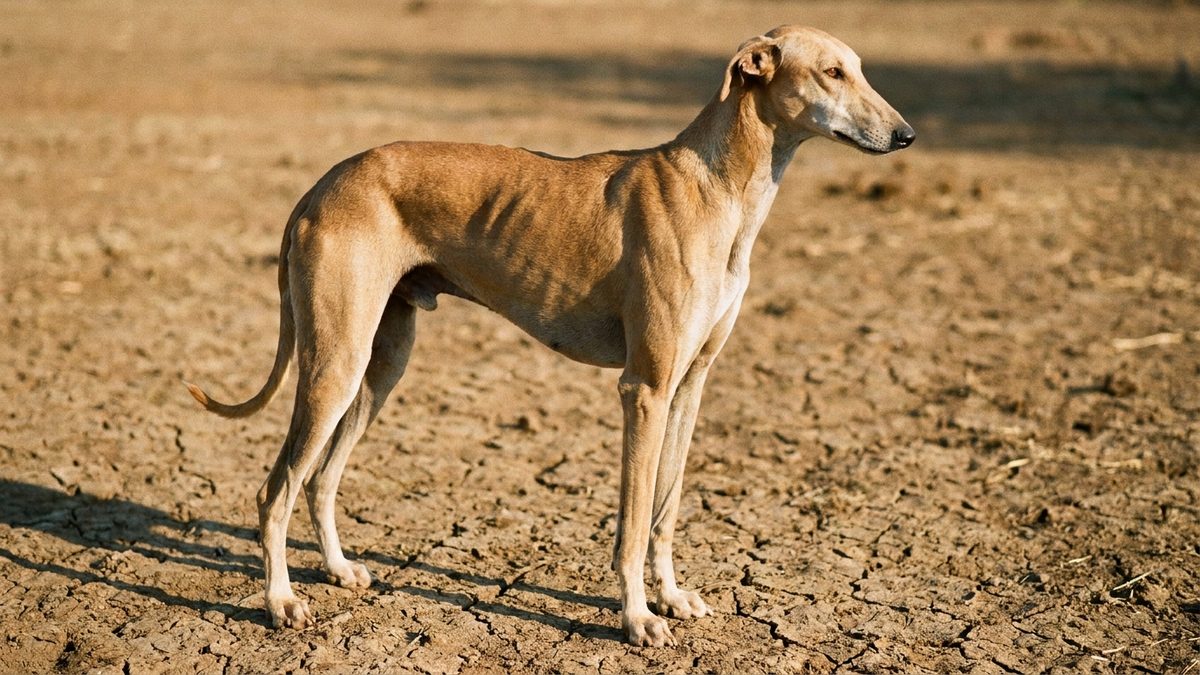
This is a coursing hound built for speed across open country. The body is lean and muscular, and the head is notably long and narrow with a broad space between moderately sized ears. The dark muzzle carries a long, powerful jaw known for its scissor bite.
| Attribute | Male | Female |
|---|---|---|
| Height at withers | 24 to 30 in | 22 to 28 in |
| Weight | 48 to 90 lb | 45 to 85 lb |
| Coat | Smooth or silky (Pashmi) | Smooth or silky (Pashmi) |
| Shedding | Low | Low |
| Drooling | None reported | None reported |
| Origin | Mudhol, Bagalkot district, Karnataka | Same |
Two coat types, one breed
The Mudhol comes in a smooth-coated variety and a silky-coated variety with feathering on the ears, legs and tail. The feathered type is the one called Pashmi. Both are the same breed, and neither commands a legitimate price premium on coat type alone, though sellers sometimes claim otherwise.
How it reached England
The breed declined significantly in the late 1800s and was revived by Shrimant Rajesaheb Malojirao Ghorpade of Mudhol. It reached England in the early 1900s when the Maharaja of Mudhol State presented several of the dogs to King George V. That royal gift is the origin of the breed's international recognition, and it is the reason the Mudhol appears in older British hound literature under the Caravan Hound name.
Mudhol Hound price in India
A Mudhol Hound costs Rs 3,000 to Rs 30,000 in India depending almost entirely on registration and intended purpose. Pet-quality puppies sit at the bottom of that band and KCI-registered dogs near the top, which makes this one of the most affordable purebred dogs in the country.
Published bands disagree, as with every Indian breed. Bonbeno compared the sources currently publishing figures.
| Source | Stated range | Scope |
|---|---|---|
| whatsthecost.in | Rs 3,000 to Rs 10,000 | Pet quality |
| whatsthecost.in | Rs 15,000 to Rs 30,000 | Show quality |
| Wrapinfur | Rs 15,000 to Rs 25,000+ | KCI-registered |
| Wrapinfur, overall | Rs 5,000 to Rs 30,000+ | India-wide |
| Supertails | Varies by quality and bloodline | India-wide |
One outlier deserves flagging. At least one source states that registered Mudhol Hounds can reach Rs 1,00,000. That figure sits far outside every other published band and should be treated as an exceptional show or breeding animal rather than a market rate. A buyer quoted Rs 1,00,000 for a pet should walk away.
Buying directly from experienced Karnataka breeders is often cheaper, because the breed originates there and the working population is concentrated in and around Bagalkot district. This is the same regional price inversion seen with the Rajapalayam in Tamil Nadu.
Reported monthly running costs add Rs 2,500 to Rs 6,000 for food, veterinary care and grooming. Bonbeno notes that this figure is published without a stated method, so treat it as an indication rather than a budget.
Monthly cost of owning a Mudhol Hound
A Mudhol Hound is among the cheapest large dogs to keep in India. The coat needs almost nothing, the breed is climate-adapted, and it does not carry the inherited-disease burden that drives veterinary spend in popular imported breeds.
Published Indian estimates put monthly upkeep at Rs 2,500 to Rs 6,000, though no source states how that was calculated. Bonbeno's verified owner cost survey across eight metros is in progress and will be published with its sample size and collection date.
Where the money goes
- Food. A lean 25 to 40 kg sighthound eats less than a heavier dog of similar height, but this is still the largest recurring line.
- Preventive veterinary care. Core vaccination, boosters, deworming, and year-round tick and flea control.
- Exercise provision. The real cost of this breed. A coursing hound needs secure space to run, which in a metro usually means paid access rather than a park.
- Secure fencing. Non-negotiable rather than optional, for reasons covered in the temperament section.
- Grooming. Effectively nil. Brushing and nail clipping once a week is the entire routine.
Heat tolerance and the Indian climate
The Mudhol Hound is one of the best heat-adapted dogs available in India, developed in the dry Deccan country of northern Karnataka. Its short coat and lean build are the opposite of what puts imported breeds in danger during Indian summers.
The breeds most at risk of heat stroke in India are the double-coated imports, specifically German Shepherds, Golden Retrievers, Labrador Retrievers, Huskies and Collies. Peak summer temperatures cross 45 C in several parts of the country. A short-coated Deccan sighthound is built for exactly those conditions.
The Indian Air Force's decision to deploy Mudhol Hounds on airfields to keep birds and animals off runways is a practical endorsement of that tolerance. These dogs work outdoors on open tarmac in Indian conditions.
Adaptation is not immunity. Heat stroke remains a veterinary emergency in any breed, and standard precautions still apply.
- Run the dog early morning and late evening, which is the standard veterinary recommendation during Indian summers.
- Keep constant access to fresh water, since hydration and monitoring are the most effective preventive measures available.
- Watch the lean build in cold. The flip side of heat tolerance is minimal body fat and a thin coat, so a Mudhol needs a coat in a Delhi or Shimla winter more than a Labrador does.
- Provide shade rather than confinement, because a coursing breed responds badly to being shut in.
Temperament and household fit
The Mudhol Hound is reserved and independent rather than aggressive, and it is closer to a Saluki in character than to a guarding breed. It suits active owners with secure space and is a poor fit for households wanting an outgoing family dog.
Sighthounds are built to spot movement at distance and pursue it at speed without waiting for instruction. That independence is the defining trait, and it produces a dog that is affectionate with its own people, aloof with strangers, and largely deaf to recall once it is running.
A Mudhol Hound in pursuit will cross roads without registering them. Secure fencing and lead discipline in open areas are not training preferences, they are the difference between a long-lived dog and a road accident. Households with cats or small pets should think carefully.
Who this breed suits
- Good fit. Active owners, houses with genuinely secure outdoor space, semi-rural properties, owners who want a calm indoor dog that needs hard exercise outdoors.
- Poor fit. Households with free-roaming cats or rabbits, owners who need reliable off-lead recall, homes with no safe running space, anyone wanting a demonstrative greeter.
- Often misunderstood. These dogs are famously quiet and low-energy indoors. That is not the whole picture, because the same dog needs serious daily output to stay that way.
The breed's service record speaks to its trainability. The Indian Army, the Indian Air Force, the Central Armed Police Forces, the Defence Research and Development Organisation, state police and forest departments have all used Mudhol Hounds. That is not the record of an untrainable dog. It is the record of a dog that needs a clear job.
Training a Mudhol Hound
Train a Mudhol Hound with short, varied, rewarding sessions that respect its independence. The breed is intelligent and learns quickly, but it thinks for itself, so drilling produces refusal rather than compliance.
The Mudhol is naturally reserved and protective, and a puppy that meets many people, dogs, sounds and surfaces grows into a steady adult. One that does not becomes a suspicious one. The window closes around 16 weeks, long before the reserve becomes visible.
Sighthound rules apply
Sighthounds were bred for both the motivation and the ability to spot and chase moving objects, so a chase instinct overrides commands. They are also less food-motivated than biddable breeds and are sensitive to harsh correction.
- Short and varied beats long and repetitive.
- Find the reward that works. Movement or a chase toy often outperforms food with this breed.
- Never correct harshly. It produces avoidance in a sensitive sighthound.
- Treat recall as management, not trust. Use a long line in any area with wildlife or traffic, permanently.
The breed's service record shows what is achievable with a clear job. The Indian Army, Air Force, Central Armed Police Forces, DRDO, state police and forest departments have all worked Mudhol Hounds. That is not the record of an untrainable dog. It is the record of one that needs purpose.
How much exercise a Mudhol Hound needs
An adult Mudhol Hound needs at least an hour of physical activity daily and often enjoys twice that, with 60 to 90 minutes of vigorous work as the working target. Calm indoors is earned outdoors, not given.
The specific requirement is daily long walks coupled with long weekly or bi-weekly running sessions in a large, enclosed, safe area. A coursing hound that never gets to run flat out is not adequately exercised however many walks it gets.
Puppies under a year should not do activities involving a lot of jumping, running or stairs, because it injures still-developing bones and joints. Shorter play sessions, increasing gradually with age, is the correct approach.
| Stage | Guidance |
|---|---|
| Under 12 months | Short play sessions. No jumping, running or stairs work |
| Adult | 60 minutes minimum, often 2 hours. Long walks daily |
| Adult, weekly | A long free run in a large enclosed safe area |
| Senior | Shorter and gentler, kept daily |
| Peak summer | Early morning and late evening only |
As an intelligent, task-oriented breed the Mudhol benefits from work that stimulates it mentally as well as physically. Lure coursing is the natural fit where it is available.
Grooming a Mudhol Hound
Grooming a Mudhol Hound takes minutes a week. The breed is not a heavy shedder and does not drool, so maintenance is genuinely minimal, and brushing plus weekly nail clipping is the whole routine.
The silky Pashmi variety carries feathering on ears, legs and tail and needs slightly more attention at those points to prevent tangling, particularly in a dog that runs through scrub. The smooth variety needs even less.
- Brush weekly with a soft brush or hound glove.
- Clip nails weekly, which matters more in a running breed than in a sedentary one.
- Check feathering after runs on Pashmi-coated dogs, particularly behind the ears and between the toes.
- Inspect skin over bony points. Lean sighthounds develop pressure calluses on elbows and hocks if bedding is too hard.
A dog with this little body fat needs soft bedding. Sighthounds kept on hard floors develop pressure sores over the elbows and hips. This is the one care item Indian owners of the breed most often miss.
Bedding is a grooming item in this breed
A sighthound carries almost no fat over its bony points, so hard floors produce pressure calluses on elbows and hocks that thicken, crack and occasionally infect. In Indian homes with tile or stone floors this is close to universal in poorly provisioned dogs and close to absent in well provisioned ones. A thick bed in the spot the dog actually chooses is the whole intervention.
The Pashmi coat needs slightly more
The silky Pashmi variety carries feathering on ears, legs and tail, and that feathering picks up burrs, seeds and moisture on a dog that runs through scrub. Check behind the ears and between the toes after any free run. The smooth variety needs even less than the weekly brush already described.
Neither variety needs professional grooming at any point in its life, which over a 12 to 15 year lifespan is a meaningful saving against any double-coated import.
Health and lifespan
The Mudhol Hound is a hardy landrace breed with fewer inherited problems than most pedigree imports, which is the direct result of functional rather than cosmetic selection. The honest caveat is that formal disease-prevalence data for the breed does not exist.
There is no Mudhol Hound equivalent of the large prospective cohort studies that exist for popular Western breeds, so breed-level prevalence figures of the kind quoted for Golden Retrievers cannot be quoted here. Any source giving you a precise percentage for this breed is extrapolating.
What sighthound anatomy means practically
- Anaesthesia sensitivity. Sighthounds as a group metabolise some anaesthetic agents differently because of low body fat. Tell any veterinarian that your dog is a sighthound before a procedure, and confirm they have accounted for it.
- Thin skin and lean build. Cuts and tears from scrub and fencing are common in working dogs of this type, and they need prompt attention.
- Pressure calluses. A predictable consequence of hard bedding, and entirely preventable.
- Cold intolerance. Minimal insulation means a Mudhol genuinely needs a coat in a North Indian winter.
Mudhol Hounds are bred at the Canine Research and Information Centre at Thimmapur near Mudhol in Bagalkot district, a unit of Karnataka Veterinary, Animal and Fisheries Sciences University in Bidar. Karnataka allocated Rs 5 crore to the breed in its state budget. No other Indian breed has this level of formal support, and it is the reason Mudhol bloodlines are better documented than most.
One practical consequence of the lean build deserves stating plainly. A Mudhol Hound at correct weight looks underfed to an owner used to retrievers, and the most common harm done to this breed in Indian homes is being fed up to a body condition that looks reassuring and is wrong. Ribs lightly covered, a visible waist and a clear tuck are correct. If your dog looks like a Labrador at the same height, it is carrying weight a sighthound's joints were never built to move.
Feeding a Mudhol Hound
Feed a Mudhol Hound to a visibly lean sighthound condition, which looks underweight to owners used to retrievers and is correct for this breed. Ribs lightly covered and a pronounced waist is the target.
This is the single most common feeding mistake with Indian sighthounds. Well-meaning owners see a lean dog, assume it is undernourished, and feed it to a body condition that damages its joints and removes the athleticism the breed exists for.
- Feed to body condition, not to a chart. Sighthound condition differs markedly from a retriever's at the same height.
- Split intake across two meals rather than one, which is standard practice for deep-chested breeds.
- Match intake to workload, adjusting between active and rest periods.
- Adjust in peak summer, when appetite commonly drops. Persistent inappetence is a veterinary matter, not a preference.
Bonbeno reviews Indian pet food brands separately and tests products first-hand before publishing a verdict. See our testing method for what a Bonbeno food review does and does not claim.
Mudhol Hound puppy: the first two years
A Mudhol Hound lives 10 to 15 years, and a well-kept one thrives across a 12 to 15 year span The Pack, All about the Mudhol Hound. The first year is about restraint, because the two things that damage this breed early are hard exercise and missed socialisation.
- 8 to 16 weeks. Vaccination course. Structured socialisation, which is the single most important investment in this breed. Three to four smaller meals a day to fuel growth.
- 4 to 6 months. Lead work and handling. Still no jumping, running or stairs work. Soft bedding matters from now on, because lean sighthounds develop pressure calluses on hard floors.
- 6 to 12 months. Reserve toward strangers begins to show. Keep socialising rather than withdrawing. Prey drive becomes obvious, so lead discipline and secure boundaries become non-negotiable.
- 12 to 18 months. Build gradually toward the adult load of an hour or more daily. Introduce free running in enclosed space.
- 18 to 24 months. Physically mature. Full adult exercise, including long weekly runs.
Before any procedure requiring anaesthesia, state that the dog is a sighthound. Low body fat changes how some anaesthetic agents are metabolised, and it is the one breed-specific thing a general practice may not think to check.
Mudhol Hound vs German Shepherd
Choose a Mudhol Hound over a German Shepherd for Indian conditions on heat and grooming alone. Both are working breeds used by Indian forces, which makes this the realistic comparison for a buyer who wants a capable dog rather than a companion breed.
| Factor | Mudhol Hound | German Shepherd |
|---|---|---|
| Origin | Bagalkot, Karnataka | Germany |
| Coat | Smooth or silky, low shedding | Dense double coat, heavy shedding |
| Heat tolerance | Excellent. Bred in the Deccan | Poor. On the veterinary heat-stroke risk list |
| Grooming | Brush weekly | Frequent, year-round, heavier in humidity |
| Exercise | 1 to 2 hours, needs free running | High, but tolerates structured work |
| Trainability | Independent, needs a clear job | Highly biddable |
| Indian service use | Army 2017, IAF 2021, SPG | Long-established across Indian forces |
| Health flag | Sighthound anaesthesia sensitivity | Hip and elbow dysplasia |
The honest trade is trainability against climate fit. A German Shepherd is easier to train to a standard and worse suited to an Indian summer. A Mudhol is harder to drill and built for the conditions. For a household in Chennai or Nagpur that difference is not academic.
Grooming load, heat tolerance and inherited-disease burden. Where the German Shepherd clearly wins is off-lead reliability and formal obedience, because no sighthound will match a herding breed for biddability.
Mistakes Indian Mudhol Hound owners actually make
These repeat consistently and are ranked by consequence.
- Running a puppy hard. Jumping, running and stairs work under 12 months injures developing bones and joints.
- Mistaking calm indoors for low exercise needs. The breed is quiet inside only when it has run outside.
- Never providing a free run. Long walks alone do not satisfy a coursing hound; it needs a large enclosed area weekly.
- Skipping socialisation. The breed is naturally reserved, and reserve left unaddressed becomes suspicion.
- Trusting recall near wildlife or traffic. Chase overrides commands in any sighthound.
- Hard floors and thin bedding. Lean sighthounds develop pressure calluses over elbows and hips.
- Not warning the vet about anaesthesia sensitivity before a procedure.
- No winter coat in North India. Minimal body fat and a thin coat cut both ways.
Sourcing, service record and adoption
Source a Mudhol Hound from Karnataka breeders or through the state's research centre network, and verify registration directly rather than trusting paperwork you are shown. This is the best-documented Indian breed, so there is less excuse for buying blind.
Why the Mudhol Hound is famous
The Mudhol Hound is the first Indian dog breed inducted into the Indian Army, entering the Army's inventory in 2017 after training at the Remount and Veterinary Corps Centre in Meerut. In 2021 the Indian Air Force inducted the breed to keep birds and animals off runways and prevent animal-related accidents at airports. The breed has also been included in the Special Protection Group squad responsible for the Prime Minister's security.
India Post recognised the breed earlier, issuing a Rs 5 stamp on 9 January 2005 as part of a set on indigenous dog breeds that also covered the Himalayan Sheepdog, Rampur Hound and the Rajapalayam iStampGallery, India: Breeds of Dogs.
Sourcing checklist
- Buy in or near Bagalkot district where the working population and the research centre are located.
- Decide registration first. Pet-quality and KCI-registered dogs differ by a factor of five in price, and most buyers do not need registration.
- Verify KCI registration directly with the Kennel Club of India rather than trusting a photocopy, remembering that KCI certifies pedigree and not health.
- See both parents, and ask specifically about temperament with other animals given the prey drive.
- Refuse any Rs 1,00,000 quote for a pet. That figure exists in published sources but sits far outside every credible band.
Adoption
Mudhol Hounds and Mudhol crosses turn up in Karnataka and Maharashtra shelters, usually surrendered when owners underestimate the exercise requirement. An adult has a known temperament around other animals, which is the single most useful thing to know about a sighthound before committing. If you want an Indian breed with lower exercise demands, the Indian Pariah Dog is the more adaptable choice and free to adopt.
Mudhol Hound questions Indians actually search
Why is Mudhol dog famous?
The Mudhol Hound is the first Indian breed inducted into the Indian Army, entering service in 2017 after training at the Remount and Veterinary Corps Centre in Meerut. The Indian Air Force inducted it in 2021 for runway bird control, and it has joined the Special Protection Group squad guarding the Prime Minister. India Post issued a stamp for the breed in 2005.
Is Mudhol Hound aggressive?
No. The Mudhol Hound is reserved and independent rather than aggressive, affectionate with its own household and aloof with strangers. The trait that causes real problems is prey drive, not aggression toward people. A Mudhol will chase a cat or a small dog and will not stop for a recall command.
What is the price of Mudhol Hound?
A Mudhol Hound costs Rs 3,000 to Rs 10,000 for a pet-quality puppy and Rs 15,000 to Rs 30,000 for show quality. KCI-registered dogs run Rs 15,000 to Rs 25,000 or more. Buying directly from Karnataka breeders is usually cheaper because the breed originates in Bagalkot district.
Are Mudhol and Rajapalayam the same?
No, they are separate breeds from different states. The Mudhol Hound comes from Bagalkot district in Karnataka and is usually fawn, brindle or particoloured with a long narrow head. The Rajapalayam comes from Virudhunagar district in Tamil Nadu and is a white sighthound with a pink nose. Both are Indian sighthounds and both appeared on the 2005 India Post stamp set, which is why they are confused.
How big does a Mudhol Hound get?
Males stand 24 to 30 inches at the withers and weigh 48 to 90 pounds. Females stand 22 to 28 inches and weigh 45 to 85 pounds. The build is lean and muscular rather than heavy, so a Mudhol looks taller and lighter than a same-weight retriever.
Is a Mudhol Hound good for an apartment?
Only with a reliable daily running outlet. Mudhol Hounds are famously calm and quiet indoors, which misleads buyers into thinking they are low-exercise dogs. They are coursing hounds that need hard running to stay calm, and confinement without that output produces frustration behaviours.
What is a Pashmi hound?
Pashmi is the name for the silky-coated variety of the Mudhol Hound, which carries feathering on the ears, legs and tail. The smooth-coated variety and the Pashmi are the same breed, not two breeds, and coat type alone does not justify a higher price.
Does a Mudhol Hound need grooming?
Barely. Mudhol Hounds are not heavy shedders and do not drool, so brushing the coat and clipping nails once a week is the entire maintenance routine. The silky Pashmi variety needs slightly more attention to the feathering on ears, legs and tail.
How much exercise does a Mudhol Hound need?
An adult Mudhol Hound needs at least an hour of physical activity daily and often enjoys two. The specific requirement is daily long walks plus a long free run in a large enclosed safe area weekly or fortnightly. Puppies under a year must not do jumping, running or stairs work, which injures developing joints.
Mudhol Hound or German Shepherd for India?
The Mudhol Hound is better suited to Indian conditions. It has a smooth low-shedding coat, excellent heat tolerance from Deccan breeding, and a lighter inherited-disease burden. The German Shepherd is more biddable and easier to train to a formal standard, but it is double-coated and sits on the veterinary heat-stroke risk list.
Compare with similar breeds
Mudhol Hound sits in 3 Bonbeno groups. Each one compares it directly against the breeds it is genuinely an alternative to, on the same figures.