
Breed profile
Greek Harehound: Price in India, Heat and the Registry Facts
Greece's only FCI-recognised breed, read off the register rather than off the ranking pages, and tested against Indian heat with real numbers.
Quick answer
The Greek Harehound price in India cannot be stated honestly, because no verified Indian listing for a live dog exists and no lawful route to import one for breeding does either. The breed is FCI standard 214, accepted on a definitive basis on 16 October 1959, and is separately recognised by the United Kennel Club since 2006. It is a working hare hound, not an apartment dog.
This page reports published veterinary evidence and is not a diagnosis. No inherited-disease data exists for this breed, so nothing here can substitute for examining an individual dog. Consult a registered veterinarian before acting on any health, feeding or vaccination decision, and take any dog showing collapse, laboured breathing or a rectal temperature above 40 C to a veterinarian immediately.
Greek Harehound at a glance
What the Greek Harehound is
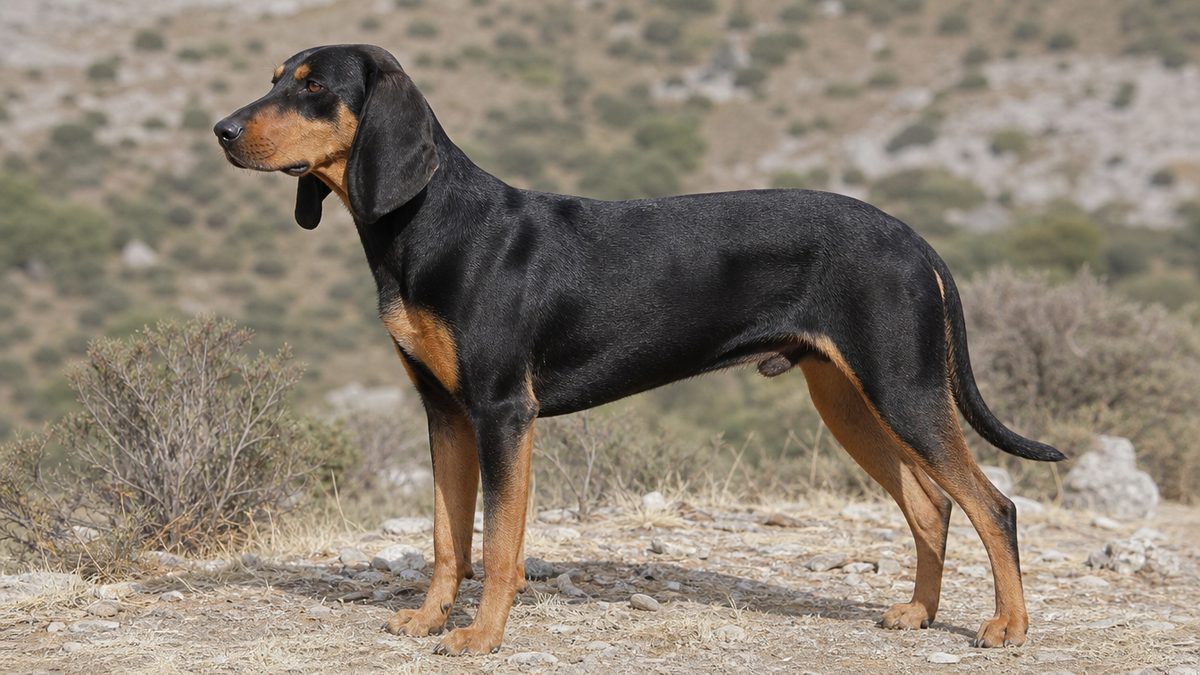
The Greek Harehound is a medium-sized black-and-tan scent hound from Greece, recognised by the Federation Cynologique Internationale as standard number 214 and bred to hunt hare across rocky ground alone or in a pack. It is a working hound first and a household dog second, and its own standard says so.
Its FCI standard is unusually direct about the job. The breed is described as a hound with a fine sense of smell and of great resistance, an active hunter either alone or in a pack, which responds completely in all terrains of lowland or mountains and even in the more rocky and unworkable terrains, with a voice that is resonant and harmonious. Three things in that sentence matter to an Indian buyer: it is a stamina animal, it works independently, and it is loud on purpose.
In Greek the breed is the Ellinikos Ichnilatis, and the FCI registers it under the transliteration Hellinikos Ichnilatis, with Hellenic Hound as the English name, Chien Courant Grec in French and Griechischer Laufhund in German. Search engines and breed directories mostly use Greek Harehound, which is why this page does too, but the register does not. Dog Breed Info Center, ranking second for the head term in India, calls it simply the Greek Hound. If you are checking a pedigree, the name printed on it will be one of the register forms, not the search term.
Appearance, from the standard rather than from a photograph
Colour is the fastest identification check and the strictest rule in the document. The coat is black and tan, a small white patch on the chest is tolerated, and the visible mucous membranes, the nose and the nails are black. Any other colour of coat, nose, eyes or nails excludes the dog under the standard, and so does total depigmentation of the visible mucous membranes. There is no colour variety, no dilute, and no long-coated version, so a page offering you a fawn or a blue one is describing a different dog.
The build is a working hound's. The body is 10 percent longer than the height at the withers, the chest is well developed and deep, let down to elbow level, the loin is slightly arched and the belly is lean and slightly tucked up. The head is long, with divergent upper lines of the skull and muzzle and a cephalic index under 50, and the ears are of medium length, almost half the length of the head, set above the zygomatic arches, flat, rounded at the lower extremity and hanging vertically. The tail is not long, reaches at most the point of the hock, and is carried sabre-fashion in movement.
How rare is rare
Rare is the word every page uses and none of them quantifies. Bonbeno can put three numbers against it, all of them zero. PubMed returns no genuine record naming the breed, against control searches that worked in the same session. The Orthopedic Foundation for Animals publishes no statistics row for it and does not carry a breed code for it at all in the markup of its own breed list. And two India-targeted search pulls returned no listing for a live dog anywhere in either result set. A breed can be rare and still well-documented, as several Balkan hounds are; this one is rare and undocumented, which is a different and more awkward position for a buyer.
Where it comes from, and where the story gets vague
The history and origins of the breed are genuinely unsettled. Northern Greece and southern Greece are both claimed, by different sources, and neither claim carries a citation. Wikipedia says the breed was originally bred for tracking and chasing hare in Southern Greece, and traces it to the extinct Laconian hound of ancient Sparta. That is a southern Greek origin story. The UKC standard says only that the Hellenic Hound is a medium sized scenthound that originated in Greece, and declines to name a region. The FCI standard names the origin as Greece and stops there. Bonbeno has found no primary source that fixes a region, so this page does not pick one.
It is not a trivia question. If the breed is Laconian in origin it was shaped by the dry Peloponnese; if it is a northern Greek mountain hound it was shaped by a climate with hard winters and snow. Those two starting points imply different heat physiology, and this page's climate section deliberately uses northern Greek data because that is where the breed is most consistently reported today, while saying plainly that the origin is not settled.
Which registries recognise the Greek Harehound, and when
Two registries recognise the Greek Harehound and one does not. The FCI accepted it on a definitive basis on 16 October 1959 and the American Kennel Club lists it nowhere, including in the Foundation Stock Service. The United Kennel Club, covered in the next section, recognised it in 2006. Every one of those statements is read here off the register's own page.
The FCI: standard 214, and the date almost everyone gets wrong
Bonbeno reached the breed by opening the FCI nomenclature index for the letter H and following the register's own link, rather than assembling a URL, because on fci.be the trailing number in an address decides which document you get and the breed name in the address is ignored. The index lists HELLINIKOS ICHNILATIS and links it to breed record 214. That record gives the group as 6, scent hounds and related breeds, the section as scent hounds, the subsection as medium-sized hounds, the country of origin as Greece, the breed status as recognised on a definitive basis, and the working-trial position as subject to a working trial.
The dates on that record are the interesting part. The date of acceptance on a definitive basis by the FCI is given as 10/16/1959 and the date of publication of the official valid standard as 10/16/1959. The FCI writes dates month first, and the same tables carry rows such as 9/17/2024 and 6/21/2022 where the second field exceeds twelve, which settles the format without needing to know the house style. So the date is 16 October 1959. The standard's own English PDF repeats it in unambiguous form as 16.10.1959.
Wikipedia says 1996, and so does most of what follows Wikipedia. What happened in 1996 is that the FCI published translations of a standard that was already 37 years old: the English text on 19 March 1996 and the French text, which is the authentic language for this standard, on 22 April 1996. The Kennel Club of Greece publishes the Greek text under the header Standard F.C.I. No 214 / 22.04.1996, which is the French publication date, indicating that the Greek version was made from the authentic French rather than from the English. Wikipedia's own wikitext carries a citation-needed tag on the 1996 sentence dated September 2025, and the article rests on a single reference, a newspaper listicle.
Wikipedia adds a second claim worth checking, that the Greek Harehound remains the only Greek breed recognised by the FCI. Bonbeno tested it by reading the FCI's own alphabetical indexes rather than by searching. The letter E index runs from Eesti Hagijas to Eurasier and contains no Ellinikos Poimenikos. The letter G index runs from Galgo Espanol to Grosser Schweizer Sennenhund and contains no Greek entry. The letter K index runs from Kai to Kuvasz and contains no Kokoni. The twenty-breed provisional register contains no Greek breed either. So on the four indexes Bonbeno read, Wikipedia's claim holds: the Hellinikos Ichnilatis at 214 is the only Greek breed present. The Kennel Club of Greece meanwhile publishes seven Greek breeds of its own, including the Cretan Hound and the Greek Shepherd, none of which the FCI lists.
The AKC: not recognised, and not in Foundation Stock Service either
The American Kennel Club's Foundation Stock Service is where rare breeds sit before full recognition, and this breed is not in it. Bonbeno read the AKC's own roster, which is headed FSS and Miscellaneous Breeds Broken Out By Group, is marked revised 6/10/26, and states that there are currently 88 breeds in the FSS program. The group counts printed on that page are 17 sporting, 20 hound, 20 working, 4 terrier, 2 toy, 8 non-sporting and 17 herding, which sum to exactly 88, so the roster reconciles with its own total. The hound group of 20 includes the Porcelaine, the Slovensky Kopov, the Segugio Italiano, the Hanoverian Scenthound and the Transylvania Hound, so European scent hounds are plainly eligible. The Greek Harehound is not among them, and neither is any other Greek breed.
The obvious AKC address for the Foundation Stock Service returned a 404 to us. A 404 on an address you assembled yourself proves your guess was wrong and nothing else, so no conclusion was drawn from it. The AKC's own 404 page carried the correct link, which was followed to the real roster. The absence reported above is read from the register's own list, not from a failed fetch.
The UKC recognises it too, and its standard is not the same document
The United Kennel Club recognised the Hellenic Hound in 2006, and no page ranking in India for this breed mentions it. That matters because the UKC standard, revised on 1 July 2009, differs from the FCI text on points a buyer can measure, and on one point that Indian law turns into a legal problem.
The United Kennel Club is the second registry, and no ranking page for this breed mentions it. The UKC's breed-standards index lists Hellenic Hound in its Scenthound Group among the more than 300 breeds it recognises, and the breed's own page states plainly that the Hellenic Hound was recognized by the United Kennel Club in 2006, carries a 2006 copyright line, and is marked Revised July 1, 2009.
The UKC text is largely a paraphrase of the FCI standard, but it is not identical, and the differences are checkable rather than cosmetic. Three of them matter.
| Point | FCI standard 214 | UKC standard |
|---|---|---|
| Dewclaws on the hind legs | Hock described as without dewclaws; presence of dewclaws is a disqualifying fault | Not mentioned anywhere, and absent from the disqualification list |
| Height tolerance | Plus or minus 2 cm | Eliminating fault at more than one inch, that is 2.54 cm, over or under |
| Female minimum height | 45 cm, which is 17.72 inches | 17 inches, which is 43.2 cm |
| Male range | 47-55 cm, that is 18.50-21.65 inches | 18.5-21.5 inches, that is 47.0-54.6 cm |
| Weight | 17-20 kg, that is 37.5-44.1 lb | Approximately 37-44 lb, which converts back cleanly |
| Scale of points | A 100-point scale with Excellent at 90 and Fair at 60 | No scale of points at all |
| Albinism | Not named; total depigmentation of visible mucous membranes disqualifies | Albinism named as a disqualification in its own right |
| Parallel skull and muzzle planes | Only convergence is a disqualification | Parallel planes are a named serious fault |
Work through the height arithmetic and the pattern is that the UKC converted the metric figures unevenly. The FCI's male minimum of 47 cm is 18.504 inches and the UKC prints 18.5, so no tolerance was folded in. The FCI's female minimum of 45 cm is 17.717 inches and the UKC prints 17, which is 43.2 cm, so roughly the full 2 cm tolerance was folded in on that one figure and not on the others. The weights convert cleanly in both directions, 17 kg being 37.5 lb and 20 kg being 44.1 lb. A buyer measuring a bitch at 44 cm is inside the UKC standard and outside the FCI's stated minimum, though within its tolerance, which is exactly the kind of gap that a seller can exploit and a page like this exists to close.
What the 1959 breed standard actually says, and where the translations drift
Read the standard in its authentic language and two things become clear: it is an old document that still carries a marking scale out of 100, and its translations have drifted in small ways that matter. French is the authentic language for FCI standard 214, so where the English, Greek and French texts disagree, the French governs.
| Measurement | Figure in the standard |
|---|---|
| Height at withers, males | 47-55 cm |
| Height at withers, females | 45-53 cm |
| Height tolerance | Plus or minus 2 cm |
| Weight, both sexes | 17-20 kg |
| Head length to height at withers | 4.35 to 10 |
| Neck length to total head length | 6.5 to 10 |
| Body length against height at withers | 10 percent longer |
| Skull width against total head length | Not more than half, cephalic index under 50 |
| Ear length | Almost half the length of the head |
| Tail length | At most to the point of the hock |
Notice what is not in that table. There is no life expectancy, no litter size, no coat-care instruction, no temperament rating and no health screening requirement. FCI standards from 1959 are conformation documents, and every lifespan figure circulating for this breed was therefore supplied by somebody other than the registry.
The scale of points, and why it dates the document
Standard 214 still awards the breed out of 100. General appearance carries 20 points, the head 15, eyes 5, ears 5, neck 5, body 15, limbs 20, tail 5 and coat 10, and the qualifications are Excellent at not less than 90 points, Very good at 80, Good at 70 and Fair at 60. Almost no modern FCI standard is written this way. Its survival here tells you the text has not been substantively revised since the 1950s, which in turn tells you that any modern claim attributed to the standard, about temperament or health or exercise, is being attributed to a document that does not contain it.
Faults and disqualifications, which are the practical part
The disqualifying faults are the list a buyer should actually read, because they are the shortest description of what the breed is not. A dog is excluded for aggression or extreme shyness, for physical or behavioural abnormality, for convergence of the upper longitudinal axes of the skull and the muzzle, for a concave nasal bridge or a very pointed muzzle, for an over- or undershot mouth, for semi-erect ears, for a curled tail, for legs out of vertical, for the presence of dewclaws, for any colour other than that prescribed for coat, nose, eyes and nails, for total depigmentation of the visible mucous membranes, and for height outside the tolerance.
Two of those matter under Indian law and they pull in opposite directions. The standard disqualifies an over- or undershot mouth, and Indian law happens to agree with it: Second Schedule Part III paragraph 8(10) of the Prevention of Cruelty to Animals (Dog Breeding and Marketing) Rules, 2017 requires that dogs shall have been tested for genetic defects including hip dysplasia, progressive retinal atrophy, night blindness, hypothyroidism, entropion, ectropion, overshot, undershot jaw when incisors do not touch or mesh, wry mouth, two or more missing teeth, and unilateral or full cryptorchid males. A breeder screening for the standard's bite fault is doing exactly what the Rules require.
The dewclaw disqualification is the opposite case, and it is the sharpest collision on this page. The standard's own hindquarters description says the hock is almost straight and without dewclaws, and the presence of dewclaws is then listed as a disqualifying fault. The obvious remedy is to remove them from a puppy, and in India that remedy is unlawful. Second Schedule Part II paragraph 6(8) of the same 2017 Rules states that there shall be no tail docking, ear cropping, de-barking, de-clawing, branding, dyeing, injecting substances to enhance visual appeal, performing a surgery or procedure to camouflage or hide any defect or infirmity or any other kind of mutilation of any body part of the pup, and that any change of appearance by artificial means is strictly forbidden.
A translation error in the Kennel Club of Greece's own text
Comparing the three published versions of the fault list turns up one real discrepancy, and it is in the Greek. The French authentic text lists among the faults Croupe courte, etroite, pas inclinee, meaning a croup that is short, narrow and not sloping, and the English translation renders it correctly as croup short, narrow, not sloping. The Kennel Club of Greece's Greek text prints the same fault as short, narrow and sloping, dropping the negative. Since the breed description in all three languages calls for a croup that is long, broad, well muscled and slightly sloping, the Greek fault line as printed contradicts the breed description it sits beside. The French governs, so the fault is a croup that fails to slope.
That is a small error with a general lesson attached. An FCI standard is a primary source for what the FCI says, and its measurements are reliable, but its translated prose can drift, and a national kennel club's own version is not automatically the safest copy. Where a figure matters, read the authentic language.
Wikipedia gives the breed's height as 18 to 22 inches, which it converts to 46 to 56 cm. No standard contains those numbers. The FCI gives 47-55 cm for males and 45-53 cm for females, and the UKC gives 18.5-21.5 inches for males and 17-20.5 inches for females. Wikipedia appears to have merged the sexes and rounded to whole inches, producing a range that describes neither dog. Check any secondary source's size claim against the standard before quoting it.
Greek Harehound price in India
No Greek Harehound price in India exists, because no verified Indian listing for a live dog exists. That is the answer, and it is worth more to a buyer than an invented number would be. What follows is what Bonbeno actually found when it went looking, and how to read the rupee figures that a search will put in front of you.
Two India-targeted searches were run on 31 August 2026, one for the head term and one for the price query. Between them they returned twenty organic results. Not one was a listing for a live Greek Harehound anywhere in India. The India-facing results were a merchandise marketplace, a paperback book, two Facebook groups, a Pinterest idea page, a rehoming form and a set of overseas breed profiles. To prove the search itself works, a control query for labrador retriever puppy price in india was run in the same tool in the same session and returned ten Indian pages carrying real rupee bands, including Supertails at Rs 8,000 to Rs 70,000. The instrument is fine. The market is absent.
The rupee figure in your search results is a book
The one India-facing rupee amount attached to this breed is around Rs 2,274, and it belongs to a paperback. The listing is Greek Harehound (Hellenikos Ichnilatis) Tricks Training Tracker and Workbook on Amazon.in, and the word dog does not appear on the product page at all, while Workbook appears twenty-three times and Paperback five times. Anyone quoting Rs 2,274 as a puppy price has copied the price of a training journal.
The other rupee figures in the same result set, Rs 587, Rs 1,075, Rs 1,984 and Rs 3,023, come from an Etsy market page titled Buy Greek Harehound Online In India. Those are prints, shirts and gifts. None of the six figures describes an animal, and none of them survives even the crudest sanity check: no medium-sized pedigree hound anywhere on earth sells for Rs 587.
Running the currency tests anyway, and what they show
Indian breed pages routinely publish a dollar figure converted at a single rate and present it as a local price, so Bonbeno divides every suspicious rupee figure by the three rates that have been caught doing it on this site. Applied to the only figure with any claim to be a price, Rs 2,274, the results are these.
| Rate tested | Quotient in US dollars | Verdict |
|---|---|---|
| 84.38 | 26.95 | Not a round price, and not a dog price |
| 74.00 | 30.73 | Not a round price |
| 66.67 | 34.11 | Not a round price |
| 80.00 | 28.43 | Not a round price |
None of the four divides to anything a seller would print, which is the expected result for a figure that was never a converted price in the first place. It is the retail price of a book, set in rupees by a marketplace. Note the weakness in two of those tests while you are here: 66.67 is exactly 200 divided by 3, so any rupee figure that is a multiple of 1,000 passes it by construction, and 1,000 divided by 80 is 12.5, so any figure ending in three zeros passes the 80 test the same way. Neither test means anything on its own, and Bonbeno reports the quotient rather than a pass or fail for exactly that reason.
What the breed costs where it does exist
One ranking page publishes a purchase price and it is not an Indian one. Wamiz, which holds position one in India for the price query, gives a purchase cost of 400 to 600 British pounds for a Greek Harehound puppy, on a page written for a United Kingdom audience. Bonbeno reports that figure as what it is, a British price on a British site, and does not convert it into rupees. Converting a foreign price is how a fabricated Indian price band gets born, and this site has documented Indian tables built by exactly that method.
Why no Indian price can form
The supply side is closed by law rather than by chance. India's import policy classes dogs as Restricted under ITC(HS) 01061900 and Policy Condition 7 permits their import only as a pet dog with a valid pet book in the importer's name, for research by an R&D organisation with CPCSEA recommendation, or for internal security by the Defence and Police Force. Policy Condition 8 states that import of commercial dogs for breeding or any other commercial activities is not permitted, and paragraph 6 of the same trade notice states that any applications for trading or breeding purposes shall be duly rejected.
So there is no lawful route by which an Indian breeder could obtain founding stock, and therefore no way for a domestic litter, a price list or a market to appear. A breed whose only legal presence in India is an individual pet arriving in somebody's baggage does not have a price. It has an owner.
Treat any Indian rupee quote for a Greek Harehound puppy as a claim about a different dog until the seller produces import paperwork in a named person's name. There is no other lawful way the parents could be here. The commonest substitution for a black-and-tan medium hound is a black-and-tan Indian pariah dog or a hound cross, both of which are excellent dogs and neither of which is this breed.
What a Greek Harehound would cost to keep in India each month
Budget roughly Rs 6,500 to Rs 13,000 a month to keep a 17 to 20 kg working hound in an Indian metro, before any one-off costs. That range is built from Indian prices for a dog of this size and activity level, not from a figure published for this breed, because no such figure exists.
Be clear about what this table is and is not. It is a monthly cost model for a lean, hard-working, short-coated hound weighing 17 to 20 kg as the standard specifies, priced against what Indian owners pay for a comparable dog. It is not a quotation, and it is not sourced from a Greek Harehound owner in India, because Bonbeno could not find one.
| Item | Lower | Upper | What drives the spread |
|---|---|---|---|
| Food, quality dry diet | 3,000 | 6,000 | Working dogs at this weight eat more than the pack chart says |
| Preventive parasite control | 700 | 1,400 | Monthly tick and flea cover is not optional in India |
| Routine veterinary care, amortised | 800 | 1,600 | Annual vaccination, deworming and one check-up spread over twelve months |
| Ear care and skin management | 200 | 600 | Driven entirely by the hanging ear and the monsoon |
| Grooming | 0 | 300 | A rubber mitt at home covers it; salon visits are optional |
| Exercise-related costs | 500 | 2,000 | Long lead, harness, and in many cities a boarding or day-care fallback |
| Insurance, where taken | 500 | 1,500 | Optional, and priced on size rather than breed for an unlisted breed |
| Contingency | 800 | 1,600 | Tick-borne disease testing and treatment is the likeliest unplanned cost |
| Monthly total | 6,500 | 13,000 |
The row that surprises people is parasite control, and it should not. A survey of canine tick-borne diseases in India found ticks on 278 of the 525 dogs it examined, which is 53 percent, and that is a nationwide sample of owned dogs rather than street dogs. A hound that works in scrub is on the wrong side of that statistic. Skipping a Rs 700 monthly preventive to save money is how an owner ends up paying for ehrlichiosis treatment instead.
One-off costs that are not in the monthly figure
- Import authorisation and travel, if you are bringing your own dog in, which the DGFT trade notice says to begin at least two months before the travel date and which is priced by the airline and the agent rather than by any published tariff
- Quarantine at a government station at one of the permitted ports, where required
- Neutering, which the breeding Rules make a condition of sale for dogs over six months in most circumstances
- A secure yard or a long-line setup, because this is not a dog you let off in an unfenced Indian park
- Crate, harness and a genuinely strong 10-metre training line, since the recall will fail on a live scent
Set that monthly total against a common Indian benchmark to see where it sits. A Labrador Retriever, at a heavier 25 to 36 kg, is published in India at Rs 8,000 to Rs 70,000 to buy and is described as needing 45 to 60 minutes of exercise a day. The Greek Harehound is lighter, so it eats less, and needs roughly double that exercise, so it costs more in the owner's time than in the owner's money. For most Indian households the binding constraint on this breed is not rupees. It is two hours a day, outdoors, at hours when it is cool enough to move.
In an Indian metro the honest hidden cost of a vocal pack hound is the housing society. The FCI standard praises a voice that is resonant and harmonious, which is a hunting virtue. Budget for the possibility that you will need a ground-floor home with a yard rather than a flat, and price that difference before you price the dog food.
Greek Harehound heat tolerance in India, tested against real climate data
The Greek Harehound is not a hot-country dog, and the data says so plainly. Its home region in northern Greece averages 15.4 C across the year at an annual wet bulb of 11.8 C, while Chennai averages 27.9 C at a wet bulb of 24.0 C. That is a 12.5 C gap in air temperature and a 12.2-point gap in wet bulb, and the wet-bulb gap is the one that decides whether a panting dog can shed heat.
Every figure in this section comes from NASA POWER's Source Native Resolution Climatology, queried by explicit latitude and longitude, with the coordinates the service returned checked against the coordinates asked for. Wet-bulb temperatures are computed from the returned air temperature and relative humidity using the Stull (2011) approximation published in the Journal of Applied Meteorology and Climatology. Nothing here is copied from a climate directory, because those have served this site the wrong city at least six times.
| Place | Mean air temp C | Mean RH percent | Annual wet bulb C | Wet-bulb gap vs Thessaloniki |
|---|---|---|---|---|
| Thessaloniki, northern Greece | 15.4 | 68.8 | 11.8 | - |
| Ioannina, Epirus | 15.3 | 68.7 | 11.8 | 0.0 |
| Athens, the hottest large Greek city | 17.9 | 68.5 | 14.1 | +2.3 |
| Bengaluru | 23.7 | 67.9 | 19.5 | +7.7 |
| Pune | 23.9 | 66.8 | 19.4 | +7.6 |
| Mumbai | 26.8 | 67.4 | 22.2 | +10.4 |
| Delhi | 25.6 | 45.6 | 17.8 | +6.0 |
| Chennai | 27.9 | 72.4 | 24.0 | +12.2 |
Read the Greek rows first, because they overturn the usual story. This is routinely described as a Mediterranean breed, and Mediterranean is heard as hot. Thessaloniki's January mean is 4.5 C and Ioannina's is 5.6 C, both at over 80 percent relative humidity. The breed's home winter is cold and wet. Its summer is genuinely hot and genuinely dry: July at Thessaloniki averages 27.0 C at 49.7 percent relative humidity, giving a wet bulb of 19.7 C. So the animal was selected for a climate with three hot dry months and nine cool ones, not for year-round heat.
Dryness is what the breed is adapted to, and India removes it
The important difference is not the temperature, it is the humidity that comes with it. A Greek July delivers 27 C at under 50 percent relative humidity, which is a climate in which panting works extremely well, because evaporation is fast. Chennai delivers 29.7 C in July at 67.5 percent, and Mumbai delivers 26.6 C at 89.6 percent. The air temperature in Mumbai's July is lower than Thessaloniki's, and the dog will cope far worse, because a wet bulb of 25.2 C leaves almost no evaporative headroom.
| City | Worst month | Mean air temp C | Mean RH percent | Mean wet bulb C |
|---|---|---|---|---|
| Thessaloniki | July | 27.0 | 49.7 | 19.7 |
| Delhi | July | 32.3 | 62.7 | 26.5 |
| Chennai | May | 31.5 | 64.5 | 26.1 |
| Mumbai | June | 28.7 | 79.5 | 25.8 |
| Pune | June | 25.6 | 80.3 | 23.0 |
| Bengaluru | May | 27.0 | 63.8 | 21.9 |
Delhi's monsoon month is the most dangerous single month for this dog anywhere in India, and it is not the hottest one. Delhi in May averages 35.0 C at 23.4 percent humidity, which is brutal air but a wet bulb of only 20.4 C. Delhi in July averages 32.3 C at 62.7 percent, which is cooler air and a wet bulb of 26.5 C. A dry-adapted hound will handle May better than July, which is the opposite of what most owners assume.
City by city, in plain terms
- Bengaluru and Pune, at annual wet bulbs of 19.5 C and 19.4 C, are the only large Indian cities where this breed could be worked with reasonable safety for most of the year, and both still sit 7.6 points above its home region
- Delhi is survivable from November to March and hazardous from June to September, with July the worst month
- Mumbai is the hardest posting, because the wet bulb never drops below 16.6 C and sits above 23 C for five consecutive months
- Chennai is the least suitable on an annual basis, sitting above a 21 C wet bulb in every single month of the year
- Hill stations change the arithmetic entirely, which is the honest exception rather than the rule
The India Meteorological Department does not treat a day as a heat wave until the maximum temperature reaches at least 40 C in the plains, or 30 C in hilly regions, and grades it severe when the departure from normal reaches 7 C or more. Thessaloniki's monthly mean maximum never reaches 40 C in the climatology; Delhi's exceeds it in five months. A dog bred where 40 C is exceptional is being asked to live where 40 C is scheduled.
How to keep a Greek Harehound safe in Indian heat
Manage the walk, not the coat. The best available evidence on canine heatstroke says that most exercise-triggered cases follow an ordinary walk rather than hard exercise, and that bodyweight above the breed mean raises the odds, so the two interventions that matter are timing your walks and keeping the dog lean.
The evidence base here is the VetCompass work on UK dogs, and it has to be used carefully. Two papers by the same authors on the same 2016 cohort of 905,543 dogs are routinely confused with each other, and they use different case definitions. Hall 2020 in Scientific Reports identified 395 confirmed heat-related illness events, estimated the 2016 incidence at 0.04 percent and the event fatality rate at 14.18 percent, and reported that dogs with bodyweight equal to or greater than the relative breed and sex mean had 1.42 times the odds of heat-related illness, with a confidence interval of 1.12 to 1.80. Hall 2020 in Animals identified 1,259 events from 1,222 dogs and analysed what triggered them.
The finding that should change how you walk this dog
In the Animals paper, 380 of the 1,259 events had no trigger recorded, leaving 879 with one. Of those 879, exertional heat-related illness accounted for 652 events, which is 74.2 percent, environmental heat for 113 events at 12.9 percent, and confinement in a vehicle for 46 events at 5.2 percent. Exercise, not hot cars, is the dominant trigger, and the paper's title says so.
Go one level deeper and the practical point appears. Of the 652 exercise-triggered events, the exercise type was not specified for 101. Of the remaining 551, 372 events, or 67.5 percent, followed a walk. Ninety-seven followed high-intensity activity such as running or cycling, 76 followed play, and 6 followed canine sport. Two thirds of exercise heatstroke in that dataset happened on a walk, in the United Kingdom. An Indian owner walking a working hound at nine in the morning in May is operating well outside the conditions that produced those numbers.
What transfers to this breed and what does not
Neither the Greek Harehound nor any Greek breed appears in the breed-specific results of either paper, and neither can, because the analyses required a minimum number of cases within a breed present in the UK population. So the breed-level odds ratios in those papers do not apply here and this page does not borrow them. What does transfer is the factors that are about the dog rather than the label: bodyweight relative to the breed and sex mean, at an odds ratio of 1.42, and age, since dogs aged twelve years and over carried the greatest odds. The over-50 kg weight band, at an odds ratio of 3.42, is irrelevant to a 17 to 20 kg hound, and saying so is more useful than quoting it.
The management plan
- Walk before sunrise and after full dark from March to October in the plains, and treat any morning where the wet bulb is above 24 C as an indoor day
- Keep the dog at or below the breed mean weight, which for this breed means the lower half of the standard's 17 to 20 kg band, because that is the one heat risk factor an owner directly controls
- Carry water on every walk and offer it every fifteen minutes, rather than at the end
- Cool a hot dog with room-temperature water over the paws, groin and armpits, and move it to shade and moving air, before you drive anywhere
- Never shave a short-coated hound to cool it; the coat is a single layer that reflects radiant heat and shaving it exposes skin to sun
- Learn the numbers that mean stop: a rectal temperature above 40 C, gums that are brick red or grey, staggering, vomiting or collapse
- Treat the monsoon as the risky season in Delhi and the pre-monsoon as the risky season in Chennai, because the wet bulb peaks at different times in the two cities
One more habit is worth building. Learn to think in wet bulb rather than in temperature. A 32 C day at 40 percent humidity and a 28 C day at 85 percent humidity feel similar to a human in an air-conditioned car and are completely different to a panting dog, because the second has a wet bulb roughly four points higher. Free weather apps increasingly show dew point, which is close enough to reason with: when the dew point climbs above 24 C, a working hound should not be working.
It is short-coated, lean, mesocephalic and under 20 kg. Every one of those is on the right side of the heat-illness evidence. Hall's Scientific Reports analysis found brachycephalic dogs at 2.10 times the odds of mesocephalic dogs and dogs over 50 kg at 3.42 times the odds of dogs under 10 kg. A Greek Harehound is neither. Its problem in India is the job it wants to do, not its skull or its coat.
Temperament and who should not buy this breed
The Greek Harehound is an independent, vocal, high-drive pack hound, and its registry-level temperament description runs to five words. Anything longer than that which you read about its personality was written by someone extrapolating, including parts of this section, and this page marks the difference.
Here is the entire temperament content of the governing document. Under general appearance the FCI standard calls the breed strong, vigorous, lively and keen; under utilisation it says the dog hunts actively alone or in a pack and has a resonant, harmonious voice; and among the disqualifying faults it excludes a dog that is aggressive or overly shy. The UKC standard compresses the character section to two words, lively and keen. That is all a registry will tell you.
What the standard does say is more informative than it first looks, because it describes function. A dog bred to hunt alone across rocky and unworkable terrain is a dog selected for making its own decisions at distance from the handler. A dog bred to give tongue is a dog selected to vocalise while working. Neither trait switches off at the front door.
What the ranking pages claim, and how much weight to give it
Wamiz, Bil-Jac and Basepaws all publish personality profiles for this breed, and they broadly agree: affectionate with family, good-natured, independent, high prey drive, needs a job, destructive when under-exercised Basepaws, Greek Harehound Breed Information…. That consensus is worth something, because it is what owners in Greece and the small European diaspora report. It is not worth what a survey would be worth. No temperament study, no owner questionnaire and no behavioural dataset covering this breed exists, and Bonbeno found none in a PubMed search that returned zero genuine records.
Who this breed suits
- A household with a securely fenced yard, in Bengaluru, Pune or a hill town, that walks two hours a day at dawn and after dark
- An owner who has kept a scent hound before and is not surprised when recall fails on a live trail
- A family that treats barking as information rather than as a fault to be trained out
- Someone who wants a working dog and has actual work for it, whether that is long-distance trail walking, canicross or scent sport
Who should not buy one
- Anyone in an apartment, because a pack hound's voice is designed to carry across a valley
- A first-time dog owner, since an independent hound is the hardest common temperament to live with badly
- Anyone who wants an off-lead dog in an Indian city, because the nose wins and traffic does not negotiate
- A household in Chennai or Mumbai that cannot restructure its day around dawn and darkness for eight months of the year
- Anyone who wants a dog with published health data, because none exists for this breed
One trait deserves separating from the rest, because it is the one Indian owners underestimate. This is a pack breed. The standard's own utilisation clause allows for hunting in a pack as a normal working mode, and pack hounds are typically sociable with other dogs and poor at being alone. In a city where most owners are out for nine hours, a hound that has been bred for centuries to work in company is an animal at real risk of separation distress. Plan for company, a second dog, or a genuinely different daily routine.
An alert hound is not a guard dog. This breed will tell you something is happening, loudly, and then carry on. Buyers who want protection are describing a livestock guardian, and Bonbeno's Greek Shepherd page covers the breed that actually does that job. Buying a hound for security produces a noisy dog and an unprotected house.
Training a Greek Harehound, and what it will resist
Train the household manners early and accept that the recall will never be reliable off-lead. That is not defeatism, it is what selecting a dog for independent scent work across rough country produces, and no Indian city offers the conditions in which you could safely find out whether your dog is the exception.
Start from the standard's own description of the job. The FCI text says the dog responds completely in all terrains of lowland or mountains and even in the more rocky and unworkable terrains. It is describing an animal that keeps working when the handler is out of sight and the ground is bad. Every training difficulty this breed presents is a downstream consequence of that one selected trait.
What works
- Food, because a hound that hunts on its own initiative is not working for your approval and will not be trained by it
- Very short sessions, three to five minutes, several times a day, before the walk rather than after it
- Scent games as the reward rather than as an extra, since letting the dog use its nose is the strongest reinforcer available
- A long line of ten metres for the whole of the first two years, and probably for life in an Indian city
- Socialise the puppy continuously with people, traffic, other dogs and household noise, starting the week it arrives
- A settle cue trained deliberately, because a hound that never learns to switch off will pace and vocalise indoors
What it will resist
Recall is the headline. A scent hound running a line is in a state where hearing is deprioritised, and shouting louder makes it worse rather than better. Assume that once the nose engages, the dog is gone until the trail ends. The second resistance is repetition: this is not a breed that enjoys drilling the same exercise, and a handler who repeats a cue ten times has taught the dog that the cue means nothing. The third is heel work at a human pace, which for a dog built to cover ground at a swift and light gait is genuinely uncomfortable.
Barking, and why you cannot train it away
The voice is in the standard as a virtue. The breed is described as having a voice that is resonant and harmonious, and the whole point of a hunting hound's tongue is that the handler can locate the dog a kilometre away. You can reduce nuisance barking by removing its causes, which are boredom, isolation and under-exercise, and you can teach a quiet cue. You cannot select the voice out of an individual dog, and you should not try, because the Indian route people reach for is illegal: de-barking is expressly forbidden by Second Schedule Part II paragraph 6(8) of the Prevention of Cruelty to Animals (Dog Breeding and Marketing) Rules, 2017, in the same sentence that forbids tail docking and ear cropping.
A realistic first-year timeline
| Period | Realistic goal | What will not happen yet |
|---|---|---|
| 8-16 weeks | Name response, crate settled, house-trained, met 60 novel things | Any reliability outdoors |
| 4-6 months | Loose-lead walking on a long line, sit and settle at home | Off-lead anything |
| 6-12 months | Recall in a fenced space with no live scent, first scent games | Recall in the presence of a trail |
| 12-24 months | Two-hour walks, calm in traffic, reliable settle indoors | Reliable off-lead recall |
| 2 years plus | A hound that is easy to live with on a long line | A hound you can trust off-lead in an Indian city |
The temptation with a hound that ignores a recall is an electronic or prong collar. Beyond the welfare argument, it does not address the cause, which is that the dog is in a drive state where the handler is not salient. It reliably produces a hound that is both unreliable and anxious. Manage the environment with a long line instead and stop trying to win an argument with three hundred years of selection.
How much exercise a Greek Harehound actually needs
Plan on two hours of real exercise a day, split into two sessions, for the working life of the dog. That is roughly double what a common Indian family breed is published as needing, and in most of India both sessions have to happen in darkness for eight months of the year.
There is no published exercise figure for this breed from any registry, so the number above is reasoned from the standard rather than quoted from it. The FCI describes a hound of great resistance that hunts actively across lowland, mountain and rocky terrain, and the UKC notes it as a working scenthound. Ranking pages describe a dog that becomes destructive when it cannot exercise for extended periods. For scale, Supertails publishes 45 to 60 minutes a day for a Labrador Retriever in India. A working hare hound sits well above that.
What two hours should contain
- Sixty to ninety minutes of continuous walking or trotting on a long line, which is what the body is built for
- Twenty to thirty minutes of scent work, which tires this breed faster than distance does and can be done indoors on the worst days
- Free running only inside a genuinely fenced area, which in most Indian cities means a private compound rather than a park
- Two rest days a month, because a hound that never gets a light day accumulates soft-tissue strain
The scent-work point is the one that saves Indian owners. Twenty minutes of hidden-food searching in a hallway will settle this dog more effectively than a forty-minute walk in heat, and it can be done at three in the afternoon in May when a walk cannot. Owners who build a scent routine early have a fallback for the season when outdoor exercise is genuinely unsafe. Owners who rely only on distance have a destructive dog by June.
Scheduling around the Indian year
| Season | Morning session | Evening session | Indoor substitute |
|---|---|---|---|
| November to February | 60-90 min from first light | 45-60 min after sunset | Not usually needed |
| March to May | 60 min, finished before sunrise | 45 min, at least 90 min after sunset | Scent work at midday |
| June to September | 45 min pre-dawn only | 30-45 min late, on cooler nights | Scent work daily; skip walks on high wet-bulb days |
| October | 60 min early | 45 min after dark | As needed |
The June-to-September row is the one that reflects real risk rather than caution. In Delhi, July averages 32.3 C at 62.7 percent relative humidity, giving a mean wet bulb of 26.5 C, and that is the daily mean rather than the afternoon peak. In Mumbai, the wet bulb sits above 24 C for four consecutive months. A dog does not know to stop, and a hound with a scent in front of it certainly does not, so the decision has to be the owner's and it has to be made before the lead goes on.
What under-exercise looks like
The failure mode is specific and recognisable. An under-exercised scent hound does not become hyperactive so much as obsessive: it patrols, it vocalises at nothing, it works surfaces with its nose for hours, it chews skirting boards and doorframes rather than toys, and it becomes progressively harder to settle in the evening. Owners usually report this as a behaviour problem around month eight, which is exactly when the puppy allowance runs out and the adult exercise requirement arrives.
If you have this dog in India and a cool season, a running harness and a bungee line will absorb more of its need in forty minutes than an hour of walking will, and it keeps the dog on line. Start after eighteen months, when the growth plates have closed, and never in the plains between March and October.
Grooming a Greek Harehound in Indian humidity
The coat takes two minutes a week and the ears take the rest of your attention. A short, dense, close-fitting single coat is one of the lowest-maintenance coats in the dog world, and the hanging ear over it is one of the highest-risk structures for an Indian climate.
The standard describes the hair as short, dense, a little hard, close fitting, in black and tan with a small white patch on the chest tolerated, and the visible mucous membranes, nose and nails black. There is no undercoat specified, no feathering and no furnishings. In practice that means a rubber curry mitt twice a week, a bath only when the dog is actually dirty, and nothing else.
The ear is the whole grooming job
Look at the geometry the standard requires. The ears are of medium length, almost half the length of the head, set on high above the zygomatic arches, flat, rounded at the lower extremity and hanging vertically. A vertically hanging flap of skin over a warm canal is the classic setup for otitis externa, and in an Indian monsoon it is the single most predictable health cost this breed carries.
- Lift and look inside both ears once a week, and daily during the monsoon; ten seconds is enough
- Dry the ear canal after every swim and every bath, because water left in a hanging ear is the commonest avoidable trigger
- Use a veterinary ear cleaner, not cotton buds, and stop if the dog is painful rather than pushing on
- Treat head shaking, a yeasty smell or brown discharge as a veterinary appointment rather than a home remedy
- Do not pluck or shave the ear; the problem is airflow and moisture, not hair
There is a piece of overseas care advice that does not transfer, and it is worth naming. European and North American breed guidance routinely says to towel a dog off and let it air dry. In a climate where the outdoor air is at 85 percent relative humidity for four months, air drying is not drying. Dry a hound's ears actively, with a towel corner and then time, before the dog goes back outside.
Shedding, skin and the rest
This breed sheds moderately and continuously rather than in seasonal blowouts, because a single short coat has no undercoat to release. Indian owners often expect the two-week blizzard they have seen from a Spitz or a Labrador and are pleasantly surprised. Nobody should buy this dog for a low-allergen household, though: coat length has no bearing on allergen load, and there is no such thing as a non-allergenic dog.
| Task | Frequency | Time | Why |
|---|---|---|---|
| Ear check | Weekly, daily in monsoon | 10 seconds | The one predictable conformation risk |
| Rubber mitt | Twice a week | 2 minutes | Removes loose hair and distributes skin oil |
| Nail trim | Every 3-4 weeks | 5 minutes | Black nails; trim little and often |
| Bath | When dirty, roughly monthly | 15 minutes | Over-bathing strips a short coat's oils |
| Tick check | After every walk in scrub | 1 minute | Ticks were found on 53 percent of dogs in an Indian survey |
| Teeth | Several times a week | 1 minute | Indian law lists two or more missing teeth as a defect to test for |
The tick-check row is not padding. The Indian survey that examined 525 owned dogs found potential tick vectors, most commonly Rhipicephalus and Haemaphysalis, on 278 of them, which is 53 percent. A short coat makes that check easy, which is one of the few genuine advantages this breed has in India. Run your hands over the dog after every walk, and pay attention to the ear margins, the neck and between the toes.
Indian owners shave short-coated dogs every summer in the belief that it cools them. A single close coat is a radiant-heat barrier over skin that has never seen direct sun, and removing it raises the risk of sunburn without improving evaporative cooling, which happens through panting rather than through the skin. Keep the coat, move the walk.
Greek Harehound health and life expectancy, and what is not known
No inherited-disease data exists for the Greek Harehound, and no life expectancy figure for it has ever been measured. Three different lifespans circulate on the ranking pages, none of them cited, and this page prints all three rather than choosing one.
The literature: zero papers, proved with controls
Bonbeno searched PubMed through the E-utilities interface, which returns the query translation alongside the result count, because a raw count is not evidence. Searching the exact phrase Hellinikos Ichnilatis returned zero records with the phrase preserved in the translation, which is a clean zero. Searching Greek Harehound returned 20,632 records, which looks like a literature until you read the translation line: the engine discarded the word Harehound entirely and searched greek people as a supplementary concept plus greek and greeks as all-fields terms. None of those 20,632 records is about a dog.
Searching Hellenic Hound returned three records, and all three were opened. They are a 2024 paper on rabies in Hellenic antiquity, a 2006 JAVMA study of clinical spirocercosis in 39 dogs, and a 2005 Australian Veterinary Journal case report on a cervical sialocoele. None names the breed. The controls run in the same session behaved normally: Labrador Retriever with hip dysplasia returned 52 records, Bergamasco with dog returned 13, and dog with Greece and leishmaniasis returned 120. For comparison, the same search for Cretan Hound returned exactly one genuine record, a 2010 Journal of Clinical Microbiology paper on parvovirus leukoencephalopathy. So the instrument works, and the honest answer for this breed is zero.
The screening registries: no row, and no breed code either
The Orthopedic Foundation for Animals publishes hip, elbow, eye, cardiac and other statistics for roughly 292 breeds. Bonbeno retrieved the full statistics page, which runs to about 2.2 million characters, saved it and searched it case-insensitively. GREEK, HELLEN, ICHNIL and HAREHOUND each returned zero. The control terms behaved: LABRADOR returned 109 rows and BERGAMASCO returned its single verified row reading 105 evaluations and 24.8 percent dysplastic.
The stronger finding is upstream of the statistics. OFA's browse-by-breed page carries every breed it knows about as a checkbox with a data-name attribute, and reading that raw markup shows LABRADOR RETRIEVER at code LR and BERGAMASCO at code BER, while GREEK, HELLEN, ICHNIL and HAREHOUND return nothing at all. So this is not a breed that holds an OFA code and falls below the publication threshold of 100 hip evaluations. It is a breed OFA does not list. Say it that way, because the two are different.
Life expectancy: three figures, none of them measured
| Figure | Where it appears | Supporting evidence |
|---|---|---|
| About 13 years | Wikipedia, Description section | None cited anywhere in the article |
| 11 years | Bil-Jac breed library | None cited |
| 10 to 12 years | A widely shared breed spotlight post | None cited |
| No figure at all | FCI standard 214 and the UKC standard | Neither document contains a lifespan |
Bonbeno publishes no life expectancy for this breed. The three figures above span three years, agree with nothing, and rest on nothing. What can honestly be said is contextual: the UK life tables built from 30,563 dogs that died between 1 January 2016 and 31 July 2020 give a life expectancy at age 0 of 11.23 years across all companion dogs, with a confidence interval of 11.19 to 11.27, and females at 11.41 years against males at 11.07. A lean medium-sized working hound would be expected to sit at or above that population figure. That is a reasonable expectation and it is not a measurement of this breed.
What the conformation predicts, in the absence of data
- Otitis externa, from the vertically hanging ear the standard specifies, which is the one risk this page will state with confidence
- Soft-tissue and joint strain in a working dog kept at high mileage without rest days, which is a management risk rather than a genetic one
- Heat-related illness, where bodyweight at or above the breed and sex mean carries an odds ratio of 1.42 in the UK data
- Tick-borne disease in India, which is an environmental risk and covered in its own section below
- Nothing else, and a page that names hip dysplasia or epilepsy for this breed is guessing
It does not mean the breed is healthy. It means nobody has looked. A popular breed with a long list of documented conditions has that list because thousands of dogs were screened; a breed with an empty list has an empty list because nobody screened any. Treat the absence as uncertainty, not as reassurance, and screen the individual dog rather than trusting the breed.
The Indian disease pressure this breed would actually meet
Tick-borne disease is the risk that matters most for a scent hound in India, and it is measurable in a way that the breed's own health record is not. Half the owned dogs in one nationwide Indian survey carried at least one tick-borne pathogen, and a hound that works scrub is on the exposed side of that number.
The reference study examined 525 owned dogs across India using PCR alongside blood-smear microscopy. Microscopy alone found Hepatozoon gamonts in just 12 of 525 smears, which is 2.3 percent. PCR found that 261 of the 525 dogs, or 49.7 percent with a confidence interval of 45.4 to 54.1, were infected with one or more canine tick-borne pathogen. The gap between 2.3 percent and 49.7 percent is the study's central point: the old diagnostic misses most of it.
| Pathogen | Prevalence | 95 percent confidence interval |
|---|---|---|
| Hepatozoon canis | 30.0 percent | 26.0 to 34.0 |
| Ehrlichia canis | 20.6 percent | 17.2 to 24.3 |
| Mycoplasma haemocanis | 12.2 percent | 9.5 to 15.3 |
| Anaplasma platys | 6.5 percent | 4.5 to 8.9 |
| Babesia vogeli | 5.5 percent | 3.7 to 7.8 |
| Babesia gibsoni | 0.2 percent | 0.01 to 1.06 |
| Any of the above | 49.7 percent | 45.4 to 54.1 |
Two details from that paper change how an owner should behave. Concurrent infection with more than one pathogen occurred in 39 percent of infected cases, so finding one does not close the question. And potential tick vectors, most commonly Rhipicephalus and, less often, Haemaphysalis, were found on 278 of the dogs examined, which is 53 percent. These were owned dogs, not strays.
What that means for this breed specifically
A Greek Harehound in India would be a worst-case exposure profile: a dog whose entire purpose is to move slowly through low vegetation with its head down. The short coat helps, because ticks are easy to find on it, but the exposure is higher than for a dog walked on pavement. Build the following into the routine rather than treating it as optional.
- Year-round veterinary tick preventive, chosen with your vet, not a seasonal product
- A hands-on tick check after every walk in vegetation, concentrating on ear margins, neck, armpits and between the toes
- A PCR-based tick-borne disease panel at least annually, because a blood smear alone missed most infections in the study above
- Immediate testing on any episode of lethargy, pale gums, nosebleed, lameness that moves between legs, or unexplained fever
- Awareness that a negative smear is not a negative result
The ear, again, in an Indian monsoon
The other India-specific pressure is the one the conformation creates. A vertically hanging ear over a humid canal, on a dog that pushes through wet vegetation for two hours a day during the monsoon, is the highest-probability veterinary appointment this breed will generate in India. There is no Indian study of otitis in this breed, because there are no dogs of this breed in India to study, so this page states the mechanism and the management rather than a prevalence figure.
Vaccination, and one point of Indian law
Vaccinate on your veterinarian's schedule for the local disease pressure, which in most of India means core vaccines plus consideration of leptospirosis given the monsoon. The breeding Rules give a timing reference worth knowing: Second Schedule Part III paragraph 8(9) states that all pups shall be vaccinated, which can start at the age of seven to eight weeks and is usually completed at the age of eighteen weeks. Rule 8(1)(a) separately provides that pups less than eight weeks in age are not sold, so a seller offering a six-week-old puppy is breaking a Rule, whatever the breed.
Second Schedule Part III paragraph 8(10) requires that breeding dogs shall have been tested for genetic defects, including hip dysplasia, progressive retinal atrophy, night blindness, hypothyroidism, entropion, ectropion, overshot, undershot jaw, wry mouth, two or more missing teeth and cryptorchidism. Note what is absent from the whole gazette: patella and luxation appear zero times, and BAER and deaf appear zero times. There is no Indian patella-grading or hearing-test requirement, so do not let a seller tell you otherwise.
Feeding a Greek Harehound in India
Feed to a visible waist and a palpable rib, not to a chart, because bodyweight above the breed mean is the one heat risk factor an Indian owner directly controls. For a 17 to 20 kg working hound, that usually means two meals a day totalling roughly 350 to 500 grams of a good dry diet, adjusted hard against condition.
The standard fixes the weight at 17 to 20 kg for both sexes and describes a body that is lean, with the belly slightly tucked up and the loin short, strong and well muscled. That is the target shape, and it is a leaner shape than most Indian pet dogs carry. Feeding this breed correctly means being comfortable with a dog that looks thinner than the neighbours' dogs.
Why body condition is a heat decision here
The link is direct and evidenced. In the UK VetCompass analysis of 905,543 dogs, dogs with bodyweight equal to or greater than the relative breed and sex mean had 1.42 times the odds of heat-related illness compared with dogs below that mean, with a confidence interval of 1.12 to 1.80. In a climate where the annual wet bulb is 12.2 points above the breed's home region, that is not an abstract statistic. Keeping the dog at the lower end of 17 to 20 kg is a heat intervention, and it is free.
Life-stage feeding
| Stage | Meals per day | Approximate daily quantity | Watch for |
|---|---|---|---|
| 8-16 weeks | 4 | Per the food's puppy chart, split evenly | Loose stool from over-feeding, not from the food |
| 4-6 months | 3 | Puppy formulation, growing fast | Rapid growth; do not push weight on |
| 6-12 months | 2-3 | Transition toward adult around 10-12 months | Ribs becoming hard to feel |
| 1-7 years | 2 | Roughly 350-500 g dry, by activity | Waist visible from above, ribs easily felt |
| 7 years plus | 2 | Reduce 10-15 percent, keep protein up | Muscle loss masquerading as weight control |
Practical Indian points
- Feed the larger meal after the evening walk, not before it, because a full stomach before exercise in heat is a genuine risk in deep-chested dogs
- Never exercise within an hour either side of a meal during hot months
- Water is the most important input in an Indian summer; refill twice a day and carry water on every walk
- Home-cooked Indian diets can work but need a veterinary nutritionist to balance calcium and phosphorus, especially during growth
- Skip the rice-and-milk default; adult dogs commonly tolerate lactose poorly and it adds calories without protein
- Weigh the dog monthly on the same scale and write it down, because drift is invisible day to day
One caution on the food charts. Feeding guides on Indian dry-food packaging are calculated for an average pet dog, and a hound doing two hours of work a day in a cool season will need more than the chart says, while the same dog in a Chennai June doing forty minutes will need noticeably less. Let the ribs decide, not the packet.
Run your flat hand along the ribcage. You should feel the ribs the way you feel your own knuckles through the back of your hand, with a thin covering. If they feel like the back of your fist, the dog is overweight. Do that check on the first of every month and you will never need a body-condition chart.
The first year with a Greek Harehound, month by month
Plan the first year around three things: socialisation before sixteen weeks, joint protection until eighteen months, and building a scent-work habit that will carry the dog through Indian summers. Everything else is ordinary puppy raising.
| Age | What is happening | What you do |
|---|---|---|
| 8-10 weeks | Legal minimum age for sale in India is eight weeks under Rule 8(1)(a); vaccination usually begins at seven to eight weeks | Settle, crate, name, gentle handling of ears and feet every single day |
| 10-12 weeks | The socialisation window is open and closing | Sixty novel experiences: traffic, lifts, tiles, autos, umbrellas, other dogs, doorbells |
| 12-16 weeks | Vaccination course continuing, usually completed around eighteen weeks | First long-line walks; start hidden-food scent games indoors |
| 4-6 months | Rapid growth; teething | Short walks only, roughly five minutes per month of age twice a day; no stairs drills, no jumping |
| 6-8 months | Prey drive switching on; recall begins to fail | Long line becomes permanent outdoors; do not test off-lead |
| 8-10 months | The adult exercise requirement arrives and owners are caught out | Step walks up gradually; add a second daily session; expect a behaviour dip |
| 10-12 months | Adolescence; adult food transition | Hold the training line; more scent work, less repetition |
| 12-18 months | Growth plates still closing | Build distance slowly; no canicross, no running on hard surfaces yet |
| 18 months plus | Physically adult; mentally still young | Full two-hour routine; introduce running work in the cool season only |
The socialisation window is the part India makes harder
The critical window closes around sixteen weeks, and in India that collides with the vaccination course, which the breeding Rules describe as usually completed at eighteen weeks. The resolution is not to keep the puppy indoors until it is fully covered, because a socially unprepared hound is a far more dangerous long-term outcome than the residual infection risk. Carry the puppy outdoors, let it watch traffic from your arms, visit friends' homes with vaccinated adult dogs, and take veterinary advice on where it may and may not walk.
The month-eight cliff
Almost every problem report about hound puppies arrives between seven and ten months, and it is predictable rather than mysterious. Until then the puppy's exercise has been deliberately limited to protect joints, and the owner has been enjoying a manageable dog. Somewhere around month eight the animal's capacity and drive both jump, the walk that used to be enough stops being enough, and the household experiences it as a sudden behavioural collapse. Build the second daily session in before you need it.
Buying and paperwork, in the order that protects you
- Confirm the breed exists where the seller says it does; there is no Indian breeding population and no lawful route to create one
- Ask for the registry and pedigree, then check that registry's own breed list rather than the paper
- Ask for the import authorisation for the parents, since no other lawful route exists
- Refuse any puppy under eight weeks, which Rule 8(1)(a) prohibits from being sold
- Ask what the dogs were tested for and cross-check against the Second Schedule Part III paragraph 8(10) list
- Walk away from a seller who offers to dock, crop or remove dewclaws, which Second Schedule Part II paragraph 6(8) forbids outright
For almost every reader, the first year with a Greek Harehound in India will not happen, because the dog is not available here. If you are reading this section anyway, the most useful thing on it is the month-eight cliff, which applies identically to a Beagle, a Mudhol Hound or an Indian pariah dog with hound ancestry. That is the part worth taking away.
Greek Harehound compared with the hounds Indian buyers actually see
Compare the Greek Harehound against a Beagle, a Mudhol Hound and a Cretan Hound and the honest conclusion is that only two of those four are obtainable in India at all. The table below sets the registry position, the standard's own size figures and the Indian supply side against each other, using each breed's own governing document rather than an aggregator.
| Greek Harehound | Beagle | Mudhol Hound | Cretan Hound | |
|---|---|---|---|---|
| FCI status | Definitive, standard 214, since 16 October 1959 | Definitive, standard 161 | Not in the FCI nomenclature | In neither FCI register |
| UKC status | Recognised 2006, Scenthound Group | Recognised | Not listed | Not listed |
| Standard height | Males 47-55 cm, females 45-53 cm, tolerance 2 cm | Under 40 cm | Roughly 68-72 cm as published by Indian sources | Published by the Kennel Club of Greece |
| Standard weight | 17-20 kg | Around 10-11 kg | Roughly 20-22 kg | Not fixed in the same form |
| Coat | Short, dense, a little hard, close fitting | Short, dense | Short, fine | Short |
| Verified Indian listings | None found | Many, with real rupee bands | Many, including state-supported breeding | None found |
| Peer-reviewed literature | Zero records in PubMed | Extensive | Limited | One paper, on parvovirus |
| Published OFA statistics row | None, and no breed code | Yes | None | None |
Read that table the way a buyer should, which is column by column rather than row by row. The Greek Harehound is the best-documented of the three rare hounds on paper, because it has an FCI standard and a UKC standard and both are public. It is simultaneously the least documented in every way that affects a living dog, because a breed standard describes what a show ring wants and says nothing about what the animal dies of, how long it lives, or what it costs to keep in Pune.
The Beagle is the comparison that matters most, and not because the two look alike. They do the same job. Both are pack scent hounds bred for hare hunting, both are short-coated and athletic, both are noisy by design, and both are famously difficult to recall once the nose is engaged. The difference is that the Beagle is available in India at a published rupee price, has decades of veterinary literature behind it and fits in a lift. A buyer drawn to the Greek Harehound's looks is usually describing a Beagle's job in a larger body.
Where the Mudhol Hound wins outright
The Mudhol Hound wins on every axis an Indian buyer should weigh. It is bred in India, for Indian conditions, by breeders you can visit, and it has been the subject of state-supported breeding programmes in Karnataka. Its heat physiology was shaped by the Deccan rather than by a Greek mountainside. Nothing in the Greek Harehound's standard suggests it would do a job in India that the Mudhol Hound does not already do better, and the Mudhol Hound comes with a supply chain, a price and a community of owners who can tell you what went wrong with theirs.
The Cretan Hound is the closest thing to a sibling, and Bonbeno's page on it reached the same place by a different route. There, the breed is recognised nationally by the Kennel Club of Greece and by Germany's VDH but appears in neither FCI register, so no FCI pedigree route exists. Here, the FCI route exists and has existed since 1959. That single difference is the whole practical gap between the two breeds, because India's Kennel Club of India issues pedigrees against FCI nomenclature, so an FCI breed has a paper route into India that a nationally-recognised-only breed does not.
Of the four hounds above, the Greek Harehound is the only one whose two recognising registries disagree with each other about a physical trait. The FCI disqualifies a dog with dewclaws on the hind legs; the UKC standard, which is otherwise a close paraphrase of the FCI text, does not mention dewclaws at any point and does not list them among its disqualifications. Same breed, same decade, two registries, two answers.
Mistakes Indian owners make with a Greek Harehound
The first mistake is believing you have found one. Every other error on this list follows from the same root, which is that the information ecosystem around this breed in India is thin enough that a confident-sounding page is usually just repeating a guess. What follows is ordered by how much damage each mistake does.
1. Treating the rupee figure in search results as a price
Search for the Greek Harehound price in India and the rupee amount you will see, around Rs 2,274, is the cover price of a paperback. It belongs to a Tricks and Games Training Tracker and Workbook on Amazon.in, and the product page does not contain the word dog once. The other rupee figures in that result set, Rs 587, Rs 1,075, Rs 1,984 and Rs 3,023, come from an Etsy merchandise market. None of them describes an animal, and quoting any of them as a breed price would be inventing a market that does not exist.
2. Reading a breed name in a dropdown as evidence of supply
ThePetNest, an Indian rehoming platform, ranks for this breed because its listing form has a breed selector containing Greek Harehound. The same selector offers the Talbot, the Kuri, the Southern Hound, the Tweed Water Spaniel, the North Country Beagle, the Bullenbeisser, the Blue Paul Terrier, the Alpine Spaniel and several other breeds that have been extinct for over a century. A form field that will let you rehome a Talbot is not telling you anything about what is available in India.
3. Believing the 1996 recognition date
Wikipedia says the FCI recognised the breed in 1996, and almost everything downstream repeats it. The FCI's own breed record gives 16 October 1959 as the date of acceptance on a definitive basis and 16 October 1959 again as the date of publication of the official valid standard. What happened in 1996 is that the FCI published translations, on 19 March in English and 22 April in French. Wikipedia's own markup has carried a citation-needed tag on the 1996 sentence since September 2025, and the article's single reference is a newspaper listicle. An owner who repeats 1996 has aged the breed's recognition wrongly by 37 years Federation Cynologique Internationale.
4. Removing a puppy's rear dewclaws to satisfy the standard
This one is illegal in India and it is a genuine trap, because the FCI standard invites it. The standard describes the hock as being without dewclaws and lists the presence of dewclaws among the faults that exclude a dog under the standard. An Indian breeder reading that will reach for the obvious fix. The Prevention of Cruelty to Animals (Dog Breeding and Marketing) Rules, 2017 forbid it outright: Second Schedule Part II paragraph 6(8) states that there shall be no tail docking, ear cropping, de-barking, de-clawing, branding, dyeing or any other kind of mutilation of any body part of the pup, and that any change of appearance by artificial means is strictly forbidden. The UKC's version of the same standard drops the dewclaw disqualification entirely, which shows the fault is a convention rather than a necessity United Kennel Club.
5. Walking the dog at the wrong hour because it looks tough
A lean, short-coated hound looks built for heat, and Indian owners walk it accordingly. In the UK VetCompass data, of 551 exercise-triggered heat-related illness events where the exercise type was recorded, 372 of them, 67.5 percent, followed a walk rather than running, cycling, play or canine sport. Heatstroke in dogs is overwhelmingly an ordinary-walk problem, not an athlete's problem, and that is in a country whose summer is milder than a Chennai winter.
6. Assuming a hound's hanging ears look after themselves
The standard specifies ears that are set on high, flat, rounded at the lower extremity and hanging vertically. A vertically hanging ear over a humid Indian ear canal is the classic otitis geometry, and this is the one predictable health cost of the breed's conformation. Owners who groom the coat, which takes two minutes, and never look inside the ear, which takes ten seconds, have the maintenance priorities exactly backwards.
7. Letting a scent hound off-lead because the recall works at home
The FCI standard says the breed responds completely in all terrains of lowland or mountains and even in the more rocky and unworkable terrains. That is a description of a dog that will keep going. Indian cities are not fenced hillsides, and a hound running a scent line across traffic is the most likely way this breed dies here. Recall trained on a quiet terrace does not transfer to a live trail.
If somebody in India offers you a Greek Harehound puppy, the single most likely explanation is that the dog is not a Greek Harehound. Black-and-tan medium hounds are common, an Indian pariah dog with tan points looks the part to an untrained eye, and there is no lawful commercial import route that could have produced a litter here. Ask for the pedigree, ask which registry issued it, and check the registry rather than the paper.
Adoption and responsible sourcing for the Greek Harehound
Adopt rather than import, and if you specifically want this breed, look at rehoming in Europe rather than at anything advertised in India. The breed does turn up in rescue, but it turns up in the United Kingdom and Greece, not in Bengaluru, and the route into India for a rescued dog is narrower than most owners expect.
Real Greek Harehounds enter rescue regularly, which is the one part of the supply picture that is genuinely documented. Dogsblog, a UK rehoming index, carries a Greek Harehound category with individual named dogs in it, including a one-year-old male and a one-year-old female listed by their rehoming organisations. That is what an actual available dog of this breed looks like online: a named animal with an age, a sex and a shelter, not a breed page with a price band. Greek hunting dogs are abandoned in numbers at the end of each hunting season, which is why the rescue flow exists at all and why a European adopter can realistically find one.
What Indian law lets you bring in, and what it does not
India's import position is set out in Directorate General of Foreign Trade Trade Notice No. 22/2022-23, dated 19 December 2022. Under ITC(HS) 01061900, mammals other than those separately listed, the import policy is Restricted. Policy Condition 7 allows the import of dogs only for three purposes: a pet dog with a valid pet book and relevant records in the name of the importer, dogs imported by research and development organisations with the recommendation of CPCSEA, and dogs for internal security by the Defence and Police Force. Policy Condition 8 states that import of commercial dogs for breeding or any other commercial activities other than those purposes is not permitted.
The notice is blunter still further down. Paragraph 6 states that any applications for trading or breeding purposes, or applications made on behalf of some other person or entity, shall be duly rejected. Paragraph 7 restricts entry to the airports and seaports of Delhi, Mumbai, Chennai, Hyderabad, Bangalore and Kolkata, with quarantine at the government station of those ports where required, and the summary table distinguishes up to two pets from more than two. Paragraph 5 advises starting the authorisation process at least two months before travel.
A separate route exists and should not be confused with that one. Notification S.O. 4396(E) of 10 October 2024, issued under the Live-stock Importation Act, 1898 and circulated by the Department of Animal Husbandry and Dairying, permits a pet dog or pet cat as allowed under the applicable baggage rules to be imported through Cochin International Airport, Kochi, under the jurisdiction of the Animal Quarantine and Certification Station in Chennai. That addition is to the personal pet route. The DGFT notice still names six ports for its own licence route, so a pet arriving under the baggage rules can land at seven ports today and a licence-route import plans on the DGFT's six. Both lists are right for their own route, as how to import a dog to India sets out.
Read together, the two documents close the loop
Put the import rules beside the market evidence and the conclusion is not a gap, it is a finding. No Indian breeder can lawfully import breeding stock, because the application would be duly rejected. No Indian seller has a verified listing. No Indian kennel club publishes the breed. So any Greek Harehound legitimately in India arrived in one person's baggage as their own pet, which means the population is measured in individuals rather than litters, and there is no supply for a market to form around.
How to verify a dog somebody claims is this breed
- Ask which registry issued the pedigree, then open that registry's own breed list and confirm the breed appears in it. The FCI lists it as Hellinikos Ichnilatis at 214 and the UKC lists it as Hellenic hound in the Scenthound Group.
- Check the coat against the standard. Black and tan only, with a small white patch on the chest tolerated. Any other colour of coat, nose, eyes or nails excludes the dog under the standard.
- Check the ears. Medium length, almost half the length of the head, set above the zygomatic arch, flat, rounded at the tip and hanging vertically. Semi-erect ears are a disqualification.
- Check the tail. Not long, reaching at most the point of the hock, thick at the root, carried sabre-fashion. A curled tail is a disqualification, and a docked tail would be unlawful in India.
- Ask for the import paperwork, because there is no other lawful way the dog's parents reached India. No paperwork means no verified provenance, whatever the seller says.
- Weigh and measure. Males 47-55 cm and females 45-53 cm at the withers with a 2 cm tolerance, and 17-20 kg. A 30 kg dog sold as this breed is a different dog.
The honest recommendation
Adopt an Indian dog. The reasoning is not sentimental. An Indian pariah dog is the only hound-shaped animal in this comparison whose ancestors were selected by Indian summers, it costs nothing to acquire, it comes with no import paperwork, and shelters in every metro have them, which makes it the hardy, athletic and genuinely available choice. If you want the specific working temperament this breed carries, a Beagle or a Mudhol Hound gives you it with a supply chain and a vet who has seen the breed before. If you want this exact breed, move to Europe or wait until you can adopt one there and bring it as your own pet.
A Greek Harehound in India is a rescued European dog brought in on its owner's pet book, kept in a house with a yard, walked before sunrise and after dark, screened for tick-borne disease twice a year, and never bred. That is a legal, humane and achievable plan. Everything else being sold under this name is something else.
Greek Harehound questions Indian buyers actually ask
What is the Greek Harehound price in India?
No Greek Harehound price in India can be quoted, because no verified Indian listing for a live dog exists. The rupee figure that Indian search results attach to the breed, around Rs 2,274, belongs to a paperback training workbook on Amazon.in whose page does not contain the word dog even once.
Is the Greek Harehound recognised by the FCI?
Yes. The FCI recognises the breed as Hellinikos Ichnilatis, standard number 214, in group 6, section 1.2, medium-sized hounds, with a working trial. Its breed record gives 16 October 1959 as the date of acceptance on a definitive basis, not 1996 as Wikipedia states.
Is the Greek Harehound recognised anywhere outside the FCI?
Yes, by the United Kennel Club, which recognised the breed in 2006 and publishes a Hellenic Hound standard in its Scenthound Group, revised on 1 July 2009. The American Kennel Club does not: the breed appears nowhere in the 88-breed Foundation Stock Service roster.
What is the average life expectancy of a Greek Harehound?
Nobody knows, and the pages that answer are guessing. Wikipedia says about 13 years, Bil-Jac prints 11 years, and a widely shared breed spotlight says 10 to 12. None of the three cites anything, and no life-expectancy study covering this breed exists.
How big is a Greek Harehound?
The FCI standard gives 47 to 55 cm at the withers for males and 45 to 53 cm for females, with a tolerance of plus or minus 2 cm, and a weight of 17 to 20 kg for both sexes. Wikipedia's 46 to 56 cm matches neither sex and appears in no standard.
Can a Greek Harehound handle Indian heat?
Only with real management. Its home climate at Thessaloniki averages 15.4 C across the year at an annual wet bulb of 11.8 C by NASA POWER data. Chennai sits at 27.9 C and a wet bulb of 24.0 C, so the gap is 12.2 wet-bulb points, and evaporative cooling works far less well here.
Can you import a Greek Harehound into India?
Only as your own pet. India's import policy makes dogs a Restricted item under ITC(HS) 01061900, allows entry only for a pet dog with a valid pet book in the importer's name, for research with CPCSEA recommendation, or for Defence and Police use, and states that any application for trading or breeding purposes shall be duly rejected.
Does the Greek Harehound have any known genetic diseases?
None are documented, which is different from none existing. PubMed returns zero genuine records for the breed against controls that worked in the same session, and the Orthopedic Foundation for Animals publishes no statistics row and does not carry a breed code for it at all.
Is the Greek Harehound good for apartment living?
No. The breed's own FCI standard praises a voice that is resonant and harmonious, which is exactly what a pack hound needs on a hillside and exactly what a shared Indian apartment building cannot absorb. It also asks for hours of daily work.
Why do Greek Harehounds show up on Indian pet sites if none are here?
Because the breed name sits in an auto-generated dropdown, not next to an animal. ThePetNest's Indian rehoming form lists Greek Harehound among its breed options, in a list that also offers the Talbot, the Kuri, the Tweed Water Spaniel and at least nine other extinct breeds.
Does the Greek Harehound shed a lot?
It sheds moderately and continuously rather than in seasonal blowouts, because the coat is short, dense and close-fitting with no long guard hair to drop. Grooming is a two-minute job; the ears take longer than the coat.
What is the Greek Harehound bred to do?
The FCI standard describes a hound with a fine sense of smell and great resistance that hunts actively alone or in a pack, responds completely in lowland, mountain and even the most rocky and unworkable terrain, and gives tongue with a resonant voice. It is a hare specialist.
Are Greek harehounds good family dogs?
For a family that will work the dog, and on thin evidence. The registry-level temperament description runs to five words: the FCI standard calls the breed strong, vigorous, lively and keen, says it hunts actively alone or in a pack with a resonant, harmonious voice, and disqualifies a dog that is aggressive or overly shy; the UKC compresses character to lively and keen. The ranking pages agree on affectionate with family, good-natured, independent, high prey drive, needs a job and destructive when under-exercised, which is what owners in Greece report, but no temperament study or owner survey covering this breed exists.
Do Greek Harehounds need a lot of space?
Yes, and time more than floor area. Plan on two hours of real exercise a day, split into two sessions, for the working life of the dog, reasoned from an FCI standard that describes a hound of great resistance hunting actively across lowland, mountain and the most rocky and unworkable terrain. Free running belongs only inside a genuinely fenced area, which in most Indian cities means a private compound rather than a park, and an apartment is out: the standard praises a voice that is resonant and harmonious, which a shared Indian building cannot absorb.
Compare with similar breeds
Greek Harehound sits in 1 Bonbeno group. Each one compares it directly against the breeds it is genuinely an alternative to, on the same figures.