
Dog breed profile
Alopekis Dog: What the Registries Actually Say, and Why India Has None
No kennel club recognises this small Greek landrace, not the FCI, not Greece's own club and not the UKC, whatever the ranking pages say. Here is what the primary sources support, what the ancient texts actually describe, and what it would really take to keep one in India.
Quick answer
The Alopekis dog is a small Greek landrace that no kennel club recognises, including Greece's own. Bonbeno read the published breed lists of the FCI, the Kennel Club of Greece and the United Kennel Club, and found no Alopekis in any of them. India has no market for this dog, no verified listing, and no lawful import route for breeding stock.
This guide is general information for Indian pet owners and is not a diagnosis. No breed-specific veterinary evidence exists for the Alopekis, so the health content here is drawn from general canine population data and from Indian field studies, and it is clearly labelled as such throughout. Always consult a registered veterinarian near you before acting on anything you read here, and treat collapse, laboured breathing, pale gums or any sudden change in appetite or drinking as a same-day veterinary emergency.
Alopekis at a glance
What the Alopekis dog actually is
The Alopekis dog is a small Greek landrace, a village dog shaped by local conditions rather than by a studbook, standing roughly 20 to 30 cm at the withers and weighing 3.5 to 7.5 kg. No major kennel club recognises it as a breed, and no official breed standard exists for it anywhere. Read the rest of this page as a separation exercise, because most of what circulates about this dog is repetition rather than record.
Start with the word landrace, because it carries the whole argument. A landrace is a population that natural selection and local use shaped in place, without a closed studbook, a written standard or a national register behind it. The Greek conservation group that monitors this dog states the position in its own submission to the Panhellenic Veterinary Association, saying these animals are not pedigree breeds but indigenous populations, ecotypes, landraces, village dogs, and that their keepers exchange puppies among themselves free of charge. That single sentence answers more questions on this page than any breed profile does, including the price question.
Bonbeno covers two other landraces in the same terms, and reading across them helps. The Indian pariah dog is India's own version of the same idea, and the Africanis is southern Africa's. In each case the animal is real, the population is real, and the pedigree paperwork that western buyers expect does not exist. What differs is only how far each has travelled toward formal recognition.
What the dog looks like, from the only detailed descriptions that exist
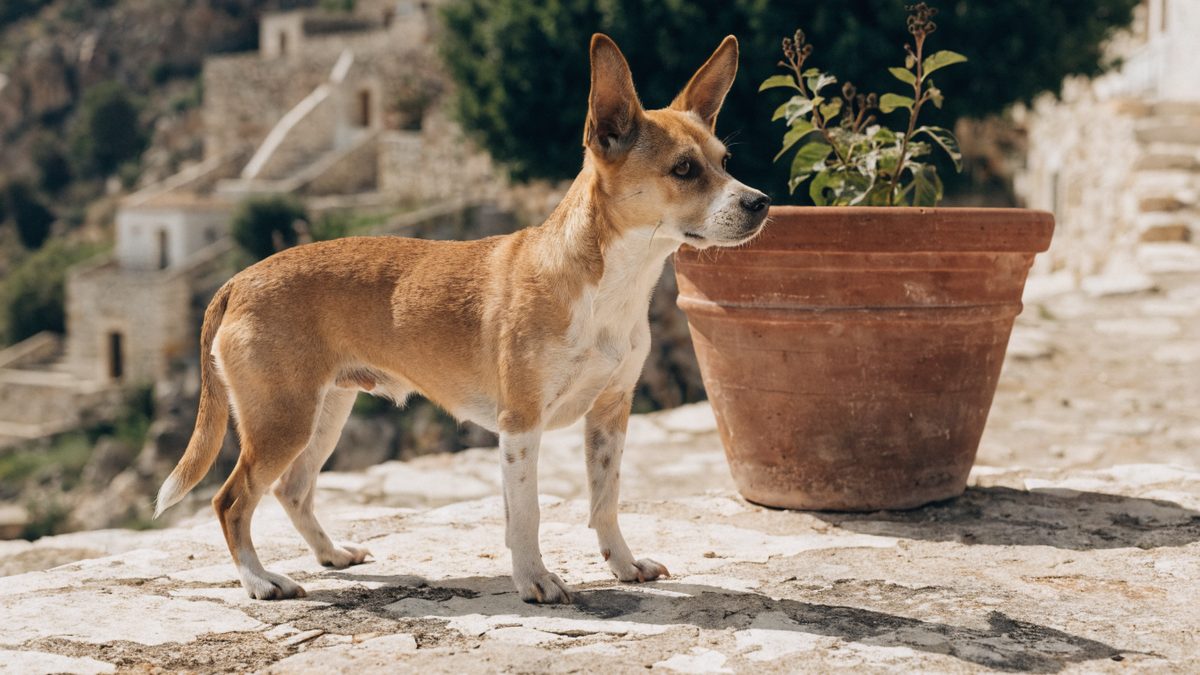
The Alopekis is fox-like, hence the name, with a wedge-shaped head, large triangular prick ears carried erect and very mobile, a sickle tail reaching the hock joints, and a body clearly longer than the dog is tall. The muzzle tapers evenly without being pointed, the jaw is strong with even and regular teeth in a scissor bite, and the feet are elliptical with thick elastic pads. Movement is described as swift and graceful. Nothing in that description is exaggerated, which matters more in an Indian summer than it sounds.
The coat is the detail buyers get wrong. This is a double coat, with a hard smooth outer coat over a soft dense undercoat, the outer coat medium-short and not exceeding about 5 cm, lying flat or only slightly wavy. Wikipedia records three coat types rather than one, listing a short hard smooth coat, a semi-long tufted rough coat and a semi-long hard wiry coat, and adds that the insulating undercoat is never missing because this is a working farm dog expected to live outdoors comfortably. A wirehaired variety exists and is described as very rare. All colours and combinations are acceptable except an absence of pigment, and the commonest are white, black, brown and bicolour.
The build is classified as primitive in the technical sense: regular dentition, a mesomorphic symmetrical body, an arched or semicircular tail, no dwarfism, and limbs that are not markedly shortened, with acquired clubfoot treated as an undesirable feature. That is a description of an unmodified small dog rather than a miniaturised one, and it is the reason the animal is not fairly compared with a toy breed.
| Source | Height | Weight | Stated lifespan |
|---|---|---|---|
| Wikipedia infobox | 20 to 30 cm | 3.5 to 7.5 kg | Not stated |
| Wikipedia body text | 25 to 30 cm average | 4 to 7 kg average | Not stated |
| Dog Breed Info Center | 20 to 30 cm | 3 to 7 kg | Well over 14 to 16 years |
| Dog Breeds List | 23 to 32 cm by sex | 3.5 to 8 kg by sex | 14 to 16 years |
| DogTime | 20 to 30 cm | 3 to 7 kg | 12 to 15 years |
The spread is small on size and large on lifespan, and that pattern is diagnostic. Height and weight are things a person can measure on a living dog, so the sources converge. Lifespan requires a cohort, a denominator and years of follow-up, so the sources simply assert, and they assert three different answers with no study behind any of them. Hold that thought until the health section.
What the dog was for
Alopekis worked as a multipurpose farm dog rather than a specialist, functioning as a ratter, a poultry guard, a watchdog and a flock attendant. The specific job that gave it a niche is worth naming: the dogs are small enough to fit inside a hen coop and curl up there for the night, on guard against the foxes, jackals and ferrets that raid domestic poultry Alopekis, Wikipedia. They also worked alongside the much larger Greek livestock guardians rather than competing with them.
Geographically the dog is described as present throughout Greece but concentrated in the northern farming regions, with Serres, Drama and Xanthi named specifically, and its numbers have fallen far enough that the surviving total is unknown. Bonbeno found no census, no registry count and no population estimate with a method behind it, in any language, and says so rather than repeating a round number.
A breed with a national club, a closed studbook and a health scheme generates data. A landrace with none of those generates description. Where a figure exists, this page gives it and names the source. Where none exists, this page says none exists rather than borrowing a number from a dog that happens to be a similar size.
Which kennel clubs recognise the Alopekis, checked one by one
No kennel club recognises the Alopekis, and Bonbeno established that by reading three registries' own published lists rather than by repeating the claim. The FCI nomenclature, the Kennel Club of Greece Greek Breeds section and the United Kennel Club breed standards were each opened and read in full on 19 August 2026. The Alopekis appears in none of them.
This matters because the highest-ranking pages say the opposite. DogTime, at position 10 on the India SERP, states that 'the Greek Kennel Club and United Kennel Club recognize the Alopekis as a distinct breed';. That sentence is wrong twice, and both halves are checkable in about four minutes.
| Registry | What its own list contains | Alopekis? |
|---|---|---|
| Fédération Cynologique Internationale, letter A | 23 breeds running from Affenpinscher to Azawakh | Absent |
| FCI, letter E | 16 breeds, no Ellinikos Poimenikos | Not applicable |
| FCI, letter H | 11 breeds, including Hellinikos Ichnilatis, breed no. 214 | Not applicable |
| FCI, letter K | 14 breeds, no Kokoni and no Kritikos Lagonikos | Not applicable |
| Kennel Club of Greece, Greek Breeds section | Seven breed pages: White Greek Sheepdog, Molossus of Epirus, Rhodes Hound, Hellenic Hound, Greek Shepherd, Kokoni, Cretan Hound | Absent |
| United Kennel Club, Breed Standards | Over 300 breeds across nine groups, including a Sighthound and Pariah group of 25 | Absent |
The Greek kennel club recognises six or seven Greek breeds, and this is not one
The Kennel Club of Greece publishes a dedicated Greek Breeds section, and when Bonbeno read it there were exactly seven breed pages in it. In January 2024 the club itself issued a statement, reproduced in full by the Greek hunting press, warning that 'Greece has six recognised Greek breeds' and that all of them are at risk of disappearing under the sterilisation provisions of Law 4830/2021. Six in early 2024, seven in mid 2026, and the Alopekis in neither count. Registers move, which is why both readings are printed here with their dates.
The breed's own conservation body puts the same fact more sharply. In a February 2024 letter to the Panhellenic Veterinary Association, the Study and Care Group for the Alopekis notes in passing that the Kennel Club of Greece recognises only 6 of the roughly 39 Greek breeds and varieties that the group and the Amalthea network between them monitor, and it then lists the excluded ecotypes by name: the Rhodes Hounds, the Alopekides, the Gryphons, the moustached shepherds, the Molossers of Souli and the Kordolouri of Skyros. The people working hardest to save this dog state plainly that it is unrecognised.
Only one Greek breed clears the FCI bar at all
Reading the FCI nomenclature under A, E, H and K returns exactly one Greek breed, the Hellinikos Ichnilatis or Hellenic Hound, listed as breed number 214. The letters E and K contain no Ellinikos Poimenikos, no Kokoni and no Kritikos Lagonikos Fédération Cynologique Internationale. The OMMA letter says the same thing from inside Greek cynology, noting that only one of the six Greek breeds the national club recognises is recognised by the FCI. Two independent readings, one from the registry's own list and one from a Greek body with no reason to flatter the FCI, agree.
Put those together and the Alopekis is not a marginal case. It sits below a national bar that six or seven Greek breeds clear, and those breeds in turn sit below an international bar that only one of them clears. Calling it 'not yet recognised' overstates the position considerably.
What the United Kennel Club actually lists
The UKC publishes standards for over 300 breeds arranged into nine groups, and the full list is on one page. Its Companion Dog group runs Affenpinscher, American Bully, Bichon Frise and onward, with no Alopekis between them. Its Sighthound and Pariah group, which is where a small primitive landrace would sit if anywhere, contains 25 breeds including the Basenji, the Canaan Dog and the Carolina Dog, and again no Alopekis. The UKC does list the Hellenic Hound, under Scenthound. So the registry DogTime names does recognise a Greek breed. Just not this one.
The only registry claim any ranking page can support is the one Dog Breed Info Center makes, which lists the Alopekis under 'DRA = Dog Registry of America, Inc.' and adds that 'the relevant Hellenic breed club is under formation right now';. Treat both carefully. A commercial registry that issues paperwork on an owner's declaration is not a kennel club and does not maintain a studbook of verified ancestry. And the Study and Care Group for the Alopekis has been operating since 2013, which makes 'under formation right now' a sentence that has been sitting on that page for well over a decade.
Non-recognition is not a technicality in Greece. To hold an amateur breeder's certificate, a Greek owner must be a paid-up member of the Kennel Club of Greece, hold an FCI-registered kennel name, and own at least one purebred dog entered in the club's Greek genealogy, a package the Alopekis group costs at roughly 500 euro for a single dog plus about 150 euro per dog for the mandatory DNA deposit. A landrace that cannot enter the genealogy cannot produce a registered dog, so its keepers cannot obtain the certificate, so their dogs fall under the general sterilisation requirement. The group argues this is unconstitutional and contrary to Greece's obligations under the ratified Convention on Biological Diversity.
Is the Alopekis really an ancient breed? What the sources trace back to
The antiquity claim is the most repeated fact about this dog and the least examined. Bonbeno traced it to its primary sources and found something more interesting than either 'true' or 'false': the ancient word alopekis is well attested, the ancient animal it names is not the modern dog, and the modern population is genuinely old in the way village dogs are old, which is not the same as being an ancient breed.
Take the word first. The standard scholarly lexicon of ancient Greek, Liddell, Scott and Jones, gives three senses for alopekis. Sense one is 'mongrel between fox and dog', glossed as equivalent to kunalopex, with a single dog citation, Xenophon Cynegeticus 3.1. Sense two is 'fox-skin cap'. Sense three is a kind of grape, named for its colour. Two of the three senses are not animals at all, and the one that is describes a hybrid rather than a landrace.
Now read the Xenophon passage the lexicon points to, because every 'the ancients described this breed' claim rests on it. Chapter III of the Cynegeticus opens: 'There are two breeds of sporting dogs: the Castorian and the fox-like.' It then explains the second name. 'The other breed is literally foxy, being the progeny originally of the dog and the fox, whose natures have in the course of ages become blent';. The translator glosses the Greek alopekides as 'vulpocanine, hybrid between fox and dog';.
Three problems with reading that as a description of today's dog
- Function does not match. Xenophon's alopekides are hare hounds, one of two breeds of sporting dog he sets out to describe for hunters. The modern Alopekis is a 3 to 7 kg farm and house dog that guards hen coops. Those are different animals doing different work.
- Ancestry does not match. Xenophon states the type descends from dog and fox interbreeding. Cross-species chromosome painting shows the red fox carries 2n = 34 plus zero to eight B chromosomes while the dog carries 2n = 78, a difference produced by 26 chromosomal fusion events and 4 fission events. No fox-dog offspring exists to descend from.
- The name describes an appearance, not a lineage. Alopekis means fox-like, and a small, prick-eared, sickle-tailed, russet village dog looks like a fox in any century. Ancient Greeks applying a descriptive nickname to fox-shaped dogs does not establish continuity between those dogs and a population catalogued in the 2010s.
None of this makes the modern dog young. It makes the evidence for its age archaeological and circumstantial rather than textual. Wikipedia's history section cites an engraved pithos from Thessaly with a silhouette said to be characteristic of an Alopekis, held in the Athens archaeological museum, and a similar Early Bronze Age find from Rafina, dated 2500 to 2100 BC. A small fox-shaped dog scratched onto a jar is real evidence that small fox-shaped dogs lived in Neolithic Thessaly. It is not evidence that a named breed persisted unbroken for five thousand years.
The DNA claim, and what Bonbeno could not find
Greek Reporter states that 'according to DNA analysis, the Alopekis is thought to be one of the oldest domesticated dog breeds in all of Europe', without naming a study, an author or a journal. Bonbeno searched the research literature for any published genetic work on this population and found none. No peer-reviewed paper on Alopekis population genetics, breed ancestry or diversity surfaced in any search run for this page.
There is a second, sharper example of the same problem on Wikipedia itself. Its claim that the breed's proportions 'indicate a model of progressive downsizing through evolution, adaptation, and artificial selection' is footnoted to Sutter and colleagues' 2007 Science paper on the IGF1 allele that determines small size in dogs. Bonbeno read that paper. It is a genome-wide scan that located a body-size quantitative trait locus on chromosome 15, then found a selective sweep spanning IGF1 in small and giant breeds, concluding that a single IGF1 haplotype is common to all small breeds and nearly absent from giant ones. It is real, it is important, and it is a study of body size across dog breeds in general. It says nothing about the Alopekis, it names no Greek breed, and it establishes nothing whatever about this population. A general paper attached to a specific claim reads, at a glance, exactly like breed-specific evidence.
The Russian news agency RIA Novosti headline that Wikipedia cites goes further still, calling the Alopekis 'the oldest dog breed in Greece', and Greek Reporter gives the breed 'a history stretching back nearly 7,000 years'; Wichmann A, Greece's New Pet Law May…. Neither figure has a method attached. Both are press summaries of an advocacy position, and that is a reasonable thing for advocates to say about an endangered population. It is not a fact a buyer should pay for.
| Claim as published | Where it traces to | Bonbeno's reading |
|---|---|---|
| Xenophon and Aristotle described this breed | Xenophon Cynegeticus 3.1, on fox-dog hare hounds | The word is attested. The animal described is a full-size hound of impossible ancestry |
| Domesticated in Greece before 1750 BC | Press reports of an engraved Thessalian pithos | Evidence for small fox-shaped dogs, not for breed continuity |
| Nearly 7,000 years of history | Greek Reporter, no source given | Unsourced press figure |
| DNA analysis shows it is among Europe's oldest breeds | Greek Reporter, no study named | Bonbeno found no published genetic study of this population |
| Proportions show progressive downsizing | Sutter et al. 2007 on the IGF1 allele | A general paper on canine body size, not a study of this dog |
The honest summary is short. The Alopekis is an old kind of dog in an old place, of the same order of antiquity as any village dog population anywhere, and the specific claims that make it sound older and better documented than that do not survive being followed to their sources.
Alopekis price in India, and why no honest figure exists
There is no Alopekis price in india, because there is no Indian market for this dog. Bonbeno read India's most comprehensive published dog price list, ran two India-targeted searches for the breed as a purchase, and checked what Indian import policy permits. The result is no Indian listing, no Indian seller, no rupee figure with a method behind it, and no lawful route by which an Indian supply could form.
This is a finding, not a gap in the research, so here is the evidence. Supertails publishes what it calls the most comprehensive breed price table available in India for 2026, with 40 numbered breeds priced from breeder networks, KCI registration data and Q1 2026 marketplace surveys. That table reaches the Dogo Argentino at Rs 80,000 to Rs 3,00,000 at the top and the adopted Indie at Rs 0 to Rs 3,000 at the bottom. It reaches native breeds, listing the Rajapalayam at Rs 5,000 to Rs 20,000 and the Mudhol Hound at Rs 3,000 to Rs 15,000. It even prices a crossbred, a Cane Corso and Mastiff mix, at Rs 30,000 to Rs 1,50,000. It contains no Alopekis, and no Greek breed of any kind.
When a price list that goes to the trouble of pricing a named crossbreed still has no line for your dog, that absence is a market signal rather than an oversight.
What an India-targeted search for the puppy actually returns
Bonbeno ran the purchase query with India geo-targeting on 19 August 2026 and read every result on page one. Not one offered an Alopekis in India. The top result was a US aggregator whose Puppy Prices field reads 'Average (Unknown)';. Two results were YouTube videos. One was the Wikipedia list of dog breeds. One was an Indian classifieds page for a female Lhasa Apso puppy in Narela, Delhi, where the breed name appeared only in the site's alphabetical navigation. One was an international marketplace where Alopekis heads the breed dropdown and the actual listing on show was a beagle in Berlin at 380 dollars. One was an ebook. One was an Indian Instagram account that publishes a breed profile and sells reflective collars for community dogs.
Two of those pages would not open for direct reading, returning a 403 and a human-verification wall, so Bonbeno has recorded only what the search results themselves showed and has not written up content it could not see.
The Indian pages that do exist for this breed, and what they are
One Indian commercial page ranks for the breed, and it is worth looking at closely because it is the template every absent breed gets. GuavaSure, an Indian pet insurance and wellness service, publishes a page titled 'Alopekis Pet Insurance & Wellness India' whose meta keywords include 'Alopekis pet insurance India' and 'Alopekis dog insurance';. Its About section reads, in full, that 'The Alopekis is a small-sized pedigree breed. Known for their distinctive characteristics, Alopekis dogs make wonderful companions for the right families';.
Every clause there is either wrong or empty. It is not a pedigree breed, as three registries confirm Kynologikos Omilos Ellados Fédération Cynologique Internationale. 'Known for their distinctive characteristics' names no characteristic. The health section lists patellar luxation, 'tracheal collapse in some breeds' and 'hypoglycemia in very small breeds', which is small-dog category boilerplate rather than anything measured in this population. The giveaway is the Explore More Breeds block at the foot, which links to Affenpinscher, Aidi, American Eskimo and American Lo-Sze Pugg. Those are the alphabetical neighbours. The page is one template multiplied across a breed list, and an identical page exists for every entry on it.
| Source | Figure | What it actually represents |
|---|---|---|
| Supertails, 40-breed India price list | No entry | India's fullest published price table has no line for the breed |
| Dog Breeds List | Average (Unknown) | The aggregator's own price field, left blank |
| GuavaSure India | No price | An insurance template page, not a sale |
| O.M.M.A., the breed's conservation group | Free | Keepers exchange puppies among themselves at no charge |
| DogTime, Wikipedia, Dog Breed Info Alopekis, Wikipedia Dog Breed Info Center | No price stated | Three of the largest breed references publish no figure at all |
The most useful line in that table is the free one. The Study and Care Group for the Alopekis states that these populations are not market products, that they are not bred for the dog trade or for shows, and that their keepers, who are hunters, livestock farmers and villagers, exchange puppies among themselves free of charge. The same document says there are no breeders at all for 98 percent of the roughly forty Greek dog populations it tracks, professional or amateur. A dog with no commercial supply chain in its own country cannot have an export price to India.
What Indian import rules permit, in the government's own words
Indian import rules are the hard barrier here, and they are unambiguous. DGFT Trade Notice 22/2022-23, dated 19 December 2022, classifies dogs under ITC(HS) 01061900 as a Restricted import and permits entry only for three purposes: a pet dog with a valid pet book and relevant records in the name of the importer, dogs imported by R&D organisations for research with a CPCSEA recommendation, and dogs for internal security by the Defence and Police Force. Policy Condition 8 states that import of commercial dogs for breeding or any other commercial activity beyond those purposes is not permitted.
- Two pets maximum as passenger baggage, allowed without DGFT authorisation only to a person transferring residence to India after two years of continuous stay abroad.
- Import authorisation from DGFT is required if the stay abroad was under two years, if the animal is not travelling as passenger baggage, or if it cannot come in under the baggage rules.
- Applications for trading or breeding purposes shall be duly rejected, in the notice's own words, and so shall applications made on behalf of another person or entity.
- Entry is permitted through seven ports only, the airports and seaports of Delhi, Mumbai, Chennai, Hyderabad, Bengaluru and Kolkata and, since October 2024, Kochi airport, with quarantine at the government station where required Department of Animal Husbandry….
- An advance No Objection Certificate from the quarantine officer must be obtained seven days before travel, relaxable to three days, on submission of the DGFT licence and an exporting-country health certificate.
Read those alongside the registry position and the picture closes completely. A returning Indian resident who already owns an Alopekis in Greece can bring that individual dog home. Nobody can lawfully import Alopekis dogs to breed and sell them here. Add that the Kennel Club of India runs an FCI-affiliated studbook that registered 33,880 pure-bred dogs in 2025, a register built on breeds the FCI nomenclature contains, and there is no paperwork route either. DGFT advises starting any authorisation at least two months before travel.
Treat it as a red flag rather than a find. There is no verified Indian source for this dog, no KCI registration to check paperwork against, no FCI or Greek kennel club standard to judge the animal by, and no lawful import channel for breeding stock Kynologikos Omilos Ellados. The likeliest explanations are a small Indian street dog, a spitz cross, or a mislabelled toy breed. Ask where the dog came from before you ask what it costs, and remember that Bonbeno reports published figures as editorial context and never as an offer.
Monthly cost of keeping a small dog like this in India
Budget roughly Rs 3,000 to Rs 11,000 a month to keep a small dog in an Indian city, and understand before you use that number that none of it is specific to the Alopekis. No Indian cost study exists for this dog, because no Indian population of this dog exists. The figures below describe a 3 to 8 kg dog in India generally, and they are labelled as such throughout.
Supertails puts the average monthly cost of keeping a dog in India at Rs 3,000 to Rs 11,000 in its main text, widens that to Rs 3,000 to Rs 18,000 in its summary depending on breed size and grooming needs, and observes that urban Indian households are now spending Rs 5,000 or more a month. It puts total first-year spending, purchase included, at Rs 80,000 to Rs 2,00,000. A dog of this size sits at the bottom of every one of those ranges, because almost every recurring cost in dog ownership scales with body weight.
| Cost line | What drives it | Confidence |
|---|---|---|
| Food | Body weight, directly. A 5 kg dog eats a fraction of what a 30 kg dog eats | High. Weight-driven and breed-independent |
| Core vaccination and deworming | Schedule, not size. Same protocol as any dog | High |
| Tick and flea prevention | Year-round in most of India, and non-optional | High |
| Grooming | A short double coat needs brushing, not a salon | Medium. Coat type is disputed between sources |
| Routine vet consults | City rates, not breed | High |
| Breed-specific screening | Nothing exists to screen for. No scheme, no panel, no club protocol | Not applicable |
| Insurance | Indian insurers price on weight and age, and the one Indian page for this breed quotes no premium | Low. No breed rating exists |
The zero line in that table deserves attention rather than a shrug. For a pedigree breed you would budget for hip scoring, an eye certificate or a DNA panel appropriate to the breed. For the Alopekis there is nothing to buy, because no kennel club, breed club or laboratory publishes a screening protocol for it. That is a genuine saving on paper and a real loss of information in practice, and it cuts both ways.
The cost line nobody prices, and it is the largest one
The dominant cost of owning an unobtainable dog is the acquisition itself, and it is not a purchase price. Bringing one dog from Greece to India lawfully means a DGFT import authorisation where the baggage route does not apply, an exporting-country veterinary health certificate with the prescribed disease testing done in Greece, an advance No Objection Certificate from the quarantine officer, arrival at one of seven permitted ports, and quarantine at the government station where required Department of Animal Husbandry…. Airline crate, freight and agent fees sit on top. Bonbeno has not seen a published all-in Indian figure for that process and is not going to invent one, but every component of it costs more than the dog would. The full route is set out in how to import a dog to India.
Three costs an Indian owner of any small dog should plan for
- Tick prevention, every month, all year. Nearly half of the dogs in a four-city Indian survey carried at least one tick-borne pathogen, so this is treatment-grade spending, not a comfort purchase.
- Cooling that does not depend on the grid. A shaded tiled floor, cross-ventilation and multiple water points cost almost nothing and keep working during a power cut, which an air conditioner does not.
- Dental care from year three. Small dogs carry a full set of teeth in a short jaw, and the Alopekis is described with regular dentition in a wedge-shaped muzzle. Scaling under anaesthesia is the commonest unplanned bill in small-dog ownership.
One more honest caveat. Because these are category figures rather than breed figures, they will be right for a healthy 5 kg dog in Pune and wrong for a sick one anywhere. Use them to decide whether you can afford a small dog at all, not to predict what a particular animal will cost.
Heat tolerance in Indian conditions, rated 4 out of 5
Bonbeno rates the Alopekis 4 out of 5 for heat tolerance in India, and that is the highest score on this page. The reasoning is not the dog's Mediterranean origin, which proves less than it sounds. It is that the published heat-illness evidence in dogs favours exactly this animal's body plan: under 10 kg, unexaggerated muzzle, and not a closed-studbook purebred.
The best evidence available is a VetCompass study of heat-related illness in UK dogs under primary veterinary care, and its findings on size are unusually clean. Dogs weighing over 50 kg had 3.42 times the odds of heat-related illness (95% CI 1.54 to 7.57) compared with dogs weighing under 10 kg, and every bodyweight group above 10 kg had significantly higher odds than the under-10 kg group. The authors explain the mechanism directly, noting that smaller dogs have a high heat storage to radiative surface area ratio that results in more rapid heat loss compared to larger dogs, so they can exercise for longer before overheating.
The study goes further and names the pattern. The purebred breeds with the lowest odds of heat-related illness in it are all small breed dogs, and the Lhasa Apso, Shih Tzu and Chihuahua had the lowest odds of the whole set despite all three being brachycephalic, because all three typically weigh under 10 kg. Read that carefully. Weight beat skull shape in those three breeds. An Alopekis at 3 to 7 kg with an unexaggerated wedge muzzle has the weight advantage and the airway advantage at the same time.
A third finding in the same model points the same way. Brachycephalic dogs had 2.10 times the odds of mesocephalic dogs (95% CI 1.68 to 2.64), and purebred dogs had 1.86 times the odds of crossbred dogs (95% CI 1.39 to 2.49), which the authors attribute to purebreds being more likely to carry exaggerated features such as thick coats and extreme body size. A landrace is the opposite of an exaggerated animal by definition.
Why it is 4 and not 5
One feature holds the score down, and it is the coat. This dog carries a double coat whose insulating undercoat is described as never absent, precisely because the animal was expected to live outdoors in a Greek winter. Coat thickness is the factor the heat-illness authors invoke to explain their outlier: the Chow Chow, a very thickly coated breed, carried the greatest risk of any breed studied, and the Golden Retriever carried 2.67 times the Labrador's odds despite the two being similar in size and purpose, with the thicker coat identified as the likely tipping factor. The authors state plainly that other double-coated breeds may also have increased risk and that their study was under-powered to explore it.
So the Alopekis carries the single feature that pushed larger breeds up the risk table, on a body small enough that the same table's strongest protective factor applies. Four out of five is where those two pull to. It is a genuinely heat-tolerant small dog and it is not a heat-proof one.
| Factor | Direction | Evidence |
|---|---|---|
| Adult weight 3 to 7 kg, inside the lowest-risk band | Strongly favourable | Every weight group over 10 kg had higher odds than under 10 kg |
| Mesocephalic wedge muzzle, unobstructed panting | Favourable | Brachycephalic dogs carried 2.10 times mesocephalic odds |
| A landrace, not a closed-studbook purebred | Favourable | Purebreds carried 1.86 times crossbred odds |
| Mediterranean farm origin, no cold adaptation | Mildly favourable | Described as a Greek and Balkan village dog |
| Dense undercoat that is never absent | Adverse | Thick coat is the factor invoked for the Chow Chow and Golden Retriever Alopekis, Wikipedia |
| Indian plains heatwave threshold is 40 degrees C | Adverse | NDMA declares no heat wave below 40 degrees C in the plains |
| No acclimatisation or Indian field data for this dog | Unknown | Bonbeno found no study of this population in any climate |
What Indian summer actually asks of a dog this size
India's National Disaster Management Authority does not consider a heat wave until the maximum temperature at a station reaches at least 40 degrees C in the plains and at least 30 degrees C in hilly regions, and it declares one outright whenever the actual maximum stays at 45 degrees C or more regardless of the normal. Those are the conditions, not the extremes. Severe heat-related illness in dogs begins when core temperature exceeds a critical threshold of 43 degrees C, and both the degree and the duration of that elevation determine the damage.
Two findings from the severe-illness study translate straight into Indian practice. Dogs that developed heat-related illness after confinement in a hot vehicle had three times the odds of severe illness compared with dogs that overheated during exercise, because a confined dog cannot escape and nobody is watching. And dogs aged 12 years or older had the greatest odds of both severe and fatal outcomes. A small dog that may well reach twelve is a small dog whose heat risk rises in its last years.
City by city, if you keep a small dog of this type
- Delhi, Jaipur, Ahmedabad, Nagpur. Dry extreme heat, where evaporative cooling still works. Shade, airflow and constant water do most of the job. Watch April to June, when plains maxima cross the 40 degrees C threshold routinely.
- Mumbai, Chennai, Kolkata, Kochi. Lower peaks, far higher humidity, and humidity is what suppresses the panting this dog depends on. Ambient temperature, humidity and windspeed all influence the rate of cooling in a panting dog.
- Bengaluru, Pune. The easiest Indian cities for a small double-coated dog, and the only ones where an outdoor midday walk is survivable for much of the year.
- Anywhere in a parked car. Never, for any duration. Vehicular confinement carried three times the odds of severe illness in the UK data, in a far cooler country.
One last honest note on this rating. Every number above comes from UK dogs in a temperate climate, because that is where the research was done. Bonbeno has applied it to India by reference class, not by measurement, and no study of this dog in Indian conditions exists to check it against.
Temperament and household fit, separating description from measurement
Every published description of the Alopekis temperament agrees, and not one of them rests on a survey, a breed club questionnaire or any measurement at all. The dog is described as alert, affectionate, adaptable and hardy, good with children, and a determined enemy of vermin. Treat that as a consistent portrait from people who know the dogs, and not as data.
The fullest description comes from Dog Breed Info Center, which calls the Alopekis a small multi-purpose utility and house dog, a faithful and devoted companion, of pleasant disposition and high intelligence, an easily trained worker that is strong, healthy, hardy and of moderate needs. It adds watchful but self-confident and optimistic, obedient, lively, alert, attentive, outgoing and happy by nature, friendly and even-tempered, protective of people and house animals, and a relentless enemy of vermin.
Wikipedia gives a shorter version with two useful differences. It describes Alopekis as very obedient, quiet and loyal to their owners, very expressive and affectionate towards people, alert and protective of other farm animals, and good with children. It also calls them high energy dogs capable of covering very long distances, and describes them as versatile dogs suited to either an urban or rural home that adapt readily as a companion for all ages.
Notice what is missing across both. There is no mention of separation behaviour, no bite-risk framing, no note on same-sex dog tolerance, no observation about resource guarding. Those are the things a breed club learns from a few hundred owner questionnaires, and no such body of returns exists for this dog.
The apartment contradiction the ranking pages have not noticed
Dog Breeds List rates the Alopekis 2 stars out of 5 for Apartment Friendly, and the explanatory note printed directly underneath that rating reads 'The Alopekis is suitable for urban or country life, small apartment or farm. It is a very adaptable dog'. The score and its own justification contradict each other on the same line of the same page.
The primary descriptions favour the note over the number. Both Dog Breed Info Center and Wikipedia state the dog is at home in urban or rural settings alike, and Dog Breed Info Center calls it a house dog of urban and city life specifically Alopekis, Wikipedia. For apartment living in an Indian city, the relevant facts are that the dog is 3 to 7 kg, that barking tendency is described as occasional rather than constant, and that it is a watchdog by function, which means it will announce the lift, the delivery and the neighbour's door Dog Breed Info Center. Plan for the announcing, not for the size.
Who this dog would suit, and who it would not
- Suits a household that wants a small, sturdy, unexaggerated dog and enjoys a watchdog that reports everything.
- Suits a first-time owner who has time for daily walks and short training sessions, since the dog is described as easy to train by every source.
- Suits a home with children, on the consistent testimony of the descriptions rather than on any behavioural study.
- Does not suit a household with small pet rodents or free-flying birds, because ratting is the job this dog was kept for.
- Does not suit a buyer who wants pedigree paperwork, a show career or a predictable adult appearance, none of which this population can supply.
- Does not suit anyone in India who wants this dog specifically, because there is no lawful way to obtain one here.
A closing caution on the whole section. Landrace populations are variable by definition, since no closed studbook has narrowed them, so individual temperament varies more within an Alopekis population than within a heavily selected breed. That is a strength for genetic health and a weakness for predictability, and a buyer should know which of the two they are shopping for.
Training approach, and what no source can tell you
Train an Alopekis the way you train any bright, biddable small working dog, with short reward-based sessions built around food and a firm rule about the doorbell. That advice is generic on purpose. No breed-specific training study, no working-trial record and no club protocol exists for this population, so anything more specific would be invention.
What the sources do agree on is trainability, and unusually they agree strongly. Dog Breeds List gives the Alopekis 5 stars out of 5 for Trainability with the note 'Easy Training: The Alopekis is known to listen to commands and obey its owner. Expect fewer repetitions when training this breed';. Dog Breed Info Center calls it an easily trained worker, highly trainable, extremely agile, eager to please its owner. Wikipedia calls it very obedient. Three sources, one direction, zero measurements.
Set against that, the same descriptions call the dog a watchdog with a natural hunting instinct and quick reflexes, and note it is capable of covering great distances Alopekis, Wikipedia. Those are the traits that resist training rather than yield to it. A dog selected for centuries to notice things and to chase small fast animals does not stop noticing or chasing because it learned to sit.
The three things a dog of this description will fight you on
- Alarm barking. The watchdog role is the most consistently reported function in every source. Manage it with a trained alternative behaviour rather than trying to suppress it, because you are working against the job description.
- Prey drive around small animals. Ratting and poultry protection are the specific historical uses recorded. Recall around squirrels, cats and Indian street chickens will need real proofing.
- Independent decision-making. Landrace dogs were selected to make choices without a handler present, the same pattern Bonbeno records for the Indian pariah dog. Expect a dog that cooperates rather than one that complies.
A realistic first-year training timeline for a small landrace dog in India
The schedule below is the general small-dog schedule, and it is offered as that. It is not derived from Alopekis puppies, because no developmental study of Alopekis puppies exists.
| Age | Focus | What good looks like |
|---|---|---|
| 8 to 12 weeks | Name, handling, crate, toilet routine | Comes to name indoors, tolerates ear and paw handling |
| 12 to 16 weeks | Socialisation to Indian street noise, lifts, two-wheelers, monsoon rain | Neutral rather than reactive to traffic and horns |
| 4 to 6 months | Loose-lead walking, sit, down, hand target | Walks past a food cart without lunging |
| 6 to 9 months | Recall proofing against moving small animals | Turns away from a cat at 10 metres, on lead |
| 9 to 12 months | Doorbell protocol, settle on a mat | Barks twice, then goes to the mat on cue |
| 12 months onward | Maintenance, plus scent games or mini-agility | A dog with a job, described as ideal for mini-agility |
One Indian-specific note that matters more than any obedience cue. Socialise this dog to heat management early, meaning teach it to settle on a cool floor and to drink on cue, and do the walking and training in the first and last light of the day. A dog that has learned to work at 6 am is a dog you will not be tempted to walk at noon in May.
No working-trial results, no obedience-titling record, no breed-club training guidance and no comparative trainability study exists for the Alopekis. Every rating above is a description by people who have kept the dogs, which is worth something, and none of it is a measurement, which is worth stating.
Daily exercise requirement, and what happens without it
Plan on 45 to 60 minutes of activity a day, split into two or three sessions, which is the level the published descriptions imply for a small dog of this type. Every source calls the Alopekis athletic and high energy while also calling it undemanding, and reconciling those two is the useful part.
The most concrete guidance available says the Alopekis should be taken for long daily walks, needs free play, and can adjust to a small household provided it gets frequent walks, adding that these are very athletic little dogs ideal for mini-agility. The same source rates Exercise Needs at 3 stars out of 5, which is a middling score attached to a description of a dog that wants long walks. Wikipedia calls them high energy dogs capable of covering very long distances. Dog Breed Info Center calls them tireless and capable of covering great distances, athletic and with fast reflexes, while also describing moderate needs.
The apparent contradiction resolves on stride length. A 5 kg dog covering great distances is not asking for the same absolute exercise as a 30 kg dog doing the same, and it will bank a great deal of that need indoors through play if you let it. The honest reading is a dog with high willingness and modest requirement.
How to split the day in an Indian city
- Morning, 25 to 35 minutes. Before 7 am for most of the year in most of India. This is the walk that does the work.
- Evening, 20 to 30 minutes. After the pavement has cooled. Test it with the back of your hand for five seconds before you set out.
- Indoors, 10 to 15 minutes. Scent games, a flirt pole, a food puzzle. Cheap, cool, and it tires a bright dog faster than distance does.
- Skip the midday walk entirely from March to June. Severe heat-related illness begins above a core temperature of 43 degrees C, and exertion in a hot environment is one of the two routes to it.
What happens without it is predictable from the descriptions rather than from any study. A watchful, high-energy, intelligent small dog that is under-exercised becomes a noisier and more reactive version of itself, and in an Indian apartment that shows up first as barking at the corridor. Bonbeno has found no behavioural research on under-exercised Alopekis specifically, and says so rather than dressing up a general principle as a breed finding.
One exercise fact that is measured, and it is about the weather
Exertional heat-related illness is the more common trigger in dogs and the less lethal one, while confinement in a hot vehicle carries three times the odds of a severe outcome. The practical conclusion for an Indian owner is the opposite of intuitive. Do not cut this dog's exercise to keep it safe from heat, because poor fitness and obesity both worsen thermoregulation, and dogs at or above the mean bodyweight for their breed and sex carried higher odds of heat-related illness Hall EJ, Carter AJ, Chico G, Bradbury J. Move the exercise to the cool hours instead, and keep the dog lean.
That single point is worth more to an Indian small-dog owner than any breed profile, and it applies whether the dog on your floor is an Alopekis, an Indian Spitz or a street puppy you picked up in July.
Grooming and coat care in Indian humidity
Brush an Alopekis-type dog once or twice a week with a slicker and a fine comb, and bathe it rarely. The coat is genuinely low maintenance, and the only reason this section is longer than two lines is that the sources cannot agree on what the coat is.
Here is the disagreement, laid out. Dog Breed Info Center describes a double coat with a hard smooth outer coat over a soft dense undercoat, medium-short and not exceeding 5 cm, and records two varieties, shorthaired and wirehaired, the wirehaired being very rare. Wikipedia records three types rather than two, a short hard smooth coat, a semi-long tufted rough coat and a semi-long hard wiry coat, and insists the protective undercoat is never missing. DogTime describes something different again, calling it simply 'a short, sleek coat that doesn't require extensive grooming' with no undercoat mentioned at all.
Those are not compatible descriptions, and the practical consequence is real. A short sleek single coat and a dense double coat need different tools and shed differently in a Chennai August. Dog Breeds List splits the difference by rating Grooming at 2 stars, low maintenance, while rating Shedding Level at 3 stars, moderate, with the note 'Routine brushing will help. Be prepared to vacuum often';.
| Source | Coat described | What that implies for India |
|---|---|---|
| Dog Breed Info Center | Double coat, hard smooth outer under 5 cm, soft dense undercoat | Twice-weekly brushing, heavy seasonal shed, never shave |
| Wikipedia | Three types, short to semi-long, undercoat never absent | Same as above, with more brushing on the rough and wiry types |
| DogTime | Short sleek coat, no undercoat mentioned | Weekly brushing would be enough, if this description were right |
| Dog Breeds List | Low maintenance grooming, moderate shedding | Consistent with a double coat, inconsistent with a sleek single coat |
Bonbeno's reading favours the double coat, for two reasons. The two most detailed physical descriptions both specify an undercoat and one explains why the dog needs it, and no source that mentions an undercoat is contradicted by anything except a summary that mentions no coat structure at all Alopekis, Wikipedia. Groom for a double coat and you will be right or over-prepared. Groom for a sleek single coat and you may be wrong in the worst month of the year.
The one rule that matters in an Indian summer
Never shave a double-coated dog to cool it down. The undercoat that traps warm air in winter also holds a layer of still air that slows heat gain and shields skin from direct sun, and removing it exposes skin to sunburn while doing nothing for the panting that actually cools a dog. Cooling in dogs runs through evaporation from the respiratory tract, and ambient temperature, humidity and windspeed govern how well that works, none of which a haircut changes.
A monsoon and summer routine for a small double-coated dog
- Brush twice weekly, with a slicker through the body and a fine comb behind the ears and under the tail where a rough-coated individual will mat.
- Dry completely after every monsoon walk. Damp trapped under an undercoat is how hot spots start, and Indian humidity keeps it damp for hours.
- Check the ears weekly. Large erect ears drain well and collect dust and grass seed easily.
- Bathe monthly at most, and use a plain dog shampoo. Frequent bathing strips the coat oils that keep the outer coat weather-resistant.
- Watch for ticks at every brush. This is the highest-value five minutes in the routine, for reasons the health section covers.
Both descriptive sources note that the Alopekis is naturally clean, easy to groom, and that the texture and quality of the coat help keep it clean. That claim is plausible for a working farm coat and it is untested, so treat it as a reason to expect less work rather than as a reason to skip the brush.
Health risks and lifespan, with the missing evidence named
No breed-specific health data exists for the Alopekis anywhere. There is no kennel club, no breed club health survey, no hip or elbow scheme, no eye scheme and no DNA panel for this population, so every health figure you will read about this dog, including the friendly ones, is an assertion rather than a finding. This section says that once here, and then says it again wherever a specific number would otherwise slip in.
The absence has a structural cause rather than a research gap. Health data on dogs comes from registries that hold studbooks, from breed clubs that survey members, and from insurance and practice databases that record a breed field. The Alopekis is in no registry, has a conservation group rather than a breed club, and is too rare to appear as a breed field in any clinical dataset. Nothing about that will change until recognition does.
Bonbeno has found no lifespan study, no disease-prevalence survey and no screening scheme for the Alopekis. Where a figure appears below, it comes from the general dog population or from a different, named population, and it is labelled that way every time. Consult your nearby vet before acting on anything here, and treat collapse, laboured breathing or a sudden change in drinking or appetite as a same-day emergency.
What the ranking pages claim about health, and what each claim is
Dog Breed Info Center states, as its entire Health Problems section, 'NO common genetic problems known';. That is a defensible thing to say about a landrace and a misleading thing to read, because no known problems and no problems are different statements when nobody has looked. Dog Breeds List rates health issues at 2 stars out of 5, and the only text under that rating is 'Hypoallergenic: No', which answers a question nobody asked in place of the one the rating claims to answer.
The Indian page is the least careful of the three. GuavaSure lists Common Health Considerations for the Alopekis as patellar luxation, 'tracheal collapse in some breeds' and 'hypoglycemia in very small breeds';. Read those qualifiers. 'In some breeds' and 'in very small breeds' are hedges that belong to a generic small-dog template, not to a breed profile, and the same page's related links reveal the template by pointing at the alphabetical neighbours. None of those three conditions has been documented in an Alopekis population by anyone.
The lifespan question, and the correct reference class
Three sources give three different lifespan figures for this dog and none cites anything. DogTime says 12 to 15 years and calls that 'relatively long for a small breed'. Dog Breeds List says 14 to 16 years. Dog Breed Info Center says that if well cared for they can reach 'well over 14-16 years';. Wikipedia, the only page that reads its own sources carefully, publishes no lifespan at all.
Compare those to a real life table. The VetCompass study of UK companion dogs, built from clinical records rather than assertion, found overall life expectancy at age 0 of 11.41 years for females (95% CI 11.35 to 11.47) and 11.07 years for males (95% CI 11.01 to 11.13). Of the breeds it could analyse, the longest-lived at age 0 was the Jack Russell Terrier at 12.72 years (95% CI 12.53 to 12.90), and the shortest was the French Bulldog at 4.53 years (95% CI 4.14 to 5.01). The study confirms that breeds of toy or small size have a longer life expectancy than larger-sized dogs.
| Figure | Source | Basis |
|---|---|---|
| 14 to 16 years | Dog Breeds List | Asserted. No study, no cohort, no citation |
| Well over 14 to 16 years | Dog Breed Info Center | Asserted |
| 12 to 15 years | DogTime | Asserted |
| Not stated | Wikipedia | No figure published |
| 12.72 years, longest breed studied | Jack Russell Terrier, VetCompass life tables | Measured, 95% CI 12.53 to 12.90 |
| 11.2 years, all UK companion dogs | VetCompass life tables | Measured, from clinical records |
Two of the three asserted Alopekis figures sit above the longest-lived breed in the largest published UK life table. That does not make them false, because a hardy landrace plausibly does well and because a UK table is not an Indian one. It does mean the numbers were never checked against anything, and a reader planning fifteen years of care should know that.
The Indian health risks that are measured, for any small dog
Two things about keeping a small dog in India are documented, and neither is breed-specific. The first is tick-borne disease. In a survey of 525 dogs sampled across four Indian climatic zones, Sikkim, Ladakh, Delhi and Mumbai, PCR testing found 261 of 525 dogs, or 49.7 percent (95% CI 45.4 to 54.1), infected with one or more canine tick-borne pathogens. In Delhi the individual prevalences were 39.5 percent for Ehrlichia canis, 38.3 percent for Hepatozoon canis, 17.3 percent for Mycoplasma haemocanis, 13 percent for Anaplasma platys and 8.6 percent for Babesia vogeli; in Mumbai Hepatozoon canis reached 43.8 percent. Those figures come from 2008 fieldwork and remain the clearest picture available.
The second is heat. Annual incidence of heat-related illness in UK dogs was 0.14 percent, which sounds small until you read the severity data: more than half the UK dogs presenting to primary care practices with severe heat-related illness died of it Hall EJ, Carter AJ. India is not the UK, and the direction of that difference is not in dispute.
What a sensible owner would actually screen for
- Tick-borne panel at the first sign of lethargy, pale gums, fever or bruising, given a measured Indian prevalence near 50 percent.
- Patella check at every routine consult, because it is quick, free and common in small dogs generally, even though it has never been documented in this population.
- Dental exam from year three, standard for any small dog with a full dentition in a short jaw.
- Body condition score at every visit, because dogs at or above the mean weight for their breed and sex carried 1.42 times the odds of heat-related illness (95% CI 1.12 to 1.80).
- Nothing breed-specific, because there is nothing breed-specific to screen for. No panel exists, no scheme exists, and no laboratory offers one.
That last bullet is the section in one line. Bonbeno would rather leave a gap on the page than fill it with a Chihuahua's numbers wearing a Greek name.
Feeding and nutrition through the life stages
Feed an Alopekis-type dog a complete, meat-first diet matched to its life stage, and manage the portion rather than the brand. Portion control is the one nutrition decision on this page with published evidence attached to it, and in India that evidence is about heat rather than about waistlines.
Here is the evidence, and it is worth the space. In the VetCompass heat-illness model, dogs whose bodyweight was equal to or greater than the mean for their breed and sex had 1.42 times the odds of heat-related illness compared with dogs below that mean (95% CI 1.12 to 1.80). The authors conclude that maintaining a healthy bodyweight should be considered a key welfare priority for all dogs to limit the risk, and that routine body condition scoring should be a standard clinical strategy. In a country where the plains cross 40 degrees C every summer, that turns the food bowl into a heat-safety instrument.
No Alopekis feeding study exists, no breed-club diet guidance exists, and no published daily calorie figure for this population exists. What follows is life-stage feeding for a small dog, and it is offered as exactly that.
Life-stage feeding for a 3 to 8 kg dog in India
| Life stage | Meals per day | What to watch |
|---|---|---|
| 8 to 16 weeks | 4 | Blood sugar dips between meals. Small puppies do not tolerate long gaps |
| 4 to 6 months | 3 | Steady growth, ribs easily felt but not seen |
| 6 to 12 months | 2 to 3 | The transition point where most owners overfeed |
| 1 to 7 years | 2 | Body condition score at every vet visit |
| 7 years onward | 2 | Weight creep, dental pain changing appetite, and slower heat recovery |
Two Indian practicalities. First, complete small-breed dry food is widely available in Indian metros and thin on the ground in smaller cities, so check the supply before you commit to a brand rather than after. Second, feed the main meal after the evening walk in summer rather than before it, because a full stomach and exertion in heat is a poor combination for any dog.
The hydration point that matters more than the diet
Dogs shed heat mainly by evaporation through panting, and the rate of that cooling depends on ambient temperature, humidity and windspeed. Water availability is therefore not a comfort item in an Indian summer, it is the cooling system's fuel supply. Keep at least two bowls in different rooms, refill them twice daily rather than topping up, and put one at ground level in the coolest tiled part of the house so the dog can drink where it wants to lie.
What not to do
- Do not free-feed. A landrace descended from village dogs will eat opportunistically, which is a survival trait indoors and a weight problem.
- Do not feed for the lifespan you read online. Two of the three published Alopekis lifespan figures exceed the longest-lived breed in the UK life tables, and feeding a small dog as though it were bulletproof is how it stops being lean.
- Do not switch food during a heatwave. Gastrointestinal upset plus fluid loss plus 42 degrees C is a bad week.
- Do not use a breed-specific formula. No manufacturer makes one for this dog, and any product claiming to is selling a label.
Month by month through an Alopekis puppy's first year
Raise an Alopekis-type puppy on the ordinary small-dog timeline, because no developmental data exists for this population and the general milestones apply without modification. Two things are worth knowing before the table, and both concern how few of these puppies there are.
Litter size is small and consistently reported. Both detailed sources give about 3 to 5 puppies Dog Breed Info Center. Greek Reporter adds that females of the breed are fertile only once a year and that the resulting litters are small because the dams themselves are small, with many puppies not surviving to adulthood. That last claim is press reporting of an advocacy position rather than a measured figure, and Bonbeno records it as such, but it fits the picture of a population that recovers slowly from any loss.
The second point is legal rather than biological, and it is the reason a critically endangered dog stays endangered. Greece's Law 4830/2021 pushes owners toward sterilisation unless they hold a breeder's certificate, and Alopekis are frequently kept as loose village dogs that come and go, so they are mistaken for strays and neutered under stray-control programmes. Advocates argue the sterilisation of indigenous populations is unlawful under Greece's ratified biodiversity obligations, and they ask for exemption from the mandatory sterilisation, the fee and the DNA deposit. That fight, not the puppies, decides whether this dog exists in twenty years.
| Month | Development | What the owner does |
|---|---|---|
| Month 1 | With the dam. Eyes and ears open, first steps | Nothing. Do not take a puppy this young |
| Month 2 | Weaning completes, first vaccinations begin | Earliest sensible collection age. Start toilet routine and name |
| Month 3 | Socialisation window at its widest | Indian street exposure: horns, two-wheelers, lifts, monsoon rain |
| Month 4 | Teething. Vaccination course completes | Chew management. First short lead walks in cool hours |
| Months 5 to 6 | Adult coat begins to come through | Establish twice-weekly brushing before the coat needs it |
| Months 7 to 9 | Sexual maturity in a small breed. Prey drive sharpens | Recall proofing. Discuss neutering timing with your vet |
| Months 10 to 12 | Close to adult height and weight, 3 to 7 kg | Move to two meals. Set the adult body condition target |
| Month 12 onward | Physically mature, behaviourally still settling | Maintenance, and a job: scent work or mini-agility |
The one month that is different in India
Whichever month of the year falls between March and June is the one to plan around, not month four of the puppy's life. A puppy going through its socialisation window in an Indian pre-monsoon summer needs that exposure done at 6 am and 7 pm, in short sessions, on grass or shaded paving rather than on open tar. Pavement that is comfortable on your palm for five seconds is comfortable for paws. Anything hotter is not.
Everything above is the standard timeline for a small dog. Bonbeno has not found a single published account of a documented Alopekis litter raised under observation, in Greece or anywhere else, and would rather label the table generic than dress it up as breed knowledge.
Alopekis versus the Kokoni, and versus the small dogs Indians actually get
The Alopekis has two useful comparisons and neither is a pedigree import. The first is the Kokoni, the small Greek dog it is constantly confused with and the one Greece's kennel club does recognise. The second is the small dog an Indian buyer will actually end up with, which is an Indie or an Indian Spitz. Compare it against both and the decision resolves quickly.
Start with the Greek comparison, because it is the one nobody has done properly. The Kokoni, also called the Small Greek Domestic Dog, has a full published breed standard from the Kennel Club of Greece, and Bonbeno read it. Setting that standard beside the Alopekis descriptions produces a surprising result: the two dogs overlap almost exactly on size and diverge completely on the two features you notice first.
| Feature | Alopekis | Kokoni (KOE standard) |
|---|---|---|
| Registry status | Recognised by no kennel club United Kennel Club, Breed Standards | Published breed standard from the Kennel Club of Greece |
| Height | 20 to 30 cm | Males 24 to 28 cm, females 23 to 27 cm, 1 cm tolerance |
| Weight | 3 to 7.5 kg Dog Breed Info Center | 4 to 8 kg |
| Ears | Triangular, large, erect and very mobile | Triangular, drop. Erect ears are a DISQUALIFYING fault |
| Coat length | Medium-short, not exceeding about 5 cm | 4 to 8 cm on body, 8 to 14 cm on tail and rump. Short coat outside named points is a SERIOUS fault |
| Coat structure | Double, hard smooth outer over dense undercoat | Double, long fine outer over short dense undercoat. Hard texture is a serious fault |
| Tail | Sickle, reaching the hocks, carried high | Carried high in a semicircle, tip touching the back |
| Colour | All colours except absence of pigment | All colours and combinations acceptable |
Read the ear row and the coat row together. Under the only published Greek standard for a small Greek domestic dog, the two features that define an Alopekis are respectively a disqualifying fault and a serious fault Dog Breed Info Center. That is strong evidence the two really are different animals, which is worth saying because the distinctness is genuinely contested. Dog Breed Info Center records that the Alopekis and the Small Greek Domestic Dog were at one time considered different types of the same breed, that this has since changed, that provisional standards were written for each because both breed true to type, and that the Alopekis is the smaller and lighter of the two and the less numerous.
Bonbeno is not going to resolve that dispute, and neither should any breed page. What it can do is report the position honestly: Greek cynological opinion has moved from treating them as one population to treating them as two, the Kennel Club of Greece recognises one of the two, and the standard it publishes for that one would disqualify the other on ear carriage alone Kynologikos Omilos Ellados.
The comparison that actually decides an Indian purchase
For an Indian reader, the Kokoni question is academic, because neither dog is available here. The real comparison is between a dog you cannot get and the small dogs you can. Bonbeno rates the Alopekis 1 out of 5 for availability in India, and every row below is a dog scoring higher on that axis by definition.
| Dog | Indian price | Registry position | Heat suitability |
|---|---|---|---|
| Alopekis | No Indian market at any price | Unrecognised everywhere | Good on the reference-class evidence, untested here |
| Indie or Indian pariah dog | Rs 0 to Rs 3,000, usually adoption only | A landrace, like the Alopekis | Shaped by Indian conditions directly |
| Indian Spitz | Widely available across India | Long established in Indian households | Small, prick-eared, coped with Indian summers for generations |
| Pomeranian | Rs 8,000 to Rs 80,000 | FCI and KCI recognised | Small but heavily coated |
| Chihuahua | Rs 15,000 to Rs 50,000 | FCI and KCI recognised | Among the lowest heat-illness odds recorded, on weight |
| Mudhol Hound | Rs 3,000 to Rs 15,000 | Indian native breed | Native to the Deccan |
The row that should stop a reader is the second one. The Indian pariah dog is the same kind of animal as the Alopekis: an unmodified, prick-eared, medium-boned landrace shaped by natural selection and village life, with an open gene pool and no closed studbook. Everything a buyer says they want from a primitive Greek farm dog is available in India for the cost of a vet visit. The only difference is the passport, and the same argument applies to the Africanis in southern Africa.
One more comparison belongs here, and it is a cat. Bonbeno's page on the Aegean cat covers a Greek landrace in exactly this position, unrecognised by any registry and absent from India. The two are not a coincidence. The same Greek conservation group, O.M.M.A., maintains the register that lists both the Alopekis and the Aegean cat among the indigenous Greek populations it monitors.
Mistakes Indian buyers make with this breed
The commonest mistake is believing the dog is available, and every other error on this list follows from it. The second commonest is trusting a breed recognition claim from a page that never opened a registry. Both are avoidable in the time it takes to read one list.
- Believing the DogTime recognition line. The claim that 'the Greek Kennel Club and United Kennel Club recognize the Alopekis as a distinct breed' is wrong on both halves, and both are checkable against those registries' own published lists in minutes United Kennel Club, Breed Standards.
- Reading an insurance template as a breed profile. The one Indian page ranking for this dog calls it a pedigree breed and lists three generic small-dog conditions hedged with 'in some breeds' and 'in very small breeds'. Its related links are the alphabetical neighbours, which is how you spot a template.
- Paying a pedigree price for a dog with no pedigree to sell. No studbook holds this dog, so no document anyone hands you is verifiable against anything. There is nothing to check the paperwork against.
- Planning for a 16-year lifespan. Two of the three published figures exceed the longest-lived breed in the largest UK life-table study, and none of the three cites a source.
- Assuming 'no known genetic problems' means a healthy dog. It means nobody has surveyed the population, which is a different statement. There is no screening scheme to fall back on either.
- Confusing the Alopekis with the Kokoni. They overlap on size and differ on the features you see first, and under the Kokoni standard erect ears are a disqualifying fault.
- Shaving the double coat for summer. The undercoat shields skin and slows heat gain, and shaving does nothing for the panting that actually cools a dog.
- Cutting exercise to avoid heat. Excess weight relative to the breed and sex mean raised heat-illness odds by 1.42 times, so an unfit heavy dog is at more risk, not less. Move the walk, do not cancel it.
- Skipping tick prevention because the dog lives indoors. Nearly half the dogs in a four-city Indian survey carried a tick-borne pathogen.
- Trying to import breeding stock. DGFT states that applications for trading or breeding purposes shall be duly rejected, in those words.
The mistake that is nobody's fault
One error on this list is structural rather than careless, and it deserves separating out. An Indian buyer who searches this breed name is served a page-one result set consisting of two YouTube videos, a US aggregator whose price field is blank, an image board from 2019, an insurance template, and India's own price list which does not contain the dog. Nothing in that set announces itself as unreliable. The auto-generated pages in particular look exactly like the real ones, because they were built from the same template as pages about breeds that genuinely exist.
The defence is a habit rather than knowledge. Before believing any recognition claim about any breed, open the registry's own list. The FCI, the UKC and most national kennel clubs publish theirs on a single page, free, with no login United Kennel Club, Breed Standards Kynologikos Omilos Ellados. That habit would have caught every error on this page.
Adoption, responsible sourcing and the dog already near you
Adopt an Indian dog. That is the honest recommendation for essentially every reader who arrives here, because the Alopekis has no Indian supply, no registry, no verifiable pedigree and no lawful import route for breeding, while the animal most readers actually want is available in every Indian city for free.
Say what the appeal is first, because it is a real one. Readers who search for this dog usually want a small, sturdy, unexaggerated, intelligent dog with prick ears and no engineered health problems, a dog that looks like a dog. That description fits the Alopekis, and it fits the Indian pariah dog at least as well, with the added advantage that Indian summers already selected it.
India's own price list makes the arithmetic plain, putting the adopted Indie at Rs 0 to Rs 3,000 against Rs 50,000 to Rs 2,00,000 for a French Bulldog and Rs 80,000 to Rs 3,00,000 for a Dogo Argentino. The cheapest dog on that list is also the one best adapted to the climate it will live in.
Where to adopt a small Indian dog
- Municipal and NGO shelters in every metro, which carry adult dogs of known temperament, an underrated advantage over any puppy.
- Local feeders and animal-birth-control volunteers, who usually know which litters need homes before any shelter does.
- Veterinary clinics, which are often the informal clearing house for puppies in a neighbourhood.
- Breed-specific rescue, if you want an Indian Spitz or a small pedigree dog rather than an Indie. Surrendered small dogs are common and rehoming them is unambiguously good.
If you live in Greece or the Balkans and want to help this dog
The Study and Care Group for the Alopekis, O.M.M.A., maintains a register of indigenous Greek dog and cat populations and runs adoption, volunteer and support channels from its own site. Its position on sourcing is the important one for any reader who might otherwise go looking for a breeder: it states that these animals are not market products, that there are no breeders for roughly 98 percent of the Greek populations it tracks, and that keepers exchange puppies free of charge among themselves. Anyone selling Alopekis puppies commercially is operating outside how this population actually moves.
The group's practical ask is legal rather than financial. It wants indigenous populations exempted from the mandatory sterilisation, the fee and the DNA deposit imposed by Law 4830/2021, and it points out that a gene pool needs at least 51 percent of individuals reproducing to avoid collapse through inbreeding. Alongside it, the Hellenic Society for the Protection and Rescue of Indigenous Breeds and Domestic Animals, Amalthea, has worked on the same cause for years, and a veterinary surgeon, Professor Spyros Chleiounakis, has led monitoring of the surviving northern Greek populations.
How to verify any small dog offered to you in India
Use this list whatever the seller calls the dog, because the checks that catch a mislabelled Alopekis catch a mislabelled anything.
- Ask to see the dam, at the place the litter was born. A seller who will not show you the mother in her own environment is not a source you can verify.
- Ask for the KCI registration number and check it. For breeds the FCI nomenclature contains, the Kennel Club of India runs a real studbook that registered 33,880 pure-bred dogs in 2025. For the Alopekis no such number can exist.
- Ask the age. Refuse any puppy under eight weeks, whatever the reason given.
- Ask for the vaccination and deworming record, with dates, product names and the vet's stamp.
- Ask where the dog came from, if the seller claims an import. The lawful routes are narrow, documented and closed to breeding, and a seller who cannot describe them has not used them.
Bonbeno does not broker sales, does not recommend breeders and does not link puppy listings. The figures on this page are reported from published sources as editorial context, not offered as prices. For the Alopekis specifically, the recommendation is not a cautious one: there is no way to obtain this dog in India, and the small landrace on your own street is the same idea, better adapted, and already waiting.
Alopekis questions people actually search
What is the Alopekis dog price in India?
There is no Alopekis price in India, because there is no Indian market for the dog. India's fullest published price list covers 40 breeds down to the adopted Indie at Rs 0 to Rs 3,000 and contains no Alopekis line, and Bonbeno found no Indian seller in two India-targeted searches.
Is the Alopekis recognised by any kennel club?
No kennel club recognises the Alopekis. Bonbeno read the FCI nomenclature, the Kennel Club of Greece Greek Breeds section and the United Kennel Club list of over 300 breed standards, and the Alopekis appears in none of them. Wikipedia states the same position in its infobox.
Does the Greek Kennel Club recognise the Alopekis?
No. The Kennel Club of Greece publishes seven breeds in its Greek Breeds section, the White Greek Sheepdog, Molossus of Epirus, Rhodes Hound, Hellenic Hound, Greek Shepherd, Kokoni and Cretan Hound, and the Alopekis is not one of them. The breed's own conservation group states the same thing.
Is the Alopekis really an ancient Greek breed?
It is an old kind of dog rather than a documented ancient breed. The standard Greek lexicon defines the ancient word alopekis as a mongrel between fox and dog, and Xenophon's alopekides are hare hounds described as fox-dog offspring, a cross that modern chromosome mapping rules out entirely.
How long do Alopekis dogs live?
No lifespan study exists for this dog. Three aggregators assert 12 to 15 years, 14 to 16 years, and well over 14 to 16 years, none of them citing anything, and two of those figures sit above the longest-lived breed in the largest published UK life-table study.
Can the Alopekis handle Indian heat?
Better than most dogs, on the published evidence. Bonbeno rates it 4 out of 5, because dogs under 10 kg had the lowest heat-illness odds of any bodyweight band and this dog is mesocephalic rather than flat-faced. Its dense undercoat is the one factor working against it.
Can I import an Alopekis into India?
Only as your own pet, and only in narrow circumstances. Indian import policy classifies dogs as Restricted, permits entry through seven ports, caps passenger baggage at two animals for people transferring residence after two years abroad, and states that applications for trading or breeding purposes shall be duly rejected.
What is the difference between an Alopekis and a Kokoni?
Ears and coat, mainly. The two overlap almost exactly on size, but the Alopekis has large erect prick ears and a short coat, while the published Kokoni standard treats erect ears as a disqualifying fault and a short coat outside named points as a serious fault.
Do Alopekis dogs have health problems?
Nobody knows, and that is the honest answer. No breed club health survey, no screening scheme and no DNA panel exists for this population, so the reassuring claim that there are no known genetic problems means only that nobody has looked, which is a different statement.
How big does an Alopekis get?
Small, at roughly 20 to 30 centimetres at the withers and 3 to 7.5 kilograms as an adult. The sources converge closely on size because height and weight can be measured on a living dog, unlike the lifespan figures, which diverge widely.
Is the Alopekis good for apartment living in India?
Yes on size and adaptability, with one reservation. Descriptions place the dog equally at home in urban or rural settings, but it is an alert watchdog by function, so plan for barking at the lift and the delivery rather than for a space problem.
What should I get instead of an Alopekis in India?
An Indian pariah dog, an Indie, adopted locally. It is the same idea as the Alopekis, an unmodified prick-eared landrace with an open gene pool, it is already adapted to Indian heat, and India's own price list puts it at Rs 0 to Rs 3,000.
Are Alopekis dogs good pets?
On every published description, yes, with one caveat about noise. Dog Breed Info Center calls the Alopekis a faithful and devoted companion of pleasant disposition and high intelligence, easily trained, hardy and of moderate needs, and Wikipedia describes it as very obedient, quiet and loyal to its owners, affectionate towards people and good with children. The caveat is that it is a watchdog by function, so in an Indian flat it will announce the lift, the delivery and the neighbour's door. No behavioural study exists for the breed, so this rests on consistent testimony rather than measurement.
Compare with similar breeds
Alopekis sits in 3 Bonbeno groups. Each one compares it directly against the breeds it is genuinely an alternative to, on the same figures.