
Cat breed profile
Aegean Cat in India: Why You Will Not Find One, and What the Evidence Actually Says
No registry recognises this Greek island landrace, no written breed standard exists, and no Indian seller could be found. Here is what the primary sources do support, and what it would actually take to keep one in India.
Quick answer
The Aegean cat is a Greek island landrace, not a recognised breed. Bonbeno read the full breed lists of TICA, CFA, FIFe, GCCF and WCF and found no Aegean in any of them, and no written standard exists anywhere. No Indian retailer, price guide or breed list carries the cat, so the rupee figures circulating online describe a market that does not exist.
This guide is general information for Indian pet owners and is not a diagnosis. No breed-specific veterinary evidence exists for the Aegean, so the health content here is drawn from feline population data and clearly labelled as such. Always consult a registered veterinarian near you before acting on anything you read here, and treat heat stress, laboured breathing or any sudden change in appetite, drinking or litter habits as a same-day veterinary emergency.
Aegean at a glance
What the Aegean cat actually is
The Aegean cat is a naturally occurring landrace of domestic shorthair from the Cycladic islands of Greece, not a developed breed. It has no written breed standard, no registry recognition anywhere in the world, and no controlled population from which a kitten could be bought with paperwork. Everything else on this page follows from those three facts.
A landrace is a population shaped by a place rather than by a breeder. Aegean cats developed on the Cyclades under natural selection, and English-language sources agree that they occur throughout Greece and western Turkey as free-living cats around fishing ports and villages. Selective breeding to turn that population into a formal breed began in the early 1990s in the young Greek cat fancy, and it has not finished. The animal is genuinely ancient. The idea of it as a breed is about thirty years old and still incomplete.
That distinction is not pedantry, and it is the single most useful thing an Indian reader can take from this page. A breed comes with a written breed standard, a closed or managed studbook, a registering body, and a paper trail that connects a specific kitten to specific parents. A landrace comes with none of that. When you buy a Persian or a Bengal you are buying against a document. When somebody offers you an Aegean, there is no document to buy against, because no cat registry publishes one.
Where the cat came from, on the genetic evidence
Cats reached the Aegean by ship, and the ancient DNA now says so directly. A 2017 study in Nature Ecology and Evolution analysed archaeological cat remains spanning roughly 9,000 years and found that only the north African and southwest Asian wildcat, Felis silvestris lybica, was ever domesticated. Two Late Bronze or Iron Age cats from Greece, dated around 1200 BC, carried an Anatolian maternal lineage whose spread the authors attribute to human-mediated translocation, and they conclude that the cat's expansion patterns 'suggest dispersal along human maritime and terrestrial routes of trade and connectivity';.
The same study makes a second point that matters for anybody weighing an Aegean against a pedigree cat. A coat-colour variant only reached high frequency after the Middle Ages, which the authors read as evidence that 'directed breeding of cats occurred later than with most other domesticated animals';. Cats spent thousands of years as commensal animals before anyone bred them on purpose, and the paper notes that domestication 'seemingly has not profoundly altered the morphological, physiological, behavioural and ecological features of cats' in the way it altered dogs. The Aegean is a cat that never left that stage.
The oldest firm evidence for cats living closely with people in this region is older still. A cat was buried beside a human at the Neolithic village of Shillourokambos on Cyprus roughly 9,500 years ago, and that burial remains the earliest known close cat-human association. Cats.com attaches this find to the Aegean and describes Cyprus as 'just off the coast of Greece';. Cyprus sits in the far eastern Mediterranean, roughly a thousand kilometres from the Cyclades, and the burial predates the Greek cats in the ancient-DNA record by several thousand years. The find is real and important. The way that page uses it is not.
What the cat looks like, and why nobody can tell you precisely
No two authorities describe the Aegean's coat length the same way, and one of them cannot keep it consistent within a single page. Wikipedia calls the cat medium-sized, muscular and semi-longhaired, and flags that description as disputed. Cats.com groups it under 'Medium-sized short-haired' in its summary box, says 'Aegean cats typically have medium hair length' in its personality section, refers to 'a medium-length coat' in its grooming advice, states that 'All Aegean cats are semi-long-haired, with soft undercoats' in its coat section, and then answers its own FAQ with 'Aegean are short-haired cats';. That is four incompatible answers in one document.
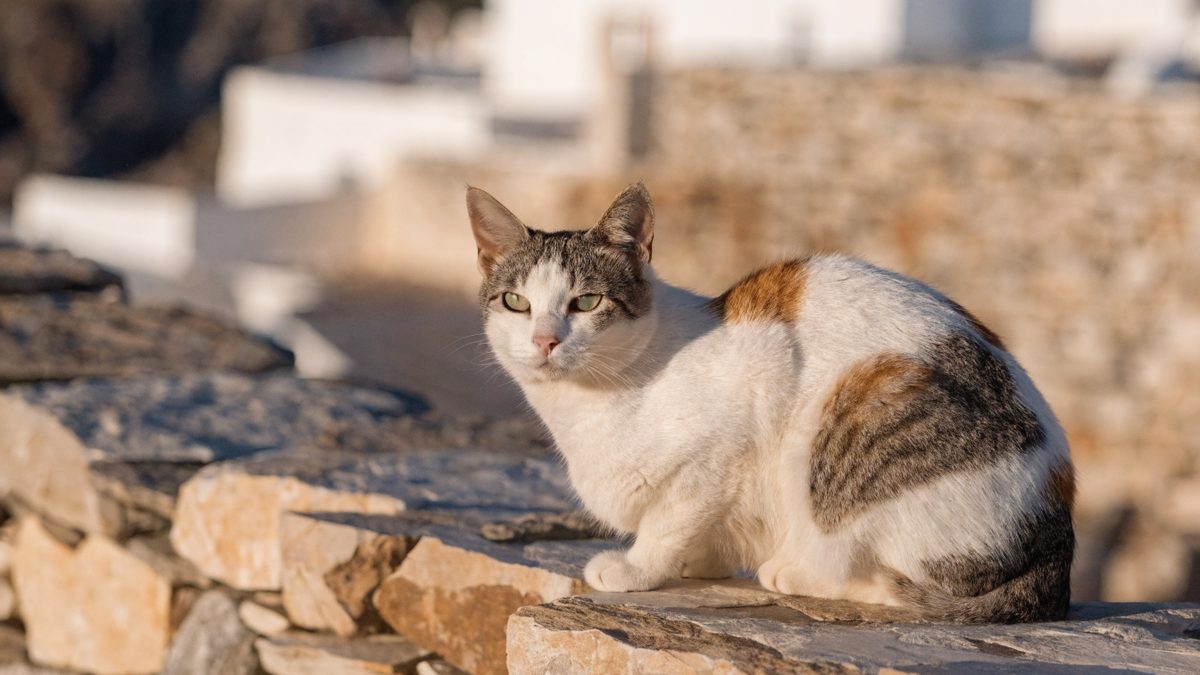
The one description every source does agree on is the colour, because it is the pattern that makes an Aegean recognisable at all. The coat is bicolour or tricolour and white is almost always one of the colours, covering roughly 25 to 90 percent of the body, with almost any other colour or pattern possible alongside it. Eyes are almond shaped and can be any shade of green, blue or yellow. The tail can be long and hooked. Body type is medium, muscular and unexaggerated, which is exactly what you would expect of a cat nothing has been selected into.
| Attribute | Wikipedia | Cats.com | Happy Pet (India) |
|---|---|---|---|
| Coat length | Semi-longhaired, flagged as disputed | Short-haired, medium, medium-length and semi-long-haired, in four places | 'Semi-long, water-resistant'; |
| Size | Medium, muscular | 8 to 10 inches tall, 7 to 10 pounds | Medium breed |
| Eye colour | Any shade of green, blue or yellow | Green only, light to dark | Not stated |
| Lifespan | Not stated | 9 to 12 years | 10 to 15 in the data box, 12 to 15 in the body |
| Registry status | Not recognised by any major registry | 'Not recognized by Cat Fancier associations in any country'; | 'Recognized officially in the early 1990s', no body named |
| Price | Not stated | $300 to $500 | Rs 40,000 to Rs 1,00,000 |
Read that table as a whole and the useful conclusion is not any single row. It is that six attributes produce six disagreements, and that the disagreement is what an honest page has to report. When five independent descriptions of an animal cannot converge, the animal has not been standardised, and no amount of confident prose changes that.
The English Wikipedia article on the Aegean cat rests on three references. One is a blog post, one is an episode of the Animal Planet series Cats 101, and one is a peer-reviewed ecology paper about lizards. Almost every specific claim you will read elsewhere, including the 25 to 90 percent white figure, the hooked tail, the affinity for water and the assertion that the cat is 'free from most feline genetic diseases', is sourced on that page to the television segment. The article has carried a maintenance template asking for more citations since May 2013 and one flagging possible original research since June 2018. Bonbeno is not repeating those figures as facts. We are telling you where they come from.
Which registries recognise the Aegean cat, checked one by one
No major cat registry recognises the Aegean, and Bonbeno confirmed that by reading the complete published breed lists of TICA, CFA, FIFe, GCCF and WCF rather than by repeating the claim. The interesting finding is not the absence itself. It is that four comparable regional landraces have made it through the same doors.
Every ranking page states the recognition status in a single sentence and moves on. None of them shows its working, and one contradicts itself immediately, publishing 'There are no breed standards' and a section headed 'The Breed Standard' on the same page. So we opened the registries. Alphabetically, an Aegean entry would sort between Abyssinian and American Bobtail in an English-language list, which makes the check unusually easy to verify for yourself.
| Registry | Aegean listed? | What the list does contain |
|---|---|---|
| TICA | No | The full A-to-Z runs Abyssinian, American Bobtail, American Bobtail Shorthair, American Curl and onward to Turkish Van, with nothing between the first two |
| CFA | No | The recognised-breeds grid places Abyssinian and American Bobtail adjacent |
| FIFe | No | All four categories plus the preliminary-recognised list and the house-cat standards, none of them Aegean |
| GCCF | No | 40 recognised breeds under the June 2026 Standard of Points |
| WCF | No | But the shorthair index does carry the Anatoli, Aphrodite's Giant, Arabian Mau and Ceylon |
The comparison that makes the absence meaningful
WCF's door is demonstrably open to exactly this kind of cat, which is why the Aegean's absence from it is the most telling result in the audit. The World Cat Federation publishes standards for the Anatoli, a Turkish shorthair landrace; the Aphrodite's Giant, a Cypriot landrace; the Arabian Mau, an Arabian peninsula landrace; and the Ceylon, a Sri Lankan landrace. Four regional island and peninsula landraces from the same corner of the world have a written standard. The Greek one does not.
Look at what those standards contain and you can see precisely what the Aegean is missing. The WCF Anatoli standard is a single page that fixes the body as medium to large and muscular with medium-heavy bone, the head as a blunt triangle of medium length with an almost straight profile, the ears as large with a broad base and slightly rounded tips, the eyes as large and oval on a slight slant, and the coat as short with no woolly undercoat and a fine but harsh texture. It then rules out chocolate, cinnamon, lilac, fawn and the pointed pattern in every combination, permits any amount of white, and allocates a scale of points giving 25 to head and eye shape, 10 to eye colour and 25 to coat texture and colour. That is what a standard looks like. It is short, specific and falsifiable.
GCCF goes further and shows what an active recognition pathway looks like. Its unrecognised-breeds register grades candidates green, amber or red, and the Aphrodite sits in green with the genetics committee comment 'Not applied, probable acceptance if export from Cyprus is legal';. That is a specific, named, solvable obstacle. The Aegean appears nowhere on that register, nor in the amber or red tables, nor in GCCF's closing note listing other recognised breeds it knows of, which names the Anatoli, Arabian Mau, Brazilian Shorthair, Chinese Li Hau, Kanaani, Tasman and Ural Rex. The Cypriot cat is in the queue with a documented blocker. The Greek cat is not in the queue.
- No registry recognises it. TICA, CFA, FIFe, GCCF and WCF all publish complete breed lists, and none includes the Aegean Fédération Internationale Féline (FIFe) Governing Council of the Cat Fancy (GCCF) World Cat Federation (WCF).
- No written standard exists. There is no document specifying head shape, coat, eye colour or scale of points, in contrast to the Anatoli's one-page standard.
- No recognition application is pending anywhere Bonbeno could find. GCCF's candidate register, the only one of the five that publishes a queue, does not list it.
- Comparable landraces have succeeded. The Anatoli, Aphrodite's Giant, Arabian Mau and Ceylon all hold WCF standards.
What this means for a paper trail
You cannot register an Aegean, so any certificate offered with one is worth checking rather than trusting. The single self-described Aegean cattery ranking on page one of the Indian search results states that each cat is supplied with a 'CFA Registered Blue Slip';. A blue slip is a CFA registration document, and CFA does not list the Aegean among its recognised breeds at all. Whatever that paper is, it is not a CFA registration of an Aegean, because no such thing can exist. The same page advertises 'Aegean cats cost between $800-$1500' in its meta description, prints a flat $1,800 against all three kittens, and tells the reader 'Please contact me for the prices';.
None of this makes the cat fake. The Aegean is a real population of real cats, and the peer-reviewed literature treats free-living Cycladic cats as a genuine study subject. It makes the *breed* claim unsupported, and that is a different thing. If somebody in India tells you they have an Aegean kitten with papers, the papers are the part to verify first, and the five lists above are how you do it in about ten minutes.
What recognition would actually take, on the neighbouring island's precedent
The Aphrodite's Giant standard documents the exact route, and it is the most useful page in this whole audit. WCF's published standard for the Cypriot landrace records that Dr Lyons's genetics programme at the Davis laboratories in the United States, which had developed a genetic fingerprint method for purebred cats, investigated 30 Aphrodite's Giants, and that on the basis of those DNA scans Lyons agreed the breed's genetic fingerprint 'is very consistent and could be recognized on this basis a breed';. The standard that followed allocates head 20 points, eyes 5, ears 5, body 35, tail 5, coat and colour 25 and condition 5.
That is the recipe as the standard describes it, and it is not exotic. A cohort of thirty cats is genotyped, the population is shown to be genetically consistent, and a standard is written describing what that population looks like. One caveat belongs here, because Bonbeno went looking for the study behind that sentence and could not find it. PubMed returns no indexed record for the Aphrodite as a cat breed, the Lyons paper that established the fingerprint method sampled seventeen random-bred populations and Cyprus was not among them, and the later peer-reviewed work that does include Cyprus genotyped 1,987 random-bred cats worldwide, placed the island in the Near East cluster and never uses the word Aphrodite. So the thirty-cat investigation is asserted in the WCF standard rather than published anywhere a reader can check it.
That caveat sharpens the comparison rather than dissolving it. Neither cat has published breed genetics that a reader can look up. The difference is that somebody made the case for the Aphrodite to a registry, wrote a standard and got it accepted, while for the Aegean nobody has done even that. The honest answer to 'is the Aegean a breed' remains that the work has not been done, rather than that the cat has been rejected.
The class your cat can actually be shown in
An Aegean is not homeless in the cat fancy, and this is the one genuinely cheerful finding in the section. TICA maintains a Household Cat class with its own published standard and a seven-member breed committee, defined as covering 'mixed breed/random-bred cats; half-pedigree "oops" cats; and pedigree cats which are either unregistered or do not meet the breed standard';. An Aegean sits squarely in the first group.
The class is also unusually humane about what it accepts. Anomalies that would disqualify a pedigree cat are allowed, including blind, three-legged and earless cats, and the only stated requirement is that the cat is obviously well cared for and content, with adults required to be altered. GCCF takes the opposite line and states that cats of breeds without its recognition are not eligible to be present at GCCF-licensed shows at all. So the answer to 'can I show my Aegean' depends entirely on which body's show you enter.
Aegean cat price in India, and why no honest figure exists
There is no Aegean cat price in india, because there is no Indian market for the cat. Bonbeno checked the 50-breed list published by India's largest pet retailer, two Indian all-breed price guides and a Justdial category built specifically around the breed name, and found no Indian supply, no Indian transaction and no rupee figure with a method behind it. The one rupee range on the Indian SERP is described as hypothetical in the same page's own body text.
Start with the single Indian number, because most readers will have seen it. Happy Pet ranks first in India for this query and prints 'Cost of buying ₹40,000 - ₹1,00,000' in its data box. Four hundred words further down, the same page explains what that figure is. Its own words are 'Rare outside Greece, Aegeans are not commonly bred in India', followed by 'If available through specialty breeders, they may range between' that band, 'depending on lineage and availability';. The word doing the work there is 'if'. A conditional estimate about a rare animal that the page itself says is not bred in India has been promoted into a hard price in the summary box, and that box is what Google shows and what an answer engine will quote.
Three Indian price guides that do not list the breed at all
Every Indian breed list Bonbeno opened omits the Aegean, including the ones that go deep into rarities. Heads Up For Tails publishes a list of 50 cat breeds kept in India, annotated breed by breed with life expectancy, country of origin and whether the breed suits the Indian climate. That list reaches the Sokoke from Kenya, the Serengeti, the Cymric, the Donskoy, the Khao Manee and the Burmilla Longhair. It does not reach the Aegean. PawSpace prices ten breeds from the Indian Domestic Cat at Rs 0 to Rs 5,000 up to the Sphynx at Rs 80,000 to Rs 2,00,000 and beyond, with no Aegean line.
When a retailer that sells to Indian cat owners for a living lists fifty breeds and yours is not among them, that is not an oversight. It is a market signal, and it is more informative than any price range.
| Source | Figure | What it really represents |
|---|---|---|
| Happy Pet (India) | Rs 40,000 to Rs 1,00,000 | A conditional estimate for cats the same page says are not bred in India |
| Cats.com (US) | $300 to $500 | A US figure with no stated method, on a page that cannot agree with itself on coat length |
| Aegean Cattery (meta description) | $800 to $1,500 | Advertised range that the same site's own listings contradict |
| Aegean Cattery (listings) | $1,800 flat, three kittens | Actual asking price, dated October 2022, offered with a CFA slip that cannot exist |
| Etsy India (SERP position 2) | Rs 2,074 to Rs 3,689 | Merchandise, not a cat. It ranks second in India for a live-animal query |
| PawSpace, Heads Up For Tails | No entry Heads Up For Tails | The breed does not appear in Indian price guides or breed lists |
Notice that the two independent-looking US figures are the same number. Cats.com says $300 to $500 and the aggregator ranking eighth repeats $300 to $500. One unsourced figure copied twice is not corroboration, and treating it as two data points is exactly the mistake this table exists to prevent.
The Justdial listings that promise a cat nobody has
Justdial has generated an entire local-commerce category for a breed with no Indian supply, and the result is worth seeing. The page is titled 'Popular Pet Shops For Aegean Cat in Vashi, Navi Mumbai' and carries its own category identifier. The businesses it returns are Khan Exotic Pets in Nalasopara East, Yash Shopee in Yeola, Doggy Do in Ahmedabad, Himalaya Dog Center in Haldwani, Cat's Villa in Ludhiana and Doon Pets World in Dehradun. Not one is in Vashi. Several are in other states, more than a thousand kilometres away. None of them says it has an Aegean.
That page is not lying so much as auto-generating. A directory takes a breed name, multiplies it by every locality it covers, and produces thousands of pages promising local availability that was never checked. If you searched 'Aegean cat near me' from Navi Mumbai and rang the top result, you would reach a pet shop in Palghar that has never heard of the cat.
What it would actually cost to bring one to India
The only lawful way to get an Aegean into India is to move to India with it, and the import rules are specific enough to price. India's Animal Quarantine and Certification Service allows pets in under the baggage route governed by Customs Circular No. 15/2013, capped at two animals, and only on proof of two years of continuous stay abroad plus proof of transferring residence to India. The cat needs an official health certificate from the country of origin covering rabies, distemper, feline enteritis, feline panleukopenia and leptospirosis, and a rabies vaccination given more than one month but within twelve months before embarkation.
Two clauses matter more than the rest. The owner must sign a declaration 'that the dog/cat is bonafide pet with no commercial interest, gift and breeding purpose', and the same page states in capitals that import for breeding or any other commercial activity is not permitted. You therefore cannot legally import an Aegean into India in order to breed from it, which closes the only route by which an Indian population could ever start. Anything outside the baggage route requires a licence from the Directorate General of Foreign Trade.
The United States agriculture department documents the same process from the other end and adds the detail Indian sources leave out. A No Objection Certificate from AQCS must be issued before landing, a duplicate must be fixed to the crate, animals arriving as accompanied or unaccompanied baggage are quarantined for 15 days, the short-visit exemption applies to two pets only, and no feed or bedding may travel with the animal. AQCS itself notes that advance clearance can be issued up to seven days before arrival and that final clearance follows after 30 days.
The figures above are reported from published sources as editorial context, not offered as prices. We link no listings and endorse no seller. If anyone quotes you a rupee price for an Aegean kitten in India, the first question is not how much, it is where the cat came from, because the lawful routes into the country are narrow, documented and closed to breeding imports.
Monthly cost of keeping an Aegean-type cat in India
Budget roughly Rs 3,000 to Rs 12,000 a month to keep a medium shorthaired cat in an Indian city, and note that none of that figure is breed-specific to the Aegean. The two Indian sources that publish a monthly cost for this cat disagree by a factor of nearly three at the top end, and the reason is that one of them is costing a cat nobody in India owns.
Two Indian pages publish a running monthly cost here and they are not measuring the same thing. Happy Pet gives average monthly expenses of Rs 2,800 on a basic lifestyle and Rs 4,200 on a premium one, itemised as food Rs 1,500 to Rs 2,000, veterinary Rs 500 to Rs 700 and grooming Rs 800 to Rs 1,500. PawSpace, costing cats generally rather than this breed, lands at Rs 3,000 to Rs 12,000 and above.
| Line item | Happy Pet, quoted for the Aegean | PawSpace, quoted for cats in India |
|---|---|---|
| Food | Rs 1,500 to Rs 2,000 | Rs 1,500 to Rs 6,000 |
| Litter | Not itemised | Rs 800 to Rs 2,500 |
| Grooming | Rs 800 to Rs 1,500 | Rs 500 to Rs 3,000 |
| Vet and preventive care | Rs 500 to Rs 700 | Rs 500 to Rs 2,000 |
| Toys and scratching posts | Not itemised | Rs 300 to Rs 1,500 |
| Treats | Not itemised | Rs 300 to Rs 1,000 |
| Tick and flea prevention | Not itemised | Rs 300 to Rs 1,000 |
| Stated monthly total | Rs 2,800 to Rs 4,200 | Rs 3,000 to Rs 12,000 and above |
The gap is explained by scope rather than by the cat. Happy Pet itemises three lines and totals them. PawSpace itemises seven and includes litter, treats and parasite control, which are real recurring costs for any Indian cat and which the breed page simply leaves out Happy Pet (India). Use the wider figure to budget, because the narrower one is not a cheaper cat, it is a shorter list.
The first year, which is where the money actually goes
First-year ownership in India runs Rs 50,000 to Rs 2,50,000 and above, and the purchase price is only one line of it. PawSpace itemises vaccinations at Rs 2,000 to Rs 6,000, deworming and vet visits at Rs 1,500 to Rs 5,000, a year of food at Rs 18,000 to Rs 72,000, a year of litter at Rs 9,600 to Rs 30,000, bed, bowls and carrier at Rs 3,000 to Rs 12,000, a litter box at Rs 1,000 to Rs 5,000, scratching post and toys at Rs 2,000 to Rs 15,000 and sterilisation at Rs 4,000 to Rs 15,000.
Read those numbers against the acquisition figures in the previous section and the conclusion is unavoidable. Food and litter alone, at the top of the published range, cost more in one year than the entire international asking price for the cat. Arguing about whether an Aegean is worth Rs 40,000 or $500 is arguing about the smallest line in the budget.
Three costs no Indian source budgets for
- The import bill. Nobody publishes it, because nobody has done it for this cat. Relocation involves an AQCS No Objection Certificate, an official origin-country health certificate, IATA-compliant crating, air freight and a 15-day quarantine United States Department of Agriculture. Bonbeno found no published Indian total for a cat relocation and is not going to estimate one. Ask a licensed relocation agent for a written quote and treat any number without one as fiction.
- Cooling. An indoor cat in Delhi, Nagpur or Chennai through April to June shares whatever cooling you run, and that electricity is a genuine cost of ownership that neither Indian estimate counts. Price it against your own tariff slab rather than a national average.
- A genotype test, if you buy a mostly-white cat. The University of California Davis veterinary genetics laboratory prices its dominant white and white spotting panel at $53 with a turnaround of at least 15 business days, and recommends it for random-bred cats as well as recognised breeds. On a bicolour landrace with no health paperwork, that swab tells you more than any certificate you will be handed.
One structural point about cost is worth stating plainly. Because there is no registry, no breed club and no screening scheme behind this cat, none of your money buys you information. With a recognised breed, part of the purchase price pays for a studbook and, in the better breeds, published screening results. Here there is nothing to buy, so spend the equivalent on diagnostics instead.
Heat tolerance in Indian conditions, rated honestly
Bonbeno rates the Aegean 3 out of 5 for heat tolerance in India. A Mediterranean island landrace descended from an arid-zone wildcat starts with real advantages over a Persian or a Norwegian Forest Cat, and it has no advantage whatsoever over the Indian domestic shorthair already living on your street. The limit is not the cat's ancestry. It is Indian humidity, and the physiology of how a cat sheds heat.
Take the ancestry seriously first, because it is the strongest argument in the cat's favour. Ancient DNA shows that the only wildcat lineage ever domesticated is Felis silvestris lybica, the north African and southwest Asian wildcat, an animal of hot dry country. The Cycladic population descends from cats moved along Mediterranean maritime trade routes and has lived through Greek island summers without human management for millennia Li B, Belasen A, Pafilis P, Bednekoff P. Nothing about it is cold-adapted. It carries no Persian-style flat face and no engineered coat.
Now take the Indian side seriously, because that is where the rating comes down. India's Meteorological Department declares a heatwave in the plains once the maximum temperature reaches 40 degrees C, and at 30 degrees C in hill regions. Over 24,000 deaths were attributed to heatwaves in India between 1992 and 2015. That is the environment the cat would live in, and no Mediterranean pedigree changes it.
What actually happens to a cat at Indian summer temperatures
A cat sheds heat mainly by evaporation, and dehydration halves that capacity at exactly the temperatures Indian summers produce. In a controlled study of nine cats at high ambient temperatures, evaporative water loss in animals dehydrated for four days fell to about 50 percent of hydrated levels at 38 and 35 degrees C, and core temperature rose significantly in dehydrated animals at 38, 40 and 43 degrees C. The authors found that reductions in respiratory rate tracked the reduced evaporation closely, meaning the control of cooling in a dehydrated cat is largely the control of breathing.
Read that alongside the IMD threshold and the practical rule writes itself. At 40 degrees C, which is merely the level at which India officially calls a heatwave, a well-hydrated cat is working hard and a dehydrated one is losing thermoregulatory control Ravindra K, Bhardwaj S, Ram C. Water access is not a comfort item in an Indian summer. It is the cooling system.
Humidity is the second half of the problem and the reason a Greek island cat has no special edge in Mumbai or Kochi. Evaporative cooling depends on moisture leaving the body for the air, so the same 35 degrees C behaves very differently at 30 percent humidity and at 85 percent. The mechanism the cat physiology study measures is precisely the one coastal Indian monsoon air suppresses. Bonbeno found no published comparison of Cycladic and Indian summer conditions for this cat, and we are not going to invent one, but the direction of the difference is not in dispute.
The Indian source's own ceiling
The one India-facing page for this cat puts its ideal weather at 15 to 30 degrees C. That is a striking number to publish next to a rupee price, because 30 degrees C is below the daily maximum in most Indian cities for a large part of the year, and it is ten degrees below the level at which IMD declares a heatwave in the plains Happy Pet (India). The page recommending the cat to Indian buyers has already stated, in its own data box, that Indian summers sit outside its comfort range.
| Factor | Direction | Evidence |
|---|---|---|
| Descended from an arid-zone wildcat lineage | Favourable | Only Felis silvestris lybica was domesticated |
| No brachycephalic muzzle, so panting is unobstructed | Favourable | Described as a medium, unexaggerated natural cat |
| Coat length genuinely unknown | Uncertain | Called short-haired, medium and semi-long-haired on one page |
| Indian plains heatwave threshold is 40 degrees C | Adverse | IMD definition |
| Cooling halves in a dehydrated cat at 35 to 38 degrees C | Adverse | Nine-cat controlled study |
| Monsoon humidity suppresses evaporative cooling | Adverse | Follows from the measured cooling mechanism |
| Its own Indian listing caps ideal weather at 30 degrees C | Adverse | Happy Pet data box |
Three out of five is therefore a pass, not a licence. The cat is heat-tolerant in the ordinary sense that a moderate shorthaired cat is heat-tolerant, and it is not a heat specialist. Any Indian domestic shorthair, which has actually been selected by Indian summers for generations, will do the same job at least as well and is described by Indian sources as better suited to Indian weather.
City by city, if you keep a cat of this type
- Delhi, Jaipur, Nagpur, Ahmedabad. Dry extreme heat. Evaporative cooling still works, so shade, airflow and constant water do most of the job. Watch April to June, when plains maxima cross the 40 degrees C heatwave threshold routinely.
- Mumbai, Chennai, Kochi, Kolkata. Lower peak temperatures, far higher humidity, and that combination is harder on a cat than the dry heat, because it attacks the evaporation the cat depends on.
- Bengaluru, Pune. The easiest Indian cities for a cat of this type, sitting closest to the 15 to 30 degrees C band the Indian listing names.
- Anywhere during a power cut. Cooling that depends on a fan or an air conditioner is cooling that stops. Keep a shaded, tiled, ground-level room available and multiple water bowls filled, so the cat has an option that needs no electricity.
Temperament and household fit, separating what is known from what is asserted
Published descriptions of the Aegean temperament agree that the cat is sociable, talkative and active, and none of them rests on a survey, a breed club or any measurement at all. On the one question that decides whether this cat suits an Indian flat, the sources flatly contradict each other, and that contradiction is the honest headline.
Here is what the sources say. Wikipedia describes a social pet that 'tolerates living in an apartment rather well', intelligent, active, lively and communicative, 'not hesitating to draw a person's attention';. Cats.com calls the cat friendly, intelligent and 'notably chatty', rating affection at 80 percent, activity at 60, sociability at 80, kid-friendliness at 80 and independent behaviour at 40. Happy Pet lists the top five traits as playful, curious, independent, friendly and affectionate.
Read across those three and a consistent picture appears: a chatty, people-oriented, moderately active shorthair that wants company. That is a perfectly reasonable description of the cat. It is also a perfectly reasonable description of a great many ordinary domestic cats, and none of the three pages says where any of it came from.
The contradiction that actually matters in an Indian flat
Two of the same sources give opposite answers on indoor confinement, which is the single most decision-relevant question for apartment living in an Indian city. Wikipedia says the Aegean tolerates a flat rather well. Cats.com states that 'Aegean cats have an instinctive love of the outdoors and can become quite unhappy when kept as indoor-only pets';. Both cannot be right, and almost every Indian home that would want this cat is a flat where the cat lives indoors.
Bonbeno cannot resolve that from the pet-media sources, because neither offers evidence. What can be brought to bear is the field research, and it points one way. On Naxos and its surrounding islets, free-living Cycladic cats are documented predators whose presence reduced Aegean wall lizard populations by half. That is a population with a working, effective hunting drive, studied because the drive is strong enough to reshape an island ecosystem.
A cat from that background is not a decorative lap animal, and the practical reading for an Indian household is straightforward. Assume high prey drive and plan enrichment accordingly, rather than assuming the cat will settle for a windowsill. That means real daily play, climbing height and things to stalk, not a bigger flat.
Who this cat suits, and who it does not
- Suits a household that is home. Every description converges on a sociable, communicative cat that seeks attention. A flat empty from nine to eight is a poor match.
- Suits an owner who will enrich vertically. Prey drive documented well enough to halve a lizard population needs an outlet. Shelves, cat trees and window perches matter more than floor area.
- Suits a home that can secure its balcony. A confident hunting cat plus an unmeshed high-rise balcony is the most common avoidable accident in Indian cat ownership. Mesh first, then bring the cat home.
- Does not suit a buyer who wants predictability. Temperament in a landrace varies more than in a selected breed, because nothing has been selected for. You are adopting an individual, not a profile.
- Does not suit anyone relying on the ratings above. No breed club, health survey or behavioural study underlies any of those percentages.
One further point about aquatic behaviour, since it is the claim most repeated about this cat. The affinity for water and fishing traces on Wikipedia to an Animal Planet television segment rather than to any study, and Cats.com repeats it with the practical advice that aquariums need tight lids. Treat it as a charming, plausible, unverified trait. If you keep fish, the advice costs nothing to follow either way.
Training approach, and what no source can tell you
Train an Aegean-type cat the way you train any intelligent domestic shorthair, with short reward-based sessions built around food, because no breed-specific training evidence exists for this population. Every claim about Aegean trainability on the ranking pages is an assertion, and Bonbeno found no breed club, study or survey behind any of them.
The two useful behavioural observations in the published sources point in opposite directions and are both worth planning around. Cats.com rates intelligence at 60 percent and notes that 'Left to their own devices, Aegean cats often choose napping over playtime and exploration', recommending a cat tree that doubles as a nap spot to draw the cat into activity. Happy Pet puts energy level at medium and prescribes an exercise routine of 30 to 60 minutes. A cat that will nap by default but has a documented hunting drive is a cat whose training problem is initiation, not capacity.
What works, in the order it matters in an Indian home
- Litter habits first. Offer one tray per cat plus one, keep them away from the kitchen and from noisy machines, and scoop daily. Indian summers make an unscooped tray unbearable faster than most owners expect.
- Carrier acceptance second. Leave the carrier open in the room with a blanket in it for weeks before you need it. A cat that loads calmly is a cat you will actually take to the vet, which matters more on an unscreened landrace than on a breed with published health data.
- Name and recall third. Pair the name with food every time for a fortnight. Chatty, people-oriented cats pick this up quickly, and every description of this cat agrees it is chatty and people-oriented.
- Handling fourth. Practise paws, ears and mouth in ten-second sessions with a reward. You will need all three for claw trims, ear checks and dental care.
- Harness last, and only if you want it. A confident hunter on an Indian street faces traffic, dogs and disease. Enrich indoors instead unless you have a genuinely safe enclosed space.
Two things this cat is likely to resist are worth naming, because they are the same two most cats resist and no breed magic exempts this one. It will resist being made to play on your schedule rather than its own, which is why short sessions at dawn and dusk work far better than one long session in the evening. It will also resist restraint, so build every handling routine on reward and release rather than on holding the cat still.
The honest gap
There is no trainability figure for this cat, and any page giving you one has made it up. Trainability ratings on breed sites are editorial judgements, and for a population with no breed standard, no registry and no club, there is not even a defined population to judge. What you can rely on is the general behaviour of intelligent domestic shorthairs, which is well understood, widely documented and entirely adequate for planning. Assume an ordinary bright cat and you will not be wrong.
Daily exercise requirement, and what happens without it
Plan on 30 to 60 minutes of active play a day, split into short sessions, which is the only exercise figure any source publishes for this cat. The number matters less than its shape, because a cat with a documented hunting drive needs stalking and chasing rather than time on a clock.
Happy Pet gives the requirement as 30 to 60 minutes at a medium energy level, and lists the cat's preferred activities as playing with toys, exploring, climbing, scratching and interactive playtime. Cats.com sets activity at 60 percent and playfulness at 60 percent, and warns that toys, particularly wands, help prevent obesity in a cat that will otherwise nap.
The field evidence explains why the play needs to look like hunting. On Naxos, cats living around villages reduced Aegean wall lizard populations by half, and the study compared nine sites within 300 metres of villages against nine ecologically similar sites more than 500 metres away to isolate that effect. Lizards near cats stayed closer to refuges, shed their tails more readily and fled sooner. This is a cat that hunts effectively enough to change the behaviour of an entire prey species.
Give that drive an outlet indoors and you have a settled cat. Withhold it and the drive does not disappear, it redirects, usually onto your ankles, your curtains and your sleep.
How to structure it in an Indian flat
- Play at dawn and after dark. Cats hunt at low light anyway, and in April to June those are the only hours a cat should be exerting itself, because cooling capacity falls sharply once a cat is even mildly dehydrated at 35 degrees C and above.
- Use wand toys, not laser pointers alone. A wand ends in a catchable object. A laser dot never gets caught, and a hunting sequence that never completes leaves the cat wound up rather than satisfied.
- Build height, not floor space. Shelves, a tall tree and a window perch triple the usable volume of a one-bedroom flat, which is the practical answer to whether this cat can live in a Mumbai two-BHK.
- Feed part of the ration through puzzles. Foraging converts eating into activity, which is the cheapest enrichment available and the most useful in a small home.
- Stop and offer water if the cat pants. Panting in a cat is not routine cooling behaviour the way it is in a dog. In the controlled study, respiratory rate was the mechanism dehydrated cats lost first. Treat it as a signal to end the session.
Two sessions of fifteen minutes will beat one session of forty, and both beat the cat tree nobody plays at. If you can only commit to one habit, make it ten minutes of wand play before you leave in the morning and ten when you get home.
Grooming and coat care in Indian humidity
Brush an Aegean-type cat two to three times a week with a slicker brush, and increase that if the individual cat turns out to have an undercoat. That hedge is necessary because no source agrees on the coat length, and the grooming load for a short single coat and a semi-longhaired coat with an undercoat are genuinely different jobs.
The coat length disagreement covered earlier has a direct practical consequence, so it is worth restating in grooming terms. Cats.com advises using a slicker brush two to three times a week to cut shedding and reduce hairballs, in the same document that calls the cat short-haired in one place and states that 'All Aegean cats are semi-long-haired, with soft undercoats that are shed during hot weather' in another. Happy Pet describes a 'semi-long, water-resistant coat' as low-maintenance compared with other long-haired breeds and rates shedding as moderate.
Do not resolve this from a web page. Resolve it by looking at the actual cat in front of you, which takes about five seconds. Part the fur over the shoulder. If you see a dense, woolly, differently coloured layer beneath the top coat, the cat has an undercoat and needs a comb as well as a brush, plus daily attention during a seasonal shed. If the coat is a single uniform layer to the skin, twice a week is enough.
| If the coat is | Frequency | Tools | The Indian complication |
|---|---|---|---|
| Short and single | Twice a week | Rubber brush or soft slicker | Loose hair on furniture, not mats |
| Medium, no undercoat | Two to three times a week | Slicker brush | Hairballs rise as shedding rises in hot weather |
| Semi-long with an undercoat | Three times a week, daily in a shed | Slicker plus a wide-tooth metal comb | Mats behind the ears, in the armpits and along the belly |
| Any of the above, monsoon months | Add a weekly skin check | Fine-tooth flea comb | Damp fur, fleas and ticks, and hot spots that start under a mat |
What Indian conditions add to the job
Humidity is the variable global grooming advice ignores, and it changes the priority order. A coat that stays damp through a Mumbai or Kolkata monsoon is a coat that harbours fleas and grows mats faster, and mats trap moisture against the skin. The weekly job in those months is therefore a skin check with a flea comb rather than a cosmetic brush-out. Run the comb from the base of the tail forward, along the belly and behind the ears, and look at what comes out on the teeth.
Shedding also rises with heat, which the sources note without connecting to the consequence. More shed hair means more swallowed hair, which means more hairballs, which is the most common reason an Indian owner of a moderately coated cat ends up at a vet in summer. Brushing is the intervention. Brushing removes the hair before the cat does.
The rest of the routine, and the cost
Claws, ears, teeth and eyes need the same attention they need on any cat, and none of it is breed-specific here. Trim claw tips every two to three weeks, check ears weekly and clean only the visible outer part, and introduce toothbrushing early because dental disease is one of the commoner problems listed for this cat by its Indian page. Happy Pet budgets Rs 800 to Rs 1,500 a month for grooming and PawSpace puts a professional Indian grooming session at Rs 500 to Rs 3,000 PawSpace, Cat Price in India: All Breeds.
Never shave a cat to keep it cool. The coat insulates in both directions and shields skin from sun, and removing it takes away the passive protection while doing nothing for the evaporative cooling the cat actually depends on. Groom the coat out instead, which achieves the airflow a shave is supposed to and keeps the barrier intact.
Health risks and lifespan, with the missing evidence named
No breed-specific health data exists for the Aegean cat anywhere. There is no registry, no breed club, no health survey, no screening scheme and no DNA panel for this population, so any page telling you its inherited disease risks is telling you something nobody has measured. What can be said honestly comes from two places, the genetics of the white pattern this cat actually carries, and the published data for non-pedigree cats as a whole.
Two claims dominate the search results and both need dismantling. Wikipedia states that 'Because the breed was allowed to develop through natural selection, rather than selective breeding, Aegean cats are free from most feline genetic diseases', sourcing that to an Animal Planet television segment. Cats.com goes further, saying the cat 'is naturally healthy, with no known health issues';.
The second sentence is true in a way that does not mean what readers take it to mean. There are indeed no known health issues, because nobody has looked. An unrecognised landrace with no club and no studbook has never been surveyed, so 'no known problems' and 'never studied' produce identical text and opposite levels of reassurance. Absence of evidence is not evidence of absence, and on a population this unstudied the distinction is the whole story.
We will not import another breed's numbers to fill this gap. The Maine Coon and Ragdoll each have their own named hypertrophic cardiomyopathy mutations, the Persian carries a well-documented polycystic kidney disease burden, and none of that evidence transfers to a Greek island landrace. A DNA test developed for a Ragdoll proves nothing about this cat. Where a figure does not exist for the Aegean, this page says so rather than substituting a figure that exists for something else.
Lifespan, and the only defensible reference class
The published Aegean lifespan figures contradict each other and none carries a method. Cats.com says 9 to 12 years. Happy Pet says 10 to 15 years in its data box and 12 to 15 years in its body text on the same page. Three numbers, one page apart, from two sources, with no study behind any of them.
A better answer exists if you accept what the Aegean actually is. Functionally it is a non-pedigree domestic shorthair, so the honest reference class is crossbred cats, for which real life expectancy data has been published. VetCompass life tables built from 7,936 UK cats give life expectancy at birth of 11.74 years for companion cats overall, 11.89 years for crossbred cats and 10.41 years for purebred cats. Crossbred cats lived 1.27 years longer than purebred cats after adjustment, and purebred cats had 1.83 times the odds of dying before three years of age.
| Group | Life expectancy at birth | What it tells an Aegean buyer |
|---|---|---|
| All companion cats | 11.74 years | The population baseline |
| Crossbred cats | 11.89 years | The closest defensible proxy for a landrace cat |
| Purebred cats | 10.41 years | Selection has not, on this measure, bought longevity |
| Female cats | 12.51 years | 1.33 years more than males, a bigger effect than breed |
| Male cats | 11.18 years | Neutering added 1.07 years in the same model |
Two caveats belong with that table and neither is small. The data is British, collected from cats under primary veterinary care between January 2019 and March 2021, and Indian conditions, veterinary access and outdoor risk differ substantially. And crossbred cats showed the widest lifespan range of any group analysed, from 0.00 to 26.69 years. A landrace average is an average over enormous individual variation, which is precisely what you would expect of a population nothing has been selected in.
The genuinely encouraging finding is that the crossbred figure beats the purebred one. If the appeal of an Aegean is that an unselected natural cat might be hardy, that intuition has support, just not from any Aegean study.
The one inherited risk this cat's own pattern raises
White spotting deserves a paragraph because the Aegean is defined by it, and because the popular version of the story is wrong in a way that matters. The coat is bicolour or tricolour with white covering roughly 25 to 90 percent of the body. Both dominant white and white spotting in cats come from an endogenous retrovirus insertion in the KIT gene, where the full 7,125 base pair insertion produces white spotting and a partial insertion produces dominant white David VA, Menotti-Raymond M, Wallace AC.
Those are two different variants with two different consequences for hearing, and conflating them is the common error. UC Davis reports that in an extended pedigree nearly 75 percent of cats carrying two dominant white copies were deaf and the remainder had at least partial impairment; with one dominant white copy and one normal allele, nearly 60 percent had normal hearing, 21 percent were deaf and 17 percent had impairment; and with one dominant white and one white spotting copy, a third each had normal hearing, impairment and deafness. The white spotting genotypes on their own carry no hearing warning in that guidance.
The practical reading for a bicolour Aegean-type cat is reassuring but conditional. A patched cat with clear colour over most of its body is very unlikely to be carrying dominant white, and hearing loss is not the concern the internet makes it. A cat at the 90 percent end of the white range is a different proposition, because a nearly-white cat may be dominant white rather than heavily spotted, and that is a laboratory question rather than a visual one. UC Davis prices the panel at $53 and explicitly recommends it for random-bred cats as well as recognised breeds.
What to screen for in India, in the absence of breed data
Screen for the conditions Indian cats actually get, not for the ones a breed page lists. The conditions Happy Pet names for this cat are obesity, upper respiratory infections, dental problems, kidney disease, hairballs, hyperthyroidism, fleas and ticks, and urinary tract infections. Every one of those is a general feline problem rather than a breed finding, which is itself the useful signal: the Indian page for this cat could not name a single breed-specific risk either.
- Core vaccination on schedule. India's own import rules name the diseases the state considers serious in cats, being rabies, distemper, feline enteritis, feline panleukopenia and leptospirosis. Happy Pet's schedule gives feline herpesvirus, calicivirus and panleukopenia at 6 to 8 weeks, again at 10 to 12 and 14 to 16 weeks, rabies at 12 to 16 weeks, and annual boosters thereafter. Confirm the schedule with your own vet, because Indian protocols vary by region and by disease pressure.
- Year-round parasite control. Ticks and fleas do not have an off season in most of India, and PawSpace budgets Rs 300 to Rs 1,000 a month for prevention.
- Body condition every month. Non-ideal body weight, whether too light or too heavy, was significantly associated with a shortened lifespan in the VetCompass model. This is the single controllable factor with published evidence behind it.
- A hearing check in kittenhood if the cat is mostly white. Either a genotype panel or a veterinary hearing assessment.
- Dental care from the first year. Dental disease appears on the Indian list for this cat and is among the commonest feline problems generally.
One structural warning to close on. Because this cat has no registry, nobody is tracking its inherited disease at all, and no seller can hand you a screening result that means anything Governing Council of the Cat Fancy (GCCF). That is not a reason to avoid the cat. It is a reason to buy diagnostics rather than paperwork, and to build a relationship with a vet early rather than after something goes wrong.
Feeding and nutrition through the life stages
Feed an Aegean-type cat a complete, meat-first diet appropriate to its life stage, and manage the portion rather than the brand, because body condition is the one nutrition variable with published evidence tying it to lifespan. No breed-specific dietary requirement exists for this cat, and the Indian source that covers it says so directly.
Happy Pet is unusually candid here, stating that Aegeans 'have no unique dietary needs' while noting that an active cat of semi-feral origin needs a balanced, nutrient-rich diet. Cats.com agrees that the cat has 'no special nutritional needs in comparison with other domesticated cat breeds';. That agreement is worth something precisely because these two sources agree on so little else.
The one figure with real weight behind it is not about food at all, it is about condition. In the VetCompass life-table analysis, non-ideal body weight in either direction was significantly linked to a decreased lifespan, alongside being entire and being purebred. Neutered cats lived 1.07 years longer than entire cats in the same model. Portion control and neutering are therefore the two nutrition-adjacent decisions with published lifespan consequences, and neither depends on which bag you buy.
Life stage by life stage
| Stage | What to feed | The Indian detail |
|---|---|---|
| 8 weeks to 4 months | Complete kitten food, four small meals a day | Keep water within a metre of the food in summer; kittens dehydrate fast |
| 4 to 12 months | Kitten food, three meals, weigh weekly | Growth slows through the monsoon in many kittens; do not chase it with more food |
| 12 months to 7 years | Adult maintenance, two meals plus puzzle feeding | Happy Pet budgets Rs 1,500 to Rs 2,000 a month for food; PawSpace puts the Indian range at Rs 1,500 to Rs 6,000 |
| 7 years and older | Senior diet after a vet assessment | Kidney disease appears on the Indian condition list for this cat; wet food raises water intake |
| Every stage, April to June | Same food, more water | Cooling capacity halves in a dehydrated cat at 35 to 38 degrees C |
Happy Pet publishes daily calorie figures of 200 kcal for kittens and 300 kcal for adults. Treat those as a starting point rather than a prescription. Energy needs scale with body weight, activity and neuter status, and a 3 kg indoor neutered female and a 5 kg active entire male do not eat the same amount. Weigh the cat monthly and adjust to the animal in front of you.
Water, which matters more here than the food does
Hydration is the Indian priority, and the physiology says why. A cat that is even mildly dehydrated loses about half its evaporative cooling at 35 to 38 degrees C, and its core temperature climbs at 38 degrees C and above. In a country where the plains heatwave threshold is 40 degrees C, water intake is a thermoregulatory intervention, not a nicety.
- Put out more bowls than you think you need, in at least three rooms, away from the litter tray and away from the food.
- Feed wet food at least once a day through the hot months, because most of a cat's water can arrive in its meal.
- Change water twice daily in summer, because warm still water in a plastic bowl is water a cat will decline.
- Use wide, shallow, non-plastic bowls, which suit cats better and stay cleaner in humid weather.
- Watch the tray, not the bowl, since reduced or concentrated urine is the earlier signal that intake has dropped.
Avoid the foods that are dangerous to every cat rather than looking for breed-specific restrictions. Happy Pet's list is onions and garlic, chocolate, alcohol, xylitol, grapes and raisins, dairy in some cases, bones and raw eggs. None of that is particular to this cat, and all of it is worth knowing in a household that cooks Indian food daily, since onion and garlic are in almost everything on the stove.
Month by month through an Aegean kitten's first year
Raise an Aegean-type kitten on the ordinary domestic-shorthair timeline, because no breed-specific developmental data exists and the general feline milestones apply without modification. Two things do change in India, the summer months and the parasite load, and both fall inside the first year.
One published observation about growth exists and it is worth noting for what it is. Wikipedia's caption states that a seven-month-old domesticated Aegean kitten 'may reach the size and physical condition of its full-grown mainland European counterparts', which is an unsourced photograph caption rather than a measurement. Adult size is given as 7 to 10 pounds and 8 to 10 inches at the shoulder by the one source that publishes figures at all.
| Age | What happens | What you do |
|---|---|---|
| 6 to 8 weeks | First core vaccines are due: herpesvirus, calicivirus, panleukopenia | Do not take a kitten home before eight weeks. Meet the mother if you possibly can |
| 8 to 10 weeks | Litter habits set, socialisation window is wide open | Handle paws, ears and mouth daily. Introduce the carrier as furniture, not as transport |
| 10 to 12 weeks | Second vaccine round | Start the vet relationship now, while nothing is wrong. Begin deworming on your vet's schedule |
| 12 to 16 weeks | Rabies is due, and India's own import rules treat rabies as the headline feline disease Animal Quarantine and Certification… | If the kitten is mostly white, this is when to order a genotype panel or ask for a hearing assessment |
| 14 to 16 weeks | Final kitten booster | Mesh the balcony before the kitten can jump to the railing. This is the deadline, not a suggestion |
| 4 to 6 months | Hunting play turns serious and ankles become targets | Two wand sessions a day. Redirect onto toys the moment teeth meet skin |
| 5 to 8 months | Sexual maturity approaches | Discuss neutering. Neutered cats lived 1.07 years longer in the VetCompass model |
| 6 to 9 months | Growth slows, appetite stays high | Switch from free feeding to measured meals. Weigh monthly and hold condition |
| 9 to 12 months | Adult coat and adult temperament settle | Now you can see whether the coat has an undercoat, and set the grooming routine accordingly |
| First summer, whenever it lands | The riskiest stretch of the year | Move play to dawn and after dark, and add water bowls. Cooling capacity halves in a dehydrated cat at 35 to 38 degrees C |
Two Indian specifics deserve emphasis because they are where first-year kittens actually come to harm. Balconies kill more urban Indian kittens than any inherited disease, and a hunting-bred cat is exactly the kind that goes over a railing after a pigeon. And parasite pressure in most of India runs year-round rather than seasonally, so the deworming and tick schedule your vet sets is not the one written on a European packet.
One caution about sourcing a kitten under this name. Because no registry recognises the cat and no studbook exists, an 'Aegean kitten' in India is a description of appearance, not of ancestry Wikipedia, Aegean cat. A white-and-tabby kitten from an Indian street is genetically no further from a Cycladic cat than most animals sold under the label, which is a point the adoption section takes up properly.
How the Aegean compares with the cats Indian buyers actually choose between
The Aegean's closest real comparison is not another pedigree cat. It is the Indian domestic shorthair, which is the same kind of animal, available in every Indian city, adapted to Indian conditions, and free. Against the recognised breeds, the Aegean's distinguishing feature is that everything about it is unverified.
Compare the Aegean with three groups and the picture resolves quickly. Against the Indian street cat, it is the same category of animal at a much higher notional price. Against a landrace that was formalised, such as the American Shorthair, it shows exactly what recognition adds. Against the nearest geographic relative, the Turkish Angora, it shows what a written standard makes possible.
| Aegean | Indian domestic shorthair | Turkish Angora | American Shorthair | |
|---|---|---|---|---|
| Registry recognition | None, at any of five registries checked Cat Fanciers' Association (CFA) Fédération Internationale Féline (FIFe) Governing Council of the Cat Fancy (GCCF) World Cat Federation (WCF) | None, and none claimed | TICA, CFA, FIFe and WCF all list it Fédération Internationale Féline (FIFe) | CFA, TICA and SACC, per GCCF's own note |
| Written breed standard | None exists | None, and none claimed | Published by multiple bodies | Published |
| Available in India | No Indian supply found PawSpace, Cat Price in India: All Breeds | Every city, every street | Listed among India's 50 breeds | Not on India's 50-breed list |
| Published Indian price | A conditional estimate only | Rs 0 to Rs 5,000 | Priced in Indian guides | Not priced in Indian guides |
| Suited to Indian climate | Rated 3 of 5 here, ancestry good, humidity poor | Marked suitable by Indian retailers | Marked 'not ideal' by Indian retailers | Not assessed for India |
| Health data available | None for the breed | Crossbred life tables apply | Breed screening exists | Breed screening exists |
| What your money buys | An appearance and a story | A cat, plus a rescue's vaccination record | A pedigree and a standard | A pedigree and a standard |
The comparison that decides it
Against the Indian domestic shorthair, the Aegean has no demonstrable advantage. Indian retailers list the Indian Billi first among 50 breeds, with a life expectancy of 10 to 18 years and an explicit 'suitable for Indian climate' marking. PawSpace describes Indian domestic cats as highly adaptable, low maintenance, usually healthier and better suited to Indian weather, at Rs 0 to Rs 5,000. Both are describing an unselected, locally adapted, moderately sized shorthair, which is precisely what an Aegean is, except that one of them evolved in the climate you live in.
The genetics reinforces the point rather than softening it. Cats spread around the Mediterranean and beyond along maritime trade routes, and the domestication process did not profoundly alter feline morphology or behaviour. A landrace shorthair is a landrace shorthair. The Cycladic one has a better story, and the Indian one has better local evidence behind it.
Against the recognised breeds, and where the Aegean actually wins
One comparison does favour the Aegean, and it is worth stating fairly. Purebred cats had 1.83 times the odds of dying before three years of age compared with crossbred cats, and lived 1.27 years less on average, in the VetCompass life tables. An unselected natural cat avoids the specific inherited burdens that selection has concentrated in some breeds, which is the real content behind the 'naturally healthy' claim even though the claim itself is unevidenced for this population.
That advantage, though, belongs to landrace cats generally rather than to the Aegean specifically, and it is fully available from a shelter in your own city. If your reason for wanting an Aegean is that you want a robust, unexaggerated, natural cat rather than a Persian with a flat face or a coated northern breed like the Norwegian Forest Cat, the evidence supports the instinct and points at a different cat. If your reason is the ticked elegance of an ancient natural breed with actual registry standing, the Abyssinian is recognised everywhere and available in India The International Cat Association (TICA).
Mistakes Indian buyers make with this breed
The commonest mistake is paying a pedigree price for a cat that has no pedigree to sell. Every other error on this list follows from the same root, which is treating an unrecognised landrace as though it were a documented breed.
- Paying Rs 40,000 or more on the strength of a data box. The rupee range on the Indian SERP is a conditional estimate the same page describes as applying only 'if available through specialty breeders', for a cat it says is not bred in India. Read past the box before you transfer money.
- Accepting registration papers that cannot exist. A seller offering a 'CFA Registered Blue Slip' for an Aegean is offering a document for a breed CFA does not list. Check the registry's own breed list, which takes two minutes.
- Believing a local directory has local stock. Justdial's 'Pet Shops For Aegean Cat in Vashi' returns shops in Ahmedabad, Ludhiana, Haldwani and Dehradun, none of them in Vashi and none of them claiming to have the cat. Auto-generated category pages are not inventory.
- Trusting 'no known health issues' as a health guarantee. Nobody has surveyed this population, so 'no known problems' and 'never studied' are the same sentence. Budget for diagnostics rather than relying on the reassurance.
- Planning grooming from a web page instead of the cat. One source calls the same animal short-haired, medium, medium-length and semi-long-haired. Part the fur over the shoulder and look for an undercoat, then set the routine.
- Assuming Mediterranean means heat-proof. IMD declares a heatwave in the Indian plains at 40 degrees C, and a dehydrated cat loses about half its evaporative cooling at 35 to 38 degrees C Doris PA, Baker MA. Effects of dehydration…. The cat's own Indian listing caps its ideal weather at 30 degrees C.
- Shaving the cat in summer. The coat is a two-way insulator and a sun barrier, and removing it does nothing for the evaporative route the cat actually cools by.
- Keeping a documented hunter in a bare flat. Free-living Cycladic cats halved the wall lizard population they were studied against. Vertical space and daily wand play are not enrichment extras here.
- Leaving the balcony unmeshed. The combination of prey drive and an Indian high-rise is the most preventable serious accident in urban cat ownership.
- Trying to import one to breed from. India's rules require a signed declaration that the animal is a bona fide pet with 'no commercial interest, gift and breeding purpose', and state that import for breeding or commercial activity is not permitted. That route is closed, not merely difficult.
A final mistake sits underneath all of these and is worth naming on its own. Buyers assume that because a name exists, a breed exists behind it. On the Indian search results for this cat, the name has generated an Etsy merchandise page at position two, a phantom Justdial category at position five, and a rupee price at position one that its own author framed as hypothetical Happy Pet (India). The name is doing commercial work that the animal is not. Knowing that is most of the protection you need.
Adoption, responsible sourcing and the cat already near you
Adopt an Indian domestic shorthair. That is the honest recommendation for almost every reader who arrives on this page, because the Aegean is a landrace with no Indian supply, no registry, no standard and no health record, and the Indian street cat is the same kind of animal with better local evidence behind it and a shelter full of them within a few kilometres of you.
This is not a consolation prize, and the sources make the case without any help from us. Heads Up For Tails lists the Indian Billi first among 50 cat breeds kept in India, records a life expectancy of 10 to 18 years, and marks it suitable for the Indian climate, describing a cat that has 'over years of living as community street cats, evolved to be independent, active and inquisitive' and is low-maintenance to groom. PawSpace calls Indian domestic cats highly adaptable, low maintenance, intelligent, usually healthier and better suited to Indian weather, at Rs 0 to Rs 5,000 including adoption fees, vaccination support and sterilisation contributions.
Compare that description with the Aegean's, line by line, and they are the same cat wearing different passports. Both are unselected shorthairs shaped by a place rather than a breeder Heads Up For Tails. Both are moderately sized, unexaggerated and muscular. Both hunt. The difference is that one of them has been shaped by Indian summers for as long as the other has been shaped by Aegean ones, and only one of them is standing in a shelter in your city.
Where an Aegean-type cat could genuinely come from
- A shelter or independent rescuer, as a look-alike. Cats.com, a site that sells breed content, advises this itself, noting that the Aegean 'is seldom seen in shelters and rescues' and that 'many shelters incorrectly label moggies as purebreds'. A white-and-tabby bicolour rescue is not an inferior Aegean. It is the same category of animal, correctly labelled.
- Relocation, if you are already moving to India from abroad. The AQCS baggage route permits up to two pets on proof of two years of continuous stay abroad and proof of transferring residence, with an origin-country health certificate and a rabies vaccination given more than one month but within twelve months before embarkation. Expect a No Objection Certificate before landing and a 15-day quarantine after it.
- Not through an Indian breeder, because none was found. No Indian breed list, price guide or retailer Bonbeno opened lists this cat. Anyone advertising Indian-bred Aegean kittens is making a claim about ancestry that no studbook exists to support.
- Not by importing for breeding. The declaration India requires explicitly excludes breeding purpose.
How to verify any cat offered to you under this name
Four questions settle it, and none of them is about the cat's looks. Ask which registry the cat is registered with, then open that registry's own breed list, which will not contain the Aegean at any of the five bodies checked here Cat Fanciers' Association (CFA) Fédération Internationale Féline (FIFe) Governing Council of the Cat Fancy (GCCF) World Cat Federation (WCF). Ask what the parents were screened for, and expect no verifiable answer, because no screening scheme exists. Ask to see the mother in the place the kitten was raised. And ask for the vaccination and deworming record, which is the one document that genuinely means something here.
If the answer to the first question is a certificate from a body you cannot find, or a 'blue slip' from a registry that does not recognise the breed, you have learned what you needed to know about the seller Cat Fanciers' Association (CFA).
The Cycladic cats themselves are not a supply
One last point of conscience. The Aegean population that people romanticise is a free-living island population, studied in the wild as a community cat system and as an ecological actor, with cats near Naxos villages having halved the local wall lizard population. Those are not surplus kittens waiting for export. Any trade that treated them as stock would be removing animals from a functioning population to satisfy demand generated largely by a television segment and a Wikipedia article.
The cat you want is a friendly, chatty, hardy, medium shorthair with a white-patched coat and a strong hunting instinct. India has hundreds of thousands of them, they are already adapted to the climate you live in, and adopting one costs a fraction of any figure on this page Heads Up For Tails. That is the whole recommendation.
Aegean cat questions people actually search
How much does a Aegean cat cost?
Published figures run from $300 to $500 on US breed sites up to a flat $1,800 per kitten at the one self-described cattery ranking in India, whose own advertising says $800 to $1,500. None of these figures states a method, and the two US sources quote the identical range, so they are one number repeated rather than two independent estimates.
What is the price of Aegean cat in India?
No trustworthy Aegean cat price in india exists, because there is no Indian market for the breed. The only rupee range published, Rs 40,000 to Rs 1,00,000, is described in the same page's body text as a conditional estimate for cats it says are not commonly bred in India.
Are Aegean cats recognized by any registry?
No. Bonbeno read the complete published breed lists of TICA, CFA, FIFe, GCCF and WCF on 16 August 2026 and found no Aegean at any recognition level. WCF does publish standards for the Anatoli, Aphrodite's Giant, Arabian Mau and Ceylon, so the door is open to comparable landraces, and this one has not gone through it.
How long do Aegean cats live?
Nobody has measured it. Published claims range from 9 to 12 years up to 12 to 15 years, and one Indian page gives two different answers on the same page. The nearest defensible figure is the crossbred cat life expectancy of 11.89 years at birth from UK veterinary life tables covering 7,936 cats.
Do Aegean cats shed?
Yes, moderately, though the amount depends on a coat nobody can agree about. The same page calls this cat short-haired, medium hair length, medium-length and semi-long-haired in four different places, so check the individual cat for an undercoat rather than trusting any published description.
How big do Aegean cats get?
Medium. The only source publishing figures gives 7 to 10 pounds in weight and 8 to 10 inches at the shoulder, which is an ordinary domestic shorthair build. No breed standard exists to define the size, so treat those numbers as one writer's observation rather than a specification.
Are Aegean cats hypoallergenic?
No. The Indian breed page answers this directly, stating that Aegean cats are not hypoallergenic, that they shed moderately and that they produce allergens which may affect people with cat allergies. No cat breed is genuinely hypoallergenic, and an unstandardised landrace has no basis for such a claim.
What is the temperament of an Aegean cat?
Sociable, talkative and active, according to every source, though none of them rests on a survey. The sources also contradict each other on indoor life, with one saying the cat tolerates a flat well and another saying it can become quite unhappy kept indoors only, which matters a great deal in an Indian apartment.
Is the Aegean cat suitable for Indian climate?
Partly. Bonbeno rates heat tolerance 3 out of 5. The ancestry is arid-adapted and there is no flat face to obstruct panting, but India's plains heatwave threshold is 40 degrees C and a dehydrated cat loses about half its evaporative cooling at 35 to 38 degrees C. Its own Indian listing caps ideal weather at 30 degrees C.
What kind of care does an Aegean cat require?
Ordinary domestic shorthair care. Brush two to three times a week, more if the individual has an undercoat, feed to body condition rather than to a bag, keep water available in several rooms through summer, and give thirty to sixty minutes of hunting-style play daily.
Is your cat a Aegean Cat?
Probably not, and there is no test that could tell you. With no registry, no studbook and no written standard, Aegean is a description of appearance rather than of ancestry. A white-patched bicolour Indian shorthair matches the published description as well as anything sold under the name does.
Is there black markings on the gums of these cats?
No source describes gum pigmentation as an Aegean characteristic, and none could, since no breed standard exists to define one. Pigmented spots on the gums and lips occur in many cats and are usually harmless lentigo, but any new or changing oral pigmentation should be shown to a veterinarian.
Compare with similar breeds
Aegean sits in 1 Bonbeno group. Each one compares it directly against the breeds it is genuinely an alternative to, on the same figures.