
Cat breed profile
Turkish Angora Cat in India: Price, Care and How to Tell It Is Real
What a Turkish Angora cat costs in India, why the published prices disagree by a factor of thirty, how the written breed standard tells this cat apart from the white Persian that is usually sold instead, and what the deafness evidence actually says.
Quick answer
Turkish Angora cat price in India runs from Rs 5,000 to Rs 1,50,000 across published sources, and none of them states a method, so no figure is trustworthy on its own. The bigger problem is what you get. This is a single-coated cat with a straight two-plane profile and no nose break, and the CFA standard disqualifies a cobby body and a break in profile outright, which is exactly the white Persian most Indian buyers are handed instead.
This guide is general information for Indian pet owners and is not a diagnosis. Always consult a registered veterinarian near you before acting on anything you read here, and treat any sudden change in your cat's condition as urgent.
Turkish Angora at a glance
What a Turkish Angora actually is
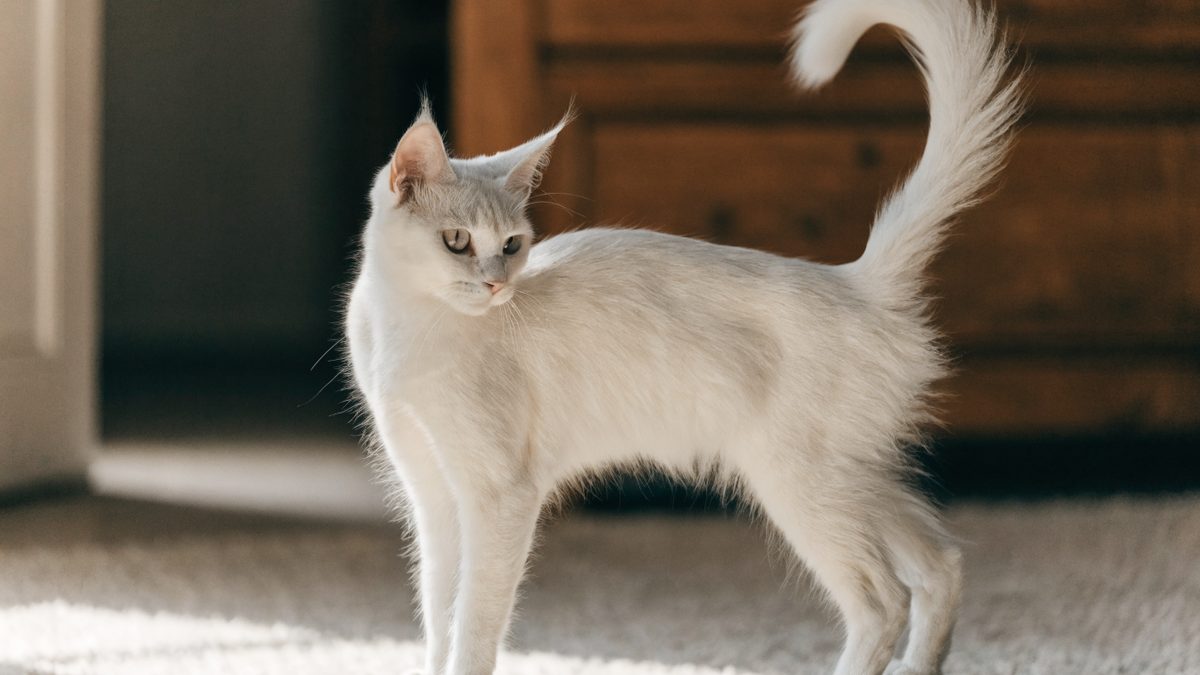
A Turkish Angora is a medium-sized, finely boned, single-coated cat from central Anatolia with a wedge-shaped head, a straight two-plane profile and no nose break. That last detail is the whole page. The written breed standard defines this cat by angles and straight lines, and it specifically excludes the round, cobby, flat-faced animal that most Indian buyers are handed when they ask for a Turkish Angora.
The Cat Fanciers' Association standard opens by describing the ideal Turkish Angora as a balanced, graceful cat with a fine, silky coat that shimmers with every movement, in contrast to the firm, long, muscular body beneath it, and calls it a cat of angles and straight lines, medium in size with no exaggerated features. Every physical clause after that follows from those two words, angles and straight. The CFA's own point score puts 40 of 100 points on the head, split 15 for head shape and profile, 15 for ears and 10 for eyes, against 35 for the body and only 10 for coat and 5 for colour. Judges are told, in scoring terms, that the head and body decide this breed and the coat colour barely matters.
The head is small to medium, a medium long smooth wedge. The profile is two flat planes formed by a flat top head and the line of the nose meeting at an angle slightly above the eyes, and the standard prints the instruction in capitals, NO BREAK. The ears are large, wide at base, pointed and tufted, set closely together, high on the head, vertical and erect. The eyes are large, almond-shaped, slanting slightly upward. The body is medium size, finely boned with firm muscularity, long and slender, possessing greater depth than width, oval rather than round, with the rump slightly higher than the shoulders. The legs are long, and the hind legs are longer than the front.
The single coat is the breed's defining feature, and it matters most in India
The CFA standard states the coat requirement in two words, single coated, then specifies that the length of body coat varies but the tail and ruff should be long, full, finely textured and have a silk-like sheen, with britches apparent on the hind legs. FIFe is more explicit and says the coat is single, of medium length on the body, long at the frill and tail, very fine with a silk-like sheen, and adds a flat three-word line, no undercoat.
TICA words it slightly differently and describes a semi-longhair with slight undercoat, appearing to be single-coated. That is a real disagreement between two registries and Bonbeno is not going to paper over it. The practical position is that a Turkish Angora carries far less insulating undercoat than a Persian, a Maine Coon or a Norwegian Forest Cat, and whether the residue is called none or slight, an Indian summer treats the two descriptions the same way. Hill's Pet describes the single coat as having no undercoat, which makes this longhair cat easy to care for.
| Attribute | What the standard says | Registry |
|---|---|---|
| General impression | A cat of angles and straight lines, medium in size, no exaggerated features | CFA |
| Head | Small to medium, a medium long smooth wedge | CFA |
| Profile | Two flat planes meeting slightly above the eyes, NO BREAK | CFA |
| Nose | Medium length, almost straight, very gently curved, no stop or break | FIFe |
| Ears | Large, wide at base, pointed and tufted, set high and close together, vertical and erect | CFA |
| Eyes | Large, almond-shaped, slanting slightly upward | CFA |
| Body | Long and slender, finely boned, oval rather than round, rump slightly higher than shoulders | CFA |
| Legs | Long, hind legs longer than front | CFA and FIFe Fédération Internationale Féline |
| Coat | Single coated, no undercoat, silk-like sheen | CFA and FIFe Fédération Internationale Féline |
| Disqualify | Cobby body type, stop or break in profile, chocolate, lilac or point pattern | CFA |
| Withhold all awards | Cobby body type, Oriental head or body type | TICA |
White is one accepted colour out of dozens, not the definition
The single most expensive misconception in the Indian market is that Turkish Angora means white long-haired cat. It does not. The CFA colour prefix chart lists more than forty separate Turkish Angora colour codes, including black, blue, red, cream, silver tabby, brown tabby, tortoiseshell, calico, dilute calico, black smoke, blue smoke, shaded silver and bi-color, alongside the five white codes for blue-eyed, amber-eyed, green-eyed, green-gold-eyed and odd-eyed whites. FIFe permits all colour varieties including all varieties with white, and excludes only pointed patterns and the colours chocolate, lilac, cinnamon and fawn.
Turkey's own preservation programme is the reason white dominates the image. The Atatürk Forest Farm and Zoo in Ankara began a breeding programme in the early twentieth century to protect and preserve pure white Angoras, and particularly prized odd-eyed individuals. VCA Animal Hospitals dates that zoo programme to 1917, and WebMD notes that the programme specifically focused on white cats. So the white association is a real historical artefact of one conservation decision, not a definition of the breed.
VCA Animal Hospitals states it flatly: the word Angora in this breed's name specifies pedigreed cats from Turkish Angora only, and does not describe any long-haired cat. In India that single line would prevent most of the mis-selling on this page.
History, and why the Persian confusion is three centuries old
Turkish Angoras are one of the ancient natural breeds of cat, originating in central Anatolia in what is now Ankara Province, and documented as early as the seventeenth century. Hill's Pet reports that a long-haired white cat was brought to Europe from Ankara in 1520, while WebMD dates the earliest written record to France in the 1500s. The dates differ by decades across sources and no single one is authoritative.
The confusion with the Persian is not an Indian invention and it is not new. In the 1788 book Animals Drawn from Nature and Engraved in Aqua-tinta, Charles Catton gave Persian cat and Angora cat as alternative names for the same breed. In 1903 Frances Simpson wrote in The Book of the Cat that the distinctions between Angoras and Persians were of so fine a nature that she would ignore the class of cat commonly called Angora, and that despite many inquiries she had never been able to obtain any definite information as to the difference. Two hundred and thirty years of muddle sit behind the kitten being offered to you in a Delhi WhatsApp group.
What broke the muddle was selective breeding in opposite directions. WebMD records that Turkish Angoras were heavily used to bolster the Persian breed and almost died out because they were exclusively bred into Persian programmes. Hill's Pet says the breed was surpassed in popularity by the Persian, largely ignored, and almost became extinct in Europe, and would have been lost entirely but for the Ankara zoo. Meanwhile the show Persian was bred progressively flatter. The two cats began as one description and ended as opposites, which is exactly why the modern standards can now be used as a test.
Registry recognition, and the dates that do not agree
Recognition history is another place published sources conflict, so here it is as reported rather than smoothed. Wikipedia records that the breed was brought to Canada in 1963 and accepted as a championship pedigreed breed in 1973 by the CFA, with only white Angoras recognised until 1978. VCA states that the first Turkish Angora arrived in the United States in 1963 and that the CFA granted championship status in 1972. WebMD says the CFA started registering the breed in 1968, that it became eligible for championship status in 1972, and that the all-white restriction was lifted two years later.
What the genetics says about which Turkish Angora you are looking at
There is a further wrinkle that matters if you are paying a premium for authenticity. Breeders in Turkey hold that the fine-boned Western show version is unrepresentative of the true Turkish cats, which are sturdier, and one long-running criticism is that American Turkish Angoras retain only a minimal remnant of the original Ankara zoo DNA.
The peer-reviewed genetics is more careful but points the same way. Kurushima and colleagues analysed 477 cats representing 29 fancy breeds using 38 short tandem repeats and 148 intergenic markers, and concluded that despite the fancy's short breed history a majority of cats can be assigned to their proper breed or population of origin. That 2012 work found Turkish-originating and USA-originating Turkish Angoras resolving as separate breed populations, with the American cats assigned as descendants of European random-bred cats and the imported Turkish cats assigned to the Eastern Mediterranean group.
The earlier and larger survey by Lipinski and colleagues genotyped over 1,100 individuals across 17 random-bred populations from five continents and 22 breeds, reconfirmed the Mediterranean as the probable site of domestication, and found that most breeds were derived from indigenous cats of their purported regions of origin, with the notable exception of the Persian and the Japanese bobtail, which aligned more with European and American clusters than with the Mediterranean basin. That study also recorded that pure breeding was associated with a loss of genetic diversity. Kurushima's group additionally noted that over 85 percent of the fancy's 40 to 50 breeds arose only in the past 75 years, primarily through selection on single-gene aesthetic traits. The Turkish Angora is one of the genuine exceptions to that, which is part of why it is worth getting right.
The CFA's own breed article supplies a fourth date and contradicts its own organisation's other pages, stating that in January 1970 CFA officially recognized the breed for show purposes. That article also records the founding import in detail, that in November 1962 Walter and Liesa Fallon Grant obtained Yildi, an odd-eyed white male, and Yildizcik, an amber-eyed white female, from the Ankara Zoo, that their first litter was born in March 1963, and that the Grants returned in August 1966 for a second unrelated pair because there were no other unrelated pairs in the United States. Every Turkish Angora outside Turkey traces to a handful of cats released by one zoo, which is the real reason the breed is scarce.
Four reputable sources, four different chronologies. What all three agree on is the direction of travel, which is that the breed was rescued from near-extinction by a Turkish state zoo, exported in tiny numbers from the 1960s, recognised in North America in the early to mid 1970s, and opened to non-white colours later. WebMD adds the detail that matters most for anyone buying paperwork: all Turkish Angoras registered with the CFA need to be able to trace their lines back to Turkey.
How to tell a Turkish Angora from a white Persian
Check the profile and the body type first, because those two features alone separate the breeds and both are written into the standards as disqualifications. A Turkish Angora has a straight two-plane profile with no break and a long, slender, finely boned body. A Persian has a nose break centred between the eyes and a cobby body. The CFA Turkish Angora standard disqualifies a cobby body type and a stop or break in profile outright.
This is the substitution Indian buyers get most often. A white Persian, or more commonly a white domestic long-haired cat of no fixed breeding, is sold as a Turkish Angora because both are white and both are fluffy. The two standards make the test easy once you know what to look at, because they are not merely different, they are written in opposition to each other.
| Feature | Turkish Angora standard | Persian standard |
|---|---|---|
| Head | Small to medium, a medium long smooth wedge | Round and massive, with great breadth of skull |
| Profile | Two flat planes meeting slightly above the eyes, NO BREAK | Break centred between the eyes; forehead, nose and chin in vertical alignment |
| Nose | Medium in length, even in width from the front | Short, snub and broad |
| Eyes | Large, almond-shaped, slanting slightly upward | Large, round and full, set level and far apart |
| Ears | Large, pointed, tufted, set high and close together, vertical and erect | Small, round tipped, tilted forward, set far apart and low on the head |
| Body | Long and slender, finely boned, oval rather than round | Cobby type, low on the legs, broad and deep through the chest |
| Legs | Long, hind longer than front | Short, thick and strong |
| Tail | Long, tapering from a wide base to a narrow end, full brush | Short, carried without a curve and lower than the back |
| Coat | Single coated, silk-like sheen | Long and thick, standing off the body, immense ruff |
| Disqualification that settles it | Cobby body type, or a stop or break in profile | Not applicable; cobby and the break are required |
The six-point physical check, in the order that is quickest
- Look at the profile from the side. Run your eye down from the top of the skull to the nose tip. A Turkish Angora shows two straight planes meeting at a soft angle above the eyes, with no stop and no dip. A Persian shows an obvious step. This is the single fastest test and it takes two seconds.
- Feel the body, do not just look at it. Under a long coat, everything looks round. Put a hand on the ribcage. A Turkish Angora is long, slender and finely boned with a narrow chest and the rump slightly higher than the shoulders. A Persian is broad and deep through the chest and equally massive across the shoulders and rump.
- Check the leg length. Turkish Angora legs are long, with hind legs longer than front. Persian legs are short, thick and strong. A long-haired white cat standing tall on visibly long back legs is not a Persian.
- Check the ear set. Turkish Angora ears are large, pointed and tufted, set high on the head and close together, vertical and erect. Persian ears are small, round tipped and set low and far apart. Catster describes the Angora ear as long, wide-based and triangular rather than round.
- Check the eye shape, not the eye colour. Almond and slanting slightly upward for the Turkish Angora, large and round for the Persian. Eye colour tells you nothing, because the CFA standard states there is no relationship between eye colour and coat colour in this breed.
- Part the coat down to the skin. A Turkish Angora coat is single, fine and silky with no dense woolly layer underneath. A Persian carries a long thick coat standing off the body with an immense ruff. If your fingers meet packed wool at skin level, you are not holding a single-coated cat.
None of these six tests proves pedigree. They prove type. A well-typed long-haired white Indian cat with a straight profile and a slender body may look exactly right and still have no Turkish Angora ancestry at all, because a straight profile and a slim build are the default for domestic cats everywhere, including India. Physical type rules a Persian out. It does not rule a Turkish Angora in. Only documented parentage does that.
What paperwork would actually have to exist
Pedigree papers are the only thing that turns an Angora-type cat into a documented Turkish Angora, and in India that is where the trail usually goes cold. Pedigree in cats is registry paperwork, and there is no Indian cat registry to issue it. The recognised bodies are foreign, and they are the CFA, TICA, FIFe, the World Cat Federation, ACFA, the Canadian Cat Association, the Governing Council of the Cat Fancy and a handful of others. TICA describes itself as the world's largest genetic registry of pedigreed cats. India has no equivalent national feline registry, which means an Indian seller cannot issue you a legitimate breed pedigree from any Indian body, because no such body exists.
That leaves three real possibilities and you should ask which one you are being offered.
- A foreign registration certificate for the kitten itself, issued by CFA, TICA, FIFe or WCF, naming the cattery, the sire and the dam. The CFA lets a cat registered with another recognised association be registered by pedigree from that association's paperwork, so cross-registry documents are normal and checkable.
- A registered cattery name. The WCF requires a cattery name to be registered and verifies its uniqueness within the federation, and publishes registered cattery names from 2001 onward. A breeder claiming registry status but unable to name a registered cattery is not what they say they are.
- A pedigree chart tracing back to Turkey. WebMD records that all Turkish Angoras registered in the CFA need to be able to trace their lines back to Turkey. That is a hard constraint and it is the reason genuine Turkish Angoras are scarce everywhere, not only in India.
Ask for the registration number and the registering body, then verify it directly with that body before money moves. A photograph of a certificate is not verification. A laminated card from a local shop with a logo on it is not a pedigree. If a seller cannot name the registry, cannot supply a number, and cannot name the sire and dam, then whatever you are buying may be a lovely cat but it is not a documented Turkish Angora, and it should not carry a Turkish Angora price.
Most white long-haired kittens sold in India as Turkish Angoras are undocumented cats of mixed or unknown ancestry. That is not a reason to reject the kitten. It is a reason to reject the price. A cat with no verifiable pedigree is worth what a lovely undocumented cat is worth, which in India is an adoption fee, not Rs 85,999.
Turkish Angora cat price in India
Published Turkish Angora cat price in India figures run from Rs 5,000 to Rs 1,50,000, and the evidence behind them is thinner than for any other imported cat Bonbeno has priced. There is no editorial price survey for this breed in India. What exists is a handful of listing sites, one repurposed blog post and a scattering of classified ads, so treat every number below as a quoted asking price rather than a market rate.
Here is the scarcity in one checkable number. Mr n Mrs Pet, which describes itself as India's number one pet platform, lists 1,674 cats for sale nationally, with Persian alone accounting for 1,117 of them, followed by Maine Coon at 96, Bengal at 78, Himalayan at 64 and Ragdoll at 62. The Turkish Angora does not appear anywhere in that platform's breed filter, which runs from American Shorthair through Siberian and includes eighteen categories. The largest organised purebred cat marketplace in the country does not list this breed at all. That is what rare means in practice, and it is also why the prices that do exist are so scattered.
That same platform states the general Indian position bluntly in its own FAQ, that in India pet buying is not regulated. It puts the average price of kittens in India at Rs 18,000 to Rs 35,000 by breed, with premium breeds costing up to Rs 60,000 or more, and puts general monthly maintenance for a low to medium coat cat on a moderate lifestyle at Rs 2,000 to Rs 6,000. Those are all-breed figures rather than Turkish Angora figures, and Bonbeno is presenting them as context for the market rather than as a price for this cat.
Say the weak part out loud first. For the Persian, Bonbeno was able to compare six published Indian price bands that at least agreed on a structure. For the Turkish Angora there is no such body of data. The breed is genuinely rare in India, Hill's Pet lists its worldwide prevalence simply as rare, and a rare breed produces a thin, noisy price signal. Anyone publishing a confident Rs X to Rs Y band for this cat in India is extrapolating, and so would we be if we did the same.
| Source | What it quotes | What kind of source it is |
|---|---|---|
| Supertails, key takeaways | Rs 20,000 to Rs 1,50,000 or more | Retailer blog, no method stated |
| Supertails, kitten section | Rs 40,000 to Rs 1,50,000 or more | Same page, different floor |
| Supertails, breeder section | Rs 50,000 to Rs 1,50,000 or more | Same page, third floor |
| Supertails, adoption | Rs 5,000 to Rs 15,000 | Described as rare for purebreds |
| Charwaha, pet quality | Rs 20,000 to Rs 45,000 | India-specific breed guide |
| Charwaha, show quality | Rs 50,000 to Rs 90,000 | India-specific breed guide |
| Charwaha, rare odd-eyed | Can exceed Rs 1,00,000 | India-specific breed guide |
| Puppiezo, live listing | Rs 85,999 per white kitten at 8 weeks | Seller inventory, top-tier package |
| MyKitten classifieds, Mumbai | Rs 15,000 negotiable, 1.5-year-old female, not spayed | Private classified ad |
| Instagram listing on the SERP | Rs 5,000, kitten aged 45 days | Social post, ranked position 2 in India |
Read the disagreement, because it is the finding
The spread runs from Rs 5,000 to Rs 1,50,000, a factor of thirty for what every one of those sources calls the same breed. Three things drive it and none of them is quality.
- One page contradicts itself three times. Supertails prints a floor of Rs 20,000 in its key takeaways, Rs 40,000 in its kitten price section and Rs 50,000 in its breeder section, all in the same article. A reader who lands on the summary box and a reader who scrolls get different answers.
- The article ranking third in India for this query is not about this breed. That same Supertails page sits at a URL about the Himalayan cat, carries a Himalayan headline, and closes by telling you to stay on top of your Himalayan cat's health, while its body copy prices the Turkish Angora throughout. Bonbeno is not guessing at that, it is on the page.
- The top result sells cats and calls them puppies. Puppiezo ranks first in India for this query with a page headed Turkish Angora Puppies For Sale, quoting Rs 85,999 for each of two white eight-week kittens, and its own page description markets them as elegant, blue-eyed beauties. A seller advertising blue eyes as the premium feature is charging extra for the exact trait most strongly associated with congenital deafness, which the health section below covers properly.
What Bonbeno will and will not say about the price
Bonbeno will say this. Indian asking prices for cats sold as Turkish Angoras cluster in two separate places rather than along one curve. Classified and social listings sit around Rs 5,000 to Rs 15,000, while commercial sellers and breed guides sit around Rs 40,000 to Rs 90,000 with a claimed ceiling above Rs 1,00,000 Puppiezo, Turkish Angora listing page. Those are not two ends of one market. They are two different products, and only one of them is even claiming documentation.
Bonbeno will not publish a single recommended price band for this breed in India, because no source we could open supports one. Nobody has surveyed Indian catteries. Nobody has published a method, a sample size or a collection date. Charwaha does not state where its figures come from, and Supertails does not either. Inventing a tidy number from that would be the exact failure this page exists to correct.
For international context only, the US market prices this breed at roughly USD 1,000 to USD 2,000. That is not an Indian figure and should not be converted into one, because import cost, quarantine, breeder scarcity and the near-total absence of registered Indian catteries all sit between the two markets.
A Rs 5,000 to Rs 15,000 white long-haired kitten in an Indian metro is almost certainly an undocumented domestic long-haired cat, and a Rs 85,999 one may be too. The price tells you what the seller wants, not what the cat is. The only thing that separates the two is registry paperwork you can verify with the registry, which the identification section above sets out. Bonbeno does not broker kitten sales and does not publish breeder listings. Every figure here is reported from a third-party source so you can see the disagreement yourself.
Monthly cost of keeping a Turkish Angora in India
Budget roughly Rs 3,000 to Rs 10,000 a month to keep a Turkish Angora in an Indian city, and expect the low end only if you groom at home and the cat stays healthy. Published Indian estimates for this breed put the monthly cost between Rs 3,000 and Rs 12,000 depending on which source you read and how much you outsource.
Two Indian sources publish a running monthly cost for this breed and they land in a similar place by different routes. Supertails puts ongoing monthly expenses for food, litter, grooming supplies and potential veterinary visits or insurance at Rs 3,000 to Rs 10,000 or more. Charwaha totals its line items to Rs 4,500 to Rs 12,000 depending on lifestyle.
| Line item | Supertails | Charwaha |
|---|---|---|
| Food | Rs 1,500 to Rs 4,000 | Rs 2,000 to Rs 5,000 |
| Treats | Rs 300 to Rs 800 | Included in food |
| Litter | Quoted in the setup list | Rs 1,000 to Rs 2,500 |
| Grooming, if outsourced | Rs 1,000 to Rs 3,000 | Rs 500 to Rs 2,000 |
| Routine vet and vaccination | Rs 500 to Rs 2,000 per year | Rs 500 to Rs 2,000 per month |
| Toys and accessories | Included in setup | Rs 500 to Rs 1,500 |
| Pet insurance | Rs 1,000 to Rs 3,000 | Not quoted |
| Stated monthly total | Rs 3,000 to Rs 10,000 or more | Rs 4,500 to Rs 12,000 |
Note the one line where the two sources are not comparable at all. Supertails quotes routine vet visits and vaccinations at Rs 500 to Rs 2,000 per year, while Charwaha quotes Rs 500 to Rs 2,000 per month for vet care Charwaha, Turkish Angora Cats Breed…. That is a twelvefold difference on the same line. The honest reading is that routine preventive care is an annual cost of a few thousand rupees and that Charwaha's monthly figure is an averaging of unpredictable illness spending, not a recurring bill.
One-time setup, before the first month starts
Supertails puts initial supplies at Rs 15,000 to Rs 30,000 and the first vet visit with vaccinations at Rs 3,000 to Rs 8,000. Its itemised list runs food and water bowls at Rs 500 to Rs 1,500, litter box and scoop at Rs 700 to Rs 2,000, scratching post or cat tree at Rs 1,500 to Rs 5,000 and upward, carrier at Rs 1,000 to Rs 3,000, bedding at Rs 800 to Rs 2,500, toys at Rs 500 to Rs 2,000, grooming tools at Rs 500 to Rs 1,500 and a collar with ID tag at Rs 300 to Rs 1,000.
Two Indian costs neither source budgets for
Both published estimates leave out the two line items that matter most for this specific breed in this specific country.
- Cooling. A single-coated cat handles Indian heat better than a Persian, but better is not the same as fine. If you run a room cooler or an air conditioner through April to June because the cat is indoors all day, that electricity is a real cost of ownership and neither Indian source counts it. Price it against your own tariff rather than a national average, because state slabs differ too much for a single figure to be honest.
- A BAER hearing test, if you buy a white kitten. Brainstem auditory evoked response testing is the only reliable way to identify a unilaterally deaf cat, and Strain notes that availability is limited because of equipment costs. Bonbeno could not find a published Indian price for feline BAER testing at any veterinary college or referral hospital, and we are not going to estimate one. Ask your nearest veterinary college's neurology or ENT service directly, and treat the answer as a one-time diagnostic cost rather than routine care.
Grooming is the swing factor and it is entirely within your control. Outsourced grooming is quoted at Rs 500 to Rs 3,000 a month across the two Indian sources, which over fifteen years is a large number. A single-coated cat that gets combed at home two or three times a week rarely needs a professional groom at all, because without a dense undercoat the coat generally does not knot or tangle. Ten minutes with a comb replaces most of that line.
Can a Turkish Angora handle the Indian climate
A Turkish Angora handles the Indian climate better than any other popular long-haired cat, and Bonbeno rates its heat tolerance 3 out of 5. The reason is structural. This is a single-coated cat with little or no undercoat and a normal, unshortened muzzle, so it keeps both of the cooling systems that a flat-faced double-coated breed has given up. It is still a cat in a country that recorded 47.6 C in May, so 3 is a pass, not a licence.
Start with what India actually does to an indoor cat. The India Meteorological Department reported maximum temperatures across northwest, central and peninsular India running between 40 C and 44 C, with a high of 44.5 C at Sri Ganganagar in Rajasthan, and noted regions running markedly above normal by 5 C or more. IMD's seasonal outlook for April to June 2026 projected above-normal heatwave days over parts of east, central and northwest India and the southeast peninsula. In May 2026, Delhi's Safdarjung recorded a maximum of 43.6 C and the highest temperature anywhere in the country on 21 May was 47.6 C at Banda in Uttar Pradesh.
Why the single coat is the whole advantage
Cats do not cool by sweating. They cool by evaporation from the respiratory tract and by grooming saliva onto the coat, which then evaporates. Both of those routes work better on a Turkish Angora than on the breed it is most often confused with.
The coat first. FIFe specifies a single coat with no undercoat, the CFA says single coated, and Hill's Pet notes that lacking an undercoat the coat is relatively easy to care for and generally does not knot or tangle. A Persian by contrast carries a long thick coat standing off from the body with an immense ruff continuing in a deep frill between the front legs. Undercoat is insulation. Less of it means air reaches skin, saliva evaporates from skin rather than from a wool layer, and the cat can actually shed heat.
The face second. The Turkish Angora standard requires a nose of medium length, even in width, on a straight two-plane profile with no break, and FIFe adds no stop or break. That is a normal feline airway. The Persian standard requires a nose that is short, snub and broad with the break centred between the eyes. Open-mouth breathing is a cat's emergency cooling route and a normal muzzle keeps it available.
| Condition | Where and when | What it means for this breed |
|---|---|---|
| Dry extreme heat, 40 C to 44 C | Punjab, Haryana, Delhi, Rajasthan, UP, Madhya Pradesh, April to June | Manageable indoors with shade, airflow and constant water. Not manageable in a closed west-facing room. |
| Peak heat spikes above 45 C | Banda in UP recorded 47.6 C on 21 May | Active cooling needed. A fan alone moves hot air past a cat that is already at ambient. |
| Warm nights | Northern plains, where IMD flags warm night conditions compounding heat stress | The overnight recovery window closes. This is the underrated risk, not the afternoon peak. |
| Hot and humid | Odisha, West Bengal, Tamil Nadu, Andhra Pradesh, coastal Maharashtra and Kerala | Evaporative cooling works worse in humid air, so the same temperature is harder work than inland. |
| Monsoon humidity | Most of India, June to September | The single coat dries faster than a double coat, which is a genuine advantage, but a damp cat still needs to dry fully. |
| Winter and hill stations | Himachal, Uttarakhand, the Northeast | Comfortable. FIFe notes the summer coat is definitely shorter than the winter coat, so the cat adjusts seasonally. |
Why the rating is 3 and not 5
Three things hold this breed back from a top heat tolerance score even with the coat and the face in its favour.
- Long hair is still long hair. FIFe describes a body coat of medium length with a long frill and tail. That is more coat than an Indian domestic shorthair carries, and the shorthair is the local benchmark for a genuinely heat-tolerant cat.
- This is a high-activity breed indoors. Turkish Angoras are described as exceptionally intelligent and athletic, curious, and given to climbing to the highest point in the room. A cat that plays hard at 2 pm in a Nagpur summer generates heat that a placid cat does not. The behaviour has to be managed, which mostly means moving playtime to early morning and after dark.
- Coat colour matters and white is the common colour. A white cat has unpigmented skin under a thin single coat, which is a sunburn risk on ear tips and nose in direct Indian sun in a way that a black or tabby Turkish Angora is not. Keep white cats off sunny balconies at midday. The CFA colour list confirms white is only one of many accepted colours, so if sun exposure is your constraint, a pigmented Turkish Angora is the more practical choice.
What actually reduces the risk in an Indian flat
- Cool one room properly rather than the whole flat badly. The cat needs a single reliable retreat through the hot hours, not a fan pushing 42 C air around the living room.
- Put water in three places, not one. Multiple stations raise total intake, and WebMD suggests a flowing fountain and water left in multiple locations.
- Comb through the coat twice a week in summer. Removing dead hair lets air reach the skin. VCA recommends you brush more often during the summer, partly to prevent hairballs.
- Move play to the cool hours. Early morning and after sunset. An athletic cat still gets its exercise, just not at the worst time of day.
- Watch the weight. Hill's Pet warns that the Turkish Angora should not be allowed to get fat because the fine boning means too much weight can be harmful. An overweight cat manages heat worse.
- Treat open-mouth breathing as an emergency. A cat panting is not the same as a dog panting. Move it to a cooled room and call your nearby vet rather than waiting to see whether it settles.
This is the one section where the Turkish Angora wins outright and no ranking page in India says so. A single-coated cat with a straight profile keeps both cooling routes intact. A Persian has neither, which is why Bonbeno rates the Persian's heat tolerance at the bottom of the scale. If you are choosing between the two long-haired white cats for an Indian city, the climate argument is not close.
Temperament and whether this cat fits your household
Buy a Turkish Angora only if someone is home for most of the day, because this is an intensely social, attention-demanding, athletic cat that does badly when ignored. It is affectionate, confident with strangers, and physically busy in a way that suits an active household and frustrates a quiet working couple who are both out from nine to seven.
The consistent description across veterinary and registry sources is a cat that behaves more like a small dog than a typical aloof feline. VCA calls the breed graceful, elegant and totally devoted to their owners, exceptionally intelligent and athletic, curious and thriving on learning commands and tricks, and notes that it especially enjoys riding around on people's shoulders or surveying the scene from high perches such as the top of the refrigerator or doors. Both VCA and WebMD record the breed's nickname as the border collies of the cat world WebMD, What To Know About a Turkish Angora….
WebMD describes the personality as very outgoing and affectionate, says these cats tend to be very interested in their owners' lives and will follow you around the house, and adds a warning worth reading twice, that if you ignore them for too long they will likely act out to make sure you notice them. Charwaha's Indian guide reaches the same conclusion from owner experience and says they usually dislike being ignored for long periods and may become emotionally stressed if left alone frequently.
Sources disagree on children, and the disagreement is useful
This is one of the clearest source conflicts on the breed. VCA rates the Turkish Angora 2 out of 5 for good with children. WebMD says they are good with children and seniors if you are looking for a motivated, curious pet. Catster says Angoras do well in homes with sensible and respectful children. Charwaha says they are affectionate toward children when treated respectfully.
Read the qualifiers and the conflict resolves. Three of the four sources attach a condition about the child's behaviour rather than the cat's. VCA also notes that the breed is extremely extroverted and boldly goes up to greet newcomers, but that they can be quick-tempered. A confident, quick-tempered, physically capable cat is fine with a calm eight-year-old and a poor match for a household where a toddler grabs handfuls of tail. That is a household test, not a breed test.
Other pets, and the alpha problem
VCA reports that the breed happily welcomes the companionship of other pets, including dogs. WebMD agrees they do well in households with other pets including dogs, then adds a caveat with real consequences, that this cat will need to ensure it is the pack's alpha and your other pets should be prepared to submit to this cat's will. Catster puts it more bluntly and says they will not hesitate to put an unruly canine or feline companion in their place.
In practice a Turkish Angora usually integrates well with an existing easy-going dog or a placid resident cat, and badly with another assertive cat that also wants the top perch. Introduce slowly, give vertical space so two confident animals are not competing for one high spot, and do not assume that because the breed is sociable the introduction manages itself.
Who should not buy this breed
- Households empty ten hours a day. Charwaha flags loneliness as a real risk and lists it among the cons of the breed. A second cat helps, an empty flat does not.
- People who want a lap ornament. VCA rates lap cat 3 out of 5 and intelligence 5 out of 5. This cat wants to be involved, not held still.
- Anyone unwilling to cat-proof. WebMD notes they are clever and can learn to open cabinets and doors, and that you may need to baby-proof openings you do not want explored.
- Anyone who wants a quiet cat and buys a deaf one unprepared. Hill's Pet notes that a deaf Turkish Angora may have a louder voice than expected because she cannot hear to modulate the loudness of her voice. That is manageable and it is not a defect, but it should not be a surprise.
This breed suits apartment living well provided the apartment goes upward. Hill's Pet says the Turkish Angora loves to run and play and should be provided with adequate perches and cat trees, and Charwaha reports the breed performs very well in Indian apartments given scratching posts, cat trees and window perches. Floor space matters less than vertical space and a window with something to watch.
Training a Turkish Angora, and what this breed resists
Train a Turkish Angora with short reward-based sessions and it will learn faster than almost any other cat, because this is one of the few breeds every source rates at or near the top for intelligence and trainability. What it resists is repetition, correction and being made to do anything on your schedule rather than its own.
VCA rates ease of training 4 out of 5 and intelligence 5 out of 5, and notes the breed is curious and thrives on learning commands and tricks. Cats.com rates intelligence high in its breed profile. Charwaha's Indian guide lists litter box habits, name recognition, basic commands, interactive tricks and leash training as realistic targets, and recommends rewards, treats, a gentle voice and short sessions while explicitly warning against punishment because sensitive cats may develop fear.
What works, in the order worth doing it
- Start litter training on day one and expect it to be easy. A confident, clean, intelligent cat usually needs a clean box in a quiet corner and nothing else. Problems here are almost always about box hygiene, box location or stress rather than the cat's ability to learn.
- Teach carrier acceptance before you need it. Feed meals in an open carrier for two weeks. Charwaha recommends allowing cats to become familiar with the carrier before travel day and using short practice rides to reduce fear. In India this pays for itself the first time you need an emergency vet run in traffic.
- Teach the name, then a recall. Reward every response, never call the cat to do something it dislikes, and keep sessions under two minutes.
- Add a target or trick to burn brain time. WebMD notes the breed does well in the sport of feline agility because it has both speed and smarts. Puzzle feeders and target training convert that intelligence into something other than opening your kitchen cabinets.
- Redirect climbing rather than banning it. WebMD advises providing high places to climb and perch, preferably the highest surfaces in the room, because otherwise you will find them trying to get up to places they should not. That is training the environment, which works better than training the cat.
Training a deaf Turkish Angora
If your cat is bilaterally deaf, switch to visual signals from the start. Strain notes that the use of gesture communication, including obedience training signals and sign-language signs, has been found effective in deaf dogs, that deaf animals are naturally more visually attentive to humans, and that owners of deaf cats may with patience be able to train their pets with this system. A hand signal for food, a torch flash for come, and a stamped floor vibration for attention cover most daily needs.
Strain also flags one safety point that matters in a household with small children, which is that the danger to infants and toddlers from reflex bites or scratches inflicted when a deaf cat is startled should be kept in mind. Teach children to approach into the cat's field of vision rather than from behind, and to touch the floor or bed before touching the cat.
What the breed resists
- Being ignored during a session. This cat is training you as much as you are training it. Divided attention ends the session.
- Repetition past the point of interest. Intelligent cats stop cooperating when a task stops being new. Three repetitions and stop.
- Any form of correction. Charwaha's guidance to avoid punishment because sensitive cats may develop fear is the right instinct. A cat that becomes wary of your hands takes months to recover.
- Being confined without stimulation. Charwaha reports that without stimulation these cats may become destructive or depressed. Destructive behaviour in this breed is usually a symptom of boredom rather than a training failure.
Litter habits settle within days. Name recognition takes one to two weeks of short daily sessions. Carrier acceptance takes two to four weeks if you never rush it. Leash walking, where Indian conditions make it sensible at all, takes two to three months and is only appropriate on a harness in a safe enclosed space, never on a road with stray dogs and traffic.
Daily exercise a Turkish Angora actually needs
Give a Turkish Angora at least two structured play sessions a day plus permanent access to vertical climbing space. One Indian source puts the daily exercise routine at 30 to 45 minutes. This is an athletic breed and the consequence of under-exercising it is not laziness, it is destruction and weight gain on a frame that cannot carry weight.
WebMD describes the Turkish Angora as an incredibly athletic breed, very active, needing a reasonable amount of playtime to keep them at their mental and physical best, with strong hunting instincts that will happily chase toys throughout your house. Hill's Pet says the breed loves to run and play and should be provided with adequate perches and cat trees as well as a selection of toys. Puppiezo's Indian listing rates energy level as high and puts the exercise routine at 30 to 45 minutes daily.
A workable Indian daily routine
| Time | What to do | Why |
|---|---|---|
| 6 am to 8 am | Main play session, 15 to 20 minutes of wand or chase play | Coolest part of the day. The cat is naturally crepuscular and most willing to hunt. |
| Mid-morning | Puzzle feeder or food-dispensing toy | Mental work without heat load. |
| Afternoon, 12 pm to 4 pm | Leave the cat alone in the cooled room | IMD advises avoiding exposure and strenuous activity during peak afternoon hours. The same logic applies to a cat. |
| Evening, after sunset | Second play session, 15 minutes, ending with a meal | Play then eat then sleep matches the natural hunting cycle and settles the cat overnight. |
| Overnight | Free access to cat tree and window perch | Warm night conditions in the northern plains mean the cat may be restless. Give it somewhere to be. |
Vertical space is the requirement, not floor space
The single most useful thing you can buy for this breed in an Indian flat is height. VCA notes the breed especially enjoys surveying the scene from high perches including the top of the refrigerator or doors. WebMD recommends providing high-up places to perch, preferably the highest surfaces in the room. Charwaha's Indian apartment list is scratching posts, cat trees, window perches and interactive toys.
If the cat has no legitimate high place, it will pick one, and it will be your wardrobe top, your kitchen shelf or the top of a door. That is not misbehaviour and correcting it does not work. Provide the alternative instead.
Do not let this cat outdoors in an Indian city
Charwaha's guidance is direct and Bonbeno agrees with it. Avoid free outdoor roaming because traffic accidents are common, stray dogs can attack and disease exposure increases. For a deaf cat the case is stronger still. Strain's management guidance for bilaterally deaf cats is that the primary concern is protection from undetected dangers such as motor vehicles or predators, and that these cats should preferably be kept as indoor pets. In an Indian street with traffic and free-roaming dogs, a cat that cannot hear either one has no early warning at all.
Charwaha lists obesity, anxiety, destructive behaviour and lethargy as the consequences of insufficient daily activity in this breed. Weight is the one with a physical cost, because Hill's Pet warns this elegant cat has fine boning and too much weight can be harmful. A fat Turkish Angora is carrying load on a frame that was not built for it.
Grooming a single coat through Indian humidity
Comb a Turkish Angora two to three times a week with a fine-toothed comb, and daily during seasonal shedding. Published advice ranges from once a week to every day, and the gap between those two recommendations is the most useful thing on this subject, because the answer depends on the season and on how much undercoat your individual cat actually carries.
This is the breed's genuine practical advantage over the Persian and the reason a working Indian household can realistically keep one. Hill's Pet explains the mechanism, that lacking an undercoat the coat is relatively easy to care for as it generally does not knot or tangle. WebMD says the same in different words, that despite their semi-long coats they do not form mats or tangles easily. Mats form when dead undercoat is trapped against skin by the outer coat. Take away most of the undercoat and you take away most of the matting.
Four sources, four different frequencies
| Source | Recommended frequency | Tool named |
|---|---|---|
| Hill's Pet | Every day | Not specified |
| VCA Animal Hospitals | Once or twice a week, more often in summer | Fine-toothed comb or slicker brush |
| WebMD | Once a week, more often during seasonal shed | Brush or comb |
| Charwaha, India | Two to three times weekly, daily in shedding season | Not specified |
Hill's daily figure and WebMD's weekly figure differ by a factor of seven for the same breed. Bonbeno's position is that both are defensible and the honest answer sits between them. Two to three combings a week keeps a true single coat clear year round, daily is correct through a seasonal shed, and weekly is enough only for a young cat in cool weather. If your cat is one of the individuals TICA describes as having a slight undercoat, you are at the daily end rather than the weekly end, and you will know which within a month of owning it.
What Indian humidity changes
The Indian monsoon does not create the same matting crisis in this breed that it creates in a Persian, because there is far less undercoat to hold moisture at skin level. It still changes three things.
- Drying time after a bath is non-negotiable. A fine silky single coat dries faster than a dense double coat, which is the advantage. Take the advantage and finish the job. A damp cat allowed to settle in humid weather is the setup for skin problems regardless of coat type.
- Shedding rises with the heat. Charwaha notes that Indian summers may increase shedding and recommends proper hydration and quality nutrition to reduce excessive hair fall. FIFe records that the summer coat is definitely shorter than the winter coat, so the transition is a real seasonal event, not a myth.
- Hairballs go up when combing goes down. VCA advises brushing more often during summer specifically to prevent hairballs, and WebMD notes that brushing reduces hairballs because the cat swallows less loose fur. In a hot Indian April, that connection is direct.
The rest of the grooming job
| Task | Frequency | Note |
|---|---|---|
| Comb through to the skin | Two to three times weekly, daily in shed season | Fine-toothed comb, not a slicker alone |
| Ear check | Weekly | Large open erect ears collect dust, which matters in Indian cities |
| Nail trim | Every two to three weeks | Charwaha lists nail trimming among routine tasks |
| Tooth brushing | Daily where possible | WebMD advises brushing teeth daily to prevent dental disease, with professional cleaning as directed by your vet |
| Eye check | Weekly | A straight-profiled cat has normal tear drainage, so persistent discharge is a veterinary sign rather than normal breed grooming |
| Bath | Only when genuinely dirty | The coat is self-maintaining. Over-bathing strips the silk-like sheen the standard describes |
| Professional groom | Rarely needed | Indian sources quote Rs 500 to Rs 3,000 a month if outsourced Charwaha, Turkish Angora Cats Breed… |
A Persian owner who skips three days of combing in a Chennai June is heading toward a clip-out under sedation. A Turkish Angora owner who skips three days has a slightly hairier sofa. That difference is the strongest practical argument for this breed in India, and it comes directly from single coat versus dense double coat Cat Fanciers' Association.
Health risks, the real deafness evidence, and lifespan
Three conditions are consistently named for the Turkish Angora, which are congenital deafness linked to the dominant white gene, hereditary ataxia in kittens, and hypertrophic cardiomyopathy in adults WebMD, What To Know About a Turkish Angora…. Of those, only deafness has real breed-level prevalence data, and that data disagrees with itself by a wide margin. This section separates what is measured from what is repeated.
Start with the caveat that most of the internet skips. WebMD states plainly that in general Turkish Angoras are a very healthy breed and there are not any health problems that are only found in this breed. Supertails says the same thing in its Indian pricing article, that Turkish Angoras are generally a healthy breed and do not typically have a lot of inherited health problems. Both are broadly right, and both are the reason nobody ever gives an Indian buyer a number. Bonbeno is going to give you the numbers that exist and mark the places where none do.
Congenital deafness: what the evidence actually covers
The claim everybody repeats is that white cats with blue eyes are deaf. The evidence is more specific and more interesting than that, and getting the specifics right changes what you should do about it.
The mechanism is a single gene acting on pigment cells, not on the eye. Strain's veterinary review explains it directly: white cats, especially those with blue eyes, are deaf as a consequence of the actions of the dominant pigment gene W, which acts by suppressing melanocytes; in the absence of melanin the skin and hair are white; if W acts strongly it also suppresses melanocytes in the iris, producing an iris that looks blue because of the absence of melanin; and strong action by W also suppresses melanocytes in the stria vascularis on the outer wall of the cochlea, causing degeneration of the stria, then degeneration of the hair cells, and deafness within the first weeks of life.
In other words, blue eyes do not cause deafness. Blue eyes and deafness are two separate downstream effects of the same gene acting strongly, which is why the technical term is pleiotropy. David and colleagues identified the molecular cause as a feline endogenous retrovirus insertion in intron 1 of the KIT gene, with a 623 bp solo long terminal repeat producing Dominant White and the full-length 7125 bp element producing white spotting. Their abstract states that the Dominant White locus demonstrates pleiotropic effects exhibiting complete penetrance for absence of coat pigmentation and incomplete penetrance for deafness and iris hypopigmentation. Complete penetrance for the white coat, incomplete for the deafness. That is why some white cats hear perfectly.
The detail that matters most, and that Indian sellers get wrong
Not all blue eyes are the same blue eyes. Strain states that non-W cats with any hair and skin pigmentation colour present can have blue eyes from the Siamese dilution pigment locus, and that deafness does not appear to be associated with this locus. He adds that for the white spotting locus, blue eyes are not typically seen and deafness has not been reported to be associated with it.
So the evidence covers one specific combination, which is a solid white coat produced by the dominant white gene, with blue eyes produced by the same gene. It does not cover a blue-eyed Siamese or Himalayan, whose blue eyes come from a different locus entirely. It does not cover a bicolour or van-patterned cat whose white comes from the spotting allele. A seller telling you that any blue-eyed cat is at risk, or that a pointed cat's blue eyes carry the same risk, is wrong.
David's group also quantified how strongly white and blue eyes travel together. A cat homozygous for W had odds of blue irises 77.25 times larger than a cat of any other genotype, a heterozygote had odds 4.667 times larger, and the odds of blue irises in a wild-type individual was zero. On hearing, in their pedigree every W homozygote showed some degree of hearing impairment, with 73 percent deaf and 27 percent partially hearing, while among heterozygotes 58 percent had normal hearing, 16.7 percent had partial hearing and 20.8 percent were deaf. They state the finding that ties it together, that all deaf cats carry at least one W allele.
The prevalence numbers, including the one for this breed
Here is where published figures diverge sharply, and Bonbeno is showing the spread rather than picking one.
| Study population | Reported prevalence | Method and caveat |
|---|---|---|
| Turkish Angora cats, n = 474 | 11 percent | Behavioural testing. Strain notes percentages are likely underestimates because behavioural testing would not have identified unilaterally deaf cats |
| Maine Coon cats, n = 134 | 17 percent | Same behavioural-test dataset |
| Norwegian Forest Cats, n = 329 | 18 percent | Same behavioural-test dataset |
| 84 white cats from 10 purebreeds | 20.2 percent overall, 9.5 percent unilateral and 10.7 percent bilateral | BAER testing. Deafness associated with iris colour, P = 0.04. No association with sex |
| 132 solid white purebred kittens, UK | 30.3 percent, 15.9 percent bilateral and 14.4 percent unilateral | BAER. Diagnosed only in solid white kittens, never in the 61 coloured littermates |
| Non-purebred white cats, n = 256, three pooled studies | 50 percent | Combined figure across three studies of non-purebred cats |
| 72 purebred white cats, Poland, 2007 to 2021 | 16.7 percent, CI95 8.9 to 23.3 | BAER. No Turkish Angoras in the sample and no significant association with blue irises found in this population |
| Experimental colony, dominant white segregating | 67 percent deaf and 29 percent partially hearing | A research colony bred for the trait, not a pet population. Not transferable to a household cat |
Read that table across, not down. The same condition is reported at 11 percent and at 67 percent depending on who was measured and how. Three things explain almost all of the gap.
- Behavioural testing misses unilateral deafness entirely. Strain is explicit that behavioural testing of hearing is subjective, can be unreliable and will typically not detect unilateral deafness. The 11 percent Turkish Angora figure comes from behavioural testing, so the true figure is higher than 11 percent by an unknown amount.
- Purebred and non-purebred populations differ. Strain's pooled non-purebred figure is 50 percent, while the two BAER studies of purebred cats found 20.2 percent and 16.7 percent. Breeders screening and removing affected cats is the likely reason.
- Research colonies are not pet cats. Geigy's colony figure of 67 percent deafness came from a population in which the dominant white gene was deliberately segregating. Quoting that number at an Indian pet buyer would be dishonest.
By eye colour, with the numbers as published
Strain reports combined deafness prevalence in non-purebred white cats as 85 percent or 65 percent in cats with two blue eyes, 40 percent in cats with one blue eye, and 22 percent or 17 percent in cats with no blue eyes. Two of those three categories are given as a pair of alternative values in the source itself, and Bonbeno is reproducing the pair rather than averaging them, because averaging a disagreement invents a number nobody measured.
Mari and colleagues, using BAER on UK purebred kittens, found prevalence significantly higher in white kittens with one blue iris at 44.4 percent or two blue irises at 50 percent than in those without blue irises at 22.2 percent, and calculated that a kitten with at least one blue iris was 3.2 times more likely to have congenital sensorineural deafness. Cvejic and colleagues found deafness status associated with iris colour at P = 0.04.
First, a white cat with no blue eyes is still at meaningful risk. The lowest published figure for white cats without blue irises is 17 percent and Mari's BAER study put it at 22.2 percent. Testing only the blue-eyed kittens misses a fifth of affected cats. Second, unilateral deafness is roughly as common as bilateral. Cvejic found 9.5 percent unilateral against 10.7 percent bilateral, and a unilaterally deaf cat behaves almost normally, which is exactly why nobody notices.
Was the Turkish Angora in these studies? Yes, in two of them
This matters because most breed pages assert a deafness link without ever checking whether the breed was studied. Cvejic's sample of 84 client-owned purebred white cats included 11 Turkish Angoras alongside 31 British Shorthairs, 14 Maine Coons, 9 Persians, 6 Foreign Whites, 6 Norwegian Forest Cats, 4 Highlanders and one each of Balinese, Devon Rex and Oriental Shorthair. Strain records that deaf cats were seen in six of those ten breeds, and the Turkish Angora is named first in that list. The behavioural-test dataset Strain cites included 474 Turkish Angoras, the largest breed sample of the three reported.
Two studies did not include the breed. The 2022 Polish BAER study covered Maine Coons, Norwegian Forest Cats, Sphynx, British Shorthairs, Devon Rexes and one Cornish Rex, with no Turkish Angoras. Mari's UK study listed Turkish Vankedisi, Maine Coon, Norwegian Forest, British Shorthair, Devon Rex, Persian, Russian and Sphinx, again with no Turkish Angoras. The Turkish Vankedisi is the all-white Turkish Van, a different breed, and its 46.7 percent figure should not be transferred onto the Angora.
How to actually find out, and what to do if the answer is yes
Brainstem auditory evoked response testing is the only reliable answer. Strain states that the BAER test is the most reliable assessment tool but access to testing facilities is limited, that it can be performed in awake and unconscious cats and is unaffected by drugs other than ototoxic ones, and that the recording of a deaf ear is essentially a flat line. He also explains why home testing fails, because deaf animals may detect test stimuli through other sensory modalities and hearing animals stressed in an exam room may simply stop responding.
Bonbeno could not find a published Indian price or a public list of veterinary facilities offering feline BAER testing, and is not going to guess at either. Ask a veterinary college with a neurology service, and ask your nearby vet for a referral. If no testing is available where you live, the practical fallback is to assume a solid white cat may be unilaterally deaf and manage it as such.
If the cat is deaf, the outlook is genuinely good and this is not a tragedy. Strain's management guidance is that cats with unilateral deafness or partial hearing loss require no specific management except that those with suspected hereditary deafness should not be used for breeding, and that with bilaterally deaf cats the primary concern is protection from undetected dangers such as motor vehicles or predators, so these cats should preferably be kept as indoor pets. WebMD adds that most cats can adapt to being deaf to the point humans might not notice. What deafness is not is treatable. Strain states that sensorineural deafness cannot be treated because no treatment modalities are available at present to restore lost hair cells.
What the breed's own registry says, and why it is only half right
The CFA's published breed article answers the question directly and defensively. Asked whether all Turkish Angoras are deaf, it replies absolutely not, notes that two blue eyes or odd eyes do not necessarily mean deafness, adds that even in a deaf cat the degree of deafness varies widely between individuals, and states that cats who are deaf do very well in a home environment. On the practical side it is right on every count, and it matches Strain's management guidance almost exactly.
Where Bonbeno parts company is the framing. That article also asserts that the concern about deafness in cats and the breeding of these cats is more a matter of politics rather than of scientific ethics. The peer-reviewed record does not support treating this as politics. Deafness was found in Turkish Angoras in the only BAER study that included them, reported at 11 percent of 474 cats by behavioural testing that cannot detect one-sided deafness, and traced to a specific retroviral insertion in KIT whose deafness association reached a combined linkage and association P value of 0.000023. Both things can be true. A deaf cat lives a good life, and the breeding decision that produces one is still a real question.
The debate is also older than either position. The CFA article quotes Harrison Weir's 1889 book Our Cats and All About Them describing the best Turkish Angoras as a pure white with blue eyes, being thought the perfection of cats, and its hearing by no means defective. People were arguing about whether the white blue-eyed Angora could hear more than 135 years ago, which is a useful reminder that a confident assertion is not evidence.
Hereditary ataxia and hypertrophic cardiomyopathy
Both conditions are named for this breed and neither has a published breed prevalence figure Bonbeno could verify. Wikipedia's health section, sourced to International Cat Care, records reports of kittens suffering from ataxia and adult cats with hypertrophic cardiomyopathy. WebMD's vet-reviewed page describes hereditary ataxia as a problem with the cat's nervous system leading to movement problems such as an unsteady gait, present at birth, with treatment depending on severity and requiring in-person veterinary assessment.
For hypertrophic cardiomyopathy, the useful number is the species-wide one rather than a breed one. The CatScan study of apparently healthy cats in UK rehoming centres reported an HCM prevalence of 14.7 percent, with a 95 percent confidence interval of 12.3 to 17.4 percent, and concluded that hypertrophic cardiomyopathy is common in apparently healthy cats in contrast with other cardiomyopathies. WebMD describes it as the most common form of heart disease in felines, caused by thickening of the heart muscles, with signs including trouble breathing, vomiting, decreased appetite and weakness particularly in the rear limbs, and notes there is no cure though medication can manage it WebMD, What To Know About a Turkish Angora….
There are validated DNA tests for specific HCM-causing mutations in the Maine Coon and the Ragdoll. Those mutations are breed-specific and a clear result on either one says nothing about a Turkish Angora. If a seller shows you an HCM DNA certificate, read which mutation was tested. The appropriate screening for this breed is echocardiography by a veterinary cardiologist, not a mail-order swab designed for another breed.
Lifespan, where the sources are furthest apart
Published lifespan figures for this breed span eleven years, which is the widest disagreement on this page. Hill's Pet gives longevity as 9 to 14 years. Cats.com gives 15 to 18 years. VCA gives 15 to 20 years. WebMD gives an average of 15 to 20 years. Charwaha's Indian guide says 12 to 18 years with some cats crossing 20, and Puppiezo's listing says 12 to 18 years.
None of those is a life table. The best current life-table data for cats comes from UK primary care records, which put life expectancy at age zero for companion cats overall at 11.74 years, with a 95 percent confidence interval of 11.61 to 11.87, and 12.51 years for females against 11.18 years for males. Of the twelve breed groups that study analysed, Burmese and Birman had the longest life expectancy at 14.42 and 14.39 years, and the Sphynx the shortest at 6.68 years. The Turkish Angora was not among the twelve breeds analysed, so no life-table figure exists for it and Bonbeno will not manufacture one.
The practical reading is that a well-cared-for indoor Turkish Angora in India should be planned for as a twelve to sixteen year commitment, that the 20-year claims describe outliers rather than expectations, and that the population average for all cats sits close to twelve years.
Everything in this section is general reference information for Indian pet owners and is not a diagnosis. Deafness, ataxia and heart disease all need in-person veterinary assessment, and an unsteady gait, laboured breathing or sudden weakness in the hind limbs is an urgent reason to see a registered veterinarian near you rather than to read further.
Feeding a Turkish Angora in India
Feed a Turkish Angora a complete, high-protein commercial cat food matched to its life stage, split into four small meals a day as a kitten and two as an adult. The breed-specific point is weight, not nutrients. A finely boned cat carries excess weight worse than a heavy-boned one, and Hill's Pet warns explicitly that too much weight can be harmful on this frame.
Start with the boring correct advice, because the internet is full of the exciting wrong kind. WebMD's guidance is to consult your veterinarian for the most accurate feeding advice, to make sure your cat is getting the right nutrient balance for its stage of life, and in general to find a high-quality food your pet enjoys. Hill's Pet says to serve high quality commercial food to keep the coat healthy and reduce shedding Hill's Pet Nutrition. There is no Turkish Angora diet. There is a cat diet, correctly portioned.
Meal frequency by life stage
| Life stage | Meals per day | Note |
|---|---|---|
| Kitten to about 6 months | 4 small meals | Growth demand is high and stomach capacity is small |
| 6 to 12 months | 3 meals | Transition period. Watch body condition rather than the calendar |
| Adult | 2 balanced meals | Puppiezo's Indian listing quotes roughly 350 kcal a day for an adult and 400 for a kitten |
| Senior | Controlled portions based on activity level | Activity drops before appetite does, which is how senior cats gain weight |
Water intake is the Indian priority
In a country running 40 C to 44 C maximums across large regions, hydration is the daily thing most likely to go wrong. WebMD advises making sure your cat is getting enough water and suggests a flowing fountain and water left in multiple locations. Charwaha adds that high-quality wet food improves hydration and reduces urinary issues in cats, which is the simplest intervention available. If your cat eats only dry food in an Indian summer, adding one wet meal a day does more for hydration than any bowl placement.
What not to feed, and the Indian household version of that list
Charwaha's list of foods never to feed is chocolate, onion, garlic, grapes, excess milk, bones and raw spicy meat, and it adds specifically that spicy Indian food damages digestive health. Puppiezo's listing separately names almonds, avocados, cherries, grapes, lemon, onions, salt and sugar.
In an Indian kitchen the practical risks are the ones nobody thinks of as cat food. Onion and garlic are in almost every Indian gravy, so a saucer of leftover curry is not a treat. Milk is offered to cats reflexively across India and most adult cats are lactose intolerant, so the milk that seems kind causes the diarrhoea. Cooked chicken or fish bones splinter. And a plate scraped into the cat's bowl after dinner is the single most common route for all of these at once.
Body condition, checked by hand
Weigh the cat monthly and run your hands over the ribs. On a correctly conditioned Turkish Angora you should feel the ribs easily under a thin layer, with a visible waist from above. Published adult weights for the breed disagree considerably, which is another reason to trust your hands over a chart. WebMD and VCA both give 5 to 10 pounds, roughly 2.3 to 4.5 kg VCA Animal Hospitals. Charwaha's Indian guide gives 3.5 to 5.5 kg for males and 2.5 to 4 kg for females, and Puppiezo quotes 3.5 to 5.5 kg. Hill's Pet is the outlier and classifies males as large at over 12 pounds and females as large at 8 to 12 pounds.
Those ranges do not reconcile and Bonbeno is not going to force them to. The breed standards deliberately avoid weights and instead specify type. The CFA says overall balance, grace and fineness of bone are more important than actual size, that females are typically smaller than males, and that fine boning should not be construed to give advantage to a smaller frame. Hill's Pet's own care note is the one to act on, that this elegant cat has fine boning and should not be allowed to get fat.
Every food category named on this page is available in Indian metros and through Indian online pet retailers, so availability is not the constraint it once was. The constraint is cost consistency. Pick a food you can buy reliably for the next fifteen years at a price you can sustain, because switching foods repeatedly upsets a cat's digestion far more than feeding a mid-priced complete food consistently. Indian monthly food budgets published for this breed run Rs 1,500 to Rs 5,000 Charwaha, Turkish Angora Cats Breed….
Month by month through a Turkish Angora kitten's first year
Plan the first year around four fixed points, which are the vaccination course from 6 to 16 weeks, a hearing assessment for a white kitten as early as your vet can arrange it, neutering, and the coat change that will not finish until well after the first birthday. Everything else is play, socialisation and body condition.
Two structural facts shape this timeline and neither is optional. First, deafness in white cats is present within the first weeks of life, because Strain describes degeneration of the stria followed by degeneration of the cochlear hair cells and deafness within the first weeks of life. It does not develop later and it does not improve. Second, the coat you buy is not the coat you get. TICA notes that kittens and young adults may take 2 to 3 years to develop, that the britches and ruff may not be in full coat until after their first winter, and that kittens may have a growth bump on the ridge, forehead or end of their nose which is not penalised. FIFe adds that the frill is not fully grown during the first year.
| Age | What happens | What you do |
|---|---|---|
| 6 to 8 weeks | First FVRCP dose is due | The kitten should still be with its mother and littermates. A seller offering a 45-day kitten is offering one too young to leave. |
| 8 to 10 weeks | Earliest reasonable homing age | Set up the cooled room, the litter box and a cat tree before arrival. Puppiezo lists its Indian kittens at 8 weeks. |
| 10 to 12 weeks | FVRCP booster due | Begin carrier training. Feed meals inside an open carrier. |
| 12 to 16 weeks | Rabies vaccination due | Ask your vet about BAER hearing assessment, especially for a solid white kitten. |
| 3 to 4 months | Socialisation window and peak play drive | Handle paws, ears and mouth daily so grooming and vet visits are uneventful later. Introduce the comb now, not at six months. |
| 4 to 6 months | Adult teeth erupt, climbing gets serious | Install the highest perch you intend to allow. WebMD advises providing the highest surfaces in the room. |
| 5 to 8 months | Neutering window, timing per your vet | Discuss timing with your nearby vet. Strain notes that cats with suspected hereditary deafness should not be used for breeding. |
| 6 to 9 months | Growth slows, appetite stays high | Move from 4 meals to 3, then to 2. This is where weight gain starts on a fine-boned cat. |
| 9 to 12 months | First seasonal coat change | FIFe notes the summer coat is definitely shorter than the winter coat. Comb daily through the change. |
| 12 months and beyond | Adult in size, not in coat | The frill and britches keep filling in. TICA allows 2 to 3 years for full development. |
The three months that matter most
Weeks eight to sixteen decide most of what the adult cat will be like. This is the window in which handling becomes normal or frightening, in which the carrier becomes furniture or a trap, and in which the vaccination course either completes or does not. Charwaha's Indian vaccination schedule is FVRCP first dose at 6 to 8 weeks, FVRCP booster at 10 to 12 weeks, rabies at 12 to 16 weeks and annual boosters after that, and notes that Indian environmental conditions increase infection risk.
Do the hearing question in the same window. If the kitten is solid white, the question is not whether it looks deaf, because a unilaterally deaf cat looks completely normal. Strain notes that animals with unilateral deafness will initially always turn to the hearing side in response to sound, and that behavioural testing will typically not detect unilateral deafness at all. Either you get a BAER test or you accept that you do not know.
What a healthy Turkish Angora kitten looks like at collection
Charwaha's checklist for a healthy kitten is bright eyes, clean ears, active movement, healthy appetite, a soft shiny coat, no breathing difficulty and clean litter habits, and its list of questions to ask the seller is whether vaccinations are complete, whether the parents are genetically tested, what food the kitten eats, whether the kitten is socialised and whether deworming has been done.
Add four Turkish Angora questions to that list. Ask to see the registration paperwork and the registry it came from. Ask to see the sire and dam, or at minimum photographs showing their profiles from the side. Ask whether either parent has had a BAER hearing test. And ask what colour the kitten is registered as, because a seller who cannot answer that has not registered it anywhere.
The social-media kitten advertisement ranking second in India for this query, recorded in the price comparison above, offers a Turkish Angora kitten at Rs 5,000 at 45 days of age. Even the commercial seller ranking first lists its kittens at 8 weeks, which is the earliest defensible age. A kitten at 45 days has had at most one vaccine dose and has not finished learning cat behaviour from its mother and littermates. Early separation produces the biting, poor litter habits and food guarding that owners later describe as a bad temperament. Whatever the price, do not take a kitten home before eight weeks, and preferably not before ten.
Turkish Angora vs Persian, and vs the Indian domestic cat
Choose a Turkish Angora over a Persian if Indian heat, grooming time and airway health matter to you, because on all three the Angora wins on structure rather than on opinion. Choose an Indian domestic cat over both if what you want is a healthy long-lived companion at an adoption fee, because that is the option the entire market has an incentive not to mention.
These are the two comparisons Indian buyers actually run. The first is forced on them by mis-selling. The second they rarely make at all.
Turkish Angora vs Persian, on the factors that matter in India
| Factor | Turkish Angora | Persian |
|---|---|---|
| Published Indian price | Rs 5,000 to Rs 1,50,000 across listing sites, no editorial survey exists | Rs 8,000 to Rs 3,00,000 across six published Indian sources |
| Availability in India | Rare. Hill's Pet lists worldwide prevalence as rare | The default purebred cat in most Indian metros |
| Muzzle | Medium length, straight two-plane profile, no break | Short, snub and broad with a break centred between the eyes |
| Coat | Single coated, no undercoat, silk-like sheen | Long and thick, standing off the body, immense ruff |
| Heat tolerance for India | 3 out of 5. Both cooling routes intact | 1 out of 5. Neither cooling route intact |
| Grooming load | Two to three combings a week, does not knot or tangle easily WebMD, What To Know About a Turkish Angora… | Daily combing to the skin is the minimum |
| Main inherited concern | Congenital deafness linked to dominant white, 11 percent by behavioural testing in 474 cats | Polycystic kidney disease plus the documented consequences of brachycephaly |
| Activity level | High. 30 to 45 minutes of daily play quoted | Low. Ground-level, short bursts, long naps |
| Noise | Quiet by breed, louder if deaf | Quiet by breed |
| Suits an empty flat | No. Charwaha flags loneliness as a real risk | Better tolerated |
Be fair to the Persian on the two points where it wins. It is calmer, so it suits a household that wants a quiet cat and will not provide 45 minutes of daily play. And it tolerates being alone better, which for a working Indian couple is not a small thing. Everything structural, though, goes the other way, and in a country recording 44.5 C maximums the structural points are the ones that decide how the cat's life goes.
The Turkish Van footnote, because it comes up in the same search
The Turkish Van is a separate breed from a different part of Turkey and it is not interchangeable with the Angora. Catster notes that Turkish Angoras are medium in size but fairly small compared with the breeds they are sometimes mistaken for, including the Turkish Van and the Persian, and VCA adds that the Angora is smaller in build and lacks the Van's distinctive markings around the eyes. Genetic work found the Turkish Van resolving as a distinct population from the Turkish Angora despite their geographical association. This distinction matters for the deafness numbers, because Mari's UK study reported 46.7 percent congenital deafness in 15 white Turkish Vankedisi kittens, and that figure belongs to the Van, not to the Angora.
Turkish Angora vs the Indian domestic cat
The Indian domestic cat, the billi, is not a breed. It is a landrace shaped by generations of survival in the exact climate you live in, with a short or semi-long coat, a normal muzzle and no selected conformational trait. Charwaha's own Indian guide concedes the point directly and says native Indian cats naturally handle Indian heat, humidity and environmental conditions better, and require less grooming, lower medical costs and fewer climate adjustments.
| Factor | Turkish Angora | Indian domestic cat |
|---|---|---|
| Cost to acquire | Rs 5,000 to Rs 1,50,000 as quoted by Indian sellers | Free to a nominal adoption fee |
| Pedigree verifiable in India | Only via a foreign registry, since India has no national cat registry | Not applicable |
| Heat adaptation | Good for a long-haired breed, 3 out of 5 | Adapted to the local climate by generations of selection |
| Grooming | Two to three times weekly | Essentially self-maintaining |
| Known inherited risk | Congenital deafness in white individuals, reported ataxia and HCM | No breed-specific inherited disease burden |
| Temperament predictability | High. Consistently described as social, athletic and dog-like | Variable by individual |
| Availability | Rare and mostly undocumented in India | Available at every shelter in every Indian city |
If what you want is a specific, documented, registered Turkish Angora, budget for the paperwork verification, expect a long wait, and accept that in India the supply is very thin. If what you want is an elegant, intelligent, long-haired white cat that copes with your city's summer, an Indian domestic long-haired cat from a shelter delivers most of that for an adoption fee and with no inherited-deafness question attached. What does not work is paying a Turkish Angora price for a cat nobody can document, which is the most common outcome in India today.
Mistakes Indian owners make with this breed
The single most expensive mistake Indian buyers make is paying a Turkish Angora price for a white long-haired cat with no verifiable pedigree. The rest of the list follows from the same root, which is buying the look rather than the breed and then discovering the requirements afterward.
- Assuming white plus fluffy equals Turkish Angora. VCA states that the word Angora in this breed's name specifies pedigreed cats from Turkish Angora only and does not describe any long-haired cat. Check the profile and the body type before you check the coat, because CFA disqualifies a cobby body type and a break in profile outright.
- Paying extra for blue eyes. The top-ranking Indian seller page markets these kittens as elegant, blue-eyed beauties. Blue irises arising from the dominant white gene are the trait most strongly associated with congenital deafness, with prevalence reported at 44.4 percent for one blue iris and 50 percent for two against 22.2 percent for white kittens without blue irises. Paying a premium for that is paying more for a higher probability of a deaf cat.
- Assuming a white cat without blue eyes is safe. It is not. The lowest published figure for white cats with no blue eyes is 17 percent and Mari's BAER study put it at 22.2 percent Mari L, Freeman J, Van Dijk J. Roughly one in five is not a rounding error.
- Testing the kitten's hearing by clapping. Strain is explicit that behavioural testing is subjective, can be unreliable and will typically not detect unilateral deafness, and that deaf animals may respond to test stimuli through other senses entirely. A kitten that turns toward a clap may be feeling air movement or seeing your hands.
- Buying a 45-day-old kitten. A kitten separated before eight weeks has had at most one vaccine dose and has missed critical social learning from its mother and littermates. A social-media advertisement offering a 45-day Turkish Angora kitten ranks second in India for this query, while the commercial seller at position one at least lists its kittens at 8 weeks.
- Treating the coat like a Persian coat. Over-bathing and heavy slicker work strip the silk-like sheen the standard describes and are unnecessary on a coat that generally does not knot or tangle. Comb it, do not process it.
- Under-exercising it and calling the result laziness. Charwaha lists obesity, anxiety and destructive behaviour as the consequences of insufficient daily activity in this breed. A Turkish Angora shredding your sofa is bored, not badly behaved.
- Letting it get fat. Hill's Pet warns that this elegant cat has fine boning and too much weight can be harmful. Weight is the one mistake on this list that is entirely reversible and entirely your call.
- Leaving it alone all day. Charwaha reports the breed may become emotionally stressed if left alone frequently and lists loneliness among the cons. WebMD warns that if you ignore them for too long they will act out to make sure you notice.
- Letting a deaf cat outdoors. Strain's guidance is that bilaterally deaf cats should preferably be kept as indoor pets because the primary concern is protection from undetected dangers such as motor vehicles or predators. In an Indian street that means traffic and free-roaming dogs, neither of which the cat will hear coming.
- Believing the breed has no health issues because a pricing page said so. Supertails states in its Turkish Angora pricing article that the breed is generally healthy and does not typically have a lot of inherited health problems. That page is a retailer blog with no cited source, and the peer-reviewed record on white-coat deafness in this breed says otherwise Strain GM. Hearing disorders in cats.
It is worth saying plainly that most Indian buyers who end up with the wrong cat were not careless. They searched, they read page one, and page one gave them a seller listing at position one, a social media kitten ad at position two, a price article published at a Himalayan cat URL at position three, and a directory listing at position four. Nobody on that page showed them a breed standard. The information to get this right existed, it just was not where they were looking.
Adoption and responsible sourcing in India
Look for a Turkish Angora in a shelter before you look for one from a seller, and expect to find a very good white long-haired cat rather than a documented pedigree. Supertails itself puts Indian adoption fees at Rs 5,000 to Rs 15,000 and notes that purebred cats are rare in shelters, so patience might be key.
Two honest starting points. First, this breed is rare, and Hill's Pet records its prevalence as rare worldwide, not only in India. A documented Turkish Angora is genuinely hard to find here. Second, that scarcity is precisely what makes the Indian market for the name so unreliable, because demand for a label always outruns the supply of the thing the label describes.
The adoption route, in the order that works
- Contact city shelters and independent rescues directly rather than waiting for a listing. Long-haired white cats surrendered by owners who underestimated the commitment are a recurring shelter intake across Indian metros, and they rarely stay listed long.
- Ask specifically for long-haired white or semi-long-haired adults. Adults are the ones shelters struggle to place and they are also the ones whose temperament and health are already visible rather than a gamble.
- Have the cat checked before you commit, including a hearing assessment if it is solid white. Strain notes that a unilaterally deaf cat will initially always turn to the hearing side in response to sound and that behavioural testing typically will not detect the deficit.
- Adopt the deaf cat if you can keep it indoors. Deafness is not a medical problem to manage day to day. Strain records that cats with unilateral deafness or partial hearing loss require no specific management at all, and WebMD notes most cats adapt to being deaf to the point humans might not notice. A deaf cat in a secured Indian flat lives a completely normal life.
- Budget the same running cost either way. An adopted cat costs the same Rs 3,000 to Rs 10,000 a month to keep as a purchased one. The saving is entirely in the acquisition.
If you buy instead, verify before money moves
Bonbeno does not recommend breeders, does not link kitten listings and does not broker sales. What we can give you is the verification checklist, and every item on it is checkable before you pay.
- Name the registry and the number. CFA, TICA, FIFe or WCF, with a registration number you verify with that body rather than with the seller. There is no Indian cat registry, so any Indian-issued breed certificate means nothing.
- Name the cattery. WCF registers cattery names and verifies their uniqueness within the federation, publishing registered names from 2001 onward. A breeder who cannot name a registered cattery is not a registered breeder.
- See the parents. In person if possible, in profile photographs at minimum. Both should show the straight two-plane profile and the slender long-legged build the standard requires.
- Ask about the line's Turkish ancestry. WebMD records that all Turkish Angoras registered in the CFA must be able to trace their lines back to Turkey. A seller who has never heard of that requirement has not registered anything.
- Ask what BAER testing has been done on the parents. Strain's guidance is that cats with suspected hereditary deafness should not be used for breeding. A breeder who screens knows this. A breeder who does not screen usually does not know what BAER stands for.
- Refuse a kitten under eight weeks, whatever the price and whatever the story.
The disclosure Bonbeno owes you
This page reports published price ranges as editorial content and nothing more. We do not sell pet food, products or animals, we do not broker kitten sales, and no figure on this page is an offer. Where sources conflict, we have shown the conflict rather than picking the convenient number, and where no reliable figure exists, we have said so rather than borrowing one from another breed.
A reader who came here to buy a Turkish Angora and left having adopted a healthy long-haired Indian cat has, on the evidence on this page, made the better decision for an Indian climate, an Indian budget and an Indian vet network. A reader who still wants the breed specifically and now knows to check the profile, the body type, the registry number and the parents' hearing has also made a better decision than the one page one of Google was steering them toward. Either result is a win. Buying an undocumented white cat at Rs 85,999 is not.
Turkish Angora questions Indians actually search
What is the price of Turkish Angora in India?
Published Indian asking prices run from Rs 5,000 on classified listings to Rs 1,50,000 on retailer guides, and no source Bonbeno could open explains how it arrived at its band. Supertails alone prints three different floors on one page, at Rs 20,000, Rs 40,000 and Rs 50,000. Puppiezo currently lists white kittens at Rs 85,999 each. Treat every figure as an asking price rather than a market rate.
How can you tell the difference between Persian and Angora cats?
Check the side profile and the body first. A Turkish Angora shows two straight planes meeting slightly above the eyes with no break, on a long slender finely boned body with long hind legs. A Persian has a nose break centred between the eyes and a cobby body low on short thick legs. The CFA Turkish Angora standard disqualifies both a cobby body and a break in profile.
Is my cat Angora or Persian?
Run one finger down the bridge of the nose from between the eyes. If it dips into a step, you have a Persian or a Persian-type cat. If it runs straight, you have an Angora-type profile. Then feel the ribcage under the coat, because a Persian is broad and deep through the chest while a Turkish Angora is narrow-chested and slender. Type rules a Persian out but only registry paperwork proves an Angora.
How much does a Turkish Angora cat cost?
Internationally the breed is priced at roughly USD 1,000 to USD 2,000 by US breed profiles. In India the published figures are far less reliable and range from Rs 5,000 to Rs 1,50,000. Do not convert the dollar figure into rupees, because import costs, quarantine and the near-total absence of registered Indian catteries sit between the two markets.
What is the average price of Turkish Angora Cats Breed in India?
There is no reliable average, and Bonbeno will not publish one. Indian asking prices cluster in two separate places rather than along one curve, with classified and social listings around Rs 5,000 to Rs 15,000 and commercial sellers around Rs 40,000 to Rs 90,000. Those are two different products and only one of them is even claiming documentation.
Are Turkish Angora cats aggressive?
No, they are consistently described as affectionate, social and outgoing rather than aggressive. VCA does note the breed can be quick-tempered and rates it 2 out of 5 for good with children, so a confident cat plus a grabbing toddler is a poor combination. That is a household match question rather than a breed aggression problem.
Do Turkish Angoras shed heavily?
They shed moderately year round and noticeably at the seasonal coat change. FIFe records that the summer coat is definitely shorter than the winter coat, so the transition is a real event. Because the coat is single with little or no undercoat, the shed hair is less prone to matting than a Persian's, but in an Indian summer shedding does increase.
Are Turkish Angoras easy to train?
Yes, unusually so for a cat. VCA rates ease of training 4 out of 5 and intelligence 5 out of 5, and the breed is often nicknamed the border collie of the cat world. Litter habits, name recognition, carrier acceptance and simple tricks are all realistic with short reward-based sessions. What fails is repetition, correction and any form of punishment.
Is grooming difficult for the Turkish Angora Cats Breed?
No, and this is the breed's biggest practical advantage in India. Because the coat is single with little or no undercoat, it generally does not knot or tangle. Published advice ranges from once a week to daily. Two to three combings a week suits most cats year round, with daily combing through the seasonal shed.
Do Turkish Angoras adapt to apartment living?
Yes, provided the apartment goes upward. This is an athletic climbing breed that needs cat trees, window perches and high shelves rather than floor area, and it will pick your wardrobe top if you do not provide an alternative. Floor space matters much less than vertical space and something to watch out of a window.
Can Turkish Angoras stay alone for long hours?
No, and this is the strongest reason not to buy one. The breed forms intense attachments and Indian breed guides report it may become emotionally stressed if left alone frequently. WebMD warns that if you ignore them too long they will act out to make sure you notice. A household empty ten hours a day is a poor match for this cat.
Is the Turkish Angora Cats Breed suitable for Indian homes?
Yes, better than most long-haired breeds, and Bonbeno rates its heat tolerance 3 out of 5. A single coat with little or no undercoat plus a normal unshortened muzzle means both feline cooling routes stay intact, which is exactly what a Persian gives up. The catch is that genuine documented examples are extremely scarce in India.
Are all white Turkish Angora cats deaf?
No. Deafness is linked to the dominant white gene and its penetrance is incomplete, so many white cats hear normally. Behavioural testing of 474 Turkish Angoras reported 11 percent affected, while brainstem testing of purebred white cats has reported 16.7 to 30.3 percent. The only reliable test is a BAER hearing assessment, because clapping will not detect deafness in one ear.
Do blue eyes always mean a deaf cat?
No, and the detail matters. Only blue eyes produced by the dominant white gene carry the association, because that gene suppresses melanocytes in both the iris and the inner ear. Blue eyes from the Siamese dilution locus, as seen in pointed cats, are not associated with deafness. A blue-eyed pointed cat and a blue-eyed solid white cat are not the same risk.
How long do Turkish Angora cats live?
Published figures disagree by eleven years, from 9 to 14 at Hill's Pet to 15 to 20 at VCA and WebMD. No breed life table exists, because the UK life-table study covering twelve breeds did not include the Turkish Angora. Plan realistically for twelve to sixteen years, with the all-cat population life expectancy sitting at 11.74 years.
Compare with similar breeds
Turkish Angora sits in 1 Bonbeno group. Each one compares it directly against the breeds it is genuinely an alternative to, on the same figures.