
Breed profile
Khao Manee in India: The Thai Sources Say Something Else
A white Thai cat whose Indian price comes from a carousel containing eight dogs, and whose history two Thai state and university sources tell differently from the two registries that hold its standard.
Quick answer
The Khao Manee cat price in India cannot be verified. The listing page Google's AI answer cites carries a carousel of eight prices in its raw HTML, and every one belongs to a dog. The only Indian breed guide with a figure prints Rs 30,000 to Rs 70,000 alongside a healthcare line of Rs 500 to Rs 7,000, where its sibling pages print Rs 500 to Rs 700. Thailand's Cabinet designated the breed part of the national identity in 2025.
This page summarises published veterinary and genetic research on white cats, including the KIT dominant-white locus, three client-owned prevalence studies of congenital sensorineural deafness that disagree with each other, and the ultraviolet exposure risk that a white coat carries in India. It is reference material, not a diagnosis and not a treatment plan. Consult your nearby vet, a registered veterinarian who can examine the animal in front of them, before acting on anything here, and have any crusting, non-healing sore on a white cat's ear tips or nose looked at promptly rather than watched.
Khao Manee at a glance
What a Khao Manee is, from the standard that defines it
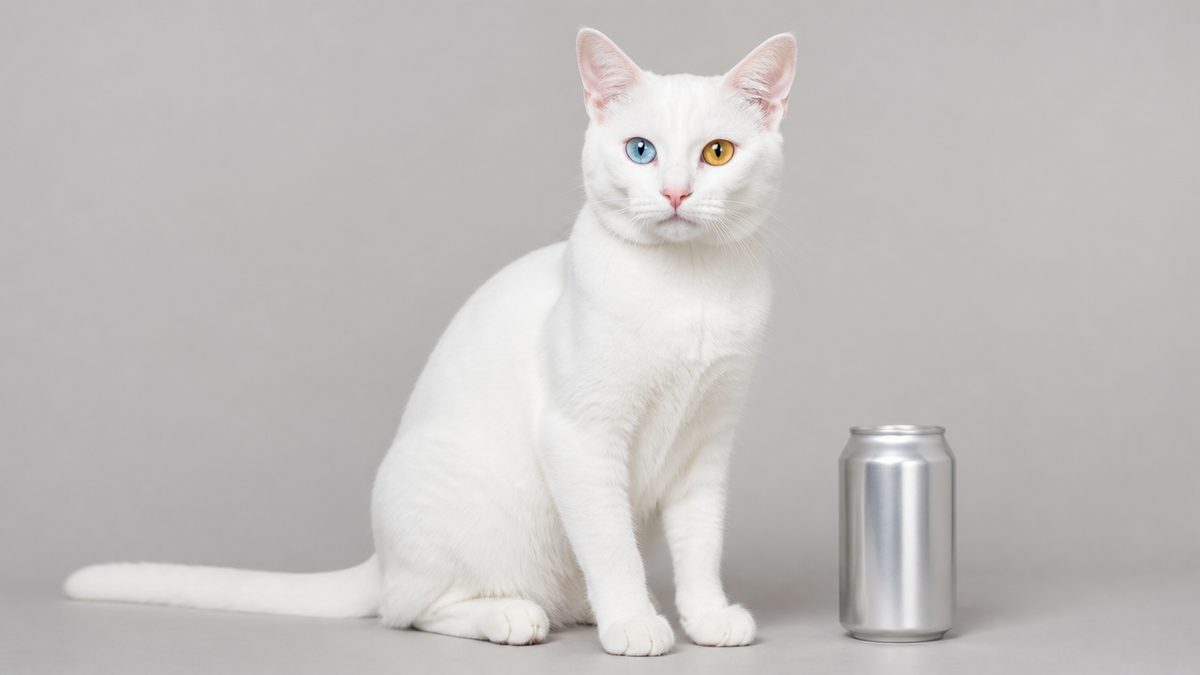
A Khao Manee is a medium, firmly muscled, semi-foreign shorthaired cat that is pure glistening white with luminous eyes of any clear vivid colour, and any colour but white disqualifies it.
One document does most of the defining, and it is short. The Cat Fanciers' Association's Khao Manee standard is a single page carrying the 2026 mark, and it opens by calling the breed a natural breed of Thailand that exists only in white with shimmering eye colours. Khao Manee means white gem, and the Thai people prized this cat for its gem-like eyes. The breed travels under two other names in English, Khao Plort and the Diamond Eye cat, and Wikipedia carries both alongside the ancient-ancestry framing this page tests below.
The eyes carry 15 points and the colour carries 20
The eyes are slightly to moderately large and luminous, an open almond shape with a noticeable Asian slant, set a bit more than an eye width apart. Any eye colour is permissible provided it is clear and vivid, and the standard names three families: any shade of blue including pale blue, aqua and blue with red reflections; yellow including brown, copper, amber, yellow and hazel; and green from pale peridot-like to deep emerald. It adds an unusual clause, allowance and appreciation for multiple colours or shades between eyes or within an eye, which is how a registry writes down that odd eyes are the point.
Thailand's own account says the same thing from the other direction. A Fine Arts Department library records that the Khao Manee has an all-white coat with either two yellow eyes or two blue eyes, and that crossing the two types gives the two-coloured eye that earned it the name cat of gems. A Thai university library gives the identical breeding note.
The head is a modified wedge, not an oriental one
The head is a modified wedge of medium width and moderate length, appearing oval from the front with a chiselled look and high cheekbones set along the lower curve, and the tip of the nose and the tips of the ears must form the points of an equilateral triangle. Ears are slightly large, wide at the base with oval tips, and should point toward 11 and 1 o'clock. The standard penalises both a short blunt muzzle and a long pointed one, which places this cat between a British Shorthair and a Siamese rather than at either end.
The standard explains itself by climate, which is rare
Most breed standards describe. This one gives a reason. It says that like other native cats of Thailand, the Khao Manee should have characteristics suitable for the hot, wet, tropical climate, including a lithe but not extreme body, a medium length nose to handle hot air better than a short nose, a short smooth coat, and a muscular and athletic but never bulky body. That single sentence is the most useful thing on this page for an Indian reader, and the climate section below tests it against real numbers.
| Feature | What the standard requires | What disqualifies |
|---|---|---|
| Colour | Pure, glistening white; nose leather, lips and paw pads pink | Any colour but white |
| Kitten exception | A headcap of colour showing the underlying genotype may persist to 18 months | Not a fault before 18 months |
| Eyes | Slightly to moderately large, luminous, open almond, Asian slant, any clear vivid colour | Crossed eyes |
| Head | Modified wedge, oval face, high cheekbones, equilateral triangle to the ear tips | Narrow upper head is penalised |
| Body | Medium torso, very firm musculature, agile, springy, never meaty or cobby | Overly cobby or overly foreign is penalised |
| Coat | Medium short, fine, slightly open, revealing musculature, sparse to moderate undercoat | Coarse or fluffy is penalised |
| Tail | Medium, proportional, tapering; palpable and tip-third visible kinks accepted | A visible kink from the base to two-thirds along |
| Feet | Oval, medium, five toes in front and four behind | An incorrect number of toes |
Most modern standards disqualify any tail kink. This one accepts palpable kinks anywhere and visible kinks in the last third, and disqualifies only a visible kink from the base to two-thirds along. That is a registry writing down that kinked tails are ordinary in the native Thai population and choosing not to breed them out at the cost of the gene pool. It is worth knowing before a seller tells you a slight kink means the cat is not purebred.
Registry recognition, and a standard that contradicts itself on its own page
Three registries of six hold a Khao Manee standard, and the CFA's own current document cannot decide which class the breed is in. Its heading says Provisional and its footer says Miscellanous.
State registry recognition per body rather than as one global claim. On this breed there are three holders, three non-holders, and one registry disagreeing with itself inside a single page.
| Registry | Status | The document that settles it |
|---|---|---|
| CFA | PROVISIONAL by the heading, MISCELLANEOUS by the footer of the same page | The one-page standard carrying the (c)2026 mark, headed Khao Manee (Provisional Category) |
| TICA | RECOGNISED. Filed as Khaomanee, one word, among the 73 breeds | Browse All Breeds, plus its absence from all three sub-class indexes |
| WCF | RECOGNISED, code KAM, Category 4 Oriental Group | The EMS code table actualised 6 June 2026, crediting WCF, CFA and TICA |
| GCCF | NOT HELD. No standard exists | Standard of Points, June 2026, where Khao Manee returns zero across 723,034 characters |
| FIFe | NOT HELD. No EMS code | The breeds index, 49 codes, where Khao and KAM both return zero |
| LOOF | NOT HELD | Liste des Races, version au 1 January 2026, where the name returns zero |
The CFA promotion, visible in two documents a year apart
The 2024-2025 show standards book indexes the breed as KHAO MANEE Miscellaneous Category (revised 2022), and the standard printed inside it is headed Khao Manee (Miscellaneous Category). The current standalone standard, carrying the 2026 mark, is headed Khao Manee (Provisional Category). So the breed moved up a rung between the two documents, which is the CFA ladder working as designed.
What is odd is that the footer of the current page still reads Khao Manee Miscellanous Show Standard (2026), with Miscellaneous misspelled and the superseded class name still in place. One page, two classes, and a typo in the word that names the wrong one. The breed-council ballot hedges the same way, filing the single entry under a block headed Committee Chairs for Miscellaneous/Provisional Breeds.
TICA's own class indexes contradict TICA's own history text
TICA's breed page says the association accepted the Khao Manee for Registration Only in May 2009 and moved it to Preliminary New Breed effective May 2012. Read against TICA's live indexes on 9 September 2026, that sentence is stale. The Khaomanee sits in the Browse All Breeds index of 73 recognised breeds, and it appears in none of the three sub-class indexes: Advanced New Breeds holds only the Serengeti and the Toybob, Preliminary New Breeds returns the literal line No matches found, and Non-Championship holds only the household-pet classes.
Register membership drifts in weeks on this site's evidence, so date-stamp both readings rather than choosing between them. What a buyer needs is the practical consequence: a TICA pedigree for this cat exists and is current, and a CFA one exists but will carry a class name that has changed at least once since 2022.
The name is spelled two ways and only one finds anything
Two of the three non-holders are worth checking yourself, because both are cheap to verify. FIFe's breeds index returns 49 breed codes including THA, KOR and SIA, and the strings Khao and KAM both return zero, so no FIFe code exists. The French studbook's Liste des Races of 1 January 2026 returns zero for the name while carrying THAI THA with a championnat tick as an in-document control. TICA files the breed as Khaomanee, one word, and its own at-a-glance text hedges with sometimes known as Khao Manee. The CFA and the World Cat Federation both use two words. Searching a registry index for the wrong form returns nothing, which is a manufactured absence rather than a finding, and it is the same class of error this site has recorded for the Kurilian and Kurilean spellings at the GCCF.
A search of the trade mark register through TMview returns two marks worldwide containing khao manee, and both are Thai restaurant marks in the food-services class rather than anything to do with animals. The reason is linguistic: khao means white and manee means gem, so the name is two ordinary Thai nouns. The instrument was proved in the same session against a control that returns four live-animal marks. Nobody owns this breed's name, which makes what happens next more interesting rather than less.
History, and where the Thai sources and the registries part company
The Khao Manee's documented history begins in the early Rattanakosin period, not in 1350. Thailand's Fine Arts Department and a Thai university library both say the breed is absent from the Ayutthaya treatise of 17 auspicious cats that every English page cites.
TICA's breed page makes a specific historical claim twice. Its history section says references to the Khaomanee are found in the Tamra Maew, an ancient collection of Thai cat poems from 1350, where the cat is called the Khao Plort, and its Did You Know block repeats that the breed is mentioned in a 14th century book of poems. That claim is repeated across the English-language internet.
What Thailand's own institutions say
Thailand's Fine Arts Department, through the Rachamangkhalaphisek National Library in Chanthaburi, states in Thai that the Khao Manee does not appear recorded in the treatise of the 17 auspicious cats of the Ayutthaya period, and was found additionally in the early Rattanakosin period. It goes further and names the manuscript: the cat's former name in the samut khoi treatise of Wat Arun is Maew Khao Plort, described there as a jewel cat beyond price, written in an old Thai hand resembling Ayutthaya-period letters, of unknown authorship, and carrying no dedicated verse of the kind the 17 auspicious cats each have. All it says is that the wise person should keep it.
A second Thai institution says the same thing independently. Ramkhamhaeng University's central library lists all 17 auspicious cats by name and all 6 inauspicious ones, 23 in total, and then states in one clause that the Khao Manee, or Khao Plort, does not appear in the Thai cat treatise but is nonetheless classed as a Thai cat. Its own Khao Manee entry adds where the real evidence lives: temple murals in the Thonburi district, and specifically the ubosot of Wat Thong Nopphakhun.
A peer-reviewed paper dates the two manuscripts and closes the gap
The Thai genetics study gives the dates that make the disagreement legible. It records that in Thailand, ancient texts such as the Cat-Book Poems, dated 1350 to 1767, and the Smud Khoi of Cats, dated 1868 to 1910, identified 23 cat breeds, and that today only five remain. Put those dates beside the Fine Arts Department's account and the picture resolves: the 17 auspicious cats belong to the earlier text, the Khao Plort appears in the later Rattanakosin manuscript tradition, and the gap between them is roughly five centuries.
| Source | What it says about the Khao Manee's first appearance | Type of source |
|---|---|---|
| TICA breed page | Referenced in the Tamra Maew, a collection of cat poems from 1350, as the Khao Plort | A registry's own breed page |
| Fine Arts Department, Thailand | Absent from the 17 auspicious cats of Ayutthaya; found in the early Rattanakosin period, in the samut khoi of Wat Arun | A Thai government cultural agency |
| Ramkhamhaeng University Library | Does not appear in the Thai cat treatise; evidence is in Thonburi temple murals | A Thai university library |
| Jaito 2024, peer reviewed | Cat-Book Poems 1350 to 1767; Smud Khoi of Cats 1868 to 1910; 23 breeds named across both | A genetics paper's own dating |
A hypothesis about how the error happened, labelled as one
One of the 17 auspicious cats is Pat Sawet, also called Pat Talot. The Khao Manee's old name is Khao Plort. Those two names are close enough in a romanised transcription that a confusion is plausible, and Sawet means white, which would make the confusion easier still. No source states this, so it is offered as a hypothesis and nothing more. What is documented is that two Thai institutions and one peer-reviewed paper place the cat outside the 1350 text.
Rarity and antiquity are what the international price is built on, and the seven-hundred-year claim is the load-bearing part of it. Correcting the date does not make the cat less good. It makes one of the arguments for a Rs 70,000 price tag weaker, and it tells an Indian buyer that the strongest evidence for this breed is a mural in a Bangkok temple rather than a poem, which is a more interesting thing to know.
Thailand claimed this cat in 2025, and said why
The Thai Cabinet designated five native cat breeds as national identity in the pet category, and the Khao Manee is one of them. The government's own announcement names preventing unauthorized foreign registration as a declared priority.
This site's playbook already carries a rule that a breed's status can sit with the state rather than with a cynological body, and the Khao Manee is the cleanest cat-side example of it. Thailand's Government Public Relations Department announced on 19 November 2025 that the Cabinet had officially approved five indigenous Thai cat breeds as national emblems in the pet category, on a proposal from the National Identity Committee, naming the Suphalak, Korat, Wichien Maat, Kornja and Khao Manee.
The announcement places the designation alongside other national symbols established between 1964 and 2024, including the Thai elephant as the national animal, the Siamese fighting fish as the national aquatic animal, the Naga as the national mythical animal emblem, and the wai as the national gesture of respect. This is a cultural instrument rather than a breed register, and it does not issue pedigrees.
The sentence worth quoting
The government states that Thai cats are internationally recognised and popular, and that this has led to attempts by foreign entities to register purebred Thai cats and establish breed standards independently. It then lists three declared priorities. Preservation, establishing a foundation for conservation and the development of unified breed standards. Protection, safeguarding Thailand's ownership rights and preventing unauthorized foreign registration. And economic development.
Set that beside the recognition table above and the tension is plain. The three bodies holding a Khao Manee standard are the CFA and TICA, both American, and the World Cat Federation, German. Thailand's position is that unified breed standards should be developed under Thai auspices. Neither side has done anything wrong; they are simply two different claims about who defines a native breed, and both are current.
Two Thai government sources give two different dates
The Government Public Relations Department published its announcement on 19 November 2025. The Fine Arts Department's own library article, published the same month, dates the Cabinet's approval of the National Identity Committee proposal to 21 March 2568 in the Thai era, which is 21 March 2025. Both are Thai state sources and they are eight months apart.
Publish the disagreement rather than picking one. The likeliest reconciliation is two Cabinet steps, an approval in principle and a formal designation, but no document seen here says so, and inventing a reconciliation is worse than reporting the gap. What is not in doubt is that the designation exists and that the Khao Manee is in it.
| Thai name | Western name | Registry position on 9 September 2026 |
|---|---|---|
| Wichien Maat | Siamese | Held by every major registry |
| Si Sawat | Korat | Held by CFA, TICA, FIFe, WCF and GCCF |
| Suphalak | Suphalak | Held by the World Cat Federation alone, recognised 2024 |
| Khao Manee | Khao Manee | Held by CFA, TICA and WCF; absent from GCCF, FIFe and LOOF |
| Konja | Konja | Held by no registry in the WCF cross-registry table |
Very little legally and quite a lot practically. A Thai national-identity designation confers no import restriction and no pedigree, so nothing about bringing a cat to India changes. What it does is tell you that the Thai state has an active interest in this breed's definition, that unified Thai breed standards are a stated goal rather than an existing document, and that an English-language cattery's account of the breed's history is not the last word. Read the Thai sources too.
Khao Manee cat price in India, and the carousel of eight dogs
No verifiable Khao Manee price exists in India. The listing page that ranks for the Indian query carries eight prices in its raw HTML and every one of them belongs to a dog, and Google's AI answer rounds one of those dog prices into its own ceiling.
Read the raw markup rather than the rendered page, because that is where the evidence is. The Puppiezo page titled Khao Manee Puppies For Sale carries, under a heading reading Looking for Your Perfect Companion?, exactly eight prices: Rs 98,999, Rs 92,599, Rs 92,599, Rs 94,999, Rs 1,20,000, Rs 98,999, Rs 76,499 and Rs 98,999. The same markup contains the strings Fizey, Samy and Yoki, twice each.
Those are the names and the figures this site has recorded on ten other breed pages of the same site, attached to two Maltipoos, two Poodles, a Cane Corso, a Goldendoodle, a Rottweiler and a Doxiepoo. Not one of the eight animals is a Khao Manee, and not one is a cat. This is the first time the carousel has been confirmed on a cat page.
The page also tells you what it is, if you read the headings
- The page title reads Khao Manee Puppies For Sale, on a listing for a cat.
- A section heading reads Never feed these foods to Khao Manee Puppies For Sale, with the product title substituted into it.
- A trait row reads Compatibility with Dogs, on a page about a cat.
- The calorie block reads Puppies 400 kcal and Adult 350 kcal, which are dog figures.
- The product sits under a path reading product, on a site whose search result headline reads Buy Dogs Online.
That is the template seam this site has documented elsewhere. The parts a person retyped name the cat; the parts the software filled in name a dog. A page assembled that way is evidence about the software, not about the animal or its price.
What Google's AI answer did with it
Google India's AI Mode reports that a Khao Manee cat generally costs between Rs 30,000 and Rs 95,000 in India and cites Puppiezo plus one other source. The floor is the Indian breed guide's Rs 30,000. The ceiling of Rs 95,000 is a rounding of the Rs 94,999 in the carousel, which belongs to a Cane Corso. A rupee band assembled from a dog's price and a template row is not a price for this cat.
| Figure | Where it appears | What it is |
|---|---|---|
| Rs 30,000 to Rs 70,000 | happypet.care spec card and prose | A template breed guide's band, on a page whose own cost lines carry a misplaced zero |
| Rs 98,999 (three times) | puppiezo.com raw HTML | The house price point tracked across ten other breed pages, attached to dogs |
| Rs 94,999 | puppiezo.com raw HTML | A Cane Corso listing, rounded by an AI answer into this breed's ceiling |
| Rs 30,000 to Rs 95,000 | Google India AI Mode | A splice of a template floor and a dog's price |
| 7,000 to 11,000 US dollars | Western profiles, repeated by Indian aggregators | A foreign market figure; converting it into rupees would be fabrication |
| No row at all | India's leading cat-price guide, 14 breeds | The honest position for the Indian market |
The 7,000 to 11,000 dollar band is the single most repeated number about this breed, and multiplying it by an exchange rate would produce a confident, false Indian price. This site has documented answer engines doing exactly that on other breeds, printing a rupee band immediately after saying no local price exists. No conversion appears on this page. If you are quoted an Indian rupee price for a Khao Manee, ask which cattery bred the cat, in which country, and ask to see the registration certificate before the conversation goes any further.
What a Khao Manee actually costs to keep in India
The cost of ownership for an odd-eyed Khao Manee is the cost of ownership for any medium shorthaired cat, plus one test. Budget a monthly cost of roughly Rs 2,800 to Rs 4,500 in an Indian metro, plus about Rs 5,000 to Rs 9,000 in the first year once the kitten course and neutering are paid for. One extra line applies to this cat specifically, and it is the hearing test.
The Indian breed guide for this cat prints a monthly range of Rs 2,800 basic to Rs 10,500 premium, and the second of those numbers is wrong in a way you can check in ten seconds. Its three component lines read food Rs 1,500 to Rs 2,000, healthcare Rs 500 to Rs 7,000 and grooming Rs 800 to Rs 1,500. Add the lower ends: 1,500 plus 500 plus 800 is 2,800, which matches. Add the upper ends: 2,000 plus 7,000 plus 1,500 is 10,500, which also matches.
Now compare the same site's Javanese page, which prints the identical food line, the identical Rs 2,800 basic total, and a healthcare line of Rs 500 to Rs 700 producing a Rs 4,200 premium total. The Khao Manee's healthcare ceiling is Rs 7,000 where its sibling's is Rs 700. A single misplaced zero, propagating straight into a headline monthly figure that is 2.5 times too high, on the page that ranks first for the Indian query.
| Item | Published figure | Source and scope |
|---|---|---|
| Kitten vaccination course | From Rs 3,999 for three visits at days 60, 90 and 120 | One national clinic chain's own listing, against a struck-through Rs 5,065 |
| Adult annual booster | From Rs 1,899 | Same chain, national page |
| Anti-rabies, single dose | Rs 699 | Same chain |
| Feline CRP test | Rs 1,249 | Same chain |
| Annual vaccination, second source | Rs 1,500 to Rs 3,000 | India's leading cat-price guide, a wider band from a different publisher |
| Pet licence, Chennai | Rs 50 | Greater Chennai Corporation, which issued 9,115 licences in 2024 |
| Municipal treatment and anti-rabies, Chennai | Free of cost | Greater Chennai Corporation's six pet clinics |
| BAER hearing test | No published Indian rate found | Available at referral and teaching hospitals; ask before you buy, not after |
The one line this breed adds
A brainstem auditory evoked response test is the screen that decides how this cat should be kept, and no published Indian price for it was found on 9 September 2026. That absence is itself worth stating rather than filling in with a guess. Ask a referral hospital or a veterinary college in your city for a quote, and ask the seller whether the kitten and both parents have already been tested, because a responsible breeder will have the reports.
Where this coat saves money and where it does not
Grooming is genuinely cheap. Purina India puts the requirement at once a week, and a medium-short slightly open coat needs nothing a salon can sell you. Against that, a white cat in India adds one cost most owners never budget: shade. Window film, a mesh that keeps the cat off a sunlit terrace, and an indoor perch away from direct glare are one-time purchases that matter more here than a grooming package.
Add the vaccination course, one neutering, one carrier and three months of food, then compare that total against whatever a seller is asking. For most Indian buyers the first-year care cost is comparable to the purchase price of an ordinary cat and a small fraction of a claimed pedigree price. If the asking price is many times the care cost, the seller is charging for a story, and this page has already shown that the story's dates do not hold.
Heat tolerance in India, and the standard that already answered this
The Khao Manee is the best-adapted cat on this site for Indian coastal heat, and the evidence is arithmetic rather than opinion. Bangkok's annual mean of 27.85 degrees C sits 0.10 degrees from Chennai's 27.95.
Start with the breed standard, because it makes a climate claim outright. It says that like other native cats of Thailand, the Khao Manee should have characteristics suitable for the hot, wet, tropical climate, including a lithe but not extreme body, a medium length nose to handle hot air better than a short nose, a short smooth coat, and a muscular and athletic but never bulky body. That is a registry stating that the morphology exists because of heat.
Now test it. NASA POWER, queried by explicit latitude and longitude with the cell elevation echoed back on every point, returns a Bangkok cell at 4.48 m against a real 1.5 m, an error of about 3 m, so the cell is the city. Its annual mean is 27.85 degrees C at 74.45 percent relative humidity. Chennai's cell sits at 48.95 m against a real 6.7 m and returns 27.95 degrees C at 72.39 percent.
| Place | Annual mean, C | Annual RH, percent | Hottest month | Peak Stull wet bulb, C |
|---|---|---|---|---|
| Bangkok, Thailand | 27.85 | 74.45 | April, 30.73 | 25.99 (May) |
| Ayutthaya, Thailand | 27.83 | 72.21 | April, 31.22 | 25.75 (May) |
| Chennai | 27.95 | 72.39 | May, 31.51 | 26.11 (May) |
| Kolkata | 25.81 | 73.93 | May, 31.53 | 27.09 (June) |
| Mumbai | 26.77 | 67.39 | May, 31.19 | 25.77 (June) |
| Delhi | 25.60 | 45.56 | June, 35.88 | 26.50 (July) |
| Hyderabad | 26.10 | 60.30 | May, 33.30 | 23.35 (June) |
| Ahmedabad | 27.57 | 48.32 | May, 35.06 | 26.11 (June) |
| Bengaluru | 23.74 | 67.94 | April, 28.37 | 21.86 (May) |
Read the first three rows together. Bangkok and Chennai differ by 0.10 degrees in annual mean, by 2.06 points in humidity, by 0.12 degrees in peak wet bulb, and their wet bulb peaks fall in the same month. Ayutthaya, the old capital where the Thai cat texts were written, is 0.12 degrees from Bangkok. A cat selected for Bangkok is, in the only numbers that matter, already selected for Chennai.
Where India is harder than Thailand
Two places. Delhi's June mean of 35.88 degrees C is roughly five degrees above anything Bangkok reaches, and Delhi's 45.56 percent annual humidity is a genuinely different climate rather than a warmer version of the same one. And Kolkata's June wet bulb of 27.09 is the highest figure in the table, above both Thai points, so the eastern monsoon is harder on any cat than Bangkok is. Ahmedabad is the other hard case, at a May mean of 35.06 degrees C on 48.32 percent annual humidity, which is dry heat rather than the wet heat this cat was selected for, and Hyderabad at 33.30 in May sits between the two. The easiest Indian cities for a Thai cat are the coastal ones, and Chennai in Tamil Nadu is the closest match on the table.
The real Indian constraint is light, not heat
This is the part no ranking page says. A white cat has no melanin in the skin of its ear tips, eyelids and nose, and India sits at latitudes with high ultraviolet loads for most of the year. A transcriptome analysis reports that the ratio of squamous-cell-carcinoma-suppressing to promoting gene expression may be considerably lower than theoretically expected in white coat skin cells. That study is a bioinformatic analysis rather than a clinical trial, so treat it as a mechanism and not as a risk figure.
Sun exposure is therefore the variable to manage, and the practical instruction does not need a risk figure. Keep a white cat off a sunlit terrace and away from a south-facing window between roughly 10 am and 4 pm, and have any crusting or non-healing sore on an ear tip, an eyelid margin or the nose looked at by your nearby vet promptly rather than watched for a month.
Purina India's need-to-know list labels the Khao Manee an Outdoor cat. For this breed in this country that is the wrong advice twice over. An unpigmented cat outdoors in Indian sun is the squamous cell carcinoma exposure described above, and a cat that may be deaf in one or both ears is a cat that cannot hear traffic. The same page is right about the deafness link and right to recommend testing, which is why it is worth reading and worth disagreeing with.
Health, and the one question that has three different published answers
Deafness is the health question for this breed, and three studies of client-owned white purebred cats report 16.7 percent, 20.2 percent and 30.3 percent. None of the three included a Khao Manee, and they also disagree on whether blue eyes predict it.
There is almost no breed-specific literature. A PubMed audit run on 9 September 2026, reading the query translation on every query, returned exactly one record for Khao Manee[tiab], and that record is the Thai microsatellite study rather than a clinical paper. The control returned 126 with a sane translation in the same session. So the evidence has to come from the white-cat literature, and it is substantial.
The mechanism, which is settled
The dominant white locus in the cat is KIT on chromosome B1, and the cause is the retrotransposition of a feline endogenous retrovirus into KIT intron 1. A full-length 7,125 bp element is associated with white spotting; a long terminal repeat alone is associated with all dominant white individuals. Deafness is genetically linked to and associated with that marker, with estimated P values in the range 0.007 to 0.10 across a survey of 270 cats from 30 breeds. The insertion interrupts a regulatory site in KIT intron 1 conserved across mammals.
A later transcriptome analysis proposes how that translates into a deaf ear. It reports frequent production of KIT lacking its first exon in white-coated skin cells, and a substantial negative correlation between that product and expression of SOX10, which is essential both for melanocyte formation and for adjustment of hearing function. Melanocytes are needed in the inner ear, not only in the coat, which is why one gene produces both a white cat and a deaf one. Broader review work places this cat squarely in the class where deafness tracks white pigmentation loci and the cochlear pathology is cochleo-saccular.
The rate, which is not settled
| Study | Cats | Overall deafness | Bilateral / unilateral | Blue irises associated? |
|---|---|---|---|---|
| Cvejic 2009, Germany | 84 across 10 breeds | 20.2 percent | 10.7 / 9.5 percent | Yes, P equal to 0.04 |
| Mari 2019, United Kingdom | 132 solid white kittens | 30.3 percent | 15.9 / 14.4 percent | Yes, 3.2 times more likely |
| Kortas 2022, Poland | 72 across 6 breeds | 16.7 percent | 5.6 / 11.1 percent | No, P equal to 0.91 |
Two of the three found unilateral deafness roughly as common as bilateral, and the third found it twice as common. Two found blue irises predictive and one did not. All three authors nonetheless reach the same practical conclusion, which is to test white cats regardless of eye colour. That is the sentence to act on.
One caveat this page will not skip. The UK study found deafness only in solid white kittens and not in their coloured littermates, and its per-breed figures run from 46.7 percent in Turkish Vankedisi down to 4.8 percent in Russians. No Khao Manee appears in any of the three. So these figures describe the allele this breed carries, not a measured rate in this breed, and a page quoting any single number as the Khao Manee's deafness rate is overstating what exists.
What a unilaterally deaf cat is actually like
- A unilaterally deaf cat usually behaves normally and most owners never notice, which is why testing rather than observation is the answer.
- A bilaterally deaf cat lives a full indoor life, sleeps deeply, startles when touched unexpectedly, and is often unusually vocal because it cannot hear itself.
- Approach a deaf cat within its line of sight, and use a floor vibration or a light switch rather than a voice to get its attention.
- Never allow a deaf cat outdoors unsupervised in an Indian city, because traffic is the risk that hearing would have managed.
- Tell your vet before any procedure, so nobody assumes the cat is unresponsive from sedation when it simply cannot hear.
Everything else, in proportion
Hypertrophic cardiomyopathy is the commonest feline heart disease and may affect up to approximately 15 percent of the domestic cat population, mostly subclinically, with a genetic cause identified in only two breeds and suspected in a third. No gene test applies to this breed. An echocardiogram on breeding parents is the only screen that means anything, and sudden hind-limb weakness in a cat is an emergency.
Lifespan has no breed figure. The largest UK feline life-table analysis reached its 15-death inclusion threshold for exactly 12 breeds, and this cat is not among the 12 that reached that threshold; the string Khao returns zero across the whole paper. TICA gives 10 to 12 years and the Indian guide gives 12 to 15, neither citing a study. Crossbred cats in that table sit at 11.89 years on 7,117 deaths.
Everything above is published research summarised for a reader, not a diagnosis. A BAER test needs equipment most general practices do not have, so ask a referral hospital or a veterinary college. Take crusting or non-healing sores on a white cat's ear tips, breathlessness, sudden hind-limb weakness or collapse to a clinic immediately rather than researching them.
Temperament and household fit
A Khao Manee is active, talkative, socially dependent and unusually people-focused, and it does badly alone. TICA calls the breed very sociable and Purina India files it as sociable and dependent.
TICA describes a graceful, curious cat that is very calm and relaxed and makes an ideal lap companion, and in the same breath says the breed has been known for being very talkative and verbal, so be prepared for many back-and-forth conversations. Both halves are true of the same cat at different hours. Purina India adds that the breed is reputed to be active, outgoing, communicative, intelligent and playful, people-loving, with a lovely purr.
Who this cat suits in India
- Households where somebody is home for most of the day, because TICA says plainly that the breed does not like being left alone for long periods.
- Homes with a second cat or a cat-friendly dog, since TICA reports a good fit with young children and other pets including dogs.
- Flats rather than houses with terrace access, for the sun and the traffic reasons set out in the climate section.
- Owners willing to arrange a hearing test and to adapt if it comes back positive, rather than owners hoping it will not.
- Anyone in Chennai, Mumbai or Kolkata who wants a pedigree cat that is not fighting the climate.
Who should not buy one
- Anyone out for a twelve-hour Indian working day with no second animal at home.
- Anyone who wants a quiet cat, because this one talks and a deaf one talks more.
- Anyone who intends to let the cat roam, which for a white and possibly deaf cat is the wrong plan in an Indian city.
- Anyone buying on the seven-hundred-year story, since this page has shown the Thai sources date the cat differently.
- Anyone who cannot verify what they are buying, which given the state of the Indian listings is most buyers.
If the BAER test comes back showing deafness in one or both ears, the correct response is a change of management rather than a change of mind. Bilaterally deaf cats live ordinary indoor lives, and the adaptations are small: approach in sight, use vibration rather than voice, and keep the cat indoors. The cats that suffer are the ones whose owners never found out.
Training approach, including for a cat that cannot hear you
Train a Khao Manee with short reward-based sessions and hand signals rather than voice cues, because roughly one white purebred cat in five to one in three is deaf in at least one ear. Hand signals work on hearing cats too.
To train this breed, use visual markers from the start. A hearing cat loses nothing by learning a hand signal, and a cat that turns out to be unilaterally or bilaterally deaf loses everything if you built the whole system on a clicker. Given prevalences of 16.7 to 30.3 percent across three studies of white purebred cats, that is a sensible default rather than a precaution.
Five things worth teaching first, in India specifically
- Carrier entry on a hand cue, because a monsoon vet trip is harder with a cat that fights the box.
- Come to a light flash or a floor tap, which replaces recall for a deaf cat and works for a hearing one.
- Settle on a shaded perch, which is the behaviour that keeps a white cat out of direct Indian sun.
- Accept ear and eye handling for ten seconds a day, so weekly humid-season checks stay uneventful.
- Tolerate a harness, since supervised outdoor time in shade is the safe version of the outdoor life one page recommends.
What this cat resists
It resists being ignored, and that is the whole list worth taking seriously. TICA describes a cat that will happily play fetch and will not think twice about exploring every nook and cranny of the house. An intelligent, athletic cat with nothing to do finds something, and in an Indian flat that usually means the kitchen counter or the balcony grille.
Punishment is worse than useless with any cat and meaningless with a deaf one, since a raised voice is not information the animal receives. Redirect and reward instead.
Never wake a deaf cat by touch alone. Put a hand near it so it feels the air move, or press the floor or mattress so it feels the vibration, then touch. Owners who skip this get bitten once and then wrongly conclude the cat is aggressive.
Daily exercise requirement in an Indian flat
A Khao Manee needs about 30 to 60 minutes of active play a day, split across the cool ends of the day. In an Indian city that means before nine in the morning and after sunset, for reasons of light as much as heat.
TICA describes an outgoing and playful cat, very curious and athletic, highly intelligent with an inquisitive nature, that will happily play fetch. Purina India files the breed as highly active and inquisitive. Neither is a cat that entertains itself on a windowsill.
How to split it
- Two wand sessions of ten to fifteen minutes, early morning and after dark, avoiding the middle of an Indian day.
- One food-puzzle meal daily, which converts feeding into working time at no extra cost.
- Vertical furniture in at least two rooms, placed away from direct window glare rather than on the sunniest ledge.
- A mesh-secured window perch, which gives hours of low-effort stimulation without letting a possibly deaf cat out.
- Fetch, which this breed genuinely plays and which needs no equipment at all.
The timing rule is about ultraviolet as well as heat
Most breed pages tell you to avoid midday play because of temperature. For a white cat the stronger reason is light. The sunniest hours are also the hours of highest ultraviolet exposure on unpigmented ear tips and nose, so the ideal play spot in an Indian flat is a shaded interior room rather than the balcony, even on a mild day in December. Chennai's coolest month averages 24.09 degrees C, which is comfortable and still bright.
Counter-surfing, night vocalisation, door-opening and overgrooming are the standard signs, and a deaf cat vocalises more than a hearing one at the best of times. Add twenty structured minutes a day for two weeks before concluding anything else, and take genuine overgrooming to your nearby vet, because skin disease and boredom look identical in a photograph.
Grooming a white shorthair in Indian humidity
Brush a Khao Manee once a week and check the ears weekly through the monsoon. The coat is the easiest job on this site; keeping a white cat clean in an Indian city is the part that takes thought.
The standard describes hair that is medium short in length, fine and slightly open, smooth enough to reveal the musculature, with a sparse to moderate undercoat, neither coarse nor fluffy. Purina India puts the requirement at grooming once a week and TICA says most Khaomanee cats are very low maintenance due to their short hair, recommending brushing once a week. Three sources, one answer.
The weekly routine, in full
- Brush once a week with a soft rubber curry or a fine comb, which removes loose hair without stripping the light undercoat.
- Check ears weekly between June and September and fortnightly otherwise, using a dry cotton pad rather than any liquid.
- Inspect the ear tips, eyelid margins and nose every week for crusting or a sore that does not heal, and photograph anything you find so you can see whether it changes.
- Trim nail tips every two weeks, taking only the white tip, which is the standard advice TICA gives across its breeds.
- Brush teeth twice a week with a veterinary paste, since dental disease is the health cost owners most consistently under-budget.
What Indian humidity actually changes
Humidity does not mat this coat, because there is barely any undercoat to felt. What it does is favour ear and skin problems, and the answer is inspection rather than more brushing. Do not bathe on a schedule. Bathe when the cat is genuinely dirty, plug the ears first, and dry it properly with a towel and a fan on a low setting rather than leaving it to air-dry, because in a Chennai or Kolkata monsoon the ambient humidity runs above 85 percent for weeks and air drying is slow enough to matter.
The one grooming question specific to a white cat
A white cat shows every stain, and the temptation in an Indian household is to bathe it often or to use whitening products sold for show dogs. Do neither. Frequent bathing strips the coat and irritates skin that already has no melanin protection, and whitening preparations are not formulated for cats, who groom everything off their coat and swallow it. Spot-clean with plain warm water and leave the rest.
White kittens are sometimes born with a small darker mark on the top of the head, and Purina India records that this is normal and has usually disappeared by around one year of age. The CFA standard allows for exactly this, saying a headcap of colour indicating the underlying genotype may persist until 18 months. A seller discounting a kitten for it, or a buyer rejecting one over it, is misreading the standard.
What the Thai genetic survey actually found
The five surviving Thai cat breeds are barely distinguishable from one another genetically, and the Khao Manee carries the highest allelic richness of the five. The paper's own numbers make the case for keeping the Thai population open rather than closed.
One peer-reviewed study covers this ground, and it is Thai-led. It genotyped 184 cats from five Thai breeds at 15 microsatellite loci and sequenced the mitochondrial D-loop, and it is the only record PubMed returns for the breed name.
| Measure | Khao Manee | What it means |
|---|---|---|
| Sampled cats | 42 for the microsatellite panel, 37 for the inbreeding analysis | The second-largest sample of the five after the Wichien Maat |
| Allelic richness | 8.423 | The HIGHEST of the five breeds, against 7.369 for the Wichien Maat |
| Observed heterozygosity | 0.511 | Against an all-population mean of 0.522, so ordinary rather than depleted |
| Inbreeding coefficient FIS | 0.0002 | Effectively zero, and the closest to zero of the five |
| Effective population size | 19.6, 95 percent interval 15.7 to 26.0 | Small in absolute terms, which is the real conservation concern |
| Mitochondrial haplotypes | 7, haplotype diversity 0.745 | Against 14 across all 184 cats |
The headline finding is about all five breeds at once
The study reports high genetic diversity, with observed and expected heterozygosity above 0.5, in every one of the five breeds, and two primary mitochondrial haplogroups, A and B, shared among all Thai domestic cat breeds and globally. Pairwise differentiation between the five breeds is very low, and only the Wichien Maat shows a distinct genetic structure. The authors read that as allele fixation for distinctive morphological traits in populations that emerged in isolated regions from shared racial origins.
Put plainly, the five Thai breeds are five appearances drawn from one underlying population rather than five separate lineages. That is not a criticism of any of them. It is the honest genetic description, and it explains why a Khao Manee litter can contain kittens of other colours, which TICA's own breed page notes without explaining.
Two cautions on reading this paper
First, the effective population size of 19.6 is a figure about the sampled Thai population, not a census of the breed, and it should not be quoted as the number of Khao Manee in existence. Second, the paper's introduction says that the Wichien Maat and the Korat are recognised by the CFA and TICA, which as of 9 September 2026 understates the position, since both bodies also hold the Khao Manee. That is registry drift in a 2024 paper rather than an error worth making much of, and it is the reason this site date-stamps every registry reading.
Western pages sell this cat on extreme rarity. In Thailand a university library calls the Khao Manee the purebred Thai cat most numerous today, and the genetic survey finds the highest allelic richness of the five breeds in it with an inbreeding coefficient of essentially zero. The cat is rare outside Thailand and unremarkable inside it. That is a supply problem, and a supply problem is not the same thing as a rare animal.
Feeding a Khao Manee in India, by life stage
Feed a kitten three to four small meals a day to about six months, then twice a day as an adult, with wet food doing real work in an Indian summer. The calorie figures printed on the Indian listing page are dog figures.
Start with what to ignore. The listing page that ranks for the Indian query prints a calorie block reading Puppies 400 kcal and Adult 350 kcal. Those are dog values on a cat page, sitting under a heading that also reads Puppies For Sale. The Indian breed guide prints kittens 250 kcal and adults 300 kcal, and the identical pair appears on its unrelated Javanese page, so those are template values rather than a calculation for this cat.
TICA's own guidance is simple and transfers to India unchanged: Khaomanee cats do not have any particular nutritional needs other than good, quality food, and fresh clean water daily matters more than the brand.
- Kittens to six months, three to four small meals a day, weighed rather than eyeballed.
- Six to twelve months, three meals tapering to two, with growth still finishing at a year.
- Adults, two meals a day, with wet food forming a real share rather than a garnish.
- Seniors from about ten years, the same frequency, with an annual blood and urine panel added.
- All ages, water changed daily and placed at least three feet from the food, in more than one room.
Why wet food earns its place here
In Chennai, with an annual mean of 27.95 degrees C and a peak wet bulb of 26.11 in May, total fluid intake is the single easiest thing an owner can influence. Canned food carries water into the cat without asking it to drink, which supports kidney and bladder health, and it is higher in protein and lower in carbohydrate than most dry food. That argument holds for any cat in coastal India and is not breed-specific.
Body condition beats a chart
The standard asks for a cat with very firm musculature that looks agile and feels flexible and springy, not meaty or heavy, and adds that some loose skin on the underbelly is permissible. That is a body-condition instruction hidden in a show standard. Feel the ribs easily under a thin covering, see a waist from above, and treat the belly flap as normal rather than as fat.
Onions and garlic, chocolate, alcohol, cooked bones, raw eggs, grapes and raisins, xylitol and caffeine appear on every credible avoid-list including the Indian breed guide's. Onion and garlic matter more in an Indian kitchen than a Western one, because both are in almost every dish and a cat that scavenges is exposed daily rather than occasionally.
Month by month through a Khao Manee kitten's first year
Get the hearing test done in the first three months, because everything else about how you keep this cat depends on the answer. The rest of the year is an ordinary shorthaired kitten's year.
| Age | What is happening | What to do in India |
|---|---|---|
| 0 to 8 weeks | With the queen. A darker headcap may still show and is normal | Do not take the kitten. Indian pet shop rules treat kittens below eight weeks as un-weaned |
| 8 to 10 weeks | Home transition, litter training, first fears | First vaccination visit; a three-visit course from Rs 3,999 at one national chain |
| 8 to 12 weeks | Hearing is fully developed and testable | Book the BAER test now, at a referral hospital or veterinary college, and ask for both parents' results |
| 10 to 14 weeks | Socialisation window closing; handling habits set for life | Second visit; start hand signals rather than voice cues from day one |
| 14 to 16 weeks | Rabies dose due; climbing begins in earnest | Third visit; mesh the windows and balcony before this stage, not after |
| 4 to 6 months | Rapid growth, teething, first real athleticism | Discuss neutering timing with your vet; set up shaded vertical furniture |
| 6 to 12 months | Adolescent testing; the headcap fades | Annual booster planning; switch to adult feeding at two meals |
| 12 to 18 months | Adult musculature fills in; any headcap should be gone by 18 months | Monthly body condition check and a weekly ear-tip inspection |
The eight-week line is law in India, not etiquette
The Prevention of Cruelty to Animals (Pet Shop) Rules, 2018, read here from the Karnataka Department of Animal Husbandry and Veterinary Services copy, treat kittens below eight weeks as un-weaned, and the Second Schedule's paragraph 2, headed FOR CATS, sets out six housing requirements including that cats or kittens shall be kept in a room which is not shared by other, inimical animal species such as dogs. That last clause is worth quoting to any Indian seller who houses cats and dogs together, and it is directly relevant to a listing site that files cats under a dog products path.
A citable absence from the same instrument: its microchipping requirement is written as micro-chipped and is scoped to puppies, so kittens fall outside it. Microchip a white cat anyway. A cat that gets out of a fourth-floor flat has no other identification, and a deaf one will not come when called.
A BAER report for the kitten and both parents, a vaccination card with dates and batch numbers, a deworming record, the sire and dam registration numbers with the issuing registry named in full, and a willingness to let you visit with the mother present. If the BAER report is missing, everything else is beside the point for this particular breed.
Khao Manee against the cats an Indian buyer is really choosing between
Compare the Khao Manee against the other four Thai national breeds and against the white cats an Indian buyer can actually find. On climate the Thai group wins outright; on availability it loses to every one of them.
Two comparisons matter and they are different questions. The first is which Thai cat to want. The second is what you can actually buy in India, where the honest answer is a white domestic shorthair.
| Cat | How it differs | Registry position | Indian availability |
|---|---|---|---|
| Siamese (Wichien Maat) | Pointed rather than white, blue eyes only, more extreme in Western lines | Held by every major registry | Priced at Rs 15,000 to Rs 40,000 in India's leading guide |
| Thai | Pointed, moderate type, the old-style Siamese preserved | Held by WCF, FIFe, TICA, GCCF and LOOF | No Indian price sourceable |
| Korat (Si Sawat) | Silver-blue rather than white, green eyes, heart-shaped head | Held by CFA, TICA, FIFe, WCF and GCCF | No Indian price sourceable |
| Suphalak | Solid copper-brown, amber eyes | Held by the World Cat Federation alone, recognised 2024 | No Indian price sourceable |
| Turkish Angora, white | Semi-longhaired, a different white gene history, same deafness question | Held by every major registry | Priced at Rs 20,000 to Rs 1,50,000 in India's leading guide |
| White domestic shorthair | No pedigree, the same white allele, the same deafness question | None, and none needed | Free to Rs 2,000 through shelters and municipal routes |
The comparison that decides most Indian purchases
A white Indian domestic shorthair carries the same dominant white allele, faces the same deafness risk, needs the same BAER test and the same sun management, and costs Rs 0 to Rs 2,000 against a claimed Rs 30,000 to Rs 70,000. What the pedigree buys is the head shape, the eye colour selection and a document. Those are real things to want, and they are the only things being bought.
Against the Turkish Angora the argument is closer, because that breed is genuinely available in India and is one of the 14 breeds priced in the national guide. The deciding differences are coat length in an Indian summer, where the Khao Manee's short coat wins, and evidence, where the Angora loses: the UK prevalence study included white Turkish Vankedisi kittens at 46.7 percent affected and no Khao Manee at all.
All five Thai breeds share two mitochondrial haplogroups and show very low pairwise differentiation, with only the Wichien Maat structurally distinct. Choosing between them is choosing an appearance from one population, not choosing between lineages. That makes the choice easier rather than harder, and it means a Thai cat of any of the five is equally well suited to Chennai.
Mistakes Indian buyers make with this breed
Five mistakes account for most bad Khao Manee purchases in India, and the first two happen before anyone looks at a cat.
1. Taking the Indian price from a page selling dogs
The listing that ranks for the Indian query is titled Khao Manee Puppies For Sale, carries a Compatibility with Dogs row, prints puppy calorie figures, and shows a carousel of eight prices in its raw markup that belong to two Maltipoos, two Poodles, a Cane Corso, a Goldendoodle, a Rottweiler and a Doxiepoo. Google's AI answer then rounds one of those dog prices into the ceiling of its own Indian band. Open the page, search the markup, and check whether the number is attached to the animal.
2. Budgeting from a page with a misplaced zero
The Indian breed guide's premium monthly figure of Rs 10,500 is its own three preset lines added up, and one of those lines reads Rs 500 to Rs 7,000 where the same site's other pages read Rs 500 to Rs 700. A reader budgeting from that page plans for a cat 2.5 times more expensive than the template intends. Check that any monthly total you are shown equals the sum of its own components.
3. Skipping the hearing test because the cat seems fine
Unilateral deafness is close to invisible in a household, and it was as common as bilateral deafness in two of the three published studies. A cat that responds to you may still be deaf in one ear. The test is a BAER, it takes minutes, and it changes how you keep the animal for the next fifteen years. Ask for it on the kitten and on both parents.
4. Letting a white cat live outdoors in India
One Indian-facing brand page lists this breed as an outdoor cat. For an unpigmented animal at Indian latitudes, with a real probability of being deaf, that combines an ultraviolet exposure risk with an inability to hear traffic. Keep the cat indoors, use a harness for supervised time, and prefer shaded early-morning and evening access.
5. Paying for a seven-hundred-year story
The antiquity claim is the load-bearing part of the international price, and Thailand's own Fine Arts Department places the breed's first manuscript appearance in the early Rattanakosin period rather than in the 1350 text. The cat is exactly as good either way. The price argument is weaker, and knowing that is worth more to a buyer than the story is.
- Verify the registry and the exact spelling used, since Khaomanee and Khao Manee find different things in different indexes.
- Verify a BAER report exists for the kitten and both parents, in writing.
- Verify the kitten is at least eight weeks old, which Indian pet shop rules treat as the weaning line.
- Verify the seller houses cats away from dogs, which the same rules require.
- Verify the price against the raw markup of whatever page produced it.
A pure white shorthaired cat with odd eyes is not a rare phenotype in a random Indian population. Dominant white plus odd eyes occurs in domestic cats everywhere, so a seller can present an ordinary white cat as a Khao Manee and nothing in the animal's appearance will contradict them. The head shape, the equilateral triangle to the ear tips and the registration certificate are the only checks, and only the last one is decisive.
Adoption, and the honest route for an Indian household
Adopt a white cat and test its hearing, rather than importing a name. India has no Khao Manee rescue because India has no Khao Manee population, and the white cats in Indian shelters carry the same allele and the same needs.
There is no Indian Khao Manee breeder network, no Indian registry entry and no rescue pipeline for the name. What exists is a large population of Indian shelter cats including white ones, a municipal system that will vaccinate them free in at least one metro, and a documented set of care costs that apply whatever the ancestry.
Four routes, in the order worth trying
- Local shelter or foster network first, where a white cat turns up regularly and where an adult's hearing status can be established before you commit.
- Breed rescue second, which for this breed effectively means white-cat rescue, since surrendered white cats are often surrendered because of deafness.
- A registered breeder third, and only one who will produce BAER reports for the kitten and both parents.
- Import last, and only as a personal pet, because India's foreign trade rules route commercial animal import through a separate and far harder channel.
If you do import, what the rules actually say
India's foreign trade FAQ for pet import names cats explicitly, gives ITC(HS) 01061900, limits entry to a named list of ports and sends anything outside the personal pet allowance to the Exim Facilitation Committee. Nothing in Thailand's national-identity designation restricts export, so the Thai side is not the obstacle. The obstacle is the Indian commercial import channel, and it is the reason no Indian supply chain has formed.
What adoption gets you that a purchase cannot
A known hearing status. With an adult you can watch how the cat responds in a room, then confirm with a BAER test, and you will know what you are taking on. With a kitten you are guessing until the test is done, and roughly one white purebred kitten in three was affected in the largest of the three studies. An adult also arrives past the socialisation window and usually already neutered.
Greater Chennai Corporation charges Rs 50 for a pet licence and its six pet clinics provide all treatment and anti-rabies vaccination free of cost, having issued 9,115 licences in 2024. Against a template price of Rs 30,000 to Rs 70,000 for a cat nobody in India can document, a white shelter cat with a hearing test and a municipal licence is the better animal on every measure except the certificate.
Khao Manee questions people actually ask
How much does a Khao Manee cat cost?
No verifiable Indian figure exists. The Indian listing page that ranks for the query carries eight prices in its raw HTML and every one belongs to a dog, including Rs 98,999 three times. The only Indian breed guide with a band prints Rs 30,000 to Rs 70,000, and the same page's healthcare line reads Rs 500 to Rs 7,000 where its sibling pages read Rs 500 to Rs 700. Western pages quote 7,000 to 11,000 US dollars, which is a different market.
Is Khao Manee rare in India?
Yes in India and no in Thailand, and that distinction is the whole answer. India's leading cat-price guide prices 14 breeds and this is not one of them, so no Indian supply chain exists. In Thailand a university library describes the Khao Manee as the purebred Thai cat most numerous today, and the Thai genetics study found the highest allelic richness of the five Thai breeds in it.
Which cat is costly in India?
India's leading cat-price guide puts the Sphynx at Rs 50,000 to Rs 1,50,000 and the Himalayan at Rs 30,000 to Rs 1,20,000 at the top of its 14-row table, with the Indian domestic or desi cat at Rs 0 to Rs 2,000 at the bottom. The Khao Manee appears in no row of that table, which is a more useful answer than any figure quoted for it.
Which cat is under 2000?
The Indian domestic or desi cat is the only entry under Rs 2,000 in India's leading cat-price guide, at Rs 0 to Rs 2,000. Municipal routes cost less again: Greater Chennai Corporation charges Rs 50 for a pet licence and runs six clinics giving treatment and anti-rabies vaccination free of cost.
Are Khao Manee cats deaf?
Some are, and the honest answer is a range rather than a rate. Three studies of client-owned white purebred cats report 16.7 percent, 20.2 percent and 30.3 percent, and none of the three included a Khao Manee. What applies to this breed is the mechanism: it carries the dominant white KIT allele, and deafness is genetically linked to that marker. Ask for a BAER hearing test on the kitten and both parents.
Do blue eyes mean a Khao Manee is deaf?
Two studies say blue irises raise the risk and one says they do not, so treat eye colour as a hint rather than a test. A UK study of 132 white kittens found 44.4 percent affected with one blue iris and 50 percent with two against 22.2 percent with none. A Polish study of 72 cats found no association at all. Both sets of authors recommend testing white cats whatever their eye colour.
Is the Khao Manee in the Tamra Maew?
No, according to Thailand's own institutions. The Fine Arts Department states that the Khao Manee does not appear in the treatise of 17 auspicious cats of the Ayutthaya period and was found additionally in the early Rattanakosin period, in the samut khoi of Wat Arun, under the name Maew Khao Plort and with no dedicated verse. TICA's breed page says the opposite and dates the reference to 1350.
Is the Khao Manee recognised as a breed?
By three registries of six, and the CFA's own current standard cannot decide which class it is in. Its heading reads Khao Manee (Provisional Category) while the footer of the same one-page document reads Khao Manee Miscellanous Show Standard. TICA carries it among its 73 breeds, the World Cat Federation codes it KAM, and the GCCF, FIFe and the French studbook hold nothing.
Why is the Khao Manee white?
Because it carries the dominant white allele at the KIT locus on feline chromosome B1, which in cats is caused by the insertion of an endogenous retrovirus long terminal repeat into KIT intron 1. That insertion interrupts a regulatory site conserved across mammals, and it is the same event that links white coat colour to blue irises and to deafness. White here is a switch that turns pigment off, not a pigment.
Can a Khao Manee live in Indian heat?
Better than almost any imported breed, and the CFA standard says why in its own words. It asks for characteristics suitable for the hot, wet, tropical climate, including a medium length nose to handle hot air better than a short nose and a short smooth coat. Bangkok's annual mean of 27.85 degrees C is 0.10 degrees from Chennai's 27.95, so this cat is already adapted to the Indian coastal climate.
Does a white cat need sun protection in India?
Yes, and this is the India-specific care point no ranking page makes. Unpigmented skin at the ear tips, eyelids and nose has no melanin protection, and a transcriptome analysis reports that the balance of squamous cell carcinoma suppressing to promoting gene expression may be considerably lower in white coat skin cells. Keep a white cat off a sunlit terrace between about 10 am and 4 pm and take any crusting, non-healing sore on an ear tip to your nearby vet.
How long do Khao Manee cats live?
No breed-specific figure exists. The largest UK feline life-table study reached its 15-death inclusion threshold for only 12 breeds and this is not among them, and the string Khao returns zero across that whole paper. TICA gives 10 to 12 years and the Indian guide gives 12 to 15, neither citing a study. The nearest sourced comparator is 11.89 years for crossbred cats.
Is the Khao Manee a national symbol of Thailand?
Yes. The Thai Cabinet approved five indigenous cat breeds as national emblems in the pet category on the proposal of the National Identity Committee, naming the Suphalak, Korat, Wichien Maat, Kornja and Khao Manee. The government's own announcement lists preventing unauthorized foreign registration among its three declared priorities, alongside preservation and economic development.
Compare with similar breeds
Khao Manee sits in 2 Bonbeno groups. Each one compares it directly against the breeds it is genuinely an alternative to, on the same figures.