
Cat breed guide
Korn Ja Cat (Konja): Price in India, Thai Status and Care
A solid black Thai cat that Thailand's Cabinet made a national symbol in November 2025, that no cat registry on earth holds, and whose effective population was measured at 11.6 animals.
Quick answer
No Korn Ja cat price in India could be sourced on 10 September 2026, and India's two largest cat guides never name the breed. Thailand does: a Cabinet resolution announced on 19 November 2025 named the Korn Ja one of five Thai cat breeds constituting a national identity, and a 2024 genetics study measured its effective population size at 11.6 animals.
This page reports what a 2024 genetics study, Thai state sources and the cat registries do and do not say about a landrace with no clinical literature of its own. Where no study exists, it says so rather than borrowing another breed's numbers. It is reference material, not a diagnosis and not a treatment plan. Consult your nearby vet, a registered veterinarian who can examine your own animal, before acting on anything here.
Korn Ja at a glance
What the Korn Ja is, in the words of the Thai sources
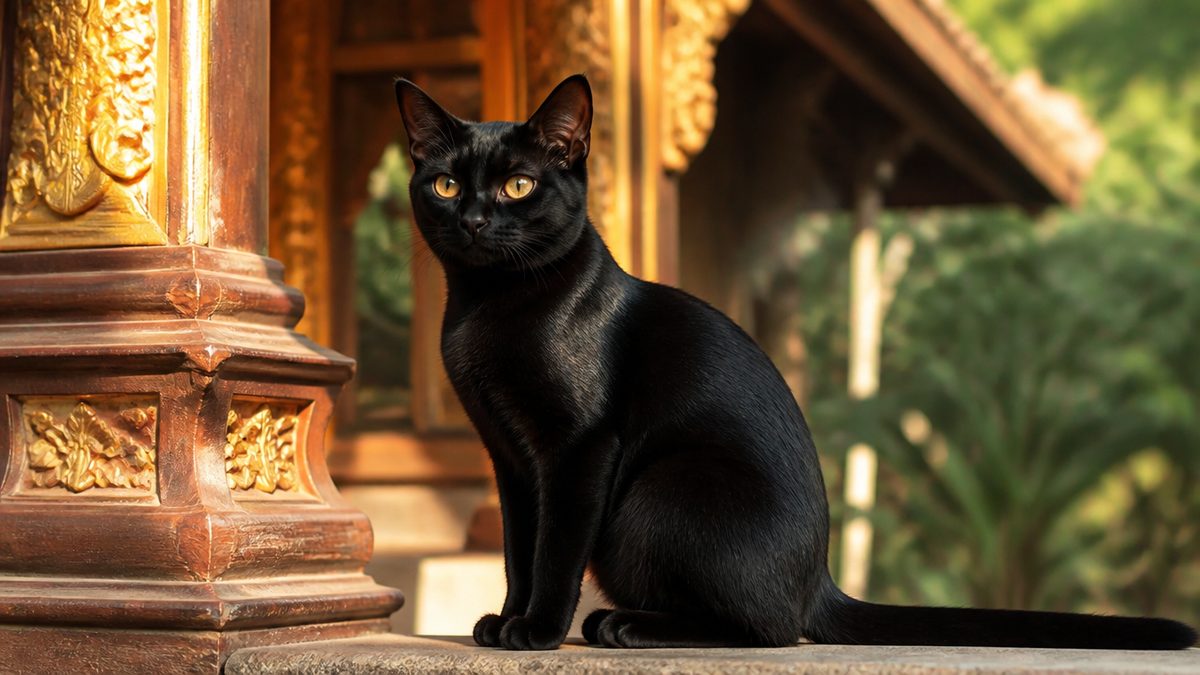
The Korn Ja is a solid black, short-coated Thai landrace cat named among the seventeen auspicious cats of the Tamra Maew, and its name comes from the Pali-Sanskrit word for a crane.
The name is the first thing to get right, because the English spelling is the least useful of the four in circulation. Thai sources write โกญจา and โกนจา, and OKMD's entry gives two further Thai names for the same cat, รองมด and ดำปลอด. English pages file all of it under Korn Ja, and one romanisation, Konja, is the only key that finds the breed's entire indexed scientific literature. A breed-identification app that does use the English form still records the breed as a native Thai cat with a small muscular body, solid black colour and yellow eyes, which is at least consistent with the Thai descriptions even where the spelling is not.
The Fine Arts Department gives the etymology. In the Tamra Phrommachat the name โกญจา has a Pali-Sanskrit root meaning a crane, the bird, or a loud resounding cry. The same department notes that a related word, โกญจศัพท์, is the name of a white elephant lineage and means the same crane's call, which places the name inside a wider Thai vocabulary of auspicious animals rather than inside a cat fancy.
The description, from three Thai sources at once
All three Thai sources agree on the essentials and they are worth reading together, because English pages contradict all three.
| Feature | Fine Arts Department | Ramkhamhaeng University | OKMD |
|---|---|---|---|
| Coat colour | Solid black throughout, glossy | Solid black throughout | Solid black throughout |
| Coat length | Not stated | Short | Short, smooth and fine |
| Eyes | Clearly amber | Yellowish-green | Yellowish-green |
| Ears | Not stated | Large and erect | Erect |
| Head | Not stated | Round but not very large | Slender muzzle |
| Tail | Not stated | Long, pointed tip held straight | Not stated |
| Belief | Brings fortune, drives away evil | Not stated | Auspicious, one of the 17 |
Two of the three Thai sources give the eye as yellowish-green Office of Knowledge Management…. The Fine Arts Department, which is Thailand's state cultural authority and the body that curates the manuscripts these descriptions come from, gives it as clearly amber. Both readings sit inside the same warm-eye range and neither is blue, so nothing about breed identity turns on it, but the disagreement is real and this page publishes it rather than picking the more convenient one.
What none of them says is more important. No Thai source gives this cat a lilac colour, a blue colour or a medium-length coat. The coat clause in every one of them is solid black and short Office of Knowledge Management…. Hold on to that, because it is where the English pages go wrong.
The Thai tradition's own family of black cats
The Korn Ja is not the only black cat in the seventeen, and the differences between them are the size of a fingernail. OKMD's neighbouring entries define แซมเสวตร (Sam Sawet) as the same cat with white hairs interspersed and green eyes, and นิลรัตน์ (Ninrat) as the same cat again with black claws, a black tongue, black teeth and black eyes.
That is the tradition's logic laid bare. These are not three populations. They are three readings of a black cat, distinguished by exactly the features a person could check by looking into its mouth. Understanding that is the difference between reading the Tamra Maew as a breed register, which it is not, and reading it as a system of household omens, which it is.
Recognition: a national symbol that no cat registry holds
Thailand's Cabinet designated the Korn Ja a national identity cat in November 2025, and not one of the five major cat registries carries a standard for it.
This breed is the clearest example on the whole site of why registry recognition has to be checked in the state as well as in the cynological bodies. Ask the registries and the answer is a flat no everywhere, so the cat is formally unrecognised by every body that writes cat standards. Ask the Thai government and the answer is that this cat is a national symbol.
What Thailand decided, and when
On 19 November 2025 the Public Relations Department of the Office of the Prime Minister announced that the Cabinet had resolved to designate Thai cats as a national identity in the pet-animal category, quoting Mr Siripong Angkasakulkiat, spokesperson for the Prime Minister's Office.
The announcement names the five purebred Thai breeds that remain: แมวศุภลักษณ์ แมวโคราช แมววิเชียรมาศ แมวโกญจา และแมวขาวมณี, that is Suphalak, Korat, Wichienmaat, Konja and Khao Manee. The stated rationale is worth quoting in substance, because it explains the timing: Thai cats are internationally admired and popular, which has led to foreign attempts to take purebred Thai cats abroad, register them and set breed standards, and the state therefore considers it important to declare them a national identity as a starting point for conservation and for agreeing a Thai standard.
That is a dated state recognition event and it is the single most important fact about this breed. No English-language cat page carries it.
What the registries say, checked one at a time
| Body | Status | Document checked | In-document control |
|---|---|---|---|
| Cabinet of Thailand | National identity cat, announced 19 November 2025 | Prime Minister's Office announcement | Names all five breeds explicitly |
| Fine Arts Department | One of five Thai breeds with a distinctly Thai identity | National library article | Names all five breeds explicitly |
| World Cat Federation | No row in any spelling | All 198 EMS rows via the nonce POST | Korat, Thai, Siamese, Oriental Shorthair, Russian Blue present |
| The International Cat Association | Absent | The 90-breed index at tica.org | Khao Manee, Korat, Thai, Siamese, Bombay present |
| Cat Fanciers' Association | Absent | Breed Council Declared Candidates, including miscellaneous and provisional | Korat, Siamese, Oriental, Bombay, Russian Blue present |
| Governing Council of the Cat Fancy | Absent | Standard of Points, June 2026, 723,034 characters | Full Thai standard present in Section 4 Group A |
| Fédération Internationale Féline | Absent from all categories and from the preliminary class | The live recognised-breeds list | THA and SIA fully recognised |
The GCCF check is the sharpest of the five, because that document does hold Thai cats. Its Section 4 Group A carries a full current Thai standard with named colour clauses such as Thai Blue Point (TAI 33 a) and Thai Lilac Point (TAI 33 c), while the strings Korn Ja and Konja appear zero times across all 723,034 characters. The registry is not ignorant of Thai cats. It simply does not hold this one.
The WCF check makes the same point from the other direction. Its cross-registry table gives the Korat as recognised by WCF, CFA, FIFE, TICA, ACF, CCCA, SACC and LOOF, eight bodies on one row. Two cats from the same manuscript, one with eight registries and one with none.
Nothing about the Korn Ja makes it harder to standardise than the Korat. What made the Korat a registered breed was a Western fancier importing it and writing a standard. What has kept the Korn Ja out is that a solid black shorthair is not visually distinctive enough to interest a Western registry, and there is already an American solid black breed occupying that slot. The Thai Cabinet's own stated concern about foreigners setting breed standards for Thai cats reads differently once you know that.
History and the genetics that finally measured it
The Korn Ja enters the record in the Ayutthaya-era cat manual and was first measured genetically in 2024, when a study of 184 Thai cats found it the rarest of the five that survive.
The documentary history is the manuscript one. The Thai cat manual describes 23 varieties, 17 auspicious and 6 that bring harm, and the Konja is among the 17 Office of Knowledge Management…. The 2024 genetics paper dates the texts precisely: the Cat-Book Poems to 1350-1767 and the SMUD Khoi of Cats to 1868-1910.
For four centuries that was the whole record. Then in 2024 a team at a Thai university published the first population-genetic characterisation of Thai cats, and the Korn Ja finally has numbers attached to it.
The study, and what it found
The paper sampled 184 Thai domestic cats, 69 males and 115 females, from five breeds, using 15 microsatellite markers and mitochondrial D-loop sequencing. Buccal swabs were taken, the animals were released, and the cats were classified into breeds by the British Library on external morphology guided by the Cat-Book Poems. That last detail is not a curiosity: the British Library holds a Tamra Maew manuscript, and the study leaned on it to decide which cat was which.
| Breed | Cats sampled | Alleles observed | Effective population size | 95% CI |
|---|---|---|---|---|
| Wichien Maat | 59 | 137 | 70.2 | 54.0 to 77.8 |
| Korat | 41 | 111 | 23.7 | 18.9 to 30.4 |
| Khao Manee | 37 | 95 | Reported in the paper | Reported in the paper |
| Suphalak | 29 | 110 | 36.9 | 24.7 to 34.6 |
| Konja (Korn Ja) | 18 | 92 | 11.6 | 8.9 to 13.2 |
| All five | 184 | Mean 7.267 per locus | - | - |
The per-breed sample sizes sum exactly to the paper's stated total: 59 plus 29 plus 41 plus 37 plus 18 is 184. That arithmetic check matters, because a flattened reading of the paper's microsatellite table does not close, while the effective-population table and the mitochondrial table both give the Konja 18 and the Khao Manee 37. Where two tables agree and one flattening does not, the two agreeing tables are the ones to quote.
The Konja's estimated effective population size is 11.600, with a 95 percent confidence interval of 8.900 to 13.200, and an Ne over N ratio of 0.644. That is the smallest of the five, and it is roughly a sixth of the Wichien Maat's 70.2.
Effective population size is not a headcount. It is the size of an idealised population that would lose genetic diversity at the same rate as the real one, and conservation genetics generally treats values in the low tens as the zone where inbreeding accumulates fast. The breed also carried the fewest alleles of the five, 92 against the Wichien Maat's 137, and only 6 mitochondrial haplotypes with a haplotype diversity of 0.699 plus or minus 0.090.
Read that beside the Cabinet resolution and the sequence makes sense. Thailand declared these cats a national identity in November 2025, eighteen months after a study reported that one of them has an effective population in the low teens Jaito W, Singchat W, Patta C, Thatukan C.
One further result is worth stating because it cuts against the romantic version. The study found no distinct clustering separating the five breeds, with only the Wichien Maat showing a distinct genetic structure, and reported that two mitochondrial haplogroups are shared among all Thai domestic cats and globally. The Thai breeds are morphological selections from a shared population rather than deeply separated lineages, which is exactly what four centuries of selecting cats by coat pattern would produce.
Korn Ja cat price in India
No Korn Ja cat price in India exists, and buying one out of Thailand would run directly against the reason Thailand named it a national symbol.
The Indian absence was tested rather than assumed. India's 2026 all-breed cat price guide runs to 45,016 characters of extracted text and the strings Korn Ja and Konja each appear zero times, while Persian appears 22 times, Bengal 16 and Siamese 9. The 40-breed guide to cats for the Indian climate returns zero across 51,780 characters.
That is unsurprising for a breed no registry holds. What is more interesting is the reason a Thai price is also hard to establish, and it is not obscurity.
Thailand is actively trying to stop this trade
The Cabinet announcement states the rationale directly: Thai cats are internationally admired, foreigners have been taking purebred Thai cats abroad to register them and set breed standards, and the state therefore judged it important to declare them a national identity as a starting point for conservation and for a Thai standard.
That is a government saying, in effect, that the export of its cats for foreign registration is the problem the policy exists to address. An Indian buyer commissioning an export from Thailand would be the specific behaviour named in the resolution. Add the effective population size of 11.6 and the case closes on its own.
| Source | What it is | Korn Ja named | Usable as a price |
|---|---|---|---|
| India's 2026 all-breed cat price guide | 45,016 characters | Zero times | No |
| India's 40-breed cat climate guide | 51,780 characters | Zero times | No |
| Amazon.in | A print-on-demand breed guide book at Rs 226 | Yes | No, that is the price of a paperback |
| Dreamstime and similar | Six stock illustrations offered for licensing | Yes | No, that is a licence fee |
| Any registry or Thai breeder body | Nothing found | No | No |
The Amazon row is the trap. A print-on-demand book about this breed sells on Amazon.in at Rs 226 with free delivery. It is the only rupee figure anywhere in an Indian search for this cat, and it is the price of a paperback. This is the same mechanism that has produced fake Indian dog prices from downloadable posters, and it is easier to fall for here because the item is not expensive enough to look suspicious.
The honest answer is that this cat has no price in India, no route into India, and a country of origin actively discouraging its export.
Monthly cost of ownership in India
A Korn Ja would be among the cheapest cats in India to keep, because a short smooth coat removes the single largest breed-driven cost an Indian cat owner faces.
Nobody in India owns one, so this prices the animal the Thai sources describe rather than pretending to quote a market. A medium, short-coated, solid black cat with no undercoat described, no brachycephaly and no documented inherited condition costs what a healthy Indian shorthair costs.
| Line | Figure | Note |
|---|---|---|
| Kitten vaccination course | From Rs 3,999, three visits at days 60, 90 and 120 | List price Rs 5,065 at the same chain |
| Annual booster | From Rs 1,899 | Anti-rabies alone Rs 699 |
| Consultation | Rs 500 to Rs 1,000 | One data point, not two; two publishers print it identically |
| Professional grooming | Rs 0 | A Delhi haircut starts at Rs 1,359, a full bath and styling at Rs 1,869 |
| Boarding, per 24 hours | Rs 899 in Bengaluru, or Rs 130 to Rs 900 across 14 providers | Most Bengaluru providers sit in the Rs 500 to Rs 800 band |
| Municipal licence | Rs 50 in Chennai | Delhi's Rs 500 registration covers dogs only |
The grooming line is the breed-driven saving and it is the largest one available. A Delhi grooming list starts at Rs 1,359 for a haircut, Rs 934 for a bath and Rs 1,869 for a complete bath and styling. A short, smooth, fine coat needs none of it.
One Bengaluru-specific line is worth carrying for any short-coated cat kept in a hot flat. A boarding directory covering 14 verified providers at Rs 130 to Rs 900 a night also warns about BESCOM load shedding between March and May and advises checking generator backup for air conditioning. If you board a cat in a Bengaluru summer, ask that question before you ask about the price.
Neutering belongs in the budget as a one-off and buys more than anything else here: entire cats carried 4.29 times (3.72-4.95) the odds of death before three years in the UK life tables.
- Budget Rs 4,000 to vaccinate a kitten through its first-year course, then about Rs 1,900 a year.
- Budget nothing for professional grooming, because a short smooth coat does not need it.
- Budget Rs 899 for a night of boarding in Bengaluru, and ask about generator backup between March and May.
- Budget one neutering, which is the single largest survival intervention available.
- Budget Rs 50 for a Chennai licence, and check your own corporation rather than assuming Delhi's dog fee applies.
Suitability for the Indian climate
Bangkok and Chennai are the same climate to within a tenth of a degree, so a Korn Ja would find coastal India unremarkable, and only the black coat and the north Indian winter need managing.
Both Thai cells check out against their real elevations before any figure is used. NASA POWER returns a Bangkok cell at 4.48 m against a real elevation near 2 m, an error of +2.48 m, and a Nakhon Ratchasima cell at 226.26 m against a real 187 m, +39.26 m. Both describe the places they are meant to.
| Place | Annual mean C | Annual RH % | Warmest month | Coolest month | Peak Stull wet bulb |
|---|---|---|---|---|---|
| Bangkok | 27.85 | 74.45 | Apr, 30.73 | Dec, 24.95 | May, 25.99 |
| Nakhon Ratchasima (Korat) | 26.31 | 73.19 | Apr, 29.86 | Dec, 22.62 | May, 24.73 |
| Chennai | 27.95 | 72.39 | May, 31.51 | Jan, 24.09 | May, 26.11 |
| Kolkata | 25.81 | 73.93 | May, 31.53 | Jan, 17.31 | Jun, 27.09 |
| Kochi | 27.31 | 78.83 | Mar, 29.42 | Aug, 25.91 | May, 25.79 |
| Mumbai | 26.77 | 67.39 | May, 31.19 | Jan, 23.19 | Jun, 25.77 |
| Bengaluru | 23.74 | 67.94 | Apr, 28.37 | Dec, 20.22 | May, 21.86 |
| Delhi | 25.60 | 45.56 | Jun, 35.88 | Jan, 13.61 | Jul, 26.50 |
Bangkok runs 27.85 C at 74.45 percent relative humidity; Chennai runs 27.95 C at 72.39 percent NASA POWER climatology API, 2001-2020. A tenth of a degree apart, two points of humidity apart. For this cat, Chennai is home.
The wet-bulb column says the same thing: Bangkok peaks at 25.99 C in May, Chennai at 26.11 C, a difference of 0.12 C NASA POWER climatology API, 2001-2020. Kolkata is the outlier at 27.09 C in June, about a degree above anything Thai.
The one genuinely breed-specific heat point
A solid black coat is not thermally neutral in direct sun. Dark fur absorbs more shortwave radiation than pale fur, which is why a black cat lying on a Chennai balcony in May at a 31.51 C air mean is under a different load from a white cat beside it. The effect is on radiant gain in sun, not on air temperature, and the answer is shade rather than air conditioning.
That is the difference between this cat and the Khao Manee, the solid white Thai cat from the same tradition. Same climate of origin, opposite coat colour, and only one of them needs a shaded resting place written into the care plan.
The north Indian winter
Bangkok's coolest month averages 24.95 C; Delhi's averages 13.61 C NASA POWER climatology API, 2001-2020. That eleven-degree gap is the real risk, and a short smooth coat with no undercoat described has little to offer against it. In Delhi, Chandigarh, Lucknow and Jaipur this is an indoor cat from November to February with a warm raised bed off a tiled floor.
The Deccan cities sit in between. Pune peaks in April at 28.93 C and falls to 19.62 C in December, Hyderabad peaks in May at 33.30 C, and Ahmedabad is the driest and hottest of the three at 35.06 C in May against 48.32 percent annual humidity. Pune is the mildest fit and Ahmedabad the harshest, and none of the three needs Delhi's winter arrangement.
One monsoon note that applies everywhere in India. Kochi's 78.83 percent annual humidity and Kolkata's June wet bulb of 27.09 C mean a wet cat should not be left to air-dry in a closed room. Dry the ears properly after any soaking.
Temperament and household fit
No Thai source describes the Korn Ja's temperament, so this section reports the gap and refuses to fill it with adjectives.
The Thai sources describe coat, eyes, ears, muzzle, tail and legs, and the belief attached to keeping one Ramkhamhaeng University Central Library Office of Knowledge Management…. None of them describes behaviour. The manuscript tradition is a system of omens organised by appearance, and what a cat is believed to bring is not a description of how it behaves.
The English pages fill the gap without hesitation, calling the breed affectionate, loyal, vocal, active at night and patient with children. Nothing supports any of it. There is one paper about this cat in the world and it is a population-genetics study.
What the Fine Arts Department does supply is the cultural frame, and it is worth stating because it is the opposite of the Western one. In ancient Thai belief the Korn Ja is a cat that brings good fortune and drives away evil, and the department is explicit that the Thai black cat is not a bad omen or a ghost cat as many Thais now assume. A black cat as a protector rather than a portent is a genuinely different cultural starting point, and it is the most useful thing this page can tell an Indian reader who is hesitant about a black cat.
For household fit, use the honest general rule. Thai landrace cats that do survive range from the famously demanding Wichien Maat to the more reserved Korat, and this breed sits somewhere in that range with nobody having measured where. If you need a specific temperament, choose a breed that has a registry description, such as the Korat or the Siamese.
Training a cat with no training literature
To train a Korn Ja you would train an ordinary Thai shorthair, because the only paper about this breed measures alleles rather than behaviour.
There is no training research and no behavioural research. The complete indexed literature is one population-genetics paper. Every Korn Ja training guide on the web is a general cat guide with a name attached, and one of them describes the coat as curly, which tells you how much of the rest to trust.
The general principles that work for any short-coated Asian landrace cat are what a reader can actually use.
- Train the carrier weeks before the first vet visit, by feeding in it with the door open.
- Train a recall to a distinct sound and pay it every single time, without exception.
- Train handling of ears and paws early, because the monsoon ear routine depends on it.
- Train the full hunting sequence twice a day, ending in a catch and a meal, rather than leaving toys out.
- Train an alternative to counter-surfing by supplying a higher legal perch, because height competition cannot be won.
Two Indian specifics. Litter refusal in an Indian summer is usually a substrate problem rather than disobedience: clumping clay dries and dusts in Chennai and Ahmedabad heat and cats reject a dusty tray, so change the litter before treating it as behaviour. And a black cat is harder to see at dusk on an Indian street than any other colour, which is a practical argument for a recall that works and against unsupervised outdoor access.
Daily exercise requirement
Two structured play sessions a day plus vertical space suits any Thai shorthair, and no breed-specific figure exists for this one.
The Thai description gives long slender legs in proportion to the body and a long tail, which is the outline of an ordinary agile landrace cat. No published exercise requirement exists for the breed because no breed population has been observed.
Two sessions of ten to fifteen minutes with a wand toy, each ending in a catch and a meal, meets the behavioural need better than an hour of undirected play. Add vertical space, which in an Indian flat means a shelf run or a tall tree rather than furniture.
Time it around the Indian day. Chennai in May averages 31.51 C and Delhi in June averages 35.88 C. Hard play in the afternoon during those months is a bad idea for any cat, and slightly worse for one wearing a black coat in a sunlit room. Early morning and after dark are the sessions that work.
Do not substitute outdoor roaming. India's free-roaming cat population carries infectious, road and fight risk, and this is not a cat any owner should be casual about losing.
Grooming and coat care in Indian humidity
Grooming a Korn Ja takes a weekly brush and nothing else, and the Thai coat description is also what disproves the three commonest English claims about this breed.
OKMD gives the coat as short, smooth and fine, solid black throughout. Ramkhamhaeng gives short and solid black. The Fine Arts Department adds that it should be glossy. A rubber brush once a week during a coat change and a wipe with a damp cloth is the whole routine, and no professional appointment is needed at any point.
Against a Delhi grooming list starting at Rs 1,359 for a haircut and Rs 1,869 for a complete bath and styling, that is the largest single saving this breed offers an Indian owner.
The English pages get the coat wrong in three separate ways, and each is checkable against the sources above.
| Claim | Where it appears | What the Thai sources say |
|---|---|---|
| The coat comes in black, lilac or grey | Hepper | Solid black throughout, in all three Thai sources |
| The coat is medium-length | Animalia | Short in Ramkhamhaeng, short smooth and fine in OKMD |
| The fur is soft, curly and wavy, like a Cornish Rex | A YouTube breed item | Smooth and fine, close-lying, with a glossy shine |
The third of those is the one that has done real damage, because it has propagated into the search results themselves: Google's question box for this breed contains 'Are Cornish Rex cats friendly?';. A wrong claim about a coat has become a question the search engine now asks about the breed. That is what an unchecked assertion looks like once an index absorbs it.
The practical consequence for a buyer is simple. A cat offered to you as a Korn Ja in lilac, in grey, with a medium coat, or with any curl to it, does not match a single Thai description of the breed.
The one routine that matters in an Indian monsoon
Grooming advice written for temperate countries says to towel a cat and let it air-dry. In Kochi at 78.83 percent annual humidity or Kolkata with a June wet bulb of 27.09 C, that is how ear problems start. Dry the ears properly after any soaking and do not leave a damp cat in a closed humid room.
One cosmetic note specific to a black cat in a hot country. Sustained sun exposure can rust a black coat to a brownish cast, which is a coat-quality issue rather than a health one and is another argument for a shaded resting place in an Indian summer.
Health risks and lifespan, with the gaps stated
No clinical study of the Korn Ja exists, the one paper that mentions it measures population genetics, and the number that should concern a prospective owner is an effective population size of 11.6.
The clinical literature is empty and the emptiness was tested. "Korn Ja"[tiab] returns zero in PubMed with the quotedphrasesnotfound warning.
Konja[tiab] returns exactly 1, translated cleanly as "Konja"[Title/Abstract], and that single record is the 2024 Thai cat genetics paper. The entire indexed literature for this breed is reachable under the Thai romanisation and invisible under the English name that every cat website uses. The same session shows the pattern is general: "Khao Manee"[tiab] returns 1 and "Suphalak"[tiab] returns 1, and both are the same paper.
So the honest statement is not that there is no research on Thai cats. It is that there is exactly one paper, that it covers five breeds at once, and that you will not find it if you search the English names.
What the genetics paper says that a buyer should care about
The paper reports high genetic diversity across all five breeds, with observed and expected heterozygosity above 0.5, and found no significant deviation from Hardy-Weinberg equilibrium in most allele frequencies. Mean relatedness across all 184 cats was slightly negative at -0.015, and the Konja's own mean relatedness was -0.032 plus or minus 0.070 with an inbreeding coefficient of -0.039. Negative values mean the sampled animals were, on average, less related than random pairs would be, which is a good sign rather than a bad one.
The concerning number is the other one. The Konja's estimated effective population size is 11.600, 95 percent CI 8.900 to 13.200, the smallest of the five. The breed also showed the fewest alleles, 92, against 137 for the Wichien Maat, and only 6 mitochondrial haplotypes with haplotype diversity 0.699 plus or minus 0.090.
Those two findings are not in conflict. The currently sampled animals are not closely related, and there are very few of them. That is a population which is healthy today and has almost no margin, and it is exactly the situation a national conservation programme is for.
Coat colour and health, which is a question worth closing
Solid black in cats is the non-agouti genotype and carries no known health consequence. In particular, the deafness risk that attaches to white cats does not apply here at all: that risk is linked to the Dominant White locus, and a solid black cat has neither dominant white nor white spotting. A Korn Ja cannot be at raised risk of congenital deafness on colour grounds, which is a real and reassuring difference from the Khao Manee, the white Thai cat from the same manuscript.
Lifespan
No lifespan figure exists for this breed. Google's own AI summary asserts 13 to 16 years and names no source. The best cat life-table study available gives life expectancy at age 0 of 11.74 years across all cats and 11.89 years (11.75-12.03) for crossbreds on 7,117 deaths. Its breed-specific table carries 12 rows and the Methods state that breeds with fewer than 15 deaths were grouped into 'other'. The Korn Ja is not among the 12 breeds that reached that threshold, which reflects the absence of a UK population and says nothing about its health.
The only Thai cat in that table is the Siamese at 11.69 years (10.56-12.82) on 88 deaths, essentially the all-cat average. An unsourced 13-to-16-year claim sits above every measured figure in a twelve-row table, which is on its own a reason to distrust it.
Two figures transfer because neither is breed-specific: entire cats carried 4.29 times (3.72-4.95) the odds of death before three years compared with neutered cats, and purebred cats 1.83 times (1.50-2.23) the odds compared with crossbreds.
Feeding and nutrition
Feed a Korn Ja as an ordinary medium shorthair on a complete diet, because no breed-specific nutritional requirement has ever been established for it.
There is no Korn Ja feeding literature, no registry guidance and no breed body. The Thai description gives a medium cat with long slender legs in proportion to the body and a slender muzzle Office of Knowledge Management…, which implies nothing unusual about energy requirements.
The practical Indian points are the ones that apply to any active shorthair here. Split the daily ration into three or four meals rather than free-feeding. Weigh the food rather than measuring by cup. Check body condition by feel over the ribs and the base of the spine monthly, which matters more with a black cat because a dark short coat hides an outline that a tabby's markings would reveal.
Water, which matters more in India than the brand does
In a Chennai May at a 31.51 C mean or a Delhi June at 35.88 C, intake is the variable to watch. Wet food raises total water intake more reliably than a fountain does. If the cat eats dry food only, place a second and third water source in rooms it actually uses and keep them away from the food bowl, because cats routinely refuse water sited beside a meal.
Do not buy a diet on a breed claim. There is no Korn Ja formulation, no research that could support one, and nothing in any Thai description that implies a special requirement.
Kitten timeline, month by month through the first year
A Korn Ja kitten follows the ordinary feline schedule, with two breed-specific checkpoints at the coat's soundness to the roots and the adult eye colour.
No breed-specific developmental data exists, so this is the standard feline timeline with the two points where the Thai descriptions give you something to check.
| Age | What happens | What you do |
|---|---|---|
| 0 to 8 weeks | With the queen. Weaning completes around eight weeks | Nothing. Indian law treats kittens below eight weeks as un-weaned |
| 8 to 9 weeks | Home. Socialisation window still open | Handle ears and paws daily. Introduce the carrier |
| Day 60 | First vaccination visit | Kitten course starts, from Rs 3,999 for three visits |
| Day 90 | Second visit | Confirm the schedule your own clinic uses |
| Day 120 | Third visit plus anti-rabies | Anti-rabies Rs 699 privately, free at Chennai's six municipal clinics |
| 3 to 8 months | Kitten coat gives way to the adult coat | Checkpoint one: ghost tabby markings that are normal in a black kitten should fade |
| 5 to 8 months | Sexual maturity, early in a tropical climate | Neuter. The single largest survival intervention available |
| 9 to 12 months | Adult eye colour settles | Checkpoint two: amber or yellowish-green, never blue |
Checkpoint one is worth explaining because it worries new owners. Black kittens commonly show faint ghost tabby markings that fade as the adult coat comes in, and the Fine Arts Department's requirement is a coat that is solid black with a glossy shine. Faint rings on a twelve-week-old kitten are normal; obvious tabby banding on an adult is not solid black.
Checkpoint two is the eye, and it is where the Thai sources disagree. Adult colour is clearly amber on the Fine Arts Department's account and yellowish-green on Ramkhamhaeng's and OKMD's Ramkhamhaeng University Central Library Office of Knowledge Management…. What all three exclude is blue. Kitten eye colour is unreliable and settles over the first year, so a seller certain of adult colour at ten weeks is guessing.
The neutering line is not a formality. Entire cats carried 4.29 times the odds of death before three years in the UK life tables, and in a tropical climate the exposure starts earlier than a temperate schedule assumes.
Korn Ja against the black cats it gets confused with
Three solid black cats are routinely confused with the Korn Ja and only one of them is obtainable in India, so the useful comparison is what each is and who holds a standard for it.
A buyer drawn to this breed wants a sleek solid black cat. Three exist as named types, and only one of them is a registered breed you can buy in India.
| Cat | Origin | Coat | Eyes | Registry standard | Obtainable in India |
|---|---|---|---|---|---|
| Korn Ja (Konja) | Thailand, in the Tamra Maew | Short, smooth, fine, glossy | Amber, or yellowish-green depending on the Thai source | None anywhere | No |
| Bombay | United States, 1950s, Burmese crossed to black American Shorthair | Very short, close-lying, patent-leather sheen | Copper to gold | CFA, TICA, GCCF, FIFe preliminary | Occasionally |
| Oriental Shorthair, ebony | Britain, from Siamese outcrosses | Very short, fine, close-lying | Green | CFA, TICA, GCCF, FIFe, WCF | Rarely, and absent from India's price guide |
| Indian shorthair, black | India | Short, variable | Yellow to green | None, and none needed | Yes, in every shelter |
The registry column carries the argument. The Bombay and the ebony Oriental are held by multiple registries, which means a written standard, a pedigree and a body to complain to. The Korn Ja is held by none, which means a seller offering one in India can be held to nothing at all The International Cat Association The Cat Fanciers' Association The Governing Council of the Cat Fancy Fédération Internationale Féline.
Against the other Thai cats
The more revealing comparison is within Thailand's own five. Every one of them is in the same manuscript and on the same Cabinet list, and their registry fates could hardly be more different.
| Cat | Cats sampled in 2024 | Effective population size | Registries holding a standard |
|---|---|---|---|
| Wichien Maat (Siamese) | 59 | 70.2 | CFA, TICA, GCCF, FIFe, WCF and more |
| Korat | 41 | 23.7 | WCF, CFA, FIFE, TICA, ACF, CCCA, SACC, LOOF |
| Khao Manee | 37 | Reported in the paper | TICA, and CFA at provisional |
| Suphalak | 29 | 36.9 | None in the major registers |
| Korn Ja (Konja) | 18 | 11.6 | None anywhere |
The Korat row is the one to sit with. The WCF's cross-registry table gives it eight recognising bodies on a single line, and the 2024 study puts its effective population size at 23.7, roughly double this breed's. Two cats from the same four-hundred-year-old manuscript, one with eight registries and twice the population, the other with none and 11.6.
For an Indian buyer the recommendation follows. If you want a sleek solid black cat, the honest answer is the black Indian shorthair in your nearest shelter, which costs nothing and is already adapted to your climate. If you want a registered black breed with a standard behind it, look at the Bombay. The Korn Ja is not a purchase available in India, and Thailand has just told the world it would rather it were not one anywhere.
Mistakes Indian readers make with this breed
Five errors account for nearly everything written about the Korn Ja in English, and every one is checkable against a Thai source or a search-translation line.
1. Searching the English name
"Korn Ja"[tiab] returns zero records in PubMed. Konja[tiab] returns exactly one, and it is the only paper about this cat in existence. One romanisation finds the whole literature and the other finds nothing, on the same database in the same session. If you research this breed, search Konja and the Thai forms โกญจา and โกนจา.
2. Giving the cat colours the Thai sources do not
Hepper describes the coat as black, lilac or grey and Animalia as a medium-length coat in black, lilac or blue. All three Thai sources describe a short coat, solid black throughout Ramkhamhaeng University Central Library Office of Knowledge Management…. A lilac Korn Ja is not a rare variety, it is a different cat.
3. Repeating the Cornish Rex claim
A YouTube breed item states that Korn Ja cats have soft, curly and wavy fur similar to a Cornish Rex. The Thai sources give smooth, fine, close-lying and glossy Fine Arts Department of Thailand. That single wrong claim has already propagated into Google's question box for this breed, which now asks whether Cornish Rex cats are friendly. It is a small, checkable, live example of how a fabricated trait becomes a search entity.
4. Missing the Cabinet resolution entirely
Not one English cat page mentions that on 19 November 2025 the Prime Minister's Office announced a Cabinet resolution naming this cat one of five Thai breeds constituting a national identity. It is the most consequential thing that has happened to the breed in four hundred years, it is published on a Thai government domain, and the entire English-language cat internet is unaware of it. Check the state, not only the cynological bodies.
5. Taking an unsourced lifespan over a measured one
Google's AI summary gives 13 to 16 years with no source. That figure sits above every value in a twelve-row life table built on 7,936 confirmed cat deaths, in which the highest breed figure is 14.42 years and the all-cat average is 11.74. When an unsourced number beats every measured number in the field, it is not a finding.
Adoption, and the honest recommendation
Adopt a black Indian shorthair, because it is the cat the Thai description actually fits and because Thailand has explicitly asked the world to stop exporting this one.
This page ends with the clearest recommendation in the batch, and it comes from the country of origin rather than from Bonbeno.
Thailand's Cabinet resolution of November 2025 was prompted by foreigners taking purebred Thai cats abroad to register them and set breed standards, and the stated purpose is conservation and the agreement of a Thai standard. The 2024 study measured this breed's effective population size at 11.6, the smallest of the five. A country with a national symbol in the low teens is not a source of pets.
There is no route in any case. No registry anywhere holds the breed The International Cat Association The Cat Fanciers' Association The Governing Council of the Cat Fancy Fédération Internationale Féline, India's two largest cat guides never name it Supertails, 'Cat Breeds in India, and the only rupee figure attached to the breed anywhere in an Indian search is Rs 226 for a paperback.
What the description actually fits
Strip away the manuscript and the Thai sources describe a medium, short-coated, solid black cat with a glossy coat and warm-coloured eyes Office of Knowledge Management…. Every Indian city has hundreds of those in shelters, and black cats are the hardest colour to rehome in almost every shelter system that publishes figures.
The Thai tradition is on the side of taking one home. The Fine Arts Department is explicit that the Korn Ja is an auspicious cat believed to bring good fortune and drive away evil, and that the Thai black cat is not a bad omen or a ghost cat as many people now assume. That framing, from Thailand's own cultural authority, is worth more to an Indian black cat sitting in a shelter than any breed claim on this page.
- Contact a registered municipal or NGO shelter in your own city and ask specifically for a black cat, which shelters everywhere struggle to place.
- Confirm the kitten is at least eight weeks old, which Indian law requires and which the pet-shop rules define as the weaning threshold.
- Confirm the vaccination record and start the course if it has not begun, from Rs 3,999 for three visits.
- Confirm the licence position with your own corporation, which in Chennai is Rs 50 and covers cats.
- Confirm neutering is booked, because it buys more life expectancy than any other decision on this page.
If you want to help conserve the Korn Ja itself, the work is happening in Thailand, in a Cabinet policy and in a university genetics laboratory that has now sampled eighteen of them Jaito W, Singchat W, Patta C, Thatukan C. Reading about this cat is the right relationship to have with it, and for an Indian reader it is currently the only one available.
Korn Ja cat questions people actually ask
What is the Korn Ja cat price in India?
No Korn Ja cat price in India could be sourced on 10 September 2026. India's 2026 all-breed cat price guide runs to 45,016 characters and the strings Korn Ja and Konja each appear zero times, while Persian appears 22 times. The only rupee figure attached to the breed anywhere in an Indian search is Rs 226 on Amazon.in, and that is the price of a print-on-demand paperback about the cat rather than of a cat.
Are all Khao Manee deaf?
No. Deafness risk in cats attaches to the Dominant White phenotype rather than to any breed, and it is a raised probability rather than a certainty, with blue-eyed white cats at highest risk. A BAER test settles it for an individual animal. The comparison is directly useful here: the Korn Ja is solid black, carries neither dominant white nor white spotting, and therefore cannot be at raised risk of congenital deafness on colour grounds at all.
How rare is a Japanese bobtail?
Far less rare than the cat you searched for. The Japanese Bobtail is held by CFA, TICA, FIFe and the WCF with published standards in both coat lengths. The Korn Ja is held by no registry anywhere, and the only genetic study of Thai cats estimated its effective population size at 11.6 animals with a confidence interval of 8.9 to 13.2, the smallest of Thailand's five surviving breeds.
Are Cornish Rex cats friendly?
Cornish Rex cats are generally described as active and people-oriented, but the reason this question reached a Korn Ja search matters more than the answer. A YouTube breed item claims Korn Ja cats have soft, curly, wavy fur similar to a Cornish Rex. Every Thai source describes the Korn Ja's coat as short, smooth, fine and glossy. One fabricated claim about a coat has propagated far enough to shape the questions Google now asks about this breed.
What breed is a chinchilla cat?
Chinchilla is a coat colour rather than a breed. It describes a very lightly tipped silver coat, and it appears as a colour class within several breeds including the Persian and the British Shorthair. The question is a useful one to have landed here, because the Korn Ja page is partly about the same confusion in reverse: several of the seventeen Thai auspicious cats are readings of coat pattern rather than separate populations.
Is the Korn Ja cat recognised by any registry?
By no cat registry anywhere, and by the Thai state. The World Cat Federation's full 198-row EMS table, TICA's 90-breed index, the CFA breed-council list, the GCCF's 723,034-character Standard of Points and FIFe's recognised-breeds list all return nothing, each with passing controls. Thailand's Cabinet, meanwhile, designated the Korn Ja one of five Thai cat breeds constituting a national identity in an announcement dated 19 November 2025.
What does Korn Ja mean?
It comes from Pali-Sanskrit and means a crane, the bird, or a loud resounding cry. Thailand's Fine Arts Department gives that etymology from the Tamra Phrommachat and notes that a related word, โกญจศัพท์, names a white elephant lineage and carries the same crane's-call meaning. The name therefore sits inside a wider Thai vocabulary of auspicious animals rather than inside a cat fancy, and it is not a description of the cat's own voice.
How many Korn Ja cats are left?
Nobody has published a headcount, but the best available proxy is stark. A 2024 study sampled 18 Konja among 184 Thai cats and estimated the breed's effective population size at 11.600, with a 95 percent confidence interval of 8.900 to 13.200 and an Ne over N ratio of 0.644. That is the smallest of the five surviving Thai breeds, roughly a sixth of the Wichien Maat's 70.2, and the breed also showed the fewest alleles at 92 against 137.
What colour eyes does a Korn Ja have?
Warm, and the Thai sources disagree on exactly how warm. Thailand's Fine Arts Department gives clearly amber. Ramkhamhaeng University's library and the Office of Knowledge Management and Development both give yellowish-green. All three exclude blue, so nothing about breed identity turns on the difference, but the disagreement is real and Bonbeno publishes it rather than picking the more convenient version.
Can a Korn Ja cat live in the Indian climate?
Coastal India would be indistinguishable from its homeland. Bangkok runs an annual mean of 27.85 C at 74.45 percent relative humidity against Chennai's 27.95 C at 72.39 percent, and their peak wet bulbs are 0.12 C apart. Two things need managing: a solid black coat absorbs more radiant heat in direct sun, so shade matters, and Delhi's January mean of 13.61 C is eleven degrees below anything in Bangkok's calendar.
How long do Korn Ja cats live?
No lifespan figure exists and the 13 to 16 years that Google's AI summary asserts names no source. The best available cat life-table study gives 11.74 years for all cats and 11.89 for crossbreds on 7,117 deaths, and its breed table carries only 12 rows because breeds with fewer than 15 deaths were grouped into other. The Korn Ja is not among the 12 breeds that reached that threshold. An unsourced figure that beats every measured figure in the field is not a finding.
Is a Korn Ja the same as a Bombay cat?
No. The Bombay is an American breed created in the 1950s by crossing Burmese with black American Shorthairs, with a patent-leather coat and copper to gold eyes, and it holds standards at CFA, TICA and GCCF and preliminary recognition at FIFe. The Korn Ja is a Thai landrace named in a manuscript tradition dated 1350 to 1767, with no registry standard anywhere. They are two solid black cats with nothing else in common.
Compare with similar breeds
Korn Ja sits in 2 Bonbeno groups. Each one compares it directly against the breeds it is genuinely an alternative to, on the same figures.