
Cat breed guide
Oriental Bicolour: Price in India, and Whether It Is a Breed at All
Five registries, four different answers to whether this is a breed, and two of them agree exactly on one white-marking code while disagreeing on the two either side of it.
Quick answer
No Oriental Bicolour cat price in India could be sourced on 10 September 2026, and India's leading cat-price guide names no Oriental of any kind. Whether this is even a breed depends on the registry: the GCCF holds it as a named breed spanning both coat lengths, the CFA as a Bi-Color Class inside one Oriental breed, and the WCF and FIFe as a colour code.
This page reports published research on AA-amyloidosis in Siamese and Oriental cats, a lethal systemic condition with an age at death between one and seven years, for which there is no reliable genetic test and no treatment beyond supportive care. It is reference material, not a diagnosis and not a treatment plan. Consult your nearby vet, a registered veterinarian who can examine your own animal, before acting on anything here.
Oriental Bicolour at a glance
What an Oriental Bicolour is, and why the answer depends on who you ask
An Oriental Bicolour is a cat of Oriental type carrying white areas produced by the white spotting gene, and whether that makes it a breed is a question five registries answer four different ways.
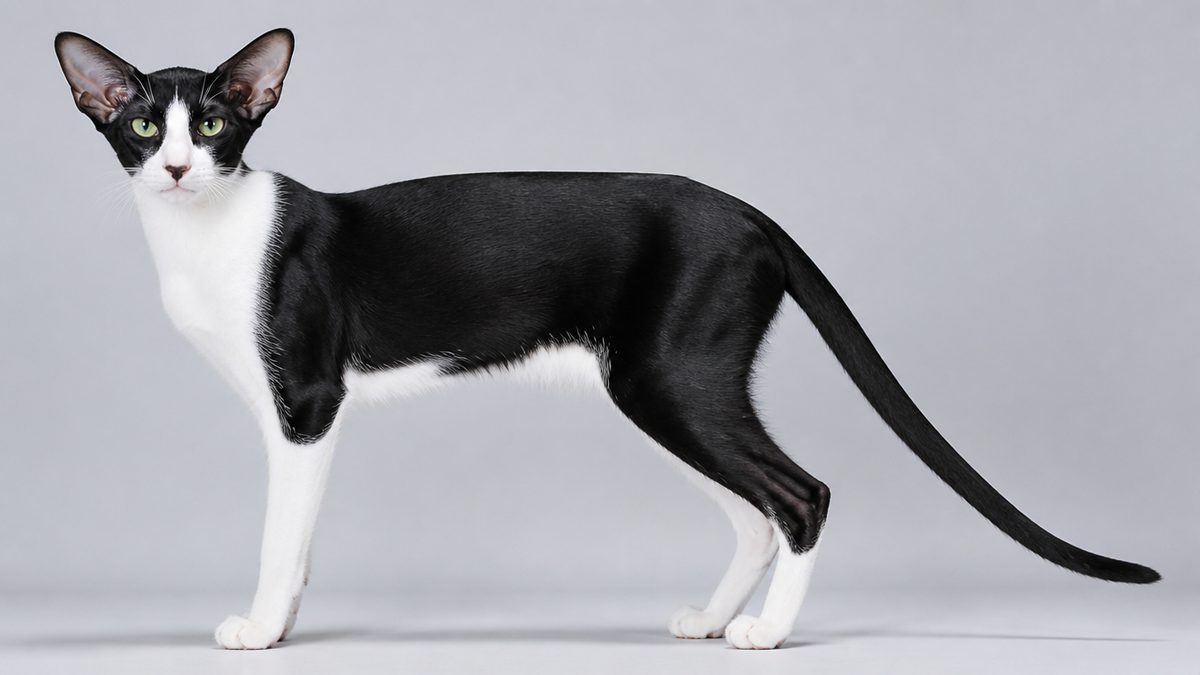
The physical description is not in dispute anywhere, and every breed standard quoted on this page gives the same one. This is a modern, short-coated or semi-longhaired Oriental: a long wedge-shaped head made of straight lines with no break or pinch at the whiskers, a straight profile with no stop or dip, a strong chin whose tip lines up with the tip of the nose, large ears wide at the base continuing the lines of the wedge, almond eyes slanting toward the nose, a long svelte body with a tight abdomen, long slim legs with the hind legs higher than the front, small oval paws and a long tapering tail.
What is in dispute is the coat colour, and specifically the white. Wikipedia's definition, which Google reprints in its own knowledge panel, is that an Oriental bicolour is any cat of Oriental type, either long-haired or short-haired and in any pattern including colourpoint, which has white areas on its coat caused by the white spotting gene. It then states plainly that in most cat fancier and breeder organisations these cats do not constitute a standardised breed but a coat pattern variant of the breed of their foundation stock, with the UK-based GCCF the one exception.
Google's knowledge panel for this query labels the entity a Cat breed and sources that label to a commercial cat site, while the description printed immediately beneath it is Wikipedia's definition of a coat pattern variant. The label and the text disagree inside one box. That is a small thing, but it is the whole confusion in miniature, and it is why this page opens the registry documents instead of quoting summaries.
The GCCF standard, which is the strongest case for calling it a breed
The GCCF's June 2026 Standard of Points carries a standard headed ORIENTAL BICOLOUR (OSH and OLH), sitting inside Section 6 Group A at pages 270 and 271. It has its own General Type Standard, its own coat clauses for both coat lengths, and its own Scale of Points for all Oriental Bicolours, which is what a breed standard looks like rather than a colour note: Type 50, split Head and Neck 15, Ears 5, Eye Shape and Setting 5, Body 15, Legs and Paws 5, Tail 5; and Colour and Coat 50, split Eye colour 10, White markings, colour and pattern 30, Coat Length, Texture and Condition 10.
Thirty of a hundred points for the white markings alone is the tell. No colour class in any registry carries that weight. This is a standard built around the white.
The white rule is quantitative and it withholds a certificate. Cats displaying less than one third of white to colour, or with unlinked chest and/or belly spots, must not be awarded the certificate, and the standard adds that this is of paramount importance to the integrity of the genetics of this breed. Note the word: the GCCF calls it a breed in its own text.
The eye rule is unusual and worth having. In full-coloured Bicolours the eyes may be green (64), blue (61) or one green and one blue (63); in pointed Bicolours both eyes must be blue. An Oriental that is not white is normally green-eyed only, so permitting blue and odd eyes is a direct consequence of the white spotting.
Registry recognition: four answers to one question
The GCCF holds the Oriental Bicolour as a breed, the CFA as a colour class, the WCF and FIFe as a colour code, and TICA as a colour within two separate breeds.
Recognition here is not a yes-or-no question, and treating it as one is why every ranking page gets it wrong. The right question is what rank each registry gives the white.
| Registry | Rank given to the white | Rank given to coat length | Where it is written |
|---|---|---|---|
| GCCF | BREED. A named standard, Oriental Bicolour | A clause inside that one standard | Standard of Points, June 2026, pages 270-271 |
| CFA | Colour class. Bi-Color Class, numbers 4390 and 4391 in the Longhair Division | DIVISION. Longhair Division and Shorthair Division inside one Oriental breed | CFA Oriental show standard and colour class numbers |
| WCF | Colour code. Bicolour is EMS 03 in the amounts-of-white block | Two separate breed rows, OSH and OLH | EMS table rows 95, 96 and 341 |
| FIFe | Colour variety. Chapter 7 of the General Part, codes 01 to 09 | Two separate breeds, OSH and OLH in category 4 | FIFe breeds list and General Part |
| TICA | Not separately listed | Two separate breeds, oriental-shorthair and oriental-longhair | TICA 90-breed index |
Read the first two rows of that table together, because they are the finding.
The GCCF takes white and makes it a breed, then handles coat length as two clauses inside that one standard. Its Oriental Bicolour standard is explicitly headed for both coat lengths and prints a Shorthaired coat clause and a Longhaired coat clause one after the other. At the GCCF, white outranks coat length.
The CFA does the reverse, and its breed standard says so on its own face. It takes coat length and makes it a division: Oriental Shorthairs were accepted for registration in 1974 and reached championship in 1977, Oriental Longhairs were accepted in 1988, the name of the breed became simply Oriental, and the two coat lengths are shown in separate divisions. White is then a Bi-Color Class inside each division, numbered 4390 and 4391 in the Longhair Division and defined as all established colors and patterns for parti-colors, shadeds, smokes, solids, tabbies and pointeds with the addition of white. At the CFA, coat length outranks white.
Two registries, the same two variables, opposite rankings, both current, both published. Neither is wrong. What is wrong is any page that says the Oriental Bicolour either is or is not a breed without naming the registry.
The Seychellois, which FIFe recognised and then stopped listing
There is a fourth name for these cats and its fate is the most checkable thing on this page. Wikipedia records that FIFe granted championship recognition in 2003 to the bicoloured Oriental Shorthairs and in 2005 to the colourpoint and white cats under the breed name Seychellois.
FIFe's current breeds page, read on 10 September 2026, lists every fully recognised breed across four categories plus the preliminary class. Category 4 runs ABY, BAL, CRX, DRX, DSP, GRX, JBS, OLH, OSH, PEB, RUS, SIA, SOM, SPH and THA. The strings Seychellois and SYS each appear zero times anywhere on that page.
Where the bicolour went instead is visible in the same document. FIFe's General Part of the Standards has a Chapter 7 headed 'Colour varieties - with white', covering EMS codes 01, 02, 03, 04, 05 and 09. A breed name granted championship in 2005 is now a chapter of the colour rules.
That is not a criticism of FIFe. It is the clearest available demonstration that this cat's status is genuinely unstable, and that a page citing a 2005 recognition without checking the current list is citing history as though it were status.
What TICA and the WCF do
TICA's 90-breed index holds oriental-shorthair and oriental-longhair as two separate breeds and no Oriental Bicolour at all, although Wikipedia records that TICA recognised the variety as long ago as 1983, with the first champion Ciara Quite-N-Oreo. Recognising a variety and listing a breed are different acts.
The WCF is the tidiest of the five. Its 198-row EMS table gives row 96 as Oriental Shorthair, OSH, recognised by ALL and row 95 as Oriental Longhair (Mandarin), OLH, ALL, and puts bicolour in the amounts-of-white block as row 341, bicolour, code 03. Two breeds, one colour code, no ambiguity.
History: an American cattery, a Moroccan street cat and the fastest recognition the GCCF has granted
Modern Oriental bicolours descend from matings begun in the United States in 1979, reached British registration in 2004, and moved from Preliminary to Provisional status in two years.
The line does not run from Thailand. It runs from an American cattery in the late 1970s.
Wikipedia records that although experimental breeding took place in the UK during the 1970s and 1980s, including Pat Turner's Seychellois programme, modern-day Oriental bicolours owe their origins to matings initiated in the United States by Lindajean Grillo of Ciara Cattery. Starting in 1979, Grillo carried out a series of matings between Siamese and bicoloured American Shorthairs, then selected the best bicoloured offspring to mate back to Siamese or Orientals to regain type.
The variety was granted recognition by TICA in 1983 and the first champion was Ciara Quite-N-Oreo.
During the 1980s European breeders, principally in France and the Netherlands, started their own lines. A red and white Moroccan street cat was used as an initial outcross, and later a black and white Cornish Rex. Having separate lines mattered, because breeders needed to mate bicolour to bicolour to raise the proportion of white without excessive inbreeding.
The British arrival, and an unusually fast recognition
The first modern Oriental bicolours reached the UK from 2004, beginning with the black and white male Tassam Tom of Landican, owned by Sarah Johnson and Pat Norman of the Landican Cattery. The variety gained Preliminary recognition with the GCCF in 2006 and progressed to Provisional status in 2008, described as the fastest breed recognition within that organisation and a mark of the breed's popularity.
Two years from Preliminary to Provisional is genuinely quick for a British registry, and it is worth noticing what made it possible: nothing new had to be proved. The type already existed as a registered breed, the outcross partners were all registered breeds, and the only novel element was the white.
The registration policy, which is the practical difference
The GCCF's registration policy is where being a breed rather than a colour actually changes what a breeder can do. Permitted outcrosses are Siamese, Balinese, Oriental Shorthair and Oriental Longhair. All offspring are registered as Oriental Bicolours and cannot be registered under the breed of their outcross parent. Offspring that do not inherit white spotting can now be registered as Orientals according to their phenotype and can be shown.
Compare the CFA's rule for the same underlying cats. Its allowable outcrosses are Siamese or Colorpoint for the Shorthair Division and Siamese, Colorpoint, Balinese or Javanese for the Longhair Division, and since 15 June 2010 no Oriental litters resulting from a pointed to pointed breeding are registrable.
Two registries, overlapping outcross lists, and completely different filing of the results. Under the GCCF a white-marked kitten from a Siamese outcross is an Oriental Bicolour; under the CFA it is an Oriental in the Bi-Color Class of its coat-length division.
Oriental Bicolour cat price in India
No Oriental Bicolour cat price in India exists, and neither does an Oriental price of any kind, because India's leading cat-price guide does not name the parent breed either.
The absence here is wider than the variety. India's 2026 all-breed cat price guide runs to 45,016 characters of extracted text, and the strings Oriental, Bicolour and Bicolor each appear zero times, while Persian appears 22 times, Bengal 16 and Siamese 9. The country's leading cat-price guide prices no Oriental at all, in any coat length or colour.
The 40-breed guide to cats for the Indian climate mentions Oriental three times across 51,780 characters and Bicolour and Bicolor zero times. So the parent breed is known to Indian cat writing and is not sold here, and the colour variety is not known at all.
What Google returns instead, and why it is not an Indian price
Google's AI summary for this query, on an India-targeted search with gl=IN and hl=en, answers entirely in US dollars: pet-quality kittens at 600 to 1,500 dollars, show quality at 1,500 to 3,000, first-year setup 580 to 1,400 dollars and monthly expenses 90 to 250 dollars. It never produces an Indian figure at any point.
That is unusually honest behaviour by the standards this site has recorded elsewhere, where AI answers routinely state that no Indian price exists and then print a converted rupee band anyway. Here the engine simply declined to convert. Do not convert it yourself. A dollar band multiplied by an exchange rate is not an Indian price, it is arithmetic, and this site has caught that pattern repeatedly on other breeds.
| Source | What it is | Oriental Bicolour named | Usable as an Indian price |
|---|---|---|---|
| India's 2026 all-breed cat price guide | 45,016 characters, no Oriental at all | Zero times | No |
| India's 40-breed cat climate guide | 51,780 characters, Oriental three times | Zero times | No |
| Google's AI summary for an India-targeted query | US dollar bands only | As Oriental Shorthair | No, wrong currency and wrong market |
| US breeder and price-guide sites | USD 600 to 3,000 | As Oriental Shorthair | No |
| Any Indian registry, breeder or classified listing | Nothing found | No | No |
The honest answer to the price question is therefore layered. There is no Indian price for this cat because there is no Indian market for the Oriental at all, and there is no Oriental Bicolour price anywhere in the world separate from the Oriental Shorthair price, because in four of the five registries checked here it is not a separate cat The Cat Fanciers' Association Fédération Internationale Féline The International Cat Association.
If a seller in India offers you an Oriental Bicolour at a premium over an Oriental Shorthair, ask which registry recognises the difference they are charging for. Outside the GCCF, there is not one.
Monthly cost of ownership in India
An Oriental Bicolour is one of the cheapest cats in India to run, because both coat lengths in the GCCF standard exclude the woolly undercoat that creates grooming bills.
This prices the animal the standards describe rather than a market that does not exist here. Both coat clauses point the same way. The shorthaired coat is very short and fine in texture, glossy and close-lying; the longhaired coat is medium long, fine and silky in texture without a woolly undercoat, lying flat along the body.
| Line | Figure | Note |
|---|---|---|
| Kitten vaccination course | From Rs 3,999, three visits at days 60, 90 and 120 | List price Rs 5,065 at the same chain |
| Annual booster | From Rs 1,899 | Anti-rabies alone Rs 699 |
| Consultation | Rs 500 to Rs 1,000 | One data point, not two; two publishers print it identically |
| Professional grooming | Rs 0 | A Delhi haircut starts at Rs 1,359, a full bath and styling at Rs 1,869 |
| Boarding, per 24 hours | Rs 899 in Bengaluru | Daycare to ten hours Rs 799 |
| Municipal licence | Rs 50 in Chennai | Delhi's Rs 500 registration covers dogs only |
| A second cat | The realistic breed-specific line | This is a breed that does badly alone all day |
The consultation figure is published identically by a dog sanctuary and a general insurer, so one copied the other and Bonbeno counts it as a single data point. Budget above it.
The last row is the one people underestimate. The GCCF's own group description calls Orientals lively, talkative and intelligent and very attached to their people. A cat like that left alone for a working day in an Indian flat is a cat that will vocalise, over-groom or find something expensive to do. Two cats is not an indulgence for this breed, it is the design.
Neutering belongs in the budget as a one-off and buys more than any other line here: entire cats carried 4.29 times (3.72-4.95) the odds of death before three years in the UK life tables.
- Budget Rs 4,000 to vaccinate a kitten through its first-year course, then about Rs 1,900 a year.
- Budget nothing for professional grooming, because neither coat clause describes a woolly undercoat.
- Budget Rs 899 for a night of boarding in Bengaluru if you travel.
- Budget for a companion cat, which for this breed is a welfare provision rather than a luxury.
- Budget a liver and kidney panel at the annual check from about a year old, which is the only monitoring available for the condition that matters.
Chennai readers get one line the rest of the country does not. Greater Chennai Corporation licenses pet animals generally at Rs 50, issued 9,115 licences in 2024, and its six municipal pet clinics provide all treatment and anti-rabies vaccination free of cost.
Suitability for the Indian climate
The Oriental's short coat and lean build suit Indian heat well, and its origin climate is more humid than any Indian city on this page, which settles the usual humidity argument the other way.
The Oriental is a British and American creation rather than a tropical one, so the reflex expectation is a cat that will struggle here. The numbers say something more interesting.
NASA POWER returns a London cell at 73.15 m against a real elevation near 11 m, an error of +62.15 m. That is large for a low-lying city and is recorded here rather than hidden, because a page quoting a cell without echoing its elevation is quoting a number it has not verified. The temperature effect of 62 m is small, under half a degree at the standard lapse rate, so the figures are usable with that caveat stated.
| Place | Annual mean C | Annual RH % | Warmest month | Coolest month | Peak Stull wet bulb |
|---|---|---|---|---|---|
| London | 10.39 | 84.59 | Jul, 17.63 | Jan, 4.14 | Jul, 14.76 |
| Bengaluru | 23.74 | 67.94 | Apr, 28.37 | Dec, 20.22 | May, 21.86 |
| Mumbai | 26.77 | 67.39 | May, 31.19 | Jan, 23.19 | Jun, 25.77 |
| Delhi | 25.60 | 45.56 | Jun, 35.88 | Jan, 13.61 | Jul, 26.50 |
| Kolkata | 25.81 | 73.93 | May, 31.53 | Jan, 17.31 | Jun, 27.09 |
| Chennai | 27.95 | 72.39 | May, 31.51 | Jan, 24.09 | May, 26.11 |
| Kochi | 27.31 | 78.83 | Mar, 29.42 | Aug, 25.91 | May, 25.79 |
Look at the humidity column before the temperature one. London runs 84.59 percent annual relative humidity. Kochi, the most humid Indian city here, runs 78.83 percent, and Chennai runs 72.39.
So the standard warning that Indian humidity will overwhelm a British breed is simply false for this one. The origin climate is damper than anywhere the cat would live in India. What is different is heat, and heat combined with humidity, which is what the wet-bulb column measures.
London's peak wet bulb is 14.76 C in July. Kolkata reaches 27.09 C in June, Delhi 26.50 C in July and Chennai 26.11 C in May. That is a rise of roughly twelve degrees in peak wet bulb, and it is the entire climate story for this breed.
Why the coat helps more than the origin hurts
Two features of the standard work in India's favour. The shorthaired coat is very short and fine, glossy and close-lying, with no undercoat described at all, and the longhaired coat is explicitly without a woolly undercoat. And the body is long and svelte with long slim legs, which is a high surface-to-mass ratio and therefore an efficient shape for shedding heat.
Those two facts together are why the heat rating on this page is four rather than two. An Oriental is far better equipped for Chennai than a Persian, and the fact that it comes from a cold country is close to irrelevant next to what its coat and body shape actually are.
City by city
Bengaluru and Pune are the easiest, with the lowest wet-bulb peaks in the table and annual means near 23.8 C. Mumbai and Chennai are entirely workable with shade, water and no hard play between eleven and four. Kolkata is the hardest at a June wet bulb of 27.09 C. Delhi is a split case: a June mean of 35.88 C is the hottest in the table, but its 45.56 percent humidity is the lowest by a wide margin, and dry heat is more survivable for a cat than wet heat at the same temperature.
The one cold-side provision worth making is in the north. A very short coat with no undercoat on a lean body is poor insulation, and Delhi's January mean of 13.61 C justifies a raised warm bed off a tiled floor from November to February. That is a comfort measure rather than a safety one.
Temperament and household fit
Orientals are lively, talkative and intensely attached to their people, and the voice is the single trait most likely to decide whether this cat suits an Indian flat.
The GCCF's own description of the group is unusually blunt for a registry: Orientals are long, slender, stylised cats that are lively, talkative and intelligent and are very attached to their people. The CFA's breed profile says the same in more words, describing a very people-centred breed that can be fairly vocal and needy.
Neither registry is selling the cat short, and both are telling you the same thing. This is a demanding animal.
What that means in an Indian home
Three consequences follow, and none of them is about the bicolour pattern.
First, the voice. An Oriental is loud, frequent and persistent, and it does not moderate with age. In a flat with shared walls that is a decision to make before the cat arrives rather than after.
Second, company. A breed described by two registries as very attached to its people does badly alone through a working day. The honest recommendation for a working Indian household is two cats, and the GCCF's own outcross list makes a second Oriental or a Siamese the obvious companion.
Third, handling. This is a cat that will be involved in everything, which is charming in a household that wants that and exhausting in one that does not. There is no version of this breed that keeps to itself.
Nothing in the white marking changes any of this. An Oriental Bicolour is an Oriental with white on it, and every temperament statement above applies identically to a solid-coloured Oriental Shorthair or to the parent Siamese.
Training an intelligent, vocal breed
To train an Oriental Bicolour, give it a job and answer it selectively, because the intelligence and the voice are the same trait pointed in two directions.
The registries describe an intelligent, people-centred cat that will make a close examination of your toothbrush before you use it The Governing Council of the Cat Fancy. That is a cat that learns fast, learns things you did not intend to teach, and is easily bored.
There is no breed-specific training literature, because there is no breed-specific literature at all: "Oriental Bicolour"[tiab] and "Oriental Bicolor"[tiab] each return zero in PubMed. What follows is Oriental training, which is what the breed actually needs.
- Train the carrier weeks before it is needed, because this breed will need veterinary handling for liver and kidney monitoring.
- Train an answer rule for the voice: respond to a quiet request and ignore a loud one, from the first week, without exception.
- Train clicker tricks or food puzzles daily, because an intelligent bored cat invents its own entertainment.
- Train handling of ears, paws and mouth early, so a blood draw is not the first time anyone has restrained the cat.
- Train an alternative to counter-surfing by supplying a higher legal perch, because this breed will get onto everything.
One Indian specific worth stating. This is a breed that will follow you onto a balcony, and in a high-rise flat that is a netting decision rather than a training one. Net first, train second.
Daily exercise requirement
An Oriental Bicolour needs two structured play sessions a day plus real climbing height, because the standard describes a long-legged athletic cat and the temperament will not accept boredom.
The GCCF standard gives long slim legs with the hind legs higher than the front, small oval paws and a body that must be firm and well muscled throughout. That is an athletic outline and it comes with a requirement.
Two sessions of ten to fifteen minutes with a wand toy, each ending in a catch and a meal, meets the behavioural need better than an hour of undirected play. Add vertical space, which in an Indian flat means a shelf run at two heights or a tall tree rather than furniture.
Time the sessions around the heat. Chennai in May averages 31.51 C and Delhi in June 35.88 C. Hard play in an Indian afternoon is a bad idea for any cat, whatever its coat. Early morning and after dark are the sessions that work, which is also when a cat naturally wants them.
The specific risk to manage is not under-exercise but boredom. A breed this intelligent, left with an empty day, produces over-grooming, destructive behaviour and vocalisation that owners then treat as a health problem. Enrichment is cheaper than a veterinary work-up.
Grooming and coat care in Indian humidity
Grooming an Oriental Bicolour takes a weekly brush in either coat length, because both GCCF coat clauses exclude the woolly undercoat that creates matting.
The two coat clauses are worth reading side by side, because they are the reason this breed is cheap to keep.
Shorthaired: very short and fine in texture, glossy and close-lying and free from any flakes of dead skin.
Longhaired: medium long, fine and silky in texture without a woolly undercoat, glossy with no knots, lying flat along the body except around the chin, neck, underside and tail where it may frill, and the standard adds that by smoothing back the coat it is possible to study the lines of the body.
A longhaired cat whose body outline can still be read through the coat is not a grooming problem. A rubber brush or a soft slicker once a week in either variety is the whole routine, and against a Delhi grooming list starting at Rs 1,359 for a haircut and Rs 1,869 for a complete bath and styling, that is a real saving.
The one clause that is a buying check rather than a grooming task
The white markings clause is what distinguishes this cat, and it is checkable by eye. Under the GCCF standard, bicolour requires colour patches covering not less than half but not more than two thirds of the total body surface, the head showing a minimum of one third white leading from under the chin to chest to lower abdomen, all four legs and feet showing white, no unlinked chest or belly spots, and the amount of white on the tail immaterial.
A cat with a white chest patch and nothing else is not a bicolour under that rule. It is closer to what the WCF codes as 09, a medallion, locket, bikini or toes and paws, in breeds where any amount of white is permitted, up to a maximum of one quarter white, and under the CFA standard a locket or button is a disqualification on the Oriental.
The Indian monsoon routine
Grooming advice written for Britain says to towel a cat and let it air-dry. In Kochi at 78.83 percent annual relative humidity or Kolkata with a June wet bulb of 27.09 C, that is how ear problems start. Dry the ears properly after any soaking, use no cotton buds, and do not leave a damp cat in a closed humid room. The large open ears this breed carries collect more than a small-eared cat's do.
Health risks and lifespan: the amyloidosis that defines this group
Siamese and Oriental cats carry a lethal systemic AA-amyloidosis with an age at death between one and seven years, and it is the single most important health fact about this breed group.
There is no literature on the Oriental Bicolour as such: "Oriental Bicolour"[tiab] and "Oriental Bicolor"[tiab] each return zero in PubMed. That is expected, because in four of five registries this is not a separate cat. The literature that matters is filed under the parent breed, and there is a real one.
The condition is described in the current literature as a lethal one in which amyloid deposits accumulate systemically, especially in the liver and the thyroid gland, and the age at death of affected cats varies between one and seven years. A previous study indicated a complex mode of inheritance involving a major locus.
The condition has been recognised in this group for nearly three decades. Generalised AA-amyloidosis in Siamese and Oriental cats was described in 1997, a complex segregation analysis of familial amyloidosis in Oriental shorthair cats followed in 2020, and a genome-wide association study appeared in 2023.
What the 2023 study did and did not achieve
The study performed a multi-locus genome-wide association analysis on 20 affected mixed Siamese/Oriental cats from one cattery and 48 healthy controls from the same breeds, genotyped on the Illumina Infinium Feline 63K array. It identified eight significantly associated single nucleotide polymorphisms on chromosomes FCA A1, D1, D2 and D3.
The genomic regions harbouring those SNPs contain 55 genes, of which three are associated with amyloidosis in humans or mice, one being SAA1, which encodes a member of the Serum Amyloid A family, the precursor protein of Amyloid A.
Read that carefully, because it is the difference between a finding and a test. Eight associated markers across four chromosomes, 55 candidate genes and one plausible mechanism is a contribution to understanding a complex genetic background. It is not a diagnostic test. There is no DNA test a buyer can ask for, and the study's own framing is that its results contribute to future genomic studies.
What a buyer and an owner can actually do
Since no genetic test exists, the practical steps are pedigree questions and monitoring.
- Ask the breeder directly whether amyloidosis has occurred in the line, and ask about the ages at death of related cats.
- Ask for the pedigree and look for early deaths between one and seven years, which is the window the literature describes.
- Screen liver and kidney values at the annual health check from about a year old, because the liver is a principal deposition site.
- Screen thyroid function alongside it, since the thyroid gland is the other site the literature names.
- Treat unexplained lethargy, jaundice or sudden collapse in a young Oriental as urgent rather than as a passing illness.
None of that is specific to the bicolour pattern. It applies to every cat in this group, and it is the reason the medical disclaimer on this page names the condition rather than gesturing at it.
White, blue eyes and deafness, which is a separate question
The GCCF standard permits green, blue or odd eyes in full-coloured Oriental Bicolours, and the CFA gives blue, green or odd-eyed for white and bi-color Orientals. Blue eyes on a non-pointed cat raise the deafness question, and the genetics are worth stating precisely.
In cats the Dominant White locus is KIT on chromosome B1, and it shows complete penetrance for absence of coat pigmentation with incomplete penetrance for deafness and iris hypopigmentation. A full-length 7,125 bp FERV1 retroviral element is associated with white spotting, while a FERV1 long terminal repeat alone is associated with all Dominant White individuals, and deafness is genetically linked to that marker. An earlier mapping study had already placed white spotting near KIT on chromosome B1.
The Oriental Bicolour is defined by white spotting, not by dominant white, so it is not the high-risk phenotype. But no study has measured hearing in Oriental Bicolours specifically, and the eye rules permit blue and odd eyes. The honest advice is therefore simple: ask for a BAER test on any blue-eyed or odd-eyed white-marked kitten, and treat the absence of one as an open question rather than as reassurance.
Lifespan
No life-expectancy figure exists for the Oriental in the twelve-row cat life table. The best study available gives 11.74 years for all cats and 11.89 years (11.75-12.03) for crossbreds on 7,117 deaths, with the Burmese at the top on 14.42 and the Sphynx at the bottom on 6.68. Its Methods state that breeds with fewer than 15 deaths were grouped into 'other', and the Oriental is not among the 12 breeds that reached that threshold.
The closest available proxy is the parent breed. The Siamese sits at 11.69 years (10.56-12.82) on 88 deaths, essentially the all-cat average. That is the number to plan around, with the amyloidosis caveat above sitting beside it rather than being folded into it.
Two figures transfer because neither is breed-specific: entire cats carried 4.29 times (3.72-4.95) the odds of death before three years, and purebred cats 1.83 times (1.50-2.23) the odds compared with crossbreds.
Feeding and nutrition
Feed an Oriental Bicolour as a lean, high-energy, long-bodied cat on a complete diet, and watch condition closely because a svelte standard makes thinness look normal.
The standard requires a body that is long and svelte with a tight abdomen, firm and well muscled throughout. That is a lean frame by design, and it creates a specific feeding problem that a Persian owner never has: on this breed, genuine weight loss looks like correct type.
Weigh the food rather than scooping it, and weigh the cat monthly rather than judging by eye. Feel over the ribs, the spine and the pelvis. A cat losing condition on an Oriental frame can look elegant right up to the point where it is unwell, and given the amyloidosis picture in this group, unexplained weight loss deserves a vet visit rather than a diet adjustment.
Split the ration into three or four meals rather than free-feeding, which suits a high-energy cat better than one large meal.
Water, which matters more in India than the brand does
In a Chennai May at a 31.51 C mean or a Delhi June at 35.88 C, intake is the variable to watch, and it matters more here than for most breeds because the liver and kidney monitoring recommended above works better on a well-hydrated cat.
Wet food raises total water intake more reliably than a fountain does. If the cat eats dry food only, place a second and third water source in rooms it actually uses, away from the food bowl.
Do not buy a diet on a breed claim. There is no Oriental Bicolour formulation and no research that could support one.
Kitten timeline, month by month through the first year
An Oriental Bicolour kitten follows the ordinary feline schedule, with a white-markings checkpoint, an eye-colour checkpoint and a health baseline that should be established at a year.
This is the standard feline timeline with the three points where this breed group differs.
| Age | What happens | What you do |
|---|---|---|
| 0 to 8 weeks | With the queen. Weaning completes around eight weeks | Nothing. Indian law treats kittens below eight weeks as un-weaned |
| 8 to 9 weeks | Home. Socialisation window still open | Handle ears, paws and mouth daily. Net the balcony before arrival |
| Day 60 | First vaccination visit | Kitten course starts, from Rs 3,999 for three visits |
| Day 90 | Second visit | Confirm the schedule your own clinic uses |
| Day 120 | Third visit plus anti-rabies | Anti-rabies Rs 699 privately, free at Chennai's six municipal clinics |
| 8 to 16 weeks | White markings are already fixed at birth | Checkpoint one: at least one third white, all four feet white, no unlinked spots |
| 5 to 8 months | Sexual maturity, early in a warm climate | Neuter. The single largest survival intervention available |
| 9 to 12 months | Adult eye colour settles; frame lengthens | Checkpoints two and three: eye colour, and a liver and kidney baseline |
Checkpoint one is the easiest to verify and the one sellers get wrong. White spotting is present at birth and does not spread with age, so a nine-week-old kitten either meets the GCCF's rule or never will: at least one third white to colour, all four legs and feet showing white, and no unlinked chest or belly spots. A kitten with a white bib and dark feet is not going to become a bicolour.
Checkpoint two is the eye. Adult colour in a full-coloured bicolour may be green, blue or odd, so unlike most breeds there is no single correct answer, and a blue or odd eye is the trigger for the BAER question rather than a fault.
Checkpoint three is the one that matters most and is on no other breed page in this batch. Establish a liver and kidney baseline at around a year old, because the amyloidosis literature describes systemic deposition especially in the liver, with an age at death between one and seven years. A baseline taken when the cat is well is what makes a later change interpretable.
The neutering line is not a formality: entire cats carried 4.29 times the odds of death before three years in the UK life tables.
Oriental Bicolour against the rest of its own group
The Siamese group is four or five cats separated by two variables, coat length and colour, and every registry draws the lines somewhere different.
This is the cleanest comparison table in the batch, because the cats differ by exactly two variables and the registries have written down where they draw each line.
| Cat | Coat | Pointed | White spotting | GCCF files it as | CFA files it as |
|---|---|---|---|---|---|
| Siamese | Short | Yes | No | A breed | A breed |
| Oriental Shorthair | Short | No | No | A breed | The Shorthair Division of the Oriental |
| Oriental Longhair | Semi-long | No | No | A breed, code OLH | The Longhair Division of the Oriental |
| Oriental Bicolour | Either | Either | YES | A BREED spanning both coat lengths | The Bi-Color Class in each division |
| Foreign White | Short | No | White | A colour of the Siamese, SIA w at the WCF | The White colour class |
The fourth row is the whole point. The GCCF has a standard headed ORIENTAL BICOLOUR (OSH and OLH) sitting between its Oriental Shorthair standard at page 258 and its Oriental Longhair standard at page 277. In one registry's own document, a colour spans two breeds and is given a standard of its own.
Where the WCF and the GCCF agree, and where they do not
The two registries define the three white-marking codes numerically, which means their agreement can be checked to the fraction. Almost nobody does this, and the result is more interesting than either a flat agreement or a flat conflict.
| EMS code | WCF definition | GCCF definition | Do they agree |
|---|---|---|---|
| 01 Van | 1/8 colour, only head and tail, 7/8 white | Coloured areas not more than a quarter of the total body surface | NO. WCF fixes 1/8 colour, GCCF allows up to 1/4 |
| 02 Harlequin | 1/6 colour, 5/6 white | Colour patches at least a quarter but not more than half | NO. WCF fixes 1/6 colour, GCCF allows 1/4 to 1/2 |
| 03 Bicolour | 1/3 till 1/2 white | Colour patches not less than half but not more than two thirds, so white is 1/3 to 1/2 | YES, exactly |
| 09 Locket | Up to a maximum of 1/4 white, no limit on where | Not a bicolour; unlinked chest or belly spots withhold the certificate | Different purpose, not comparable |
The two bodies land on exactly the same fraction for bicolour, one third to one half white, and diverge on the two codes either side of it. This site's standing instruction is to report agreement when it is found rather than only hunting for conflict, and this is a case where the agreement is the more useful half: whatever registry you are dealing with, a bicolour is one third to one half white.
The disagreements have a shape too. The WCF fixes a single fraction for van and harlequin, while the GCCF gives a range and describes where the white must fall. A breeder working to both would satisfy the WCF's van at 1/8 colour and still be inside the GCCF's, but a cat at 1/4 colour is a GCCF van and not a WCF one.
The practical conclusion for an Indian buyer
None of the five is available in India. India's leading cat-price guide names no Oriental at all. If the appeal is the type, the talkativeness and the closeness, the Siamese is the only member of this group with any Indian presence and the only one with a published life expectancy at 11.69 years. If the appeal is specifically the white pattern, that is an import question rather than a purchase question, and it is worth knowing before you start that four of five registries would not charge you extra for it.
Mistakes Indian readers make with this breed
Five errors account for nearly everything wrong that is written about the Oriental Bicolour, and each is checkable in a registry document that takes minutes to open.
1. Asking whether it is a breed without naming a registry
It is a breed at the GCCF, a colour class at the CFA, a colour code at the WCF and FIFe, and not separately listed at TICA The Cat Fanciers' Association World Cat Federation Fédération Internationale Féline The International Cat Association. Google's own knowledge panel manages to label it a breed while printing a definition that calls it a coat pattern variant. There is no registry-free answer to this question.
2. Citing FIFe's 2005 Seychellois recognition as current status
FIFe granted championship recognition to the colourpoint and white cats under the breed name Seychellois in 2005. FIFe's current breeds page, read on 10 September 2026, contains zero occurrences of Seychellois or SYS, and bicolour now sits in Chapter 7 of the colour rules instead. A registry class is a dated event, not a permanent label, and this is one of the cleanest examples on the site.
3. Calling a cat with a white bib a bicolour
Under the GCCF standard a bicolour needs at least one third white, white on all four legs and feet, and no unlinked chest or belly spots. A white chest patch alone is closer to the WCF's code 09, a locket or medallion, and under the CFA's Oriental standard lockets and buttons are a disqualification. The difference is not cosmetic; it is the difference between a show cat and a disqualified one.
4. Converting a dollar price into an Indian one
Google's AI summary for this India-targeted query answers entirely in US dollars and never produces a rupee figure. That is the correct behaviour and it should not be undone. This site has repeatedly caught rupee bands that turn out to be a dollar range multiplied by an exchange rate, and a converted figure is not an Indian observation. There is no Indian price for this cat because there is no Indian market for any Oriental.
5. Reading a Siamese life expectancy as an Oriental one
The twelve-row cat life table has no Oriental row, because the Oriental is not among the 12 breeds that reached its threshold of fifteen deaths. The Siamese figure of 11.69 years is the nearest proxy and it is a proxy, not a measurement of this breed. And it should be read alongside a lethal group condition with an age at death between one and seven years, which a population median does not show you.
Adoption, and the honest recommendation
There is no Oriental market in India at all, so adopt a shorthaired Indian cat or, if the type is the point, look at the Siamese, which is the only member of this group with an Indian presence.
The starting fact is broader than this variety. India's leading cat-price guide runs to 45,016 characters and names no Oriental of any kind, while naming Persian 22 times, Bengal 16 and Siamese 9. This is not a rare breed in India; it is an absent one.
That absence removes the usual advice about finding a good breeder, because there is nobody to find. It also removes the usual warning about paying a premium, except in one specific form.
If anyone in India offers you an Oriental Bicolour at a higher price than an Oriental Shorthair, ask which registry recognises the difference. Outside the GCCF, four of five registries treat the white as a colour rather than as a breed World Cat Federation Fédération Internationale Féline The International Cat Association. A colour premium on a cat with no Indian registry route behind it is a premium on nothing.
What to do instead
If the appeal is the look, an Indian shorthaired cat with white markings is available in every shelter in the country, is adapted to the climate you live in, and costs nothing. The white spotting gene is the same gene Cooper MP, Fretwell N, Bailey SJ, and no registry anywhere is required for a cat to carry it.
If the appeal is genuinely the type, the talkativeness and the closeness to people, the Siamese is the only member of this group with an Indian market, is the permitted outcross in every registry policy quoted on this page, and is the only one with a published life expectancy at 11.69 years on 88 deaths.
- Contact a registered municipal or NGO shelter in your own city, where white-marked shorthaired cats are common.
- Confirm the kitten is at least eight weeks old, which Indian law requires and which the pet-shop rules define as the weaning threshold.
- Confirm the vaccination record and start the course if it has not begun, from Rs 3,999 for three visits.
- Confirm the licence position with your own corporation, which in Chennai is Rs 50 and covers cats.
- Confirm neutering is booked, because it buys more life expectancy than any other decision on this page.
- Ask for a BAER test on any blue-eyed or odd-eyed white-marked kitten, whatever its breed.
That last line is the one to carry away, and it applies to a shelter kitten exactly as it applies to a pedigree one. In cats the Dominant White locus is KIT, its penetrance for deafness and iris hypopigmentation is incomplete, and a BAER test is the only way to settle it for an individual animal. A registry cannot tell you whether your cat can hear. A test can.
Oriental Bicolour questions people actually ask
How expensive is an Oriental cat?
No Indian figure exists. India's 2026 all-breed cat price guide runs to 45,016 characters and the string Oriental appears zero times, while Persian appears 22 times. Google's AI summary for the same India-targeted query answers entirely in US dollars, at 600 to 1,500 for a pet-quality kitten and 1,500 to 3,000 for show quality, and never produces a rupee figure. Do not convert those bands, because a dollar range multiplied by an exchange rate is arithmetic rather than an Indian price.
Why are oriental cats so expensive?
Where they are expensive, the reason is small breeding numbers and a demanding registration policy rather than anything about the cat. The GCCF permits only Siamese, Balinese, Oriental Shorthair and Oriental Longhair as outcrosses, and the CFA has barred pointed to pointed Oriental breedings from litters born after 15 June 2010. In India the question does not arise, because no Oriental of any colour is priced in the country's leading cat guide.
Are oriental cats rare?
Rare in India and not rare in Britain or the United States. India's leading cat-price guide names no Oriental at all across 45,016 characters. The GCCF, CFA, FIFe, TICA and WCF all hold the Oriental Shorthair, and the WCF's cross-registry table marks it as recognised by ALL bodies. The bicolour variety within it is a different matter: only the GCCF gives it a standard of its own, and FIFe's Seychellois, recognised in 2005, no longer appears on FIFe's current breed list.
Are oriental cats friendly?
Extremely, and that is the trait most likely to be a problem rather than a benefit. The GCCF describes Orientals as lively, talkative and intelligent and very attached to their people, and the CFA describes a very people-centred breed that can be fairly vocal and needy. In an Indian flat with shared walls the voice is a household decision, and a cat this attached does badly alone through a working day, which is why two cats is the honest recommendation.
Is the Oriental Bicolour a real breed?
It depends entirely on the registry, and there is no registry-free answer. The GCCF holds it as a named breed with its own standard spanning both coat lengths and its own scale of points. The CFA holds it as a Bi-Color Class inside the single Oriental breed, which is itself divided by coat length. The WCF and FIFe treat bicolour as a colour code, 03, applied to the Oriental Shorthair. TICA lists oriental-shorthair and oriental-longhair and no bicolour breed at all. The CFA, for its part, runs a single breed council named simply Oriental, covering both coat lengths and every coat colour class, with no Oriental Bicolour council and no Seychellois council anywhere on the list.
How much white does an Oriental Bicolour need?
At least one third, and two registries agree on that to the fraction. The GCCF requires colour patches covering not less than half but not more than two thirds of the body surface, which puts white at one third to one half, and withholds the certificate below one third or where chest and belly spots are unlinked. The WCF's EMS code 03 for bicolour reads one third till one half white. The same two registries disagree on van and harlequin, the codes either side of it.
What is a Seychellois cat?
It is the name FIFe used for the colourpoint and white cats of this group, granted championship recognition in 2005 after the bicoloured Oriental Shorthairs were recognised in 2003. It traces back further, to Pat Turner's UK breeding programme in the 1970s and 1980s. FIFe's current breed list, read on 10 September 2026, contains zero occurrences of Seychellois or SYS, and bicolour now sits in Chapter 7 of FIFe's colour rules instead.
Do Oriental Bicolour cats have health problems?
The group carries one serious inherited condition and it is not about the colour. AA-amyloidosis in Siamese and Oriental shorthair cats is described in the current literature as lethal, with amyloid deposits accumulating systemically especially in the liver and thyroid gland and an age at death between one and seven years. A 2023 genome-wide study on 20 affected and 48 control cats found eight associated SNPs across four chromosomes and 55 candidate genes including SAA1, but there is no diagnostic DNA test.
Can an Oriental Bicolour be deaf?
The risk is lower than for a solid white cat and it has not been measured in this breed. In cats the Dominant White locus is KIT on chromosome B1, where a full-length retroviral element produces white spotting and an LTR alone produces Dominant White, with deafness genetically linked to that marker and its penetrance incomplete. Oriental Bicolours are defined by white spotting rather than dominant white, but the standards permit blue and odd eyes, so ask for a BAER test on any blue-eyed or odd-eyed kitten.
How long do Oriental cats live?
No Oriental figure exists in the twelve-row cat life table, because the breed is not among the 12 that reached its threshold of fifteen deaths. The nearest proxy is the parent Siamese at 11.69 years, 95 percent CI 10.56 to 12.82, on 88 deaths, against an all-cat figure of 11.74 and a crossbred figure of 11.89. Read that alongside a group condition whose age at death runs from one to seven years, which a population median cannot show you.
Can an Oriental Bicolour handle Indian heat?
Better than its origin suggests. The GCCF standard requires a very short, fine, glossy, close-lying coat with no undercoat in the shorthaired variety and a fine silky coat without a woolly undercoat in the longhaired one, on a long svelte body, which is an efficient shape for shedding heat. The humidity argument fails entirely: London runs 84.59 percent annual relative humidity against Kochi's 78.83 and Chennai's 72.39. What is new is wet bulb, which rises from a London peak of 14.76 C to 27.09 C in Kolkata.
Is an Oriental Bicolour the same as an Oriental Shorthair?
In four registries out of five, yes, it is an Oriental Shorthair or Oriental Longhair carrying white. The WCF gives the Oriental Shorthair code OSH recognised by all bodies and files bicolour separately as colour code 03. The CFA files it as a Bi-Color Class within the Oriental breed. Only the GCCF writes a separate standard, headed for both coat lengths, and registers all offspring as Oriental Bicolours regardless of which permitted outcross produced them.