
Cat breed guide
Russian White, Black and Tabby: Price in India, and Whether These Are Three Breeds
Wikipedia's title says three breeds. Not one registry on earth agrees, and the registry that holds these cats bars the third one by policy.
Quick answer
No Russian White cat price in India could be sourced on 10 September 2026, and India's leading cat-price guide names no Russian at all. The bigger answer is that these are not three breeds. The GCCF holds one breed, the Russian, in three colours, and its own registration policy bars any pattern other than self or pointed, which rules the tabby out entirely.
This page reports the registry testing requirements and the published genetics behind deafness in white cats, including a mandatory hearing test that one registry imposes before any progeny may be registered. It is reference material, not a diagnosis and not a treatment plan. Consult your nearby vet, a registered veterinarian who can examine your own animal, before acting on anything here.
Russian White, Russian Black and Russian Tabby at a glance
What these cats are, and why the page title is a question
The Russian White and Russian Black are two of three colours in which one registry recognises a single breed called the Russian, and the Russian Tabby appears in no registry document checked here.
Wikipedia's article is titled Russian White, Black, and Tabby, and its first sentence says they are breeds of cat created in 1971, derived from the Russian Blue. Every commercial page ranking for these names copies that framing, and the highest-ranking encyclopedia among them repeats that the three were created in 1971.
The registry that actually holds these cats says something different in its first line. The GCCF's breed page opens: The Russian is bred in three colours, Blue, Black and White. Not three breeds. One breed, three colours.
What the cat is, from the standard
The physical animal is not in dispute, and every breed standard quoted here describes the same cat. The GCCF files the Russian in Section 4, FOREIGN, Group 1, and describes a medium to large cat of elegant foreign type that is not as extreme in type as the Siamese and other Orientals, with a long graceful body on medium strong bone, long legs and small oval paws. Its breed characteristics give 8 to 15 lbs, low grooming, a dense and soft coat, a lifespan of 12 to 15 years, and a temperament described as playful and intelligent.
The coat is the breed. The CFA's standard calls it short, dense, fine and plush, a double coat that stands out from the body due to its density, with a distinct soft and silky feel. The GCCF backs this with a penalty: it withholds a certificate for a flat coat that shows lack of undercoat. In a breed defined by a standing double coat, a flat coat is a failure.
The two colour clauses this page exists for
The GCCF's Standard of Points carries a full RUSSIAN (RUS) standard from page 176, marked Updated Council October 2025, with a Scale of Points of Head and Ears 25, Eyes 15, Body Legs and Tail 20, Coat 30 and Colour 10. Thirty points for coat against ten for colour is a registry telling you which matters.
Then come the colour clauses.
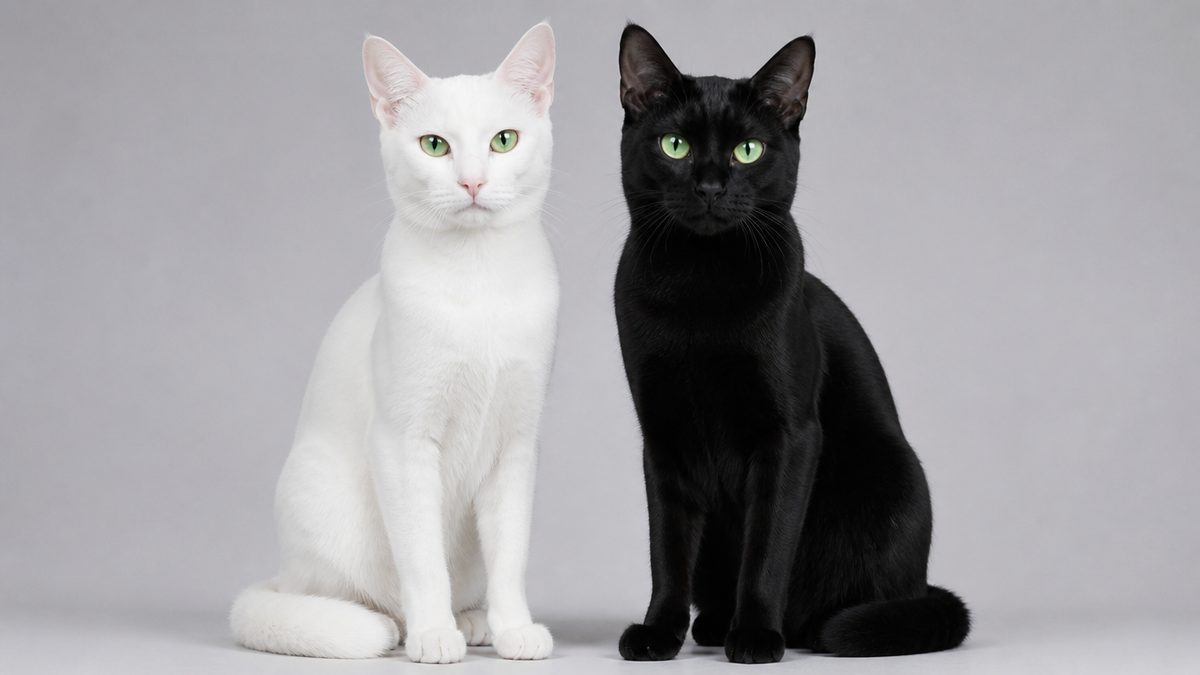
RUSSIAN BLACK (RUS n): jet black with a high, glossy shine and sound to the roots, the coat black to the roots which may be lighter in tone, a slight rusty tinge allowable in kittens, a note that the Russian Black may have a firm, silky textured coat, and a fault of a very pale undercoat in adults. Nose leather and paws: black.
RUSSIAN WHITE (RUS w 64): pure white with no yellow tinge, and in certain lights the coat will appear to sparkle. White kittens often have a coloured cap on the head, which is normal, disappears with the growth of the first adult coat around twelve months and should not be penalised. A note that the Russian White may have a firm, harsher textured coat, and a fault of a yellow tinge detracting from whiteness. Nose leather and paw pads: pink.
Read the two together and the pattern is clear. Coat colour is the only variable. Same cat, same coat requirement, different pigment, and the nose leather and paw pads change with it: black on the black, pink on the white, blue or pinkish lavender on the blue. The 64 in RUS w 64 is not decorative either. It is the EMS eye-colour code for green, so the GCCF's Russian White is defined as a green-eyed white, and that turns out to matter more than anything else on this page.
Registry recognition: one breed, three colours, and no tabby anywhere
Not one of the five registries checked treats the Russian White, Black and Tabby as three breeds, and the tabby is barred by the GCCF's own registration policy.
This is the clearest recognition question in the batch and it has been answered by opening documents rather than summaries.
| Registry | Russian Blue | Russian White | Russian Black | Russian Tabby |
|---|---|---|---|---|
| GCCF | One of three colours of the Russian, RUS a | A colour, RUS w 64, with its own clause | A colour, RUS n, with its own clause | Absent. 'Tabby' appears zero times in the breed page and the registration policy |
| CFA | The breed. Sole colour class, Blue 500 | DISQUALIFIED. 'Any color other than blue' | DISQUALIFIED, same clause | DISQUALIFIED, same clause |
| FIFe | RUS, fully recognised in category 4 | No entry | No entry | No entry |
| TICA | russian-blue, one of 90 breeds | No page | No page | No page |
| WCF | Row 79, code RUS, recognised by ALL | Same row: only WCF, ACF, CCCA, GCCF, NZCF | Same row, same five bodies | No row anywhere in 198 rows |
The WCF row, which packs the whole answer into one line
The World Cat Federation's cross-registry table has one Russian row, number 79, and it reads: 'Russian Blue | RUS | blue: ALL / white & black: only WCF - ACF-CCCA-GCCF-NZCF';.
One breed name, one code, and a colour caveat naming the five bodies that accept white and black. That single cell is a more accurate summary of this subject than any page currently ranking for it. And there is no tabby in it.
Absence is a weak finding on its own, so this one was pushed further. The GCCF's four-page Registration Policy for Russian Cats, June 2025 edition, was fetched directly at HTTP 200 and extracted with pypdf to 10,401 characters.
Three things in it settle the question. The Full Register admits Russians whose pedigrees within five preceding generations contain only Russian Blues (RUS a), Russian Whites (RUS w 64) or Russian Blacks (RUS n). The only approved outcross is a Domestic Shorthair that is a green-eyed Blue or Black Self, only. And clause 4 states that all cats overstamped as carrying or possibly carrying patterns other than self or pointed, or colours other than blue, white or black, will be registered on the Reference Register until cleared by DNA test.
A tabby is by definition a pattern other than self or pointed. The policy does not need to name it, because it excludes the whole category. And the word tabby appears zero times in that policy, zero times on the GCCF breed page, and the phrase Russian Tabby appears zero times across all 723,034 characters of the Standard of Points The Governing Council of the Cat Fancy The Governing Council of the Cat Fancy.
The CFA is blunter still. Its Russian Blue disqualification list reads, in full: kinked or abnormal tail. Locket or button. Incorrect number of toes. Any color other than blue. Long coat. A white, black or tabby Russian is not a variety at the CFA, it is a disqualification. The same page records Russian Blue allowable outcross breeds: none.
What TICA proves by comparison
TICA's 90-breed index carries russian-blue and no other Russian. It also carries the Nebelung, the semi-longhaired cat derived from the Russian Blue, as a breed in its own right, and the WCF gives the Nebelung its own row and code, NEB, recognised by four bodies.
That is the control. TICA and the WCF will split a Russian-derived cat into a separate breed when they judge the difference sufficient, and they have done exactly that for coat length. They have not done it for colour. The absence is a decision, not an oversight.
History: two origin stories that are the same story
The British account dates the white line to a kitten born in 1961 and the Australian account to a programme begun in 1971, and one sentence on the GCCF's own page reconciles them.
Every source on these cats picks a side, and neither side mentions the other. This page carries both, because they turn out not to be rivals.
The British account, from the registry
The GCCF's own history is specific and dated. A breeder called Frances MacLeod registered a white kitten born in 1961 with the GCCF. It was said to have come from a Russian boat, its name was Arctic Chumvi, and it was registered as AOV, Any Other Variety, Foreign Type.
Chumvi was mated to a Russian Blue stud, Meadliam Lupun. That mating produced both white and blue kittens and, in a third litter, a black kitten. The GCCF draws the genetic conclusion explicitly: this proved that Chumvi's white coat masked her true colour of black, and that she also carried the gene for dilution.
That single sentence is the origin of the black as well as the white. A masking white coat over a black cat carrying dilution produces whites, blacks and blues from one female, which is precisely what happened.
One of Chumvi's sons, Arctic Sumairki, was mated to a Russian Blue female called Harvees Amanda Too, and a daughter from that litter, Osmunda, was registered as a Russian White in 1968.
The Australian account, from the breeder
Wikipedia's account is Australian and it quotes Mavis Jones at length. The Russian White programme started on 4 May 1971 by Dick and Mavis Jones of Myemgay Cattery.
The foundation animal was a genuine white Siberian cat with no pedigree, the family pet of an official at the Thai Embassy who brought her to Australia. The Joneses exchanged a Russian Blue for her and mated her to one of their Russian Blue studs. She produced two white kittens, the best of which was kept and named White Rose, and White Rose was then mated back to her sire, Myemgay Yuri. Their two first-generation White Russian kittens were registered in November 1971.
The account does not soften what followed. White Rose developed milk fever when her kittens were three weeks old and died, and the two were hand-raised on a doll's bottle and carnation milk. The named line then runs Myemgay Arctic Girl (first generation), Myemgay Arctic Star (second), Myemgay Arctic Snowflake (third) and Myemgay Arctic Kosack (fourth), because the Royal Agricultural Society Cat Club of New South Wales only fully registered cats when they reached the fourth generation.
The GCCF's page ends its white-line paragraph with eleven words that no other source carries: Frances MacLeod eventually relocated to Australia, where she continued to breed Russian cats.
The British breeder moved to Australia. The GCCF then adds that in due course, Russian Whites and Russian Blacks were accepted by Australian cat registering bodies, and also in South Africa.
So the 1961 British kitten and the 1971 Australian programme are two chapters of one story, and the connecting fact sits in plain sight on the registry's own page. Read that way, Wikipedia's claim that these cats were created in 1971 is a decade late and describes the Australian chapter as though it were the whole book.
Two dates in one article, and a surname invented by a search engine
Two smaller errors are worth recording because both are checkable in seconds.
First, Wikipedia contradicts itself on the Australian recognition date. The Mavis Jones quotation says the cats were granted full registration, eligible to compete for Championship status in July 1975, while the article's own Breed recognition section states Full register status was given by RAS in November 1975. Four months apart, in one article, with no note that they differ.
Second, Google's AI summary of this breed says in one paragraph that it was developed in Australia in 1971 by crossing a Russian Blue with a white Siberian cat, and in another that the breed began in the 1970s when breeder Frances Cox crossed Russian Blues with white Siberian cats. No source found in this research names a Frances Cox. Wikipedia gives Frances McLeod and the GCCF gives Frances MacLeod The Governing Council of the Cat Fancy. Two spellings of one real person, and a third surname produced by a machine.
The last dated recognition event is American. In 2010 the American Cat Fanciers Association recognised the Russian Black and Russian White for championship status, under a standard the association files as the ACFA Russian Shorthair Standard. Note the breed name it used: Russian Shorthair, not Russian White. Even the registry that granted the white championship status did so under a single breed name.
Russian White cat price in India
No Russian White cat price in India exists, and neither does a Russian price of any colour, because India's leading cat-price guide does not name the Russian at all.
The absence is wider than these colours and it was tested rather than assumed. India's 2026 all-breed cat price guide runs to 45,016 characters of extracted text and the string Russian appears ZERO times, while Persian appears 22 times, Bengal 16 and Siamese 9. The country's leading cat-price guide prices no Russian cat at all, not even the blue.
The same publisher's 40-breed guide to cats for the Indian climate mentions Russian seven times, and every one is the Russian Blue. Neither Russian White nor Russian Black nor Russian Tabby appears in either document.
So Indian cat writing knows the Russian Blue as a breed worth discussing and does not price it, and has never heard of the other two colours at all.
| Source | What it is | Russian White named | Usable as an Indian price |
|---|---|---|---|
| India's 2026 all-breed cat price guide | 45,016 characters, Russian zero times | No | No |
| India's 40-breed cat climate guide | 51,780 characters, Russian seven times, all blue | No | No |
| The GCCF breed page | The registry that holds the colour | Yes | No, it publishes no prices |
| US and UK commercial breed pages | Catster, Feliway, PetSafe and similar | Yes | No, wrong market |
| Any Indian registry, breeder or classified listing | Nothing found | No | No |
The premium to refuse, and how to test it
If anyone in India offers you a Russian White or a Russian Black at a premium over a Russian Blue, there is a single question that settles it: which registry recognises the colour you are charging me for?
The answer, from the documents on this page, is that five bodies do, named on one line of the WCF's own table: WCF, ACF, CCCA, GCCF and NZCF. None of them operates in India. The CFA disqualifies the colour outright, FIFe holds only the blue and TICA lists only russian-blue.
A Russian Tabby offered at any price is a different matter, because no registry document checked here supports the category at all, and the GCCF's own registration policy sends any cat carrying a pattern other than self or pointed to the Reference Register. A tabby cat of Russian type is a cat of Russian type with tabby markings, and the registry that holds this breed would not register it as a Russian.
If you are importing, the registration paperwork is the real cost
Anyone seriously pursuing one of these cats will be importing it, and the GCCF's rules are worth knowing before money moves, because they are strict and specific.
Imported Russian Blues, Russian Whites or Russian Blacks with blue eyes or odd eyes are not acceptable for registration. Every cat must be microchipped before it is DNA or BAER/OAE tested, with the microchip number recorded on the certificate. And an entire imported Russian needs DNA certification lodged at the time of registration.
None of that binds an Indian buyer, because no Indian body enforces it. That is precisely the problem: a pedigree issued abroad is only as good as the registry behind it, and there is no Indian registry to check it against.
Monthly cost of ownership in India
A Russian costs what any short-coated cat costs in India, with one genuine addition for the white and one for the double coat.
This prices the animal the standards describe. A medium, short-coated, double-coated cat with a low grooming rating and no registry-documented disease costs what a healthy Indian shorthair costs, with two exceptions worth budgeting separately.
| Line | Figure | Note |
|---|---|---|
| Kitten vaccination course | From Rs 3,999, three visits at days 60, 90 and 120 | List price Rs 5,065 at the same chain |
| Annual booster | From Rs 1,899 | Anti-rabies alone Rs 699 |
| Consultation | Rs 500 to Rs 1,000 | One data point, not two; two publishers print it identically |
| Professional grooming | Rs 0 | A Delhi haircut starts at Rs 1,359 and a full bath and styling at Rs 1,869. Never shave a double coat |
| Boarding, per 24 hours | Rs 899 in Bengaluru | Daycare to ten hours Rs 799 |
| Municipal licence | Rs 50 in Chennai | Delhi's Rs 500 registration covers dogs only |
| Microchipping | Rs 1,250 in Chennai | Required before any BAER or DNA test under the GCCF policy |
| BAER hearing test, for a white cat | The genuine breed-specific line | No Indian price could be sourced, and Bonbeno will not invent one |
The consultation figure is published identically by a dog sanctuary and a general insurer, so one copied the other and it counts as a single data point. Budget above it.
The microchipping line is not optional if you ever intend to test or register the cat. The GCCF's policy is explicit that all cats must be microchipped before they are DNA or BAER/OAE tested, with the microchip number recorded on the certificate. A Chennai clinic's own transacted price for microchipping is Rs 1,250.
For a white cat this is the one test that matters, and no Indian price for it could be sourced in this research. Bonbeno will not publish a figure it cannot cite. What can be said is where to ask: a BAER test needs specialist equipment and is generally available at veterinary teaching hospitals and large referral centres rather than at a neighbourhood clinic, so the question to ask locally is which referral centre in your city performs it, not what it costs at your usual vet.
- Budget Rs 4,000 to vaccinate a kitten through its first-year course, then about Rs 1,900 a year.
- Budget nothing for professional grooming, and never budget for a shave, because a double coat regrows unevenly.
- Budget Rs 899 for a night of boarding in Bengaluru if you travel.
- Budget Rs 1,250 for microchipping in Chennai, which is a prerequisite for any certified testing.
- Budget a BAER test for any white cat, and find the referral centre before you need it.
- Budget one neutering, which buys more life expectancy than any other decision here.
Chennai readers get one line the rest of the country does not. Greater Chennai Corporation licenses pet animals generally at Rs 50, issued 9,115 licences in 2024, and its six municipal pet clinics provide all treatment and anti-rabies vaccination free of cost.
Suitability for the Indian climate
The dense double coat that defines this breed is the one thing about it that suits India least, and the two origin climates are both far cooler than anywhere in India.
Both origin cells check out against their real elevations before any figure is used. Sydney returns a cell at 31.72 m against a real 19 m, an error of only +12.72 m. London returns 73.15 m against a real 11 m, an error of +62.15 m, which is large for a low-lying city and is recorded here rather than hidden. The temperature effect of 62 m is under half a degree at the standard lapse rate, so the London figures are usable with that caveat stated.
| Place | Annual mean C | Annual RH % | Warmest month | Coolest month | Peak Stull wet bulb |
|---|---|---|---|---|---|
| London | 10.39 | 84.59 | Jul, 17.63 | Jan, 4.14 | Jul, 14.76 |
| Sydney | 18.66 | 72.52 | Jan, 22.93 | Jul, 14.00 | Feb, 19.73 |
| Bengaluru | 23.74 | 67.94 | Apr, 28.37 | Dec, 20.22 | May, 21.86 |
| Delhi | 25.60 | 45.56 | Jun, 35.88 | Jan, 13.61 | Jul, 26.50 |
| Mumbai | 26.77 | 67.39 | May, 31.19 | Jan, 23.19 | Jun, 25.77 |
| Kolkata | 25.81 | 73.93 | May, 31.53 | Jan, 17.31 | Jun, 27.09 |
| Chennai | 27.95 | 72.39 | May, 31.51 | Jan, 24.09 | May, 26.11 |
| Kochi | 27.31 | 78.83 | Mar, 29.42 | Aug, 25.91 | May, 25.79 |
Humidity is not the problem, and Sydney proves it
The reflex worry about a British or Australian breed in India is humidity. Both origin figures refuse it. London runs 84.59 percent annual relative humidity, higher than every Indian city in this table including Kochi at 78.83 NASA POWER climatology API, 2001-2020. Sydney runs 72.52 percent, which is essentially Chennai's 72.39 NASA POWER climatology API, 2001-2020.
So neither origin is a dry climate, both are more humid than Delhi, and a Russian arriving in Chennai would find the air no damper than Sydney's. What it would find is the same humidity ten degrees hotter, and that is what the wet-bulb column measures.
Sydney's peak wet bulb is 19.73 C in February and London's is 14.76 C in July. Kolkata reaches 27.09 C in June, Delhi 26.50 C in July and Chennai 26.11 C in May. That is a rise of six to twelve degrees in peak wet bulb, and it is the entire climate argument.
This breed's defining feature works against it here. The CFA requires a short, dense, fine and plush double coat that stands out from the body due to its density, and the GCCF withholds a certificate for a flat coat that shows lack of undercoat. A standing double coat is an insulating layer, and the registries penalise breeders who let it thin.
That is why the heat rating on this page is three where the Oriental group scores four. The Russian is not a heat breed. It is a temperate cat whose most valued feature is insulation.
What to do about it, and what never to do
Never shave a double coat. A shaved double coat regrows unevenly, loses the standing structure the standard describes, and removes the layer that keeps radiant heat off the skin as well as the layer that keeps warmth in. It is the single most common and most damaging thing owners of plush-coated cats do in hot countries.
Do this instead. Brush weekly and more often during a coat change, so the shed undercoat comes out rather than matting into the standing coat. Provide a cool hard surface, since a cat with a dense coat loses heat by conduction more effectively than by evaporation. Keep the cat indoors between eleven and four from March to June. And provide multiple water sources.
City by city, Bengaluru and Pune are the easiest by a clear margin, with the lowest wet-bulb peaks in the table. Delhi is a split case: the highest summer mean at 35.88 C but by far the lowest humidity at 45.56 percent, and dry heat is more survivable than wet heat at the same temperature. Kolkata, Chennai and Kochi are the hardest, because there is no cool season in which a dense-coated cat can recover.
The winter runs the other way entirely, and it is worth saying plainly. Delhi's January mean of 13.61 C would be pleasant to a cat built for Sydney's July at 14.00 C. Of every breed in this batch, this is the one that would enjoy a north Indian winter most.
Temperament and household fit
The Russian is quiet, reserved with strangers and closely attached to its own household, which makes it one of the better pedigree choices for an Indian flat.
The GCCF gives the temperament as playful and intelligent and the grooming requirement as low. Neither registry document describes a vocal cat, which is the significant absence.
That matters more than it sounds. The commonest reason pedigree cats are rehomed from flats is noise, and this breed is at the opposite end of that scale from the Oriental group. A quiet, reserved cat that bonds hard to its own people and hides from visitors is a good fit for a small home and a poor fit for a household with constant traffic.
The reserve is worth planning for rather than treating as a fault. A Russian will typically vanish when the doorbell rings and reappear when the flat is quiet again. Give it a high, enclosed retreat that it does not have to leave when guests arrive, and the behaviour stops being a problem.
The one thing colour changes
Nothing in the temperament differs by colour, and no source claims otherwise. What does differ is what a deaf cat needs, and a white cat carries a raised probability of deafness that a blue or black one does not.
A deaf cat is not a difficult cat, but it is a different one. It cannot hear a car, a door or a warning, which makes outdoor access unsafe rather than merely unwise. It startles when touched while asleep, so wake it by vibration through the floor or bedding rather than by hand. And it will often be louder than a hearing cat, because it cannot modulate its own voice.
Those are manageable adjustments and none of them is a reason to avoid a white cat. They are a reason to know before you commit, which is the whole purpose of the BAER test the GCCF requires.
Training a reserved cat, and a possibly deaf one
To train a Russian, build on the household bond and use visual signals from the start, because a white cat may not be able to hear a verbal one.
There is no breed-specific training literature: "Russian Tabby"[tiab] returns zero in PubMed and the other two names return chickens and soil science. What follows is training for a quiet, reserved, human-focused cat, with one adaptation this breed genuinely needs.
- Train the carrier weeks before the first vet visit, feeding in it with the door open, because a reserved cat resists being handled under pressure.
- Train a VISUAL signal alongside every verbal one from day one, such as a hand sign or a torch flash, so a deaf or partly deaf cat is never excluded.
- Train a retreat rather than a confrontation: give the cat a high enclosed refuge and reward it for using it when visitors arrive.
- Train handling of ears and paws early, because microchipping and BAER testing both involve restraint.
- Train a floor-vibration recall for a white cat, since a stamp on the floor carries where a call does not.
The visual-signal point is the one worth doing even if the cat turns out to have normal hearing. It costs nothing, it works for a blue or black Russian as well, and it means that a later diagnosis of age-related hearing loss does not require starting again.
One Indian specific. A reserved cat in a flat with domestic staff, deliveries and frequent visitors will spend a great deal of its life hiding unless the retreat is properly provided. Height helps more than enclosure: a shelf above head level is used far more readily than a covered bed on the floor.
Daily exercise requirement
Two structured play sessions a day and vertical space suit a Russian well, and the timing matters more here than for most breeds because of the coat.
The standard describes a long graceful body on medium strong bone with long legs and small oval paws, which is an athletic outline rather than a heavy one. The temperament is playful, and a reserved cat will often play more freely when the household is quiet.
Two sessions of ten to fifteen minutes with a wand toy, each ending in a catch and a meal, meets the behavioural need better than an hour of undirected play. Add vertical space, which for a reserved breed doubles as the retreat described above.
Timing carries more weight for this breed than for the single-coated cats in this batch. A dense standing double coat slows heat loss during exertion, and Chennai in May averages 31.51 C while Delhi in June averages 35.88 C. Play early in the morning and after dark from March to June, and stop the session at the first sign of open-mouthed breathing rather than pushing through it.
Do not use outdoor access as a substitute, and for a white cat do not use it at all. A cat that may not hear traffic has no business on an Indian street.
Grooming and coat care in Indian humidity
Grooming a Russian means brushing out a shed undercoat weekly and never shaving it, because the standing double coat is both the breed's defining feature and its heat management.
The GCCF rates grooming as Low and describes the coat as dense and soft. The CFA is more precise: short, dense, fine and plush, a double coat that stands out from the body due to its density, with a distinct soft and silky feel.
Low grooming and a double coat are not a contradiction. This coat does not mat and does not need a groomer, so there is no Rs 1,359 haircut and no Rs 1,869 bath and styling in this budget. What it does need is the shed undercoat removed, weekly as routine and more often during a coat change, or the loose hair packs into the standing coat and defeats the structure the standard requires.
This is the most consequential grooming instruction on the page. A double coat is two layers doing two jobs: a dense undercoat that insulates and guard hairs that shed water and reflect radiant heat. Shaving removes both, exposes skin to sun, and regrows unevenly and often with a changed texture.
Indian groomers routinely offer summer shaves for plush-coated animals, and the GCCF's own standard makes the point implicitly by withholding a certificate for a flat coat that shows lack of undercoat. If the registry penalises a naturally thin coat, an artificially removed one is worse. Brush it out instead.
What the colour clauses tell a groomer and a buyer
Two coat notes in the standard are colour-specific and both are useful in the hand.
The Russian Black may have a firm, silky textured coat and its fault is a very pale undercoat in adults. The Russian White may have a firm, harsher textured coat and its fault is a yellow tinge that detracts from whiteness.
So the registry itself acknowledges that pigment changes coat texture in this breed, which is a real and often-denied phenomenon. A white Russian that feels slightly coarser than a blue one is not a badly bred cat; it is what the standard describes.
A yellow tinge on a white cat is worth understanding practically. It is usually not genetic but staining, from tears, saliva, food or sun, and in an Indian summer sun bleaching and dust both contribute. Wipe the face daily and keep the cat out of the harshest midday sun, which is advice that helps the coat and the cat at the same time.
The Indian monsoon routine
A dense double coat holds water, which makes drying more important here than for a single-coated breed. In Kochi at 78.83 percent annual relative humidity or Kolkata with a June wet bulb of 27.09 C, a wet double coat in a closed room dries slowly and stays warm and damp against the skin.
Dry the cat properly after any soaking, dry the ears specifically, use no cotton buds, and do not let it air-dry in an unventilated room.
Health: a registry-mandated hearing test and one merged life expectancy
The GCCF requires a certificate of freedom from deafness before any progeny may be registered from a Russian White parent, which is the most concrete health rule on any page in this batch.
The GCCF's own summary of the breed's health is short and positive: the Russian is generally a very healthy breed and no major genetic problems have been reported. That is the registry's own assessment and it is worth taking seriously.
There is exactly one exception and it applies to the white.
The GCCF's Registration Policy for Russian Cats states, at Note 3: before any progeny may be registered from a Russian White or White of Russian type sire or dam, this cat must have a BAER or OAE certificate of freedom from unilateral or bilateral deafness which is lodged with the GCCF. Russian Whites without such a certificate are registered on the non-active register until one is lodged.
The breed page says the same from the other direction: White Russians registered with the GCCF on the active register and used for breeding must have undergone a BAER test to detect deafness.
A registry that will not let you breed from a cat until it has proved it can hear is a registry taking the risk seriously, and it makes deafness testing something precise an Indian buyer can ask a seller for.
The genetics, and why green eyes matter
The GCCF adds a reassuring qualifier: as Russian Whites have green eyes, the incidence of deafness is usually low. That is not folklore, and the published genetics explain it.
In cats the Dominant White locus is KIT on chromosome B1, and it shows complete penetrance for absence of coat pigmentation and incomplete penetrance for deafness and iris hypopigmentation. A full-length 7,125 bp FERV1 retroviral element is associated with white spotting, while a FERV1 long terminal repeat alone is associated with all Dominant White individuals, and deafness is genetically linked to that marker.
Incomplete penetrance is the operative phrase. Not every dominant white cat is deaf and not every dominant white cat has hypopigmented eyes, and the two travel together because they share a cause. A white cat that has retained full iris pigmentation, which is what green eyes mean, has expressed less of the pleiotropic effect, and is correspondingly less likely to have expressed the deafness as well.
The registry has built that into its rules. Blue-eyed Russian Whites (RUS w 61) and odd-eyed Russian Whites (RUS w 63) go to the Reference Register with no progression, and whites of other eye colours shall not be registered at all. Imports with blue or odd eyes are not acceptable for registration. The GCCF's Russian White is a green-eyed white by policy, not by preference.
One caution against reading eye colour as a guarantee. Blue eyes with hearing loss in cats is not confined to the KIT pathway: a 2024 study mapped PAX3 haploinsufficiency in Maine Coon cats with dominant blue eyes and hearing loss resembling human Waardenburg syndrome. Eye colour lowers the odds. Only a test settles them.
What else the registration policy screens for
The GCCF's policy carries several other requirements worth knowing, because they tell you what the breed community considers a risk.
Every cat must be microchipped before it is DNA or BAER/OAE tested. An entire imported Russian needs DNA certification lodged at registration, including that it is blood type A, not carrying B. The single approved outcross is a green-eyed Blue or Black Self Domestic Shorthair, only, and a minimum of four generations must be bred after that cross before a cat can be registered as a Russian.
The blood-type requirement is the one an Indian owner should understand. Feline blood type incompatibility causes neonatal isoerythrolysis, in which a type B queen's colostrum destroys the red cells of type A kittens. A registry requiring blood typing before registration is managing a breeding risk rather than a pet-owner risk, but it is a question worth asking any breeder anywhere.
Lifespan, and the merged row that is the only figure available
The GCCF's breed page gives a lifespan of 12 to 15 years. That is a registry estimate rather than a measured one, and the measured figure is lower and more complicated.
The UK life-table study's Table 6 was read directly from the full text on 10 September 2026. Its Russian row reads Russian cats 9.65 (7.20-12.10), observed range 0.32 to 19.39, on 19 deaths, and the footnote defines the category as Russian Blue and Russian (unspecified).
That footnote is why this page carries the figure at all. A merged row folding in cats recorded simply as Russian (unspecified) necessarily includes any Russian White, Black or otherwise non-blue cat presented in UK primary-care practice, because that is exactly how such a cat would be recorded. The merged 9.65 years is the only life-expectancy estimate in existence that reaches these colours, and it reaches them only because it is merged.
Read it with its confidence interval, which is wide: 7.20 to 12.10 years on 19 deaths. Nineteen deaths is a small denominator and the study's own threshold for a breed-specific row was fifteen. Do not treat 9.65 as a prediction for an individual cat, and do not treat the GCCF's 12 to 15 as a measurement. Publish both and say which is which, which is what this page does.
For context in the same table: all cats 11.74 years, crossbred 11.89 on 7,117 deaths, Burmese 14.42 at the top and Sphynx 6.68 at the bottom.
Two figures transfer because neither is breed-specific: entire cats carried 4.29 times (3.72-4.95) the odds of death before three years compared with neutered cats, and purebred cats 1.83 times (1.50-2.23) the odds compared with crossbreds.
Feeding and nutrition
Feed a Russian as a medium, moderately active cat on a complete diet, and weigh it monthly because a dense standing coat hides both gain and loss.
There is no breed-specific nutritional requirement and no registry guidance beyond the weight range. The GCCF gives 8 to 15 lbs, which is a wide band and includes a substantial difference between a small female and a large male.
The practical problem this breed creates is measurement. A dense double coat that stands out from the body visually smooths the outline, so a cat gaining weight looks the same as a cat in condition, and a cat losing it looks the same too. Judging by eye does not work here.
Weigh the cat monthly on a kitchen scale and record it. Feel over the ribs, the spine and the pelvis with your hands rather than looking. Split the ration into three or four meals rather than free-feeding, and weigh the food rather than scooping it.
Water, which matters more in India than the brand does
In a Chennai May at a 31.51 C mean or a Delhi June at 35.88 C, intake is the variable to watch, and it matters slightly more for a densely coated cat that is working harder to shed heat.
Wet food raises total water intake more reliably than a fountain does. If the cat eats dry food only, place a second and third water source in rooms it actually uses and keep them away from the food bowl, because cats routinely refuse water sited beside a meal.
One point specific to a white cat. Tear staining is the commonest cause of the yellow tinge the standard treats as a fault, and while diet is often blamed there is no evidence that any commercial food prevents it. Wipe the face daily instead of changing the diet on a cosmetic argument.
Do not buy a diet on a breed claim. There is no Russian White formulation and no research that could support one.
Kitten timeline, month by month through the first year
A Russian kitten follows the ordinary feline schedule with three breed-specific checkpoints, one of which is a hearing test that should happen before you commit.
This is the standard feline timeline with the three points where this breed differs, and the first of them comes before the kitten leaves the breeder.
| Age | What happens | What you do |
|---|---|---|
| Before purchase | Breeder assessment | Checkpoint one: for a white kitten, ask for the BAER or OAE certificate on BOTH parents |
| 0 to 8 weeks | With the queen. Weaning completes around eight weeks | Nothing. Indian law treats kittens below eight weeks as un-weaned |
| 8 to 9 weeks | Home. Socialisation window still open | Handle ears and paws daily. Introduce visual signals alongside verbal ones |
| Day 60 | First vaccination visit | Kitten course starts, from Rs 3,999 for three visits |
| Day 90 | Second visit | Confirm the schedule your own clinic uses |
| Day 120 | Third visit plus anti-rabies | Anti-rabies Rs 699 privately, free at Chennai's six municipal clinics |
| 8 to 16 weeks | Hearing can be tested reliably from a few weeks of age | Checkpoint two: BAER test the kitten itself if it is white and untested |
| 5 to 8 months | Sexual maturity, early in a warm climate | Neuter. The single largest survival intervention available |
| Around 12 months | The first adult coat comes through | Checkpoint three: the white kitten's coloured head cap should have gone |
Checkpoint one is the one that saves money and heartache. The GCCF requires a BAER or OAE certificate of freedom from deafness before any progeny may be registered from a Russian White parent. A breeder working to that policy will already have it. A breeder who has never heard of it is a breeder working to no policy at all.
Checkpoint two matters because hearing is testable and guessing is not. A kitten that responds to a clap may be responding to the air movement. Only a BAER or OAE test distinguishes unilateral deafness, which is common, easily missed and entirely compatible with a normal life, from normal hearing.
Checkpoint three is the reassuring one and it is written into the standard. White kittens often have a coloured cap on the head; this is normal, disappears with the growth of the first adult coat around 12 months of age and should not be penalised. A coloured smudge on a ten-week-old white kitten is expected. The same mark on an adult is a withholding fault, because the standard withholds a certificate for any colour other than white anywhere on Russian White adults apart from the head smudge in cats up to twelve months.
The neutering line is not a formality: entire cats carried 4.29 times the odds of death before three years in the UK life tables.
The three colours against each other, and against the Russian Blue
The four Russians differ in one gene each and in nothing else, and the registries treat those four cats in four different ways.
This is the tidiest comparison on the site, because the cats are genuinely identical apart from pigment, and the standard says so by giving all four the same type, coat and eye requirements.
| Cat | GCCF code | Nose leather and pads | Held by | Indian price published |
|---|---|---|---|---|
| Russian Blue | RUS a | Blue nose; blue, or pinkish lavender, pads | Every major registry | Yes, quoted by Indian publishers |
| Russian Black | RUS n | Black nose and paws | WCF, ACF, CCCA, GCCF, NZCF, and ACFA since 2010 | None |
| Russian White | RUS w 64 | Pink nose leather and paw pads | The same five bodies, plus ACFA since 2010 | None |
| Russian Tabby | No code exists | Not described anywhere | No registry document found | None |
| Nebelung | NEB at the WCF | As the Russian Blue | WCF, TICA, GCCF, LOOF as a separate breed | None |
The last two rows carry the argument. The Nebelung is a Russian Blue with a semi-long coat, and four registries hold it as a separate breed with its own code. The Russian Tabby is a Russian with tabby markings and no registry document found here holds it as anything at all.
That comparison is the honest answer to the page's title question. These registries are perfectly willing to create a new breed out of a Russian Blue when they judge the difference sufficient. They did it for coat length. They declined to do it for colour, and for the tabby they declined even to create a colour.
Where the four sit on registry standing
The blue, with its silvery sheen from the silver-tipped guard hairs, is held by everyone. The WCF's row 79 marks it recognised by ALL, FIFe carries RUS in category 4 with a standard last modified in 2025, TICA lists russian-blue and the CFA runs a Russian Blue breed council.
The white and black are held by five bodies, named on that same WCF line: WCF, ACF, CCCA, GCCF and NZCF, with the ACFA adding championship status in 2010 under a Russian Shorthair standard.
The tabby is held by nobody, and the GCCF's registration policy actively excludes the category by restricting the breed to three colours and sending any pattern other than self or pointed to the Reference Register.
The practical conclusion for an Indian buyer
Only one of these five is realistically obtainable in India, and it is the Russian Blue, which is also the only one with a published Indian price band and the only one every registry holds.
If someone offers you a Russian White or Russian Black in India, the cat may be entirely genuine, but its pedigree will come from a registry with no Indian presence and its colour is one the CFA would disqualify. Being rarer does not make it more expensive in any market that exists here, because no such market exists. If someone offers you a Russian Tabby, ask to see the registry standard. There is not one.
Mistakes Indian readers make with these cats
Five errors account for nearly everything written about the Russian White, Black and Tabby, and four of them are settled by two documents on the GCCF's own website.
1. Believing there are three breeds
Wikipedia's title says three breeds created in 1971 and the highest-ranking encyclopedia repeats it. No registry agrees. The GCCF holds one breed in three colours, the WCF has one Russian row, the CFA disqualifies anything but blue, FIFe holds only the blue and TICA lists only russian-blue. The three-breed framing exists in article titles and nowhere else.
2. Treating the Russian Tabby as a rare variety
It is not rare, it is absent, and the exclusion is explicit. The GCCF's Registration Policy for Russian Cats restricts the breed to blue, white and black and sends any cat carrying patterns other than self or pointed to the Reference Register. The word tabby appears zero times in that policy and zero times on the GCCF breed page, and 'Russian Tabby' appears zero times in 723,034 characters of the Standard of Points The Governing Council of the Cat Fancy The Governing Council of the Cat Fancy.
3. Dating the breed to 1971
The Australian programme did begin on 4 May 1971. The British line begins with a white kitten born in 1961, registered as AOV Foreign Type, whose granddaughter Osmunda was registered as a Russian White in 1968. And the two are the same story, because the GCCF records that Frances MacLeod eventually relocated to Australia, where she continued to breed Russian cats.
4. Repeating a surname a search engine invented
Google's AI summary names the founder Frances Cox. Wikipedia gives Frances McLeod and the GCCF gives Frances MacLeod The Governing Council of the Cat Fancy. The Mac and Mc spellings are an ordinary variant of one real name. Cox is not, and no source found in this research uses it. When an AI answer supplies a proper name, check it against a document before repeating it.
5. Reading a PubMed count as a literature
"Russian White"[tiab] returns 23 records and the first five are about chickens, because the Russian White is also a poultry breed. "Russian Black"[tiab] returns 22 and they are the Black Sea and chernozem soil. "Russian Tabby"[tiab] returns zero. Two plausible two-figure counts, neither of them about a cat.
One further note in the same family. "Russian Blue"[tiab] returns 44 and "Russian Blues"[tiab] returns 6, and the two sets do not fully overlap. Singular and plural must be searched and unioned, which is the same discipline this site applies to every breed name.
Adoption, and the honest recommendation
Adopt a shorthaired Indian cat, or buy a Russian Blue if the type is the point, because the white and black have no Indian market and the tabby has no registry.
The starting fact is broader than these colours. India's leading cat-price guide runs to 45,016 characters and the string Russian appears zero times, in any colour, while Persian appears 22 times. The blue is discussed in Indian cat writing and not priced there; the white and black are not discussed at all.
So the practical options are three, and they are worth setting out plainly.
If the type is what appeals
Buy a Russian Blue. It is the same cat in the colour every registry holds, it has a real Indian market, and it comes with a standard you can hold a seller to. The GCCF, CFA, FIFe, TICA and WCF all publish one Fédération Internationale Féline The International Cat Association World Cat Federation.
If the white coat is what appeals
White shorthaired cats are common in Indian shelters and cost nothing. The genetics that matter are the same genetics: the Dominant White locus is KIT, its penetrance for deafness and iris hypopigmentation is incomplete, and no pedigree changes that.
Take the registry's own precaution with a shelter cat. Ask for a BAER or OAE test, which is what the GCCF requires before any progeny may be registered from a Russian White parent, and treat a blue-eyed or odd-eyed white cat as higher risk than a green-eyed one, which is the distinction the registry itself draws.
A deaf cat is a perfectly good pet. It is an indoor pet, and knowing in advance is what makes that decision rather than a discovery.
If somebody offers you a Russian Tabby
Ask for the standard. There is not one, in any of the five registries checked here, and the GCCF's own registration policy would send the cat to its Reference Register. Whatever animal is being offered, it is not a recognised anything, and it should not carry a premium.
- Contact a registered municipal or NGO shelter in your own city, where short-coated white and black cats are common.
- Confirm the kitten is at least eight weeks old, which Indian law requires and which the pet-shop rules define as the weaning threshold.
- Confirm the vaccination record and start the course if it has not begun, from Rs 3,999 for three visits.
- Confirm a BAER or OAE hearing test for any white cat, and find the referral centre before you need it.
- Confirm the licence position with your own corporation, which in Chennai is Rs 50 and covers cats.
- Confirm neutering is booked, because it buys more life expectancy than any other decision on this page.
One closing observation about this breed group that generalises. The GCCF's registration policy for the Russian is one of the strictest documents quoted anywhere on this site: microchipping before testing, a single approved outcross, four generations after it, DNA certification on imports, blood typing, no blue or odd eyes, and a hearing certificate before progeny can be registered. None of that is enforceable in India, and no Indian body will read the paperwork it produces.
That is not an argument against the breed. It is an argument for asking an Indian seller the same questions the GCCF asks a British one, and for understanding that the answers are yours to verify.
Russian White, Black and Tabby questions people actually ask
What is special about white Russian cats?
Two things, and one is administrative. Physically the Russian White is the Russian in a white coat, with the same dense plush double coat, the same elegant foreign type and, by registry policy, green eyes rather than blue. Administratively it is one of the very few cats anywhere whose registry requires a hearing test: the GCCF will not register progeny from a Russian White parent without a BAER or OAE certificate of freedom from deafness lodged with it.
How much do Russian white cats cost?
No Indian price exists. India's 2026 all-breed cat price guide runs to 45,016 characters and the string Russian appears zero times, in any colour, while Persian appears 22 times and Bengal 16. The country's 40-breed climate guide mentions Russian seven times and every one is the Russian Blue. If a seller in India quotes you a premium for a white or black Russian over a blue one, ask which registry recognises the colour, because the CFA disqualifies it outright.
Is Russian white cat rare?
Rare in India and uncommon everywhere. Five registries accept the colour, named on one line of the World Cat Federation's own table: WCF, ACF, CCCA, GCCF and NZCF, with the American Cat Fanciers Association adding championship status in 2010. The CFA disqualifies any colour other than blue, FIFe recognises only the blue, and TICA's 90-breed index lists only russian-blue. India's leading cat-price guide names no Russian of any colour at all.
What is the Russian white cat breed like?
Quiet, reserved with strangers and closely bonded to its own household, which makes it a good flat cat and a poor choice for a home with constant visitors. The GCCF describes the Russian as playful and intelligent, of elegant foreign type but not as extreme as a Siamese, at 8 to 15 lbs with a dense soft coat, low grooming and a lifespan of 12 to 15 years. Nothing about the temperament differs by colour; what differs is that a white cat may be deaf and needs testing.
Are the Russian White, Black and Tabby separate breeds?
No registry treats them as separate breeds. The GCCF states plainly that the Russian is bred in three colours, Blue, Black and White, and files them as colour clauses within one standard. The World Cat Federation's 198-row table carries one Russian row. The CFA disqualifies any colour other than blue. FIFe and TICA recognise only the blue. The three-breed framing comes from an article title rather than from any registry document.
Does the Russian Tabby exist?
Not as a recognised variety anywhere this research could check, and the exclusion is explicit rather than accidental. The GCCF's Registration Policy for Russian Cats restricts the breed to blue, white and black and places any cat overstamped as carrying patterns other than self or pointed on the Reference Register until cleared by DNA test. The word tabby appears zero times in that four-page policy, zero times on the GCCF breed page, and the phrase Russian Tabby appears zero times in 723,034 characters of the Standard of Points.
Are Russian White cats deaf?
Some are, and the risk is lower than for most white cats because of the eye colour. In cats the Dominant White locus is KIT on chromosome B1, with complete penetrance for absence of coat pigmentation but incomplete penetrance for deafness and iris hypopigmentation, and deafness is genetically linked to that marker. The GCCF states that as Russian Whites have green eyes the incidence of deafness is usually low, and it sends blue-eyed and odd-eyed Russian Whites to its Reference Register with no progression.
When were Russian White cats created?
Earlier than the usual answer. Wikipedia says the breeds were created in 1971 and dates the Australian programme to 4 May 1971. The GCCF records that a breeder called Frances MacLeod registered a white kitten born in 1961, named Arctic Chumvi and said to have come from a Russian boat, and that Chumvi's granddaughter Osmunda was registered as a Russian White in 1968. The two accounts join up in one sentence on the GCCF's page: MacLeod eventually relocated to Australia.
How long do Russian White cats live?
The only measured figure is a merged one and it is lower than the registry estimate. The UK life tables give Russian cats 9.65 years, 95 percent CI 7.20 to 12.10, on 19 deaths, with the footnote defining the category as Russian Blue and Russian unspecified, which is exactly how a white or black Russian would be recorded. The GCCF's own breed page gives 12 to 15 years, which is a registry estimate rather than a measurement. Publish both and know which is which.
Can a Russian cat handle Indian heat?
Less well than most cats in this batch, because its defining feature is insulation. The CFA requires a short, dense, fine and plush double coat that stands out from the body, and the GCCF withholds a certificate for a flat coat that shows lack of undercoat. Peak wet bulb rises from 19.73 C in Sydney and 14.76 C in London to 27.09 C in Kolkata. Humidity is not the issue: London runs 84.59 percent annual relative humidity, higher than any Indian city. Never shave the coat.
Why does my white Russian kitten have a spot on its head?
Because that is normal and the standard says so. The GCCF's Russian White colour clause records that white kittens often have a coloured cap on the head, that this is normal, that it disappears with the growth of the first adult coat around twelve months of age, and that it should not be penalised. The same standard withholds a certificate for any colour other than white anywhere on a Russian White adult, apart from that head smudge in cats up to twelve months.
What outcrosses are allowed in the Russian breed?
Exactly one, and it is tightly specified. The GCCF's registration policy gives the only approved outcross as a Domestic Shorthair that is a green-eyed Blue or Black Self, and requires a minimum of four generations bred since that cross before a cat may be registered as a Russian Blue, Russian White or Russian Black. The CFA takes the opposite approach and records that Russian Blue allowable outcross breeds are none at all.
Compare with similar breeds
Russian White, Russian Black and Russian Tabby sits in 1 Bonbeno group. Each one compares it directly against the breeds it is genuinely an alternative to, on the same figures.