
Cat breed guide
Kanaani Cat: Price in India, Registry Status and the Wildcat Question
One registry, six accepted colour varieties, a closed register since 2008, and a wildcat story that appears nowhere in the registry's own document.
Quick answer
No Kanaani cat price in India could be sourced on 10 September 2026, and India's two largest cat guides do not name the breed at all. Only one registry in the world holds it, the World Cat Federation, whose standard has been unchanged since 1 January 2010. India lists the breed's wild parent species, the Desert Cat, in Schedule I of the Wild Life (Protection) Act.
This page reports what breed standards, registers and the peer-reviewed literature do and do not say about a cat with claimed recent wildcat ancestry and no health study of its own. Where no evidence exists, it says so rather than borrowing another breed's figures. It is reference material, not a diagnosis and not a treatment plan. Consult your nearby vet, a registered veterinarian who can examine your own animal, before acting on anything here.
Kanaani at a glance
What the Kanaani is, according to the only registry that holds it
The Kanaani is a short-coated spotted or marbled cat developed in Jerusalem in the 1990s, and the single document that governs it is one page long.
Almost every English page about this breed opens with a wildcat. The World Cat Federation's own breed standard does not. It is worth reading in full because it is short, freely downloadable and almost never quoted.
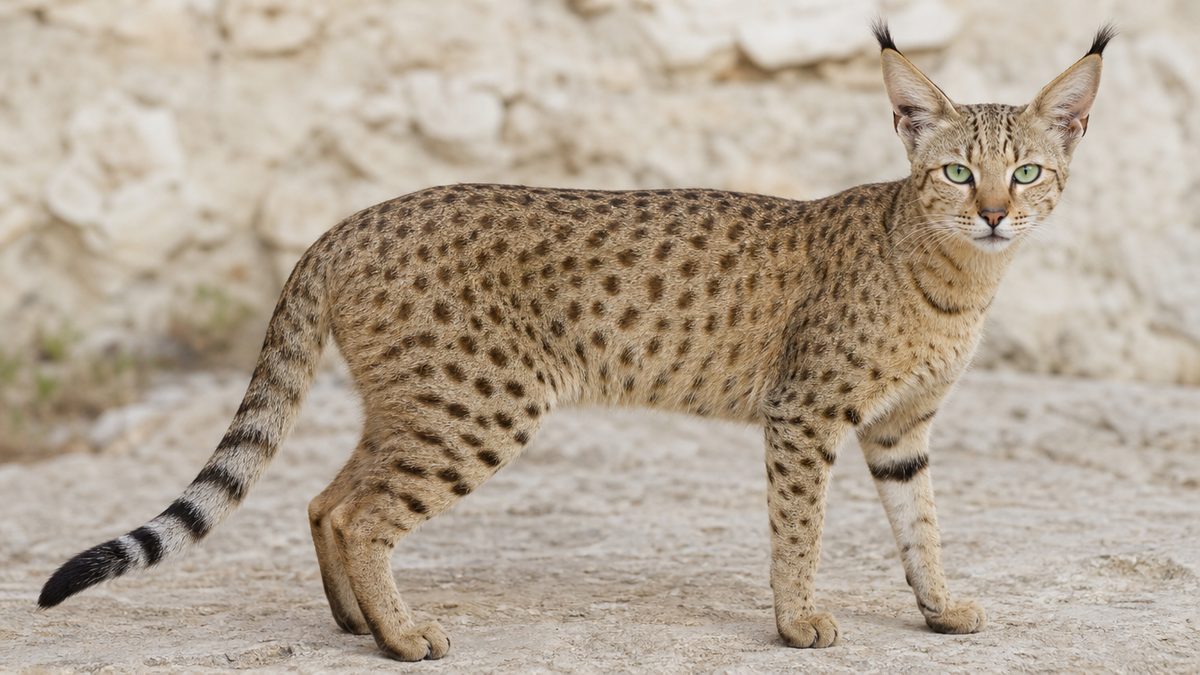
The standard, filed as KAN_en_2010-01-01 and updated on 1 January 2010, describes a medium to large, slender, muscular and athletic cat that is nonetheless elegant, with long slender legs, oval paws and a long tail that is rather thick at the base and tapering. The head is carried on a long slender neck and forms a broad triangle, the skull between the ears is flat, the cheekbones are visible without pinch, and the slightly arched forehead runs into a well-defined straight nose with no stop or suggestion of a stop.
The ears carry the breed. They are large, broad at the base and tapered, erect and set wide apart, with the distance between them at least the width of the lower ear, tufts on the tips desired, and a thumb print on the back of each ear. The eyes are large, almond-shaped, wide set and slightly oblique, and adult eye colour is always green, with yellow-green tolerated.
The coat clause, which is the technical heart of the breed
The coat is short, close-lying and has little undercoat, and its structure is described as rather coarse and not soft like in the Siamese. The individual hairs must be long enough to show clear ticking in both the base colour and the pattern, and the standard then sets the difficulty that defines the breed: *the ticking cannot be sacrificed, but it is not pronounced enough for the spots to disappear*.
That is a genuinely hard breeding target. Ticking and spotting pull against each other, and a standard that demands both without letting either win is asking for a narrow phenotype. The colour clause is correspondingly narrow: on a beige to cinnamon base colour there are spots softened by the ticking, spotted and marbled patterns are accepted, and silver varieties are not permitted. In ordinary cat-fancy vocabulary that is a spotted tabby and a blotched tabby respectively, and calling the marbled pattern a spotted tabby, as several ranking pages do, is simply wrong.
| Base colour | Spotted | Marbled |
|---|---|---|
| Seal | Accepted | Accepted |
| Chocolate | Accepted | Accepted |
| Cinnamon | Accepted | Accepted |
| Silver in any base | Not permitted | Not permitted |
Two more lines matter. The scale of points runs Body 30, Head 25, Eyes 10, Coat texture 15, Coat colour and pattern 15, Condition 5. A body worth thirty points against a colour worth fifteen tells a judge, and a buyer, that this is a type breed before it is a pattern breed.
And the fault list is a single entry: oriental appearance. That one line does more to place the breed than any prose description. It is a slender athletic cat that must not be allowed to become a tubular fine-boned one, which is the direction a long-legged spotted breed drifts if nobody stops it.
Registry recognition: one register, and what the others actually say
The World Cat Federation is the only registry in the world that holds the Kanaani, and TICA's position is registration without recognition rather than either yes or no.
Recognition is a per-registry question, so here it is per registry, each with the control that proves the search worked.
| Registry | Status | Document checked | In-document control |
|---|---|---|---|
| World Cat Federation | Recognised. EMS row 68, code KAN, recognising body listed as WCF alone | All 198 EMS rows via the nonce POST, plus the shorthair standards index | Korat, Russian Blue, Oriental Shorthair, Thai all present |
| The International Cat Association | Registration for recording purposes only, not recognised as a breed | The 90-breed index at tica.org | Bengal, Egyptian Mau, Savannah, Serengeti, Chausie, Toyger all present |
| Cat Fanciers' Association | Absent | Breed Council Declared Candidates, including miscellaneous and provisional | Korat, Russian Blue, Oriental, Siamese, Turkish Van all present |
| Governing Council of the Cat Fancy | Absent | Standard of Points, June 2026, 723,034 characters | British Shorthair appears 32 times |
| Fédération Internationale Féline | Absent from all four categories and from the preliminary class | The live recognised-breeds list by EMS code | OSH, OLH, RUS, SIA, THA present; only Bombay and Lykoi are preliminary |
The WCF row is unambiguous and it is worth quoting exactly, because the recognising-body column on that table usually lists several federations. Row 68 reads Kanaani, KAN, WCF. Compare row 79, the Russian Blue, whose recognising-body cell reads 'blue: ALL / white & black: only WCF - ACF-CCCA-GCCF-NZCF';. One body against a list of six is the whole picture in a single line.
The WCF recognised the breed in 2008, making it the first cat breed established in Israel. Two years later the register was effectively closed: kittens born after 1 January 2008 may only have Kanaani parents, a rule Wikipedia dates to a 2010 WCF decision.
TICA allows registration of the experimental Kanaani for recording purposes only while not recognising it as a breed as of 2026. That is a real category and it is not the same as absence. A register can hold an animal's parentage on file without holding a standard for it or letting it compete, and a page that reports TICA as simply not recognising the breed loses the fact that TICA will still write the pedigree down.
The revival, and who is issuing the paperwork
The breed came close to disappearing. The current animals are described as a 2020s revival programme built on three cats, whose first modern registrations were issued by the Association of Rare Breeds of Cats (ARBC) in Ukraine, on pedigrees prepared by Dr Anna Kalinichenko. The breed was then entered into the records of Pedigree Club UK, an independent British registry, and subsequently registered within the WCF registry by the Feline Alliance of Ukraine, a club affiliated to the WCF.
That chain is worth reading carefully. A WCF-affiliated club registering cats into the WCF registry is a normal mechanism and not a shortcut, but it is a different event from the WCF recognising a breed, which happened in 2008. A reader told that the Kanaani has just been recognised by a major federation is being told about the second thing while the first is what the word recognition usually means.
History, and the wildcat ancestry the standard never mentions
The Kanaani was developed in Jerusalem in the 1990s from crosses between local domestic cats and the African wildcat, and the claim is credible but is absent from the registry's own document.
The breed takes its name from Canaan, and the programme is dated to Jerusalem in the 1990s. The account given everywhere is that domestication of the Kanaani occurred through hybridisation of the local African wildcat, *Felis lybica*, with Israeli domestic cats, producing a fully domestic animal deliberately built to resemble the wild steppe cat of the region.
Bonbeno has no reason to doubt that account and every reason to say where it is and is not written down. The World Cat Federation's Kanaani standard contains the strings wild, wildcat and lybica exactly zero times. The document that governs the breed describes a phenotype and says nothing whatever about ancestry. Every wildcat sentence you will read about this cat comes from secondary sources, from breeders, or from Wikipedia, and none from the register.
What the science does say about Felis lybica
The underlying biology is not in doubt and it is unusually well settled for a cat question. The domestic cat descends from the African wildcat *Felis lybica lybica*. A 2007 assessment of 979 domestic cats and their wild progenitors established *Felis silvestris silvestris*, *F. s. lybica*, *F. s. ornata*, *F. s. cafra* and *F. s. bieti* as five distinctive subspecies, placed domestication in the Near East, and traced modern domestic cats to at least five founders from across that region.
A 2025 analysis of 87 ancient and modern cat genomes then revised the dispersal story: domestic cats did not spread into Europe with Neolithic farmers, and were instead introduced around 2,000 years ago, probably from North Africa.
So a Levantine breeding programme crossing local domestic cats back to *Felis lybica* is not an exotic act. It is a cross back to the same species the domestic cat came from, in roughly the region it came from. That makes the Kanaani a very different proposition from a Bengal or a Savannah, where the wild parent belongs to a different genus entirely. It also makes the hybrid claim harder to verify, because the parent species and the domestic cat are not genetically far apart, and no published study has ever genotyped a Kanaani.
The first page of Google results for this breed is dominated by a single revival campaign rather than by information. Facebook and Instagram posts under one name, an Issuewire press release, a Big News Network syndication and a contributor post on the Times of Israel's open blogging platform all carry the claim that the Kanaani is the world's rarest officially registered cat breed. Google's own AI summary states that Official World Records, Record Holders Republic and Noble World Records certify it as such.
Three record-certifying organisations agreeing is not three confirmations. These are commercial certification bodies that issue records on application, and a certificate from one is a receipt rather than a measurement. The underlying rarity is real and better evidenced by the registry facts on this page: one register, a closed studbook since 2008, and a revival built on three animals World Cat Federation. Say that instead, because it is checkable.
Kanaani cat price in India
No Kanaani cat price in India exists, and the legal position on the wild parent species makes this the one breed in this batch where the absence is a relief rather than a shame.
The Indian absence was tested rather than assumed. India's 2026 all-breed cat price guide runs to 45,016 characters of extracted text and the string Kanaani appears zero times, while Persian appears 22 times, Bengal 16 and Siamese 9. The same publisher's 40-breed guide to cats for the Indian climate returns zero across 51,780 characters.
There is no supply chain to price. One registry holds the breed, the studbook has been closed to outside parentage since 2008, and the current population on the revival campaign's own account began from three cats.
The legal question, which no other page about this breed asks
Two jurisdictions have already imposed legal restrictions. In the Netherlands, and in Belgium in both Flanders and Brussels, it is illegal to own or breed African wildcats and their F1 to F4 generation hybrid Kanaani offspring. Those are the two places that have looked at this specific breed and legislated on it by name, and their restrictions bite on exactly the generations a breeder would produce by hybridising back to the wild parent.
India has not, and the reason a prospective owner should care is that India's own law already covers the wild parent. The Wild Life (Protection) Act, 1972 lists Desert cat (Felis libyca) in Schedule I, the Act's highest protection tier. That entry was verified in a second, independent readable copy, which prints it as 'Desert Cat (Felis libyca)' with the amendment brackets shown. India's own population of that species is the Asiatic form, which the 2007 subspecies assessment separates as *F. s. ornata*.
Both readable copies use the pre-2023 Schedule I Part I numbering, in which the entry is 6-B International Environmental Law Research…. The schedules were restructured by the 2022 amendment, so those numbers are stale. The obvious move is to read the current numbering out of the amending Act. That document returns HTTP 200 at 10,127,962 bytes across 165 pages and extracts to 164 characters: it is an image scan with no text layer, and nothing in it can be quoted. So this page names the entry and declines to give it a number, which is the honest position and a useful warning to anyone citing the current schedules.
What can be said plainly is this. The Kanaani is presented as a hybrid of a species India protects at its highest tier, no Indian instrument has ever been tested against this breed, and the F1 to F5 generation rules that English-language cat writing repeats are American rather than Indian. Anyone contemplating an import should get that resolved in writing by their State Chief Wild Life Warden before spending money, not afterwards.
| Source | Kanaani named | Usable as a price |
|---|---|---|
| India's 2026 all-breed cat price guide, 45,016 characters | Zero times | No |
| India's 40-breed cat climate guide, 51,780 characters | Zero times | No |
| A kittens-for-sale page carrying the world-record wording | Yes | No, it is the campaign restated |
| Stock image and clipart libraries | Yes, repeatedly | No, that is a licence fee |
| Any Indian registry or classified listing | No | No |
Note the third row. A kittens-for-sale domain ranks on page one carrying the same world-record sentence as the press releases. When the marketing copy and the sales copy are the same paragraph, you are looking at one operation rather than at a market.
Monthly cost of ownership in India, if one existed here
A Kanaani would be one of the cheapest cats in India to run, because the standard describes a coat that needs no professional grooming at all.
Nobody in India owns one, so this prices the animal the standard describes rather than pretending to quote a market. The coat clause does the work: short, close-lying, little undercoat, coarse rather than soft. There is nothing to de-mat and nothing to trim.
| Line | Figure | Note for this breed |
|---|---|---|
| Kitten vaccination course | From Rs 3,999, three visits at days 60, 90 and 120 | Same as any cat; list price Rs 5,065 at the same chain |
| Annual booster | From Rs 1,899 | Anti-rabies alone Rs 699 |
| Consultation | Rs 500 to Rs 1,000 | One data point, not two; two publishers print it identically |
| Professional grooming | Rs 0 | A Delhi haircut starts at Rs 1,359 and a full bath and styling at Rs 1,869. This breed needs neither |
| Boarding, per 24 hours | Rs 899 in Bengaluru | Daycare to ten hours Rs 799 |
| Municipal licence | Rs 50 in Chennai | Delhi's Rs 500 registration covers dogs only |
| Enrichment | The real cost | Shelf runs, secure netting and toys, because a bored athletic hunter is destructive |
The grooming line deserves emphasis because it is the largest breed-driven difference in Indian cat ownership. A Persian owner in Delhi paying for a haircut at Rs 1,359 and a complete bath and styling at Rs 1,869 is buying something a Kanaani owner would never need. Over a year that is the difference between a real recurring line and none.
The enrichment row is not padding. This is the one budget item this breed genuinely adds, and it is the one people skip.
- Budget Rs 4,000 to vaccinate a kitten through the first-year course, then about Rs 1,900 a year.
- Budget nothing at all for professional grooming, which is this breed's single largest saving.
- Budget Rs 899 for a night of boarding in Bengaluru, or arrange a sitter.
- Budget one neutering, which buys more life expectancy than any other line on this page.
- Budget for vertical space and secure netting before the cat arrives, not after the first escape.
Chennai readers get one line the rest of the country does not. Greater Chennai Corporation licenses pet animals generally at Rs 50, issued 9,115 licences in 2024, and its six municipal pet clinics provide all treatment and anti-rabies vaccination free of cost.
Suitability for the Indian climate
The Kanaani comes from a dry Mediterranean climate, so Indian heat is survivable and Indian humidity is the genuinely new load, and the homeland figure has to be corrected before it can be used at all.
This section starts with an admission, because the alternative is publishing a number that is wrong.
NASA POWER returns a grid cell for Jerusalem with an elevation of 280.50 m against the city's real elevation near 754 m, an error of -473.50 m. The model has flattened the Judaean hills, and the cell describes a lower, warmer place than the city. Its raw output, an annual mean of 19.70 C at 66.29 percent relative humidity with August at 27.00 C and January at 11.40 C, is therefore too warm throughout.
Applying the standard lapse rate of about 6.5 C per 1,000 m to a 473.50 m error gives a correction of roughly 3.1 C. That puts a corrected annual mean near 16.6 C, an August near 23.9 C and a January near 8.3 C. Those are estimates and are labelled as such. They are published because a labelled estimate with its error stated is more useful than either a silent wrong number or no number at all.
| Place | Annual mean C | Annual RH % | Warmest month | Coolest month | Peak Stull wet bulb |
|---|---|---|---|---|---|
| Jerusalem, cell as returned | 19.70 | 66.29 | Aug, 27.00 | Jan, 11.40 | Aug, 22.13 |
| Jerusalem, lapse-corrected estimate | about 16.6 | 66.29 | Aug, about 23.9 | Jan, about 8.3 | Not recomputed |
| Delhi | 25.60 | 45.56 | Jun, 35.88 | Jan, 13.61 | Jul, 26.50 |
| Ahmedabad | 27.57 | 48.32 | May, 35.06 | Jan, 19.93 | Jun, 26.11 |
| Chennai | 27.95 | 72.39 | May, 31.51 | Jan, 24.09 | May, 26.11 |
| Kolkata | 25.81 | 73.93 | May, 31.53 | Jan, 17.31 | Jun, 27.09 |
| Bengaluru | 23.74 | 67.94 | Apr, 28.37 | Dec, 20.22 | May, 21.86 |
The argument the numbers actually support
The reflex claim about a Middle Eastern breed is that it will love Indian heat. The table says something more precise. On humidity, the origin runs 66.29 percent, which is close to Bengaluru's 67.94 and Pune's range, well above Delhi's 45.56 and Ahmedabad's 48.32, and clearly below Chennai's 72.39 and Kolkata's 73.93. So the humidity shock is real but modest, and it is a coastal-India problem rather than an all-India one.
On heat, the corrected origin peaks near 23.9 C in August. Delhi peaks at 35.88 C in June and Ahmedabad at 35.06 C in May. That is a genuinely large gap, roughly twelve degrees at the summer peak, and no amount of desert imagery closes it. A cat adapted to a hill climate with hot dry summers is not the same animal as a cat adapted to the Gangetic plain in June.
Read the wet-bulb column for the part that matters physiologically. The origin's cell peak is 22.13 C in August. Kolkata reaches 27.09 C in June, Delhi 26.50 C in July, Chennai and Ahmedabad 26.11 C. That four-to-five degree wet-bulb rise is the real load, and it is the reason the honest heat rating here is four rather than five.
What that means in practice, city by city
Bengaluru and Pune are the best fits in India by a clear margin: a mild annual mean, a humidity level close to the origin, and the lowest wet-bulb peaks in the table at 21.86 C and below. Delhi and Ahmedabad match the origin's dryness and badly overshoot its heat, which makes them workable with shade and water and unpleasant without. Chennai, Kochi and Kolkata are the hardest, not because of temperature but because a short-coated dry-climate cat has no experience of a June wet bulb above 27 C.
The practical instructions are the same everywhere and cheap. Keep the cat indoors between eleven and four in summer. Provide at least three water sources in rooms the cat uses. And in the monsoon, dry the coat properly after any soaking rather than letting a wet cat air-dry in a closed humid room, which is how ear problems start in any breed.
Temperament and household fit
The Kanaani is described as active, energetic, playful and affectionate with a marked degree of independence, and the hunting drive is the trait that decides whether it fits your home.
The published description is consistent across sources: active, energetic, playful and affectionate, while also displaying a marked degree of independence. Owing to its recent wild ancestry the breed is said to retain certain behavioural traits associated with wildcats and to be an excellent hunter.
Treat the hunting claim as the operative one, and treat the wildcat framing carefully. No behavioural study of this breed exists in the literature, because no study of this breed exists at all. What can be said without a study is that the standard describes a long-legged, muscular, athletic animal with very large ears, and that is the morphology of a cat that hunts.
For an Indian household that produces three specific consequences. First, balconies and windows need netting before the cat arrives, because a competent hunter with long legs will follow a bird. Second, this is a poor choice for a household with small caged pets. Third, the described independence means the cat will tolerate a working day alone better than a Siamese would, provided the environment gives it something to do.
The single listed fault in the standard, oriental appearance, is a useful hint about behaviour too. This is deliberately not a Siamese-type cat, and buyers who want the clinging, conversational temperament of an Oriental are being pointed at a different animal.
Training an active hybrid-derived cat
To train a Kanaani, redirect the hunting sequence into structured play rather than trying to suppress it, because that drive is the strongest thing the breed brings.
No training research exists for this breed and none is likely to. The seven ranking pages that publish Kanaani training advice are publishing general cat training advice with a breed name attached.
What the breed's own description supports is a plan built around prey drive and independence. A cat that hunts well learns fast when the reward is the hunt and learns nothing when the reward is a scolding.
- Train the carrier weeks before it is needed, by feeding in it with the door open.
- Train a recall to a distinct sound, and pay it every single time, because a hunter that ignores recall is a hunter you cannot retrieve.
- Train the full prey sequence twice a day: stalk, chase, catch, kill, eat, ending with a meal.
- Train handling of the ears and paws early, because the ear tufts and thumb print will need checking and the claws need clipping.
- Train an alternative to counter-surfing by giving the cat a higher legal perch, because height competition is not winnable.
One Indian specific. Netting a balcony is a training decision as much as a hardware one. A cat that has once succeeded in getting onto an unnetted ledge will try again for the rest of its life, and in a Mumbai or Bengaluru high-rise that is not a risk worth taking with a breed whose entire global population is small enough to count.
Daily exercise requirement
A Kanaani needs two structured hunting sessions a day plus real vertical space, because the standard describes an athletic long-legged cat and an Indian flat supplies neither by default.
The scale of points gives the body thirty of a hundred marks, twice what the pattern is worth, and the body described is muscular, athletic and long-legged with oval paws. That is a build with an exercise requirement attached.
Two sessions of ten to fifteen minutes with a wand toy, each ending in a catch and a meal, meets the behavioural need better than an hour of undirected play. Add vertical space: a shelf run at two heights, or a tall tree, because a cat that jumps needs somewhere legitimate to jump.
Time it around the Indian day. In Delhi in June the outdoor mean is 35.88 C and in Ahmedabad in May it is 35.06 C. Hard play in the afternoon during those months is a bad idea for any cat and a worse one for a breed with little undercoat and a high activity drive. Early morning and after dark are the sessions that work, which is also when a cat naturally wants them.
Do not substitute outdoor access for enrichment. India's free-roaming cat population brings infectious risk, road risk and fight risk, and a rare cat outdoors is a rare cat that will eventually not come back.
Grooming and coat care in Indian humidity
Grooming a Kanaani takes a weekly rubber brush and nothing else, because the standard specifies a short coat with little undercoat and a deliberately coarse texture.
The coat clause is three lines long and every one of them reduces work: short, close-lying, little undercoat, and a structure that is rather coarse and not soft like in the Siamese. A coarse close coat sheds less visibly than a plush one and mats not at all.
A rubber brush once a week during a coat change and a damp cloth is the whole routine. There is no bathing requirement, no de-shedding tool needed and no professional appointment. Against a Delhi grooming price list where a haircut starts at Rs 1,359 and a complete bath and styling at Rs 1,869, that is the largest single saving this breed offers an Indian owner.
The two things to check instead of brushing
Check the ears. The standard makes them large, broad-based and wide-set with desirable tufts, and large open ears collect dust in a dry Delhi summer and moisture in a Kolkata monsoon, where the June wet bulb peaks at 27.09 C. Weekly visual checks, no cotton buds, and proper drying after any soaking.
Check the coat colour under good light, because it is diagnostic. The standard requires visible ticking in both the ground colour and the pattern without the ticking obscuring the spots. A supposed Kanaani whose spots sit on a flat unticked ground, or whose ground is silver rather than beige to cinnamon, does not meet the only standard the breed has: silver varieties are not permitted.
Health risks and lifespan, with the gaps stated
No health study of the Kanaani exists in any form, so this section reports the tested absence, explains the collision that makes the literature look larger than it is, and gives only the figures that genuinely transfer.
The literature is empty and the emptiness was tested. Kanaani[tiab] returns zero records in PubMed, and "Kanaani cat"[tiab] returns zero, against a session control of 167 for "Siamese cat"[tiab].
Searched without quotes or a field tag, Kanaani returns 120 records, translated by PubMed as "Kanaani"[All Fields]. Opening the first five shows Qatari SARS-CoV-2 epidemiology and a paper on seawater metal-ion binding to ribose. Kanaani is a personal surname, and the count is an author collision. The near-spelling behaves the same way: Canaani[tiab] returns six records, all molecular biology and plant physiology. A three-figure count on a breed with a global population in single figures is always a collision, never a literature.
What a closed register founded on three cats implies
The genuine health concern here is not a named disease. It is population structure. The register has been closed to non-Kanaani parentage since 1 January 2008, the standard names no permitted outcross, and the current revival is described as beginning from three cats. A closed studbook founded on a handful of animals accumulates inbreeding by arithmetic rather than by bad luck, and there is no published coefficient for this breed because nobody has calculated one.
Bonbeno will not put a number on that, because putting a number on it would be inventing one. What can be said is what a buyer should ask for: a full pedigree, the name of the registering body, and the coefficient of inbreeding if the breeder has calculated it. If none of those is available, the animal is being sold on a story.
Lifespan
No lifespan figure exists for this breed. The best cat life-table study available covers UK cats under primary veterinary care and gives life expectancy at age 0 of 11.74 years for all cats and 11.89 years (11.75-12.03) for crossbreds on 7,117 deaths. Its breed-specific table carries 12 rows, and the Methods state that breeds with fewer than 15 deaths were grouped into 'other'. The Kanaani is not among the 12 breeds that reached that threshold, which is exactly what a breed with no UK population produces and says nothing about its health.
The comparison worth making from that table is the Bengal, the other spotted hybrid-derived breed and the only one with a figure: 8.51 years (7.12-9.90) on 73 deaths, the third shortest in the table. That is not a prediction for the Kanaani and must not be used as one. It is a reason to ask questions rather than to assume that a spotted coat comes with a normal life expectancy.
Two figures from the same study do transfer, because neither is breed-specific. Entire cats carried 4.29 times (3.72-4.95) the odds of death before three years compared with neutered cats, and purebred cats 1.83 times (1.50-2.23) the odds compared with crossbreds. The first is the strongest single argument for neutering in the cat literature.
If a seller quotes you a Kanaani lifespan, ask for the source. There is not one.
Feeding and nutrition
Feed a Kanaani as a large, lean, highly active shorthair on a complete diet, because no breed-specific nutritional requirement has ever been established for it.
There is no Kanaani feeding research and no registry nutritional guidance. The standard describes a medium to large, slender, muscular and athletic cat with an elongated well-muscled body, which is a frame that carries more lean mass than a cobby cat of the same weight and therefore a higher maintenance requirement.
Split the ration into three or four meals rather than free-feeding, because a high-drive cat that gorges once a day is a cat that will hunt for entertainment at three in the morning. Weigh the food rather than scooping it. Check condition by feel over the ribs and the base of the spine monthly, because a short coarse coat hides gain less well than a plush one but hides loss just as effectively.
Water, which matters more in India than the brand does
In a Delhi June at a 35.88 C mean or an Ahmedabad May at 35.06 C, intake is the variable to watch. Wet food raises total water intake more reliably than a fountain does. If the cat eats dry food only, place a second and third water source in rooms it actually uses and keep them away from the food bowl, because cats routinely refuse water sited beside a meal.
One thing not to do is buy a diet on a breed claim. There is no Kanaani-specific formulation, no research that could support one, and nothing in the standard that implies a special requirement.
Kitten timeline, month by month through the first year
A Kanaani kitten follows the ordinary feline schedule, with three breed-specific checkpoints at the ticking, the eye colour and the ear set.
No breed-specific developmental data exists, so this is the standard feline timeline with the three points where the standard gives you something to check.
| Age | What happens | What you do |
|---|---|---|
| 0 to 8 weeks | With the queen. Weaning completes around eight weeks | Nothing. Indian law treats kittens below eight weeks as un-weaned |
| 8 to 9 weeks | Home. Socialisation window still open | Handle ears and paws daily; net the balcony before arrival |
| Day 60 | First vaccination visit | Kitten course starts, from Rs 3,999 for three visits |
| Day 90 | Second visit | Confirm the schedule your own clinic uses |
| Day 120 | Third visit plus anti-rabies | Anti-rabies Rs 699 privately, free at Chennai's six municipal clinics |
| 3 to 6 months | Ticking develops through the coat | Checkpoint one: ticking must show in both ground and pattern without hiding the spots |
| 5 to 8 months | Sexual maturity, early in a tropical climate | Neuter. The single largest survival intervention available |
| 9 to 12 months | Adult eye colour and ear set settle | Checkpoints two and three: eyes green or yellow-green; ear gap at least one lower-ear width |
Checkpoint one is the ticking, and it is the hardest thing to judge in a kitten. The standard requires clear ticking in both the base colour and the pattern while insisting the ticking must not be pronounced enough for the spots to disappear. Kittens frequently show one without the other, and the balance settles with the adult coat.
Checkpoint two is the eye. Adult colour is always green, with yellow-green tolerated. Kitten eye colour is unreliable and any breeder certain of adult colour at ten weeks is guessing.
Checkpoint three is the ear set, which is measurable rather than aesthetic: the gap between the ears must be at least the width of the lower ear, and tufts on the tips are desirable. Ears grow before heads do, so a kitten's proportions will change; the rule applies to the adult.
Kanaani against the spotted cats an Indian buyer can actually get
Three spotted breeds are obtainable in India and the Kanaani is not, and the registry column explains why more clearly than the price column does.
A buyer drawn to this breed is drawn to a spotted, wild-looking, athletic cat. Three breeds deliver that and are held by every major register. This table is the honest version of the choice.
| Breed | Wild parent | Registries | Life expectancy in Teng 2024 | Indian price published |
|---|---|---|---|---|
| Kanaani | African wildcat, Felis lybica, claimed but absent from the standard | One, the WCF | Not among the 12 breeds that reached the threshold | None |
| Bengal | Asian leopard cat, Prionailurus bengalensis | All major registers | 8.51 years (7.12-9.90), 73 deaths | Yes, widely quoted |
| Egyptian Mau | None; a natural spotted breed | CFA, TICA, FIFe, WCF and others | Not among the 12 breeds that reached the threshold | Occasionally quoted |
| Savannah | Serval, Leptailurus serval | TICA, WCF, LOOF | Not among the 12 breeds that reached the threshold | Occasionally quoted |
Read the registry column first. The Bengal is held by every major register, which means a pedigree that an Indian buyer can check against a published standard and a breed council that can be complained to. The Kanaani is held by one federation whose standard has not changed since 2010 World Cat Federation. That is not a criticism of the WCF; it is a statement about how much recourse a buyer has.
Read the life-expectancy column second and read it carefully. Only one of these four breeds appears in the twelve-row life table at all, and it is the Bengal at 8.51 years, the third shortest figure in that table. The other three are absent because they did not reach fifteen deaths in a UK primary-care population, which is a statement about sample size and not about health. Do not read the Kanaani's absence as reassurance and do not read the Bengal's presence as a warning transferable to the others.
The wild-parent column contains the sharpest practical difference. The Bengal and the Savannah descend from cats in a different genus, *Prionailurus* and *Leptailurus*. The Kanaani descends, on the standard account, from *Felis lybica*, the same species the domestic cat itself came from Driscoll CA, Menotti-Raymond M, Roca AL. That makes the Kanaani biologically the least exotic of the three and legally the most awkward in India, because *Felis libyca* is the one of the three listed as a Desert Cat in Schedule I of the Wild Life (Protection) Act.
For an Indian reader the recommendation follows without much argument. If the appeal is the spotted coat and the athletic build, the Bengal supplies both, has a real Indian market and comes with a published life-expectancy figure you can plan around. If the appeal is specifically this breed's story, that is a story rather than a purchase.
Mistakes Indian readers make with this breed
Five errors account for nearly everything wrong that is written about the Kanaani in English, and all five are checkable against documents that take minutes to open.
1. Treating a record certificate as evidence
Three organisations described as Official World Records, Record Holders Republic and Noble World Records are cited on page one as certifying this breed the world's rarest. These are commercial certification bodies that issue records on application. Three of them agreeing is one claim repeated three times, not three measurements. The registry facts on this page make the same point far better, and they are checkable.
2. Repeating a wildcat origin the registry never states
The wildcat account is probably true and is worth reporting. It is also worth reporting that the World Cat Federation's own Kanaani standard contains the words wild, wildcat and lybica exactly zero times. When the governing document is silent on the single most-repeated fact about a breed, that gap is itself information, and no ranking page mentions it.
3. Reading 120 PubMed records as a literature
The unquoted name returns 120 records and they are a Qatari epidemiologist's surname. This is the exact shape of a false positive: a plausible three-figure count attached to a breed with no research at all. Read the query translation line and open the records before believing any count.
4. Assuming Indian law is silent because no Indian page discusses it
The Netherlands and Belgium have both legislated on this breed by name, banning ownership and breeding of African wildcats and their F1 to F4 Kanaani offspring. India has not legislated on the breed, but it does list Desert cat (Felis libyca) in Schedule I of the Wild Life (Protection) Act, verified in two independent readable copies. Silence in the pet press is not silence in the statute book.
5. Quoting a clause number from a document nobody can read
This is the mistake this page nearly made itself. The obvious source for the current schedules is the 2022 amending Act. It returns HTTP 200 at over ten megabytes across 165 pages and extracts to 164 characters, because it is an image scan. Any page quoting a post-2023 entry number from it has not read it. A byte count and a status code prove a download, not a document.
Adoption, and the honest recommendation
Adopt an Indian shorthair or buy a registered Bengal instead, because there is no Kanaani in India, no lawful route to one and no recourse if the paperwork turns out to be worthless.
This is not a breed an Indian reader can responsibly pursue, and the reasons are specific rather than moralistic.
There is no supply. One registry holds the breed, the studbook has been closed to outside parentage since 2008, and the modern population traces to three cats. There is no Indian market: two long Indian cat guides return zero for the name Supertails, 'Cat Breeds in India.
There is no recourse. A breed held by a single federation, with no CFA, TICA, GCCF or FIFe standard to hold a seller to The International Cat Association The Governing Council of the Cat Fancy Fédération Internationale Féline, leaves an Indian buyer with a pedigree no Indian body will read and no complaints route at all. India's import rules compound it: live cats sit under ITC(HS) 01061900 as a Restricted item and the commercial route bars import for trading or breeding purposes outright, so an unrecognised breed cannot arrive here through any lawful commercial channel. Only the WCF publishes a standard for this cat at all.
And there is an unresolved legal question that the buyer, not the seller, would carry. India lists the wild parent species in Schedule I, two European jurisdictions have banned the F1 to F4 hybrids outright, and nobody has tested an Indian instrument against this breed. Get that in writing from your State Chief Wild Life Warden before money moves, or do not start.
What to do instead
- Adopt an Indian shorthair from a registered municipal or NGO shelter, which is already adapted to the climate you live in.
- Confirm the kitten is at least eight weeks old, which Indian law requires and which the pet-shop rules define as the weaning threshold.
- Confirm the vaccination record and start the course if it has not begun, from Rs 3,999 for three visits.
- Confirm the licence position with your own corporation, which in Chennai is Rs 50 and covers cats.
- Confirm neutering is booked, because it buys more than any other decision on this page.
If the spotted coat is the point, buy a registered Bengal from a breeder whose pedigree you can check against a published standard, and go in knowing the one figure the literature actually supplies: 8.51 years of life expectancy at age 0, on 73 deaths. That is a harder fact than anything written about the Kanaani, and knowing a hard fact is worth more than a record certificate.
The Indian street cat, meanwhile, is a lightly modified descendant of the same wild species this breed is built around. It costs nothing, it is already here, and it has never needed a certificate.
Kanaani cat questions people actually ask
Are Kanaani cats considered a rare breed?
Yes, but the rarity is better evidenced by registry facts than by the record certificates the top search results rely on. Only one registry in the world holds the breed, the World Cat Federation, whose EMS row 68 names the WCF alone as the recognising body. The studbook has been closed to non-Kanaani parentage since 1 January 2008, and the current revival programme traces to three cats. Three commercial record-certifying organisations also describe it as the rarest registered breed, which is one claim repeated rather than three measurements.
How intelligent are Kanaani cats?
No study has measured intelligence in this breed, or anything else about it: PubMed returns zero records for Kanaani as a title or abstract term. Published descriptions call the breed active, energetic, playful and affectionate with a marked degree of independence, and an excellent hunter. The standard supports the physical half of that, describing a muscular, athletic, long-legged cat with very large wide-set ears, which is the morphology of an animal that hunts rather than a measure of cognition.
What is the no. 1 cat breed?
There is no single answer, and the honest reply is that it depends on which register you count and in which country. Bonbeno does not publish a global ranking. For an Indian reader the more useful figure is life expectancy, where the UK life tables give the Burmese 14.42 years and the Birman 14.39 at the top of a twelve-row table and the Sphynx 6.68 at the bottom. The Kanaani is not among the 12 breeds that reached that table's threshold of fifteen deaths.
Which cat is most expensive in India?
Bonbeno does not publish a most-expensive ranking, because the figures circulating for exotic breeds in India are routinely converted dollar prices rather than Indian observations. What can be said for this breed is that no Kanaani price exists in India at all: the country's 2026 all-breed cat price guide runs to 45,016 characters and does not name the breed once, while naming Persian 22 times and Bengal 16.
Is the Kanaani cat recognised by TICA?
Not as a breed. TICA allows registration of the experimental Kanaani for recording purposes only and does not recognise it as a breed as of 2026, and the breed does not appear among the 90 breeds linked from TICA's own index, where the Bengal, Egyptian Mau, Savannah, Serengeti, Chausie and Toyger all do. That is a fourth state rather than a simple no: the register will write the parentage down without holding a standard or allowing competition.
Is the Kanaani cat part wildcat?
The published account says yes, and the registry's own document says nothing at all. Every secondary source describes hybridisation of the local African wildcat, Felis lybica, with Israeli domestic cats in 1990s Jerusalem. The World Cat Federation breed standard that governs the breed contains the strings wild, wildcat and lybica exactly zero times. Biologically the cross is less exotic than a Bengal's, because Felis lybica lybica is the species the domestic cat itself descends from.
Is it legal to own a Kanaani cat in India?
Unresolved, and worth settling in writing before spending money. India lists the wild parent species as Desert cat (Felis libyca) in Schedule I of the Wild Life (Protection) Act, 1972, verified in two independent machine-readable copies. No Indian instrument has been tested against this breed. Two jurisdictions have decided: the Netherlands and Belgium in Flanders and Brussels make it illegal to own or breed African wildcats or their F1 to F4 Kanaani offspring. Ask your State Chief Wild Life Warden in writing.
How long do Kanaani cats live?
No lifespan figure exists for this breed and any number quoted to you is invented. The best available cat life-table study gives 11.74 years for all cats and 11.89 for crossbreds on 7,117 deaths, and its breed-specific table carries only 12 rows because breeds with fewer than 15 deaths were grouped into other. The Kanaani is not among the 12 breeds that reached that threshold. The nearest comparable breed with a figure is the Bengal at 8.51 years, which is not transferable.
What colours does the Kanaani come in?
Six varieties, and no more. The standard accepts a beige to cinnamon ground carrying spots softened by ticking, in three base colours, each in a spotted or a marbled pattern: seal spotted, seal marbled, chocolate spotted, chocolate marbled, cinnamon spotted and cinnamon marbled. Silver varieties are explicitly not permitted. A silver spotted cat sold as a Kanaani does not meet the only standard the breed has.
Can a Kanaani cat handle Indian heat?
Mostly yes, with humidity the genuinely new load rather than temperature. The short close-lying coat with little undercoat suits heat. The origin climate runs about 66 percent annual relative humidity against Chennai's 72 and Kolkata's 74, and its peak wet bulb is 22.13 C against 27.09 C in Kolkata in June. Bengaluru and Pune are the best Indian fits; Delhi and Ahmedabad match the dryness and overshoot the heat by about twelve degrees at the summer peak.
How much grooming does a Kanaani need?
A weekly rubber brush and nothing else. The standard specifies a short, close-lying coat with little undercoat and a texture that is deliberately coarse rather than soft, which does not mat and cannot be improved by a groomer. In Indian terms that removes a real line item: a Delhi grooming list starts at Rs 1,359 for a haircut and Rs 1,869 for a complete bath and styling, and this breed needs neither.
Why does the Kanaani standard list oriental appearance as a fault?
Because a long-legged, slender, spotted breed drifts toward oriental type unless a standard stops it. Oriental appearance is the single entry in the fault list, and it sits beside a scale of points that gives the body 30 marks against 15 for coat colour and pattern. Together those two lines tell a judge that the Kanaani is a type breed before it is a pattern breed, and that the type it must not become is the tubular, fine-boned Siamese outline.
Compare with similar breeds
Kanaani sits in 1 Bonbeno group. Each one compares it directly against the breeds it is genuinely an alternative to, on the same figures.