
Breed profile
Savannah Cat in India: What the Law Actually Says
A serval crossed into a domestic cat, sold worldwide as a domestic breed, banned outright by one national registry and absent from every Indian seller we checked.
Quick answer
No Savannah cat price in India could be verified. Six Indian commerce pages were opened and none carries the breed, while Persian, Bengal and Maine Coon controls appear on all six. India's Wild Life (Protection) Act does not name the serval anywhere in its 222 pages, and the Act says nothing at all about animal hybrids.
This page reports what registries, published studies and Indian law say about the Savannah, including two conditions described in single case reports. None of it is a diagnosis and none of it is a treatment plan. Bonbeno does not give legal advice either: where this page describes Indian statute it quotes the instrument and names what it does not settle. Consult your nearby vet, a registered veterinarian, about any animal in your care before acting on anything here, and take a legal question to your State Chief Wild Life Warden in writing.
Savannah at a glance
What a Savannah cat is
The Savannah is a domestic cat breed created by crossing the domestic cat with the African serval, and it is the most genetically divergent hybrid breed in the whole cat family.
Start with the fact that decides everything else. A 2025 genome paper puts it in one sentence: the Savannah is a breed derived from an interspecific hybrid cross between the domestic cat, Felis silvestris catus, and the African serval, Leptailurus serval, and within Felidae the Savannah represents the most divergent interspecific hybrid breed, with about 13 million years separating the parental species. That paper used an F1 Savannah to build near-gapless reference genomes for both parents, which tells you how far apart the two genomes are.
Where it came from
The first known Savannah was born on 7 April 1986, when a female domestic cat gave birth to a kitten sired by an African serval. That F1 kitten and the breed that followed were both named Savannah. Patrick Kelly heard about her and decided to try to develop a new breed, persuaded the breeder Joyce Sroufe to join him, and together they wrote the original TICA breed standard. TICA accepted the Savannah for registration in 2001 and granted Championship status in 2012.
What the breed standard requires
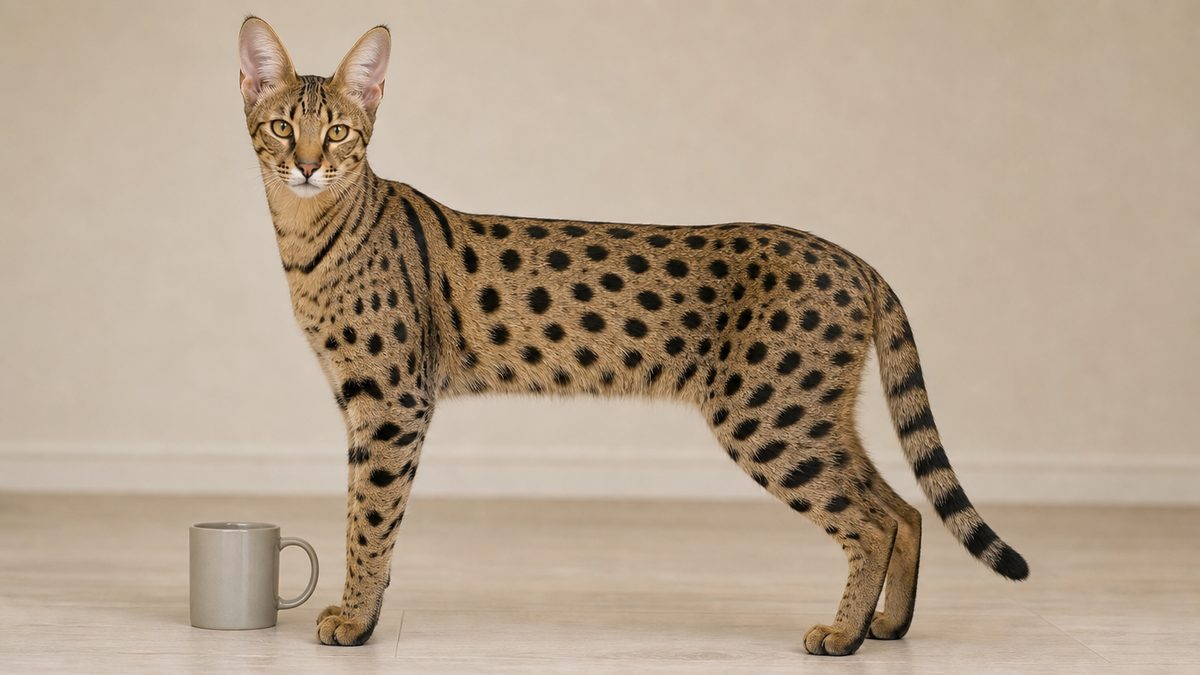
Two standards exist and they disagree in one place worth knowing. The WCF standard describes a tall, lean, graceful cat with striking dark spots, a domestic breed which closely resembles its ancestral source the African serval but is smaller in stature. The torso is long, lean and well muscled, the neck long and lean, the legs longer than average with the back legs slightly longer than the front, and the head small in proportion to the body. The ears are the signature: remarkably large, high on the head, wide with a deep base, very upright with rounded tops, with the outside base no lower on the head than the height of the eyes.
The recognised colours are narrow. The WCF standard admits black, brown (black) spotted tabby, black silver spotted tabby and black smoke, with no ticking on the ground colour and bold solid markings preferred on all tabbies. TICA adds a list of nonstandard colours that exist in the gene pool but do not show, including seal, seal lynx, cinnamon, chocolate, blue and the nonstandard marble pattern. A seller offering a blue or marble Savannah at a premium is offering something more expensive than the standard admits, not something rarer than the standard admits.
The coat is short, with good substance and a slightly coarse feel, coarser guard hairs over a softer undercoat, not inordinately dense and lying relatively flat against the body. Only the spotted pattern is recognised, and rosettes exclude the certificate, which is the cleanest way to tell a Savannah from a Bengal on paper.
The WCF permits outcrosses to the Egyptian Mau, the Ocicat, the Oriental Shorthair and the Domestic Shorthair. TICA's own Savannah standard prints PERMISSIBLE OUTCROSSES: None. Neither is wrong; they are two registries running two closed-book policies. If you are shown a pedigree with an Egyptian Mau or an Oriental Shorthair in it, that pedigree is a WCF one and would not be a TICA one.
The generation ladder, in plain terms
A Savannah is described by an F number counting generations away from the serval. An F1 has a serval parent. An F2 has a serval grandparent, an F3 a serval great-grandparent, and so on. This matters for three separate reasons that people tend to run together: size, since early generations are markedly larger; showability, since the WCF bars F1 to F3 Savannahs from shows and lists the F1 to F3 generation as a disqualification; and law, which is the subject of the next section.
Size, honestly
TICA's own description is the corrective to most of what is written about this breed. Savannahs are tall and lanky, which makes them appear heavier than they actually are, and in reality most are just the size of a large domestic cat and weigh less than another cat of similar size. The Guinness record holder, a Savannah, measured just over 19 inches. Long legs and tall ears create the impression of a much larger animal than the scales support.
Legal status in India: what the Act says, and what it does not
India's Wild Life (Protection) Act does not name the serval anywhere in its 222 pages, so the Savannah does not run into the provision that catches the Chausie, and the Act contains no animal-hybrid rule at all, so nothing in it clears the Savannah either.
This section quotes the instrument rather than summarising it, because Indian pages about wild-hybrid cats routinely cite the wrong law. Bonbeno does not give legal advice, and where the statute is silent this page says so instead of filling the silence.
The serval is not in Schedule I
Schedule I Part A of the Act, under the sub-heading CATS, runs sixteen entries: 34 Asiatic Golden Cat, 35 Asiatic Lion, 36 Caracal, 37 Cheetah, 38 Clouded Leopard, 39 Desert Cat, 40 Eurasian Lynx, 41 Fishing Cat, 42 Jungle Cat, 43 Leopard, 44 Leopard Cat, 45 Marbled Cat, 46 Pallas's Cat, 47 Rusty Spotted Cat, 48 Snow Leopard, 49 Tiger. Every one is an Indian species. The serval is African and it is not there.
Searching an extracted PDF for a species name is how false absences are manufactured, so this one was run with controls. The strings Serval and Leptailurus return zero across the whole 222-page consolidated Act, while in the same extraction Felidae returns 3, Jungle Cat 1, Panthera 10 and Caracal 5. The search works; the serval genuinely is not in the document.
That is the decisive difference between this breed and the Chausie, whose wild parent Felis chaus is Schedule I entry 42 and therefore inside section 40(2), which forbids acquiring, keeping, selling or transporting a Schedule I animal without the Chief Wild Life Warden's written permission. None of that machinery is triggered by a serval.
But the serval is in Schedule IV
Schedule IV of the Act reproduces the CITES appendices, and its Appendix II carries a generic entry reading Felidae spp., annotated *Except the species included in Appendix I. Excludes specimens of the domesticated form, which are not subject to the provisions of the Convention*. The serval is not among the Appendix I cats named in the Act, so it sits inside that Appendix II blanket. Under section 49D(k), a scheduled specimen means any specimen of a species listed in Appendices I, II or III of the Convention and incorporated as such in Schedule IV.
Section 49M then does real work. Sub-section (1) provides that every person possessing a living specimen of an animal species listed in Schedule IV shall report the details to the Management Authority or authorised officer. Sub-section (3) requires reporting of any transfer, (5) of any birth, (7) of any death, and (8) provides that no person shall possess, transfer or breed any living specimen of a Schedule IV species except in conformity with the section and the rules.
The rules that give section 49M effect
Those rules exist and almost nobody writing about hybrid cats in India cites them. The Living Animal Species (Reporting and Registration) Rules, 2024 were notified as G.S.R. 145(E) on 28 February 2024. Rule 2(b) defines animal species as any living specimens of any animal species listed in Schedule IV. Rule 3 requires reporting and an application for registration, electronically, within six months of commencement and thereafter within thirty days of possession, with a fee of one thousand rupees. Rule 4 requires birth reporting within seven days, rule 5 transfer reporting within fifteen days, and rule 6 death reporting with a post-mortem report from a registered veterinary practitioner. The registration route is the PARIVESH 2.0 portal, and the government set 28 August 2024 as the deadline for existing holders.
Rule 7(1)(g) requires a registered holder to not allow the animal species to mix or breed with indigenous animal species. In a country with free-roaming domestic cats and a native jungle cat, that is not a formality. And rule 8(2)(a) lets the authority refuse or cancel registration where the provisions or resolutions of the Convention are not satisfied. The word resolutions matters, because the CITES treatment of animal hybrids lives in a resolution rather than in the appendices themselves.
The honest gap: the Act says nothing about hybrids
Searching the full consolidated Act for the word hybrid returns twelve occurrences and not one of them concerns an animal hybrid. Two are species whose own names contain it, the Hybrid Sapphire butterfly Heliophorus hybrida and the Whiskered Tern Chlidonias hybrida. The remaining ten sit in the Schedule IV interpretation notes and concern artificially propagated plant hybrids. The word progeny does not appear at all.
So whether a Savannah is *a living specimen of an animal species listed in Schedule IV* for the purposes of section 49M is a question the statute does not answer on its face, and the annotation that would decide it, *excludes specimens of the domesticated form*, is precisely the phrase a hybrid a few generations from a wild parent does not obviously resolve. Anyone who tells you the answer is settled, in either direction, is going beyond the text. If you need an answer about a specific animal, put the question to your State Chief Wild Life Warden in writing before money changes hands.
Import, and the one rule that does turn filial generation into a legal test
Importing any cat into India is restricted and needs a DGFT authorisation, and the only instrument anywhere that makes an F number legally decisive is a United States regulation rather than an Indian one.
The DGFT's own published guidance is the right source here, because it covers cats explicitly rather than by analogy from the dog rules. It states that the import policy of pets, dogs and cats, is restricted and permitted only with an authorisation from DGFT, and that import of live animals including cat, dog and rabbit is restricted in India.
What the DGFT FAQ actually provides
- The ITC(HS) code to select for a pet cat import authorisation is 01061900.
- Animals for commercial purposes such as breeding, or as a gift, are not allowed to be imported.
- Import without authorisation is available to a person shifting residence permanently to India under the Customs Baggage Rules.
- An application goes on Form ANF 2M, is forwarded to the Department of Animal Husbandry, Dairying and Fisheries for a no-objection certificate, then to an inter-ministerial Exim Facilitation Committee that meets once a month.
- Entry is permitted only through the airports and seaports of Delhi, Mumbai, Chennai, Hyderabad, Bengaluru and Kolkata and, since October 2024, Kochi airport, with quarantine at the government station of those ports where required.
The nine-page FAQ contains the word CITES zero times, the word wild zero times, the word hybrid zero times and the word exotic zero times. India's own front-line guidance for people importing a pet cat says nothing at all about wild ancestry. An importer bringing in a Savannah would therefore get no warning from the document they are most likely to read, which is a gap worth knowing about rather than a loophole worth using.
The four-generation rule, and whose law it is
CITES treats animal hybrids through a resolution rather than through the appendices, and the clearest published statement of how that resolution is applied sits in United States federal regulation. Title 50 of the Code of Federal Regulations, part 23, section 23.43 is headed *What are the requirements for a wildlife hybrid*, and its definition reads: *For the purposes of this section, recent lineage means the last four generations of a specimen's ancestry (direct line of descent)*. Its table then provides that if at least one specimen in the recent lineage is listed in Appendix II, and no Appendix-I species is included, the specimen is listed in Appendix II.
Map that onto Savannah generations and the arithmetic is exact. An F1, F2, F3 or F4 has a serval within the last four generations. An F5 does not. That is the whole of the legal significance of the F number, and it is worth stating plainly that this is a United States rule, applied to trade, and India has no equivalent test in its own statute.
| Generation | Serval within the last four generations | WCF show eligibility | Instrument |
|---|---|---|---|
| F1 | Yes, a parent | Disqualified | 50 CFR 23.43 recent lineage; WCF standard |
| F2 | Yes, a grandparent | Disqualified | 50 CFR 23.43; WCF standard |
| F3 | Yes, a great-grandparent | Disqualified | 50 CFR 23.43; WCF standard |
| F4 | Yes, at the fourth generation | Eligible | 50 CFR 23.43 |
| F5 and later | No | Eligible | Outside the recent-lineage window |
What another government concluded, with its reasoning published
Australia banned importation of the Savannah cat in 2008, and a 2019 peer-reviewed paper sets out the assessment behind that kind of decision. Its authors built a framework identifying which native non-volant mammals would be susceptible to predation by a free-roaming Savannah, assuming the hybrid would hunt prey ecologically similar to that taken by both parent species. They concluded Savannah cats were likely to add at least 28 extant native mammal species to the 168 already known to be susceptible to domestic-cat predation, putting 91 percent of Australia's 216 extant non-volant terrestrial mammal species and 93 percent of its threatened mammal species at risk.
India is not Australia and its small-mammal fauna is differently exposed. But the paper says explicitly that its framework could be generalised to assess risks from any other hybrid taxon, and no comparable Indian assessment appears to exist. That absence is the honest state of the question here.
Registry recognition, checked body by body
Three of the six registries this site checks hold the Savannah, two do not hold it at all, and the sixth refuses it on a stated principle rather than by oversight.
| Registry | Status | Evidence |
|---|---|---|
| TICA | Championship since 2012 | Breed page and breed standard; registration accepted 2001 |
| WCF | Recognised, code SAV, Category 3 Shorthair | Published standard dated 22 November 2020; EMS row gives WCF and TICA |
| LOOF | Recognised | Listed among 55 breeds in the French studbook index, with no new-breed tag |
| CFA | Absent | No breed council, no Miscellaneous or Provisional entry, and cfa.org/breed/savannah/ returns 404 against five passing controls |
| FIFe | Absent | Not among the 52 EMS rows in the breeds index nor the 54 rows of the 2024 statistics |
| GCCF | Refused, Red status | Ineligible for recognition as derived from an outcross to a wild species |
The GCCF refusal is the most informative document about this breed
Most registry absences are silence. The GCCF's is a written verdict, which is what makes its unrecognised-breeds page the best negative instrument in the cat world. The Savannah sits on the Red list, defined as breeds most unlikely to be recognised without new information, where scientific evidence exists of links to serious health problems. Its entry reads: recognising body TICA, potential section N/A, Genetics Committee comment *Ineligible for recognition as derived from an outcross to a wild species*, what this means for the owner *Risk of unsuitability for an average UK home*, alternative breeds Bengal, Toyger and Ocicat Classic.
The policy behind it is stated on the same page: outcrossing to wild species cats brings risks to the wild and domestic animals used for breeding, to inexperienced owners of early generations, and to the environment of the wild breed, and therefore *GCCF does not recognise new breeds derived from wild species*. The Savannah shares that Red row with the Chausie and the Marguerite, for the identical reason.
The word doing the work in the GCCF policy is new. The Bengal was recognised before the policy hardened and remains a full GCCF breed with a standard in Section 4 Group C. A reader comparing the two breeds should understand that the difference in UK status is a matter of when each arrived, not a judgement that one has more wild ancestry than the other.
The two clean absences
CFA holds no Savannah. Its index of declared candidates for breed council secretary lists every Longhair and Shorthair breed council plus the committee chairs for Miscellaneous and Provisional breeds, where the only entry is the Khao Manee, and the Savannah appears nowhere on it. A direct probe of cfa.org/breed/savannah/ returns 404 while the same URL pattern returns 200 for the Siberian, Selkirk Rex, Persian, Bengal and Korat, so the absence is not an artefact of a guessed URL.
FIFe holds no Savannah either. The breeds index parses to 52 EMS rows and the 2024 breeding statistics rank 54 codes summing exactly to the printed total of 96,075 registrations, and there is no SAV row in either. There is no FIFe number for this breed because FIFe does not register it.
One error in the WCF's own map
The WCF EMS table gives the Savannah's recognising bodies as WCF - TICA. The French studbook LOOF, whose complete 55-breed list was enumerated on the same day, carries a Savannah record Livre Officiel des Origines Felines. So the map understates recognition by one body. Use it to know where to look, then confirm in the registry's own documents, which is exactly how this page found the discrepancy.
Two further checks close the GCCF question. The 315-page Standard of Points for June 2026, running to 723,034 extracted characters, contains the string Savannah zero times, against Bengal, Sokoke and Siberian as in-document controls. And TICA's own Browse All Breeds index, captured on 28 August 2026, carries 83 breed entries with the Savannah among them, which is the positive control that makes the GCCF and CFA absences meaningful rather than accidental.
Savannah cat price in India, and why this page publishes none
No Savannah cat price in India could be verified, because no Indian seller checked on 9 September 2026 carries the breed, and Bonbeno will not convert a foreign figure into rupees.
That is a finding rather than a research failure, and the method matters, so here it is in full. Six Indian commerce pages were opened directly, chosen because they are the pages Bing India actually returns for the unqualified query cat price in india, which is a query the engine does read properly. Each page was searched for the Savannah alongside three control breeds.
| Indian page | Savannah | Persian | Bengal | Maine Coon |
|---|---|---|---|---|
| Supertails, position 1 for cat price in india | No | Yes | Yes | Yes |
| Wrapinfur cat price guide | No | Yes | Yes | Yes |
| World Blaze cat breeds price list | No | Yes | Yes | Yes |
| MyKitten, verified breeders | No | Yes | Yes | Yes |
| Puppiezo, live listings | No | Yes | Yes | Yes |
| Nearby Pets India, live listings | No | Yes | No | Yes |
Three controls present on every page and the target absent from every page is composition evidence, not volume evidence. This site does not treat a printed result count as a measure of market size, because an exact-phrase query returns few results even for the thickest commercial terms. What it does treat as evidence is a seller index that runs to well over a hundred breed names and does not contain yours MyKitten, Cats for Sale in India Wrapinfur, Cat Price in India 2026 World Blaze, List of Cat Breeds Price… Nearby Pets India.
Why no rupee figure appears anywhere on this page
Overseas guides quote Savannahs in dollars, with early generations priced far above later ones. Converting any of that into rupees would manufacture an Indian price that no Indian seller charges, and this site has repeatedly documented Indian breed pages whose rupee figures resolve to round dollar amounts at 84.38, 80 or 74. A breed with no Indian supply chain is exactly where that fabrication would be hardest for a reader to detect, so this page prints no converted figure at all.
Treat the quote as information about the seller rather than about the breed, and ask five questions in writing before anything else. What is the filial generation. Where was the animal born, and if imported, under which DGFT authorisation and through which of the seven permitted ports. Is it registered under the Living Animal Species (Reporting and Registration) Rules 2024, and can you see the certificate. Which registry issued the pedigree, given that CFA and FIFe do not hold this breed. And has any permission been sought from the State Chief Wild Life Warden. A seller who cannot answer those five in writing is not a seller to buy from, whatever the number is. The full route, which covers cats too, is set out in how to import a dog to India.
The search results are part of the answer
Bing India's ten results for the commercial query are, in order, a London fashion label, Wikipedia on the city of Savannah in Georgia, the official Savannah tourism board, Wikipedia on the savanna biome, a Savannah must-do list, Visit The USA, Savannah.com, two Tripadvisor pages and Britannica on grasslands. Not one concerns the cat. The token is captured completely by a US city, and the engine compounds it by reading only the first word of the query, which was verified by running a second query that returned an identical result set and an identical count.
What a Savannah would cost to keep in India, if the legal question were resolved
The recurring cost of ownership for a Savannah in India is ordinary for a large active cat, and the unusual line is compliance rather than care.
This section is conditional on purpose. Nothing below is a recommendation to acquire the animal; it is what the arithmetic would look like if you did, so that the compliance cost is visible next to the care cost rather than hidden behind it.
There is no single monthly cost for a cat in India, and the figures below are published rates rather than an average, so you can rebuild the total with your own city's numbers.
| Item | Published figure | Source |
|---|---|---|
| Kitten vaccination course, three visits | From Rs 3,999, list price Rs 5,065 | Vetic |
| Adult annual booster | From Rs 1,899 | Vetic |
| Anti-rabies, single dose | Rs 699 | Vetic |
| CRP (Tricat or Feligen) | Rs 1,249 | Vetic |
| Pet licence, Chennai | Rs 50 for pet animals generally | Greater Chennai Corporation |
| Boarding, 24 hours, Bengaluru | Rs 899 | PawSpace |
| Schedule IV registration, if it applies | Rs 1,000 per application | Living Animal Species Rules 2024 |
| Each birth registered, if it applies | Rs 1,000, within seven days | Living Animal Species Rules 2024 |
The Vetic figures are promotional floors from one clinic chain rather than a market average, and the same chain quotes different course prices on different city pages on the same day, so record which city page a figure came from. The Chennai licence at Rs 50 covers pet animals generally rather than dogs only, and the corporation's six pet clinics give treatment and anti-rabies vaccination free of charge, which is the most useful municipal fact available to a Chennai cat owner.
The compliance line nobody prices
If a Savannah is treated as a living specimen of a Schedule IV species, the recurring obligations are not trivial: registration within thirty days of possession at Rs 1,000, birth reporting within seven days at Rs 1,000 per kitten, transfer reporting within fifteen days, death reporting with a post-mortem report from a registered veterinary practitioner, a health check by a veterinary practitioner at least once in six months recorded in Form IV, and production of the animal and its records to the forest officer on demand. There is also an escape duty: notify the nearest forest office immediately and within twenty-four hours, and be liable for damages caused by the escape.
Feeding and grooming, which are cheap here
Against that, the ordinary running costs are lower than for most pedigree cats on this site. The coat is short and needs very little grooming, so there is no de-matting line and no monsoon skin-check regime of the kind a semi-longhair needs. Boarding at Rs 899 a night comes to Rs 6,293 for a week away. The cost that does rise is enrichment, because a bored high-energy cat is destructive, and cat trees, wall shelving and puzzle feeders are a real annual line for this breed rather than an optional one.
Heat tolerance: the one thing India is genuinely good for
A Savannah handles Indian heat better than almost any pedigree cat on this site, because the standard specifies a short coat that lies flat and is not inordinately dense, on a tall lean frame.
Start with the coat, because it is a written specification rather than an impression. The WCF standard requires a coat that is short with good substance, with coarser guard hairs over a softer undercoat, not inordinately dense, lying relatively flat against the body. TICA adds that the short coat has no heavy undercoat. That is close to the opposite of the triple coat that makes a Siberian unsuitable here.
Body shape helps too. A long, lean torso on long legs with a long neck gives a higher surface area for a given mass than a cobby cat, and the WCF standard excludes the certificate for a cobby body. Surface area is how a cat sheds heat when evaporation is limited.
| Place | Annual mean (C) | Hottest month | Mean daily max, hottest month (C) | Annual mean RH (%) | Peak wet bulb (C) |
|---|---|---|---|---|---|
| Nairobi | 20.11 | March, 21.62 | 29.66 | 66.25 | 17.13 |
| Serengeti, Seronera | 20.33 | October, 21.98 | 27.15 | 65.49 | 16.99 |
| Bengaluru | 23.74 | April, 28.37 | 36.31 | 67.84 | 21.86 |
| Pune | 23.86 | April, 28.93 | 38.56 | 66.68 | 22.97 |
| Mumbai | 26.77 | May, 31.19 | 38.17 | 67.28 | 25.77 |
| Chennai | 27.94 | May, 31.51 | 36.02 | 72.39 | 26.11 |
| Kolkata | 25.80 | May, 31.53 | 37.43 | 73.84 | 27.09 |
| Delhi | 25.57 | June, 35.88 | 41.66 | 45.51 | 26.50 |
People assume an African cat is built for extreme heat, and the highland part of the serval's range says otherwise. Nairobi's annual mean is 20.11 degrees and the Seronera point on the Serengeti plain 20.33, both markedly cooler than every Indian city here, with peak wet bulbs near 17 degrees against Kolkata's 27.09. The serval's range is wide and includes far hotter lowlands, so this is not an argument that the Savannah cannot take Indian heat. It is a caution against the lazy version of the argument, which is that a savanna cat must find Chennai comfortable. The coat is the real reason it copes; the geography is not.
What still needs managing
Two things. The first is that a high-activity cat generates heat, and TICA describes a breed that is a stellar jumper, bores easily and needs routine play, leash walks or other enrichment. Move that activity to the cool ends of an Indian day, particularly in Delhi where the June mean daily maximum measures 41.66 degrees. The second is water, which this breed actually likes: TICA notes many Savannahs play in water, so a shallow tray in summer is enrichment and cooling at once.
Tick and flea pressure is the Indian risk that outranks heat for a short-coated outdoor-inclined cat. An Indian clinic study of 120 animals found Babesia in 80 of them, 66.7 percent, with a pre-monsoon peak from March to May. That figure is a clinic caseload rather than a population prevalence and it concerns dogs, so read it as a reason to keep any cat on a vet-prescribed parasite protocol rather than as a Savannah statistic.
Temperament and household fit
A Savannah bonds hard to its family, follows people around, greets them at the door, and is emphatically not a lap cat.
TICA's description is specific enough to plan around. Savannahs are intelligent, persistent cats that get into mischief when curiosity gets the better of them, and may teach themselves to open doors, turn on taps, flush toilets or knock objects off a shelf to see what happens. They are friendly and loyal, bond tightly, greet at the door and follow family members around the house, but they prefer being near people to sitting on them.
The short version is that this is an athletic cat with a strong social attachment and no interest in sitting still, which is a combination that suits some households and defeats others.
Who it suits
- Households with older children rather than toddlers, which is TICA's own framing.
- Homes with vertical space, because this cat wants the top of the door and the top of the fridge.
- Owners who will leash-train and enrich daily rather than leave a bored athlete alone.
- Households willing to keep a second animal, since TICA recommends a companion pet for families out most of the day.
- Owners prepared to research and document the animal's legal position before buying.
Who it does not suit
A first-time cat owner, an apartment with no climbing route, a household away twelve hours a day, and anyone who wants a cat that will sit still. The temperament is not difficult; it is demanding, which is a different problem and one that does not go away with age.
Training a Savannah, and what it resists
Train a Savannah with a harness, a clicker and puzzle feeders, because this is one of the few cat breeds a registry explicitly describes as leash-trainable and fetch-playing.
TICA says Savannahs can easily be trained to walk on a leash with a harness, most love games such as fetch, and many have dog-like qualities including playing in water. They enjoy being taught tricks and playing with interactive or puzzle toys that reward them with treats. That is an unusually strong training profile for a cat, and it is the single best tool for managing the breed's energy in an Indian flat.
What works
- Introduce a harness in the first three months, indoors, before any attempt at a walk.
- Clicker-train a hand target first, since it converts into recall, carrier loading and vet handling.
- Feed at least half the daily ration from puzzle feeders to occupy a problem-solving mind.
- Teach a station, a mat the cat goes to on cue, which is what you will use when guests arrive.
- Rotate toys weekly rather than adding more, because this breed solves a puzzle and then ignores it.
What it resists
Confinement without occupation. A cat that opens doors and turns on taps will find its own entertainment if you do not supply any, and the failures Indian owners report with high-energy breeds are almost always failures of enrichment rather than of obedience. The second resistance is being carried, since this is not a lap cat by either registry's account, so train handling for veterinary purposes deliberately rather than assuming it will come with affection.
Daily exercise, and why vertical space is not optional
Give a Savannah two structured sessions a day plus a climbing route to human head height, because TICA describes a cat that chooses the top of doors, refrigerators and high cabinets.
TICA's own guidance is direct: Savannahs are high-energy, active, curious and playful, they bore easily, and routine entertainment in the form of play periods, walks on a leash or other enrichment is recommended. They are stellar jumpers, and cat trees and window perches are recommended because they like to spend time on top of doors, refrigerators and high cabinets.
- Two wand or chase sessions of fifteen minutes, at the cool ends of the Indian day.
- One climbing route from floor to above head height that does not require using your furniture.
- One leash walk where it is safe and lawful, which for most Indian flats means a balcony or a quiet terrace rather than a street.
- One shallow water tray in summer, since many Savannahs play in water.
- One puzzle-feeding meal daily, replacing free-choice bowl feeding.
For families out most of the day TICA recommends a companion animal, a cat-friendly dog or another cat, as a playmate. In an Indian flat that is a second set of costs and a second set of introductions, and it is worth deciding before the first animal arrives rather than after.
Grooming, which is the easiest part of this breed
Brush a Savannah occasionally with a stainless steel brush or comb, and more often during the moult, because the short coat has no heavy undercoat to mat.
TICA's instruction is short because the job is: Savannahs have a short coat without a heavy undercoat requiring very little grooming, brushed occasionally with a stainless steel brush or comb and more frequently during shedding season. The WCF standard's description of a coat that is not inordinately dense and lies relatively flat against the body explains why.
| When | What | Why |
|---|---|---|
| Weekly | Steel comb or brush over the whole coat | Removes loose guard hair before it reaches the sofa |
| Twice weekly in the moult | Same, plus a rubber curry | The only period this coat needs attention |
| Weekly in tick season | Check ears, neck, armpits and between toes | A short coat makes ticks findable, which is an advantage |
| Fortnightly | Nails, ears, teeth | Standard, and easy on a clicker-trained cat |
| Rarely | Bath | Only if soiled. A flat short coat dries quickly, unlike a double coat |
The Indian advantage here is real and worth stating, because it is the reverse of the semi-longhair situation. In a humid Indian summer a flat short coat dries fast and does not trap moisture against the skin, so the monsoon skin problems that dog long-coated breeds are largely absent. Grooming is not a reason to avoid this breed.
Health risks and what is actually documented
Screen a Savannah for pyruvate kinase deficiency and progressive retinal atrophy, treat hypertrophic cardiomyopathy as a known concern with no available test, and read the breed's published clinical literature as two case reports rather than a body of evidence.
Consult your nearby vet before acting on anything in this section. The studies below are single-animal case reports from the United States and the United Kingdom, not Indian population data.
What the registry recommends
TICA's health guidance names two screening tests and one untested concern: recommended health screening for Savannahs includes pyruvate kinase deficiency and progressive retinal atrophy, a PCR test for common infectious agents may also be considered, and *there has been some history of hypertrophic cardiomyopathy (HCM) in Savannahs but unfortunately there is no specific test to screen for this at this time*. Both named tests are DNA tests, so they can be run once on a parent and never repeated, which is exactly the paperwork to ask a seller for.
The two published case reports
A 2023 case report describes fibrodysplasia ossificans progressiva in a 10-month-old neutered male Savannah referred for progressive gait abnormalities and multifocal firm soft-tissue masses. Diagnosis rested on intralesional biopsy showing osteo-cartilaginous metaplasia with endochondral ossification. The cat was managed with enrofloxacin at 5 mg/kg twice daily plus hydrotherapy for three years, with consistent improvement in endurance, quality of life and range of motion, until acute death; post-mortem confirmed the diagnosis. The authors describe it as the first report of long-term enrofloxacin and hydrotherapy for this condition in a cat and the first report of the condition in an exotic breed cat.
A 2026 report describes Mycobacterium caprae infection in two UK cats, the first a 4-year-old male-neutered Savannah investigated for chronic coughing, lethargy and weight loss, with diffuse broncho-interstitial changes and multifocal soft-tissue nodules on thoracic imaging and acid-fast bacilli on bronchoalveolar lavage. Eleven months of triple therapy with pradofloxacin, rifampicin and azithromycin produced a complete clinical recovery, still holding twelve months after treatment ended.
Two single-animal reports are a description of what has been seen, not a prevalence. They tell an Indian owner what a specialist might look for in a young Savannah with a progressive gait problem, and that mycobacterial disease is treatable in this breed with a long course. They do not tell you how likely either is, and any page that converts them into a percentage has invented the percentage.
Lifespan
TICA gives 12 to 15 years or more, and that is the only breed figure available. The largest recent UK life-table study covered 7,936 confirmed deaths and reported only 12 breeds, because breeds with fewer than 15 deaths were grouped into other; the Savannah is not among the 12 breeds that reached that threshold, so no UK breed-specific median exists. Two figures from the same study do apply to any cat: entire cats had 4.29 times the odds of dying before three years compared with neutered cats, and purebreds 1.83 times the odds compared with crossbreds.
One health question specific to a hybrid
Early-generation hybrids of any species pair can carry fertility and developmental problems that later generations do not, and with roughly 13 million years between the parent species this pairing is at the extreme end of the range. No published study quantifies that for the Savannah specifically, so this page states the biology and stops there rather than guessing at a number.
Feeding a high-drive cat in India
Feed a Savannah a high-quality complete diet split across the day and delivered partly through puzzle feeders, and watch the weight of a spayed female in particular.
TICA's guidance is that Savannahs are an active breed that should be fed a high quality food to keep up with their nutritional needs, that the occasional couch-potato Savannah needs its intake monitored and calories cut back, and that spayed females sometimes gain weight after surgery and should be monitored for a change in nutritional needs.
- Split the ration into three or four meals rather than free-feeding.
- Deliver at least one meal through a puzzle feeder, which is enrichment and pace control at once.
- Weigh monthly and record it, because the UK life-table study associates body-weight deviance with shortened lifespan at an estimate of minus 0.02 years per 100 g.
- Keep water away from food and in more than one place, following the standard feline recommendation TICA repeats.
- Store dry food airtight and out of the heat, since Indian summer storage is what spoils kibble.
There is no Savannah-specific feeding study and this page will not quote a protein percentage as though there were one. What is worth saying is that a cat this active burns more than a sedentary pedigree, and that the failure mode Indian owners report is under-stimulation followed by over-feeding rather than the reverse.
Kitten timeline: month by month through the first year
A Savannah's first year is ordinary veterinary work plus one thing no other cat on this site needs, which is a documentation file opened on day one.
| Age | What is happening | What you do |
|---|---|---|
| Before 8 weeks | Legally un-weaned under the Pet Shop Rules 2018 | Do not collect. Get the date of birth in writing |
| Day one of possession | The thirty-day reporting clock may be running | Resolve whether Schedule IV registration applies, in writing, with the Chief Wild Life Warden |
| 8 to 9 weeks | Collection window opens; first vaccinations | Start the kitten course, from Rs 3,999 at one national chain |
| 9 to 12 weeks | Socialisation window still open | Introduce harness, carrier and handling. This is a leash-trainable breed and this is when to start |
| 3 to 4 months | Second and third vaccinations, deworming | Ask for the parents' PK deficiency and PRA certificates if you did not get them at purchase |
| 4 to 6 months | Growth and joint loading | Build the climbing route now, before the cat improvises one |
| 5 to 6 months | Neutering conversation | Discuss timing with your vet. Entire cats carry 4.29 times the odds of early death |
| 10 months | The age at which the published FOP case presented | Take any progressive gait change or firm soft-tissue mass to a vet promptly |
| 12 months | Adult size approaching | Reassess enrichment. A bored adult Savannah is a different animal from a bored kitten |
Vaccinate on your vet's schedule rather than on a seller's, and start the course only once the kitten is legally old enough to have left its mother.
Two of those rows are legal rather than clinical. Eight weeks is the collection floor, because rule 2(1)(p)(ii) of the Pet Shop Rules 2018 defines kittens below eight weeks as un-weaned and rule 7(15) bars a pet shop from selling un-weaned or underage animals. And the thirty-day registration window under rule 3 of the 2024 rules runs from possession, not from when you get round to asking, which is why the question has to be settled before the kitten arrives.
Rule 7(16) of the Pet Shop Rules 2018 makes microchipping mandatory for puppies sold through pet shops, and requires each shop to keep a functional reader. The rule says puppy, so kittens fall outside it. For an animal whose legal identity may need to be proved to a forest officer, a chip is not optional in practice even though it is in law.
Savannah against the spotted cats you can actually buy in India
Every practical alternative to a Savannah in India is a spotted cat with less wild ancestry, more registry acceptance and an actual Indian supply chain.
| Breed | Wild ancestor | GCCF status | FIFe 2024 kittens | On Indian seller pages | Indian price seen |
|---|---|---|---|---|---|
| Savannah | African serval | Red, refused | Not registered | 0 of 6 pages | None found |
| Bengal | Asian leopard cat | Recognised | 3,559 | Yes, most pages | Rs 30,000 to Rs 80,000 |
| Chausie | Jungle cat | Red, refused | Not registered | No | None found |
| Ocicat | None | Recognised | 177 | No | None found |
| Egyptian Mau | None | Recognised | 113 | No | None found |
| Toyger | None | Recognised | Not registered | No | None found |
Against the Bengal
The Bengal is the comparison that matters, because it is the wild-hybrid spotted cat that India actually sells and that the GCCF actually recognises. It is priced on Indian pages at Rs 30,000 to Rs 80,000, it registered 3,559 kittens with FIFe in 2024, and the GCCF names it first among the Savannah's alternatives. The pattern differs: rosettes are the Bengal's signature and exclude a Savannah from its certificate.
Against the Chausie
The Chausie is the closer legal comparison and the harder one. Its wild parent, Felis chaus, is a Schedule I species in India, so the Chausie runs directly into section 40(2) in a way the Savannah does not. Both sit on the GCCF's Red list for the identical reason. If you are choosing between them on Indian legal grounds, the Savannah's position is less constrained and still unsettled, which is a poor basis for a fifteen-year commitment either way.
Against the fully domestic spotted breeds
The Ocicat and the Egyptian Mau give a spotted cat with no wild ancestry at all. The Ocicat was created from Abyssinian, Siamese and American Shorthair crosses and the Mau is a naturally spotted breed, and both hold full GCCF standards. Neither appeared on the Indian commerce pages checked here, so availability is a genuine constraint on all three. But if what you want is the look, the wild ancestry is not the part supplying it.
Against an Indian domestic cat
Purebred cats in the UK life-table study had 1.83 times the odds of dying before three years compared with crossbreds, and crossbreds lived 11.89 years against 10.41 for purebreds. An Indian domestic shorthair costs between nothing and Rs 2,000, is adapted to the climate, needs no registration certificate from anybody, and outlives the average pedigree. That is the benchmark.
What Indian buyers get wrong about this breed
Six mistakes recur, and the first three are about paperwork rather than about cats.
- Assuming a domestic-breed label settles the legal question. TICA files the Savannah as a domestic breed and says so, and in the same paragraph warns that it is still illegal in some states and countries because of its serval ancestry and that owners must check local law. A registry classification is not a legal one.
- Citing the dog breeding rules. The Prevention of Cruelty to Animals (Dog Breeding and Marketing) Rules 2017 govern dogs. For a cat bought from an Indian shop the instrument is the Pet Shop Rules 2018, and for a Schedule IV question it is the Wild Life (Protection) Act and the Living Animal Species Rules 2024.
- Treating the F number as a marketing tier. The generation is a legal variable under the CITES hybrid rule, which counts the last four generations, and a show variable under the WCF standard, which disqualifies F1 to F3. It is not simply a price band.
- Reading Indian silence as permission. No Indian instrument addresses animal hybrids at all, which cuts both ways. Nobody can point you to a clause saying an F5 is lawful, and nobody can point you to one saying it is not.
- Expecting a serval. The breed is smaller in stature than its ancestral species by its own standard, and most Savannahs weigh less than another cat of similar size. Buyers who wanted a wild-looking giant are the ones who surrender the cat.
- Under-enriching an athlete. This is a cat that opens doors and turns on taps. Build the climbing route and the puzzle-feeding routine before the kitten arrives, not after the first destroyed curtain.
Buying first and asking the Chief Wild Life Warden afterwards. If the answer comes back that a Savannah is a living specimen of a Schedule IV species, you are then holding an unregistered animal and the thirty-day clock in rule 3 has already run. Ask before, in writing, and keep the reply.
Adoption, verification and the honest recommendation
There is no Indian adoption route for this breed because there is no Indian population of it, so the honest recommendation is a different cat.
No Savannah appeared on any of the six Indian commerce pages checked, and none of the Indian rescue routes this site tracks lists the breed. Supertails names CUPA in Bengaluru and Friendicoes in Delhi as starting points for adopting a cat in India, and its own advice is that an Indian domestic cat is the most low-maintenance and resilient choice. For a spotted cat specifically, ask local rescues to flag tabby-spotted surrenders rather than searching for a breed name that has no Indian population behind it.
What to verify if you buy anyway
- The filial generation, in writing, on the pedigree rather than in conversation.
- The registry, given that CFA and FIFe do not hold this breed at all and the GCCF refuses it.
- The import trail, if the animal or a parent came from abroad: the DGFT authorisation number, the port of entry from the six permitted, and the quarantine record.
- Any Schedule IV registration certificate, or written confirmation from the State Chief Wild Life Warden that none is required.
- Parent screening certificates for pyruvate kinase deficiency and progressive retinal atrophy, naming the laboratory and the date.
What the Pet Shop Rules give you as a buyer
Rule 6(5) of the Pet Shop Rules 2018 makes temperature the shop's responsibility and states that comfortable temperature varies from animal to animal and from breed to breed, with the onus on the shop owner to familiarise himself with the requirements of the breeds he deals in. The Second Schedule paragraph 2, headed FOR CATS, requires a solid floor in the enclosure, elevated resting surfaces, matting, soft clean play toys, the litter-box area excluded from the space calculation, and cats or kittens kept in a room not shared with inimical species such as dogs. Look for those on a visit.
The honest recommendation
Do not buy a Savannah in India. Not because the breed is bad, and not because Indian law forbids it, but because Indian law does not answer the question, no Indian seller carries the animal, no Indian registry recognises it, and the two large registries that would give you a pedigree an Indian vet or official has heard of do not hold it either. If you want a spotted cat you can buy, register and defend, the Bengal is the answer this page keeps arriving at.
Four things, named rather than papered over. TICA's registration rules on filial generation could not be retrieved this session, because tica.org served a Cloudflare browser challenge to every request, so this page does not state TICA's own generation thresholds. DGFT Trade Notice 22/2022-23 returned an access-denied error at its published address, so the import position here is built from the DGFT's own FAQ instead. No Indian assessment of the ecological risk from hybrid cats was found, in contrast to Australia's. And no Indian price exists to publish, which is the finding rather than a gap.
Savannah cat questions Indian buyers actually ask
Is the Savannah cat legal in India?
Indian law does not answer that question on its face, and any page that says it does is going beyond the text. The serval appears zero times in the 222-page Wild Life (Protection) Act, so it is not a Schedule I or II wild animal the way the jungle cat is. But the Act also contains no provision on animal hybrids at all, so nothing in it clears a Savannah either.
What is the Savannah cat price in India?
No Indian price could be verified. Six Indian commerce pages were opened on 9 September 2026, including the page ranking first for cat price in india, and none of them carries the Savannah, while Persian, Bengal and Maine Coon appear on all six. Bonbeno will not convert a foreign figure into rupees.
What does F1, F2, F3, F4 and F5 mean for a Savannah?
The number counts generations away from the serval, and F1 is the direct cross. It matters legally because the CITES animal-hybrid rule, as written into United States regulation, defines recent lineage as the last four generations, so an F1 to F4 has a listed species inside that window and an F5 does not. No Indian instrument contains an equivalent test.
Can I import a Savannah cat into India?
Import of cats into India is restricted and needs a DGFT authorisation, and the DGFT's own FAQ says cats for commercial purposes such as breeding are not allowed. Entry is limited to the airports and seaports of Delhi, Mumbai, Chennai, Hyderabad, Bengaluru and Kolkata and, since October 2024, Kochi airport, under ITC(HS) code 01061900.
Which registries recognise the Savannah cat?
Three of the six this site checks. TICA gave it Championship status in 2012, the WCF holds it as SAV, and the French studbook LOOF lists it. CFA and FIFe do not hold it at all, and the GCCF explicitly refuses it Red status as a breed derived from an outcross to a wild species.
How big does a Savannah cat get?
Smaller than it looks. TICA calls the breed medium to large and says Savannahs are tall and lanky, which makes them appear heavier than they are, with most weighing less than another cat of similar size. The Guinness record holder measured just over 19 inches at the shoulder.
Do Savannah cats handle Indian heat?
On coat alone, better than most pedigree cats. The WCF standard describes a short coat with a softer undercoat that is not inordinately dense and lies relatively flat against the body, on a tall lean frame. Heat is not this breed's Indian problem. Its legal status is.
What health problems do Savannah cats have?
TICA recommends screening for pyruvate kinase deficiency and progressive retinal atrophy, and says there has been some history of hypertrophic cardiomyopathy in Savannahs with no specific test currently available to screen for it. Published breed-specific literature amounts to two clinical case reports.
Why did Australia ban the Savannah cat?
Australia imposed a specific import ban in 2008 and a 2019 peer-reviewed assessment set out the reasoning. It concluded Savannah cats would likely add at least 28 native mammal species to the 168 already susceptible to domestic-cat predation, putting 91 percent of Australia's 216 extant non-volant land mammals at risk.
Do I have to register a Savannah cat with the Indian forest department?
That depends on whether a Savannah counts as a living specimen of a Schedule IV species, which is the question the Act leaves open. If it does, the Living Animal Species (Reporting and Registration) Rules 2024 require reporting through PARIVESH 2.0 with a Rs 1,000 fee, within thirty days of possession, plus reporting of every birth, transfer and death.
Are Savannah cats good pets?
Demanding rather than difficult, on TICA's own description. Savannahs are intelligent, persistent cats that bond tightly, greet family at the door and follow people around the house, but prefer being near people to sitting on them, so this is emphatically not a lap cat. They may teach themselves to open doors, turn on taps and flush toilets, they bore easily, and TICA recommends structured play, leash walks, cat trees to head height and a companion animal for households out most of the day. In India the real obstacle is not temperament but an unresolved legal status.
Compare with similar breeds
Savannah sits in 2 Bonbeno groups. Each one compares it directly against the breeds it is genuinely an alternative to, on the same figures.