
Breed profile
Ocicat in India: Price, Spots, Urate Stones and Real Costs
A spotted cat with no wild ancestry, a short coat that genuinely suits India, one published Indian price, and a urinary stone type most owners have never heard of.
Quick answer
Ocicat cat price in India rests on one published Indian source, which quotes Rs 50,000 to Rs 90,000 for a pet-quality kitten and Rs 1,00,000 to Rs 2,00,000 or more for show quality. That page also carries a heading reading How to Choose a Healthy Puppy, which is what a dog template looks like when a cat breed is dropped into it. Everything else ranking in India quotes US dollars.
This page reports what the registries and the veterinary literature actually say about the Ocicat, including two studies that name the breed by name and one that does not. It is general information for Indian cat owners, not a diagnosis, and it cannot assess your cat. Consult your nearby vet in person before acting on anything here, and treat straining to urinate, blood in the urine or any sudden change in litter-tray behaviour as an emergency rather than something to look up.
Ocicat at a glance
What the Ocicat actually is
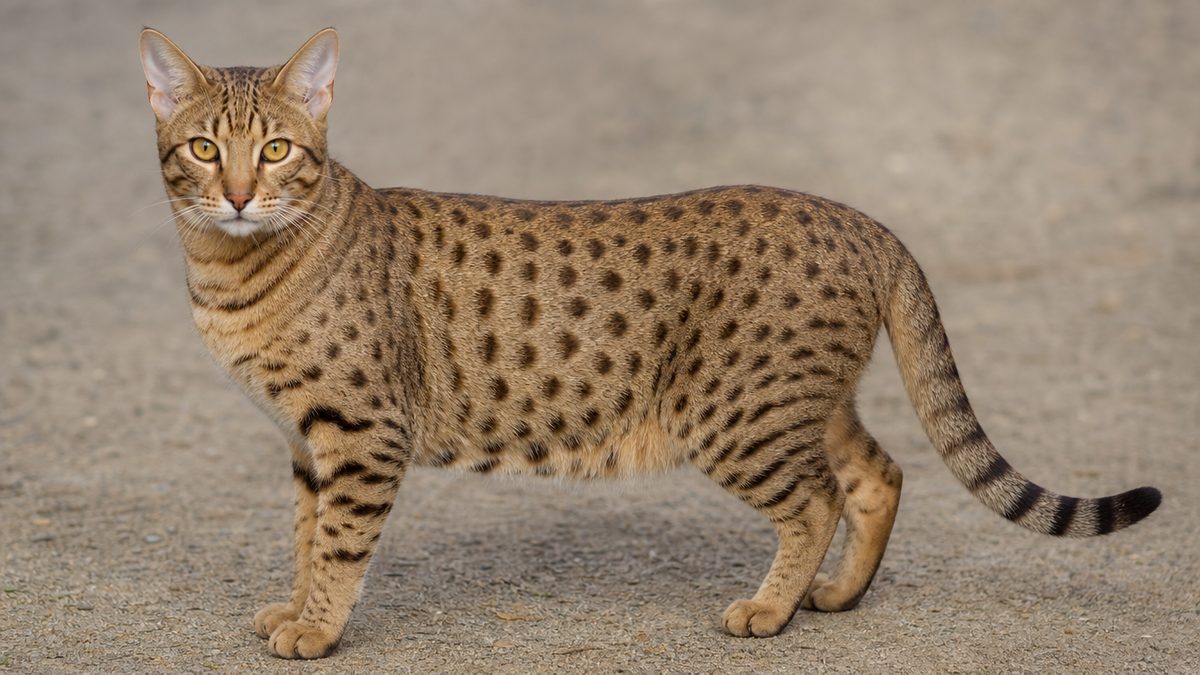
The Ocicat is a shorthair cat with a spotted coat and no wild ancestry whatsoever, built from Abyssinian, Siamese and American Shorthair lines to look like a small wildcat. That last clause is the whole breed, and it is also the thing Indian listings get wrong most often by confusing it with the Bengal.
The CFA's own history is unusually specific. The first Ocicat, a kitten called Tonga born in 1964, came from an attempt to cross an Abyssinian with a Siamese in order to produce an Aby-pointed Siamese. The breeding produced a spotted kitten instead, and the breeder's daughter thought he looked like an ocelot, which is where the name comes from. Tonga was neutered and placed in a pet home, but his photograph ran in a Detroit newspaper and was seen by the geneticist Dr Clyde Keeler, who wanted domestic cats that mimicked vanishing wild species. That prompted a repeat of the breeding, and other breeders added the American Shorthair to broaden the genetic base.
The standard is mostly about the pattern
The GCCF allocates 25 of its 100 points to coat pattern, another 10 to colour and 10 to contrast, and only 5 to the head. No other breed on this site is judged so heavily on markings. The written description is worth quoting because it names the mechanism: "Each hair (except on the extremities) has several bands of colour, and where the dark bands fall together a spot is formed on the surface of the coat";.
FIFe describes the same animal more briefly as "a medium to large, well-spotted shorthair cat of moderate type", under the code OCI in fully recognised category 3, alongside the Bengal and the Egyptian Mau Fédération Internationale Féline. OCICAT…. The GCCF adds that the spots are well-scattered on the sides, across the shoulders and hindquarters and down the legs, with a well-spotted belly, and that they must not be faint or blurred.
The body, and one feature people mistake for fat
The standard asks for a solid, rather long body with substantial bone and muscle, a deep broad chest, high shoulders and a straight back that is slightly higher at the rear, which together produce a gait the GCCF compares to a wildcat's. It notes that some, though not all, Ocicats carry a loose skin flap called a primordial pouch running from the flank underside to the hind legs, and that its absence is not a fault. Indian owners regularly mistake that pouch for excess weight; it is anatomy, not condition.
Cats of this breed "feel heavy for their size", which the standard flags as surprising. The GCCF's public breeds index gives the working weight as 8 to 12 lb.
| Feature | Ocicat | Bengal | Egyptian Mau | Abyssinian |
|---|---|---|---|---|
| Wild ancestry | None | Asian leopard cat in the founding lines | None | None |
| Pattern | Spots on a classic tabby layout | Spots or rosettes | Naturally occurring spots | Ticked, no pattern |
| Coat | Short, close-lying, satiny | Short, often glittered | Short, silky | Short, fine, resilient |
| Allowed eye colours | Any except blue | Varies by colour | Gooseberry green | Gold or green |
| FIFe code | OCI, recognised 1992 | BEN | MAU | ABY |
| Over-represented urolith type | Urate | Not reported in that series | Urate | Not reported in that series |
An Ocicat's spots sit on the classic tabby layout and its coat is plain satiny short hair with no glitter. A Bengal carries rosettes, often a glittered coat, and documented Asian leopard cat ancestry in its founding lines. If an Indian listing says wild ancestry, it is either describing a Bengal or describing the Ocicat wrongly, and the CFA's own history says the second is impossible.
Coat genetics, and how a tabby becomes a spotted cat
The Ocicat's coat genetics are ordinary tabby genetics arranged to an unusual end. Every hair is agouti banded, the spots are what happens where the dark bands line up, and the underlying layout is the classic tabby pattern rather than a separate spotting gene.
The GCCF standard states the pattern's basis directly: the spots are "well-scattered in a distinctive pattern, based on the Classic Tabby pattern", and the mechanism is that each hair away from the extremities carries several bands of colour, so a spot appears on the surface where the dark bands coincide. That is the agouti ticking the Abyssinian contributed, laid over a tabby layout, and it is why an Ocicat's spot has soft rather than solid edges when you part the coat.
Where each founding breed shows
- Abyssinian: the agouti ticking that bands every hair, and the ruddy and sorrel colour base.
- Siamese: the modified wedge head, the long body, the voice and the original accidental cross itself.
- American Shorthair: substance, bone, the silver series, and the wider gene pool the early breeders needed.
The CFA records that the American Shorthair was introduced specifically to broaden the new breed's genetic base rather than to add a look. That is a useful thing to know when a seller tells you a silver Ocicat is a rarer or better cat; silver is an American Shorthair inheritance and carries no extra weight in the standard.
Twelve colours, and none of them is worth a premium
The GCCF states that Ocicats occur in twelve different colours, and that all colours should be clear and pleasing, with the pale colours naturally showing less contrast than the darker ones. It also gives a piece of practical identification most owners never hear: the darkest colour is at the tip of the tail, and the tail tip is the final determinant of what colour the cat actually is. Eye colour is independent, with all colours except blue allowed and no correspondence required between eye colour and coat colour.
The GCCF holds a second entry for the classic-patterned cat. Its contents page lists it at page 213 as OCICAT CLASSIC (OCI), while the group page for the same section lists the pair as OCICAT & AZTEC (OCI) & (AZT). One register, one document, two names and two codes for the same cat. If you are offered a marbled or classic-patterned Ocicat in India, that is a real variety with a real standard, not a mismarked spotted cat.
Registry recognition, which is the strongest of any breed in this batch
Registry recognition is not the Ocicat's problem. All four major registries hold it at full championship level, with dates recorded in each body's own documents, which makes the pedigree question here purely about verifying the paper rather than about whether the breed exists.
The CFA accepted the Ocicat for registration in 1966, two years after Tonga was born, and advanced it to championship status in 1987 after two decades of work on consistent type. It runs a full Ocicat breed council today, listed among the shorthair breeds on CFA's own enumeration.
FIFe recognised the breed in 1992, which its standard prints on its own face as "OCI Rec. 1992", and files it in category 3 with a standard valid from 01.01.2026. TICA lists it among the 73 breeds it recognises. The GCCF carries a full Standard of Points entry at page 209, updated by Council in June 2025, showing in Section 4 Group C alongside the Bengal, the Egyptian Mau, the Sokoke and the Toyger.
| Registry | Status | Date on the record |
|---|---|---|
| CFA | Championship, with an active breed council | Registration 1966, championship 1987 |
| FIFe | Fully recognised, category 3, code OCI | Rec. 1992, standard valid 01.01.2026 |
| TICA | Recognised, one of 73 breeds | Not stated on the index |
| GCCF | Own Standard of Points entry, Section 4 Group C, page 209 | Updated Council June 2025 |
| LOOF | Own breed record, id 39 | 5 pedigrees registered in 2024 |
What the French numbers say about scarcity
LOOF, which files the Ocicat under its own breed record id 39 rather than folding it into another breed's entry, is the only register publishing a live per-breed count. Its Ocicat figures are small enough to be worth naming individually: 3 pedigrees in 2023 and 5 in 2024, against a twenty-year total of 74 in which six separate years recorded none at all. Full recognition by four registries and a French national total in double figures is not a contradiction; it is what a genuinely uncommon but properly established breed looks like.
FIFe's own registration table puts the same point at international scale. Its Breeding Statistics 2024 covers 96,075 kittens across 54 breeds, and the Ocicat sits 26th with 177 registrations, marked as having fallen in rank. For comparison in the same document, the Bengal is 7th with 3,559 and the Egyptian Mau is 31st with 113. So among the spotted breeds the Ocicat is neither the popular one nor the rarest, and its scarcity is a fact about how few people breed it rather than about whether it is recognised.
Because every major registry holds this breed, a genuine Ocicat can produce pedigree papers from CFA, TICA, FIFe through a national member club, the GCCF or LOOF. Ask which body, then check that body's own breed list. Unlike some breeds in this batch, there is no registry here that cannot have issued the paper, so a seller who cannot name one at all has a simpler problem.
Ocicat cat price in India, and the single source it rests on
Ocicat cat price in India comes from exactly one Indian page, which quotes Rs 50,000 to Rs 90,000 for a pet-quality kitten and Rs 1,00,000 to Rs 2,00,000 or more for show quality. That page is worth reading carefully before you use its numbers, because of what else is on it.
We pulled the Indian results for this query on 8 September 2026 with gl=IN and hl=en and read the pages in their raw markup. Nine of the ten results are either overseas price pages quoting US dollars, a marketplace listing for Ocicat-themed merchandise, a general Indian cat-price guide that does not list the breed, or a page for an entirely different breed.
| Rank | Domain | What it is | Ocicat price given |
|---|---|---|---|
| 1 | supertails.com | Indian all-breeds cat price guide | None. The breed is not mentioned |
| 2 | charwaha.com | Indian breed page | Rs 50,000 to Rs 2,00,000 or more |
| 3 | etsy.com | Marketplace listing page for Ocicat merchandise in India | None for a live animal |
| 4 | petful.com | US price guide | 800 to 2,500 US dollars |
| 5 | cats.com | US breed profile | 800 to 1,200 US dollars |
| 6 | headsupfortails.com | Indian 50-breed listicle | None, but rates the breed for the Indian climate |
| 7 | instagram.com | A seller account listing other breeds | None |
| 8 | petrebels.com | European breed page | About 1,100 euros |
| 9 | a-z-animals.com | US price guide | 800 to 1,500 US dollars |
| 10 | mrnmrspet.com | An Indian page for the Calico, a different breed | Not applicable |
The one Indian source, and its seam
Charwaha's Ocicat page publishes the figures above and a monthly budget of food Rs 3,000 to Rs 8,000, litter Rs 1,000 to Rs 3,000, grooming Rs 500 to Rs 2,000, vet Rs 1,000 to Rs 5,000 and toys from Rs 1,000, totalling Rs 6,000 to Rs 20,000. Those are plausible Indian numbers. What sits beside them is the problem: one of the page's own headings reads "How to Choose a Healthy Puppy", its related-article block is entirely dog content, and it closes with a section headed "Why Native Indian Cat Breeds Are Better for Indian Climate";. This is a template built for dog breed pages with a cat dropped into it.
That does not automatically make the price wrong. It does mean the number has no independent corroboration in India, and that the page carrying it did not have a cat-shaped editorial process behind it. We report the figure and we report what it is sitting next to.
Running the division tests
Petful gives 800 to 2,500 US dollars for a breeder kitten, with most pet-quality kittens between 800 and 1,500. Test the Indian figures against that. Rs 2,00,000 divided by a flat 80 is exactly 2,500, which is precisely Petful's ceiling. Rs 50,000 divided by 80 is 625, which is below Petful's floor of 800, and 800 at 80 would be Rs 64,000. So the top of the Indian range coincides with the US ceiling and the bottom does not.
A flat 80 divides any rupee figure ending in three zeros into a clean quotient, so a match at 80 proves almost nothing on its own. Neither Indian figure divides cleanly at 84.38 (Rs 50,000 gives 592.56, Rs 2,00,000 gives 2,370.23) or at 74 (675.68 and 2,702.70). The honest reading is that these are rupee-native numbers whose ceiling happens to land on the US ceiling, not a converted dollar list. We flag the coincidence and stop there.
The homonym that will corrupt any automated price you find
There is an OciCat cryptocurrency token, and it trades for a fraction of a cent. Both Google's own AI answer for this query and the Petful page open by warning readers not to confuse the two. Any scraped or generated "Ocicat price" that comes back as a tiny decimal is quoting a token, not a cat. This is the cleanest example on this site of a breed name colliding with something else in the world, and it is worth knowing before you trust a price aggregator.
Monthly cost of ownership in India, from published rate cards
The cost of ownership for an Ocicat in India is lower than for any longhaired pedigree, because the grooming line nearly disappears. Litter, food, vaccination and parasite control carry the budget instead, and every figure below comes from a named Indian rate card read live.
| Line | Published rate card figure | Charwaha's Indian estimate |
|---|---|---|
| Kitten vaccination course, three visits | From Rs 3,999, list Rs 5,065, Vetic Mumbai | Not itemised |
| Adult annual booster | From Rs 1,899, list Rs 1,908, Vetic Mumbai | Vet Rs 1,000 to Rs 5,000 a month |
| Anti-rabies, single | Rs 699, Vetic | Included above |
| Bath and blow dry, 60 minutes | From Rs 934, Vetic Delhi | Grooming Rs 500 to Rs 2,000 a month |
| Cat boarding, overnight to 24 hours | Rs 649 plus food and litter, PawSpace Bengaluru | Not itemised |
| Pet animal licence | Rs 50, Greater Chennai Corporation | Not itemised |
| Food | No national published rate | Rs 3,000 to Rs 8,000 a month |
| Litter | No national published rate | Rs 1,000 to Rs 3,000 a month |
Read the last two rows honestly. Food and litter are the two largest recurring lines in any Indian cat budget and neither has a published national rate this page could quote. Charwaha's estimates for them are plausible and unverifiable, which is exactly how they should be labelled.
Boarding is the line most owners forget until they travel, and it is worth pricing for a breed this social. PawSpace in Bengaluru publishes a separate cat rate card at Rs 499 for up to four hours, Rs 599 for daycare to ten hours and Rs 649 overnight, with festive-season rates 25 to 30 percent higher and food and litter charged on top.
Where a short coat saves you money
A semi-longhair cat needs professional grooming on a schedule. An Ocicat does not. The GCCF rates the coat low maintenance and describes it as short, satiny and close-lying with no suggestion of woolliness. In practice that removes roughly Rs 700 to Rs 800 a month of Vetic-priced grooming from the budget compared with a British Longhair. Budget instead for the litter that an active, athletic cat gets everywhere.
The line that is not optional for a female
Spaying is a cost line with a specific number behind it for this breed. In Swedish insurance data covering 1999 to 2006, the mean incidence of pyometra was about 17 cats per 10,000 cat years at risk, and the Ocicat is one of eight breeds with an incidence above 60 per 10,000, alongside the Siberian, Korat, Siamese, Ragdoll, Maine Coon and Bengal, with the Sphynx far ahead at 433. The mean case fatality rate was 5.7 percent. Consult your nearby vet about timing, but treat spaying as a health measure rather than a discretionary spend.
Greater Chennai Corporation licenses pet animals generally at Rs 50, issued 9,115 licences during 2024, and runs municipal pet clinics that provide all treatment and anti-rabies vaccination free of cost. Delhi's scheme registers pet dogs only. Check your own corporation before assuming private clinic rates are the only route.
Heat tolerance in India, where this breed genuinely scores
The Ocicat has the best heat tolerance of any breed in this batch, and for once an Indian listicle's claim survives checking. The short, close-lying satiny coat has no dense undercoat to trap heat, and the breed's homeland is not as cold as its American origin suggests.
We queried NASA POWER by explicit coordinates for Detroit, where Tonga was born and where the newspaper photograph ran, and for Indian cities, echoing the cell elevation each time.
| Place | Cell elevation | Annual T2M | Annual RH2M | Hottest month | Peak wet bulb |
|---|---|---|---|---|---|
| Detroit, Michigan | 226.33 m | 9.18 C | 78.74 percent | July, 22.40 C | 19.03 C in July |
| Chennai | 48.95 m | 27.95 C | 72.39 percent | May, 31.51 C | 26.11 C in May |
| Kolkata | 7.35 m | 25.81 C | 73.93 percent | May, 31.53 C | 27.09 C in June |
| Mumbai | 97.15 m | 26.77 C | 67.39 percent | May, 31.19 C | 25.77 C in June |
| Bengaluru | 841.72 m | 23.74 C | 67.94 percent | April, 28.37 C | 21.86 C in May |
| Delhi | 206.37 m | 25.60 C | 45.56 percent | June, 35.88 C | 26.50 C in July |
Two things in that table are worth naming. Detroit's annual relative humidity of 78.74 percent is higher than Chennai's 72.39, so the humidity intuition fails here as it does everywhere else on this site. And Detroit's peak wet-bulb load of 19.03 degrees C is only 7.08 degrees below Chennai's, which is the narrowest homeland gap in this batch of six breeds. A cat from a genuinely warm-summer continental climate, wearing a coat with no undercoat, is a better Indian proposition than the marketing usually is.
Where the ranking pages are right, and this page says so
Heads Up For Tails' fifty-breed listicle rates the Ocicat "suitable for the Indian climate" and calls the short coat easy to maintain and a practical choice for many Indian households. That is correct, and it is worth saying plainly because this site spends most of its time correcting Indian breed pages rather than agreeing with them. The short-coated argument holds up against the temperature data.
What still needs managing
Heat-tolerant is not heat-proof, and this is an athletic cat that will keep playing past the point of sense.
- Move the two daily play sessions to early morning and after dark from March to June, because this breed will not self-limit.
- Give the cat a tiled floor or a cool tile shelf to lie on, since conduction outperforms a fan for any cat.
- Keep two water sources away from food bowls, which matters more here than in most breeds because of the urate stone finding below.
- Delhi peaks in June rather than May and Bengaluru in April rather than May, so plan the hot window by city rather than by a national rule.
- Watch the coat through the monsoon in Mumbai, Kolkata and coastal Tamil Nadu, since a short satiny coat dries fast but the skin under it still stays damp in an unventilated room.
- Rank your own city rather than assuming: hottest-month means run Ahmedabad 35.06 C in May, Hyderabad 33.30 C in May and Pune 28.93 C in April, so Pune is materially easier than Chennai and Ahmedabad is materially harder.
One legal note belongs here. Rule 6(5) of the Prevention of Cruelty to Animals (Pet Shop) Rules, 2018 requires the temperature where pet animals are displayed or housed to be comfortable, says it varies from breed to breed, and puts the onus on the pet shop owner to familiarise himself with the requirements of the breeds he deals in. That clause protects a longhaired cat more than it protects this one, but it is the shop's obligation either way.
Temperament, and the two registries that disagree about it
The Ocicat is an extroverted, trainable, people-oriented cat, and the two registries that describe its temperament in writing disagree on one word that matters to a buyer: whether it is demanding.
The CFA describes a dog-like personality, cats dedicated to their owners "but neither clingy nor demanding", natural extroverts who welcome strangers, respond well to training, will fetch, walk on a leash and learn voice commands. The GCCF describes the same breed as "active, agile, intelligent, inquisitive and demanding of attention", with a very affectionate friendly nature that desires the company of people or other pets, adding that Ocicats are gentle, easy going and companionable.
One registry says not demanding, the other says demanding of attention. Both are describing a cat that wants company and will ask for it, and the difference is a judgement about how insistent that asking is. For an Indian buyer the practical reading is the safer one: assume this cat needs interaction, and if it turns out to be undemanding, you have lost nothing.
Who this suits in India
- Families with children, since the CFA calls them natural extroverts who welcome strangers.
- Households with another cat or a cat-safe dog, which the GCCF standard names explicitly as company this breed desires.
- Owners who want a trainable cat, because fetch, leash walking and voice commands are all on the registry's own list.
- Anyone in a hot Indian city, where the short coat is a genuine advantage rather than a compromise.
Who should choose something else
- People out of the house twelve hours a day with no second animal, because a social breed alone in a flat gets destructive rather than sad.
- Anyone wanting a calm ornamental cat, since this one is athletic and will use the top of your cupboards.
- Households with fragile shelving, which is not a joke about a breed the standard says moves like a wildcat.
- Buyers who cannot verify a pedigree, given that only one Indian page even publishes a price for the breed.
Training an Ocicat, which is the easy part
To train an Ocicat, use food and repetition and start early, because this is one of the few cat breeds a registry describes as responding well to training. Fetch, leash walking and voice commands are all on the CFA's own list of what the breed does.
The CFA's trait section is unusually concrete: many Ocicats will fetch, walk on a leash, learn to respond to voice commands and easily adapt to household rules. Take that seriously rather than as breed flattery. A cat that can be trained is a cat whose vet visits, carrier trips and nail trims are all easier, and in an Indian summer the carrier trip is the one that matters.
The curriculum, in order
- Start handling paws, ears and mouth at eight to ten weeks, ten seconds at a time, ending in food.
- Teach a name response before anything else, since a recall in a flat is a safety tool.
- Introduce the carrier as furniture and feed inside it, never using it only for vet trips.
- Add harness and leash indoors before ever going outside, and only in a safe, enclosed space.
- Build fetch on the cat's own offer rather than trying to teach it cold, because most Ocicats offer it unprompted.
What this breed resists
It resists boredom rather than instruction. An under-stimulated Ocicat opens cupboards, knocks things off surfaces and shouts, and Indian owners routinely read that as bad temperament when it is an unmet exercise requirement. The GCCF standard describes a cat that is inquisitive and demanding of attention; a cat like that will find its own job if you do not give it one.
A leash-trained cat is not an outdoor cat. Indian streets carry traffic, stray dogs, and a tick and parasite load that an indoor pedigree cat has no exposure history for. Use the leash on a balcony, a terrace or an enclosed garden, and treat outdoor walking as a supervised enrichment activity rather than a routine.
Daily exercise, which this breed actually needs
Give an Ocicat two structured play sessions a day of fifteen to twenty minutes each, plus vertical space it can climb. This is the highest exercise requirement of any breed in this batch, and it is the requirement Indian buyers most often underestimate.
The GCCF standard describes an athletic and powerful cat, graceful and lithe, with high shoulders and a straight back that produce a gait similar to a wildcat's, and substantial muscle and bone development. That body is built for movement, and cats built for movement do badly in a flat with nothing to climb.
The general weight evidence still applies. Among UK cats that died after nine months, lifespan decreased by 0.02 years for every 100 g of deviation, in either direction, from the median adult body weight within the breed and sex strata. A muscular breed that feels heavy for its size, as the standard says it should, is a breed where judging condition by eye is unreliable.
What to provide
- Install a tall climbing structure or a set of wall shelves, because floor space alone will not do for this breed.
- Run two wand sessions a day, each ending with a catch and a food reward.
- Rotate toys weekly rather than leaving them all out, since an intelligent cat habituates fast.
- Feed at least one meal from a puzzle feeder, which turns eating into the work this breed is looking for.
- Move both sessions to early morning and after dark from March to June.
A second cat is a legitimate exercise strategy here and the GCCF standard supports it, describing a breed that desires the company of people or other pets. In an Indian household where everyone is out during the day, two cats is often the honest answer rather than a luxury.
Grooming, which is the shortest section on this page
Groom an Ocicat once a week with a rubber brush and that is essentially the whole routine. The GCCF rates the coat low maintenance, and the standard asks for a short, close-lying, satiny coat with no suggestion of woolliness.
The full coat description is worth quoting because it explains why the routine is so light: "Short, satiny in texture with a lustrous sheen. Close lying and sleek, with no suggestion of woolliness. Allowances should be made for seasonal variation";. There is no dense undercoat to mat, which is the difference between this breed and every semi-longhair on this site.
| Task | Frequency | If you outsource it |
|---|---|---|
| Rubber brush or grooming mitt | Weekly, twice weekly in the moult | Not sold separately |
| Bath | Rarely. Only when genuinely soiled | From Rs 934 for 60 minutes, Vetic Delhi |
| Nail trim | Every two weeks | Included in a full groom |
| Ear check | Weekly | Not sold separately |
| Tooth brushing | Weekly | Not sold separately |
Seasonal variation is written into the standard, so an Ocicat whose coat looks thinner in an Indian summer is behaving as the register expects rather than losing condition.
The one grooming-adjacent thing that does matter here
Skin, not coat. A short satiny coat gives less protection against sun on a balcony or a terrace, and against the tick and flea load an Indian ground-floor flat carries. Parasite control on a veterinary schedule is the grooming budget this breed actually needs, and it is worth asking your nearby vet which product suits a cat in your city rather than buying a dog product by mistake.
This warning belongs on every cat page in India because the two products sit side by side on the same shelf. An Italian veterinary teaching hospital reported four cases of feline permethrin intoxication, in every one of which the cause was an owner applying a canine permethrin spot-on to a cat; the cats needed intravenous lipid emulsion and sedation to recover. Buy the cat formulation, read the species on the box, and ask the pharmacist to show it to you before you pay.
Health issues, and the three studies that name this breed
The Ocicat has no life table of its own, but it is one of the better-studied breeds in this batch: three separate peer-reviewed series name it explicitly, on urinary stones, on pyometra and on Toxoplasma gondii. All three findings are actionable in India, and none of them appears on any page currently ranking for the breed here.
Urate stones, not the ones most owners are warned about
In 21,426 feline bladder urolith submissions to the Canadian Veterinary Urolith Centre between 1998 and 2014, struvite and calcium oxalate together made up more than 90 percent of everything submitted. The breed pattern is where it gets specific: compared with domestic short-haired cats, the Tonkinese, Burmese, Devon Rex, Himalayan, Persian and Siamese were significantly associated with calcium oxalate, while the "Egyptian mau, Birman, ocicat, and Siamese breeds were over-represented amongst urate submissions";.
That distinction matters clinically because urate stones are managed differently from the common two. They are a minority stone type overall, and their appearance can prompt a vet to look for an underlying reason rather than simply changing the diet. If your Ocicat produces a stone, tell the vet what the breed is over-represented for, because the prior matters.
There is no routine screening test for urate stones, and no registry asks breeders to screen for them, so this is a management finding rather than a breeding one. What it changes is what you watch for and what you tell the vet.
- Keep at least two water sources, away from food, since dilute urine is the single largest owner-controlled variable.
- Lead with wet food where the budget allows, which raises total water intake more than any bowl arrangement.
- Treat straining, frequent small volumes, blood in the urine or tray avoidance as an emergency in a male cat.
- Ask for the stone to be analysed rather than assumed, because the management for urate differs from struvite and oxalate.
Pyometra, and why spaying is a health decision here
Swedish insurance data covering cats insured from 1999 to 2006 gives a mean pyometra incidence of about 17 cats per 10,000 cat years at risk, diagnosed at a median age of four years, with a significant breed effect. The Sphynx led at 433 cats per 10,000 cat years at risk, and the breeds above 60 included the Siberian, Ocicat, Korat, Siamese, Ragdoll, Maine Coon and Bengal. The mean case fatality rate across all cats was 5.7 percent, slightly higher than the 3 to 4 percent reported in dogs.
An incidence above 60 per 10,000 cat years at risk is roughly three and a half times the all-cat mean of about 17, and it applies to entire females only. Spaying removes the risk entirely. This is a Swedish insured population rather than an Indian one, so the absolute rate will not transfer, but the breed ranking within one dataset is the part that carries.
Toxoplasma gondii, where the breed sits near the top
A Finnish feline biobank study tested 1,121 cats from eight breeds for immunoglobulin G antibodies against Toxoplasma gondii. Overall seroprevalence was 41.12 percent (95% CI 38.28 to 44.03). Ocicats came in at 38 of 88 cats, 43.18 percent (95% CI 33.33 to 53.60), fourth of the eight behind the Persian at 60.00 percent, the Norwegian Forest Cat at 46.65 and the Birman at 45.20, and well above the Burmese at 18.82.
In the final multivariable model, adjusting for age and lifestyle, the odds of testing seropositive were four to seven times higher in Birmans, Ocicats, Norwegian Forest Cats and Persians than in the Burmese, and older age and receiving raw meat were separate risk factors. Seroprevalence in adult cats was 45.20 percent against 18.79 percent in kittens.
| Breed | Cats tested | Seropositive | Percent | 95 percent CI |
|---|---|---|---|---|
| Persian | 60 | 36 | 60.00 | 47.35 to 71.44 |
| Norwegian Forest Cat | 343 | 160 | 46.65 | 41.43 to 51.93 |
| Birman | 281 | 127 | 45.20 | 39.48 to 51.04 |
| Ocicat | 88 | 38 | 43.18 | 33.33 to 53.60 |
| Siamese | 43 | 15 | 34.88 | 21.37 to 49.88 |
| British Shorthair | 107 | 36 | 33.64 | 25.38 to 43.04 |
| Korat | 114 | 33 | 28.95 | 21.39 to 37.88 |
| Burmese | 85 | 16 | 18.82 | 11.83 to 28.52 |
| All cats tested | 1,121 | 461 | 41.12 | 38.28 to 44.03 |
The practical Indian consequence is about raw feeding, not about avoiding the breed. Toxoplasma is a zoonotic parasite and the cat is its definitive host, so a household decision to feed raw meat is a household decision about a human health risk as well as a feline one. Discuss it with your nearby vet before you start, not after.
Life expectancy, where nothing has been measured
The UK feline life tables modelled only the 12 breeds reaching 15 or more deaths, and the Ocicat is not among them. Indian and overseas pages publish 12 to 18 years, which Heads Up For Tails prints as the breed's life expectancy. That is an estimate, not a life table, and this page keeps the two labelled apart. What the UK data does supply is general and still useful: crossbred cats reached 11.89 years at age 0 against 10.41 for purebreds, entire cats carried 4.29 times the odds of dying before three, and non-ideal body weight was significantly linked to a shorter lifespan.
Erythrocyte pyruvate kinase deficiency is an autosomal recessive anaemia whose causative feline mutation was originally identified in Abyssinian and Somali cats, and the Ocicat has Abyssinian ancestry. A Japanese survey found the mutant allele frequency high enough in Abyssinians and Somalis to warrant control measures, and relatively low in Bengals and American Shorthairs. The Ocicat itself was not among the four breeds surveyed, so no Ocicat frequency exists to quote. Ask a breeder whether the Abyssinian side has been tested, and ask your nearby vet whether the test is available in your city.
Feeding an athletic cat with a urate stone risk
Feed an Ocicat measured meals with as much moisture as your budget allows, because the one breed-specific stone finding on this page turns on urine concentration. Portion control matters second, and it matters because the standard itself says this cat should feel heavier than it looks.
Water first. The Canadian series over-represents this breed among urate submissions, and urine concentration is the variable an owner can actually influence. In an Indian summer that is not a marginal effect.
- Place at least two water sources, each at least three feet from any food bowl.
- Refresh water twice a day from March to June, because warm stale water is refused.
- Weight wet food into the ration deliberately rather than treating it as a topper.
- Watch litter clump size, which is the observable proxy for how much the cat is drinking.
Portions, and why eyeballing fails on this breed
The GCCF standard says both sexes should feel surprisingly heavy for their size, with substantial bone and muscle. A cat that is supposed to feel heavy is a cat whose weight gain is easy to excuse. Weigh the ration and weigh the cat, because the UK data attaches 0.02 years of lifespan to every 100 g of deviation from the breed and sex median.
| Stage | Approach | What to watch |
|---|---|---|
| 8 to 16 weeks | Four small meals a day, kitten formulation | Weekly weight gain and stool quality after any change |
| 4 to 12 months | Three meals, then two, still on kitten food | Muscle developing over ribs rather than fat |
| 1 to 7 years | Two measured meals, at least one from a puzzle feeder | Body condition score at every vet visit, and litter clump size |
| 7 years and older | Two meals, senior formulation on veterinary advice | Drinking volume, appetite change and any tray-behaviour change |
Raw meat was an independent risk factor for Toxoplasma gondii seropositivity in the study that also found Ocicats among the highest-odds breeds. That does not prove raw feeding causes the breed effect, and the authors do not claim it does. It does mean an Ocicat household stacking two risk factors should have the conversation with a vet first.
The Ocicat kitten timeline, month by month
Plan an Ocicat kitten timeline around four fixed points: the eight-week legal floor for sale in India, the vaccination course, the training window that this trainable breed rewards, and the neutering or spaying decision, which for a female carries a specific pyometra number behind it.
Indian law sets the first date. The Prevention of Cruelty to Animals (Pet Shop) Rules, 2018 define an un-weaned animal to include "kittens and pups below eight weeks", and rule 7(15) states that no pet shop shall sell un-weaned or underage animals.
| Age | What happens | Cost anchor |
|---|---|---|
| Under 8 weeks | Not legally saleable in India. Stay with the queen | None |
| 8 to 10 weeks | Home, first vet check, start handling and name response | Kitten vaccination course from Rs 3,999 for three visits |
| 10 to 16 weeks | Vaccination course completed, carrier as furniture, first harness indoors | Included in the course above |
| 4 to 6 months | Spots sharpen as the kitten coat is replaced; climbing structure becomes essential | Climbing furniture, one-off |
| 5 to 8 months | Neuter or spay window, discussed with your own vet | Clinic dependent, ask for a written quote |
| 8 to 12 months | Adult feeding routine set, puzzle feeder introduced | None |
| 12 months | First adult annual booster, baseline adult weight recorded | Adult annual from Rs 1,899 |
The window that decides the adult cat
Between eight and sixteen weeks this breed learns whether handling, carriers and harnesses are normal. The CFA says Ocicats respond well to training and easily adapt to household rules, which is a statement about a window rather than about a lifetime. A cat that meets a carrier for the first time at three years old will fight it, breed notwithstanding.
What to write down in the first year
- The registry that issued the pedigree papers, copied from the certificate rather than remembered.
- Every vaccination date and product name, from the certificate.
- Monthly weight, which is the baseline the body-condition argument later rests on.
- Whether the parents were tested for pyruvate kinase deficiency on the Abyssinian side.
Rule 7(16) of the Pet Shop Rules, 2018 requires that every puppy be micro-chipped by a veterinary practitioner and that only micro-chipped puppies be sold. It says puppies, not kittens, so a kitten falls outside it. Microchipping an Ocicat in an Indian city is a genuinely good idea for a breed this athletic and this inclined to explore, but it is your choice rather than the shop's legal obligation.
Ocicat against the spotted cats Indian buyers cross-shop
Almost everyone who reaches this breed is also looking at the Bengal, and a smaller number at the Egyptian Mau or the Abyssinian. The comparison that matters is not which looks wilder; it is which health evidence exists, and which cat is actually obtainable in India.
| Ocicat | Bengal | Egyptian Mau | Abyssinian | Indian domestic shorthair | |
|---|---|---|---|---|---|
| UK life expectancy at age 0 | No row | 8.51 years (7.12 to 9.90), 73 deaths | No row | No row | 11.89 years (11.75 to 12.03), 7,117 deaths |
| Wild ancestry | None | Asian leopard cat in founding lines | None | None | None |
| Coat care | Weekly rubber brush | Weekly | Weekly | Weekly | Weekly |
| Heat tolerance in India | Good | Good | Good | Good | Best |
| Over-represented urolith type | Urate | Not reported | Urate | Not reported | Not separately reported |
| Toxoplasma seroprevalence in the Finnish series | 43.18 percent of 88 | Not tested | Not tested | Not tested | Not tested |
| Held by CFA, TICA, FIFe and GCCF | Yes, all four | Yes | Yes | Yes | Not applicable |
| Published Indian price | Rs 50,000 to Rs 2,00,000 from one source | Widely listed | Rarely listed | Occasionally listed | Adoption, usually free |
The Bengal row is the one to read twice. It is the only cat in that table with a measured UK life expectancy, and at 8.51 years from 73 deaths it is the shortest of the twelve breeds the study modelled. That is not an argument for the Ocicat, which has no measured figure at all; it is an argument for noticing which claims have numbers behind them.
Ocicat against Bengal, on the question people actually ask
The difference is ancestry, and it is documented rather than rhetorical. The CFA's history records that the Ocicat came from an Abyssinian and Siamese cross with the American Shorthair added later, with no wild species involved at any point. A Bengal's founding lines include the Asian leopard cat. For an Indian buyer that matters practically: a breed with no wild ancestry raises no questions about wildlife law, import provenance or generational distance from a wild parent.
Ocicat against the cat outside your building
In the UK life tables, crossbred cats reached 11.89 years at age 0 across 7,117 deaths, against 10.41 years for purebred cats and 1.83 times the odds of dying before three. An Indian domestic shorthair needs no import route and no pedigree verification, and an Indian tabby is already spotted or striped. If the appeal of the Ocicat is the wild-looking pattern, look at what is already outside before you spend Rs 50,000 or more.
Mistakes Indian buyers make with this breed
Five mistakes account for most of what goes wrong with an Ocicat in India, and the first one costs money before the cat arrives.
1. Taking the single Indian price as a market
One Indian page publishes an Ocicat price, and its own headings show it is a dog template with a cat dropped in. A single unverified source is not a market rate. Treat Rs 50,000 to Rs 2,00,000 as one observation to compare against whatever you are quoted, not as a benchmark you owe anyone.
2. Buying a spotted cat and calling it an Ocicat
Spots are not the breed. The GCCF requires the spots to sit on a classic tabby layout, to be well-scattered including on the belly, and to be neither faint nor blurred, and it allows any eye colour except blue. A spotted Indian domestic shorthair is a spotted Indian domestic shorthair, and there is nothing wrong with that except the price difference.
3. Underestimating the exercise requirement
This is the one that produces the returned cat. A breed the standard describes as athletic and powerful, with a wildcat's gait and a demand for attention, does not settle into a small flat with nothing to climb. Install the climbing furniture before the cat arrives, not after the curtains come down.
4. Feeding raw without thinking about the household
Raw meat was an independent risk factor for Toxoplasma gondii seropositivity in the study that also placed Ocicats among the highest-odds breeds. Toxoplasma is zoonotic and cats are its definitive host. This is a decision to make with a vet, especially in a household with a pregnant person or anyone immunocompromised.
5. Leaving a female entire
The Ocicat sits among eight breeds above 60 pyometra cases per 10,000 cat years at risk against an all-cat mean of about 17, with a 5.7 percent case fatality rate. Spaying is the intervention, and it also removes the 4.29 times odds of early death that entire cats carried in the UK data.
There is an OciCat cryptocurrency token trading at a fraction of a cent, and both Google's AI answer and the leading US price page open by telling readers not to confuse it with the cat. Any automated price you find for this breed that returns a tiny decimal is quoting the token. Check what the number is attached to before you quote it.
Adoption, verification and buying without being fooled
Adopt first, and if you buy, verify three things before money moves: the age, the registry and the parents. Every check is free, and for this breed the registry check is unusually easy because all four major bodies hold the breed.
Start with adoption, and be realistic about what it offers. A purebred Ocicat in an Indian shelter would be extraordinary. A spotted or ticked Indian domestic shorthair with the same short coat, the same heat tolerance and a longer measured life expectancy is not extraordinary at all; it is what most Indian shelters are full of.
The three checks, in order
- Age. Kittens below eight weeks are un-weaned under rule 2(1)(p)(ii) of the Pet Shop Rules, 2018, and rule 7(15) bars selling un-weaned or underage animals. Ask for the litter date in writing.
- Registry. Ask which body issued the pedigree papers. CFA, TICA, FIFe and the GCCF all hold this breed, so any of those four is a checkable answer and a seller who cannot name one has told you what you need to know.
- Parents. Ask to see the queen with the litter, ask about pyruvate kinase deficiency testing on the Abyssinian side, and ask what the parents weigh.
Two further written rules are worth carrying to the counter. Rule 7(14) bars selling a pet animal with any form of mutilation other than necessary curative surgery on veterinary prescription, and rule 7(22) bars selling any pet animal to a person who has not attained the age of majority.
What a genuine breeder does without being asked
- Names the registry and hands over the paperwork with the cat rather than promising it later.
- Shows the queen, the litter and the room they were raised in.
- Volunteers what has and has not been tested, rather than claiming the line is clear of everything.
- Takes the cat back in writing if the placement fails.
The Ocicat is one of the few pedigree cats whose coat genuinely suits Indian heat, and it is held at championship level by all four major registries, so a real pedigree is verifiable. What it is not, in India, is easy to find or cheap to verify. If you want the look and cannot verify a seller, an Indian spotted shorthair from a shelter gives you most of what you wanted, immediately, and with better survival odds behind it.
Ocicat questions Indian buyers actually ask
How much do Ocicats cost?
One Indian source publishes a figure: Rs 50,000 to Rs 90,000 for a pet-quality kitten and Rs 1,00,000 to Rs 2,00,000 or more for show quality. Overseas pages quote 800 to 2,500 US dollars, with most pet-quality kittens between 800 and 1,500. India's largest cat-price guide does not list the breed at all.
Is an Ocicat a good pet?
Yes, for an active household. The two registries that describe the temperament disagree about how demanding it is, but both agree on the core: the CFA calls them natural extroverts who welcome strangers, respond well to training, fetch, walk on a leash and learn voice commands. The short coat also suits Indian heat better than most pedigree cats.
Are Ocicat cats rare?
Rare in registration terms and almost absent in India. France's national studbook registered 5 Ocicat pedigrees in 2024 and 74 across the twenty years to 2022, with zero in six of those years. The breed is nonetheless held at championship level by the CFA, TICA, the GCCF and FIFe, so it is rare rather than obscure.
Which cat is very costly?
Google injects this question into Indian cat searches regardless of the breed, and no sourced ranking of the world's costliest cats exists. What is checkable for this breed is narrower and more useful: one Indian page publishes Rs 50,000 to Rs 2,00,000, and every other result on that page quotes US dollars instead.
Does the Ocicat have wild cat ancestry?
No. The CFA's own breed history records that the first Ocicat resulted from an attempt to cross an Abyssinian with a Siamese to produce Aby-pointed Siamese, and that the American Shorthair was added later to broaden the gene pool. There is no wild species anywhere in the pedigree, which is the practical difference from a Bengal.
How does an Ocicat cope with Indian heat?
Better than almost any other pedigree cat sold here. The coat is short, close-lying and satiny with no woolliness, which is what the standard requires, and the breed's homeland near Detroit sits at a peak wet-bulb load of 19.03 degrees C against Chennai's 26.11, the narrowest gap among the breed homelands measured for this batch.
What health problems does the Ocicat have?
Three findings name the breed. Ocicats are over-represented among urate bladder stone submissions in a 21,426-sample Canadian series, they sit among eight breeds above 60 pyometra cases per 10,000 cat years at risk in Swedish insurance data, and 43.18 percent of 88 Ocicats tested Toxoplasma gondii seropositive in a Finnish biobank study.
Should I feed my Ocicat raw meat?
Think hard before you do. In the study that found Ocicats among the breeds with four to seven times the Burmese odds of Toxoplasma gondii seropositivity, receiving raw meat was itself an independent risk factor. Toxoplasma is a zoonotic parasite and cats are its definitive host, so this is a household decision rather than a diet preference.
How long do Ocicats live?
No measured figure exists. The UK feline life tables modelled only the 12 breeds reaching 15 or more deaths and the Ocicat is not among them. Indian and overseas pages publish 12 to 18 years as an estimate, which is a plausible range rather than a life table, and this page prints it as an estimate.
What does an Ocicat cost to keep each month in India?
Build the figure from published rate cards rather than a seller's estimate. A Vetic kitten vaccination course starts at Rs 3,999 and the adult annual at Rs 1,899, a Delhi bath starts at Rs 934, overnight cat boarding in Bengaluru is Rs 649 before food and litter, and a Chennai pet animal licence is Rs 50. Food and litter dominate the rest.
Compare with similar breeds
Ocicat sits in 2 Bonbeno groups. Each one compares it directly against the breeds it is genuinely an alternative to, on the same figures.