
Breed profile
Sokoke Cat in India: Zero Kittens, and a Climate Match
A short-coated Kenyan forest cat with a bark-like coat, recognised by three registries, and registered zero times by the largest of them in 2024.
Quick answer
No Sokoke cat price in India exists. Six Indian commerce pages were opened on 9 September 2026 and none carries the breed, while Persian, Bengal and Maine Coon controls appear on all six. FIFe, which has recognised the Sokoke since 1993, registered zero Sokoke kittens worldwide in 2024, last of 54 breeds.
This page reports what registries say about the Sokoke and records that no veterinary literature about the breed exists, which means there is no published health evidence to summarise and none has been borrowed from other breeds. Nothing here is a diagnosis and nothing here is a treatment plan. Consult your nearby vet, a registered veterinarian, about any animal in your care before acting on anything on this page.
Sokoke at a glance
What a Sokoke cat is
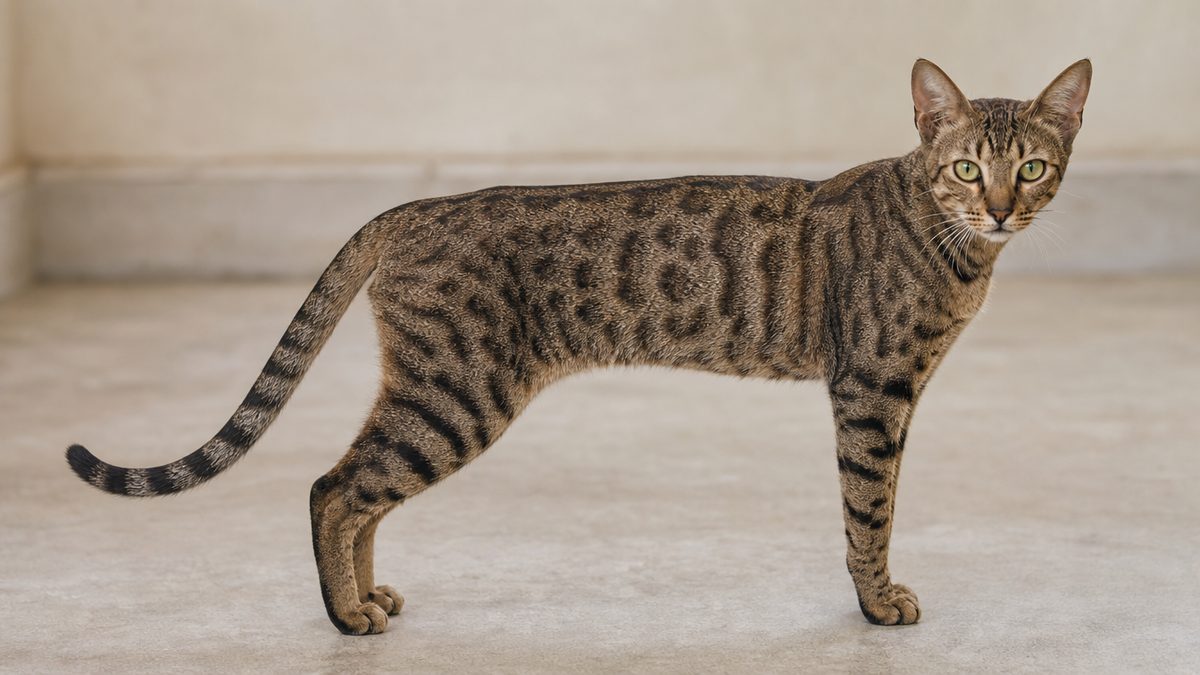
The Sokoke is a slender, very short-coated domestic cat from the Arabuko-Sokoke Forest in coastal Kenya, carrying a broken classic tabby pattern that the UK standard compares to tree bark.
Two things need saying immediately, because both are usually got wrong. This is a domestic cat, Felis catus, with no wild species anywhere in its ancestry, which is what separates it from the Savannah and the Chausie and means no wildlife legislation touches it. And it is not a landrace kept alive by a large local population: FIFe, which has recognised the breed since 1993, registered zero Sokoke kittens worldwide in 2024 Livre Officiel des Origines Felines.
The history, with names and dates
The French national studbook gives the fullest account on any registry page. The Sokoke lived wild in the Sokoke forest in Kenya until Jeni Slater, an Englishwoman, brought it out of obscurity in 1978 and suggested to Gloria Moldrup that she import the first pair to Denmark, which happened in 1984. FIFe recognised the breed in 1993. The studbook adds, in its own words, that the breed's audience remains small. In France the first Sokoke litter was born to Monique Dumont in 2003.
Nineteen years between the Danish import and the first French litter is the single clearest measure of how slowly this cat spreads, and it explains the 2024 registration figure better than any adjective could.
What the breed standard describes
The GCCF's Standard of Points gives the Sokoke a full standard in Section 4 Group C, and its general description is worth quoting because it is unusually vivid for a registry document: a sleek, slender, naturally athletic, muscular cat with a medium frame, dressed in a close-lying short ticked modified classic tabby coat, whose appearance has been described as looking like tree bark. Even when relaxed, the slightly longer hind legs give the appearance of being at the ready.
The hind legs are the breed's signature. The standard specifies legs that are long and slender with medium or fine boning, hind legs well angled and muscular and longer than the front, and says the position of the hind legs gives a tip-toe gait that is very characteristic of the breed, while the back remains level even at rest. The French studbook says the same thing more briefly: the very pronounced angulation of the hind legs is characteristic of the breed.
The coat, in detail
The hair is very short, close-lying and glossy but not silky, with little or no undercoat. The pattern is a modified classic tabby muted by ticking throughout the pattern areas, and the standard sets out exactly how it differs from an ordinary classic: at least one necklace is required and may be broken, the shoulder butterfly may be broken or merely a blotch or not obvious at all, the oysters should be broken, and the forehead M may be broken but must be visible. Ticked hairs inside the black markings are typical.
The GCCF withholds certificates for a cobby body, a head too round or too oriental, a short thick neck, a nose showing a stop, incorrect eye colour, lack of tabby markings, weak ticking on pattern, any white locket, or three or more listed faults. It withholds all awards for aggressive temperament. Weak ticking sitting in that list is the useful detail: the muting of the pattern is not a tolerance, it is the breed.
Eye colour runs amber to green and the eyes are moderately large, set wide apart and slightly slanted towards the base of the ears The Governing Council of the Cat Fancy. Ears are medium to moderately large, broad at the base, upright with slightly rounded tips, with tufts desirable but not required.
Two smaller points of the coat pattern are worth having before you look at any photograph. Ear tufts, the lynx tips the French studbook names, are desirable but not required The Governing Council of the Cat Fancy. And the tail is heavily banded with a dark tip, while the front legs are barred and do not necessarily match each other, which is the kind of asymmetry a standard usually forbids and this one expects.
Zero. The rarest cat this site has measured
FIFe registered zero Sokoke kittens worldwide in 2024, placing the breed last of 54 in a statistics table whose rows sum exactly to its own printed total.
Rarity claims on breed pages are usually adjectives. This one is a number, and it comes from a register that has held the breed for more than thirty years.
The figure, and the check that makes it usable
FIFe's Breeding Statistics 2024 ranks 54 EMS codes by registrations. The Sokoke is rank 54 with 0 registrations, 0.0 percent of a total of 96,075 kittens. Before quoting that, this page summed all 54 rows: they come to exactly 96,075, matching the printed total to the kitten, and the four category tables sum to the same figure. The table is internally consistent, so the zero is a real reading rather than a parsing artefact.
| Rank | EMS code | Breed | Kittens registered in 2024 |
|---|---|---|---|
| 49 | BOM | Bombay | 13 |
| 50 | CYM | Cymric | 9 |
| 52 | JBS | Japanese Bobtail Shorthair | 6 |
| 53 | LPS | LaPerm Shorthair | 4 |
| 54 | SOK | Sokoke | 0 |
For contrast, the Maine Coon registered 23,775 in the same year and the British Shorthair 16,278. The Sokoke is not merely uncommon inside FIFe. In 2024 it did not exist there.
It means no FIFe member federation registered a Sokoke litter in that calendar year. It does not mean no Sokoke kittens were born anywhere, because the GCCF and LOOF hold the breed separately and cats can be bred outside all three. What it does establish is that the breed's largest register recorded none, which is a far stronger statement than the usual claim that a breed is hard to find.
The second rarity instrument agrees
The French studbook, which recognises the breed with championship status, says in its own history that the Sokoke's audience remains small, and records that the first French litter arrived in 2003, nineteen years after the first European import. Two registries, two independent measures, the same conclusion.
And the register is closed
LOOF records the permitted mating for this breed as Sokoke by Sokoke. There is no approved outcross. For a breed registering almost nothing, a closed studbook is a structural constraint on its future rather than an administrative footnote, and it is worth understanding before treating this cat as an option rather than a curiosity.
One more check makes the registration count trustworthy rather than merely striking. FIFe's own breeds index lists SOK among its 52 EMS rows, so the breed is in the register and the zero is a count rather than an omission. The French studbook's complete 55-breed index likewise carries the Sokoke, so two European registers hold it while recording almost nothing.
Registry recognition, checked body by body
Three of the six registries this site checks hold the Sokoke, and the World Cat Federation's own cross-registry table names the other three rather than itself.
| Registry | Status | Evidence |
|---|---|---|
| FIFe | Recognised since 1993 | EMS code SOK in the breeds index and rank 54 in the 2024 statistics |
| GCCF | Recognised | Full standard in the June 2026 Standard of Points, Section 4 Group C |
| LOOF | Recognised, championship | Breed record with permitted mating Sokoke by Sokoke |
| WCF | EMS code only | Row SOK exists in the 198-row table but names FIFe, GCCF and LOOF as recognising bodies, not the WCF |
| CFA | Absent | No breed council and no Miscellaneous or Provisional entry |
| TICA | Absent | Not among the 83 breed entries in the Browse All Breeds index |
The WCF row is worth reading carefully
The World Cat Federation's EMS code table is a cross-registry map, giving breed name, three-letter code and recognising bodies. The Sokoke row reads SOK, Category 3 Shorthair, recognised by FIFE - GCCF - LOOF. The WCF is not among them. Checking the WCF's own shorthair breed-standards index confirms it: 46 standards are published there and no Sokoke standard is one of them.
So the WCF maintains an EMS code for a breed it does not itself recognise, presumably so that pedigrees from other registries can be transcribed into its notation. That is a useful thing to understand about the table generally: a code in it is not the same as recognition by the body that publishes it.
The GCCF standing is the strongest of the three
The GCCF gives the Sokoke a complete standard with a scale of points, a general type standard, a full pattern description, a withhold list and a fault list, and places it in Section 4 Group C alongside the Bengal, Egyptian Mau, Ocicat, Aztec and Toyger, with one Grand and one Imperial title available in that group. It also does not appear anywhere on the GCCF's unrecognised-breeds page, on any of the green, amber or red lists, which is the correct negative control for a recognised breed The Governing Council of the Cat Fancy.
The two absences
CFA holds no Sokoke: its index of declared candidates for breed council secretary lists every Longhair and Shorthair council plus the Miscellaneous and Provisional chairs, where the only entry is the Khao Manee, and no Sokoke appears. TICA holds none either: its Browse All Breeds index, captured on 28 August 2026, carries 83 breed entries plus two household-pet classes, and the Sokoke is not among them. Both indexes carried the control breeds this page checked in the same pass, so neither absence is an artefact.
Most rare cat breeds are held by TICA and refused elsewhere, because TICA has the most open new-breed programme. The Sokoke is the reverse: it is recognised by the three European registries and absent from both American ones. That is worth knowing if you ever see a Sokoke pedigree, because it will be a FIFe, GCCF or LOOF document and never a CFA or TICA one.
Sokoke cat price in India, and why this page publishes none
No Sokoke cat price in India exists, because no Indian seller carries the breed and the world's largest register recorded no kittens at all in 2024.
Six Indian commerce pages were opened directly, chosen because they are the pages Bing India returns for the unqualified query cat price in india, which is a query the engine reads properly. Each was searched for the Sokoke alongside three control breeds.
| Indian page | Sokoke | Persian | Bengal | Maine Coon |
|---|---|---|---|---|
| Supertails, position 1 for cat price in india | No | Yes | Yes | Yes |
| Wrapinfur cat price guide | No | Yes | Yes | Yes |
| World Blaze cat breeds price list | No | Yes | Yes | Yes |
| MyKitten, verified breeders | No | Yes | Yes | Yes |
| Puppiezo, live listings | No | Yes | Yes | Yes |
| Nearby Pets India, live listings | No | Yes | No | Yes |
Three controls present on every page and the target on none is composition evidence rather than volume evidence MyKitten, Cats for Sale in India Wrapinfur, Cat Price in India 2026 World Blaze, List of Cat Breeds Price… Nearby Pets India. In this case the supply-side figure settles it independently: a register that recorded zero kittens worldwide in 2024 cannot be feeding an Indian market.
The search engine could not read the query at all
The result set for the commercial query is worth reporting because it is a documented failure rather than a finding. Bing India returned ten Chinese-language recipe pages for braised aubergine, and a differently phrased query returned a single Indonesian government human-resources portal under About 50 results. The instrument was healthy: the control query cat price in india, run in the same session, returned ten genuine Indian cat-commerce pages under About 6,850 results. So the engine works and this query is being rewritten into something unrelated, which means no conclusion about the Indian market can be drawn from those ten rows and none is.
Ask for the registry and the registration number first, because the pedigree can only be a FIFe, GCCF or LOOF document and never a CFA or TICA one. Then ask for the parents' registration numbers and the litter's registration, given that FIFe recorded no registrations at all in 2024. A brown broken-tabby domestic cat is very easy to present as a Sokoke and very hard to distinguish without papers, and the honest expectation is that any Indian offer of this breed is something else.
Import is the only theoretical route. The DGFT's own FAQ states that import of cats into India is restricted and permitted only with an authorisation, that animals for commercial or breeding purposes are not allowed, and that entry is confined to the airports and seaports of Delhi, Mumbai, Chennai, Hyderabad, Bangalore and Kolkata under ITC(HS) code 01061900. DAHD added a seventh port, Cochin International Airport at Kochi, for pets arriving under the baggage rules in October 2024. Supply, not paperwork, is the binding constraint here. The full route, which covers cats too, is set out in how to import a dog to India.
One last point on money. Any Sokoke reaching India would be expensive by construction rather than by demand: an import authorisation, air freight, quarantine where required, and a source population that produced no registered kittens at all in the most recent year for which FIFe has published figures Directorate General of Foreign Trade.
Heat tolerance: the closest homeland match to India on this whole site
A Sokoke would suit coastal India better than any other cat Bonbeno has profiled, because its home forest and Chennai differ by about one degree on every measure that matters.
This is the finding that makes the page worth writing, and it is measurable rather than impressionistic. The Sokoke comes from the Arabuko-Sokoke Forest on the Kenyan coast, a lowland tropical forest a few kilometres from the Indian Ocean. Every figure below was pulled from NASA POWER by explicit latitude and longitude, with the cell elevation echoed and checked against the real elevation.
| Place | Annual mean (C) | Hottest month | Mean daily max, hottest month (C) | Annual mean RH (%) | Peak wet bulb (C) |
|---|---|---|---|---|---|
| Arabuko-Sokoke Forest | 26.83 | March, 28.28 | 31.32 | 77.20 | 25.18 |
| Malindi, nearest town | 26.89 | March, 28.61 | 34.11 | 73.93 | 24.73 |
| Chennai | 27.94 | May, 31.51 | 36.02 | 72.39 | 26.11 |
| Mumbai | 26.77 | May, 31.19 | 38.17 | 67.28 | 25.77 |
| Kolkata | 25.80 | May, 31.53 | 37.43 | 73.84 | 27.09 |
| Bengaluru | 23.74 | April, 28.37 | 36.31 | 67.84 | 21.86 |
| Delhi | 25.57 | June, 35.88 | 41.66 | 45.51 | 26.50 |
Read the Chennai row against the forest row
Annual mean 26.83 degrees against 27.94, a gap of 1.11. Annual mean relative humidity 77.20 percent against 72.39, with the forest the wetter of the two. Peak wet bulb 25.18 degrees against 26.11, a gap of 0.93. No other breed on this site produces a comparison that close. Mumbai is closer still on annual mean, at 26.77 against 26.83, a difference of six hundredths of a degree.
Indian pages routinely warn that Indian humidity will trouble an imported breed. For this cat the argument runs the other way: the home forest is more humid than Chennai, Mumbai, Bengaluru and Delhi, and only Kolkata comes close at 73.84 percent. The Sokoke evolved in exactly this kind of air. The coat matches it too, being very short, close-lying and carrying little or no undercoat, which is the opposite of a coat that traps moisture against skin.
The one place it would struggle
Delhi. The forest's hottest month averages 28.28 degrees and its mean daily maximum in that month measures 31.32; Delhi's June mean daily maximum measures 41.66, more than ten degrees higher, with a January mean of 13.61 that is colder than anything the breed's homeland experiences. A tropical coastal cat in a continental climate faces both ends of the year rather than one. On the coast and in the south, this is as good a match as India offers.
Parasite pressure is the risk that heat is not. A Kerala study of 120 animals tested at veterinary clinics found Babesia in 80 of them, 66.7 percent, with a pre-monsoon peak from March to May. That is a clinic caseload rather than a population prevalence and it concerns dogs, so read it as a reason to keep any cat on a vet-prescribed parasite protocol. A very short coat is an advantage here, because ticks are findable.
What a Sokoke would cost to keep in India
The cost of ownership for a Sokoke in India would be the lowest of any breed in this cluster, because a very short coat needs no grooming budget and a tropical cat needs less cooling than a northern one.
There is no Indian purchase price to report and no realistic supply, so this section exists to show what the recurring monthly cost of a short-coated cat in India actually is. Every figure is a published Indian rate re-checked on 9 September 2026.
| Item | Published figure | Source |
|---|---|---|
| Kitten vaccination course, three visits | From Rs 3,999, list price Rs 5,065 | Vetic |
| Adult annual booster | From Rs 1,899 | Vetic |
| Anti-rabies, single dose | Rs 699 | Vetic |
| CRP (Tricat or Feligen) | Rs 1,249 | Vetic |
| Pet licence, Chennai | Rs 50 for pet animals generally | Greater Chennai Corporation |
| Boarding, 24 hours, Bengaluru | Rs 899 | PawSpace |
| Daycare to 10 hours, Bengaluru | Rs 799 | PawSpace |
The Vetic figures are promotional floors from one clinic chain rather than a market average, and the same chain quotes different course prices on different city pages on the same day, so record which city page a figure came from. Chennai's Rs 50 licence covers pet animals generally, and the corporation's six pet clinics give treatment and anti-rabies vaccination free of charge, which for a coastal short-coated cat is the single most useful municipal fact in this section.
Where the money would go is enrichment. LOOF describes a very active cat and an excellent climber capable of impressive leaps, and the GCCF standard describes hind-leg angulation that leaves the cat looking at the ready even when relaxed. Cat trees and wall shelving are an annual line. Boarding at Rs 899 a night adds Rs 6,293 for a week away. A realistic Indian metro total would be roughly Rs 38,000 to Rs 60,000 a year.
Temperament and household fit
A Sokoke is gentle with people, extremely vocal and physically demanding, and the voice is what would decide whether it suits an Indian flat.
The French studbook's description is the fullest available from a registry: the Sokoke knows how to be gentle with children as well as adults, is very talkative and emits all sorts of sounds to communicate, and is a very active cat and an excellent climber capable of impressive leaps. Its character field reads *demonstrative*.
The GCCF standard adds one behavioural line, and it is a negative one worth knowing: awards are withheld for aggressive temperament. A standard that has to say so is a standard written for a breed recently out of a feral population, which is exactly what this one is.
Who it would suit
- Coastal and southern Indian households, on climate grounds alone.
- Homes with real climbing height, because leaping is described by both registries.
- Owners who do not mind constant conversation, or who live where noise does not carry.
- People who want a short-coated cat that needs almost no grooming in a humid climate.
- Anyone who accepts that they will probably never find one.
Who it would not suit is a quiet flat with shared walls, a household out all day, and anyone who wanted a placid lap cat. Demonstrative and very talkative are the registry's own words, not marketing softened by a breeder.
Training a Sokoke, and what it resists
Train a Sokoke by giving it height and puzzles, because a very active climber with a large vocabulary responds to problems and answers back.
No breed-specific training guidance is published by any of the three registries that hold this cat, so this section applies general feline practice to the traits the registries do describe: very active, an excellent climber capable of impressive leaps, very talkative and demonstrative.
- Clicker-train a hand target early, which converts into recall, carrier loading and vet handling.
- Build the climbing route before the kitten arrives rather than after it finds its own.
- Feed at least one meal from a puzzle feeder, to occupy a cat with nothing to hunt.
- Reward quiet deliberately, because responding to noise trains a talkative cat to talk more.
- Handle the ears and paws daily from the start, since a short coat makes tick checks routine and easy.
What it would resist is confinement without height. The GCCF standard describes hind-leg angulation that leaves the cat looking at the ready even at rest and produces a characteristic tip-toe gait. That is an animal built to launch, and a flat with nothing above waist height is a flat it will improvise in.
Daily exercise for a forest climber
Give a Sokoke two structured sessions a day and a vertical route above head height, because both registries describe leaping as the defining physical trait.
- Two wand or chase sessions of fifteen minutes, at the cool ends of the Indian day.
- One climbing route from floor to above head height that does not use your furniture.
- One elevated resting place per cat, which is also what the Pet Shop Rules require of shops.
- Puzzle feeding for at least one meal daily.
- Weekly tick and ear checks, which are quick on a very short coat.
Weight is easy to judge on this breed and should still be measured. The largest recent UK life-table study associates body weight deviance from the breed and sex mean with shortened lifespan at an estimate of minus 0.02 years per 100 g in cats that died after nine months of age. Weigh monthly and record the trend rather than the reading.
Grooming, which is almost nothing
Comb a Sokoke once a week and check its ears and coat for ticks, because a very short close-lying coat with little or no undercoat has nothing to mat.
The GCCF standard describes hair that is very short, close-lying and glossy but not silky, with little or no undercoat. The French studbook rates grooming as moderate, which in practice means a weekly pass. There is no published breed-specific grooming routine and this page will not invent one.
| When | What | Why |
|---|---|---|
| Weekly | Rubber curry or fine comb over the whole coat | Removes loose hair and lets you feel the skin |
| Weekly in tick season | Check ears, neck, armpits and between toes | A very short coat makes ticks findable, which is the real advantage |
| Fortnightly | Nails and teeth | Standard, and easy on a clicker-trained cat |
| Rarely | Bath | Only if soiled. A close-lying coat dries in minutes |
| Never | De-matting tools | There is nothing here to mat |
The Indian point is worth stating plainly: this coat is the right coat for a hot humid country. It dries fast, holds no moisture against the skin, and hides no parasites. Of all the reasons this breed is impractical in India, grooming is not one of them.
Health: an evidence base that does not exist
No veterinary literature about the Sokoke exists, so this page reports the absence rather than filling it, and the absence was tested against a passing control.
Consult your nearby vet before acting on anything in this section. The honest content of this section is what is missing, and the method for establishing that matters as much as the conclusion.
The absence, tested rather than assumed
A PubMed search for the exact phrase Sokoke in title or abstract returns 17 records. Every one of them is about the Arabuko-Sokoke Forest rather than the cat: four papers on wild mushrooms, two on tsetse flies and trypanosomosis, one on clearwing moths, one on mosquito larval habitats, one on malaria transmission on the Kenyan coast, one on the Angola black-and-white colobus, one on forest carbon storage, one on subsistence hunting, one on ants and others on fungi and owls. Filtering that set with cat, feline or breed leaves one record, a mosquito-habitat survey. The control query returned 126 records in the same session.
It means no case report, no survey and no genetic study has been published about this breed. It does not mean the breed is healthy, and it does not mean it is unhealthy. It means a buyer has no breed-level evidence at all, and for a breed with a closed studbook and near-zero registrations that absence is more consequential than it would be for a common cat, because a small closed population is exactly where inherited problems concentrate unnoticed.
What the forest literature does tell you
Only about the place, but that is not nothing. The Arabuko-Sokoke Forest is a studied conservation site: work on subsistence hunting there measured its effects on mammal populations, and later work assessed its carbon storage and emissions-offset potential as an African dry forest. A breed named after a forest that is itself under documented pressure is a useful thing for a buyer to know, because it bears on where any future genetic refreshment would have to come from.
Lifespan
No breed figure is available from any registry document read for this page. The largest recent UK life-table study covered 7,936 confirmed deaths and reported only 12 breeds, because breeds with fewer than 15 deaths were grouped into other; the Sokoke is not among the 12 breeds that reached that threshold. Two figures from the same paper apply to any cat: entire cats had 4.29 times the odds of dying before three years compared with neutered cats, and purebreds 1.83 times the odds compared with crossbreds.
There is also nothing to screen for, which sounds like good news and is not. Where the French studbook requires named DNA tests of many breeds before it will qualify them for breeding, no such requirement is published for the Sokoke, and with no literature there is no candidate condition to screen against. A buyer therefore cannot ask a breeder for a test result, because none exists to ask for.
Feeding an active tropical cat in India
Feed a Sokoke a complete diet split across the day with one meal through a puzzle feeder, because there is no breed-specific nutrition guidance and general practice is all anyone has.
No registry publishes feeding guidance for this breed and no study exists, so the advice below is general feline practice applied to a very active short-coated cat in a hot climate.
- Split the ration into three or four meals rather than free-feeding.
- Deliver one meal through a puzzle feeder, which occupies a climber with nothing to climb.
- Keep water away from food and in more than one place, which is the standard feline recommendation.
- Store dry food airtight and out of the heat, because Indian summer storage is what spoils kibble.
- Feed wet food within twenty minutes in a hot kitchen and discard the rest rather than leaving it down.
Weigh monthly and record it. The UK life-table study associates body weight deviance with shortened lifespan at an estimate of minus 0.02 years per 100 g in cats that died after nine months, and a short glossy coat shows the trend early if you are looking.
Kitten timeline: month by month through the first year
A Sokoke kitten's first year would be ordinary veterinary work plus one unusual task, which is documenting the animal's identity in a breed nobody can verify by eye.
| Age | What is happening | What you do |
|---|---|---|
| Before 8 weeks | Legally un-weaned under the Pet Shop Rules 2018 | Do not collect. Get the date of birth in writing |
| At purchase | The pedigree is the only proof of breed | Get the registry, the registration number and both parents' numbers |
| 8 to 9 weeks | Collection window opens; first vaccinations | Vaccinate on your vet's schedule. Kitten course from Rs 3,999 at one national chain |
| 9 to 12 weeks | Socialisation window still open | Handle ears and paws daily, which sets up a lifetime of easy tick checks |
| 3 to 4 months | Second and third vaccinations, deworming | Start a weekly parasite check, since pre-monsoon is the Indian peak |
| 4 to 6 months | Pattern and ticking settle | Check the pattern is broken and ticked rather than a crisp classic tabby |
| 5 to 6 months | Neutering conversation | Discuss timing with your vet. Entire cats carry 4.29 times the odds of early death |
| 6 to 12 months | Climbing drive arrives in full | Extend the vertical route before the cat finds the curtain rail |
The eight-week floor is legal rather than advisory. Rule 2(1)(p)(ii) of the Pet Shop Rules 2018 defines an un-weaned animal to include kittens below eight weeks, and rule 7(15) provides that no pet shop shall sell un-weaned or underage animals. Eight weeks is 56 days.
Rule 7(16) makes microchipping mandatory for puppies sold through Indian pet shops and requires a functional reader on the premises; the rule says puppy, so kittens fall outside it. For a breed whose identity rests entirely on a pedigree from one of three European registries, and which cannot be told from a domestic brown tabby without one, a chip is the only thing tying the animal to the document.
Sokoke against the cats it shares a show group with
The GCCF puts the Sokoke in the same group as the Bengal, Egyptian Mau, Ocicat and Toyger, and on every measure except climate suitability it is the least practical of the five.
| Breed | Pattern | FIFe 2024 kittens | Registries of six | On Indian seller pages | Heat suitability |
|---|---|---|---|---|---|
| Sokoke | Broken classic tabby, heavily ticked | 0 | Three | 0 of 6 | 5 of 5 |
| Bengal | Spotted or rosetted, marbled | 3,559 | All six | Yes, on most | 4 of 5 |
| Egyptian Mau | Naturally spotted | 113 | Most | 0 of 6 | 4 of 5 |
| Ocicat | Spotted, no wild ancestry | 177 | Most | 0 of 6 | 4 of 5 |
| Toyger | Mackerel, tiger-like | Not registered | Four | 0 of 6 | 4 of 5 |
Against the Bengal
The Bengal wins on everything except climate specificity. It registered 3,559 FIFe kittens in 2024 against the Sokoke's zero, is held by all six registries, and is sold on Indian marketplaces today. If what appeals about the Sokoke is a patterned short-coated cat suited to Indian heat, the Bengal delivers that and can actually be obtained.
Against the Egyptian Mau and the Ocicat
Both are naturally or domestically patterned cats with far wider recognition and real, if small, registration numbers. Neither appeared on the Indian commerce pages checked here, so on availability all three are equal. What separates them is that a Egyptian Mau or Ocicat pedigree comes from registries with large membership, while a Sokoke pedigree comes from one of three European bodies and from a register that recorded nothing in 2024.
Against an Indian domestic cat
This is the comparison that decides the page. An Indian domestic shorthair is short-coated, tropical, adapted to exactly the climate the Sokoke evolved in, costs between nothing and Rs 2,000, and often carries a broken tabby pattern that a Sokoke standard would recognise as familiar. Purebreds in the UK life-table study had 1.83 times the odds of dying before three years compared with crossbreds, and crossbreds lived 11.89 years against 10.41 for purebreds. For this breed specifically, the Indian street cat is not a compromise. It is the closer animal.
What people get wrong about this breed
Five mistakes recur, and the first is the one the name invites.
- Assuming it is a wild cat or a hybrid. The Sokoke is a domestic cat that was living feral in a Kenyan forest. No wild species is in its ancestry and no wildlife legislation touches it, which is the opposite of the Savannah and the Chausie.
- Assuming a rare breed is simply hard to find. FIFe recorded zero registrations in 2024, last of 54 breeds, in a table that balances exactly against its own printed total. That is a different order of scarcity from a breed with a small number.
- Expecting a crisp tabby. The pattern is deliberately muted by ticking, the butterfly may be broken or absent and the oysters should be broken. Weak ticking is a reason to withhold a certificate, so a sharp classic tabby is not the breed.
- Expecting a quiet cat. The French studbook describes a very talkative cat that emits all sorts of sounds, and rates the character demonstrative.
- Buying an unpapered brown tabby as a Sokoke. Without a FIFe, GCCF or LOOF pedigree there is no way to distinguish this cat from a domestic broken tabby, and no CFA or TICA pedigree can exist because neither registry holds the breed.
Paying a rare-breed premium on the strength of appearance. India has a large population of short-coated brown broken tabby cats that will photograph very like this breed, and the only thing separating them is a pedigree from one of three European registries in a year when the largest of them registered none World Cat Federation.
Adoption, verification and the honest recommendation
Adopt an Indian short-coated tabby, because it is the same animal in every respect that matters and it is the only one you will actually find.
No Sokoke appeared on any of the six Indian commerce pages checked, no Indian rescue route this site tracks lists the breed, and FIFe registered none worldwide in 2024. Supertails names CUPA in Bengaluru and Friendicoes in Delhi as starting points for adopting a cat in India, and its own advice is that an Indian domestic cat is the most low-maintenance and resilient choice.
If you somehow find one, verify these four things
- The registry and registration number, which can only be FIFe, GCCF or LOOF.
- Both parents' registration numbers, given that the register is closed to outcrossing.
- The DGFT authorisation, since import of cats is restricted, breeding and commercial imports are refused, and entry is limited to seven ports.
- The date of birth, because eight weeks is the collection floor under Indian law.
What the Pet Shop Rules give you as a buyer
Rule 6(5) of the Pet Shop Rules 2018 makes temperature the shop's responsibility and states that comfortable temperature varies from animal to animal and from breed to breed, with the onus on the shop owner to familiarise himself with the requirements of the breeds he deals in. The Second Schedule paragraph 2, headed FOR CATS, requires a solid floor, elevated resting surfaces, matting, soft clean play toys, the litter-box area excluded from the space calculation, and cats or kittens kept in a room not shared with inimical species such as dogs.
The honest recommendation
This page ends where the climate data pointed. The Sokoke would suit coastal and southern India better than any pedigree cat Bonbeno has profiled, and it is simultaneously the least obtainable. The resolution is not to chase it. India already has millions of short-coated, broken-tabby, heat-adapted, tick-findable cats living in exactly the climate the Sokoke evolved for, and adopting one gets you the same animal for the price of a vet visit.
Five things, named rather than papered over. No People Also Ask box could be captured on the day this page was built. A rendered Google India result on 18 September 2026 did carry one, 4 questions, and the FAQ below answers 4 of them verbatim. The commercial SERP for this breed was substituted into Chinese recipe pages while the control passed in the same session, so no conclusion was drawn from it. No veterinary literature about the breed exists, so no health evidence is reported and none has been borrowed. TICA and CFA absences were read from index documents rather than from board minutes. And no Indian price exists to publish, which is the finding rather than a gap.
Sokoke cat questions people actually ask
How much does a Sokoke cat cost?
No Indian price exists. Six Indian commerce pages were opened on 9 September 2026, including the page ranking first for cat price in india and two live-listing marketplaces, and none carries the Sokoke, while Persian, Bengal and Maine Coon appear on all six. Bonbeno will not convert a foreign figure into rupees.
How rare is the Sokoke cat?
Rarer than any other cat this site has profiled. FIFe's 2024 breeding statistics rank 54 codes whose registrations sum exactly to the printed total of 96,075 kittens, and the Sokoke sits last with zero. Not a small number: zero, in a register that has recognised the breed since 1993.
Which registries recognise the Sokoke?
Three of the six this site checks. FIFe has recognised it since 1993, the GCCF publishes a full standard in Section 4 Group C, and the French studbook LOOF registers it with championship status. It is absent from CFA and from TICA's 83-entry breed index, and the WCF lists an EMS code without naming itself as a recognising body.
Is the Sokoke a wild cat or a hybrid?
Neither. It is a domestic cat, Felis catus, that was living feral in the Arabuko-Sokoke Forest in coastal Kenya when it was brought to notice in 1978. There is no wild species in its ancestry, which is what separates it from the Savannah and the Chausie and is why no wildlife legislation touches it.
What does the Sokoke coat look like?
Like tree bark, which is the comparison the GCCF standard itself uses. The pattern is a modified classic tabby muted by ticking throughout, with the shoulder butterfly often broken, the oysters broken with a central spot, at least one necklace and a visible but possibly broken forehead M.
Would a Sokoke suit the Indian climate?
Better than any other cat in this cluster. Its home forest runs an annual mean of 26.83 degrees at 77.20 percent relative humidity with a peak wet bulb of 25.18 degrees, against Chennai's 27.94 degrees, 72.39 percent and 26.11 degrees. The coat is very short, close-lying and carries little or no undercoat.
What health problems does the Sokoke have?
Nobody knows, and that is the honest answer. All 17 PubMed records for the term Sokoke concern the Kenyan forest rather than the cat, covering mushrooms, tsetse flies, moths, malaria and forest carbon. There is no published veterinary literature about this breed to summarise.
Are Sokoke cats noisy?
Yes. The French studbook describes the breed as very talkative, emitting all sorts of sounds to communicate, alongside being very active and an excellent climber capable of impressive leaps. In an Indian flat with shared walls that is the trait most likely to matter day to day.
Can I import a Sokoke into India?
In principle yes, in practice almost certainly not. Import of cats into India is restricted and needs a DGFT authorisation, animals for breeding or commercial purposes are refused, and entry is limited to seven ports. The harder obstacle is supply: FIFe registered zero of these cats worldwide in 2024.
Can a Sokoke be crossed with another breed?
Not in the French register. LOOF records the permitted mating for this breed as Sokoke by Sokoke, with no outcross allowed, which for a breed registering almost no kittens is a real constraint on its future rather than an administrative detail.
Why is Sokoke cat so rare?
Because it started from a handful of feral cats and has never been allowed to grow beyond them. The breed was living feral in the Arabuko-Sokoke Forest in coastal Kenya when it was brought to notice in 1978, only three of the six registries this site checks hold it, and the French studbook records the permitted mating as Sokoke by Sokoke with no outcross allowed, which for a breed registering almost no kittens is a real constraint on its future rather than an administrative detail. The result is measurable: FIFe, which has recognised the breed since 1993, registered zero Sokoke kittens worldwide in 2024, last of 54 codes in a table whose rows sum exactly to its printed total.
How to tell if your cat is a Sokoke?
Start with papers, because a brown broken-tabby domestic cat is very easy to present as a Sokoke and very hard to distinguish without them; the pedigree can only be a FIFe, GCCF or LOOF document, never CFA or TICA. On the cat itself, the GCCF standard describes a sleek, slender, naturally athletic cat with a medium frame and slightly longer hind legs, dressed in a very short, close-lying, glossy coat with little or no undercoat, in a modified classic tabby muted by ticking throughout, which the standard says looks like tree bark. At least one necklace is required, the shoulder butterfly may be broken or absent, the oysters should be broken, the forehead M may be broken but must be visible, and weak ticking or any white locket costs the cat its certificates.
How many Sokoke cats are there?
Nobody publishes a worldwide count, and the one hard figure available is zero. FIFe's Breeding Statistics 2024 rank 54 EMS codes by registrations, and the Sokoke sits at rank 54 with 0 registrations, 0.0 percent of a total of 96,075 kittens; this page summed all 54 rows and they come to exactly 96,075, so the zero is a real reading rather than a parsing artefact. It means no FIFe member federation registered a Sokoke litter that year, not that no kittens were born anywhere, because the GCCF and LOOF hold the breed separately and cats can be bred outside all three registers. What it establishes is that the breed's largest register recorded none.
Compare with similar breeds
Sokoke sits in 1 Bonbeno group. Each one compares it directly against the breeds it is genuinely an alternative to, on the same figures.