
Breed profile
Somali Cat in India: Two DNA Tests, One Coat Gene, Real Costs
The longhaired Abyssinian, fixed for one coat allele, carrying two inherited diseases with real numbers and real tests, and absent from the Indian market.
Quick answer
No Somali cat price in India exists, because no Indian seller lists the breed. What does exist, and is far more useful, is two inherited diseases with published numbers and commercial DNA tests: in an Australian survey the pyruvate kinase deficiency allele reached a frequency of 0.29 in Somalis, and the rdAc retinal degeneration mutation was first described in Abyssinian and Somali cats.
This page reports what the registries and the veterinary literature say about the Somali, including two inherited diseases with published allele frequencies and commercially available DNA tests. It is general information for Indian cat owners, not a diagnosis, and it cannot assess your cat. Consult your nearby veterinarian in person before acting on anything here, and treat lethargy, pale gums or any change in a cat's vision or night-time confidence as urgent rather than as something to watch.
Somali at a glance
What the Somali actually is
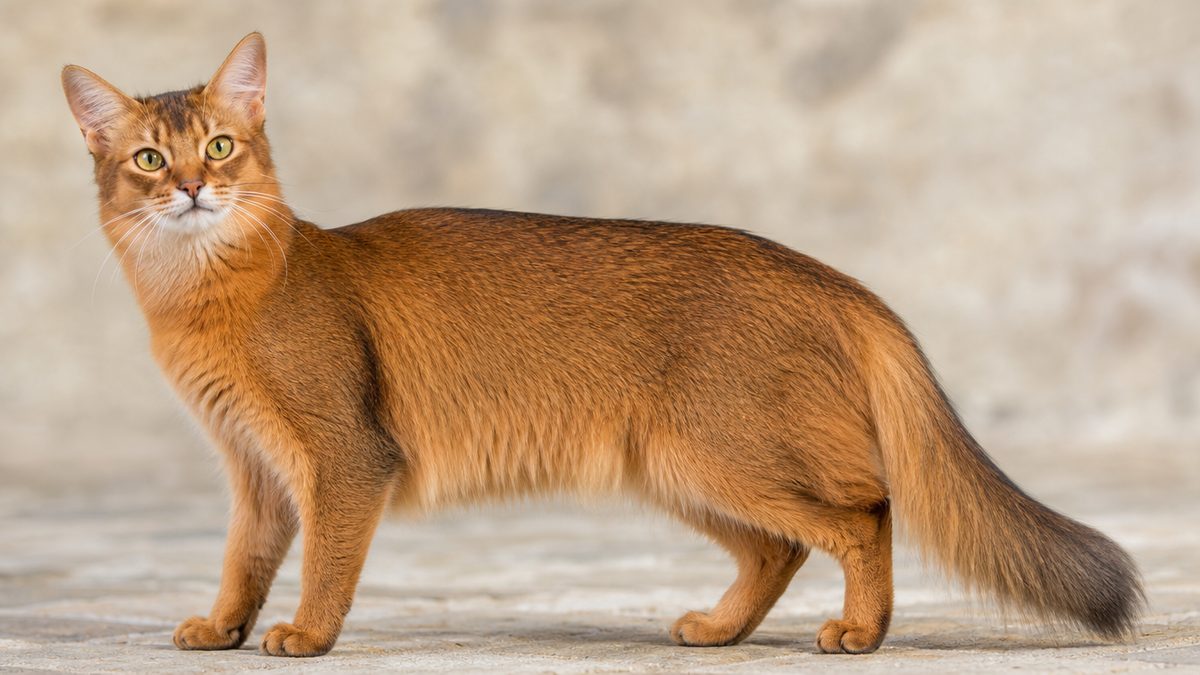
The Somali is the semi-longhaired form of the Abyssinian, and the two are separated by one recessive gene. Everything else about the breed, including its name, its show group and its health list, follows from that single fact.
The GCCF describes a beautifully balanced cat of medium build and foreign type, the head a firm wedge on an elegant neck, the body firm, lithe and muscular of medium length, with a fairly long gently tapering tail and no exaggerated features anywhere. It adds one requirement most standards do not make: "The expression should be alert and smiling";. The GCCF's public index gives 8 to 12 lb with weekly grooming and a life expectancy of 12 to 14 years.
The coat is the whole difference
FIFe publishes one standard covering both breeds, headed ABYSSINIAN / SOMALI in category 4, and its face prints two recognition dates: ABY Rec. 1949 and SOM Rec. 1981. The Abyssinian is a founding-year FIFe breed and the Somali arrived 32 years later, with the same body, the same head and a longer coat.
The ticked coat is what both share. Every hair away from the extremities carries several bands of colour, which is why a Somali has no tabby pattern on its body: no stripes, no spots, no rosettes, just an even shimmer that changes as the cat moves. On a semi-long coat that banding sits on a longer hair shaft, which is where the fox-like look comes from.
The variety most people have never heard of
The GCCF holds the Somali in two coat lengths. Its Standard of Points entry is headed SOMALI (SOL & SOS) and appears in the contents as covering both long hair and short hair, and its public breeds index marks the breed with an asterisk that the page defines as meaning it has short and long haired variations. A shorthaired Somali is a real, registrable animal in Britain.
Long hair in cats is recessive, and the Somali is fixed for the long-hair allele in the only survey that genotyped the breed. A cat registered as a Somali Shorthair therefore cannot be carrying two copies, so it is a cat from Somali breeding with at most one. In practice the GCCF's shorthaired Somali register is a carrier register, and that is a useful thing to understand before buying a shorthaired cat from Somali lines.
| Feature | Somali | Abyssinian | Maine Coon | Norwegian Forest Cat |
|---|---|---|---|---|
| Coat | Semi-longhair, fine, soft, dense | Short, fine, resilient | Semi-longhair, shaggy | Semi-longhair, double |
| Body pattern | Ticked only, no tabby markings | Ticked only | Tabby patterns common | Tabby patterns common |
| FIFe code and recognition | SOM, Rec. 1981 | ABY, Rec. 1949 | MCO | NFO |
| FIFe registrations in 2024 | 230, rank 25 of 54 | 848, rank 18 | 23,775, rank 1 | 4,105, rank 6 |
| UK life expectancy at age 0 | No row | No row | 9.71 years, 69 deaths | 9.95 years, 15 deaths |
| Recognised in two coat lengths by the GCCF | Yes, SOL and SOS | Not applicable | No | No |
Coat genetics, and the origin question they raise
The Somali's coat genetics were settled twice in 2007, and the result is unusually clean: the breed is fixed for one FGF5 long-hair allele while its shorthaired parent breed, in the same study, carried none at all.
Kehler and colleagues sequenced FGF5 across 26 registered breeds and found four separate mutations that disrupt the protein, all recessive. Their allele-frequency table gives the Somali six cats with Mutation 4 at a frequency of 1.00, phenotype long. Two rows above, the Abyssinian appears with eight cats and no mutant FGF5 allele of any kind, phenotype short. Drögemüller and colleagues independently reported the c.194C>A missense mutation homozygous in long-haired Somali, Persian, Maine Coon, Ragdoll and crossbred cats, naming the Somali directly.
Where the long-hair allele came from is genuinely open
One of the ranking pages puts the standard account plainly: the breed began in the late 1800s to early 1900s when Abyssinian breeders found the long-haired variant, and some believe this came from outcrossing to unrelated long-haired cats, though this has never been proven. Kehler's table is suggestive without settling it. Eight Abyssinians carrying no mutant allele at all is consistent with the allele having entered from outside, and eight cats is also far too small a sample to prove the breed carries none.
This page states the arithmetic and stops there. What is certain is that the allele is recessive, that the Somali is fixed for it, and that an Abyssinian breeding programme that produces a longhaired kitten has two carrier parents whether anyone intended it or not.
The genetics survey that could not place the parent breed
A 2008 microsatellite survey of 22 breeds and seventeen random-bred populations produced a striking result for the Abyssinian. Its factorial correspondence analysis found that "Sri Lankan cats and the Abyssinian breed bridged cats of the East and West, perhaps resulting from maritime trade routes in the Arabian Sea or again from recent British colonialism", and that the Abyssinian and the Japanese Bobtail possessed genetic markers common to both Southeast Asian and Western breeds.
The authors went further than that in their methods. They excluded both the Abyssinian and the Sri Lankan cats from their AMOVA analysis entirely, because "the a priori geographical origins of Abyssinians and the Sri Lankan cats, as well as their placement in the FCA and Structure analyses were unclear";. A breed named for one region and genetically pointing at the Arabian Sea rim is a better story than any of the ranking pages tell.
The Somali's parent breed sits genetically on the Indian Ocean rim, grouped with Sri Lankan cats, in the largest cat-population genetics study on this site. That is a genuine connection to this part of the world, and it is worth saying precisely: it is a statement about microsatellite markers in 40 Abyssinians, not a claim that the breed comes from India. Nobody has genotyped Indian random-bred cats in that framework at all.
- Long hair is recessive, so two Somalis cannot produce a shorthaired kitten.
- An Abyssinian can carry the allele invisibly, which is what a GCCF Somali Shorthair effectively documents.
- Coat colour is separate: ruddy, sorrel, blue and fawn are colour genetics, not coat-length genetics.
- No FGF5 test result should ever be confused with the two disease tests in the health section below.
Registry recognition, which is complete and unusually well dated
Registry recognition of the Somali is complete at every major body, and each one publishes a date or a code you can check. The interesting variation is not whether the breed is held but how each register treats the shorthaired variety.
The CFA runs a full Somali breed council, listed among the shorthair breeds on its own enumeration of every council. TICA lists it among the 73 breeds it recognises. FIFe recognised it in 1981, printed as SOM Rec. 1981 on the face of the shared Abyssinian and Somali standard in category 4. The GCCF carries a full Standard of Points entry at page 77 in Section 2 Group B, covering both coat lengths. LOOF holds a Somali breed record with published annual counts.
| Registry | Status | Treatment of the shorthaired variety |
|---|---|---|
| CFA | Championship, with an active breed council | Not separately listed |
| FIFe | Fully recognised, category 4, code SOM, Rec. 1981 | One standard shared with the Abyssinian |
| TICA | Recognised, one of 73 breeds | Not separately listed |
| GCCF | Standard of Points at page 77, Section 2 Group B | Recognised as SOL and SOS, long hair and short hair |
| LOOF | Own breed record with annual counts | Not separately listed |
The numbers, and the direction they are moving
FIFe's Breeding Statistics 2024 covers 96,075 registered kittens across 54 breeds. The Somali ranks 25th with 230 registrations and is marked as having fallen in rank, while the Abyssinian ranks 18th with 848. France's studbook tells the same story at national scale: 179 Somali pedigrees in 2023 and 171 in 2024, against 216 and 192 Abyssinians, on a Somali twenty-year total of 2,851.
Read those together and the picture is consistent. The Somali runs at roughly a quarter of its parent breed's registrations in both registers, and both are drifting slightly downward. That is an uncommon breed in slow decline rather than a rare one on the edge.
Unlike two other breeds in this batch, there is no major registry that cannot have issued a Somali pedigree. CFA, TICA, FIFe, the GCCF and LOOF all hold the breed. So the registry question here is easy, and the harder and more useful question is the one in the health section: which DNA tests were run on the parents, and what were the results.
Somali cat price in India, and what to spend the money on instead
No Somali cat price in India exists. No Indian seller lists the breed, India's most visible cat marketplace has zero Somali entries in its own catalogue, and every page quoting a figure quotes US dollars. The useful question for an Indian buyer is not what a Somali costs but what a DNA test costs.
We pulled the Indian results on 8 September 2026 with gl=IN and hl=en and read the pages in their raw markup.
| Rank | Domain | What it is | Somali price given |
|---|---|---|---|
| 1 | supertails.com | Indian all-breeds cat price guide | None. The breed is not mentioned |
| 2 | a-z-animals.com | US price guide | 1,000 to 3,000 US dollars, average about 1,800 |
| 3 | cats.com | US breed profile | 1,000 to 1,500 US dollars |
| 4 | qualitykitten.in | Indian seller, Persians from Rs 15,000 | Not this breed |
| 5 | somali-olympus.webflow.io | An overseas breeder's own pricing page | A single breeder's asking price |
| 6 | thesprucepets.com | US breed profile | 1,000 to 1,500 US dollars |
| 7 | instagram.com | An Indian post about the Abyssinian | Rs 15,000 to Rs 50,000, for the sibling breed |
| 8 | pets4homes.co.uk | UK breed page | UK figures |
| 9 | puppiezo.com | Indian marketplace cat catalogue | No Somali in the catalogue |
| 10 | youtube.com | An Indian video about the Bengal | Not this breed |
The only Indian rupee figure on that page is for a different breed
Position seven is an Indian Instagram post stating that the price for an Abyssinian kitten in India varies from Rs 15,000 to Rs 50,000 depending on breeder, location and pedigree. That is the shorthaired sibling, not the Somali. The distinction matters because the two breeds are separated by one recessive gene and are constantly conflated, and because an Indian buyer shown that figure for a longhaired cat is being shown the wrong number for the wrong animal.
The absence, checked directly rather than inferred
Rather than read the absence off a search result, we opened India's most visible cat marketplace and read its own cat catalogue. Its raw markup contains zero occurrences of Somali, and also zero of Snowshoe, Singapura, Nebelung and Ocicat. India's largest cat-price guide, titled Cat Price in India 2026: All Breeds, mentions the Persian 22 times and the Somali zero times.
Turning 1,000 to 3,000 US dollars into a rupee band would invent an Indian market. What an Indian buyer can usefully do with the money instead is insist on two DNA test results before any deposit, because both diseases on this page have commercially available tests and published allele frequencies. A pedigree without those results is a certificate; a pedigree with them is information.
Why the absence is not surprising
FIFe registered 230 Somali kittens across all its member clubs in 2024 and France's national studbook registered 171 Livre Officiel des Origines Félines.…. Those are national and international totals in the low hundreds for a breed with no Indian breeders. The honest answer to the price question is the absence rather than a figure, and this page prints it.
Cost of ownership in India, from published rate cards
The cost of ownership for a semi-longhair cat in India is built from litter, food, parasite control, some grooming, an annual vaccination and occasional boarding. Every figure below comes from a named Indian rate card read live, because no Somali-specific Indian cost exists to quote.
| Line | Published figure | Source and scope |
|---|---|---|
| Kitten vaccination course, three visits | From Rs 3,999, list price Rs 5,065 | Vetic, Mumbai clinic page |
| Adult annual booster, CRP plus anti-rabies | From Rs 1,899, list price Rs 1,908 | Vetic, Mumbai clinic page |
| Anti-rabies, single | Rs 699 | Vetic |
| CRP (Tricat or Feligen), single | Rs 1,249 | Vetic |
| Bath and blow dry, 60 minutes | From Rs 934, list price Rs 1,099 | Vetic, Delhi, dogs and cats |
| Grooming haircut, 120 minutes | From Rs 1,359, list price Rs 1,599 | Vetic, Delhi |
| Cat boarding, overnight to 24 hours | Rs 649, food and litter excluded | PawSpace, Bengaluru |
| Pet animal licence | Rs 50 | Greater Chennai Corporation |
PawSpace also notes that festive-season rates run 25 to 30 percent higher, which an annual average hides.
The line this breed adds that others do not
DNA testing. Both diseases in the health section have commercial tests, and for a breeding cat the published advice is explicit: screening for pyruvate kinase deficiency is indicated before mating and in individual cats of these breeds, even in the absence of anaemia. For a pet buyer the cost falls on the breeder rather than on you, which is exactly why it belongs in the price conversation. Ask your nearby vet which laboratories run feline DNA panels in your city, since availability in India varies considerably.
The two lines nobody prices honestly
Litter and food dominate any Indian cat budget and neither has a published national rate this page could quote. A semi-longhair coat tracks more litter than a short one, and a cat the GCCF rates as needing weekly grooming needs a comb rather than a professional appointment. Budget roughly one Vetic bath a quarter at Rs 934 if you want the coat professionally handled, and nothing at all if you will do it yourself.
The cheapest life-extending decision
Neuter on your vet's schedule. In UK primary-care data, entire cats had 4.29 times the odds (95% CI 3.72 to 4.95) of dying before three years of age compared with neutered cats, and among cats dying after nine months, neutered cats lived 1.07 years longer on average.
Greater Chennai Corporation licenses pet animals generally at Rs 50, issued 9,115 licences during 2024, and runs municipal pet clinics that provide all treatment and anti-rabies vaccination free of cost. Delhi's scheme registers pet dogs only. Check your own corporation before assuming private clinic rates are the only option.
Heat tolerance in India, and a homeland nobody can locate
The Somali is a semi-longhair cat with a fine rather than woolly coat, which puts it in the middle of this batch on heat tolerance. Its homeland baseline is genuinely undefined, because the genetics survey that placed 22 cat breeds could not place its parent breed at all.
Most breed pages open a climate section with a homeland comparison. This one cannot honestly do that. The 2008 microsatellite survey excluded the Abyssinian from its regional analysis because its geographic origin was unclear, and placed it in its correspondence analysis bridging East and West alongside Sri Lankan cats, possibly through Arabian Sea trade routes. So we queried NASA POWER for Colombo as the nearest point that survey actually names, labelled as a genetic affinity rather than a documented homeland, and worked the rest from the Indian numbers.
| Place | Cell elevation | Annual T2M | Annual RH2M | Hottest month | Peak wet bulb |
|---|---|---|---|---|---|
| Colombo, Sri Lanka | 123.66 m | 26.40 C | 83.23 percent | April, 27.57 C | 25.34 C in May |
| Chennai | 48.95 m | 27.95 C | 72.39 percent | May, 31.51 C | 26.11 C in May |
| Kolkata | 7.35 m | 25.81 C | 73.93 percent | May, 31.53 C | 27.09 C in June |
| Mumbai | 97.15 m | 26.77 C | 67.39 percent | May, 31.19 C | 25.77 C in June |
| Bengaluru | 841.72 m | 23.74 C | 67.94 percent | April, 28.37 C | 21.86 C in May |
| Delhi | 206.37 m | 25.60 C | 45.56 percent | June, 35.88 C | 26.50 C in July |
NASA POWER returns a grid cell rather than a point. The Colombo cell reports an elevation of 123.66 m against a real city elevation of roughly 1 to 7 m, an overstatement of about 117 m, which makes the cell around 0.8 degrees C cooler than the coast underneath it at the usual lapse rate. That is small enough not to change the argument and large enough to state. The Indian plains cells in that table are accurate to within tens of metres.
What the coat can and cannot do
The GCCF describes the Somali coat as soft, fine and dense and rates the grooming requirement weekly. Fine and dense is not the same as plush and double: this coat carries less trapped air than a British Longhair's and sheds heat better, which is why this breed sits at three out of five on heat tolerance rather than two. It is still a semi-longhair cat, and it is still heat-sensitive in a Chennai May.
Practical rules by city
- Bengaluru and Pune are comfortable year round, at peak wet-bulb loads of 21.86 and 22.97 degrees C respectively.
- Chennai, Kolkata, Mumbai, Hyderabad and Ahmedabad need an indoor cat with a genuinely cooler retreat room from March to June, and Delhi from April to July.
- Rank your own city rather than assuming: hottest-month means run Ahmedabad 35.06 C in May, Hyderabad 33.30 C in May and Pune 28.93 C in April.
- Give the cat a tiled floor to lie on, because conduction outperforms a fan for a coated cat.
- Comb more often through the monsoon, since a fine dense coat holds damp at the skin in Mumbai and coastal Tamil Nadu.
Indian law puts the temperature question on the seller as well. Rule 6(5) of the Prevention of Cruelty to Animals (Pet Shop) Rules, 2018 requires the temperature where pet animals are displayed or housed to be comfortable, notes that it varies from breed to breed, and places the onus on the pet shop owner to familiarise himself with the requirements of the breeds he intends to deal in.
Temperament and household fit
The Somali is athletic, alert, intelligent and very active, and the household question is not whether it is affectionate but whether you have anywhere for it to climb.
TICA's summary of the breed is that the Somali is the longhaired cousin of the Abyssinian and that they are athletic, alert and very active. The GCCF's breeds index gives affectionate, intelligent and inquisitive, with a wide variety of colours and weekly grooming. Its Standard of Points asks for an expression that is alert and smiling, and for a cat in excellent physical condition with good weight for its size.
Read those together and the picture is consistent and unusual for a longhaired breed: this is not a lap cat that happens to have a plume, it is an active foreign-type cat wearing a longer coat. Buyers who choose it for the look and expect a placid longhair are choosing the wrong half of the description.
Who this suits in India
- Households that can provide vertical space, since an active cat with no height uses the furniture instead.
- Owners in Bengaluru, Pune or a hill climate, where a semi-longhair coat is comfortable year round.
- People who want an interactive cat and will play twice a day rather than expecting the cat to settle.
- Buyers willing to ask a breeder two specific DNA questions and to wait for written answers.
Who should choose something else
- Anyone in Chennai, Kolkata or Ahmedabad without a room that stays cooler than the rest of the flat.
- Households wanting a calm decorative longhair, for which this is the wrong breed by every registry description.
- Buyers who cannot verify a pedigree, since there is no Indian supply chain to verify against.
- Anyone who would skip the DNA questions, because on this breed those are the whole point.
Almost everything written about Abyssinian temperament applies here, because one recessive coat gene is the entire genetic difference the registries recognise. If you have met an Abyssinian and liked it, you have effectively met a Somali with a shorter coat. If you have not, read the Abyssinian material as well as this page.
Training a Somali, and the one routine that pays for itself
To train a Somali, start the grooming and handling routine in the first weeks, because this is an active intelligent cat that learns fast and a semi-longhair coat that will need handling for fifteen years.
An active, intelligent breed learns whatever you teach first, including that being picked up ends badly. The training curriculum for this breed is therefore ordinary but the timing matters more than usual, because the coat means the cat cannot simply be left alone the way a shorthaired cat can.
The curriculum, in order
- Handle paws, ears and belly from eight weeks, ten seconds at a time, ending in food.
- Introduce the comb as an object to investigate before it ever touches the coat.
- Comb one small area, stop while the cat is still relaxed, and reward.
- Leave the carrier out as furniture and feed inside it, so it is never a vet-only object.
- Add a weighing routine, since a semi-longhair coat disguises gradual weight change.
What this breed resists
It resists inactivity rather than instruction. An active foreign-type cat in a flat with nothing to climb will find the top of the wardrobe on its own, and Indian owners frequently read that as bad behaviour when it is an unmet need. Give the cat a tall structure before it chooses one.
It also resists being rushed at the vet. That matters here more than on most pages, because the two published diseases in the health section are diagnosed by blood test and by ophthalmic examination, and both go better with a cat that tolerates handling. A Somali that accepts a carrier and a blood draw is a Somali whose PK deficiency status can actually be checked.
A heat-stressed or lethargic cat needs to reach a clinic quickly, and lethargy is the one consistent historical sign the Australian study recorded in affected cats. A cat that fights the carrier loses minutes at exactly the wrong moment. Leave it out, feed in it, close the door for a few seconds at a time.
Daily exercise for a very active longhair
Give a Somali two structured play sessions a day and real vertical space, and expect it to use both. This is the highest activity requirement of any semi-longhair breed on this site.
TICA describes the breed as athletic, alert and very active. The GCCF asks for a cat in excellent physical condition with good weight for its size, firm, lithe and muscular. Neither description belongs to a cat that will exercise itself on a rug.
What to provide
- Two wand sessions a day of ten to fifteen minutes, each ending with a catch and a food reward.
- A tall climbing structure or wall shelves, because a foreign-type athlete uses height.
- A puzzle feeder for at least one meal, which converts appetite into activity.
- Toy rotation weekly, since an intelligent cat habituates quickly.
- Both sessions moved to early morning and after dark from March to June.
The weight evidence applies here as everywhere. Among UK cats that died after nine months, lifespan decreased by 0.02 years for every 100 g of deviation, in either direction, from the median adult body weight within the breed and sex strata. On a coated cat that hides the outline, monthly weighing is the only reliable check.
One breed-specific note belongs here rather than in health. In the Australian pyruvate kinase study the only consistent historical sign in affected cats was lethargy. An owner who plays with the cat twice a day is the person most likely to notice a drop in stamina early, which is exactly what you want on a breed where the affected phenotype is intermittent.
Grooming a fine semi-longhair coat in Indian humidity
Comb a Somali once or twice a week and more through the moult. The GCCF rates the coat weekly grooming, and the texture, soft, fine and dense rather than woolly, is why this breed is easier than a British Longhair and harder than an Abyssinian.
The GCCF's public index gives the coat as soft, fine and dense, with weekly grooming and a wide variety of colours. That texture matters. A fine, silky coat tangles at friction points, the ruff, the britches and behind the ears, rather than matting across the body the way a plush undercoat does.
| Task | Frequency | If you outsource it |
|---|---|---|
| Comb through with a wide-toothed metal comb | Twice weekly, daily in the moult | Not sold separately |
| Check the ruff, britches and behind the ears | Weekly | Included in a full groom |
| Bath and full dry | Every 8 to 12 weeks, more in the monsoon | From Rs 934 for 60 minutes, Vetic Delhi |
| Sanitary and paw trim | Every 8 to 12 weeks | From Rs 1,359 for a 120 minute haircut, Vetic Delhi |
| Nail trim | Every two weeks | Included in a full groom |
| Ear check and tooth brushing | Weekly | Not sold separately |
The Indian variables that change the routine
- Heat drives a heavier and earlier moult than any British schedule assumes, so increase combing from February rather than April.
- Monsoon humidity keeps a bathed coat damp at the skin for hours, so dry the cat properly rather than towelling and leaving it.
- City dust loads a fine dense coat between baths, which a weekly comb removes and a monthly one does not.
- Never shave the coat to cool the cat, since it blocks radiant load as well as trapping heat and regrows unevenly.
The grooming check that is actually a health check
Watch the coat's condition rather than only its tidiness. A ticked coat shows dullness earlier than a solid one because the banding relies on light, so a Somali that suddenly looks flat is worth a closer look. Combined with lethargy, which the Australian study recorded as the only consistent historical sign in cats affected by pyruvate kinase deficiency, that is a reason to see a vet rather than to book a groom.
The two products sit side by side on Indian shelves and the packaging difference is small. An Italian veterinary teaching hospital reported four cases of feline permethrin intoxication in which the cause, every time, was an owner applying a canine permethrin spot-on to a cat; the cats needed intravenous lipid emulsion and sedation to recover. Read the species on the box before you pay.
Health issues, the two DNA tests, and life expectancy
The Somali is the one breed in this batch with two named inherited diseases, published allele frequencies and commercially available DNA tests. That makes this the most actionable health section on the site for a breed with no Indian market, because the questions to ask a breeder are specific and answerable.
Pyruvate kinase deficiency, with real numbers
Erythrocyte pyruvate kinase deficiency is an autosomal recessive glycolytic enzyme disorder causing haemolytic anaemia, and the causative feline mutation was originally identified in Abyssinian and Somali cats in the United States in the early 1990s, with the mutation itself detected in 1997 as a deletion of the last 13 bases of exon 5 from mRNA due to a splicing defect. Unlike affected dogs and humans, deficient cats show an intermittent rather than chronic anaemia, and bilirubin gall bladder stones with post-hepatic obstruction are also characteristic.
An Australian study genotyped 60 cats, 36 Abyssinians and 24 Somalis. Three cats were homozygous and affected, and all three were female Somalis, which is 5 percent of the sample. Seventeen cats were heterozygous carriers, 28 percent, and 40 tested normal, 67 percent. The mutant allele frequency was 0.19 overall: 0.29 in the Somalis and 0.13 in the Abyssinians. Pedigree analysis revealed common ancestry among the affected and many carrier cats.
| Result | Cats | Share of the 60 |
|---|---|---|
| Homozygous, affected, all three female Somalis | 3 | 5 percent |
| Heterozygous carrier | 17 | 28 percent |
| Normal | 40 | 67 percent |
| Mutant allele frequency, Somalis | Not applicable | 0.29 |
| Mutant allele frequency, Abyssinians | Not applicable | 0.13 |
| Mutant allele frequency, both breeds combined | Not applicable | 0.19 |
What affected cats actually showed is worth quoting plainly. Two of the three had regenerative anaemias, all three had reticulocytosis in the range 64 to 390 x 10 to the 9 per litre, and the only consistent historical sign was lethargy. One affected cat was euthanased 18 months after testing because of anaemia, neutropenia, anorexia and weight loss. The authors conclude that screening is indicated before mating and in individual cats of these breeds, even in the absence of anaemia and especially where there is reticulocytosis.
All 60 cats in that study were blood type A. The commercial blood typing card method incorrectly identified 12 of them as type AB, and the authors recommend retyping any AB-typed cat by a laboratory technique. In a country with very few feline blood banks, a wrong blood type on a chart is a transfusion risk, and this is a specific thing to raise with your nearby vet if your cat is ever typed on a card.
rdAc retinal degeneration, the second test
A variant in the CEP290 gene confers recessive retinal degeneration in Abyssinian and Somali cats, the condition abbreviated rdAc. A survey of 41 cat breeds prompted by that discovery found the rdAc allele widely distributed, observed in 16 of 43 breeds, with a high allele frequency of about 33 percent in North American and European Siamese populations. Clinical evaluation showed high concordance between rdAc pathology and the homozygous genotype, with disease similar to that in affected Abyssinians and Somalis.
The authors note that this retinal degeneration has not been reported in breeds other than the Abyssinian and Somali despite the allele's wide distribution, that it poses a significant health risk particularly in the Siamese breed group, and that commercial diagnostic testing is available so breeders can reduce the incidence of rdAc blindness.
The paper's own abstract describes a survey among 41 cat breeds and then reports the allele observed in 16 of 43 breeds. Forty-one and forty-three are two different denominators in two consecutive sentences, and 16 of 43 is the 37 percent the abstract prints. The discrepancy does not affect the breed-level conclusion, which is what matters here, but a reader quoting a breed count from that abstract should know it exists.
What to ask a breeder, in order
- Have both parents been tested for pyruvate kinase deficiency, and what were the exact genotypes?
- Have both parents been tested for the rdAc CEP290 variant, and what were the exact genotypes?
- Can I see the certificates rather than a verbal assurance?
- Has any cat in the line ever been typed as blood type AB on a card, and was it retyped in a laboratory?
- Has any cat in the line shown unexplained lethargy or intermittent anaemia?
Two carrier parents produce, on average, one affected kitten in four for a recessive disease, so a breeder who has tested and can show the results is not merely being conscientious; they are making the arithmetic checkable. Consult your nearby vet about which laboratories run feline DNA panels in your city before assuming the tests are locally available.
What is documented in the Abyssinian and not in the Somali
Renal amyloidosis has its own Abyssinian literature, and a PubMed search for renal amyloidosis in Abyssinian cats on 8 September 2026 returned five records, the most recent a 2021 multi-omic study of Abyssinians with primary renal amyloid deposits. The same searches returned no equivalent study naming the Somali. Because these two breeds share almost everything except one coat gene, the temptation to transfer the finding is strong and this page declines it: an Abyssinian result is an Abyssinian result until somebody publishes a Somali one. What that means for a buyer is a question rather than a warning, and it is worth putting to a breeder and to your nearby vet.
Life expectancy, where nothing has been measured
The UK VetCompass feline life tables modelled only the 12 breeds reaching 15 or more deaths, and neither the Somali nor the Abyssinian is among them. The GCCF's breeds index publishes 12 to 14 years, which is a registry estimate. The measured general figures remain: crossbred cats 11.89 years at age 0 across 7,117 deaths, purebred cats 10.41 across 819, and purebred cats carrying 1.83 times the odds of dying before three.
Feeding an active semi-longhair in India
Feed a Somali measured meals twice a day and weigh both the ration and the cat, because a fine dense coat hides body condition and the GCCF standard explicitly asks for a cat in excellent physical condition with good weight for its size.
The standard's phrasing is the useful part. Asking for good weight for its size makes condition a judged quality rather than a preference, and the general evidence attaches a number to getting it wrong: among UK cats that died after nine months, lifespan decreased by 0.02 years for every 100 g of deviation, in either direction, from the median adult body weight within the breed and sex strata.
Water, and one breed-specific reason it matters
- Place at least two water sources, each at least three feet from any food bowl.
- Refresh water twice a day from March to June, because warm stale water is refused.
- Lead with wet food where the budget allows, since it is the largest single lever on total water intake.
- Watch litter clump size, which is the observable proxy for how much the cat is actually drinking.
The breed-specific reason is bilirubin gall bladder stones, which are described as characteristic of pyruvate kinase deficient cats alongside the intermittent anaemia. That is a hepatobiliary rather than a urinary problem, so hydration is not a preventive for it, but a cat under investigation for lethargy is a cat whose intake and output you will be asked about.
| Stage | Approach | What to watch |
|---|---|---|
| 8 to 16 weeks | Four small meals a day, kitten formulation | Weekly weight gain, and stool quality after any change |
| 4 to 12 months | Three meals, then two, still on kitten food | The adult ticked coat coming through, and stamina in play |
| 1 to 7 years | Two measured meals, one from a puzzle feeder | Monthly weight, coat condition, and any episode of lethargy |
| 7 years and older | Two meals, senior formulation on veterinary advice | Drinking volume, appetite change and gum colour |
A semi-longhair ticked coat is an excellent disguise for a gaining or a losing cat, and losing matters here because weight loss was one of the signs in the single affected cat that was euthanased in the Australian study. A kitchen scale and a monthly weight cost almost nothing and give you the number that both arguments rest on.
The Somali kitten timeline, month by month
Plan a Somali kitten timeline around five fixed points: the birth weight, the eight-week legal floor for sale in India, the vaccination course, the two DNA test results, and the neutering decision before the first birthday.
Indian law sets one of those dates. The Prevention of Cruelty to Animals (Pet Shop) Rules, 2018 define an un-weaned animal to include "kittens and pups below eight weeks", and rule 7(15) states that no pet shop shall sell un-weaned or underage animals.
The birth-weight numbers, from the study that names this breed group
A French study of 5,596 live-born kittens from 15 breeds, 1,507 litters and 194 catteries analysed Abyssinian and Somali as one group of 264 kittens and published birth-weight alarm thresholds for it. The group's mean birth weight was 97.2 g. The low-birth-weight threshold is 94 g, which is 96.7 percent of the group mean and the second highest proportion in the whole table, and the very-low threshold is 60 g.
That high threshold is worth understanding rather than skimming. For most breeds the alarm sits well below the mean; for this group it sits almost at it, which means a kitten only slightly under the average birth weight is already in the higher-risk band. Mortality across the study was 4.5 percent for normal-birth-weight kittens (203 of 4,486), 16.5 percent for low-birth-weight kittens (166 of 1,004) and 50.9 percent for very-low-birth-weight kittens (54 of 106). The Abyssinian and Somali group's own 0 to 2 month mortality was 7.6 percent (4.7 to 11.5), exactly the study average.
| Age | What happens | Cost anchor |
|---|---|---|
| Day 0 | Weigh the kitten. Under 94 g is the low-birth-weight alarm for this breed group, under 60 g the very-low alarm | None |
| Under 8 weeks | Not legally saleable in India. Stay with the queen | None |
| 8 to 10 weeks | Home, first vet check, comb and carrier routine started | Kitten vaccination course from Rs 3,999 for three visits |
| 10 to 16 weeks | Vaccination course completed, DNA certificates filed with the pedigree | Included in the course above |
| 4 to 12 months | Adult ticked coat and full ruff develop; grooming load rises | First professional groom, bath from Rs 934 |
| 5 to 8 months | Neutering window, discussed with your own vet | Clinic dependent, ask for a written quote |
| 12 months | First adult annual booster, baseline adult weight recorded | Adult annual from Rs 1,899 |
What to write down in the first year
- The registry that issued the pedigree papers, copied from the certificate rather than remembered.
- Both DNA test results for both parents, as genotypes rather than as reassurances.
- Every vaccination date and product name, from the certificate.
- Monthly weight, which becomes the baseline for everything else on this page.
Rule 7(16) of the Pet Shop Rules, 2018 requires that every puppy be micro-chipped by a veterinary practitioner and that only micro-chipped puppies be sold. It says puppies, not kittens, so a kitten falls outside it, as does rule 7(17)'s written exercise plan for pups over sixteen weeks. Microchipping a cat in an Indian city is still worth doing, and it is your choice rather than the shop's obligation.
Somali against the cats an Indian buyer can actually get
The only comparison that really matters here is Somali against Abyssinian, because they are one recessive gene apart, one of them is quoted at an Indian price and the other is not.
| Somali | Abyssinian | Maine Coon | Indian domestic shorthair | |
|---|---|---|---|---|
| FIFe registrations in 2024 | 230, rank 25 of 54 | 848, rank 18 | 23,775, rank 1 | Not registered |
| French pedigrees in 2024 | 171 | 192 | 24,160 | Not registered |
| Coat | Semi-longhair, fine and dense | Short, fine, resilient | Semi-longhair, shaggy | Usually short |
| Grooming in India | Twice weekly comb | Weekly | Daily comb | Weekly |
| Heat tolerance in India | Moderate | Good | Poor | Best |
| Published inherited diseases with DNA tests | Two, PK deficiency and rdAc | The same two | Different set | Not applicable |
| UK life expectancy at age 0 | No row | No row | 9.71 years (8.42 to 11.00), 69 deaths | 11.89 years (11.75 to 12.03), 7,117 deaths |
| Published Indian price | None found | Rs 15,000 to Rs 50,000 in one Indian post | Widely listed | Adoption, usually free |
Read the last row against the second-to-last. The Abyssinian carries the same two inherited diseases at published frequencies of 0.13 for pyruvate kinase deficiency against the Somali's 0.29, is more available in India, and has a shorter coat for the climate. On every practical axis except the coat's appearance, the shorthaired sibling is the better Indian proposition.
Somali against Maine Coon
The Maine Coon is the semi-longhair Indian buyers actually buy, at 23,775 FIFe registrations against the Somali's 230. It also has something the Somali does not: a measured UK life expectancy, 9.71 years at age 0 from 69 deaths, which is below the crossbred figure of 11.89. A buyer comparing a breed with a measured figure against one with none is not comparing like with like, and this page says so rather than filling the gap.
Somali against the cat outside your building
In the UK life tables, crossbred cats reached 11.89 years at age 0 across 7,117 deaths, against 10.41 years for purebred cats and 1.83 times the odds of dying before three. Indian streets also produce ticked cats, since ticked tabby is a common pattern, though not the fixed even ticking with no body markings that this breed's standard requires. If the appeal is the shimmer rather than the pedigree, look outside first.
If you like the Somali and cannot find one in India, the answer is not a compromise. It is the same breed with a shorter coat, better suited to the climate, more available here, and carrying the same two inherited diseases at a lower published allele frequency. Ask an Abyssinian breeder the identical two DNA questions and you have most of what you wanted.
Mistakes Indian buyers make with this breed
Five mistakes account for almost everything that goes wrong, and the first one is the only mistake on this site that has a published number attached to what it costs.
1. Buying without the two DNA test results
This is the big one. In an Australian survey, 28 percent of Abyssinian and Somali cats were carriers of the pyruvate kinase deficiency allele and 5 percent were affected, with the Somali allele frequency at 0.29. The rdAc CEP290 variant causing recessive retinal degeneration was first described in these same two breeds and has a commercial test. Two carrier parents produce one affected kitten in four on average. Ask for both certificates, in writing, before any money moves.
2. Taking the Abyssinian's Indian price as the Somali's
The only Indian rupee figure on the results page for this query is an Instagram post quoting Rs 15,000 to Rs 50,000 for an Abyssinian kitten. That is a different breed, one recessive gene away, with a different coat and a different care cost. Using it as a Somali price is exactly the sort of substitution this site exists to catch.
3. Reading a semi-longhair as a placid cat
TICA describes the Somali as athletic, alert and very active, and the GCCF asks for a firm, lithe, muscular cat in excellent physical condition. Buyers who choose it for the plume and expect a Persian temperament get a foreign-type athlete in a fur coat, and then blame the cat.
4. Grooming to a British schedule in an Indian summer
A weekly comb is the registry's recommendation for a British climate. Indian heat drives an earlier and heavier moult, and monsoon humidity keeps a bathed coat damp at the skin for hours. Increase combing from February rather than April, and dry the cat properly after every bath rather than towelling it and leaving it to air dry.
5. Accepting a card blood type at face value
In the same Australian study, a commercial blood typing card wrongly identified 12 of 60 cats as blood type AB when all 60 were type A, and the authors recommend retyping any AB-typed cat by a laboratory technique. In a country with very few feline blood banks, a wrong type on a chart is a transfusion problem waiting for an emergency. Raise it with your nearby vet.
Every price page ranking in India for this query is written for an American or British buyer, in dollars or pounds, and the Indian-domain results are two sellers of other breeds, a video about the Bengal and a post about the Abyssinian. Read the currency and the breed name before you read the number.
Adoption, import and how to proceed honestly
Adopt, and if you are set on this breed, the lawful route into India is personal pet import under the baggage rule. There is no Indian purchase route to verify, so the useful checks are the DNA ones and the legal ones.
Adoption first, and with a caveat this page can source. One overseas guide states plainly that you are highly unlikely to find a purebred Somali in a shelter, and another notes that you may find a Somali mix or a cat that closely resembles a Somali at a shelter instead. In India that second sentence is the realistic one: ticked semi-longhaired cats exist in shelters, and they are not Somalis, and the UK life tables give crossbred cats 11.89 years at age 0 against 10.41 for purebreds.
The import route, stated precisely
India's Animal Quarantine and Certification Service publishes the conditions under the baggage rule, Customs Circular No. 15/2013 of 8 April 2013.
- Dogs and cats are permitted up to two in number under this route.
- The owner must show proof of two years of continuous stay abroad and proof of transferring residence to India.
- For accompanied baggage the owner's ticket is required; for unaccompanied baggage, a passport copy with the immigration stamp within one month of arrival.
- The cat needs an official country-of-origin health certificate naming freedom from rabies, distemper, feline enteritis, feline panleukopenia and leptospirosis.
- Rabies vaccination must have been given more than one month, but within 12 months, before actual embarkation.
- The owner's name on the health certificate must match the name on the ticket.
If someone does offer you a Somali in India
- Ask for the pyruvate kinase deficiency genotype of both parents, in writing, and do not accept a verbal clear.
- Ask for the rdAc CEP290 genotype of both parents, in writing.
- Ask which register issued the pedigree papers, then open that register's own breed list. CFA, TICA, FIFe, the GCCF and LOOF all hold this breed.
- Ask the litter date in writing, since kittens below eight weeks are un-weaned under rule 2(1)(p)(ii) and cannot lawfully be sold.
- Ask to see the queen with the litter, which rule 7(3) means a pet shop may not display for sale at all.
- Ask what the kittens weighed at birth, because 94 g is the published low-birth-weight alarm for this breed group.
Two further written rules are worth carrying to the counter. Rule 7(14) bars selling a pet animal with any form of mutilation other than necessary curative surgery on veterinary prescription, and rule 7(22) bars selling any pet animal to a person who has not attained the age of majority.
The Somali is a well-recognised breed at every major registry, with a real standard, published genetics and, unusually, two inherited diseases you can actually test for. It is also absent from the Indian market entirely. For an Indian reader the practical answer is the Abyssinian, which is the same cat with a shorter coat, better suited to this climate, occasionally available here, and carrying the same two diseases at a lower published frequency. Ask the identical two DNA questions and you are buying on evidence rather than on a photograph.
Somali questions people actually ask in India
How much do Somali kittens cost?
There is no Indian figure, because no Indian seller lists the breed. Overseas guides give 1,000 to 3,000 US dollars with an average around 1,800, and another gives 1,000 to 1,500. India's largest cat-price guide, titled All Breeds, mentions the Somali zero times while mentioning the Persian 22 times.
Are Somali cats good pets?
Yes, for an active household that will do the homework first. The GCCF summarises the breed as affectionate, intelligent and inquisitive and rates grooming as weekly. The homework is the two inherited diseases with published allele frequencies and available DNA tests, which is the part every ranking page leaves out.
How big is a Somali cat?
Medium. The GCCF's own standard describes a beautifully balanced cat of medium build and foreign type with no exaggerated features, and its breeds index gives 8 to 12 lb, roughly 3.6 to 5.4 kg. The long coat and the full brush tail make the cat look larger than the weight suggests.
Are Somali cats rare?
Uncommon rather than rare, and falling. FIFe registered 230 Somali kittens worldwide in 2024, ranking the breed 25th of 54 and marking it as having fallen in rank, against 848 Abyssinians at 18th. France's studbook registered 171 in 2024 against 179 in 2023.
What is the real Somali cat price in India?
There is none. No Indian seller lists the breed, India's most visible cat marketplace has zero Somali entries in its own cat catalogue, and the only Indian rupee figure on the results page belongs to an Instagram post quoting Rs 15,000 to Rs 50,000 for the shorthaired Abyssinian instead.
Is the Somali just a long-haired Abyssinian?
Genetically that is close to exact. The two share one FIFe standard, and in a 2007 genetics survey six Somalis carried the long-hair Mutation 4 at a frequency of 1.00, meaning fixed, while eight Abyssinians carried no mutant FGF5 allele at all. One recessive gene separates them.
What DNA tests should a Somali breeder have done?
Two, and both exist commercially. Pyruvate kinase deficiency, whose mutant allele reached a frequency of 0.29 in Australian Somalis, and the rdAc CEP290 variant causing recessive retinal degeneration, first described in Abyssinian and Somali cats. Ask for both results in writing and consult your nearby vet about what testing is available in your city.
Can a Somali have short hair?
Yes, and one registry recognises it. The GCCF's Standard of Points covers Somali long hair and short hair as SOL and SOS, and its public breeds index marks the Somali with an asterisk it defines as meaning the breed has short and long haired variations. Since long hair is recessive, a shorthaired Somali carries at most one copy of the allele.
How does a Somali cope with Indian heat?
Moderately. The coat is semi-longhair but fine and soft rather than a plush double coat, so it sheds heat better than a British Longhair's. Bengaluru, at a peak wet-bulb load of 21.86 degrees C, is comfortable. Chennai at 26.11 and Kolkata at 27.09 require an indoor cat with a genuinely cooler room.
How long do Somali cats live?
No measured figure exists. The UK feline life tables modelled only the 12 breeds reaching 15 or more deaths and neither the Somali nor the Abyssinian is among them. The GCCF's breeds index publishes 12 to 14 years, which is a registry estimate rather than a life table, and this page keeps the two labelled apart.
Compare with similar breeds
Somali sits in 1 Bonbeno group. Each one compares it directly against the breeds it is genuinely an alternative to, on the same figures.