
Breed profile
Serengeti Cat in India: The Wild Look Without the Serval
A long-legged spotted cat built by a conservation biologist to look like a serval without using one, recognised by exactly one registry, and sold nowhere in India.
Quick answer
No Serengeti cat price in India could be verified. Six Indian commerce pages were opened on 9 September 2026 and none carries the breed, while Persian, Bengal and Maine Coon controls appear on all six. Only one of the six registries this site checks holds the Serengeti, and it holds it as a preliminary new breed rather than a championship one.
This page reports what registries say about the Serengeti and records that no veterinary literature about the breed exists, which means there is no published health evidence to summarise. Nothing here is a diagnosis and nothing here is a treatment plan. Consult your nearby vet, a registered veterinarian, about any animal in your care before acting on anything on this page.
Serengeti at a glance
What a Serengeti cat is
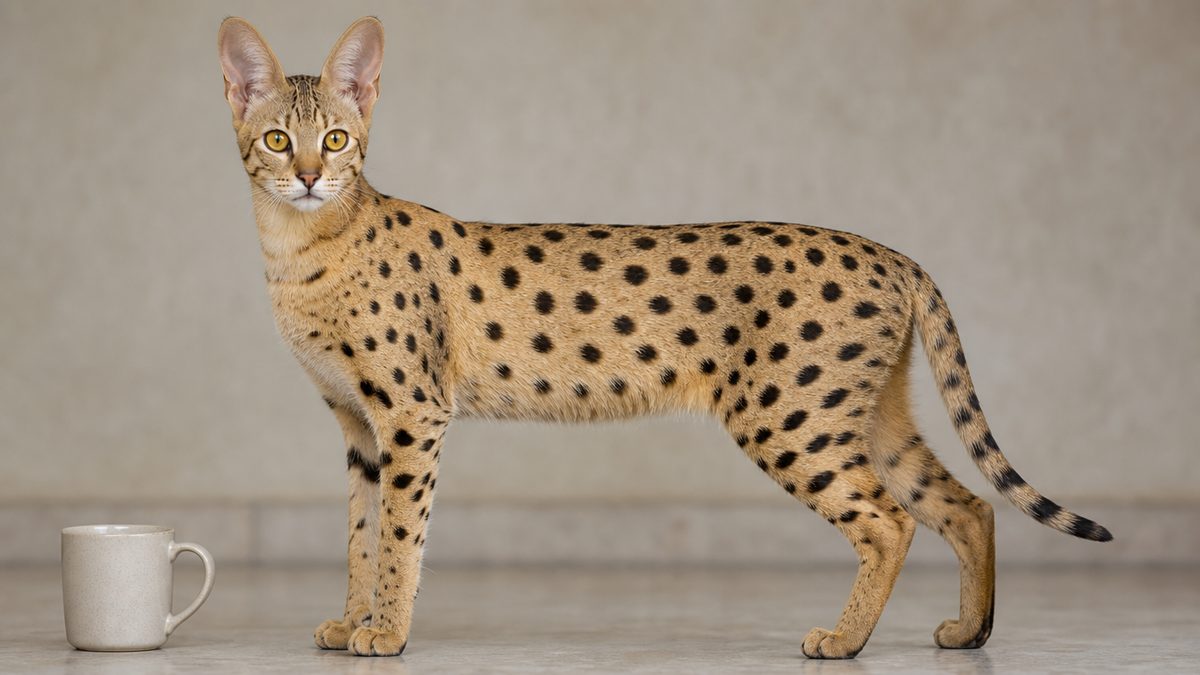
The Serengeti is a long-legged, large-eared spotted domestic cat created in California from Bengal and Oriental Shorthair crosses, and it was built specifically to look like an African serval without containing any serval.
The founding intent is the fact that explains everything else about this breed, and TICA states it without hedging. The Serengeti cat was created by Karen Sausman, owner of Kingsmark Cattery in California and a professional conservation biologist. She set out to create a domestic breed partially modelled on the African serval. And in TICA's own words, *unlike the breed known as Savannah cats, the Serengeti cats have no serval blood and have been developed from crossing bengals and oriental shorthairs*. The project started slowly in 1995.
That last clause is the whole design. A serval and a domestic cat are separated by roughly 13 million years of evolution. The Serengeti reaches for the same silhouette using two domestic breeds that already carry the components: the Oriental Shorthair supplies leg length, ear size and an upright posture, and the Bengal supplies the spotted coat.
The history is short and unusually well documented for a rare breed, because the person who started it is named on the registry's own page and the year is given. There is no folk origin story here and no claim of ancient ancestry: the breed began as a stated design brief in 1995 and the cats being bred today in the United States, the United Kingdom, Europe, Australia and Russia all descend from it.
What the cat looks like
TICA describes a medium-sized cat with long legs, in excellent physical condition, strong and muscular, appearing graceful, statuesque and squarely built with a very upright posture. The long neck blends into the base of the skull without tapering. Strikingly large, round-tipped ears equal to the length of the head are one of the main features, along with bright round eyes.
The coat is short and tight with a silky texture. Serengetis come in yellow to gold with a pattern of distinctly, widely spaced black spots, and also in solid black, in a cold grey with black spots, and in bright white silver with black spots. The eyes are usually gold to amber. In conformation and body type the breed is more similar to the Oriental Shorthair than to anything else, but with larger boning, longer legs and a more upright stance. Males weigh 10 to 15 pounds and females 8 to 12.
The spots are described as distinct and widely spaced. A rosette, the ringed spot with a lighter centre, is the Bengal's signature and not this breed's. If you are shown a rosetted cat as a Serengeti, you are being shown a Bengal or a Bengal cross, and the difference is easy to see once you know to look.
The temperament that came with the Oriental
TICA describes an open, self-assured and friendly cat that may be shy for a few moments in a new place and then becomes like Velcro, wanting to be with you and help with every endeavour. They are extremely agile and very active, love high places, and run through the house at full speed. And they can be vocal, which comes probably from their oriental ancestors, and will gladly talk with you about almost any subject.
For an Indian buyer that voice is worth taking seriously rather than treating as charm. A Siamese-derived voice in a flat with shared walls is a household negotiation, and it is the single most common reason Oriental-type cats are rehomed.
Registry recognition: one body of six, and not at championship
Only TICA holds the Serengeti, and it holds it as a preliminary new breed rather than a championship one, with no breed committee listed.
| Registry | Status | Evidence |
|---|---|---|
| TICA | Registered, shown as a preliminary new breed | Breed page; the committee field reads No Committee |
| GCCF | Green list, not applied | Acceptance Grade A, probable acceptance if different from other breeds |
| CFA | Absent | No breed council and no Miscellaneous or Provisional entry |
| FIFe | Absent | Not among the 52 EMS rows nor the 54 rows of the 2024 statistics |
| WCF | Absent | Not present in any of the 198 rows of the WCF EMS cross-registry table |
| LOOF | Absent | Not among the 55 breeds in the complete French studbook index |
Preliminary is not championship, and the difference is real
TICA's own sentence is that Serengeti cats are TICA registered and can be shown as a preliminary new breed. A preliminary new breed is shown for evaluation rather than for championship titles, and TICA's breed page for the Serengeti lists No Committee, where established breeds list a named committee with members. Compare the Bengal, which TICA shows at championship and CFA advanced to Championship in 2018.
The GCCF verdict is the most informative document about this breed
Most registry absences are silence. The GCCF's is a written assessment. The Serengeti sits on the Green list, defined as breeds not yet applied for but with probable acceptance if the representative provides information, sufficient facts to demonstrate merit and significant difference. Its row reads: Acceptance Grade A, Genetics Committee comment *Not applied, probable acceptance if different from other breeds*, recognising body TICA, potential Section 4, recommended similar breeds Bengal and Toyger.
The same GCCF page places the Savannah on its Red list, ineligible for recognition as derived from an outcross to a wild species, alongside the Chausie and the Marguerite, and states the policy behind it: outcrossing to wild species cats brings risks to the wild and domestic animals used for breeding, to inexperienced owners of early generations, and to the environment of the wild breed, so GCCF does not recognise new breeds derived from wild species. Two cats built for the same look, two verdicts, one document. That single contrast is the most useful thing an Indian buyer can know about either breed.
The four clean absences
CFA holds no Serengeti: its index of declared candidates for breed council secretary lists every Longhair and Shorthair council plus the Miscellaneous and Provisional chairs, where the only entry is the Khao Manee, and no Serengeti appears. FIFe holds none: the breeds index parses to 52 EMS rows and the 2024 statistics rank 54 codes summing exactly to the printed 96,075 total, with no Serengeti in either. The WCF holds none: its EMS cross-registry table was retrieved in full, all 198 rows, and the breed is not in it. And LOOF holds none: the complete French studbook list of 55 breeds was enumerated and contains no Serengeti. The GCCF Standard of Points, 315 pages and 723,034 characters, contains the string zero times against Bengal, Toyger and Sokoke as in-document controls.
Two further checks close the recognition question. There is no published breed standard from any of the five registries that do not hold the breed, so the only written description with any standing is TICA's, which its breed page presents under the heading The Breed Standard. And the GCCF's own index of recognised breeds does not list the Serengeti, which is what places it on the unrecognised page in the first place. TICA's Browse All Breeds index, captured on 28 August 2026, does carry it among 83 breed entries, which is the positive control that makes the other five absences meaningful rather than accidental. An unrecognised breed in five registries and a preliminary one in the sixth is a precise status, and it is the status a buyer is paying for.
The wild-ancestry question does not disappear, it moves
A Serengeti has no serval ancestry, and the wild ancestry it does have arrives through the Bengal, whose own wild parent is a species India protects at the highest level.
This is the part no page about the breed sets out, and for an Indian reader it is the part that matters, because the two wild cats involved sit on opposite sides of Indian law.
Two wild cats, two Indian answers
The serval, Leptailurus serval, appears zero times in the 222 pages of India's Wild Life (Protection) Act, against in-document controls of Felidae 3, Jungle Cat 1, Panthera 10 and Caracal 5. It is African and it is not an Indian protected species. The Asian leopard cat, Prionailurus bengalensis, is Schedule I Part A, sub-heading CATS, entry 44. So the wild ancestor the Serengeti does not have is unlisted in India, and the wild ancestor it distantly does have is protected at the highest level India provides.
Far enough that the registries treat it as historical rather than current. CFA's Registration Rules for the Bengal, revised February 2026, permit no outcross breeds, require a five-generation pedigree, and list under DO NOT ACCEPT, for the cat being registered or any cat in that five-generation pedigree, the Asian Leopard Cat and anything other than Bengal. A Serengeti built on registered Bengals therefore has no leopard cat within at least five generations on that side, and one further generation beyond that at minimum through the cross itself.
Why this matters for an Indian buyer specifically
It matters because a buyer told only that the Serengeti is a domestic breed with no serval blood may conclude that no wild-ancestry question arises at all. The accurate statement is narrower and more useful: the breed carries no serval ancestry, its distant wild ancestry is leopard cat rather than serval, and the registries that admit the Bengal require that leopard cat to be absent from the recent pedigree. That is a different position from the Savannah, whose standard names the serval as the ancestral source and whose F1 to F3 generations are a disqualification.
It is also a different position from the Chausie, whose wild parent Felis chaus is Schedule I entry 42 and therefore squarely inside India's possession provisions. Three breeds that look wild, three genuinely different legal starting points.
The precedent worth knowing
Australia banned import of the Savannah in 2008, and the published assessment behind that kind of decision built a framework for judging predation risk from a hybrid, concluding that Savannah cats would likely add at least 28 native mammal species to the 168 already susceptible to domestic-cat predation. That framework turns on the wild parent's hunting ecology. A breed with no wild parent does not enter it, which is the practical reason the Serengeti attracts none of the regulatory attention the Savannah does.
Serengeti cat price in India, and why this page publishes none
No Serengeti cat price in India could be verified, because no Indian seller checked on 9 September 2026 carries the breed.
Six Indian commerce pages were opened directly, chosen because they are the pages Bing India returns for the unqualified query cat price in india, which is a query the engine reads properly. Each was searched for the Serengeti alongside three control breeds.
| Indian page | Serengeti | Persian | Bengal | Maine Coon |
|---|---|---|---|---|
| Supertails, position 1 for cat price in india | No | Yes | Yes | Yes |
| Wrapinfur cat price guide | No | Yes | Yes | Yes |
| World Blaze cat breeds price list | No | Yes | Yes | Yes |
| MyKitten, verified breeders | No | Yes | Yes | Yes |
| Puppiezo, live listings | No | Yes | Yes | Yes |
| Nearby Pets India, live listings | No | Yes | No | Yes |
Three controls on every page and the target on none is composition evidence rather than volume evidence MyKitten, Cats for Sale in India Wrapinfur, Cat Price in India 2026 World Blaze, List of Cat Breeds Price… Nearby Pets India. What Indian sellers do carry is the foundation breed: Supertails prices the Bengal at Rs 30,000 to Rs 80,000, which is the nearest thing to a Serengeti an Indian buyer can actually purchase.
The search results are part of the answer
Bing India's ten results for the commercial query are Wikipedia on the Serengeti region, Wikipedia on the Serengeti National Park, three national-park tourism sites, Britannica, Africa Geographic, UNESCO, a national-parks directory and a safari guide. Not one is about the cat. An Indian searcher looking for this breed is served safari packages, which is what happens when a rare breed is named after one of the most heavily marketed place names on earth.
Ask four things in writing. Which registry issued the pedigree, given that only TICA holds this breed and holds it as preliminary. Whether the cat is spotted rather than rosetted, since a rosetted cat is a Bengal. Both parents' registration numbers, so the Bengal and Oriental Shorthair sides can be checked. And the kitten's date of birth, because eight weeks is the collection floor under the Pet Shop Rules 2018. A seller who cannot produce those is more likely selling a Bengal cross under a rarer name.
Import is the only other route and it is narrow. The DGFT's own FAQ states that import of cats into India is restricted and permitted only with an authorisation, that animals for commercial or breeding purposes are not allowed, and that entry is confined to the airports and seaports of Delhi, Mumbai, Chennai, Hyderabad, Bangalore and Kolkata under ITC(HS) code 01061900. DAHD added a seventh port, Cochin International Airport at Kochi, for pets arriving under the baggage rules in October 2024. The full route, which covers cats too, is set out in how to import a dog to India.
What a Serengeti would cost to keep in India
The cost of ownership for a Serengeti in India is the cheapest of any breed in this cluster, because a short tight coat needs no grooming budget and the cat needs no compliance paperwork.
There is no Indian purchase price to report, so the recurring monthly cost is the whole of the money question. Every figure below is a published Indian rate re-checked on 9 September 2026.
| Item | Published figure | Source |
|---|---|---|
| Kitten vaccination course, three visits | From Rs 3,999, list price Rs 5,065 | Vetic |
| Adult annual booster | From Rs 1,899 | Vetic |
| Anti-rabies, single dose | Rs 699 | Vetic |
| CRP (Tricat or Feligen) | Rs 1,249 | Vetic |
| Pet licence, Chennai | Rs 50 for pet animals generally | Greater Chennai Corporation |
| Boarding, 24 hours, Bengaluru | Rs 899 | PawSpace |
| Daycare to 10 hours, Bengaluru | Rs 799 | PawSpace |
The Vetic figures are promotional floors from one clinic chain rather than a market average, and the same chain quotes different course prices on different city pages on the same day, so record which city page a figure came from. Chennai's Rs 50 licence covers pet animals generally, and the corporation's six pet clinics give treatment and anti-rabies vaccination free of charge, which is the most useful municipal fact available to a Chennai cat owner.
Where the money actually goes with this breed
Not on grooming and not on cooling. It goes on enrichment, because TICA describes an extremely agile, very active cat that loves high places and runs through the house at full speed. Cat trees, wall shelving and puzzle feeders are an annual line rather than a one-off. Boarding at Rs 899 a night adds Rs 6,293 for a week away. An Indian metro annual total of roughly Rs 40,000 to Rs 65,000 is realistic.
Heat tolerance: one of the better Indian matches in this cluster
A Serengeti handles Indian heat well, because a short tight coat on a long-legged medium-boned frame is close to the Oriental Shorthair build that already suits hot countries.
The coat is the argument. TICA describes it as short and tight with a silky texture, with no heavy undercoat mentioned anywhere in the breed description. Long legs and an upright, statuesque posture add surface area relative to mass, which is how a cat sheds heat when evaporation is limited. Compare that with the triple coat that makes a Siberian unsuitable here and the difference is structural rather than marginal.
| City | Annual mean (C) | Hottest month | Mean daily max, hottest month (C) | Annual mean RH (%) | Peak wet bulb (C) |
|---|---|---|---|---|---|
| Bengaluru | 23.74 | April, 28.37 | 36.31 | 67.84 | 21.86 |
| Pune | 23.86 | April, 28.93 | 38.56 | 66.68 | 22.97 |
| Delhi | 25.57 | June, 35.88 | 41.66 | 45.51 | 26.50 |
| Kolkata | 25.80 | May, 31.53 | 37.43 | 73.84 | 27.09 |
| Mumbai | 26.77 | May, 31.19 | 38.17 | 67.28 | 25.77 |
| Chennai | 27.94 | May, 31.51 | 36.02 | 72.39 | 26.11 |
Every point is a plains or coastal city and every NASA POWER cell landed within 83 m of the real elevation, so the cells describe the towns rather than a neighbouring hill. What still needs managing is activity rather than coat: a cat that runs the length of a flat at full speed generates heat, so move play to the cool ends of the day, particularly in Delhi where the June mean daily maximum measures 41.66 degrees.
Parasite pressure is the Indian risk that outranks heat here. A Kerala study of 120 animals tested at veterinary clinics found Babesia in 80 of them, 66.7 percent, with a pre-monsoon peak from March to May. That is a clinic caseload rather than a population prevalence and it concerns dogs, so read it as a reason to keep any cat on a vet-prescribed parasite protocol.
Temperament and household fit
A Serengeti is confident, extremely active and talkative, and the voice is the trait most likely to decide whether it suits an Indian flat.
TICA describes an open, self-assured and friendly cat that may be shy for a few moments in a new location and then becomes like Velcro, always wanting to be with you and helping with every endeavour. They are extremely agile and very active, love to get on high places, and enjoy running through the house at full speed. They can be vocal, probably from their Oriental ancestors, and will gladly talk with you about almost any subject. If properly introduced, they get along well with other pets.
Who it suits
- Households that want a cat involved in everything rather than one that keeps to itself.
- Homes with vertical space, because high places are where this cat wants to be.
- Owners who do not mind a talkative cat, or who live somewhere the noise does not carry.
- Multi-pet households, with proper introductions.
- People prepared to research a breed that only one registry holds.
Who it does not suit is a shared-wall flat with light sleepers, a household out all day, and anyone who wanted a quiet decorative cat. The confidence and the voice are the same trait seen from two sides.
Training a Serengeti, and what it resists
Train a Serengeti with puzzles and height, because an agile Oriental-derived cat responds to problems and ignores repetition.
Nothing breed-specific is published about training this cat, so the honest approach is to train it as what it is: an Oriental Shorthair body with a Bengal's drive. Both are among the more trainable cat types.
- Clicker-train a hand target in the first three months, which converts into recall and carrier loading.
- Feed at least one meal a day from a puzzle feeder rather than a bowl.
- Teach a station, a mat the cat goes to on cue, for use when guests arrive or the door opens.
- Introduce a harness early if you intend leash work, and use a balcony or terrace rather than an Indian street.
- Rotate toys weekly, because a problem-solving cat stops engaging with a solved puzzle.
What it resists is silence and stillness. A vocal cat that is ignored gets louder, and the training answer is to reward quiet rather than to respond to noise, which is easier written than done at four in the morning.
Daily exercise for a genuinely athletic cat
Give a Serengeti two structured sessions a day plus a climbing route to above head height, because TICA describes a cat that runs through the house at full speed and loves high places.
- Two wand or chase sessions of fifteen minutes, at the cool ends of the Indian day.
- One climbing route from floor to above head height that does not use your furniture.
- One elevated resting place per cat, which is also what the Pet Shop Rules require of shops.
- Puzzle feeding for at least one meal daily.
- A companion animal if the household is out all day, since this is a socially demanding breed.
Weight is easier to judge on this breed than on most, because a short tight coat hides nothing. Weigh monthly anyway and record it: the largest recent UK life-table study associates body weight deviance with shortened lifespan at an estimate of minus 0.02 years per 100 g in cats that died after nine months of age.
Grooming, which is close to nothing
Comb a Serengeti once a week and check its ears, because a short tight silky coat has no undercoat to mat and nothing to trap monsoon moisture.
TICA's description of the coat as short and tight with a silky texture is the whole grooming brief. There is no published breed-specific grooming guidance beyond that, and this page will not invent any.
| When | What | Why |
|---|---|---|
| Weekly | Rubber curry or fine comb over the whole coat | Removes loose hair before it reaches furniture |
| Weekly in tick season | Check ears, neck, armpits and between toes | A short coat makes ticks findable, which is the advantage here |
| Fortnightly | Nails and teeth | Standard, and easy on a clicker-trained cat |
| Rarely | Bath | Only if soiled. A short tight coat dries within minutes |
| Never | De-matting tools | There is nothing here to mat |
The Indian advantage is real and worth stating: in a humid summer a short flat coat dries fast and does not hold moisture against skin, so the monsoon skin and ear problems that trouble dense-coated breeds are largely absent. Grooming is not a reason to avoid this breed, and it is one of the few genuine points in its favour for a hot country.
Health: an evidence base that does not exist
No veterinary literature about the Serengeti exists, so this page reports the absence rather than filling it, and points instead at the health of the two breeds it was built from.
Consult your nearby vet before acting on anything in this section, and note that the honest content of this section is what is missing.
The absence, tested rather than assumed
A PubMed search for the exact phrase Serengeti cat in title or abstract returns zero records, with the phrase honoured in the query translation and no silent rewrite. Broadening to serengeti combined with feline, cats or breed returns 23 records, and every one of them is about the Serengeti ecosystem: carnivore parvovirus, distemper in lions, hepatozoon in spotted hyenas, feline immunodeficiency virus in African lions. In the same session the control query returned 126 records.
It means no case report, no survey and no genetic study has been published under this breed's name. It does not mean the breed is healthy, and it does not mean it is unhealthy. It means an Indian buyer has no breed-level evidence to rely on and must reason from the foundation breeds instead, which is a materially weaker position than for a breed with a literature.
What to reason from instead
Two breeds. The Bengal side brings the conditions that breed's registries and breeders screen for, and the Oriental Shorthair side brings the Siamese-family concerns. Ask a seller for the screening certificates that apply to both parents by their own breed rather than for a Serengeti panel, because no Serengeti panel exists. That is the practical translation of a literature gap.
Lifespan
No breed figure is available from any registry document read for this page. The largest recent UK life-table study covered 7,936 confirmed deaths and reported only 12 breeds, because breeds with fewer than 15 deaths were grouped into other; the Serengeti is not among the 12 breeds that reached that threshold. Two figures from the same paper apply to any cat: entire cats had 4.29 times the odds of dying before three years compared with neutered cats, and purebreds 1.83 times the odds compared with crossbreds.
Feeding an athletic short-coated cat in India
Feed a Serengeti a complete diet split across the day with at least one meal delivered through a puzzle feeder, because the drive that makes this cat entertaining also makes it impatient at a bowl.
No breed-specific feeding study or registry guidance exists for the Serengeti, so the advice below is general feline practice applied to a very active short-coated cat in a hot country.
- Split the ration into three or four meals rather than free-feeding.
- Deliver one meal through a puzzle feeder, which occupies the mind and slows the pace.
- Keep water away from food and in more than one place, which is the standard feline recommendation.
- Store dry food airtight and out of the heat, because Indian summer storage is what spoils kibble.
- Feed wet food within twenty minutes in a hot kitchen and discard the rest rather than leaving it down.
Weigh monthly and record it. The UK life-table study associates body weight deviance from the breed and sex mean with shortened lifespan at an estimate of minus 0.02 years per 100 g in cats that died after nine months of age, and a short coat makes the trend visible early if you are looking.
Kitten timeline: month by month through the first year
A Serengeti kitten's first year is ordinary veterinary work, and the breed-specific task is verification rather than care.
| Age | What is happening | What you do |
|---|---|---|
| Before 8 weeks | Legally un-weaned under the Pet Shop Rules 2018 | Do not collect. Get the date of birth in writing |
| At purchase | The pedigree is the only proof this is the breed | Get both parents' registration numbers and the registry name |
| 8 to 9 weeks | Collection window opens; first vaccinations | Vaccinate on your vet's schedule. Kitten course from Rs 3,999 at one national chain |
| 9 to 12 weeks | Socialisation window still open | Handle daily, introduce the carrier, start clicker work |
| 3 to 4 months | Second and third vaccinations, deworming | Ask for the screening certificates that apply to each parent by its own breed |
| 4 to 6 months | Spotting pattern settles | Check the pattern is spotted rather than rosetted, which is the Bengal tell |
| 5 to 6 months | Neutering conversation | Discuss timing with your vet. Entire cats carry 4.29 times the odds of early death |
| 6 to 9 months | Voice arrives in earnest | Reward quiet rather than responding to noise, before the habit sets |
| 12 months | Adult size approaching | Reassess enrichment. A bored adult of this breed is loud as well as destructive |
The eight-week floor is legal rather than advisory. Rule 2(1)(p)(ii) of the Pet Shop Rules 2018 defines an un-weaned animal to include kittens below eight weeks, and rule 7(15) provides that no pet shop shall sell un-weaned or underage animals or birds. Eight weeks is 56 days.
Rule 7(16) of the Pet Shop Rules 2018 makes microchipping mandatory for puppies sold through pet shops and requires each shop to keep a functional reader on the premises. The rule says puppy, so kittens fall outside it. For a breed only one registry holds, whose identity rests entirely on paperwork, a chip is the only thing that ties the animal to its documents.
Serengeti against the spotted cats it is confused with
The Serengeti sits between the Bengal and the Savannah on wild ancestry, and behind both on registry acceptance and availability.
| Breed | Wild ancestor | Registries of six | GCCF verdict | FIFe 2024 kittens | On Indian seller pages |
|---|---|---|---|---|---|
| Serengeti | None directly; leopard cat via the Bengal | One, TICA, preliminary | Green, probable acceptance | Not registered | 0 of 6 |
| Savannah | African serval | Three | Red, refused as wild-derived | Not registered | 0 of 6 |
| Bengal | Asian leopard cat | All six | Recognised | 3,559 | Yes, on most |
| Ocicat | None | Most | Recognised | 177 | 0 of 6 |
| Egyptian Mau | None | Most | Recognised | 113 | 0 of 6 |
| Oriental Shorthair | None | All six | Recognised | 1,694 | 0 of 6 |
Against the Savannah
This is the comparison the breed was designed to win. Both aim at the serval look; only one uses a serval. The Savannah standard names the African serval as its ancestral source and disqualifies the F1 to F3 generations from shows, and the GCCF refuses the breed outright as derived from an outcross to a wild species. The Serengeti reaches the same silhouette from Bengal and Oriental Shorthair stock and sits on the GCCF's green list instead The Governing Council of the Cat Fancy. For an Indian buyer weighing an unsettled legal question, that difference is the entire argument.
Against the Bengal
The Bengal wins on everything except the look. It is recognised by all six registries, registered 3,559 kittens with FIFe in 2024, is priced on Indian pages at Rs 30,000 to Rs 80,000, and is sold by Indian marketplaces today. The Serengeti is one of its descendants and is available nowhere here. If the appeal is a spotted cat you can buy, register and insure in India, the answer is the parent breed rather than the child.
Against the fully domestic spotted breeds
The Ocicat and the Egyptian Mau give a spotted cat with no wild ancestry at all and full recognition across most registries. Neither appeared on the Indian commerce pages checked here, so on availability all three are equal, which is to say unavailable. What separates them is paperwork: an Ocicat pedigree is recognised by bodies an Indian vet or insurer has heard of, and a Serengeti pedigree comes from one registry that files the breed as preliminary.
Against an Indian domestic cat
Purebred cats in the UK life-table study had 1.83 times the odds of dying before three years compared with crossbreds, and crossbreds lived 11.89 years against 10.41 for purebreds. An Indian domestic shorthair costs between nothing and Rs 2,000, is adapted to the climate, and has more published health evidence behind it than this breed does, since the Serengeti has none at all.
What buyers get wrong about this breed
Five mistakes recur, and the first is the one the breed's own name invites.
- Assuming the name means African origin. The Serengeti was created in California and named for the look, not the place. Every search result for the breed name in India is a national park, and that confusion runs both ways.
- Assuming it is part serval. TICA states plainly that Serengetis have no serval blood. A seller who tells you otherwise is either wrong or selling something else.
- Assuming it therefore has no wild ancestry at all. One foundation breed is the Bengal, whose own wild parent is the Asian leopard cat, a Schedule I species in India. The ancestry is distant and the registries require it to be, but the accurate statement is not none.
- Buying a rosetted cat as a Serengeti. Rosettes are the Bengal pattern. This breed's spots are distinct and widely spaced.
- Expecting a quiet cat. TICA says they can be vocal, probably from their Oriental ancestors. In a shared-wall Indian flat that is the trait most likely to end the arrangement.
Paying a rare-breed premium for a cat whose pedigree only one registry will recognise, and which that registry files as a preliminary new breed with no committee. A Bengal cross sold as a Serengeti is very hard to disprove without both parents' registration numbers, and those numbers are the one thing a genuine breeder can supply instantly.
Adoption, verification and the honest recommendation
There is no Indian adoption route for this breed because there is no Indian population of it, so adopt a cat and buy the parent breed if you want the look.
No Serengeti appeared on any of the six Indian commerce pages checked, and no Indian rescue route this site tracks lists the breed. Supertails names CUPA in Bengaluru and Friendicoes in Delhi as starting points for adopting a cat in India, and its own advice is that an Indian domestic cat is the most low-maintenance and resilient choice. For a spotted cat specifically, ask local rescues to flag spotted tabby surrenders rather than searching a breed name with no Indian population behind it.
If you import, verify these five things
- The registry, since only TICA holds this breed and holds it as preliminary rather than championship.
- Both parents' registration numbers, so the Bengal and Oriental Shorthair sides can be checked independently.
- The pattern, spotted and widely spaced rather than rosetted.
- The DGFT authorisation, since import of cats is restricted, commercial and breeding imports are refused, and entry is limited to seven ports.
- The date of birth, because eight weeks is the collection floor under Indian law.
What the Pet Shop Rules give you as a buyer
Rule 6(5) of the Pet Shop Rules 2018 makes temperature the shop's responsibility and states that comfortable temperature varies from animal to animal and from breed to breed, with the onus on the shop owner to familiarise himself with the requirements of the breeds he deals in. The Second Schedule paragraph 2, headed FOR CATS, requires a solid floor, elevated resting surfaces, matting, soft clean play toys, the litter-box area excluded from the space calculation, and cats or kittens kept in a room not shared with inimical species such as dogs.
The honest recommendation
The Serengeti is the most interesting idea in this cluster and the least available animal in it. A conservation biologist built a cat that gives the wild look without the wild animal, and the UK registry's own filing shows the approach working: green list rather than red list, on the same page, for the same aesthetic. If that idea appeals, the honest Indian route is the Bengal, which is recognised everywhere and sold here, or an Indian domestic spotted tabby, which is neither expensive nor rare and needs no paperwork at all.
Four things, named rather than papered over. No People Also Ask box could be captured on the day this page was built. A rendered Google India result on 18 September 2026 did carry one, 3 questions, and the FAQ below answers 2 of them verbatim. No veterinary literature about this breed exists, so there is no health evidence to report and none has been borrowed from other breeds and relabelled. TICA's registration rules for the breed could not be retrieved, because tica.org served a Cloudflare browser challenge to every request, so this page states TICA's shown status from its breed page and no more. And no Indian price exists to publish, which is the finding rather than a gap.
Serengeti cat questions Indian buyers actually ask
How much does a Serengeti cat cost?
No Indian price could be verified. Six Indian commerce pages were opened on 9 September 2026, including the page ranking first for cat price in india and two live-listing marketplaces, and none carries the Serengeti, while Persian, Bengal and Maine Coon appear on all six. Bonbeno will not convert a foreign figure into rupees.
Is the Serengeti cat part serval?
No. TICA states plainly that unlike the breed known as Savannah cats, Serengeti cats have no serval blood, and that the breed was developed from crossing Bengals and Oriental Shorthairs. The serval resemblance is the deliberate result of selecting for long legs and very large ears in domestic stock.
Does the Serengeti cat have any wild ancestry?
The question moves rather than disappearing. It has no serval ancestry, but one of its two foundation breeds is the Bengal, which is itself derived from crosses with the Asian leopard cat. CFA will not register a Bengal with an Asian Leopard Cat anywhere in its five-generation pedigree, so a Serengeti built on registered Bengals is well outside that window.
Which registries recognise the Serengeti cat?
One of the six this site checks. TICA registers it and shows it as a preliminary new breed. It is absent from CFA, FIFe, the GCCF, LOOF and every one of the 198 rows in the World Cat Federation's cross-registry EMS table.
Why does the GCCF refuse the Savannah but not the Serengeti?
Because one has a wild parent and the other does not. The GCCF places the Savannah on its Red list as ineligible for recognition as derived from an outcross to a wild species, and places the Serengeti on its Green list with the comment that it has not applied and would probably be accepted if shown to differ from other breeds.
How big does a Serengeti cat get?
Medium. TICA gives males at 10 to 15 pounds, roughly 4.5 to 6.8 kg, and females at 8 to 12 pounds, roughly 3.6 to 5.4 kg. The long legs and upright posture make the cat look larger than the scale says, which is the same optical effect the Savannah produces.
Are Serengeti cats noisy?
Yes, by their own registry's account. TICA says they can be vocal, probably from their Oriental ancestors, and will gladly talk with you about almost any subject. In an Indian flat with shared walls that is a real consideration rather than a charming detail.
What health problems do Serengeti cats have?
Nobody knows, and that is the honest answer. PubMed returns zero records for the exact phrase Serengeti cat with the query translation honoured, against a passing control in the same session. There is no published veterinary literature about this breed to summarise, so treat health as the health of its two foundation breeds.
Can a Serengeti cat handle Indian heat?
Better than most pedigree cats. TICA describes a short, tight coat with a silky texture on a medium-boned, long-legged body, which is close to the Oriental Shorthair build that already suits hot climates. Heat is not this breed's obstacle in India. Availability is.
Can I import a Serengeti cat into India?
Only under a DGFT authorisation, and not for breeding or resale. Import of cats into India is restricted, the DGFT's own FAQ says animals for commercial purposes such as breeding are not allowed, and entry is limited to the airports and seaports of Delhi, Mumbai, Chennai, Hyderabad, Bangalore and Kolkata under ITC(HS) code 01061900. DAHD added a seventh port, Cochin International Airport at Kochi, for pets arriving under the baggage rules in October 2024.
Are Serengeti cats good pets?
For an active household, yes, and the voice is the trait that decides it. TICA describes an open, self-assured and friendly cat that may be shy for a few moments in a new place and then becomes like Velcro, wanting to be with you and to help with every endeavour, and says that if properly introduced they get along well with other pets. They are extremely agile, love high places and run through the house at full speed, and they can be vocal, probably from their Oriental ancestors. In a shared-wall Indian flat that vocal streak is the trait most likely to end the arrangement, while the short, tight coat makes the breed one of the better heat matches in its cluster.
Compare with similar breeds
Serengeti sits in 2 Bonbeno groups. Each one compares it directly against the breeds it is genuinely an alternative to, on the same figures.