
Breed profile
Javanese Cat in India: A Colour Class, Not a Breed
The name survives in exactly one registry, where it labels a colour class inside another breed's standard. Everywhere else it has either been folded away or was never used at all.
Quick answer
No verifiable Javanese cat price in India exists. The single Indian page that prices the cat prints three bands on one page, Rs 30,000 to Rs 60,000 on its card and Rs 20,000 to Rs 50,000 twice in its text, and Google's AI answer then quotes it as Rs 20,000 to Rs 60,000, a band appearing nowhere on the page it cites. Of six registries, only the CFA still uses the word Javanese, and it names a colour division of the Balinese rather than a breed.
This page summarises published veterinary and genetic research on the pointed longhair cats of Siamese type, including the CEP290 retinal degeneration allele, AA-amyloidosis in the Siamese and Oriental group, and what the pointed coat allele does to the eye. It is reference material, not a diagnosis and not a treatment plan. Consult your nearby vet, a registered veterinarian who can examine the animal in front of them, before acting on anything here, and take any sudden vision loss, jaundice, abdominal swelling or collapse in a cat to a clinic immediately.
Javanese at a glance
What a Javanese cat actually is
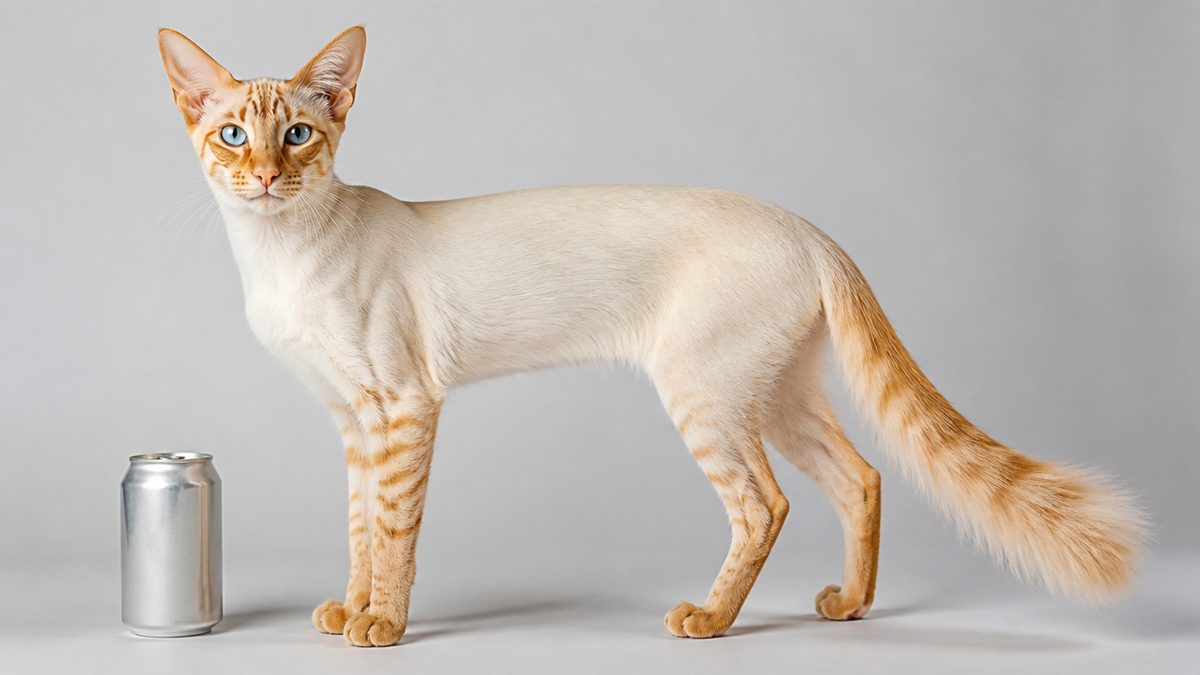
A Javanese is a Balinese in a colour the Balinese Division does not allow. It is a medium-sized, svelte, blue-eyed cat of Siamese type carrying a medium-length single coat and the pointed pattern, in red, cream, cinnamon, fawn, lynx or parti-colour points.
One document settles the description, and it is the Cat Fanciers' Association's Balinese Show Standard, revised 2026. There is no separate Javanese standard anywhere. That single document carries one point score, one head clause, one body clause, one coat clause and one disqualification list, and then splits its COLORS section into a Balinese Division and a Javanese Division. Everything above the colour list is shared.
The body is oriental, not fluffy
The standard asks for a cat that is medium in size, graceful, long and svelte, a distinctive combination of fine bones and firm muscles, with shoulders and hips continuing the same sleek lines of a tubular body and hips never wider than shoulders. Legs are long and slim with the hind legs higher than the front, paws are dainty, small and oval, and the neck is long and slender. A reader who pictures a Persian with points has the wrong animal by a wide margin.
The head is a long tapering wedge that starts at the nose and flares in straight lines to the ear tips, forming a triangle with no break at the whiskers, over a flat skull with no bulge above the eyes and no dip in the nose. Ears are strikingly large, pointed and wide at the base. Eyes are almond shaped, medium sized and slanted toward the nose.
The single coat is the part that matters in India
The coat clause reads medium length, longest on the tail, fine and silky without downy undercoat, lying close to the body, so that the coat may appear shorter than it is. A definite double coat, meaning a downy undercoat, is a listed disqualification. The CFA's own Balinese page puts the practical consequence plainly: these are single-coated cats with no downy undercoat, they are not susceptible to mats, and they are extremely easy to care for.
That single coat is why a semi-longhaired cat of this type is a reasonable proposition in a humid Indian flat and a thick double-coated northern breed is not. Wikipedia records the same structural point, noting that the single coat lies close to the skin and produces a longer, sleeker look than is typical for long-haired cats.
Blue eyes are not a breed trait, they are a coat trait
Every correct Javanese has deep vivid blue eyes, and eyes other than blue are a disqualification. The reason is genetic rather than aesthetic. The pointed pattern is a tyrosinase mutation, an exon 2 G to A transition changing glycine to arginine at position 302, and every cat with the pointed coat colour phenotype tested in the founding study was homozygous for it. The same enzyme deficit that restricts pigment to the cooler extremities also removes it from the iris. The allele sits in a series at that locus, below full colour and below the Burmese allele and above full albino, which is why two pointed parents can only produce pointed kittens.
The cat has short hair in Java. Wikipedia's own Features section makes the point that the Javanese has a long silky coat unlike the actual native domestic cats of Java, and its infobox gives the origin as Canada and the United States. The name comes from a North American habit of naming oriental-type cats after Southeast Asian places, in the same series that produced the Balinese. India's own ranking guide states it the same way, that the name comes from Java Island to match the Balinese breed's naming theme and has no connection with Indonesia.
| Feature | What the standard requires | What disqualifies |
|---|---|---|
| Body | Medium, graceful, long, svelte, tubular, fine bones with firm muscle | Soft or mushy body is penalised |
| Head | Long tapering wedge, straight lines to the ear tips, no whisker break | Malocclusion, undershot or overshot chin |
| Coat | Medium length, fine, silky, no downy undercoat, lying close | A definite double coat |
| Eyes | Deep vivid blue, almond, medium, slanted, uncrossed | Any eye colour other than blue; crossed eyes |
| Tail | Long, thin, tapering, hair spreading like a plume | A visible kink |
| Feet | Dainty, small, oval, five toes in front and four behind | White toes or feet; an incorrect number of toes |
Registry recognition, and the one registry that contradicts itself
Exactly one of the six registries this site checks still uses the word Javanese, and it uses it for a colour division rather than a breed. State registry recognition per body rather than as one global claim, because on this cat five bodies of six have no entry to state.
Two instruments make this checkable rather than a matter of reading breed pages. The CFA runs one breed council per recognised breed, and its 2026 candidate list, last modified 31 July 2026, carries a single shorthair council named Balinese (including Javanese). The GCCF's Standard of Points for June 2026 runs to 723,034 characters and returns zero occurrences of Javanese, against 18 for Balinese and 12 for Toyger as in-document controls. One registry that names the cat only in parentheses, and one that never names it at all. Three more indexes agree with the GCCF. TICA's Browse All Breeds carries 73 breeds with Balinese, Siamese, Oriental Shorthair and Oriental Longhair each present once and no Javanese entry anywhere; FIFe's breeds index returns 49 breed codes in which BAL, SIA, OLH, OSH and THA are present while JAV returns zero; and the World Cat Federation's EMS table, actualised 6 June 2026, files the cat as Siamese Longhair (Balinese) BAL, with the string Javanese appearing zero times across the whole four-page document.
| Registry | Structural position | The document that settles it |
|---|---|---|
| CFA | A COLOUR DIVISION of the Balinese since 1 May 2008 | The Show Standards contents page, which indexes it as JAVANESE (see Balinese), and the Balinese standard's own footnote |
| TICA | NOT USED. The Balinese sits in the Siamese Breed Group with no colour split by name | The Browse All Breeds index of 73 breeds and the Balinese breed page, where Javanese appears zero times |
| GCCF | NOT USED. One Balinese standard covering the colours | Standard of Points, June 2026, printed page 284, marked Updated Council February 2026 |
| FIFe | NOT USED. BAL is a single code sharing one standard with SIA, OLH and OSH | The breeds index, where JAV returns zero across 49 breed codes |
| WCF | NOT USED. Siamese Longhair (Balinese) BAL, plus a separate Foreign White Longhair row | The EMS code table actualised 6 June 2026, where Javanese returns zero |
| LOOF | NOT USED. BALINAIS with a correspondance to SIAMOIS | Liste des Races, version au 1 January 2026, where Javanais returns zero |
The footnote that settles the date
The CFA prints the change in its own standards book, in a footnote attached to the Balinese allowable outcross line. It reads, verbatim, that the Javanese became a division of the Balinese breed effective May 1, 2008. The same book's contents page lists 46 standards and indexes this cat as JAVANESE (see Balinese), which is a cross-reference rather than a standard. Anyone can check both lines in the same PDF.
The asymmetry nobody publishes
The CFA applies the identical colour rule twice and reaches opposite structural answers. In the long coat, non-traditional points are a division inside the Balinese. In the short coat, the identical non-traditional points are the Colorpoint Shorthair, a separate breed with its own show standard revised 2012 and its own breed council. Both councils sit on the same ballot page, one line apart: Balinese (including Javanese), and Colorpoint Shorthair.
The French studbook takes a third position again, listing BALINAIS with code BAL and a correspondance to SIAMOIS, and returning zero for Javanais across its whole Liste des Races. So the same registry says that colour makes a new breed when the hair is short and merely a new class when the hair is long, while four other bodies decline to divide the cat by colour at all. Neither position is wrong on its own. Publishing the disagreement is more useful than picking one, because it tells an Indian buyer exactly why two American pedigrees for two littermates can carry different breed names.
A cat sold to you as a Javanese will carry a pedigree reading Balinese, and that pedigree is correct rather than a substitution. The CFA's colour class numbers make the division visible: 1270 to 1277 for the four Balinese Division colours, and 2047 to 2099 for the Javanese Division's solid, lynx and parti-colour points. Ask a seller for the colour class number, not for the word Javanese. If a seller cannot produce a number in the 2000s, the cat is either a Balinese Division colour or has no CFA registration at all.
One more registry note matters for anyone importing. The CFA's Oriental registration rules list the Longhair Division outcross options as Siamese, Colorpoint, Balinese or Javanese, and prohibit registration of litters and individual kittens from pointed Oriental parents for litters born after 15 July 2013. The word therefore still functions inside CFA paperwork even though it is no longer a breed, which is how it survives in circulation.
How the name arrived, and how it went away
The history of the Javanese runs 29 years. The name was created in 1979 for Balinese colours the Balinese standard excluded, and it was retired as a breed on 1 May 2008. Both dates come from the CFA's own documents, and neither appears on the expensive-looking breed pages that rank for the term.
The CFA's Balinese page records the first half in one sentence: lynx points, tortie points and other non-traditional Siamese colours were accepted in 1979 under the name of Javanese. The parent breeds were the Siamese, the Colorpoint Shorthair and the Balinese, and the CFA's own breed article describes the result as a Siamese-type cat with a medium long coat in the Colorpoint colours, lynx point, tortie point or red and cream point.
The second half is the footnote already quoted. Effective 1 May 2008 the Javanese stopped being a breed and became a division. Nothing about the cats changed. What changed was how many standards the registry maintained.
Why the name exists at all
The name was chosen to extend a series rather than to describe an origin. The Balinese had already been named after the dancers of Bali by a breeder who liked the association, and Javanese continued the geography. The cats of Java are shorthaired, so the name is doubly ornamental. Wikipedia states the point directly and India's own ranking guide repeats it accurately, which is worth noting because that page gets other things wrong.
The European branch of the name, and why it confuses everything
In parts of Europe the same word was applied to a completely different cat, the fully coloured green-eyed semi-longhair of Siamese type that the GCCF calls the Oriental Longhair and the French studbook calls the Mandarin. That is why English-language cat writing about the Javanese contradicts itself so often: two traditions, one word. This site's Oriental Longhair page maps that second cat across the same six registries and finds six different filings for one animal.
The test that separates them is the coat pattern, not the coat length. A Javanese is pointed and blue-eyed. An Oriental Longhair is fully coloured and green-eyed. If a seller shows you a solid chocolate semi-longhair with green eyes and calls it a Javanese, the cat is fine and the label is not.
| Year | What happened | Source document |
|---|---|---|
| 1979 | Lynx points, tortie points and other non-traditional Siamese colours accepted under the name Javanese | CFA Balinese breed page |
| 2008 | Javanese becomes a division of the Balinese breed, effective 1 May | CFA Show Standards footnote |
| 2013 | Registration prohibited for litters from two pointed Oriental parents, born after 15 July | CFA Oriental registration rules |
| 2026 | Balinese Show Standard revised, still carrying both divisions | CFA Balinese Show Standard, (c)2026 |
| 2026 | One of six registries uses the word; five have no entry | GCCF, FIFe, WCF, LOOF and TICA current indexes |
This site has now recorded three cases where a cat name means something different in two registries at the same time, and the Javanese is the cleanest of them, because one body retired the name as a breed and kept it as a colour class rather than dropping it. That is why the word keeps circulating in India: it is still printed in CFA paperwork, still used by catteries, and no longer describes a breed anyone can register.
Javanese cat price in India, and why no number here is real
No verifiable Javanese cat price in India exists on 9 September 2026. Exactly one Indian page carries a rupee figure for this cat, it prints three different bands on that one page, and the AI answer citing it reports a fourth band that appears in none of them.
Start with what the ranking Indian page actually says, because the three numbers sit within a single scroll of each other. Its specification card reads Cost of buying Rs 30,000 to Rs 60,000. Its price paragraph, a few hundred words below, reads that Javanese cats are rare and that in India you should expect to pay anywhere between Rs 20,000 to Rs 50,000. Its own frequently-asked-questions block, lower again, repeats Rs 20,000 to Rs 50,000.
Google India's AI Mode answer for the commercial query then reports Rs 20,000 to Rs 60,000, attributes it to that page, and splits it into Rs 20,000 to Rs 35,000 standard and Rs 40,000 to Rs 60,000 high pedigree. Neither the band nor the two tiers appear anywhere on the page cited. The floor comes from the prose, the ceiling from the card, and the tiers from nowhere at all.
| Figure | Where it is printed | What it is |
|---|---|---|
| Rs 30,000 to Rs 60,000 | happypet.care specification card | The site's own headline figure |
| Rs 20,000 to Rs 50,000 | happypet.care price paragraph | The same page contradicting its card |
| Rs 20,000 to Rs 50,000 | happypet.care FAQ block | The prose figure repeated |
| Rs 20,000 to Rs 60,000 | Google India AI Mode, citing happypet.care | A splice of the prose floor and the card ceiling |
| No row at all | India's leading cat-price guide, 14 breeds | The honest answer for the Indian market |
The cost lines on that page are a template, and here is the proof
The same site publishes a Khao Manee page, a Thai shorthair with nothing in common with an American semi-longhair, and the two rows match to the rupee where it matters. Both print monthly food at Rs 1,500 to Rs 2,000. Both print a basic monthly total of Rs 2,800. Both print Apartment as the ideal space. The Javanese page prints healthcare at Rs 500 to Rs 700 and grooming at Rs 800 to Rs 1,500, and 1,500 plus 500 plus 800 is exactly 2,800, while 2,000 plus 700 plus 1,500 is exactly 4,200. The totals are the sum of three preset lines rather than an observation about either cat.
Test any Indian figure you are shown, in ten seconds
Divide a suspicious rupee figure by 84.38, then by 80, then by 74, and look at the quotient rather than at whether it divided. The four bands above do not resolve to round dollar prices, so this is not a converted American list. It is worse in a quieter way: the numbers are rupee-native and arbitrary, generated by a template, and then laundered into an AI answer as though someone had surveyed the market.
- Ask which registry issued the pedigree, spelled out in full, and expect the answer Balinese rather than Javanese.
- Ask for the CFA colour class number and check it falls in the 2000s, which is the Javanese Division range.
- Ask for the sire and dam registration numbers and verify them with the issuing registry before paying anything.
- Ask when the parents were last examined and by whom, and ask to see the report rather than a verbal assurance.
- Budget the vaccination course, the neutering and the first year of food before you budget the cat.
Searching this term in India returns cat-price roundups, a template breed guide and marketplace shells, not Javanese kittens. India's leading cat-price guide prices 13 pedigree breeds plus the Indian domestic cat, 14 rows in all, and this cat appears in none of them. Treat any Indian listing using the word as a Balinese at best, and ask which of the two CFA colour divisions the cat sits in before you discuss money.
What a cat of this type actually costs to keep in India
Budget a monthly cost of roughly Rs 3,000 to Rs 6,500 for a medium single-coated cat in an Indian metro, plus about Rs 5,000 to Rs 9,000 in the first year once the kitten course and neutering are paid for. Those figures come from published Indian rate cards rather than from a breed page.
There is no Indian price for this cat, but Indian care costs are real, published and quotable, and they apply to any medium cat living in Chennai or Pune whatever its pedigree says. Use these rather than a template row.
| Item | Published figure | Source and scope |
|---|---|---|
| Kitten vaccination course | From Rs 3,999 for three visits at days 60, 90 and 120 | One national clinic chain's own listing, against a struck-through Rs 5,065 |
| Adult annual booster | From Rs 1,899 | Same chain, national page |
| Anti-rabies, single dose | Rs 699 | Same chain |
| Feline CRP test | Rs 1,249 | Same chain |
| Annual vaccination, alternative source | Rs 1,500 to Rs 3,000 | India's leading cat-price guide, a wider band from a different publisher |
| Pet licence, Chennai | Rs 50 | Greater Chennai Corporation, which issued 9,115 licences in 2024 |
| Municipal treatment and anti-rabies, Chennai | Free of cost | Greater Chennai Corporation's six pet clinics |
| One-time setup | Rs 500 to Rs 1,20,000 | India's leading cat-price guide, a band so wide it is a warning rather than a figure |
Two of those rows deserve a second look. The vaccination spread is genuine and it is a function of delivery model rather than of the drug: a municipal clinic, a private chain and a vet-at-home service will quote three different prices for the same vial. And the Chennai municipal route is the most useful line on this page for most readers, because a Rs 50 licence plus free anti-rabies at a corporation clinic changes the arithmetic of cat ownership more than any breed choice does.
Where this coat saves you money
Grooming is the line that a single-coated cat genuinely reduces. There is no undercoat to blow out twice a year, no mat-clipping appointment, and no seasonal deshedding package. The CFA describes the coat as not susceptible to mats and extremely easy to care for. A brush twice a week at home replaces most of what a double-coated breed needs from a salon, so the template's Rs 800 to Rs 1,500 monthly grooming line is an overstatement for this coat rather than an underestimate.
Where it does not
Food, litter and veterinary care do not care about coat type. A medium cat eating a mix of wet and dry food in an Indian metro is the largest recurring line, and the honest way to budget it is to price the specific product you intend to buy at the shop you intend to buy it from, on the week you buy it. Retail food prices on this site have gone stale within days before now, so no monthly kibble figure is published here.
Add the vaccination course, one neutering, one carrier, one litter tray and three months of food, and compare that total against the cat's asking price. For most Indian buyers the first-year care cost is the same size as the purchase price or larger, which is the number that decides whether the household can carry the animal. Budget it before you fall in love with a photograph.
Heat tolerance in India, and why this coat is easier than it looks
A Javanese handles Indian heat better than almost any other semi-longhaired cat, because the standard forbids the undercoat that traps warmth. The limit is not the coat, it is the same wet-bulb load that limits every cat in coastal India.
Start with the number that matters. NASA POWER, queried by explicit latitude and longitude for Chennai and read with the cell elevation echoed back, returns a 48.95 m cell against a real 6.7 m, an annual mean of 27.95 degrees C at 72.39 percent relative humidity, a May mean of 31.51 and a peak Stull wet bulb of 26.11 degrees C in May. That elevation error of about 42 m is small, so the cell is the city rather than a hill behind it.
| City | Annual mean, C | Hottest month | Peak Stull wet bulb, C |
|---|---|---|---|
| Chennai | 27.95 | May, 31.51 | 26.11 (May) |
| Kolkata | 25.81 | May, 31.53 | 27.09 (June) |
| Mumbai | 26.77 | May, 31.19 | 25.77 (June) |
| Delhi | 25.60 | June, 35.88 | 26.50 (July) |
| Ahmedabad | 27.57 | May, 35.06 | 26.11 (June) |
| Hyderabad | 26.10 | May, 33.30 | 23.35 (June) |
| Pune | 23.86 | April, 28.93 | 22.97 (June) |
| Bengaluru | 23.74 | April, 28.37 | 21.86 (May) |
Read the last column rather than the second. Kolkata is the hardest city on this table for any cat despite a lower annual mean than Chennai, because its June wet bulb of 27.09 is the highest figure in the set. Delhi is the hottest by air temperature and peaks a month later than most people expect, in June rather than May. Bengaluru and Pune both peak in April and are both coolest in December, not January.
Why the coat is not the problem here
Heat leaves a cat through evaporation from the respiratory tract and through radiation from thinly furred skin. A dense double coat with a downy undercoat obstructs the second route; a single silky coat lying close to the body barely does. The CFA disqualifies a definite double coat in this cat, which means the breed standard itself rules out the structure that makes northern breeds suffer in India.
There is a second, less obvious reason this cat copes. The pointed pattern is temperature sensitive by definition: the tyrosinase enzyme it carries works at the cooler extremities and not at the warm core. In a consistently warm Indian home, points darken more slowly and body colour stays paler than the same cat would show in a Delhi winter. That is cosmetic rather than clinical, and it is worth knowing before you conclude a kitten is the wrong colour.
What actually needs managing
- Shade and airflow beat air conditioning for a single-coated cat, and a ceiling fan plus a tiled floor is usually enough below a 26 degree wet bulb.
- Water placement matters more than water volume; put the bowl at least three feet from the food, which is standard advice from cat behaviourists and is repeated by TICA for the whole Siamese group.
- Humid months are ear months, so check ears weekly between June and September rather than monthly.
- Never leave any cat in a parked vehicle or on a closed balcony in an Indian summer, whatever its coat length.
- Watch for open-mouth breathing, which is an emergency in a cat rather than the panting it resembles in a dog.
Any published wet-bulb temperature above about 35 degrees C is impossible, because that is the outer edge of what has ever been recorded anywhere on Earth. Several Indian pet pages print derived heat figures well above that, which is a sign the writer fed a period maximum into a formula that expects a mean. Every wet-bulb figure on this page is a Stull calculation from POWER's T2M and RH2M means, and the method is named because two common methods disagree by more than a degree.
Temperament and household fit, stated honestly
A Javanese is a Siamese-group cat in a long coat, which means it is vocal, athletic, socially demanding and poor at being left alone. Buy this cat for the conversation or do not buy it.
TICA describes the whole Siamese Breed Group in one line that applies here without modification: the members share the same body type but come with a different paint job. The temperament comes with the body type. TICA's own Balinese page adds that these cats are very social and talkative, thrive within the company of other people, demand a lot of attention and get into mischief, and should not be left alone for long periods.
Every ranking Western profile agrees. The Spruce Pets answers the question directly, that Javanese are wonderful cats, affectionate, friendly, social and talkative, and that they love being around people. Litter-Robot's profile files its personality material under a heading reading intelligent and energetic. Nobody who has kept one describes a quiet cat.
Who this cat suits in India
- Households where somebody is home most of the day, including work-from-home and joint-family homes.
- Homes that already have one confident cat, because a second cat covers the hours a person cannot.
- Owners who want interaction rather than decoration, and who will play twice a day without being reminded.
- Flats with vertical space, because this cat will use the top of every wardrobe you own.
- Families with older children who understand that a cat which follows them is not asking to be carried.
Who should not buy one
- Anyone out of the house for a twelve-hour Indian working day with no second animal at home.
- Anyone in a building where noise complaints are a live issue, because this cat is genuinely vocal.
- Anyone who wants a lap ornament, because this is an athletic cat that works for a living indoors.
- Anyone buying on looks alone, since the coat photographs far more dramatically than it behaves.
- Anyone who cannot verify what they are actually buying, which in India is most buyers of this name.
The commonest reason cats of this group are rehomed is noise, and the second commonest is separation distress. Neither is a behaviour problem to be trained out. Both are what a Siamese-type cat does when its social needs are unmet. If the vocal level in the trait table above reads as a warning to you, that is the correct reading and it is better to notice it now than after six weeks.
Training approach, and what this cat resists
Train a Javanese with short reward-based sessions, because it learns fast and gets bored faster. It resists repetition, restraint and being ignored, and it will find its own entertainment if you supply none.
To train a cat of this group, work in bursts of three to five minutes, twice a day, with food it actually wants rather than food you have spare. TICA notes that the Balinese group is very receptive to training, excels at feline agility, can play fetch and learns to walk on a leash easily. That is unusually strong for a cat and it is the practical upside of the temperament.
Five things worth teaching first, in India specifically
- Carrier entry on cue, because a monsoon vet trip is much harder with a cat that fights the box.
- Recall to a specific sound, which matters in buildings with open stairwells and shared terraces.
- Station on a mat, so the cat has a job during doorbell traffic rather than bolting past a delivery rider.
- Nail handling and ear handling, ten seconds a day, so weekly humid-season ear checks stay uneventful.
- Settle on a perch away from the kitchen, which is the single most useful behaviour in a small Indian flat.
What it resists
This cat resists three things reliably. It resists repetition, so a trick drilled ten times in a row stops working on the fourth. It resists physical restraint, and a cat of this build will escalate rather than freeze. And it resists being ignored, which is not stubbornness but the same social drive that makes it trainable in the first place.
Punishment is worse than useless here. A vocal, socially motivated cat interprets attention of any kind as a reward, so shouting reinforces exactly the behaviour it is meant to stop. Redirect to an alternative and reward that instead.
Stop the session while the cat still wants more. That single habit does more for a Siamese-group cat's training than any equipment, and it costs nothing. Owners who train to exhaustion get a cat that walks away when the treat pouch appears.
Daily exercise requirement, and what happens without it
A Javanese needs about 30 to 60 minutes of active play a day, split into several sessions. Without it the cat redirects that energy into height, noise and your possessions, in that order.
The Indian breed guide for this cat puts the requirement at 30 to 60 minutes and describes the energy level as high, which matches every Western profile. Hill's describes the cat as a great jumper that can leap effortlessly to the top of the refrigerator, bookcases and even the tops of doors, and that is a description of what unspent energy does rather than a charming fact.
How to split it in an Indian flat
- Two wand sessions of ten to fifteen minutes, early morning and after dark, avoiding the afternoon heat.
- One food-puzzle meal a day, which converts feeding time into working time at no extra cost.
- Vertical furniture in at least two rooms, because horizontal floor area does very little for this cat.
- A window perch with a secured mesh, which supplies hours of low-effort stimulation in a city.
- Rotating three toys rather than owning fifteen, since novelty is what this cat is actually chasing.
The Indian heat constraint
Play early and late. In Chennai in May, with a mean of 31.51 degrees C and a peak wet bulb of 26.11, midday play is a heat risk rather than exercise. In Delhi the same logic applies a month later, since the June mean is 35.88. In Bengaluru and Pune, which peak in April at 28.37 and 28.93, the usable window is wider through most of the year.
Overgrooming, night vocalisation, door-opening, counter-surfing and redirected aggression toward another pet are the standard signs, and every one of them is commonly misread as a health problem or a personality flaw. Add twenty minutes of structured play a day for two weeks before you conclude anything else, and take genuine overgrooming to your nearby vet, because skin disease and boredom look identical from a photograph.
Grooming a single coat in Indian humidity
Brush a Javanese twice a week and comb the tail plume more often. A single silky coat with no undercoat is the lowest-maintenance semi-longhaired coat in the cat fancy, and Indian humidity changes the ear routine rather than the coat routine.
The standard does the work here. The coat is medium length, fine and silky, without downy undercoat, lying close to the body, and a definite double coat is a disqualification. The CFA's Balinese page draws the practical conclusion itself: no downy undercoat means the cats are not susceptible to mats and are extremely easy to care for. There is no seasonal coat blow to manage because there is no undercoat to blow.
The weekly routine, in full
- Brush twice a week with a soft slicker or a fine comb, working with the lie of the coat rather than against it.
- Comb the tail plume separately, because that is the one place hair length reaches five centimetres and tangles.
- Check ears weekly between June and September and fortnightly otherwise, using a dry cotton pad and no liquid.
- Trim nail tips every two weeks, taking only the white tip, which TICA recommends across this group.
- Brush teeth twice a week with a veterinary paste, because dental disease is the commonest issue owners under-budget.
What Indian humidity actually changes
Humidity does not mat this coat, because matting needs an undercoat to felt against. What humidity does is favour ear and skin problems, and the routine that prevents them is weekly inspection rather than more brushing. Do not bathe a cat of this type on a schedule; bathe it when it is dirty, dry it properly, and never leave the ear canal damp.
One piece of imported advice needs adjusting for India. Western profiles routinely say a Javanese can be towel-dried and left to air-dry after a bath. In a Chennai or Kolkata monsoon, with relative humidity above 85 percent for weeks, air drying is slow enough to matter. Dry the cat properly with a towel and a fan on a low setting, and plug the ears before any bath.
The ranking Indian page answers yes to whether Javanese cats are hypoallergenic, on the reasoning that they shed minimally and carry no undercoat. That reasoning is wrong. A 2024 review states flatly that there is no scientific evidence for a hypoallergenic cat breed. Less visible hair on your sofa is a real and worthwhile difference in a humid flat. It is not a statement about Fel d 1, and an allergic buyer paying a premium on that basis is paying for the wrong thing. Spend an hour with an adult cat of the type before you commit.
Health risks and lifespan, from the papers rather than the breed pages
Two inherited risks are documented for the Siamese group this cat belongs to, and both are worth acting on. A CEP290 retinal degeneration allele runs at about 33 percent in Siamese populations and has a commercial DNA test; AA-amyloidosis appeared in 6.2 percent of Siamese and Oriental cats at post-mortem and has no test at all.
There is no Javanese-specific literature. A PubMed audit run on 9 September 2026, reading the query translation line on every query, returned zero records for Javanese cat[tiab] and zero for Javanese[tiab] AND Felis[tiab], while the control Labrador retriever hip dysplasia returned 126 with a sane translation in the same session. Balinese cat[tiab] returns two records and both are single-animal case reports. So the honest source of risk information is the Siamese group literature, and that is substantial.
The eye risk, which is testable
The rdAc allele in CEP290, IVS50+9T>G, causes a recessive late-onset retinal degeneration. A survey of 846 individuals found it in 16 of 43 breeds at an allele frequency of about 33 percent in North American and European Siamese populations, and the authors describe it as a significant health risk particularly in the Siamese breed group. Clinical evaluation showed high concordance between the homozygous genotype and disease, at p equal to 1.1 times ten to the minus six.
Two honest caveats belong beside that figure. The 33 percent is an allele frequency in Siamese populations rather than a disease rate in this colour division, and the paper contradicts itself on its own denominator, saying 41 breeds in one sentence and 16 of 43 in another. Neither weakens the practical advice: a commercial DNA test exists, the mutation is recessive, and two tested-clear parents cannot produce an affected kitten. Ask for the parents' test results in writing.
The amyloidosis risk, which is not testable
Across seven years, 194 Siamese cats including the colour variant then designated Oriental were presented for post-mortem examination, and 12 of them, 6.2 percent, were diagnosed with amyloidosis. The gross findings were enlarged pale livers with haemorrhages, pale swollen spleens and dilated intestines, and the pedigree analysis suggested a familial trait. The Siamese amyloid A protein differs from the Abyssinian one at two amino acid positions, so this is a group-specific problem rather than a general feline one. Later work has identified associated single nucleotide polymorphisms in Siamese and Oriental Shorthair cats, which is progress toward a test rather than a test.
The practical consequence is a monitoring habit rather than a screen. Sudden abdominal swelling, pale gums, jaundice or collapse in a cat of this group is a same-day emergency, because spontaneous hepatic rupture is the presenting sign in some cases. Consult your nearby vet rather than waiting to see whether it settles.
What the coat allele does to the eye, separately
Every pointed cat carries a visual pathway difference that has nothing to do with disease. Pointed cats show foveal hypoplasia, misrouting of retinal ganglion cell axons at the optic chiasm and altered binocular vision. This is the real home of the nystagmus and the cross-eyed look that float around pointed breeds. It belongs to the coat allele, and the CFA already disqualifies crossed eyes in the standard. A cat that meets the standard is not thereby free of the underlying wiring difference.
| Concern | Evidence | Is there a test |
|---|---|---|
| Retinal degeneration, rdAc | CEP290 IVS50+9T>G, about 33 percent allele frequency in Siamese populations | Yes, a commercial DNA test; recessive, so two clears are safe |
| AA-amyloidosis | 12 of 194 Siamese and Oriental cats at post-mortem, 6.2 percent, familial pattern | No. Associated SNPs identified, no clinical test |
| Hypertrophic cardiomyopathy | Affects up to about 15 percent of all domestic cats, mostly subclinical; cause unknown in most | Echocardiography on the parents, not a swab |
| Visual pathway differences | Foveal hypoplasia and chiasm misrouting in pointed cats | Not a test; a property of the pointed allele |
| Breed-specific lifespan | Not among the 12 breeds reaching the 15-death threshold in the UK life tables | No breed figure exists; do not accept one |
Lifespan, and why no honest number exists
Three ranking profiles give three different lifespans for this cat, 10 to 15, 9 to 15 and 12 to 16 years, and none of them names a study. The largest UK feline life-table analysis reached its inclusion threshold of 15 or more deaths for exactly 12 breeds, and this cat is not among the 12 that reached that threshold. The comparators that do exist in that table are the Siamese at 11.69 years with a 95 percent interval of 10.56 to 12.82 on 88 deaths, and crossbred cats at 11.89 years on 7,117 deaths. Nor is there a registration count to fall back on: FIFe's 2024 breeding statistics list every one of its 54 codes across 96,075 kittens, and no Javanese row exists because FIFe holds no such code.
HCM is the commonest feline heart disease and may affect up to approximately 15 percent of the domestic cat population, primarily as subclinical disease, with a genetic cause identified in only two breeds and suspected in a third. It is not a Javanese problem specifically and no gene test applies here. What applies is that an echocardiogram on breeding parents is the only screen that means anything, that a heart murmur is neither necessary nor sufficient for the diagnosis, and that sudden hind-limb weakness in a cat is an emergency. Take it to a clinic immediately.
Feeding a Javanese in India, by life stage
Feed a kitten three to four small meals a day to about six months, then twice a day as an adult, with wet food doing real work in an Indian summer. Water placement matters as much as the food you choose.
TICA's guidance for this group is specific and it transfers to India without modification. Adults are fed at least twice a day and kittens three or four times, because kittens burn calories faster; canned food is often preferred because it is higher in protein and lower in carbohydrate than dry food and its water content raises total fluid intake, which keeps kidneys and bladder healthy.
The water rule that costs nothing
Place the water bowl at least three feet away from any food. Cats' noses are sensitive and an overwhelming smell of food can cause them to drink less, which is standard behaviourist advice repeated by TICA on the breed page itself. In a Chennai May, with an annual mean of 27.95 degrees C and a peak wet bulb of 26.11, total fluid intake is the single most useful thing an owner can influence.
- Kittens to six months, three to four small meals a day, weighed rather than eyeballed.
- Six to twelve months, three meals a day tapering to two, with growth still incomplete at a year.
- Adults, two meals a day, with wet food forming a real share rather than a garnish.
- Seniors from about ten years, same frequency, with an annual blood and urine panel added.
- All ages, fresh water changed daily and placed away from the food, in more than one room.
Body condition beats a feeding chart
The CFA standard penalises a soft or mushy body and describes the correct animal as neither flabby nor bony. That is a body-condition instruction hiding in a show standard. You should feel the ribs easily under a thin covering with light pressure, see a waist from above, and see a tuck from the side. A svelte oriental cat carrying two hundred extra grams looks obviously wrong far sooner than a cobby breed does, which is an advantage for the owner.
One India-specific caution. The ranking Indian guide prints calorie figures of 250 kcal for kittens and 300 kcal for adults on this cat's page, and the identical pair of numbers appears on its unrelated Khao Manee page. Those are template values rather than a calculation for either animal. Ask your vet for a figure based on the cat's actual weight and body condition score.
Onions and garlic, chocolate, alcohol, cooked bones, raw eggs, grapes and raisins, xylitol and artificial sweeteners are on every credible avoid-list including the Indian one. Onion and garlic matter more in an Indian kitchen than in a Western one, because both appear in almost every dish and a cat that scavenges is exposed daily rather than occasionally.
Month by month through a Javanese kitten's first year
Expect slow physical maturity and fast social development. A Siamese-group kitten is socially adult long before it is physically adult, and TICA puts full development at 18 to 24 months.
TICA states the maturity timeline for this group plainly: kittens mature slowly and do not fully develop until 18 to 24 months. The coat arrives late as well, which matters for anyone assessing a kitten's coat length at twelve weeks. Judge the parents, not the kitten.
| Age | What is happening | What to do in India |
|---|---|---|
| 0 to 8 weeks | With the queen. Weaning completes; eye colour and points are still developing | Do not take the kitten. Indian pet shop rules treat kittens below eight weeks as un-weaned |
| 8 to 10 weeks | Home transition, litter training, first fears | First vaccination visit; a three-visit course from Rs 3,999 at one national chain |
| 10 to 14 weeks | Socialisation window closing; handling habits set for life | Second visit; start ten seconds a day of ear and nail handling |
| 14 to 16 weeks | Rabies dose due; climbing begins in earnest | Third visit; secure balconies and window meshes before this stage, not after |
| 4 to 6 months | Rapid growth, teething, first real athleticism | Discuss neutering timing with your vet; add vertical furniture |
| 6 to 9 months | Adolescent testing, vocalisation increases sharply | Hold the training routine; this is when most rehoming decisions are made |
| 9 to 12 months | Body lengthens, coat begins to come in on the tail | Annual booster planning; switch to adult feeding at two meals |
| 12 to 24 months | Full development completes; points darken with age | Body condition check every month, because a svelte cat hides weight badly |
The eight-week line is law in India, not etiquette
The Prevention of Cruelty to Animals (Pet Shop) Rules, 2018 treat kittens below eight weeks as un-weaned, and the Second Schedule's paragraph 2, headed FOR CATS, sets out six housing requirements including that cats or kittens shall be kept in a room which is not shared by other, inimical animal species such as dogs. A seller offering a six-week kitten is telling you something about the whole operation. Walk away.
One citable absence in the same instrument is worth knowing. Its microchipping requirement is written as micro-chipped and is scoped to puppies, so kittens fall outside it. Microchip your cat anyway, at about Rs 1,250 at a named Chennai hospital's own transacted rate, because a cat that gets out of a fourth-floor flat has no other identification.
A vaccination card with dates and batch numbers, a deworming record, the sire and dam registration numbers, a written note of which registry issued them, and a willingness to let you visit the kitten with the mother present. If any of those five is missing, the price is irrelevant.
Javanese against the four cats buyers actually cross-shop
Compare a Javanese against a Balinese, a Colorpoint Shorthair, an Oriental Longhair and a Ragdoll, because those four are what an Indian buyer is really choosing between. Three of the four differ from it by one variable only.
The comparison is unusual because three of the four alternatives are the same cat with one thing changed. Against the Balinese, only the colour differs. Against the Colorpoint Shorthair, only the coat length differs. Against the Oriental Longhair, only the pattern differs. Only the Ragdoll is a genuinely different animal, and it is the one most Indian buyers actually end up with.
| Cat | How it differs from a Javanese | Registry position | India note |
|---|---|---|---|
| Balinese | Colour only. Seal, chocolate, blue and lilac point instead of red, cream, lynx and parti-colour | Same CFA standard, same point score, different colour division | The pedigree name a Javanese actually carries |
| Colorpoint Shorthair | Coat length only. Same non-traditional points, short coat | A separate CFA breed with its own standard revised 2012 and its own council | Easier again in Indian humidity; the same temperament |
| Oriental Longhair | Pattern only. Fully coloured body, green eyes, no points | A breed at TICA and the GCCF, a division at CFA, the Mandarin at LOOF | The other cat the word Javanese has been used for |
| Siamese | Coat length and colour range. Short coat, four traditional points | A separate breed everywhere, and the parent of the whole group | Priced at Rs 15,000 to Rs 40,000 in India's leading guide |
| Ragdoll | Everything. Large, heavy, semi-cobby, mitted or bicolour patterns available | A separate breed in all six registries | Priced at Rs 25,000 to Rs 60,000 and genuinely available |
The comparison that matters most in India
For most Indian buyers the real choice is between a Siamese-group cat and a Ragdoll, and the deciding variable is noise rather than looks. Both are blue-eyed pointed cats. One is vocal, athletic and demanding of company; the other is quiet and heavy. India's leading cat-price guide prices both, at Rs 15,000 to Rs 40,000 for the Siamese and Rs 25,000 to Rs 60,000 for the Ragdoll, and prices neither the Javanese nor the Balinese.
If the coat length is what attracted you, the honest comparison is against the Colorpoint Shorthair rather than against a Persian. Identical colours, identical temperament, identical body, less hair. In an Indian summer that is a real argument, and it costs nothing.
The Colorpoint Shorthair and the Balinese (including Javanese) appear as two separate councils on the same CFA ballot page. The colour rule that defines both is identical. The CFA treats it as breed-making in the short coat and division-making in the long coat, and has done since 1 May 2008. Nobody is hiding this; it simply has never been put side by side before.
Mistakes Indian buyers make with this name
Five mistakes account for almost every bad Javanese purchase in India, and four of them happen before money changes hands. The first is treating the word as a breed.
1. Treating Javanese as a breed you can register
No registry issues a Javanese pedigree today. The CFA retired the breed on 1 May 2008 and kept the word as a colour division inside the Balinese standard; five other registries never used it. If a seller promises Javanese papers, ask which body issues them. The honest answer is that the papers will say Balinese, and that answer is correct.
2. Believing an AI answer's price
Google India's AI Mode reports a rupee band for this cat and attributes it to a page that prints two different bands, neither of which matches what the answer says. This is a documented mechanism rather than a one-off: an answer engine reads a page with contradictory numbers and emits a third figure with a citation attached. A price gains no credibility from appearing in an AI answer. Open the page it cites and look for the number.
3. Reading a template cost row as a budget
The Indian breed guide's monthly figures are the sum of three preset lines shared with unrelated breeds on the same site, and the identical food line, basic total and ideal-space field appear on its Thai shorthair page. Worse, that sibling page carries a healthcare line of Rs 500 to Rs 7,000 rather than Rs 500 to Rs 700, and the misplaced zero propagates straight into a Rs 10,500 premium monthly total. A reader budgeting from a template inherits its typos.
4. Buying the coat for allergy reasons
The same page answers yes to whether this cat is hypoallergenic, and a 2024 review states flatly that there is no scientific evidence for a hypoallergenic cat breed. Low shedding is real and useful. It is a different claim. An allergic buyer should spend an hour with an adult cat of the type before committing, and should not pay a premium for the word.
5. Underestimating the noise and the company requirement
This is the mistake that produces rehoming rather than a bad purchase. A Siamese-group cat left alone through a long Indian working day vocalises, climbs and opens things, and every ranking profile says so. The cat is not misbehaving. It is doing what the breed group does. Plan for a second cat or plan for a different breed.
- Verify the registry and the colour class number before discussing price.
- Verify the parents' rdAc test results in writing, because the mutation is recessive and testable.
- Verify the kitten is at least eight weeks old, which Indian pet shop rules treat as the weaning line.
- Verify the ear and eye condition in person, in daylight, rather than from a video call.
- Verify your own working hours against the cat's need for company, honestly.
Because no registry issues papers under this name and no Indian breeder specialises in it, the likeliest outcome of searching for a Javanese in India is being sold a longhaired domestic cat with points. That cat may be perfectly healthy and a fine pet. It is not what you paid for, and there is no document that will ever say otherwise. Buy a cat you have seen, from a person you can visit, with parents you can meet.
Adoption, and the honest route for an Indian household
Adopt a pointed longhaired cat rather than importing a name. India has no Javanese rescue because India has no Javanese population, and the cats that fit this description in Indian shelters are simply longhaired cats with points.
Start with what exists. There is no Indian Javanese breeder network, no Indian registry entry and no Indian rescue pipeline for the name. What does exist is a large population of Indian shelter cats, a municipal system that will vaccinate them free in at least one metro, and a well-documented set of care costs that apply whatever the cat's ancestry.
Four routes, in the order worth trying
- Local shelter or foster network first, where a semi-longhaired pointed cat turns up regularly and costs a fraction of any breeder price.
- Breed-specific rescue for the Siamese group second, since surrendered Siamese-type cats are surrendered for the noise rather than for illness.
- A Balinese breeder third, if you specifically want the colour division, and ask for the CFA colour class number in the 2000s.
- Import last, and only as a personal pet, because Indian foreign trade rules route commercial animal import through a separate and far harder channel.
If you do import, what the rules actually say
India's foreign trade FAQ for pet import names cats explicitly, gives ITC(HS) 01061900, limits entry to a named list of ports and sends anything outside the personal pet allowance to the Exim Facilitation Committee. The document contains zero occurrences of CITES, so it settles nothing about wild-hybrid cats, which does not matter here because this cat is entirely domestic. What matters is that the paperwork will name the breed as Balinese, and a customs officer reading Balinese on a pedigree while your invoice says Javanese is an avoidable problem.
What adoption gets you that a purchase does not
An adult cat's temperament is already visible. With a Siamese-group cat that is worth more than pedigree, because the single variable that decides whether the household works is how vocal and how needy this particular animal is, and no kitten shows you that. An adult also arrives past the rdAc onset window in many cases, past the socialisation window, and usually already neutered.
Greater Chennai Corporation charges Rs 50 for a pet licence and its six pet clinics provide all treatment and anti-rabies vaccination free of cost. It issued 9,115 licences in 2024. For a household weighing a Rs 30,000 to Rs 60,000 template price against a shelter cat, that is the arithmetic that should decide it, and the cat you get will be equally capable of climbing your wardrobe.
Javanese cat questions people actually ask
What is the average lifespan of a Javanese cat?
No breed-specific lifespan figure exists for the Javanese, because the largest UK feline life-table study reached its 15-death inclusion threshold for only 12 breeds and this is not among them. The nearest honest comparators from that same table are the Siamese at 11.69 years and crossbred cats at 11.89 years. Ranking pages quote 10 to 15, 9 to 15 and 12 to 16 years, three ranges from three sites, and none of them names a study.
Are Javanese cats rare?
The name is rarer than the cat. Pointed semi-longhair cats in lynx, tortie, red and cream points are registered in reasonable numbers worldwide, but only the CFA still files them under the word Javanese, and there it is a colour division of the Balinese rather than a breed. FIFe, the GCCF, TICA, the World Cat Federation and the French studbook return zero occurrences of the name in their current breed documents.
What is the most misbehaved cat breed?
No registry or veterinary body ranks breeds by misbehaviour, and the question has no sourced answer. What is documented is that this group of cats is extremely vocal and dislikes being alone, which owners often report as misbehaviour when it is really an unmet need for company. A Javanese left alone through a twelve-hour Indian working day will vocalise, climb and open things.
How much does a Javanese cat cost?
No verifiable Indian price exists. The one Indian page carrying a figure prints Rs 30,000 to Rs 60,000 on its specification card and Rs 20,000 to Rs 50,000 twice in its own text, and Google's AI answer reports Rs 20,000 to Rs 60,000 while citing that page, a band that appears in neither place. India's leading cat-price guide prices 14 breeds and this is not one of them.
Which cat is costly in India?
India's leading cat-price guide puts the Sphynx at Rs 50,000 to Rs 1,50,000 and the Himalayan at Rs 30,000 to Rs 1,20,000 at the top of its 14-row table, with the Indian domestic or desi cat at Rs 0 to Rs 2,000 at the bottom. The Javanese appears in no row of it, which is the more useful answer for anyone shopping for this cat in India.
Which cat is under 2000?
The Indian domestic or desi cat is the only entry under Rs 2,000 in India's leading cat-price guide, listed at Rs 0 to Rs 2,000. Municipal routes cost less again: Greater Chennai Corporation charges Rs 50 for a pet licence and runs six clinics giving treatment and anti-rabies vaccination free of cost.
Is the Javanese a separate breed?
Not in any current registry document. The CFA made the Javanese a colour division of the Balinese effective 1 May 2008 and now indexes it in its show standards as JAVANESE (see Balinese). Five other registries never adopted the name at all. A cat sold as a Javanese is a Balinese in a colour the Balinese Division excludes.
What is the difference between a Javanese and a Balinese?
Colour, and nothing else. The two share one CFA show standard, one point score, one set of type clauses and one disqualification list. The Balinese Division holds seal, chocolate, blue and lilac point; the Javanese Division holds red, cream, cinnamon and fawn point, every lynx point and every parti-colour point. A single litter can contain both.
Are Javanese cats hypoallergenic?
No cat breed is hypoallergenic, and the ranking Indian page that answers yes to this question is wrong. A 2024 review states flatly that there is no scientific evidence for a hypoallergenic cat breed. A single coat with no undercoat does shed less visible hair, which is a real difference in a humid Indian flat, but shedding is not the same thing as allergen load.
Can you import a Javanese cat to India?
Yes, as a personal pet rather than as stock. India's foreign trade rules name cats explicitly under ITC(HS) 01061900, route entry through a limited list of ports and send anything outside the personal pet allowance to the Exim Facilitation Committee. Since no registry issues a Javanese pedigree, the paperwork will read Balinese, and that is correct rather than a substitution.
What colours does the Javanese Division include?
The CFA's Javanese Division holds the solid colour points red, cream, cinnamon and fawn including their smokes, the blue, chocolate, lilac and seal smokes, every lynx point across 14 base colours including silver, and the parti-colour points seal-tortie, chocolate-tortie, blue-cream, lilac-cream, cinnamon-tortie and fawn-cream. The Balinese Division holds four colours in total.
Do Javanese cats have blue eyes?
Always. The CFA standard requires deep vivid blue and disqualifies eyes other than blue, because the same tyrosinase allele that restricts pigment to the points also removes it from the iris. That is a fact about the coat gene rather than about the breed, and it is why a green-eyed cat sold as a Javanese is something else.
Is a Javanese the same as an Oriental Longhair?
No, and mixing them up is the commonest error in English-language cat writing. Both are semi-longhaired cats of Siamese type, but the Javanese is pointed and blue-eyed while the Oriental Longhair is fully coloured and green-eyed. The name Javanese has been applied to the Oriental Longhair in some European usage, which is exactly why the two get confused.
Compare with similar breeds
Javanese sits in 1 Bonbeno group. Each one compares it directly against the breeds it is genuinely an alternative to, on the same figures.