
Cat breed guide
Jianzhou Cat (Si-Er Mao): Price in India, the Four Ears and the Tang Dynasty
A Qing-dynasty gazetteer says this cat has four ears. A Chinese encyclopedia explains that it does not. And a 2026 genome study just placed the arrival of the domestic cat in China exactly where the folk history puts this one.
Quick answer
No Jianzhou cat price in India could be sourced on 10 September 2026, and India's two largest cat guides never name the breed. It is not recognised by any pedigree cat organisation internationally, and a Qianlong-era Sichuan gazetteer is the source of the four-eared claim that gives the cat its second name.
This page reports what Chinese gazetteers, a 2026 archaeogenomics study and the cat registries do and do not say about a Sichuanese landrace with no veterinary literature of its own. Several widely repeated claims about this cat trace to a popular picture book and are flagged as such rather than repeated. It is reference material, not a diagnosis and not a treatment plan. Consult your nearby vet, a registered veterinarian who can examine your own animal, before acting on anything here.
Jianzhou cat at a glance
What the Jianzhou cat is, and what the four ears actually are
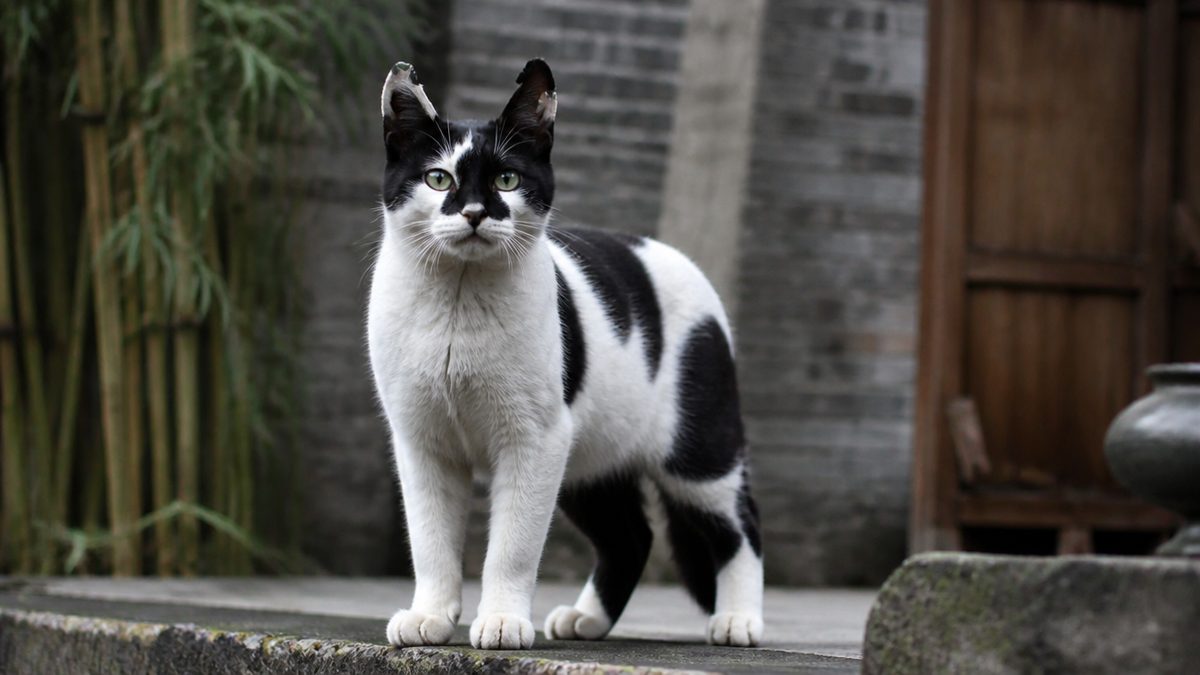
The Jianzhou cat is a Sichuanese farm landrace kept for rat hunting, and its famous four ears are a notch in the outline of two ordinary ears.
The cat takes its name from Jianzhou, the old name for what is now Jianyang City in Sichuan Province, and the Chinese encyclopedia files it simply as the cat of that locality, a mammal of the order Carnivora, family Felidae, genus Felis. That taxonomic filing is worth noticing: there is no breed classification, only a species and a place. This is a landrace population, not a standardised breed.
It has four names in Chinese. 簡州貓 is the place name, 神貓 Shen Mao is the divine cat, 四耳貓 Si-Er Mao is the four-eared cat, and locals call it 丫猫 Nia Mao. The four-eared name is the one that reaches English, and it is the one that gets misunderstood.
The Qing gazetteer, and the sentence that explains it away
The claim is old and it is documented. A Qianlong-reign 简州志, the Jianzhou county gazetteer, states: *天下猫两耳,惟四川简州猫盖,轮廓重叠,两大两小,合成四耳也*, all cats under heaven have two ears; only the Sichuan Jianzhou cat has overlapping ear outlines, two large and two small, combining into four ears. The eighteenth-century writer 袁枚 repeats it in 《子不语》: *四川简州,猫皆四耳。有从简州来者,亲为余言*, in Jianzhou, Sichuan, cats all have four ears; someone who came from Jianzhou told me so himself.
Two dated Chinese sources, several centuries apart, both asserting four ears. And then the same encyclopedia entry that quotes them turns round and explains the mechanism in its own words: 实际上,是在耳朵的部位有一个小缺口,形成了拐点, in fact there is a small notch on the ear forming an inflection point, so that each ear appears to be two.
English Wikipedia describes ears that overlap and may be attached, with a distinct gap in the ear outline and a mid-point inflection point, giving the appearance of having two extra ears, which is accurate. But the search results, the video content and the social posts that make up the rest of page one all present the four ears as a wonder rather than as an ear notch. The Chinese source is more sceptical about this cat than the English internet is, which is an unusual direction for that gap to run.
What the cat looks like
The build is described as tall and sturdy with well-developed muscles but not bulk. The Chinese entry adds that the body is strong and the movements agile, and that the cat is an outstanding hunter.
The coat colour is where a Western reader has to adjust their expectations. 毛色繁多,大多毛色混杂,鲜有纯毛色, coat colours are many, mostly mixed, and a pure solid colour is rare. Wikipedia gives the same: varied and mixed, rarely a single solid colour, lacking distinct markings.
That single line disqualifies the animal from being a breed in the Western sense, and the tradition compensated by naming patterns instead. The Chinese sources list more than ten, and the names are the best thing about this cat: 乌云盖雪, black cloud covering snow, a white body with a black back; 金枪雪里埋, golden spear buried in snow, a white body with a black tail; 铁棒打樱桃, iron rod striking a cherry, white with a black tail and a cherry-coloured head. A tradition that names ten coat patterns and standardises none of them is doing something different from a breed register.
Registry recognition: none, anywhere, and none sought
No pedigree cat organisation anywhere in the world holds the Jianzhou cat, and unlike the Thai landraces there is no state recognition either.
Wikipedia states it flatly: the breed is not recognized internationally by any pedigreed cat organizations. That claim was tested against five registers, each with a control that proves the search worked.
| Registry | Holds the breed | Document checked | In-document control |
|---|---|---|---|
| World Cat Federation | No, and no Chinese cat of any kind | All 198 EMS rows via the nonce POST | Korat, Thai, Siamese, Oriental Shorthair, Kanaani present |
| The International Cat Association | No | The 90-breed index at tica.org | Khao Manee, Korat, Thai, Japanese Bobtail, Kurilian Bobtail present |
| Cat Fanciers' Association | No, and no Li Hua or Dragon Li either | Breed Council Declared Candidates, including miscellaneous and provisional | Bombay and Khao Manee present |
| Governing Council of the Cat Fancy | No | Standard of Points, June 2026, 723,034 characters | British Shorthair appears 32 times |
| Fédération Internationale Féline | No | The live recognised-breeds list by EMS code | OSH, OLH, RUS, SIA, THA present |
The WCF result is the most complete of the five. Across all 198 rows of its cross-registry table, no row contains the strings China, Chinese, Dragon or Hua. The federation that recognises the most breeds of any body checked on this site holds no Chinese cat at all.
The comparison that makes the absence legible
One Chinese landrace did get registry attention. The Chinese encyclopedia records the 狸花猫, the Li Hua or Dragon Li, as the Chinese native cat breed certified by the CFA, recognised as an experimental breeding variety in 2003. So a Chinese landrace can reach a Western register.
Note what the CFA's current documents show, though. The breed-council list, which includes the miscellaneous and provisional blocks, contains Li Hua and Dragon Li zero times as of 10 September 2026, while Bombay and Khao Manee both appear. A Chinese cat did enter that system and is no longer in the current list.
That is the fairest thing this page can say about the Jianzhou cat's registry prospects. The pathway exists and has been walked once by another Chinese landrace, and it did not lead anywhere permanent. Nobody has attempted it for this cat, and no Chinese state designation of it could be found, which is the sharpest available contrast with the Thai landraces on this site, where a Cabinet resolution did the work no registry would.
History: a tribute cat, and the century the genetics agree with
Chinese sources date this cat's court popularity to the Tang dynasty and its tribute status to the Ming and Qing, and a 2026 genome study places the arrival of the domestic cat in China in the same Tang century.
The folk history is unusually specific for a landrace. The cat is said to have become popular in China during the Tang dynasty, and during the Ming and Qing dynasties it was selected as a local tribute item from Sichuan and presented to the emperor, after which it became a royal pet and then a fashionable gift among officials and aristocratic families.
The Chinese entry gives the machinery of that imperial tribute. According to the 简阳县志, roughly five hundred years ago in the mid-Ming, an empress dowager was fond of Jianzhou cats, and officials of Chengdu Prefecture and Jianzhou set up collection points each year at 龙泉驿 to compulsorily purchase them, partly for tribute and partly to satisfy their superiors. The imperial tribute items sent from Sichuan in the Ming and Qing were the Jianchang duck, the Gushi chicken, the Songpan sand fox and the Jianzhou cat. Being an imperial tribute animal made the cat briefly expensive and fashionable, and left it exactly as unrecognised by any register as it had been before.
A later anecdote from the Xianfeng reign has the governor of Chengdu, 李松云, whose daughter loved cats, being sent dozens of selected Jianzhou cats complete with embroidered brocade beds.
The genomics, which nobody has set beside this
Chinese cat pages routinely claim great antiquity, and this site's standing position is that the ancient-Chinese-cat-breed claim does not survive the literature. That position now has a precise date attached to it, and the date is what makes this breed's folk history interesting rather than false.
A 2026 study in Cell Genomics analysed 22 small felid bones from 14 archaeological sites across China spanning 5,000 years. It found that commensal leopard cats, *Prionailurus bengalensis*, appeared in human settlements at least 5,400 years ago and persisted until about 150 CE. Then, after a gap of several centuries, the earliest known domestic cat in China dates to about 730 CE, reconstructed as a fully or partially white cat and identified in Shaanxi during the Tang dynasty. The genomic analysis of 130 modern and ancient Eurasian specimens points to a Levantine origin and a merchant-mediated dispersal along the Silk Road.
Read those two paragraphs together. Chinese tradition says the Jianzhou cat became prominent in the Tang dynasty. The best archaeogenomic evidence available says the domestic cat arrived in China in the Tang dynasty, around 730 CE Wikipedia, 'Jianzhou cat'. The tradition is not claiming implausible antiquity. It is claiming that this cat was noticed at roughly the moment domestic cats became available to notice.
That reframing matters in both directions. It rescues the Tang claim from the general scepticism about ancient Chinese cat breeds, and it rules out anything older. Any page telling you the Jianzhou cat is a five-thousand-year-old Chinese breed is describing the leopard cat commensal phase that ended around 150 CE, which involved a different genus entirely. The domestic cat's own ancestry runs back to the Near East and to at least five founders assessed across five wildcat subspecies, not to Sichuan.
How the population declined, in the Chinese source's own words
The Chinese entry gives a specific and translatable mechanism that no English page carries: 因多次使用毒饵灭鼠,猫被误杀,数量也明显减少, because poison bait was used repeatedly for rodent extermination, cats were killed by accident, and numbers fell markedly. The same entry adds that breeding is largely unplanned, with no technical measures, left to nature.
A cat kept for rat control, killed by rat poison. That is the whole modern history of the breed in one sentence, and it is directly relevant to Indian readers, because secondary rodenticide poisoning is a live risk for free-roaming cats in Indian cities too.
Jianzhou cat price in India
No Jianzhou cat price in India exists, no registry holds the breed, and the Chinese source describes a declining rural population bred without any planning at all.
The Indian absence was tested. India's 2026 all-breed cat price guide runs to 45,016 characters of extracted text and the string Jianzhou appears zero times, while Persian appears 22 times, Bengal 16 and Siamese 9. The 40-breed guide to cats for the Indian climate returns zero across 51,780 characters.
There is no supply chain of any kind. The Chinese encyclopedia describes breeding as unplanned, with no technical measures, left to nature, which is the opposite of a breeding programme. There is no registry anywhere, so there is no pedigree an Indian buyer could be given.
| Source | What it is | Jianzhou named | Usable as a price |
|---|---|---|---|
| India's 2026 all-breed cat price guide | 45,016 characters | Zero times | No |
| India's 40-breed cat climate guide | 51,780 characters | Zero times | No |
| A 3D-printing forum post | A digital model of the cat, offered for printing | Yes | No, that is a model file |
| A pet-products company blog | A list mentioning less common Chinese breeds | Yes | No, no price given |
| Any registry, breeder or Indian listing | Nothing found | No | No |
The 3D-printing row is the most telling thing about this breed's presence in English. On page one of Google India for this query sits a developer-community forum post offering a printable model of a Chinese Jianzhou cat. When a digital sculpture outranks every editorial page about a living animal, the animal has essentially no English-language footprint.
Why an import is not a realistic idea
India's import rules place live cats under ITC(HS) 01061900 as a Restricted item, and the commercial route bars import for trading or breeding purposes outright; the personal pet route runs on the Livestock Importation Act, 1898, and requires a valid pet book in the importer's own name after a qualifying stay abroad. None of that describes a route to acquiring a farm cat from a Sichuan village.
And there is nothing to acquire in the sense a buyer imagines. The Chinese sources describe a rural working population in decline from rodenticide exposure, not a cattery system with kittens available. The honest answer to the price question is that this cat is not a commodity anywhere, including in China.
Monthly cost of ownership in India
A Jianzhou cat would cost what an ordinary Indian shorthair costs, because a short-coated working farm cat adds nothing to the grooming, feeding or veterinary lines.
Nobody in India owns one, so this prices the animal the Chinese sources describe rather than pretending to quote a market. A tall, muscular, short-coated cat with a mixed coat, no described undercoat and no documented inherited condition costs what a healthy Indian shorthair costs.
| Line | Figure | Note |
|---|---|---|
| Kitten vaccination course | From Rs 3,999, three visits at days 60, 90 and 120 | List price Rs 5,065 at the same chain |
| Annual booster | From Rs 1,899 | Anti-rabies alone Rs 699 |
| Consultation | Rs 500 to Rs 1,000 | One data point, not two; two publishers print it identically |
| Professional grooming | Rs 0 | A Delhi haircut starts at Rs 1,359, a full bath and styling at Rs 1,869 |
| Boarding, per 24 hours | Rs 899 in Bengaluru | Daycare to ten hours Rs 799 |
| Municipal licence | Rs 50 in Chennai | Delhi's Rs 500 registration covers dogs only |
| Cooling | The genuine breed-specific line | This is the one cat in the batch whose homeland is cooler than every Indian city |
The consultation figure is published identically by a dog sanctuary and a general insurer, which means one copied the other, so Bonbeno counts it as a single data point rather than two. Budget above it rather than at it.
The cooling row is not padding. Every other breed in this batch comes from a climate as warm as India's or warmer. This one comes from a basin whose warmest month averages 27.66 C, and in Delhi, Ahmedabad or Hyderabad that turns a fan into a genuine welfare item rather than a comfort.
- Budget Rs 4,000 to vaccinate a kitten through its first-year course, then about Rs 1,900 a year.
- Budget nothing for professional grooming, because a short working coat does not need it.
- Budget Rs 899 for a night of boarding in Bengaluru if you travel.
- Budget one neutering, which buys more life expectancy than any other line here.
- Budget for cooling in a north or west Indian summer, which for this origin climate is not optional.
Two Indian facts change the arithmetic more than the breed does. Greater Chennai Corporation licenses pet animals generally at Rs 50, issued 9,115 licences in 2024, and its six municipal pet clinics provide all treatment and anti-rabies vaccination free of cost.
Suitability for the Indian climate
The Jianzhou cat is the one breed in this batch whose homeland is cooler than every Indian city, so Indian heat would be a real step up and a north Indian winter would be easy.
The grid cell checks out. NASA POWER returns a Jianyang cell at 484.56 m against a real elevation near 400 m, an error of +84.56 m. That is small enough for the cell to describe the place, which matters, because the same API puts Jerusalem 473 m below its true elevation and a page quoting a cell without echoing its elevation is quoting a number it has not verified.
| Place | Annual mean C | Annual RH % | Warmest month | Coolest month | Peak Stull wet bulb |
|---|---|---|---|---|---|
| Jianyang, Sichuan | 17.45 | 71.60 | Jul, 27.66 | Jan, 5.28 | Jul, 23.93 |
| Bengaluru | 23.74 | 67.94 | Apr, 28.37 | Dec, 20.22 | May, 21.86 |
| Pune | 23.86 | 66.80 | Apr, 28.93 | Dec, 19.62 | Jun, 22.97 |
| Delhi | 25.60 | 45.56 | Jun, 35.88 | Jan, 13.61 | Jul, 26.50 |
| Mumbai | 26.77 | 67.39 | May, 31.19 | Jan, 23.19 | Jun, 25.77 |
| Kolkata | 25.81 | 73.93 | May, 31.53 | Jan, 17.31 | Jun, 27.09 |
| Chennai | 27.95 | 72.39 | May, 31.51 | Jan, 24.09 | May, 26.11 |
The first row is the finding. Jianyang's annual mean is 17.45 C, more than six degrees below Bengaluru, the coolest Indian city in the table, and more than ten below Chennai.
Then look at the warmest-month column. Jianyang peaks in July at 27.66 C. Chennai's annual mean is 27.95 C NASA POWER climatology API, 2001-2020. The hottest month this cat's homeland has is cooler than an average Chennai day across the whole year. That is not a subtle difference in heat tolerance; it is a different thermal world.
Every other breed on this seven-page batch comes from a place as warm as India or warmer. The Raas cat's island runs 27.99 C annually, Bangkok runs 27.85 C. Jianyang runs 17.45 C. A cat selected for four centuries in a cool, overcast, humid basin would find Delhi in June at a 35.88 C mean, or Ahmedabad in May at 35.06 C, entirely outside its experience.
The humidity, by contrast, would be familiar. Jianyang runs 71.60 percent annual relative humidity, which sits between Bengaluru's 67.94 and Kolkata's 73.93 NASA POWER climatology API, 2001-2020. The Sichuan basin is famously overcast and damp, so damp air is not the problem. Heat is.
Read the wet-bulb column for the physiological version. Jianyang's peak is 23.93 C in July. Kolkata reaches 27.09 C, Delhi 26.50 C and Chennai 26.11 C NASA POWER climatology API, 2001-2020. A rise of two to three degrees in peak wet bulb is a meaningful increase in heat load for an animal that cannot sweat.
What this means city by city
Bengaluru and Pune are the only comfortable fits, with annual means around 23.8 C, low wet-bulb peaks and humidity close to the origin. Delhi is a paradox: its winter would suit this cat better than any other in the batch, since a January mean of 13.61 C is eight degrees above Jianyang's January, while its June at 35.88 C would be the hardest month any Indian city could offer. Chennai, Kochi and Kolkata are warm year-round with no cool season to recover in, which is the harder pattern for a cool-climate animal.
The practical instructions follow. Provide a genuinely cool room, not merely a shaded one, between March and June in the north and west. Provide multiple water sources. And treat the absence of a cool season, rather than any single hot day, as the thing this particular cat would struggle with.
Temperament and household fit
The Chinese sources describe a one-person working cat that may injure a stranger who approaches it, which is a serious household-fit warning rather than a charming quirk.
The Chinese encyclopedia is direct and the English pages soften it. 简州猫认主,只有主人才可亲近,他人亲近可能会误伤, the Jianzhou cat recognises its owner, only the owner may approach it closely, and others approaching may be accidentally injured. Wikipedia carries the same: loyal to their owners and only allowing them to approach, with others risking accidental injury.
That is not a temperament description of the kind a breed profile usually offers. It is a warning, and it comes from the source that is most sympathetic to the cat.
It is also exactly what you would expect. This is a working animal selected for four hundred years for one function, catching rats on a farm, with no selection at all for handling by strangers. The Chinese entry also calls it 安静, quiet, and suited to catching mice, which fits: a quiet, self-contained animal bonded to one household.
A cat that permits handling by one person and may injure others is a poor fit for a household with children, with regular visitors, or with domestic staff, which describes most Indian urban homes. It is also a poor fit for a cat that will need veterinary handling twice a year.
Nothing in the sources suggests aggression as a temperament flaw. It reads as a working animal's ordinary wariness, which is very different from a pet-bred cat's tolerance. Bonbeno reports it because it is in the source and because leaving it out would misrepresent the animal to a reader considering it as a pet.
For a household that wants a self-contained, quiet, low-maintenance cat bonded to one person, the Indian shorthair supplies the same profile with none of the acquisition problems, and the Korn Ja page makes the same case for the Thai equivalent.
Training a working rat-catcher
To train a Jianzhou cat you would work with an intact hunting drive and a strong single-person bond, because those are the only two behavioural traits the sources actually record.
There is no training research on this cat and there is no behavioural research either. The only two behavioural statements in the Chinese source are the hunting function and the owner bond. Everything else circulating in English is generic.
Those two facts are enough to plan around, and the plan is different from the usual one.
- Train handling by more than one person from the first week, because the source specifically warns that strangers may be injured.
- Train the carrier long before it is needed, because a wary cat and a forced carrier is how a bite happens.
- Train a recall to a distinct sound, because a strong hunting drive and a household bond can be pointed in the same direction.
- Train the full hunting sequence twice a day, ending in a catch and a meal, because a rat-catcher denied hunting will find its own targets.
- Train tolerance of ear and paw handling early, so a vet visit does not become the first time anyone has held a paw.
Two Indian specifics carry real weight for a cat with this history. First, rodenticide. The Chinese source records that repeated poison-bait rodent control killed Jianzhou cats by accident and drove the population down. A cat with a hunting drive in an Indian city where building societies routinely bait for rats is exposed to exactly the same mechanism, through eating a poisoned rat rather than the bait. Ask your society what it uses and where.
Second, unsupervised outdoor access. A cat bonded to one person and hostile to others is a cat that will not be helped by a stranger if it is injured on an Indian street. Train indoors, enrich indoors, and keep it indoors.
Daily exercise requirement
A Jianzhou cat needs two structured hunting sessions a day and real vertical space, because it is a working rat-catcher rather than a companion breed.
The Chinese sources describe a strong body and agile movements, and state that hunting is the cat's main work. The build described, tall and sturdy with well-developed muscles but not bulk, is a working outline rather than an ornamental one.
Two sessions of ten to fifteen minutes with a wand toy, each ending in a catch and a meal, meets the behavioural need better than an hour of undirected play. Add vertical space, which in an Indian flat means a shelf run or a tall tree rather than furniture. A cat selected to work will find work if you do not supply it.
Time the sessions around the heat, and for this breed that instruction is stricter than usual. Delhi in June averages 35.88 C and Ahmedabad in May 35.06 C, against a homeland whose hottest month averages 27.66 C. Hard play in an Indian afternoon is a bad idea for any cat and a genuinely poor one for an animal from a cool basin. Early morning and after dark.
Do not meet the exercise requirement with outdoor access. The rodenticide risk described above applies precisely to a cat that hunts successfully, and a hunting cat in an Indian city is a cat that will eventually catch a poisoned rat.
Grooming and coat care in Indian humidity
Grooming a Jianzhou cat would take a weekly brush and nothing else, because the sources describe an ordinary short working coat with no special features.
Neither Chinese nor English sources give the coat any special property. Wikipedia's description covers colour and pattern only, noting that the coat colour is varied and mixed, rarely a single solid colour, and lacks distinct markings. The Chinese entry adds the named patterns and nothing about texture or length beyond ordinary shorthair.
That means a rubber brush once a week during a coat change and a wipe with a damp cloth. Against a Delhi grooming list starting at Rs 1,359 for a haircut, Rs 934 for a bath and Rs 1,869 for a complete bath and styling, the professional grooming line for this cat is zero.
The ears, which need looking at rather than cleaning
The one genuinely breed-specific grooming note is the ear. If the notch that produces the four-eared appearance is a real structural feature rather than an artefact of the way the ear is held, it creates a fold in the outer ear that can trap moisture and debris. Nobody has studied this, and no source describes an ear-health consequence.
The practical rule is therefore the general Indian one, applied with a little more attention. Check the ears weekly by eye, use no cotton buds, and dry them properly after any soaking. In Kochi at 78.83 percent annual relative humidity or Kolkata with a June wet bulb of 27.09 C, leaving a damp cat to air-dry in a closed room is how an ear problem starts in any breed.
One thing not to do is treat the ear notch as a defect to be corrected or as evidence of injury. It is the feature the Qing gazetteer was describing four centuries ago.
Health risks and lifespan, with the gaps stated
No veterinary study of the Jianzhou cat exists, several widely repeated physiological claims trace to a popular picture book, and the encyclopedia entry itself carries an AI-generated measurement block that must not be cited.
The literature is empty and the emptiness was tested carefully, because this breed's name produces one of the cleanest homonym collisions in the batch.
"Jianzhou cat"[tiab] returns zero in PubMed with the quotedphrasesnotfound warning.
Searched without quotes, Jianzhou[tiab] returns 22 records, translated cleanly as "Jianzhou"[Title/Abstract]. Opening the first five gives intramuscular and subcutaneous adipose formation, goat milk composition from colostrum to mature milk, heat stress mitigation, flavour formation in goat meat and meat-quality biomarkers in Sichuan goats. The collision is with the Jianzhou Da'er goat, a livestock breed from the same Sichuan district. A two-figure count that looks like a small literature is entirely a different species from the same place.
The obvious next step is to search the Chinese name. 简州猫 returns zero, and the query translation line PubMed actually ran is blank whitespace. The query was emptied before it executed. That zero measures nothing at all, and it belongs on the same list as this site's Cyrillic and Thai findings.
So the honest statement is that no English-language literature exists and the Chinese-language literature could not be searched through this instrument.
Three claims that trace to a picture book
Three physiological claims circulate about this cat in both Chinese and English: that it can hear frequencies up to 60,000 hertz, that it can detect a mouse's footsteps at 20 metres, and that it eats grass to supplement folic acid for growth and development.
In the Chinese encyclopedia these three sit together and are attributed to references 10 and 11, both of which are a 2014 popular cat picture book. English Wikipedia carries the same three claims.
Two of them are not even breed claims. Domestic cats as a species hear well into the ultrasonic range, so a 60 kHz figure, if correct, is a property of cats and not of this population. The folic-acid claim is the one to treat as fiction: cats eat grass, the reason is not established, and no study has shown folate supplementation as the mechanism in any cat, let alone in one Sichuanese landrace.
The Baidu Baike entry for this cat carries the 科普中国 science-communication review mark and names a reviewer, a Research Curator at the Beijing Museum of Natural History. It also carries an interactive comparison widget giving body height 35 cm, body weight 4.5 kg, claw length 18 mm, body length 50 cm and tail length 28 cm, set against the same measurements for another Chinese cat.
That widget is labelled 内容由无敌小糖纸使用AI生成: content generated with AI by a named user. It sits inside a reviewed entry, in a structured numeric format, immediately beside genuinely sourced gazetteer quotations. No figure from it appears anywhere on this page, and any page giving this cat a precise height or claw length has almost certainly taken it from there.
Lifespan
No lifespan figure exists for this breed. The best cat life-table study available gives life expectancy at age 0 of 11.74 years across all cats and 11.89 years (11.75-12.03) for crossbreds on 7,117 deaths. Its breed-specific table carries 12 rows and the Methods state that breeds with fewer than 15 deaths were grouped into 'other'. The Jianzhou cat is not among the 12 breeds that reached that threshold, which reflects the absence of a UK population and says nothing about its health.
Two figures transfer because neither is breed-specific: entire cats carried 4.29 times (3.72-4.95) the odds of death before three years compared with neutered cats, and purebred cats 1.83 times (1.50-2.23) the odds compared with crossbreds. For a landrace that has never been closed into a studbook, the second figure is quietly encouraging.
The one health risk the sources do document is not genetic. It is rodenticide, which the Chinese entry names as the cause of the population's decline, and it is the risk an Indian owner of any hunting cat should actually plan around.
Feeding and nutrition
Feed a Jianzhou cat as a tall, muscular, highly active shorthair on a complete diet, and disregard the folic-acid claim entirely.
There is no Jianzhou feeding literature and no registry guidance. The Chinese and English sources agree on a tall, sturdy, well-muscled but not bulky frame Baidu Baike entry 簡州貓 (Jianzhou cat), which carries more lean mass than a cobby cat of the same weight and therefore a higher maintenance requirement.
Split the daily ration into three or four meals rather than free-feeding. Weigh the food rather than measuring by cup. Check body condition by feel over the ribs and the base of the spine monthly.
The folic acid claim, which should not shape a diet
The claim that this cat eats grass to supplement folic acid and promote growth traces to a 2014 popular picture book in the Chinese entry's own reference list. Cats do eat grass and the reason is genuinely unsettled, with hairball clearance and parasite expulsion both proposed. No study establishes folate as the mechanism in any cat.
The practical consequence is that grass-eating in a cat is normal and not a nutritional signal, and that no diet should be built around a folate claim. A complete commercial diet already meets a cat's folate requirement.
Water, which matters more in India than the brand does
This cat's origin is a cool basin at 17.45 C annually. In a Chennai May at a 31.51 C mean or a Delhi June at 35.88 C, water intake would matter more for this animal than for any other in this batch. Wet food raises total water intake more reliably than a fountain does. Place a second and third water source in rooms the cat uses, away from the food bowl.
Kitten timeline, month by month through the first year
A Jianzhou kitten would follow the ordinary feline schedule, with one breed-specific checkpoint at the ear notch and one behavioural priority that outranks everything else.
No breed-specific developmental data exists, so this is the standard feline timeline with the two points where this cat differs.
| Age | What happens | What you do |
|---|---|---|
| 0 to 8 weeks | With the queen. Weaning completes around eight weeks | Nothing. Indian law treats kittens below eight weeks as un-weaned |
| 8 to 9 weeks | Home. Socialisation window still open | The behavioural priority: handling by SEVERAL people daily, not just one |
| Day 60 | First vaccination visit | Kitten course starts, from Rs 3,999 for three visits |
| Day 90 | Second visit | Confirm the schedule your own clinic uses |
| Day 120 | Third visit plus anti-rabies | Anti-rabies Rs 699 privately, free at Chennai's six municipal clinics |
| 4 to 6 months | Ears reach adult proportion | Breed checkpoint: the notch in the ear outline is visible or it is not |
| 5 to 8 months | Sexual maturity, early in a warm climate | Neuter. The single largest survival intervention available |
| 9 to 12 months | Adult muscle and frame fill out | First full Indian summer: watch heat load closely for this origin climate |
The behavioural line at eight to nine weeks is the most important row in the table, and it is specific to this cat. The Chinese source records that the Jianzhou cat recognises its owner and that others approaching may be accidentally injured. A kitten handled by several people through the socialisation window is far less likely to become that adult. This is the one breed in the batch where socialisation is a safety measure rather than a nicety.
The ear checkpoint is diagnostic rather than medical. The notch in the outer ear outline is the feature the Qianlong gazetteer described, and it is either there in an adult ear or it is not.
The final row matters for this origin climate more than for any other in this batch. A kitten born in Bengaluru will meet its first Indian summer at around nine months, and coming from a lineage adapted to a basin whose hottest month averages 27.66 C, that summer deserves active management rather than observation.
Jianzhou cat against the other Chinese cats
Two Chinese cats reach English-language attention and only one has ever held registry standing, so the comparison worth making is between a landrace that was standardised and one that never has been.
China has many regional cat populations and almost none of them are breeds in the Western sense. Two get named in English, and the difference between them is instructive.
| Cat | What it is | Coat | Registry history | In the WCF's 198-row table |
|---|---|---|---|---|
| Jianzhou cat | Sichuanese farm landrace from Jianyang | Mixed, rarely solid, no distinct markings | None ever | No |
| Dragon Li / Chinese Li Hua | Chinese native cat, brown mackerel tabby | Bold brown mackerel tabby with an M on the forehead | CFA experimental variety from 2003; absent from the current breed-council list | No |
| Shandong Lion Cat | Linqing regional long-coated cat | Long, often white, sometimes odd-eyed | None in the major registers | No |
| Indian shorthair | Indian landrace | Highly variable | None, and none needed | No |
The Dragon Li row is the one to study. The Chinese encyclopedia records the 狸花猫 as the Chinese native cat certified by the CFA and recognised as an experimental breeding variety in 2003. That is a landrace entering a Western register.
As of 10 September 2026 the CFA's breed-council list, which covers the miscellaneous and provisional blocks as well as championship breeds, contains Li Hua and Dragon Li zero times, while Bombay and Khao Manee both appear. The pathway was walked and it did not end in a permanent place on the list.
The distinguishing factor between the two Chinese cats is not history or quality. It is visual consistency. The Dragon Li is a bold, uniform brown mackerel tabby, which is a describable phenotype a standard can be written around. The Jianzhou cat is, in its own sources' words, mixed in colour with a pure colour rare and no distinct markings. There is nothing for a standard to hold on to except the ear notch.
What that means for an Indian reader
None of these four is realistically obtainable in India except the last one, and the last one is free. The Indian shorthair parallel is exact: a highly variable regional landrace selected mainly by survival and rodent control, with no registry and none needed.
If what appeals about the Jianzhou cat is the working temperament, the hunting competence and the self-sufficiency, that is the Indian street cat's profile too, and it comes with a climate match this one does not have. If what appeals is specifically the four-eared curiosity, the honest answer is that the four ears are a notch in two ordinary ears, and there is no cat anywhere with four of them.
Mistakes Indian readers make with this breed
Five errors account for almost everything written about the Jianzhou cat in English, and the Chinese source corrects three of them itself.
1. Believing the cat has four ears
It does not. A Qianlong-era gazetteer says it does, and the Chinese encyclopedia that quotes that gazetteer explains in the same entry that there is a small notch on the ear forming an inflection point, so each ear appears to be two. The correction is in the primary source and the English internet has never carried it across.
2. Searching the breed name and finding a goat
Unquoted, Jianzhou[tiab] returns 22 PubMed records and they are the Jianzhou Da'er goat, a Sichuanese livestock breed from the same district. The Chinese-script query returns zero with a blank translation line, meaning it never ran. A researcher who reports 22 papers on this cat has read a result count rather than a record.
3. Claiming great antiquity
Chinese cat pages routinely reach for thousands of years. A 2026 study of 22 archaeological felid bones dates the earliest known domestic cat in China to about 730 CE, in the Tang dynasty, arriving from the Levant along the Silk Road, and shows that the animals in Chinese settlements before about 150 CE were leopard cats, a different genus. The Tang claim for this cat is supportable. Anything older is describing the leopard cat.
4. Quoting the measurements in the Baidu comparison widget
The reviewed Chinese entry carries a structured numeric block giving body height, weight, claw length, body length and tail length, and it is explicitly labelled as content generated with AI by a user. It sits beside genuinely sourced gazetteer quotations inside an entry that carries a national science-communication review mark. Any page giving this cat precise measurements has probably taken them from there, and Bonbeno publishes none of them.
5. Repeating the 60 kHz, 20-metre and folic-acid claims
All three trace to a 2014 popular cat picture book in the Chinese entry's own reference list, and English Wikipedia carries them onward. Two are properties of cats in general rather than of this population, and the folic-acid claim has no support in any cat at all. Follow the reference number before repeating a striking physiological figure.
Adoption, and the honest recommendation
Adopt an Indian shorthair, because it is the same kind of animal in a climate that suits it, and because there is no route to a Jianzhou cat from India at all.
There is nothing to buy. No registry anywhere holds the breed The International Cat Association The Cat Fanciers' Association The Governing Council of the Cat Fancy Fédération Internationale Féline, India's two largest cat guides never name it Supertails, 'Cat Breeds in India, and the Chinese encyclopedia describes a rural population bred without planning and declining from rodenticide exposure.
There is also a climate argument, and it is the strongest in this batch. Jianyang's annual mean is 17.45 C and its hottest month averages 27.66 C, which is below Chennai's annual mean. Of the seven breeds in this batch, this is the one whose homeland is genuinely cooler than India, and importing a cool-basin working cat into a Chennai or Ahmedabad summer would be a welfare decision rather than a preference.
What the description actually fits
Strip away the gazetteers and the Chinese sources describe a tall, muscular, short-coated cat of mixed colour with no distinct markings, kept for rodent control, bonded to one household and wary of strangers Wikipedia, 'Jianzhou cat'. That is a description of an Indian street cat with a different accent.
The Indian version comes with three advantages this one cannot offer: it is adapted to the climate you actually live in, it is available in every city for nothing, and its socialisation can begin at eight weeks in your own home rather than being inherited from a farm.
- Contact a registered municipal or NGO shelter in your own city rather than looking for an import that does not exist.
- Confirm the kitten is at least eight weeks old, which Indian law requires and which the pet-shop rules define as the weaning threshold.
- Confirm the vaccination record and start the course if it has not begun, from Rs 3,999 for three visits.
- Confirm the licence position with your own corporation, which in Chennai is Rs 50 and covers cats.
- Confirm neutering is booked, because it buys more life expectancy than any other decision on this page.
- Ask your building society what rodenticide it uses and where, because a hunting cat is exposed through the rat rather than through the bait.
That last line is this page's most transferable finding, and it comes from the Chinese source rather than from an Indian one. The Jianzhou cat's population fell because a cat kept to catch rats was killed by the poison put down for rats. Any Indian household keeping a hunting cat in a building that baits for rodents is running the same experiment, and almost nobody in Indian pet writing mentions it.
If you want to help this breed, the work is in Sichuan, where a declining rural landrace is bred without planning and has no conservation programme. Reading about it accurately, and not repeating the four ears, is the contribution available from here.
Jianzhou cat questions people actually ask
What is a Jianzhou cat?
The Jianzhou cat is a Sichuanese farm landrace from Jianyang City, formerly Jianzhou, kept by rural households mainly for catching rats. It is also called Shen Mao, the divine cat, and Si-Er Mao, the four-eared cat. Its coat colour is varied and mostly mixed, with solid colours rare and no distinct markings, and it is not recognised by any pedigree cat organisation anywhere in the world. The four ears are a notch in the outline of two ordinary ears.
What is the national cat of China?
China has designated no national cat, and this matters for the comparison. The Dragon Li or Chinese Li Hua is sometimes called the national cat informally, and the Chinese encyclopedia records that the CFA recognised it as an experimental breeding variety in 2003, but as of 10 September 2026 the CFA's breed-council list contains no Li Hua or Dragon Li at all. Contrast Thailand, whose Cabinet formally named five Thai breeds a national identity in November 2025.
Are Chinese Li Hua cats rare?
Rare outside China and common inside it, which is the usual pattern for a landrace. The Chinese encyclopedia records the Li Hua as the Chinese native cat certified by the CFA and recognised as an experimental breeding variety in 2003. As of 10 September 2026, however, the strings Li Hua and Dragon Li each appear zero times in the CFA's breed-council list, which includes the miscellaneous and provisional blocks, while Bombay and Khao Manee both appear.
What cat costs $100,000?
The figure usually attached to that question is the Ashera, which is a marketing name rather than a registry breed, and Bonbeno does not repeat six-figure cat prices as market observations. For this breed the answer runs the other way: the Jianzhou cat has no price anywhere at any level, no registry holds it, and its own Chinese encyclopedia entry describes breeding as unplanned and left to nature.
Does the Jianzhou cat really have four ears?
No. A Qianlong-reign Jianzhou gazetteer states that all cats under heaven have two ears while only the Sichuan Jianzhou cat has overlapping outlines combining into four, and the eighteenth-century writer Yuan Mei repeats the claim. The same Chinese encyclopedia entry that quotes both then explains the mechanism in its own words: there is a small notch on the ear forming an inflection point, so each ear looks like two. Two ears, one notch each.
How old is the Jianzhou cat breed?
Chinese tradition dates its prominence to the Tang dynasty, and that is about as old as any Chinese domestic cat can be. A 2026 study of 22 archaeological felid bones from 14 Chinese sites dates the earliest known domestic cat in China to about 730 CE, in the Tang dynasty, reconstructed as a fully or partially white cat in Shaanxi and traced to a Levantine origin via the Silk Road. Cats in Chinese settlements before about 150 CE were leopard cats, a different genus.
What is the Jianzhou cat price in India?
No Jianzhou cat price in India could be sourced on 10 September 2026. India's 2026 all-breed cat price guide runs to 45,016 characters and the string Jianzhou appears zero times, while Persian appears 22 times. There is no registry, no breeder network and no import route. The most prominent rupee-adjacent item on page one of an Indian search is a 3D-printable model of the cat on a developer forum.
Can a Jianzhou cat handle Indian heat?
Less well than any other cat in this batch, and the numbers are stark. Jianyang runs an annual mean of 17.45 C and its warmest month averages 27.66 C, which is below Chennai's annual mean of 27.95 C. The hottest month this cat's homeland has is cooler than an average Chennai day. Its peak wet bulb is 23.93 C against Kolkata's 27.09 C. Bengaluru and Pune are the only comfortable Indian fits.
Is the Jianzhou cat good with children?
Probably not, on the sources' own account. The Chinese encyclopedia states that the cat recognises its owner, that only the owner may approach it closely, and that others approaching may be accidentally injured. English Wikipedia carries the same. That is a working farm animal's wariness rather than a temperament flaw, but it makes the breed a poor fit for a household with children, frequent visitors or domestic staff, which describes most Indian urban homes.
Can Jianzhou cats really hear at 60,000 hertz?
The claim is not a breed claim and it is not well sourced. It appears in the Chinese encyclopedia entry alongside claims that the cat detects a mouse at 20 metres and eats grass to supplement folic acid, and all three are attributed there to a 2014 popular cat picture book. Domestic cats as a species hear far into the ultrasonic range, so even if the figure is right it is a fact about cats rather than about this population. The folic-acid claim has no support in any cat.
How long do Jianzhou cats live?
No lifespan figure exists for this breed and any number quoted to you is invented. The best available cat life-table study gives 11.74 years for all cats and 11.89 for crossbreds on 7,117 deaths, and its breed-specific table carries only 12 rows because breeds with fewer than 15 deaths were grouped into other. The Jianzhou cat is not among the 12 breeds that reached that threshold, which reflects the absence of a UK population rather than anything about its health.
Why did the Jianzhou cat become rare?
Rat poison, according to the Chinese source. The encyclopedia entry states that repeated use of poison bait for rodent extermination killed cats by accident and that numbers fell markedly, and adds that breeding is largely unplanned with no technical measures. A cat kept for four centuries to catch rats was reduced by the poison put down for rats. The same mechanism applies to any hunting cat in an Indian building that baits for rodents.
Compare with similar breeds
Jianzhou cat sits in 1 Bonbeno group. Each one compares it directly against the breeds it is genuinely an alternative to, on the same figures.