
Cat breed profile
Japanese Bobtail Cat in India: The Short Tail That Is Not the Manx's
A short tail in a cat is usually a welfare question. On this breed the honest answer is largely reassuring, and this page gives the numbers behind it and the three limits nobody mentions.
Quick answer
A japanese bobtail cat is a medium-sized, athletic Japanese breed whose short kinked pom-pom tail comes from a missense change in HES7, a somite-segmentation gene, and not from the T gene that causes Manx taillessness. Radiography found vertebral anomalies in every kinked-tailed cat examined, but the anomalies did not coincide with morbidity or mortality and the kinks sat remote from the sacrum. The trait is autosomal dominant, not recessive, and both CFA and FIFe disqualify a cat with no tail bone.
This page reports published genetics papers, veterinary literature and registry documents for general information. It is not a diagnosis and it is not a treatment plan. The tail findings below come from small colony and pedigree studies whose limits are stated in the text, and they describe those groups rather than your individual cat. Consult a qualified veterinarian before acting on anything here, and take any cat showing hind-limb weakness, an abnormal gait, straining or dribbling urine, or constipation to a vet the same day rather than looking it up.
Japanese Bobtail at a glance
What a Japanese Bobtail actually is
A Japanese Bobtail is a medium-sized, long-bodied, athletic cat whose tail is short, kinked and carried like a pom-pom, and whose tail is unique to the individual animal. It is the opposite of a Persian on almost every axis: light-boned rather than cobby, long-nosed rather than flat, loud rather than quiet, and busy rather than still.
Take the shape first. CFA's standard describes a medium-sized cat with clean lines and bone structure, well muscled but straight and slender rather than massive in build, with a torso that is long, lean and elegant, and no inclination toward flabbiness or cobbiness. The head forms almost a perfect equilateral triangle with high cheekbones and a noticeable whisker break, and the nose is long and well defined by two parallel lines from tip to brow with a gentle dip at or just below eye level. The eyes are large and oval, set into the skull at a pronounced slant. TICA gives females at 5 to 7 pounds and males at 8 to 10.
The legs are the part that explains the behaviour. The hind legs are noticeably longer than the forelegs but deeply angulated, so the torso stays nearly level rather than rising toward the rear. TICA calls the resulting shape a deep Z, and says it gives immense power to the leap. This is a cat that gets on top of things.
The tail, described by the people who judge it
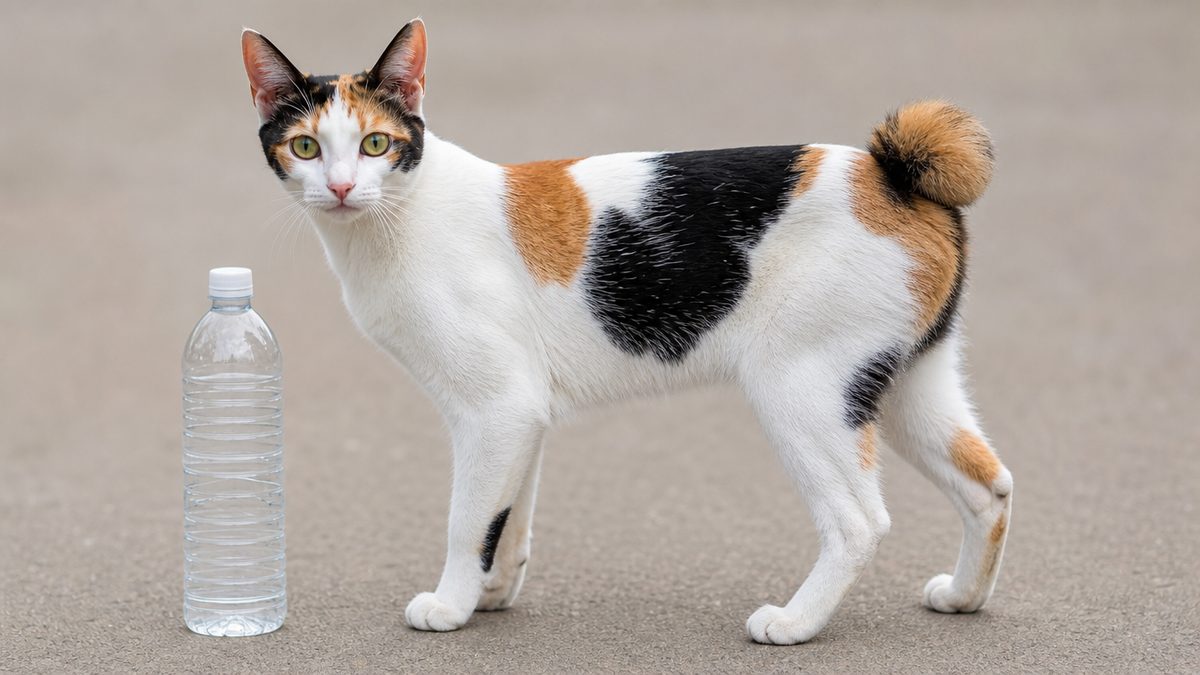
The pom-pom tail is the breed standard's central feature and it is worth reading the wording, because it is unusually specific. CFA: the tail must be clearly visible and is composed of one or more curves, angles or kinks or any combination thereof, and the furthest extension of the tail bone from the body should be no longer than three inches. The direction of carriage is not important, the tail may be flexible or rigid, and the standard explicitly says this is a guideline rather than a promotion of one specific type of tail out of the many that occur within the breed.
FIFe puts numbers on the same thing in centimetres: the furthest extension of the tailbone from the body should be approximately 5 to 8 cm, even though the tailbone, straightened out to its full length, might be 10 to 13 cm long, and the tailbone is usually strong and rigid rather than jointed except at the base. Both standards then require the hair to fan outward into a pom-pom that appears to commence at the base of the spine and camouflages the bone underneath.
In the CFA standard the tail is worth 20 of 100 points, level with head and with body. FIFe gives it 20 of 100 as well. And both disqualify a cat whose tail bone is absent. That is worth holding on to before the next section, because in the Manx standard from the same registry the tail is worth 5 points and the ideal is no tail at all.
Coat, colour and the Mi-Ke
Two coat lengths exist and both are low maintenance, which is the breed's most underrated practical feature. CFA gives the shorthair as medium length, soft and silky, without a noticeable undercoat, and the longhair as medium-long to long, soft and silky, with no noticeable undercoat in the mature adult, a frontal ruff, and coat lengthening toward the rump with longer hair on the tail and rear britches. TICA notes that the lack of undercoat in both hair lengths means there is little shedding outside seasonal coat changes, and that the silky texture makes the longhair less likely to mat or tangle.
On colour, CFA's standard opens with a sentence most breed standards do not contain: no colour or pattern is preferred over any other. In practice the tricolour Mi-Ke of black, red and white is the celebrated one, and preference within the bi-colour and tri-colour classes goes to bold, dramatic markings and vividly contrasting colours. Blue eyes and odd eyes are allowed, and odd-eyed white cats are especially prized.
The three registers do not agree on which colours are allowed, which is a live disagreement rather than an old one. FIFe's JBS colour table accepts black, blue, chocolate, lilac, red, cream, cinnamon and fawn. CFA's current standard accepts chocolate and lilac and carries a Colorpoint and Colorpoint and White class. LOOF states that all traditional colours are accepted except chocolate, lilac, cinnamon and fawn. Same breed, three registers, three different colour lists, all current.
One care instruction that comes from the anatomy
TICA's own page carries a practical warning that follows from the tail's structure and that no Indian page repeats: the bones in the tail are often fused or may be jointed in one or two places, so the cat can wiggle them expressively, but they should only be handled very gently. That is worth saying to children in the house on day one. The next section explains why those bones are shaped that way.
The tail: what the genetics and the radiographs actually show
The Japanese Bobtail's short tail is caused by a missense change in HES7, a somite segmentation gene, and it is inherited as an autosomal dominant with variable expression. Every kinked-tailed cat radiographed had an abnormal vertebral formula, and none of those abnormalities coincided with illness. Both halves of that sentence matter.
This is the question the breed turns on and the one the ranking pages answer badly. Bonbeno resolved it from three papers, read in full rather than from abstracts, and reports the limits as well as the findings.
It is not the Manx gene, and that was established before the causal variant was found
The first thing to establish is negative and it is firm. The 2013 study that identified the Manx mutations sequenced the T gene, encoding Brachyury, in several independent Manx lineages and found three one-base-pair deletions and one duplication-deletion, each causing a frameshift that truncates the carboxy terminal end of the protein. The 2015 Japanese Bobtail study opens by stating that this discovery demonstrated that the Japanese Bobtail does not have a causative mutation in the same gene. Different gene, established by exclusion, before anyone knew what the right gene was.
In 2016 two independent groups found it. A Chinese team built a pedigree of 13 cats from a short-tailed feral founder in southern China, mapped the trait to a 5.6 Mb region of chromosome E1, and identified the substitution c.5T>C in HES7, causing the missense change p.V2A. In the same year the first whole-genome sequencing study ever run in cats, on a Persian to Japanese Bobtail pedigree, reported the same amino-acid change, writing the variant as c.5A>G, and concluded that it was private to the Japanese Bobtail breed.
One group writes the variant c.5T>C and the other c.5A>G. Both give the protein change as p.V2A, so this is the same substitution described from opposite DNA strands rather than a disagreement about the biology. It is worth flagging because a reader comparing the two papers would otherwise think one is wrong.
The mode of inheritance, and where the recessive claim comes from
The mode of inheritance is autosomal dominant, and the first-ranking page for this breed says both things. Wikipedia's Health section states that the recessive gene paired with the shortened tails is not associated with any spinal or bone abnormalities; its Breeding and genetics section, two headings later, states that the short tail is caused by the expression of a dominant gene. One article, two answers.
The primary literature is consistent. Three F1 and one second-generation cat were mated to straight-tailed cats with no Japanese Bobtail ancestry, producing 37 kittens; two were stillborn males unavailable for evaluation, and 15 of the remaining 35, or 43 percent, had kinked or shortened tails, showing no significant deviation from autosomal dominance (chi-square 0.714, 1 df, P = 0.40) and no sex bias (chi-square 0.191, 1 df, P = 0.66). Breeding the male F1 produced only normal-tailed offspring of both sexes, excluding X- or Y-linked inheritance. The Chinese pedigree gave 8 short-tailed to 3 normal in the F1, again consistent with autosomal dominance, with the range of kink severity suggesting incomplete dominance. The paper proposes the locus symbol BTAD-J.
What the radiographs found, including the parts that are not reassuring
Seventeen kinked-tailed cats had the entire vertebral column radiographed, and the findings are more than a short tail.
| Finding | Count | Share |
|---|---|---|
| Kinked-tailed cats with an abnormal vertebral formula | 17 of 17 | 100 percent |
| Carrying the formula C7, T12, L7, S3, Cd11-20 | 14 of 17 | 82.4 percent |
| Caudal hemivertebrae | 8 of 17 | 47 percent |
| Caudal block vertebrae | 7 of 17 | 50 percent of those assessed |
| Transitional cervicothoracic region, ribs on C7 | 5 of 14 | 36 percent |
| At least one hemivertebra inside the kink | 12 of 20 | 60 percent |
| Straight-tailed cats in the same colony with any of this | 0 of 3 | None |
Read the last row. Three straight-tailed cats from the same colony were radiographed and all had a completely normal vertebral formula, with no block vertebrae, no hemivertebrae, no bifid vertebra and no transitional segments in the cervicothoracic, thoracolumbar or lumbosacral regions. That in-study control is what makes the findings attributable to the trait rather than to the colony.
The mean number of caudal vertebrae in kinked-tailed cats was 15.8, ranging from 11 to 21, against a normal 20 to 24. The paper draws the comparison itself: the reduction is less pronounced than in the Manx, where caudal vertebral numbers range from 0 to 23. One cat that died of unrelated causes went to necropsy; the scoliosis of its tail was due to three coccygeal hemivertebrae which were shortened and misshapen but otherwise normal, with no histological evidence of degeneration, consistent with a congenital abnormality rather than a progressive one.
The sentence that answers the welfare question, and the mechanism behind it
The paper's own conclusion is that the abnormal vertebral formula and the placement of the kink did not coincide with morbidity or mortality, and that transitional vertebrae and reduced cervical and thoracic vertebral numbers were not associated with significant morbidity in this group of cats. The anatomical reason is given in one clause and it is the most useful line in the literature on this breed: the tail kinks were almost all remote from the sacrum, thereby reducing the likelihood of concurrent neurologic deficits.
That is the difference from the Manx stated mechanically rather than rhetorically. The Manx problem is not that the tail is short. It is that the defect sits at the sacrum, where the spinal cord ends. The Japanese Bobtail's defect sits further down the tail, away from it.
Against the Manx: two short tails, two genes, two very different records
The Manx and the Japanese Bobtail are the two short-tailed cats an Indian buyer will meet, and they are not comparable. The Manx tail comes from a gene whose double dose appears to be lethal and whose carriers show a documented spectrum of spinal malformations. The Japanese Bobtail's does neither, and the registries say so in their own show rules.
Bonbeno's Cymric page sets out the Manx position in detail and this section does not repeat it. What it does is put the two side by side on the same measures, because that comparison is what makes the reassuring answer here mean something.
| Measure | Japanese Bobtail | Manx and Cymric |
|---|---|---|
| Gene | HES7, somite segmentation | T, encoding Brachyury |
| Type of change | Missense, p.V2A | Frameshift, truncating the protein |
| Inheritance | Autosomal dominant, incomplete | Dominant |
| Homozygotes found alive | 12 of 12 pedigree cats genotyped | None among 82 short-tailed cats |
| Homozygote outcome | Viable, extreme kink phenotype | Presumed embryonic lethal |
| Caudal vertebrae | 11 to 21, mean 15.8 | 0 to 23 |
| Associated malformations | Caudal hemivertebrae and block vertebrae, remote from the sacrum | Sacral agenesis, absent sacral cord, diastematomyelia, tethered cord, intradural lipomas, imperforate anus |
| Share of short-tailed cats with a further anomaly | Not established; none coincided with morbidity in 17 cats | About 20 percent, of which about 90 percent are rumpies |
| Tail points in the CFA standard | 20 of 100 | 5 of 100 |
| Registry view of an absent tail bone | Disqualification, CFA and FIFe | The rumpy ideal, CFA and FIFe |
The homozygote row is the sharpest single contrast
In the Manx study, 95 percent of short-tailed cats were heterozygous for a mutant T allele and no cat was homozygous or compound heterozygous, from which the authors concluded that complete absence of Brachyury results in early embryonic lethality. In the Japanese Bobtail, all 12 pedigree cats genotyped for the HES7 variant were homozygous, and the authors read that as the trait being fixed in the breed. Not merely surviving in a double dose but standard in it.
That difference has a direct practical consequence for a buyer. On the Manx, the question to ask a breeder is what the tail lengths of both parents were, because a tailless-to-tailless mating is expected to lose a quarter of the litter. On the Japanese Bobtail that question does not arise the same way, because breeders routinely mate bobtail to bobtail and the breed is homozygous. The honest caveat, which the 2015 authors state themselves, is that no bobtail to bobtail cross was conducted in their study, so possible in-utero loss of homozygous kittens was never evaluated. The genotyping evidence says homozygotes live. Nobody has formally counted the litters.
The registries state the difference in their own rules
This is the part that needs no interpretation, because two federations wrote it down. CFA's Japanese Bobtail standard: DISQUALIFY: tail bone absent or tail bone extending more than 3 inches from the body. CFA's Manx standard, on the same website, in the same series of documents: TAILLESS: appearing to be absolute in the perfect specimen.
FIFe does the same thing in one edition. Its JBS standard disqualifies a tail bone that is absent or extends too far beyond the body. Its MAN/CYM standard of the identical 01.01.2026 edition defines the Rumpy as absolute absence of tail and awards tail points for absence of tail in the rumpy.
A cat with no tail bone is disqualified as a Japanese Bobtail and is the scored ideal as a Manx, under standards published by the same federation with the same date on them. That is not an accident of drafting. The Japanese Bobtail is required to have a tail, just a short and crooked one, and the trait was never selected toward absence. The Manx was.
The same gene in another species, which is the reason not to be complacent
One finding stops this from being a clean good-news story, and it comes from dogs. An exonic deletion in HES7 causes autosomal recessive spondylocostal dysostosis in miniature Schnauzers, a serious congenital malformation of the vertebrae and ribs. Human and mouse HES7 mutations are likewise associated with a high rate of infant mortality in homozygotes.
So HES7 is not a harmless gene. What appears to be different in the cat is the kind of change. The canine, human and murine mutations produce reading-frame shifts or knockout alleles that destroy the protein's function; the feline p.V2A is a single conservative amino-acid substitution. The authors' own reading is that p.V2A may primarily affect the caudal portion of the vertebrae only without completely diminishing the function of HES7, and they observe that feral cats heterozygous or homozygous for it appear normal and experience no apparent health hazards in urban or rural environments.
The three limits on all of this, stated plainly
- The radiographic study is small and derived from one founder. Seventeen cats had the full spine imaged, all descended from a single donated Japanese Bobtail queen. That is a colony, not a population.
- The cats were young. The paper says explicitly that no health concerns had been reported and that the cats were, to date, all aged five years or younger. A five-year clean sheet is not a lifetime.
- The health remark in the genetics paper is an observation, not a study. The statement that feral HES7 carriers appear normal and face no apparent health hazards is a field observation offered in a discussion section. It is not a cohort followed to death, and no such cohort exists.
Bonbeno's verdict, said in the form the evidence supports. On the available primary literature the Japanese Bobtail's short tail is not the Manx's welfare problem, the mechanism for why is understood, and the registries treat the two traits in opposite directions. That is a genuinely reassuring answer. It rests on one small colony study, one pedigree genotyping study and a field observation, and anyone telling you the question is closed is over-reading three papers.
Registry recognition: five bodies, five different filings
Every major register except Britain's recognises the Japanese Bobtail, and no two of them file it the same way. The disagreements are about coat length, about the Kurilian Bobtail and about the three-letter code, and each one has a practical consequence.
Registry recognition was read on 8 September 2026, with an in-document control on each source, and date-stamped because register membership drifts in weeks.
CFA: one breed, two divisions, and the Kuril Islands decision
CFA's registration rules give the acceptance dates in one block: registration effective 9/69, provisional 5/1/71, championship 5/1/76, and championship for longhairs effective 5/1/93. Allowable outcross breeds: none. Breed codes are 13 for shorthair and 60 for longhair, with BCS series 6600 and 6700, so the two coats are divisions of one breed rather than two breeds. CFA's breed council list confirms it, carrying a single Japanese Bobtail council among the Shorthair Breeds.
Two rules there deserve a reader's attention. REGISTER AS AOV: Tailed means a Japanese Bobtail born with a normal tail is not thrown out of the register; it is recorded as Any Other Variety. And a 2004 decision, updated 2/19, records that imported bobtails from the Kuril Islands were accepted for registration as Japanese Bobtails instead of recognising them as a separate breed, registered with the prefix FOR BREEDING ONLY. Every other register on this page holds the Kurilian Bobtail separately.
One more provision is unusual and tells you how the breed is maintained. Imports from Japan may be registered with unknown or unregistered parents, on submission of two photographs of the cat, one of which must show the tail, with approval by the Breed Council Secretary. A closed studbook with a documented door to the street cats of the country of origin is rare, and it is part of why the breed's genetic diversity is what it is.
TICA: two rows in the index, one committee behind them
TICA lists Japanese Bobtail and Japanese Bobtail Longhair as separate entries in its championship A-Z, and then runs a single Japanese Bobtail (SH/LH) Breed Committee of three people. It recognised the shorthair for competition in June 1979 and the longhair only in March 1991, despite both coats having existed for centuries.
One thing about that index is worth recording as an instrument note. Its own prose says TICA recognises 73 cat breeds while the list beneath it carries 81 rows. The likeliest explanation is that TICA counts a breed once where its list enumerates the longhair and shorthair divisions separately, and the Japanese Bobtail is one of the cases that produces the gap. Quote the rows you counted and say so.
FIFe: the shorthair only, and it is filed with the Siamese
FIFe's register, parsed on the EMS three-letter code rather than on link slugs, returns 52 rows and holds JBS, Japanese Bobtail Shorthair, in Category 4, the Oriental group, alongside SIA, BAL, OSH and OLH. There is no JBL. The standard confirms it from the other direction: the word Longhair appears nowhere in the FIFe JBS document. FIFe recognised the breed in 1989.
That is a genuine restriction rather than a filing quirk. FIFe splits the Manx and Cymric into two breeds by coat length and splits the Kurilian into KBL and KBS, so it is perfectly willing to make longhair divisions into breeds. It has simply not recognised a longhaired Japanese Bobtail at all.
GCCF: zero occurrences, with six controls
Britain does not recognise the breed. The GCCF's June 2026 Standard of Points runs 315 pages, and Bonbeno's own pypdf extraction of it came to 723,662 characters. The strings Japanese Bobtail and Bobtail each appear zero times. Absence is a strong claim, so it was earned with controls read from the same extraction in the same session: Exotic 205, Persian 168, Siamese 47, British Shorthair 32, Birman 16 and Manx 7. The instrument works and the breed is not there, which is also what one ranking page correctly tells UK readers.
WCF and LOOF, and a code that does not match
The World Cat Federation's EMS table gives the shorthair code JBT, recognised by WCF, CFA, FIFE, TICA, ACF, CCCA, NZCF, SACC and LOOF, and gives the longhair code JBL, recognised by the same list minus CFA and FIFe. The FIFe half of that is correct, since FIFe holds no longhair. The CFA half is not: CFA has held a Longhair Division with championship status since 1 May 1993. A cross-registry map is a very useful starting instrument and it still has to be checked against the register it describes.
Note also that the codes themselves disagree. WCF calls the shorthair JBT; FIFe calls it JBS Federation Internationale Feline. Breeds. Read a three-letter code from the document you are actually citing.
LOOF, the French national studbook, lists JAPANESE BOBTAIL once in its index of 51 recognised breeds, with no separate longhair heading, and describes both varieties inside one record Livre Officiel des Origines Felines.…. Its history section states that the breed was recognised in 1976 by the Cat Fanciers' Association, which matches CFA's own championship date of 5/1/76 exactly and is a rare instance of two registers cross-confirming each other The Cat Fanciers' Association. Registration….
History, folklore and the genetics finding that complicates it
The Japanese Bobtail is documented in Japanese art for centuries and is the cat behind the beckoning Maneki-neko. The breed as it exists in Western registers is fifty-odd years old, and its genome does not look Japanese, which is a real finding rather than a debunking.
The history as the registers tell it is consistent. Cats reached Japan from the Asian mainland long ago; LOOF records that the first are said to have come from China as early as the sixth century, and that at the end of the tenth century Emperor Idi-Jo imported cats from Korea to protect his manuscripts from mice. TICA says short-tailed cats are portrayed in Japanese manuscripts and paintings for at least a thousand years, and names a fifteenth-century painting in the Smithsonian Institution's Freer Gallery of Art showing two longhaired bobtails with feathery pom-pom tails.
The good luck association is the reason most Indian buyers have heard of the breed at all, because the Maneki-neko figurine with the raised beckoning paw is a bobtailed tricolour cat. TICA also records the practical origin story: in the 1600s rodents infested Japan's silkworm barns and threatened the silk trade, authorities ordered people to set their cats loose on the streets, and over time the Japanese Bobtail became the country's de facto street cat.
How it reached the West, and when
The Western breed begins in 1968. LOOF records that Elizabeth Freret imported the first three Japanese Bobtails that year, and TICA adds that the breeder Judy Crawford sent the first cats to Freret from Japan, later bringing more herself and working with Freret to get the breed recognised. CFA accepted the breed for registration in September 1969 and granted championship on 1 May 1976. Everything downstream of that is registry chronology rather than history.
The genetics finding nobody quotes
The largest survey of cat breed genetics put the Japanese Bobtail somewhere unexpected. Across breeds and random-bred populations worldwide, Asian breeds separated early and clustered together, but of the Asian breeds only the Japanese Bobtail grouped strongly with Western cats, albeit with some Asian influence. The authors state it directly: the Japanese Bobtail does not appear to hail from its stated origins of Japan, and Japanese Bobtails from the USA appear to have been influenced more in their gene pool by European cats than by Asian cats.
Two things are true at once. The mutation is Asian: the HES7 variant is common in short-tailed feral cats of southern China and Southeast Asia, and Charles Darwin recorded short kinked tails in the Malayan archipelago in 1868. The Western breeding population is not: the small number of founders imported from 1968 were bred within American and European catteries and their genomes reflect that. A breed can have an ancient Asian trait and a recent Western pedigree, and this one does.
That reading also explains CFA's unusual import provision. Allowing registration of Japanese imports with unknown or unregistered parents, on two photographs with the tail visible and Breed Council approval, is a mechanism for pulling the original population back into a Western studbook. It is the register acting on exactly the problem the genetics identified.
One consequence for the buyer: genetic diversity, with a number
The same survey measured genetic diversity across breeds, and the Japanese Bobtail comes out well. Across 32 cats it recorded observed heterozygosity of 0.60 against 0.67 expected, allelic richness 3.14, and an average inbreeding coefficient of F_IS 0.12. For scale in the same table, the Persian returned 0.51 observed and F_IS 0.19, the Siamese 0.47, the Havana Brown 0.41, and the highest figure visible was the Norwegian Forest Cat at 0.61.
One ranking page tells UK readers that Japanese Bobtails are one of the most genetically diverse and healthy pedigree breeds. On the diversity half, the primary data supports it and this page can give the reader the actual number rather than the adjective. That is a ranking page being right, which is worth saying as clearly as this site says the opposite when it happens. The health half is weaker, and the health section below explains why.
Japanese Bobtail cat price in India: two bands that do not overlap
Two Indian pages publish a Japanese Bobtail price and their bands do not touch: one ends at Rs 1,10,000 and the other begins at Rs 1,50,000. Neither is verifiable against an actual Indian sale, because there is no evidence of an Indian breeding population at all.
Bonbeno reports published price in india figures as editorial content and never as an offer. We do not sell cats, broker sales or recommend breeders. What follows is what the Indian market prints, read from raw markup on 8 September 2026.
| Source | Band printed | Note |
|---|---|---|
| HappyPet India, 3 Sept 2025 | Rs 70,000 to Rs 1,10,000 | Single band, no quality grades |
| Wrapinfur, 14 July 2026, adoption | Rs 5,000 to Rs 25,000 | Described as very rare |
| Wrapinfur, pet quality | Rs 1,50,000 to Rs 2,80,000 | Floor sits above the other source's ceiling |
| Wrapinfur, show quality | Rs 2,80,000 to Rs 4,50,000 | |
| Wrapinfur, champion bloodlines | Rs 4,50,000 to Rs 7,00,000+ | Stated as after import-related expenses |
| Google AI panel | USD 600 to 1,600 | No rupee figure offered at all for an Indian query |
The two bands do not overlap by a single rupee. HappyPet's ceiling is Rs 1,10,000 and Wrapinfur's pet-quality floor is Rs 1,50,000, so the cheapest cat one page will sell you is 36 percent more expensive than the dearest cat the other will. At the top the gap is 6.4 times. There is no way to reconcile these, and the honest thing to publish is the gap.
Running the division tests
Indian breed pages routinely print a dollar figure converted at one rate and presented as rupees, so every figure was divided by 84.38, by 80 and by 74. None divides cleanly at 84.38 or 74. The apparent matches at 80 are the arithmetic artefact this site keeps warning about, because any rupee figure ending in three zeros divides cleanly by 80 by construction. What settles it is the quotients: Rs 70,000 gives 875, Rs 1,10,000 gives 1,375, Rs 4,50,000 gives 5,625 and Rs 7,00,000 gives 8,750. No cattery anywhere prices a kitten at 5,625 or 8,750 dollars. These are rupee-native, arbitrary figures rather than converted ones.
Asked about a breed in India, Google's AI panel said buyers pay between 600 and 1,600 dollars and offered no Indian figure. That is more honest than inventing one, and it is also a signal: the engine could not find an Indian market to describe either. Neither could we.
What the rarity instrument says, and why it matters more than either band
France's national studbook is the best per-breed count in the cat fancy because it publishes a live figure. Read on 8 September 2026, in the same register on the same day: Japanese Bobtail 2 kittens born in the last 365 days, Manx and Cymric 8, Kurilian Bobtail 20, Exotic Shorthair 155, Persian 436, Chartreux 584 Livre Officiel des Origines Felines. Manx… Livre Officiel des Origines Felines.… Livre Officiel des Origines Felines.…. The LOOF record also lists no dedicated breed club for the Japanese Bobtail, giving LOOF's own address instead.
Two kittens a year in one of Europe's larger pedigree markets is the context for any Indian price. Both Indian pages say the kittens are imported, and Wrapinfur states that since very few are bred domestically most kittens sold in India come from breeders in Japan, Europe or the United States. Bonbeno found no evidence of an Indian breeding population, no Indian cattery advertising the breed, and no Indian listing with a photograph of a specific animal. A price quoted for a supply that does not visibly exist is a projection, not an observation.
One claim in the Indian pricing that is worth checking against the law
Wrapinfur states that the purchase price often includes vaccinations, deworming, microchipping and pedigree registration. Microchipping a valuable imported cat is a good idea. It is not a legal requirement in India, and a seller should not present it as one: rule 7(16) of the Pet Shop Rules 2018 requires that every puppy be microchipped by a veterinary practitioner and that only microchipped puppies be sold. It says puppies. Kittens fall outside it entirely.
The Google AI panel also asserts that the breed is uncommon globally partly because Japanese Bobtails give birth to smaller litters than most other cat breeds, usually only two to four kittens. The only published study of the breed's reproduction reports litter sizes ranging from one to seven with an average of four, and states in terms that reduced litter sizes were not suggested. The rarity is real. That explanation for it is not supported.
What a Japanese Bobtail costs to keep in India each month
This is a cheap cat to keep and an expensive one to acquire, which is the reverse of most breeds on this site. The grooming line is small, there is no breed-specific screening test to budget for, and the monthly figure the Indian pages print is a template constant shared with unrelated breeds.
Start with the number not to use. HappyPet India gives the Japanese Bobtail an average monthly cost of Rs 2,800 basic and Rs 4,200 premium, with food at Rs 1,500 to Rs 2,000. The identical row, to the rupee, appears on the same site's Persian page and its Colorpoint Shorthair page HappyPet India. Colorpoint Shorthair cat…. Three breeds with nothing in common, one row. The totals are assembled from a small set of preset component lines, so a matching figure describes the template rather than the cat.
Put the cost of ownership in the right order before reading any table. For this breed the purchase price dominates and the recurring monthly figure is small, which reverses the usual pattern on this site. A Persian's cost of ownership is mostly grooming and veterinary attention spread over fifteen years. A Japanese Bobtail's is almost entirely the money you spend on day one.
A Persian needs daily combing of a dense double coat. A Japanese Bobtail needs a brush twice a week and has almost no undercoat. Any cost table that gives both the same grooming line has not looked at either animal. That single comparison is enough to set the whole row aside.
The sourced Indian figures that do hold
| Item | Published figure | Source and note |
|---|---|---|
| Kitten vaccination course, 3 visits | From Rs 3,999 (list Rs 5,065) | Vetic; one chain's promotional floor, not a market average |
| Adult annual booster | From Rs 1,899 | Vetic |
| Rabies, single | Rs 699 | Vetic |
| Municipal pet licence, Chennai | Rs 50 | Greater Chennai Corporation licenses pet animals generally |
| Treatment and anti-rabies at a GCC clinic | Free | Six municipal veterinary clinics in Chennai |
| Grooming | Owner time, roughly 10 minutes twice a week | No professional grooming line is needed for this coat |
| Breed-specific health screen | None exists | TICA names no screening test for this breed |
Two municipal points, because Indian cat pages routinely get them wrong. Delhi's MCD scheme registers pet dogs only, so its fee is not a cat cost. Greater Chennai Corporation licenses pet animals generally at Rs 50, and its six veterinary clinics provide all treatment and anti-rabies vaccination free of cost.
The lines that are genuinely breed-specific, and they are unusual
- Import cost, if you go that route. Both Indian sources say kittens are imported HappyPet India. Japanese Bobtail cat breed…, and Wrapinfur states the price often includes transportation, health certifications, pedigree registration and import formalities. That is a real cost and it is opaque, which is precisely why the two published bands are so far apart.
- Vertical furniture rather than grooming tools. The money that goes on combs and clinic grooming for a Persian goes on tall stable perches here. This is a leaping, climbing, exploring cat, and TICA states plainly that it is not a lap cat.
- Enrichment that survives use. Puzzle feeders, fetch toys and things it can splash in. TICA specifically notes it likes to splash its paws in water and plays fetch, and recommends teaching tricks and providing puzzle toys.
- Cooling, but less of it than most imports. The climate section explains why the muzzle and the coat both work in this cat's favour, so this is a smaller line than for a long-coated flat-faced breed.
The cost that does not appear on any Indian page
There is no published Indian veterinary cost specific to this breed, because there is no Indian population to have generated one. What can be said, from the register documents, is what you will not be paying for. There is no mandatory or advisory breed health test: TICA's health section for the Japanese Bobtail says only that the breed is considered overall healthy and that vaccinations and parasite treatments should be kept up to date. On the same site, the Himalayan page names four things to check for, including polycystic kidney disease and hypertrophic cardiomyopathy. Same registry, same page template, two very different health sections, and that contrast is itself information.
Set against the acquisition price, that is the honest summary of this cat's economics in India. If someone quotes you Rs 4,50,000 for a champion-bloodline kitten, the recurring cost afterwards is among the lowest of any pedigree cat on this site. Whether the acquisition figure means anything is the question the price section could not answer.
Indian heat, and why the humidity warning is the wrong warning
Japan is more humid than India, year-round and by a wide margin, so the standard warning that Indian damp will overwhelm an imported breed is simply wrong here. What India adds is heat, and on wet-bulb load two Indian cities are easier for this cat than its own homeland.
Bonbeno queried NASA POWER climatology by explicit latitude and longitude on 8 September 2026 and echoed back the elevation the model reports for each cell, because a grid cell is not a town. The Indian plains points came back close: Delhi 9.6 m low, Kolkata 1.7 m low, Chennai 43.0 m high, Bengaluru 78.3 m low, Mumbai 83.2 m high, Pune 76.0 m high. The Japanese points are less exact and the divergence is stated rather than hidden: the Kyoto cell reports 251.31 m against a city near 56 m, an error of about +195 m, and Tokyo 232.92 m against about 40 m, about +193 m. At a standard lapse rate that makes the Japanese temperatures roughly 1.3 degrees C too cool, which is small enough not to change the argument and large enough to declare.
| Place | Annual T2M | Annual RH2M | Hottest month mean | Peak mean wet bulb |
|---|---|---|---|---|
| Kyoto | 13.73 C | 83.23 % | 25.69 C in August | 23.58 C in August |
| Tokyo | 13.91 C | 80.63 % | 25.82 C in August | 23.45 C in August |
| Kolkata | 25.81 C | 73.93 % | 31.53 C in May | 27.09 C in June |
| Chennai | 27.95 C | 72.39 % | 31.51 C in May | 26.11 C in May |
| Delhi | 25.60 C | 45.56 % | 35.88 C in June | 26.50 C in July |
| Mumbai | 26.77 C | 67.39 % | 31.19 C in May | 25.77 C in June |
| Pune | 23.86 C | 66.80 % | 28.93 C in April | 22.97 C in June |
| Bengaluru | 23.74 C | 67.94 % | 28.37 C in April | 21.86 C in May |
Kyoto's annual relative humidity is 83.23 percent, against Kolkata's 73.93, Chennai's 72.39, Bengaluru's 67.94 and Delhi's 45.56. A cat whose ancestors lived through a Kyoto August at 84 percent humidity is not going to be defeated by Indian damp. What Kyoto does not have is India's temperature: 13.73 degrees C annual mean against Chennai's 27.95, a gap of 14.2 degrees. The risk is heat, or heat combined with humidity, and not humidity by itself.
The result that will surprise most readers
Rank the cities by peak mean wet bulb, which is what governs how much cooling an animal can still get from evaporation, and two Indian cities come out below Kyoto. Bengaluru peaks at 21.86 degrees C and Pune at 22.97, against Kyoto's 23.58. On that measure a Japanese Bobtail in Bengaluru faces an easier summer than one in Kyoto. Kolkata at 27.09 is 3.5 degrees C worse than the homeland, and that is the genuinely hard posting.
Two features of the breed itself help, and both come from the standards. The coat is medium length, soft, silky and without a noticeable undercoat in either hair length, so there is far less trapped insulation than in a Persian or a Maine Coon. And the muzzle is long, defined by two parallel lines from tip to brow, so the nasal surface that does the evaporative work is full length. Nothing in this cat's construction fights Indian heat the way a brachycephalic long-coat does.
What that means practically, city by city
- Bengaluru and Pune. The two easiest Indian postings on wet-bulb load, both below the homeland's own August. A shaded, ventilated flat is enough for most of the year.
- Mumbai and Chennai. Manageable with a cooled room through the hot months. Chennai's May at 31.51 degrees C mean is the pressure point, not the monsoon.
- Delhi. The dry-heat case. June at 35.88 degrees C mean is the highest air temperature in the table, and the low humidity actually helps evaporative cooling, which is why its wet bulb is below Kolkata's despite the far hotter air.
- Kolkata. The hardest of the six, at a 27.09 degrees C peak mean wet bulb, 3.5 above Kyoto. Cooling here is not a luxury.
- Move play to the cool hours. This is a high-activity cat that will exercise itself hard. The climate constraint bites during play, not during rest.
The Indian law that puts this on a shop rather than on you
Rule 6(5) of the Pet Shop Rules 2018 requires that the temperature where animals are displayed or housed for sale be comfortable, that it may vary from animal to animal and from breed to breed, and that it is incumbent upon the pet shop owner to familiarise himself with the requirements of the breeds or species he intends to deal in and provide an ambient and comfortable temperature for them. Rule 7(1) adds that animals must at all times be housed in accommodation suitable to their species with respect to situation, size, temperature, lighting, ventilation and cleanliness. A shop importing a Japanese breed into an Indian summer has a written obligation to know what that breed needs, and the registration form asks it to state its cooling and power backup arrangements.
Temperament, and who should not buy one
The Japanese Bobtail is talkative, athletic, sociable with children and dogs, and explicitly not a lap cat. Every register says the same thing, which is unusual, and the disagreement is only about how much noise you are being promised.
On temperament TICA is direct: talkative, with voices described as almost songlike, communicating through a wide range of chirps and meows; very active and intelligent; loving, outgoing personalities; loyal to their family and adapting well to other pets and children, including dogs; often found perched on the shoulder of a family member; and not lap cats, in that they will settle for a short nap and then go. LOOF adds the calibration that matters if you have met a Siamese: it is rather outgoing with constant curiosity, but not as demanding and talkative as a Siamese, and says it is hard to put a Japanese Bobtail in a bad mood.
The playful and athletic side is not marketing. TICA notes the breed is known for great jumping and excels at feline agility, likes to splash its paws in water, plays fetch, and is highly curious. LOOF describes big cavalcades powered by the long back legs. A vocal, athletic cat that talks to you and rides on your shoulder is the honest description.
Who this cat suits
- Households with children old enough to play properly. The registries name children explicitly, and this is a robust, interactive cat rather than a fragile ornament.
- Homes with a dog. TICA names dogs specifically among the pets it adapts to, which is not something most breed pages can say.
- People who want to interact with a cat. Fetch, tricks, puzzle feeders and conversation are all on offer here and all wasted on most breeds.
- Bengaluru and Pune households. The climate section shows those two cities sit below the breed's own homeland on wet-bulb load.
- Owners who do not want a grooming routine. Two brushes a week with no undercoat is as light as pedigree cat care gets.
Who should not buy one
- Anyone who wants a quiet cat. This one talks, and it is described as songlike rather than as occasional.
- Anyone who wants a lap cat. TICA says outright that it should not be considered one. Buyers who wanted a Persian's stillness in a Japanese package will be disappointed by a real animal.
- Anyone in a flat with nothing to climb. The leap is the breed's defining behaviour and a cat that cannot use it becomes a cat that uses your curtains.
- Anyone who cannot verify what they are buying. With two Indian price bands that do not overlap, no visible Indian breeding population and a phenotype that superficially resembles several other bobtailed breeds, this is a breed where the paperwork question matters more than usual.
- Anyone in an uncooled Kolkata flat. At a 27.09 degrees C peak mean wet bulb it is the one Indian city that is meaningfully harder than the homeland.
Blue eyes and odd eyes are permitted in the standard and are especially prized in cats with a lot of white. Heterochromia is more common in this breed than in most, with the Turkish Van as the notable exception. It is a pigment trait rather than a health trait in itself, but deafness is associated with the white spotting and blue-eyed genetics in cats generally, so a white, blue-eyed or odd-eyed kitten of any breed is worth a hearing check. That is a general feline caution, not a Japanese Bobtail finding, and this page will not dress it up as one.
One legal point on multi-species households, carried over because Indian buyers ask. The Pet Shop Rules 2018 require at Second Schedule paragraph 2(f) that cats or kittens be kept in a room not shared by other, inimical animal species such as dogs, and at rule 7(2)(j) that dogs and cats not be kept adjacent to each other because it causes acute stress. Those rules govern shops rather than homes, and the registries' own advice for this particular breed is that it adapts well to dogs. Both can be true: a caged cat beside a dog run and a family cat that grew up with the household labrador are not the same situation.
Two of the pages ranking for this term in India describe the same temperament in commercial language, and they are consistent with the registries rather than with each other's marketing. Royal Canin's India breed page says Japanese Bobtail cats are full of energy, always playful, loving, endearing and happy, with a very friendly and sociable nature. CFA's own Cat Talk feature, written for an audience that already owns these cats, is titled From the Streets of Japan to the Judging Tables of the World and covers living with a Japanese Bobtail or two. Where a registry, a national studbook and a pet-food company independently describe the same animal in the same terms, that description is probably the animal.
Training a Japanese Bobtail, and the one thing to teach first
Teach gentle tail handling before anything else, because the tail bones are often fused and the cat cannot tell a child to stop. After that this is one of the most trainable cats you will meet.
Start with the tail, because it is the one instruction unique to this breed and it comes from the registry rather than from folklore. TICA states that the bones in the tail are often fused or may be jointed in one or two places, so the cat can wiggle them expressively, but that they should only be handled very gently. The radiographic study explains why: hemivertebrae and block vertebrae involving the caudal vertebrae were found in roughly half the cats examined, and while none of it coincided with illness, these are shortened and misshapen bones rather than normal ones.
- Set the household rule on day one. Nobody picks the cat up by the tail, nobody pulls the pom-pom, nobody uses it as a handle. Say it to children before the cat arrives.
- Handle the tail yourself, briefly and daily, with food. A cat that accepts gentle tail contact from you is a cat a vet can examine without a fight.
- Watch for a change rather than for a shape. The kinks are normal and individual. A cat that suddenly resents its tail being touched, or that stops carrying it upright, is worth a veterinary look.
- Do not let anyone tell you a tail can be tidied. Rule 7(14) of the Pet Shop Rules 2018 bars the sale of any pet animal with any form of mutilation, and this is a breed where a shortened tail is the selling point.
After that, train it properly, because it will repay you
TICA's own recommendation is to play with this cat's mind: challenge them by teaching tricks and providing puzzle toys that reward them with treats. That is unusual advice from a registry breed page and it should be taken literally. A curious, food-motivated, high-energy cat that already plays fetch is close to ideal for shaping.
- Fetch is often already there. TICA names it as something the breed does. Reward the return rather than the chase and you have a game that burns real energy in a small flat.
- Target training in five-minute blocks. Touch a stick with the nose, follow it onto a perch, into the carrier, onto the scales. Four behaviours that make ownership easier.
- Carrier as furniture. Leave it out permanently and feed in it. For a breed that may need air travel or a long car journey to reach you, this one is not optional.
- Recall on a distinct sound. A vocal cat that answers is a cat you can find, which matters in a household with an open balcony.
- Water play is a legitimate outlet. TICA notes the breed likes to splash its paws in water. A shallow tray with a floating toy is a hot-afternoon activity that also helps the cat hydrate.
Teach this cat to walk into a carrier on cue and to sit still on a weighing scale. Both take a fortnight of five-minute sessions. Both make every future veterinary visit cheaper, faster and less stressful, and in a breed with no routine screening test the annual weigh-in and physical is the entire health programme.
What this cat will resist
Very little, which is the point, but two things reliably fail. Being made to sit still on a lap for a photograph is one; TICA is explicit that this is not a lap cat and it will leave. And any regime built on ignoring the cat is the other. A vocal, human-oriented, shoulder-riding animal that is left alone all day becomes a loud and destructive one, and no amount of later training fixes a boredom problem that furniture and company would have prevented.
Daily exercise, and what happens without it
Plan two or three real play sessions a day and build upwards rather than outwards. This is the highest-activity cat on this section of the site and the one most likely to invent its own exercise if you do not supply any.
The anatomy sets the requirement. The hind legs are noticeably longer than the forelegs and deeply angulated, which TICA describes as a deep Z shape giving immense power to the leap and letting the cat spring to great heights with ease. CFA's standard describes legs that are long, slender and high but not dainty, and a torso that stays level because of that angulation. This animal is built to jump and it will.
- Two or three sessions of ten to fifteen minutes. Wand toys, thrown toys it can fetch, and something it has to solve.
- Vertical beats horizontal. Stable shelves and tall perches use the leap. Floor space does not.
- Rotate the toys. A curious cat that has solved a puzzle feeder is bored of it. Three cheap toys in rotation beat one expensive one.
- Use the balcony safely or not at all. A cat that can reach a bookcase top can reach a balcony rail. Mesh it before you buy the cat, not after.
Time it to the heat
The climate section shows the constraint bites during exertion rather than at rest. In Chennai in May the mean temperature is 31.51 degrees C and the peak mean wet bulb 26.11, well above anything Kyoto reaches. Move the hard sessions to early morning and late evening through the hot months and keep the middle of the day for puzzle feeders, which work the mind without generating heat.
What happens without it
Two outcomes, and Wikipedia names the second one for this breed specifically: they enjoy climbing and can be prone to obesity. The first is behavioural, and in a shoulder-riding vocal cat it shows up as night activity, counter-surfing and noise rather than as withdrawal.
The weight point has a published consequence attached, even though it is not breed-specific. The UK feline life table found that non-ideal body weight was significantly associated with a decreased lifespan, alongside being entire and being purebred. This breed has no row in that table because it is too rare to have reached the threshold of 15 deaths, so the general finding is the best available guide. An athletic cat kept lean and neutered has the two modifiable factors on its side.
Grooming: the lightest routine of any pedigree cat on this site
Brush twice a week, more during the two seasonal moults, and that is essentially the whole routine in both coat lengths. The absence of an undercoat is the reason, and it is a genuine advantage in Indian humidity.
Grooming here is unusually light and the standards explain why. CFA gives the shorthair coat as medium length, soft and silky, without a noticeable undercoat, and the longhair as medium-long to long, soft and silky, with no noticeable undercoat in the mature adult. TICA draws the consequence: the lack of undercoat in both hair lengths means there is little shedding other than at seasonal coat changes, and the silky texture means the longhair is also less likely to mat or tangle.
That single structural fact is worth more in an Indian July than any grooming product. A dense undercoat is what holds moisture against the skin in monsoon humidity, and it is what felts into mats when a cat is not combed daily. This breed has almost none of it in either coat length.
| Task | Frequency | Note |
|---|---|---|
| Brush or comb | Twice weekly | More often during autumn and spring shedding |
| Nails | Trimmed regularly | TICA's general guidance for the breed |
| Ears | Cleaned regularly | Worth a monthly look in Indian humidity and dust |
| Teeth | Regularly, vet-approved paste | The single most neglected item in Indian cat care |
| Scratching post | Provide a tall one | TICA specifies a nice tall post for the natural scratching instinct |
| Tail | Handle gently, do not groom aggressively | The bones are often fused; treat the pom-pom carefully |
The two coat lengths, and what actually differs
The longhair carries a longer coat draping the body with a belly shag and definite britches on the hindquarters underneath a tail TICA compares to a chrysanthemum, while the shorthair's coat lies flat against the body and emphasises the lines of the cat. Practically, the longhair takes a few minutes more per session and sheds a little more visibly. It does not take daily work, because there is no undercoat to felt.
The commonest error an Indian owner makes with an imported longhair is applying advice written for a different coat. This breed does not need daily combing, does not need clipping in summer, and does not need a de-shedding tool designed to strip undercoat it does not have. Twice a week with a soft slicker or a wide-toothed comb is the routine, and over-grooming a fine silky coat with an aggressive tool damages it.
Bathing, and the water thing
Most cats do not need bathing and this one is no exception, but it is unusually likely to cooperate. TICA notes the breed likes to splash its paws in water, and LOOF says the closely related Kurilian will join its owner in the bath Livre Officiel des Origines Felines.…. If Indian dust or a monsoon soaking makes a rinse worthwhile, dry the cat through with a towel and warm air rather than letting a damp coat sit, which is sound practice in 90 percent humidity regardless of how thin the undercoat is.
Shedding, and what to expect through an Indian year
TICA notes the breed tends to shed during the autumn and spring and needs brushing more frequently in those seasons. That schedule is written for a temperate climate with a sharp seasonal light cycle, and it is worth saying plainly that Bonbeno found no published data on how an Indian light and temperature cycle changes feline moult timing. Expect the pattern to be less sharply seasonal in an air-conditioned Indian flat and to be driven by daylight rather than by the calendar. Brush more when you see more hair, which is the honest instruction when the imported advice does not transfer.
Health, screening and the life expectancy nobody has measured
There is no breed-specific health test for the Japanese Bobtail, no registry recommends one, and no published life table contains a row for it. That is an unusual combination on this site and it needs reporting honestly in both directions.
Start with the health issues the registries themselves name, because the contrast is informative. TICA's health section for this breed reads, in full: the Japanese Bobtail is considered an overall healthy breed, however it is recommended their vaccinations and parasite treatments are kept up to date. No condition is named and no screening test is recommended. On the same site, using the same page template, the Himalayan's health section names polycystic kidney disease, respiratory problems, progressive retinal atrophy and hypertrophic cardiomyopathy. Same registry, same format, and one page has four things to say while the other has none.
That is a real signal rather than an oversight, and it is consistent with what the genetics shows. Across the reference survey of cat breeds the Japanese Bobtail returned observed heterozygosity of 0.60 against 0.67 expected, allelic richness 3.14 and an average inbreeding coefficient of F_IS 0.12, placing it among the most diverse pedigree breeds measured. A wide gene pool is not a guarantee of health, but it is the condition under which recessive breed-limited disease is least likely to concentrate.
What the tail does and does not add to the health picture
The tail section sets this out in detail and the summary belongs here. The trait is caused by a missense change in HES7 rather than by the Manx T-gene mutations; every kinked-tailed cat radiographed had an abnormal vertebral formula, with caudal hemivertebrae in 47 percent and block vertebrae in about half; and none of it coincided with morbidity or mortality, with the kinks sitting almost entirely remote from the sacrum. Homozygotes are viable and appear to be the norm in pedigree cats.
What to screen for, then, is nothing specific. The practical programme for this breed is the general one: an annual physical with a weigh-in, vaccinations and parasite control kept current, and attention to anything that changes.
Because the vertebral anomalies exist even though they were not associated with illness in the cats studied, an owner should know what a problem would look like. Hind-limb weakness or an abnormal gait, straining or dribbling urine, faecal incontinence, or constipation are the presentations associated with sacral and caudal spinal problems in short-tailed cats generally. In a Japanese Bobtail these are not expected. If they appear, they are a same-day veterinary matter and not something to research online.
The absence that has to be stated: there is no life expectancy figure
Three sources give a lifespan and none of them is a study. TICA says 9 to 13 plus years. HappyPet India says 9 to 15. Wrapinfur says 12 to 16, often longer. Those are breed-page assertions, not measurements, and they span seven years at the top end.
The only published feline life table, built from 7,936 confirmed deaths under UK primary veterinary care, analysed the twelve breeds with 15 or more deaths. The Japanese Bobtail is not among them, because it is too rare in the UK to have reached that threshold. What that study can offer this page are the population figures and the risk factors: life expectancy at age 0 for all cats was 11.74 years, crossbred cats reached 11.89 and purebred cats 10.41, and being entire, being purebred and having a non-ideal body weight were each significantly associated with a shortened lifespan.
What the literature contains under this breed's name, counted
Searching PubMed on 8 September 2026, the phrase "Japanese Bobtail" restricted to title and abstract returns six records, and reading them shows the true count is smaller: one is about the Hawaiian bobtail squid and its Vibrio symbionts, a homonym rather than a cat paper. Of the remaining five, two are the breed's own studies, one is the Manx paper that establishes the contrast, one is the founding cat-genome paper and one is the breed-diversity survey. The control query, Labrador retriever hip dysplasia, returned 126 records in the same session, so the instrument was working.
Five papers is the entire veterinary and genetic literature on this breed, and four of the five are about the tail. There is no epidemiological study, no clinic caseload analysis, no cardiac screening dataset and, so far as Bonbeno could establish, no Indian data of any kind. Saying so is more useful than filling the gap with a lifespan number somebody else guessed.
Thin literature is not the same as good health, and this page will not pretend otherwise. What can be said is that the one question anybody has studied properly, the tail, came back reassuring with named limits; that the breed's measured genetic diversity is high; that the registry that names four conditions on a related page names none here; and that nobody has looked hard enough to find something that might exist. Buy the cat knowing which of those four statements is evidence and which is absence.
Feeding an athletic cat in India
Feed a complete high-protein cat food, control the portion against the waistline rather than the bowl, and get water into the animal. There is no breed-specific nutritional requirement here, and the one ranking Indian page that prints a calorie table prints a template value.
Feeding this breed is ordinary good cat nutrition. One ranking UK page puts it plainly, saying the breed has no specific feeding requirements, and TICA's own nutrition section says Japanese Bobtails do not have any particular nutritional needs other than good quality food. What differs from a Persian is the energy budget: this is a high-activity cat, and an active young adult burns more than a cat that sleeps twenty-two hours a day.
The Indian calorie table, checked
HappyPet India's Japanese Bobtail page prints daily calories as kittens 250 kcal and adults 300 kcal. Its Colorpoint Shorthair page prints the same pair, 250 and 300, while its Persian and Himalayan pages print the reverse, 300 for kittens and 250 for adults. Those are template values that flip between pages rather than breed-derived figures, and a growing kitten's requirement per kilogram is higher than an altered adult's regardless of which way round a table prints it. Use your cat's body condition score and your vet's guidance.
Water, and the one thing this breed makes easy
TICA's guidance for the breed is the standard advice and it is worth following: fresh clean water daily, and if you are worried about intake, place the water bowl at least three feet away from any food because a strong food smell can reduce drinking, with a filtered fountain as an alternative to a bowl. This is the breed most likely to cooperate, since it already likes to splash its paws in water. A wide shallow bowl and a fountain in the same room will usually get an Indian summer's worth of water into the animal without argument.
- Include wet food where the budget allows. It raises total water intake, which matters more in Chennai in May than in Kyoto in May.
- No household scraps. Indian home cooking is salted, spiced and usually onion- or garlic-based, and both are toxic to cats in any quantity.
- Store dry food against humidity. An opened bag in a monsoon goes stale and can grow mould. Decant into an airtight container and buy smaller bags.
- Weigh the food and weigh the cat. Obesity is the one dietary problem this breed is reported to be prone to, and non-ideal body weight is a measured risk factor for shortened lifespan in cats generally.
- Feed the mind at the same time. Puzzle feeders slow eating and burn energy, which suits a curious high-activity cat far better than a filled bowl.
Owners of imported longhairs in India often assume a hairball routine is compulsory. With almost no undercoat in either coat length, this cat swallows far less coat than a Persian or a Maine Coon. If a Japanese Bobtail is bringing up hair regularly, look for over-grooming driven by boredom, stress or a skin problem rather than reaching for a laxative paste.
Kitten timeline, month by month through the first year
Two dates matter most. Eight weeks is the legal floor for a sale in India, and the first year is when handling habits are built, because this breed has no screening test and the annual physical is the whole health programme.
This kitten timeline is built from Indian law, the published vaccination schedule and the registries' own care guidance. It is a plan, not a promise, and your vet's schedule overrides it.
| Age | What happens | Why |
|---|---|---|
| Before 8 weeks | The kitten must not be sold | Rule 2(1)(p)(ii) defines kittens below eight weeks as un-weaned and rule 7(15) bars the sale of an un-weaned or underage animal |
| 8 to 9 weeks | Homecoming; set the tail-handling rule for the whole household; start the vaccination course | The tail bones are often fused and children need the rule before the cat arrives |
| 9 to 12 weeks | Second vaccination; carrier out permanently with food in it | For a breed that may travel far to reach you, carrier tolerance is not optional |
| 12 to 16 weeks | Third vaccination and rabies; first proper brush-out | Vetic prices rabies at Rs 699; twice weekly from here |
| 4 to 6 months | Vertical furniture in place; balcony meshed | The leap develops fast and a cat that can reach a bookcase can reach a rail |
| 5 to 8 months | Neutering, on veterinary advice | Entire cats had 4.29 times the odds of death before three years in the UK life table |
| 6 to 12 months | Target training, fetch, puzzle feeders, scale training | TICA recommends teaching tricks and using puzzle toys for this breed specifically |
| 12 months | Switch to adult feeding, weigh monthly, first annual booster and physical | There is no breed screening test, so the annual physical is the programme; Vetic prices the adult booster from Rs 1,899 |
One row deserves expanding, because it is the row that differs most from the other cat pages on this site. There is no month at which you book a breed-specific screen. A Himalayan buyer schedules a PKD test or a renal ultrasound; a Maine Coon buyer schedules a cardiac DNA test. A Japanese Bobtail buyer has nothing to schedule, because no registry recommends a test and no published dataset identifies a condition to test for. That is genuinely good news and it is also the reason the annual physical matters more here, not less.
Indian law is clear and easy to check. A seller offering a kitten at six or seven weeks is offering to break rule 7(15), and the same rules require at 7(2)(k) that only healthy pet animals certified in writing by a veterinary practitioner be offered for sale. On an imported breed with no visible Indian breeding population, a seller's willingness to break a rule you can verify is the best available proxy for how they handle the ones you cannot.
A note on the neutering row. The UK feline life table found entire cats had 4.29 times the odds (95 percent CI 3.72 to 4.95) of dying before three years compared with neutered cats, and that purebred cats had 1.83 times the odds of the same. Neither figure is specific to this breed, and the timing of neutering is a veterinary decision that depends on the individual animal. The direction of the association is not in doubt.
Japanese Bobtail against the cats an Indian buyer is really choosing between
Three of these four cats have a short tail and they do not share a gene, a welfare record or a registry treatment. The fourth is here because it is what most Indian buyers actually end up with when the imported cat cannot be found.
Bonbeno's Cymric and Manx pages carry the tailless side of this argument in full. This table puts the four on the same measures so a buyer can see what the differences are made of.
| Japanese Bobtail | Manx / Cymric | Kurilian Bobtail | Siamese | |
|---|---|---|---|---|
| Tail | Short, kinked, pom-pom | Absent to full length | Short pom-pom, 3 to 8 cm | Long |
| Gene | HES7 | T, Brachyury | Not established | Not applicable |
| Spinal defects linked to the tail | Caudal only, remote from the sacrum | Sacral agenesis, spina bifida, incontinence | Not established | Not applicable |
| Homozygote viability | Viable and normal in the breed | None found, presumed lethal | Not established | Not applicable |
| Coat | Silky, no undercoat, two lengths | Dense double coat, two lengths | Two lengths | Very short, close-lying |
| Grooming load | Twice weekly | Frequent, dense undercoat | Medium | Minimal |
| LOOF kittens in 365 days | 2 | 8 | 20 | 83 recorded for the Siamese group |
| GCCF recognition | None, zero occurrences | Yes, Manx section present | Not read for this page | Yes, own section |
| Activity level | Very high | Moderate | High | Very high |
| Heat tolerance in India | Reasonable, no undercoat, long muzzle | Lower, dense double coat | Lower, denser coat | High, minimal coat |
Against the Manx and Cymric: the comparison this page exists to make
This is the one that matters and the tail sections give it in full. Two short tails, two different genes, two opposite registry rules about an absent tail bone, and two very different welfare records. About 20 percent of short-tailed Manx cats carry at least one further congenital anomaly, and about 90 percent of those are found in the completely tailless rumpy, the phenotype the show system rewards. In the Japanese Bobtail the anomalies are caudal, remote from the sacrum, and did not coincide with morbidity or mortality in the cats studied.
If you are drawn to a short-tailed cat and the welfare question is what is stopping you, this is the breed where the evidence is most reassuring. It is also, at two LOOF kittens a year against the Manx and Cymric's eight Livre Officiel des Origines Felines. Manx…, four times harder to find in Europe.
Against the Kurilian Bobtail: the same cat to CFA, a different one to everyone else
This is the comparison a buyer is most likely to get wrong, because two visually similar bobtailed cats are filed differently by different bodies. FIFe, TICA, WCF and LOOF all hold the Kurilian Bobtail as a separate breed with its own codes World Cat Federation. WCF EMS Code Livre Officiel des Origines Felines. CFA does not: it decided in 2004, updated 2/19, to accept imported bobtails from the Kuril Islands for registration as Japanese Bobtails instead of recognising them as a separate breed.
The two animals are not hard to tell apart once you know what to look for. LOOF describes the Kurilian as semi-cobby, compact and powerful with an arched back and males that can exceed 7 kg, against a Japanese Bobtail that is long, lean and slender with males at 8 to 10 pounds, or roughly 3.6 to 4.5 kg The International Cat Association. Japanese…. If someone offers you a heavy, cobby, arched-back bobtailed cat as a Japanese Bobtail, ask again.
Against the Siamese: the cat you will actually find in India
FIFe files the Japanese Bobtail Shorthair in Category 4, the Oriental group, alongside the Siamese, and the two do share the vocal, athletic, human-oriented temperament that draws buyers. The differences that matter in India are supply and coat. The Siamese is genuinely available here and this cat is not, on the evidence of every source we opened. LOOF's own record makes the temperament calibration: the Japanese Bobtail is outgoing and curious but not as demanding and talkative as a Siamese.
If what you want is a talkative, athletic, shoulder-riding, low-grooming cat that gets on with dogs and children, and you cannot verify a Japanese Bobtail's provenance or price, a Siamese or an Oriental Shorthair gives you most of that temperament from a supply chain you can actually inspect. Wanting the pom-pom tail specifically is a legitimate reason to keep looking. Paying Rs 4,50,000 for an animal whose seller you cannot verify is not.
What Indian buyers get wrong about this breed
Most of what goes wrong with a Japanese Bobtail in India happens before the cat exists, because the commonest mistakes are about verification and about carrying the Manx's reputation onto a different animal.
Mistakes about the tail, in both directions
- Assuming it is the Manx problem. It is a different gene, a different kind of mutation, and a defect that sits away from the sacrum. Both CFA and FIFe disqualify a Japanese Bobtail with no tail bone while treating the tailless Manx as the ideal.
- Assuming there is nothing there at all. Every one of the 17 kinked-tailed cats radiographed had an abnormal vertebral formula, and 47 percent had caudal hemivertebrae. The reassuring finding is that these did not coincide with illness, not that they do not exist. A page that says no skeletal abnormality is overstating it.
- Believing the recessive claim. The first-ranking page calls the gene recessive in one section and dominant in another. The segregation data says dominant with variable expression Xu X, Sun X, Hu XS, Zhuang Y, Liu YC.
- Treating the tail as a handle or a toy. The bones are often fused and should be handled very gently. Set the rule with children on day one.
Mistakes about buying
- Paying either published Indian band without asking why they do not overlap. One page ends at Rs 1,10,000 and the other starts at Rs 1,50,000 Wrapinfur. Japanese Bobtail Cat Price…. Somebody is wrong and neither shows a transaction.
- Accepting a bobtailed cat as this breed on the tail alone. At least five cat breeds carry an abnormal tail length, and at least three independent short-tail mutations exist in domestic cats. A short-tailed cat of unknown parentage is a short-tailed cat, not a Japanese Bobtail.
- Confusing it with the Kurilian Bobtail. CFA registers Kuril imports as Japanese Bobtails; everyone else holds them separately. Weight and build tell them apart.
- Buying a kitten under eight weeks. Rule 7(15) of the Pet Shop Rules 2018 prohibits the sale of un-weaned or underage animals.
- Being told microchipping is a legal requirement. Rule 7(16) makes it compulsory for puppies only. Chip the cat because it is sensible, not because a shop says the law demands it.
Mistakes about living with it
- Applying Persian grooming advice. No undercoat means no daily comb and no summer clip. Twice a week is the routine.
- Expecting a lap cat. TICA says explicitly it should not be considered one. Buyers who wanted stillness have bought the wrong animal.
- Under-building vertically. A cat with a deep Z hindquarter and a powerful leap will find the highest surface in the flat whether you provide one or not.
- Leaving a balcony unmeshed. This is a climbing, curious, high-jumping breed in a country of high-rise flats.
- Free-feeding. The breed is reported prone to obesity, and non-ideal body weight is significantly associated with a shortened lifespan in cats generally.
Google's AI panel explains this breed's rarity partly by saying Japanese Bobtails give birth to smaller litters than most other cat breeds, usually two to four kittens. The only published study of the breed's reproduction reports litters of one to seven with an average of four, and states in terms that reduced litter sizes were not suggested. The rarity is real and well evidenced by the registration counts. That explanation for it is not, and it is the kind of plausible detail that spreads because nobody checks it.
Adoption, responsible sourcing and what to do instead
There is no realistic adoption route to a Japanese Bobtail in India, and saying so is more useful than pretending otherwise. What there is instead is a short-tailed Indian street cat that may carry the same mutation, and that is not a consolation prize.
Take the honest position first. Both Indian sources say the kittens sold here are imported, and one states outright that finding a Japanese Bobtail through adoption in India is extremely uncommon. Bonbeno found no Indian rescue listing, no Indian cattery and no Indian breed club for this cat. France's national studbook, in one of Europe's larger pedigree markets, recorded two kittens in the last 365 days and lists no dedicated breed club, giving LOOF's own address in the breed-club field. This is a genuinely rare animal everywhere outside Japan.
One framing worth setting out before the practicalities. If you want to adopt rather than buy, this page cannot send you anywhere in India to adopt this specific breed, and it will not pretend that a waiting list is an adoption route. What it can do is tell you what the cat is like so you can decide whether the temperament, rather than the pedigree, is what you were after.
The thing worth knowing before you import one
The short-tailed phenotype is not a Japanese invention and it is not confined to a pedigree. The whole-genome study that identified HES7 built its pedigree from a kinked-tailed feral female from southern China, validated the variant in 126 feral cats from Asia, and noted that Charles Darwin recorded shortened and kinked tails in the Malayan archipelago in 1868, with such cats remaining common in Southeast and East Asia today. Of 59 kinked-tailed feral cats sampled in southern China, 38 were heterozygous for the variant and one was homozygous, while none of the 174 normal-tailed control cats carried it at all.
The same paper found that roughly a third of the kinked-tailed Chinese cats it sampled carried neither HES7 nor the Manx T variant, concluding that at least three independent short-tail events occurred in the evolution of domestic cats. Bonbeno has no Indian sampling data and will not claim that Indian street cats carry the same allele. What can be said is that a short, kinked tail in a free-roaming Asian cat is a common, ancient and generally harmless trait rather than a defect, and a cat that already has it is available for the cost of a health check.
If you do buy: the checks that matter for this breed specifically
- Ask which register issued the pedigree, and read it. CFA papers will say Japanese Bobtail with a Shorthair or Longhair Division; FIFe papers will say JBS and cannot say longhair at all, because FIFe holds no longhair. A pedigree naming a body that does not recognise the breed is a document worth questioning.
- Check the animal against the type, not the tail. Long, lean and slender with high cheekbones, a long parallel nose and hind legs noticeably longer than the front. A heavy, cobby, arched-back bobtail is more likely a Kurilian or an unrelated cat.
- Ask what the parents' tails looked like. Not because of a lethality risk, which the homozygote evidence argues against, but because a breeder who cannot describe the parents is a breeder who has not seen them.
- Confirm the age and refuse under eight weeks. Rule 7(15) prohibits the sale of un-weaned or underage animals, and rule 2(1)(p)(ii) puts kittens below eight weeks in that class.
- Look at where the animals are housed. Second Schedule paragraph 2, FOR CATS, requires a solid-surfaced enclosure large enough for free movement and play, elevated resting surfaces, matting, clean play toys, litter-box area excluded from the space calculation, and that cats be kept in a room not shared by inimical species such as dogs.
- Ask for the import documentation if the cat is imported. A seller quoting Rs 4,50,000 on the basis of import costs should be able to show what was imported and from where.
Where an Indian adopter should actually look
- City shelters and municipal veterinary services. Greater Chennai Corporation runs six veterinary clinics providing treatment and anti-rabies vaccination free of cost and licenses pet animals generally at Rs 50. Municipal vets know what is being rehomed locally.
- Ask specifically for short-tailed cats. Shelter listings describe colour and age, rarely tail length. The question has to be asked.
- Consider the temperament rather than the tail. If the athletic, vocal, dog-tolerant personality is what appealed, a great many Indian street cats have exactly that and are already adapted to the climate.
What Bonbeno will not do
This site does not recommend breeders, link kitten listings, quote a live price as an offer, or take commission on any animal. The Indian retail pages named here are cited only as evidence of what the market publishes HappyPet India. Japanese Bobtail cat breed…, and the registry and journal sources are cited for facts. If a page anywhere claims to have verified a Japanese Bobtail breeder in India, ask who paid for the verification and what was inspected.
The closing judgement, said plainly. The tail question that would normally stop a careful buyer has a reassuring answer here, better evidenced than for any other short-tailed cat, with three named limits. The problem with this breed in India is not welfare. It is that you probably cannot find one, and that the two published prices for the cat you cannot find differ by a factor of more than six.
Japanese Bobtail questions Indians actually search
Are Japanese Bobtail cats rare?
Extremely, outside Japan, and there is a number for it. France's national studbook publishes a live per-breed kitten count, and on 8 September 2026 it recorded two Japanese Bobtail kittens born in the last 365 days, against 20 Kurilian Bobtails, 8 Manx and Cymrics and 584 Chartreux in the same register on the same day. Britain's GCCF does not recognise the breed at all: the word Bobtail appears zero times in its 315-page Standard of Points.
How much does a Japanese Bobtail cat cost?
In India, the two published bands do not overlap at all. HappyPet India prints Rs 70,000 to Rs 1,10,000. Wrapinfur prints Rs 1,50,000 to Rs 2,80,000 for pet quality and Rs 4,50,000 to Rs 7,00,000 for champion bloodlines, so its floor is above the other's ceiling. Google's AI panel gives no rupee figure at all and quotes USD 600 to 1,600. Treat the spread as the finding rather than picking one.
Are Japanese Bobtail cats friendly?
Unusually so, and the registries agree without hedging. TICA describes loyal cats that get along well with children and other pets including dogs, are often found perched on a shoulder, and are talkative with an almost songlike voice. LOOF says it is hard to put a Japanese Bobtail in a bad mood. Both also warn it is not a lap cat: it will nap briefly and then go exploring.
What are the top 5 rarest cats?
Bonbeno does not publish a top-five list, because rarity depends entirely on which register you count in and where. What we can give you is the instrument. LOOF's live per-breed kitten counts for the 365 days to 8 September 2026 put the Japanese Bobtail at 2, the Manx and Cymric together at 8, the Kurilian Bobtail at 20, the Exotic Shorthair at 155, the Persian at 436 and the Chartreux at 584. Anything in low single digits is genuinely rare in Europe.
Does the Japanese Bobtail's short tail cause spinal problems like the Manx?
The evidence says no, and it is a different gene. The Manx tail comes from mutations in T, encoding Brachyury; the Japanese Bobtail has no causative mutation in that gene and its trait maps to a missense change in HES7. Radiography of 17 kinked-tailed cats found abnormal vertebral formulae in all of them and caudal hemivertebrae in 47 percent, but the authors report that these did not coincide with morbidity or mortality, and that the kinks sat almost entirely remote from the sacrum, which reduces the likelihood of neurological deficits.
Is the Japanese Bobtail's tail gene dominant or recessive?
Dominant, and the first-ranking page for this breed says both. Wikipedia's Health section calls it a recessive gene while its Breeding and genetics section, two headings later, calls it dominant. The primary literature is consistent: a segregation analysis found 15 of 35 offspring short-tailed on an outcross to normal-tailed cats, with no significant deviation from autosomal dominance and no sex bias, and the whole-genome study reported the same pattern with incomplete dominance and a dose effect.
Can a Japanese Bobtail be born with no tail at all?
It can happen, and both major registries treat it as a fault rather than a prize. CFA disqualifies a cat whose tail bone is absent or extends more than three inches from the body, and FIFe disqualifies a tail bone absent or extending too far beyond the body. Compare the Manx, where CFA describes the tailless rumpy as appearing to be absolute in the perfect specimen and FIFe defines the rumpy as absolute absence of tail. One family of registries, two opposite rules.
Do two Japanese Bobtail parents lose kittens the way two Manx parents do?
There is no evidence that they do, and one strong indication that they do not. All 12 pedigree Japanese Bobtails genotyped in the 2016 study were homozygous for the HES7 variant and alive, so the double dose is clearly survivable. In the Manx, no homozygote has ever been found among 82 short-tailed cats sequenced, and complete absence of Brachyury causes early embryonic lethality. The honest caveat is that no bobtail to bobtail cross has been formally studied in this breed.
Are Japanese Bobtails healthy?
On the available evidence, yes, with the limits stated. The breed is among the most genetically diverse pedigree cats measured, at 0.60 observed heterozygosity against the Persian's 0.51. TICA's own health section names no breed-specific screening test at all, which on the same site's Himalayan page names four. But the breed is too rare to appear in the UK feline life table, so there is no published life expectancy for it and there is no Indian data whatsoever.
Can a Japanese Bobtail handle Indian heat?
Better than most imported longhairs, and the reason is not what you would guess. Kyoto runs 83.23 percent annual relative humidity against Kolkata's 73.93, so Japan is the more humid place; what India adds is heat. Kyoto's peak mean wet bulb is 23.58 degrees C in August, while Bengaluru peaks at 21.86 and Pune at 22.97, both below the breed's own homeland. Kolkata at 27.09 is 3.5 degrees C worse.
Do Japanese Bobtails have small litters?
Google's AI panel says so and the only published study says otherwise. The 2015 segregation work reports litter sizes ranging from one to seven kittens with an average of four per litter, and states in terms that reduced litter sizes were not suggested. The same study notes it conducted no bobtail to bobtail cross, so possible in-utero loss of homozygotes was never tested, which is the honest gap rather than the claim.
What is the difference between a Japanese Bobtail and a Kurilian Bobtail?
It depends which register you ask, and CFA and everyone else disagree. FIFe, TICA, WCF and LOOF hold the Kurilian Bobtail as a separate breed with its own codes. CFA does not: its 2004 decision, updated 2/19, accepted imported bobtails from the Kuril Islands for registration as Japanese Bobtails instead of recognising them as a separate breed, with the prefix FOR BREEDING ONLY. The Kurilian is also the heavier cat, with males over 7 kg.
Is it legal to buy a Japanese Bobtail kitten under eight weeks old in India?
No. The Prevention of Cruelty to Animals (Pet Shop) Rules, 2018 define an un-weaned animal at rule 2(1)(p)(ii) to include kittens and pups below eight weeks, and rule 7(15) states that no pet shop shall sell un-weaned or underage animals. Rule 7(14) separately bars the sale of any pet animal with any form of mutilation, which matters for a breed whose defining feature is a shortened tail. Note also that rule 7(16) makes microchipping compulsory for puppies only.
Do Japanese Bobtails come in a longhair?
Yes, and the registers file it four different ways. CFA holds one breed with a Longhair Division, championship from 1 May 1993, under BCS codes in the 6700 series. TICA lists Japanese Bobtail and Japanese Bobtail Longhair as separate rows in its A-Z but runs one Japanese Bobtail (SH/LH) breed committee. WCF gives JBT and JBL separate EMS codes. FIFe recognises only the shorthair, JBS, and the word Longhair appears nowhere in its standard.
Compare with similar breeds
Japanese Bobtail sits in 2 Bonbeno groups. Each one compares it directly against the breeds it is genuinely an alternative to, on the same figures.