
Cat breed profile
Himalayan Cat in India: One Registry's Breed, Everyone Else's Persian Colour
The Himalayan is a pointed Persian, and whether that makes it a breed has no single answer. Six registers were opened for this page, each with a control, and they do not agree.
Quick answer
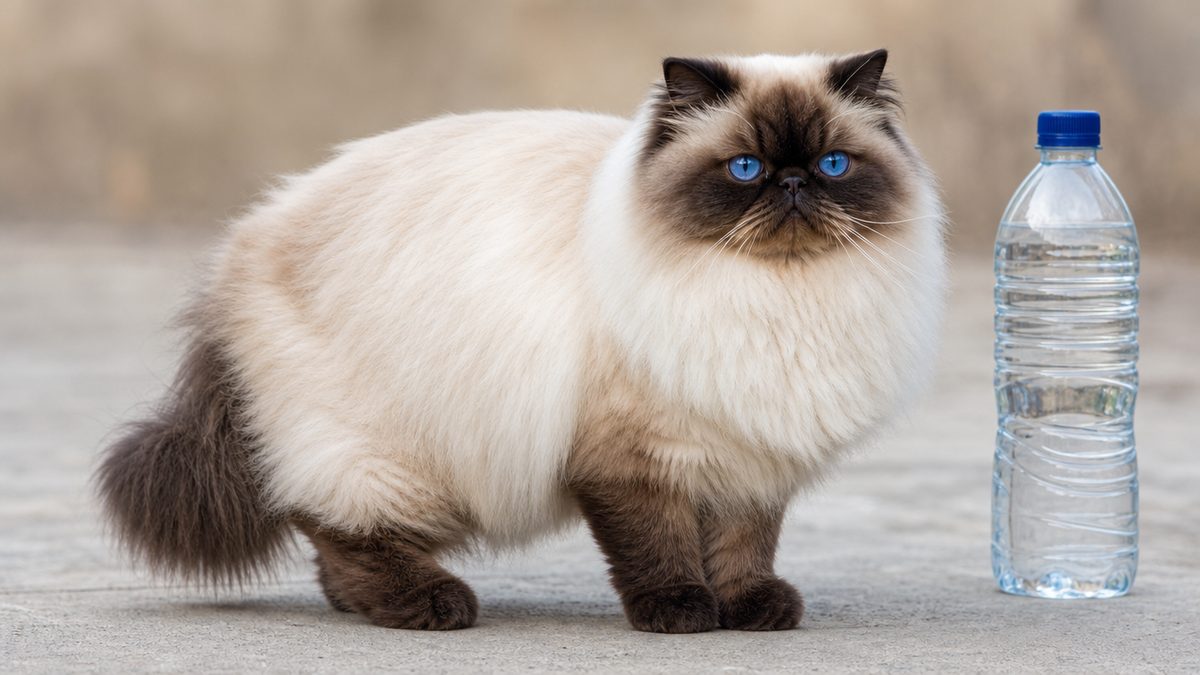
A himalayan cat is a Persian in the colourpoint pattern, with a long coat, a cobby body, a brachycephalic head and deep blue eyes. Whether that makes it a breed depends on which register you read. TICA lists it as a breed but judges it to the Persian standard. CFA combined it into the Persian in February 1984. FIFe, the GCCF, LOOF and the WCF hold no Himalayan at all, and in EMS nomenclature himalayan is colour code 33, Siamese pointed.
This page reports published veterinary literature, genetics papers and registry documents for general information. It is not a diagnosis and it is not a treatment plan. Prevalence figures describe the populations that were studied, not your individual cat. Consult a qualified veterinarian before acting on anything here, and take any cat that is breathing with an open mouth, breathing noisily at rest, straining in the litter tray, drinking or urinating more than usual, or losing weight to a vet the same day rather than looking it up.
Himalayan at a glance
What a Himalayan cat actually is
A Himalayan is a Persian carrying the Siamese colour gene in a double dose, which gives it a pale body, dark points and deep blue eyes while leaving everything else about the cat unchanged. Every other difference a seller will quote you is a consequence of that one substitution.
Start with what is not in dispute. The Himalayan is long-coated, cobby, heavily boned, short-legged and brachycephalic, with a round massive head, small round-tipped ears set far apart and low, and large round eyes set wide apart. It is medium to large but looks larger because of the coat. It is gentle, quiet, low in activity and happiest indoors. If you put a seal point Himalayan and a blue Persian side by side and covered the head and legs of each, nothing in the body would tell you which was which.
The difference is the pattern. In a pointed cat the enzyme that makes pigment works properly only below normal body temperature, so colour develops at the cool extremities and the warm trunk stays pale. The mask, ears, legs, feet and tail carry the colour; the body carries a paler version of it; and the iris is blue-eyed as a side effect of the same allele. CFA's Persian standard states the requirement flatly: for all colours in the Himalayan Division, eye colour is deep vivid blue, and any eye colour other than blue disqualifies.
The breed standard, in the words of the bodies that wrote it
Three registers publish a breed standard that covers this cat, and they describe the same animal. CFA gives the head as round and massive with great breadth of skull, the nose as short, snub and broad with a break centred between the eyes, the body as medium to large with quality rather than size the determining consideration, and the coat as long and thick, standing off from the body, with an immense ruff continuing in a deep frill between the front legs. FIFe describes a round and massive head, a very broad skull, and a nose short and broad with a definite stop but not a snub nose. TICA gives a single Persian Breed Group standard with head 40 points, body 35 and coat, colour and pattern 25.
All three then do something the ranking pages never mention. They write a breathing requirement into the standard itself. FIFe requires nostrils well open, allowing free and easy passage of air. LOOF's Persian record repeats it, describing a nose short and broad with a deep break and well opened nostrils for a normal breathing. CFA requires nostrils sufficiently open to allow the cat to breathe without restriction, and disqualifies a nose leather sitting above the top line of a fully opened eye. TICA goes furthest, withholding all awards for audible or heavy breathing or pinched or very narrow nostrils, and making inability to breathe normally with a closed mouth a mandatory disqualification.
Four registers, four documents, four independently worded requirements that the cat must be able to breathe. An Indian buyer shown a kitten with slit-like nostrils and told that this is what a good Himalayan looks like is being sold a cat that would be disqualified by TICA and could not take a certificate under FIFe or CFA. The flat face is the breed. A face so flat the cat cannot breathe through it is not.
History, and the woman the pattern is named after
The history is short, American and documented. Virginia Cobb and Dr Clyde Keeler began an experimental breeding programme in 1931 and produced the first Himalayan kitten, Newton's Debutante. Ben Borrett ran a parallel programme in Canada in the 1950s. Marguerita Goforth used a longhaired seal point cat named Princess Himalayan Hope to build a Persian-type cat with Siamese markings, and American associations recognised the result in 1957 as the Himalayan; Britain had already recognised it in 1955 under a different name, the Colorpoint Longhair.
So the breed is ninety-five years old at most, and the name is older than the breed. TICA says so itself, in the first paragraph of its own General Description: the Himalayan is a man-made breed named for the pointed pattern that is known as Himalayan in many other breeds. That sentence, published by the one major register that lists the Himalayan as a breed, is the whole of the next two sections in miniature.
What the genetics says about the family
The largest survey of cat breed genetics places the Persian awkwardly. Across 22 breeds and thousands of random-bred cats, the modern Persian did not cluster with cats from the Near East at all but with random-bred cats of Western Europe, having lost its phylogeographical signature to a century of selection for an extreme phenotype. The same study found the Exotic Shorthair impossible to separate from the Persian, describing it as essentially a shorthaired variant demonstrated by the complete clustering of the two breeds as one group, and observed that crossing to Persians is often used to make other breeds more brachycephalic.
Two numbers from that survey are worth carrying into the health section. The Persian's average inbreeding coefficient was F_IS 0.19, among the highest measured, with observed heterozygosity 0.51 against 0.62 expected across 33 cats. A closed pedigree with no permitted outcross does that. CFA's Persian registration rules list the allowable outcross breeds as NONE, and TICA's Persian Breed Group standard says the same.
Is the Himalayan a breed or a colour of the Persian? Start with CFA and TICA
The two largest American registers give opposite answers, and each one undercuts its own answer inside its own documents. Bonbeno opened six registers on 8 September 2026, each with a control that passed on the same document, and publishes the disagreement rather than picking a winner.
Registry recognition here is not one fact but six, and they split three ways. One body lists the Himalayan in its championship A-Z. One body registered it as a breed for twenty-six years and then merged it. Four hold no Himalayan at all. Every reading below carries the date it was taken, because register membership drifts in weeks.
CFA: a breed from December 1957, a colour division since February 1984
CFA's answer is written in two lines of its own Persian registration rules, and no page ranking for this term quotes either. Under SIGNIFICANT ACCEPTANCE DATES the document records Registration effective 1906 Persian and effective 12/57 Himalayan. Under BREED NOTES it says, in full: Himalayan combined with Persian 2/84. Prior to 1976, Himalayan allowed to outcross to Siamese. So CFA accepted the Himalayan for registration in December 1957, allowed a Siamese outcross until 1976, and folded the breed into the Persian in February 1984.
What survives is a colour division. CFA's Persian Show Standard, revised 2025, carries a HIMALAYAN DIVISION with its own colour class numbers, running Chocolate Point 0170, Seal Point 0172, Lilac Point 0174, Blue Point 0176, Flame Point 0178, Cream Point 0196, Tortie Point 0193 and Blue-Cream Point 0189, then the lynx point colours at 3252 to 3263, an Other Pointed Colors Class at 3249 and an AOV Himalayan Division at 3298. The registration rules split the BCS code series the same way: 0100, 1000, 1100, 1300 and 1400 for cats with no colorpointed background, and 3000, 3100, 3200, 3300 and 3400 for colorpointed and CPC.
The in-document control is decisive and it is CFA's own enumeration of its breeds. CFA's breed councils are per breed. Read on 8 September 2026, the Longhair Breeds list carried American Bobtail, American Curl, Birman, Exotic, Maine Coon Cat, Norwegian Forest Cat, Persian, RagaMuffin, Ragdoll, Siberian, Turkish Angora and Turkish Van. There is no Himalayan council. On the same page the Shorthair Breeds list does carry a Colorpoint Shorthair council and a Japanese Bobtail council, which proves the instrument works and that CFA does file colour-defined derivatives as breeds when it means to.
TICA: a breed in the index, a division in the standard
TICA gives the opposite headline and then spends its own page taking it back. Its Browse All Breeds A-Z lists Himalayan between Highlander Shorthair and Japanese Bobtail, with its own breed page, its own printable breed introduction and its own breeder filter. On any reasonable reading, that is a breed.
Four things on and behind that page say otherwise, and all four are TICA's own words. The page opens by saying the Himalayan is part of the Persian Breed Group, which also includes the Persian and Exotic Shorthair breeds. Its Breed Standard link and its View Full Breed Standard link both resolve to a file named Persian.pdf. Its committee is the Persian/Himalayan/Exotic Shorthair Breed Committee, seven people for three breeds. And its General Description says the Himalayan is a man-made breed named for the pointed pattern that is known as Himalayan in many other breeds.
The standard itself closes the argument. TICA's Persian Breed Group Standard, dated 05/01/2025, opens PERSIAN BREED GROUP (PS/HI/ES) and states that the group comprises the Persian, the Himalayan and the Exotic Shorthair, that all have the same head and body type, and that the characteristics distinguishing the breeds are the coat and coloration. It then sets one point scale for all three, lists CATEGORIES as PS Traditional, HI Pointed, ES Traditional and Pointed, and specifies that the only allowable genotypes at locus C are CC, Ccs and cscs.
Read TICA's CATEGORIES line again. A pointed Persian becomes a Himalayan. A pointed Exotic Shorthair stays an Exotic Shorthair, judged as the ES Pointed category with medium blue eye colour accepted. The same allele, in the same breed group, in the same document, changes the breed name of one cat and not the other. Whatever that difference is, it is not biology. It is a naming convention inherited from 1957.
What the two American answers cost you in practice
The practical consequences are small but real, and worth knowing before you pay a premium for a word. A cat registered with CFA will have Persian on its papers and a Himalayan Division colour class. The same cat registered with TICA will have Himalayan on its papers and be judged against the Persian standard by a Persian judge. Neither is more purebred than the other. If a seller quotes a higher price because the kitten is a Himalayan rather than a colourpoint Persian, ask which register issued the paperwork, then compare the two documents and see whether anything about the animal changed.
In Europe the Himalayan is not a breed, it is colour code 33
Four European registers hold no Himalayan breed, and the reason is more interesting than the absence. In the international EMS nomenclature that all of them use, himalayan is a colour code meaning Siamese pointed, sitting beside sepia and mink.
This is the finding no ranking page has, and it took one fetch to get. The World Cat Federation publishes its EMS code table as a registry-authored cross-registry map, with columns for breed name, code and recognised by. Its 198 rows had to be read through the table's own data endpoint, because the page's HTML carries only the first ten, which is exactly how a careless reader manufactures a false absence. Row 8 of Category 1, Longhair, reads Persian / Colourpoint Himalayan, code PER, recognised by ALL.
One code, one entity, every listed body. But the same table has a second Himalayan entry, 351 rows further down, and it is not a breed at all. Under the heading POINTED, three codes appear: sepia 31, Burmese pointed; mink 32, Tonkinese pointed; and himalayan 33, Siamese pointed. In the nomenclature that the WCF, FIFe and the GCCF all share, the word himalayan names a colour restriction pattern that any breed can carry, in the same list as sepia and mink.
| Code | Name in the table | What it means |
|---|---|---|
| 31 | sepia | Burmese pointed |
| 32 | mink | Tonkinese pointed |
| 33 | himalayan | Siamese pointed |
| 21 | tabby | Permitted on 33 among others, giving the lynx points |
GCCF: three occurrences in 723,662 characters, and all three are patterns
Britain gives the cleanest evidence, because the GCCF publishes one enormous document and it can be counted. The June 2026 Standard of Points runs 315 pages, and Bonbeno's own pypdf extraction of it came to 723,662 characters. The string Himalayan appears three times. Absence is a strong claim, so it was earned with controls read from the same extraction in the same session: Exotic returns 205 hits, Persian 168, Siamese 47, British Shorthair 32, Birman 16, Chartreux 8 and Manx 7. The instrument works.
Now read what the three occurrences say. Two sit in the British Shorthair section: the Colourpointed Group is described as a variety of British Shorthair that displays the Himalayan (pointed) coat pattern, and the Colourpointed and White Group as that pattern combined with the bi-colour pattern. The third sits in the Manx section, excluding colour-pointed cats under the phrase Himalayan/Siamese colour restriction. Not one of the three uses Himalayan as the name of a cat.
What Britain has instead is the Colourpoint, and it is filed inside the Persian. Colourpoint appears 301 times in the document. The GCCF's 43 breed sections open with Section 1 Group A PERSIAN and Section 1 Group B EXOTIC SHORTHAIR, with no Colourpoint or Himalayan section anywhere, and the pointed Persians are listed within the Persian section as PER n 33 seal point, PER a 33 blue point, PER b 33 chocolate point and so on. Britain also imposes a flat face limit specific to these cats, withholding certificates if the upper edge of the nose leather is above the lower eye level.
FIFe and LOOF: pointed is a colour row, not a breed
FIFe's register was parsed on the EMS three-letter code rather than on link slugs, which is the only way to read it correctly, and returns 52 rows. PER Persian and EXO Exotic are both present. There is no Himalayan, no Colourpoint and no third code. Controls on the same list: RAG, SBI, TUV, BSH, SIA, CYM and MAN all present.
FIFe then serves one standard document, EXO / PER, edition 01.01.2026, covering both breeds. Its recognised colour varieties table ends with two rows: POINTED EXO/PER n/a/b/c/d/e/f/g/h/j 33, and TABBY POINTED EXO/PER n/a/b/c/d/e/f/g/h/j 21 33, both carrying remark F, which the same page defines as an intense, deep Siamese blue eye. Ten base colours in solid point and ten in tabby point is twenty pointed varieties, and every one of them is a Persian or an Exotic.
France agrees and adds a number. LOOF's index of 51 recognised breeds carries PERSIAN and EXOTIC SHORTHAIR and no Himalayan. LOOF is also the best rarity instrument in the cat fancy, because it publishes a live per-breed kitten count. On 8 September 2026 its Persian record read 436 kittens born in the last 365 days, its Exotic Shorthair 155 and, as a same-day comparator from the same register, its Chartreux 584 Livre Officiel des Origines Felines. Exotic… Livre Officiel des Origines Felines.…. There is no Himalayan row to read, because France does not hold one. Every pointed kitten sits inside the 436.
| Register | Himalayan | In-document control that passed |
|---|---|---|
| TICA | A breed in the A-Z, judged to the Persian standard, PS/HI/ES committee | Persian and Exotic Shorthair listed separately on the same index |
| CFA | Registered 12/57, combined into the Persian 2/84, survives as the Himalayan Division | Persian and Exotic hold breed councils; no Himalayan council exists |
| FIFe | Absent. Pointed Persians are PER 33 | PER, EXO, RAG, SBI, SIA, MAN all carry EMS codes on the same list |
| GCCF | 3 occurrences in 723,662 characters, all pattern names for other breeds | Exotic 205, Persian 168, Siamese 47, British Shorthair 32, Chartreux 8 |
| LOOF | Absent. 436 Persian kittens in 365 days, no Himalayan row | Exotic Shorthair, Manx and Cymric, Siamese, Chartreux all listed |
| WCF | Row reads Persian / Colourpoint Himalayan, code PER, recognised by ALL | Same table gives himalayan as colour code 33, beside sepia 31 and mink 32 |
Wikipedia, which ranks first for this query in India, gets the direction right and the detail thin. Its Recognition section correctly says CFA and the GCCF treat the Himalayan as a colour variant of the Persian, and that TICA files it in the Persian Breed Group. It names no European register, cites no standard, and does not mention code 33. Its own list of prohibited colours is the accidental confirmation: mink and sepia, which are codes 32 and 31, the two pointed patterns that are not this one.
One last cross-check, from a document about a completely different cat. CFA's own Manx Show Standard, listing the colours it will not accept, excludes those showing evidence of hybridization resulting in chocolate, lavender or the himalayan pattern. So the register that once held the Himalayan as a breed uses the same word as a pattern name in a standard for a tailless shorthair. Across CFA, the GCCF and the WCF, the word behaves as a colour term in every document where it is not being used as a breed name. That is why a rare-sounding breed name and a common colour term can be the same word, and why an Indian buyer paying a premium for one is often paying for the other.
Himalayan cat price in India, and why four sources disagree twelvefold
There is no single Himalayan cat price in India. Four pages ranking for this term publish bands whose extremes are twelve times apart, the highest-ranking one contradicts itself twice inside one article, and Google's AI panel has invented a pedigree tier that does not exist. The spread is the finding.
Bonbeno reports published price in india figures as editorial content and never as an offer. We do not sell cats, broker sales or recommend breeders. What follows is what four Indian sources actually print, read from their own raw markup on 8 September 2026 rather than from a search snippet.
| Source | Band printed | Note |
|---|---|---|
| HankPets | Rs 10,000 to Rs 30,000 | The lowest floor and the lowest ceiling of the four |
| HappyPet India | Rs 15,000 to Rs 50,000 | Identical to the band the same site gives the Persian |
| Royal Kitten | From about Rs 25,000 | A seller page, floor only |
| Supertails, headline | Rs 30,000 to Rs 1,20,000 | Stated in the article's own Key Takeaways |
| Supertails, its own table | Rs 50,000 to Rs 80,000 basic; Rs 70,000 to Rs 1,00,000+ show | Does not overlap the headline band at either end |
| Google AI panel | Rs 25,000 to Rs 1,20,000+ | Includes an FCI-Registered tier at Rs 45,000 to Rs 90,000 |
Read the fourth and fifth rows together. Supertails holds position three for this query in India and its Key Takeaways say the price in india usually falls between Rs 30,000 and Rs 1,20,000. Its own Types and Quality Grades table, further down the same article, prints Basic Quality 50,000 to 80,000 and Show Quality 70,000 to 1,00,000 plus. The table's floor is Rs 20,000 above the headline's floor and its ceiling is Rs 20,000 below. One article, two incompatible bands, and the reader is never told which to use.
Running the division tests, and what they show
Indian breed pages routinely publish a US dollar figure run through one exchange rate and printed as rupees, so every figure here was divided by 84.38, by 80 and by 74. None of these bands divides cleanly at 84.38 or at 74. Rs 1,20,000 divides at 80 to exactly 1,500, which is a price a shop would print, but Rs 25,000 divides at 80 to 312.5, which is not. The 80 test is weak by construction, because any figure ending in three zeros divides cleanly by it. On the balance of the evidence these are rupee-native figures rather than converted ones, which makes them arbitrary rather than laundered. That is a different problem and it needs saying differently.
The FCI tier, traced from an Indian retailer to an answer engine
Google's AI panel for this query prints a price tier labelled Premium Pedigree / FCI-Registered at Rs 45,000 to Rs 90,000. Follow it back. Supertails carries an H3 reading FCI Registered and Champion Bloodline Himalayans, and states in its own text that FCI registration means the Feline Club of India. On this site FCI is spelled out for exactly this reason: on a cat page in India it means the Feline Club of India, while the international body that shares those initials is a dog federation that registers no cats at all.
So what does the Feline Club of India actually certify? Its registration page describes giving a cat a unique 16-digit microchip, a breed authentication certificate and an ownership certificate, and says it records up to seven generations. It publishes no list of breeds it authenticates, so a buyer cannot check what the certificate means for a Himalayan specifically. And its own counters disagree with each other: the home page says 500K Cat registered, printed three times, while the registration page on the same domain and the same day says 400+ Cats Feline Club of India. Cat Registration…. Half a million against four hundred.
An Indian retailer names a domestic body using an ambiguous acronym. An answer engine turns the acronym into a Rs 45,000 to Rs 90,000 pedigree tier and states it as fact. The body itself publishes no breed list and two registration counts that differ by a factor of more than a thousand. Before paying anything extra for registration, ask which body issued the certificate, ask to see the certificate, and ask what the parents' PKD status was. That last question is worth more than all the paperwork.
The one Indian page that treats the Himalayan and the Persian as one cat
HappyPet India gives the Himalayan a buying band of Rs 15,000 to Rs 50,000 and a life expectancy of 12 to 15 years, and gives the Persian the identical band and the identical life expectancy HappyPet India. Persian cat breed page. Whatever else that site gets wrong, on price it has reached the same conclusion the European registers reached: these are one animal. Note the contrast with its own Colorpoint Shorthair page at Rs 30,000 to Rs 60,000, which is a genuinely different band, so the match is not a site-wide default.
What a Himalayan actually costs to keep in India each month
Budget for grooming and cooling, not for food. The monthly cost figures the ranking Indian pages print are either a shared template constant or a table that does not add up, so this section shows the arithmetic and names the sourced figures that do hold.
Start with the cost of ownership claim that appears most often, and the reason not to use it. HappyPet India gives the Himalayan an average monthly cost of Rs 2,800 for a basic lifestyle and Rs 4,200 for a premium one, with food expenses of Rs 1,500 to Rs 2,000. Those are not observations about this cat. The identical row, to the rupee, appears on the same site's Persian page and its Colorpoint Shorthair page HappyPet India. Colorpoint Shorthair cat…. Three breeds, one row. The total is assembled from a small set of preset component lines, so a matching figure tells you about the template rather than about the animal.
Supertails publishes a breakdown instead, and it is worth reading because it fails its own arithmetic. The article states monthly upkeep of Rs 3,000 to Rs 8,000, then prints a table giving food Rs 2,000 to Rs 5,000, grooming Rs 500 to Rs 3,000, routine vet Rs 1,000 to Rs 3,000, litter Rs 500 to Rs 1,000 and accessories Rs 500 to Rs 1,000. Add the rows. The minimums sum to Rs 4,500 against a stated Rs 3,000, and the maximums sum to Rs 13,000 against a stated Rs 8,000. Neither end reconciles, and the stated total is the number every downstream page repeats.
This took one addition. A monthly budget whose components sum to Rs 4,500 to Rs 13,000 cannot also be Rs 3,000 to Rs 8,000. Use the component rows if you use anything from that page, and treat the headline as unusable.
The figures that do hold, with their sources
| Item | Published figure | Source and note |
|---|---|---|
| Kitten vaccination course, 3 visits | From Rs 3,999 (list Rs 5,065) | Vetic; one chain's promotional floor, not a market average |
| Adult annual booster | From Rs 1,899 | Vetic |
| Rabies, single | Rs 699 | Vetic |
| Municipal pet licence, Chennai | Rs 50 | Greater Chennai Corporation, which licenses pet animals generally |
| Treatment and anti-rabies at a GCC clinic | Free | Six municipal veterinary clinics in Chennai |
| Professional grooming session | Rs 500 to Rs 3,000 | Supertails; the line this breed will actually use |
| Home grooming kit | Rs 1,500 to Rs 3,000, one-off | Supertails |
Two municipal notes matter and are routinely got wrong on Indian cat pages. Delhi's MCD registration scheme covers pet dogs only, so its fee is not a cat cost and must not be quoted as one. Greater Chennai Corporation licenses pet animals generally at Rs 50, and its six veterinary clinics provide all treatment and anti-rabies vaccination free of cost. For a Chennai household that free anti-rabies line is worth more than any grooming discount.
The two lines that are genuinely breed-specific
Everything above applies to any cat in India. Two costs belong to this cat in particular, and neither appears on the ranking pages as a line item.
- Cooling. A long-coated, brachycephalic cat in Kolkata or Delhi needs a cooled room through the hot months, and that is an electricity bill rather than a pet bill. Price it against your own tariff before you buy, because it recurs every year for the life of the cat.
- Grooming, either your time or a clinic's. A dense undercoat mats without daily combing. A coat that has matted to the skin is not brushed out, it is clipped under sedation, and that is a veterinary charge plus an anaesthetic risk on a flat-faced cat. Budget the daily fifteen minutes or budget the clip.
- A PKD test, once. A DNA test for the PKD1 variant is a one-off cost that is a small fraction of any of the purchase bands above, and it is the only spend on this page that changes what happens to the cat.
One structural point about pet-shop costs is set by Indian law rather than by the market. Rule 6(5) of the Pet Shop Rules 2018 requires that the temperature where animals are displayed or housed for sale be comfortable, that it may vary from breed to breed, and that it is incumbent on the shop owner to familiarise himself with the requirements of the breeds he deals in and provide an ambient and comfortable temperature. For a Himalayan in an Indian summer that is not a formality, and the registration form itself asks a shop to state its cooling and power backup arrangements.
Indian heat, and the one breed where the coat and the face fail together
The Himalayan has the worst combination of coat and skull this site rates for Indian conditions, and the reason is mechanical rather than rhetorical. Cats shed heat mainly by evaporation from the respiratory tract, and a brachycephalic head shortens the surface that does it while a long double coat adds insulation on top.
Take the physiology first, because it explains why heat tolerance here is worse than for a plain long-coated cat. A cat has limited sweating and relies on evaporative cooling across the nasal turbinates and the mouth. Shorten the muzzle and you shorten that surface. The registers themselves treat compromised airflow as a fault serious enough to disqualify: TICA withholds all awards for audible or heavy breathing or pinched nostrils and mandates disqualification for inability to breathe normally with a closed mouth, and CFA, FIFe and LOOF all write an open-nostril requirement into the standard Federation Internationale Feline. Breed… Livre Officiel des Origines Felines.…. A cat that is already at the limit of that requirement in Chennai in May has nothing left.
What the Indian numbers are, and how they were taken
Bonbeno queried NASA POWER climatology by explicit latitude and longitude on 8 September 2026 and echoed back the elevation the model reports for each cell, because a grid cell is not a town. For the six plains cities below the cell elevation matched the real one closely, so the numbers describe the place: Delhi came back 9.6 m low, Kolkata 1.7 m low, Chennai 43.0 m high, Bengaluru 78.3 m low, Mumbai 83.2 m high and Pune 76.0 m high.
| City | Annual T2M | Annual RH2M | Hottest month mean | Peak mean wet bulb |
|---|---|---|---|---|
| Kolkata | 25.81 C | 73.93 % | 31.53 C in May | 27.09 C in June |
| Delhi | 25.60 C | 45.56 % | 35.88 C in June | 26.50 C in July |
| Chennai | 27.95 C | 72.39 % | 31.51 C in May | 26.11 C in May |
| Mumbai | 26.77 C | 67.39 % | 31.19 C in May | 25.77 C in June |
| Pune | 23.86 C | 66.80 % | 28.93 C in April | 22.97 C in June |
| Bengaluru | 23.74 C | 67.94 % | 28.37 C in April | 21.86 C in May |
Wet bulb is the number that matters for a cat that cools by evaporation, because it measures how much cooling the air can still absorb. The spread across Indian metros is 5.2 degrees C, from Bengaluru at 21.86 to Kolkata at 27.09, and that gap is larger than any difference between two long-coated breeds. Where you live changes this cat's life more than which pointed variety you buy.
Bengaluru's annual humidity, 67.94 percent, is barely below Mumbai's 67.39 and well above Delhi's 45.56. What separates them is temperature. Bengaluru peaks at a 21.86 degrees C mean wet bulb against Kolkata's 27.09. The rule generalises: for a heat-sensitive breed in India the enemy is heat, or heat combined with humidity, and almost never humidity by itself.
The hill stations, and why the obvious answer needs a correction
Readers reasonably ask about Shimla, Ooty or Darjeeling for a long-coated cat, and the satellite data cannot answer that question at face value. Queried at Shimla's coordinates, NASA POWER returns a cell elevation of 897.65 m against a real town elevation near 2,200 m, an error of about 1,302 m, and reports a June mean of 30.25 degrees C. That is the model describing the valley beneath the hill, not the hill. Applying a standard lapse rate of about 6.5 degrees C per 1,000 m suggests the real June mean is nearer 22 degrees C, which fits the town. Bonbeno publishes the divergence rather than the cell, and labels the correction an estimate.
The thing about point colour that no Indian page mentions
The point colour is made by a temperature-sensitive enzyme, so it is not fixed. Pigment forms where the skin is coolest, which is why the mask, ears, feet and tail are dark and the trunk is pale. Warm the cat and the contrast falls; cool it and the body darkens. A Himalayan living its whole life in a Chennai flat and the same cat living in a cooled room will not look identical, and a cat that spends a Delhi winter on a balcony can darken visibly over the body.
That has a judging consequence worth knowing before you buy a show-quality kitten in India. CFA's Himalayan Division requires a definite contrast between body colour and point colour, with allowance made for darker colour in older cats. TICA penalises a very heavily shaded coat on the body and instructs the judge to check the colour at the roots, because seasonal shading can be told apart from a coat that is coloured to the roots. Indian ambient temperature pushes contrast in the favourable direction for the body but the same warmth is what the cat is struggling with, so the show ring and the animal want opposite things.
- Cool the room, not the cat. A cooled space the cat can choose beats any device applied to the animal.
- Watch the mouth. Open-mouth breathing in a resting cat is an emergency, not a quirk, and in this breed it is the sign to act on.
- Comb rather than shave by default. A clipped coat removes insulation but also removes the layer that reflects radiant heat, and a shaved flat-faced cat is still a flat-faced cat.
- Hydrate deliberately. Place the water bowl at least a metre from food, because a strong food smell suppresses drinking, and consider a fountain, which LOOF and TICA both note helps keep a flat face drier.
Temperament, and who should not buy one
The Himalayan is a quiet, low-activity, people-oriented indoor cat that follows you from room to room and asks for very little. That is the honest description, and it is also the reason the breed is bought by households that cannot service its maintenance.
On temperament the registers and the French studbook agree closely, which is not always true. TICA describes a gentle, quiet cat that prefers a calm environment, is easygoing, communicates with expressive eyes and a soft voice, and adapts to any family that treats it gently. LOOF describes the Persian as calm and reserved, not very talkative, with a voice that is never disturbing, not a big climber, preferring to follow its owners from room to room, and better suited to a cosy indoors than to adventurous outdoors. The same cat, described twice, on two continents.
Activity comes in bursts. TICA's phrasing is precise and useful: placid, sleeping in the sun one minute and suddenly exploding into action, running through the room and rolling around, then stopping. Plan for weight management rather than for exercise, because a cat that is calm for twenty-two hours a day and altered by six months is a cat that gains weight quietly.
Who this cat suits
- Households with a cooled room. The single strongest predictor of a good outcome for this breed in India, ahead of flat size, budget or experience.
- People at home during the day. This is a companion cat that follows and settles rather than one that entertains itself.
- Owners who genuinely enjoy grooming. Fifteen minutes daily, every day, for fifteen years, is roughly 1,400 hours. Enjoy it or do not buy the cat.
- Quiet homes. A calm environment is not a preference here, it is the described requirement.
Who should not buy one, said plainly
- Anyone without cooling in Kolkata, Chennai, Delhi or Mumbai. The climate section gives the wet-bulb numbers. This is the disqualifying condition, and no amount of care compensates for it.
- Anyone buying a cat for a child to look after. Daily combing and daily eye cleaning are adult jobs and a missed fortnight becomes a sedated clip.
- Anyone who wants a talkative, interactive cat. Buyers who liked the blue eyes on a Siamese and the coat on a Persian often want the Siamese personality, and this cat does not have it.
- Anyone unwilling to ask about the parents' PKD status. Given the prevalence figures in the health section, buying a Himalayan without that question is a decision to find out later.
TICA files the Siamese, Balinese, Oriental Longhair and Oriental Shorthair as Opposite Breeds to the Himalayan, meaning they sit at the opposing extreme of feline type. The Himalayan borrowed one gene from the Siamese and nothing else. If the Siamese voice, activity level or body is what you want, the Balinese is the semi-longhaired version of that cat and a completely different animal from this one.
With children, dogs and other cats
A quiet, low-activity cat that dislikes being grabbed is a reasonable fit for older, calmer children and a poor fit for toddlers, and that is a supervision question rather than a breed question. On dogs, one point is worth carrying from Indian law even though it governs shops rather than homes: the Pet Shop Rules 2018 require at rule 7(2)(j) that dogs and cats not be kept adjacent to each other because it causes acute stress, and the Second Schedule paragraph 2(f) requires that cats or kittens be kept in a room not shared by other, inimical animal species such as dogs. The regulation is about display cages, but the underlying observation about stress is sound, and a Himalayan with nowhere to retreat from a dog is a cat that will stop using its litter tray.
Training a Himalayan, and the two things to teach first
Teach grooming tolerance and carrier tolerance before anything else, because those two are the ones that decide whether this cat's life goes well. Everything else is optional.
Cats train through repetition, food and consent, and this breed's low activity level works in your favour. A calm cat that is not trying to leave is easy to handle. The problem is not resistance, it is that most owners start the handling too late, at the point where the coat is already matted and the cat has learned that combing hurts.
One: grooming tolerance, taught in the first eight weeks at home
- Begin on day three, not on the first bad mat. Thirty seconds of comb contact, then food. Repeat twice a day.
- Build by body part. Shoulders and back first, then flanks, then the armpits, breeches and the ruff under the chin, which are where mats actually form and where cats object most.
- Stop before the cat does. Ending while the cat is still relaxed is what builds the habit; ending because the cat struggled teaches the opposite.
- Separate the eye job. Wipe each eye corner with its own damp pad, outward, daily, so the cat learns that face handling is routine rather than a response to a problem.
- Practise the clip position. Getting a cat used to lying on its side for two minutes is what makes an unsedated tidy-up possible later.
Two: the carrier, and why it matters more for this breed
A flat-faced cat that arrives at a clinic panting from stress on a hot day is a cat whose examination has to be delayed or sedated, and sedation in a brachycephalic patient is a higher-risk procedure than in a normal-muzzled one. Leave the carrier out permanently with bedding in it, feed in it, and never let it appear only on vet days. This is a fifteen-minute-a-week habit that changes what your vet can safely do.
Given the polycystic kidney disease prevalence figures in the next section, a Himalayan in India is likely to need repeated ultrasound scans or at minimum regular blood and urine checks. A cat that tolerates being held on its side and having its abdomen handled makes those checks cheap and quick. A cat that does not makes them stressful, expensive and occasionally deferred, which is how a treatable finding becomes a late one.
What this cat will resist
Three things reliably fail with a Himalayan and are worth not attempting. Harness and outdoor walking suits an active, curious cat and this one neither wants it nor tolerates Indian pavement heat. High-energy clicker sequences of the kind a Bengal enjoys run past this cat's attention within a minute or two. And any training that depends on food restriction is a poor idea in a breed whose main long-term risk after altering is quiet weight gain.
What does work is short, low-arousal, food-led shaping: coming when called, sitting on a mat to be combed, stepping into the carrier, and accepting a toothbrush. TICA's guidance for the group is to trim nails weekly as a kitten and every two to three weeks as an adult, and to brush teeth regularly with a vet-approved paste. All four of those are handling exercises before they are hygiene tasks, and a cat that accepts them is a cat you can keep well.
Daily exercise, and what happens without it
Aim for two or three short play sessions a day and watch the waistline rather than the clock. This is a low-activity breed in which the realistic risk is obesity, not under-stimulation.
TICA describes the pattern precisely: placid cats that exhibit bursts of kitten-like activity, sleeping in the sun and then suddenly running through the room, and it adds that you might have to keep after them to exercise on a daily basis. Take that literally. The cat will not self-start. Interactive toys, chased balls and catnip mice are what TICA names, and five to ten minutes twice or three times a day is a realistic target.
Time the play to the heat, not to your schedule
This is the India-specific part, and it follows from the climate section. In Chennai in May the mean temperature is 31.51 degrees C and the peak mean wet bulb is 26.11. Play a brachycephalic, long-coated cat hard in that and you are asking an animal with a shortened cooling surface to generate heat it cannot shed. Move play to early morning and late evening through the hot months, and stop at the first sign of open-mouth breathing rather than at the end of the game.
A cat panting after play is not the same as a dog panting after play. TICA makes inability to breathe normally with a closed mouth a mandatory disqualification in this breed group, which tells you how the people who judge these cats regard it. If your cat pants during ordinary indoor play in a cooled room, that is a veterinary appointment, not a fitness observation.
What happens without it
Two things, and the second is the one with a number attached. A bored indoor cat overgrooms, and in a long coat overgrooming produces mats and swallowed hair, which produces vomiting that owners then treat as a food problem. And an under-exercised altered cat gains weight. The UK feline life table found that non-ideal body weight was significantly associated with a shortened lifespan, alongside being entire and being purebred. A Himalayan is already purebred. Body weight is the one of those three variables you control.
Vertical space helps more than floor space, but adapt it to the animal. This is not a climbing breed; LOOF says the Persian is not a big climber. Low, wide, stable platforms at sofa and windowsill height suit a heavy, short-legged, cobby cat far better than a tall narrow tower, and a shaded window perch in a cooled room is the single most-used piece of furniture you will buy.
Grooming a long double coat and a flat face in Indian humidity
Comb the whole coat daily and clean the eye corners daily, and treat those as two separate jobs. The coat is the obvious one; the face is the one that has a published anatomical explanation and the one Indian owners most often mistake for an infection.
Grooming a Himalayan is a daily commitment, not a weekly one. The coat is long all over the body with a dense undercoat, an immense ruff and a deep frill between the front legs, plus ear and toe tufts. TICA states the requirement without softening it: the coat requires constant grooming because of the undercoat that will mat if not groomed, this is a cat that demands a serious time commitment, and doing it properly takes knowledge and practice.
The coat: what to do, in order
- Comb, do not just brush. A slicker moves the top coat and leaves the undercoat felting underneath. A wide-then-narrow metal comb that reaches skin level is the tool that prevents mats.
- Work the four mat sites first. Behind the ears, under the chin and into the ruff, the armpits, and the breeches around the hindquarters. If those four are clear the cat is clear.
- Comb the belly on the cat's terms. Short sessions, on a lap, not a wrestling match. This is the area owners skip and the area that mats to the skin.
- Bathe rarely and dry completely. An occasional bath is reasonable in Indian dust and heat, but the coat must be dried through to the skin, because a dense undercoat left damp in monsoon humidity is where skin problems start.
- Never air-dry a double coat in the monsoon. Overseas breed guides written for temperate climates say towel off and let the cat dry naturally. That advice does not transfer to a Mumbai or Kolkata July at 90 percent relative humidity.
Mats tighten against the skin, pull, trap moisture and hide sores. Once a coat has felted, it is clipped rather than combed, and clipping a flat-faced cat means sedation. Sedation in a brachycephalic patient carries more airway risk than in a normal-muzzled cat. The daily comb is not vanity, it is the thing that keeps your cat off an anaesthetic list.
The face: why the tears do not drain, with the anatomy
Tear staining on a Himalayan is anatomy, and the mechanism is published. A CT, CT-dacryocystography and anatomical study of 31 brachycephalic and 15 mesocephalic cats found that the greater the degree of brachycephaly, the more the facial bones and the upper canine teeth are displaced dorsally. That dorsorotation dislocates the ventral nasal concha, rotates the upper canines to almost horizontal, and leaves the nasolacrimal drainage system steeply oriented. In severe brachycephaly the drainage system is forced to pass below the canine tooth in a V-shaped course, and the drainage function appears to be inefficient.
Two things follow for an owner. The tears are not excessive; they simply have nowhere to go, so they spill over the lower lid onto the face and stain. And the study's own recommendation is aimed at breeders rather than owners: the authors advise avoiding breeding from individuals affected by this condition and giving preference to cats with longer facial bones. When you are choosing a kitten, that is the sentence to remember.
- Wipe daily, outward, with a separate pad per eye. Cooled boiled water or a vet-supplied lotion. Never share a pad between eyes.
- Do not use human eye drops or antiseptics on the face. Staining is not an infection, and treating it as one irritates the skin.
- Watch for the change, not the stain. A stain that suddenly becomes thicker, greener, one-sided, or comes with squinting or a cloudy eye is a same-day veterinary matter, because corneal problems are common in this head shape.
- Keep the fold under the eye dry. In Indian humidity a permanently damp facial fold is where yeast and bacteria establish.
Nails, ears and teeth
TICA's own guidance for this group: trim nails weekly as a kitten and every two to three weeks as an adult, and brush teeth regularly with a vet-approved pet toothpaste. Add ears to that list in India, where humidity and dust make a monthly look inside worthwhile. None of this is breed-specific in principle, but all of it is easier on a cat that has been handled daily since it arrived, which is the argument the training section makes.
Polycystic kidney disease: the numbers every Himalayan page omits
Roughly 38 percent of Persian-type cats worldwide carry the mutation that causes polycystic kidney disease, one DNA test identifies it, and no registry requires that test. Those three facts together are the most useful thing on this page, and no page ranking for this breed in India prints any of them.
The health issues section of every ranking page names polycystic kidney disease and stops. Here is what is actually known, with denominators, countries and years.
The mutation, and what it does
Feline polycystic kidney disease is autosomal dominant and presents much as the human disease does. In 2004 the causative variant was identified in the feline PKD1 gene: a C to A transversion at c.10063 in exon 29, creating a stop at position 3284 and removing roughly 25 percent of the C-terminus of the protein. The same paper reports that PKD affects approximately 38 percent of Persian cats worldwide, about 6 percent of all cats, making it the most prominent inherited feline disease.
Two details from that paper matter for a buyer. The variant was found in the heterozygous state in all 48 affected cats examined, including 41 Persians, a Siamese and several other breeds known to outcross with Persians. And no homozygous cat has ever been identified, which supports the mutation being embryonic lethal in a double dose. In practice that means an affected cat has one copy, has a 50 percent chance of passing it to each kitten, and cannot be bred out by mating two affected cats.
Prevalence, measured in six countries
| Study, country | Cats tested | Prevalence |
|---|---|---|
| Cannon 2001, United Kingdom | 132 Persians | 49.2 percent overall |
| Barrs 2001, Sydney and Brisbane | 320 Persian-type, of which 48 Himalayans | 45 percent Sydney, 42 percent Brisbane |
| Barthez 2003, France | 310 cats | 41.8 percent Persian, 39.1 percent Exotic Shorthair |
| Lyons 2004, worldwide estimate | not a survey | about 38 percent of Persians |
| Noori 2019, Tehran | 76 Persian and Persian-related | 36.8 percent |
| Shitamori 2023, Tokyo clinic population | 1,281 cats of all breeds | 23 cats, 1.8 percent, odds highest in Persian, Scottish Fold and Exotic |
Read the last row carefully, because it is the one most easily misquoted. The 1.8 percent is the share of all cats presenting at one Japanese university hospital that carried the conventional PKD1 variant, not the Persian rate; within that population the odds were significantly higher in Persians, Scottish Folds and Exotic Shorthairs. Quoting 1.8 percent as the Persian figure would understate the risk by a factor of about twenty.
The Australian study is the one that matters most on a Himalayan page, because it counted Himalayans separately: of the 320 cats, 230 were Persians and 48 were Himalayans, with prevalence of 45 percent in Sydney and 42 percent in Brisbane and no sex predilection. It also settles a question buyers ask. Two of 14 Burmillas were positive, which the authors note demonstrates that long hair coat and brachycephalic features do not segregate with the polycystic kidney disease trait. The flat face does not cause the kidney disease. They travel together because they came down the same closed pedigree.
What it means for a cat that has it, with a survival curve
Until recently there was no published answer to the obvious question, which is what actually happens to an affected cat. A 2025 retrospective cohort followed 300 cats that tested positive for the PKD1 c.10063C>A variant in Japan and built a life table. Life expectancy at birth came out at approximately 12.7 years, with cumulative survival of 95.1 percent at five years and 61.3 percent at ten. Of the 300, 48 (16.0 percent) progressed to uraemia and 62 (20.7 percent) died of renal failure and other causes. Among those 62, the median age at death was 8 years and the first decile was 5 years, the highest number of deaths fell at age 7, and the cumulative survival rate began to decline significantly between ages 6 and 7.
A life expectancy at birth of about 12.7 years for PKD1-positive cats sits above the 11.74 years the UK life table gives for all cats, which is genuinely surprising and reflects different countries, cohorts and methods rather than a benefit of the mutation. What the same study also shows is that 16 percent reached uraemia and that survival fell away sharply from age six. The authors' own conclusion is the actionable one: examine frequently at a young age. That is a screening instruction, not a reassurance.
Does any registry require the test?
No. TICA advises that owners of Persians, Himalayans and Exotic Shorthairs should check with their breeder and veterinarian that the cat has been checked for polycystic kidney disease, respiratory problems, eye problems such as progressive retinal atrophy, and hypertrophic cardiomyopathy. Advising is not requiring. CFA's Persian registration rules set pedigree depth, colour acceptance and outcross policy and mandate no health screen at all. Neither the FIFe standard nor the GCCF Standard of Points imposes one Governing Council of the Cat Fancy.…. The test exists, it is cheap relative to the kitten, and whether it is done rests entirely on the buyer asking.
One note on what the literature contains under this cat's own name, because it explains why the numbers above are all Persian numbers. Searching PubMed on 8 September 2026, the phrase "Himalayan cat" restricted to title and abstract returns 29 records, and reading them shows almost all are single-patient case reports: a von Willebrand's disease case, a choanal atresia case, a hypospadias case, eyelid cysts. The control query, Labrador retriever hip dysplasia, returned 126 records in the same session, so the instrument was working. There is no cohort study of Himalayans as a population, which is exactly what you would expect of a name that four registers treat as a colour.
The flat face, the eyes and how long these cats actually live
Brachycephaly brings the airway, the tear ducts, the cornea and the birth canal with it, and the registers themselves treat the extreme version as a fault. This section gives the measured figures and one life-expectancy comparison that no ranking page makes.
The brachycephalic head is the breed's defining feature and the source of most of its non-renal problems. The chain is mechanical. Shortening the face rotates the facial bones and upper canines upward, which crowds the nasal passages, distorts the tear drainage and changes the position of the eye in the orbit. All three consequences are documented.
- Airway. Every register writes an open-nostril or normal-breathing clause into this standard, and TICA makes inability to breathe normally with a closed mouth a mandatory disqualification Federation Internationale Feline. Breed… Livre Officiel des Origines Felines.….
- Tear drainage. The nasolacrimal system is forced into a steep and sometimes V-shaped course below the canine tooth in severe brachycephaly, and drainage appears inefficient.
- Eye surface. Wikipedia's own health section names respiratory infections, epiphora, corneal abrasions, ulcers and corneal sequestration as consequences of the head shape. Bonbeno did not independently verify the source behind that list, and says so rather than restating it as measured.
- Birth. In a survey of 2,928 litters from 735 queens, dystocia occurred in 5.8 percent of litters overall, ranged from 0.4 percent in a large mixed-breeding colony to 18.2 percent in the Devon Rex, and was significantly higher in pedigree litters, with an odds ratio of 22.6 against litters of cats of mixed breeding. Persian and Siamese-type litters were among those with relatively high levels, and both dolichocephalic and brachycephalic types were significantly higher than mesocephalic cats.
A Persian-lineage blindness variant, with a frequency
One inherited eye condition in this lineage has a measured allele frequency, which is unusual and worth knowing. The first whole-genome sequencing study ever performed in cats was run on a trio segregating for Leber congenital amaurosis, the most severe and earliest-onset form of human visual impairment, and for the bobbed tail. It identified a stop-gain in feline AIPL1, c.577C>T, p.Arg193*. More than 1,700 cats across 40 breeds and populations were then genotyped, giving an allele frequency of 1.15 percent, confined to Persian-related breeds.
That figure is small, and it is the right kind of small: it is a real number attached to a real test, unlike the vague warnings about eye problems that fill the ranking pages. It also carries a nice coincidence for readers of this site. The pedigree that produced the first cat genome was a Persian to Japanese Bobtail cross, which is why the two breeds Bonbeno built together this week share a founding paper.
How long these cats live, and what TICA's own number implies
TICA's Himalayan page says the breed is very healthy and can be expected to live between 8 and 11 years. Set that against the only published feline life table. Using 7,936 confirmed deaths in cats under UK primary veterinary care in 2019, life expectancy at age 0 for cats overall was 11.74 years (95 percent CI 11.61 to 11.87).
| Group | Life expectancy at age 0 | Deaths in the study |
|---|---|---|
| Burmese | 14.42 years (12.91-15.93) | 45 |
| Birman | 14.39 years (12.87-15.91) | 38 |
| Crossbred | 11.89 years (11.75-12.03) | 7,117 |
| All cats | 11.74 years (11.61-11.87) | 7,936 |
| Siamese | 11.69 years (10.56-12.82) | 88 |
| Persian | 10.93 years (9.63-12.23) | 80 |
| Purebred, all breeds | 10.41 years (9.99-10.83) | 819 |
| Sphynx | 6.68 years (4.53-8.83) | shortest of the twelve |
Three things follow. TICA's 8 to 11 years sits entirely below the all-cat figure, so a registry is describing a life expectancy below the population average while calling the breed very healthy. The Persian's measured 10.93 years is close to the top of TICA's range and its confidence interval, 9.63 to 12.23, does overlap the all-cat figure, so this is a difference worth noting rather than a gulf. And the study's own risk factors are the ones an owner can act on: being entire, being purebred and having a non-ideal body weight were each significantly linked to a decreased lifespan, and purebred cats had 1.83 times the odds of dying before three years compared with crossbred cats.
You cannot change that your cat is purebred. You can neuter it and you can keep it at an ideal body weight, and those are two of the three risk factors the UK life table identified. On top of that, buy from a seller who can show a PKD result for both parents. Those three decisions, taken before the cat is a year old, do more for its life expectancy than anything else on this page.
Feeding a flat-faced cat in India, and the calorie table to ignore
Feed a complete, high-protein cat food from a bowl the cat can physically reach into, control the portion, and get water into the animal. The one breed-specific complication is mechanical: a very flat face changes how a cat picks food up.
Feeding advice for this breed is mostly ordinary cat nutrition with two adjustments. The first is bowl and kibble shape. A cat with a short broad muzzle and a nose leather close to the eye line cannot use the tip of its jaw the way a normal-muzzled cat does, so it scoops rather than picks. A wide shallow dish and a larger, flatter kibble both help; a deep narrow bowl and small round kibble both make a mess and reduce intake.
The second is water. TICA's own guidance for the Persian group is worth quoting because it is practical and specific: fresh clean water daily, bowls washed and refilled, and if you are worried about intake, place the water bowl at least three feet away from any food, because cats' noses are sensitive and an overwhelming smell of food can make them drink less. It adds that many Persians do better with fountains, which also help keep the hair on the chin and chest drier. In an Indian summer, getting a cat to hydrate is a health intervention rather than a convenience.
The calorie table on the ranking Indian page, checked
HappyPet India's Himalayan page prints daily calories as kittens 300 kcal and adults 250 kcal. That direction is right, since a growing kitten needs more energy per day than a sedentary altered adult of the same breed, but note what the same site does elsewhere: its Colorpoint Shorthair and Japanese Bobtail pages print the reverse, kittens 250 and adults 300. The numbers are template values that flip between pages rather than breed-derived figures. Use your own cat's body condition and your vet's guidance, not a number from a breed page.
The UK feline life table found non-ideal body weight significantly associated with a shortened lifespan. In a low-activity breed that is altered young and does not self-exercise, portion control is the intervention. Weigh the food rather than filling the bowl, and weigh the cat monthly.
Practical points for an Indian kitchen
- Include wet food where you can afford it. It raises total water intake, which matters in a breed with a high background rate of kidney disease and in a climate where losses are higher.
- Do not feed household scraps. Indian home cooking is salted, spiced and often onion- or garlic-based, and onion and garlic are toxic to cats in any form.
- Store dry food against humidity. An opened bag in a Chennai or Kolkata monsoon goes stale and can grow mould; decant into an airtight container and buy smaller bags.
- Expect hairballs and treat the cause. A long-coated cat swallows coat. The answer is the daily comb, not a permanent laxative habit.
One caution about kidney diets, because it is the commonest mistake made by owners who have read the health section. A prescription renal diet is a treatment for diagnosed chronic kidney disease, not a preventive measure for a cat that carries the PKD1 variant and is currently well. Restricting protein or phosphorus in a healthy young cat is not protective and can be harmful. The evidence-based action for a positive cat is monitoring, and the 2025 life-table study is explicit that examination should be frequent at a young age, with survival falling away between six and seven years.
Kitten timeline, month by month through the first year
Two dates decide most of the first year. Eight weeks is the legal floor for a sale in India, and around ten to twelve months is when an ultrasound screen for kidney cysts becomes reliable if the parents' status is unknown.
This kitten timeline is built from what is legally required in India, what the vaccination schedule dictates and what the screening literature says about age. It is a plan rather than a promise, and your vet's schedule overrides it.
| Age | What happens | Why |
|---|---|---|
| Before 8 weeks | The kitten must not be sold | Rule 2(1)(p)(ii) defines kittens below eight weeks as un-weaned and rule 7(15) bars selling an un-weaned or underage animal |
| 8 to 9 weeks | Homecoming; start the vaccination course and start daily combing | Vetic's kitten course runs three visits from about day 60; the coat habit has to start before there is a coat to fight |
| 9 to 12 weeks | Second vaccination; introduce the carrier as furniture | Handling built now is what makes screening cheap later |
| 12 to 16 weeks | Third vaccination and rabies; first full-body groom | Vetic prices rabies at Rs 699; the first full groom establishes the routine |
| 4 to 6 months | Eye-corner cleaning is a fixed daily habit; nails weekly | TICA advises weekly nail trims in kittens, easing to every 2 to 3 weeks in adults |
| 5 to 8 months | Neutering, on veterinary advice | Being entire was significantly associated with a shortened lifespan and with 4.29 times the odds of death before three years |
| 10 to 12 months | Renal ultrasound if the parents' PKD status is unknown | Screening schemes have excluded cats under 10 months because of the higher chance of a false negative |
| 12 months | Switch to adult feeding, weigh monthly, first annual booster | Non-ideal body weight is a measured risk factor; Vetic prices the adult booster from Rs 1,899 |
Two of those rows deserve expansion. The ten-month line comes from how the Australian prevalence study was designed: cats had to be older than 10 months to enter the ultrasound scheme, because younger cats carry an increased likelihood of a false negative result. If the parents were DNA-tested you do not need to wait, because a DNA test works at any age; if they were not, the scan is worth timing properly rather than doing early and trusting.
The neutering row rests on the UK life table, which found entire cats had 4.29 times the odds (95 percent CI 3.72 to 4.95) of dying before three years compared with neutered cats, and that being entire was among the factors significantly linked to a shortened lifespan. Timing is a veterinary decision. The direction is not in doubt.
Indian law is unambiguous here and it is easy to check. If a shop or breeder offers you a Himalayan kitten at six or seven weeks, they are offering to break rule 7(15), and the same rules require at 7(2)(k) that only healthy pet animals certified in writing by a veterinary practitioner be offered for sale. A seller who will break the age rule in front of you has told you what else they will do out of sight.
Himalayan against the cats Indian buyers actually cross-shop
Most people choosing a Himalayan are really choosing between four cats: this one, the plain Persian, the Exotic Shorthair and the Ragdoll. The differences that matter in India are muzzle length, coat load and whether the breed carries the PKD1 variant at a high rate.
Two of the four comparisons below are with animals that are genetically the same cat as the Himalayan, and one is with a cat that merely looks similar. That distinction is the whole point of the table.
| Himalayan | Persian | Exotic Shorthair | Ragdoll | |
|---|---|---|---|---|
| Muzzle | Brachycephalic | Brachycephalic | Brachycephalic | Normal length |
| Coat | Long, dense undercoat | Long, dense undercoat | Short and plush | Semi-long, little undercoat |
| Daily grooming | Required | Required | Weekly is enough | Two or three times a week |
| Pointed | Always, EMS 33 | Yes in the pointed varieties | Yes in TICA's ES Pointed category | Always |
| High PKD1 rate | Yes, Persian lineage | Yes, about 38 percent worldwide | Yes, 39.1 percent in France | Not established at these rates |
| UK life expectancy at age 0 | No separate row | 10.93 years, 80 deaths | No separate row | 10.31 years, 69 deaths |
| LOOF kittens in 365 days | No row exists | 436 | 155 | Not read for this page |
| Heat tolerance in India | Lowest of the four | Very low | Low, but sheds heat better | Low, and no muzzle penalty |
Against the Persian: there is no difference to buy
In four of the six registers Bonbeno opened, this comparison does not exist, because the Himalayan is the Persian Governing Council of the Cat Fancy.… Federation Internationale Feline. Breeds Livre Officiel des Origines Felines (LOOF). Even the Indian retail market has half-noticed: HappyPet gives both cats the identical Rs 15,000 to Rs 50,000 band and the identical 12 to 15 year life expectancy HappyPet India. Persian cat breed page. If someone quotes you a premium for the word Himalayan over a colourpoint Persian, they are charging for a name that four registers do not use.
Against the Exotic Shorthair: the same cat with a tenth of the grooming
This is the comparison that changes lives in an Indian summer and almost nobody makes it. The Exotic is a shorthaired Persian, and the genetics is blunt about it: the two breeds cluster completely as one group and could not be separated by the markers used. TICA files it in the same Persian Breed Group with the same head and body type, and recognises a pointed Exotic Shorthair as its own category, meaning you can have the point colour and the blue eye on a short plush coat.
What changes is the workload and, marginally, the heat. LOOF says the Exotic needs a weekly brushing except in shedding season, against daily care for the Persian Livre Officiel des Origines Felines.…. The face is just as flat, so the tear staining, airway and dystocia points all still apply, and the French PKD survey put the Exotic Shorthair at 39.1 percent against the Persian's 41.8 percent, a difference well inside the noise. You are buying back grooming time, not health.
Against the Ragdoll: the only one of the four with a normal muzzle
A Ragdoll gives you the pointed pattern, blue eyes and a large semi-longhaired cat without brachycephaly. That removes the airway clause, the tear-drainage anatomy and the brachycephalic contribution to dystocia in one step, and it substantially reduces the grooming load because the coat carries little undercoat. The UK life table puts the Ragdoll at 10.31 years across 69 deaths against the Persian's 10.93 across 80, so this is not a longevity upgrade. It is a conformation upgrade, and in Indian heat that is the one that matters.
Rank them by muzzle first, then by coat. A Ragdoll and a pointed Exotic Shorthair both give you the look; the Ragdoll also gives you a nose. The Himalayan is the version of this cat with the highest grooming load and the least respiratory margin, and it is the one that suffers most in the two cities with the highest wet-bulb load. This is not an argument against the breed. It is an argument for buying it in Bengaluru or Pune rather than Kolkata, or for buying it with a cooled room.
One comparison Indian buyers make that does not hold up: the Himalayan against the Siamese. TICA files the Siamese as an Opposite Breed, judged at the other extreme of type. Nothing about the two cats is shared except one colour allele. Anyone drawn to a Himalayan because they liked a Siamese has responded to the pattern rather than the animal.
What Indian owners get wrong with this breed
Eight mistakes account for most of what goes wrong with a Himalayan in India, and six of them are made before the cat arrives. All eight are avoidable with a question rather than a purchase.
Mistakes made before you buy
- Paying a premium for the word Himalayan. Four of the six registers Bonbeno opened hold no Himalayan breed at all, and the word is a colour code in the nomenclature all of them share. Ask which register issued the paperwork and what it says.
- Treating FCI registration as an international pedigree. On an Indian cat page FCI is the Feline Club of India, whose own site prints 500K registered cats on the home page and 400 plus on the registration page, and which publishes no list of the breeds it authenticates.
- Not asking about the parents' PKD status. With prevalence measured between 36.8 and 49.2 percent in Persian-type populations across five countries, this is a coin flip you are choosing not to look at.
- Choosing the flattest face in the litter. The extreme peke face is a deviation from every standard on this page, not the top of the range. CFA disqualifies a nose leather above the top line of a fully opened eye, and TICA disqualifies inability to breathe normally with a closed mouth.
- Buying a kitten under eight weeks. Rule 7(15) of the Pet Shop Rules 2018 prohibits the sale of un-weaned or underage animals, and rule 2(1)(p)(ii) puts kittens below eight weeks in that category.
- Buying before arranging cooling. The climate section gives the wet-bulb figures. A Himalayan in an uncooled Kolkata flat in June is the hardest combination of coat and face this site rates.
Mistakes made after the cat arrives
- Brushing instead of combing. A slicker leaves the undercoat felting underneath while the top coat looks fine. The mat is discovered at the skin, weeks later.
- Treating tear staining as an infection. It is a drainage problem created by the skull, documented on CT. Wiping daily manages it; antiseptics on the face make the skin worse.
- Shaving the cat for the summer without advice. A clipped coat loses insulation but also loses the layer that reflects radiant heat, and the flat face is unchanged either way.
- Feeding a renal diet to a healthy carrier. A prescription kidney diet treats diagnosed disease. In a well young cat it is not preventive, and restricting protein is not harmless.
- Free-feeding a low-activity altered cat. Non-ideal body weight was significantly associated with shortened lifespan in the UK life table.
- Waiting for symptoms before screening. The Japanese life-table study found cumulative survival in PKD1-positive cats declining significantly between ages six and seven, and its authors' explicit conclusion was to examine frequently at a young age.
If a pet shop is housing your kitten in a room shared with dogs, it is not complying with the Second Schedule paragraph 2(f) of the Pet Shop Rules 2018, and rule 7(2)(j) separately bars keeping dogs and cats adjacent because it causes acute stress. You are entitled to see where the animal has been kept. A shop that will not show you is answering the question.
One mistake the internet is now making for you
Google's AI panel for this query prints a Rs 45,000 to Rs 90,000 tier for an FCI-Registered Himalayan and states it as a market fact. The chain behind it is traceable: an Indian retailer used an ambiguous three-letter acronym for a domestic club, an answer engine promoted it to a pedigree grade, and a buyer now believes there is an international registration standard behind the premium. A price gains no credibility by being repeated in an AI answer. Trace every quoted figure back to the page it came from, and check what that page is actually selling.
Adoption, and how to verify a seller in India
Adopting a Himalayan in India is realistic in a way it is not for most breeds on this site, because the breed is genuinely common here and surrendered adults exist. If you do buy, five checks separate a seller worth using from one that is not, and four of them are questions rather than inspections.
Start with the case for adoption, which on this breed is stronger than usual. This is a common pedigree cat in Indian cities, which means adults are surrendered for the ordinary reasons: a move, an allergy, a family change, or an owner who discovered what daily combing means. A surrendered adult Himalayan comes with two advantages a kitten cannot offer. Its adult conformation is visible, so you can see for yourself whether the nostrils are open and the cat breathes quietly at rest. And it is old enough for a renal ultrasound to be reliable, which a young kitten is not.
- Ask city shelters and municipal veterinary services directly. In Chennai, Greater Chennai Corporation runs six veterinary clinics providing treatment and anti-rabies vaccination free of cost, and licenses pet animals generally at Rs 50. Municipal vets know which animals are being rehomed locally.
- Ask breed-specific rescue groups and vet clinics. Long-coated surrenders often reach a groomer or a clinic before they reach a shelter listing.
- Expect a matted cat. A surrendered Himalayan is frequently in poor coat, and a first clip is a normal cost of adoption rather than a warning sign about the animal.
- Budget the same monthly figures. Adoption changes the purchase price, not the grooming, cooling or veterinary lines in the cost section.
If you buy: the five checks, in order of what they tell you
- Ask for the PKD result for both parents, by name, in writing. This is the one question on the page that changes the cat's life. A DNA test for the PKD1 variant is definitive at any age and costs a small fraction of the kitten. A seller who has never heard of it is telling you the breeding programme is not managed.
- Ask which register issued the papers, and read them. CFA papers will say Persian with a Himalayan Division colour class; TICA papers will say Himalayan; a Feline Club of India certificate is a domestic breed authentication and ownership document, not an international pedigree.
- Watch the kitten breathe, at rest, for a full minute. Audible breathing, open-mouth breathing or visibly pinched nostrils are faults serious enough that TICA withholds all awards for them and disqualifies the cat that cannot breathe with a closed mouth.
- See where the animals are kept. The Pet Shop Rules 2018 require cats to be kept in a room not shared with dogs, bar dogs and cats being kept adjacent, and require that only healthy animals certified in writing by a veterinary practitioner be offered for sale.
- Confirm the age, and refuse under eight weeks. Rule 7(15) prohibits selling un-weaned or underage animals, and rule 2(1)(p)(ii) defines kittens below eight weeks as un-weaned.
Rule 7(16) of the Pet Shop Rules 2018 requires that every puppy be microchipped by a veterinary practitioner, that every pet shop hold a functional microchip reader, and that only microchipped puppies be sold. It says puppies. Kittens fall outside it. A microchip is a genuinely good idea for a valuable indoor cat, and the Feline Club of India includes one in its registration, but no Indian rule makes it compulsory for a kitten and no shop can charge you for it as a legal requirement.
What Bonbeno will not do
This site does not recommend breeders, link kitten listings, quote a live price as an offer or take commission on any animal. The seller pages named on this page, including Royal Kitten, are cited only as evidence of what the Indian market advertises and how it prices HankPets. Himalayan Cat in India. If a page anywhere tells you it has found you a verified Himalayan breeder, ask who paid for the verification.
One last framing for a reader who has got this far and is still deciding. The best argument for this cat is that it is affectionate, quiet, undemanding of space and genuinely lovely to live with. The best argument against it is that a closed pedigree with no permitted outcross has concentrated one kidney mutation to near coin-flip frequency and pushed a face to the edge of what the registers themselves will pass. Both are true. Buy the cat with the open nostrils, from the parents with the test results, and put it in a cooled room.
Himalayan cat questions Indians actually search
How much does a Himalayan cat cost in India?
Four Indian pages ranking for this breed publish bands whose extremes are twelve times apart, so there is no single answer to quote. HankPets prints Rs 10,000 to Rs 30,000, HappyPet prints Rs 15,000 to Rs 50,000, Royal Kitten starts at Rs 25,000 and Supertails prints Rs 30,000 to Rs 1,20,000. Supertails then contradicts itself inside the same article with a quality table reading Rs 50,000 to Rs 80,000 for basic and Rs 70,000 to Rs 1,00,000 plus for show. Treat the spread as the finding and budget for the monthly cost instead.
Why are Himalayan cats so special?
Because they carry two things that do not normally occur together: the long coat, cobby body and round flat head of a Persian, and the heat-sensitive point colour and deep blue eyes of a Siamese. TICA's own standard reduces the difference from a Persian to the genotype at one locus, the C locus, where the Himalayan carries the Siamese allele in a double dose. That is what makes it special and also what makes its breed status arguable.
Are Himalayan cats expensive?
The purchase price is the small part. Supertails puts monthly upkeep at Rs 3,000 to Rs 8,000, although the components of its own table sum to Rs 4,500 to Rs 13,000, so check the arithmetic before budgeting from it. The costs that are certain are daily grooming time, a kitten vaccination course from Rs 3,999 and an adult booster from Rs 1,899 at Vetic, and the cooling bill for a long-coated flat-faced cat in an Indian summer.
Is a Himalayan a Siamese cat?
No. It carries the Siamese colour gene and nothing else of the Siamese. TICA files the Siamese as an Opposite Breed to the Himalayan, meaning the two are judged as extremes of opposing type, and the Himalayan is built to the Persian standard throughout. What came from the Siamese is the point pattern and the blue eye, both consequences of the same temperature-sensitive allele.
Is the Himalayan a separate breed or a Persian?
Both answers are correct depending on the register, and Bonbeno publishes the disagreement rather than resolving it. TICA lists the Himalayan in its championship A-Z with its own breed page. CFA registered it separately from December 1957 and combined it into the Persian in February 1984, where it survives as the Himalayan Division of the Persian standard. FIFe, the GCCF, LOOF and the WCF carry no Himalayan breed at all.
Do Himalayan cats get polycystic kidney disease?
Yes, and it is the most consequential thing on this page. A single mutation in PKD1, a C to A change in exon 29 that truncates about a quarter of the protein, causes it, and it affects roughly 38 percent of Persian-type cats worldwide. Surveys put prevalence at 49.2 percent in the United Kingdom, 45 and 42 percent in Sydney and Brisbane, 41.8 percent in France and 36.8 percent in Tehran. A DNA test exists and costs far less than the cat.
Does any registry require a PKD test before breeding a Himalayan?
No registry Bonbeno opened requires one. TICA advises that owners of Persians, Himalayans and Exotic Shorthairs check with their breeder and veterinarian that the cat has been screened for polycystic kidney disease, respiratory problems, progressive retinal atrophy and hypertrophic cardiomyopathy, but advising is not requiring. CFA's Persian registration rules set pedigree depth and colour acceptance and mandate no health test. Ask the seller for the certificate, because nobody else will.
How long do Himalayan cats live?
TICA's own page says 8 to 11 years and calls the breed very healthy, which sits entirely below the 11.74-year life expectancy for all UK cats in the only published feline life table. The nearest measured figure is the Persian's, at 10.93 years with a confidence interval of 9.63 to 12.23 across 80 deaths, sixth of the twelve breeds analysed and below the 11.89 years for crossbred cats.
Can a Himalayan cat handle Indian heat?
Poorly, and worse than a Persian by a small margin because the point colour makes the coat darker at the extremities. The coat and the flat face work against the same mechanism: cats shed heat mainly by evaporation from the respiratory tract, and a brachycephalic head shortens the surface that does it. Kolkata peaks at a 27.09 degrees C mean wet bulb in June on NASA POWER climatology, Delhi at 26.50 in July. Plan cooling before you plan grooming.
Why does my Himalayan have brown stains under its eyes?
Because the tears cannot drain, and it is anatomy rather than infection. A CT and dacryocystography study of 31 brachycephalic and 15 mesocephalic cats found that the more brachycephalic the head, the more the facial bones and upper canines rotate dorsally, forcing the nasolacrimal drainage system into a steep and in severe cases V-shaped course under the canine tooth, where drainage appears inefficient. The authors advise breeders to prefer cats with longer facial bones.
What does FCI registered mean for a Himalayan in India?
On an Indian cat page FCI means the Feline Club of India, not the international dog body that shares the initials and registers no cats at all. The Feline Club of India issues a breed authentication and ownership certificate with a microchip. Its home page says 500K cats registered and its own registration page says 400 plus, on the same day. Google's AI panel has turned that acronym into a Rs 45,000 to Rs 90,000 price tier.
Is it legal to buy a Himalayan kitten under eight weeks old in India?
No. The Prevention of Cruelty to Animals (Pet Shop) Rules, 2018 define an un-weaned animal at rule 2(1)(p)(ii) to include kittens and pups below eight weeks, and rule 7(15) states plainly that no pet shop shall sell un-weaned or underage animals or birds. Rule 7(14) also bars the sale of any pet animal with any form of mutilation. Note what is absent: rule 7(16) makes microchipping mandatory for puppies only, so a kitten's microchip is voluntary.
Can a Himalayan cat be kept in the same room as a dog at a pet shop?
Not lawfully. The Second Schedule paragraph 2, FOR CATS, of the Pet Shop Rules 2018 runs six sub-clauses, and sub-clause (f) requires that cats or kittens be kept in a room which is not shared by other, inimical animal species such as dogs. Rule 7(2)(j) adds that dogs and cats shall not be kept adjacent to each other because it causes acute stress. A shop that houses your kitten beside a dog run is telling you what it thinks of the rules.
What is the difference between a Himalayan and a Colourpoint Persian?
Geography, not biology. Britain calls the cat a Colourpoint and files it inside the Persian section of the GCCF Standard of Points under codes such as PER n 33 for seal point and PER a 33 for blue point. America calls the same cat a Himalayan. FIFe simply calls it POINTED and gives it EMS code 33 within the shared Exotic and Persian standard. Three names, one cat, one code.
Compare with similar breeds
Himalayan sits in 1 Bonbeno group. Each one compares it directly against the breeds it is genuinely an alternative to, on the same figures.