
Breed profile
Highlander Cat in India: Where the Registry and Wikipedia Disagree
A curled-ear, short-tailed cat that TICA has held since 2008 and shows below championship, that the GCCF red-lists by name, and whose most-repeated origin story its own registry contradicts.
Quick answer
No reliable highlander cat price in India exists. The single Indian page that prices the breed gives Rs 80,000 to Rs 2,00,000, and a same-site control shows its monthly and food figures are byte-identical to those on that site's California Spangled page for a cat it labels a different size. India's leading cat pricing guide never names the breed across 206,421 characters, and TICA, which holds the breed, publishes no weight, size or lifespan for it at all.
This page reports what the published record does and does not contain about a breed with no peer-reviewed veterinary literature of its own, and it is explicit about which genetic mechanisms have been established in other breeds and never tested in this one. It is reference material, not a diagnosis and not a treatment plan. Consult your nearby vet, a registered veterinarian who can examine your own cat, before acting on anything you read here, and treat any difficulty passing urine or faeces in a short-tailed cat, and any ear discharge or pain, as urgent.
Highlander at a glance
What a Highlander actually is
A Highlander is a medium to large domestic cat with loosely curled ears and a naturally short tail, developed from 2004 to look like a big cat. TICA holds it, its standard was revised on 26 February 2024, and the most-cited description of where it came from is contradicted by the registry that holds it.
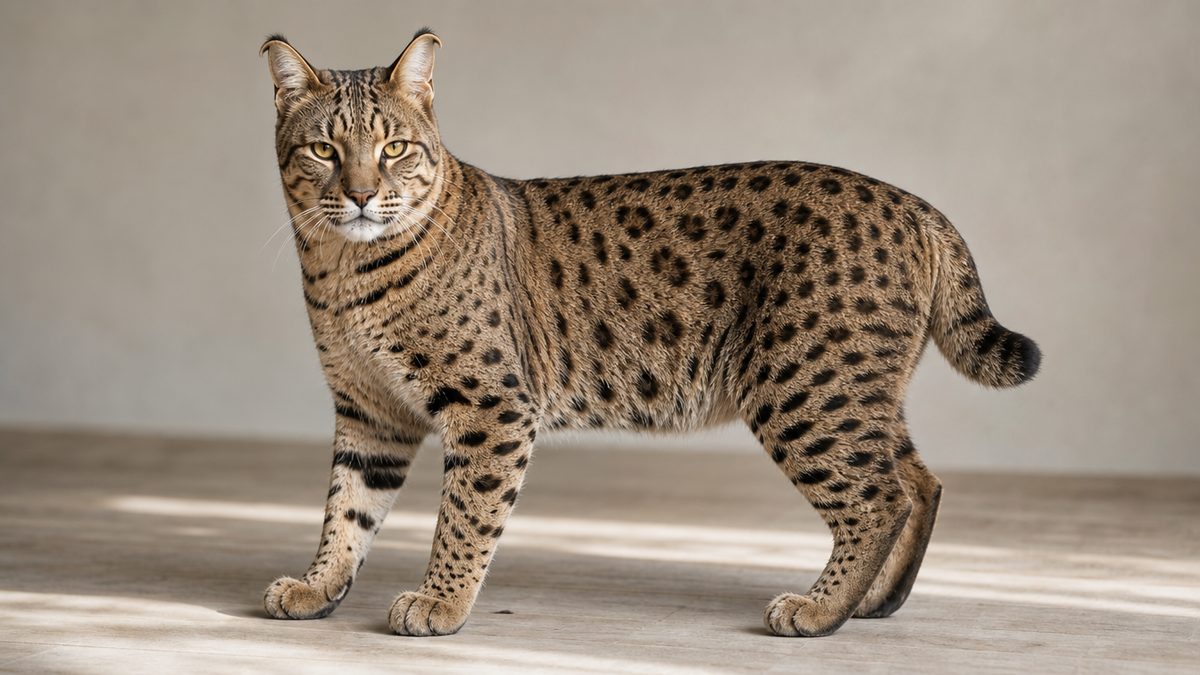
The physical description is specific and comes from TICA itself. The forehead is long and sloping, the eyes medium to large and shaped like a slightly flattened oval set on a bias, the nose wide with large nose leather, and the muzzle boxy, which together make the head appear longer than it is wide. The ears are the signature: the top third has a loose curl, and they sit as much on the top of the head as on the side.
The tail is the second signature and it varies enormously. TICA describes it as naturally short, ranging from 1 inch to hock length, thick and articulated, sometimes with kinks and curls, and carrying a fat pad at the end. A range from 2.5 cm to most of a normal tail is a very wide phenotype for a breed characteristic.
What TICA does not publish about this cat
Every structured field on TICA's own Highlander page is empty. There is no height, no weight, no life expectancy and no colour list, only the prose sections and a one-member breed committee. That is unusual: the same registry's Minuet page fills all of those fields. So the registry that recognises this breed publishes no size and no lifespan figure for it, and every number you will read elsewhere comes from somewhere else.
Wikipedia states that the unique appearance of the Highlander comes from the deliberate cross between the Desert Lynx and the Jungle Curl breeds, and Google India's knowledge panel reproduces that sentence for the query. TICA's own breed page says the opposite in as many words: the cats used to develop the breed were carefully chosen from the domestic gene pool and not from any existing recognized breed. Both cannot be right. This page follows the registry that maintains the breed's standard and registers its cats, and prints the disagreement rather than resolving it silently, because a reader who meets the Wikipedia version elsewhere deserves to know what the registry says.
Which registries hold the Highlander, and what class it is in
One registry of six holds the Highlander and one red-lists it by name. TICA places Highlander and Highlander Longhair in Category IV, Domestic Hybrid Breeds, with the accepted source breed given as domestic longhair or shorthair not a member of a recognised breed, while the GCCF lists it under Red Status as ineligible.
Registry recognition here needs a date attached to it, because the class has moved and the sources disagree about where it now sits. TICA recognised the Highlander for competition in the Preliminary New Breed class starting 1 May 2008, and its own breed page, last modified 12 June 2025 and read on 9 September 2026, states that Highlanders are currently being shown as an Advanced New Breed.
That is a non-championship class, and it is worth being careful about what the standards book does and does not tell you. A HIGHLANDER BREED GROUP standard exists, revised 26 February 2024, under the codes HG and HGS. But that compilation carries no class markers at all, returning zero occurrences of Provisional, Preliminary, Advanced New Breed and Registration Only, and it also contains the Toybob, which is not a championship breed. So the presence of a standard establishes that a written standard exists and nothing about the show class.
| Registry | Position | Document and date |
|---|---|---|
| TICA, registration | Category IV, Domestic Hybrid Breeds. Source breed: domestic longhair or shorthair not a member of a recognised breed | Registration Rules Version B, 22 November 2024, Standing Rule 307.5 |
| TICA, standard | HIGHLANDER BREED GROUP (HG/HGS) exists, revised 26 February 2024 | Standards of all TICA breeds, May 2025 capture |
| TICA, show class | Preliminary New Breed from 1 May 2008, and described as currently shown as an Advanced New Breed | TICA breed page, modified 12 June 2025, read 9 September 2026 |
| GCCF | Red Status. Named directly: Ineligible, multi-mutation breed with bobtail and curled ears | Unrecognised Breeds, modified 23 September 2025 |
| WCF | Absent from the entire 198-row EMS map | WCF EMS code table, full table pulled 9 September 2026 |
| FIFe | Absent from the 52-breed EMS list | Breeds index parsed on the EMS code, read 9 September 2026 |
| CFA | No breed council, and not in the Miscellaneous or Provisional block | Declared Candidates for Breed Council Secretary, modified 31 July 2026 |
| LOOF | No breed group and no pedigrees issued in 2025 | Nombre de chats, pedigrees issued 2025 |
The French national studbook publishes a breed group called Scottish et Highland, which issued 951 pedigrees in 2025. That is not this cat. Highland is the French and European name for the longhaired Scottish Fold, a completely different breed with a different mutation, and the studbook holds no Highlander row at all. Anyone reading a French or Continental source and finding a healthy Highland registration count has found the Scottish Fold's longhair variety, not the Highlander.
Why the GCCF names this breed and not just its category
The GCCF's Red Status is defined on its own page as covering breeds most unlikely to be recognised without new information, being those where scientific evidence exists of links to serious health problems. Its Highlander row reads Ineligible, multi-mutation breed with bobtail and curled ears, with the owner note Possible health and care risks, and it names the Manx, the Kurilian Bobtail, the American Curl and the British Shorthair and Longhair as alternative breeds. The objection is explicitly to stacking two structural mutations rather than to either one alone.
FIFe reaches a similar position by a different route, and it is worth verifying rather than assuming. FIFe's Health and Welfare Rules say it will not register or recognise any new breed of cats with breed characteristics based on phenotypic abnormalities or other congenital traits which give rise to health problems or impede the normal life of the cat, and its show rules bar cats with docked tails and cropped ears from exhibition. FIFe does not name the Highlander and its named prohibitions are the achondroplasia and osteochondrodysplasia clauses, which do not reach this breed, so the honest statement is that the Highlander is simply absent from FIFe's 52-breed list rather than barred by a clause aimed at it.
Where the Highlander came from, and the two accounts of it
TICA dates the breed's history to 2004, with the name settled in 2005 and Preliminary New Breed recognition from 1 May 2008. Two other widely read accounts give a different decade and a different ancestry, and this section sets all three beside each other rather than picking one.
| Account | Source | Status |
|---|---|---|
| Development began in 2004 with the intent of creating a domestic cat with a powerful big cat look, name settled 2005, TICA Preliminary New Breed from 1 May 2008 | TICA's own breed page, modified 12 June 2025 | The registry that maintains the standard and registers the cats |
| The appearance comes from the deliberate cross between the Desert Lynx and the Jungle Curl breeds | Wikipedia, reproduced by Google's knowledge panel Google India result page for the bare… | Directly contradicted by TICA's own sentence about the domestic gene pool |
| The breed started in the 1990s | Google India's generated answer, 9 September 2026 | A decade earlier than the registry's own date, on the same day |
The disagreement is not cosmetic and it is worth knowing why. If the breed descends from the Desert Lynx and the Jungle Curl, both of which are themselves recently developed cats with their own claimed ancestry, then a buyer is being told something about the animal's background that TICA denies. If TICA is right, the Highlander is a domestic cat built from domestic cats, and the big-cat look is selection rather than descent.
TICA's wording is unambiguous and it is the wording this page follows: the cats used to develop the breed were carefully chosen from the domestic gene pool and not from any existing recognized breed.
It settles a legal question before it arises. A cat described as descended from a lynx invites the question of whether Indian wildlife law reaches it. On TICA's account no wild species is involved at all, and the animal is Felis catus throughout, so the instrument that governs its sale in India is the Prevention of Cruelty to Animals (Pet Shop) Rules, 2018 like any other cat Prevention of Cruelty to Animals. Note also that Desert Lynx and Jungle Curl are breed names rather than species names, so even the contested account is not a claim about wild ancestry.
Highlander cat price in India, and why the one figure fails its own test
One Indian page publishes a Highlander price and it is a template. happypet.care gives Rs 80,000 to Rs 2,00,000, and a same-site control shows that everything around that figure is a constant shared with an unrelated breed. India's most-read cat pricing guide never names the breed at all across 206,421 characters.
Run the control yourself and the mechanism is obvious in about a minute. The Highlander page is labelled Large Breed and the California Spangled page on the same site is labelled Medium Breed. Their monthly expenses are identical to the rupee, at Rs 2,800 Basic Lifestyle and Rs 4,200 Premium Lifestyle. Their food expenses are identical to the rupee, at Rs 1,500 to Rs 2,000. Their life expectancy fields are identical, at 12 to 15 years. Their ideal space fields are identical happypet.care, California Spangled Cat….
| Field | Highlander page | California Spangled page | Verdict |
|---|---|---|---|
| Size label | Large Breed | Medium Breed | Different, so any shared figure cannot be a size band |
| Monthly expenses | Rs 2,800 basic, Rs 4,200 premium | Rs 2,800 basic, Rs 4,200 premium | Identical to the rupee. A template constant |
| Food expenses | Rs 1,500 to Rs 2,000 | Rs 1,500 to Rs 2,000 | Identical to the rupee. A template constant |
| Life expectancy | 12 to 15 years | 12 to 15 years | Identical, and TICA publishes no lifespan for the Highlander at all |
| Cost of buying | Rs 80,000 to Rs 2,00,000 | Rs 35,000 to Rs 60,000 | Different, so this is the field that varies per breed |
| Adult calories per day | 400 kcal | 250 kcal | Different, and the Spangled page gives adults FEWER calories than its own kittens |
Testing the buying price for a disguised dollar figure
The buying price is the one field that varies, so it deserves the division tests rather than dismissal. Rs 80,000 and Rs 2,00,000 divide by a flat 80 to exactly 1,000 and 2,500 US dollars, which are prices a seller would actually print. They do not divide cleanly at 84.38, giving 948.09 and 2,370.23, nor at 74, giving 1,081.08 and 2,702.70.
That result has to be reported with its own weakness attached. A flat 80 is a structurally weak test, because any rupee figure ending in three zeros divides cleanly at 80 by construction, and both these figures end in several. So the honest statement is that the band is consistent with a USD 1,000 to 2,500 list converted at a flat 80, that the quotients are plausible seller prices rather than arithmetic noise, and that the test alone cannot prove it. What is certain is that everything around the figure on that page is a shared constant.
There is no identified Indian breeder of this cat, and India's leading cat pricing guide does not name it. A cat offered in India as a Highlander is most likely a domestic cat with a naturally short or kinked tail, or a curled-ear cat of unknown parentage. Both can be good pets. Neither carries a pedigree, and the one Indian page pricing the breed is running a template whose monthly figures it shares with a completely different cat happypet.care, California Spangled Cat….
Import is not a route around any of it. Live cats are a Restricted import in India under ITC(HS) code 01061900, with anything outside the personal pet baggage route referred to the Exim Facilitation Committee.
Monthly cost of a large cat in India, with real figures
Budget Rs 4,000 to Rs 9,000 a month for a large cat in an Indian metro, and treat the first year as the expensive one. That range is built from sourced Indian rate cards rather than from a template, and the monthly cost of a large cat is genuinely higher than a small one because food scales with body weight.
Vaccination has the clearest published rate card and it does not scale with size. Vetic, a chain with clinics across eleven Indian cities, prices a kitten course of three visits at days 60, 90 and 120 from Rs 3,999 against a struck-through Rs 5,065, an adult annual booster from Rs 1,899, anti-rabies alone at Rs 699 and a feline CRP at Rs 1,249.
- Licence, Rs 50 in Chennai. The Greater Chennai Corporation licenses pet animals generally rather than dogs only, and issued 9,115 licences in Tamil Nadu during 2024.
- Free municipal treatment in Chennai. Its pet clinics provide all treatment and anti-rabies vaccination free of cost.
- Microchipping, Rs 1,250 at a Chennai clinic's own transacted price.
- No statutory microchip duty for a kitten. Rule 7(16) of the Pet Shop Rules, 2018 makes microchipping mandatory for puppies only.
- No breed genetic test to buy. Neither the curled ear nor the short tail has been genotyped in this breed, so there is nothing to screen for that a laboratory could sell you.
The Rs 2,800 to Rs 4,200 monthly band that happypet.care prints for this breed is not a wild figure. It is a reasonable running cost for a medium cat in an Indian city, and it is close to what the sourced vaccination, food and litter numbers add up to. What it is not is a Highlander figure, because the identical band appears on that site's California Spangled page for a cat it labels a different size happypet.care, California Spangled Cat…. Use it as a general Indian cat budget and not as breed information.
Heat tolerance and the Indian climate
A Highlander's heat tolerance is that of any medium to large domestic cat, because nothing in the breed's two distinguishing features touches thermoregulation. Curled ears and a short tail change appearance rather than cooling, and TICA describes the breed in both short and long hair.
Two features do need Indian-specific attention, and neither is about heat. The ear curl means the pinna is folded on itself at the tip, which changes airflow inside the ear and makes routine ear checking more important in humid months than it would be for a straight-eared cat. And a tail that TICA describes as ranging from 1 inch to hock length, sometimes with kinks and curls and a fat pad at the end, is a structure worth handling gently and inspecting rather than assuming is normal.
The Indian care points that actually apply
- Check the ears weekly, and more often in the monsoon. A curled pinna traps more moisture than a straight one in Mumbai, Chennai or Kochi humidity.
- A shaded tiled floor the cat can reach when you are out, in Delhi, Pune, Hyderabad, Kolkata or Ahmedabad.
- Water at least three feet from the food bowl. Cats drink less when they can smell food nearby.
- Handle the tail gently and know its shape. Kinks are described in the standard, so a change in shape or a pain response is what matters rather than the kink itself.
One published Indian figure for this breed should be read with care. happypet.care gives Ideal Weather 15 to 25 degrees C, a band that essentially no Indian plains city meets for most of the year. That field is also a template value on that site, so it is not a measurement about this cat, and a healthy medium-coated domestic cat manages an Indian summer indoors perfectly well with shade and water.
Indian law places the temperature duty on the seller and does it breed by breed. Rule 6(5) of the Pet Shop Rules, 2018 puts the obligation on the establishment rather than fixing one number for all animals, and rule 7(1) requires a species-suitable environment.
Temperament, household fit and who should not buy one
TICA describes the Highlander as the clown of the cat fancy, a cat that loves to play and chase, greets people at the door and shows off to visitors, and is relatively quiet vocally but high energy physically. That is a registry's own description rather than a study, and it is the best-sourced temperament account available.
The energy claim comes with a mechanism attached, which is unusual. TICA states that the breed's energy comes out in entertaining chase games and that it is this energetic activity that builds the powerful muscular body so characteristic of the breed. In other words the muscular build the standard asks for is partly a product of how the cat is kept, which makes exercise a conformation issue rather than only a welfare one.
The tail is described as an expressive element rather than a defect. TICA writes that the Highlander's tail is incredibly expressive and will wag like a dog from sheer joy, signalling happiness and playfulness.
Anyone who wants a calm cat should look elsewhere, because a registry describing its own breed as high energy and a clown is not overselling the quiet end. Anyone who wants to show internationally should think again, because the breed sits in a non-championship class at the only registry that holds it, and the GCCF lists it as ineligible on stated welfare grounds The Governing Council of the Cat Fancy. And anyone buying in India should read the price section first, because the one Indian page pricing this cat is running a template.
Training a Highlander, and the handling that matters
Teach ear handling and tail handling first, inside the first sixteen weeks. For a cat with a curled pinna and a short articulated tail those two lessons make every future veterinary visit easier, and both get harder the longer you wait.
- Handle both ears every day for the first month. A cat that accepts an ear being lifted and looked into is a cat whose ear infections get caught early.
- Handle the tail gently and often. TICA's standard describes kinks, curls and a fat pad at the end, so you need a baseline for what this individual's tail feels like.
- Reward with food, not with release. Letting a struggling cat go teaches it that struggling works.
- Teach the carrier before you need it, which saves heat stress on a Chennai afternoon.
- Give the chase games structure. TICA says the breed's musculature is built by its own chase activity, so play is training here.
This is a high-energy cat by its registry's own account, and in an Indian flat that energy needs somewhere to go. Vertical routes, a long corridor for sprinting and two or three interactive sessions a day will prevent most of what gets described as behaviour problems.
Litter training is ordinary for this breed. What is not ordinary is that a cat this size needs a tray sized for it, and a large cat in a small tray is one of the commonest causes of elimination outside the box.
How much exercise a Highlander actually needs
Budget 45 to 60 minutes of active play a day, split into two or three sessions, and expect the cat to ask for it. TICA describes a high energy cat whose characteristic musculature is built by chase activity, which puts the exercise requirement above that of most companion breeds.
- Chase games rather than static toys. The registry names chasing specifically as what builds the breed's build.
- Vertical routes as well as horizontal ones. This is a normal-legged athletic cat and it will use height.
- Food puzzles for the working day, doing the job while you are out.
- Cool hours only in an Indian summer, in Delhi, Ahmedabad, Kolkata or Pune alike.
Weight control matters here in a way that is different from the short-legged breeds. A large athletic cat that is not exercised does not become a calm cat, it becomes a heavy bored one, and osteoarthritis in cats is common enough at baseline that adding load is worth avoiding. Radiographs of 100 British cats euthanised in 1972 and 1973 found appendicular osteoarthritis in 74 percent, and a 2025 review puts current prevalence at well over a quarter of the feline population with detection rates remaining low.
One Indian caveat about the published figures. happypet.care gives 400 kcal a day for an adult Highlander and 300 kcal for a kitten, while its California Spangled page gives 250 kcal for an adult and 350 for a kitten. A page that puts an adult below its own kitten figure is not a feeding guide, and calorie needs belong to your vet and your cat's body condition rather than to a spec card.
Grooming a Highlander in Indian humidity
Brush weekly for the shorthair and twice weekly for the longhair, and check the ears every week regardless. TICA states the Highlander comes in both short and long hair, so the coat job depends on which one you have and the ear job does not.
The ears are the part that differs from every ordinary cat. A pinna curled backward at the top third folds tissue over itself, and in Indian monsoon humidity that fold holds moisture and wax that a straight ear would shed. Weekly inspection and gentle cleaning when your vet advises it is the whole routine, and it is more important between June and September than at any other time.
- A weekly ear check, lifted and looked into, for every Highlander regardless of coat length.
- Weekly brushing for the shorthair, twice weekly for the longhair, concentrating on the ruff and britches if the coat is long.
- Dry the coat and the ears completely after any bath, because in 90 percent Mumbai or Kochi humidity nothing air dries.
- Nails every two to three weeks, and handle the tail while you are there so you know its baseline shape.
The monsoon adjustment
Overseas grooming guidance routinely tells owners to towel a cat and let it air dry, which is written for a temperate climate and does not transfer to an Indian monsoon. Towel, comb, then let the cat finish somewhere with moving air, and pay particular attention to the inside of a curled ear, which is the one place on this breed that a towel will not reach.
Highlander health, and what has and has not been genotyped
No health issues have been measured in this breed. PubMed returns zero records for Highlander[tiab] combined with cat[tiab], with a clean query translation and the message No items found, in a session where the control Persian[tiab] AND cat[tiab] returned 322. Neither of the breed's two defining mutations has been genotyped in it, and this section is careful not to borrow a mechanism from a breed that has been.
The curled ear, and what is actually known about curled ears in cats
One curled-ear cat has been genetically described and it is not this one. The American Curl's ear was characterised in 1989: breeding data indicated the pinnate shape is inherited as a monogenic autosomal dominant trait, and the mutant gene was designated curl and symbolised Cu. That describes the American Curl. Whether the Highlander's curl is the same allele, a different one, or the same one acquired independently has not been published, and this page does not assume it.
The short tail, and why borrowing a mechanism here would be wrong
Two separate mechanisms are known for short tails in cats and they are in different genes. The Manx short tail comes from multiple mutant T alleles causing haploinsufficiency of Brachyury, with 95 percent of short-tailed Manx heterozygous for T mutations, and one of those alleles is shared with the American Bobtail and the Pixie-Bob. The short tail of Asian domestic cats including the Japanese Bobtail is associated with a missense mutation in a different gene entirely, HES7.
The paper that mapped the Manx alleles opens by naming the breeds with abnormal tail length phenotypes, and it names five: the American Bobtail, the Manx, the Pixie-Bob, the Kurilian Bobtail and the Japanese Bobtail. The Highlander is not among them. So the honest position is that this breed's short tail has never been genotyped, that two candidate mechanisms exist in other breeds, and that neither has been tested here.
The two known mechanisms have very different consequences and guessing wrong would mislead a buyer badly in either direction. The Manx T mutations are associated with a well-documented set of congenital problems in that breed. The Japanese Bobtail's HES7 mutation is not associated with the same picture. Telling a Highlander owner their cat carries either one, without a test, would be inventing a prognosis. What a buyer can do is concrete: know the shape of your own cat's tail, handle it regularly, and raise any pain response, any change, or any difficulty with urination or defecation with your vet immediately.
What the GCCF's objection actually is
The GCCF places this breed under Red Status with the comment Ineligible, multi-mutation breed with bobtail and curled ears, and the owner note Possible health and care risks. Read that precisely. The objection named is to combining two structural mutations in one breed, not to a published finding about the Highlander itself, and the GCCF also red-lists the American Curl's relatives and the bobtail breeds on their own separate grounds. It is a policy position on stacking, stated openly.
What a real breed-level investigation looks like
Compare this breed's evidence base with what has been done for the Bengal. Thoracic wall deformity in Bengal cats was investigated with whole-body computed tomography, macroscopic and microscopic rib-cage examination and a breeder questionnaire covering 311 litters over two years. Affected kittens appeared in 38 of 311 litters, or 12 percent, stillbirths and deaths within 24 hours ran at 20 percent against 12 percent at p equals 0.025, males were over-represented at 72 percent, and the proportion of affected litters varied between sires. That is a breed answering a question about itself. Nothing comparable exists for the Highlander, and the obstacle is willingness rather than technique.
| Claim | Status | Evidence |
|---|---|---|
| A written breed standard exists | Established | HIGHLANDER BREED GROUP (HG/HGS), revised 26 February 2024 |
| TICA recognised it for Preliminary New Breed competition from 1 May 2008 | Established and dated | TICA's own breed page |
| It descends from the Desert Lynx and the Jungle Curl | Contradicted by the registry | TICA states the founding cats came from the domestic gene pool and not from any recognised breed Highlander cat, Wikipedia |
| Its curled ear is the American Curl mutation | Never tested | The Cu gene was described in the American Curl; no Highlander genotyping has been published |
| Its short tail is the Manx or the Japanese Bobtail mutation | Never tested | The Manx T alleles were found in five named breeds and this is not one of them Xu X, Sun X, Hu XS, Zhuang Y, Liu YC |
| It has a measured life expectancy | No | Not among the 12 breeds reaching the 15-death threshold in the UK feline life tables, and TICA's own page leaves the field empty |
| It is hypoallergenic | Contradicted | There is no scientific evidence for a hypoallergenic cat breed |
Life expectancy
No measured figure exists, and the registry that holds the breed publishes none. TICA's Highlander page leaves the life expectancy field empty, and the breed is not among the 12 breeds that reached the 15-death threshold in the largest UK feline life-table study, so it sits inside the grouped other category holding 111 of that study's 7,936 confirmed deaths. The 12 to 15 years published on the one Indian page is a template value shared with an unrelated breed on the same site. From the UK life tables, crossbred cats reached 11.89 years of life expectancy at age 0 on 7,117 deaths, which is the most reliable general number an owner of an unregistered cat has.
Nothing on this page is a diagnosis or a treatment plan. Book an appointment this week for any of the following: head shaking, scratching at an ear, or discharge or odour from a curled ear; any pain response when the tail is handled; any change in the tail's shape or carriage; difficulty passing urine or faeces, which in any short-tailed cat deserves prompt attention; a change in how the cat walks; or reduced grooming. Chronic pain in cats is quiet and owners routinely reinterpret it as a cat mellowing with age. Consult your nearby vet, a registered veterinarian who can examine your own cat, before acting on anything you read here.
Feeding a large cat in India
Feed a complete commercial diet by measured meals and adjust to body condition rather than to a published calorie figure. The one Indian page that prints calories for this breed contradicts itself against its own sibling page, so a kitchen scale and your vet beat any spec card happypet.care, California Spangled Cat….
- Kitten to twelve months, three to four measured meals a day.
- Adult, two measured meals, weighed once with a kitchen scale.
- Wet food daily where the budget allows, because the water matters in an Indian summer.
- Treats under ten percent of daily calories.
- Water at least three feet from the food bowl. Cats drink less when they can smell food nearby.
- Discuss an omega-3 enriched diet with your vet if osteoarthritis is diagnosed. In a 2025 review it showed efficacy comparable to standard pharmacological treatment, without side effects and with high compliance.
Body condition by hand beats any chart, and it beats a size label most of all. A page that calls this cat a Large Breed while printing the same monthly food figure it prints for a Medium Breed is not telling you anything about how much your cat should eat happypet.care, California Spangled Cat….
Feed for the activity the cat actually gets. TICA describes a high-energy cat whose musculature is built by its own chase activity, and a Highlander in a small Indian flat with no play routine has the appetite of an athletic cat and the exercise of a sedentary one.
Kitten timeline, month by month through the first year
A Highlander kitten's first year has two breed-specific jobs and the rest is ordinary. Establish a baseline for the ears and the tail early, and get the handling done inside the first sixteen weeks.
- Before you pay, ask which registry issued the paperwork and what class the breed sits in there. TICA's own page describes the breed as currently shown as an Advanced New Breed rather than at championship.
- Weeks 0 to 8, do not take the kitten. The Pet Shop Rules, 2018 treat kittens below eight weeks as un-weaned and rule 7(15) bars their sale.
- Week 8 to 9, home and settle, and photograph the tail from above and the side so you have a baseline.
- Day 60, first vaccination. Vetic's kitten course runs three visits from Rs 3,999.
- Weeks 9 to 16, the handling window. Ears daily, tail often, paws every session, carrier before you need it.
- Day 90 and day 120, visits two and three, adding anti-rabies at Rs 699 when your vet advises.
- Month 4 to 5, microchip at Rs 1,250 and licence at Rs 50 where your municipality issues one.
- Month 5 to 7, neuter. Sex and neuter status are better evidenced influences on allergen output than breed.
- Months 6 to 12, the musculature arrives with the exercise. TICA is explicit that chase activity is what builds it.
- Month 12, first annual booster from Rs 1,899.
One item does not belong on the list, and it is worth saying why rather than leaving a gap. There is no DNA test to demand for either the ear or the tail, because neither has been genotyped in this breed Buckingham KJ, McMillin MJ, Brassil MM. Spend the money on veterinary examinations instead, and on knowing your own cat's baseline.
Highlander versus the breeds it borrows its features from
Two features define this cat and each one has an established breed behind it with far more evidence attached. The comparison below is the practical output of this page for anyone who likes the look but wants a documented animal.
| Feature | Breed that carries it with published genetics | What is known there | Registry standing |
|---|---|---|---|
| Curled ears | American Curl | Monogenic autosomal dominant, gene designated Cu, described in 1989 | Held by WCF, CFA, FIFe, TICA, ACF, CCCA and LOOF in both coat lengths |
| Short tail | Manx | Multiple mutant T alleles causing Brachyury haploinsufficiency, 95 percent of short-tailed Manx heterozygous | Held by every body on the WCF map |
| Short tail, other mechanism | Japanese Bobtail | A missense mutation in HES7, a different gene entirely | Held by WCF, CFA, FIFe, TICA and five more |
| Short tail, third breed | Kurilian Bobtail | Named among the five short-tailed breeds, and not explained by the Manx T alleles | WCF, FIFe, TICA and LOOF |
| Big cat look, no wild ancestry | Pixie-Bob | Named in the same five-breed list, and shares one Manx T allele | WCF, TICA, ACF and LOOF |
If you want the curled ears, buy an American Curl, whose ear mutation was described in 1989 and which seven registries hold. If you want the short tail, buy a Manx or a Japanese Bobtail, both of which have their tails genotyped and both of which every major registry holds. The Highlander offers both at once, which is exactly what the GCCF objects to and exactly what nobody has studied PubMed search audit run through the NCBI….
Mistakes Indian buyers make with the Highlander
Five mistakes account for most of what goes wrong, and the first two are both about believing a published sentence without checking who published it.
- Believing the Desert Lynx and Jungle Curl origin story. TICA's own page states the founding cats came from the domestic gene pool and not from any existing recognized breed.
- Taking the Indian price page at face value. Its monthly and food figures are byte-identical to those on the same site's California Spangled page, for a cat it labels a different size.
- Assuming the short tail is the Manx mutation. The paper that mapped those alleles names five short-tailed breeds and this is not one of them.
- Reading a TICA standard as championship status. The standards compilation carries no class markers at all, and TICA's own page describes the breed as currently shown as an Advanced New Breed.
- Believing the hypoallergenic claim. There is no scientific evidence for a hypoallergenic cat breed.
A sixth mistake belongs to anyone reading Continental sources. The French national studbook's Scottish et Highland group, at 951 pedigrees in 2025, is the Scottish Fold and its longhaired Highland variety rather than this breed. A healthy-looking registration count under a similar name is a different cat entirely.
One caution about your own searching. Highlander[tiab] AND cat[tiab] returns zero in PubMed with a clean translation and the message No items found. That is a real absence rather than a broken query, because the Persian control returned 322 in the same session, and it means every health claim you read about this breed comes from somewhere other than the veterinary literature.
Adoption, responsible sourcing and the honest answer
No Highlander breeder operates in India that Bonbeno could identify, and India's leading cat pricing guide never names the breed. Adopting a domestic cat with a naturally short tail or unusual ears is the route that exists, and Indian streets and shelters produce both.
- Ask which registry issued any pedigree, then verify the class with that registry. A TICA registration is a real document, and the class it carries is not championship.
- Assume an unregistered or imported cat comes with no health history, and monitor the ears and tail yourself from week one rather than waiting for a problem.
- Check the age before anything else. Sale below eight weeks is prohibited outright.
- Ask to see the parents' ears and tails. With nothing genotyped, the parents are the only evidence available.
- Consider an American Curl or a Manx if it is one feature you want, because both carry published genetics and full registry standing Buckingham KJ, McMillin MJ, Brassil MM.
- Use the municipal route where it exists. Chennai licenses pet animals at Rs 50 and treats and vaccinates them free at its own clinics.
Adoption deserves a specific note for this breed. Naturally short-tailed and kink-tailed cats are common in Indian street populations, and a cat that looks like a Highlander is not necessarily related to one at all. What such a cat is, is a domestic cat that already exists and already needs a home, and nothing on this page argues against taking one.
Import is not a workaround. Live cats are a Restricted import under ITC(HS) 01061900, and anything outside the personal pet baggage route goes to the Exim Facilitation Committee. Bonbeno does not broker cats and does not recommend breeders.
Highlander questions Indian buyers actually ask
How rare is a Highlander cat?
Rare enough that only one of six registries holds it. TICA carries the Highlander and Highlander Longhair in its Domestic Hybrid category with a standard revised in February 2024, and describes them as currently shown as an Advanced New Breed rather than at championship. The World Cat Federation's 198-row cross-registry table has no Highlander row, FIFe's 52-breed list has none, the CFA runs no breed council, the French studbook issued no pedigrees in 2025, and the GCCF lists the breed as ineligible.
How much does a Highlander cat cost?
No reliable Indian price exists. One Indian page gives Rs 80,000 to Rs 2,00,000, and a same-site control shows the surrounding figures are a template: that page and the site's California Spangled page print identical monthly expenses of Rs 2,800 and Rs 4,200, identical food expenses of Rs 1,500 to Rs 2,000 and identical life expectancy, for cats it labels different sizes. India's most-read cat pricing guide never names the breed at all across 206,421 characters.
Are Highlander cats good pets?
By its registry's own account, yes, provided you want an active cat. TICA describes the Highlander as the clown of the cat fancy, a cat that loves to play and chase, greets people at the door and shows off to visitors, relatively quiet vocally but high energy physically, with a tail it says will wag like a dog from sheer joy. Budget 45 to 60 minutes of active play a day, because the registry states that the breed's characteristic musculature is built by its own chase activity.
How big does a Highlander cat get?
TICA publishes no weight or height figure for this breed at all, which is worth knowing before you trust one. Its own breed page leaves the height, weight, life expectancy and colour fields empty, and the standard describes the Highlander and Highlander Longhair as medium to large cats without giving numbers. Figures of 10 to 20 pounds circulate in breed guides, and none of them comes from the registry that maintains the standard.
Is the Highlander descended from a lynx?
TICA says no, and TICA is the registry that holds the breed. Its breed page states that the cats used to develop the breed were carefully chosen from the domestic gene pool and not from any existing recognized breed. Wikipedia states the opposite, that the appearance comes from a deliberate cross between the Desert Lynx and the Jungle Curl, and Google's knowledge panel reproduces that. Note that Desert Lynx and Jungle Curl are breed names rather than species names, so even the contested account is not a claim of wild ancestry.
Why does the GCCF refuse to recognise the Highlander?
It names the breed directly under Red Status, its most severe category, with the comment Ineligible, multi-mutation breed with bobtail and curled ears and the owner note Possible health and care risks. The stated objection is to combining two structural mutations in one breed rather than to a published finding about the Highlander itself, and the GCCF names the Manx, the Kurilian Bobtail, the American Curl and the British Shorthair and Longhair as alternatives.
What causes the Highlander's curled ears?
Nobody has published the answer for this breed. One curled-ear cat has been genetically described, the American Curl, whose ear was shown in 1989 to be inherited as a monogenic autosomal dominant trait with the gene designated Cu. Whether the Highlander's curl is the same allele, a different one, or the same trait arrived at independently has not been tested, and assuming it would be inventing a genotype.
What causes the Highlander's short tail?
That has not been tested either, and two different mechanisms exist in other cats. The Manx short tail comes from multiple mutant T alleles causing haploinsufficiency of Brachyury, with 95 percent of short-tailed Manx heterozygous, and one allele shared with the American Bobtail and the Pixie-Bob. The short tail of Asian domestic cats including the Japanese Bobtail is associated with a missense mutation in HES7, a different gene. The paper that mapped the Manx alleles names five short-tailed breeds and the Highlander is not among them.
How long do Highlander cats live?
No measured figure exists, and TICA leaves the field empty on its own breed page. The Highlander is not among the 12 breeds that reached the 15-death threshold in the largest UK feline life-table study, so it sits inside the grouped other category holding 111 of that study's 7,936 confirmed deaths. The 12 to 15 years published by the one Indian page is a template value it also prints for an unrelated breed. From the UK life tables, crossbred cats reached 11.89 years at age 0.
Are Highlander cats hypoallergenic?
No, and no cat breed is. A 2024 review in Allergologie Select states in its full text that to date there is no scientific evidence for a hypoallergenic cat breed, and that even hairless Sphynx cats produce Fel d 1. Its conclusion adds that dander analyses across breeds show high individual variation but provide no evidence for the concept at all. Sex and neuter status are better evidenced than breed, since unneutered males average more Fel d 1 than females.
Is a Highlander cat the same as a Highland Fold?
No, and the names collide often enough to catch people out. Highland is the European name for the longhaired Scottish Fold, a different breed carrying a different mutation, and the French national studbook registers a group called Scottish et Highland that issued 951 pedigrees in 2025. The same studbook holds no Highlander row at all. A healthy registration count under a similar name in a Continental source is the Scottish Fold's longhair variety.
Can a Highlander live comfortably in an Indian flat?
Yes, provided the flat has a play routine in it. TICA describes a high energy cat whose musculature is built by chase activity, so 45 to 60 minutes of active play a day matters more than floor area. Two Indian adjustments apply: check the curled ears weekly and more often in the monsoon, because a folded pinna holds moisture that a straight ear sheds, and give the cat a shaded tiled floor it can reach when nobody is home.
Compare with similar breeds
Highlander sits in 3 Bonbeno groups. Each one compares it directly against the breeds it is genuinely an alternative to, on the same figures.