
Breed profile
Brazilian Shorthair in India: One Registry, and a Spelling That Hides It
A standardised Brazilian street cat, the first Brazilian breed to reach international recognition, held by the World Cat Federation alone under a spelling and a code that both hide it from an ordinary search.
Quick answer
No brazilian shorthair cat price in India could be sourced on 9 September 2026. India's most-read cat pricing guide never uses the word across 206,421 characters, while naming the Persian 22 times on the same page. One registry of six holds the breed, the World Cat Federation, which spells it Brasilian and codes it BSH, the same code FIFe uses for the British Shorthair. Foreign asking prices run 1,000 to 1,300 US dollars.
This page reports what the published record does and does not contain about a breed with two peer-reviewed records to its name, neither of them a health survey, and it is explicit about which study describes the breed and which describes the population it came from. It is reference material, not a diagnosis and not a treatment plan. Consult your nearby vet, a registered veterinarian who can examine your own cat, before acting on anything you read here, and treat straining to urinate or blood in the urine as urgent, particularly in a male cat.
Brazilian Shorthair at a glance
What a Brazilian Shorthair actually is
A Brazilian Shorthair is a street-descended Brazilian domestic cat developed into a pedigree breed, and it is held by exactly one registry in the world. The World Cat Federation lists it as the Brasilian Shorthair, code BSH, with no other body credited anywhere in its 198-row cross-registry table.
Its claim to significance is a first rather than a look. Wikipedia records it as the first cat breed from Brazil to receive international recognition, and a ranking result describes it as the only Brazilian breed recognised by the World Cat Federation. Both statements survive checking against the WCF's own table, which carries exactly one Brazilian breed row.
The ranking pages disagree about how big it is
Two of the top results give incompatible sizes and this page prints both rather than splitting the difference. Cats.com calls it a fairly large cat with males up to 22 pounds and females up to 16 pounds, which is roughly 10 kg and 7.3 kg. GoofyTails describes the same breed as medium-sized, elegant and athletic with a slender but muscular body, and puts it at 3 to 6 kg. A 10 kg cat and a 3 to 6 kg cat are not the same animal. The World Cat Federation's own one-page standard calls the body medium sized and muscular, yet slender and elegant, and prints no weight at all, so the registry sides with the medium description without settling the kilograms.
The World Cat Federation spells this breed Brasilian with an s. A case-insensitive search of the whole 198-row table for the string Brazilian therefore returns zero, which reads exactly like an absence. This agent hit that on the first pass and recovered the row only by dumping all 198 rows and reading them one by one. Anyone checking this breed's registry status for themselves should search a fragment such as Brasil rather than the full English spelling, and the same discipline applies to any breed whose name crosses a language.
Which registries hold the Brazilian Shorthair, one by one
One registry of six holds this breed and a second names it without holding it. The World Cat Federation recognises the Brasilian Shorthair under code BSH and is the only body credited on its own map, while the GCCF names the Brazilian Shorthair in the closing paragraph of its Unrecognised Breeds page as a breed it knows of but does not hold.
Registry recognition this narrow is unusual and worth stating plainly rather than softening. A single-registry breed has one standard, one register and one set of judges anywhere in the world, and outside that body's shows it is a domestic cat with paperwork.
| Registry | Position | Document and date |
|---|---|---|
| WCF | Recognised. Brasilian Shorthair, code BSH, with no other body credited on the row | WCF EMS code table, complete 198 rows pulled 9 September 2026 |
| GCCF | Not held, but named. Listed among other recognised breeds known of, described as minority breeds which are experimental or rare and not present in the UK | Unrecognised Breeds, modified 23 September 2025 |
| TICA | Absent from all six registration categories and from the standards book | Registration Rules Version B, 22 November 2024; standards compilation |
| CFA | No breed council, and not in the Miscellaneous or Provisional block | Declared Candidates for Breed Council Secretary, modified 31 July 2026 |
| FIFe | Absent from the 52-breed EMS list | Breeds index parsed on the EMS code, read 9 September 2026 |
| LOOF | No breed group and no pedigrees issued in 2025 | Nombre de chats, pedigrees issued 2025 |
The code collision worth knowing before you read any registry document
BSH means two different cats depending on whose document you are holding. The World Cat Federation gives BSH to the Brasilian Shorthair at row 53 and BRI to the British Shorthair at row 54. FIFe uses BSH for the British Shorthair in its own 52-breed list. So a pedigree marked BSH is a Brazilian Shorthair in a WCF document and a British Shorthair in a FIFe one, and reading the code without checking the issuing body gets it exactly backwards.
The GCCF's mention is short but it is a considered verdict rather than an oversight, which is what makes it useful. Its Unrecognised Breeds page grades roughly thirty breeds green, amber and red, and then adds a closing line naming seven further breeds it knows of, the Brazilian Shorthair among them, describing all seven as minority breeds which are experimental or rare and not present in the UK. So a body that publishes reasoned refusals has looked at this breed, has no health objection to it, and simply records that there are none in Britain. That is a very different position from the red-listed breeds elsewhere in the same table.
Where the Brazilian Shorthair came from
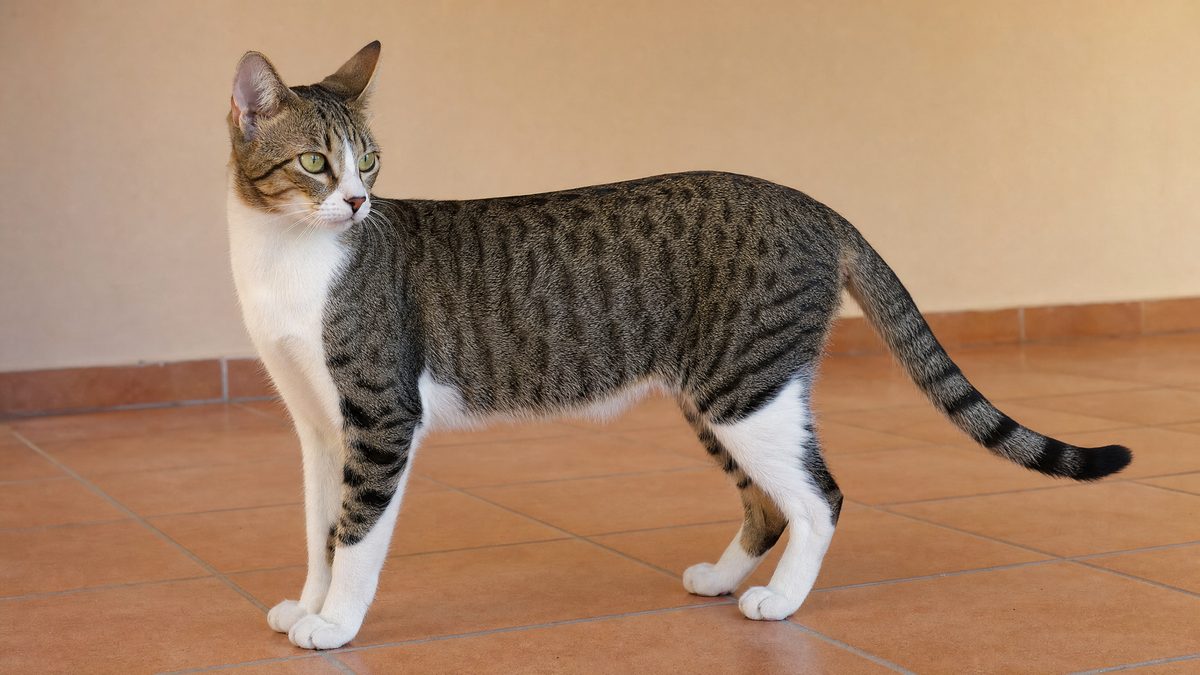
The Brazilian Shorthair descends from the ordinary street and house cats of Brazil, which themselves descend from the cats European colonists brought with them, and it was developed into a pedigree breed rather than discovered as one. Its significance is that it is the first Brazilian cat breed to reach international recognition.
That history explains almost everything about the breed's health picture, and the health section below builds on it. A breed drawn from a large, long-established, freely breeding urban population starts with a broad genetic base rather than a narrow founder group, which is the opposite of the position of most modern breeds.
It also explains the size disagreement. A breed standardised out of a street population will contain a wide range of sizes for several generations, and two breed guides describing the same breed as a 22-pound cat and as a medium slender cat are probably both describing real animals GoofyTails, Brazilian Shorthair.
What the only registry standard says, and what it leaves out
The one registry standard that exists is a single page. The World Cat Federation's cross-registry table records the recognition, and its Brazilian Shorthair standard, updated 1 January 2010, describes a medium-sized, muscular yet slender and elegant body on legs of medium length, a moderate wedge head longer than broad, large high-set ears with tufts, large rounded eyes set one and a half eye-widths apart, and a short, glossy, close-lying coat with a silky texture and no undercoat. It admits all colours and patterns except pointed, permits any amount of white, and restricts the novice class to Brazil. It gives no weight and no height. The live wcf.de path for that PDF returned 404 on 17 September 2026 and the text was read from an Internet Archive capture, and no Brazilian body's own document was reached, so every kilogram figure on this page is attributed to the breed guide that published it.
Brazilian Shorthair cat price in India, and the figures that circulate
No Brazilian Shorthair cat price in India could be sourced on 9 September 2026. India's most-read cat pricing guide never uses the word across 206,421 characters, while naming the Persian 22 times and the Siamese 9 times on the same page, and the one Indian breed-page site that does price rare cats returned HTTP 404 for this breed.
The figures that do circulate are all foreign, and Google's own answer for this breed carries an unusually useful warning inside it. It gives 1,000 to 1,300 US dollars from a reputable breeder and 800 to 1,000 pounds in the United Kingdom, then adds a note telling readers to be careful not to confuse the distinct Brazilian Shorthair pedigree breed with a standard Domestic Shorthair, a mixed-breed house cat adopted for around 50 to 150 dollars.
| Figure | Source | What it is |
|---|---|---|
| 1,000 to 1,300 US dollars | Cats.com, restated by Google's generated answer Google India result page for the bare… | A North American asking price for a breed with one registry worldwide |
| 800 to 1,000 pounds | United Kingdom classified sources, restated by the same answer | A British asking price for a breed the GCCF records as not present in the UK |
| 50 to 150 US dollars | The adoption fee for a domestic shorthair, quoted in the same answer as a warning | The engine's own acknowledgement that the two are easily confused |
| Rs 0 to Rs 2,000 | Supertails 2026 table, for the Indian Domestic or Desi cat | The Indian equivalent of that last row, and the realistic price of what an Indian buyer will actually be offered |
A Brazilian Shorthair is, by origin, a standardised version of an ordinary shorthaired street cat. That makes it almost impossible to tell from an ordinary shorthaired street cat without a pedigree, and India has a very large population of exactly that animal at Rs 0 to Rs 2,000. Google's own answer flags the same risk in dollars. If a seller in India offers you a Brazilian Shorthair, the only thing that distinguishes it from a healthy Indian shorthair is a World Cat Federation pedigree, and asking to see one costs nothing.
Import is not a realistic route either. Live cats are a Restricted import in India under ITC(HS) code 01061900, with anything outside the personal pet baggage route referred to the Exim Facilitation Committee.
Monthly cost of a Brazilian Shorthair in India
Budget Rs 3,000 to Rs 8,000 as the monthly cost of a medium to large shorthaired cat in an Indian metro. Nothing about this breed's coat or conformation adds a special recurring cost, which is genuinely unusual among the breeds in this batch and is worth saying plainly.
Vaccination has the clearest published rate card. Vetic, a chain with clinics across eleven Indian cities, prices a kitten course of three visits at days 60, 90 and 120 from Rs 3,999 against a struck-through Rs 5,065, an adult annual booster from Rs 1,899, anti-rabies alone at Rs 699 and a feline CRP at Rs 1,249.
- Licence, Rs 50 in Chennai. The Greater Chennai Corporation's page calls it a Pet Animal Licence for keeping pet animals, although the section heading above it reads Licensing of Pet Dogs, and it issued 9,115 in Chennai during 2024, so ask the Corporation whether your cat needs one.
- Free municipal treatment in Chennai. Its pet clinics provide all treatment and anti-rabies vaccination free of cost.
- Microchipping, Rs 1,250 at a Chennai clinic's own transacted price.
- No statutory microchip duty for a kitten. Rule 7(16) of the Pet Shop Rules, 2018 makes microchipping mandatory for puppies only.
- No breed genetic test to buy, and no breed health scheme to join. With one registry worldwide there is no published screening programme for this breed.
Blood typing before any planned surgery or breeding is cheap and useful, and this breed has a directly relevant population study behind it. Among 172 non-pedigreed domestic shorthair cats sampled across Rio de Janeiro, 94.8 percent were type A, 2.9 percent type B and 2.3 percent type AB, and the authors calculated the probability of a type A cat receiving type B or AB blood in a first random transfusion at 2.25 and 2.20 percent. That study is about the street population this breed came from rather than about the breed itself, and it says the risk is low rather than zero. Ask your vet whether typing is worth it for your own cat.
Heat tolerance and the Indian climate
This is the best-suited breed in this batch for the Indian climate, and the reason is its origin rather than any measurement. A short-coated cat descended from the free-living cats of Brazilian cities is descended from animals that already solved heat and humidity without help.
Brazilian urban conditions are a fair analogue for much of coastal India, so heat tolerance here is inherited from the environment rather than bred for. Rio de Janeiro, Recife and Salvador run hot and humid for most of the year, and a population that bred freely there for centuries was selected on nothing else. That is a reasoning argument rather than a measured one, and this page labels it as such rather than dressing it up as a finding.
What still needs doing in an Indian summer
- A shaded tiled floor the cat can reach when you are out, in Delhi, Chennai, Mumbai, Pune, Kolkata, Hyderabad or Ahmedabad alike.
- Water at least three feet from the food bowl. Cats drink less when they can smell food nearby.
- Weekly ear and skin checks through the monsoon, which is where a short coat still gets into trouble in 90 percent humidity.
- Watch weight rather than heat. A large indoor cat in an Indian flat gains weight far more easily than it overheats.
Indian law places the temperature duty on the seller and does it breed by breed. Rule 6(5) of the Prevention of Cruelty to Animals (Pet Shop) Rules, 2018 puts that obligation on the establishment rather than fixing one number for all animals, and rule 7(1) requires a species-suitable environment. That instrument governs cats in India; the Dog Breeding and Marketing Rules, 2017 govern dogs and are frequently miscited on cat pages.
Temperament, household fit and who should not buy one
Breed guides describe the Brazilian Shorthair as sociable, athletic, intelligent and a good hunter, and note that it is quite sensitive. Those descriptions come from breed guides rather than from any study, and this page marks them as such.
The origin gives a reasonable prior and it is a good one. A cat descended from a successful free-living urban population is likely to be adaptable, alert and confident with people, because those are the traits that survive in that environment. What it is unlikely to be is a placid lap cat, and buyers wanting one should look at the breeds bred for it.
Household fit in an Indian flat is straightforward. A short-coated, active, adaptable cat needs company, vertical space and play, and gives back very little in the way of special requirements.
Anyone who wants a documented pedigree easily should think about the practicalities, because one registry worldwide means one route to paperwork and no British, French, American or FIFe register at all The Governing Council of the Cat Fancy. Anyone who wants a calm indoor ornament should choose differently, since the breed guides describe an athletic hunter. And anyone in India should read the price section first, because the honest difficulty here is telling this cat apart from a healthy Indian shorthair without a pedigree.
Training a Brazilian Shorthair
Train the handling and the carrier first, in the first sixteen weeks, and then train for the energy. An athletic, intelligent, street-descended cat responds well to structure and badly to boredom, and both facts point the same way.
- Handle the paws and ears every session from week nine. A cat that accepts handling is a cat whose vet visits are short.
- Teach the carrier before you need it, which saves heat stress on a Chennai afternoon.
- Reward with food, not with release. Letting a struggling cat go teaches it that struggling works.
- Use clicker or target training for the intelligence. A hunting-type cat that gets no problems to solve invents its own.
- Give the hunting drive an outlet at dawn and dusk, which is when it will surface whatever you do.
Litter training is ordinary. A large cat needs a tray sized for it, and a large cat in a small tray is one of the commonest causes of elimination outside the box in Indian flats.
One habit is worth building for a different reason. Weigh the cat monthly on a kitchen scale in a carrier and subtract the carrier, because with two published size descriptions differing by several kilograms there is no breed chart to tell you whether your own cat is heavy.
How much exercise a Brazilian Shorthair needs
Budget 40 to 60 minutes of active play a day in two or three sessions, and expect a hunting-type cat to want both horizontal chase and vertical climbing. Breed guides describe an athletic cat and a good hunter, and an Indian flat has to provide for both or the cat will improvise.
- Wand toys with a real chase and a real catch. A hunting-type cat needs the sequence to finish.
- Vertical routes, shelves and a tall perch. This is a normal-legged athletic cat, unlike most of the breeds in this batch.
- Food puzzles for the working day, which suit an intelligent cat particularly well.
- Cool hours in an Indian summer, at dawn and after dark, which is also when the drive is strongest.
Weight control is the practical reason this matters. Feline osteoarthritis is common at baseline: radiographs of 100 British cats euthanised in 1972 and 1973 found appendicular osteoarthritis in 74 percent, and the authors concluded that it is not a novel disease. A 2025 review puts current prevalence at well over a quarter of the feline population with detection rates remaining low. A large cat carrying extra weight into old age is loading joints that will probably be affected anyway.
One genuine advantage this breed has over most of the batch deserves stating. A normal-legged cat with normal joint alignment can take all the exercise it wants without loading a deformity, which is not true of the short-legged breeds and is one of the strongest practical arguments for choosing a cat like this one.
Grooming a Brazilian Shorthair in Indian humidity
Brush weekly and do nothing else routinely. A short close coat on a cat descended from free-living animals is the lowest-maintenance combination in this batch, and in Indian humidity that is a real advantage rather than a minor one.
- A weekly brush, more often during a seasonal moult.
- Ear checks weekly through the monsoon, because humidity gets into ears regardless of coat length.
- Nails every two to three weeks, which matters more for an active climbing cat than for a sedentary one.
- Baths almost never. A healthy short-coated cat in India does not need routine bathing, and over-bathing does more harm than good.
The monsoon adjustment
Between June and September, dry the cat completely after any wetting rather than letting it air dry. Overseas grooming guidance routinely says to towel and let the coat finish in the air, which is written for a temperate climate. In 90 percent Mumbai or Kochi humidity nothing air dries, and a persistently damp coat against skin is where Indian skin problems start.
One observation doubles as a health check. Reduced grooming, particularly over the lower back, is one of the changes owners most often reinterpret as a cat mellowing with age, and it is associated with radiographic osteoarthritis rather than with contentment.
Brazilian Shorthair health, and what the two published records actually say
No health issues have been established for this breed and only two peer-reviewed records touch it, neither of them a health survey. PubMed's query Brazilian Shorthair[tiab] returns five records, of which exactly one names the breed in its own title, a two-case report of a rare ureteral variation PubMed search audit run through the NCBI…. No inherited disease has been described and no life expectancy has been measured.
The one record about the breed itself
Two Brazilian Shorthair cats were reported with a right circumcaval ureter and a double right renal vein. A circumcaval ureter, also called a preureteral vena cava or retrocaval ureter, is a loop of the ureter passing behind the caudal vena cava, described by the authors as one of the rarest ureteral variations and thought to arise from a deviation during that vein's embryonic development. Its association with two renal veins makes the combination rarer still.
Read what that paper is and is not. It is a two-case anatomical report, not a prevalence study, and it does not establish that the breed is predisposed to anything. The authors state their own reason for publishing it and it is practical: these variations should be preoperatively identified in order to avoid complications in kidney transplants, ureteral surgeries and cystoscopies. That is a message for a surgeon rather than a warning for a buyer.
Blood types, and a scope note that matters
The other relevant record is about the population rather than the breed, and conflating the two would be an error. Among 172 non-pedigreed domestic shorthair cats sampled across Rio de Janeiro, 94.8 percent were type A, 2.9 percent type B and 2.3 percent type AB, confirmed for the B and AB cats by high-performance thin-layer chromatography of erythrocyte membrane gangliosides. The authors calculated the probability of a type A cat receiving type B or AB blood in a first random transfusion at 2.25 and 2.20 percent, and concluded the pattern was consistent with domestic shorthair cats in other regions of the world.
The study sampled non-pedigreed domestic shorthairs, not Brazilian Shorthairs. It is quoted on this page because it describes the exact population this breed was standardised out of, which makes it the closest available evidence and not evidence about the breed. What it supports is a modest, useful statement: type B is uncommon in Brazilian cats, so the transfusion and neonatal isoerythrolysis risks that matter enormously in breeds like the British Shorthair are less prominent here. What it does not support is any figure presented as the Brazilian Shorthair's blood type frequency.
What has never been measured
| Claim | Status | Evidence |
|---|---|---|
| An inherited disease has been described in the breed | No | One PubMed record names the breed in its title and it is a two-case anatomical report |
| A life expectancy has been measured | No | Not among the 12 breeds reaching the 15-death threshold in the UK feline life tables |
| A breed health screening scheme exists | No | One registry worldwide, and no published programme |
| The breed is hypoallergenic | Contradicted | There is no scientific evidence for a hypoallergenic cat breed |
| A broad founder base is a genuine advantage | Reasonable but unmeasured | The origin supports it and no study has tested it. Stated here as reasoning, not as a finding |
The absence of an inherited disease list is not the same as a clean bill of health, and this page will not present it as one. What it does mean is that no registry, breed club or research group has published a screening recommendation for this breed, so a buyer has nothing specific to demand and should ask instead about the general health of the parents and the conditions the kittens were reared in.
What a breed-level investigation looks like, for comparison
Thoracic wall deformity in Bengal cats was investigated with whole-body computed tomography, macroscopic and microscopic rib-cage examination and a breeder questionnaire covering 311 litters over two years, finding affected kittens in 38 of 311 litters, stillbirths and 24-hour deaths at 20 percent against 12 percent at p equals 0.025, males over-represented at 72 percent, and variation between sires suggesting a genetic background. That is what a breed answering a question about itself looks like. No such study exists for the Brazilian Shorthair, and with one registry and a small population that is unsurprising rather than negligent.
Life expectancy
No measured figure exists for this breed. It is not among the 12 breeds that reached the 15-death threshold in the largest UK feline life-table study, so it sits inside the grouped other category holding 111 of that study's 7,936 confirmed deaths. The most useful number from that table for an owner of a street-descended cat is the crossbred row, at 11.89 years of life expectancy at age 0 with a confidence interval of 11.75 to 12.03 on 7,117 deaths, which is longer than nine of the eleven pedigree rows in the same table.
Nothing on this page is a diagnosis or a treatment plan. Book an appointment for any of the following: straining to urinate or blood in the urine, which in any cat is urgent and in a male cat is an emergency; a change in how the cat walks; reduced grooming over the lower back; eliminating beside the tray rather than in it; or any change in appetite or weight. If your cat is ever scheduled for abdominal or urinary tract surgery, mention the reported ureteral variation in this breed to the surgeon so it can be looked for on imaging beforehand. Consult your nearby vet, a registered veterinarian who can examine your own cat, before acting on anything you read here.
Feeding a Brazilian Shorthair in India
Feed a complete commercial diet in measured meals and adjust to body condition, because no breed weight chart exists that you could trust. Two ranking pages describe this cat's size incompatibly, so your own hands and a kitchen scale are the only reliable guide.
- Kitten to twelve months, three to four measured meals a day.
- Adult, two measured meals, weighed once with a kitchen scale.
- Wet food daily where the budget allows, because the water matters in an Indian summer.
- Treats under ten percent of daily calories.
- Water at least three feet from the food bowl. Cats drink less when they can smell food nearby.
- Discuss an omega-3 enriched diet with your vet if osteoarthritis is diagnosed. In a 2025 review it showed efficacy comparable to standard pharmacological treatment, without side effects and with high compliance.
Body condition by hand beats any chart, and here it beats one particularly badly. A page describing a 22-pound cat and a page describing a medium slender cat cannot both be giving you a target weight GoofyTails, Brazilian Shorthair, so feel the ribs under a thin fat cover and look for a waist from above rather than aiming at a number.
One general caution applies to this breed as to any active hunter. A cat with a strong prey drive that is fed free-choice dry food all day gets neither the hunt nor the portion control, and in Indian flats that combination is the most common route to a heavy cat.
Kitten timeline, month by month through the first year
A Brazilian Shorthair kitten's first year is unusually ordinary, and that is the point. There is no breed-specific test to demand and no conformation to monitor, so the calendar below is the standard Indian one with one addition at the start.
- Before you pay, ask to see the World Cat Federation pedigree. It is the only registry that holds this breed, so it is the only paperwork that can exist.
- Weeks 0 to 8, do not take the kitten. The Pet Shop Rules, 2018 treat kittens below eight weeks as un-weaned and rule 7(15) bars their sale.
- Week 8 to 9, home and settle. One room, one tray, one hiding place, no visitors for three days.
- Day 60, first vaccination. Vetic's kitten course runs three visits from Rs 3,999.
- Weeks 9 to 16, the handling window. Paws, ears, carrier, and the beginnings of clicker work for an intelligent cat.
- Day 90 and day 120, visits two and three, adding anti-rabies at Rs 699 when your vet advises.
- Month 4 to 5, microchip at Rs 1,250 and licence at Rs 50 where your municipality issues one.
- Month 5 to 7, neuter. Sex and neuter status are better evidenced influences on allergen output than breed.
- Month 6 onward, weigh monthly. With two incompatible published size ranges, your own record is the only growth curve you will have.
- Month 12, first annual booster from Rs 1,899.
One item is deliberately absent and the absence is the useful information. There is no DNA panel and no breed screening scheme to buy for this cat, because one registry holds it and none publishes a health programme. Spend the money on the vaccination course and on a good first veterinary examination.
Brazilian Shorthair versus the cats an Indian buyer will actually compare it with
The honest comparison for this breed is not with other pedigree cats. It is with the Indian shorthair a buyer can adopt for nothing, and the table below sets out what a pedigree actually buys in that comparison.
| Option | What it shares | What differs | Indian price |
|---|---|---|---|
| Indian Domestic or Desi shorthair | A short coat, a broad founder base, street-descended hardiness and an active temperament | No pedigree, and no way to prove ancestry | Rs 0 to Rs 2,000 |
| Brazilian Shorthair | The same, standardised, with one registry's paperwork | A World Cat Federation pedigree, and no other registry anywhere | No Indian price could be sourced |
| British Shorthair | A short dense coat and a calm temperament | A different code, BRI at the WCF and BSH at FIFe, and full recognition everywhere Federation Internationale Feline | Rs 20,000 to Rs 60,000 |
| Bombay | A short glossy coat and a sociable active cat | A recognised breed at seven bodies, and the cheapest pedigree row in the Indian table | Rs 10,000 to Rs 30,000 |
| Siamese | Intelligence and activity | A measured life expectancy of 11.69 years, which this breed does not have | Rs 15,000 to Rs 40,000 |
If what appeals is a hardy, active, short-coated cat with a broad genetic base, India already has one and it costs nothing. The Brazilian Shorthair's genuine offer is a documented version of that animal, from a breed whose only register is the World Cat Federation. That is a real thing to want, and it is worth being clear that it is what you are paying for, because the cat itself is the kind of cat Indian streets produce in large numbers.
Mistakes Indian buyers make with this breed
Four mistakes account for most of what goes wrong here, and two of them are about codes and spellings rather than about cats.
- Reading a BSH code as British Shorthair. The World Cat Federation gives BSH to the Brasilian Shorthair and BRI to the British, while FIFe uses BSH for the British.
- Searching for Brazilian and concluding the breed is unrecognised. The WCF spells it Brasilian, so the English spelling returns zero across its whole table.
- Paying a pedigree price without asking for the pedigree. One registry worldwide means one possible document, and Google's own answer warns that the breed is easily confused with an ordinary domestic shorthair.
- Treating the Rio blood type study as breed data. It sampled 172 non-pedigreed domestic shorthairs, not Brazilian Shorthairs.
A fifth mistake is about size rather than paperwork. Two of the top-ranking pages describe this cat as a 22-pound animal and as a medium slender one GoofyTails, Brazilian Shorthair, and a buyer who picks one of those and feeds to it will get it wrong for half of all Brazilian Shorthairs. Weigh your own cat monthly and use body condition instead.
One caution about your own research. If you search PubMed for this breed, Brazilian Shorthair[tiab] returns five records and PubMed broadens Brazilian to a supplementary concept, so most of what comes back is Brazilian veterinary work rather than breed literature. Exactly one record names the breed in its own title.
Adoption, sourcing and the honest Indian answer
Adopt an Indian shorthair. That is not a consolation on this page, it is the closest available animal: a hardy, short-coated, street-descended cat with a broad genetic base, which is precisely what the Brazilian Shorthair was standardised out of.
- Ask for the World Cat Federation pedigree and verify it with that body. It is the only registry that holds this breed, so an unregistered kitten offered under this name is simply a domestic shorthair.
- Compare the asking price against an Indian shelter cat before you pay. An imported pedigree is not on offer here, and the animal itself is the kind Indian streets produce in large numbers.
- Check the age before anything else. Sale below eight weeks is prohibited outright.
- Ask what the parents were like and how the kittens were reared. With no breed screening scheme to demand, husbandry is what you can actually assess.
- Use the municipal route where it exists. Chennai licenses pet animals at Rs 50 and treats and vaccinates them free at its own clinics.
- Do not import. Live cats are a Restricted import under ITC(HS) 01061900.
There is a specific and unusual argument for adoption on this page. Most breed pages have to explain that the adopted cat is different from the pedigree one. Here the pedigree breed is a standardised street cat, and India's street cats are the same kind of animal reaching the same solutions in a similar climate. An Indian shorthair adopted from a shelter is not an approximation of this breed's qualities; it is an independent instance of them.
Bonbeno does not broker cats and does not recommend breeders.
Brazilian Shorthair questions Indian buyers actually ask
How much does it cost to get a Brazilian Shorthair cat?
No Indian price could be sourced, and the figures in circulation are foreign. Published bands are 1,000 to 1,300 US dollars from a North American breeder and 800 to 1,000 pounds in the United Kingdom, in a country whose own registry records the breed as not present there. Google's own answer adds a caution worth repeating: do not confuse the pedigree breed with a standard domestic shorthair, adopted for around 50 to 150 dollars. India's equivalent of that last row is the Indian Domestic or Desi cat at Rs 0 to Rs 2,000.
Which cat is very costly?
In India the most expensive row in the most-read cat pricing guide is the Sphynx at Rs 50,000 to Rs 1,50,000, followed by the Himalayan and the Turkish Angora at up to Rs 1,20,000 and Rs 1,50,000. Six-figure and higher figures that circulate for rare cats are almost always breeder asking prices restated by answer engines rather than transactions. The Brazilian Shorthair appears nowhere in that Indian table at all.
What are the top 3 cat breeds?
It depends whether you mean popularity or availability, and in India the two differ. By Indian coverage, the most-read cat pricing guide leads with the Indian Domestic or Desi cat, the Persian at Rs 12,000 to Rs 50,000 and the Siamese at Rs 15,000 to Rs 40,000. By registration numbers in a mature register, Britain's top three in 2025 were the British Shorthair, the Ragdoll and the Maine Coon. The Brazilian Shorthair is in neither list.
Which is the rarest cat in India?
The question has two honest answers and they are about different animals. If it means pedigree breeds, almost every rare breed is equally absent: India's most-read cat pricing guide lists 14 rows in total, and the Brazilian Shorthair, the Highlander, the Minskin, the Lambkin, the Minuet and the Chantilly-Tiffany all return zero occurrences across its 206,421 characters. If it means wild cats, that is a question about Indian wildlife rather than about cat breeds, and this page does not answer it because it has no source for it.
Which registries recognise the Brazilian Shorthair?
One, the World Cat Federation, which lists it as the Brasilian Shorthair with the code BSH and credits no other body on the row. TICA holds it in none of its six registration categories, the CFA runs no breed council, FIFe's 52-breed list omits it and the French national studbook issued no pedigrees in 2025. The GCCF names it in the closing paragraph of its Unrecognised Breeds page among minority breeds which are experimental or rare and not present in the UK.
Is BSH the Brazilian Shorthair or the British Shorthair?
Both, depending on whose document you are reading, and this trips people up regularly. The World Cat Federation gives BSH to the Brasilian Shorthair and BRI to the British Shorthair. FIFe uses BSH for the British Shorthair in its own list. So a pedigree marked BSH is a Brazilian cat in a WCF document and a British one in a FIFe document, and the code alone tells you nothing without the issuing body.
How big is a Brazilian Shorthair?
The ranking sources disagree and the registry standard gives no weight. Cats.com describes a fairly large cat with males up to 22 pounds and females up to 16 pounds, which is about 10 kg and 7.3 kg. GoofyTails describes the same breed as medium-sized, elegant and athletic with a slender but muscular body, at 3 to 6 kg. The World Cat Federation's standard calls the body medium sized, muscular yet slender and elegant, and prints no figure. For a breed standardised out of a street population, a wide range is what you would expect, so weigh your own cat and use body condition rather than a chart.
What health problems does a Brazilian Shorthair have?
No inherited disease has been described in this breed. Exactly one PubMed record names it in its own title, a two-case report of a right circumcaval ureter with a double right renal vein in two Brazilian shorthair cats, which is an anatomical variation rather than a breed disease. The authors' own reason for publishing it is practical: such variations should be identified before kidney transplants, ureteral surgery or cystoscopy. An absence of a described disease is not a clean bill of health, and it does mean there is no specific screening test to demand.
How long do Brazilian Shorthair cats live?
No measured figure exists. The breed is not among the 12 breeds that reached the 15-death threshold in the largest UK feline life-table study, so it sits inside the grouped other category holding 111 of that study's 7,936 confirmed deaths. The most relevant number in that table for a street-descended cat is the crossbred row at 11.89 years of life expectancy at age 0, on 7,117 deaths, which is longer than nine of the eleven pedigree rows beside it.
Are Brazilian Shorthair cats hypoallergenic?
No, and no cat breed is. A 2024 review in Allergologie Select states in its full text that to date there is no scientific evidence for a hypoallergenic cat breed, and that even hairless Sphynx cats produce Fel d 1. Its conclusion adds that dander analyses across breeds show high individual variation but provide no evidence for the concept at all. Sex and neuter status are better evidenced than breed, since unneutered males average more Fel d 1 than females.
Is a Brazilian Shorthair good for the Indian climate?
Probably better suited than any other breed in this group, though the argument is from origin rather than from measurement. A short-coated cat descended from the free-living cats of hot humid Brazilian cities comes from a population selected on nothing but survival in those conditions, which is a fair analogue for coastal India. Give it a shaded tiled floor it can reach, water away from the food bowl, and weekly ear checks through the monsoon. Indian law puts the temperature duty on the seller breed by breed under rule 6(5) of the Pet Shop Rules, 2018.
How do I tell a Brazilian Shorthair from an ordinary shorthair?
By the pedigree, and by nothing else reliable. The breed was standardised out of Brazil's ordinary street and house cats, which themselves descend from the cats European colonists brought, so it looks like what it is. The only registry that issues paperwork for it is the World Cat Federation. If a seller cannot produce a WCF pedigree, what you are being offered is a shorthaired domestic cat, which in India is available from shelters at Rs 0 to Rs 2,000.
Compare with similar breeds
Brazilian Shorthair sits in 1 Bonbeno group. Each one compares it directly against the breeds it is genuinely an alternative to, on the same figures.