
Cat breed profile
European Shorthair Cat: Breed, Landrace, and What It Means in India
Three registries publish a written standard for this cat and three do not hold it at all. France's studbook registered two kittens in a year. The veterinary literature uses the name for any ordinary cat. Here is the whole disagreement, with every register opened.
Quick answer
The European Shorthair cat is a recognised breed and an ordinary domestic cat at the same time, and which one you mean depends on who you ask. FIFe has recognised it since 1949, the World Cat Federation and France's LOOF publish standards for it, and CFA, TICA and GCCF do not list it at all. LOOF registered two European Shorthair kittens in France in the last 365 days. No Indian market exists.
This guide is general information for Indian pet owners and is not a diagnosis. Because the veterinary literature uses this breed's name for ordinary domestic cats, much of the health evidence here describes cats in general rather than a closed breeding population, and it is labelled that way. Always consult a registered veterinarian near you before acting on anything you read, and treat heat stress, laboured breathing or any sudden change in appetite, drinking or litter habits as a same-day veterinary emergency.
European Shorthair at a glance
What the European Shorthair actually is
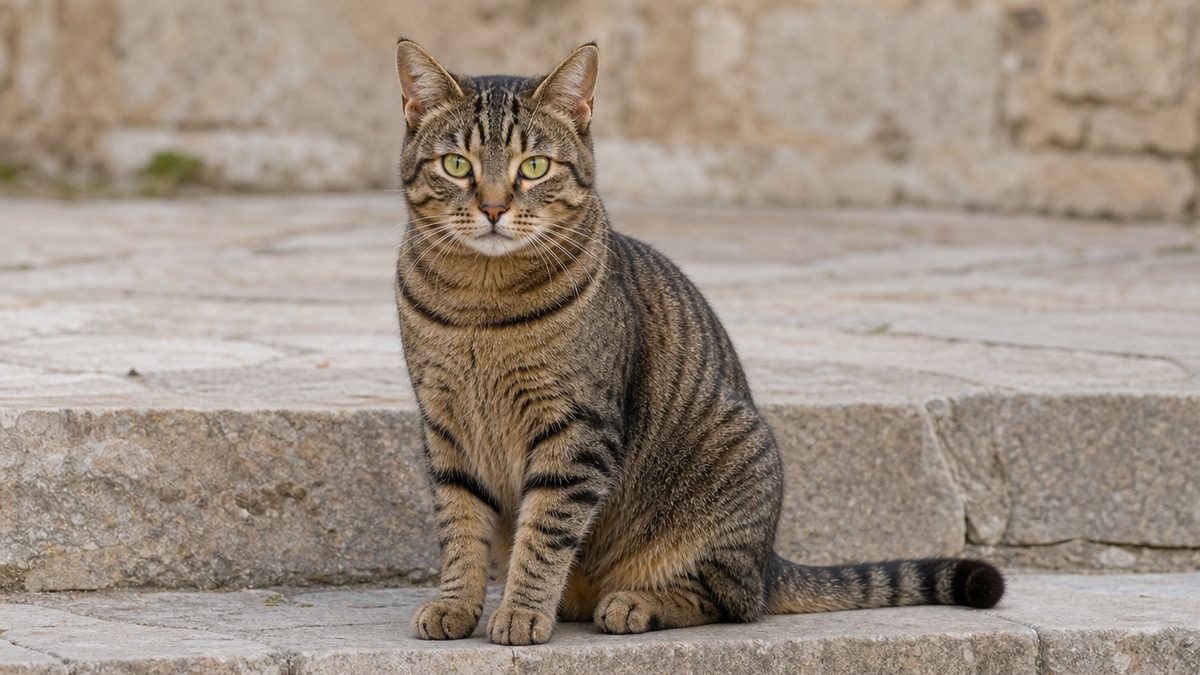
The European Shorthair is a medium to large shorthaired cat that three registries hold as a pedigree breed and three do not list at all, and whose own standards describe it as anatomically indistinguishable from the ordinary European domestic cat.
That is not a hedge. It is what the documents say. FIFe's standard opens with the line that the European can be compared to the kind of domestic cat which has developed naturally, that is, without having been subjected to special rules for breeding, and adds that breeding should be based on a robust and supple cat which is not different, from the point of view of anatomy, from the European domestic cat. The World Cat Federation says nearly the same thing in nearly the same words, that the Celtic Shorthair cat equates to an average European domestic cat which has developed naturally, without any planned breeding aims.
Both then add the sentence that makes it a breed. FIFe requires that the ideal European is presumed to be totally free of any admixture of other breeds, and WCF that the ideal Celtic Shorthair is free from any outcross to other recognized breeds World Cat Federation. Breed standard Celtic…. A cat that looks like every other cat and must be descended from none of them is a strange object, and the argument about what to call it is the subject of the next section.
The physical description, which is a list of things not to be
Hill's and PetMD both describe the same unremarkable animal at greater length and neither mentions that three major registries do not hold the breed PetMD. European Shorthair Cat Breed Health…. Nothing about this cat is exaggerated, and the standards enforce that negatively. LOOF puts it most directly: most of all, the European Shorthair shall not look like any other breed. FIFe asks for a fairly large head giving a rounded impression but a little longer than broad, a straight nose of medium length and uniformly broad through its length, and a transition to the forehead marked only by a shallow indentation between the eyes.
The body is robust, strong and muscular, and specifically not cobby. The ears are medium, slightly rounded at the tips, set well apart and fairly upright, with the height of the ear equal to the width of its base. The eyes are rounded and open, widely separated and set slightly oblique. The coat is short and dense, springy and glossy. LOOF adds that it is close-lying without too much undercoat, which is the single most useful sentence on this page for an Indian reader.
| Part | Fault that precludes the certificate |
|---|---|
| Head | A definite stop of the nose |
| Body | Too cobby, or too slender |
| Coat | A long or woolly coat |
| Coat | Any appearance of cross breeding, that is, a hybrid |
Read that last row carefully. On most breeds a fault list describes deviations from a type. Here the decisive fault is evidence of ancestry, which is the clearest sign that this standard is policing a pedigree rather than describing an animal.
Colour, and the four shades that give the game away
Every recognising registry excludes the same colours. FIFe's recognised list runs to white, black, blue, red, cream, black and blue tortie, the smokes, the tabbies, the silver tabbies and the van, harlequin and bicolour patterns, and it states that colour varieties resulting from cross breeding with other breeds are not permitted. WCF names the exclusions outright: chocolate and cinnamon and their dilutions lilac and fawn are not recognised in any combination, and the pointed pattern is not recognised either. LOOF adds sepia and mink to the excluded patterns.
That is a genetics rule wearing a colour rule's clothes. Chocolate, cinnamon and the pointed patterns cannot appear in a European population without an outcross to an Oriental-type or Siamese-type ancestor, so banning the colour is how you police the pedigree without a DNA test. Three registries arriving at the identical exclusion list independently is the strongest evidence on this page that the purity requirement is real.
FIFe permits green, amber, blue and odd eyes and restricts white to specific van, harlequin and bicolour codes. WCF asks only that eye colour be even and correspond with the coat colour, and permits any amount of white. LOOF gives the range as orange to yellow and green. Three standards for one breed, three different eye rules.
Which registries recognise the European Shorthair, and why the answer is genuinely split
Three of six registries recognise the European Shorthair with a written breed standard and a register, and three do not list it at all. Bonbeno publishes that split rather than resolving it, because the disagreement is the fact.
Breed recognition is not a single fact to be looked up, and treating it as one is how nearly every page on this subject goes wrong. The test applied here has two conditions. A written breed standard must exist somewhere, and a register or studbook must exist that individual cats are entered in. Each register was opened directly and a control breed was located on the same document, so that an absence is a measured absence rather than a failed search. The bare-form search that produced this page's People Also Ask harvest was run in the same session as a passing Labrador control. The indexes read were CFA's recognised-breeds page, TICA's A to Z, FIFe's breeds page, GCCF's breed list, WCF's shorthair standards index and LOOF's breed index.
| Body | Holds the breed | Written standard | Register | Control on the same document |
|---|---|---|---|---|
| FIFe (international) | Yes | EUR standard, Category 3, dated 01.01.2026, recognition line 1949 / 1981 | Member national registers issue FIFe pedigrees | British Shorthair BSH and Chartreux CHA in the same category list |
| WCF (international) | Yes | Celtic Shorthair KKH standard, update 01.01.2010 | Cattery and pedigree registration through affiliated clubs | British Shorthair BRI and Russian Blue RUS on the same shorthair index |
| LOOF (France) | Yes | Standard linked from breed record 23 | The official French feline studbook since 1996 | BRITISH at record 11 and CHARTREUX at record 18 on the same index |
| CFA (United States) | No | None. Not on the recognised-breeds index | Not applicable | The complete E block reads Egyptian Mau, European Burmese, Exotic |
| TICA (international) | No breed page or standard | None found on TICA's own site | Not applicable | 87-entry A to Z index runs Donskoy, Egyptian Mau, Exotic Shorthair with no European entry |
| GCCF (United Kingdom) | No | None. Zero occurrences in the Standard of Points | Not applicable | British Shorthair appears 34 times in the same 315-page document |
The cleanest negative test available anywhere
The GCCF result is worth stating precisely because it is unusually strong. Bonbeno downloaded the Governing Council of the Cat Fancy Standard of Points, June 2026 edition, extracted it directly rather than through a fetch tool, and searched the resulting 723,034 characters across 315 pages using a pattern tolerant of the word breaks that PDF extraction introduces. The word European appears zero times. British Shorthair appears 34 times, with its own standard on page 103, and Chartreux appears 8 times with its own standard on page 160.
European is an extremely common English word. A 723,000-character document about cat breeds that never once uses it is not a document with a gap; it is a register that does not hold the breed. The control passes on the same file, so the instrument is sound.
One claim Bonbeno could not verify
Wikipedia states that as of 2023 the breed is recognised by ACF, FIFe, LOOF, TICA for registration only, and WCF. Bonbeno found no European entry anywhere on TICA's own site, in an A to Z index of 87 breeds that includes both a Household Cat and a Household Pet Kitten class The International Cat Association.…. GCCF likewise maintains a published list of breeds it does not recognise, and a separate Household Pets show class, and the European Shorthair appears in neither Governing Council of the Cat Fancy.…. A registration-only listing would not generate a breed page or a show standard, so the two statements are not necessarily in conflict, but Bonbeno reports the TICA claim as unverified rather than repeating it. The same Wikipedia article carries an additional-references banner dated February 2021.
The recognising three disagree with each other on the date
This is the detail no ranking page carries. FIFe's own current standard prints the recognition line as Rec. 1949 / 1981. Wikipedia says felinological associations judged both types by one standard until 1982, when FIFe registered the Scandinavian type of European Shorthair as a separate breed with its own standard. LOOF says the cat fancy finally recognized the breed in 1983, and adds that it was renamed European Shorthair in 2007.
Three documents, three years, one event. Bonbeno follows the primary source and treats 1981 as FIFe's own record of when it granted the separate standard, while publishing the other two dates rather than quietly dropping them. Note also that FIFe's page lists the European among the eight breeds recognised in its founding year of 1949, alongside the Abyssinian, Chartreux, Manx, Persian, Russian Blue, Sacred Birman and Siamese, so the 1949 half of the line is not in dispute.
The strongest argument that it is a breed, and it is not the standard
FIFe and WCF both run a separate class for the non-pedigree cat, and both treat it as a different thing. FIFe's House Cat standard, covering longhair and shorthair, carries its own recognition date of 1984, thirty-five years after the European was recognised. It permits any eye colour, all coat colours and patterns, any coat length and texture and any tail length, and judges the animal on physical condition and temperament.
The WCF comparison is sharper still, because both standards score out of 100 and you can put them side by side.
| Scored on | Celtic / European Shorthair (KKH) | Household Pet Shorthair (HPS) |
|---|---|---|
| Body | 25 | Balance 20 |
| Head | 25 | included in balance |
| Eye colour | 10 | 20 for eyes, coat texture and colour together |
| Coat texture | 10 | included above |
| Coat colour and pattern | 25 | included above |
| Temperament | not scored | 10 |
| Maintenance | not scored | 20 |
| Condition | 5 | 30 |
Fifty of the European's hundred points go to head and body conformation and five to condition. Thirty of the household pet's hundred go to condition alone and twenty to maintenance, with none to head shape at all World Cat Federation. Breed standard…. Those are not two grades of the same judgement. They are two different judgements, and the registry that wrote both plainly does not think it is looking at the same animal twice.
The strongest argument that it is a landrace
Four lines of evidence point the other way, and three of them come from outside the cat fancy entirely.
- Both recognising standards describe the cat as the ordinary domestic cat. FIFe says not different, from the point of view of anatomy, from the European domestic cat.
- UK primary-care veterinary coding treats it as non-pedigree. The VetCompass life tables classify cats recorded as domestic shorthair, mediumhair or longhair as crossbred, alongside recorded mixes.
- The 2026 multicentre anaesthetic study of 14,964 cats uses European and Domestic Shorthair as a single reference category against which pedigree breeds are compared.
- In clinical case reports the name is a patient descriptor rather than a pedigree. A 2025 first-in-literature salivary stone report opens by describing an 8-year-old neutered female European domestic shorthair cat.
LOOF, which recognises the breed, acknowledges the dispute in its own entry. It opens by asking whether the European cat is a purebred cat and answering that of course it is, totally, then concedes that some judge it too common and mix it up with the alley cat, and that the breed consequently struggles to establish itself. A register defending its own breed in the second sentence is telling you the argument is live.
The evidence does not resolve, and pretending otherwise would be the error. Under FIFe, WCF and LOOF, European Shorthair names a small registered pedigree population with a written standard, a colour-purity rule and a pedigree requirement. In clinical veterinary usage, in UK primary-care coding and in ordinary speech, the same words name any ordinary European domestic cat. Wikipedia has to carry a hatnote reading Not to be confused with Domestic cat (landrace) for exactly this reason. Ask which sense a seller, a vet or a study means before you act on it.
The Indian half of the question
India has a working cat register, the Feline Club of India, which issues microchips, ownership certificates and breed authentication certificates and records ancestry to seven generations across 45 regional clubs and a register of 400-plus cats. It publishes no breed list and no written standard for any breed, so it cannot answer a recognition question about this or any other cat. Reporting that as non-recognition would describe a broken instrument rather than the animal.
Its show record can be measured, and it was. The 2023-24 General Score Board runs to 14 pages and identifies every cat by registration number and 15-digit microchip. European appears zero times. Persian appears 64 times, Bengal 53, Maine Coon 39, British Shorthair 16, Exotic Shorthair 16, Siamese 6 and Sphynx once. Seven controls pass on the document that returns nothing for this breed.
History, and the name the British Shorthair used to carry
The European Shorthair exists as a separate breed because Scandinavian breeders objected to being judged against the British Shorthair, which held the name European Shorthair before 1949 despite looking nothing like the cats being shown.
The underlying animal has no origin story worth telling, and that is the point. LOOF describes the direct descendant of the common domestic cat, probably arriving from Egypt, sharing the lives of the Greeks and Romans of antiquity, introduced into Gaul by Julius Caesar and his legions, and then developing naturally without being submitted to breeding rules. That is the history of the domestic cat in Europe, not of a breed.
The naming problem that created the breed
Until the early twentieth century the role of the cat representing Europe's ordinary domestic cats was held by the British Shorthair, even though it was stockier than the majority of common European cats. Meanwhile the British Shorthair itself had been crossed with the Persian and selectively bred to become cobbier, with a slightly shortened muzzle and a thicker coat. So the cat carrying the name European Shorthair was drifting away from the cats the name described.
Scandinavian breeders found this confusing, in the plain sense that the British Shorthair was also called European Shorthair at that time even though it looked different. Felinological associations judged both types as a single breed under one standard, which meant a Swedish or Finnish cat of the local type was being marked down against a British ideal it had never been bred toward.
1949, then a separation whose date is disputed
FIFe recognised the European Shorthair in 1949, its own founding year, and lists it among the eight breeds it has held since then. The separation from the British came later, and the sources give three years for it: 1981 on FIFe's current standard, 1982 on Wikipedia and 1983 on LOOF Wikipedia. European Shorthair Livre Officiel des Origines Felines.…. LOOF adds that the breed was renamed European Shorthair in 2007, which is why FIFe's own documents still call it simply the European.
FIFe merged the Chartreux into the British standard in 1970 and separated the two again in 1977, and the Chartreux standard still carries the recognition line Rec. 1949 / 1977 Federation Internationale Feline. Breed…. Two of FIFe's eight founding breeds were absorbed into the British Shorthair and had to be extracted again within a decade of each other. That is a pattern in how the British standard was applied, not a coincidence about either cat.
One further claim circulates and should be handled carefully. Wikipedia states that the oldest known European Shorthair registered in FIFe was born in 1940, and that sentence carries a citation-needed tag dated January 2024. Bonbeno reports it as an unverified claim. The same article says the breed is on the list of endangered breeds in Sweden and is the national cat of Finland, and that sentence is likewise tagged.
What the register shows today
France's national studbook lists BRITISH at record 11 and EUROPEAN SHORTHAIR at record 23 as separate entries, so the two are not folded together there. It also publishes a live count of kittens born in the last 365 days for every breed it holds. For the European Shorthair the figure is 2. For the Chartreux, read from the same register on the same day, it is 574 Livre Officiel des Origines Felines.…. The European Shorthair record also lists no dedicated breed club, showing only LOOF's own address, while the Chartreux record lists three separate French clubs.
Two kittens a year in the country whose national studbook recognises the breed is the most concrete measure of the problem LOOF describes in its own history note, that some judge the cat too common and mix it up with the alley cat, and that the breed struggles to establish itself as a result.
European Shorthair price in India, and a search result with no results in it
No European Shorthair price in India exists, and the Indian search results demonstrate it rather than merely lacking it. Not one of the twelve first-page results for the price query is about this breed.
Bonbeno ran the commercial query from an Indian location and read every result. The first is a general Indian cat price guide whose 14-breed table does not contain this breed. The second is an Exotic Shorthair page. Positions four, six, eight and ten are British Shorthair listings. The rest are a general chooser article, an Instagram account, a YouTube video and a Quora thread.
Zero of twelve. The Indian search index does not merely lack a price for this cat, it resolves the name to two other shorthairs, which is the entity confusion this page exists to unpick.
Supertails' cat price guide holds position one in India for this query. Its social preview image is a file named european-shorthair-8601492_640.jpg, and its breed-wise price table runs from the Indian domestic cat at Rs 0 to Rs 2,000 through Persian, Siamese, Ragdoll, Bengal, Scottish Fold, Munchkin, Himalayan, Siberian, Maine Coon, British Shorthair, Bombay, Sphynx and Turkish Angora. The European Shorthair is the picture, not a row.
The one figure that is real, and it is not a price
France's national studbook publishes how many kittens of each breed were born and registered in the last 365 days. For the European Shorthair the answer is 2. Read from the same register on the same day, the Chartreux figure is 574 and the register lists three French clubs for that breed against none for this one.
Two kittens a year, in the country whose official register recognises the breed, is the number that settles the practical question. There is no supply chain to India because there is barely a supply chain inside France.
| What you search | What India returns | Published Indian price |
|---|---|---|
| European Shorthair | British Shorthair listings | Rs 20,000 to Rs 60,000 |
| European Shorthair | Exotic Shorthair listings | Rs 80,000 to Rs 2,00,000 on one page, Rs 45,000 to Rs 85,000 on another |
| European Shorthair | A general cat price guide with no such row | Not listed |
| European Shorthair | The cat this breed actually resembles | Rs 0 to Rs 2,000 through adoption |
The last row is the honest one. What a European Shorthair is, on its own registries' definition, is the ordinary domestic cat of its region entered in a register. India has that cat already, and the leading Indian price guide puts it at Rs 0 to Rs 2,000.
India's registry has never shown one
The Feline Club of India's 2023-24 show scoreboard is a 14-page document identifying every cat by registration number and microchip. It contains no European entry at all, while Persian appears 64 times, Bengal 53, Maine Coon 39, British Shorthair 16, Exotic Shorthair 16, Siamese 6 and Sphynx once. Seven controls pass on the document that returns nothing for this breed.
Bonbeno quotes no rupee price for a European Shorthair, because inventing one would be the only way to produce it. Anyone offering you one in India is either selling a different breed or selling an ordinary cat with a story attached, and the second of those is not a scandal so much as a description of what the breed is.
Cost of ownership for a European-type shorthair in India
Budget Rs 2,300 to Rs 4,600 a month at the budget tier for a short-coated cat in India, and expect this breed to sit at the bottom of every line except food, because a coat that needs no professional grooming removes the most inflatable cost on the list.
Cost of ownership is where this cat is at its best. There is no coat to pay for, no brachycephalic surgery risk to insure against, and no breed-specific DNA test that any registry requires. What remains is food, litter, vaccination and the ordinary vet.
| Line | Budget | Mid-range | Premium |
|---|---|---|---|
| Cat food, dry plus wet | Rs 800-1,500 | Rs 1,500-3,000 | Rs 3,000-6,000 |
| Kitten food, under one year | Rs 1,000-2,000 | Rs 2,000-3,500 | Rs 3,500-5,000 |
| Litter and litter box | Rs 300-600 | Rs 600-1,200 | Rs 1,200-2,500 |
| Routine vet visits | Rs 300-600 | Rs 600-1,000 | Rs 1,000-2,000 |
| Professional grooming | Rs 500-1,000 | Rs 1,000-2,000 | Rs 2,000-4,000 |
| Flea and tick prevention | Rs 150-300 | Rs 300-600 | Rs 600-1,200 |
| Monthly total | Rs 2,300-4,600 | Rs 4,600-9,000 | Rs 9,000-21,700 |
For contrast, the Indian breed pages that do quote monthly figures give a Persian, a Maine Coon and a Russian Blue identical healthcare and grooming lines of Rs 500 to Rs 700 and Rs 800 to Rs 1,500, which tells you those rows are presets rather than measurements Happy Pet (India). Russian Blue Cat breed…. Delete the professional grooming row for this cat and the budget total falls to roughly Rs 1,800 to Rs 3,600. A short, dense, close-lying coat with little undercoat needs a weekly comb and no salon at all, which is a genuine structural saving rather than a corner cut.
Vaccination, where two Indian sources disagree by more than double
Read live in September 2026, a national clinic chain prices a kitten course from Rs 3,999 across three visits at days 60, 90 and 120, an adult annual package from Rs 1,899, anti-rabies from Rs 699 and the CRP combination vaccine from Rs 1,249. The Supertails guide puts a full first-year vaccination schedule at Rs 1,500 to Rs 3,000 and annual boosters at Rs 800 to Rs 1,500.
The ranges do not overlap at the top: the clinic's kitten course begins above the retailer's ceiling for the entire first year. Both are published Indian figures and Bonbeno prints both rather than averaging them. Ring two clinics in your own city, because delivery model drives this cost far more than breed does.
- Expect a first-year total between Rs 35,000 and Rs 2,40,000 including acquisition, setup and twelve months of running costs.
- Expect spay or neuter surgery at Rs 3,000 to Rs 8,000, a one-time cost with the largest measured survival effect on this page.
- Expect litter at Rs 300 to Rs 1,200 a month, the line Indian first-timers most often underestimate.
- Expect to spend nothing on professional grooming, which is where a short-coated cat pulls ahead of a Persian by Rs 500 to Rs 4,000 a month.
- Expect no breed-specific screening bill, because none of the three registries that recognise this cat requires a DNA test for it.
In UK primary-care data, entire cats had 4.29 times the odds of dying before three years of age compared with neutered cats, and a non-ideal body weight was significantly linked to a decreased lifespan. Neutering on schedule and controlling portions outrank every premium product an Indian pet retailer will offer you.
Heat tolerance in Indian conditions, rated honestly
A European-type shorthair handles Indian heat better than most pedigree cats and is still not adapted to it, because the advantage comes from an absence of exaggeration rather than from any heat adaptation.
Two features do the work, and both are written into the standards. The coat is short, dense and close-lying without much undercoat, so there is far less insulation to trap heat than on a double-coated breed. And the nose is straight, of medium length and uniformly broad, with a definite stop listed as a fault that precludes the certificate, so the airway is unobstructed and panting works as it should.
That is the whole of the advantage. Nothing in this cat's ancestry is tropical.
The homeland numbers, with the cell elevation echoed
Bonbeno queried NASA POWER by explicit latitude and longitude and echoed the elevation the model returned at every point, because POWER answers with a grid cell rather than with a town. Stockholm returned a cell at 26.64 m against a real elevation near 28 m, a divergence of about one metre, so the figures can be taken at face value. Paris returned 92.41 m against about 35 m.
| Place | Cell elevation | Annual mean | Annual humidity | Warmest month | Warmest wet-bulb |
|---|---|---|---|---|---|
| Stockholm, Sweden | 26.64 m | 6.87 C | 85.3% | July, 18.42 C | 15.2 C |
| Paris, France | 92.41 m | 10.93 C | 81.4% | July, 19.34 C | 15.9 C |
| Bengaluru | 841.72 m | 23.74 C | 67.9% | April, 28.37 C | 20.7 C |
| Pune | 635.99 m | 23.86 C | 66.8% | April, 28.93 C | 20.0 C |
| Delhi | 206.37 m | 25.60 C | 45.6% | June, 35.88 C | 24.4 C |
| Mumbai | 97.15 m | 26.77 C | 67.4% | May, 31.19 C | 25.1 C |
| Kolkata | 7.35 m | 25.81 C | 73.9% | May, 31.53 C | 26.6 C |
| Chennai | 48.95 m | 27.95 C | 72.4% | May, 31.51 C | 26.1 C |
The humidity warning is the wrong warning, again
Stockholm runs 85.29 percent annual relative humidity and Paris 81.43, both higher than every Indian city in the table, including Chennai at 72.39 and Kolkata at 73.93. A northern European cat is not going to be undone by damp air. It is going to be undone by damp air at thirty degrees, which is a different problem with a different name.
Wet-bulb temperature is the honest measure, because evaporation is the route by which a cat sheds heat once panting begins. Stockholm's hottest month sits at 15.2 degrees C wet-bulb and Kolkata's at 26.6, a gap of 11.4 degrees. Bengaluru and Pune, both above 600 m, are the two Indian cities on this list where a temperate cat has a comfortable year.
- Keep one room reliably cool from March to June, whether by air conditioner or by shade and cross-ventilation.
- Put out more water points than seem necessary and refresh them twice daily in summer, because dehydration directly reduces evaporative cooling.
- Move play to early morning and late evening through the pre-monsoon months.
- Run a weekly flea-comb skin check through the monsoon, which is a humidity task rather than a coat task.
- Screen windows and balconies rather than leaving them open for airflow, because this is a hunting cat that will use the gap.
A rating of 3 is a genuine pass and not a licence. The breed carries no heat adaptation, only an absence of the exaggerations that make other pedigree cats worse. The Indian domestic shorthair, by contrast, has been selected by the Indian climate itself for many generations, which is a different and stronger claim.
Temperament and household fit, separating what is documented from what is asserted
The European Shorthair is described consistently as a social, adaptable, active hunting cat that stays playful into adulthood, and the descriptions come from registries and consumer sites rather than from any behavioural study.
Be clear about the evidence level first. No behavioural study of this breed exists, because the breed is not separable from the ordinary domestic cat in any dataset large enough to study. What follows is registry description and consumer-site consensus, and it is labelled that way rather than dressed up as research.
FIFe's own breed profile page for the European carries the same short description its standard does. LOOF describes a cat that adapts to any environment, is social enough to live with other cats or even dogs provided they respect it, remains playful its whole life, loves to play outside if it has a garden, and is a fearsome hunter. Wikipedia records that the breed developed from the natural mouse hunters of Europe with the wish to strengthen the most desirable personality traits of the domestic cats.
The hunting drive is the trait that matters in an Indian home
Everything else about this cat is easy. The hunting drive is not, and it is the one trait every source agrees on. A cat bred from working mousers, kept in an Indian flat with a balcony, unscreened windows and pigeons on the ledge, is a cat that will eventually go through the gap.
Screen the openings before the cat arrives rather than after the first escape. Provide daily interactive play that completes the hunt sequence, ending with a food reward, because an unexercised hunting cat redirects the drive onto ankles, curtains and the household's smaller pets.
- Choose this cat if you want an active, social, low-maintenance companion that stays kitten-like for years.
- Choose it if you have children or other pets, since the temperament reports are consistently easy-going.
- Do not choose it if you keep hamsters, rabbits or birds, because the prey drive is documented rather than theoretical.
- Do not choose it if you want a placid lap cat, which is the Chartreux or the British Shorthair rather than this.
- Do not build a plan around acquiring one in India, because on the available evidence you cannot.
What the standards say about temperament, which is almost nothing
This is worth noticing. FIFe's European standard contains no temperament section at all, and neither does WCF's World Cat Federation. Breed standard Celtic…. Both describe conformation, colour and faults and stop. By contrast, FIFe's House Cat standard opens with temperament, naming a friendly and easy-to-handle temperament among the principal characteristics and awarding points for it.
So the registry that recognises this breed judges it on shape and judges the ordinary cat on behaviour. That is another way of seeing what the recognition argument is actually about, and it is why temperament claims for this breed rest on consumer sources rather than on the documents that define it.
Training approach, and what this cat needs rather than resists
Train a European-type shorthair through play and routine rather than correction, because this is an intelligent working-descended cat whose problems come from boredom rather than from stubbornness.
The training question for this breed is really an enrichment question. LOOF describes a cat that is social, active and playful its whole life, and a cat that stays kitten-like for a decade needs the mental workload of a kitten for a decade.
Litter training and the Indian humidity problem
Litter training is rarely difficult and litter maintenance often is. Budget Rs 300 to Rs 1,200 a month and expect to scoop daily through the monsoon months, when odour builds fastest and a neglected tray is the commonest cause of a cat going elsewhere. Site the tray away from the kitchen, away from the food bowl, and somewhere the cat is not cornered.
- Run two short interactive play sessions a day, each ending with a food reward so the hunt sequence completes.
- Rotate puzzle feeders rather than free feeding, which uses the intelligence and slows the eating at once.
- Teach carrier tolerance in the first month, because a confident cat that has never been crated will fight it at the worst moment.
- Socialise a kitten deliberately to household noise, visitors and handling, since an under-socialised natural cat becomes a reactive adult.
- Reward with play as often as with food, given that obesity is one of only two health issues consumer sources reliably name for this cat.
What no source can tell you
There is no training literature for this breed, and there cannot be one while it is inseparable from the general domestic population in every dataset. Everything above is general feline behaviour advice applied to a cat described as social, active and intelligent. Bonbeno states that plainly rather than inventing breed-specific technique, and an Indian reader is better served by a good general cat-behaviour resource than by anything claiming to be European Shorthair training.
Daily exercise, and what happens without it
Give a European-type shorthair at least 30 minutes of active play a day in two sessions, because this is a high-drive hunting cat and the failure modes are obesity and redirected predation.
The drive is the defining trait. The breed developed from the natural mouse hunters of Europe, and LOOF warns in plain terms that it is a fearsome hunter and that it loves to play around outside if it has a garden. An Indian flat is not a garden, and the difference has to be made up deliberately.
Two failure modes, both avoidable
The first is weight. Obesity is one of the two health issues consumer veterinary sources consistently name for this cat, and the consequence is measurable rather than cosmetic: in UK primary-care data a non-ideal body weight was significantly linked to a decreased lifespan.
The second is redirected hunting. A cat with an unmet prey drive practises on what is available, which in an Indian household means ankles, curtains, the neighbour's pigeons through an unscreened window and any smaller pet in the house. This is the breed to keep away from hamsters and rabbits.
- Use wand toys that move like prey rather than laser pointers, which never let the hunt sequence finish.
- Provide vertical space, because unlike the Chartreux this cat genuinely climbs.
- Move play to early morning and late evening from March to June, since a cat generates heat while it plays and India removes it slowly.
- Feed part of the daily ration through a puzzle feeder on hot afternoons, so the cat works without overheating.
- Weigh the cat monthly and record it, because a short close-lying coat hides less than a double coat but an owner's eye still adjusts.
A high-drive cat plus an Indian balcony is a fall risk and an escape risk at once. Screen every opening the cat can reach before the first play session rather than after the first incident, and remember that a cat that has never been outdoors in Chennai has no heat sense and no traffic sense.
Grooming and coat care in Indian humidity
Comb a European-type shorthair once a week and skip the salon entirely, because the standards specify a short, dense, close-lying coat without much undercoat and that is the lowest-maintenance coat on this site.
FIFe describes the coat as short and dense, springy and glossy. WCF says short, dense, firm and glossy. LOOF adds the detail that matters most in India, that the coat is close-lying without too much undercoat. A long or woolly coat is a fault that precludes the certificate outright.
That combination is close to ideal for the humid Indian plains. There is no packed undercoat to trap moisture against the skin through the monsoon, and no professional grooming requirement at all, which removes a Rs 500 to Rs 4,000 monthly line from the budget.
- Comb weekly with a fine metal comb, rising to twice weekly during a seasonal shed.
- Run a flea comb through the coat once a week in the monsoon and look at the skin, since parasite pressure rather than coat texture is the Indian risk.
- Bathe almost never, and only for a specific reason, because a healthy short coat maintains itself.
- Trim claws every two to three weeks and check ears, which matter more than the coat does on this cat.
- Brush the teeth, which is the one grooming task this breed genuinely needs and almost nobody does.
Teeth are the real grooming job here
Dental disease is the health issue consumer veterinary sources name first for this cat, and the case literature supports taking it seriously. A 2025 report describes an 8-year-old neutered female European domestic shorthair presented for halitosis, reduced appetite and weight loss, whose oral examination revealed generalised periodontal disease and multiple teeth affected by tooth resorption alongside the salivary stone that made the case publishable.
None of that is breed-specific and all of it is under-treated in India. A weekly toothbrushing habit started in kittenhood is worth more to this cat than any brush you could buy for its coat.
Set against a Persian, which Indian guidance describes as needing daily brushing and rates very high on grooming, this cat asks for a weekly comb. At Indian professional grooming rates of Rs 800 to Rs 2,500 a session, that is the largest single running-cost difference between the two.
Health risks and life expectancy, with the missing evidence named
No registry publishes a breed-specific health screening requirement or DNA test for the European Shorthair, and that absence is structural rather than an oversight, because the population is drawn from the general domestic cat rather than from a small closed founder group.
Start with what is not there. FIFe, WCF and LOOF each publish a full written standard for this cat and none of them attaches a mandatory test, unlike the British Shorthair, whose British registry has required a normal PKD DNA result for active registration. There is no breed health survey, no breed club testing scheme and no inherited condition named against it by any of the three bodies that recognise it.
That is a genuine advantage and it is also a measurement artefact. A breed that cannot be separated from the general population in a dataset cannot accumulate a breed-specific disease list either.
Being the control group is its own finding
The largest recent feline anaesthesia study is unusually useful here. Across 14,964 cats anaesthetised at 198 centres, anaesthetic-related death occurred in 0.63 percent of cases, with a 95 percent confidence interval of 0.51 to 0.77, rising from 0.07 percent in the healthiest physical-status class to 33.33 percent in the sickest. The reference category against which every breed was compared was European and Domestic Shorthair cats.
After adjustment for physical status, most breeds did not differ from that baseline. Persians remained at 2.22 times the risk, with a confidence interval of 1.11 to 4.46, and the brachycephalic group of Persian, Exotic Shorthair and Himalayan sat at 2.33 times, 1.17 to 4.63. Genomic lineage made no difference and moderate brachycephaly was not associated with increased risk.
A cat used as the baseline in a study of that size is a cat with no measurable excess anaesthetic risk, which is a stronger statement than any breed club could make about itself.
Life expectancy, from the category this cat is coded into
The UK VetCompass life tables are built on 7,936 confirmed deaths and contain no European Shorthair row, because their breed-status variable classifies cats recorded as domestic shorthair, mediumhair or longhair as crossbred. That coding decision is itself part of the recognition argument, and it also produces the most useful number available.
| Category | Life expectancy at age 0 | Lifespan range | Deaths in sample |
|---|---|---|---|
| Burmese | 14.42 years (12.91-15.93) | 0.74-21.29 | 45 |
| Birman | 14.39 years (12.87-15.91) | 0.94-22.25 | 38 |
| Crossbred, including domestic shorthair | 11.89 years (11.75-12.03) | 0.00-26.69 | 7,117 |
| Siamese | 11.69 years (10.56-12.82) | 0.66-21.48 | 88 |
| Persian | 10.93 years (9.63-12.23) | 0.01-21.68 | 80 |
| Maine Coon | 9.71 years (8.42-11.00) | 0.03-21.61 | 69 |
| British cats | 9.58 years (8.73-10.43) | 0.01-22.32 | 194 |
| Bengal | 8.51 years (7.12-9.90) | 0.14-21.22 | 73 |
| Sphynx | 6.68 years (4.53-8.83) | 0.13-14.67 | 18 |
Crossbred cats reached 11.89 years against 10.41 for purebred cats overall, and purebred cats carried 1.83 times the odds of dying before three years of age. The crossbred row also has by far the widest lifespan range and by far the largest sample, at 7,117 deaths against 18 for the Sphynx. Note one small internal inconsistency worth knowing: the paper's prose gives the crossbred confidence interval as 11.76 to 12.03 while its own Table 6 gives 11.75 to 12.03. Bonbeno quotes the table.
What the breed name does buy you in the literature
One genuinely breed-labelled study exists and it is anatomical rather than pathological. A 2026 paper analysed computed tomography scans from 24 European Shorthair cats to produce simple linear reference values for the orbital and infraorbital regions, measured directly from sagittal, transverse and dorsal planes rather than from three-dimensional reconstructions.
Its numbers are practical. Mean infraorbital canal length was 5.02 millimetres in females, with a standard deviation of 0.42, against 5.46 millimetres in males with a standard deviation of 0.46. Skull length was 88.06 millimetres in females against 94.54 in males. The clinical point the authors draw is that the safe depth for an infraorbital or maxillary nerve block is limited, and that advancing an instrument too far into the infraorbital canal risks penetrating the globe of the eye.
If your cat is booked for a dental extraction in India, this is a question worth asking. A local block makes the procedure kinder and shortens the anaesthetic, and the study above exists precisely because the safe depth in a cat is a few millimetres. A vet who blocks confidently and knows the landmarks is doing the cat a favour.
The conditions that actually turn up
Consumer veterinary sources name two health issues for this cat, dental disease and obesity, and both are behaviour-driven rather than inherited Cats.com. European Shorthair Cat. The case literature supports the dental half: the first reported minor-salivary-gland sialolith in a cat was found in an eight-year-old European domestic shorthair alongside generalised periodontal disease and multiple resorptive lesions.
Hypertrophic cardiomyopathy affects ordinary domestic cats too, and one French referral study is instructive on how. Among 344 cats across five breed groups, Domestic Shorthairs were diagnosed at a median 8.0 years, were among the only cats surviving beyond 15 years of age, and were one of the three groups in which sudden death was observed. That study used the Domestic Shorthair label rather than European Shorthair, which on this page's own argument is the same animal under a different name, and Bonbeno flags the substitution rather than making it silently.
Feeding and nutrition through the life stages
Feed a European-type shorthair to body condition on an ordinary complete diet, because this is a medium cat with no breed-specific nutritional requirement and obesity is one of only two health problems anyone names for it.
Indian food costs for a cat run Rs 800 to Rs 1,500 a month at the budget tier, Rs 1,500 to Rs 3,000 mid-range and Rs 3,000 to Rs 6,000 premium, with kitten food a tier higher because of the protein requirement. There is no reason for this cat to sit above the mid-range band.
- Feed a kitten growth diet to about twelve months, then transition over a week rather than overnight.
- Split adult food into two or three measured meals, because a high-drive cat eats fast and free feeding is how the weight arrives.
- Combine dry and wet food for hydration, which is the standard Indian veterinary recommendation and matters more in a hot climate.
- Weigh the portion rather than scooping it, and reassess in March when the heat cuts activity.
- Deliver part of the ration through puzzle feeders, which meets the enrichment need and the portion-control need at once.
Water, which does more work in India than any supplement
Evaporative cooling is a cat's main defence against heat, and a dehydrated cat has less of it. Put out more water points than seem necessary, keep them away from the food bowl because a strong food smell suppresses drinking, and refresh them twice daily through the summer. Track litter clumps as a rough intake proxy and treat a sudden change in drinking as a same-day veterinary question.
In UK primary-care data, a non-ideal body weight was significantly linked to a decreased lifespan, and entire cats had 4.29 times the odds of dying before three years of age compared with neutered cats. Portion control and timely neutering are the two decisions on this page with the clearest measured effect on how long the cat lives.
Month by month through a European-type kitten's first year
Plan the first year around the vaccination course from day 60, the neutering decision before the first birthday, and an enrichment routine established early, because a hunting-descended kitten that learns to play with people does not learn to hunt the household instead.
The physical development of this cat is unremarkable, which is the advantage. There is no slow-maturing coat to wait for, no folded ear cartilage to worry about and no brachycephalic airway to monitor. What needs planning is health cover and behaviour.
| Age | What is happening | What you do |
|---|---|---|
| Weeks 0-8 | With the mother and litter. Indian buying guidance lists a kitten sold under eight weeks as a red flag | Do not take the kitten home. See the mother |
| Day 60, about 2 months | First core vaccination due | First CRP from Rs 1,249, or a three-visit package from Rs 3,999 |
| Day 90, about 3 months | Second visit | Anti-rabies plus CRP. Rabies from Rs 699 |
| Day 120, about 4 months | Third visit completes the course | CRP plus anti-rabies. Only now widen social exposure |
| Months 3-5 | The prey drive switches on visibly | Establish two daily wand-play sessions. Screen every window and balcony |
| Months 4-6 | Teeth and handling habits set | Start weekly toothbrushing now, because dental disease is this cat's named problem |
| Months 6-9 | Neutering window | Discuss timing with your vet. Entire cats carry 4.29 times the odds of death before three years |
| Months 9-12 | Adult size reached, appetite steadies | Switch to adult food around twelve months. Weigh monthly and hold the line |
| Year 2 onward | Playfulness continues rather than fading | Keep the enrichment routine. Annual booster from Rs 1,899 |
The schedule above is a live Indian clinic schedule read in September 2026, and it begins at day 60 rather than at the six to eight weeks quoted in general guidance. Ask which protocol your own vet runs before planning travel or a move around it.
The clinic's own instruction is blunt: do not socialise your kitten before all three vaccines and boosters are complete. In an Indian building with free-roaming cats on the stairwell and in the parking, that instruction carries far more weight than it does in a European suburb.
How this cat compares with the ones Indians actually choose between
Against the shorthairs it is confused with, the European Shorthair wins on health and grooming and loses completely on availability, and its closest real-world equivalent in India is the desi cat, which shares its argument and its advantages.
The three cats this breed gets mistaken for in Indian search results are the British Shorthair, the Exotic Shorthair and the ordinary domestic cat. The comparison worth making is against all three at once.
| European Shorthair | British Shorthair | Chartreux | Indian domestic shorthair | |
|---|---|---|---|---|
| Registries recognising it, of six checked | 3. FIFe, WCF, LOOF | 6 | 6 | 0 as a breed |
| UK life expectancy at age 0 | No row. Coded as crossbred, 11.89 years | 9.58 years, 194 deaths | No row. Under the 15-death threshold | Coded as crossbred, 11.89 years, 7,117 deaths |
| Coat | Short, dense, close-lying, little undercoat | Short and very dense, plush | Dense double coat, slightly woolly | Short, varies |
| Professional grooming needed | None | Occasional | None, but weekly combing to the skin | None |
| Required DNA test at its registry | None | PKD, for active registration in Britain | None | None |
| Appearances in India's 2023-24 registry scoreboard | 0 | 16 | 0 | 0 |
| Published Indian price | None exists | Rs 20,000 to Rs 60,000 | Rs 30,000 to Rs 80,000, from one page | Rs 0 to Rs 2,000 |
| Kittens registered in France in 365 days | 2 | Not compared here | 574 | Not applicable |
| Heat suitability in India | Moderate. No exaggeration to fight | Poor. Very dense coat | Poor. Double coat | Adapted to the climate you live in |
European Shorthair against British Shorthair, the pair that shared a name
These two were judged by one standard until FIFe separated them, and the British Shorthair carried the name European Shorthair before 1949. What separates them now is real, and a closed studbook is the sharpest version of the difference: CFA's Chartreux rules permit no outcross breeds at all and demand four generations of pedigree, which is what a genuinely closed register looks like. The GCCF stud book service works the same way, listing only cats on its Active Register. The British was crossed with the Persian and bred cobbier, with a shortened muzzle and a thicker coat, while the European standard treats too cobby as a fault that precludes the certificate and bans a definite nose stop.
For an Indian buyer the practical differences run the other way from the availability. The British Shorthair has a UK life expectancy of 9.58 years, a required PKD DNA test at its home registry, a very dense coat and a real Indian market. The European Shorthair has no test requirement, a coat that suits the climate better, and no Indian market at all.
European Shorthair against the desi cat
This is the comparison that matters and almost nobody makes it. The European Shorthair is, by the explicit wording of both standards that define it, the ordinary domestic cat of its region entered in a register World Cat Federation. Breed standard Celtic…. India has exactly such a cat, in far greater numbers, adapted by many generations to this climate rather than to a Baltic one, and available for Rs 0 to Rs 2,000 through a shelter.
The dataset that exists treats them as the same category and rates that category well. Crossbred cats reached 11.89 years against 10.41 for purebred cats, on a sample of 7,117 deaths. If the argument for the European Shorthair is that a naturally developed, unexaggerated, healthy domestic cat is a good pet, then that argument is fully available in India without importing anything.
The European Shorthair project is a European country's attempt to give its own street cat a standard, a register and a show class. India could do the same with the desi cat and has not. That, rather than any question about this particular breed, is the interesting thing an Indian reader can take from the argument.
Mistakes Indian buyers make with this breed
The commonest mistake is paying a pedigree price for a cat sold under this name in India, where the search results return no European Shorthairs at all and the registry has never shown one.
Buying something else under the name
Not one of the twelve first-page Indian results for the price query is about this breed, and the ones offering cats are selling British Shorthairs and Exotic Shorthairs. A seller who advertises a European Shorthair in India is, on the evidence, either mislabelling a different pedigree or attaching the name to an ordinary cat.
The second of those is subtler than it sounds, because the cat may genuinely look correct. That is the whole difficulty with this breed: the standard describes an animal indistinguishable from an ordinary domestic cat, so appearance can never verify the claim. Only a pedigree from FIFe, WCF or LOOF can, and none of those bodies has a registered breeder network in India.
Treating an Indian breed certificate as a pedigree
The Feline Club of India issues breed authentication certificates, ownership certificates and microchips for all cat breeds, and publishes no breed list and no written standard for any of them. That is a real and useful identity record. It is not a pedigree from a registry with a written standard for this breed, and the acronym FCI connects it to no international body: internationally the Federation Cynologique Internationale is a dog federation that registers no cats at all.
- Assuming the breed is unhealthy because no registry lists health tests for it, when the absence reflects an open population rather than a hidden problem.
- Assuming the breed is rare and therefore valuable, when the rarity is of the pedigree paperwork rather than of the animal.
- Reading a veterinary case report that names a European Shorthair as evidence about a breed, when in clinical usage the phrase means an ordinary European cat.
- Buying on the strength of a Wikipedia claim, when the article carries an additional-references banner and tags several of its key sentences as needing citations.
- Leaving windows and balconies unscreened for ventilation, which is the single most dangerous habit with a hunting-descended cat in an Indian flat.
Repeating one registry's answer as the answer
The most common editorial mistake, made by nearly every page that ranks for this term, is to state either that the European Shorthair is a recognised breed or that it is just a domestic cat, and to leave it there. Both statements are true of different registries, and the reader who acts on only one of them will be surprised by the other.
The lawful pet route into India requires documented proof of two years of continuous stay abroad plus proof of transferring residence, caps the movement at two animals, and requires the owner to declare that the animal is a bona fide pet with no commercial interest, gift or breeding purpose. With two kittens registered in France in a year, there is nothing at the far end of that process to collect anyway.
Adoption, responsible sourcing and the cat already near you
Adopt an Indian domestic shorthair, because it is the same argument as the European Shorthair carried out on this continent, and because it is the only version of that argument you can actually act on in India.
This page has spent several thousand words on whether a naturally developed, unexaggerated European domestic cat counts as a breed. Whatever the answer, the reason people want the cat is not the paperwork. It is the animal: healthy, unexaggerated, active, sociable, low-maintenance and long-lived. India has that animal on every street.
The numbers favour it and they are not close
Crossbred cats in UK primary care, the category that includes every cat recorded as a domestic shorthair, reached a life expectancy at age 0 of 11.89 years across 7,117 deaths, against 10.41 years for purebred cats, and purebred cats carried 1.83 times the odds of dying before three years of age. In the large anaesthetic study, European and Domestic Shorthair cats were the reference group that pedigree breeds were measured against, and most breeds did not beat them.
In India, adoption costs Rs 500 to Rs 5,000 and usually includes basic vaccination, against Rs 10,000 to Rs 1,20,000 or more from a breeder.
- Contact established shelters directly, since Indian guidance names CUPA in Bengaluru, Friendicoes in Delhi and Blue Cross in Chennai as starting points.
- Take an adult rather than a kitten if temperament certainty matters, because with an adult what you see is what you get.
- Ask for the vaccination and deworming record, and check it against the schedule your own vet runs.
- Budget the same running cost either way, since Rs 2,300 to Rs 4,600 a month at the budget tier does not care where the cat came from.
- Neuter on schedule, which is the single intervention with the largest measured effect on survival.
If you want the registered breed specifically
Then understand what you are joining. France's national studbook registered two European Shorthair kittens in the last 365 days and lists no dedicated breed club for it, showing only LOOF's own address. The population is concentrated in Scandinavia and it is small. Any acquisition would be an import under the pet baggage rules, which depend on your own residence history rather than on a seller's willingness.
- Verify which register issued the pedigree, and read that register's standard yourself, since the three that recognise the breed disagree on eye colour and on permitted white.
- Expect no health test paperwork, because no registry requires one for this breed, and treat a seller offering breed-specific DNA results as confused rather than thorough.
- Refuse any kitten under eight weeks, which Indian buying guidance lists among its red flags.
- Never pay in advance for a cat you have not seen, and never accept a photograph-based breed certificate as a pedigree.
- Read the import conditions yourself before committing money.
If you want to check an Indian seller's legal claims yourself, be aware that the government's published copy of the Prevention of Cruelty to Animals (Pet Shop) Rules, 2018 is a fifteen-page image scan yielding fourteen characters of extractable text. Anyone quoting a rule number at you from that PDF did not read it there either.
The honest close is short. The European Shorthair is a real breed to three registries and not a breed at all to three others, and both positions are defensible on the documents. It is close to unobtainable even in Europe and entirely unobtainable in India. What it stands for, a healthy natural cat with nothing exaggerated about it, is sitting in an Indian shelter right now under a different name and a much better dataset.
European Shorthair questions people actually search
What is the difference between a European Shorthair cat and a domestic shorthair cat?
The difference is paperwork, not appearance, and the registries say so themselves. FIFe's own standard states that the European is anatomically no different from the European domestic cat, and WCF's states that the Celtic Shorthair equates to an average European domestic cat. What separates them is a pedigree recording that the cat carries no admixture from other breeds, which is why both standards refuse chocolate, cinnamon, lilac, fawn and the pointed patterns and treat any appearance of crossbreeding as a fault.
Is my cat a European Shorthair?
Almost certainly not, if you are in India. The breed is recognised by three registries and absent from three others, France's national studbook registered two kittens in the last 365 days, and India's cat registry recorded none at all in its 2023-24 show season. A short-coated Indian cat is an Indian domestic shorthair, which is a different landrace with its own local history. Without a pedigree from FIFe, WCF or LOOF, the honest answer is no.
Are European Shorthair cats good pets?
Yes, and unusually so for India, because nothing about the cat is exaggerated. The standards ask for a short, dense, close-lying coat with little undercoat and a straight nose with no defined stop, so neither heat nor breathing is working against the animal. It is a natural hunting cat that stays playful into adulthood, adapts to most homes and needs almost no grooming. The practical problem is not the cat, it is that you cannot buy one here.
How much do European Shorthair cats cost?
No Indian price exists, and the search results demonstrate why rather than merely asserting it. Not one of the twelve first-page Indian results for the price query is about this breed, and they return British Shorthair and Exotic Shorthair listings instead. In India the honest comparison is the domestic cat, which the leading Indian price guide puts at Rs 0 to Rs 2,000 through adoption, against Rs 10,000 to Rs 1,20,000 or more from a breeder for a pedigree.
Which registries recognise the European Shorthair?
Three of the six Bonbeno opened. FIFe holds it as EUR in Category 3 with a full standard dated 1 January 2026, the World Cat Federation publishes a standard under the name Celtic/European Shorthair with the code KKH, and France's LOOF holds it at record 23. CFA, TICA and GCCF do not list it. The GCCF test is the cleanest: the word European appears zero times in its 315-page Standard of Points while British Shorthair appears 34 times.
Why is the European Shorthair confused with the British Shorthair?
Because for decades they shared the name. Until 1949 the role of the cat representing Europe's ordinary domestic cats was held by the British Shorthair, and Scandinavian breeders found it confusing that the British Shorthair was also called European Shorthair at the time even though it looked different. FIFe judged both types by one standard until it registered the Scandinavian type separately. The British was meanwhile crossed with the Persian to become cobbier, with a shortened muzzle and a thicker coat.
How long do European Shorthair cats live?
No breed-specific figure exists, because the UK life tables code a domestic shorthair as crossbred rather than as a breed. That category is the largest in the dataset and gives a life expectancy at age 0 of 11.89 years from 7,117 deaths, against 10.41 years for purebred cats. Purebred cats also carried 1.83 times the odds of dying before three years of age. On the only large dataset available, the ordinary cat outlives the pedigrees.
Does the European Shorthair have inherited health problems?
None that any registry publishes a screening requirement for, and that absence is meaningful rather than an oversight. Neither FIFe, WCF nor LOOF requires a DNA test for this breed, and the large multicentre anaesthetic study of 14,964 cats uses European and Domestic Shorthair cats as the baseline against which pedigree breeds are measured. After adjustment, most breeds did not differ from that baseline, with Persians at 2.22 times the risk and brachycephalic breeds at 2.33.
Is the European Shorthair suited to the Indian climate?
Better than most pedigree cats, and still not adapted to it. The coat is short, dense and close-lying without much undercoat, and the muzzle is unexaggerated, so neither insulation nor airway works against the cat in heat. But the homeland is cold: Stockholm averages 6.87 degrees C annually and Paris 10.93, against 27.95 degrees C in Chennai. Provide shade, ventilation and constant water from March to June rather than assuming the coat solves it.
What colours is a European Shorthair allowed to be?
Most of them, with four colours and one pattern group specifically excluded. FIFe recognises white, black, blue, red, cream, the torties, smoke, tabby, silver tabby and the van, harlequin and bicolour patterns. What all three recognising registries refuse is chocolate, cinnamon, lilac and fawn, along with the pointed, sepia and mink patterns. Those are exactly the colours that can only arrive from another breed, which is how a purity rule is enforced in practice.
Is the European Shorthair the national cat of any country?
Wikipedia states that the breed is on the list of endangered breeds in Sweden and is the national cat of Finland, and that sentence carries a citation-needed tag on the article itself. Bonbeno reports it as an unverified claim rather than as a fact. What is verifiable is that France's national studbook registered two kittens in the last 365 days, which is what endangerment looks like in a register.
Should I buy a European Shorthair or adopt an Indian cat?
Adopt, and the argument is unusually simple for this breed. What the European Shorthair is, by its own registries' definition, is the ordinary domestic cat of its region formalised into a register. India has its own such cat on every street, adapted to this climate rather than to a Baltic one, available for Rs 0 to Rs 2,000 through a shelter, and coded into the category that outlives pedigree cats by roughly a year and a half in the only large dataset that exists.
Compare with similar breeds
European Shorthair sits in 1 Bonbeno group. Each one compares it directly against the breeds it is genuinely an alternative to, on the same figures.