
Breed profile
Manx Cat: The Tail, The Risk and What to Ask in India
One in five short-tailed Manx cats carries a further congenital anomaly, and nine in ten of those are the tailless rumpy the show standards reward. Here is what that means for a buyer in India.
Quick answer
The Manx cat is a tailless breed from the Isle of Man whose short tail comes from mutations in the T gene encoding Brachyury. Roughly 20 percent of short-tailed Manx carry a further congenital anomaly, and about 90 percent of those sit in the rumpy phenotype the show standards reward. No cat has ever been found carrying two copies, so ask a breeder what both parents' tails looked like. In India the breed is very rare, priced around Rs 30,000 to Rs 60,000 where listed at all.
This page reports published veterinary and genetic literature. It is not veterinary advice and it cannot diagnose your cat. Manx syndrome covers real neurological, urinary and bowel disease, and any kitten straining to pass urine or faeces, dribbling, dragging a hind limb or walking with a hopping gait needs a veterinarian the same day, not a web page. Discuss screening, neutering and any breeding decision with a registered veterinary practitioner who has examined the animal.
Manx at a glance
What the Manx cat is, and what its missing tail actually is
The Manx cat is a tailless or short-tailed shorthair from the Isle of Man whose tail length is set by loss-of-function mutations in the T gene, and whose four tail phenotypes are named, scored and registered by every major cat federation. Everything else on this page follows from that one sentence.
Start with the vocabulary, because the whole breed turns on it. Four tail lengths are recognised and each has a name. A rumpy has no caudal vertebrae at all. A rumpy riser has a small rise of bone, sacral rather than caudal, that a judge can feel. A stumpy has a definite short tail, capped at 3 cm without bends or kinks under the FIFe standard. A longie has a full tail. The World Cat Federation has gone further and issued each one an EMS code, 51 for the rumpy, 52 for the rumpy riser, 53 for the stumpy and 54 for the longie. A breed whose defining trait needed four registry codes is telling you something before you read a single health paper.
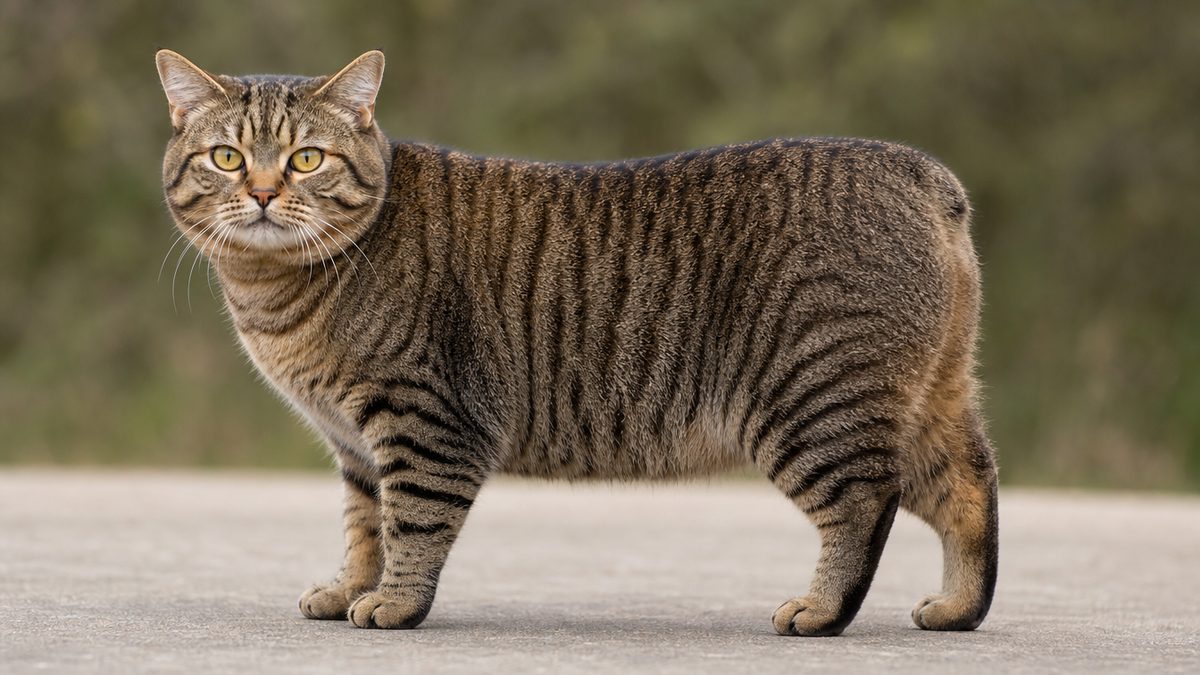
The cat itself is rounded, compact and surprisingly heavy for its size. CFA's standard asks for a round head with prominent cheeks, a broad chest, heavily boned forelegs set well apart, and hind legs much longer than the forelegs with heavy muscular thighs, producing a continuous arch from shoulders to a broad round rump. Those long hind legs are not decoration. They are why the breed jumps as well as it does, and they are also why a Manx with a neurological deficit shows it in the way it lands rather than the way it walks.
Where the breed comes from, and why an island matters
The Manx developed on the Isle of Man, and the isolation is the mechanism rather than the folklore. A dominant mutation that appears once in an island population with limited gene flow will reach a high frequency quickly, which is exactly what happened. The breed was in American shows by 1883 and fashionable in England in the 1920s and 1930s, when Edward VIII kept several. CFA has registered the shorthair since 1906, and FIFe has recognised the Manx since its own foundation year of 1949, making it one of just eight breeds on that list alongside the Abyssinian, Chartreux, European, Persian, Russian Blue, Sacred Birman and Siamese.
That longevity in the registers is worth holding on to, because it explains why the welfare argument on this page is not a fringe position. This is not a designer breed invented last decade. It is a founding member of the modern cat fancy whose founding trait is a spinal mutation, and the fancy has had a very long time to decide what to do about that.
The semi-longhaired version, and what to call it
The semi-longhaired Manx is the Cymric, and the registries no longer agree on whether that is a breed. CFA folded it back in: its own breed notes read that the longhair Manx was once called Cymric, with the longhair Manx effective 5 May 1994, and the registration rules cover shorthair tailless, longhair tailless, shorthair tailed and longhair tailed as one breed. FIFe keeps CYM and MAN as separate codes in a single standard document, with the Cymric recognised in 2006. WCF files CYM in the semi-longhair group and MAN in the shorthair group. Bonbeno covers the semi-longhair separately at Cymric cat in India, because the coat changes the Indian grooming answer even though the genetics are identical.
CFA registers the semi-longhair as a Manx. FIFe registers it as a Cymric in a shared standard. WCF puts the two in different coat-length groups entirely. Nothing about the cat changes across those three documents, which is a useful reminder that a registry's filing is a decision rather than a fact about the animal.
The tailless gene: what the 2013 study actually found
The Manx tail is caused by four different mutations in the T gene encoding Brachyury, all of them frameshifts that truncate the protein, and 78 of 82 short-tailed Manx tested carried one. Not one cat in the entire sample carried two.
The definitive work is Buckingham 2013, which sequenced the feline T gene in several independent Manx lineages from the United States and the Isle of Man. Buccal swabs and phenotype data were collected from 196 domestic cats: 136 Manx, 21 American Bobtail, 14 Japanese Bobtail, 15 Pixie-Bob and 10 Kurilian Bobtail. Ninety-nine of the Manx came from two large extended pedigrees across four US catteries and 37 from an animal shelter on the Isle of Man itself.
Four mutant alleles were found, and all four are in Manx cats only. Three are single-base deletions, c.998delT, c.1169delC and c.1199delC. The fourth is a small duplication-deletion, c.998_1014dup17delGCC, found in one cat. Every one of them causes a frameshift that introduces a premature stop codon and truncates the carboxy-terminal end of Brachyury. The c.998delT allele terminates translation at residue 354 of 437.
The headline numbers, with their denominators
| Finding | Count | Share |
|---|---|---|
| Short-tailed Manx heterozygous for a mutant T allele | 78 of 82 | 95 percent |
| Full-tailed Manx carrying only wild-type T | 47 of 48 | 98 percent |
| Cats homozygous or compound heterozygous for mutant T | 0 of 196 | None |
| Short-tailed Manx with at least one further congenital anomaly | about 1 in 5 | about 20 percent |
| Share of those anomalies occurring in rumpies | about 9 in 10 | about 90 percent |
| Maximum LOD score linking the phenotype to T | 6.21 at a recombination fraction of 0.00 | conclusive linkage |
Read the first two rows together, because they hand a buyer something free. Ninety-five percent of short-tailed cats carried a mutant allele and 98 percent of full-tailed ones did not. The tail is a visible, no-cost proxy for the genotype. You do not need a laboratory to know roughly what a Manx kitten is carrying. You need to look at it and palpate the base of its spine, which is what the registries' own judges do.
Why no cat has two copies
No cat in the study was homozygous or compound heterozygous for a mutation in T, and the authors' conclusion is stated directly: the finding supports complete absence of Brachyury resulting in early embryonic lethality. Earlier work had already reported that litters from two short-tailed parents are often smaller than typical, which is the same phenomenon counted from the other end.
State the strength of that evidence precisely, because precision is what a buyer can act on. The case for lethality is the consistent absence of homozygotes plus reduced litter size, and the paper itself uses the words presumed and supporting rather than proven. Three foetal cats that died late in gestation were genotyped, and all three were heterozygous, so they are not evidence of a dying homozygote either. What follows for a breeding pair is unambiguous whichever way the mechanism is finally settled: a rumpy to rumpy mating is expected to lose about a quarter of the litter before birth.
The allele does not decide how short the tail is
One more finding matters and almost nobody repeats it. No evidence suggested that a particular mutant allele determined how much the tail was shortened. A single rumpy riser male produced kittens with all four tail phenotypes in one litter, which means other loci or environmental factors modify the outcome. Robinson had already put a number on that modifying component, estimating the heritability of Manx expression at h2 = 0.40 plus or minus 0.11, and finding no support for the old claim that the M allele enjoys a transmission advantage during gametogenesis.
Ask a seller what the tail lengths of both parents were. A tailless to tailed mating cannot produce a homozygote at all, and a full-tailed kitten out of it is very likely to carry only wild-type T. A seller who does not know, or will not say, has told you what you needed to know.
Manx syndrome: what it is, who gets it, and what India's top page gets wrong
Manx syndrome is the spectrum of spinal, urinary and bowel malformations that travels with the tailless allele, it affects roughly 20 percent of short-tailed Manx, and it occurs in cats with one copy of the mutation, not two. The highest-ranking Indian page on this breed states the opposite.
The published list of defects is specific rather than vague: sacral agenesis or dysgenesis, absence of the sacral spinal cord, diastematomyelia, tethered cord, intradural lipomas and imperforate anus, drawn from six separate veterinary papers going back to 1969. The functional consequences named alongside them are hind-limb paresis or paralysis and incontinence of urine and faeces.
The mechanism is not mysterious. Sacral agenesis and absence of the sacral cord leave the hind limbs and the gut poorly innervated, which presents as lameness, incontinence and constipation. Related feline neural tube defects including spina bifida, meningomyelocele and meningocele are described in the general veterinary literature, and the Manx is the breed that literature keeps returning to.
The risk is not evenly spread. It is concentrated in the winners.
About 90 percent of the additional anomalies occur in the rumpy phenotype. Now put that beside what CFA's standard asks for: TAILLESS: appearing to be absolute in the perfect specimen, with a rise of bone allowed only if it does not stop the judge's hand and spoil the tailless appearance. And beside what FIFe scores: 20 of its 100 points go to the tail, and the criterion for a rumpy is literally absence of tail.
The phenotype that carries nine tenths of the risk is the phenotype the show standards reward. That is the sentence this page exists to print, and it is not an accusation. It is two documents read side by side.
The error on the highest-ranking Indian page
Supertails holds position 2 in India for this breed's commercial query and is the only Indian source that puts a rupee figure on a Manx. Its entry reads that Manx syndrome defects can occur when two copies of the tailless gene are inherited, and advises buying from a breeder who tests for Manx syndrome.
Both halves are wrong, and the first is wrong in the direction that gets kittens hurt.
- Two copies are not survivable. Buckingham 2013 found zero homozygotes among 82 short-tailed Manx and concluded that complete absence of Brachyury causes early embryonic lethality. A cat with two copies is not born, so it cannot be the cat with the defects.
- The defects occur in heterozygotes. Every living short-tailed Manx has one copy. The roughly 20 percent figure is a share of that population, not of some rarer double-dose subgroup. Telling an Indian buyer that the problem needs two copies implies that an ordinary Manx is safe, which inverts the actual risk.
- There is no Manx syndrome test. Manx syndrome is a clinical spectrum diagnosed on examination and imaging, not a genotype. The four causal T alleles have been published since 2013 and a DNA test for them is scientifically trivial, but no registry requires one and LOOF's breeding grid asks for none.
Bonbeno reports this rather than quietly writing around it, because an Indian buyer reading that page will believe a single-copy Manx carries no spinal risk, and will therefore not screen the kitten in front of them.
What to look at, in the room, before money changes hands
- Watch the kitten walk away from you, then land from a jump. A bunny-hopping gait or a hind end that collapses on landing is a neurological sign, not a quirk.
- Watch it urinate and defecate. Dribbling, straining, or a wet, stained rear is the urinary and bowel half of the syndrome.
- Check the anus is patent and normally placed, because imperforate anus is on the published list.
- Feel along the lower spine for a dimple, a tuft, a sinus or an unexpected softness over the sacrum.
- Ask the age. Signs commonly declare themselves between four weeks and four months, so a kitten sold at eight weeks may not yet have shown you everything.
Roughly 80 percent of short-tailed Manx carry no additional anomaly, and a healthy Manx is a genuinely lovely cat. But a one in five chance of a congenital malformation is not a background rate, and no other cat breed on this site carries a comparable published figure. Decide with the number in front of you.
What the registries actually do, which is not what people assume
No cat registry prohibits mating two tailless Manx. What they do instead is disqualify the sign: CFA excludes a cat showing evidence of weakness in the hindquarters, and LOOF requires no genetic test of a Manx at any level while naming DNA tests for five rex breeds and requiring the Scottish Fold to prove it carries one copy of its own mutation.
This distinction is the practical heart of the page. A rule against a mating changes what gets born. A rule against a sign changes what gets shown. Only one of those protects a kitten.
CFA disqualifies the sign
CFA's Manx show standard, revised 2026, reads: DISQUALIFY: evidence of poor physical condition; incorrect number of toes; evidence of hybridization; evidence of weakness in the hindquarters; in profile, pronounced stop or nose break. Weakness in the hindquarters is precisely the presenting sign of a sacral defect. A Manx that already has the neurological consequence is excluded from competition. The mating that produced it is not addressed anywhere in the standard or in the registration rules.
Two more CFA facts sharpen this. The shorthair Manx has no allowable outcross at all, and the longhair may only trace to a Persian born before 1 January 1977. So every CFA Manx must come from another Manx, and the only way to avoid the risky mating is tailless to tailed within the breed. And a tailed Manx is registered as AOV, meaning it can be recorded but cannot compete for a title. The registry therefore removes the show incentive from exactly the safe cat.
FIFe pays for the missing tail, and also lets the safe cat win
FIFe awards 20 of its 100 points to the tail, and the stated criterion for a rumpy is absence of tail. That is a federation paying points for a spinal deficit. But FIFe also does something CFA does not: it recognises all four tail lengths as titled varieties, EMS 51 through 54, with 51 and 52 judged together and the stumpy and longie each able to take a certificate. A breeder working under FIFe can show a full-tailed longie and still win, which is a real structural difference and one worth crediting.
LOOF leaves the row blank, and the comparison is the point
The French national studbook publishes a Grille de Qualification des Reproducteurs, a per-breed table of DNA tests a cat must clear to move up its six breeding levels. Parsed row by row on 8 September 2026, the grid holds 82 breed rows. Fifty-seven carry at least one named genetic test. Twenty-five carry none, and the Manx and the Cymric are both in that group.
| Breed row | Genetic test required to progress |
|---|---|
| Manx | None, at any level |
| Cymric | None, at any level |
| Kurilian Bobtail, both coat lengths | None, at any level |
| Japanese Bobtail, both coat lengths | None, at any level |
| Cornish Rex | PRA-rdAc normal |
| Devon Rex | CMS, COLQ gene |
| German Rex | PKDef and PRA-rdAc |
| Selkirk Rex, both coat lengths | PKD normal |
| Californian Rex | PRA-rdAc normal |
| Scottish Fold | Fd: N/TRPV4, proving one copy only |
| Scottish Straight | Fd: N/N, proving no copies |
| Maine Coon | HCM-MC, PKDef and SMA |
Read the Scottish Fold row against the Manx row, because it is the fair comparison rather than the rhetorical one. The fold allele is a cartilage mutation whose homozygote develops severe osteochondrodysplasia, and LOOF handles it by requiring a DNA test proving the breeding cat carries exactly one copy. The Manx allele is a mutation whose homozygote is presumed embryonically lethal and whose heterozygotes carry a published 20 percent anomaly rate, and LOOF requires nothing at all.
The mechanism is available. The four causal alleles were published in 2013 and are ordinary Sanger-sequenceable deletions. So the blank row is a decision, not a limitation. It also is not evidence of French indifference: the same grid requires any white cat of any breed to pass a BAER hearing test before reaching level 2, so LOOF plainly will regulate a welfare trait when it chooses to. Bonbeno's Scottish Fold page covers the fold allele in full.
Two smaller registry facts complete the picture. CFA's colour prefix chart, which enumerates every breed the association registers, carries 120 Manx entries including a full longhair series, so the breed is thoroughly embedded in that register rather than marginal to it. And the scale of the Manx's rarity only becomes legible against a same-register comparator: LOOF recorded 8 Manx and Cymric kittens in 365 days, and 584 Chartreux in the same book on the same day.
The register that has said the quiet part out loud
LOOF's own Manx breed record is unusually frank for a studbook. It records that while the breed still enjoys great success in the United States, the Manx had to withstand violent attacks in Europe, with some of its detractors wanting it banned outright, and that breeding suffered as a result. That is the national register describing a live ethical dispute about the breed it registers, and no page ranking for this term in India mentions that the dispute exists.
Three things, none of them novel, all of them already done for other breeds. Require a DNA test for the four T alleles, as LOOF requires Fd genotyping of the Scottish Fold. Bar the registration of litters from two short-tailed parents, as the arithmetic already recommends. Let a tailed Manx compete for a title, as FIFe already does and CFA does not.
Three short-tailed cats, three different genes, one honest table
The Manx, the Japanese Bobtail and the Kurilian Bobtail are the three short-tailed cats an Indian buyer will meet, and treating them as one category is the single most common error made about all three. One gene is identified and dangerous, one is identified and benign, and one has been excluded but never found.
Bonbeno has now built all three pages from the primary literature, and this is what the three-way comparison looks like when the same questions are asked of each. Read the full arguments at Japanese Bobtail cat and Kurilian Bobtail cat.
| Measure | Manx | Japanese Bobtail | Kurilian Bobtail |
|---|---|---|---|
| Gene | T, encoding Brachyury | HES7, somite segmentation | Unidentified |
| Type of change | Frameshift, protein truncated | Missense, p.V2A | Unknown |
| How many causal alleles | Four | One | None found |
| Homozygotes found alive | None among 82 short-tailed cats | 12 of 12 pedigree cats genotyped | Never tested |
| Homozygote outcome | Presumed embryonic lethal | Viable, extreme kink phenotype | Unknown |
| Caudal vertebrae | 0 in the rumpy, rising to a full tail in the longie | Mean 15.8, against a normal 20 to 24 | 2 to 10, per the registry |
| Where the defect sits | At the sacrum, where the cord ends | In the tail. Hemivertebrae usually inside the kink | Not studied |
| Further anomalies | About 20 percent, 90 percent of them rumpies | Did not coincide with morbidity or mortality | No study exists |
| FIFe tail points of 100 | 20, for absence of tail | 20, for length and shape | 30, for the pompom |
| FIFe disqualification for absent tail bone | No. It is the rumpy ideal | Yes | Yes |
Why the Japanese Bobtail's answer does not transfer
The Japanese Bobtail's short tail comes from a missense change in HES7, c.5T>C giving p.V2A, and Xu 2016 genotyped 12 Japanese Bobtails and found all 12 homozygous, reading the trait as fixed in the breed. Not merely surviving in a double dose but standard in it, which is the exact opposite of the Manx.
The anatomical reason the Japanese Bobtail escapes the Manx's problem is where its malformations sit. Pollard 2015 radiographed the entire vertebral column of kink-tailed cats and reported that most had hemivertebrae usually included in the tail kink, with an average of 15.8 caudal vertebrae against a normal feline formula of C7, T13, L7, S3 and 20 to 24 caudal. Its conclusion is that the abnormal vertebral formula, and the placement of the kink in the tail, did not coincide with morbidity or mortality.
So the defect is in the tail rather than at the sacrum. That is the whole difference stated mechanically. The Manx problem is not that the tail is short. It is that the defect sits where the spinal cord ends, which is why sacral agenesis, absence of the sacral cord and imperforate anus travel with it and do not travel with a tail kink further down. In the Manx, complete absence of caudal vertebrae is found only in the rumpy.
A note on how firmly Bonbeno holds that. The Pollard record available to Bonbeno is the abstract, which carries the 15.8 average, the vertebral formulae, the hemivertebrae-in-the-kink finding and the morbidity conclusion verbatim. Figures from that paper's full text that are quoted elsewhere on the web, including a caudal range and an explicit sacrum-distance clause, were not independently readable here and are therefore not quoted on this page.
The Kurilian is the open question, and it should be left open
Buckingham 2013 sequenced the T gene in 10 Kurilian Bobtails, first exons 8 and 9 and then every remaining exon, and found no causal variant. Its discussion says so plainly: no evidence was found that mutations in T underlie short-tailed phenotypes in the Japanese Bobtail and the Kurilian Bobtail. So the Kurilian does not carry the Manx mutation, and that is settled.
What is not settled is what it does carry. HES7 has never been genotyped in a Kurilian, and Xu 2016 itself concluded that at least one locus other than HES7 or T-box produces short tails in domestic cats, proposing at least three independent events in the history of the trait. Bonbeno therefore transfers neither the Manx finding nor the Japanese Bobtail finding onto the Kurilian, and says so on that page.
One federation, one edition, three different answers
The cleanest way to see that these are three different animals is to read three FIFe standards all dated 01.01.2026. The Manx and Cymric standard awards 20 of 100 points to the tail and names the criterion as absence of tail in the rumpy. The Kurilean Bobtail standard awards 30 of 100 to the tail and lists absence of the tail bone and deformities of the spinal vertebrae among its disqualifications. The same missing bone is worth 20 points in one breed and ends the cat's show career in another, under documents published by the same federation on the same day.
A fourth breed carries the Manx mutation without being a Manx
One finding from the same study rarely reaches breed pages and is worth knowing before you cross-shop. Manx alleles are segregating in two American breeds: 12 of 20 short-tailed American Bobtails were heterozygous for c.998delT and one carried c.1199delC, and 8 of 14 short-tailed Pixie-Bobs carried c.998delT. Both breeds developed recently in the United States with less documented breeding records, so the alleles most likely arrived from Manx ancestry. A short-tailed American Bobtail is therefore not automatically outside this page's argument.
If the appeal is a compact, affectionate, dog-like cat that plays fetch, the Japanese Bobtail delivers that with a documented benign tail genotype and is the better buy. If the appeal is specifically the tailless rump, no other breed offers it, and there is no version of the Manx that separates the look from the allele.
Manx cat price in India, and what the rupee figures on page one actually are
One Indian source prices the Manx, at Rs 30,000 to Rs 60,000, and labels the breed very rare in India. Every other rupee figure on page one for this query is a book, and the same publisher's dedicated Indian price list does not mention the breed at all.
Take the price in india question apart properly, because the composition of the results tells you more than any single number.
Searching 'manx cat price in india' from an Indian location on 8 September 2026 returned twelve results. Five of them, led by Petful at position 1, quote United States dollars only. Two are books: Flipkart at Rs 1,773 for a collection of historical articles about the breed, and Amazon.in for a Manx care paperback. A rupee figure attached to a book is not a price for a cat, and it is the easiest contamination on this page to fall for because the number looks plausible.
One is a Justdial page titled Top Pet Shops For Manx Cat in Noida, whose listed shops include one called Parsian CAT Kitten. Justdial's page for Japanese Bobtail shops in Delhi lists the same shop. These are auto-generated breed-crossed-with-city pages populated from a generic pet-shop directory, so the page title names the breed and the listings do not.
The one real Indian figure, read from the page rather than the snippet
Supertails' 40-breed Indian climate and price guide gives the Manx Rs 30,000 to Rs 60,000 and marks it very rare in India.
That figure had to be read off the page itself, because the search snippet was actively misleading. The snippet rendered as 'Price: Rs 40,000 to Rs 80,000. Very rare in India. 23. Manx cat', which reads as a Manx price and is not one. Rs 40,000 to Rs 80,000 belongs to entry 22, the Japanese Bobtail. The Manx is entry 23 and carries Rs 30,000 to Rs 60,000. A snippet that truncates a numbered list hands you the previous item's price, and anyone quoting from search results rather than the page would have published a figure Rs 10,000 to Rs 20,000 too high.
The same publisher contradicts itself, which is the honest finding
| Source | Manx present | Price given | Note |
|---|---|---|---|
| Supertails, 40-breed climate and price guide | Yes, entry 23 | Rs 30,000 to Rs 60,000 | Labelled very rare in India |
| Supertails, Cat Price in India 2026 breed-wise list | No. Zero occurrences | None | Persian appears 22 times in the same document |
| Heads Up For Tails, 50 popular cat breeds in India | Yes, entry 25 | None | Gives life expectancy 14 to 16 years, unsourced |
| Heads Up For Tails, same page, Cymric entry 42 | Yes | None | Gives life expectancy 9 to 13 years for the same gene pool |
One publisher's climate guide prices the Manx and its dedicated Indian price guide omits it entirely. One publisher gives the shorthair and the semi-longhair of the same breed group two different life expectancies, five years apart, on one page, with no source for either. Neither figure appears in any life table Supertails. Cat Price in India 2026.
Bonbeno's reading is that Rs 30,000 to Rs 60,000 is a published editorial figure rather than an observed Indian market rate, and should be used as an order of magnitude. Nothing in the search results evidences an actual Indian transaction for a Manx kitten.
The division tests, run and reported
Rs 30,000 divided by 84.38 is 355.54, by 80 is 375.00, and by 74 is 405.41. Rs 60,000 gives 711.07, 750.00 and 810.81. The 80 result is the arithmetic artefact any figure ending in three zeros produces, and USD 375 to USD 750 is below every American Manx quote on the same results page, which run USD 500 to USD 1,500. So this is a rupee-native editorial figure rather than a converted dollar list, and that is worth saying because converted lists are common on Indian breed pages.
No Indian price band, at any level, buys a screened kitten. LOOF requires no genetic test of a Manx breeding cat, CFA requires none, and there is no Manx syndrome test to ask for. A more expensive Manx is a better-looking Manx, and better-looking in this breed means closer to the rumpy, which is the phenotype carrying 90 percent of the anomalies.
Cost of ownership in India, with the Manx-specific line most budgets miss
Budget Rs 3,000 to Rs 6,500 a month for an ordinary Indian cat plus a first-year veterinary block of roughly Rs 4,700 to Rs 7,000, and then add a line no other cat page needs: the cost of managing incontinence and constipation if this particular cat is one of the 20 percent.
The recurring cost of ownership for a Manx is a normal cat's cost until it is not. Start with what is verifiable and Indian, then handle the breed-specific tail.
| Item | Published price | Source |
|---|---|---|
| Kitten vaccination course, three visits | From Rs 3,999, list Rs 5,065 | Vetic, national page |
| Adult annual booster | From Rs 1,899, list Rs 1,908 | Vetic |
| Anti-rabies, single | Rs 699 | Vetic |
| CRP test | Rs 1,249 | Vetic |
| Veterinary consultation | Rs 500 to Rs 1,000 | VOSD and HDFC ERGO, one data point |
| Grooming, bath from | Rs 934 | Vetic Delhi |
| Grooming, complete bath and styling from | Rs 1,869 | Vetic Delhi |
| Boarding, overnight to 24 hours | Rs 899 | PawSpace Bengaluru |
| Chennai pet animal licence | Rs 50 | Greater Chennai Corporation |
Two of those rows deserve a word. The consultation and vaccination ranges published by VOSD and by HDFC ERGO are byte-identical on both quantities, which is evidence against independence rather than for it, so they are cited here as a single data point. And the Chennai licence is the cheapest useful thing on this page: Greater Chennai Corporation licenses pet animals generally at Rs 50, issued 9,115 licences in 2024, and runs six municipal pet clinics giving treatment and anti-rabies vaccination free of cost. Delhi's MCD portal registers pet dogs only, so a Delhi cat owner has no equivalent municipal fee and no equivalent municipal clinic route.
The line item that is specific to this breed
If your Manx is one of the roughly one in five with an additional anomaly, the cost profile changes shape rather than size. What that looks like in practice, and what to budget for:
- Litter and laundry, continuously. Faecal or urinary incontinence is a daily consumable cost, not an event. Plan on multiple litter box sites and washable bedding rather than a single tray.
- Manual bladder expression, taught by a vet. A cat with a neurogenic bladder may need expressing several times a day for life. The technique is free once learned; the consultations to learn it and to monitor for urine retention are not.
- Recurrent urinary tract infections. A bladder that does not empty gets infected, which means repeat consultations, urine culture and antibiotics rather than one visit.
- Constipation and megacolon management. Poor innervation of the gut is the mechanism, and the management is lactulose, diet and sometimes enemas under sedation.
- Imaging once, properly. Radiographs of the lower spine, and ideally advanced imaging, cost more than a year of routine care but settle what you are actually dealing with.
Bonbeno cannot put an Indian rupee figure on that block, because no Indian source publishes one for feline neurogenic bladder management and inventing one would be worse than admitting the gap. What can be said honestly is that it is open-ended, that it is lifelong when it happens, and that it is the reason the tail-length question at purchase matters so much.
A realistic monthly figure
For an ordinary healthy Manx in an Indian metro, food, litter, parasite control and a share of annual veterinary care lands in the same band as any medium shorthair, roughly Rs 3,000 to Rs 6,500 a month, with the first year higher because of the kitten course and neutering. Treat that as arithmetic from the rows above rather than as a quoted package price, and re-price it locally, because Vetic itself quotes different course prices on different city pages on the same day.
On boarding specifically, a named Bengaluru operator publishes Rs 599 for up to four hours, Rs 799 for daycare to ten hours and Rs 899 for an overnight stay up to 24 hours, which is the most concrete Indian boarding figure Bonbeno has been able to verify from an operator's own page.
A Bengaluru boarding directory carries a load-shedding warning about generator backup for air conditioning between March and May. For a heavy, double-coated cat that is not a comfort issue, it is the difference between a boarding kennel that stays survivable through a power cut and one that does not. Ask before you book.
Indian climate: the humidity warning is wrong and the heat warning is right
The Isle of Man runs 85.10 percent annual relative humidity, higher than Chennai, Kolkata, Mumbai, Bengaluru, Pune or Delhi, so damp air is not what troubles a Manx in India. Temperature is. The island's peak wet bulb is 13.77 degrees C against 27.09 in Kolkata in June.
Almost every page that discusses a northern breed in India reaches for humidity, and on this breed that reasoning is simply backwards. Bonbeno queried NASA POWER by explicit latitude and longitude for the breed's homeland and for six Indian metros, echoed the grid-cell elevation each time and checked it against the real elevation, and computed wet bulb from mean temperature and mean relative humidity using the Stull approximation.
| Place | Cell elevation vs real | Annual mean C | Annual mean RH percent | Peak monthly wet bulb C |
|---|---|---|---|---|
| Douglas, Isle of Man | 8.08 m vs about 35 m | 10.80 | 85.10 | 13.77 in August |
| Bengaluru | 841.72 m vs about 920 m | 23.74 | 67.94 | 21.86 in May |
| Pune | 635.99 m vs about 560 m | 23.86 | 66.80 | 22.97 in June |
| Mumbai | 97.15 m vs about 14 m | 26.77 | 67.39 | 25.77 in June |
| Chennai | 48.95 m vs about 6 m | 27.95 | 72.39 | 26.11 in May |
| Delhi | 206.37 m vs about 216 m | 25.60 | 45.56 | 26.50 in July |
| Kolkata | 7.35 m vs about 9 m | 25.81 | 73.93 | 27.09 in June |
Every cell above is a plains or coastal cell and every elevation echo lands within about 85 m of the town, so none of these figures is the hill-station artefact that corrupts POWER queries in mountainous terrain. The wet-bulb column tops out at 27.09 degrees C, comfortably inside physical possibility, which is the sanity check that catches the commonest error in this calculation.
What the numbers actually say
Read the humidity column first. The Isle of Man is more humid than any Indian city on this table, including Kolkata at 73.93 and Chennai at 72.39. A Manx is not a dry-climate cat meeting damp air for the first time. It is a cool-climate cat meeting heat.
Now read the wet-bulb column, which combines the two into the thing an animal's body actually experiences. Douglas peaks at 13.77 degrees C. Bengaluru, the mildest large Indian city here, peaks at 21.86, a gap of just over 8 degrees. Kolkata peaks at 27.09, a gap of 13.32. That gap, not the moisture, is the load.
Why this breed carries it badly
Three features stack. The coat is a double coat, described by FIFe as double, short and glossy with an undercoat softer than the dense and springy overcoat, and by CFA as needing density. The body is compact, broad-chested and heavy, so the surface-area-to-mass ratio works against heat loss. And the semi-longhair carries a full ruff and breeches on top of that. Nothing here is heat-tolerant by design.
What to do about it, city by city
- Bengaluru and Pune are the two mainland metros where a Manx is a reasonable proposition without air conditioning, on a peak wet bulb near 22 degrees C.
- Mumbai and Chennai need a cooled room through the pre-monsoon and monsoon peak, because the wet bulb sits near 26 and stays there for months rather than spiking.
- Delhi is the deceptive one. Its annual humidity of 45.56 percent is by far the lowest here, which makes it read as the easy option, and its July wet bulb of 26.50 is the second highest on the table. The monsoon is what does the damage, not May.
- Kolkata is the hardest, at a 27.09 degrees C June wet bulb and 73.93 percent annual humidity together.
This warning is sharper for a Manx than for other breeds and it is not about the coat. A cat with any degree of hind-limb weakness cannot reliably relocate itself to the coolest tile in the house, which is how every other cat manages an Indian afternoon. If your Manx is affected, cooling is a husbandry job rather than something the cat will solve on its own.
Temperament and household fit: who should buy a Manx and who should not
The Manx attaches hard to one or two people, plays like a dog rather than a cat, and is described consistently across three independent sources as affectionate, communicative and physically confident. The household question is not whether it will suit you. It is whether you can meet a possible lifelong nursing commitment.
On temperament the sources agree to an unusual degree, which is worth noting because breed-club descriptions usually disagree at the edges. CFA describes a cat that attaches itself primarily to one or two family members with a bond strong enough that it may take a while to accept anyone else. LOOF describes a hunter that needs its owner's physical presence, walking beside them miaowing or waiting behind the door for them to come home, and notes that Manx males are as attentive to kittens as the females. The Isle of Man cafe that keeps the breed describes the same thing from daily contact.
So the honest character summary is a playful, affectionate, one-person cat with a dog-like following habit and serious jumping ability off those long hind legs. In an Indian flat that combination reads as low-maintenance company rather than an animal that needs a garden.
Who this breed genuinely suits
- Households with someone home most of the day. A cat that waits behind the door is telling you it does not do well alone for twelve hours.
- Families with children old enough to be gentle at the rear end. The base of the spine is exactly where a Manx must not be grabbed, and a rumpy has nothing there to warn a child off.
- Owners willing to accept an open-ended medical outcome. One in five is not a small number, and the person who should buy this breed is the person who has already decided what they will do if their kitten is that one.
- Owners who will take the tailed kitten. A longie out of a Manx litter is the same cat with a working sacrum and, on the genotyping, very likely no mutant allele at all.
Who should not
Anyone buying this breed for the look alone should not, and that is worth stating without hedging. There is no version of the Manx that gives you the round tailless rump without the allele that produced it, because the rump is the allele. If the appeal is a compact, dog-like, fetch-playing cat, the Japanese Bobtail delivers that on a documented benign genotype and is simply a better purchase.
Also worth ruling out: anyone who wants a cat to be left with a house-sitter for long stretches, anyone whose home has no cool room in May, and anyone who cannot commit to daily bladder management as a possibility rather than a certainty.
Ordinary cat handling assumes a tail to balance against and a normal sacrum to lift over. Neither assumption holds here. Support the chest and the hindquarters together, teach every visitor to do the same, and never scoop a Manx by the back end even in play.
Training a Manx, and the one thing you must train before anything else
Train litter box access first, before recall, before harness, before anything, because the litter box is where this breed's most common welfare failure shows up and where an owner can do the most good. Everything else about training a Manx is ordinary clicker work on an unusually willing cat.
Take the priority order seriously. Most cat pages put litter training somewhere in the middle of a training list. On this breed it is the whole point.
The litter box, engineered rather than placed
A Manx with reduced sacral innervation is not being naughty when it misses. It may not feel the urge, may not be able to posture, and may not be able to step over a rim. Design around all three.
- Cut the entry down. A tray with one side lowered to two or three centimetres removes the step-over that a weak hind end cannot manage.
- Multiply the sites. One tray per floor and per end of the flat, so the cat never has to travel while it is already struggling.
- Choose fine, soft litter. A cat that sits rather than squats is in contact with the substrate, and coarse clay abrades.
- Keep a written log for the first month. Note frequency, volume and consistency. That log is the single most useful thing you can hand a veterinarian, and it turns a vague worry into a datable change.
Everything else is ordinary, and easy
Manx cats train readily on the usual positive-reinforcement mechanics, because a cat that is already following you around the flat is a cat with high engagement. Clicker plus a high-value food reward, sessions of two or three minutes, and no punishment, which does nothing to a cat except damage the attachment the breed is bought for.
Useful behaviours to teach a Manx specifically, in order of value: stepping onto a scale, so weight is monitored without a fight; accepting handling of the rear end and the base of the spine, so a veterinary examination is not a wrestling match; going into a carrier voluntarily; and coming when called, which the breed's following habit makes almost automatic.
Socialisation, on a compressed timetable
Socialise the kitten between roughly three and nine weeks, which is the feline sensitive period and which mostly happens at the breeder's rather than at yours. That makes it a question to ask before purchase rather than a job to plan after it: how many people handled this litter, were they handled by children, did they meet a vacuum cleaner, a doorbell, a pressure cooker.
One Indian-specific addition. Get the kitten used to being handled in a warm room and to accepting a damp cloth wipe-down, because that is the cooling routine you will need in May and a cat that objects to being touched when hot is a cat you cannot help.
In most cats, going outside the tray is behavioural first and medical second. In a Manx it is medical first. Before you buy a pheromone diffuser or move the litter box, book a veterinary examination, because incontinence of urine and faeces is on the published list of what this allele does.
Daily exercise: what a Manx needs, and what to watch while it gets it
Give a Manx two or three short structured play sessions a day totalling 30 to 45 minutes, built around chasing and pouncing rather than jumping height. The exercise requirement is ordinary. The observation you make during it is not.
This is a muscular, athletic cat with hind legs much longer than its forelegs, and CFA's standard asks for heavy muscular thighs and substantial boning. Left with nothing to do it will find something, usually vertical and usually breakable.
The workable Indian pattern is short and frequent rather than long: a wand toy session before you leave in the morning, another at dusk when the flat has cooled, and food puzzles in between. Thirty to forty-five minutes of real chasing across the day covers a healthy adult.
Play is your weekly neurological examination
Here is the part no other breed page needs. Play is the best routine screen you have for the sacral half of this breed's risk, because it loads the hindquarters in ways that resting does not. Watch for these while your cat is chasing, not while it is asleep:
- A bunny hop. Both hind legs moving together rather than alternating, at speed. It is the classic sign and it is easy to mistake for a Manx quirk.
- A collapse on landing. A cat that jumps up cleanly but crumples at the rear when it lands is telling you about hind-limb strength, not about the height.
- Reluctance to jump down. Manx cats jump up eagerly. A cat that goes up and then will not come down has usually learned that landing hurts.
- Knuckling. A hind paw turning under so weight lands on the top of the foot.
- Asymmetry. One hind limb consistently doing less than the other.
None of those is a diagnosis and all of them are worth a same-week veterinary appointment. Record a ten-second phone video of the gait when you see something, because a cat that limps at home walks perfectly in a consulting room.
Timing exercise around Indian heat
Play in the coolest part of the day, which in most Indian metros means before eight in the morning and after eight at night. A heavy double-coated cat with a peak-wet-bulb tolerance calibrated to an island that tops out near 14 degrees C should not be encouraged to sprint at three in the afternoon in Chennai. If the cat pants during play, the session is over and the room is too warm.
A Manx in a small Indian flat is fine if the flat goes upwards. Shelves, a cat tree and a window perch give an athletic jumper somewhere to be. Just place the landings so the drops are short, which is a sensible precaution in any cat and a necessary one in this breed.
Grooming a Manx in Indian humidity, and the job that matters more than the coat
Brush a Manx twice a week and daily through a moult, and then do the thing no coat guide mentions: check and clean the rear end every single day, because a cat with reduced sacral innervation may not be able to keep itself clean and will not tell you.
The coat first. FIFe describes the Manx coat as double, short and glossy, with an undercoat softer than a dense and springy overcoat, and the Cymric as a medium-length double coat, soft and silky, growing gradually longer from shoulders to rump with a tendency to a frill and knickerbockers. CFA penalises a longhair Manx coat that lacks density or has a cottony texture.
In Indian conditions that means the shorthair is a twice-weekly groom with a rubber curry or a fine slicker, moving to daily during the two heavy moults. Brush with the lie of the coat, not against it, because the springy overcoat mats less than it tangles at the undercoat. The semi-longhair Cymric needs the same routine daily rather than twice weekly, and that difference is covered at Cymric cat in India.
Do not shave a double-coated cat for the Indian summer
This comes up every year and it is the wrong intervention. A double coat insulates in both directions and shading the skin is part of its job. Clipping it out removes the sun barrier, exposes skin that has never been exposed, and grows back unevenly. Manage heat with the room, with airflow and with a damp cloth, not with clippers. Where matting has already gone too far, a groomer removing specific mats is a different thing from a full body shave.
The hygiene job that is genuinely breed-specific
A normal cat cleans its own perineum and its own hind legs. A Manx that cannot feel its hind end reliably may not, and a Manx with any degree of faecal incontinence definitely will not.
- Look at the rear end daily. You are checking for staining, dampness, matted fur around the anus and vulva or prepuce, and any smell.
- Wipe with plain warm water, not a scented wipe, and dry thoroughly. Damp skin under fur in an Indian monsoon is where pyoderma starts.
- Keep the fur there short. A hygiene clip around the anus and under the tail area is worth asking a groomer for, and it is one of the few places clipping a double-coated cat is correct.
- Check between the toes and the hocks, because a cat that sits in a soiled tray carries it forward.
- Weigh weekly. Weight loss in a cat with a bowel problem is the earliest quantitative signal you will get.
Monsoon and ear care
Overseas breed clubs routinely advise letting a cat air dry after a bath. That advice is written for a climate where air dries things. In an Indian monsoon it is how skin and ear problems start, so dry a Manx properly with a towel and keep water out of the ears rather than letting it evaporate on its own. Bonbeno's general guidance on humid-season coat care applies here in full, and grooming prices in Delhi run from Rs 934 for a bath to Rs 1,869 for a complete bath and styling if you would rather it were done for you.
Coat brushing on this breed is routine. The rear-end check is not, and it is five minutes. Do it at the same time every day, ideally before feeding so the cat associates it with something good, and you will catch a urinary or bowel problem weeks before it becomes an emergency.
Health issues and lifespan: what is measured, what is guessed
The Manx has one quantified health risk, the roughly 20 percent congenital anomaly rate that travels with its tail genetics, and one honest blank, its lifespan, because no life table published anywhere contains a Manx row.
Separate the two halves cleanly, because the ranking pages mix them.
The measured half
The health issues specific to this breed are the Manx syndrome spectrum set out earlier: sacral agenesis or dysgenesis, absence of the sacral spinal cord, diastematomyelia, tethered cord, intradural lipomas and imperforate anus, with hind-limb paresis or paralysis and incontinence as the functional consequences. Around 20 percent of short-tailed Manx carry at least one of them and about 90 percent of those are rumpies.
The breed's status in the research literature is unusual and worth knowing. The Manx has served as a laboratory model for human neural tube defects, and the general veterinary literature on feline spina bifida, meningomyelocele and meningocele returns to it repeatedly. So this is not an under-studied breed whose risks are speculative. It is a well-studied one whose risks were characterised decades before the gene was found.
The blank half, stated rather than filled in
Bonbeno publishes no Manx lifespan figure, and that is a deliberate refusal rather than an omission. The largest study of feline life expectancy in the United Kingdom analysed 7,936 confirmed deaths among cats under primary veterinary care in VetCompass practices in 2019, and published breed rows only for breeds with at least 15 deaths. Twelve rows resulted: Burmese, Birman, crossbred, Siamese, Persian, Ragdoll, Norwegian Forest Cat, Maine Coon, Russian cats, British cats, Bengal and Sphynx. The Manx is not among them.
Heads Up For Tails gives the Manx 14 to 16 years and the Cymric 9 to 13 on the same page, with no source for either, which is a five-to-seven-year disagreement about one gene pool inside one document. Neither number traces anywhere.
What does transfer from the life-table study
| Measure | Value |
|---|---|
| Life expectancy at age 0, all cats | 11.74 years, 95 percent CI 11.61 to 11.87 |
| Crossbred cats | 11.89 years, CI 11.76 to 12.03 |
| Purebred cats | 10.41 years, CI 9.99 to 10.83 |
| Female cats | 12.51 years |
| Male cats | 11.18 years |
| Odds of death before age 3, entire vs neutered | 4.29 times, CI 3.72 to 4.95 |
| Odds of death before age 3, purebred vs crossbred | 1.83 times, CI 1.50 to 2.23 |
Two of those rows are actionable in an Indian home. Being entire carried 4.29 times the odds of death before three, so neuter your cat and do it on veterinary advice about timing. And a non-ideal body weight was independently linked to a shortened lifespan, which is a feeding question rather than a genetic one.
Screening, and the awkward fact that there is none to ask for
There is no Manx health scheme. LOOF requires no genetic test of a Manx or Cymric breeding cat at any of its six selection levels, CFA's registration rules impose none, and no registry mandates radiography of the lumbosacral spine before breeding The Cat Fanciers' Association. Registration…. The four causal T alleles have been in the public literature since 2013, so the technical barrier is zero.
What you can do instead is clinical rather than genetic: a careful neurological examination of the kitten, a look at the parents' tails, and lumbosacral radiographs if anything about the gait, the urination or the defecation is off. Ask your veterinarian for those specifically, because a routine kitten check will not include them.
Straining to urinate with little or no output, a distended painful abdomen, sudden inability to use the hind limbs, blood in the urine, or no faeces passed for more than 48 hours. In a Manx these are not wait-and-see symptoms. Urinary obstruction kills cats in hours.
Feeding a Manx in India, and why weight matters more here than in most breeds
Feed a Manx a complete, protein-forward diet in measured portions and keep it lean, because a non-ideal body weight was independently linked to a shortened lifespan in the largest feline life-table study and because every extra kilogram is loaded onto hindquarters that may already be compromised.
The feeding rules are ordinary. Their consequences on this breed are not.
Life-stage basics
- Kitten to twelve months. A complete kitten formulation, four meals a day to four months, three to six months, then twice daily. Kittens sold below eight weeks are un-weaned under Indian law, so a kitten arriving that young is both a legal and a nutritional problem.
- Adult, one to seven years. Twice daily measured meals rather than free feeding. Feed to body condition, not to the number printed on the bag, which assumes a cat more active than most Indian flat cats.
- Senior, eight years on. Watch for muscle loss over the spine and hips, and raise the protein rather than cutting it, which is the opposite of the old advice.
- Water, deliberately. Place the bowl at least three feet from the food, refresh daily, and consider wet food as a routine part of the diet rather than a treat, because urinary tract health is not a side issue in this breed.
Two Manx-specific feeding considerations
First, fibre and hydration are a management tool here, not a preference. Poor innervation of the gut is on the published mechanism list, and constipation is one of the three named consequences. A cat with a sluggish colon does better on higher moisture intake and appropriate fibre, and your veterinarian should be the one choosing which fibre, because the wrong one makes a megacolon worse rather than better.
Second, keep the cat lean, and be strict about it. Teng 2024 found a non-ideal body weight significantly linked to a decreased lifespan across the whole cat population. In a Manx the argument is stronger still. A cat carrying extra weight on hind legs with reduced innervation loses function sooner, and the breed's CFA standard already describes a cat that is surprisingly heavy when lifted, which makes it very easy to mistake an overweight Manx for a correct one.
Indian availability and practicalities
Complete cat diets from the major international manufacturers are widely available in Indian metros, both in store and online, so there is no reason to build a Manx's diet from home-cooked food. Where owners do go homemade, taurine is the failure point, and taurine deficiency causes dilated cardiomyopathy and retinal degeneration in cats. If you cook, do it under veterinary supervision with supplementation, and do not improvise.
Two Indian practicalities. Store dry food in an airtight container away from monsoon humidity, because a bag left open in a Mumbai August grows mould faster than it empties. And in a hot kitchen, wet food left down for more than about half an hour should be discarded rather than saved.
Run your hands along the ribs. You should feel them easily under a thin fat layer without pressing, and see a waist from above. Do this monthly, at the same time as the weekly weigh-in, and you will notice a drift long before it shows up as a number.
The kitten timeline, month by month through the first year
Use this kitten timeline as a checklist of what to observe rather than what to expect, because the Manx signs that matter declare themselves on a schedule and most of them appear before six months.
This section is written differently from the same section on other Bonbeno breed pages. On most breeds a first-year timeline is about growth and vaccination. On this one it is a kitten timeline of observation windows, because the anomalies associated with the tailless allele have a rough natural history and knowing it lets an owner act early.
| Age | Routine care | What to watch for specifically |
|---|---|---|
| Before purchase, 0 to 8 weeks | At the breeder. Ask both parents' tail lengths and how many people handled the litter | Never take a kitten below eight weeks; it is un-weaned under the Pet Shop Rules 2018 |
| 8 to 9 weeks | Home. Settle in one room. Book a full veterinary examination in week one | Gait on arrival, first urination and defecation in your house, anal placement |
| Weeks 8 to 16 | Kitten vaccination course, three visits, from Rs 3,999 at one national chain | Bunny-hopping gait, dribbling, straining, a wet or stained rear |
| 3 to 4 months | Deworming to veterinary schedule. Start weekly weighing | This is the commonest window for urinary and bowel signs to declare themselves |
| 4 to 6 months | Discuss neutering timing. Litter box audit as the cat gets bigger | Reluctance to jump down, knuckling of a hind paw, asymmetric hind limb use |
| 6 to 9 months | Neuter. Adult food transition | Constipation as stool volume increases with size; log frequency |
| 9 to 12 months | First adult booster planning, from Rs 1,899 | Weight gain as growth slows, which is the point most cats start to get heavy |
| 12 months | Adult annual booster, anti-rabies Rs 699 | Baseline the adult gait on video, so you have something to compare against later |
What good looks like at each stage
A healthy Manx kitten at eight weeks walks with alternating hind limbs, jumps down from a low sofa without hesitating, produces formed stools daily, and has a dry, clean rear end. At four months it is jumping to worktop height and landing cleanly. At a year it is a compact, rounded, heavily boned cat with visible waist definition and no staining anywhere.
If any of those is untrue at any stage, that is the moment to ask for lumbosacral radiographs rather than to wait and see whether it resolves. Congenital malformations do not resolve.
The paperwork to collect while you are at it
Verify three documents in the first month and keep them together: the vaccination record with dates and batch numbers, the pedigree or registration paperwork if the kitten is registered, and a written note from the seller stating both parents' tail phenotypes. That last one does not exist as a standard form anywhere, which is exactly why you should ask for it in writing.
Rule 7(16) of the Pet Shop Rules 2018 makes microchipping mandatory for puppies only, so a kitten falls outside it. A microchip in Chennai runs about Rs 1,250 at a named clinic, and for a cat that may one day be unable to run home, identification matters more than average.
Mistakes Indian owners actually make with a Manx
Five errors account for most of the avoidable harm on this breed in India, and the first one is made before the kitten is chosen: believing that Manx syndrome requires two copies of the gene.
- Believing the two-copies story. The highest-ranking Indian source states that the defects occur when two copies of the tailless gene are inherited. Buckingham 2013 found zero homozygotes among 82 short-tailed Manx and concluded two copies are embryonically lethal. A buyer who believes the two-copies version thinks an ordinary single-copy Manx carries no spinal risk, and therefore examines nothing.
- Choosing the rumpy because it is the show ideal. About 90 percent of the additional anomalies occur in the completely tailless phenotype, and that is the phenotype CFA calls the perfect specimen. Buying up the show scale on this breed is buying up the risk scale.
- Treating house-soiling as behaviour. In a Manx it is medical until a veterinarian says otherwise. Owners routinely spend months on litter substrates and diffusers while a neurogenic bladder goes untreated.
- Shaving the double coat for the Indian summer. It removes the sun barrier, exposes unaccustomed skin and grows back unevenly. Cool the room, not the cat.
- Letting the cat get heavy. The standard describes a cat that should feel surprisingly heavy when lifted, which makes an overweight Manx easy to mistake for a correct one, and every extra kilogram loads hindquarters that may already be compromised.
Two mistakes made by well-meaning breeders rather than buyers
Mating two tailless cats because the kittens look better. A rumpy to rumpy cross is expected to lose about a quarter of the litter before birth on the presumed-lethal model, and it maximises the share of rumpies among the survivors. No registry forbids it. The arithmetic does.
Presenting a tailed kitten as a second-rate cat. A full-tailed longie from a Manx litter is very likely to carry only wild-type T, since 47 of 48 full-tailed Manx tested had no mutant allele. FIFe will award it a certificate as a recognised variety; CFA sends it to AOV The Cat Fanciers' Association. Registration…. That registry difference, not the cat, is what makes it look like a lesser animal.
One mistake made by writers, including on this site's competitors
Treating short-tailed cats as one category. The Manx, the Japanese Bobtail and the Kurilian Bobtail have three different genetic stories, and advice written for one is actively wrong for another. Manx precautions applied to a Japanese Bobtail are needless alarm; Japanese Bobtail reassurance applied to a Manx is dangerous.
Waiting overnight on a cat that is straining to urinate. Feline urinary obstruction is lethal within hours, and a Manx with a neurogenic bladder is at higher risk of it than an ordinary cat. If the litter tray is dry and the cat is squatting repeatedly, that is an emergency tonight.
Adoption and responsible sourcing in India
Adopt rather than buy if what you want is a cat, because India has no meaningful Manx supply chain and a tailless cat is not what makes a good companion. If you specifically want this breed, the sourcing questions below are the ones that change outcomes.
Start with the honest situation. No Indian listing for a live Manx kitten was found on page one of either query tested, the one Indian price figure is editorial rather than transactional, and the same publisher's dedicated Indian price list omits the breed entirely Supertails. Cat Price in India 2026. The Justdial pages that appear to offer Manx shops are auto-generated breed-and-city templates listing generic pet stores. There is, in practice, very little to buy.
The adoption case, made properly
India's shelters and street population contain enormous numbers of cats that need homes, including short-tailed and naturally bobtailed cats whose tails were shortened by injury rather than by a mutation. Greater Chennai Corporation alone issued 9,115 pet licences in 2024 and runs six municipal pet clinics giving treatment and anti-rabies vaccination free of cost, which makes the ongoing care of an adopted cat genuinely affordable in that city.
If you adopt a cat that already has a short or absent tail, ask a veterinarian to distinguish a congenital short tail from a traumatic amputation, because the two have completely different implications. A tail lost to a door or a vehicle carries no sacral risk at all. A cat born without one may.
If you are buying, the questions that matter
- What were both parents' tail lengths? This is the single most informative question available and it costs nothing to ask. A tailless to tailed pairing cannot produce a homozygote.
- May I see the kitten walk, jump down and use the tray? A seller who will not let you watch all three is a seller to leave.
- How old is the kitten? Below eight weeks is un-weaned under rule 2(1)(p)(ii) of the Pet Shop Rules 2018 and its sale is barred by rule 7(15).
- Has a veterinarian examined the lumbosacral spine? The answer will usually be no. Ask anyway, because asking is how a norm changes.
- Which registry, and what tail code? A FIFe pedigree carries EMS 51 to 54, which tells you the tail phenotype in one character.
What Indian law actually gives you
The instrument that covers cats is the Prevention of Cruelty to Animals (Pet Shop) Rules 2018, not the 2017 dog breeding rules that most Indian articles cite by mistake. It defines kittens below eight weeks as un-weaned at rule 2(1)(p)(ii), bars the sale of un-weaned or underage animals at rule 7(15), bars the sale of mutilated animals at rule 7(14), requires a species-suitable environment at rule 7(1), sets temperature obligations on the shop at rule 6(5), and carries cat-specific housing rules at Second Schedule paragraph 2. Microchipping under rule 7(16) applies to puppies only, so it is not a legal requirement for a kitten.
Rule 7(14) is worth a thought on this breed. It bars the sale of a mutilated animal, and tail docking is a mutilation. A Manx is not docked, its tail never formed, and CFA's own rules record that show rules do not allow surgical altering and that docking is an unacceptable practice. If a seller offers you a short-tailed cat of any breed, satisfying yourself that the tail is congenital rather than cut is both a welfare check and a legal one.
If the appeal was a compact, affectionate, dog-like cat that follows you round the flat, an Indian shelter has one waiting, at a fraction of any breed price and with no inherited spinal risk attached. Bonbeno says this on every breed page and means it more on this one than on most.
What the pages ranking for this breed say, and what they leave out
Every page on the first Indian results page for this breed mentions taillessness and none of them prints the 20 percent figure. That is the gap this page exists to fill, and naming which page misses what is more useful to a reader than another description of a round rump.
Bonbeno reads the ranking set rather than guessing at it. Here is what the top results actually carry.
| Page | Health section | Prints the 20 percent anomaly figure | Prints the homozygote finding |
|---|---|---|---|
| Wikipedia, Manx cat | Yes. Health and genetics, with sub-sections on the tailless gene and a Manx Cat Genome Project | No | No |
| Hill's Pet Nutrition | No health heading at all in its rendered heading tree | No | No |
| CFA breed page | Temperament only | No | No |
| Manx Cat Cafe, Isle of Man | Yes. A Manx Cat Syndrome heading and a Genetics heading | No | No |
| Supertails, India | One health note | No | States the opposite: that two copies are needed |
| Heads Up For Tails, India | No | No | No |
Wikipedia is the instructive case, because it is trying. Its article carries a Health and genetics section with sub-headings for identification of the tailless gene and a Manx Cat Genome Project, so it knows the literature exists. It still does not print the two numbers a buyer needs. Hill's, ranking second, renders no health heading whatever in its own markup: its headings are the breed name, a lead-capture prompt, an adoption prompt, related articles and a food finder. The Isle of Man cafe page has a Manx Cat Syndrome heading and a Genetics heading and is one of the better popular treatments, and it too carries no denominator.
The literature is small, and that is checkable
It would be reasonable to assume the numbers are missing because the research is obscure. It is not. Searched on 8 September 2026 with the query-translation line read on every query, PubMed returns 9 records for the phrase 'Manx cat' and 9 for 'Manx cats', with different papers in each set, which is why both plural forms have to be run. The controls passed in the same session: Labrador retriever hip dysplasia returned 126 records and Felis catus hip dysplasia 61.
One trap fired during that search and is worth recording, because it is the kind that produces confident errors. The unqualified term Manx returns 149 records in title and abstract, and most of them are about the Manx shearwater, a seabird, or about the Isle of Man rather than the cat. A writer counting that number would conclude the breed is heavily studied. Reading the titles shows otherwise.
What Bonbeno is claiming, stated plainly
This page makes four claims no ranking page makes, and every one of them comes from a document that was opened rather than summarised. That approximately 20 percent of short-tailed Manx carry a further congenital anomaly and about 90 percent of those are rumpies. That no homozygote has ever been found, so the two-copies story circulating on Indian pages is inverted. That the registries disqualify the sign rather than restricting the mating, and that LOOF's breeding grid is blank for this breed while naming tests for five rex breeds and a genotype for the Scottish Fold. And that the three short-tailed cats are three different animals genetically, one of which has an answer, one of which has a different answer, and one of which has no answer at all.
The 20 percent and 90 percent figures are reported in Buckingham 2013's introduction as a summary of six earlier papers rather than as a fresh count with a stated denominator, so they carry the uncertainty of that older literature. Bonbeno quotes them because the paper that identified the gene chose to print them, and flags here that they are a synthesis rather than a single measured cohort. If a better-denominated figure is published, this page will change.
Manx cat questions Indian buyers actually ask
Are Manx cats expensive?
In India the Manx is priced around Rs 30,000 to Rs 60,000 on the one Indian breed guide that lists it, which puts it above a Persian and below a Maine Coon. Treat that band as a published figure rather than a market rate, because no Indian listing for a live Manx kitten was found and the same publisher's dedicated Indian price list omits the breed entirely.
Why do Manx cats not have tails?
Manx cats have no tail because of mutations in the T gene, which encodes the Brachyury protein that drives tail development in the embryo. Four mutant alleles were found in the breed, three single-base deletions and one small duplication-deletion, each of which truncates the protein. One working copy is not enough to build a full tail, which is what haploinsufficiency means.
Do Manx cats have problems?
Yes. Approximately 20 percent of Manx cats with shortened tails have at least one additional congenital anomaly, and about 90 percent of those are found in the completely tailless rumpy. The named defects are sacral agenesis or dysgenesis, absence of the sacral spinal cord, diastematomyelia, tethered cord, intradural lipomas and imperforate anus, and the functional consequences are hind-limb paresis or paralysis and incontinence.
How rare is a Manx cat?
Rare in every register that publishes a number. The French national studbook LOOF recorded 8 Manx and Cymric kittens in the last 365 days, against 584 Chartreux in the same register on the same day. In India the breed is labelled very rare by the one guide that prices it, and it is absent from that publisher's own Indian price list.
Is Manx syndrome caused by inheriting two copies of the tailless gene?
No, and this is the most consequential error on the Indian internet about this breed. Buckingham 2013 found no cat homozygous or compound heterozygous for a mutant T allele among 82 short-tailed Manx, and concluded that complete absence of Brachyury causes early embryonic lethality. Manx syndrome occurs in heterozygotes, which is every living short-tailed Manx.
What should I ask a Manx breeder before buying a kitten?
Ask what the tail lengths of both parents were. A tailless to tailless mating is expected to lose a quarter of the litter before birth, while a tailless to tailed mating cannot produce a homozygote at all. Then ask to watch the kitten walk, jump down from a height, urinate and defecate, because those are the functions the defect affects.
Do the cat registries ban breeding two tailless Manx together?
No. CFA's Manx standard disqualifies evidence of weakness in the hindquarters, which is the sign rather than the mating, and permits a rumpy to a rumpy cross. LOOF's breeding grid leaves the Manx and Cymric rows blank at every selection level while requiring named DNA tests of five rex breeds and requiring the Scottish Fold to prove it carries only one copy of the fold allele.
Is there a DNA test for the Manx tailless gene?
The four causal alleles have been published since 2013, so a test is scientifically straightforward, but no cat registry requires one. LOOF asks for no genetic test of a Manx at any of its six selection levels, and advice to buy from a breeder who tests for Manx syndrome is unactionable, because Manx syndrome is a clinical spectrum rather than a genotype.
Can a Manx cat cope with Indian heat?
Not easily, and the reason is temperature rather than humidity. The Isle of Man runs 85.10 percent annual relative humidity, higher than Chennai, Kolkata, Mumbai, Bengaluru, Pune or Delhi, so the damp is familiar. What is not familiar is the heat load: the island's peak wet bulb is 13.77 degrees C against 27.09 in Kolkata in June.
How long does a Manx cat live?
Nobody has published a Manx life table, and Bonbeno will not borrow one. The largest UK study of feline life expectancy analysed 7,936 confirmed deaths and reported breed rows for 12 breeds, none of them the Manx. What transfers is that purebred cats lived 10.41 years against 11.89 for crossbreds, and all cats 11.74 years.
Is a tailed Manx kitten from a Manx litter a lesser cat?
It is a healthier one, and the registries disagree about whether it can win. A full-tailed longie from a Manx litter is very likely to carry only wild-type T, because 47 of 48 full-tailed Manx tested had no mutant allele. FIFe recognises the longie as a titled variety, while CFA sends any tailed Manx to the AOV class.
Does Indian law say anything about buying a Manx kitten?
Yes, through the Prevention of Cruelty to Animals (Pet Shop) Rules 2018, which is the instrument covering cats rather than the 2017 dog rules. Rule 2(1)(p)(ii) treats kittens below eight weeks as un-weaned and rule 7(15) bars their sale, while rule 7(14) bars the sale of a mutilated animal. Microchipping under rule 7(16) applies to puppies only.
Compare with similar breeds
Manx sits in 3 Bonbeno groups. Each one compares it directly against the breeds it is genuinely an alternative to, on the same figures.