
Origin
Thai cat breeds, from the Tamra Maew to the registries
Thailand names five surviving native breeds. This page holds all five, the Western breeds built on them, and the manuscript cat Thailand leaves out.
Quick answer
Thai cat breeds are those founded on the native cats of Thailand, from the Tamra Maew cats to the Western breeds built on them. Thailand's Fine Arts Department, a Cabinet resolution announced on 19 November 2025 and a 2024 genetics study of 184 cats each name the same five survivors, the Wichienmaat, Suphalak, Korat, Konja and Khao Manee. The Siamese and the Thai are the Wichienmaat under Western names, the Mekong Bobtail is the same stock bred in Russia, and the Sam Sawet is in the manuscript and on no modern list. Bangkok's annual mean is within a tenth of a degree of Chennai's.
The breeds
Thailand's own authorities count five surviving native cat breeds. Every cat here either is one of them, was built from them by a Western registry, or is the manuscript cat those authorities leave out.
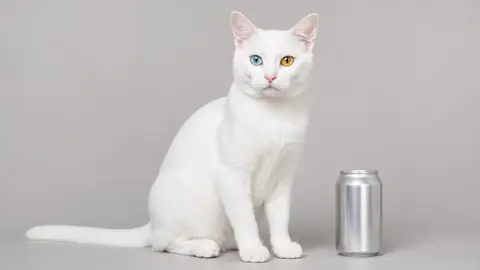 Khao ManeeA white Thai cat whose Indian price comes from a carousel containing eight dogs, and whose history two Thai state and university...
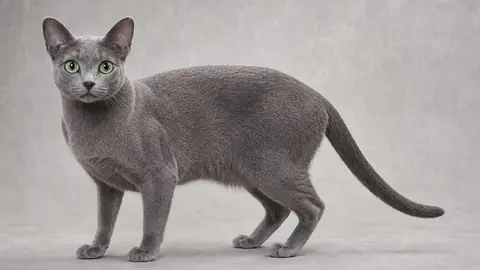 KoratA Thai natural breed with a heart-shaped head, one permitted colour, two fatal recessive diseases with DNA tests, and 97...
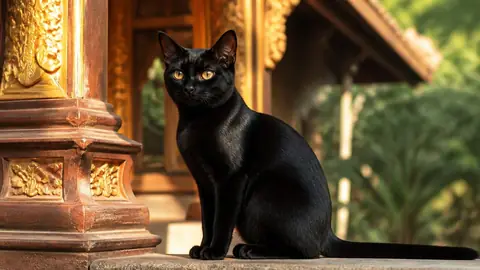 Korn JaA solid black Thai cat that Thailand's Cabinet made a national symbol in November 2025, that no cat registry on earth holds, and...
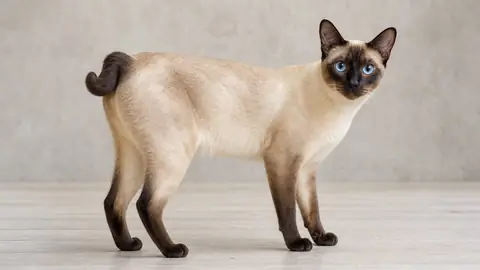 Mekong BobtailThe only breed standard this cat has anywhere requires two things at once: a tail nobody has genotyped, and a tyrosinase allele...
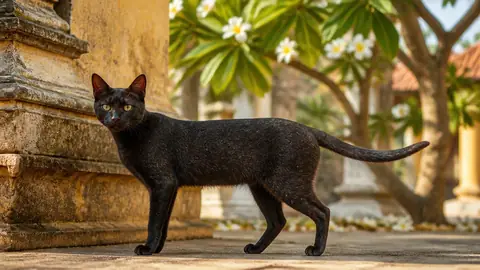 Sam SawetOne of the seventeen auspicious cats of the Ayutthaya cat-book poems, and absent from Thailand's own list of the five that...
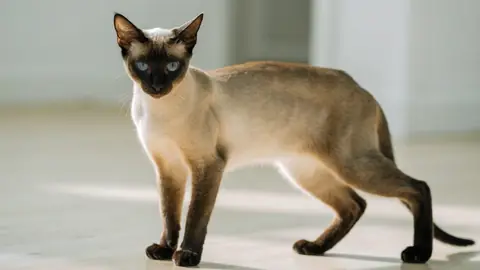 SiameseWhat a Siamese cat actually costs in India, why published prices disagree by eight times, why your cat's coat colour tracks your...
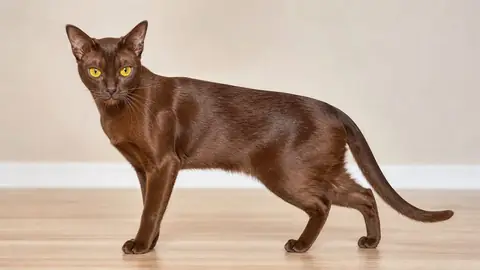 SuphalakA solid copper-brown Thai cat with a single recognised colour, held by one registry of six, and the subject of exactly one...
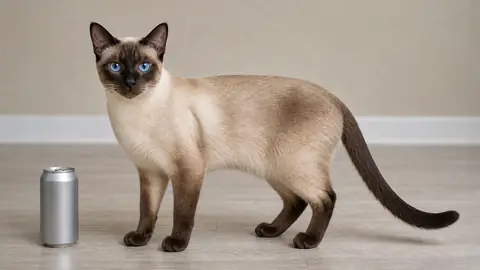 ThaiThe old-style Siamese, recognised under four different registry filings, absent from every Indian price list, and called a...
Compare the breeds side by side
To compare these 8 breeds directly, read across the table rather than down the guides. Heat tolerance is a Bonbeno rating out of 5 for Indian conditions, and the reasoning behind each one sits on the breed's own page.
| Breed | Heat tolerance | Published price, India |
|---|---|---|
| Khao Manee | 5 of 5 | Not verifiable. The one Indian guide prints Rs 30,000 to Rs 70,000; the listing page cited alongside it prices only dogs |
| Korat | 5 of 5 | None sourced. India's leading cat-price guide lists 16 breeds and the Korat is not one of them |
| Korn Ja | 5 of 5 | None sourced. Both of India's largest cat guides return zero for Korn Ja and Konja |
| Mekong Bobtail | 4 of 5 | Rs 13,895, for a gold necklace |
| Sam Sawet | 5 of 5 | None sourced. Both of India's largest cat guides return zero for the name |
| Siamese | 4 of 5 | Rs 15,000 to Rs 40,000 |
| Suphalak | 5 of 5 | None found. Six Indian commerce pages checked, zero carry the breed, with three control breeds on all six |
| Thai | 5 of 5 | None sourced. India's leading cat-price guide lists 14 breeds and the Thai is not one of them |
What matters in this group
The points below are what the evidence on these 8 guides actually supports, not what the category is assumed to mean.
- Three separate Thai authorities have published a list of the Thai cat breeds that survive today, and all three give the same five. The Fine Arts Department's national library in Chanthaburi names Wichienmaat, Suphalak, Korat, Konja and Khao Manee. On 19 November 2025 the Prime Minister's Office announced that the Cabinet had resolved to designate Thai cats a national identity in the pet-animal category, naming the same five, though the Fine Arts Department's own article dates the Cabinet's approval to 21 March 2025, and the two Thai state sources sit eight months apart. A peer-reviewed genetics study published in 2024 genotyped 184 Thai cats at 15 microsatellite loci plus the mitochondrial D-loop, 59 Wichien Maat, 41 Korat, 37 Khao-Manee, 29 Suphalak and 18 Konja, and states that the ancient texts identified 23 breeds and today only five remain. One Thai university library page lists six and includes the Sam Sawet, and its own bibliography cites Thai Wikipedia for that entry. The Cabinet's stated reason was that foreigners have been taking purebred Thai cats abroad to register them and set breed standards, so an Indian buyer commissioning an export from Thailand would be the specific behaviour the resolution names.
- The Tamra Maew is a system of household omens rather than a breed register, and being in it turns out to be independent of being a living breed. The Thai cat manual, which forms part of the Tamra Phrommachat and was copied by hand through the generations, describes 23 cats, 17 auspicious and 6 that bring harm. The 2024 study dates the Cat-Book Poems to 1350 to 1767 and the Smud Khoi of Cats to 1868 to 1910. The Korat, the Wichienmaat, the Suphalak and the Korn Ja are among the seventeen, and the Korat page records the manuscript as the probable first allusion to that breed, with the caveat that the illustration is not detailed enough to be definitive. The Sam Sawet is also among the seventeen, defined in Thai sources as a Korn Ja with white hairs interspersed, and it is the one that every modern Thai list omits. The Khao Manee is the exact inverse. Thailand's Fine Arts Department states that it does not appear in the treatise of 17 auspicious cats of the Ayutthaya period and was found additionally in the early Rattanakosin period, in the samut khoi of Wat Arun, under the name Khao Plort and with no dedicated verse. It is absent from the manuscript and present on every modern list.
- The Western registry breeds are the same cats after a breeder decision. The Siamese is a breed from Thailand, formerly Siam, that appeared in the Crystal Palace Show catalogues as early as 1881, and the Thai is the moderate old-style Siamese, known at home as the Wichienmaat, recognised by the WCF since 1990, by TICA with its own standard and breed committee, and by FIFe as THA since 2017. A pedigree analysis of 39,576 entries including 4,998 Thai concluded the Thai could be considered a subpopulation of the Siamese, and FIFe registered 234 Thai worldwide in 2024 against 929 Siamese. The Mekong Bobtail and the Siamese come from one founder population, the pointed cats of Siam, and split on a single aesthetic choice, since British breeders from 1870 bred out the tail kinks and the Russian line kept them. The WCF admitted it in August 2004, renamed it from Thai Bobtail at the same moment, and remains the only registry to hold it. The Korat, known at home as the Si-Sawat, is held by six registries in exactly one colour and bred only to other Korats, and the Suphalak is held by the WCF alone under a standard dated 1 November 2024 with a single colour and no outcrosses.
- Bangkok and coastal India are the same climate to within a tenth of a degree, which is why this group is the closest climate match on the site. Bangkok runs an annual mean of 27.85 C at 74.45 percent relative humidity against Chennai's 27.95 C at 72.39 percent, the peak wet bulbs fall in the same month and sit 0.12 C apart at 25.99 and 26.11, and Bangkok is the more humid of the two. Ayutthaya, where the Thai cat texts were written, is 0.12 degrees from Bangkok. Nakhon Ratchasima, the province the Korat is named after, runs 26.31 C at 73.19 percent, within 1.64 degrees of Chennai. The Mekong Bobtail's founder population comes from Bangkok and from Phnom Penh at 28.28 C, both warmer than Chennai. Where India is harder than Thailand is the north and the east. Bangkok's coolest month averages 24.95 C against Delhi's January at 13.61, a Delhi June at 35.88 is hotter than anything Bangkok records, and Kolkata's June wet bulb of 27.09 exceeds Bangkok's May peak. The Thai sources describe the Sam Sawet's coat as thin and rather short, and the Khao Manee standard asks for characteristics suited to a hot, wet, tropical climate, which is the coat these cats bring to Chennai and the coat they lack for a Delhi winter.
- The 2024 study found that the five surviving breeds are five appearances drawn from one underlying population rather than five separate lineages. It reported observed and expected heterozygosity above 0.5 in every breed, two mitochondrial haplogroups shared among all Thai domestic cats and globally, and a distinct genetic structure in the Wichien Maat alone. The Khao Manee carried the highest allelic richness of the five and an inbreeding coefficient of essentially zero, and the Konja the fewest alleles, 92 against the Wichien Maat's 137, with an effective population size of 11.6. For an Indian buyer two consequences follow. A solid brown, solid black or solid white Thai-type cat is not self-identifying, so the pedigree does the work that appearance cannot, and the Korn Ja and the Sam Sawet are held by no registry, which means a seller offering one in India can be held to nothing at all. Only the Siamese can be obtained in India with a pedigree an Indian body would read, and it is the only Thai cat with a published life expectancy, 11.69 years on 88 deaths in the UK life table. The Korat, the Khao Manee, the Suphalak and the Korn Ja were absent from the Indian price guides each page checked.
Membership is generated from the breed data itself, not typed by hand, so this list cannot drift from the guides it points at and fills in as more publish. The 8 guides here cite 244 sources between them.
This page is a directory of published Bonbeno guides, generated from their data rather than written as clinical guidance, so no veterinarian reviewed this page itself. Each linked guide carries its own veterinary review and its own health sections. Breed level evidence describes populations, and your animal is an individual, so consult your nearby vet before acting on anything you read here.
Common questions
How does Bonbeno decide which breeds belong on this page?
Membership is generated from each breed's own published data rather than chosen by an editor. The group is defined by a shared trait rather than a rating, so its members are named in the site's own cluster definition and each one is checked against the published guide before it appears. A breed appears here the moment its guide publishes and meets that rule, and never before, which is why no link on this page can point at a guide that does not exist.
What is a Bonbeno heat tolerance rating?
It is a 1 to 5 rating of how well a breed copes with Indian conditions, where 5 is best. Almost no international breed reference publishes one, and in a country where summer temperatures pass 45 C it is the most decision-relevant trait there is. It is Bonbeno's own judgement, built from published heat-illness evidence where that exists and stated as inference where it does not.
Are the prices on this page current?
Each price is read from that breed's own guide, where it is compared across published Indian sources and cited. Published Indian breed prices disagree widely between sellers, sometimes by more than a lakh for the same breed, so treat the figure here as the lowest band Bonbeno found and read the guide for the full range.
Does Bonbeno sell or broker any of these cats?
No. Bonbeno does not sell pet food, products or animals and does not broker puppy or kitten sales. Nothing on this page is a listing, and no breeder or seller can pay to appear on it.