
Breed profile
Turkish Van in India: A Highland Cat, Not an Angora
A semi-longhaired highland cat from the Lake Van basin, held by six registries, studied by a Turkish state university, and repeatedly confused with a different Turkish breed.
Quick answer
One Indian site prints a Turkish Van cat price in India of Rs 15,000 to Rs 30,000, and India's leading cat-price guide does not list the breed at all while listing the Turkish Angora with a price band. Two of the top five results for the Indian query price the cat in yuan rather than rupees. FIFe registered 49 Turkish Vans worldwide in 2024, ranking the breed 40th of 54.
This page reports Turkish and European veterinary research on the Turkish Van, including blood-type surveys showing that a majority of the cats tested carried type B blood and that every type B cat tested carried anti-A antibody. That has direct consequences for breeding and for transfusion. It is reference material, not a diagnosis and not a treatment plan. Consult your nearby vet, a registered veterinarian who can examine your own animal, before acting on anything here, and insist on blood typing before any transfusion or planned mating.
Turkish Van at a glance
What a Turkish Van is
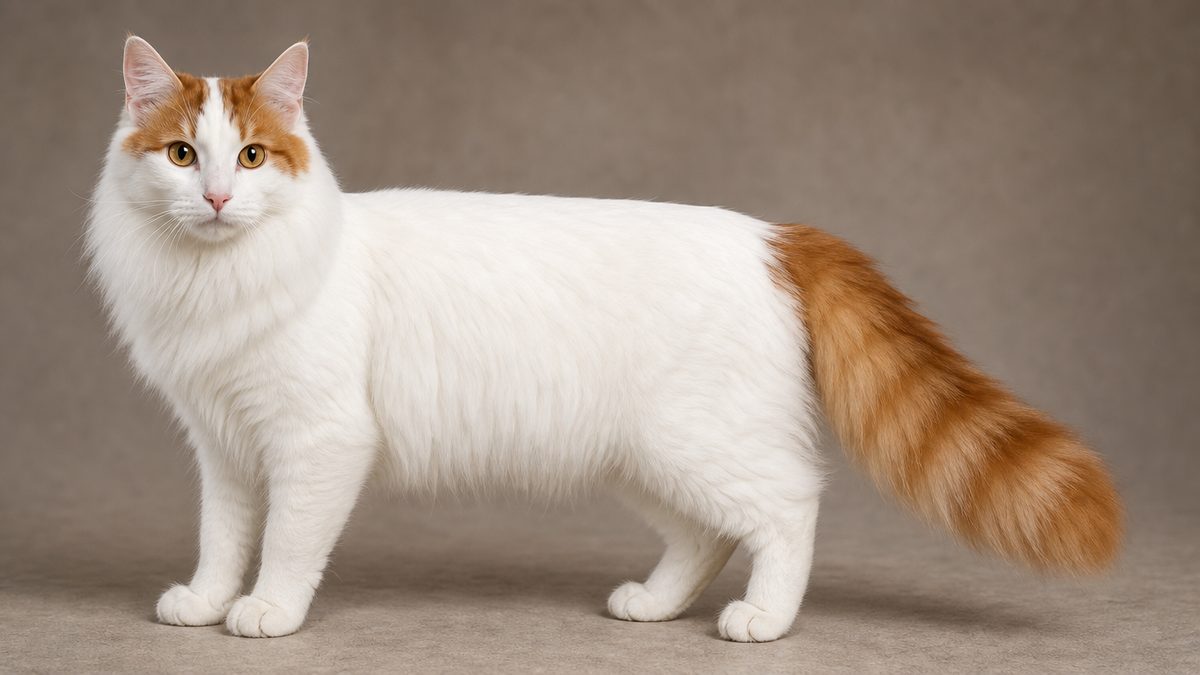
The Turkish Van is a large semi-longhaired natural cat from the Lake Van basin in eastern Turkey, chalk white with colour restricted to the head and the tail.
One sentence in the GCCF standard tells you almost everything, including why this breed does not transfer easily to a tropical country. It describes a naturally occurring semi-longhaired breed from the rugged region of the Middle East centred on Lake Van, where the climate varies to extremes, known for a unique distinctive pattern, a white cat with strikingly coloured head and tail, large and muscular with strength and power evident in a substantial body and legs.
The pattern is the breed. Colour markings sit on the head but not below the level of the eyeliners and not beyond the base of the rear of the ears, and the colour on the head must be separated by a vertical white blaze, while the brush is coloured. Too little marking on the head is as undesirable as too much. CFA puts a number on the tolerance, allowing one or more random body markings so long as no more than 15 percent of the body is coloured.
That arrangement has a name of its own, and the name has escaped the breed. CFA writes in its own breed standard that the term van has been adopted by a variety of breeds to describe white cats with coloured head and tail markings, and the World Cat Federation carries it as pattern code 01, van, defined as one eighth colour on head and tail against seven eighths white. So the van pattern is a colour code that many breeds can wear, while the Turkish Van is the breed it was named after. Meeting the words van pattern in an EMS string tells you about a coat, not about a pedigree.
The coat, which behaves like two coats
Fur should be long, soft and silky to the roots, with no woolly undercoat, and the GCCF notes explicitly that the winter coat of the Van is longer and heavier than the summer coat. CFA describes the warm-weather coat as feeling like a rabbit's and calls the breed one of the easiest longhairs to groom, with no undercoat to tangle or mat.
LOOF is blunter about what that means in practice. In winter, in memory of the continental climate of its homeland, the Van is a dense impenetrable ball of fur; in summer only its tail reminds you that it is a longhair; and the result is a spectacular moult that vigorous brushing will help. An Indian owner meets that moult once or twice a year and should plan for it.
Eyes, size and maturity
Eyes are large and oval, alert and expressive, with pink rims, and the GCCF withholds certificates for orange or copper eyes in adults. CFA accepts amber, blue or odd eyes, and the GCCF lists three separate auburn varieties, TUV d with light to medium amber eyes, TUV d 61 blue-eyed, and TUV d 63 odd-eyed with one blue and one amber.
Size takes a long time to arrive. The GCCF says the breed does not gain full maturity until three years or more, TICA says three to five, and CFA says this slow-maturing breed continues to grow until the age of five, with mature males weighing up to 20 pounds. A buyer judging an eighteen-month-old Van against an adult standard is judging an adolescent.
CFA records that the modern history begins in 1955 when two British photographers travelling through Turkey on behalf of the Turkish Tourist Board brought a pair of unrelated cats back to England, that Barbara and Jack Reark of Florida imported a breeding pair from France in 1983 and three more from the Netherlands, that CFA recognition followed in 1988 and championship status in 1994. TICA names the two photographers as Laura Lushington and Sonia Halliday and gives the same year, and LOOF names both women too while adding that the breed failed to establish itself in Britain and found its footing in the United States and Germany instead.
The Turkish genetics are thinner than the legend and worth stating plainly. A 2024 study sampled 240 specimens across Turkey and found nine universal mitotypes plus an outlier group, with the haplotype structure of random-bred Turkish cats distinct from both the Turkish Angora and the Turkish Van, and nucleotide diversity among the highest reported for any world cat population. The breeds are genuinely differentiated populations, and the country they come from is one of the most genetically diverse cat landscapes measured.
Registry recognition, and the one thing the registries disagree about
Six registries hold the Turkish Van and all six agree it exists, but they split on whether an all-white Van is the same breed.
State registry recognition per body rather than as one global claim. On this breed the recognition itself is unanimous, which is unusual, and the disagreement sits one level down, on what counts as a Turkish Van. Each registry's breed standard is a separate document again, and three of the six publish a full one.
| Registry | Status | Position on the all-white cat |
|---|---|---|
| CFA | Championship since 1994, own breed council | Characteristics line reads all white except for colour on head and tail |
| TICA | Held, with a breed page and full standard | Pure white is also an accepted colour, sometimes known as the Van Kedi |
| GCCF | Section 2 Group B from page 85 | Holds the all-white cat as a SEPARATE breed, Turkish Vankedisi, TUV W, from page 90 |
| FIFe | Recognised, EMS code TUV, Category 1 | Filed with the Persian, Exotic, Ragdoll and Sacred Birman |
| LOOF | Championnat oui, Turc du Lac de Van | Entirely white Vans exist, but the typical colour is white with head and tail markings |
| WCF | Recognised, code TUV, by ALL | Pattern code 01, van, is defined as one eighth colour on head and tail, seven eighths white |
That split is not a technicality, because it decides which cat a piece of health research applies to. The GCCF's decision to hold the Turkish Vankedisi as its own breed from page 90 of the same document means a British reader can tell the two apart on paperwork, while a TICA or LOOF pedigree may not distinguish them at all Livre Officiel des Origines Felines. The health section below explains why that matters.
The two Turkish breeds, held separately by everyone that holds either
The CFA runs a Turkish Van breed council and a Turkish Angora breed council, two separate councils with two separate secretaries on its 2026 ballot. FIFe files them in different categories, TUV in Category 1 with the Persian and the Ragdoll, TUA in Category 2 with the Maine Coon and the Norwegian Forest Cat. The WCF lists them as separate rows with separate codes.
The GCCF is the outlier and it is worth recording precisely. Across 723,034 extracted characters of its June 2026 Standard of Points, the string Angora appears zero times, while Vankedisi appears twelve times as an in-document control. So the GCCF holds two Turkish breeds and neither of them is the Angora.
FIFe registered 49 Turkish Vans in 2024, rank 40 of the 54 codes in its own statistics, whose registration counts sum exactly to the printed total of 96,075. The Turkish Angora sits above it at rank 34 with 94, and inside Category 1 the Turkish Van accounts for 0.2 percent of 21,416 registrations against the Ragdoll's 70.3 percent. A registration count of 49 across all FIFe member countries is the number to keep in mind when a seller claims easy availability.
LOOF permits one mating only, Turc du Lac de Van to Turc du Lac de Van, so the register is closed. It also records something no other registry states: that Turkey, conscious of its heritage, has decided to protect this cat and that it is very difficult to import one. That is a studbook describing a source country's export policy, and it is the single most useful fact for an Indian buyer.
The Angora confusion, and why it costs an Indian buyer money
The Turkish Van and the Turkish Angora are two breeds from different parts of Turkey, and in India the confusion has a commercial consequence, because the market carries one and not the other.
Every registry that holds both breeds says they are different, and two of them go out of their way to say so. CFA opens its Turkish Van page with the sentence that the breed is often confused with the better-known Turkish Angora, is a distinctly different breed that developed in a geographically distant part of Turkey, and that comparing the robust muscular Van to the elegant refined Angora is like comparing an Olympic swimming champion to a ballerina. TICA says the Lake Van origin is what gave the breed the name that differentiates it from the Turkish Angora, a distinctly different breed that also originates in Turkey.
The Turkish veterinary literature supports the split with data rather than description. A blood-type survey opens by stating that Turkish Van and Angora cats are different breeds that originated in geographically distinct regions of Turkey, and then measures a difference: 60 percent type B among 85 Van cats against 46.4 percent among 28 Angoras. A 2024 mitotyping study treated them as two separate pure breeds and found their haplotype structures distinct from Turkish random-bred cats.
| Feature | Turkish Van | Turkish Angora |
|---|---|---|
| Region of origin | Lake Van basin, eastern Turkey | Ankara region, central Turkey |
| Build | Long, sturdy, broad, deep-chested, muscular | Fine-boned and elegant |
| Pattern | White with colour only on head and tail | Many colours including solid white |
| FIFe category | Category 1, with the Persian and Ragdoll | Category 2, with the Maine Coon and Norwegian Forest Cat |
| FIFe registrations 2024 | 49, rank 40 | 94, rank 34 |
| Type B blood, Turkish survey | 60 percent of 85 cats | 46.4 percent of 28 cats |
| GCCF standard | Section 2 Group B, page 85 | Not held; Angora appears zero times in the whole document |
| In India's leading cat-price guide | Zero mentions | Rs 20,000 to Rs 1,50,000 |
Read the last row and the Indian consequence is obvious. A buyer who has heard of a beautiful white Turkish cat and searches for a price will be shown the Angora, because that is the breed India's leading guide actually lists. A buyer who then sees a white longhaired cat offered as a Turkish Van has no easy way to tell which breed is in front of them, and no Indian studbook to check against.
The two breeds are not different in every respect, and a behaviour study found the opposite of what the type comparison implies. Survey data on 5,726 cats found behaviour differences across 19 breeds and breed groups in ten traits, and when the breeds were clustered, the Turkish Van and Angora cats alone formed one of the four clusters. So on temperament the two Turkish breeds group together and apart from everything else, even while their build, pattern, region and blood-type frequencies separate them. Both things are true, and a page that reports only the first is telling half the story.
- Check the pattern first, because a Turkish Van shows colour on the head and tail and nowhere else worth speaking of.
- Check the blaze, since the GCCF requires a vertical white blaze separating the head markings and withholds certificates without one.
- Check the tail, because a partially white tail is a withhold-certificate fault in the Van.
- Check the build, since the Van is long, broad and deep-chested while the Angora is fine-boned.
- Check the paperwork, and ask which register issued it, because no Indian feline studbook publishes a breed list to check against.
Turkish Van cat price in India, and what the search results actually contain
One Indian site prints a Turkish Van cat price in India of Rs 15,000 to Rs 30,000, and it is the only Indian figure that could be sourced on 9 September 2026.
Start with the guide that ought to carry it. India's leading cat-price guide, dated 25 March 2026, written by a named author and reviewed by a named veterinarian, runs a 16-breed quick-reference table. Across its 50,834 extracted characters the string Turkish Van appears zero times, while Turkish Angora appears once, priced at Rs 20,000 to Rs 1,50,000. That is an absence with a working control attached, because the same document proves it names Turkish breeds when it has them.
One Indian content page carries a figure. happypet.care gives a cost of buying of Rs 15,000 to Rs 30,000, updated 16 May 2025, alongside the same Rs 2,800 to Rs 4,200 monthly template row this site has documented on that publisher across unrelated breeds, food of Rs 1,500 to Rs 2,000, an ideal weather band of 15 to 30 degrees C and a life expectancy of 12 to 15 years. Its own price heading is misspelled, reading What is the cost of Turkisssh Van Cat, which is a fair signal of the editorial care behind the number.
| Result | What it is | Currency it prices in |
|---|---|---|
| petzlover.com /in/ path | Blocked by a human-verification wall on target and control alike | Nothing readable |
| petopic.com | A listings shell | None found |
| 5dpet.com | A Chinese-market article dated 6 February 2025 | Yuan, 10,000 minimum and 20,000 to 30,000 for better cats |
| happypet.care | An Indian content page with a template cost row | Rupees, Rs 15,000 to Rs 30,000 |
| kirapet.com | A 2,026-character page calling the breed the Ferrari of the cat world | Yuan, more than ten thousand rising to twenty or thirty thousand |
| supertails.com | India's leading cat-price guide | Rupees, but the breed is not in it |
Two of the five pages that price this cat for an Indian searcher price it in yuan Kira Pet, Turkish Van Cat Prices. Neither carries a rupee figure or any Indian content. A reader skimming a search results page will read the numbers and not the currency, and will come away with a price that describes a different market entirely.
poodles.in, which publishes Indian price pages for many cat breeds and does carry Tonkinese, Persian and Korat pages, returns HTTP 200 with the page title Cat Breed Not Found for the Turkish Van and serves a 958-character shell. A crawler checking status codes would record an Indian Turkish Van price page that does not exist. Read the title, not the status.
The division tests, run and reported
Rs 15,000 divided by 84.38 is 177.77, by 80 is 187.50 and by 74 is 202.70. Rs 30,000 gives 355.54, 375.00 and 405.41. None is a price a seller would print, so the band is rupee-native rather than a converted dollar list. The 80 result carries no weight on its own, because any figure ending in three zeros divides cleanly at 80 by construction.
The international pages that outrank the Indian ones publish no rupee figure at all. Cats.com runs a full breed profile covering characteristics, care, history, the breed standard and where to find a kitten, with no Indian content and no rupee anywhere. A rare cat is expensive in every market that genuinely has one, and the useful Indian question is not what it costs but whether it exists here at all.
So the honest position is that one Indian publisher prints Rs 15,000 to Rs 30,000, the guide that lists sixteen other breeds does not list this one, and no Indian listing could be verified. Treat the figure as a single publisher's claim, and read the French studbook's warning alongside it: Turkey has decided to protect this cat and it is very difficult to import one.
The monthly cost of ownership in India
A Turkish Van costs about what any large semi-longhaired cat costs to keep in India, with one seasonal spike when the winter coat comes out.
There is no chronic condition on this breed that adds a recurring line, and the coat needs no salon. The two costs that differ from a shorthair are more brushing time twice a year and, for anyone breeding, a blood test that is not optional.
| Item | Price | Source and scope |
|---|---|---|
| Kitten course, three visits | From Rs 3,999, against a struck-through Rs 5,065 | One national clinic chain's national page, 11 cities |
| Adult annual booster, CRP plus anti-rabies | From Rs 1,899, against Rs 1,908 | Same chain, same page |
| Anti-rabies alone | From Rs 699 | Same chain |
| CRP alone (Tricat or Feligen) | From Rs 1,249 | Same chain |
| Anti-rabies, Chennai municipal clinics | Free | Greater Chennai Corporation, six named pet clinics |
| Pet licence, Chennai | Rs 50 | Greater Chennai Corporation, 9,115 issued in 2024 |
| Blood typing before breeding or transfusion | Ask your vet; a laboratory test rather than a package | Required by the Turkish blood-type findings below |
The vaccination figures are promotional floors from one chain rather than a market average, and that chain has been observed quoting different course prices on different city pages on the same day. Re-check the page for your own city before you budget from it.
The spread that matters more than any single figure
Greater Chennai Corporation runs six veterinary pet clinics that provide all treatment and anti-rabies vaccination free of cost, and issues a pet licence for Rs 50, of which it issued 9,115 during 2024. A private chain charges from Rs 699 for the same anti-rabies dose. The vaccine is the same; the delivery model is the price, and that spread is the single most actionable cost fact for an Indian cat owner.
- Budget Rs 4,000 for the first-year kitten course, then about Rs 1,900 a year for boosters at private-chain floors.
- Budget nothing for professional grooming, because a coat with no undercoat needs a comb rather than a salon.
- Budget for a good steel comb and a rubber grooming mitt, which are the only tools this coat needs.
- Budget for a blood type test before any planned mating or transfusion, which the Turkish data makes necessary.
- Budget for neutering once, which is the single largest evidenced survival intervention for any cat.
One population figure belongs in every Indian cat budget. Entire cats carried 4.29 times the odds of death before three years compared with neutered cats, with a confidence interval of 3.72 to 4.95, across the whole UK cat population under primary veterinary care. CFA adds a breed-specific reason to keep an eye on the waistline, warning that because Vans are large cats with a high activity level they need plenty of space and regular interactive play, or they could very easily become obese.
Heat tolerance: a continental highland cat in a tropical country
The Turkish Van comes from a basin whose annual mean is roughly 18 degrees C colder than Chennai's, and that gap is the honest headline of this page.
Three separate points across the Lake Van basin were queried from NASA POWER by explicit latitude and longitude, and the model returned three distinct cells rather than collapsing them into one, which is the check that makes the figures usable. The cells sit at 1,876.94 m for Van city, 1,878.22 m for Tatvan and 1,813.96 m for Ercis, against real elevations near 1,725 m, 1,720 m and 1,690 m, so the model runs 124 to 158 m high across the basin. At roughly 6.5 degrees C per 1,000 m that overstates the cold by well under a degree, so the figures below are reported as they came back with the caveat attached.
| Place | Cell elevation | Annual mean T2M | Annual mean RH2M | Hottest month | Coolest month |
|---|---|---|---|---|---|
| Van city, Turkiye | 1,876.94 m | 9.92 C | 55.47 percent | August, 24.37 C | January, -5.56 C |
| Tatvan, Lake Van west | 1,878.22 m | 9.16 C | 59.68 percent | August, 23.93 C | January, -6.25 C |
| Ercis, Lake Van north | 1,813.96 m | 9.26 C | 58.92 percent | August, 23.57 C | January, -6.18 C |
| Ankara, Turkiye | 1,128.10 m | 10.35 C | 66.47 percent | August, 22.52 C | January, -2.08 C |
| Chennai | 48.95 m | 27.95 C | 72.39 percent | May, 31.51 C | January, 24.09 C |
| Mumbai | 97.15 m | 26.77 C | 67.39 percent | May, 31.19 C | January, 23.19 C |
| Bengaluru | 841.72 m | 23.74 C | 67.94 percent | April, 28.37 C | December, 20.22 C |
| Delhi | 206.37 m | 25.60 C | 45.56 percent | June, 35.88 C | January, 13.61 C |
Van city's annual mean of 9.92 degrees C sits 18.03 degrees below Chennai's 27.95 and 13.82 below Bengaluru's 23.74. Even the basin's hottest month, August at 24.37, is cooler than Chennai's coolest month, January at 24.09, by only a quarter of a degree. Put plainly, a Lake Van summer is an Indian winter.
What the coat does and does not do about that
The coat is the mitigating factor, and it is a real one. There is no woolly undercoat, which is what usually traps heat against a longhaired cat in a humid climate, and the summer coat is much lighter than the winter one, with CFA describing it as feeling like a rabbit's. Humidity is a smaller problem than a reader might expect, because the Lake Van basin runs 55 to 60 percent relative humidity against Chennai's 72.39, so the difference is real but it is a wet-bulb question rather than a shock.
Readers reach for Srinagar or Shimla when they want an Indian analogue for a cold-climate breed, and the climate model cannot describe either. Its Srinagar cell sits at 2,630.66 m against a real 1,585 m, an error of about 1,046 m, and its Shimla cell at 897.65 m against a real 2,200 m, an error of about 1,302 m in the opposite direction. Two errors of over a kilometre running in opposite directions cannot be corrected with a rule of thumb, so this page publishes no Indian hill-station comparison rather than a wrong one.
- Provide air conditioning or strong cross-ventilation in the plains between March and June, because this coat evolved for a continental winter.
- Provide shaded tile or stone floor space, which is what a hot longhaired cat will actually seek out.
- Provide more water points than seem necessary, in wide shallow bowls away from the food.
- Provide a serious brushing routine at the seasonal moult, because a shed coat left in place traps heat.
- Provide indoor life, since an outdoor white cat in Indian sun also faces a sunburn and skin-cancer risk on the ears and nose.
That last point deserves its own sentence. This is a chalk-white cat with white ears and a white nose, and the standard requires it. White ear tips and noses burn, and India delivers far more ultraviolet than eastern Anatolia does. Keep a Turkish Van out of direct midday sun as a routine rather than a precaution.
Temperament and household fit
The Turkish Van is an affectionate but physically independent cat that wants closeness without being carried, and the registries are consistent about that distinction.
CFA describes loyal companions who always appreciate a game of fetch, very intelligent and adept at solving problems, who are not fond of being held or carried but still crave physical closeness, and who will curl up next to you or crawl into your lap once playtime is over. TICA says the same thing from the other side, describing a cat that likes to follow its favourite person around the house and enjoys being petted but is not necessarily fond of being held or cuddled.
That is an unusual and useful distinction. A household that wants a cat to carry around will be disappointed; a household that wants a cat in the room will not. CFA adds that Vans do best with older children who can understand their reluctance to be carried and can be trusted not to pull their colourful tails.
The shyness LOOF reports, which the American registries do not
LOOF gives a noticeably more reserved account. It describes a cat that has to be earned, that lived half-wild in its natural environment and has only had close human contact for a relatively short time, that is a little shy, rarely uses its strength, and asks to be put at ease before showing all the affection it is capable of. That is a different animal from CFA's problem-solving clown, and both descriptions come from registries that hold the breed.
Publish the disagreement rather than averaging it. A reasonable reading is that the French studbook is describing cats closer to the source population and the American registry is describing several more generations of selection for handling, but nobody has measured that, and this page does not pretend otherwise.
- Choose a Turkish Van if you want a cat that stays in the room rather than one that sits in your arms.
- Choose a Turkish Van if there is vertical space and floor space, because both registries describe an active climber.
- Choose a different breed for a household with toddlers, since CFA recommends older children who will not pull the tail.
- Choose a different breed if the flat is empty all day, because TICA says the breed requires a lot of attention and dislikes being left alone.
- Choose deliberately on noise, since CFA describes a cat that is quite vocal and has a great deal to say, though not loudly.
One behavioural finding is worth carrying because it is measured rather than described. In a survey of 5,726 cats covering ten behaviour traits, the Turkish Van and Angora together formed one of only four behavioural clusters across all the breeds studied, and heritability estimates for seven traits ran from 0.4 to 0.53. Temperament in cats is partly genetic, and these two breeds sit in their own corner of it.
Training a Turkish Van, and what it resists
To train a Turkish Van, use problems rather than repetition, because both registries describe an intelligent cat that solves things and then keeps solving them.
CFA describes cats very intelligent and adept at solving problems, giving the example of working out how to open the cupboard where the cat food lives. TICA recommends challenging the brain by teaching tricks and providing puzzle toys that reward with treats, and notes that Vans have been known to turn on a water tap. Neither registry describes a cat that responds to correction.
Fetch is the training shortcut here, exactly as it is for the Tonkinese, though for a different reason. CFA says these cats always appreciate a game of fetch and TICA lists small balls they can chase and fetch among favourite toys, alongside big peacock feathers and fur-like toys on a string. TICA also warns that the Van is tough on toys and that you should be prepared to replace them regularly.
- Start with fetch and a throwable toy, because both registries name it independently.
- Add puzzle feeders second, which meet the problem-solving need and slow down a cat CFA warns can easily become obese.
- Add carrier training third, in short sessions with the door open, months before a vaccination visit needs it.
- Add grooming tolerance fourth, working up to the seasonal moult with short daily sessions rather than one long fight.
- Add handling tolerance last, teaching the cat to accept examination without being picked up, which suits a breed that dislikes being carried.
The one thing worth cat-proofing
Water. TICA reports that Vans like to play with water and have been known to turn on the water faucet, and that they may want to join a family member in the bathtub or swimming pool. In an Indian home that means a covered water storage drum, a closed bathroom door when a bucket is full, and a washing machine whose door is kept shut. None of that is exotic advice; it is simply the consequence of a cat that seeks water out rather than avoiding it.
What this breed resists is being restrained. CFA's standard itself says these cats should not be restrained too tightly but handled with firm and gentle pressure, and TICA adds that being intelligent and alert they feel more secure and perform best when allowed to stand on their own on the show table The International Cat Association. Apply that at the vet's table too, and tell the clinic before the appointment rather than during it.
Daily exercise for a large, athletic climber
A Turkish Van needs real daily exercise rather than token play, and its own registry says obesity is the consequence of skipping it.
CFA states the case directly. Because Vans are large cats with a high activity level, it is important to make sure they have plenty of space in their living environment and obtain regular exercise through interactive play sessions, otherwise they could very easily become obese. That is a registry naming a specific risk from a specific omission, which is rarer than it should be.
TICA describes what the activity looks like. Active and energetic, the Van likes to jump and climb to the highest point in the room, can often be found running, playing in water and retrieving toys, and is highly acrobatic enough to catch toys mid-air and roll in somersaults.
- Provide two or three interactive sessions a day, longer than a shorthair needs, using wand toys and throwable balls.
- Provide a tall climbing structure, because a cat that seeks the highest point in the room will otherwise choose your shelving.
- Provide floor space, which CFA names explicitly as a requirement rather than a nicety.
- Provide water play in a controlled form, such as a shallow tray, rather than leaving open buckets around the house.
- Provide puzzle feeders on working days, which convert part of the ration into activity.
Move interactive sessions to early morning and after sunset from March to June across the plains. A cat whose homeland peaks at 24.37 degrees C in August is being asked to exert itself at a Chennai May mean of 31.51 or a Delhi June mean of 35.88. Ambient tolerance and exertion tolerance are different things, and this breed has less margin on the second than most cats in India.
There is no published Turkish Van exercise requirement and this page does not invent one. What is published is the direction of travel on weight: lifespan fell by 0.02 years for every 100 g of deviation from the median adult bodyweight within a cat's breed and sex group. For a breed its own registry flags as obesity-prone, that is the number to act on.
Grooming a semi-long coat with no undercoat
Grooming a Turkish Van is a weekly comb for most of the year and a serious daily effort during the seasonal moult, because the coat has no undercoat but does change weight with the season.
CFA calls this one of the easiest longhair breeds to groom, with no undercoat to tangle up or cause mats, and says owners need only run a steel comb through the coat occasionally to remove dead hair, with weekly combing sufficient when the cat is wearing its warm-weather coat. The heavier winter coat may need more frequent attention. TICA agrees, saying the coat does not shed much and is easy to groom with weekly combing.
LOOF is the registry that describes what actually happens twice a year. In winter the Van is a dense impenetrable ball of fur, in summer only the tail reminds you it is a longhair, and the transition produces a spectacular moult that vigorous brushing will help. In an Indian climate that transition is compressed rather than absent, so plan for a fortnight of daily work rather than a gradual change.
| Task | Frequency | Indian cost |
|---|---|---|
| Steel comb through the coat | Weekly in the summer coat | One comb, once |
| Daily combing during the moult | Two weeks, twice a year | Time rather than money |
| Nail trim | Every three to four weeks | Free at home, or with a clinic visit |
| Ear check | Weekly during the monsoon | Free |
| Tooth brushing | Two or three times a week | One brush and feline paste |
| Professional grooming | Not required | Rs 0 in a normal year |
A white coat is ultraviolet protection over pink skin, and this breed's standard requires a white nose and white ears with delicate shell pink inside. Removing the coat exposes skin that has no pigment to defend it, in a country with far higher ultraviolet exposure than eastern Anatolia. Comb the shed coat out instead, which is what the moult actually needs, and keep the cat out of direct midday sun.
A skin finding from the homeland worth knowing
Turkish researchers cultured hair from 264 clinically healthy Van cats in and around Van Province and isolated dermatophytes from 19 of them, 7.1 percent, most frequently Trichophyton terrestre at 4.1 percent, then Microsporum gypseum and M. nanum at 1.1 percent each and T. mentagrophytes at 0.7 percent. Microsporum canis, the species most associated with cat-to-human ringworm, was not isolated from any specimen. Carriage was highest in spring and winter, and the only possible risk factor identified was the age of the animal.
That is a finding about cats in Van rather than about the breed anywhere else, and this page does not stretch it further. What it usefully establishes is that a clinically healthy Van cat can carry dermatophytes without lesions, which is a reason to wash hands after grooming rather than a reason for alarm.
One grooming claim gets made about every semi-longhair with no undercoat and it is worth closing off here. A coat that sheds less visibly makes a home easier to keep clean and does nothing else. The 2024 review of the field states that to date there is no scientific evidence for a hypoallergenic cat breed, that even hairless Sphynx cats produce Fel d 1, and concludes that molecular analyses of dander across breeds show high individual variation in allergen levels but provide no scientific evidence for the concept.
Health: a blood-type problem, a deafness question that belongs to another breed, and one candidate variant
The Turkish Van's best-evidenced health issue is not a disease at all, it is a blood-type frequency that makes typing before breeding or transfusion a genuine requirement.
CFA states that no specific genetic problems are known to affect this healthy natural breed. That is broadly fair and it is also incomplete, because two lines of evidence complicate it and one of them is Turkish primary research that almost nothing outside Turkey cites.
Blood type, which is the finding that should change behaviour
Blood typing matters in cats because type B cats carry naturally occurring anti-A antibody, which causes neonatal isoerythrolysis when a type B queen is bred to a type A tom, and causes acute haemolytic reactions on a mismatched transfusion. Two Turkish surveys measured this breed.
| Study | Cats tested | Type A | Type B | Type AB |
|---|---|---|---|---|
| Arikan 2003, Van cats | 85 | 40 percent | 60 percent | None found |
| Arikan 2003, Turkish Angora | 28 | 53.6 percent | 46.4 percent | None found |
| Arikan 2004, Turkish Van cats | 78 | 42.3 percent | 57.7 percent | None found |
The second study went further and measured the antibody. All 45 type B cats showed gross evidence of agglutinating anti-A antibody, with titres ranging from 2 to 256, and 20 percent of type B cats carried titres above 32. The first study states the practical conclusion in its own words, putting the risk of transfusion incompatibility at 60 percent in Van cats and 46.4 percent in Angoras, and strongly recommending to breeders and clinicians that blood typing be performed before breeding and before transfusing.
Two actions follow and both are cheap relative to the consequences. Have the cat blood typed and write the result on the vaccination card, so that an emergency transfusion decision is not made by guesswork at midnight. And if a mating is ever planned, type both cats first, because a type B queen bred to a type A tom is the classic setup for neonatal isoerythrolysis. Consult your nearby vet about the local availability of feline blood typing before you need it Arikan S, Akkan HA. Titres of naturally….
Deafness, which belongs to the all-white cat
The largest study of congenital sensorineural deafness in client-owned purebred kittens tested 132 solid white kittens and 61 coloured littermates by brainstem auditory evoked response. Deafness was diagnosed only in solid white kittens, with an overall prevalence of 30.3 percent, 15.9 percent bilateral and 14.4 percent unilateral, and none in the coloured littermates. Kittens with at least one blue iris were 3.2 times more likely to be affected than those without.
The breed row matters. Turkish Vankedisi kittens were affected in 7 of 15 cases, 46.7 percent, the highest of the eight breeds reported, ahead of Maine Coon at 44.0 percent and Norwegian Forest at 43.9 percent. The Turkish Vankedisi is the all-white cat that the GCCF holds as a separate breed from page 90 of its Standard of Points, distinct from the patterned Turkish Van at page 85.
So the honest statement is narrow and it is the opposite of what most breed writing implies. That study measured solid white cats, it found no deafness in coloured littermates, and its Turkish row is the Vankedisi. A patterned Turkish Van carries colour on head and tail by definition and is not a solid white cat. Where TICA and LOOF accept an all-white animal within the breed Livre Officiel des Origines Felines, the finding does apply, and a hearing test on any solid white kitten is the sensible ask.
One candidate genetic variant, described once
In a single litter of Turkish Van cats, three of six kittens developed severe skin disease, diarrhoea and stunted growth at six weeks; one died and two were euthanased. Whole-genome sequencing of one affected kitten against 54 control genomes found a single protein-changing variant, SLC39A4 c.1057G>C, p.Gly353Arg, in a gene encoding an intestinal zinc transporter, which co-segregated with the phenotype in the index family and was absent from 173 unrelated control cats. The authors propose the condition be designated acrodermatitis enteropathica.
Read that carefully. It is one litter, one sequenced kitten and a candidate causative variant, not an established breed-wide disease, and this page does not upgrade it into one. What it does justify is asking a breeder whether any kitten in a previous litter has had unexplained skin disease with diarrhoea and failure to grow at around six weeks.
One clear negative, and the lifespan question
A Finnish case-control study drawn from a survey of 8,115 cats, with 944 examined under sedation of which 202 had tooth resorption, found higher risk in the Cornish Rex, European and Ragdoll at odds ratios of 2.44, 2.98 and 2.90, a lower risk in the Exotic-Persian group at 0.28, and states plainly that tooth resorption was not observed in Turkish Van or Devon Rex. That is a genuine negative finding on one of the commonest dental diseases in cats.
On lifespan, no breed-specific life table exists. Teng 2024 reports 12 breed rows and the Turkish Van is not among the 12 breeds that reached the threshold of 15 or more deaths, so it carries no median from that work. TICA states 13 to 17 plus years and the one Indian page prints 12 to 15, and both are claims rather than measurements.
Finally, a set of ordinary clinical numbers that exists for this breed and almost no other, because a Turkish state university keeps a research colony. A 2026 study of 307 healthy purebred Van cats at the Van Cat Research Center reported mean intraocular pressure of 24.8 plus or minus 6.8 mmHg, central corneal thickness of 649.1 plus or minus 62.2 micrometres and ocular surface temperature of 36.25 plus or minus 0.73 degrees C, with heterochromatic blue-amber cats showing slightly higher pressure and corneal thickness than blue-blue cats. Breed-specific reference ranges are rare, and a vet treating a Van now has them.
Feeding a Turkish Van in India
Feed a Turkish Van on a measured ration, because its own registry names obesity as the predictable consequence of a large active cat kept without space and play.
There is no Turkish Van diet and no published breed-specific requirement, so this section stays with what is evidenced. CFA warns that Vans could very easily become obese without space and regular interactive play, and the largest UK life-table study found lifespan falling by 0.02 years for every 100 g of deviation from the median adult bodyweight within a cat's breed and sex group. Portion control is the intervention.
- Weigh the cat monthly in its carrier, subtract the carrier weight, and record the number.
- Measure every meal rather than free-feeding, which matters more in a slow-maturing breed that keeps growing to five.
- Feed for the life stage rather than the size, because a Van at eighteen months is still an adolescent by its own standard.
- Include wet food daily, which raises water intake in a hot climate and suits a cat that likes water anyway.
- Adjust the ration by body condition rather than by the label, and ask your vet to score the cat at each visit.
What the Indian page claims about calories
The one Indian content page prints 300 kcal a day for kittens and 250 for adults, alongside a food line of Rs 1,500 to Rs 2,000 a month. Those are the same two calorie figures the same publisher prints for unrelated cat breeds, so they are a site-wide default rather than a calculation for a cat that can reach 20 pounds. Use them as an order of magnitude and let your vet set the actual ration.
Cats eat less and drink more in heat, and both are normal. Between March and June watch water intake rather than appetite, and move the larger meal to the evening. This is one breed where a shallow water tray is worth putting out as well as bowls, because a cat that plays with water will drink more when the water is interesting.
One further point belongs here rather than in the health section. A cat that will be weighed, examined and blood typed without a struggle is a cat whose owner can act on the blood-type finding above. Handling tolerance built around food, in kittenhood, is what makes that possible.
Kitten timeline: month by month through the first year and beyond
A Turkish Van kitten's first year has four checkpoints, and unusually the breed is not finished growing at the end of it.
| Age | What is happening | What to do |
|---|---|---|
| 0 to 8 weeks | With the mother and litter; pattern already visible | Nothing. A kitten should not leave its mother in this window |
| 6 weeks | The window in which the described zinc-transporter phenotype appeared | Ask the breeder about skin disease with diarrhoea in previous litters |
| 2 months | Homecoming at the earliest; first vaccination visit | Start the kitten course, from Rs 3,999 for three visits at one national chain |
| 2 to 3 months | Hearing can be tested reliably | Ask for a hearing test on any solid white kitten, and a blood type on the kitten |
| 4 months | Third vaccine visit including anti-rabies | Complete the course; begin comb training in short daily sessions |
| 6 to 9 months | Sexual maturity approaches; the frame is still growing | Discuss neutering, the largest evidenced survival intervention |
| 9 to 12 months | First full winter coat, then the first moult | Move to daily combing during the transition rather than weekly |
| 1 to 3 years | Body fills out; the GCCF puts maturity at three or more | Judge condition against an adolescent, not an adult |
| 3 to 5 years | CFA says growth continues to five | Annual health check; keep weight near the adult median |
Two of those rows are specific to this breed rather than generic. The blood type belongs on the vaccination card from the start, because the Turkish surveys put type B at 57.7 to 60 percent and every type B cat tested carried anti-A antibody. The hearing test applies to a solid white kitten because the study that measured deafness found it only in solid white cats, and its Turkish row was the Vankedisi at 46.7 percent.
The GCCF says full maturity comes at three years or more, TICA says three to five, and CFA says growth continues until five and mature males may weigh 20 pounds The International Cat Association Cat Fanciers' Association. A seller presenting a fourteen-month-old cat as a finished adult is either mistaken or hoping you are. Judge the kitten's parents, not the kitten.
Neutering deserves its own line rather than a footnote. Entire cats carried 4.29 times the odds of death before three years compared with neutered cats, with a confidence interval of 3.72 to 4.95, across the whole UK cat population under primary veterinary care. For this breed there is a second reason, since neutering removes the neonatal isoerythrolysis question entirely.
Turkish Van against the semi-longhairs an Indian buyer can actually get
The Turkish Van competes against three other semi-longhaired breeds in an Indian buyer's mind, and it is by far the hardest of the four to obtain.
The comparison that matters in India is not Van against Angora on type, it is Van against whatever is actually available. Three of the four cats below are in India's leading cat-price guide and one is not.
| Breed | Undercoat | FIFe registrations 2024 | Homeland annual mean | In India's leading guide |
|---|---|---|---|---|
| Turkish Van | None, per the GCCF standard | 49, rank 40 | 9.92 C at Van city | Not listed |
| Turkish Angora | Fine, per its FIFe category peers | 94, rank 34 | 10.35 C at Ankara | Rs 20,000 to Rs 1,50,000 |
| Maine Coon | Dense | 23,775, rank 1 | Temperate North American | Rs 40,000 to Rs 1,00,000 |
| Norwegian Forest Cat | Dense, water-resistant | 4,105, rank 6 | Sub-Arctic Scandinavian | Not listed |
| Persian | Dense | 1,981, rank 11 | Not applicable, a developed breed | Rs 12,000 to Rs 50,000 |
The absence of an undercoat is the Turkish Van's one genuine advantage over the other three in an Indian climate Cat Fanciers' Association. Against that sits a homeland 18 degrees colder than Chennai and a global registration count of 49 Federation Internationale Feline.
The deafness comparison, which cuts across three of them
In the same study of solid white purebred kittens, the three highest breed prevalences were Turkish Vankedisi at 7 of 15, Maine Coon at 8 of 18 and Norwegian Forest at 18 of 41, all in the 43 to 47 percent band, and the authors found those three significantly different from Persian or Russian kittens. So a white kitten of any of those three breeds needs a hearing test, and the question is not specific to Turkey.
The honest availability answer
Of the five cats in that table, three carry a published Indian price in a source that lists sixteen breeds: the Turkish Angora at Rs 20,000 to Rs 1,50,000, the Maine Coon at Rs 40,000 to Rs 1,00,000 and the Persian at Rs 12,000 to Rs 50,000. The Turkish Van carries a price from one Indian publisher and nothing else. A reader who wants a white Turkish cat in India has a genuinely easier route through the Turkish Angora, and a reader who wants a large semi-longhair has one through the Maine Coon.
What Indian owners and Indian pages get wrong about this breed
Five errors recur, and the first two are the ones that cost money.
- Buying an Angora believing it is a Van, because India's market carries the Angora and not the Van.
- Reading a yuan price as a rupee price, since two of the top five Indian search results quote yuan without a rupee anywhere.
- Applying the white-cat deafness figure to a patterned Van, when the study found deafness only in solid white kittens.
- Skipping the blood type, when Turkish surveys put type B at 57.7 to 60 percent and every type B cat tested carried anti-A antibody.
- Treating the coat as low maintenance all year, when the seasonal moult is what the French studbook calls spectacular.
The currency mistake, in detail
Two pages ranking for turkish van cat price in india price the breed in yuan. One states that the minimum price is around 10,000 yuan and that cats with excellent conformation and lineage range between 20,000 and 30,000 yuan. The other calls the breed the Ferrari of the cat world and prices it at more than ten thousand yuan rising to twenty or thirty thousand. Neither page carries a rupee figure, an Indian city or an Indian seller. A reader who takes 10,000 from one of them and reads it as rupees has understated the claim by roughly a factor of twelve, and a reader who reads 30,000 as rupees has still not learned anything about India.
Congenital sensorineural deafness was diagnosed only in solid white kittens in the study that measured it, and in none of the 61 coloured littermates tested alongside them. The Turkish row in that study is the Turkish Vankedisi, which the GCCF holds as a separate breed from the patterned Turkish Van. Applying 46.7 percent to a cat with auburn head markings and a coloured tail is transferring a finding between two breeds, which is exactly the error this site exists to avoid. Ask for a hearing test on a solid white kitten, and do not assume a deaf cat when the kitten is patterned.
One thing Indian buyers get right
Indian readers ask about heat first, and on this breed the instinct is correct and the answer is a genuine caution rather than reassurance. The homeland runs an annual mean of 9.92 degrees C with a January mean of minus 5.56, and its hottest month is barely warmer than a Chennai January. The absent undercoat helps, but it does not close an eighteen-degree gap, and a buyer who plans air conditioning and shade from the start is planning correctly.
Adoption, import and the honest recommendation
No verified Indian Turkish Van breeder or listing exists, Turkey restricts export, and the two real routes are adoption or a lawful personal import.
This page will not send a reader to a breeder. It can set out what the routes are, so that nobody pays a deposit against a yuan price or an Angora.
The source country's own position
LOOF records that Turkey, conscious of its heritage, has decided to protect this cat and that it is very difficult to import one. The breed is also the subject of a research and application centre at a Turkish state university, whose colony supplied 307 healthy purebred cats to a single 2026 ophthalmology study Van Yuzuncu Yil Universitesi. A country that runs a university research centre for a cat and restricts its export is not a country with a casual export trade, and an Indian seller promising a Turkish import should be asked to name the paperwork.
The Indian import route, in the government's own words
Import of live animals including cats is restricted in India and permitted only with an authorisation from the DGFT, using ITC(HS) code 01061900 for pet animals. Applications are considered by an Exim Facilitation Committee that meets once a month, and import is allowed only through the airports and seaports of Delhi, Mumbai, Chennai, Hyderabad, Bengaluru and Kolkata and, since October 2024, Kochi airport, with quarantine at the port where required Department of Animal Husbandry…. Import without authorisation is allowed for people shifting residence permanently to India under the customs baggage rules. The full route, which covers cats too, is set out in how to import a dog to India.
- Adopt an Indian shorthair from a local shelter, which costs least and helps most.
- Adopt a white cat from a shelter if the look is what appeals, and have its hearing tested at the same visit.
- Verify which Turkish breed is being offered, since India's market carries the Angora and not the Van.
- Verify the register and the cattery prefix before any money changes hands, because no Indian feline studbook publishes a breed list.
- Verify a blood type on both parents before any planned mating, which the Turkish surveys make necessary rather than optional.
What an Indian shelter cat gives you instead
A pet licence in Chennai costs Rs 50, the Corporation issued 9,115 of them in 2024, and its six municipal pet clinics provide all treatment and anti-rabies vaccination free of cost. A private kitten course starts at Rs 3,999 and an annual booster at Rs 1,899. An adopted Indian cat can be fully vaccinated and licensed for less than one private vaccine package, and it will already be adapted to the climate this breed is not.
The evidence points the same way. Crossbred cats lived 1.27 years longer than purebred cats on average, and purebred cats had 1.83 times the odds of dying before three years, across the whole UK cat population under primary veterinary care. Those are population figures rather than a verdict on any individual animal, and they are the only figures anyone has.
If you want a white cat with a striking pattern that suits an Indian home, adopt, and have any white cat's hearing tested. If you specifically want a Turkish Van, expect a long wait, plan a lawful personal import through one of the seven named ports, budget for air conditioning through the plains summer, and get the cat blood typed before you need the result Arikan S, Duru SY, Gurkan M, Agaoglu ZT NASA POWER climatology API, 2001 to 2020 Department of Animal Husbandry….
Readers who arrive here from the Norwegian Forest Cat or the Siberian are usually weighing cold-climate semi-longhairs against an Indian summer, and readers who arrive from the Persian are usually after a longhaired cat that India actually sells. The Korat is the opposite case in this cluster and worth reading beside this page, because its homeland climate is a near match for coastal India rather than an eighteen-degree gap.
Turkish Van questions people actually ask
How much does a Turkish Van cost in India?
One Indian site prints Rs 15,000 to Rs 30,000, and it is the only Indian figure that could be sourced. India's leading cat-price guide, dated March 2026, runs a 16-breed table in which the string Turkish Van appears zero times while the Turkish Angora appears once at Rs 20,000 to Rs 1,50,000. Two of the top five results for the Indian query price the breed in yuan rather than rupees, and no Indian listing could be verified anywhere.
How much does a Turkish Van cat cost?
Outside India the published figures are in other currencies and they are not comparable. The two pages ranking for the Indian query that do quote a number both quote yuan, one giving a minimum around 10,000 yuan and a range of 20,000 to 30,000 for cats with excellent conformation and lineage. Bonbeno does not convert a foreign price into rupees, so this page reports the Indian figure it could source and names the rest for what they are.
What is a Turkish Van cat?
A Turkish Van is a semi-longhaired natural cat breed from the Lake Van region of eastern Turkey, chalk white with colour confined to the head and the tail. The GCCF standard describes a large muscular cat from a rugged region where the climate varies to extremes, with a coat long, soft and silky to the roots and no woolly undercoat. Colour on the head must be separated by a vertical white blaze, and the tail must be fully coloured.
Do Turkish Van kittens come with a health guarantee?
No registry issues one, and the guarantees that marketplaces advertise are contracts with a breeder rather than anything a studbook underwrites. The two checks worth asking for instead are a blood type on both parents, because Turkish surveys put type B at 57.7 to 60 percent in this breed with every type B cat carrying anti-A antibody, and a hearing test on any solid white kitten, because congenital deafness in the largest client-owned study was found only in solid white cats.
What is the difference between a Turkish Van and a Turkish Angora?
They are two breeds from geographically distinct parts of Turkey, and the registries say so directly. CFA calls the Van a distinctly different breed and compares the robust muscular Van to the elegant refined Angora as an Olympic swimmer to a ballerina. Turkish blood-type work found different frequencies in the two breeds, 60 percent type B in Van cats against 46.4 percent in Angoras. The pattern is the fastest visual test: a Turkish Van is white with colour only on head and tail.
Are Turkish Van cats deaf?
The patterned Turkish Van is not the cat that study measured. In the largest client-owned survey, congenital sensorineural deafness was diagnosed only in solid white kittens and in none of the 61 coloured littermates, with the Turkish Vankedisi at 7 of 15, or 46.7 percent, the highest of the eight breeds reported. The GCCF holds the Vankedisi as a separate breed from the patterned Turkish Van, so ask which cat is being offered, and ask for a hearing test on any solid white kitten.
Do Turkish Van cats really swim?
The registries say so and describe it consistently, though no study measures it. TICA calls the breed the swimming cat and says they enjoy swimming and water games, may join a family member in the bathtub, and were historically known to swim in Lake Van. CFA reports that according to some founding breeders even Van kittens will play and swim in pools or lakes voluntarily. Treat it as a strong registry claim rather than a measured behaviour.
How long do Turkish Van cats live?
No breed-specific life table exists. Teng 2024 reports 12 breed rows and the Turkish Van is not among the 12 breeds that reached the threshold of 15 or more deaths, so it carries no median from that work. TICA states 13 to 17 plus years and the one Indian page prints 12 to 15 years, which are registry and publisher claims rather than measured figures, and this page reports them as such.
Is a Turkish Van suited to the Indian climate?
Less than any other cat in this cluster, and the numbers are stark. The Lake Van basin runs an annual mean near 9.92 degrees C with a January mean of minus 5.56, against Chennai's 27.95 and January 24.09. That is a gap of roughly 18 degrees on the annual mean. The coat helps, because there is no woolly undercoat and the summer coat is much lighter, but this is a continental highland cat being asked to live in the tropics.
Are Turkish Van cats rare?
Yes, by the only global count that exists. FIFe registered 49 Turkish Vans in 2024, ranking the breed 40th of the 54 codes in its own statistics, whose registration counts sum exactly to the printed total of 96,075. The Turkish Angora sits above it at rank 34 with 94, and the Maine Coon at rank 1 with 23,775. TICA describes the breed as rare even in its native homeland, where it is regarded as a regional treasure.
Which registries recognise the Turkish Van?
Six hold the breed and they disagree about one thing. The CFA gave it championship status in 1994 and runs a Turkish Van breed council, TICA holds it, the GCCF gives it Section 2 Group B from page 85, FIFe holds it as TUV in Category 1, LOOF holds it as the Turc du Lac de Van, and the WCF lists it as recognised by all. The disagreement is the all-white cat: TICA and LOOF accept it within the breed, CFA requires the pattern, and the GCCF holds it as a separate breed called the Turkish Vankedisi.
Can you import a Turkish Van into India?
Only as a personal pet, and the French studbook warns that Turkey now restricts exports. Import of live animals including cats is restricted in India and permitted only with a DGFT authorisation using ITC(HS) code 01061900, considered by a committee that meets monthly, and allowed only through the airports and seaports of Delhi, Mumbai, Chennai, Hyderabad, Bengaluru and Kolkata and, since October 2024, Kochi airport. LOOF states that Turkey, conscious of its heritage, has decided to protect this cat and that it is very difficult to import one.
Compare with similar breeds
Turkish Van sits in 1 Bonbeno group. Each one compares it directly against the breeds it is genuinely an alternative to, on the same figures.