
Cat breed profile
Birman Cat Price in India, the Gloves Test and Full Breed Guide
What a Birman actually costs in India, why the published prices disagree by twenty times, the 90-second check that separates a Birman from the Ragdoll it is sold as, and the heart screening no Indian seller mentions.
Quick answer
The Birman cat price in India runs Rs 15,000 to Rs 3,00,000 in 2026, with published sources disagreeing by four times at the floor and six times at the ceiling. Two facts decide the purchase and no ranking page carries either. Four pure white symmetrical gloves, with laces up the back of the hock, separate a Birman from the Ragdoll it is sold as, and no validated Birman HCM DNA test exists, so screening means an echocardiogram.
This guide is general information for Indian pet owners and is not a diagnosis. Always consult a registered veterinarian near you before acting on anything you read here, and treat any sudden change in your cat's condition as urgent.
Birman cat at a glance
What a Birman cat actually is
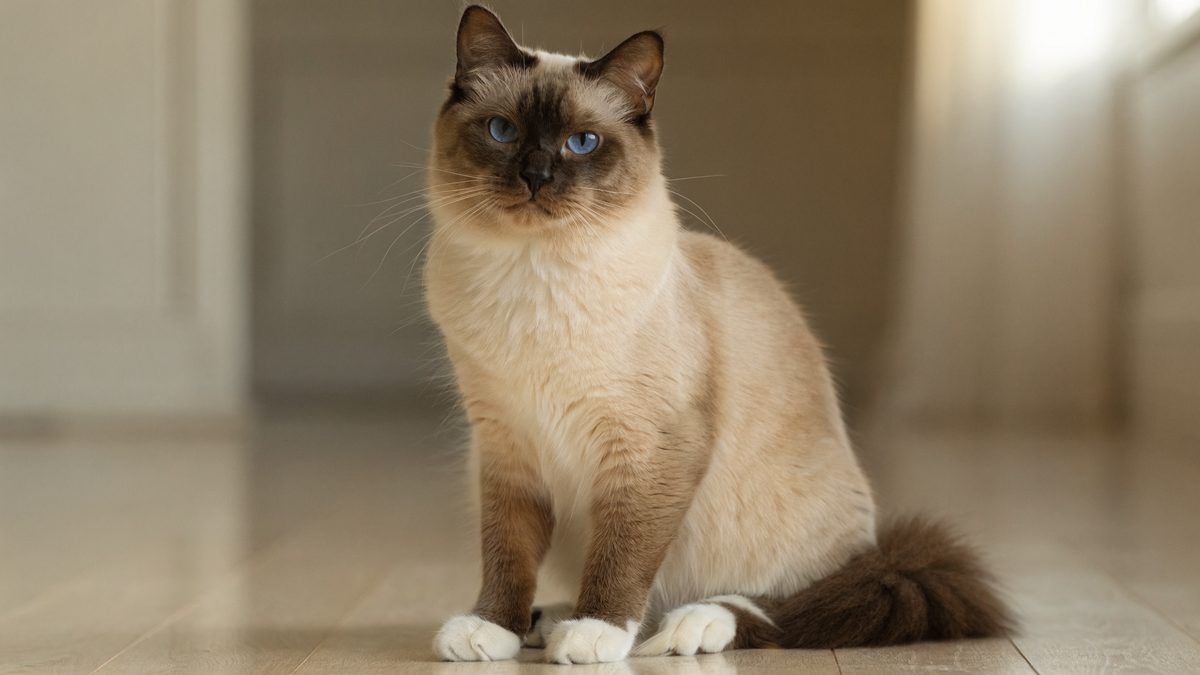
A Birman is a medium to medium-large semi-longhaired colourpoint cat with four pure white symmetrical gloves on all four feet, deep blue eyes and a Roman nose The International Cat Association. Birman…. The gloves are not decoration. They are the breed, and they are the one check that separates a real Birman from the colourpoint cat being sold to you as one.
Start with the number that settles most arguments. The Cat Fanciers' Association scores a Birman out of 100 points, and 20 of those points go to the gloves alone, covering the front gloves, the rear gloves, the laces and their symmetry. Everything else about the colour, including body colour, point colour and eye colour, is worth 15. A registry that allocates more of its scorecard to four white feet than to the entire rest of the cat's colouring is telling you exactly what the breed is defined by.
The white is caused by a specific variant in the KIT gene, inherited as an autosomal recessive trait, and UC Davis sells a DNA test for it that is valid only for the Birman breed and Birman crosses. The Governing Council of the Cat Fancy states the point plainly: the gloves and gauntlets come from a gloving gene that is not related to the white spotting gene which produces bi-colour cats in other breeds. That single sentence is the genetic reason a Birman and a mitted Ragdoll are not the same animal wearing the same pattern, and it is why the gloves have to be judged as gloves rather than as white markings.
The six-point physical check, in the order that settles it fastest
Run this check before you discuss price. It costs nothing, takes about 90 seconds, and every item comes from a published breed standard rather than from a seller.
- Count four gloves. Lack of white gloves on any paw is an outright disqualification under the CFA standard. Three gloves and a coloured foot is not a poorly marked Birman. It fails the defining test of the breed.
- Check where the front white stops. Front gloves should end in an even line across the paw, at or between the second and third joints, and the upper limit of the white is the metacarpal pad, the small pad sitting above the third joint just below the wrist bones. White that runs past that pad is penalised, and white running up the leg is the fault Birman breeders have called a runner since the 1950s.
- Turn the cat around and look for laces. The white on the back feet must extend up the back of the hock, and in that area it is called a lace. Ideally each lace ends in a point or an inverted V and reaches half to three quarters of the way up the hock. TICA describes them as extending about halfway up the back leg. White on the back legs beyond the hock is a disqualification.
- Check the eyes are blue, and only blue. Eye colour other than blue is a disqualification. The standard asks for almost round eyes, set well apart, the deeper and more vivid blue the better. Sapphire blue eyes are the phrase every seller uses; the standard is the thing that defines them.
- Feel the profile. The Birman nose is medium in length and width and Roman, meaning slightly convex, which sets the nostrils low on the nose leather. A Persian type or Siamese type head is explicitly penalised. This is the check most Indian buyers skip and it is the one that catches a Persian cross.
- Look for white where it should not be. White tail tips and chin spots are disqualifications, and white shading on the stomach and chest is penalised. A kinked or abnormal tail, crossed eyes and an incorrect number of toes are also disqualifications.
Birmans are born almost white, without their mask, points, gloves or gauntlets visible. Points develop over the first weeks and keep deepening until roughly two years of age. GCCF puts it as a test of patience for breeders, who must wait to see whether the gloves and gauntlets meet the standard without coloured spots, coloured toes or mismatched gauntlets. For a buyer this means a 9-week-old kitten cannot be fully assessed on gloving, so you verify the parents' feet, not just the kitten's.
One honest qualification, because three registries weight the gloves differently. The New Zealand Cat Fancy standard allocates only 10 of its 100 points to gloves and gauntlets, alongside 10 for eye colour, 25 for head and 25 for body, and states explicitly that while perfect white feet are desirable they should not be given preference over the type of the cat, so a cat slightly imperfect in gloves and gauntlets can still take top awards. The three standards also describe the lace differently: CFA wants a point or inverted V reaching half to three quarters up the hock, GCCF wants a gauntlet tapering to finish just below the point of the hock, and NZCF wants a spearhead shape reaching just below the middle of the hock. What all three agree on is the pass or fail line. NZCF withholds a challenge certificate or first place for lack of white gloves on any paw, lack of gauntlets on the back legs, coloured toes, crossed eyes or a squint, which matches CFA's disqualification list closely. Judges argue about lace shape. Nobody argues about whether all four feet must be gloved.
Size, coat and colours
A Birman is solidly built rather than large. GCCF gives a size band of 10 to 15 lbs and specifies that females typically weigh 6 to 10 lbs while males average 10 to 15 lbs. The Indian pages quote 4.5 to 7 kg for males and 3.5 to 6 kg for females, which overlaps the GCCF band reasonably. The CFA describes the body as elongated and stocky with a good muscular feel, neither svelte nor cobby, with heavy jaws, a strong chin and large round firm paws.
The coat matters more than the size for anyone in India. TICA states that despite the length of their coats, Birmans have what is called a single coat, meaning they do not have an undercoat, and are easy to groom. CFA describes it as medium long to long, silken in texture, with a heavy ruff around the neck and slightly curly on the stomach, and adds that the fur is of such a texture that it does not mat. GCCF recommends combing weekly. Hold that against a Persian, whose long dense double coat needs daily brushing, and the grooming difference is structural rather than a matter of effort.
GCCF recognises 20 different colours, and the Birman Cat Club lists all twenty with their GCCF codes, running from Seal Point (13c1) and Blue Point (13c2) through Chocolate (13c3), Lilac (13c4), Red (13c5) and Cream (13c7), then the tortie points which are exclusive to females, the tabby points, and the tortie tabby points which are also female only and remain rare. Every one of them carries blue eyes and white gloves. There is no such thing as a white Birman or a black Birman, whatever the Google related-search strip suggests.
Where the breed came from, and why the history is a health fact
The Birman's history is not colour. It explains the genetic diversity problem in the health section, so read it as data. The first European Birmans are thought to have reached France around 1919 as a gift; the male died on the voyage and the pregnant female, Sitah, produced a litter in 1920. GCCF records that the breed in France traces back to a single pair, Orloff and Xenia de Kaabaa. France formally recognised the breed in 1925 The Birman Cat Club.
Then the breed was nearly lost twice over. CFA states that during the Second World War Birmans almost became extinct, with only one breeding pair left in Europe by the end of it, and that French breeders rebuilt the breed by outcrossing to Persians and Siamese. GCCF gives the same account and notes that the Persian outcross is what introduced the dilute gene for blue. The Birman Cat Club adds that the post-war rebuild was done in great secrecy and is believed to have involved Colourpoint Persians, the occasional Siamese and domestic cats.
Britain came later. Elsie Fisher saw Birmans at the Paris Cat Show in 1965 and, with Margaret Richards, imported one seal point male and two blue point females; GCCF recognised the breed in 1966 The Birman Cat Club. The club's own account of that founding stock is unusually honest and worth quoting for buyers who think a pedigree guarantees perfection: the seal male Nouky had a superb coat but, in common with all the early Birmans, pale blue eye colour and an over-abundance of white on his front feet.
Two documented population bottlenecks, a single founding pair in France and a single surviving pair after the war, are the reason the breed's genetic diversity is measurably narrow today The Cat Fanciers' Association. Birman breed… Alhaddad H, Khan R, Grahn RA, Gandolfi B. That is not a reason to avoid the breed. It is the reason the health section of this page is longer than the price section, and the reason a serious breeder's paperwork is worth more here than in a breed with a wide gene pool.
One last framing point before the money. Indian buyers meet this breed in a market where the cat population is growing faster than the dog population. India's cat population rose from 2.37 million in 2020 to 4.48 million in 2025, a compound growth rate of 13.6 percent a year, and is forecast at 4.89 million for 2026, against 35.37 million dogs. Cats are 11 percent of the pet population and the fastest growing share of it. A rare pedigree breed entering a fast-growing, unregulated market is exactly the condition in which lookalikes get sold at pedigree prices.
Birman cat price in India
A Birman cat costs Rs 15,000 to Rs 3,00,000 or more in India in 2026 depending entirely on which published source you read. Bonbeno compared every Indian source currently visible on page one for this query. Four of them publish a price, two do not publish one at all, and the four that do disagree by four times at the floor and six times at the ceiling.
Read the table across, not down. The disagreement is the finding, not any single number in it.
| Source and SERP position | Published Birman price | What the source is |
|---|---|---|
| Puppiezo, position 1 | No Birman price published anywhere on the page | Kitten marketplace. The price panel on the Birman page shows a Maltipoo at Rs 98,999, two Poodles at Rs 92,599, a Cane Corso at Rs 94,999, a Goldendoodle at Rs 1,20,000, a Rottweiler at Rs 76,499 and a Doxiepoo at Rs 98,999 |
| Wrapinfur, position 2 | Rs 60,000 to Rs 1,50,000 average; pet Rs 60,000 to Rs 1,20,000; show Rs 1,20,000 to Rs 2,00,000+; imported Rs 1,50,000 to Rs 3,00,000+ | Pet products retailer with a content blog. Google's AI Overview for this query was generated from this page alone and cited it five times |
| Happy Pet, position 3 | Rs 20,000 to Rs 50,000 | Pet care app and breed database |
| VetScan, position 4 | Rs 30,000 to Rs 50,000 | Veterinary diagnostics laboratory, in a 20-breed listicle |
| PawSpace, position 5 | Not stated. The word Birman does not appear on the page | Pet services company. Its ten-breed price list covers Persian, Siamese, Himalayan, British Shorthair, Maine Coon, Ragdoll, Bengal, Scottish Fold, Sphynx and the Indian domestic cat |
| Supertails, position 6 | Rs 15,000 to Rs 60,000 | Pet pharmacy and content site, in a vet-backed 40-breed climate guide |
| Saba Birmans, position 7 | No price stated, only an inclusions list | A Hungarian cattery. It ranks in India because it named a chocolate lynx point kitten 'India' |
The floor for a Birman moves from Rs 15,000 to Rs 60,000 depending purely on who is publishing, a fourfold difference for an animal described in the same terms. The ceiling moves from Rs 50,000 to Rs 3,00,000 and above, a factor of six. Bonbeno will not average those into a consensus figure, because the average would be a number no seller in India has ever quoted anyone. Four things drive the spread, and only two of them are real.
- Whether the publisher sells anything. The two highest bands come from pages attached to commerce. The two lowest come from a veterinary laboratory and a pet pharmacy publishing breed reference content Supertails. Cat Breeds In India. A wide published band with a very high ceiling makes any mid-range quote feel like a bargain, which is what a wide published band is for.
- Genuine rarity. This one is real. Wrapinfur states that only a small number of breeders work with Birmans in India and that waiting lists are not uncommon. Supertails names only Mumbai and Bengaluru as cities with select breeders. When two sources that disagree on price agree on scarcity, treat the scarcity as the reliable part.
- Registration paperwork, which means different things at different registries. Wrapinfur cites WCF or CFA registration papers as a price factor. Those papers are worth having, but 'registered' is not one standard. CFA lists no allowable outcross breeds for the Birman at all, while GCCF permits a Persian outcross in specified colours, provided the Persian is tested clear of polycystic kidney disease and Persian PRA. Before you pay for pedigree, ask which registry issued it and what that registry's rules actually require.
- Import claims. Wrapinfur quotes imported Birman kittens at Rs 1,50,000 to Rs 3,00,000 and above. An import is a documentable event, so ask for the documents. GCCF's own rule for imports is a useful benchmark of what serious paperwork looks like: a four-generation pedigree showing only Birmans, and for active registration, DNA tests clear of polycystic kidney disease, pyruvate kinase deficiency, PRA rdAC and the silver gene, with the cat microchipped before testing, the swab taken at a veterinary practice, and the chip number matching the vaccination and travel documents.
Price by city, from the only Indian source that publishes one
One Indian source publishes a Birman price by city. It states no sample size, no method and no collection date, and it does not say how many transactions in each city it is based on. Bonbeno reproduces it because it is the only city-level data that exists for this breed, not because it is verified.
| City | Published band | Spread within the city |
|---|---|---|
| Mumbai | Rs 70,000 to Rs 1,50,000 | 2.1x |
| Bengaluru | Rs 65,000 to Rs 1,45,000 | 2.2x |
| Delhi | Rs 65,000 to Rs 1,40,000 | 2.2x |
| Hyderabad | Rs 60,000 to Rs 1,35,000 | 2.3x |
| Chennai | Rs 60,000 to Rs 1,35,000 | 2.3x |
| Pune | Rs 60,000 to Rs 1,30,000 | 2.2x |
| Kolkata | Rs 60,000 to Rs 1,30,000 | 2.2x |
| Ahmedabad | Rs 60,000 to Rs 1,30,000 | 2.2x |
Look at the shape of that table rather than the numbers. The gap between the most expensive city and the cheapest is about 15 percent, while the gap inside any single city is more than 100 percent. If those figures reflect anything real, the message is that which breeder you buy from matters roughly seven times more than which city you buy in. The same source reaches the same conclusion from the other direction, advising buyers to search beyond their own city and prioritise the breeder's reputation, health practices and pedigree over proximity.
Breeder reputation, defined as a checklist instead of a feeling
Indian pages name breeder reputation as a top price factor without defining it PawSpace. Cat Price in India: All Breeds. Define it yourself using what an established European Birman cattery actually puts in writing. The Hungarian cattery that ranks on this Indian SERP publishes no price but does publish its inclusions, and that list is a usable benchmark: all vaccinations, a two-year breeding guarantee, lifelong breeder support, a vaccination book, treatment against parasites, a microchip, worm control, litter training, socialisation, a foreign passport, chip registration in the EU system, a clinical veterinary examination before handover, and an official veterinary certificate.
Compare that against what you are being offered in India, item by item. Anything on that list that is missing from your quote is a cost that has been moved from the breeder to you, or a check that has not been done at all.
The page Google ranks first for 'birman cat price in india' publishes no Birman price. What it does publish is a tiered comparison chart in which the differences between the Silver, Gold and Platinum plans are after-sale support of 15, 30 or 60 days, two to four weekly vet follow-ups, station or home delivery, a starter kit, and a replacement guarantee of one or two weeks. The guarantee is worded around the pet perishing from a health concern within the guarantee period, in which case a replacement is offered. A commercial model in which a two-week window for a dead kitten is a paid upgrade tier is a description of the risk, not a mitigation of it. Bonbeno does not broker kitten sales and does not publish breeder listings.
One correction to the price framing that every Indian page repeats. Wrapinfur advises caution on a Birman kitten priced significantly below the market range, on the grounds that it may indicate poor breeding, missing vaccinations, or mixed-breed cats sold as purebred Birmans. That advice is sound but incomplete, because it leaves the buyer with no way to tell. The gloves test in the overview is the way to tell, and it works at any price. A colourpoint kitten with three white feet is not a cheap Birman. Under the CFA standard it is disqualified from being a Birman at all.
Monthly cost of owning a Birman cat in India
Budget Rs 2,800 to Rs 8,500 a month for a Birman in India, and treat the top of that range as the realistic figure rather than the bottom. The three published Indian estimates differ by three times, and the reason they differ is that only one of them includes toys, enrichment and one-off costs.
The purchase price is the smaller number over a cat's life. At the published Indian monthly midpoint of roughly Rs 6,000, a Birman living to the low end of its quoted 12 to 16 year lifespan costs around Rs 8,64,000 in running costs alone The Governing Council of the Cat Fancy.…. That is several times even the highest published purchase price. Anyone who can afford the kitten but not the decade should not buy the kitten.
| Line item | Wrapinfur, Birman-specific | Happy Pet, Birman-specific | PawSpace, any cat |
|---|---|---|---|
| Food | Rs 2,000 to Rs 4,000 | Rs 1,500 to Rs 2,000 | Rs 1,500 to Rs 6,000 |
| Cat litter | Rs 800 to Rs 1,500 | Not itemised | Rs 800 to Rs 2,500 |
| Grooming supplies or service | Rs 300 to Rs 700 | Rs 800 to Rs 1,500 | Rs 500 to Rs 3,000 |
| Toys and enrichment | Rs 300 to Rs 800 | Not itemised | Rs 300 to Rs 1,500 |
| Routine veterinary care | Rs 500 to Rs 1,500 | Rs 500 to Rs 700 | Rs 500 to Rs 2,000 |
| Tick and flea prevention | Not itemised | Not itemised | Rs 300 to Rs 1,000 |
| Stated monthly total | Rs 4,000 to Rs 8,500 | Rs 2,800 to Rs 4,200 | Rs 3,000 to Rs 12,000+ |
Two of the three sources are describing a Birman specifically and they still disagree by roughly two times on the total Happy Pet. Birman Cat Breed Guide. The gap is explained almost entirely by the lines Happy Pet does not itemise. Its stated total of Rs 2,800 to Rs 4,200 excludes litter, toys and enrichment. Add litter at even Rs 800 and the two Birman estimates start to converge. When you compare quotes from Indian sources, check the line items before you check the total.
First-year cost, where the real money sits
The first year is the expensive one because the one-off purchases and the initial healthcare all land together. Only one source in the ranking set publishes a first-year breakdown, and it covers any cat rather than a Birman specifically, so use it as a structure and adjust for a semi-longhaired pedigree.
| Item | Published range | Birman-specific note |
|---|---|---|
| Vaccinations | Rs 2,000 to Rs 6,000 | Core kitten course. Happy Pet's published schedule runs FVRCP at 6 to 8, 12 and 16 weeks, rabies at 20 weeks, then FVRCP and rabies annually |
| Deworming and vet visits | Rs 1,500 to Rs 5,000 | Add a baseline cardiac check. A Birman with a heart murmur should be investigated with echocardiography |
| Food for the year | Rs 18,000 to Rs 72,000 | No breed premium. A Birman eats like any cat of its weight |
| Litter for the year | Rs 9,600 to Rs 30,000 | No breed premium |
| Grooming | Rs 6,000 to Rs 36,000 | Budget at the low end. A single coat with no undercoat needs weekly combing, not professional coat work The Governing Council of the Cat Fancy.… |
| Bed, bowls and carrier | Rs 3,000 to Rs 12,000 | One-off |
| Litter box | Rs 1,000 to Rs 5,000 | One-off. Budget for one box per cat plus one |
| Scratching post and toys | Rs 2,000 to Rs 15,000 | One-off, and not optional for a breed this social |
| Sterilisation | Rs 4,000 to Rs 15,000 | One-off |
| Stated first-year total including purchase | Rs 50,000 to Rs 2,50,000+ | For a Birman, start from the higher purchase bands |
Two costs a Birman buyer should add to that list, because no Indian page includes either.
- A gloving and coat-colour DNA panel, if you are buying for breeding or want the gloving genotype documented. UC Davis publishes the Cat Coat Color plus White Gloves (Birmans) panel at 57 US dollars per animal, run from cotton cheek swabs you take at home, and states the panel is valid only for the Birman breed UC Davis Veterinary Genetics Laboratory.…. Turnaround is at least 15 business days. This is a trait test, not a health test, and it does not replace anything below.
- Cardiac screening, which is an echocardiogram and not a DNA test. This is the single most important recurring cost for the breed and it is covered in full in the health section. Bonbeno could not verify a published Indian price for a feline echocardiogram from any source it opened, so this page does not quote one. Ask two specialist practices in your city and budget from their numbers rather than from an internet estimate.
Cat boarding in India runs Rs 500 to Rs 2,500 a day and pet sitting Rs 400 to Rs 1,500 a visit. That matters more for this breed than most. CFA states Birmans are very social cats that do not do well alone for long periods, and suggests considering a pair if you work outside the home and have no other pets. A second cat roughly doubles food and litter but solves the loneliness problem that a boarding kennel does not.
Can a Birman cat handle the Indian climate
A Birman handles Indian heat better than any thick-coated breed because it has a silky single coat with no undercoat, and the vet-backed Indian source that scores breeds for climate rates it Good Supertails. Cat Breeds In India. The advice attached to that rating on every ranking page is nonetheless wrong, because it is written from a human's idea of comfortable rather than a cat's.
Start with the number that reframes the whole question. The National Research Council puts the feline thermoneutral zone at 30 C to 38 C. Humans prefer 18 C to 25 C and dogs prefer 20 C to 30 C. A cat is built for conditions that a human finds unpleasantly hot. That single fact inverts most of what Indian pet content says about keeping cats cool.
Now put an Indian summer against it. On 25 May 2026 Delhi recorded its warmest May night in nearly 14 years, with a minimum of 32.4 C, 5.7 degrees above normal, and the India Meteorological Department issued a yellow alert with the day's maximum expected around 44 C. Minimums that night were 30.5 C at Palam, 30 C at Lodi Road, 30.6 C at Ridge and 32 C at Ayanagar. Every one of those overnight figures sits inside the feline thermoneutral zone. The night that made Delhi's humans miserable was, thermally, a comfortable night for a cat.
The daytime maximum is the actual problem. At 44 C the ambient is above the top of the zone by six degrees Seavers A. The heat is. That is a real heat risk and it is where cooling belongs. But cooling a room to a human's 24 C for 24 hours a day is not the answer, and the veterinary literature says so directly: in warmer climates, where air conditioning holds homes around 24 C, cats experience a silent cold distress, which is why they hog window sills to soak up sun through the glass.
| Ambient | Where this occurs | What it means for the cat |
|---|---|---|
| Below 30 C | Any room air-conditioned to a human setting, and Indian winters in the north | Below the feline thermoneutral zone. The cat is thermally cold even though you are comfortable. Provide a warm spot it can choose |
| 30 C to 38 C | Most Indian nights for most of the year, including Delhi's record May night at 32.4 C | Inside the thermoneutral zone PTI. Delhi records warmest May night…. Thermally comfortable for the cat. No intervention needed on temperature alone |
| Above 38 C | Indian afternoons from March to June across most of the plains, peaking around 44 C in Delhi under an IMD yellow alert | Above the zone PTI. Delhi records warmest May night…. This is the band that needs cooling, shade, airflow and water |
| High humidity at any temperature | Coastal Mumbai, Chennai, Kolkata and the monsoon everywhere | Humidity blocks evaporative cooling, so the same air temperature is harder to shed. Airflow matters more than a lower thermostat |
The practical rule this produces, which no ranking page gives
Give the cat a temperature gradient and let it choose, instead of setting one number for the whole flat. The veterinary take-home is explicit: if you keep cats indoors, you need to provide heat sources all year round, and in summer you must let cats reach places where they can warm up away from the air conditioning. In an Indian flat that means running the air conditioning in one room during the hot part of the day, leaving another room at ambient, and keeping a sunny but shaded perch available. The cat will manage the rest better than you will.
Happy Pet publishes an 'Ideal Weather' figure of 15 C to 25 C for the Birman. That entire band sits below the feline thermoneutral zone of 30 C to 38 C. Taken literally by an Indian buyer, it would mean cooling a room to a temperature at which the cat is in cold distress for most of the year. The same page also lists the Birman's ideal space as an independent house, while the position-two page calls the breed excellent for apartment living. Two pages ranking within two positions of each other give opposite advice on the two questions an Indian flat-dweller most needs answered.
Why the coat helps, and where it stops helping
The Birman's coat is the reason its climate adaptation is genuinely better than a Persian's. TICA states the Birman has a long, soft, almost silky single coat, meaning no undercoat, whose thickness varies with seasonal conditions. Supertails makes the Indian comparison directly, describing a semi-longhaired breed with a silky single coat and no undercoat which manages Indian heat far better than a Persian's thick double coat. A Persian in India needs daily brushing to prevent painful mats. A Birman does not, and the difference is anatomical rather than a matter of owner diligence.
Where the coat stops helping is the seasonal moult. GCCF notes that Birmans shed their winter coat in the spring, so combing should be more frequent then, and that a warm bath can help loosen and remove the shedding coat. In northern Indian cities with a real winter, expect that spring moult on schedule. In Chennai, Mumbai and Bengaluru, where seasonal temperature swing is smaller, the moult tends to smear across the year rather than concentrate, which is why owners in those cities report steady shedding rather than one heavy period.
The Indian heat will change how your Birman looks, and this is not a defect
Here is a mechanism no Indian Birman page explains, and it produces real disputes between buyers and sellers. Colourpoint coats exist because of temperature-sensitive pigment production. UC Davis states it plainly: cats with coloured points carry mutations associated with temperature-sensitive pigment production, and pigment production is reduced in warmer areas of the body, which is why pigmentation is darker on the cooler extremities such as paws, ears and face. The Siamese colourpoint restriction is a tyrosinase variant, c.940G>A, and the enzyme it encodes is required for melanin production.
The practical consequence is that the same Birman expresses different point depth in different thermal environments. A cat living permanently in a hot Indian city has warmer extremities than one living in a cold climate, and pigment production in warm tissue is reduced. Bonbeno found no study quantifying that effect for Birmans at Indian ambient temperatures, and this page will not invent one. What buyers should take from the documented mechanism is narrower and still useful.
- Do not treat pale points on a young Indian-raised Birman as proof of poor breeding. Points deepen with age until roughly two years in any climate, and point expression is temperature-sensitive by design.
- Do not accept heat as an explanation for a failed glove. The gloves are a KIT variant, not a temperature-sensitive one. Heat does not make a white foot turn coloured, and it does not make a missing glove appear later. A seller who explains away a coloured toe as a climate effect is describing something the genetics do not support.
- Do not accept heat as an explanation for eye colour either. Eye colour other than blue is a disqualification under the CFA standard regardless of where the cat lives.
One closing observation about the ranking set. VetScan's 20-breed guide is the only page in the ranking set that publishes a climate suitability column, rating breeds from Not Ideal to Excellent for Indian conditions. The Birman has its own entry in that article, at number 15, with a price and a lifespan. It is not included in the comparison table that carries the climate column. The only Indian page that systematically rates breeds for the Indian climate left this breed out of the rating.
Temperament, household fit and who should not buy one
A Birman is a quiet, gentle, people-oriented cat that follows you from room to room, tolerates children and other pets, and does badly when left alone all day The Governing Council of the Cat Fancy.…. That last clause is the one that decides whether this breed fits your household, and it is the clause Indian sellers skip.
CFA describes the breed as patient, even-tempered and tolerant, which makes it an excellent choice for families with children and other pets, and as intelligent cats that enjoy learning and typically respond well to training. GCCF adds that Birmans are wonderful companions who adore being around people, take an intelligent interest in everything their families do, and are highly suitable for elderly people as well as families. The Indian sources agree: gentle, affectionate, people-oriented, and quieter than most vocal breeds VetScan Diagnostics. 20 Best Cat Breeds….
The vocal question, answered properly
Birmans are quiet by default but conditionally talkative, and the condition is you. CFA states that most are soft spoken and refined, with soft chirp-like voices, but that with constant response from their owners when the cat meows, a Birman may become quite a talker. GCCF gives the same mechanism from the other side: a lack of response discourages the cat from talking, though not from purring, and adds the comparison Indian buyers need, that a Birman is nowhere near as vocal as its pointed cousin the Siamese.
That distinction is worth money in an Indian flat. If you cross-shop a Birman against a Siamese because both are pointed blue-eyed cats, understand that you are choosing between a breed described by its own registry as soft spoken and a breed Indian guides describe as talkative, opinionated and impossible to ignore VetScan Diagnostics. 20 Best Cat Breeds….
Who should buy a Birman
- Households where somebody is home most of the day. CFA states Birmans are very social cats that do not do well alone for long periods, and suggests a pair if you work outside the home and have no other pets.
- First-time cat owners who want a semi-longhaired look without Persian maintenance. The single coat with no undercoat is the reason.
- Families with children old enough to handle a cat gently. CFA puts patience and tolerance at the centre of the breed's temperament.
- Homes with an existing cat or a cat-friendly dog. GCCF states Birmans will happily share their lives with other breeds of cats and with dogs.
- Buyers in hot Indian cities who want a long coat that is genuinely heat-tolerant. The Birman is the semi-longhaired breed with the best structural case in Indian conditions.
Who should not
- Anyone whose flat is empty from 9 to 7 with no second animal. This is the single strongest contraindication and both registries state it.
- Anyone who wants a working mouser. GCCF describes Birmans as eager to love and play but less inclined to hunt. A Birman is not a solution to a rodent problem.
- Anyone buying primarily on looks who will not run the gloves check. Twenty of the CFA's 100 points sit on four white feet, and a buyer who cannot tell a gloved Birman from a mitted lookalike is the buyer this market is built for.
- Anyone who cannot commit to lifetime cardiac monitoring. A Royal Veterinary College study found cardiomyopathy in 10 percent of 162 screened Birmans, at a median age of 8.4 years for hypertrophic cardiomyopathy. This is a mid-life commitment, not a kitten-stage one.
- Anyone who wants an outdoor cat in an Indian city. A trusting, non-hunting, high-value pedigree cat outdoors in Indian traffic is a short story. Road traffic accidents accounted for 60 percent of the 405 trauma deaths in a UK primary-care study of cat mortality, and trauma was the single most common cause of death overall.
Wrapinfur reaches this conclusion independently, noting that families with busy schedules may find a second compatible pet provides the social interaction a Birman needs, and CFA suggests exactly the same thing. In India this is also the cheapest fix available, because an adopted Indian domestic shorthair costs Rs 0 to Rs 5,000 and solves a problem that no toy solves.
Litter training, handling and enrichment for a Birman
To train a Birman, work with a breed that CFA describes as intelligent, keen to learn and responsive to training, and start handling in the first weeks rather than the first year. Litter training is mostly the breeder's job, and a kitten that arrives without it is telling you something about where it came from.
The litter box is the easiest part of this breed. Cats litter train readily, and an established Birman cattery treats it as a pre-handover item: the Hungarian cattery on this SERP lists getting used to using litter, alongside socialisation, among the things included in the price. Ask your Indian seller whether the kitten is litter trained and socialised before handover. If the answer is vague, that is a data point about the breeding setup rather than about the kitten.
Litter box setup that works in an Indian flat
- Provide one litter box per cat plus one spare. Budget Rs 1,000 to Rs 5,000 for boxes and Rs 800 to Rs 2,500 a month for litter.
- Place boxes away from food and away from the noisiest room. A quiet breed is a breed that will simply stop using a box it finds stressful rather than tell you about it.
- Keep the litter type constant once it works. Changing brands is the most common self-inflicted cause of a Birman going elsewhere.
- Treat a change in litter box behaviour as a medical signal, not a discipline problem. Happy Pet lists changes in litter box behaviour among the recognised signs of stress in this breed, alongside hiding, increased vocalisation, decreased appetite and overgrooming.
The handling training that is specific to this breed
Most breeds need handling training for grooming and nail trims. A Birman needs three extra things, and each of them has a reason behind it that is documented rather than generic.
- Train paw handling early and deliberately. You will be checking those gloves and laces for the cat's whole life, and every vet who sees the cat will want the feet. Wrapinfur makes the general point that introducing nail trimming, ear cleaning and dental care while the cat is a kitten makes them far easier in adulthood. For a gloved breed, paws are the highest-value habit on that list.
- Train chest and stethoscope tolerance. A Birman with a heart murmur should be investigated with echocardiography, and a cat that will lie still on its side for a scan gets a better scan. Practise gentle lateral restraint at home from kittenhood.
- Train carrier tolerance before you need it. The screening schedule for this breed is lifelong, not one-off, with the first heart test recommended at age 1 and further tests yearly until the cat is over 3, then again at 5. That is many carrier trips. A cat that fights the carrier turns a routine check into an event you skip.
Enrichment, and the one non-negotiable Indian safety item
Wrapinfur lists the right toolkit for the breed: feather wands, teaser toys, puzzle feeders and soft balls for mental stimulation, plus scratching posts, climbing trees and window perches. Happy Pet lists the activities a Birman actually wants as playing with toys, exploring, climbing, scratching and social interaction. Note that social interaction is on the list of activities rather than separate from them. For this breed, your attention is enrichment.
VetScan's advice for first-time Indian cat parents is unambiguous and applies with extra force to a trusting, non-hunting pedigree breed: cat-proof your home and secure windows with nets, which it calls non-negotiable in India, then hide electrical wires and remove toxic plants. High-rise flats plus a curious climbing cat is the combination Indian vets see. Do this before the kitten arrives, not after the first scare.
One thing not to train out. GCCF describes the Birman's soft chirp-like mew as the way it asks for attention. Because response is what turns a quiet Birman into a talkative one The Governing Council of the Cat Fancy.…, owners who want silence sometimes stop responding entirely. That works on the volume and it also works on the relationship. A better trade is to respond consistently at set times so the cat learns when asking pays, rather than learning that asking never does.
How much exercise a Birman cat actually needs
A Birman needs 30 to 60 minutes of interactive play a day, spread across short sessions, and the two Indian sources that publish a figure agree on the shape of it. This is a moderate-energy breed, not a low-energy one, and the difference shows up as weight rather than as behaviour.
Happy Pet rates the Birman's energy level Medium and gives an exercise routine of 30 to 60 minutes. Puppiezo also rates energy Medium and gives 30 minutes daily. Wrapinfur describes moderate exercise needs met by short interactive play sessions each day. CFA calls the breed moderately active but very helpful, noting Birmans will often try to assist you with work and household tasks. Take the 30 minutes as the floor and the 60 as the target.
| When | Length | What it is for |
|---|---|---|
| Early morning, before the heat | 10 to 15 minutes | Wand play at full speed. Cats are naturally most active at dawn, and in March to June this is the only comfortable window in most Indian cities |
| Midday, in the cooled room | Passive | Puzzle feeder or a food-dispensing toy. No chasing during the hours above 38 C ambient |
| Evening, after sunset | 15 to 20 minutes | The main session. Wand, teaser or ball, finishing with a meal so the hunt-catch-eat sequence completes |
| Continuous | All day | Vertical space. Scratching posts, climbing trees and window perches, with the perch shaded from direct afternoon sun |
What happens without it is weight, not destruction. This is the important behavioural difference between a Birman and a high-drive breed. Wrapinfur lists obesity as a health concern in less active indoor cats of this breed and Happy Pet lists obesity among the common health issues. An under-exercised high-energy cat wrecks your furniture and tells you there is a problem. An under-exercised Birman gets quietly heavier, and by the time you notice, the joint and cardiac consequences are already in progress.
Carrying excess weight matters more in a breed with a documented cardiomyopathy prevalence of 10 percent. It will not cause hypertrophic cardiomyopathy, which is genetic in origin, but it worsens the workload on a heart that may already be compromised and it makes early clinical signs harder to read. Run a monthly body condition check with your hands: you should feel the ribs easily under a thin fat covering, with a visible waist from above.
One India-specific adjustment. The daily play window in a Delhi or Ahmedabad summer is genuinely narrow, because afternoon ambient can reach 44 C, six degrees above the top of the feline thermoneutral zone Seavers A. The heat is. Do not push a play session in that band and do not read the resulting inactivity as laziness. Shift the session, do not shrink it.
Grooming a Birman coat in Indian humidity
Comb a Birman once a week, and more often during the spring moult. That is the whole routine, and it is far lighter than the Indian ranking pages suggest, because the Birman's coat is a single coat with no undercoat that two registries state does not mat The Cat Fanciers' Association. Birman breed….
The primary sources are consistent and specific. TICA states that despite the length of their coats, Birmans have a single coat, meaning no undercoat, and are easy to groom. CFA describes the coat as medium long to long and silken, with a heavy ruff and slightly curly on the stomach, and states outright that the fur is of such a texture that it does not mat. GCCF says it should be combed weekly to remove stray hair and distribute skin oils.
The Indian pages do not agree with the registries or with each other.
| Source | Prescribed frequency | Stated reason |
|---|---|---|
| GCCF | Comb weekly, more in spring | Silky texture that does not mat easily; remove stray hair and distribute skin oils |
| TICA | Described as easy to groom | Single coat, no undercoat |
| VetScan | Brush 2 to 3 times a week, rated Medium | Fur is silky and does not mat easily |
| Wrapinfur | Brush 2 to 3 times a week, more during seasonal shedding | Very little undercoat, less prone to shedding and matting than other long-haired breeds |
| Happy Pet, panel | Shedding level rated Low | Not stated |
| Happy Pet, FAQ on the same page | Brush every single day; monthly professional grooming is good but not required | Frequent shedding is common, especially with weather shifts |
The position-three page rates the Birman low-shedding in its panel and then answers its own FAQ by saying frequent shedding is common and daily brushing will help. Both statements are on the same URL. Bonbeno's reading is that the registries are right on the coat structure and the Indian pages are applying a long-haired template. Start at weekly as GCCF specifies, move to two or three times a week if your particular cat sheds heavily, and only go daily if you can see a reason on the cat.
What Indian humidity actually changes
Humidity does not change the matting risk much, because the coat structure that prevents matting is the absent undercoat rather than the ambient air The Cat Fanciers' Association. Birman breed…. What Indian conditions change is everything around the coat.
- The moult pattern. GCCF notes Birmans shed their winter coat in spring and recommends combing more frequently then, adding that a warm bath can help loosen and remove the shedding coat. Northern Indian cities with a real winter get a defined spring moult. Coastal and southern cities with less seasonal swing tend to get steady year-round shedding instead.
- The ruff and the belly. CFA specifies a heavy ruff around the neck and slightly curly fur on the stomach. These are the two places where a Birman coat will tangle if anywhere does. Comb them specifically rather than running a brush over the back and calling it done.
- Parasite load. Budget Rs 300 to Rs 1,000 a month for tick and flea prevention. A semi-long coat hides ticks better than a short one, and monsoon is peak season across most of India.
- Ears, nails and teeth. Regular nail trimming, occasional ear cleaning and routine dental care are part of the routine, and are far easier if introduced in kittenhood. Happy Pet's hygiene checklist covers the litter box, grooming, nail trimming, ear cleaning and teeth care. Dental disease is on both Indian sources' health lists for this breed Happy Pet. Birman Cat Breed Guide.
Professional cat grooming in India runs Rs 500 to Rs 3,000 per session. A Persian in India needs that money because its long coat requires daily brushing to prevent painful mats. A Birman, on both registries' description, does not The Cat Fanciers' Association. Birman breed…. If a groomer proposes a Birman de-matting schedule, ask them to show you the mats first. Once a month during the moult is defensible; a standing fortnightly booking for a non-matting coat is not.
One grooming task that is unique to this breed. Every time you comb, look at the gloves. You are checking for staining, for matted fur between the toes, and for anything that has changed colour, which in a white-footed cat usually means a wound, a yeast issue or litter chemistry rather than pigment. A gloved breed gives you a free weekly health check on the four body parts cats most often injure and most successfully hide.
Birman cat health, life expectancy and the screening that actually exists
Screen a Birman's heart with an echocardiogram, because no validated Birman hypertrophic cardiomyopathy DNA test exists and the two DNA tests sold for cat HCM apply only to Maine Coons and Ragdolls EveryCat Health Foundation. That single sentence is the most commercially useful fact on this page, and not one Indian source publishes it.
This section is longer than the price section on purpose. A breed rebuilt twice from a handful of cats carries specific, documented, testable risks, and the Indian pages currently list generic ones. Here is what the literature actually says about this breed, in order of how much it should change your decision.
Life expectancy, where the Indian pages are conservative and the data is surprising
Every Indian source gives the Birman 12 to 16 years Happy Pet. Birman Cat Breed Guide, 12 to 15, or 14 to 16. GCCF also gives 12 to 16. The only study Bonbeno found that publishes per-breed median longevity from primary-care veterinary records puts the Birman higher than all of them, and higher than every other breed it measured.
| Breed | Median years | IQR | Range | Cats |
|---|---|---|---|---|
| Birman | 16.1 | 8.1 to 16.9 | 1.0 to 20.7 | 12 |
| Burmese | 14.3 | 10.0 to 17.0 | 0.7 to 20.7 | 31 |
| Siamese | 14.2 | 10.8 to 19.0 | 0.9 to 21.1 | 31 |
| Persian | 14.1 | 12.0 to 17.0 | 0.0 to 21.2 | 70 |
| Crossbred | 14.0 | 9.2 to 17.0 | 0.0 to 26.7 | 3,621 |
| Maine Coon | 11.0 | 4.0 to 15.5 | 0.2 to 19.0 | 14 |
| Ragdoll | 10.1 | 0.9 to 14.8 | 0.1 to 17.9 | 21 |
| Abyssinian | 10.0 | 1.1 to 18.1 | 1.0 to 20.8 | 11 |
| Bengal | 7.3 | 2.2 to 11.5 | 0.6 to 13.7 | 15 |
Two things in that table matter and one of them is a warning about the table itself.
- The Birman came first, at 16.1 years, against an overall median of 14.0 years and a purebred median of 12.5 years. The study's authors name the Birman and the Burmese as the longest-lived breeds. In a category where purebreds generally do worse than crossbreds, this breed did better than both.
- The Birman figure rests on 12 cats. Twelve is not enough to be confident in a median, and the interquartile range makes that obvious: it runs from 8.1 to 16.9 years, meaning a quarter of those Birmans died before their ninth birthday even as the median landed at 16.1. A breed can have a high median and a heavy early-death tail at the same time, and this one does.
- The Ragdoll, in the same database, in the same study, using the same method, came in at 10.1 years. That is a six-year gap between the two breeds Indian buyers most often confuse. It rests on 21 Ragdolls and 12 Birmans, so treat it as a signal rather than a settled fact, but it is the only like-for-like comparison that exists and no Indian page carries it.
The small-sample worry has since been answered by a second dataset carrying a Birman row of its own. UK VetCompass life tables built from 7,936 confirmed cat deaths give the Birman a life expectancy at age 0 of 14.39 years, with a 95 percent confidence interval of 12.87 to 15.91 years, on 38 recorded Birman deaths and an observed lifespan range of 0.94 to 22.25 years. Only the Burmese, at 14.42 years, ranks above it among the twelve breeds in that table, and both sit well clear of the 11.74 years the same study gives UK companion cats overall, 95 percent confidence interval 11.61 to 11.87.
The 16.1 and the 14.39 are not rival estimates of one quantity, so do not average them and do not quietly pick the friendlier one. A median age at death is the halfway point among Birmans that had already died, and it says nothing about how many never reached that age. A life expectancy at age 0 is a life-table average of how long a Birman kitten can expect to live, so every cat lost young is counted in it and drags it down. Read them as two answers to two questions. The median answers how long a Birman that reaches old age tends to last, and the life expectancy answers what a kitten bought today is worth planning for. The two studies also cover different cats in different years, so the measure is not the only thing separating the numbers.
The honest summary has changed, and it changed in the breed's favour. Two independent UK studies now place the Birman among the longest-lived cat breeds anyone has measured, one at a median age at death of 16.1 years and one at a life expectancy at age 0 of 14.39 years Teng KTY, Brodbelt DC, Church DB. That is no longer a claim resting on 12 cats. What has not changed is the early-death tail. The older study's interquartile range still begins at 8.1 years and the life-table lifespan range still begins at 0.94 years, so Birmans do die young Teng KTY, Brodbelt DC, Church DB. Plan for 13 to 16 years, note that even the lower bound of the life-table interval, 12.87 years, beats the 11.89 years the same study gives crossbred cats, and read that tail as the thing your screening and sourcing decisions are actually buying down.
The blood result that will get a healthy Birman misdiagnosed in India
This is the most immediately useful finding on this page and it exists in no Indian source. Birman cats run higher blood creatinine than other breeds while being completely healthy, and a vet who does not know that will read a routine panel as kidney disease.
A UK survey sampled 106 Birman cats from 19 households, aged from eight weeks to 12 years. Of the cats under six months of age, 82 percent had creatinine concentrations above the reference range, and 35 percent of the adults did. The authors' conclusion is the sentence to show your vet: evidence of azotaemia in an otherwise healthy Birman cat should not be over-interpreted as evidence of severe or progressive renal disease.
A later Italian study measured both creatinine and SDMA in 50 clinically healthy Birmans against 46 cats of other breeds. Creatinine averaged 1.58 mg/dl in Birmans against 1.19 mg/dl in other breeds, and SDMA 12.2 against 10.3 micrograms per decilitre, both differences significant at P below 0.001. Twenty of the 50 healthy Birmans, 40 percent, had creatinine above both the laboratory's general reference interval and the 1.6 mg/dl threshold used to classify a cat as IRIS stage 2 chronic kidney disease. SDMA exceeded its reference limit in only 10 of 50 Birmans, a significantly smaller proportion. The authors established a breed-specific reference interval for Birmans.
Four in ten clinically healthy Birmans would be labelled IRIS stage 2 kidney disease on creatinine alone. Most Indian veterinarians will never have seen this breed. Ask for SDMA alongside creatinine, ask that results be read against a Birman-specific reference interval rather than the general feline one, and do not accept a chronic kidney disease diagnosis in a well Birman on a single creatinine value. The GCCF breeding policy adds the other half of the warning: consider the possibility of renal dysfunction when planning anaesthesia, surgery or drugs that can harm the kidneys in this breed.
The heart, in detail, because this is the one that matters
Hypertrophic cardiomyopathy is the most common heart disease of cats and GCCF calls it the most severe threat to the Birman, adding that in Birman cats it is thought to be inherited as an autosomal dominant trait. Cornell's list of predisposed breeds names the Maine Coon, Ragdoll, British Shorthair, American Shorthair, Sphynx, Bengal, Chartreux, Norwegian Forest, Siberian and Persian, and does not include the Birman. That omission is exactly why the dedicated study matters.
A study funded by the Winn Feline Foundation, now EveryCat Health Foundation, and led by Professor Virginia Luis Fuentes at the Royal Veterinary College screened 162 Birmans for heart disease. Its findings are the most Birman-specific cardiac data available anywhere.
| Finding | Result | What it means for a buyer |
|---|---|---|
| Cats screened | 162 | The largest dedicated Birman cardiac screening reported |
| Any cardiomyopathy | 10% | One in ten screened cats had heart muscle disease of some form |
| Hypertrophic cardiomyopathy specifically | Nearly 7% | The most common type found in the population |
| Median age at HCM diagnosis | 8.4 years | A clear scan at 12 months does not exclude the disease. Screening is lifelong |
| Sex distribution of HCM cases | 82% male | Male Birmans warrant closer monitoring |
| Other types found | Restrictive, arrhythmogenic right ventricular, and on post-mortem dilated cardiomyopathy | Eleven Birmans that died of heart disease went to pathology, and several forms were present |
| Families identified | Families containing both HCM and RCM cases, and both HCM and ARVC cases | Ask about the health of the parents' siblings, not only the parents |
| Gene test status | A DNA bank was built with the aim of producing one; none exists yet | There is no Birman HCM DNA test to buy in 2026 |
Three practical consequences follow from that table, and each one contradicts something a buyer is likely to be told.
- Any DNA test offered to you as a Birman HCM test is not one. A study of 1,855 cats representing 28 breeds and random-bred cats worldwide confirmed that the MYBPC3 A31P and R820W variants were restricted to Maine Coons and Ragdolls respectively, and the authors state both were confirmed as exclusive to those breeds. Birmans were among the breeds echocardiographed in that study. A seller running a Ragdoll test on a Birman is running a test whose informative variant does not occur in the breed.
- Screening means an echocardiogram, and it means a schedule. Cornell states HCM is diagnosed by echocardiography. The PawPeds health programme protocol is the clearest published schedule: the first test at age 1 and before the cat is used for breeding, further tests yearly until the cat is over 3, then again at 5, and later still, for example at 8, for cats that are especially important to the breeding stock or in a risky position such as an equivocal result or a close relative diagnosed with HCM. Cats diagnosed with HCM of any degree should not be bred.
- A murmur in a Birman is not to be waved away. The RVC investigators found heart murmurs more common in Birmans with cardiomyopathy than in healthy ones and concluded that any Birman with a heart murmur should be investigated further with echocardiography. That is a breed-specific recommendation, because murmurs are famously unreliable indicators in cats generally.
The RVC study found that the cardiac biomarkers NT-proBNP and troponin-I, which are not helpful in all breeds, do appear helpful in Birmans. Because healthy and affected cats overlap, biomarkers are not reliable enough to be the sole screening test, but they are useful for deciding which cats should go on to echocardiography. In India, where specialist feline echocardiography is concentrated in a handful of metros, a blood biomarker that triages who needs the scan is a real practical gain. Ask your vet whether they can run NT-proBNP.
Know the signs, because many affected cats look well. Cornell notes many cats with HCM do not appear ill, while others show laboured or rapid breathing, open-mouthed breathing and lethargy as fluid accumulates in or around the lungs. The serious complication is a blood clot forming in the heart and travelling onward, most commonly blocking blood flow to the hind limbs and causing acute hind limb pain or, in extreme cases, hind limb paralysis. Sudden death is possible though relatively rare. Open-mouthed breathing in a cat is an emergency, not a wait-and-see.
Congenital hypotrichosis with thymic aplasia, the condition only this breed has
This is the Birman-specific finding that appears on no Indian page and in no Indian seller's health list. A 2015 study identified a deletion in the FOXN1 gene, c.1030_1033delCTGT, associated with an autosomal recessive syndrome of congenital hypotrichosis and short life expectancy in Birman cats.
- What it looks like. Affected kittens are born hairless with wrinkled, greasy-looking skin, then develop sparse, shortened, fragile fur with attenuated whiskers. They are as active as their littermates and grow normally.
- What it does. Of 13 reported hairless Birman kittens, none survived beyond eight months; they died from respiratory or digestive infections or were euthanised soon after birth. Necropsy of nine hairless Birman kittens in Switzerland found an absence of the thymus and lymphocyte depletion in the spleen, Peyer's patches and lymph nodes. The kittens are effectively immunodeficient.
- How common the carrier state is. In a French panel of 126 Birman cats excluding first-degree relatives, 3.2 percent carried the deleted allele.
- How breed-specific it is. The researchers genotyped 215 cats from 15 non-Birman breeds, including 29 Persians, 16 Siamese and Orientals, 14 Ragdolls, 15 Maine Coons, 13 Bengals, 20 British Shorthairs and Longhairs and 20 Sphynx. Not one carried the deletion.
- When it entered the breed. The two affected kittens and nine healthy carriers in the study family traced to a Birman tomcat born in 1977 who breeders knew had produced several hairless kittens, so the mutation is thought to have arisen after the breed was created in the 1920s and before 1977.
- What you can do about it. A DNA test resulting from the study is available to the community, and the authors state it will allow at-risk matings to be prevented and healthy carriers to be identified in breeding stock. Because the syndrome is recessive, two carriers can both look completely normal.
For an Indian buyer this is not a reason to avoid the breed, because carriers are healthy and the affected phenotype is unmissable. It is a reason to ask a specific question that will immediately tell you how serious your breeder is: has the breeding stock been tested for the FOXN1 deletion. A breeder who knows what you are asking about is operating at a different level from one who does not.
Feline infectious peritonitis, where this breed tops the table
The only study Bonbeno found that ranks individual cat breeds for FIP risk puts the Birman at the top of it. Over a 16-year period at a veterinary teaching hospital, 11,535 cats of known breed were examined and 60, or 0.52 percent, were diagnosed with feline infectious peritonitis. Purebred cats were significantly more likely to be diagnosed than mixed breeds, at 1.3 percent against 0.35 percent, an odds ratio of 4.5.
| Breed | FIP cases / cats seen | Odds ratio | 95% CI | P value |
|---|---|---|---|---|
| Birman | 4 / 18 (22.2%) | 82.06 | 26.66 to 262.44 | <0.001 |
| Ragdoll | 2 / 13 (15.3%) | 52.22 | 11.14 to 244.79 | 0.001 |
| Bengal | 1 / 8 (12.5%) | 41.03 | 4.91 to 342.85 | 0.028 |
| Rex, Cornish and Devon | 2 / 17 (11.7%) | 38.29 | 8.42 to 174.15 | 0.002 |
| Himalayan | 4 / 364 (1.1%) | 3.19 | 1.12 to 9.06 | 0.046 |
| Persian | 4 / 481 (0.5%) | 2.41 | 0.85 to 6.83 | 0.101, not significant |
| Siamese | 1 / 536 (0.2%) | 0.54 | 0.07 to 3.93 | 1.00, not significant |
Read that table carefully rather than dramatically. The Birman odds ratio of 82.06 is the highest in the study, and the confidence interval of 26.66 to 262.44 does not come close to including 1, so the effect is real in this dataset. But it rests on 4 cases among 18 Birmans seen at a referral hospital, which is a small number in a population already skewed toward sick animals. The breeds found not to be at increased risk included the Persian, the Siamese, the Burmese, the Exotic Shorthair, the Manx and the Russian Blue.
A separate study supports the direction. Researchers at UC Davis chose Birman cats for a genome-wide association study of FIP susceptibility precisely because, in their words, Birman cats suffer a high incidence of FIP and are highly inbred. They genotyped DNA from 38 Birmans that died of FIP and 161 healthy cats from breeders in Denmark and the USA across 63,000 markers. Their practical conclusion is one an Indian buyer can act on directly: the best genetic advice for pedigreed cat breeders is not to breed healthy toms and queens that produce offspring dying from FIP, and not to breed the offspring of parents that later died of FIP.
Now the evidence that points the other way, which Bonbeno prints rather than resolves. An Italian study measured coronavirus infection and immune markers in 75 Holy Birman cats from 14 catteries against 94 cats of other breeds from 9 catteries. Birmans were significantly less likely to be shedding coronavirus, at 31.5 percent PCR positive against 46.8 percent, and showed no higher rate of seropositivity, at 69.3 percent against 68.1 percent, and no higher antibody titres. Their immune profile carried a higher CD4 to CD8 ratio, higher interferon gamma and lower IL-4, which the authors describe as an efficient Th1 profile that is theoretically protective against FIP. Their conclusion is that in their caseload Holy Birman cats did not show a higher prevalence of FIP cases than other breeds.
So the two studies disagree, and this page will not average them. One is a 16-year referral-hospital caseload where the Birman posted the highest odds ratio of any breed on four cases in 18 cats. The other is a cattery-based study of 169 cats that found lower shedding and no excess FIP in Birmans. Both are real. The practical position that survives either result is unchanged, and it is the one below.
Ask your breeder directly whether any kitten from this queen or this stud, in any litter, has died of FIP. That is the exact question the UC Davis authors' advice implies. Multi-cat, high-density environments raise coronavirus load generally, and India's kitten trade is full of them. A trader listing a supply of pedigree kittens every month is not running the low-density setup that keeps this risk down.
Genetic diversity, and why it sits in the health section
The Birman's gene pool is measurably narrow, and the measurement is published. A study of linkage disequilibrium across 18 to 21 cat populations found the Birman among the breeds with the greatest amount of linkage disequilibrium, alongside the Burmese and Siamese, with the distance to 50 percent decay reaching 186 kb against a mean of 96 kb across all populations and just 17 kb in the Siberian. In plain terms, long stretches of a Birman's genome travel together unchanged, which is what a small founding population and closed breeding produce.
The authors describe the Birman as showing strikingly similar levels of linkage disequilibrium to the Siamese, note that the Birman census population is smaller than the Siamese, that the breed is fixed for the pointed mutation and for longhair with few recognised colorations, and that levels of inbreeding and heterozygosity are near identical for the two breeds. The UC Davis FIP team put it more bluntly, selecting the breed for study because it is highly inbred.
The breed's own advisory committee publishes the numbers rather than hiding them, which is to its credit. Summarising the Ascent of Cat Breeds study, the GCCF Birman Breed Advisory Committee records that the Birman has lower than average diversity and higher than average inbreeding levels: heterozygosity of 0.42 against an all-breeds average of 0.58 and a breed range of 0.38 to 0.73, and average allelic richness of 2.31 against an all-breeds average of 2.74 and a range of 1.98 to 3.45. It states plainly that the Birman gene pool has gone through two population bottlenecks and that outcrossing was used each time to rebuild the breed.
That same document gives you a number to ask a breeder for. It bands coefficients of inbreeding as 0 to 10 percent Low, 10 to 20 percent Fair, 20 to 25 percent Acceptable, 25 to 40 percent High and only for experienced breeders with specific reasons, and above 40 percent not advised. Ask what the coefficient of inbreeding is for the litter you are looking at. A breeder who has calculated it is a breeder who is managing the problem.
The registry rules explain how that state is maintained, and the two big registries do not agree.
| Registry | Outcross policy | Health testing tied to registration |
|---|---|---|
| CFA The Cat Fanciers' Association. Registration… | Birman allowable outcross breeds: none. Registration rules revised 02/24 require a five-generation pedigree, and the breed has held CFA championship status since 1967 | CFA states that testing for hypertrophic cardiomyopathy and other conditions has proven instrumental in helping breeders maintain a healthy, diverse gene pool |
| GCCF The Governing Council of the Cat Fancy.… | Persians permitted in specified colours and patterns, tested clear of PKD and Persian PRA, with non-pointed permitted cats required to be free of blue or odd eyes and proven clear of silver by DNA test | Imports require a four-generation all-Birman pedigree and, for active registration, DNA tests clear of PKD, pyruvate kinase deficiency, PRA rdAC and the silver gene, with microchipping before testing and a vet-taken swab |
That is a real, checkable difference between two pieces of paper both described as registration. If an Indian seller quotes a premium for registered stock, ask which body registered it, because a CFA Birman comes from a closed pool with no permitted outcross while a GCCF Birman may come from a documented Persian outcross line with named DNA tests behind it.
The conditions Indian pages list, corrected
| Claim on Indian pages | What the primary sources say |
|---|---|
| Hypertrophic cardiomyopathy is a concern; regular check-ups can detect abnormalities early | Correct and understated. Prevalence is nearly 7 percent in screened Birmans, median diagnosis age 8.4 years, 82 percent male, and the screening tool is echocardiography rather than a check-up |
| Some Birmans may be affected by polycystic kidney disease, so choose a breeder who screens | Overstated for this breed. GCCF states Birmans carry a very low risk for polycystic kidney disease. The PKD test still appears in GCCF's rules, but as a condition of the Persian outcross and of imports rather than as a general breed risk |
| Obesity, particularly in less active indoor cats Happy Pet. Birman Cat Breed Guide | Correct, and it is a management issue rather than a breed defect. See the exercise section |
| Dental disease if oral care is neglected Happy Pet. Birman Cat Breed Guide | Correct and generic to cats. Start dental handling in kittenhood |
| Kidney disease, hyperthyroidism, FIV, FeLV, skin allergies, eye problems | Generic to all cats rather than breed-specific. Renal disorders were the second most common attributed cause of death across 3,309 cats with a cause recorded, and the most common in cats dying at or after five years of age |
| Nothing published in India about FOXN1 hypotrichosis with thymic aplasia, or about the breed's FIP odds ratio | Both are documented, breed-relevant and covered above Pesteanu-Somogyi LD, Radzai C |
One further test exists that is worth knowing about without overstating it. UC Davis lists mucopolysaccharidosis VI, an inherited lysosomal storage disease whose signs can include retarded growth, wide faces with shortened noses, reduced flexibility and degenerative joint disease, among the DNA tests available for the Birman. Bonbeno found no prevalence figure for MPS VI in Birmans and this page will not imply one. Treat it as available rather than as indicated.
Ask these in order and write down the answers. One, have both parents been echocardiographed by a specialist, at what ages, and can I see the reports EveryCat Health Foundation. Two, has any kitten from either parent, in any litter, died of feline infectious peritonitis. Three, has the breeding stock been DNA tested for the FOXN1 deletion. Four, which registry issued the pedigree and under whose outcross rules GCCF Birman Breed Advisory Committee.…. A seller who can answer all four is rare in India. A seller who cannot answer any of them is selling a colourpoint kitten and a story.
Feeding a Birman cat in India
Feed a Birman a high animal-protein diet appropriate to its life stage, split across a wet and dry combination, and control portions from the start because obesity is the most likely diet-related problem in this breed Happy Pet. Birman Cat Breed Guide. There is no Birman-specific nutritional requirement, and any seller charging a premium for a breed-specific formula is selling packaging.
Cats are obligate carnivores, so protein-rich nutrition is the base requirement. Wrapinfur's guidance for the breed is sound and unremarkable: food rich in animal-based protein with the right balance of healthy fats, vitamins and minerals, a combination of premium wet and dry food for complete nutrition and hydration, fresh water always available, treats in moderation to prevent obesity, kitten formulations during growth, and age-appropriate diets for adults and seniors.
The calorie figures disagree by 75 percent, so use body condition instead
Two Indian pages publish daily calorie figures for a Birman and they are not close.
The adult figures differ by 75 percent for the same breed Puppiezo. Birman Cat Price. Neither states an assumed bodyweight, which is the variable that determines the answer, and a Birman ranges from roughly 6 lbs for a small female to 15 lbs for a large male. A single number cannot serve both ends of that range. Bonbeno will not pick between them or average them. Use the cat instead of the table: run a monthly hands-on body condition check, feed to maintain an easily felt ribcage and a visible waist, and let your veterinarian set the target intake for your cat's actual weight and neuter status.
One more thing worth flagging on the same page. A 40 percent carbohydrate macronutrient split sits oddly beside the obligate carnivore framing that the same ranking set uses elsewhere. Bonbeno is not going to publish a competing percentage it cannot source. The practical instruction stands regardless: read the label, put animal protein first, and treat carbohydrate content as the number to compare between brands.
What to feed, and what the ranking set says to avoid
- Base the diet on complete commercial food. Happy Pet lists dry kibble and wet canned food first, with chicken, lamb, sardines in moderation and mackerel as additions.
- Prioritise wet food for hydration and urinary health. Happy Pet makes the point directly, and it matters more in an Indian summer where ambient can exceed the feline thermoneutral zone for hours a day.
- Get taurine right. Taurine is named among the essential amino acids for heart and vision health. In a breed with a documented 10 percent cardiomyopathy prevalence, feeding a complete commercial diet that guarantees taurine is not a detail. Home-cooked diets are where taurine goes missing.
- Never feed these. Onions and garlic, high-salt foods, high-fat foods, chocolate, caffeine, bones, raw eggs, grapes and raisins. A second Indian source adds almonds, avocados, cherries, lemon and sugar to the list. Onions, garlic, grapes and raisins appear on both, which in Indian kitchens means the onion-garlic base of most home cooking is off limits to the cat.
- Budget realistically. Monthly food cost in India runs Rs 1,500 to Rs 3,000 for budget dry food, Rs 3,000 to Rs 6,000 for premium dry, Rs 3,000 to Rs 10,000 or more for wet, and Rs 2,500 to Rs 8,000 for a mixed diet.
Obesity appears on both Indian health lists for the Birman Happy Pet. Birman Cat Breed Guide, and this is a moderate-energy indoor cat in a country where most of the year has an afternoon window too hot for play Seavers A. The heat is. Weigh food rather than eyeballing it, count treats inside the daily total, and use a puzzle feeder for part of the ration so the cat works for it. If your cat develops a medical condition, your veterinarian may prescribe a specialised diet, and that instruction outranks anything on this page.
Birman kitten: month by month through the first year and beyond
A Birman kitten is born almost entirely white, with no mask, no points, no gloves and no gauntlets visible. Everything that defines the breed arrives on a schedule, which is why the age at which you view a kitten changes what you can actually verify.
| Age | What is happening | What you can and cannot check |
|---|---|---|
| Birth | Kittens are born almost entirely white, without mask, points, gloves or gauntlets | Nothing about gloving can be assessed. A hairless kitten at this stage is a specific concern, not a coat variant |
| Weeks 1 to 6 | Colour begins to appear within a few days in seal points and a few days later in other colours. The gloves and laces begin to appear within a few days on darker colours but can take several weeks on the lighter ones Wrapinfur. Birman Cat Price in India 2026 | Points begin to be readable. On a lilac or cream kitten the gloves may still be genuinely invisible, so do not read absence as a fault this early |
| 6 to 8 weeks | First core vaccination, FVRCP | Ask for the vaccination book. An established cattery includes it in the price along with parasite treatment and worm control |
| 8 to 12 weeks | Litter training and socialisation should be under way at the breeder. Second FVRCP at 12 weeks | This is the earliest a kitten should be moving home. Puppiezo advertises kittens from 45 days old, which is roughly 6.4 weeks and too young |
| 10 to 16 weeks | The highest-demand and highest-priced window in the Indian market. Third FVRCP at 16 weeks | Gloves are readable enough to count four of them and check the front glove line against the metacarpal pad. Laces may still be developing |
| 20 weeks | Rabies vaccination | Full core course complete. Confirm before travel or boarding |
| 4 to 8 months | The window in which the FOXN1 syndrome declares itself. None of 13 reported affected kittens survived beyond eight months | A kitten with sparse, short, fragile fur, attenuated whiskers and wrinkled greasy skin needs a veterinary opinion, not reassurance |
| 6 to 12 months | Sterilisation window, budget Rs 4,000 to Rs 15,000 | Discuss timing with your vet. Adjust food downward after neutering |
| 12 months | First cardiac screening point. The PawPeds protocol puts the first HCM test at age 1 | Baseline echocardiogram. A normal scan here does not exclude later disease |
| 1 to 2 years | Points continue to deepen until around two years of age. Golden mist may be absent in kittens and appears with maturity | Only now is the adult colour and gloving fully assessable. Annual heart tests through to age 3 under the published protocol |
| Age 3 to 5 and beyond | Repeat screening at 5, and later for high-risk individuals. Median age at HCM diagnosis is 8.4 years | This is where the disease actually shows up. Do not stop screening because the kitten scans were clean |
The three things a first-year Birman owner in India should not skip
- Net the windows before the kitten arrives. VetScan calls securing windows with nets non-negotiable in India. Do it while the flat is still empty of cat.
- Build the handling habits in months two to five. Paws, chest, ears, mouth and carrier, in short daily sessions. Wrapinfur's point that these habits are far easier if introduced in kittenhood is the single highest-return training advice for this breed, because a Birman faces a lifetime of paw checks and heart scans PawPeds HCM Health Programme.….
- Get the baseline echocardiogram at 12 months and keep the report. A baseline is what makes every later scan interpretable, and in a breed where the median diagnosis lands at 8.4 years, the baseline is the only scan you will take when the cat is definitely healthy PawPeds HCM Health Programme.….
You will almost certainly buy a Birman between 10 and 16 weeks, and the cat's points will keep deepening for roughly another 20 months. GCCF describes the wait to see whether the gloves and gauntlets meet the standard, without coloured spots, coloured toes or mismatched gauntlets, as a test of patience even for breeders. This is why you inspect the parents' feet. A seller who will not show you the parents is asking you to buy a trait that has not appeared yet.
Birman vs Ragdoll, and how the Birman compares with Persian, Siamese and the Indian domestic shorthair
To tell a Birman from a Ragdoll, count four pure white symmetrical gloves and then check the chin and belly The International Cat Association. Ragdoll…. Google's own People Also Ask for this query asks whether a Birman or a Ragdoll is more expensive, which means Indian buyers already treat them as interchangeable. They are not, and the differences are documented in both registries' own words.
Bonbeno publishes a full Ragdoll cat guide for India. This section is the head-to-head that a buyer standing in front of a kitten actually needs.
| Feature | Birman | Ragdoll |
|---|---|---|
| White on the feet | Mandatory. Four pure white symmetrical gloves on all four feet. Lack of white gloves on any paw is a disqualification | Pattern-dependent. Colorpoint Ragdolls have no white anywhere on the body; only the mitted pattern has white feet, and bicolor has white extending much higher up the legs |
| Back legs | White must extend up the back of the hock as laces, ideally ending in a point or inverted V, half to three quarters up the hock. White beyond the hock is a disqualification | Mitted Ragdolls have white to the hock on the back legs, described as boots |
| Chin | A white chin spot is a disqualification | The mitted pattern includes a white chin as part of the standard |
| Belly and chest | White shading on stomach and chest is penalised | The mitted pattern includes a white belly stripe; bicolor includes a white chest, stomach and ruff |
| Face | Mask covers the entire face including whisker pads and connects to the ears by tracings. Areas of pure white in the points are a disqualification unless connected to the gloves | Bicolor carries a white inverted V on the face; mitted may carry a white blaze |
| Nose profile | Roman, meaning slightly convex, medium in length and width, setting the nostrils low on the nose leather | Soft curves and transitions, with nothing extreme or exaggerated |
| Undercoat | Single coat. TICA states Birmans do not have an undercoat | Silky, soft and plush, with some undercoat |
| Size, males | GCCF gives males an average of 10 to 15 lbs | TICA gives males generally 15 to 20 lbs, one of the largest breeds in the cat fancy |
| Size, females | Typically 6 to 10 lbs | Up to 10 to 15 lbs |
| Time to full maturity | Points deepen until around two years | Up to four years to reach full maturity |
| Colours | 20 GCCF colours, all pointed, no cinnamon or fawn The Birman Cat Club | Includes cinnamon and fawn alongside seal, blue, chocolate, lilac, red and cream |
| Genetics of the white | A KIT variant inherited as an autosomal recessive trait, with a DNA test valid only for the Birman breed and Birman crosses. GCCF states the gloving gene is not related to the white spotting gene that produces bi-colour cats in other breeds | A different mechanism. The Birman gloving test does not apply |
| HCM DNA test | None exists Longeri M, Ferrari P, Knafelz P | MYBPC3 R820W, confirmed exclusive to the Ragdoll across 1,855 cats and 28 breeds |
| Median longevity, same UK study | 16.1 years, from 12 cats | 10.1 years, from 21 cats |
| FIP odds ratio, same US study | 82.06, the highest in the study | 52.22 |
A mitted Ragdoll and a Birman both have white feet. The difference is what else is white. The mitted Ragdoll standard includes a white chin and a white belly stripe. In a Birman, a white chin spot is a disqualification and white shading on the stomach and chest is penalised. So lift the cat's chin. White chin plus white belly stripe plus white feet describes a mitted Ragdoll. Four white gloves with laces up the back of the hock, a coloured chin and no belly white describes a Birman. Then check the size: an adult male over 15 lbs is in Ragdoll territory The Governing Council of the Cat Fancy.….
The price question Google asks has no clean Indian answer, and it is worth saying so. Indian sources put the Ragdoll at Rs 25,000 to Rs 40,000 and at Rs 40,000 to Rs 1,20,000 and above, while the Birman is quoted at Rs 15,000 to Rs 60,000, Rs 20,000 to Rs 50,000, Rs 30,000 to Rs 50,000 and Rs 60,000 to Rs 3,00,000 and above. The bands overlap so heavily that neither breed is reliably more expensive than the other in India. What is reliable is that the Ragdoll is stocked by Indian marketplaces that name it and the Birman is not, so a cheap, immediately available 'Birman' in a market where Birmans have waiting lists deserves the glove check before the price negotiation.
Birman against the other three cats Indian buyers cross-shop
Read the last two rows together, because they are the honest summary of this breed. The Birman posts the best longevity figure in the table and the worst FIP odds ratio in the table, from two different studies with small Birman samples in each Pesteanu-Somogyi LD, Radzai C. Both findings point at the same underlying thing: a narrow gene pool with a heavy tail of early loss and a long, healthy median for the cats that get past it. Sourcing and screening are what move a particular cat from one end of that distribution to the other, which is why this page spends more words on breeder questions than on price.
Common mistakes Indian Birman owners actually make
The most common mistake Indian Birman buyers make is paying a pedigree price for blue eyes and a long coat without ever counting the gloves. Every mistake below comes from a gap between what the ranking pages say and what the registries and the veterinary literature say.
- Buying on the look instead of the feet. Blue eyes and a colourpoint coat describe a Siamese, a Himalayan, a colourpoint Persian, a Ragdoll and a Birman. Only the Birman is disqualified for lacking white gloves on any paw. Count to four before you discuss money.
- Accepting a white chin as normal. A white chin spot is a Birman disqualification and part of the mitted Ragdoll standard. This one check separates the two breeds faster than anything else.
- Believing an HCM DNA test claim. No validated Birman HCM DNA test exists, and the two that exist are confirmed exclusive to Maine Coons and Ragdolls. A seller offering one is either mistaken or selling you a Ragdoll test on a Birman.
- Confusing the gloving DNA test with a health test. UC Davis does sell a Birman gloving test, but it is a coat trait test bundled into a colour panel at 57 US dollars UC Davis Veterinary Genetics Laboratory.…. It tells you nothing about the heart, about FIP, or about FOXN1.
- Cooling the flat to 24 C all day and calling it cat care. The feline thermoneutral zone is 30 C to 38 C, and cats in air-conditioned homes at around 24 C experience a silent cold distress. Cool one room during the hours above 38 C, leave the cat somewhere warmer to retreat to, and stop treating your own comfort as the cat's.
- Following a Persian grooming schedule on a Birman coat. Two registries state the Birman has a single coat with no undercoat that does not mat, and GCCF prescribes weekly combing The Governing Council of the Cat Fancy.…. A standing professional de-matting booking at Rs 500 to Rs 3,000 a session is money spent on a problem the breed does not have.
- Leaving the cat alone all day with no second animal. CFA states Birmans are very social cats that do not do well alone for long periods and suggests a pair. GCCF and the Indian pages agree Wrapinfur. Birman Cat Price in India 2026. This is the welfare failure this breed suffers most often in Indian metros.
- Reading 12 to 16 years as a guarantee and stopping vet visits. The breed's median in the one study that measured it was high, at 16.1 years, but a quarter of those cats died before 8.1 years. Median age at hypertrophic cardiomyopathy diagnosis is 8.4 years. The years when screening matters most are precisely the years owners relax.
- Taking a kitten at six weeks. The position-one Indian marketplace advertises kittens from 45 days old. Core vaccination is not complete until the 16-week FVRCP and the 20-week rabies dose, and litter training and socialisation are meant to happen at the breeder before handover.
- Chasing polycystic kidney disease as the breed's main genetic risk. One Indian page raises PKD for Birmans; GCCF states the breed carries a very low risk for it. The genuine breed-specific genetic finding is the FOXN1 deletion, carried by 3.2 percent of a French Birman panel and found in none of 215 cats from 15 other breeds.
- Skipping window nets. VetScan calls securing windows with nets non-negotiable in India. A breed described as less inclined to hunt and eager to follow people is not a breed with good outdoor survival instincts.
- Shopping for a white or black Birman because Google suggested it. Google's related searches for this query include white and blue Birman cat price in India, but every recognised Birman colour is a pointed colour with white gloves and blue eyes across 20 GCCF codes The Birman Cat Club. A solid white cat sold as a Birman is not one.
- Averaging the price sources. Four Indian sources give bands from Rs 15,000 to Rs 3,00,000 and above Wrapinfur. Birman Cat Price in India 2026. The mean of those is a number nobody quotes. Use the spread to judge the seller instead, and treat any quote near the very bottom as a prompt to run the glove check rather than as a bargain.
- Treating diet and nutrition as a place to economise on taurine. Taurine matters for heart and vision, and this breed carries a documented 10 percent cardiomyopathy prevalence. Home-cooked meals built on an Indian onion and garlic base are also directly toxic Puppiezo. Birman Cat Price.
Google generated its AI Overview for 'birman cat price in india' from a single site, cited five times, and that site publishes the highest price band of any Indian source. The page ranking first publishes no Birman price at all and the page ranking fifth never mentions the breed. If your price expectation was set by the first thing Google showed you, it was set by one commercial page. Compare at least four before you decide what a Birman is worth.
Responsible sourcing, breeder verification and adopting a Birman in India
Adopting a Birman in India is possible but uncommon, and the realistic routes are breed rehoming at Rs 10,000 to Rs 40,000 or an adult cat at Rs 40,000 to Rs 90,000. If what you want is a gentle, affectionate cat rather than this specific breed, the Indian domestic shorthair costs Rs 0 to Rs 5,000 and is rated Excellent for the Indian climate.
Take the adoption question seriously rather than as a footnote, because for a large share of Indian buyers it is the better answer. VetScan, a veterinary diagnostics laboratory, states its position plainly: it strongly advocates adoption, notes that thousands of Indian shorthair and mixed-breed cats are waiting in shelters, and says that if your heart is set on a purebred you should research thoroughly and choose an ethical, responsible breeder. The same page calls the Indian shorthair arguably the best-suited cat for Indian conditions, incredibly adaptable, intelligent and hardy.
The longevity data supports that view without needing any sentiment attached. In UK primary care records, crossbred cats had a higher median longevity than purebred cats, 14.0 years against 12.5 years, and mixed-breed cats had an FIP prevalence of 0.35 percent against 1.3 percent in purebreds, an odds ratio of 4.5. Neither figure says a Birman is a bad choice. Both say the free cat is not the compromise it is often assumed to be.
If you are buying, verify in this order
- See the parents, in person or on live video, and look at their feet. The kitten's gloves are still developing at the age you will buy, so the parents' gloving is the best evidence available.
- Ask the four health questions. Parental echocardiograms with reports and ages, any FIP death in any litter from either parent, FOXN1 testing status, and which registry issued the pedigree Abitbol M, Bosse P, Thomas The Cat Fanciers' Association. Birman breed… GCCF Birman Breed Advisory Committee.….
- Collect the documents. Vaccination records, deworming records, a vet health certificate, parent photos or video, the breed certificate where available, microchip details, a purchase agreement, kitten age proof, a feeding schedule and the breeder's contact details. Measure that list against what an established cattery includes as standard: vaccinations, a vaccination book, parasite treatment, worm control, a microchip, chip registration, litter training, socialisation, a clinical veterinary examination before handover and an official veterinary certificate.
- Run the glove check yourself. Four gloves, front white stopping at or below the metacarpal pad, laces up the back of the hocks, blue eyes, Roman profile, no white chin spot, no white tail tip, no kink in the tail, correct toe count.
- Walk away on any red flag. Very low prices for a premium breed, refusal of a video call or visit, no vaccination proof, an inability to show the parent cats, pressure for immediate payment, kittens sold too young, avoidance of health questions, no verifiable address, and stock photos only.
Where to look for a Birman to adopt in India
Wrapinfur's own guidance here is reasonable and Bonbeno will not improve on it: adoption opportunities for Birmans in India are limited, but adult cats occasionally need new homes when owners' circumstances change, and reputable rescue organisations, breed-specific communities and verified rehoming groups are where they surface. Two additions from the data on this page.
- An adult Birman is a good adoption target, not a compromise. You can assess the gloves, the laces, the eye colour and the profile fully on an adult, which you cannot do on a kitten. You can also get a current echocardiogram before you commit, which matters in a breed whose median diagnosis age is 8.4 years.
- Retired breeding cats are worth asking about. Wrapinfur notes that adult or retired breeding cats are occasionally available at lower prices and can make excellent companions. A retired queen from a serious cattery comes with a documented health history, which is more than most Indian kitten sales provide.
If you want this breed and you also work full time, the answer both registries point at is two cats The Governing Council of the Cat Fancy.…. CFA's own breed article is blunter still: Birmans usually do not like to be the only animal in a home, they become lonely when their humans are out for much of the day, and they are not fussy about whether the companion is another Birman, another pedigreed cat, a moggy or a dog. One Birman from a breeder you have verified, and one adopted Indian domestic shorthair at Rs 0 to Rs 5,000, solves the loneliness problem that no toy solves, adds a cat with the best climate rating available in India, and costs less than upgrading to a higher-priced kitten. Shortlist three sources, run the same checks on each, and pick on the answers rather than on the photographs.
A closing note on what this page is. Bonbeno is an independent pet reference for India. We do not sell pet food, products or animals, and we do not broker kitten sales. The price ranges here are reported from published sources so you can see the disagreement yourself, and they are not offers. Nothing on this page replaces an examination by a registered veterinarian who has the cat in front of them.
Birman cat questions Indians actually search
Why are Birman cats so expensive?
Birman cats are expensive in India mainly because they are genuinely rare here. Only a small number of breeders work with the breed and waiting lists are common, with select breeders named only in Mumbai and Bengaluru. Registration paperwork and claimed imported bloodlines add the rest, with imported kittens quoted at Rs 1,50,000 to Rs 3,00,000 and above.
Is a Birman or Ragdoll more expensive?
Neither is reliably more expensive in India, because the published bands overlap almost completely. Indian sources put the Ragdoll at Rs 25,000 to Rs 40,000 and at Rs 40,000 to Rs 1,20,000 and above, while the Birman is quoted anywhere from Rs 15,000 to Rs 3,00,000 across four sources. The more useful difference is that Ragdolls are widely stocked by Indian marketplaces and Birmans are not.
What is the most expensive cat breed in India?
Bonbeno cannot verify a single most expensive cat breed in India from any primary source and will not repeat an unsourced ranking. Among the breeds with published Indian bands, the Sphynx is quoted at Rs 50,000 to Rs 1,00,000 and above, the Maine Coon and Scottish Fold at Rs 50,000 to Rs 1,50,000 and above, and an imported Birman above Rs 1,50,000.
What is the 3 most expensive cat?
No primary source Bonbeno opened publishes a verified ranking of the three most expensive cat breeds, so this page will not invent one. What is verifiable for India is the top of each published band: Sphynx from Rs 80,000 to Rs 2,00,000, Maine Coon and Scottish Fold to Rs 1,50,000 and above, and an imported Birman quoted to Rs 3,00,000 and above.
What is the difference between a Birman and a Ragdoll cat?
Check the chin first. The mitted Ragdoll standard includes a white chin and a white belly stripe, while in a Birman a white chin spot is an outright disqualification and white on the stomach and chest is penalised. A Birman must have four pure white gloves with laces up the back of the hock; two of the three Ragdoll patterns have no white feet at all. Ragdolls are also larger, with males at 15 to 20 lbs against 10 to 15 lbs, and they carry some undercoat where the Birman has none.
How long do Birman cats live?
Two UK studies both place the Birman among the longest-lived cat breeds measured, using two different measures. The only study publishing per-breed medians from primary-care veterinary records put the Birman first of nine groups at a median age at death of 16.1 years, though on only 12 cats and with an interquartile range running from 8.1 to 16.9 years. UK life tables built from 7,936 confirmed cat deaths give the Birman a life expectancy at age 0 of 14.39 years, 95 percent confidence interval 12.87 to 15.91, on 38 recorded deaths, second only to the Burmese. A median counts only cats that had already died, while a life expectancy from birth averages across every kitten, so the two figures are not interchangeable and neither corrects the other. Indian pages and GCCF both give 12 to 16 years.
Are Birman cats suitable for India's climate?
Yes, better than most long-coated breeds, because the Birman has a silky single coat with no undercoat and the only vet-backed Indian climate guide rates it Good. The advice to keep the flat air-conditioned all day is wrong, though. The feline thermoneutral zone is 30 C to 38 C, so a room cooled to 24 C leaves the cat in cold distress. Cool one room during the hours above 38 C and leave a warmer retreat available.
Do Birman cats shed a lot?
No, and the Indian pages contradict themselves on this. Two registries state the Birman has a single coat with no undercoat that does not mat, and GCCF prescribes combing weekly, with more frequent combing when the winter coat is shed in spring. One Indian page rates the breed low-shedding in its panel and then tells readers frequent shedding is common and daily brushing is needed, on the same URL.
Can Birman cats live in apartments?
Yes, provided somebody is home for much of the day. Apartment size is not the constraint for this breed; solitude is. CFA states Birmans are very social cats that do not do well alone for long periods and suggests keeping a pair if you work outside the home and have no other pets. Give vertical space, a shaded window perch and daily interactive play.
Do Birman cats need an HCM DNA test?
There is no validated Birman HCM DNA test to buy in 2026. A study of 1,855 cats across 28 breeds confirmed the two feline HCM mutations, MYBPC3 A31P and R820W, are exclusive to Maine Coons and Ragdolls respectively. Screening a Birman means echocardiography, with the first scan at age 1, yearly until over 3, then at 5, because the median age at diagnosis in this breed is 8.4 years.
Is there a white Birman cat, and what does it cost in India?
There is no white Birman. Every one of the 20 GCCF-recognised Birman colours is a pointed colour carrying blue eyes and white gloves, running from Seal Point and Blue Point through chocolate, lilac, red, cream, the tortie points, the tabby points and the tortie tabby points. Birman kittens are born almost entirely white, which is probably where the search term comes from, and their points develop over the following weeks.
What is the Birman cat price in Delhi?
The single Indian source publishing a city breakdown quotes Rs 65,000 to Rs 1,40,000 for Delhi, against Rs 70,000 to Rs 1,50,000 for Mumbai and Rs 60,000 to Rs 1,30,000 for Pune, Kolkata and Ahmedabad. It states no sample size, method or collection date. Note that the spread inside Delhi is more than 100 percent while the gap between the most and least expensive cities is about 15 percent, so which breeder you choose matters far more than which city you are in.
Can I adopt a Birman cat in India?
Rarely, but it happens. Adult Birmans occasionally need new homes when owners' circumstances change, and rehoming is quoted at Rs 10,000 to Rs 40,000 with adult cats at Rs 40,000 to Rs 90,000. Reputable rescue organisations, breed-specific communities and verified rehoming groups are where they surface. An adult is actually easier to assess than a kitten, because the gloves, laces and eye colour are fully developed.
Are Birman cats good for first-time owners?
Yes, on temperament and grooming. CFA describes the breed as patient, even-tempered, tolerant and responsive to training, and the single coat needs only weekly combing. The catch for a first-time owner is the health commitment: a documented 10 percent cardiomyopathy prevalence with a median diagnosis age of 8.4 years means lifelong echocardiographic screening rather than a one-off kitten check.
What health tests should I ask a Birman breeder for in India?
Ask four things in order. Echocardiogram reports for both parents with the ages at which they were scanned, whether any kitten from either parent in any litter has died of feline infectious peritonitis, whether the breeding stock has been DNA tested for the FOXN1 deletion that causes congenital hypotrichosis with thymic aplasia, and which registry issued the pedigree and under whose outcross rules. A seller who cannot answer any of them is selling a colourpoint kitten and a story.
Why is the Birman gene pool a health issue?
The breed passed through two documented bottlenecks. The French population traces to a single pair, and by the end of the Second World War only one breeding pair survived in Europe, after which the breed was rebuilt by outcrossing to Persians and Siamese. The consequence is measurable: linkage disequilibrium extends 186 kb in the Birman against a 96 kb mean across the cat populations studied, and CFA permits no outcross breed at all today.
Compare with similar breeds
Birman sits in 1 Bonbeno group. Each one compares it directly against the breeds it is genuinely an alternative to, on the same figures.