
Cat breed profile
Maine Coon Price in India, Care and Full Breed Guide
What a Maine Coon actually costs in India, why published prices disagree by more than Rs 5,75,000, and why the size premium Indian sellers charge is the one thing the veterinary genetics tells you not to pay for.
Quick answer
The Maine Coon price in India runs Rs 25,000 to Rs 6,00,000 or more in 2026, a spread of over Rs 5,75,000 for what every source calls the same breed. Indian sellers price on size and import bloodline, quoting the biggest cats highest. The genetics runs the other way. Hip dysplasia severity is genetically correlated with body mass, so selecting for a larger cat selects for worse hips.
This guide is general information for Indian pet owners and is not a diagnosis. Always consult a registered veterinarian near you before acting on anything you read here, and treat any sudden change in your cat's condition as urgent.
Maine Coon at a glance
What a Maine Coon is
The Maine Coon is a large, rectangular, semi-long-haired natural cat breed from the United States, and the two things that define it practically are the shaggy double coat and the body mass. The coat drives the grooming load and the heat problem. The body mass drives the joint problem, the food bill and, in India, the price. Everything else on this page follows from those two facts.
The Cat Fanciers' Association describes the Maine Coon as originally a working cat, solid, rugged, and able to endure a harsh climate, with a smooth shaggy coat as its distinctive characteristic. The breed standard asks for a well proportioned and balanced appearance with no part of the cat being exaggerated, and it states plainly that quality should never be sacrificed for size. Hold on to that sentence. It is the single most useful line in the standard for an Indian buyer, and it contradicts almost every listing you will read.
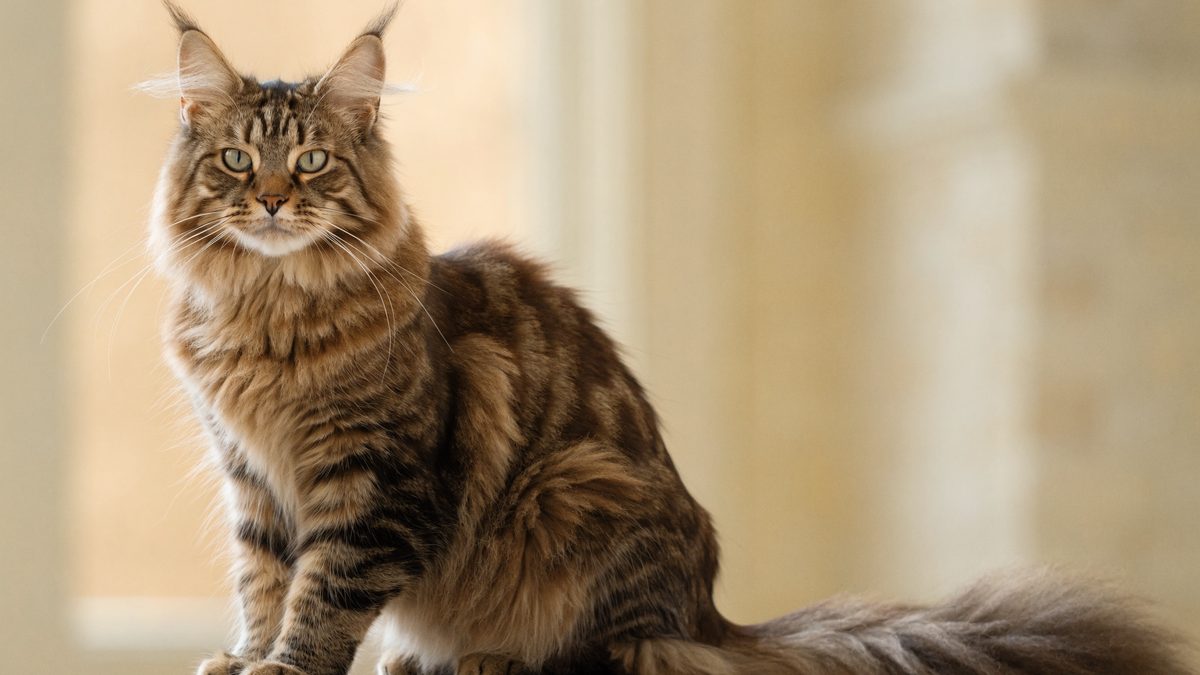
The head is medium in width and slightly longer in length than width, with a squareness to the muzzle and high cheekbones. The muzzle and chin are visibly square, medium in length and blunt ended in profile. The ears are large, well-tufted, wide at the base and tapering to appear pointed, set approximately one ear's width apart and not flared. Those tufted ears are the feature Indian listings photograph most and describe least accurately.
The body should be muscular and broad-chested, medium to large in size, long, with all parts in proportion to create a well-balanced rectangular appearance and no part of the anatomy so exaggerated as to foster weakness. Females are generally smaller than males. The tail is long, wide at base and tapering, with long flowing fur, and the coat is heavy and shaggy, shorter on the shoulders and longer on the stomach and britches, with a frontal ruff desirable and a silky texture that falls smoothly. A coat that is short or overall even is penalised.
| Attribute | What the record shows | Source |
|---|---|---|
| Origin | United States, one of the oldest natural breeds in North America | CFA standard |
| Body type | Muscular, broad-chested, long, well-balanced rectangular, size medium to large | CFA standard |
| Head | Medium width, slightly longer than wide, visibly square blunt muzzle | CFA standard |
| Ears | Large, well-tufted, wide at base, tapering to appear pointed | CFA standard |
| Coat | Heavy and shaggy, shorter on shoulders, longer on stomach and britches, frontal ruff desirable | CFA standard |
| Eye colour | Green, gold, green-gold or copper; white cats may have blue or odd eyes | CFA standard |
| Allowable outcross breeds | None | CFA standard |
| CFA Championship status | Granted 1976 | CFA |
| Life expectancy at age 0 | 9.71 years (95% CI 8.42 to 11.00), from 69 deaths | UK primary care |
| Temperament | Sociable, loyal, intelligent, fond of water, chirps and trills | CFA |
How big is a Maine Coon, really
Published weight figures for the Maine Coon vary by source and none of them comes from a study. Indian sellers quote males at 6 to 9 kg and females at 4.5 to 6.5 kg, males at 7 to 10 kg and females at 4 to 6 kg, a flat 5 to 11 kg range with a length up to 100 cm, 5 to 10 kg or more, and males at 7 to 9 kg growing up to 1 metre in length including the tail. One of the top-ranking Indian price pages publishes no numeric size or weight figure at all, despite the whole article being about a large cat.
The one figure with a real sample behind it is not a breed figure. A Danish study that weighed 332 Maine Coons reported a median weight of 6.0 kg for 118 males, with a 95 percent range of 4.0 to 8.8 kg, and 4.4 kg for 214 queens, with a 95 percent range of 3.4 to 6.0 kg. That is a real distribution, measured on a real cohort, and it sits at the low end of what Indian listings promise. A median Maine Coon male is a 6 kg cat, not a 10 kg cat.
Indian sellers price this breed on size. One lists Show Quality and Large Frame kittens at Rs 85,000 to Rs 1,75,000 against Rs 35,000 to Rs 45,000 for Indian Standard Pet Quality, and another notes that large male Maine Coons are often more expensive because they are preferred by most buyers. A study of 5,038 pedigree-registered Maine Coons found that hip dysplasia severity is genetically correlated with body mass at 0.285, and concluded that selection for a large body type in this breed concurrently selects for hip dysplasia. The same paper cautions against breed standards that actively encourage large bodied cats. The premium buys the problem. That is the single most important sentence on this page.
What Indian sellers mean by Indian Standard Maine Coon
You will meet the phrase Indian Standard Maine Coon within about two minutes of searching. It is not a registry term. No cat registry recognises an Indian standard for this or any breed, and the CFA standard permits no outcross breeds at all. It is a market category, and it is priced as one. MyKitten splits the breed into Indian Standard Maine Coon at Rs 30,000 to Rs 40,000 and Import line Maine Coon Kitten at Rs 1,25,000 to Rs 3,50,000, a gap of more than Rs 3,00,000. Mr n Mrs Pet lists Indian Standard Maine Coon in its breed dropdown as a separate selectable breed from Maine Coon.
Be clear about what you are being sold. One Indian platform states directly that cat breeding in India is unregulated, that there is no equivalent of the Kennel Club of India for cats, and that many Maine Coons listed cheaply online are domestic longhair cats misrepresented as purebreds. Another warns that some sellers may advertise mixed long-haired cats as purebred Maine Coons. A third names four registries a buyer might use, and describes one of them, the Feline Club of India, as India's largest and most trusted cat registry. Bonbeno could not independently verify that claim, and we are not going to repeat it as fact. What we can tell you is that FCI is an acronym shared by more than one organisation, so a seller who says FCI registered should be asked which body issued the document and should be able to hand you the pedigree itself.
The Maine Coon is not a common cat in India. Supply is genuinely limited, waiting lists of two to four months are described as normal for the better breeders, and most genuine breeders are said to operate in Bangalore, Mumbai, Delhi and Pune. Thin supply plus no registry coverage plus a buyer who cannot tell a Maine Coon from a domestic longhair is exactly the market condition that produces a Rs 5,75,000 price spread.
Maine Coon price in India
A Maine Coon costs Rs 25,000 to Rs 6,00,000 or more in India in 2026 depending on which published source you read, and the sources disagree by more than Rs 5,75,000 at the extremes. Even on pet quality alone, the quoted floor moves from Rs 25,000 to Rs 1,20,000 for what is described as the same animal. No single quoted figure is reliable on its own.
Bonbeno compared the price bands published by eight Indian sources currently visible for this query. They do not agree with each other, several do not agree with themselves across their own tables, and the gap is far wider than for any other cat breed we have documented.
| Source | Pet or standard quality | Show quality or large frame | Import, FCI or champion bloodline |
|---|---|---|---|
| Asia Pets | Rs 25,000 to Rs 60,000 overall | Not split | Not split |
| MyKitten | Indian Standard Rs 30,000 to Rs 40,000 | Not split | Import line Rs 1,25,000 to Rs 3,50,000 |
| Fluffyn | Verified breeder Rs 30,000 to Rs 70,000 | Not split | Not split |
| Wrapinfur | Rs 35,000 to Rs 60,000 | Rs 70,000 to Rs 1,20,000+ | Imported bloodline Rs 90,000 to Rs 2,00,000+ |
| GoodPaws | Indian Standard Rs 35,000 to Rs 45,000 | Rs 85,000 to Rs 1,75,000 | FCI registered or import Rs 1,50,000 to Rs 2,90,000 |
| Supertails | Rs 40,000 to Rs 1,00,000 overall | Not split | Not split |
| PetIndiaOnline | Rs 40,000 to Rs 80,000 | Rs 80,000 to Rs 1,50,000+ | Imported Rs 1,50,000 to Rs 3,00,000+ |
| Mr n Mrs Pet | Basic Rs 1,20,000 to Rs 2,00,000 | Not split | FCI Rs 2,00,000 to Rs 4,00,000, champion Rs 4,00,000 to Rs 6,00,000+ |
Read the table across rather than down. The pet-quality floor moves from Rs 25,000 to Rs 1,20,000 depending purely on who is publishing, which is a 4.8x difference for the same described animal. The ceiling moves from Rs 60,000 to Rs 6,00,000 and above, a 10x difference. One page even prices a Maine Coon Mix at Rs 15,000 to Rs 35,000 and adoption or rescue at Rs 2,000 to Rs 10,000, which puts the full published range at Rs 2,000 to Rs 6,00,000 across every category anyone publishes. Four things drive that spread.
- Import bloodline. Every source that splits by lineage charges several times more for imported stock. The gap between Indian Standard and import line runs Rs 95,000 to Rs 3,10,000 at one seller and Rs 1,15,000 to Rs 2,45,000 at another. Europe, and specifically Germany, Finland and Russia, is named as the most sought-after origin.
- Size. Show Quality and Large Frame is priced as one category at Rs 85,000 to Rs 1,75,000, and large males are described as costing more because most buyers prefer them. The breed standard says quality should never be sacrificed for size.
- Paperwork. FCI registered kittens are quoted at Rs 2,00,000 to Rs 4,00,000 against Rs 1,20,000 to Rs 2,00,000 for basic quality at the same seller. Health screening is also priced in, with one platform stating that HCM-tested parents command a significant premium.
- Who is publishing. Sellers and marketplaces publish the highest ceilings. Editorial and app-listing pages publish lower and narrower bands. Both types appear in the table above and you can see which is which from the price column alone.
The city-wise price tables contradict each other outright
Three ranking pages publish a city-wise Maine Coon price table, and for the same city in the same year they disagree by an order of magnitude. This is worth seeing side by side, because a buyer who reads only one of them will anchor to a number that another page treats as absurd.
| City | Fluffyn, verified breeder | Wrapinfur | Mr n Mrs Pet |
|---|---|---|---|
| Mumbai | Rs 45,000 to Rs 70,000 | Rs 60,000 to Rs 1,50,000 | Rs 1,20,000 to Rs 5,50,000 |
| Delhi | Rs 30,000 to Rs 60,000 | Rs 50,000 to Rs 1,20,000 | Rs 1,20,000 to Rs 5,00,000 |
| Bangalore | Rs 40,000 to Rs 65,000 | Rs 45,000 to Rs 1,00,000 | Rs 1,20,000 to Rs 6,00,000 |
| Hyderabad | Rs 30,000 to Rs 55,000 | Rs 40,000 to Rs 90,000 | Rs 1,20,000 to Rs 5,50,000 |
| Chennai | Rs 35,000 to Rs 60,000 | Rs 40,000 to Rs 85,000 | Rs 1,20,000 to Rs 5,80,000 |
| Pune | Rs 32,000 to Rs 58,000 | Rs 45,000 to Rs 95,000 | Rs 1,20,000 to Rs 5,30,000 |
| Kolkata | Not listed | Rs 35,000 to Rs 80,000 | Not listed |
| Lucknow | Not listed | Rs 35,000 to Rs 70,000 | Rs 1,20,000 to Rs 5,20,000 |
For Bangalore, one page's ceiling is Rs 65,000 and another's is Rs 6,00,000. None of the three states a sample size, a collection method or a date on which the prices were gathered. Bonbeno is publishing all three rather than averaging them, because an average of three unsourced tables is a fake number with three times the false confidence.
The cheap end, and what it actually is
Google's own autocomplete for this query in India returns maine coon price in india olx, which tells you where a large part of the demand is looking. One ranking page publishes an unverified-source column running Rs 8,000 to Rs 25,000 across six cities, against Rs 30,000 to Rs 70,000 from verified breeders, and states directly that many Maine Coons listed cheaply online are misidentified domestic longhair cats. A Maine Coon Mix is separately priced at Rs 15,000 to Rs 35,000.
A long-haired kitten with big ears is not evidence of anything. One Indian seller lists the physical features to check as a long bushy tail, tufted ears and paws, a rectangular body shape and a large sturdy structure, and says that a kitten not showing early signs of these traits may not be a genuine Maine Coon. That is reasonable advice and it is still not proof. The only documents that mean anything are a pedigree from a named registry, a parental HCM echocardiography result, and a hip radiograph score. Ask for all three by name before any money moves, and treat a seller who has never heard of the third one as answering the question.
Bonbeno does not broker kitten sales and does not publish breeder listings. The figures above are reported from third-party sources so buyers can see the disagreement themselves rather than trusting whichever page they happened to land on first.
Monthly cost of owning a Maine Coon in India
Published Indian estimates for the monthly cost of a Maine Coon run from Rs 3,000 to more than Rs 20,000, which is a sevenfold disagreement about a recurring bill. Only one of the five sources costs the thing that actually matters in an Indian summer, which is the electricity to keep a room cool.
Five Indian sources publish a monthly figure for this breed or for cats generally. None states a sample size or a collection method. Bonbeno is publishing all of them rather than averaging them into a false precision.
| Line item | Fluffyn | Wrapinfur | PetIndiaOnline |
|---|---|---|---|
| Food | Rs 3,000 to Rs 6,000 | Rs 2,500 to Rs 5,000 | Rs 3,000 to Rs 6,000 |
| Grooming | Rs 800 to Rs 2,000 | Rs 1,000 to Rs 3,000 | Rs 2,000 to Rs 5,000 |
| Veterinary care | Rs 1,000 to Rs 2,500 | Rs 500 to Rs 2,000 | Rs 2,000 to Rs 5,000 |
| Litter and hygiene | Not itemised | Rs 800 to Rs 1,500 | Not itemised |
| Toys and accessories | Not itemised | Rs 500 to Rs 2,000 | Not itemised |
| Cooling, meaning electricity | Not costed | Not costed | Rs 2,000 to Rs 5,000 |
| Stated monthly total | Rs 5,000 to Rs 10,000 | Rs 5,000 to Rs 12,000 | Rs 9,000 to Rs 20,000+ |
Two more sources publish figures without a Maine Coon-specific breakdown. Mr n Mrs Pet puts maintenance at Rs 3,000 to Rs 8,000 a month, and Supertails puts the monthly cost of owning a cat in India generally at Rs 2,000 to Rs 8,000. So the published range for the same cat, in the same country, in the same year, is Rs 3,000 to Rs 20,000 and above.
Wrapinfur states a monthly total of Rs 5,000 to Rs 12,000, but its own itemised table lists premium food at Rs 2,500 to Rs 5,000, grooming at Rs 1,000 to Rs 3,000, litter and hygiene at Rs 800 to Rs 1,500, vet care at Rs 500 to Rs 2,000 and toys and accessories at Rs 500 to Rs 2,000. Those line items sum to Rs 5,300 to Rs 13,500. The headline number is lower than the page's own arithmetic at both ends. We are not accusing anyone of anything. We are pointing out that if a published total does not match the published table above it, the total was not calculated from the table.
The four Maine Coon lines nobody budgets for
- Cooling, meaning electricity. PetIndiaOnline is the only source that costs it, at Rs 2,000 to Rs 5,000 a month, and it is the single largest difference between that page's total and everyone else's. Air conditioning from March through October is described as essential for this breed in Mumbai, Chennai and Hyderabad. In a May when Banda recorded 47.6 C and Delhi Safdarjung recorded 43.6 C, that is not a comfort line, it is a keeping-the-cat-alive line.
- Cardiac screening. Hypertrophic cardiomyopathy is diagnosed by echocardiography, which is described as the gold standard for the diagnosis. Annual vet check-ups covering cardiac health from age three onwards are the published recommendation for this breed. An echocardiogram is not a routine consultation fee in any Indian metro, and none of the monthly tables above includes one.
- Food, because the cat is large. A median Maine Coon male weighs 6.0 kg against a median queen at 4.4 kg, and Indian sources are consistent that the breed simply eats more than an average cat because of its size Fluffyn, Maine Coon Cat Price in India…. Food is the largest recurring line in every table above.
- Vertical furniture. A tall cat tree is described as not optional for a Maine Coon but as furniture, and a large cat needs a large one. This is a one-time cost that Indian tables tend to bury in toys and accessories at Rs 500 to Rs 2,000 a month.
What the purchase price does not buy
Set the running cost against the lifespan honestly. UK primary-care data puts Maine Coon life expectancy at age 0 at 9.71 years. Take the middle of the published monthly range, roughly Rs 8,000, and a ten-year Maine Coon costs about Rs 9,60,000 to keep before you have bought the cat and before any cardiac or orthopaedic work. The purchase price is not the expensive part.
When we publish cost figures we state the sample size, the cities covered and the collection date. Where we cannot verify a number we say so rather than repeating an unsourced estimate. Every monthly total above is somebody else's figure, reproduced so you can see how far apart they sit and decide for yourself which one describes your household.
Can a Maine Coon handle the Indian climate
Rate Maine Coon heat tolerance at the bottom of the scale for Indian conditions, and understand exactly why we are rating it there. No published study measures heat stress in this breed, in India or anywhere. What is documented is the coat, the origin and the body mass, and none of those three points anywhere except at a cold-climate cat.
Start with what is verified. The CFA standard describes a heavy, shaggy coat, shorter on the shoulders and longer on the stomach and britches, with a frontal ruff desirable, and describes the breed as originally a working cat that is solid, rugged and able to endure a harsh climate. The breed comes from Maine, in the north-eastern United States. Indian sources describe the coat as long, thick and water-resistant with a thick undercoat, heavier around the chest ruff, belly and tail, with tufted paws that help the cat adapt to colder climates.
That is a double coat built as insulation, and insulation works in both directions. The commercial Indian pages agree on the conclusion even when they disagree on everything else. One states that Maine Coons have thick double coats built for cold climates and that India's peak summer is challenging for them, with air conditioning from March through October essential in Mumbai, Chennai and Hyderabad. Another lists prone to overheating and sensitive to humidity as breed characteristics, names heatstroke, dehydration and skin infections as the risks, and states that climate control is a must in hotter cities like Kolkata, Mumbai or Chennai. A third says the breed may struggle in extreme summer heat without proper ventilation and hydration.
Bonbeno searched for a study measuring thermoregulation, heat tolerance or heat-stress incidence in Maine Coons and found none. The claim that the breed's genome is adapted to very cold environments comes from a commercial Indian pet retailer, not from a paper. We are reporting the coat, which is documented in the breed standard, and the Indian temperatures, which are documented by the India Meteorological Department, and we are drawing the obvious inference. We are not going to invent a percentage for it. Any Indian page that quotes you a precise heat-tolerance figure for this breed has made it up.
The temperatures a Maine Coon has to live through in India
The numbers are not marginal. On 21 May 2026 the highest temperature recorded anywhere in India was 47.6 C at Banda in Uttar Pradesh, and across northwest, west, central and north peninsular India maximum temperatures ranged between 40 and 47 C. Delhi's Safdarjung recorded a maximum of 43.6 C and the warmest night in 14 years, with many other parts of the city almost touching 45 degrees. The India Meteorological Department issued severe heat wave warnings for coastal Andhra Pradesh, East Madhya Pradesh, Haryana-Chandigarh-Delhi, Uttar Pradesh and Vidarbha, and warm-night warnings for Delhi, Haryana, Uttar Pradesh and Vidarbha.
The warm-night part matters more than the daytime peak for a cat in a flat. A heatwave day with a cool night gives a heavily coated animal a recovery window. A warm night, defined by the IMD as a minimum at least 4.5 to 6.4 C above the seasonal normal, removes it. That is the specific condition under which an unventilated Indian bedroom stays uncomfortable for a long-haired cat for 24 hours at a stretch.
| Condition | Where and when | What it means for this breed |
|---|---|---|
| Dry extreme heat | Delhi, Rajasthan, UP, MP, March to June | A heavy insulating double coat on a 6 kg cat. A cooled room is required, not optional. |
| Warm nights | Delhi, Haryana, UP, Vidarbha, May onward | No overnight recovery window. This is when the cooling bill stops being a daytime cost. |
| Humid heat | Mumbai, Chennai, Kolkata, Kerala coast | Evaporative cooling works worse in humid air, and Indian sources flag the breed as sensitive to humidity. |
| Monsoon humidity | Most of India, June to September | A semi-long coat holds moisture at skin level. Poor grooming in this window is named as a skin-infection route. |
| Milder plateau climate | Bangalore, Pune | Described as the most comfortable setting for a Maine Coon in India. |
| Hill cold | Himachal, Uttarakhand, Northeast winter | The one Indian climate this coat was actually built for. Not a problem. |
Why the weight matters in the heat too
There is a second reason to keep this cat lean through an Indian summer. Lifespan decreased by 0.02 years for each 100 g of adult body weight away from the mean, and non-ideal body weight was significantly linked to a shorter lifespan. Hip dysplasia severity also rises with body mass. A heavy long-haired cat in a 40 C room carries three problems at once, and only one is the temperature.
What actually reduces the risk
- Keep the cat in a genuinely cooled room through the hot months. Air conditioning from March through October is the published Indian recommendation for this breed in the hotter metros, and cooling systems in summer are listed as a special requirement.
- Keep it as an indoor cat. An indoor, temperature-controlled environment with limited exposure to heat and constant hydration is the stated requirement, and outdoor living is listed as unsuitable. One Indian seller adds that all animals need to be kept cool and hydrated through the summer months and kept indoors or in shade to avoid heat stroke and sunburn.
- Comb the coat so air can reach the skin. Regular grooming to manage the coat is named as helping significantly during Indian summers, and a packed undercoat against skin is the opposite of ventilation.
- Put water in more than one place. Constant hydration is named as a requirement for this breed in Indian conditions, and a cat fond of water is easier to persuade to drink than most.
- Weigh the cat monthly and keep it lean. Non-ideal body weight shortened lifespan measurably in the UK cohort, and heat is one more reason not to let a large cat get larger.
- Move play to the cooled room. A play session with an active breed in a 38 C living room is a heat-stress event rather than enrichment.
If you live in Delhi, Chennai, Mumbai, Hyderabad, Kolkata or anywhere in the Gangetic plain, and you cannot commit to a cooled room from March to October, do not buy this breed. That is not a lifestyle preference and it is not a comfort upgrade. It is the deciding factor, and it is the one Indian sellers mention last, in a bullet, after the price table.
Maine Coon temperament and household fit
The Maine Coon temperament is the part of the breed that lives up to its marketing. The Cat Fanciers' Association describes Maine Coons as sociable, loyal and, like many breeds that were formerly working cats, quite intelligent, enjoying interacting with every family member and tending to go from one lap to another rather than choosing a favourite.
This is the one section where Indian pages and the breed registry agree, and where the marketing is close to true. The CFA notes that Maine Coons get along well with children and other animals, though both could initially be intimidated by the cat's large size, because Maine Coons are larger than many small dogs. Daily conversation may include chirps, trills and purrs as well as an occasional meow. Fond of water, many will watch a dripping faucet in fascination, wash food or toys, or even try to join you in the shower.
The gentle giant label attached to this breed by every Indian listing is therefore not empty. What the listings get wrong is the implication that a placid label means a low-demand cat. The CFA describes the breed as fairly independent, needing a moderate amount of human interaction and insisting upon it when you are available, and warns that those who work at home may need to shut a door to maintain concentration. That is a specific and useful warning, and no Indian page carries it.
The dog-like claim, examined
Every Indian page calls this a dog-like cat. The behaviours behind the claim are real and are described consistently. Maine Coons are reported to play fetch, walk on a leash, greet visitors at the door and follow their owner from room to room, and to respond to their names reliably Fluffyn, Maine Coon Cat Price in India…. They chirp, trill and vocalise distinctively, and are described as unusually good with dogs and patient with children. The CFA supports the underlying intelligence claim directly, noting that just as their ancestors figured out where mice were hiding, today's Maine Coons can deduce exactly where you have hidden a preferred toy and unearth it to continue a game.
Read the flip side of that. Indian sellers state that Maine Coons do not do well with long periods of isolation and benefit from a companion cat or an owner who is home frequently, and that they are never passive background animals. One Indian marketplace simultaneously markets the breed as having a Low Maintenance Personality that does not demand constant attention. Those positions cannot both be right, and the registry's description of a cat that insists on interaction sides against the second.
Who should buy one
- Good fit. Households in Bangalore or Pune, or any home with reliable cooling, that want an interactive cat and have space for vertical furniture.
- Good fit. Families with children or an existing friendly dog. This is the breed's genuine strength and it is well documented.
- Good fit. Owners who want to train a cat. Leash walking, fetch and recall are realistic here in a way they are not with most breeds.
- Poor fit. Homes with no reliable cooling in a 45 C city. This is the deciding factor, not a preference.
- Poor fit. Households that are empty twelve hours a day with no second animal, given the breed's stated intolerance of long isolation.
- Poor fit. Buyers choosing on size and appearance who have not budgeted for cardiac and orthopaedic screening. Read the health section before you read another price table.
Cats are very good at not showing pain and can suffer from hip dysplasia without limping at all, moving more carefully or less than cats normally do and avoiding jumping instead. Meanwhile, many cats with hypertrophic cardiomyopathy do not appear to be ill at all. So an active, engaged breed that becomes noticeably less active is telling you something. If your Maine Coon has stopped jumping onto the surfaces it used to reach, that is a veterinary appointment, not a personality change.
Litter training, handling and enrichment for a Maine Coon
To train a Maine Coon, start with the litter box, then build handling tolerance, then add carrier and harness work, in that order. This breed rewards training more than almost any other cat, and the reason to bother is medical rather than recreational. A cat that will be echocardiogrammed, radiographed and combed for the next decade should learn early that being handled is safe.
Litter training
Litter training a Maine Coon is usually a matter of setting up correctly rather than teaching anything. Cats are innately fastidious and may be naturally attracted to sand-type substrates for elimination, with elimination tending to occur away from primary resting locations. Some practitioners believe kittens are most accepting of the litter they observed their queen using, which may influence future preferences, so offering a young kitten a variety of toileting substrates may help it become an adult with greater acceptance of an array of litter types.
Two practical adjustments matter for this breed specifically. Buy a bigger litter box than the shop suggests, because a cat with a median male weight of 6.0 kg and a 95 percent range up to 8.8 kg does not fit a standard kitten tray at maturity. And keep the britches and the rear trimmed, because a semi-long coat that picks up litter creates a tray the cat starts avoiding. Indian sellers confirm the breed arrives litter trained from the better catteries, which means what you inherit is a habit to preserve rather than a skill to teach.
Handling training is the one that pays
Teach a Maine Coon kitten to accept combing, mouth handling, paw handling and chest contact in the first weeks home. The sensitive socialisation period for new experiences, people and other animals begins as early as 2 to 3 weeks and may be closing by 9 to 10 weeks, though this period is fluid and what is truly important is the quality of the experience. Ideally kittens should have pleasant interactions with people for 30 to 60 minutes per day, and should be gently, gradually and positively acclimated to any stimuli or procedures they may encounter during their lifetime, including nail trims, grooming, medicating, car transport and the veterinary practice.
Gentle, respectful handling prepares the kitten for a lifetime of positive handling, and a kitten that is startled or subjected to rough handling may develop fears that last a lifetime. Cats can be taught to voluntarily accept grooming, nail trimming, instillation of ear treatments, application of topical antiparasitics and administration of medications both orally and subcutaneously. In a breed where you may one day be medicating for a heart condition daily, that last item is not a party trick.
| Skill | Start | Why it matters in this breed |
|---|---|---|
| Full-body combing to the skin | Week 1 home | A semi-long coat mats at the ruff, undercarriage and tail |
| Chest and sternum handling | Week 1 home | Echocardiography is the gold standard for HCM diagnosis and this cat will have chest scans |
| Paw and nail handling | Week 2 home | Tufted paws need checking, and nail trims are a listed acclimation target |
| Carrier entry | Week 2 home | Teaching a cat to come when called can be used in carrier training |
| Pilling and oral medication | Month 2 | Kittens may be taught to accept pilling by giving a tasty morsel instead of a pill |
| Lying still on one side | Month 3 | Hip radiography needs a ventrodorsal position, and a calm cat needs less sedation |
| Harness and leash | Month 4 | Realistic in this breed and a genuine enrichment route |
Enrichment, which is not optional here
Kittens have a high play drive, and intercat social play peaks at around 12 weeks of age before object play takes over. Never use your hands or feet as toys, because cats learn that this is acceptable play and it leads to scratching or biting injuries. With a cat this size, learn that in week one.
Scratching surfaces should be provided as soon as a cat enters the home. Cats scratched their preferred substrate more often when the post was a simple upright type or a cat tree with two or more levels and at least 3 ft high. For a Maine Coon, treat 3 ft as a floor rather than a target.
The initial veterinary examination visit is an ideal opportunity to create a positive experience and set the stage for a lifetime of regular veterinary care, and kittens should be allowed to explore and interact with practice team members. Ask your Indian clinic for a five-minute weigh-and-treat visit with no procedure at all, twice in the first month. It costs almost nothing and it is the difference between a cooperative echocardiogram at age three and a sedated one.
How much exercise a Maine Coon actually needs
A Maine Coon needs two or three genuine play sessions a day plus permanent access to vertical space, and the goal is weight control as much as entertainment. This is an active, interactive breed, and the consequences of under-exercising it land on the joints and the lifespan rather than on the furniture.
The breed is described as active and playful, needing more space and mental stimulation than calmer breeds, and adapting to apartment living only with tall cat trees and daily interactive play. Maine Coons need vertical space, with a tall cat tree described as furniture rather than an accessory. Indian sources list interactive toys, climbing structures and play sessions as the daily requirement, naming obesity prevention as the reason.
Why weight control is the real goal
Two independent datasets make the same point from different directions. The UK life-table study found that non-ideal body weight was significantly linked to a decreased lifespan, with lifespan decreasing by 0.02 years for each 100 g of increase or decrease in adult body weight away from the mean. The Swedish hip-screening study found that body mass and age were both related to the severity of hip dysplasia expression, with heavier and older cats having higher than average hip scores compared to lighter or younger cats. A fat Maine Coon is a shorter-lived Maine Coon with worse hips.
- Two or three sessions of ten to fifteen minutes. Wand toys, chase and fetch. This breed will actually retrieve.
- One tall cat tree, minimum. At least 3 ft is the studied minimum for scratching preference, and a Maine Coon wants more height than that.
- Food puzzles instead of a bowl. They deliver activity without loading the hips and slow eating down at the same time.
- Harness walks, if the cat takes to them. Leash walking is realistic in this breed. Do it at dawn or after dark in an Indian summer, never in the afternoon.
- Play in the cooled room from March to October. Air conditioning through those months is the stated Indian requirement for this breed.
- Watch the landings, not the jumps. Cats with hip dysplasia may avoid jumping rather than limp, so a cat that starts taking the sofa in two steps instead of one has told you something.
Hypertrophic cardiomyopathy is the most common heart disease of cats, and many cats with it do not appear to be ill, while others show signs of congestive heart failure including laboured or rapid breathing, open-mouthed breathing and lethargy. A serious and potentially life-threatening consequence is the formation of blood clots in the heart, which most commonly obstruct blood flow to the hind limbs, causing acute hind limb pain or in extreme cases hind limb paralysis. Sudden collapse of the back end in a Maine Coon is an emergency, not a slipped jump. Go to a clinic immediately.
Grooming a Maine Coon coat in Indian humidity
Groom a Maine Coon two or three times a week as the baseline and daily through the monsoon, using a comb that reaches the skin. This is a semi-long coat rather than a Persian coat, so the load is real but not punishing, and the failure mode in India is humidity rather than length.
The published Indian guidance converges on the same number. Brushing two to three times per week prevents matting, particularly around the ruff, undercarriage and tail, with bathing every six to eight weeks. Another source gives brushing 2 to 3 times per week with particular attention to the neck ruff and belly, plus professional grooming every six to eight weeks at Rs 800 to Rs 2,000. A third specifies brushing 3 to 5 times a week to prevent tangles and matting, bathing once every 4 to 6 weeks, plus nail trimming, ear cleaning and dental care. Supertails puts the time cost at 15 to 20 minutes several times a week.
The breed is genuinely easier than a Persian here. Maine Coons are described as somewhat self-maintaining compared to Persians but as benefiting greatly from regular brushing sessions, with a coat less prone to matting than a Persian's. That is a meaningful difference for an Indian household deciding between the two long-haired breeds, and it is one of the few genuine advantages this breed has on the maintenance side.
Shedding, and what Indian owners actually experience
Shedding is the complaint that arrives first. Indian sources describe moderate to heavy shedding that increases seasonally GoodPaws, Maine Coon Kittens for Sale…, and one states plainly that Maine Coons are heavy shedders because of their thick double coat, with regular brushing reducing loose fur and preventing matting. Managing seasonal shedding by grooming is described as critical in Indian conditions.
What actually goes wrong in an Indian monsoon
The cascade runs faster in Indian humidity than in the temperate climates most breed advice is written for, and it ends in a vet bill rather than a bad haircut.
- Days one to four. Loose undercoat starts knitting at the friction points, which in this breed are the frontal ruff, the armpits, the britches and the base of the tail. Nothing is visible from the top of the coat.
- Week one. Mats form and tighten at the ruff and undercarriage, the two places every Indian grooming guide names first.
- Week two. The mat traps moisture at skin level in a monsoon that runs June to September. Poor grooming is explicitly named as producing skin infections in this breed.
- Week three onward. The cat over-grooms the irritated area and swallows more hair, which is why hairball-related digestive problems appear on the breed's Indian health list.
- The endpoint. A de-matting session or a clip, costing more than the routine groom it replaced, against a professional groom quoted at Rs 800 to Rs 2,000 or Rs 2,000 to Rs 5,000 a month.
| Task | Frequency | Note |
|---|---|---|
| Comb through to the skin | 2 to 3 times a week, daily in monsoon | Ruff, undercarriage and tail first |
| Check the britches and rear | Weekly | A semi-long rear coat picks up litter and puts the cat off the tray |
| Bath | Every 4 to 8 weeks | Indian sources give 4 to 6 weeks and 6 to 8 weeks |
| Dry the undercoat fully | Every bath | A damp undercoat in humid weather is the main matting driver |
| Ear cleaning | Weekly | Large ear furnishings need checking and are listed as a hygiene task Fluffyn, Maine Coon Cat Price in India… |
| Nail trim | Every 2 to 4 weeks | Listed Indian hygiene task and an AAHA acclimation target |
| Dental care | Ongoing | Maine Coons are described as prone to periodontal disease PetIndiaOnline, Maine Coon Cat in India |
| Professional groom | Every 6 to 8 weeks if used | Rs 800 to Rs 2,000 per session |
Mr n Mrs Pet states that Maine Coon Cats have dense, curly coats that need trimming every 4 to 6 weeks to prevent matting. The CFA standard describes the coat as heavy and shaggy with a silky texture that falls smoothly, and penalises a coat that is short or overall even. A Maine Coon coat is not curly and does not require routine trimming. Treat a seller who describes the breed's basic coat type incorrectly as having told you something useful about how well they know the breed.
Maine Coon health issues, screening and lifespan
The Maine Coon carries three inherited conditions with named, orderable tests, which is unusual and genuinely good news for a buyer who knows to ask. Those are hypertrophic cardiomyopathy linked to the MYBPC3 A31P variant, hip dysplasia, and LIX1-related spinal muscular atrophy. Read this section before you compare another price table, because the tests cost less than the price difference between two listings.
Lifespan, and the number Indian pages get wrong
Indian pages quote Maine Coon lifespan at 12 to 15 years MyKitten, Maine Coon Kittens For Sale… Mr n Mrs Pet, Maine Coon Cats For Sale…, or 13 to 17 years. The largest relevant primary-care dataset does not support that. A VetCompass life-table study of 7,936 cat deaths in the United Kingdom put Maine Coon life expectancy at age 0 at 9.71 years, with a 95 percent confidence interval of 8.42 to 11.00 years and a recorded lifespan range of 0.03 to 21.61 years across 69 deaths. Among the 12 breeds analysed, only Russian cats, British cats, Bengal and Sphynx sat lower.
| Breed | Life expectancy at age 0 | Number of deaths |
|---|---|---|
| Burmese | 14.42 years (12.91 to 15.93) | 45 |
| Birman | 14.39 years (12.87 to 15.91) | 38 |
| Crossbred | 11.89 years (11.75 to 12.03) | 7,117 |
| Siamese | 11.69 years (10.56 to 12.82) | 88 |
| Persian | 10.93 years (9.63 to 12.23) | 80 |
| Ragdoll | 10.31 years (8.86 to 11.76) | 69 |
| Norwegian Forest Cat | 9.95 years (7.55 to 12.35) | 15 |
| Maine Coon | 9.71 years (8.42 to 11.00) | 69 |
| Bengal | 8.51 years (7.12 to 9.90) | 73 |
| Sphynx | 6.68 years (4.53 to 8.83) | 18 |
The Maine Coon figure rests on 69 deaths, which is a small sample, and the confidence interval runs from 8.42 to 11.00 years. The true value could sit anywhere in that band. What the study cannot support is 15 years, and what it does support is that a Maine Coon is not a long-lived cat relative to a crossbred, which reached 11.89 years on 7,117 deaths. The same study found purebred cats had 1.83 times higher odds (95 percent CI 1.50 to 2.23) of dying before three years of age than crossbred cats, and that crossbred cats lived 1.27 years longer overall. If a seller quotes you 15 years, ask which study.
Hypertrophic cardiomyopathy, and the MYBPC3 test to demand by name
Hypertrophic cardiomyopathy is the most common heart disease of cats, and the Maine Coon is named first on Cornell's list of predisposed breeds. In a cat with HCM the left ventricle thickens, reducing chamber volume and impairing relaxation, which can cause the heart to beat rapidly, increase oxygen usage and possibly starve the heart muscle of oxygen, killing heart cells and leading to arrhythmias. Less efficient pumping can then back blood up into the lungs, contributing to congestive heart failure or clot formation in the heart.
Two figures set the scale. Hypertrophic cardiomyopathy affects roughly 1 in 7 cats overall, it is an adult-onset disease in most cases whose prevalence increases with age, and more than half of affected cats may show no clinical signs at all. Definitive diagnosis is a left ventricular diastolic wall thickness above 6 mm on echocardiography without a hemodynamic or metabolic explanation, and there is no cure.
In 1999 HCM was described in a family of American Maine Coon cats as an inherited disorder with evidence of autosomal dominant inheritance, and in 2005 a causative mutation was identified in the MYBPC3 gene in a Maine Coon colony, a guanine-to-cytosine transition in exon 3 that changes the conserved alanine at the 31st codon into a proline, giving the variant its name, A31P Meurs KM, Sanchez X, David RM, Bowles NE. This is the first identified naturally occurring causal mutation for HCM in any companion animal species. It has a commercial genetic test costing 47 US dollars on a cheek swab, and almost no Indian listing mentions it.
How common A31P is, and what carrying it actually means
A European study screened 3,757 cats from 11 countries and 17 breeds, including 2,744 Maine Coons, and found the mutation only in Maine Coons apart from a single British Longhair. Within the Maine Coons, 58.5 percent were wild-type (1,605 of 2,744), 38.0 percent were heterozygous (1,044 of 2,744) and 3.5 percent were homozygous for the mutation (95 of 2,744), giving a mutation prevalence of 41.5 percent. In a sub-group of 164 Maine Coons that also underwent echocardiography at a mean age of 2.6 years, 55 of 164 (34 percent) carried the mutation while only 12 of 164 (7 percent) showed HCM, and the mutation was associated with a significantly increased risk of HCM at a relative risk of 9.91.
A second, larger screen agrees. Of 3,310 samples submitted from 21 countries and at least 17 breeds, Maine Coons accounted for 100 percent of all positive samples, and 1,089 of 3,238 Maine Coons carried the mutation, a worldwide rate of 34 percent. Of those 1,089 positive cats, 988 (90.7 percent) were heterozygous and only 101 were homozygous, which is 3.1 percent of all Maine Coons submitted. Carrier rates by continent ran 31.7 percent in North America, 37.6 percent in Europe, 30.9 percent in Asia and 46.3 percent in Australia. The ACVIM consensus statement puts the breed prevalence at approximately 35 to 42 percent. A genotyping study of 11,036 domestic cats, in which the Maine Coon was the most-represented breed at 1,971 individuals, found the A31P variant present in the heterozygous state in some additional breeds, which is what you would expect wherever Maine Coon lines have been outcrossed.
The crucial nuance is that carrying one copy is not the same as carrying two. A Danish study echocardiographed and genotyped 332 Maine Coons, 282 of them under four years old, and found 18 homozygous, 89 heterozygous and 225 wild-type cats, with a mutant allele frequency of 0.19. The odds ratio of having HCM for homozygous cats was 21.6 (95 percent CI 7.0 to 66.2), while heterozygosity was not associated with a significant odds ratio. Fifty percent of the homozygous cats had HCM, against 2.4 percent of the heterozygous cats. The authors concluded that penetrance in heterozygous cats must be considered very low in young cats and high in young cats homozygous for the mutation, and proposed that the variant behaves more like a recessive form of inheritance in young Maine Coons.
A French screening study of 96 Maine Coons using echocardiography and tissue Doppler imaging found 52 wild-type, 38 heterozygous and 6 homozygous cats, and reported that only 11 percent of heterozygous cats (4 of 38) had left ventricular hypertrophy, while 29 percent of the heterozygous cats without hypertrophy were over four years old. Hypertrophy also appeared in 2 wild-type cats (4 percent). The authors concluded that heterozygous status is not consistently associated with hypertrophy or major myocardial dysfunction, and that wild-type cats developing it suggests other genetic causes are involved.
A purpose-bred research colony reached the same conclusion from the other end. Of 44 phenotyped cats, 21 of 22 homozygous cats were affected, against 9 of 15 heterozygotes and 2 of 7 wild-type cats. Homozygotes were more likely to develop HCM than heterozygotes, with odds ratios of 8.5 and 3.75 respectively, and the odds ratio for heterozygous status did not achieve statistical significance, while multiple logistic regression left the homozygous genotype significantly associated at an odds ratio of 11.8. Penetrance was age-dependent, occurring earlier and more severely in successive generations and especially in homozygotes.
| Population | Finding | Study |
|---|---|---|
| 2,744 European Maine Coons | 41.5% carried A31P; 38.0% heterozygous, 3.5% homozygous | Mary et al 2010 |
| 164 echocardiographed Maine Coons, mean age 2.6 years | 34% carried A31P, 7% had HCM; relative risk 9.91 | Mary et al 2010 |
| 332 Danish Maine Coons, 85% under 4 years | HCM prevalence 6.3%, allele frequency 0.19 | Godiksen et al 2011 |
| Homozygous cats in that cohort | 50% had HCM; odds ratio 21.6 (95% CI 7.0 to 66.2) | Godiksen et al 2011 |
| Heterozygous cats in that cohort | 2.4% had HCM; odds ratio not significant | Godiksen et al 2011 |
| 44 phenotyped colony cats | 21 of 22 homozygotes affected; odds ratio 11.8 on regression | Stern et al 2023 |
| Male Maine Coons in the Danish cohort | HCM prevalence 11.9%, plus 11.9% equivocal | Godiksen et al 2011 |
This is the part every seller leaves out. In the Danish cohort, 10 of the 21 Maine Coons diagnosed with HCM did not carry the A31P mutation at all, and homozygosity explained only 43 percent of the HCM cases in that cohort. Even in the purpose-bred colony, two of seven wild-type cats developed HCM, which the authors attributed to at least one gene modifier or a second causal variant. Cornell puts it plainly: new genetic tests may help identify whether your cat has an increased risk of HCM, but results should be interpreted carefully with veterinary guidance, since not all cats that have these mutations will develop the condition. Ask for the genetic test AND the parental echocardiogram. Neither one alone is enough.
What a diagnosis actually means for the cat
Genotype is a risk figure. Prognosis is a separate question, and one large study answers it. The REVEAL study followed 1,730 client-owned cats, of which 1,008 had preclinical HCM or its obstructive form, and found that congestive heart failure, arterial thromboembolism or both occurred in 30.5 percent, with cardiovascular death in 27.9 percent. Risk assessed at 1, 5 and 10 years after study entry was 7.0 percent, 19.9 percent and 23.9 percent for congestive heart failure, 3.5 percent, 9.7 percent and 11.3 percent for arterial thromboembolism, and 6.7 percent, 22.8 percent and 28.3 percent for cardiovascular death. Sudden death accounted for 22 of 281 cardiac deaths, a 2.2 percent prevalence in the 1,008 cats.
Read those numbers as reassurance and as warning together. A Maine Coon diagnosed with preclinical HCM is not a cat with a death sentence, since roughly seven in ten did not reach heart failure or a clot inside the study window. It is also not a healthy cat that can be ignored, because nearly three in ten did. Genotype shifts those odds a long way. Relative risk for HCM is about 1.8 in cats carrying one copy of A31P and about 18 in cats carrying two, so a homozygous cat is roughly 10 times more likely to develop HCM than a heterozygous one. Homozygous Maine Coons can reach moderate to severe cardiac disease and sudden death by four years of age or less, while heterozygous cats have a longer life expectancy but may still develop the disease Veterinary Genetics Laboratory.
Two more findings from the same summary matter to an Indian buyer choosing a kitten. Male cats may be about twice as likely to be affected as females, and heavier cats are more prone to develop HCM than lighter cats. That is the second independent line of evidence on this page pointing the same way. Body mass tracks worse hips, and body mass tracks worse hearts. The largest kitten in the litter is not the best buy.
One study reaches a materially different conclusion and it deserves printing rather than burying. In 83 Maine Coons and 68 cats of other breeds phenotyped by echocardiography, A31P was found in 18 of 83 Maine Coons (22 percent), and 15 of those 18 (83 percent) were healthy on echocardiographic examination at a mean age of 65 months. Of 12 Maine Coons with HCM, 9 (75 percent) were genotype-negative for A31P. The authors concluded that the value of currently available genetic tests was low in their cats, that the mutations appear to have a low penetrance, and that even homozygote cats can remain healthy. Set that against the ACVIM consensus, which recommends the test for breeding cats at a high level of evidence. Bonbeno's reading is that the test is worth demanding because it is cheap and it changes breeding decisions, and that no result from it should ever replace an echocardiogram.
The screening advice from the Danish group is specific and worth repeating. Diagnosis of HCM in Maine Coons should ideally be based on a positive family history and a thorough echocardiographic assessment of several imaging planes with follow-ups, and genetic testing is currently of limited utility on its own. They also recommend that producing homozygous Maine Coons should be avoided given the high probability of those cats developing HCM. In practice that means two carriers should not be bred together, which is a question you can ask a seller in one sentence.
Hip dysplasia, where the size premium collides with the genetics
Hip dysplasia is a hereditary defect in which the socket joint in the pelvis is not as deep as it should be, so the ball does not fit exactly, the surfaces rub, and the cartilage degenerates until the joint is bone against bone. The body cannot renew cartilage and responds by increasing bone production, which only makes it worse. Cats are very good at not showing pain and can suffer from hip dysplasia without limping at all, instead moving more carefully or less than normal and avoiding jumping.
Two large registries have measured how common it is in this breed, and they do not agree, so here are both. The Orthopedic Foundation for Animals registry through April 2015 contained 2,732 unique cats, of which 2,708 (99.1 percent) were Maine Coons. Among the 2,548 cats with non-borderline scores, hip dysplasia prevalence was 24.9 percent (635 of 2,548), slightly higher in males at 27.3 percent (279 of 1,023) than in females at 23.3 percent (356 of 1,525). The Swedish PawPeds programme, analysed across 5,038 pedigree-registered Maine Coons radiographed between 2000 and 2019, found 37.4 percent with some radiographic signs of hip dysplasia, with no sex difference.
| Population | Prevalence | Source |
|---|---|---|
| 2,548 Maine Coons, OFA registry | 24.9% | Loder and Todhunter 2017 |
| Maine Coon males in that registry | 27.3% | Loder and Todhunter 2017 |
| Maine Coon females in that registry | 23.3% | Loder and Todhunter 2017 |
| 2,988 Maine Coons, PawPeds registry, as cited in 2017 | 32.4% (969 of 2,988) | Loder and Todhunter 2017 |
| 5,038 Maine Coons, PawPeds Sweden 2000 to 2019 | 37.4% | Low et al 2019 |
| 899 domestic shorthairs, as cited in 2019 | 10.4% | Low et al 2019 |
| 684 cats, mostly domestic shorthairs, Missouri 1999 | 6.6% | Keller et al, cited by Loder |
| 293 cats, mostly domestic shorthairs, Vienna 1989 | 14.5% males, 22.4% females | Koppel and Ebner, cited by Loder |
Learn the signs, because they are behavioural rather than dramatic. Presentation is often gradual and includes subtle behavioural changes such as inactivity or aggression, lack of response to human attention, reluctance to go up and down stairs, and resistance to handling, with age of onset typically between 3 months and 3.5 years. On examination there may be muscle atrophy in the hindquarters, restricted hip motion, and crepitus or pain on joint manipulation in more severe cases. An Indian owner who reads a cat refusing the stairs as moodiness will miss this for years.
Neither registry figure is a clean population estimate, and the authors say so. OFA submission is voluntary, so owners or breeders with obviously dysplastic cats may never have submitted radiographs, and the paper states directly that the prevalence of 24.9 percent is likely a low estimate. Bilateral involvement was present in 56 percent of affected cats, bilateral cases were more severe than unilateral ones, and the youngest cat with hip dysplasia in the registry was four months old. Cats with more severe dysplasia were older. Prevalence did not differ by geographic region, month or season of birth.
This is the finding that should change how an Indian buyer reads a price list. In 5,038 pedigree Maine Coons, heritability of the radiographic categories used to classify hip dysplasia severity was 0.36 (95 percent CI 0.30 to 0.43), and the severity of symptoms was genetically correlated with body mass at 0.285, so individuals with a genetic predisposition to be larger than average also had higher than average hip scores because of genetic linkage between the traits. The authors concluded that selection for a large body type in this breed concurrently selects for hip dysplasia. The proof came from the other direction too. Eight generations of selective breeding against hip dysplasia dropped the predicted maximum hip score from 0.85 at generation 1 to 0.268 in females and 0.286 in males, and those cats were also smaller than their ancestors, by 33 g per generation. The paper explicitly cautions against breed standards that actively encourage large bodied cats. Every rupee of the Large Frame premium is buying the trait the genetics says to breed away from.
PawPeds grades each hip separately as normal (grade 0), grade 1 (acceptable hips, acetabulum covering slightly less than 50 percent of the femoral head, no deforming changes, considered within the normal functional range), grade 2 (moderate hip dysplasia) and grade 3 (severe hip dysplasia and/or deforming degenerative joint disease). The recommendation is that all breeding cats should be tested for hip dysplasia before being used in a breeding programme in order to minimise it in the breed, and the programme's own statistics show that parents with a normal hip status generally produce offspring with better results than parents whose hip status is unknown.
Spinal muscular atrophy, the third test nobody in India mentions
Spinal muscular atrophy in Maine Coons is characterised by progressive instability with unsteady gait and posture abnormalities, caused by loss of motor neurons in the lower spinal cord and atrophy of the hind limb muscles. Affected kittens first show signs at about three to four months of age. The condition is neither painful nor fatal, and affected cats can live a comfortable life indoors, but it is disabling. It is caused by a large deletion on chromosome 1 disrupting the LIX1 gene, described in 2006.
The clinical picture is well described. Signs appear between 13 and 17 weeks of age and include gait abnormalities and a muscle tremor primarily involving the hindquarters, with limb weakness progressive for several months. By five months of age muscle atrophy is evident in all limbs and affected cats show a characteristic gait of wide-placed forelimbs and a swaying pelvis. Disease progression slows around 4 to 8 months, and affected cats with varying severity have lived to at least eight years of age. The causative variant is an approximately 140 kb deletion on feline chromosome A1q removing exons 4 to 6 of LIX1 and all but exon 1 of LNPEP, in a region of conserved synteny to human chromosome 5q15 Online Mendelian Inheritance in Animals. LIX1 expression is largely restricted to the central nervous system, primarily in spinal motor neurons, which explains why the pathology is confined to those tissues.
The inheritance is autosomal recessive, so two copies are needed to produce disease and males and females are equally affected. The published control advice is unambiguous. Cats from at-risk breeds used for breeding should be tested for the causative mutation, affected cats should not be bred, and carriers should only be bred to cats demonstrated by testing to be non-carriers. Cats with the N/N genotype will not have it and cannot transmit it, cats with N/S will not have it but are carriers and will pass it to half their offspring, and matings between two carriers are predicted to produce 25 percent affected kittens. The UC Davis Veterinary Genetics Laboratory offers the test at 47 US dollars per animal on a cheek swab, with a turnaround of at least 15 business days.
One Indian seller does mention it, which is worth acknowledging. MyKitten states that SMA status is documented where applicable, alongside HCM screening with an echo schedule as advised by a licensed vet, hip evaluation for the large-breed parent pair, and PKD-negative parents. That is a materially better disclosure than anything else on this SERP. Bonbeno has not verified those claims and cannot, but the correct response as a buyer is to ask for the documents rather than to accept the sentence.
The three questions that separate a real breeder from a reseller
- Can I see both parents' MYBPC3 A31P genotype results? Homozygous cats had a 21.6 odds ratio for HCM and two carriers bred together can produce one. The ACVIM consensus statement recommends genetic testing for Maine Coon cats intended for breeding at a high level of evidence, says homozygous cats should not be used for breeding, and allows heterozygous cats to be bred only to genotype-negative cats. Ask specifically whether the sire and dam are both carriers.
- Can I see both parents' echocardiogram reports? Echocardiography is the gold standard for diagnosing HCM and genetic testing alone is of limited utility, partly because 10 of 21 affected cats in one cohort carried no mutation.
- Can I see both parents' hip scores? PawPeds recommends all breeding cats be radiographed before use in a programme, and prevalence estimates run 24.9 to 37.4 percent Low M, Eksell P, Hogstrom K, Olsson U. A seller charging a premium for a large frame who cannot produce hip scores is charging you for the risk factor and not testing for the risk.
The rest of the list, honestly bounded
Indian pages list hypertrophic cardiomyopathy, hip dysplasia, spinal muscular atrophy, obesity and hairball-related digestive problems as the common issues, or hypertrophic cardiomyopathy, hip dysplasia and obesity, or add periodontal disease. Bonbeno found no Indian dataset on Maine Coon disorder prevalence, no Indian registry publishing hip scores, and no published figure for how many Indian Maine Coon breeding cats are screened for anything. That absence is itself the most useful thing an Indian buyer can know. In a market with no registry coverage, the paperwork you personally demand is the only screening that happens.
Do not read this section as a reason to write the breed off. Read it as a reason to buy carefully. Eight generations of hip screening in the PawPeds programme cut the predicted maximum hip score by roughly two thirds, and the programme's statistics show parents with normal hips producing better offspring than parents of unknown status. The tests exist, they are cheap relative to an Indian Maine Coon's purchase price, and they work. A buyer who insists on them is not being difficult. They are the reason the numbers above are improving anywhere at all.
Feeding a Maine Coon in India
Feed a Maine Coon to hold it at a lean body condition, not to make it as large as the listing photograph. That single decision touches lifespan, hip scores and the food bill at the same time, and it is the opposite of what the Indian market rewards.
Start with the two numbers that should govern the bowl. Lifespan decreased by 0.02 years for each 100 g of increase or decrease in adult body weight away from the mean in a UK study of 7,936 cat deaths. And in 5,038 Maine Coons, heavier cats had higher than average hip scores. Feeding a Maine Coon up to an impressive weight is not generosity. It is a measurable cost paid by the cat's joints and by the number of years you get.
Body condition beats the number on the pack
Use body condition rather than a feeding chart, and weigh the cat monthly. The measured reference points are a median 6.0 kg for males with a 95 percent range of 4.0 to 8.8 kg, and a median 4.4 kg for queens with a 95 percent range of 3.4 to 6.0 kg, from 332 cats. A semi-long coat hides gain, so you have to feel for the ribs with your hands rather than judging by eye, and you have to do it on a schedule.
What Indian sources recommend, and what they cost
The published Indian guidance is consistent on structure and vague on quantity. A high-protein diet with balanced fats and vitamins is the stated requirement, with kittens on three to four meals a day and adults on two, using premium cat food or a vet-approved home diet, and with the note that a large cat eats more than a common house cat. Another source specifies high-protein premium kibble at Rs 3,000 to Rs 6,000 a month for an adult, recommends wet food supplementation for urinary health, and notes that males eat more than females given their larger size. A third lists chicken, fish and eggs alongside premium wet and dry food, and stresses that Maine Coons need proper nutrition to support their large size and slow growth.
- Split intake across two or three meals rather than free-feeding, because free-feeding is the simplest route to the weight this breed should not carry.
- Feed wet food as a meaningful share of intake. Wet food supplementation is recommended for urinary health in this breed by Indian sources, and a cat that is fond of water is unusually easy to hydrate.
- Use food puzzles for part of the ration. Puzzle feeders are named as part of the enrichment this breed needs and they slow eating without loading the hips.
- Buy a wide, shallow bowl at a comfortable height. A large cat with a long muzzle and a full frontal ruff does not want its ruff in a deep narrow dish.
- Budget food as the largest recurring line. Every Indian monthly table puts food first, at Rs 2,500 to Rs 6,000 Fluffyn, Maine Coon Cat Price in India… PetIndiaOnline, Maine Coon Cat in India.
- Weigh monthly and write it down. A trend of 100 g a month is invisible in a coat like this and is 1.2 kg a year.
Growth is slow, and that changes the first two years
Maine Coons are described as slow-maturing, developing more slowly than other breeds and requiring proper nutrition, space and early socialisation to develop their signature temperament and structure. That has a practical consequence Indian buyers get wrong in both directions. A Maine Coon kitten at six months does not look like the photograph that sold it, which panics some owners into overfeeding. And a Maine Coon at eighteen months is still filling out, which persuades others that the cat is finished when it is not.
Hairball-related digestive problems appear on the Indian list of common Maine Coon health issues, and the fix is a comb rather than a paste. A cat that is brushed two or three times a week swallows less coat. Persistent vomiting in a Maine Coon also deserves a second look for another reason: signs of congestive heart failure in cats with HCM include laboured or rapid breathing, open-mouthed breathing and lethargy, and a cat that seems off is worth examining properly rather than dosing.
Feeding quantities depend on the individual cat's age, weight, body condition and health status. Set them with a registered veterinarian who has examined your cat, particularly in a breed with documented cardiac and orthopaedic risk where body weight is itself a risk factor.
Maine Coon kitten: month by month through the first year
A Maine Coon kitten's first year has four jobs, which are completing the core vaccination course, building handling tolerance, establishing a lean growth curve, and getting the inherited-disease picture written down. Get those four right and you have taken the biggest risks in this breed off the table before the cat is fully grown.
| Age | What is happening | What you do |
|---|---|---|
| Under 8 weeks | Sensitive socialisation period is open, from as early as 2 to 3 weeks | The kitten stays with its mother and litter. Do not accept a handover in this window. |
| 8 to 12 weeks | Core vaccination course underway from 6 to 8 weeks | Indian breeders name 8 to 10 weeks as the minimum separation age. Others enforce 12 weeks. |
| 12 to 14 weeks | The recommended handover window for this slow-maturing breed | Maine Coons benefit from extra time with litter and mother, and reputable breeders rarely release before 12 weeks. |
| 16 weeks | Final core kitten dose due | Repeat every 2 to 4 weeks until 16 weeks of age or older. Rabies is core in endemic areas. |
| 3 to 4 months | Earliest age SMA signs appear and the youngest recorded age for hip dysplasia | Watch the hind limbs for unsteady gait. Report any wobble or posture change immediately. |
| 4 to 6 months | Adult coat coming in, grooming load rising | Establish the two-to-three-times-a-week comb now, before the ruff and britches fill out. |
| 6 to 9 months | Sexual maturity approaching, first Indian summer likely passed | Discuss neutering timing with your vet. Confirm the cooled room arrangement worked. |
| 12 months | First adult health check; booster due at 12 months or 6 months by the newer option | Record a baseline weight, a baseline body condition score, and ask for the heart to be auscultated. |
| 12 to 24 months | Still growing. This is a slow-maturing large breed | Keep the growth curve lean. Hip score radiographs are commonly taken in this window. |
Vaccination, in Indian conditions
Core vaccines for cats protect against feline parvovirus, feline calicivirus and feline herpesvirus-1, and in areas of the world where rabies virus infection is endemic, vaccination against that agent is core as well. India is such an area, so rabies is not optional here. Global guidance recommends beginning the core course at 6 to 8 weeks of age and then vaccinating every 2 to 4 weeks until 16 weeks of age or older, and notes that some kittens may fail to respond to a final core vaccine given at 16 weeks. A 12-month booster follows, with a newer option to reduce that interval to 6 months of age.
Indian sellers list the same core set as feline viral rhinotracheitis, calicivirus, panleukopenia and rabies, and advise always ensuring vaccination records are provided before purchase. Take that literally. Ask for dates and product names, not a tick box, and check them against the Cat vaccination schedule for India.
The age question, and why it is different in this breed
Indian sellers give three different minimum ages for handing over a Maine Coon kitten. One says at least 8 to 10 weeks before separation from the mother. Another enforces 12 to 14 weeks as a minimum standard, on the grounds that Maine Coons develop more slowly than other breeds and benefit from extra time with their litter and mother, and states that reputable breeders rarely release kittens before 12 weeks. The AAHA and AAFP guidance frames why this matters, noting the sensitive socialisation period begins as early as 2 to 3 weeks and may be closing by 9 to 10 weeks, with the quality of experience mattering more than the exact window.
An early handover costs you twice in this breed. The kitten misses part of the socialisation window with its mother and littermates, and it leaves before the core vaccination course, which starts at 6 to 8 weeks and does not finish until 16 weeks or older, is anywhere near complete. Do not accept a Maine Coon kitten under 8 weeks under any circumstances, prefer 12 weeks, and treat an offer to hand one over at 5 or 6 weeks as disqualifying information about the seller rather than as a bargain.
The three things to settle in writing before the first birthday
- MYBPC3 A31P genotype. If you did not get parental results at purchase, test the cat. The homozygous genotype carried an odds ratio of 21.6 for HCM in one cohort and 11.8 on regression in another. Knowing changes how closely you monitor the heart for the next decade.
- A baseline echocardiogram plan. Annual checks covering cardiac health from age three onwards is the published breed recommendation, and echocardiography is the gold standard for diagnosis. Agree the schedule with your vet at the 12-month visit rather than after a murmur appears.
- A hip radiograph decision. Most OFA radiographs in this breed were performed between 4 and 60 months of age. If you intend to breed, screening is the published recommendation before any mating. If you do not, a baseline still tells you what kind of joints your cat is carrying into its middle age.
Maine Coon vs Persian vs the Indian domestic shorthair
Choose an Indian domestic shorthair if climate, budget or health cost is a real constraint, choose a Maine Coon over a Persian if you want a long-haired cat that can breathe properly, and choose a Persian over a Maine Coon only if you want a low-activity lap cat and have read that breed's own health record. On the two comparisons Indian buyers actually run, the Maine Coon wins one and loses one.
The third option in that list, the Indian domestic shorthair, is not a breed at all. It is a landrace shaped by generations of survival in the exact climate you live in, with a short coat and no selected conformational defect, and it is the reference point every imported breed should be measured against in India.
Indian searchers cross-shop these three constantly, and one ranking page answers the Persian question directly, stating that Maine Coons are usually more expensive than Persian cats in India because they are rarer and often come from imported bloodlines. That is true on price. It is not the whole comparison.
| Factor | Maine Coon | Persian | Indian domestic shorthair |
|---|---|---|---|
| Published purchase price | Rs 25,000 to Rs 6,00,000+ Mr n Mrs Pet, Maine Coon Cats For Sale… | Rs 15,000 to Rs 1,20,000 | Free to a nominal adoption fee |
| Life expectancy at age 0, UK primary care | 9.71 years | 10.93 years | Crossbred 11.89 years |
| Skull conformation | Square blunt muzzle, normal airway | Brachycephalic, flattened face | Mesocephalic, normal airway |
| Coat | Heavy shaggy semi-long double coat | Long dense double coat with an immense ruff | Short single coat, self-maintaining |
| Grooming | 2 to 3 sessions a week | Daily, non-negotiable | Essentially none required |
| Heat tolerance in India | Poor. Cooling March to October advised | Poor, and worse, because the airway is compromised too | Adapted to the local climate by generations of selection |
| Documented inherited disease | HCM via MYBPC3 A31P, hip dysplasia, SMA | Polycystic kidney disease, brachycephalic airway syndrome | No breed-specific inherited disease burden |
| Named genetic tests available | Three: MYBPC3, LIX1 SMA, plus hip radiography PawPeds, Feline Hip Dysplasia health… | PKD1 genetic test | Not applicable |
| Activity level | High. Fetch, leash, follows you room to room | Low, ground-level, long naps | Variable, generally active and independent |
| Published monthly running cost | Rs 3,000 to Rs 20,000+ PetIndiaOnline, Maine Coon Cat in India | Rs 2,300 to Rs 21,700 across sources | Food, litter, vaccination and parasite control only |
Maine Coon against Persian, on the merits
The Maine Coon wins this one clearly on conformation, and it is not close. The Persian's difficulties in India stem from a skull shape that compromises the airway, the eyes and the teeth at once. The Maine Coon standard asks for a visibly square, blunt-ended muzzle of medium length, which is a normal cat face. Nothing in this breed's problem list is caused by its head. Its problems are a heart mutation, a hip joint and a spinal condition, and all three have tests you can demand before buying PawPeds, Feline Hip Dysplasia health… Veterinary Genetics Laboratory.
The Persian wins on lifespan in the one dataset that compares them directly, at 10.93 years against 9.71 years for the Maine Coon, though both confidence intervals overlap and both sit below the crossbred figure of 11.89 years. The Persian also wins on activity load for a household that wants a quiet cat, and loses on daily grooming time. On price the Maine Coon is the more expensive animal in India in almost every published table.
Norwegian Forest Cat and Siberian, the footnote that matters when buying
Three semi-long-haired natural breeds look similar in a photograph, and in a market with no registry coverage that is a live risk. The Norwegian Forest Cat recorded a life expectancy at age 0 in the same UK study of 9.95 years on 15 deaths, statistically indistinguishable from the Maine Coon's 9.71. Cornell lists Norwegian Forest and Siberian alongside Maine Coon among the breeds with higher HCM prevalence, and Mr n Mrs Pet sells the Siberian cat as a separate breed line in India. If you are cross-shopping the other popular long-haired breed, read the Persian Cat Price in India, Care and Full Breed Guide alongside this page.
The distinguishing features to check on the kitten in front of you come from the standard. A Maine Coon has a head medium in width and slightly longer than wide with a visibly square, blunt-ended muzzle and high cheekbones, large well-tufted ears wide at the base and tapering to appear pointed, set about one ear's width apart and not flared, and a long, well-balanced rectangular body. If a seller cannot describe the muzzle shape, verify the pedigree document instead of the photographs.
If you want a calm indoor cat in an Indian city and you are choosing on merit rather than appearance, the Indian domestic shorthair is the better animal for the climate, the budget and the odds, and the UK data puts crossbred life expectancy above every pedigree breed but two. If you specifically want an interactive, trainable, dog-like cat, the Maine Coon delivers that better than any other cat available in India, and it is the best long-haired option on conformation. Buy it only with a cooled room, a screening file for both parents, and a realistic monthly budget. What does not work is buying the largest kitten in the litter because it looked most impressive.
Mistakes Indian Maine Coon owners actually make
The failure modes for this breed in India are predictable, and most of them come from treating a Maine Coon as a status object rather than as a large, active, cold-climate cat with three testable inherited conditions. These are the ones that do the most damage, in order.
- Paying more for a bigger cat. Large Frame kittens are quoted at Rs 85,000 to Rs 1,75,000 against Rs 35,000 to Rs 45,000 for standard pet quality, and large males are described as costing more because buyers prefer them. Hip dysplasia severity is genetically correlated with body mass at 0.285, and selection for a large body type concurrently selects for hip dysplasia. The CFA standard itself says quality should never be sacrificed for size. The size premium is the single worst rupee an Indian Maine Coon buyer spends.
- Buying without asking about MYBPC3 A31P. The variant was found in 41.5 percent of 2,744 European Maine Coons, homozygous cats carried a 21.6 odds ratio for HCM, and a cheek-swab genetic test exists. Not asking is the most expensive omission available, because HCM is the most common heart disease of cats and has no known cure.
- Treating a negative genetic test as an all-clear. Ten of 21 Maine Coons with HCM in one cohort carried no A31P mutation at all, and Cornell warns that not all cats with these mutations develop the condition and that results need veterinary interpretation. Ask for the parental echocardiogram as well as the genotype.
- Assuming a fan is enough in an Indian summer. Air conditioning from March through October is the published requirement for this breed in Mumbai, Chennai and Hyderabad, climate control is called a must in the hotter cities, and May 2026 produced 47.6 C at Banda and a 43.6 C day in Delhi. Only one of five published Indian cost tables budgets for the electricity.
- Believing the 15-year lifespan. Indian pages quote 12 to 15 years MyKitten, Maine Coon Kittens For Sale… and 13 to 17 years. UK primary-care data puts life expectancy at age 0 at 9.71 years. Plan the household budget and the emotional expectation around the lower figure.
- Skipping grooming until the monsoon. Two to three combing sessions a week is the baseline, poor grooming is explicitly linked to skin infections in this breed, and the ruff and undercarriage mat first. A coat that mats in a Chennai June becomes a vet problem, not a cosmetic one.
- Letting a large cat get larger. Lifespan fell by 0.02 years per 100 g of deviation from mean adult body weight, heavier cats had worse hip scores, and obesity appears on every Indian list of common Maine Coon health issues Wrapinfur, Maine Coon Cat Price in India….
- Buying a kitten at six weeks because it was available. The socialisation period runs from as early as 2 to 3 weeks and may close by 9 to 10 weeks, the core vaccination course does not finish until 16 weeks or older, and this slow-maturing breed is best released at 12 to 14 weeks.
- Under-furnishing the flat. A tall cat tree is described as furniture rather than an accessory for this breed, scratching surfaces should be present from the day the cat arrives, and Maine Coons do badly with long periods of isolation.
- Reading one price page and anchoring to it. Published city tables for Bangalore run from a Rs 65,000 ceiling to a Rs 6,00,000 ceiling in the same year. Compare at least four sources before you decide what normal looks like.
Bonbeno read every page ranking in India for this query. Between them they publish a great deal about price, tufted ears and gentle giants, and not one of them cites a single piece of veterinary literature. Hypertrophic cardiomyopathy is named on several pages as a health issue PetIndiaOnline, Maine Coon Cat in India GoodPaws, Maine Coon Kittens for Sale… with no prevalence figure, no mutation name and no test name attached. That is why this section exists. The information gap is not the buyer's fault.
Adopting a Maine Coon in India, and buying responsibly if you do buy
Adoption is the harder route for this breed in India and it is still worth trying first, because a Maine Coon rehomed as an adult removes the two largest unknowns in any kitten purchase. If you buy instead, verify three specific documents before any money moves rather than after.
Adoption is real here, but thin
Be honest about the odds. Indian sources list pet adoption networks as an acquisition route for this breed and mark them as rare. One ranking page prices adoption or rescue of a Maine Coon at Rs 2,000 to Rs 10,000 against Rs 35,000 to Rs 60,000 for a pet-quality kitten, which tells you the route exists. Supertails puts general cat adoption in India at Rs 500 to Rs 5,000 including basic vaccination, against Rs 10,000 to Rs 1,20,000 or more from a breeder, and notes that health history is often known from shelter records while a breeder's transparency varies.
An adopted or rehomed adult Maine Coon comes with a known temperament, a visible coat condition, an observable gait and, often, a veterinary history. Every one of those is an unknown when you buy a twelve-week-old kitten, and in a breed where hip dysplasia may present as nothing more than a cat that has quietly stopped jumping, being able to watch the animal move for a week is worth more than any photograph.
- Metro rescue organisations and cat-specific foster networks. Most Indian metros have groups that rehome through fosters rather than kennels, and a foster who has lived with the cat can describe its movement and its breathing.
- Breed rehoming posts in Indian pet communities. Owners who bought on impulse and could not sustain the cooling, the grooming or the vet bills are the commonest source of an adult Maine Coon in India.
- Veterinary clinics. Clinics usually know about a surrender before any listing appears, and a clinic-referred cat comes with a record.
- Ask the rescue what it knows. Ask specifically whether the cat jumps, whether it has ever had a heart murmur noted, and how it copes in summer. Those three answers matter more than pedigree.
If you buy, the verification checklist
India has no meaningful regulatory coverage of cat breeding. One ranking page states it directly, that cat breeding in India is unregulated and there is no equivalent of the Kennel Club of India for cats. Another lists four registries a buyer might encounter. Verification therefore falls entirely on you.
- Ask for both parents' MYBPC3 A31P results, by name. Two carriers bred together can produce a homozygous kitten, and homozygous cats carried a 21.6 odds ratio for HCM in a 332-cat cohort. The Danish authors recommend that producing homozygous Maine Coons should be avoided.
- Ask for both parents' echocardiogram reports. Echocardiography is the gold standard for diagnosing HCM, and genetic testing alone is of limited utility because the clinical significance of carrying the variant is not fully established.
- Ask for both parents' hip scores. PawPeds recommends all breeding cats be radiographed before use in a breeding programme, and its statistics show that parents with normal hips produce better offspring than parents of unknown status.
- Ask whether SMA status is documented. The test is autosomal recessive, a carrier pairing produces 25 percent affected kittens, and the assay is a cheek swab. At least one Indian seller states it documents SMA status where applicable, which sets the standard to hold others to.
- Ask which registry issued the pedigree. A document is not a claim. Ask to see the actual certificate, note the issuing body, and understand that FCI is an acronym used by more than one organisation.
- See the mother with the litter, in the place the kittens were raised, and watch her move across a floor.
- Refuse any kitten under 8 weeks, prefer 12 weeks for this slow-maturing breed, and refuse any seller who offers to meet you somewhere other than where the cats live.
- Refuse courier delivery. At least one Indian platform makes in-person handover a policy and states that it does not courier kittens. A cat that arrives in a box has told you what the seller optimises for.
- Get a written veterinary health certificate dated close to handover, separate from any claim about pedigree, plus the vaccination and deworming record with dates.
A breeder worth buying from will raise MYBPC3 before you do, will show you a laboratory report rather than describe one, will know their hip scores without looking them up, and will tell you honestly that they do not breed for maximum size. They will ask you what your summer cooling arrangement is before they ask about your budget. A seller who leads with how large their line grows, or who describes the Maine Coon coat as curly, has told you what they know about the breed.
Bonbeno does not broker kitten sales, does not recommend individual breeders and does not publish listings. If the honest conclusion of this page is that you should adopt an adult Indian domestic shorthair instead, or wait for the right screened litter rather than buying the one available this week, those are conclusions we are comfortable with.
Maine Coon questions Indians actually search
maine coon price in india olx
No responsibly bred Maine Coon reaches an OLX-style classified listing at a classified-listing price. The published verified-breeder floor is Rs 25,000 to Rs 35,000, while unverified sources are quoted at Rs 8,000 to Rs 25,000 across six Indian cities, and many cheap listings are misidentified domestic longhair cats rather than Maine Coons. A cat sold with no MYBPC3 result, no parental echocardiogram and no hip score is not cheap, it is untested.
giant maine coon price in india
Indian sellers charge a large premium for size, quoting Show Quality and Large Frame kittens at Rs 85,000 to Rs 1,75,000 against Rs 35,000 to Rs 45,000 for standard pet quality. Do not pay it. In 5,038 pedigree Maine Coons, hip dysplasia severity was genetically correlated with body mass at 0.285, and the authors concluded that selection for a large body type in this breed concurrently selects for hip dysplasia.
What is the price range for a Maine Coon cat in India?
Maine Coon kitten prices in India are published from Rs 25,000 to Rs 6,00,000 and above depending on the source, with pet quality quoted anywhere from Rs 25,000 to Rs 1,20,000. A kitten should not leave its mother before 8 weeks and ideally not before 12 to 14 weeks, because this is a slow-maturing breed and the core vaccination course does not finish until 16 weeks of age or older.
are maine coon cats expensive
Yes, and the purchase price is the smaller half. Published Indian purchase prices run Rs 25,000 to Rs 6,00,000 and published monthly running costs run Rs 3,000 to more than Rs 20,000 across sources, driven by food volume, grooming, cardiac screening and summer cooling. Over a life expectancy of roughly ten years, the recurring cost dominates the total by a wide margin.
are maine coons hypoallergenic
No. Indian breed listings state directly that the Maine Coon is not hypoallergenic. This is a heavy, shaggy, semi-long double-coated breed described as a moderate to heavy shedder that sheds more seasonally, so it is close to the worst choice for an allergic household. No cat breed is genuinely hypoallergenic, and coat length makes the shedding more visible rather than the allergen different.
are maine coons high maintenance
Moderately, and the maintenance is different from a Persian's. Grooming runs two to three sessions a week rather than daily, at about 15 to 20 minutes per session, with bathing every four to eight weeks. The higher-effort parts are the enrichment, since this breed does badly with long isolation and needs vertical space, and the health screening, because three inherited conditions have named tests.
Do Maine Coons need AC in India?
Yes, in most Indian metros. Air conditioning from March through October is described as essential for this breed in Mumbai, Chennai and Hyderabad, and climate control is called a must in the hotter cities. This is a heavy shaggy double-coated cat from Maine, and May 2026 produced 47.6 C at Banda in Uttar Pradesh and a 43.6 C day in Delhi with the warmest night in 14 years.
Do Maine Coons shed a lot?
Yes. Indian sources describe Maine Coons as heavy shedders because of the thick double coat, with shedding rated moderate to heavy and increasing seasonally. Regular brushing two to three times a week reduces loose fur and prevents matting at the ruff, undercarriage and tail. Shedding on household surfaces stays noticeable even with good grooming.
Which is more expensive: Persian or Maine Coon?
The Maine Coon, usually by a wide margin. Indian sources say Maine Coons cost more than Persians because they are rarer and often come from imported bloodlines, and one all-breed Indian price guide quotes Maine Coon at Rs 40,000 to Rs 1,00,000. On UK primary-care data the Persian Cat Price in India, Care and Full Breed Guide covers a breed with the longer life expectancy at age 0, at 10.93 years against 9.71 years for the Maine Coon.
Can Maine Coons live in apartments?
Yes, with the right setup. Maine Coons need vertical space, daily interactive play and ideally a companion animal, and a tall cat tree is described as furniture rather than an accessory for this breed. They adapt well to apartment living and do not require outdoor access. What they do not tolerate is a small unstimulated room and long periods alone.
Are Maine Coons aggressive?
No. Indian sources describe the breed as calm, affectionate and friendly with families and other pets, and the Cat Fanciers' Association describes Maine Coons as sociable, loyal and intelligent, enjoying interaction with every family member and going from one lap to another rather than choosing a favourite. They get along well with children and other animals, though both may initially be intimidated by the cat's size.
What is the best age to adopt a Maine Coon kitten?
Twelve to fourteen weeks. Maine Coons develop more slowly than other breeds and benefit from extra time with their litter and mother, and reputable breeders rarely release kittens before 12 weeks. Never accept a kitten under 8 weeks. The sensitive socialisation period begins as early as 2 to 3 weeks and may close by 9 to 10 weeks, so an early separation costs the kitten something you cannot give back.
Do Maine Coon cats require professional grooming?
Not necessarily, but it helps in Indian humidity. Home brushing two to three times a week, targeting the ruff, undercarriage and tail, is the published baseline, with professional grooming every six to eight weeks quoted at Rs 800 to Rs 2,000 a session. Note that one Indian seller describes the coat as dense and curly and recommends trimming every four to six weeks, which does not match the breed standard's heavy, shaggy, smooth-falling coat.
How much does it cost to maintain a Maine Coon Cat in India monthly?
Published Indian estimates disagree sevenfold, running from Rs 3,000 to more than Rs 20,000 a month. Food is the largest line at Rs 2,500 to Rs 6,000, grooming at Rs 800 to Rs 5,000 and vet care at Rs 500 to Rs 5,000. Only one published source budgets for summer cooling, at Rs 2,000 to Rs 5,000 a month, which is why its total is the highest.
Can Maine Coon cats survive in India?
Yes, but only in an indoor, temperature-controlled home. Indian sources say the breed is prone to overheating and sensitive to humidity, and name heatstroke, dehydration and skin infections as the risks, with air-conditioned homes and cooler cities as the ideal conditions. Bangalore and Pune are named as the most comfortable Indian settings for this breed.
How big do Maine Coons get?
Smaller than Indian listings promise. Sellers quote 5 to 11 kg and lengths up to 100 cm, but the only figure with a real sample behind it comes from 332 measured Maine Coons, where the median male weighed 6.0 kg with a 95 percent range of 4.0 to 8.8 kg and the median queen weighed 4.4 kg with a range of 3.4 to 6.0 kg. The breed standard asks for medium to large size and states that quality should never be sacrificed for size.
What is the average price of a Maine Coon cat?
There is no reliable average, because eight published Indian sources disagree by more than Rs 5,75,000 for the same breed. The pet-quality floor alone moves from Rs 25,000 at Asia Pets to Rs 1,20,000 at Mr n Mrs Pet, a 4.8x difference, and the ceiling moves from Rs 60,000 to Rs 6,00,000 and above. Bonbeno publishes every band rather than averaging them, because an average of unsourced tables is a fake number. Four things drive the spread: import bloodline, size, paperwork and who is publishing.
Are Maine Coons a good house cat?
Yes, and in India it has to be an indoor cat. The Cat Fanciers' Association describes the breed as sociable, loyal and intelligent, getting along well with children and other animals and moving from one lap to another rather than choosing a favourite. It adapts to apartment living with vertical space, daily interactive play and ideally a companion animal, but it does not tolerate long isolation, and in most Indian metros it needs air conditioning from March through October because of its thick double coat.
Compare with similar breeds
Maine Coon sits in 1 Bonbeno group. Each one compares it directly against the breeds it is genuinely an alternative to, on the same figures.