
Breed profile
York Chocolate Cat in India: Four Registries, Zero Kittens
An American farm cat with a chocolate coat that four registries still carry on paper, that the French national studbook registered zero of in 2025, and that two Indian sites price at the same made-up figure while illustrating it with a black cat.
Quick answer
There is no honest york chocolate cat price in India. Two Indian sites print an identical range of Rs 60,000 to Rs 2,00,000 for a breed neither has ever handled, and both illustrate this chocolate-coated cat with a photograph of a black cat. Four registries hold a standard, the French studbook registered zero of them in 2025, and no Indian breeder has any.
This page reports what registry documents and the veterinary literature contain about the York Chocolate, which in the case of the literature is nothing at all. It is not veterinary advice and it is not a diagnosis of any individual cat. Consult your nearby vet about any semi-longhaired cat you own, and rely on your vet rather than on any breed page for a health plan.
York Chocolate at a glance
What the York Chocolate is
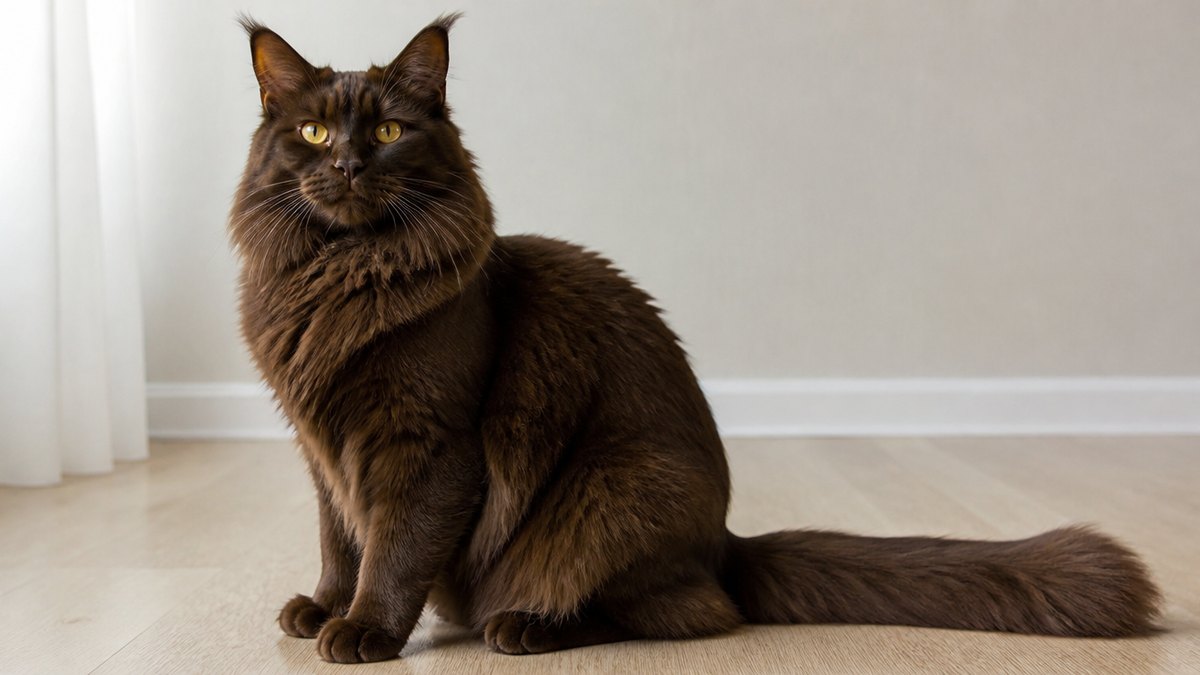
The York Chocolate is a large semi-longhaired domestic cat with a solid chocolate or lilac coat, descended from a farm litter born in Grafton, New York, in 1983. It carries no structural mutation of any kind, which sets it apart from almost every other very rare breed.
Start with the coat, because the name is the breed. The World Cat Federation standard permits chocolate and lilac only, solid or with white, and asks for eye colour in golden, hazelnut or green. The Canadian Cat Association standard goes further and states that no sex linked orange gene is allowed, which removes red, cream and tortoiseshell from the breed entirely. A chocolate coat on a large longhaired cat is the whole proposition.
The body is unremarkable in the best sense. Both standards describe a medium to large, well-muscled cat with a modified wedge head with rounded contours, medium-large ears set high and carrying ear tufts, medium to large slightly oval eyes, and a long, well-furred plumed tail. Mature males weigh 10 to 16 pounds World Cat Federation.
What this breed does not have, and why that matters
No folded ear. No curled ear. No shortened leg. No bobbed or kinked tail. No hairlessness. No coat mutation at all. Read across the rest of the very rare cat breeds and that list is unusual, because most breeds this obscure got there by combining structural mutations that registries then declined to recognise. The York Chocolate is rare for the opposite reason, which is simply that not enough people bred it.
A breed with no structural mutation has no mutation-linked welfare problem to investigate. The GCCF's unrecognised-breeds page, which names breeds and states why it refuses them, marks the Scottish Fold red for osteochondrodysplasia, dwarf breeds red for reported health problems and multi-mutation breeds red on principle. The York Chocolate is not on that page in any colour, and it is not on the recognised list either, so the British registry has simply never considered it. That is a very different thing from a refusal, and this page will not dress it up as one.
Registry recognition, and the zero that settles it
Four registries hold a written York Chocolate breed standard and no two agree on its status, which is exactly why registry recognition has to be reported one body at a time. The number that actually matters is a different one: the French national studbook issued zero York Chocolate pedigrees in 2025.
That zero comes from the best rarity instrument in the cat fancy, because it counts registrations rather than opinions. The Livre Officiel des Origines Felines publishes how many cats of each breed were entered in its studbook each year, and the 2025 table has no York Chocolate row at all. The same table records 24,196 Maine Coons, 951 Scottish and Highland Folds, 126 Munchkins, 64 American Curls and 27 Donskoys. A studbook capable of recording 27 Donskoys is capable of recording one York Chocolate.
| Registry | Position | Document and date |
|---|---|---|
| WCF | Recognised as YOR, full standard | Breed standard dated 1 January 2010, and EMS row 38 of 198 World Cat Federation, WCF EMS code table |
| LOOF | In championship as YORK CHOCOLAT, code YOC | Liste des races, version au 1 January 2026 |
| LOOF, in practice | Zero pedigrees issued in 2025, no row in the table | Nombre de chats inscrits au LOOF, read 10 September 2026 |
| CCA-AFC | Standard held but marked DORMANT | Breed standards index, standard dated 2020-01-01 Canadian Cat Association |
| CFF | Standard published on the association's own site | YORKChocolate.pdf, library modified 13 August 2026 |
| TICA | Category VI, registration only, plus the Foundation Registry | Registration Rules Version B, 22 November 2024 |
| TICA standards book | Zero occurrences of the name in 59 pages | AllBreedStandards.pdf, May 2025 capture, 355,362 characters |
| CFA | Nothing. No breed council and no miscellaneous committee | Declared Candidates, modified 31 July 2026 |
| FIFe | Absent from the index and from the two-breed preliminary block | FIFe Breeds, modified 4 August 2026 |
| GCCF | Not recognised and not on the unrecognised-breeds page either | Unrecognised Breeds, modified 23 September 2025 |
LOOF writes the breed YORK CHOCOLAT, without the final e. Search the French studbook's own PDF for York Chocolate and you get nothing, and a researcher in a hurry concludes the breed is absent from the French registry when it is actually in full championship. The same class of trap appears elsewhere in this batch: WCF writes Toy Bob as two words. Always search a registry document for the shortest distinctive fragment, in this case York, and read what comes back.
No registry has declared the York Chocolate extinct, which is a real distinction rather than a technicality. The Ojos Azules is recorded as extinct and its breeders abandoned the programme deliberately. This breed simply stopped being bred, its standards remain live in four bodies and one of them still lists it in championship, so a breeder with unregistered chocolate longhaired stock and the right documentation could in principle register cats again Canadian Cat Association / Association….
The four-registry count is real and it is also the least informative fact here. A standard on a website costs a registry nothing to keep. What costs something is a breeder producing a litter and registering it, and in France in 2025 that happened zero times. TICA's own position says the same thing in its own language: the breed sits in Category VI, which Rule 37.7.1 describes as breeds still in active development with no limitations or restrictions on breeding programs, and TICA's 59-page all-breed standards book does not mention it once.
Where the York Chocolate came from
The York Chocolate began on a goat farm in Grafton, New York, in 1983, with a solid chocolate kitten named Brownie. The Canadian Cat Association's standard records the breed origin as Natural and describes the founding animals as working cats.
The origin story is the least contested part of this breed. A long-haired black-and-white farm cat and a long-haired black tom produced a litter that included a solid chocolate female, and a breeder recognised that the colour was worth fixing. The name takes the state from New York and the colour from the coat.
| Date | Event | Source |
|---|---|---|
| 1983 | Brownie born in Grafton, New York | CCA-AFC breed standard, breed origin Natural |
| 23 October 2004 | Outcrossing to domestic longhairs closes in the Canadian standard | CCA-AFC breed standard |
| 1 January 2010 | WCF standard adopted, code YOR | WCF breed standard |
| February 2016 | CFF standard published to the association's document library | cffinc.org standards library |
| 1 January 2020 | Date on the current Canadian standard | CCA-AFC breed standard |
| 22 November 2024 | TICA lists the breed in Category VI and the Foundation Registry | TICA Registration Rules Version B |
| Calendar 2025 | Zero York Chocolate pedigrees registered in France | LOOF nombre de chats |
| 1 January 2026 | LOOF still lists YORK CHOCOLAT in championship | LOOF liste des races |
| 12 June 2026 | CCA reissues most standards; the York Chocolate's stays at 2020 and marked Dormant | CCA-AFC standards index |
One line in the Canadian standard tells you more about the breed's trajectory than any narrative does. Allowed ancestry is York Chocolate to York Chocolate, or to a solid or bi-coloured domestic longhair accompanied by signed documentation from the York Chocolate Society Genetics Committee, and outcrossing was permitted only until 23 October 2004. Closing the gene pool on a fixed date is what a confident breed club does when it believes the population is large enough to sustain itself. Twenty-one years later, France registered none.
The Canadian Cat Association keeps a standard on its books and marks it Dormant, while marking the Chantilly and the Sokoke Experimental on the same index. Those are deliberate, different labels. Dormant means the paperwork survives and the cats do not, and no Indian page describing this breed in the present tense mentions the word. That single index entry is more informative than any of the breed profiles ranking above it.
York chocolate cat price in India, and two sites printing the same number
There is no honest york chocolate cat price in India. Two Indian sites print the identical band of Rs 60,000 to Rs 2,00,000, and both illustrate this chocolate breed with a photograph of a black cat.
Identical price bands across two supposedly independent sites do not occur in a real market. Prices for a genuinely traded breed vary by city, by litter, by breeder and by season, so two surveys never land on the same pair of round numbers. When they do, one page copied the other or both were generated from a common template, and neither is reporting anything observed.
| Figure | Where it appears | What it actually is |
|---|---|---|
| Rs 60,000 to Rs 2,00,000 | happypet.care | An invented band, illustrated with a file named intense-black-cat-gaze.webp |
| Rs 60,000 to Rs 2,00,000 | poodles.in | The identical band, with a black cat portrait as the social preview image |
| Rs 719 | Amazon.in, the only Indian marketplace result | A blank 120-page notebook, ISBN 979-8607621711 |
| No figure at all | Supertails, India's top-ranking cat-price guide | The breed is not mentioned anywhere on it |
| Six businesses, no price | A Justdial page titled Pet Shops For York Chocolate Cat in India Gate | Five of the six are not in Delhi, and the top listing sells Parsian CAT Kitten |
Registry standards for this breed permit chocolate and lilac only, and the Canadian standard bars the sex linked orange gene by name Canadian Cat Association / Association…. A black cat is not an off-shade York Chocolate, it is a different cat. Both Indian pages pricing the breed lead with one, one in a file named for a black cat's gaze and the other in a file named for a black cat portrait poodles.in, York Chocolate cat breed page. A page that cannot get the breed's only defining characteristic right in its own hero image is not a source for what a kitten costs.
The Rs 719 Amazon listing deserves its own warning because it looks so ordinary. It is a real Indian listing with a real price and a real delivery date, and the product is a blank notebook with 120 wide-lined pages and the breed name on the cover. Its ISBN, 979-8607621711, sits within a few hundred of the Kurilian Bobtail notebook at 979-8607611897, which shows one publisher generating one notebook per breed from a list. Every rare-breed search in India returns one of these, and to a price scraper it looks like availability.
The one page-one result that should worry a buyer most is not a price at all. Position three is a kitten-sale site on a free odoo.com subdomain, offering kittens of a breed the French studbook registered zero of in 2025, with bare first-name testimonials and a dedicated page headed Shipping York Cat. That combination, a free subdomain, unverifiable testimonials, a shipping page and an unobtainable breed, is the standard kitten-payment scam. This page names the pattern and deliberately does not link the site.
Monthly cost for a large semi-longhaired cat in India
Budget roughly Rs 3,000 to Rs 5,000 a month for a large semi-longhaired cat in an Indian metro, and treat that monthly cost as the figure that matters rather than any purchase price. The components below are real Indian costs for a cat of this size and coat type, not this breed's, because this breed has none.
- Food, Rs 1,500 to Rs 2,500 a month. A 10 to 16 pound cat eats more than the 8 pound average that most Indian cost tables assume.
- Litter, Rs 600 to Rs 1,000 a month. Unchanged by breed, and the line most people underestimate.
- Routine health care, Rs 500 to Rs 800 a month averaged. Vaccination, deworming and one annual check, spread across the year.
- Grooming supplies, Rs 200 to Rs 400 a month. A slicker brush, a comb and a monsoon ear-cleaning solution cover a semi-long coat.
- Licence, Rs 50 in Chennai. The Greater Chennai Corporation licenses pet animals generally rather than dogs only, so a cat is covered.
- Free municipal treatment and anti-rabies vaccination in Chennai. The corporation's veterinary clinics provide both at no cost, which is the largest recurring saving an Indian cat owner can access.
- No breed genetic test to buy. No genetic test exists for this breed, because no breed-specific variant has ever been described.
- No statutory microchip cost for a kitten. Rule 7(16) of the Pet Shop Rules, 2018 makes microchipping mandatory for puppies only.
Those lines sum to roughly Rs 2,800 to Rs 4,700 a month before emergencies, which is the honest arithmetic. Compare that with the Rs 60,000 to Rs 2,00,000 purchase figure the two Indian pages print and the distortion is obvious: they lead with a large invented number and bury the recurring cost that actually decides whether a household can keep a cat poodles.in, York Chocolate cat breed page.
Neutering. Entire cats carried 4.29 times the odds of death before three years compared with neutered cats in a study of 7,936 confirmed feline deaths. No premium food, no supplement and no breed choice comes close to that effect size, and it is a one-off cost.
Heat tolerance and the Indian climate
A semi-longhaired cat needs more heat management in India than a short-coated one, and this breed's heat tolerance is moderate rather than good. The coat is fine and silky with a ruff and a plumed tail, developed on a farm in upstate New York, which is not an Indian summer.
Use your own city's real peak rather than a generic Indian summer, because the commonest error in Indian climate tables is naming May as the hottest month everywhere. That is wrong for Delhi, which peaks in June, and wrong for Bengaluru and Pune, which peak in April.
| City | Hottest month and mean | Coolest month and mean | Cell elevation |
|---|---|---|---|
| Delhi | June, 35.88 C | January, 13.61 C | 206.37 m, matches the city |
| Nagpur | May, 36.73 C | December, 19.97 C | 282.60 m, matches the city |
| Chennai | May, 31.51 C | January, 24.09 C | 48.95 m, matches the city |
| Kolkata | May, 31.53 C | January, 17.31 C | 7.35 m, matches the city |
| Mumbai | May, 31.19 C | January, 23.19 C | 97.15 m, matches the city |
| Bengaluru | April, 28.37 C | December, 20.22 C | 841.72 m, matches the plateau |
| Pune | April, 28.93 C | December, 19.62 C | 635.99 m, matches the city |
What a semi-long coat needs in an Indian summer
- Keep the room under about 30 C through the peak month. Delhi at 35.88 C in June is the hardest case in this table, and a ruffed cat feels it.
- Brush more, not less, in summer. Removing loose undercoat helps a semi-long coat move air against the skin.
- Never shave a semi-longhaired cat to cool it. The coat insulates against heat as well as cold, and a shaved cat sunburns.
- Put water in three places. A large cat drinks more, and a cat that will not walk to the kitchen will drink from a bowl beside its bed.
- Move play to early morning and after sunset. A closed Nagpur flat in May, where the monthly mean is 36.73 C, is not a place to run a big cat.
- Treat open-mouth breathing as an emergency. In a cat it is never normal, and it means calling your nearby vet rather than waiting.
Bengaluru and Pune, at April peaks of 28.37 C and 28.93 C, are the two Indian metros where a semi-longhaired cat is genuinely heat-tolerant without air conditioning. That is worth knowing before choosing any coated breed in India, and it applies to the Maine Coon and the Siberian just as much as to this one.
Temperament, and how much of it is actually known
Breed accounts describe an affectionate, people-following farm cat, and that description rests on a small number of animals in the 1980s rather than on any study. The Canadian standard's own origin note calls the founding cats working cats on a farm.
No behavioural research names this breed. PubMed returns zero records under two query forms with four controls passing in the same session, and no registry publishes temperament data for any breed. Every confident personality paragraph you will read about the York Chocolate traces back through a chain of copied pages to one breeder's description of her own cats.
What can be said with more confidence is structural rather than behavioural. A cat selected from farm stock, with no brachycephalic head, no structural mutation and no extreme conformation, starts from a better behavioural baseline than a hypertyped breed does, because pain and breathing difficulty are among the commonest causes of behaviour problems in cats. That is an inference from what the standards describe rather than a measurement Canadian Cat Association / Association….
Nobody is choosing this breed on temperament, because nobody can obtain it. This section exists because the pages selling it print temperament claims with total confidence, and one of those pages opens its description by comparing the breed to the Singapura, a small short-coated breed with no relationship to this one. If an affectionate, people-following large cat is what you want, a shelter can match that temperament by observation, which is more reliable than any breed label.
Training a large semi-longhaired cat
To train a large semi-longhaired cat, build the handling habit before you need it, because a 16 pound cat that objects to being brushed is a genuinely difficult animal to manage. Everything else is ordinary cat training.
- Handle ears, feet, tail and belly once a week from the first month. Ten seconds each, paired with food, and grooming later becomes routine rather than a fight.
- Teach the brush as a reward, not a procedure. Two minutes daily beats twenty minutes weekly for a semi-long coat and for the cat's opinion of it.
- Feed meals in an open carrier for two weeks. A large cat is hard to post into a carrier under protest.
- Train to a mat or a station. A big cat that will go and sit somewhere on cue is easier to live with in a small Indian flat.
- Clip nails every two to three weeks from kittenhood. Start before the cat is strong enough to object effectively.
- Keep the cat indoors in Indian cities. Traffic, dogs and disease pressure make free roaming the largest single risk to any pet cat here.
Litter training is usually trivial with a large low-entry tray, and the tray size matters more for a big cat than most Indian guides admit. A cat that has to curl to fit will eventually go elsewhere, and the fix is a bigger tray rather than a behavioural intervention.
Leash work is realistic for a confident large cat and worth the effort in a city where a balcony is the only outdoor space. Introduce the harness indoors over two weeks and never leave a harnessed cat unsupervised.
How much exercise a cat this size needs
Budget 30 to 45 minutes of interactive play a day for a large active cat, split into two or three sessions. A 10 to 16 pound cat carries weight easily and loses condition slowly, which makes obesity harder to notice and harder to reverse.
- Split the time. Two sessions of 15 to 20 minutes beat one of 40, because cats hunt in bursts.
- Build vertical space rated for weight. A shelf that holds a 4 kg cat may not hold a 7 kg one, and a collapsing shelf ends climbing for good.
- Use a wand rather than a laser. A large cat turning hard on a smooth Indian floor slides, and a wand lets you control the turn radius.
- Feed part of the ration from a puzzle feeder. Enrichment does more for an indoor cat's weight than an extra ten minutes of play.
- Weigh the cat monthly and write it down. A big cat can gain a kilogram before anyone notices by eye.
The failure mode for a large indoor cat in India is a quiet, well-fed, under-stimulated life in a flat with the fan on. It shows up as night activity, over-grooming and weight gain, and all three respond to enrichment faster than to diet changes.
Grooming a semi-long coat in Indian humidity
Brush a semi-long coat twice a week, and three times in the monsoon. The standards describe a fine, silky, medium to semi-long coat with a ruff and a plumed tail, which mats less than a Persian's woolly undercoat and far more than a short coat.
- Work the four mat sites first. Behind the ears, in the armpits, along the trouser hair and under the plumed tail, in that order, every session.
- Use a comb after the brush. A slicker lifts the surface and a comb finds the mat starting underneath it.
- Do a weekly ear check with a cotton pad. The visible part only, no probe, and more often through the monsoon when a damp ruff holds moisture against the ear base.
- Bathe rarely and dry completely. A semi-long coat left to air dry in a humid Indian flat stays damp for hours and mats as it dries.
- Never shave to cool the cat. The coat insulates in both directions and a shaved cat burns on an Indian balcony.
- Groom before the monsoon, not during it. A coat that goes into July already clear of dead undercoat mats far less.
Two brushings a week is about fifteen minutes of total effort, and it is the single largest ongoing difference between owning this kind of cat and owning a short-coated one. Skip it for a month in a Bengaluru monsoon and you will be paying a groomer to shave out mats, which is uncomfortable for the cat and avoidable.
The colour check nobody else on this query performs
Look at the coat in daylight. A York Chocolate is chocolate or lilac, solid or with white, and its eye colour should be golden, hazelnut or green. Red, cream and tortoiseshell are excluded by the Canadian standard's bar on the sex linked orange gene. If the cat in front of you is black, or pointed, or has blue eyes, no amount of paperwork makes it this breed, and both Indian pages selling it fail this check in their own hero images poodles.in, York Chocolate cat breed page.
York Chocolate health issues, and an empty literature
No health issues have ever been documented for the York Chocolate, and that is a statement about the literature rather than a clean bill of health. PubMed returned zero records naming the breed on 10 September 2026 across two query forms, with four controls returning results in the same session.
Read that carefully, because it is the opposite of what most pages do with it. An empty literature does not mean a healthy breed. It means nobody has studied this breed, which for a population small enough to produce zero French registrations in a year is exactly what you would expect. Absence of evidence here is a consequence of rarity, not a finding about the cats.
What can honestly be inferred
The breed carries no structural mutation, no coat mutation and no documented founder disease Canadian Cat Association / Association…. That genuinely does remove the specific welfare questions that dominate the rest of this batch: no cartilage mutation as in the folded-ear breeds, no chondrodysplasia as in the short-legged breeds, no hairlessness and no bobtail. The reasonable expectation is an ordinary large semi-longhaired cat's health profile, and that expectation should be held loosely rather than printed as a lifespan number.
| Claim | Status | Basis |
|---|---|---|
| Lifespan of 13 to 15 years | INVENTED | No study measures this breed. It is not among the 12 that reached the threshold |
| No known breed-specific disease | MEASURED, as an absence | PubMed returns 0 records under two query forms with passing controls |
| No structural mutation | MEASURED | Four registry standards describe normal ears, legs and tail Canadian Cat Association / Association… |
| Ordinary large-cat health expected | INFERRED | Follows from the absence of mutations, not from any study |
| Hypoallergenic | UNSUPPORTED | No scientific evidence exists for a hypoallergenic cat breed |
| Prone to obesity at 10 to 16 pounds | INFERRED | A large frame hides weight gain; the standard gives the weight range |
One page on this query carries a Vet-Approved badge over the same unsourced lifespan and personality claims every other page prints. A badge tells you somebody read the copy. It does not tell you the underlying figure exists, and for this breed it does not. Ask what study a lifespan number comes from, and if the answer is another breed page, the number is not evidence. Consult your nearby vet about any individual cat rather than relying on a breed page for a health plan.
The only defensible numbers to plan around come from the largest UK feline life-table study, which analysed 7,936 confirmed deaths and grouped any breed with fewer than 15 deaths into other, leaving 12 breeds in its table. The York Chocolate is not among them. Its all-cats life expectancy at age 0 is 11.74 years and its crossbred figure is 11.89 years, and purebred cats carried 1.83 times the odds of dying before three years compared with crossbreds. Use those, and screen for the ordinary things: dental disease, kidney values from middle age, and weight.
Feeding a 10 to 16 pound cat
Feed by measured portion and body condition rather than by bowl, because a large-framed cat hides weight gain well. The Canadian standard puts mature males at 10 to 16 pounds, which is a wide range and means the label's chart cannot tell you the right amount.
- Weigh the daily ration once and portion it every morning. In a household where several people feed the cat, one labelled container solves the problem.
- Monitor body condition monthly by hand. Feel ribs under a thin fat cover without pressing, and look for a waist from above.
- Keep wet food in the mix through Indian summers. Water intake matters more in a Delhi June at 35.88 C than any brand choice does.
- Feed kitten food through 12 months. A large-framed cat matures slowly and finishes growing later than an 8 pound cat.
- Ignore any breed-specific diet claim for this breed. No nutritional literature names it, and a page inventing a price is not a nutrition source.
Obesity is the condition most likely to shorten an Indian indoor cat's life, and it is entirely under the owner's control. For a cat that can legitimately weigh anywhere between 4.5 and 7.3 kg, monthly weighing is not fussiness, it is the only way to tell a well-grown cat from an overweight one.
Kitten care, month by month through the first year
Kitten care for a large semi-longhaired cat follows the ordinary feline timeline with the coat routine started early. Establishing grooming in month two is far easier than establishing it in month ten.
- Weeks 0 to 8, with the mother. Indian law treats kittens below eight weeks as un-weaned and prohibits their sale, so a kitten offered before eight weeks is an illegal sale.
- Month 2, home. One room, one large low-entry tray, one hiding place, and daily handling of ears, feet and tail.
- Month 2, first brush. Thirty seconds with a soft brush daily, paired with food, long before the coat needs it.
- Month 2 to 4, core vaccination course. Follow your nearby vet's schedule rather than any breed page's table, since Indian protocols vary by region and disease pressure.
- Month 3, carrier training. Feed in the open carrier daily, which matters more for a cat that will end up large.
- Month 4, weight baseline. Record it and repeat monthly, because the adult range is wide.
- Month 4 to 6, socialisation to household noise. Pressure cookers, mixers and doorbells at low volume, paired with food.
- Month 6 to 9, neutering discussion. Entire cats carried 4.29 times the odds of death before three years compared with neutered cats.
- Month 8, the coat changes. The adult semi-long coat and the ruff come in around this point, and brushing moves from a habit to a necessity.
- Month 12, adult health check. Ask for a body condition score to be written into the file so there is a baseline to compare against.
One thing not to do is buy a dark kitten on the promise that it will turn chocolate. Coat colour in kittens does change, but a black kitten stays black, and the breed's registry standards permit chocolate and lilac only. Given that both Indian pages selling this breed illustrate it with a black cat, that promise is a predictable sales line.
York Chocolate compared with the cats you can actually get in India
The useful comparison is against the large longhaired breeds that genuinely exist in India, because that is the choice a real buyer faces. On availability the York Chocolate loses to every one of them.
| Breed | French pedigrees in 2025 | Coat | Registry status |
|---|---|---|---|
| York Chocolate | Zero, no row in the table | Semi-long, chocolate or lilac only | 4 standards, one marked Dormant |
| Maine Coon | 24,196 | Semi-long, most colours | Full championship everywhere |
| British Shorthair | 5,668 | Short and dense | Full championship everywhere |
| Ragdoll | 4,947 | Semi-long, pointed | Full championship everywhere |
| Sphynx | 955 | Hairless | Championship in most bodies |
| Havana Brown | Not listed separately | Short, chocolate | CFA championship, genuinely chocolate |
| Indian domestic longhair | Not applicable | Variable, often semi-long | None needed, available from any shelter |
The Havana Brown is a real, registered, championship chocolate breed, and it is short-coated, which makes it the better fit for most Indian climates anyway. If the size and the plumed tail are the point, the Maine Coon and the Siberian both exist in India with real breed clubs behind them. If the point is a large affectionate cat, an Indian shelter has one today and it costs nothing. All three of those routes end with an actual cat, which this breed's search results do not.
One comparison worth making explicitly is with the other very rare breeds in this batch. The Foldex, the Kinkalow and the Ukrainian Levkoy are rare because registries examined the mutations they combine and declined them, in the GCCF's case with written reasons. The York Chocolate is rare because a small breeding programme in New York state ran out of breeders. Those are not the same kind of rarity and they should not be reported in the same tone.
Mistakes Indian searchers make with the York Chocolate
Six mistakes account for nearly everything that goes wrong on this query, and the first is trusting a price that two sites happen to share.
- Believing an identical price band. Two Indian sites print Rs 60,000 to Rs 2,00,000 character for character, which no independent market survey produces.
- Ignoring the black cat in the hero image. Registry standards permit chocolate and lilac only, and bar the sex linked orange gene by name.
- Reading Rs 719 on Amazon.in as availability. That buys a blank 120-page notebook with the breed name on the cover.
- Treating a Justdial page as inventory. Six businesses, five of them not in Delhi, and a top listing selling Parsian CAT Kitten.
- Paying a deposit to a site on a free subdomain. Position three offers kittens of a breed with zero 2025 registrations and runs a Shipping York Cat page Livre Officiel des Origines Felines.
- Quoting a lifespan figure. No study measures this breed, and it is not among the 12 that reached the threshold.
A seventh mistake runs the other way and this page avoids it too. Concluding that the York Chocolate is a fake breed would be wrong. Four registries hold a written standard, one of them lists it in full championship, and the Canadian standard records a specific founding animal, a specific place and a specific date Canadian Cat Association / Association…. The breed is real, documented and very nearly gone, and that is a more interesting story than either a scam or a bargain.
The last thing to verify before any transaction is the registry itself rather than the certificate. Ask which registry, then open that registry's own breed list and check the code. WCF uses YOR, LOOF uses YOC and spells the breed YORK CHOCOLAT, and the CCA uses YC on a standard marked Dormant Livre Officiel des Origines Felines Canadian Cat Association. A certificate naming a registry that does not list the breed is not a pedigree, it is a printout.
Adoption, responsible sourcing and the honest answer for India
Adopt, because there is nothing verifiable to buy. Four registries hold a standard, France registered zero pedigrees in 2025, and no Indian seller has produced an animal anyone has confirmed.
- Adopt an Indian semi-longhaired cat. Large coated cats turn up in Indian shelters constantly, already adapted to the climate, and they cost nothing.
- Refuse any kitten under eight weeks. Indian law defines kittens below eight weeks as un-weaned and prohibits their sale.
- Verify a pedigree against the registry's own breed list. Check the code at the source: YOR at WCF, YOC at LOOF, YC at the CCA Canadian Cat Association.
- Never send money to a seller you cannot visit. A free-subdomain site with a shipping page and first-name testimonials is the standard kitten scam.
- Ask to see the mother with the litter. It is the one check no photograph, certificate or price page can fake remotely.
- Choose a breed that exists here instead. The Maine Coon, the Siberian and the Havana Brown all have real Indian availability and real breed clubs.
If importing ever became relevant, India's policy is restricted under ITC(HS) 01061900 and needs a DGFT authorisation, with an exemption for people shifting residence permanently under the Customs Baggage Rules. None of that helps here, because the exporting population does not exist.
The wider point is why this page was written at all. A query with about 107 results in the entire Indian index supports a kitten-sale site, two invented price pages, a blank notebook, a business directory and an AI-labelled stock photo library Google India results page for york…. What it does not support is one page that opens a registry document. Four registries hold a York Chocolate standard, the French studbook registered none in 2025 and the Canadian association marks its own standard Dormant, and a reader who knows those three facts cannot be sold a black kitten for Rs 2,00,000.
York Chocolate questions Indian searchers actually ask
Is a York chocolate cat rare?
It is close to gone rather than merely rare, and one registry table settles it. The French national studbook lists YORK CHOCOLAT in championship on its list of 1 January 2026, and its own published count of cats registered during 2025 has no York Chocolate row at all, meaning zero pedigrees were issued. The same table shows 24,196 Maine Coons, 951 Scottish and Highland Folds and 27 Donskoys, so it does record tiny breeds when they exist. The Canadian Cat Association marks its York Chocolate standard Dormant.
Are York Chocolate cats expensive?
No price for this breed in India is real. Two Indian sites print the identical range of Rs 60,000 to Rs 2,00,000, and neither has ever handled the breed. One of them illustrates a chocolate-coated cat with a file photograph named for a black cat's gaze, and the other serves a black cat portrait as its social preview image. The only genuine Indian rupee figure returned for the breed name is Rs 719 on Amazon.in, which buys a blank 120-page notebook with the breed name on the cover.
What is the personality of a York Chocolate cat?
Breed accounts describe an affectionate, people-following farm cat, and that description rests on a small number of animals rather than on any study. The Canadian standard records the breed origin as Natural and notes the founding cats occurred naturally as working cats on a farm. No behavioural research names the breed, PubMed returns zero records for it, and no registry publishes temperament data. Treat every confident personality claim you read about this breed as inherited from one 1980s breeder account.
What is the average lifespan of a York chocolate cat?
Nobody has measured it, and the figures circulating online are invented. The largest UK feline life-table study analysed 7,936 confirmed deaths and grouped any breed with fewer than 15 deaths into other, so only 12 breeds reached its table and this one is not among them. Its all-cats life expectancy at age 0 is 11.74 years and its crossbred figure is 11.89 years, and those are the only defensible numbers to plan around for a semi-longhaired cat with no structural mutation.
Which registries recognise the York Chocolate?
Four hold a written standard and no two agree on its status. The World Cat Federation carries it as YOR with a standard dated 1 January 2010, the French studbook lists YORK CHOCOLAT as YOC in championship, the Canadian Cat Association holds a YC standard explicitly marked Dormant, and the Cat Fanciers' Federation publishes a standard on its site. TICA holds it only in Category VI, which the rules describe as breeds advanced to Registration Only, and also lists it in the Foundation Registry. CFA, FIFe and the GCCF hold nothing.
What colour is a York Chocolate cat, exactly?
Chocolate or lilac, solid or with white, and nothing else. The WCF standard allows chocolate and lilac with or without white and asks for eye colour in golden, hazelnut or green. The Canadian standard is blunter still and states that no sex linked orange gene is allowed, which rules out red, cream and tortoiseshell entirely. A black cat is not a York Chocolate, which matters because both Indian pages selling the breed illustrate it with one.
Is the York Chocolate a longhaired or shorthaired cat?
Semi-longhaired, with a ruff and a plumed tail. This is worth stating because one of the two Indian pages pricing the breed calls it long-haired in one sentence and then prints a template line describing a short-haired cat's grooming in the next, which is the clearest possible sign that the page was generated rather than written. A semi-long coat needs brushing twice a week, not the weekly wipe a short coat needs.
Can I import a York Chocolate cat to India?
There is nothing to import. India's import policy for pet cats is restricted under ITC(HS) 01061900 and requires a DGFT authorisation, with an exemption for people shifting residence permanently under the Customs Baggage Rules. None of that matters when the French national studbook issued zero pedigrees for the breed in 2025 and the Canadian registry marks its standard dormant. No exporting population exists to buy from.
What health issues does the York Chocolate have?
No health issues have ever been documented for this breed, which is a statement about the literature rather than a clean bill of health. A PubMed search on 10 September 2026 returned zero records for the exact phrase with a quotedphrasesnotfound warning and zero for an unquoted retry, while four controls returned results in the same session. The breed carries no structural mutation, no coat mutation and no known founder disease, so the sensible expectation is an ordinary semi-longhaired cat's health. Consult your nearby vet for any individual animal.
Are York Chocolate cats hypoallergenic?
No breed is on the current evidence, and a semi-long coat makes the claim less plausible rather than more. A 2024 review states flatly that there is no scientific evidence for a hypoallergenic cat breed. Individual cats vary far more in how much of the major cat allergen they produce than breeds do. Any page that both invents a price for this breed and calls it hypoallergenic is making two unsupported claims in the same paragraph.
Why do pet shops in India list this breed?
Because a breed name is cheap to add to a page and expensive to verify. A business directory page titled Pet Shops For York Chocolate Cat in India Gate returns six businesses, five of which are not in Delhi at all, and its top listing advertises Parsian CAT Kitten, a misspelling of Persian, on what is that shop's third breed-specific landing page. Nothing on the page indicates any of the six has ever seen the breed. Treat the breed name in an Indian shop listing as a search term rather than as stock.
What should I buy instead?
Adopt an Indian semi-longhaired cat, or choose a large longhaired breed that genuinely exists here. If the chocolate coat is what draws you, the Havana Brown is a real registered chocolate breed, short-coated and also uncommon in India. If the size and the plumed tail are the draw, the Maine Coon and the Siberian are both available and both have real breed clubs. If the point is simply a big affectionate cat, an Indian shelter has one now and it costs nothing.
Compare with similar breeds
York Chocolate sits in 1 Bonbeno group. Each one compares it directly against the breeds it is genuinely an alternative to, on the same figures.