
Breed profile
Cyprus Cat in India: The Landrace Behind the Aphrodite
An island landrace of about a million free-roaming cats, one derived breed held by a single registry, and a coronavirus outbreak that rewrote its health story.
Quick answer
The cyprus cat is a landrace, not a standardised breed. No registry holds a breed called Cyprus cat. One breed has been drawn from the population, the Aphrodite's Giant, fully recognised by the World Cat Federation since 1 July 2012 in shorthair and semi-longhair varieties; The International Cat Association listed an Aphrodite as a preliminary new breed in September 2017 and today lists it nowhere. India has no market for either. The island's own cats matter more for a different reason: the 2023 FCoV-23 outbreak.
This page is general information, not veterinary advice. Nothing here diagnoses or treats a cat. If your cat is unwell, losing weight, off its food, breathing oddly or behaving out of character, see a registered veterinary practitioner the same day rather than acting on anything you read online, including this page.
Cyprus Cat at a glance
What a Cyprus cat is, and what it is not
A Cyprus cat is a landrace, which means an unimproved local population shaped by place rather than by breeders. It is not a breed, no registry holds one under that name, and the confusion between the landrace and the breed drawn from it is the single most useful thing this page can clear up.
Two different things share this territory and most pages merge them. The first is the island population itself: hundreds of thousands of free-roaming cats living across Cyprus, from the Troodos highlands to the coastal cities, known variously as Cypriot cats, Saint Helen cats and Saint Nicholas cats. The second is a breed standardised animal drawn out of that population from 2006 onward and given a different name, the Aphrodite's Giant.
Wikipedia states the position in its own infobox: variety status not recognised as a standardised breed by any major breed registry, with the note 'Cyprus cats are a landrace, not a standardised breed'. Google's India knowledge panel labels the entity 'Domestic cat breed' and then prints a description beginning 'a landrace of domestic cat', contradicting itself in the same box.
The two-condition test, applied
Bonbeno tests any disputed name against two conditions: a written breed standard, and a studbook recording individuals generation after generation. Run the name 'Cyprus cat' through it and both conditions fail. No body has published a standard for a Cyprus cat, and no body keeps a register of Cyprus cats. Run the name 'Aphrodite's Giant' through the same test and both conditions pass: the World Cat Federation publishes two standards, APS for the shorthair and APL for the semi-longhair, both dated February 2012, and issues pedigrees under those EMS codes World Cat Federation breed standard World Cat Federation World Cat Federation.
| Cyprus cat | Aphrodite's Giant | |
|---|---|---|
| What it denotes | The whole island population | A selected, registered subset of it |
| Written standard | None | Two, WCF APS and APL, February 2012 World Cat Federation breed standard |
| Studbook | None | WCF pedigrees under codes APS and APL |
| Bonbeno verdict | Type | Breed, held by one registry |
| How you meet one | On a Cypriot street | Through a WCF-registered breeder |
| How many exist | Hundreds of thousands | Unknown; no published census |
'Cyprus cat' is a type, not a breed, and Bonbeno reports that rather than editing it into one. It is not a breed in formation either, because nobody is trying to standardise the landrace under that name; the standardising effort exists and it produced a differently named breed that already cleared both conditions in 2012. The honest sentence is that the Cyprus cat is the raw material and the Aphrodite's Giant is the product.
Why the distinction is not pedantry
It changes what a seller can promise you. A WCF pedigree names the breed as Aphrodite's Giant with an EMS code, and it can be checked against WCF's own published index. A cat sold as a 'Cyprus cat' has no document behind it at all, because there is nothing for a document to certify. If somebody offers you paperwork for a Cyprus cat, the paperwork is not what it claims to be.
Registry recognition, and the four documents that disagree about TICA
One registry fully recognises the breed drawn from this landrace, and that is the World Cat Federation. Whether The International Cat Association still does is genuinely contested, and Bonbeno found four registry-adjacent documents saying three different things.
Every check below was run on 3 September 2026 against the body's own current pages, with a control inside the same document so an absence means something.
| Body | Status today | Document read, and its control |
|---|---|---|
| World Cat Federation (WCF) | Full recognition, two varieties | Aphrodite's Giant SH (APS) among 46 shorthair standards; Aphrodite's Giant Longhair (APL) among 24 semi-longhair standards beside the Maine Coon and Norwegian Forest Cat World Cat Federation |
| The International Cat Association (TICA) | Absent from every class | 73 championship breeds; Advanced New Breeds holds Serengeti and Toybob, which proves the class pages render; Preliminary New Breeds returns 'No matches found'; The International Cat Association The International Cat Association |
| Cat Fanciers' Association (CFA) | Absent | 45 breed headings in the live prefix chart, controls Toybob, Lykoi and Khao Manee present; the 2026-27 show rules name one Provisional breed and no Miscellaneous breed Cat Fanciers' Association, CFA Show Rules |
| Federation Internationale Feline (FIFe) | Absent | Four categories of fully recognised breeds, and a preliminary list holding exactly two, Bombay and Lykoi, each time-boxed 2023 to 2027 |
| Governing Council of the Cat Fancy (GCCF) | Green list, not applied for | Filed as 'Aphrodite', Acceptance Grade A, potential Section 2, recommended similar breed Turkish Van |
The TICA question, and why it is not settled by asking once
Four documents, three answers. Wikipedia says TICA accepted the cats in September 2017 as a preliminary new breed in their own breed group, and its infobox carries the qualifier 'TICA recognition is only preliminary';. GCCF's unrecognised-breeds register names the recognising bodies as 'TICA, WCF';. The World Cat Congress comparison table, whose member associations include TICA itself, prints not recognised against TICA for both APS and APL, with a single 'full' cell for WCF. And TICA's own live pages list the breed nowhere at any level The International Cat Association.
TICA's own site is the tiebreaker, and it agrees with the confederation TICA belongs to. Bonbeno's reading is that a preliminary status granted in 2017 has since lapsed, and that the sources still repeating it are quoting a 2018 snapshot.
What preliminary status actually permits
This is worth spelling out, because 'recognised by TICA' sounds like more than it is. TICA defines its Preliminary New Breed class in its own words as 'The beginning level of the Championship Advancement Class Program. These breeds are eligible to be shown in TICA sanctioned shows but do not earn titles or points towards Annual Awards and must follow specific rules to be eligible for the next step'. It is permission to appear, not a competitive class.
FIFe's version of the same idea shows how such a status is normally bounded. Its two preliminary breeds, the Bombay and the Lykoi, each carry an explicit window, 2023 to 2027. A preliminary status is a clock, and clocks run out.
CFA's ladder is the clearest published statement of what these rungs cost. It runs registration, then the Miscellaneous class, then Provisional, then Championship, and CFA states plainly that 'Registration does not guarantee eventual progression to Provisional and Championship status';. Its Advancement Matrix puts numbers on it: 10 active breeders and 50 registered cats to enter Miscellaneous, then 25 active breeders, 100 cats and registrations spanning at least five years, with 25 cats shown across all CFA regions, to reach Provisional. WCF's own route is shorter but not trivial: a pre-recognition show of six to ten cats for an EMS code, then a recognition show presenting at least 15 cats with complete four-generation pedigrees, of which at least seven show three generations of pure breed, judged by two named judges and voted at a General Assembly. The Aphrodite cleared the WCF route in 2012. Nothing has cleared the others.
GCCF's genetics committee grades the Aphrodite green, its good list, with the comment 'Not applied, probable acceptance if export from Cyprus is legal'. That is conditional language recording GCCF's own uncertainty, not a finding that Cypriot export is prohibited, and Bonbeno found no Cypriot export ban in any government source. Note the harder rule alongside it: GCCF states that breeds without its recognition are not eligible to be present at GCCF-licensed shows at all, not even as pedigree pets.
Size and appearance, read from both standards as text
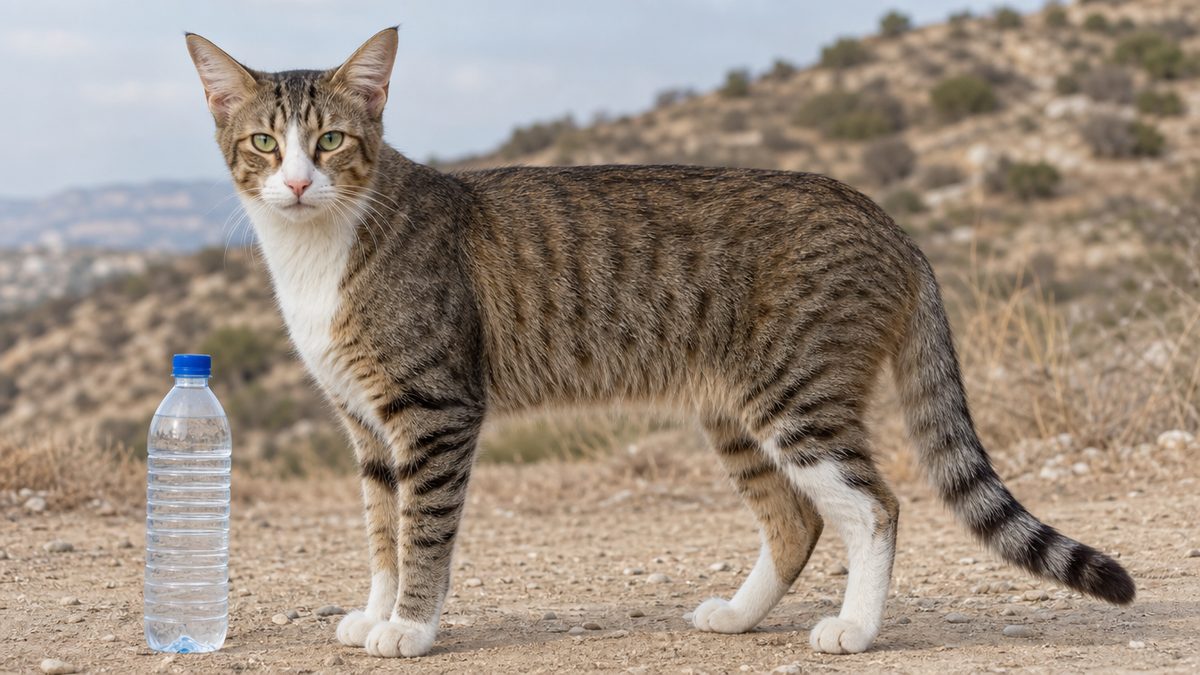
A Cyprus cat is a large, lean, long-bodied cat with a long triangular head and big open-V ears, and neither World Cat Federation standard states a weight. Bonbeno downloaded both PDFs and extracted them, rather than reading anyone's summary of them.
The two documents are nearly identical and differ in exactly the places you would expect. APS, the shorthair, calls for a 'Soft cotton-woolly coat, not too short with undercoat in Winter, in summer much shorter and no undercoat' and a tail whose 'Tip of tail more slender than the heavy root'. APL, the semi-longhair, substitutes 'Soft cotton-woolly semi-long coat' and 'Full, well plumed tail in measure with the body';. Everything else, head, eyes, ears, body, colours and the scale of points, matches.
| Feature | What the standard requires |
|---|---|
| Head | 'From the front a long triangle, cheek line straight. Long straight muzzle and nose, with a very slight dip under the height of the eyes. Strong chin and teeth... slight dome to the forehead' |
| Eyes | 'Olive shaped, from a bit rounder to a bit more oval', set oblique, all colours allowed, colour uniform. 'Pale blue and light yellow is valued to be as good as dark blue and green' |
| Ears | Wide at the base, medium to large, 'placed in form of an open V' with a slightly rounded space between them |
| Body | 'Big and strong. Elegant, lean muscular body, not cobby. Long back and neck. Muscular shoulders and hips. Big body measures. Morphology develops quickly'; back legs slightly longer than front |
| Weight | Not stated. Neither standard contains a weight range |
| Coat | Soft cotton-woolly, undercoat in winter, 'in summer much shorter and no undercoat', very little top coat in either season |
| Colours | All except pointed and mink; a solid colour must be without white; in bicolour an irregular colour setting is desired |
| Scale of points | Head 20, eyes 5, ears 5, body 35, tail 5, coat and colour 25, condition 5 |
Where the size figures actually come from
Not from a standard. Every weight quoted for this cat traces to TICA's description, which gives adult males 15 to 18 pounds, that is 6.8 to 8.2 kg, and females 10 to 14 pounds, 4.5 to 6.4 kg. Those are a registry's descriptive figures, and the registry in question does not currently list the breed. Treat them as an account of what breeders were producing in 2018 rather than as a measurement of the island population, which nobody has ever weighed systematically.
The World Cat Congress adds a size instruction with no number attached, asking judges to 'prefer large examples of both sexes of that breed' and to disqualify smaller specimens, in order to preserve the large-boned nature of the breed.
Two registries contradict each other on how fast it grows
This one is a clean conflict between two current documents. The WCF standard says 'Morphology develops quickly';. TICA says the cats are comparatively slow to mature, taking three to five years to reach full size. Both cannot be right about the same animal, and the likeliest explanation is different foundation stock behind the two versions. Bonbeno publishes both rather than averaging them, and notes that for a buyer this matters: it is the difference between judging an eighteen-month-old as finished and judging it as half-grown.
The WCF standard carries its own genetics paragraph, and it is worth reading closely: 'The Davis laboratories in the U.S., Dr. Lyons in a Genetics research program has produced a specific fingerprint for purebred cats. 30 Aphrodite's Giants were also investigated and shown genetically. From the basis of DNA scans, Dr. Lyons has agreed that the genetic fingerprint of the Aphrodite's Giants is very consistent and could be recognized on this basis a breed'. Thirty cats is the whole evidentiary base for the claim, it appears only in the recognising body's own document, and the underlying published work concluded something narrower, that Cyprus cats are a distinctive Mediterranean population from which a breed could be developed.
History and origin, from a 9,500-year-old grave to a 2012 vote
Cats have been on Cyprus for about 9,500 years and the Aphrodite's Giant has existed since 2012. Those two facts are both true and are not connected, and the gap between them is where most writing about this cat goes wrong.
The archaeology is solid and genuinely remarkable. Vigne and colleagues reported in Science in 2004 that a cat about eight months old had been deliberately buried beside a human at the Neolithic site of Shillourokambos, on an island that cats could not have reached without people carrying them. At roughly 9,500 years old, it predates Egyptian cat imagery by four thousand years or more, and it remains the earliest close cat-human association known.
The overreach is what gets built on top of it. Both WCF standards open by claiming the Aphrodite's Giants are 'based on the oldest documented cat that lived tamed with humans. Found in a Stone Age grave with a skeleton similar to the today living Aphrodite's Giants'; World Cat Federation breed standard. Wikipedia flags exactly this, noting there is no known connection between those ancient tamed-wild specimens and modern domesticated Cyprus cats, 'despite breeder claims to the contrary', and that both WCF and TICA have repeated the claim uncritically.
Bonbeno has read the WCF text and agrees with the criticism. A burial establishes that cats reached Cyprus with people in the Neolithic. It does not establish descent from that individual to a cat registered in 2012.
The legend that is at least the right kind of story
The written record starts with Saint Helen. Byzantine tradition holds that Empress Helena shipped cats from Egypt or Palestine to Cyprus in 328 AD to control venomous snakes around a monastery near Akrotiri, after a drought lasting thirty-seven years; the monastery is said to have kept two bells, one calling the cats to meals and one sending them out to hunt. The site, Saint Nicholas of the Cats, is a working nunnery today and its cats survive under the nuns' care. It is a legend rather than a record, and cats have arrived on the island as ships' cats for many centuries besides.
What the genetics actually found
Leslie Lyons at UC Davis included random-bred Cyprus cats from the Malcolm Cat Sanctuary in a comparative study of Mediterranean cat genotypes, in cooperation with National Geographic. Her January 2012 report concluded that Cyprus cats are a distinct population within the Mediterranean and that a breed from Cyprus could be developed. The published Heredity paper from the same programme places the cradle of cat domestication in the Near East and treats randomly bred island populations as the informative material.
The wider frame is worth having, because it explains why an island population is interesting at all. Marshall's 2020 PNAS commentary sets out how cats entered ancient human landscapes as predators before they were domesticates, following rodents into farming settlements rather than being taken in. That is exactly the relationship the Saint Helen legend describes, several thousand years later.
Two caveats travel with the genetics. Gene flow runs in both directions between Cyprus and the Turkish mainland, with Cyprus-like genotypes turning up in occasional cats registered as Turkish Angoras and Turkish Vans. And no Aegean samples were included, so whether Cyprus cats are close relatives of the Greek island landrace is simply untested.
The breed's own twenty years
Local breeders began working from feral stock in 2006. A WCF all-breeds judge visited in 2008, considered the cats distinct, wrote a standard and named them Aphrodite Giant. The Cyprus Cats National Breed Association formed in late 2009, applied at the WCF General Assembly in Gelsenkirchen in April 2012, and the breed became fully recognised on 1 July 2012. That is the real history: eighteen years old, well documented, and quite interesting enough without the Stone Age.
Cyprus cat price in India, and the one real listing anywhere
No Cyprus cat and no Aphrodite is sold in India at any price. The only for-sale listing Bonbeno found anywhere in the world describes its own kittens as mixed-breed, and the figures an answer engine produced for the Indian query are a US band divided by 84.
There is no price in india for this cat, because nothing is being sold here. No Indian breeder, retailer, marketplace or price guide Bonbeno opened lists a Cyprus cat or an Aphrodite. That is the finding, and the rest of this section is what turned up instead.
The only listing in the world, read in full
Pets4Homes, the largest pet classifieds site in the UK, runs a dedicated Aphrodite Giant category. On 3 September 2026 it held exactly one advertisement, priced at £70. The advertiser's own text reads: 'Hello! We have four beautiful mixed-breed kittens ready to find loving families. Born on 24th May 2026, they are almost 13 weeks old now. There are 3 boys and 1 girl.' The listing is filed in Portsmouth, and its structured fields print 'Sex: 31', which is not a sex.
So the world's only findable Aphrodite Giant for sale is four Portsmouth moggies that the seller does not claim are Aphrodite Giants. The site's own breed blurb on the same page treats 'Aphrodite Giant Cats, also known as Cyprus Cats, Cypriot Cats, Saint Helen Cats, or Saint Nicholas Cats' as one thing, which is precisely the conflation this page exists to unpick.
What the answer engine produced instead
Asked for an Aphrodite Giant price in India, Google's AI Mode reported that a kitten from a registered pedigree breeder 'typically costs between $1,000 and $2,000 USD (approximately ₹84,000 to ₹1,68,000 INR)';. Divide each pair and the implied rate is exactly 84.00 at both ends. That is arithmetic, not a market, and the dollar band itself has no stated source.
The same engine also asserted that the breed is 'highly protected' in Cyprus, which no government document Bonbeno found supports, and that the cats have 'a very thick, dual-layered coat' and cannot live in India without 'constant, 24/7 air conditioning'. The breed's own standard says the coat is 'in summer much shorter and no undercoat'. The care advice is refuted by the document it is describing.
| Figure | Where it came from | What it actually is |
|---|---|---|
| £70 | Pets4Homes, the only Aphrodite Giant listing worldwide | Four kittens the seller calls mixed-breed |
| USD 1,000 to 2,000 | Google AI Mode, no source given | An unsourced international band |
| ₹84,000 to ₹1,68,000 | Google AI Mode | The above divided at exactly 84.00 |
| ₹389,999 and ₹85,999 | Puppiezo, on a page headed cats for sale | Prices attached to a Giant Schnauzer, which is a dog |
| ₹500 to ₹5,000 | Indian retail guidance for desi cats | The adoption route, and the only real Indian figure here |
In the same session on 3 September 2026, Google's AI Mode converted at 84.00 for this cat and at 82.50 and 83.00 for the Dragon Li Wikipedia, Cyprus cat. Three rates from one engine inside an hour is the clearest possible demonstration that a generated rupee figure is a division, not a price. Never let a generated answer be the source of a rupee figure, and run the division yourself when one appears.
A word on result counts before anyone reads one as demand. The bare query 'cyprus cat' returned 'About 107 results' on the same instrument in the same session in which 'labrador retriever dog' returned 'About 197 results';. India's thickest dog query returns a three-figure count on this render, so a small number is not evidence of a thin market. What is evidence is composition: news about feral cats, stock photography and a charity.
Cost of ownership for a large cat in India
Budget roughly ₹3,500 to ₹8,000 a month for a cat of this size in an Indian metro, plus about ₹4,000 in the first year for the kitten vaccination course. Those are Indian care costs, which are real and sourceable, rather than a purchase price, which for this cat does not exist.
A large cat costs more than a small one in exactly one line of the budget, food, and the difference is smaller than most people expect. Everything else, vaccination, licensing, litter, parasite control, scales with the household rather than the animal.
First-year veterinary spend
Vetic, a chain operating across seven Indian metros, prices a kitten course from ₹3,999, covering three visits at days 60, 90 and 120 for the CRP combined vaccine, that is panleukopenia, calicivirus and rhinotracheitis, plus anti-rabies. Its adult annual booster package starts at ₹1,899, and bought singly anti-rabies starts at ₹699 and CRP at ₹1,249. Read live on 3 September 2026, and retail prices move, so re-check before planning around them.
None of those figures divides cleanly at 84.38, 80 or 74, so none is a disguised dollar price. They are rupee-native charm prices, which is what a genuine Indian rate card looks like.
| Item | Cost | Source |
|---|---|---|
| Kitten vaccination course, 3 visits | From ₹3,999 | Vetic clinic chain |
| Adult annual booster package | From ₹1,899 | Vetic clinic chain |
| Anti-rabies, single dose | From ₹699 | Vetic clinic chain |
| CRP combined vaccine, single dose | From ₹1,249 | Vetic clinic chain |
| Pet licence, Chennai | ₹50 | Greater Chennai Corporation |
| Pet registration, Delhi | ₹500, late fee ₹100 per month | Municipal Corporation of Delhi |
| Typical monthly running cost | ₹3,500 to ₹8,000 | Indian retail guidance, indicative only |
The civic option most owners miss
The Greater Chennai Corporation runs six veterinary clinics providing all treatment and anti-rabies vaccination free of cost, and issued 9,115 pet licences in 2024 at ₹50 apiece. Delhi's municipal registration is ₹500 with a ₹100 monthly late fee, and its portal reports 18,958 certificates issued since 2021. For a large cat that will need a lifetime of annual rabies boosters, a civic clinic is the difference between a few hundred rupees a year and a few thousand.
- Vaccinate on your vet's schedule, not a website's; Vetic's own kitten schedule has changed twice in the past year.
- Register the cat with your municipality where a scheme exists, because the fee is trivial and the certificate matters if the animal is lost or disputed.
- Neuter early, which is the largest one-off cost and the largest single reduction in lifetime disease and roaming risk.
- Feed to body condition rather than to the bag's chart, especially for a cat whose adult size nobody can predict from its parents.
- Budget separately for parasite control, which in India is a year-round expense rather than a summer one.
Bonbeno could not tie a current Indian figure for cat sterilisation, cat boarding or a monthly kibble total to a named provider's own page on the day of writing, so we print none. A figure without a URL is not a citation, and a plausible invented number is worse than an acknowledged gap.
Heat tolerance in India, and why the climate model cannot see Cyprus
This cat's homeland summer is as hot as an Indian one and roughly twenty points drier, so the problem in India is humidity rather than temperature. Establishing that took some care, because the standard climate model collapses the whole island into a single grid cell.
Bonbeno queried NASA POWER by explicit latitude and longitude and echoed the elevation the model reports for every point, which is the only reliable way to catch a wrong cell. On Cyprus it caught one immediately.
Nicosia at about 150 m, Kakopetria at about 667 m and a point on Troodos at about 1,730 m all returned a byte-identical series from NASA POWER: annual mean 20.03 °C, annual relative humidity 62.10 percent, precipitation 0.93 mm per day, from a cell whose stated elevation is 297.65 m. Cyprus is narrower than a MERRA-2 cell across the Troodos massif, so the model reports a 1,730 m mountain as a 298 m plain, an error of about −1,432 m. Any page quoting POWER for the Aphrodite's mountain home range without checking is quoting the Mesaoria plain.
The correction is arithmetic and Bonbeno labels it an estimate. At the standard lapse rate of about 6.5 °C per 1,000 m, 1,432 m of missing elevation is roughly 9.3 °C too warm. That puts Troodos's real annual mean near 10.7 °C and its July mean near 20.7 °C, which is consistent with a range that holds snow in winter. It is also a reminder that the World Cat Congress's account of the origin, 'cold, wet winters and very dry hot summers' in the inner mountains, describes a place the model cannot resolve.
| Point | Cell elevation vs real | Annual mean | Annual RH | Hottest month |
|---|---|---|---|---|
| Nicosia | 298 m vs 150 m, +148 m | 20.03 °C | 62.10% | Jul 30.04 °C at 45.97% RH |
| Limassol | 132 m vs 5 m, +127 m | 20.75 °C | 69.34% | Aug 28.09 °C at 68.88% RH |
| Troodos | 298 m vs 1,730 m, −1,432 m | Unusable at face value | Unusable | Same cell as Nicosia |
| Chennai | 49 m vs 6 m, +43 m | 27.95 °C | 72.39% | May 31.51 °C at 64.52% RH |
| Mumbai | 97 m vs 14 m, +83 m | 26.77 °C | 67.39% | May 31.19 °C |
| Delhi | 206 m vs 216 m, −10 m | 25.60 °C | 45.56% | Jun 35.88 °C |
| Bengaluru | 842 m vs 920 m, −78 m | 23.74 °C | 67.94% | Apr 28.37 °C |
| Pune | 636 m vs 560 m, +76 m | 23.86 °C | 66.80% | Apr 28.93 °C |
Hot and dry against hot and wet
Set the two hottest months side by side. Nicosia in July averages 30.04 °C at 45.97 percent relative humidity. Chennai in May averages 31.51 °C at 64.52 percent. One and a half degrees apart on the thermometer and nineteen points apart on the hygrometer. A cat cools itself by panting and by evaporating saliva from its coat, and both mechanisms depend on the air being able to accept water. At 46 percent it can; at 65 percent it largely cannot.
So the correct warning for this cat in India is not that it will find the heat unfamiliar. It is that it will meet the same temperature with far less of its cooling capacity available, and that the difference will be worst in exactly the months when Indian metros are hottest. That is why Bonbeno rates its heat tolerance 3 rather than 4: a heat-tolerant cat in dry heat, meeting a wet version of the same heat.
Where in India it would actually do best
- Bengaluru and Pune are the closest fit, at annual means of 23.74 and 23.86 °C with a real cool season and no coastal humidity load.
- Delhi matches Cyprus on humidity, at 45.56 percent annual against 62.10, but June's 35.88 °C mean is hotter than anything Cyprus records.
- Chennai, Mumbai and Kolkata are the hardest postings, and Limassol is the honest comparison there: the Cypriot coast runs 69.34 percent annual humidity, close to Mumbai's 67.39, but at a full six degrees cooler.
- Monsoon humidity is the coat's problem rather than the cat's, because a woolly semi-longhair holds moisture against the skin for hours.
NASA POWER's T2M_MAX is the highest value recorded across the whole climatology period, not an average daily high. The Nicosia cell reads 42.17 °C in July and Chennai reads 42.70 °C in May. Those are records, not routine afternoons. Every temperature in the table above is T2M, a genuine mean, paired with RH2M so the evaporative load is visible rather than implied.
Temperament and household fit
Expect an active, sociable, physically confident cat that was selected for hunting rather than for lap-sitting, and read every temperament claim about it as a registry's description rather than as a measurement.
No study has measured temperament in this population. What exists is TICA's breed description, which calls the cats affectionate and social and in some ways dog-like toward their keepers, and which sets a hard requirement that they must have a gentle, non-aggressive temperament. That last clause is worth noticing: it is a breeding instruction, which implies the trait needed selecting for.
The World Cat Federation, by contrast, sets no temperament rules for the breed at all and defers on breeding points to the World Cat Congress. So the recognising registry has published nothing about how this cat behaves, and the registry that has published something no longer lists the breed.
What the origin story predicts
The World Cat Congress account is a description of a predator that had to earn its living: cats that grew large and heavily boned to take 'big lizards, snakes and rats' in the mountains, where 'smaller cats or cats with weak teeth were not able to survive';. Whether or not that history is exactly right, it is the selection pressure the breed's own regulator claims, and it predicts an athletic, high-drive, independent cat rather than a decorative one.
- Suits an active household that will provide daily structured play and vertical space, and that wants a cat which participates rather than decorates.
- Suits homes with children and other pets, on TICA's account, with the usual caution around smaller animals given the prey drive.
- Does not suit a household away for long days; TICA's own description says these cats do not do well left alone for long periods.
- Does not suit anyone who wants a small, quiet, low-activity cat, since size and drive are the breed's entire selection criteria.
The free-roaming reality behind the description
Most cats you will see called Cyprus cats are community animals, and a 2026 study in Animals tracked the spatial and temporal behaviour of free-roaming cat populations on the island precisely because they matter ecologically. A cat from that background is not a blank slate: it has learned to compete for food, to avoid people who move fast, and to defend space. Any such cat taken into a home needs a slow, room-by-room introduction and a lot of patience.
Every trait score on this site is meant to be defensible against a source. Nothing measures friendliness, child tolerance or dog compatibility in this population, and a number invented to complete a table is a fabrication with a decimal point in it. The panel scores what can be evidenced: heat tolerance, grooming load, availability, evidence strength, pedigree verifiability and infectious disease risk.
Training approach, and what a hunting landrace resists
Train this cat with food, in sessions of two or three minutes, and put the effort into cooperative handling rather than tricks. A large, confident cat that objects to restraint is a genuine problem at the vet, and that is the one training investment that pays back every year.
No training research exists for this population, so what follows is general feline behaviour applied to a described temperament: sociable, active, dog-like toward its people and selected from a free-living hunting population.
What goes easily
- Litter training, which usually needs only a clean tray in a quiet place away from food.
- Recall and station training, because a big, food-motivated cat learns a mat and a cue quickly.
- Harness walking, more plausible here than with most cats given the described sociability, provided it starts in the house.
- Carrier training, which for a seven-kilogram cat is not optional; a cat that must be wrestled into a box will not get to the vet promptly.
What it resists, and the one drill worth doing
Restraint. A cat this size cannot be overpowered safely by one person, and a struggle at the clinic ends either in a sedation bill or in an examination that did not happen. Spend five minutes a day for a month on cooperative care: a treat paired with a touched paw, a lifted lip, an ear held for two seconds, a hand resting on the flank. It converts an annual battle into a routine, and it is the highest-value training an Indian cat owner can do.
Second on the list is a neutering conversation early. An entire cat of this build, from a landrace selected for roaming and competition, will spray and will try to leave. Neutering is the single largest behavioural intervention available.
The Prevention of Cruelty to Animals Act, 1960 is the governing cruelty instrument in India, and the Prevention of Cruelty to Animals (Pet Shop) Rules, 2018 regulate the sale of cats and kittens through pet shops Prevention of Cruelty to Animals. Nothing in Indian practice supports amputating the last bone of every toe to protect furniture, least of all on a heavy cat that needs its claws for balance. Trim the tips, supply tall posts, and accept the sofa arm as a cost of the arrangement.
Daily exercise requirement, and what happens without it
Give this cat two structured sessions of fifteen minutes a day, ending each on a catch and a meal, and give it height. A large hunting cat with nothing to hunt in a two-bedroom flat will find a substitute, and the substitute is usually your ankles at four in the morning.
The exercise case rests on the breed's own origin account rather than on any measurement. The World Cat Congress attributes the cat's size and bone to hunting big lizards, snakes and rats in the mountains, and a 2026 study of free-roaming Cypriot cats documents animals ranging and timing their activity across a real landscape. That is the behavioural budget an Indian flat has to absorb.
Complete the prey sequence
Cats run a fixed sequence: stare, stalk, chase, pounce, grab, kill-bite, eat. A session that stops mid-chase leaves the loop open and the cat wired. End every session by letting the cat catch the toy, then feed a small meal. That closes the loop and produces the post-meal sleep you were after.
- Morning, fifteen minutes of wand play before you leave, finishing with a catch and part of breakfast.
- Through the day, a puzzle feeder or a scattered portion so foraging has somewhere to go.
- Evening, fifteen minutes again, an hour before your bedtime rather than at it.
- Overnight, leave a foraging toy out so the small-hours energy has a legal target.
Height matters more than floor
Indian apartments are short on floor and long on wall. For a large cat this is the whole answer: a sturdy cat tree rated for seven kilograms, a cleared shelf run, and a window perch. The perch is the highest-value single item, because two hours a day of watching birds and street activity is two hours the cat is not spending on your curtains.
In May in Chennai or Delhi, move both sessions to early morning and after dark. The cat will sleep through the afternoon regardless, and asking a heavy, semi-coated animal to sprint at 35 °C is asking for a heat emergency rather than for fitness.
An athletic cat of this size with a strong prey drive and an open balcony in a high-rise is a fall waiting to happen, and high-rise syndrome is a routine emergency presentation in Indian metros. Mesh costs a small fraction of one orthopaedic repair, and it is the difference between a window perch being enrichment and being a hazard.
Grooming and coat care in Indian humidity
Comb this coat twice a week, and expect it to behave like a single-coated cat in India rather than the double-coated one the internet describes. The breed's own standard says the undercoat is a winter feature, and an Indian year supplies almost no winter.
Start by correcting the claim you will meet everywhere. Google's AI Mode states that Aphrodite Giants have 'a very thick, dual-layered coat'. The World Cat Federation standard, which Bonbeno extracted from the published PDF, says the coat carries 'undercoat in Winter, in summer much shorter and no undercoat', with 'not much topcoat covering. Neither in summer nor in winter'. The seasonal coat is the defining feature, and its summer state is thin.
TICA puts it the same way, noting that length of coat and density of undercoat may vary with the seasons. Two registries agree, and the answer engine describing the cat's care disagrees with both. So the honest description of an Aphrodite's semi-longhair coat is a garment the cat puts on for winter and takes off for summer, and in India it mostly stays off.
What that means in an Indian year
Moulting is cued by day length and temperature swing, and Indian plains supply little of either. A cat whose coat is designed to thicken in a Cypriot January will receive almost no such cue in Chennai, so expect it to sit near its summer state most of the year and to shed at a continuous low level rather than in two heavy seasonal moults. That is more hair swallowed across the year, which means more hairballs, not fewer.
- Groom twice a week with a wide-toothed comb followed by a slicker, ten minutes, working through rather than over the coat.
- Concentrate on the friction points where a cotton-woolly texture mats first: behind the ears, in the armpits, along the belly and around the britches.
- Check ears at every session, especially through the monsoon, when trapped moisture is the commonest reason an Indian cat starts head-shaking.
- Trim claw tips every three to four weeks, taking only the clear hook.
- After any rain or bath, towel the cat dry properly rather than letting it air dry.
The imported care advice that does not transfer
Overseas breed guidance for semi-longhaired cats routinely says to let the coat dry naturally. That is sensible in a Cypriot spring and wrong in an Indian July, where monsoon humidity keeps a woolly coat damp for hours and encourages yeast and bacterial overgrowth in warm skin folds. Coat care in India is a skin-barrier problem before it is an aesthetic one.
Bathing is otherwise almost never necessary. Cats groom themselves thoroughly and a bath strips the oils that keep the skin barrier working. Bathe only on veterinary instruction.
A comb and a slicker cost a few hundred rupees once. A semi-longhaired cat that is not combed will need a professional de-matting session, which in an Indian metro runs into four figures and is unpleasant for the cat. Twenty minutes a week is the whole prevention.
Health: the coronavirus outbreak that rewrote this cat's risk profile
No inherited disease is documented in this population and no screening scheme exists for it. The health story that does exist is infectious, recent and unusually well evidenced: the FCoV-23 outbreak that swept Cyprus from late 2022.
This is the rare case where a landrace has a serious peer-reviewed literature and almost none of it is about the breed. Science reported in November 2023 that a novel coronavirus was being blamed for a wave of cat deaths on the island. The virus, FCoV-23, is a recombinant feline coronavirus, and a 2026 analysis in Advanced Biology places it in the wider picture of cross-species transmission and structural adaptive evolution in coronaviruses.
What the field data actually showed
Epaminondas and colleagues ran a prospective questionnaire study through veterinary management software and published 68 veterinarian-reported cases of feline infectious peritonitis in Pathogens in 2026. The figures below are theirs.
| Measure | Finding |
|---|---|
| Cases analysed | 68, reported by 22 clinics, a 21.0 percent response rate |
| Age of affected cats | Mean 3.9 years, median 3.0, range 0.4 to 12.9, standard deviation 3.41 |
| Where | Limassol 51.5 percent, Nicosia 25.0 percent |
| Commonest signs | Anorexia 60.3 percent, weight loss 54.4 percent |
| Neurological or mental signs | 35.3 percent of cases |
| Albumin to globulin ratio below 0.8 | 86.8 percent of tested cats |
| RT-PCR confirmed | 15 of 68, 22.1 percent; 14 sequenced as FCoV-23 |
| Antiviral treatment given | 92.2 percent, with clinical improvement reported in 88.9 percent |
Two of those numbers matter more than the rest. The affected cats were older than FIP usually strikes, at a mean of 3.9 years, where the classic picture is a cat under two. And 35.3 percent showed neurological or mental signs, which the authors read as supporting molecular evidence that neurological involvement was associated with FCoV-23 circulation.
Why this matters to an Indian reader
Not because FCoV-23 is in India. Because the mechanism is general. Feline coronavirus is endemic wherever cats live at density, and a mutated variant causes FIP; a 2026 study of the UK domestic cat population measured serological response to feline coronavirus at population scale for exactly that reason. India's urban cat populations are dense, largely unvaccinated and largely unmonitored, and any cat coming out of such a population into your home is coming out of a coronavirus reservoir.
- Quarantine any new cat from a resident cat for a minimum of two weeks, in a separate room with separate litter and bowls.
- Ask your vet about the albumin to globulin ratio if a young cat presents with weight loss and anorexia; below 0.8 was seen in 86.8 percent of the Cypriot cases.
- Know that FIP is now treatable. Antivirals were given in 92.2 percent of the Cypriot cases with 88.9 percent reported improvement, and a subset treated with GS-441524 reached an 84 percent success rate. Availability and legality of these drugs varies; ask your vet rather than the internet.
- Vaccinate on schedule against the things vaccines do cover: rabies, which is mandatory for cats in India, and the CRP combination.
Life expectancy, using the only honest proxy
No study measures how long Cyprus cats live. UK primary-care life tables put life expectancy at birth at 11.74 years across 7,936 cats, and a 2025 PeerJ analysis found crossbred cats outliving purebreds. A 2025 Animal Welfare paper argues the whole conversation about purebred cat welfare needs refocusing on harms that selective breeding has fixed. An unimproved landrace carries none of those fixed harms, which is a real point in its favour, though a free-roaming island cat also faces traffic and infection that a UK indoor cat does not.
Neither World Cat Federation standard sets a health screening requirement for this breed, and WCF publishes no breeding rules for it at all, deferring to the World Cat Congress, whose entry records 'Breeding restrictions: none'; Wikipedia, Cyprus cat. Outcrossing is limited to the two coat varieties of the same breed. A closed pool with no screening requirement is worth knowing about before anyone tells you a pedigree guarantees health.
Feeding a large cat in India, by life stage
Feed a complete commercial food matched to life stage, split into two or three meals for an adult, and manage the portion to body condition rather than to the bag's chart, because nobody can tell you what this cat's adult weight should be.
The size problem is a feeding problem. Neither WCF standard states a weight World Cat Federation breed standard, TICA's description gives males 6.8 to 8.2 kg, and the two registries cannot agree whether the cat finishes growing quickly or takes three to five years. So there is no target number and no reliable growth curve. Body condition score is all you have, and it is enough: you should feel the ribs easily under a thin fat cover, and see a waist from above.
| Stage | Meals per day | What to feed | Indian note |
|---|---|---|---|
| Under 8 weeks | With the mother | Queen's milk, weaning paste from about 4 weeks | Never cow's milk; use a pet goat-milk powder |
| 8 weeks to 4 months | 4 | Complete kitten food, free water | Wet food helps hydration through the hot months |
| 4 to 9 months | 3 | Complete kitten food | Weigh fortnightly; steady growth beats fast growth on a big frame |
| 9 to 12 months | 2 to 3 | Kitten food until at least 12 months | Neutering usually falls here; cut the portion afterwards |
| 1 year to maturity | 2 to 3 | Complete adult food | If TICA is right about slow maturation, growth may continue for years |
| 7 years and over | 2 to 3 | Senior food, lower energy, kidney and urinary support | Annual bloods become worth the money |
Water is the Indian variable
Cats descend from desert ancestors and drink poorly, and an Indian summer turns that from a quirk into a risk. Run at least one wide bowl per cat plus one spare, sited away from food and litter, and consider a fountain, because moving water is drunk more readily. Wet food in a Chennai May is a hydration strategy rather than a luxury, and for a large cat with a correspondingly large urinary tract it is cheap insurance.
Weight is the whole game for a big cat
A large frame hides weight gain. Two hundred extra grams on a four-kilogram cat is visible; on an eight-kilogram cat it is not, until several hundred grams have accumulated. Weigh monthly on a kitchen scale, record it, and treat a rising trend as the signal rather than waiting for a shape change. Obesity is the most consequential and most preventable disease on this page.
Cats are obligate carnivores and cannot make enough taurine, arachidonic acid or preformed vitamin A for themselves. In an Indian household where the human diet may be vegetarian, this is the single most consequential feeding fact here. Taurine deficiency causes dilated cardiomyopathy and central retinal degeneration, both preventable and neither reversible once advanced. Talk to your vet before any dietary change made on principle.
Month by month through the first year
Plan the first year around three fixed points: the vaccination course finishing at about day 120, neutering between four and six months, and a maturation timetable the two registries cannot agree on, which means judging the cat by condition rather than by age.
Take the disagreement seriously when you plan. WCF says morphology develops quickly; TICA says three to five years to full size Wikipedia, Cyprus cat. If TICA is right, you will be feeding a growing cat for far longer than a typical breed, and a vet who assumes an eighteen-month-old is finished may misread a lean frame as underweight.
| Age | What happens | What you do |
|---|---|---|
| 0 to 8 weeks | With the mother; weaning begins about week 4 | Do not take a kitten before 8 weeks; handle daily if you have the litter |
| 8 to 9 weeks | Home; the socialisation window is already closing | One quiet room, one tray, carrier left open as furniture |
| Day 60 | First CRP vaccine | Vetic prices the three-visit course from ₹3,999 |
| Day 90 | Anti-rabies plus CRP | Keep the kitten away from unvaccinated cats |
| Day 120 | Final CRP plus anti-rabies | Course complete; widen social exposure |
| 4 to 6 months | Sexual maturity approaches | Neuter. Register with the municipality where a scheme exists |
| 6 to 12 months | Energy peak, and rapid frame growth | Two structured play sessions daily; a cat tree rated for the adult weight |
| 12 months | Switch to adult food no earlier than this | Watch post-neutering weight closely on a large frame |
| 1 to 5 years | Possible continued fill-out on TICA's account | Weigh monthly; annual booster from about ₹1,899 |
The window that closes before you meet the kitten
A kitten's primary socialisation window runs roughly from two to seven or eight weeks, which is before most kittens go home. Whatever handling the litter received has already shaped the adult, and for a cat descended from free-living stock that matters more than usual. If you are choosing, spend more time on how the kitten responds to being picked up than on its markings.
India's Prevention of Cruelty to Animals (Pet Shop) Rules, 2018 regulate the sale of cats and kittens through pet shops, and no responsible source recommends separating a kitten from its mother before eight weeks. A seller pushing a six-week kitten is telling you about the seller.
Head to head against the cats Indian buyers cross-shop
Set the Cyprus cat beside the three animals an Indian buyer is actually choosing between, and the pattern is clear: the documented breed costs five figures, the undocumented one is not available, and the free one wins on every measure that can be checked.
Each cell below is filled from a registry document or a study cited elsewhere on this page. The blanks are blank because nothing exists to fill them.
| Cyprus cat (landrace) | Aphrodite's Giant | Indian domestic cat | Maine Coon | |
|---|---|---|---|---|
| Registry status | None; not a breed | WCF full since 1 July 2012 | None, and never claimed | CFA, TICA, FIFe and WCF championship |
| Pedigree you can verify | Nothing to verify | Yes, WCF, codes APS and APL | Not applicable | Yes |
| Available in India | No | No | Everywhere, free | Yes, widely bred |
| Indian price | None | None | ₹0 to ₹2,000 adopted | Five figures |
| Coat care in Indian humidity | Seasonal, thin in summer | Same standard, same coat | Weekly comb | Heavy, needs daily work |
| Health screening required by a registry | None | None | None fixed | Hypertrophic cardiomyopathy and hip screening are standard |
| Documented breed-linked disease risk | FCoV-23 outbreak exposure | Same source population | Local endemic disease | Inherited cardiac and skeletal disease |
| Heat tolerance rating | 3 of 5 | 3 of 5 | 5 of 5, locally adapted | 2 of 5 |
Against the Aphrodite's Giant
This is the comparison the whole page turns on, and it is not really a contest between two animals. It is a contest between two descriptions of the same animal, one of which comes with a document. If you can find and lawfully import a WCF-registered Aphrodite, you get a pedigree you can check against WCF's own index. If you are offered a 'Cyprus cat', you are being offered the population without the paperwork, because no paperwork exists. The Aphrodite Giant page covers the registered version in full.
Against the Maine Coon
Indian buyers who ask for a very large semi-longhaired cat are almost always steered to the Maine Coon, and for once the substitution is honest: it is genuinely large, genuinely semi-longhaired, genuinely available in India, and genuinely documented across four registries. The trade-offs are real too. It carries known inherited cardiac and skeletal disease with established screening programmes, its coat is a far heavier commitment in monsoon humidity, and Bonbeno rates its heat tolerance lower than this cat's.
An Indian domestic cat and a Cyprus cat are the same kind of object: an unimproved island or subcontinental landrace, hardy, athletic, shaped by street life and free of fixed genetic harms. The 2025 crossbred survival advantage applies to both. One of them is locally adapted to your actual climate and available this week.
What Indian buyers get wrong about this cat
The commonest mistake is treating two different things as one. A Cyprus cat is a population, an Aphrodite's Giant is a registered breed, and almost every error below follows from merging them.
- Buying a Cyprus cat pedigree. No body issues one, because no body holds a breed under that name. Exactly one registry issues a pedigree for the derived breed, the World Cat Federation, under the names Aphrodite's Giant with EMS codes APS and APL World Cat Federation.
- Accepting paperwork from the wrong body. If a document says CFA, FIFe or GCCF, it is not what it claims, because none of those three lists the breed at any level Governing Council of the Cat Fancy. If it says TICA, ask which class, then check TICA's own live breed lists rather than the seller's screenshot.
- Believing the thick double coat. The WCF standard says the coat is 'in summer much shorter and no undercoat'. An answer engine describing this cat as needing 24/7 air conditioning for a dual-layered coat is contradicting the document it is summarising.
- Trusting a generated rupee figure. Google's AI Mode produced ₹84,000 to ₹1,68,000 from an unsourced US band at an implied rate of exactly 84.00. Run the division yourself the moment a converted price appears.
- Reading the 9,500-year burial as ancestry. It establishes that people carried cats to Cyprus in the Neolithic. It does not establish descent to a cat registered in 2012, and Wikipedia says so plainly.
- Assuming the cat cannot cope with Indian heat. Nicosia's July mean is 30.04 °C, within one and a half degrees of Chennai's hottest month. It is the humidity, nineteen points higher in Chennai, that does the damage.
- Mistaking an ear tip for a breed marker. A clipped ear means the cat has been trapped, neutered and returned. It is a public-health mark, not a pedigree feature.
The mistake the marketplace makes
It is worth seeing what a classifieds site does with a breed nobody stocks. Pets4Homes runs an Aphrodite Giant category whose single listing, at £70, is described by its own advertiser as 'four beautiful mixed-breed kittens' in Portsmouth, with a structured field printing 'Sex: 31'. The category page then defines Aphrodite Giants as 'also known as Cyprus Cats, Cypriot Cats, Saint Helen Cats, or Saint Nicholas Cats', which merges the landrace and the breed in a single sentence.
That is the whole failure mode in one page: a name with demand and no supply gets filled by whatever is available, and the taxonomy gets flattened to make the fill look plausible. An Indian buyer meeting the same name will meet the same substitution, without the seller's honesty about the kittens being mixed-breed.
Ask three questions and stop at the first failure. Which registry issued the pedigree, under which of the two EMS codes, and what is the number? Can I see the mother, in the place the kittens were born? What import documentation exists, given that India treats live cats as a restricted import and rejects applications made for breeding or trading? A seller who cannot answer the first will not answer the third.
Adoption, and the cat you should actually be looking for
Adopt an Indian domestic cat. It is the same category of animal as the one on this page, an unimproved local landrace, and it is locally adapted, available in every Indian city today, and costs between nothing and about ₹2,000, which mostly buys its vaccinations.
This follows directly from everything above rather than being a moral aside. The Cyprus cat is not a breed; it is a population of ordinary cats that a place has shaped. India has one of those, in every city, and it has been shaped by the climate you actually live in.
How to adopt well in an Indian city
- Adopt through a registered shelter or an established rescue rather than a classifieds listing, so the cat has a history somebody can tell you.
- Ask for the vaccination card and check anti-rabies and CRP are on it with dates and a vet's signature; if the course is incomplete, budget from ₹699 and ₹1,249 per remaining dose.
- Ask whether the cat has been tested for feline immunodeficiency virus and feline leukaemia, especially if a cat already lives with you.
- Verify the neutering status in writing, and if it has not been done, use the municipal or NGO route where one exists.
- Use your city's civic service. Greater Chennai Corporation runs six clinics providing all treatment and anti-rabies vaccination free of cost and issues a ₹50 licence; Delhi charges ₹500 to register Municipal Corporation of Delhi.
- Quarantine a new cat from a resident cat for two weeks in a separate room, whatever the paperwork says, and read the FIP section above before you skip this step.
What Cyprus itself is doing, and why it is relevant
Cyprus is not primarily a source of pedigree kittens. It is an island trying to manage a very large free-roaming cat population, studied for its spatial and temporal behaviour precisely because it matters ecologically, and hit hard by an FIP epizootic from late 2022 Epaminondas D, Mazeri S, Lyraki M. The visible sign of that management effort is the ear tip, which is why one of Google's four questions about Cyprus cats is about clipped ears.
The parallel with Indian cities is exact, and the lesson runs the same way. A dense free-living cat population is managed by neutering and returning, not by exporting. If you want a cat from that world, the ethical route is your own street rather than an aeroplane.
If you are set on the registered breed
There is no lawful route into India for a breeding animal. India treats live cats as a restricted import; applications made for trading or breeding purposes are rejected, with entry limited to a personal pet travelling with a valid pet book in the importer's name plus defined research and official uses. Between that and the absence of any Indian supply, no lawful breeding population of this cat can start here, which is why nobody in India is selling one honestly.
A healthy, hardy, distinctive cat already adapted to your climate, with no fixed mutation to screen for, no closed gene pool, no coat that mats in the monsoon and no premium attached. If it is the story you wanted, India's street cats have one too: nine thousand years of living alongside people in a hot country, which is the same story Cyprus tells, told closer to home. Bonbeno's cat breed index sets out what a documented breed looks like when you do want one.
Cyprus cat questions Indian owners actually ask
Why are cats in Cyprus so big?
The claim is the breed's origin story rather than a measured finding, and it is worth knowing which. The World Cat Congress states that inner-Cyprus cats grew large and heavily boned because cold wet winters and very dry hot summers forced them to hunt big lizards, snakes and rats, and that smaller cats or cats with weak teeth did not survive in the mountains. No published study measures Cypriot cats against mainland cats for size.
How big do Cyprus cats get?
No breed standard states a weight for them, which is the first thing to know. Neither World Cat Federation standard for the Aphrodite's Giant contains a weight range, and Bonbeno read both as text. The figures that circulate come from TICA's description, which gives adult males 15 to 18 pounds, that is 6.8 to 8.2 kg, and females 10 to 14 pounds, 4.5 to 6.4 kg. Treat those as a registry's description, not as a measurement of the island population.
Why do Cyprus cats have clipped ears?
A clipped or tipped ear is not a breed feature. It is the international mark of a cat that has been trapped, neutered and returned, applied under anaesthetic so that field workers can tell at a distance which cats have already been done. On an island whose free-roaming cat population is counted in the hundreds of thousands, ear-tipping is the visible edge of a neutering programme, and it is the single clearest sign that the cat in a Cyprus photograph is a community cat rather than a pedigree.
What is the average lifespan of Cyprus cats?
No study measures it, and any figure you see for this population is invented. The nearest real evidence is UK data on cats in general: a 2024 VetCompass study of 7,936 cats put life expectancy at birth at 11.74 years, and a 2025 PeerJ analysis found crossbred cats living longer than purebreds. A free-roaming island cat faces road traffic and infectious disease that a UK indoor cat does not, so the honest expectation for the landrace is lower.
How much does a kitten cost in India?
An Indian domestic kitten costs between nothing and about ₹2,000 through adoption, which mostly buys vaccination and neutering rather than the animal. A pedigree kitten of a breed India actually stocks runs from roughly ₹10,000 upward. No Cyprus cat or Aphrodite kitten is sold in India at any price, so nothing on this page is a purchase guide.
Is the Cyprus cat a recognised breed?
No registry recognises a breed called Cyprus cat. What is recognised is a breed developed from the population and given a different name: the Aphrodite's Giant, fully recognised by the World Cat Federation on 1 July 2012 in shorthair and semi-longhair varieties. Wikipedia's own infobox states plainly that Cyprus cats are a landrace and not a standardised breed.
Does TICA recognise the Aphrodite?
Four registry-adjacent documents disagree, and TICA's own site is the tiebreaker. Wikipedia says TICA accepted the Aphrodite as a preliminary new breed in September 2017; GCCF's unrecognised-breeds register names TICA as a recognising body; the World Cat Congress table, whose members include TICA, prints not recognised against TICA for both varieties. TICA's live pages, checked on 3 September 2026 with a control that passed, list 73 championship breeds, two advanced new breeds and an empty Preliminary New Breeds class, with no Aphrodite anywhere.
What happened to cats in Cyprus in 2023?
A large outbreak of feline infectious peritonitis swept the island, linked to a new recombinant coronavirus named FCoV-23. A 2026 study in Pathogens analysed 68 veterinarian-reported FIP cases from 22 clinics between November 2022 and March 2025, found the affected cats older than FIP usually strikes at a mean of 3.9 years, and recorded neurological or mental signs in 35.3 percent of them.
Do Cyprus cats have a thick double coat?
Not year round, and the widely repeated claim that they do is contradicted by the breed's own standard. The World Cat Federation text says the coat carries an undercoat in winter and in summer is much shorter with no undercoat, with very little top coat in either season. So the correct description is a seasonal coat that thins to a single layer, not a permanent double coat, which changes the Indian care advice completely.
Can you import an Aphrodite Giant cat into India?
Not for breeding or resale. India treats live cats as a restricted import, and applications made for trading or breeding purposes are rejected outright, with entry limited to a personal pet accompanied by a valid pet book in the importer's name and to defined research and official uses. Combined with the absence of any Indian supply, that means no lawful breeding population of this cat can start here.
Is the Cyprus cat related to the Aegean cat?
Nobody knows, because the study everyone cites did not include Aegean samples. The genetic work that underpins the Aphrodite compared Cyprus cats with Turkish mainland populations and found them distinct enough that a breed could be developed, while also finding gene flow in both directions between the island and the mainland. Wikipedia states directly that the relationship to the Aegean landrace is unclear.
Is a Cyprus cat suitable for the Indian climate?
Bonbeno rates its heat tolerance 3 out of 5, and the reason is humidity rather than temperature. Cyprus lowland summers reach a July mean of 30.04 °C at only 45.97 percent relative humidity, while Chennai's hottest month averages 31.51 °C at 64.52 percent. The dry-bulb temperatures are close and the evaporative load is not, so a cat adapted to hot dry air meets a climate where panting and saliva grooming work far less well.
Compare with similar breeds
Cyprus Cat sits in 1 Bonbeno group. Each one compares it directly against the breeds it is genuinely an alternative to, on the same figures.