
Breed profile
Dragon Li Cat in India: What the Registries Actually Say
A Chinese tabby landrace that one registry turned into a breed for five years, then dropped. Baidu Baike files the name as a coat colour.
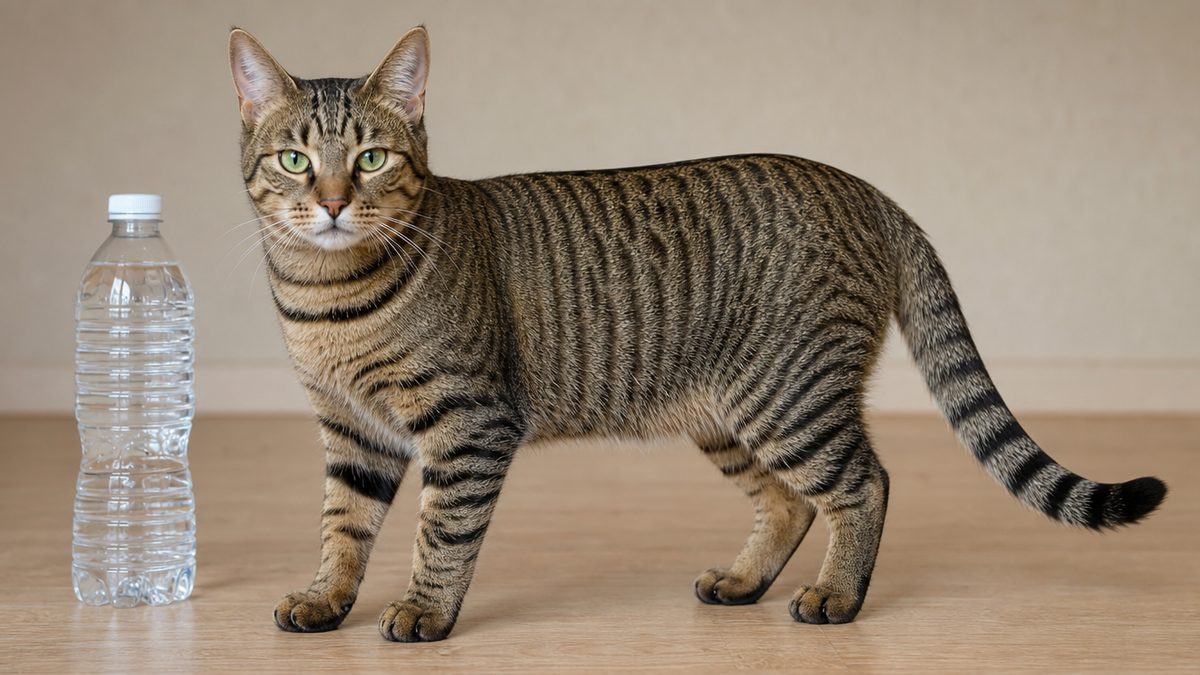
Quick answer
The dragon li cat is a Chinese mackerel tabby landrace, not a recognised breed. The Cat Fanciers' Association accepted it into Miscellaneous status in February 2010 and voted on 8 February 2015 to remove it effective 1 May 2015, closing registration. No cat registry recognises it today, and Baidu Baike defines 狸花猫 as a colour-pattern variety of the domestic cat rather than a breed. India has no market for it; the only rupee figures Bonbeno found were merchandise.
This page is general information, not veterinary advice. Nothing here diagnoses or treats a cat. If your cat is unwell, losing weight, off its food, breathing oddly or behaving out of character, see a registered veterinary practitioner the same day rather than acting on anything you read online, including this page.
Dragon Li at a glance
What a Dragon Li cat actually is
A Dragon Li is a brown mackerel tabby cat from China, and the name describes a coat colour before it describes anything else. Chinese sources say so directly, the English-language internet says the opposite, and the disagreement is the whole story of this page.
Start with the Chinese, because the Chinese is unambiguous and almost nobody in English has read it. Baidu Baike's entry for 狸花猫, reviewed under the Kepu China science programme with the Chinese Academy of Sciences Institute of Zoology, opens by defining the animal as a 家猫花色品种, a colour-pattern variety of the domestic cat, and repeats it in the zoological history section as 家猫(Felis catus)中的一种花色品种, one colour variety within the domestic cat. The species name it gives is simply *Felis catus*. There is no breed-level taxon anywhere on the page.
The alternative names settle it. The same entry says the cat is 又称黄狸猫、虎斑猫, also called the yellow li cat and the tabby cat. 虎斑猫 is the ordinary Chinese word for a tabby. A name whose synonym is the pattern word is a pattern word.
Baidu's own filing does the rest. The entry sits in two topic clusters, 中国本土猫品种 and 中华田园猫的种类, the types of Chinese village cat. The other members of those clusters are 橘猫 the orange cat, 三花猫 the calico, 奶牛猫 the black-and-white cat and 玄猫 the black cat. Every one of them is a coat colour. The Dragon Li is filed with the colours because in Chinese it is one.
What the English name adds
The English names arrived with a breeding project, not with the cats. Wikipedia records that Chinese Li Hua and Dragon Li came into international use for a standardised breed developed in the early 2000s from the landrace, and states in its own infobox that the result is not recognised as a standardised breed by any major breed registry. The dragon in the name is marketing: a potent Chinese symbol attached to a village cat for an English-speaking audience.
Even the first character is contested. Wikipedia glosses 貍 as the common raccoon dog and 花 as pattern, giving a literal reading of raccoon-dog-patterned cat, and separately offers leopard-cat-patterned cat. Baidu's own entry for 豹猫, the leopard cat *Prionailurus bengalensis*, lists 狸猫 among its aliases. Google's India results for the term list the common raccoon dog among related entities. One character, three animals, and a native Chinese speaker would not read it as a proper noun at all.
| Source | What it calls 狸花猫 / Dragon Li |
|---|---|
| Baidu Baike, reviewed with the CAS Institute of Zoology | 家猫花色品种, a colour-pattern variety of the domestic cat |
| Baidu Baike, alternative names | 黄狸猫 and 虎斑猫, yellow li cat and tabby cat |
| Wikipedia infobox | Not recognised as a standardised breed by any major breed registry |
| Wikipedia navbox | Filed under Landraces, beside Cyprus and the Aegean |
| Cat Fanciers' Association, 2010 to 2015 | A Miscellaneous breed, then not |
| Every page ranking in India | An ancient Chinese breed, with no registry named |
Bonbeno applies a two-condition test to any disputed name: a written breed standard, and a studbook recording individuals generation after generation. The Dragon Li once had both and now has neither. A standard existed and was withdrawn; a register existed and was closed on 1 May 2015. That is not a breed in formation and it is not a brand. It is a type, and specifically a coat pattern, which is what the Chinese sources called it all along. The Cyprus cat page in this pair reaches a different verdict from the same starting point.
Registry recognition, checked body by body with controls
No cat registry recognises the Dragon Li today. Bonbeno checked five bodies against their own current documents on 3 September 2026, and ran a control inside each document so that an absence means something.
The controls matter more than the absences. A search that returns nothing because it never ran is not evidence, so every check below names a breed that was present on the same page.
| Body | Status today | Document read, and the control inside it |
|---|---|---|
| Cat Fanciers' Association (CFA) | Not recognised, and not registrable | The 2026-27 Show Rules, 60 pages. 'Li Hua' occurs zero times; the control 'Toybob' occurs in Article XXX at class 7900/7901. Article XXXII names one Provisional breed, the Khao Manee. Article XXXIII names no Miscellaneous breed at all |
| CFA, second instrument | Absent | The live Breed/Color Prefix Chart carries 45 breed headings. Li Hua, Lihua and Chinese all return zero; Toybob, Lykoi and Khao Manee are present |
| The International Cat Association (TICA) | Not recognised at any level | 73 championship breeds, none of them a Li Hua. Advanced New Breeds holds Serengeti and Toybob, which is the control that proves the class pages render; Preliminary New Breeds returns 'No matches found'; The International Cat Association The International Cat Association |
| Federation Internationale Feline (FIFe) | Absent | Four categories of fully recognised breeds plus a preliminary list holding exactly two, Bombay and Lykoi, each dated 2023 to 2027. The landrace controls European and Sokoke are both fully recognised, so FIFe does admit landraces |
| Governing Council of the Cat Fancy (GCCF) | Named, not recognised, not admitted | GCCF lists 'Chinese Li Hau' among other recognised breeds it knows of, calling them experimental or rare and not present in the UK. It is not on GCCF's name-recognition list, and note 3 states that breeds without GCCF recognition are not eligible to be present at GCCF-licensed shows at all |
| World Cat Federation (WCF) | Absent | 46 shorthair standards, including the landraces Anatoli, Ceylon and Arabian Mau. No Li Hua, no Dragon Li |
A misspelling that manufactures a false absence
GCCF prints the name as Chinese Li Hau, not Li Hua. Anyone grepping the correct spelling on that site finds nothing and concludes the breed is unknown to GCCF, when in fact GCCF names it explicitly. Search a distinctive fragment rather than a full name before you report any registry absence.
Why the show rules do not settle it on their own
CFA's Article XXXIII is worth quoting in full, because it is the reason absence from the rules is not the same as removal. It reads: 'The breed(s) listed below, if any, are eligible for entry in this division. Any breed accepted for CFA registration, but not listed below, is also eligible for entry in this division immediately upon its acceptance for registration';. The list under that sentence is empty. So CFA's Miscellaneous division is defined by registration acceptance rather than by a roll call, and a breed vanishing from the rules proves nothing.
What settles it is that CFA closed registration. The board voted on 8 February 2015 to remove the Chinese Li Hua from Miscellaneous status effective 1 May 2015, and the chair stated the effect plainly: nobody can register a Li Hua after 30 April. With registration closed, the open clause in Article XXXIII has nothing to admit.
Less than the word suggests. Under CFA rule 2.26e the Miscellaneous class is non-competitive: entries are examined by judges but no awards are made unless the club chooses to offer best, second and third of breed, and the judge marks a dash on the colour class sheet for every cat handled in it. CFA's own chair put it more bluntly during the 2015 debate: 'That's all Miscellaneous is, is they can register cats';. For the opposite result on a comparable population, see the Aphrodite Giant, which one registry did accept.
The five CFA years, with the numbers the board actually saw
CFA ran the Chinese Li Hua for five years and wrote down exactly why it stopped. The figures below come from two board documents Bonbeno extracted as text, not from any summary of them.
The Cat Fanciers' Association accepted the breed at its meeting of 6 and 7 February 2010. The minute is one line under Breeds and Standards: 'Consider the acceptance of Li Hua Mao breed in Miscellaneous status. Motion Carried';. Note the name CFA used at the time, Li Hua Mao, which is the Chinese colour term transliterated whole.
Five years later the committee laid out what had happened. Its report to the board on 8 February 2015 reads: 'There is only one truly active breeder in the United States, and the driving force in China has recently expressed her desire to terminate her involvement with the advancement of the breed... we are still looking at a grand total over 5 years of about 50 cats... We don't even see them in their home country and we're not even seeing them in Beijing anymore';.
| Measure | 2010 | 2011 | 2012 | 2013 | 2014 |
|---|---|---|---|---|---|
| Status | MISC | MISC | MISC | MISC | MISC |
| Eligible for advancement | No | No | No | No | No |
| Unique cats shown | 8 | 8 | 9 | 14 | 11 |
| Total entries | 20 | 36 | 12 | 18 | 25 |
| Unique breeders | 4 | 3 | 2 | 1 | 3 |
| CFA regions shown in | 5 | 6 | 3 | 3 | 3 |
| Judges' comments positive | 51% | 61% | 67% | 36% | 48% |
The arithmetic reconciles. Positive comments across the five years run 211 against 172 negative, which is 55 percent, and the yearly percentages each reproduce from their own counts. Total entries sum to 111.
Where CFA's own two reports disagree
CFA's 2012 status report and its 2015 report give different numbers for the same two years, and both are internally consistent. The 2012 table records 6 unique cats in 2010 and 10 in 2011 on 20 and 58 entries, giving 30 percent and 17 percent unique. The 2015 table records 8 and 8 on 20 and 36 entries, giving 40 percent and 22 percent. Each set divides out correctly against its own denominators, so this is not a typo in either. Bonbeno publishes both rather than picking one, and notes that the 2015 figures are the ones that reconcile with the by-breeder pivot printed beside them.
The committee that was one person
The 2014 CFA Breed Committee Poll for the Chinese Li Hua prints its own membership: 'Re-Elected Breed Committee Chair: Jacqui Bennett, Buford, GA. Total Members: 1. Ballots Received: 1'. Set that against CFA's Breed and Color Advancement Matrix, which requires 10 active breeders and 50 registered cats to enter Miscellaneous, and 25 active breeders, 100 cats and registrations spanning at least five years to reach Provisional. The same breeder showed 18 of the 25 entries recorded in 2014.
CFA collects a written comment from every judge who handles a Miscellaneous cat, and the 2013 and 2014 sets are quoted verbatim in the transcript. Among them: 'Nothing distinctive about these cats that categorizes them as a breed'; 'Not distinctive enough from domestic tabbies'; 'looks like a nondescript random bred domestic SH'; 'This breed is nothing more than a brown mctabby domestic, apparently bred by one person'; 'Calling them a breed is a stretch of the truth';. Those are the people paid to tell one cat from another.
History and origin, and where the ancient-breed claim breaks
The Dragon Li's antiquity claim rests on Chinese cats being ancient, which is true, and on those ancient cats being this animal's ancestors, which the genetics now contradict. Three papers published since 2014 have taken the story apart.
Every ranking page opens with a version of the same sentence: one of the oldest natural cat breeds in China, thousands of years of history. Baidu itself invokes the Song dynasty tale 狸猫换太子 and Lu You's cat poems. The cultural depth is real. The descent is not established.
The first crack came from Quanhucun in Shaanxi. Hu and colleagues reported in PNAS in 2014 that cat bones from a 5,300-year-old farming village showed commensal processes of cat domestication, the earliest such evidence in China. It was widely read as proof of ancient Chinese cat-keeping.
The second crack reopened it. Vigne and colleagues re-examined the same material and published in PLoS ONE in 2016 under a title that says everything: Earliest 'Domestic' Cats in China Identified as Leopard Cat (Prionailurus bengalensis). The Quanhucun animals were not *Felis catus* at all. They were a different genus.
The third closed it. A 2026 Cell Genomics study by Han and colleagues is titled The late arrival of domestic cats in China via the Silk Road after 3,500 years of human-leopard cat commensalism. On that account the domestic cat reached China late and from the west, and the long Chinese relationship with a small striped cat was a relationship with a wild leopard cat that left no descendants in the modern population.
The Chinese mountain cat claim, tested
A second origin story holds that the Dragon Li descends from crossing with the Chinese mountain cat, *Felis bieti*. That one has actually been tested. Yu and colleagues sequenced the animal for Science Advances in 2021 and found it to be a wildcat conspecific, *Felis silvestris bieti*, with introgression flowing from it into domestic cats. Real gene flow, then, but on the Tibetan plateau, which is not Shaanxi or Henan, and running into domestic cats generally rather than into one tabby population.
What the modern history actually is
The documented history is twenty years long and Chinese sources say so. Baidu Baike dates recognition as an experimental breeding variety to 2003. Wikipedia dates the breed's debut as an experimental standardised breed to a Beijing show in January 2004, judged by two American Cat Fanciers Association judges as guests of the Cat Aficionado Association, and records a 2005 champion named Needy who was married off in a mock traditional wedding for the press.
Baidu Baike says CFA has recognised the cat since 2003 as an experimental breeding variety. CFA's own minutes record the Miscellaneous motion carried at the meeting of 6 and 7 February 2010. Seven years apart, from a Chinese state-reviewed encyclopedia and from the registry's own board record. Bonbeno prints both. The likeliest reconciliation is that 2003 refers to the Chinese Cat Aficionado Association's own experimental class rather than to anything CFA did, but no document Bonbeno opened says so, and guessing would be worse than the gap.
Baidu adds one line that the English pages leave out, and it is the most honest sentence written about this cat anywhere: 狸猫的历史悠久,与其他猫种的杂交太多,将它纯化比较困难. The li cat has a long history, it has crossed too much with other cats, and purifying it is comparatively difficult.
Dragon Li cat price in India, and what the rupee figures really are
There is no Dragon Li price in India, because there is no Dragon Li in India. Every rupee figure Bonbeno traced under the name turned out to be merchandise, and every dollar figure turned out to be a foreign price run through a calculator.
Say the conclusion first, because the rest of this section is the working. No Indian breeder, retailer, marketplace or price guide lists this cat. Nothing is being sold here, so no price in india exists to report, and any figure presented as one has come from somewhere else.
The only rupee figures are merchandise
Bonbeno searched the commercial form of the query on Google with an Indian geo on 3 September 2026 and followed every rupee figure on the page. Two sellers appeared. Amazon.in offers a paperback titled *For Dragon Li Cat Fans*, ISBN 979-8607621445, six inches by nine. Etsy's India storefront returns a Chinese Li Hua Cat results page running from ₹212 to ₹14,039 across prints and gifts. Both are objects. Neither is an animal.
This is a documented trap on obscure breeds and it is harder to spot than a wrong number, because ₹14,039 is a perfectly plausible kitten price. Before you treat any rupee figure as a price, check that the listing is for a live animal.
The dollar figures are conversions, and the rates do not agree
Google's AI Mode answered the Indian price query by stating that the breed costs 400 to 1,000 US dollars, 'approx. ₹33,000 to ₹83,000 INR', and sourced the dollar band to Cats.com, an American page carrying no Indian content. Divide the rupee figures by the dollar figures and the implied rates are 82.50 and 83.00. A single sentence cannot hold one exchange rate across its own two ends, which is the signature of arithmetic rather than of a market.
The same answer then produced '₹1,000,000+ INR' as an import cost with no source attached at all. In the same session, asked about a different cat, the same engine converted at a flat 84.00. Three rates in one hour from one engine.
| Figure | Where it came from | What it actually is |
|---|---|---|
| ₹212 to ₹14,039 | Etsy India, Chinese Li Hua Cat results page | Prints and gift items |
| Amazon.in listing | Book, ISBN 979-8607621445 | A notebook for fans of the cat |
| USD 400 to 1,000 | Cats.com, quoted by Google AI Mode | A US figure, no Indian relevance |
| ₹33,000 to ₹83,000 | Google AI Mode | The above divided at 82.50 and 83.00 |
| ₹1,000,000+ | Google AI Mode | No source given |
| ₹0 to ₹2,000 | Google AI Mode, citing Supertails | An Indian domestic shorthair, adopted |
The answer engine's own last line is the correct one. Asked for a Dragon Li in India it offered instead 'Standard brown mackerel tabby or Indian domestic shorthair cats' at ₹0 to ₹2,000 through adoption or rescue. That is not a substitute for the Dragon Li. Genetically and morphologically it is the same proposition: an unimproved regional tabby landrace of *Felis catus*. Adopt one and you have the cat without the story.
One more thing worth knowing before you read a result count as demand. The bare query 'dragon li cat' returned 'About 113 results' on the same instrument and in the same session in which 'labrador retriever dog' returned 'About 197 results';. The thickest cat and dog queries in India return three-figure counts on this render, so a small number proves nothing about a market. What does prove a thin market is composition, and here the composition is a bookshop and a print shop.
Cost of ownership for a short-haired tabby in India
Budget roughly ₹3,500 to ₹8,000 a month to keep a cat of this size and coat in an Indian metro, plus about ₹4,000 in the first year for the kitten vaccination course. Those are Indian care costs, which are real and sourceable, rather than a breed price, which is not.
The distinction matters. There is no purchase figure for this cat, and inventing one would be fabrication. What an Indian reader actually needs is the running cost of ownership, and that applies to any short-coated cat of five kilograms whatever you call it.
First-year veterinary spend
Vetic, a clinic chain operating across seven Indian metros, prices a kitten course from ₹3,999, covering three visits at days 60, 90 and 120 for CRP, that is the combined panleukopenia, calicivirus and rhinotracheitis vaccine, plus anti-rabies. Its adult annual booster package starts at ₹1,899. Bought singly, anti-rabies starts at ₹699 and CRP at ₹1,249. Read on 3 September 2026; retail prices move, so re-check before you plan around them.
None of those figures divides cleanly at 84.38, 80 or 74, so none is a disguised dollar price. They are rupee-native charm prices, which is what a genuine Indian rate card looks like.
| Item | Cost | Source |
|---|---|---|
| Kitten vaccination course, 3 visits | From ₹3,999 | Vetic clinic chain |
| Adult annual booster package | From ₹1,899 | Vetic clinic chain |
| Anti-rabies, single dose | From ₹699 | Vetic clinic chain |
| CRP combined vaccine, single dose | From ₹1,249 | Vetic clinic chain |
| Pet licence, Chennai | ₹50 | Greater Chennai Corporation |
| Pet registration, Delhi | ₹500, late fee ₹100/month | Municipal Corporation of Delhi |
| Typical monthly running cost | ₹3,500 to ₹8,000 | Indian retail guidance, treat as indicative |
The free option most Indian owners do not know about
The Greater Chennai Corporation runs six veterinary clinics that provide all treatment and anti-rabies vaccination free of cost, and issued 9,115 pet licences in 2024 at ₹50 each. Delhi's municipal registration costs ₹500 with a ₹100 monthly late fee. A civic clinic is a far more affordable route to a legally registered, rabies-vaccinated cat than any private chain, and rabies vaccination for cats is not optional in India.
- Vaccinate on the schedule your vet sets, not the one a website prints. Vetic's own kitten schedule has moved twice in the past year.
- Register the cat with your municipality where a scheme exists, because the fee is trivial and the certificate matters if the animal is ever disputed or lost.
- Feed a complete commercial cat food rather than household leftovers; cats are obligate carnivores and rice-and-curd diets cause taurine problems.
- Groom weekly with a rubber curry comb, which costs a few hundred rupees once and removes most of the shed coat.
- Neuter early. It is the single largest one-off cost and the single largest reduction in lifetime disease and roaming risk.
Bonbeno found no reliable published Indian figure for cat sterilisation, cat boarding or a monthly kibble total that we could tie to a named provider's own page on the day of writing, so we print none. A figure without a URL is not a citation, and a plausible invented number is worse than an acknowledged gap.
Heat tolerance and the Indian climate, measured against the homeland
This cat's homeland summer is nearly as hot as India's and slightly more humid, so the usual warning about tropical humidity is the wrong warning. What China gives it that India does not is a winter, and its coat is built around that.
Bonbeno queried NASA POWER by explicit latitude and longitude for the provinces Baidu names as strongholds, Shaanxi, Shanxi and Henan, and for six Indian cities, and echoed the elevation the model reports for every point so that a wrong grid cell cannot pass unnoticed NASA POWER, Prediction of Worldwide Energy….
| Point | Cell elevation vs real | Annual mean | Annual RH | Hottest month | Coldest month |
|---|---|---|---|---|---|
| Zhengzhou, Henan | 129 m vs 110 m, +19 m | 15.03 °C | 62.07% | Jul 28.41 °C at 68.48% RH | Jan −0.08 °C |
| Xi'an, Shaanxi | 593 m vs 405 m, +188 m | 14.50 °C | 59.82% | Jul 27.51 °C | Jan −0.02 °C |
| Beijing | 222 m vs 44 m, +178 m | 11.61 °C | 52.41% | Jul 26.55 °C | Jan −5.23 °C |
| Chennai | 49 m vs 6 m, +43 m | 27.95 °C | 72.39% | May 31.51 °C at 64.52% RH | Jan 24.09 °C |
| Mumbai | 97 m vs 14 m, +83 m | 26.77 °C | 67.39% | May 31.19 °C | Jan 23.19 °C |
| Delhi | 206 m vs 216 m, −10 m | 25.60 °C | 45.56% | Jun 35.88 °C | Jan 13.61 °C |
| Bengaluru | 842 m vs 920 m, −78 m | 23.74 °C | 67.94% | Apr 28.37 °C | Dec 20.22 °C |
| Pune | 636 m vs 560 m, +76 m | 23.86 °C | 66.80% | Apr 28.93 °C | Dec 19.62 °C |
Zhengzhou is the cleanest homeland baseline, because its cell sits 19 metres from the real town while Xi'an's and Beijing's are 188 and 178 metres out. Use it and the comparison inverts the usual advice. Henan in July runs 28.41 °C at 68.5 percent humidity. Chennai in May runs 31.51 °C at 64.5 percent. Three degrees hotter and four points drier. Whatever this cat's problem in India is, it is not that Chinese cats have never met hot damp air.
What the homeland has and India does not
A winter. Zhengzhou's January mean is −0.08 °C and the annual mean is 15.03 °C against Chennai's 27.95 °C, a gap of 12.9 degrees across the year. The animal is adapted to a continental cycle in which about three months are Indian-hot and three are freezing. Indian plains give it eight hot months and no cold ones, so the load is duration rather than peak.
The withdrawn CFA standard is unusually helpful here, because it describes the coat's limits from the other end: 'short and thick, lying close to the body. There is no thick undercoat so they do not have very great resistance to cold'. A single-coated cat is the right build for Indian heat and the wrong build for a Chinese January, which tells you the population is already at its cold edge, not its hot one. That is why Bonbeno rates its heat tolerance 3 rather than 2.
City by city, for India
- Bengaluru and Pune suit it best: 23.7 and 23.9 °C annual means with a real cool season, closest of any Indian city to a continental cycle.
- Delhi is the closest analogue in shape, with a January mean of 13.61 °C and a genuine winter, but June at 35.88 °C is hotter than anything Henan sees as a mean.
- Chennai, Mumbai and Kolkata are the hardest, not because they are hot but because they never stop: Chennai's coldest month still averages 24.09 °C, warmer than Zhengzhou's hottest.
- Monsoon humidity is a skin problem rather than a heat problem for a short coat; the risk is moisture trapped in ears and skin folds, not overheating.
NASA POWER's T2M_MAX is the highest value recorded across the whole climatology period, not an average daily high. For the Chennai cell it reads 42.70 °C in May and for Delhi 48.79 °C in June. Those are records, not routine afternoons. Every temperature in the table above is T2M, a genuine mean, paired with RH2M so a reader can judge the evaporative load rather than the number alone.
Temperament and household fit, with the evidence stated honestly
No study has measured this population's temperament, so the only substantial description available is Baidu Baike's, and it does not describe a lap cat. Read what follows as one encyclopedia's account rather than as a breed profile.
The English pages are confident and unsourced. Cats.com calls the cat clever, active, vigilant and friendly; UK pages call it loyal and dog-like. None of them names a study, a survey or a breed club, because none exists.
Baidu Baike is more specific and less flattering, which is a good sign in a source. It describes the cat as 性格独立活泼, independent and lively, 对环境变化敏感度较高, notably sensitive to environmental change, and says that a change of owner easily causes it psychological harm. It then says that once adult the cat 不会主动与人嬉闹, does not take the initiative in playing with people, but 会长期活动在主人视线范围内, stays active within its owner's field of view, and is 对主人忠诚含蓄, loyal to its owner in a reserved way.
That is a coherent picture and a useful one: an independent working cat that attaches to a place and a person, watches from across the room rather than sitting on you, and takes rehoming badly.
Who this cat suits in an Indian household
- Suits a household that wants a self-possessed cat, is home enough to be watched, and is not planning to move the animal between homes.
- Suits a flat with balconies netted and a window perch, because the described behaviour is observation rather than demand.
- Does not suit an owner who wants a cat that will be handled by visitors on request.
- Does not suit a household that will rehome the cat when circumstances change, which the description singles out as the specific harm.
The hunting drive is the part everyone agrees on
Chinese sources return to it constantly: 天性擅长捕鼠, naturally skilled at catching rats, and 善于捕鼠, good at hunting mice. The World Cat Congress makes the parallel argument for a different island landrace, that hard living selects for cats that can take large prey. In an Indian flat that drive has nowhere to go, and an unstimulated hunting cat redirects onto ankles, curtains and 3 a.m. sprints.
Two practical consequences follow. Provide daily wand play in two short sessions rather than one long one, and socialise kittens to handling in the first twelve weeks, because a cat that spends adulthood at a polite distance is much easier to medicate if it learned early that hands are safe.
Every trait score on this site is meant to be defensible. There is no measured evidence on which to score friendliness, tolerance of children or compatibility with dogs for this population, and a number invented to fill a table is a fabrication with a decimal point. The traits panel scores what can be evidenced: heat tolerance, grooming load, availability, evidence strength, pedigree verifiability and demandingness.
Training approach, and what this cat resists
Train this cat by making the behaviour you want more rewarding than the behaviour you do not, in sessions of two or three minutes, and expect it to resist restraint far more than it resists learning.
No training study exists for this population, so what follows is general feline behaviour applied to the one temperament description that does exist. Baidu's account of a cat that watches from a distance and dislikes handling predicts exactly which parts of training will be easy and which will not.
What goes easily
- Litter training, which usually needs nothing beyond a clean tray in a quiet corner away from food.
- Recall to a sound, because a food-motivated hunting cat learns a shaken treat tin within a week.
- Carrier training, if the carrier lives open in the room as furniture rather than appearing on vet day.
- Scratching post use, provided the post is tall enough to stretch on and stands where the cat already scratches.
What it resists
Restraint, and being made to perform in front of people. The CFA show reports are unusually good evidence here, because they record judges handling individual cats: comments across 2010 to 2014 include cats that were 'very frightened, making it difficult to examine them', one that 'clings to table', and repeated notes of shyness. A cat that finds a show table frightening will find a vet table frightening too.
The practical answer is cooperative-care training. Spend five minutes a day for a month pairing a treat with a touched paw, a lifted lip, an ear held for two seconds. It is the highest-value training an Indian cat owner can do, because it converts an annual battle into a routine.
Declawing is not a training option. The Prevention of Cruelty to Animals Act, 1960 is the governing instrument for animal cruelty in India, and the Prevention of Cruelty to Animals (Pet Shop) Rules, 2018 regulate the sale of cats and kittens through pet shops Prevention of Cruelty to Animals. Nothing in Indian practice supports removing the last bone of every toe to protect furniture. Trim the tips, provide posts, and cover the sofa arm.
Bell the cat if it goes outside, and preferably do not let it go outside at all. India's urban cat population lives alongside dogs, traffic and unvaccinated animals, and an indoor cat with a netted balcony gets most of the enrichment with almost none of the risk.
Daily exercise requirement, and what happens without it
Give this cat two structured play sessions of ten to fifteen minutes a day, ending each on a catch and a meal. Skip them and a hunting-bred tabby in a two-bedroom flat will invent its own hunting, usually at four in the morning and usually involving you.
Every Chinese description of this animal is a description of a predator. Baidu returns twice to its skill at catching rats, and the withdrawn CFA standard opens by calling the Li Hua a natural breed 'known as good hunters';. That drive does not switch off because the address changed.
The prey sequence, and why the ending matters
Cats run a fixed sequence: stare, stalk, chase, pounce, grab, kill-bite, eat. A play session that stops mid-chase leaves the sequence open and the cat wound up. Finish every session by letting the cat catch the wand toy, then feed a small meal. That completes the loop and produces the post-meal sleep you actually wanted.
- Morning, ten minutes of wand play before you leave, ending in a catch and a portion of breakfast.
- Through the day, a puzzle feeder or a portion scattered so the cat has to work for it.
- Evening, fifteen minutes of the same routine, ideally an hour before your bedtime rather than at it.
- Overnight, leave a foraging toy out so the 4 a.m. energy has a legal target.
Vertical space is the Indian flat's best answer
Indian apartments are short on floor area and long on wall. A cat tree, a cleared shelf run and a window perch triple the usable territory without taking a square metre of floor. The window perch is the single highest-value item: a cat that can watch birds and street activity for two hours a day is a cat that is not dismantling your curtains.
A muscular, athletic cat with a strong prey drive and an open balcony in a high-rise is a fall waiting to happen, and high-rise syndrome is a genuine emergency-clinic presentation in Indian metros. Net the balcony before the cat arrives, not after the first close call. The mesh costs a fraction of one orthopaedic surgery.
Heat changes the timing rather than the amount. In May in Chennai or Delhi, move both sessions to early morning and after dark and let the cat sleep through the afternoon, which is what it will do anyway.
Grooming and coat care in Indian humidity
A weekly comb is enough, and that is the strongest practical argument for this kind of cat in India. A short coat with no dense undercoat is close to the ideal for a humid flat, because there is nothing to mat and nothing to hold moisture against the skin.
The withdrawn CFA standard describes the coat precisely: 'short and thick, lying close to the body. There is no thick undercoat... The hair on the chest is short, flat and close to the skin. The male coat is thick and tough, while the female is softer in comparison';. That is an ordinary short-haired working coat.
The weekly routine
- Groom once a week with a rubber curry brush, five minutes, in the direction of the coat then briefly against it.
- Check ears at the same time, especially through the monsoon, when trapped moisture and wax are the commonest reason an Indian cat starts head-shaking.
- Trim claw tips every three to four weeks, taking only the clear hook and staying well clear of the pink quick.
- Check between the toes and under the tail for ticks after any outdoor access, which is where they attach on cats.
What Indian humidity actually changes
Not the coat, the skin under it. Monsoon humidity keeps fur damp for hours after rain and encourages yeast and bacterial overgrowth in warm folds, so the risk areas on a short-coated cat are the ear canals, the chin and the base of the tail. Dry a wet cat properly with a towel rather than leaving it to air dry, which is care advice imported from temperate countries that does not transfer to an Indian July.
Bathing is almost never necessary. Cats groom themselves thoroughly, and a bath strips the coat oils that keep the skin barrier working. Bathe only on veterinary instruction, for a medicated wash or after contamination.
Shedding and hairballs
This cat will shed more months of the year in India than in China, because moulting is triggered by day length and temperature swing and Indian plains supply little of either. Expect a continuous low-level moult rather than two heavy seasonal ones. That means more hair swallowed, so more hairballs: the weekly comb is the cheapest prevention, and a vet-recommended malt paste or cat grass is the second line.
A Persian or a semi-longhaired cat in an Indian metro needs professional grooming, and Indian salon rates run into four figures per visit. A short-coated tabby needs a ₹300 rubber brush once. Over a fifteen-year life that difference is larger than any purchase price anybody has ever quoted for this cat.
Health risks and life expectancy, with the gaps named
No inherited disease is documented in this population, no screening scheme exists for it, and no lifespan study has ever been done on it. That is a genuine finding rather than a gap in this page, and for an unimproved landrace it mostly counts as good news.
Start with what is absent and why the absence is trustworthy. Bonbeno searched the literature in three languages and ran controls in the same session, because an unproven absence is a broken query rather than evidence.
| Query | Result | What it actually means |
|---|---|---|
| 狸花猫 on PubMed | 0 records | Meaningless. PubMed emptied the query: the translation line it ran was blank |
| 黑狼 on PubMed, CJK control | 0 records, blank translation | Confirms PubMed voids Chinese script rather than searching it |
| 黑狼 on Europe PMC, CJK control | 120 records | Europe PMC does tokenise Chinese, so its zeros are real |
| 狸花猫 on Europe PMC | 3 hits, 0 about the cat | Bilingual language control, a coronavirus review and a checklist of Kenyan mammals |
| Dragon Li cat on PubMed | 0 records | Turned into an author search for 'Li, Cat'; |
| Chinese Li Hua on PubMed | 1,398 records | An author collision. Li Hua is a common Chinese personal name; none of the hits is about a cat |
| Felis catus hip dysplasia, control | 61 records, sane translation | The instrument was working throughout |
The 1,398 figure is the dangerous one. A page that reported it as this cat's literature would be wrong by 1,398 papers, and the count looks authoritative until you read the translation line PubMed prints beside it.
Life expectancy, using the only honest proxy
No study measures how long these cats live. The nearest real evidence is UK primary-care data: Teng and colleagues built life tables from 7,936 cats and put life expectancy at birth at 11.74 years for cats overall. Mata's 2025 PeerJ analysis is the more useful one here, because its finding is in its title: moggies and mollies live longer, with crossbred cats outliving purebreds.
That is the argument for this animal rather than against it. An unimproved landrace tabby carries no fixed mutation, no exaggerated skull, no shortened limb and no closed gene pool, which is exactly the profile the crossbred survival advantage describes. A 2025 Animal Welfare framework paper makes the same case from the welfare side, arguing that the conversation about UK purebred cats needs refocusing on the harms selective breeding has fixed.
What an Indian owner should actually screen for
Not inherited disease. Infectious and parasitic disease, which is where Indian cats actually get into trouble.
- Rabies, which is a mandatory vaccine for cats in India and a fatal zoonosis, not a formality.
- Panleukopenia, calicivirus and rhinotracheitis, covered by the CRP or Tricat vaccine and the reason kittens should not meet other cats before the course finishes.
- Tick-borne disease, which is a heavy burden in Indian small-animal practice; among dogs tested at Indian veterinary clinics, published series report *Ehrlichia canis* and *Babesia* at high rates, and the same tick vectors feed on cats.
- Feline immunodeficiency virus and feline leukaemia, worth testing in any cat taken off the street before it meets a resident cat.
Indian tick-borne disease studies sample clinically suspected animals or clinic caseloads, not random populations. A figure like 76 percent describes dogs brought to a vet because they were ill, not dogs on the street. Say 'among animals tested at veterinary clinics' or the number is materially misleading, and note that much Indian veterinary work appears in journals PubMed does not index, so an absence there is a coverage gap rather than proof.
Feeding a cat of this size in India, by life stage
Feed a complete commercial cat food appropriate to the life stage, split into small frequent meals for kittens and two to three meals for adults, and treat body condition rather than the bag's chart as the measure of whether you have it right.
The withdrawn CFA standard gives the only size figures anyone has for this population: adult males over 11 pounds, that is 5.0 kg, and females not below 8.75 pounds, 3.97 kg. It also warns against 'obesity, paunchiness, weakness, or apathy', which is a standard telling breeders that the cat should be lean.
Kitten to adult, the stages that matter
Baidu Baike sets out a Chinese feeding schedule that maps well onto Indian practice: weaning around four weeks onto a milk-replacer paste with a little kitten food, pure kitten food from about ten weeks with free access to clean water, five or six meals a day at two months, four a day to three months, three a day from three to six months, and two a day thereafter. It adds one warning worth repeating loudly in India, that ordinary cow's milk must not be fed and a pet-specific goat-milk powder should be used instead.
| Stage | Meals per day | What to feed | Indian note |
|---|---|---|---|
| 4 to 10 weeks | 5 to 6 | Weaning paste plus a little kitten food | Never cow's milk; use pet goat-milk powder |
| 10 weeks to 3 months | 4 | Complete kitten food, free water | Wet food helps hydration in hot months |
| 3 to 6 months | 3 | Complete kitten food | Weigh fortnightly; growth should be steady, not fast |
| 6 to 12 months | 2 | Kitten food to 12 months | Neutering usually falls here; cut portions after |
| 1 to 7 years | 2 to 3 | Complete adult food | Watch weight in the first year after neutering |
| 7 years and over | 2 to 3 | Senior food, lower fat and energy, higher fibre, lower magnesium and phosphorus | Baidu's own senior guidance, aimed at kidney and urinary health |
Water is the Indian variable
Cats evolved from desert ancestors and drink badly, and an Indian summer makes that dangerous. Run at least one wide bowl per cat plus one more, sited away from food and litter, and consider a fountain, because moving water is drunk more readily. Wet food is not a luxury in a Chennai May; it is a hydration strategy.
Cats are obligate carnivores and cannot synthesise taurine, arachidonic acid or preformed vitamin A in adequate amounts. In an Indian household where the human diet may be vegetarian, this is the single most consequential feeding fact on this page. A taurine-deficient cat develops dilated cardiomyopathy and central retinal degeneration, both of which are preventable and neither of which is reversible once advanced. Talk to your vet before making any dietary change on principle.
Month by month through the first year
Plan the first year around three fixed points: the vaccination course finishing at about day 120, neutering between four and six months, and a slow physical maturation that the withdrawn standard put at up to three years.
The maturation figure is worth stating early because it changes expectations. CFA's standard described the cat as 'relatively slow to mature, taking as long as three years', with adult males significantly larger than females. A gangly eighteen-month-old is not a finished cat.
| Age | What happens | What you do |
|---|---|---|
| 0 to 8 weeks | With the mother; eyes open, weaning begins about week 4 | Do not take a kitten before 8 weeks; handle daily and gently if you have the litter |
| 8 to 9 weeks | Home. Neophobia window closing | Quiet room, one litter tray, introduce carrier as furniture |
| Day 60 | First CRP vaccine | Vetic prices the three-visit course from ₹3,999 |
| Day 90 | Anti-rabies plus CRP | Do not let the kitten meet unvaccinated cats yet |
| Day 120 | Final CRP plus anti-rabies | Course complete. Now socialise more widely |
| 4 to 6 months | Sexual maturity approaches; deciduous teeth replaced | Neuter. Register with the municipality where a scheme exists |
| 6 to 9 months | Energy peak; the 4 a.m. sprint years | Two structured play sessions a day, vertical space, netted balcony |
| 9 to 12 months | Switch to adult food at 12 months | Watch post-neutering weight gain closely |
| 1 to 3 years | Slow fill-out; males keep gaining bone and muscle | Annual booster from about ₹1,899 |
The window that closes
A kitten's primary socialisation window runs roughly from two to seven or eight weeks, before most kittens go home. Whatever handling the litter received before you met it has already shaped the adult. If you are choosing a kitten, spend more time assessing how it responds to being picked up than assessing its markings, and remember Baidu's warning that this type takes rehoming badly.
India's Prevention of Cruelty to Animals (Pet Shop) Rules, 2018 regulate the sale of cats and kittens through pet shops, and no responsible source anywhere recommends separating a kitten from its mother earlier than eight weeks. A seller pushing a six-week kitten on you is telling you something about the seller.
Head to head against the cats Indian buyers cross-shop
Compare the Dragon Li against the three cats an Indian buyer actually chooses between, and the honest result is that the free one wins on every measure that can be checked.
The comparison below is not rhetorical. Each column is filled from the registry documents and studies cited elsewhere on this page, and the empty cells are empty because nothing exists to put in them.
| Dragon Li | Indian domestic shorthair | Bengal | American Shorthair | |
|---|---|---|---|---|
| Registry status | None; CFA registration closed 1 May 2015 | None, and never claimed | CFA, TICA, FIFe and WCF championship | CFA championship |
| Pedigree you can verify | No body issues one | Not applicable | Yes | Yes |
| Available in India | No | Everywhere, free | Yes, widely bred | Rare |
| Indian price | None; only merchandise | ₹0 to ₹2,000 adopted | Five figures | Five figures |
| Coat care in Indian humidity | Weekly comb | Weekly comb | Weekly comb | Weekly comb |
| Known inherited disease | None documented | None fixed | Progressive retinal atrophy and pyruvate kinase deficiency are screened for in the breed | Hypertrophic cardiomyopathy reported |
| Lifespan evidence | None specific to it | Crossbred survival advantage | Breed-specific data limited | Breed-specific data limited |
| Heat tolerance rating | 3 of 5 | 5 of 5, locally adapted | 4 of 5 | 3 of 5 |
Against the Indian domestic shorthair
This is the comparison that matters, and it is closer to an identity than a contest. Both are unimproved regional tabby landraces of *Felis catus*, shaped by street life rather than by breeders, short-coated, muscular and hardy. The Indian cat has the advantage of being locally adapted to exactly the climate you live in, of being free, of being available today, and of not requiring you to believe anything unverifiable about its ancestry.
Against the Bengal
Indian sellers steer buyers who ask for a striped or wild-looking cat toward the Bengal, and it is a genuinely distinctive breed with real registry standing across CFA, TICA, FIFe and WCF. It is also a hybrid breed with an active gene pool, screening programmes and a five-figure price, in the way that the Maine Coon and the Persian are documented breeds with published health schemes behind them. If what you want is a cat that looks wild and is documented, the Bengal is the honest answer. If what you wanted was a Chinese tabby, the Bengal is not it, and the American Shorthair is the closer parallel, being a working tabby landrace that did complete the journey to championship status.
A better documented failure. Because CFA ran the breed for five years and wrote everything down, we know more about why this attempt did not work than we know about most successful breeds' early years. That record, five years of counts, judges' comments and a board debate, is genuinely useful to anyone thinking about what a breed is. It is just not useful for buying a cat.
What Indian buyers get wrong about this cat
The commonest mistake is paying for a name that no longer exists. The rest follow from it, and every one of them is avoidable by asking a single question: which registry issued the paper, and can I check it?
- Believing a pedigree. No cat registry has issued a Dragon Li pedigree since 30 April 2015. Any document offered in India under this name was not issued by CFA, TICA, FIFe, GCCF or WCF, because none of them holds the breed The International Cat Association Federation Internationale Feline, Breeds Governing Council of the Cat Fancy World Cat Federation. Ask which body issued it and check the answer against that body's own breed list, not against the seller.
- Paying a premium for a street tabby. The cat being described to you is an ordinary brown mackerel tabby. It is a good cat. It is not a scarce one, and a five-figure price for it is a price for the story.
- Treating a rupee figure as a price. Every rupee figure Bonbeno traced under this name was merchandise, from a ₹212 Etsy print to a paperback on Amazon.in. Confirm the listing sells an animal.
- Trusting an AI summary's conversion. Google's AI Mode produced ₹33,000 to ₹83,000 from a US dollar band at implied rates of 82.50 and 83.00, and a ₹1,000,000 import figure with no source at all. A generated answer is not a source for a rupee figure.
- Repeating the ancient-breed line. Domestic cats reached China late and via the Silk Road, after roughly 3,500 years in which the small striped cat living alongside Chinese farmers was a leopard cat of a different genus.
- Assuming the cat cannot take Indian heat. Its stronghold provinces run a July mean of 28.41 °C at 68 percent humidity. The homeland summer is not the problem; the missing winter is.
- Buying instead of adopting. The closest available animal to what is being sold is on your street, and a 2025 analysis found crossbred cats outliving purebreds.
The mistake the internet makes, and how to catch it
The English-language web still presents this as a current CFA breed. The page ranking second in India for the term was last modified on 29 August 2022 and does not mention the 2015 removal at all. Google's own AI Overview does mention it, and sources it to a Reddit thread in a dating-game subreddit rather than to the CFA transcript that records the vote Cat Fanciers' Association.
That is worth pausing on. The primary document is free, public, machine-readable and on the registry's own website. It took one search to find and one extraction to read. The answer engine reached for a forum post instead, and anyone who trusts it inherits a claim with no document behind it.
Ask three questions and stop after the first failure. Which registry issued the pedigree, and what is the registration number? Can I see the mother, in the place the kittens were born? What is written on the vaccination card, and which vet signed it? A seller who cannot answer the first question about a breed no registry holds is not going to answer the other two.
Adoption, and the cat you should actually be looking for
Adopt an Indian domestic shorthair. It is the same kind of animal as the one this page is about, it is locally adapted, it is available in every Indian city today, and it costs between nothing and about ₹2,000, which mostly buys its vaccinations.
This is not a consolation prize and it is not a lecture. It is the direct consequence of everything above. The Dragon Li is an unimproved regional tabby landrace; so is the cat sleeping on the scooter outside your building. They are the same species, the same coat, the same body plan and the same working history. One of them has a marketing name attached and no registry behind it.
How to adopt well in an Indian city
- Adopt through a registered shelter or an established local rescue rather than through a classifieds listing, so that the cat has a history somebody can tell you.
- Ask for the vaccination card and check that anti-rabies and CRP are on it with dates and a vet's signature. If the course is incomplete, budget from ₹699 and ₹1,249 per remaining dose.
- Ask whether the cat has been tested for feline immunodeficiency virus and feline leukaemia, especially if you already have a cat at home.
- Verify the neutering status in writing. Most Indian rescues neuter before rehoming; if not, do it, and use the municipal or NGO route where one exists.
- Use your city's civic service where it exists. Greater Chennai Corporation runs six clinics giving all treatment and anti-rabies vaccination free of cost, and issues a pet licence for ₹50. Delhi charges ₹500 to register.
- Quarantine a new cat from a resident cat for two weeks in a separate room, whatever its paperwork says.
If you are set on the Chinese cat specifically
There is no lawful route to one in India, and that is a legal fact rather than a difficulty. India treats live cats as a restricted import, and applications made for trading or breeding purposes are rejected, with entry limited to a personal pet travelling with a valid pet book in the importer's name plus defined research and official uses. No registry issues a pedigree for the animal in any case. Between those two facts, no lawful Indian supply chain for this cat can form, which is why nobody is selling one honestly.
A cat already adapted to your climate, with a healthy unimproved genome, no fixed mutation to screen for, no coat that mats in the monsoon and no premium attached. You also get the thing the Dragon Li story was actually reaching for: a working tabby that has survived by its own competence for a very long time, in a place that shaped it. India has its own version of that story, and it does not need a Chinese name. For a comparable island landrace where breeders did put the work in, the Aegean cat is the closest parallel Bonbeno has written.
One last note on language, because it is the point of this page. In Chinese, calling a cat 狸花猫 is closer to calling it a tabby than to calling it a Siamese. When an Indian seller uses the English name as though it were a breed, the translation has done the selling.
Size and appearance, from the only standard ever written
A Dragon Li is a brown mackerel tabby of medium to large size, and the only detailed description that ever existed is the CFA standard withdrawn in 2015. Bonbeno reproduces its substance here because no other document describes the animal at this resolution.
The standard scored a hundred points across seven headings: head 25, body 25, coat 15, colour 20 split evenly between colour and pattern, paws 5, eye colour 5 and balance 5. It required a 'sturdy, well-proportioned, natural breed with gentle, even dispositions' and stated flatly that 'no outcrosses are required or permitted'.
| Feature | What the standard required |
|---|---|
| Head | 'Like a hexagonal diamond', longer than wide, rounded between the ears; nose the same width along its length; a slight dip at the bridge but no forehead break; lower jaw slightly shorter than the upper with a good bite |
| Eyes | Large, bright, almond-shaped, outer corner set higher than the inner; green, yellow or brown, with green preferred |
| Ears | Medium, wide at the base, set one and a half to two eye-widths apart, facing front and tilted no more than 15 degrees; sharp tips, tufts permitted |
| Body | Wide, strong, rectangular, longer than tall, wide chest, well developed muscles, back almost flat in profile; no obesity, paunchiness, weakness or apathy |
| Weight | Males more than 11 lb (5.0 kg); females not less than 8.75 lb (3.97 kg) |
| Coat | Short and thick, close to the body, no thick undercoat; male coat thick and tough, female softer |
| Pattern | Brown mackerel tabby with spectacular contrast; forehead lines, black lines from the outer eye corners, a small black spot at the rear corner of the mouth giving a smiling expression, at least one unbroken necklace, vertical body lines, ringed legs, black paw pads, ringed tail with a black tip |
| Paws | Broad, large, oval, five toes in front and four behind |
| Disqualify | Improper bite, eye colour outside green, yellow or brown, incorrect toe count, abnormal tail, long body hair or curly chest hair, lack of a complete necklace |
Why the standard could not do its job
Read that list and ask what it excludes. Almost every requirement describes an ordinary brown mackerel tabby, which is one of the commonest cats on earth and certainly the commonest in India. Set it beside any entry in Bonbeno's cat breed index and the contrast is immediate. The distinguishing features are a hexagonal-diamond head shape and a tolerance for a slightly short lower jaw, neither of which a buyer can assess.
CFA's judges said so in writing. Their reports include 'standard needs a lot of revising, i.e., hexagonal diamond??, ear set, necklaces', 'hate language of standard', 'standard confusing', and 'I've never seen more than one that might meet the standard, even loosely';. A standard that its own judges cannot apply is not doing the work a standard exists to do.
What a breed standard is supposed to buy you
Compare the machinery CFA and the World Cat Federation put behind recognition. CFA's published ladder runs registration, then the Miscellaneous class, then Provisional, then Championship, and states plainly that 'Registration does not guarantee eventual progression';. WCF requires a pre-recognition show of six to ten cats to obtain an EMS code, then a recognition show at which the club must present at least 15 cats with complete four-generation pedigrees, of which at least seven show three generations of pure breed, judged by two named judges and voted on at a General Assembly.
That is the scale of evidence a real recognition needs, and it is why a heat-tolerant, hardy, perfectly nice tabby with one breeder and fifty shown cats across five years did not clear it.
Dragon Li cat questions Indian owners actually ask
Are Dragon Li cats rare?
Registered Dragon Li cats are effectively extinct, while cats that look like one are among the commonest animals in China. The Cat Fanciers' Association was the only international registry that ever issued a pedigree, and it stopped on 1 May 2015. Its own five-year review counted a grand total of about 50 individual cats shown across the whole programme. The tabby landrace itself is not rare at all.
How do I know if my cat is a Dragon Li?
You cannot know, and that is the honest answer rather than an evasion. There is no registry issuing pedigrees, no DNA test for the population and no living studbook, so nothing exists to check a cat against. The CFA standard withdrawn in 2015 described a brown mackerel tabby with an M on the forehead, at least one unbroken chest necklace, ringed legs, a black tail tip and black paw pads. Tens of millions of ordinary Indian cats match that description.
Are Dragon Li cats friendly?
No study measures the temperament of this population, so any confident answer you read is someone's impression. Baidu Baike, reviewed with the Chinese Academy of Sciences Institute of Zoology, describes the cats as independent and lively, sensitive to changes around them, harmed psychologically by a change of owner, and not much given to playing with people once adult, while staying within their owner's line of sight. That is a description of a self-possessed working cat, not a lap cat.
How much is a Dragon Li cat worth?
Nothing findable in India is a Dragon Li, so no Indian price exists. Every rupee figure Bonbeno traced under the name is merchandise: an Amazon.in notebook for Dragon Li cat fans, and an Etsy India results page running from ₹212 to ₹14,039 for prints and gifts. Confirm any rupee figure is attached to a live animal before you treat it as a price.
How to identify a Dragon Li cat?
Identify it the way the withdrawn CFA standard did, and then accept that the test does not separate it from an ordinary cat. That standard required a brown mackerel tabby pattern with strong contrast, forehead lines, black lines from the outer eye corners, at least one unbroken necklace, vertical body striping, ringed legs, black paw pads and a black tail tip, plus green, yellow or brown eyes. CFA judges wrote repeatedly that the cats in front of them looked like nondescript random-bred domestic shorthairs.
Which cat is under 2000?
In India the answer is the cat already on your street. An Indian domestic shorthair adopted from a shelter or rescued locally costs between nothing and about ₹2,000, which usually covers vaccination and neutering rather than the animal. That cat is also the closest living match to a Dragon Li, because both are unimproved regional tabby landraces of the same species.
Was the Chinese Li Hua removed from the CFA?
Yes. At the Cat Fanciers' Association board meeting of 8 February 2015 the board voted to remove the Chinese Li Hua from Miscellaneous status effective 1 May 2015, and the chair stated on the record that nobody could register one after 30 April. A board member added that the removal was without prejudice to any future application, so the door was left open.
Can you register a Dragon Li cat anywhere today?
No cat registry Bonbeno checked will register one. The CFA closed registration in 2015, its 2026-27 show rules name no Miscellaneous breed and print Khao Manee as the single Provisional breed, TICA lists 73 championship breeds and an empty Preliminary New Breeds class, FIFe holds only Bombay and Lykoi as preliminary breeds, and GCCF files the Chinese Li Hau among minority breeds it does not recognise and does not admit to its shows.
Is the Dragon Li descended from the Chinese mountain cat?
The genetics say no, and this is one of the few Dragon Li claims that has actually been tested. A 2021 Science Advances study sequenced the Chinese mountain cat and found it to be a wildcat conspecific, Felis silvestris bieti, with introgression running from it into domestic cats on the Tibetan plateau. That is a local, plateau-scale gene flow, not the ancestry of a lowland tabby from Shaanxi or Henan.
How long do Dragon Li cats live?
No lifespan figure exists for this population, and no page that quotes one can say where it came from. The best available proxy is UK data on cats generally: a 2024 VetCompass life-table study put life expectancy at birth at 11.74 years across 7,936 cats, and a 2025 PeerJ analysis found crossbred cats outliving purebreds. An unimproved landrace tabby sits on the favourable side of that comparison rather than the unfavourable one.
Do Dragon Li cats shed?
They shed as much as any short-coated cat and more of the year in India than in China. The withdrawn CFA standard describes a short, thick coat lying close to the body with no thick undercoat, which means less bulk to lose but a near-continuous low-level moult in a climate with no real winter. Comb weekly and expect hairballs, which is the same advice that applies to an Indian street tabby.
Is the Dragon Li a good cat for an Indian apartment?
A cat of this description suits an Indian flat well, but you do not need the name to get one. The traits Chinese sources praise, hardiness, strong hunting drive, independence and a low-maintenance short coat, are the traits of the free-living Indian tabby you can adopt this week for the cost of its vaccinations. Buying the label adds no animal welfare, no health guarantee and no verifiable pedigree.
Compare with similar breeds
Dragon Li sits in 1 Bonbeno group. Each one compares it directly against the breeds it is genuinely an alternative to, on the same figures.