
Breed profile
British Longhair Cat in India: Price, Registries and Real Costs
One cat, five registries, and no agreement on whether it is a breed. What that means for an Indian buyer, and what the price really is.
Quick answer
British Longhair cat price in India is quoted between Rs 15,000 and Rs 1,30,000, and the four pages that rank for the query do not agree with each other or, in one case, with themselves. The deeper problem is that the registries disagree about whether the British Longhair is a breed at all. FIFe recognised it in 2017 and TICA in 2009, while CFA holds no breed council for it.
This page reports what the registries, the studbooks and the veterinary literature say about the British Longhair, and it says plainly where they say nothing. It is general information for Indian cat owners, not a diagnosis, and it cannot assess your cat. Consult your nearby vet, in person, before acting on anything here, and treat any sudden change in breathing, appetite or litter-tray behaviour as urgent rather than as something to match against a breed page.
British Longhair at a glance
What the British Longhair actually is
The British Longhair is the semi-longhair coated form of the British Shorthair, and everything confusing about it follows from that one sentence. It is not a separate ancient breed, it is not a Persian, and it is not a Ragdoll. It is the same cobby, plush, reserved British cat carrying two copies of a recessive coat allele instead of one or none.
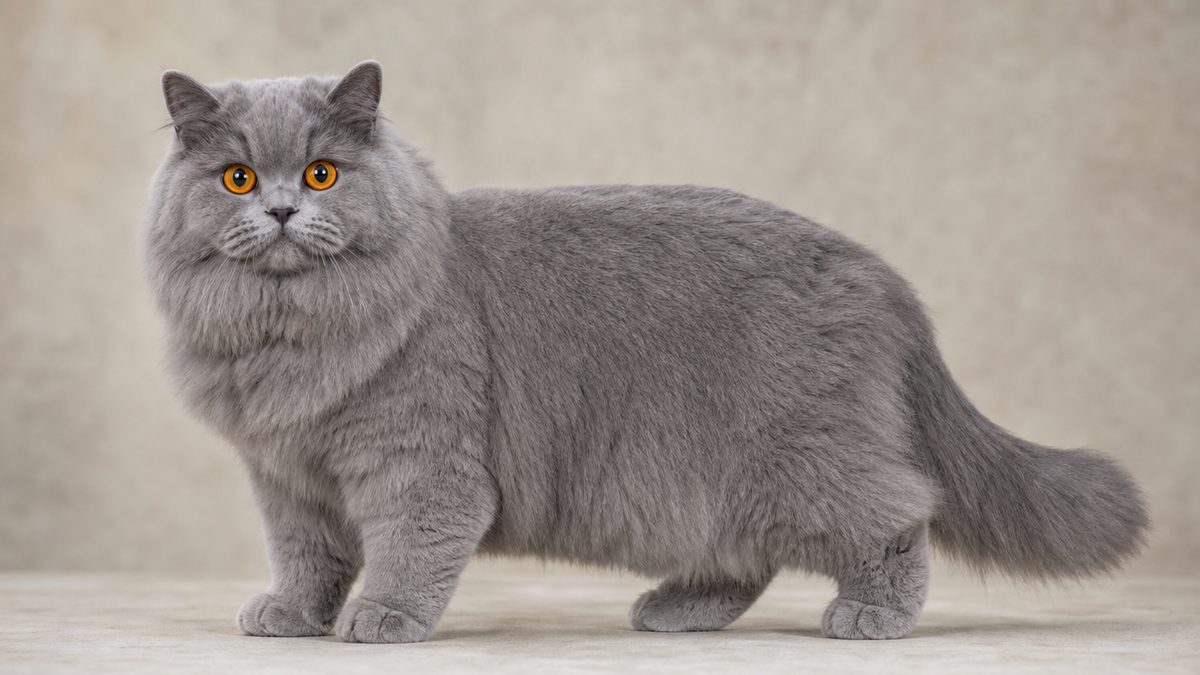
Start with the body, because the standards agree about it even where the registries disagree about the breed. The GCCF describes a compact, well balanced and powerful cat with good depth of body, a full broad chest, short strong legs, rounded paws and a tail thick at the base with a rounded tip, on a round head with small ears set far apart and large well-opened eyes. FIFe's standard, written for the British Longhair and the British Shorthair in one document, gives the size as large to medium and the head as round and massive with a broad skull. TICA describes the same animal and adds the useful behavioural detail that this is a four feet on the floor breed.
The one feature that separates it from a Persian
The nose is the test, and both European registries write it as a disqualifier rather than a preference. FIFe specifies a nose that is short, broad and straight with a slight indentation, "but not a stop as in the Exotic";. The GCCF goes further and withholds certificates outright for a pronounced nose stop, a flat face or a snub nose. An Indian listing showing a flat-faced fluffy cat under the British Longhair name is showing you a Persian or a Persian cross, and the standard says so in writing.
The second test is the coat itself. The GCCF asks for a semi-longhair coat that is straight and dense with a degree of resilience and a natural protective appearance, with a ruff, ear tufts and britches desirable, and it withholds certificates for coats that are either short or an overlong flowing silky type. So the target is a plush, standing coat, not a Persian's floor-length one and not a British Shorthair's short one.
Weights, and why sellers quote three different ones
TICA gives adult females at 8 to 11 pounds and adult males at 10 to 16 pounds on its breed-page fact panel, then says in its own body text that the breed ranges from 9 to 18 pounds. Those two figures sit on one page and do not match. Take the fact panel as the working range, roughly 3.6 to 7.3 kg, and treat any Indian listing quoting a tighter number as a guess.
| Feature | British Longhair | British Shorthair | Persian |
|---|---|---|---|
| Coat length | Semi-longhair, dense, standing away from the body | Short, dense, plush | Long and flowing |
| Nose stop | Withheld if pronounced | Withheld if pronounced | Break is required by the type |
| Body | Cobby, low on legs, deep chest | Cobby, low on legs, deep chest | Cobby but with a very different head |
| Daily grooming | Needed | Not needed | Needed, and more of it |
| FIFe code | BLH, category 3 | BSH, category 3 | PER, category 1 |
Three of those four rows are identical between the Longhair and the Shorthair, which is the honest summary of the breed: one gene of difference and a grooming routine that follows from it.
A British Longhair is a British Shorthair with a coat that mats. Every temperament claim, every apartment argument and every weight warning that applies to one applies to the other. Nothing about the long coat makes the cat calmer, healthier or more valuable, and no registry standard claims it does.
The coat genetics, and where the long hair came from
The British Longhair's coat genetics are settled and were mapped twice in the same year. Long hair in the domestic cat is recessive and sits in the FGF5 gene, and two independent 2007 papers found the mutations that cause it.
Kehler and colleagues ran a whole-genome scan in a pedigree segregating for long hair, landed on a region of cat chromosome B1 containing FGF5, and then sequenced the gene in 26 registered breeds. They found four separate mutations predicted to disrupt the FGF5 protein, and showed that different combinations of paired mutant alleles segregate with the long coat as an autosomal recessive. Drögemüller and colleagues reached the same gene independently, reporting a missense mutation at c.194C>A homozygous in long-haired Somali, Persian, Maine Coon, Ragdoll and crossbred cats, and a second exon 1 mutation found only in long-haired Norwegian Forest cats.
The single most useful row in either paper
Kehler's allele-frequency table carries a British Shorthair row, and it explains the entire breed. Across five British Shorthair samples, the Mutation 4 allele sat at a frequency of 0.20 with the rest wild type, and the paper's own footnote records that in short-haired cats Mutation 4 alleles were present only in the heterozygous state. In plain terms, one in five British Shorthair chromosomes in that sample carried the long-hair allele while every cat looked shorthaired.
That is why long-haired kittens keep appearing in British Shorthair litters. Two carrier parents that both look correct for the short coat will produce, on average, one long-coated kitten in four. TICA's own history says the same thing from the other end: crosses were made with the Persian between 1914 and 1918, introducing the longhair gene, and long-haired kittens then appeared in litters for decades while the breed languished in obscurity.
Kehler's footnote names the source
The same table footnotes the British Shorthair as one of the "breeds with histories of out-crossing with Persian cats" and separately marks the Devon Rex and Scottish Fold as "breeds that the CFA allows out-crossing with British Shorthair cats";. Read together, those two footnotes trace the long-hair allele from Persian to British Shorthair and onward into the breeds that outcross to it. That is a documented route, not a folk story, and it is the reason a British Longhair is a British cat rather than a Persian one.
- Long hair is recessive, so a British Longhair is homozygous and cannot produce a shorthaired kitten with another British Longhair.
- A shorthaired British cat can be a carrier, and nothing about its appearance will tell you.
- A DNA test for the FGF5 alleles is the only way to know a shorthaired cat's carrier status.
- Colour and pattern are separate genes entirely and carry no information about coat length.
Some British lines carry dominant blue eyes with minimal white spotting. The trait was first described in cats from Kazakhstan and Russia, in British Shorthair and British Longhair from Russia, and in Maine Coons from the Netherlands, which the authors read as separate founding events. The only mapped allele so far is a PAX3 insertion found in Celestial, Maine Coon and Siberian cats, and its non-association with deafness was established in those cats and not in British ones. A blue-eyed British Longhair sold at a premium in India is carrying something nobody has yet genotyped in this breed.
Registry recognition, where the five bodies flatly disagree
Registry recognition of the British Longhair is genuinely unsettled, and an Indian buyer being sold papers should know which register those papers come from. Five bodies handle the same cat five different ways, and each position is checkable in that body's own document.
FIFe treats it as a fully recognised breed in category 3 under the code BLH, and its standard is a single document covering British Longhair and British Shorthair together. The face of that document, valid 01.07.2026, prints "BLH Rec. 2017" beside "BSH Rec. 1960 / 1977 / 1981", so FIFe dates its own recognition of the long coat to 2017 and of the short coat to 1960. FIFe's preliminary list, for comparison, holds only the Bombay and the Lykoi, so the British Longhair is not a probationary entry.
TICA lists it among the 73 breeds it recognises, with its own breed page. TICA's history section gives championship status effective May 2009, against June 1979 for the British Shorthair, and yet the page's breed committee is named the British Shorthair (SH/LH) Breed Committee and the linked standard is a single British SH and LH document. Two championship breeds, one standard, one committee.
The GCCF writes a standard and then shows one card
The GCCF's June 2026 Standard of Points carries BRITISH LONGHAIR (BLH) as its own entry at page 131, in Section 3 Group B alongside the Chartreux and the Selkirk Rex, updated by Council in February 2025. Its scale of points differs from the British Shorthair's in a way worth noticing: head and ears score 20 for the Longhair against 25 for the Shorthair, with those five points moved to body, legs and paws. Yet the GCCF's public breeds index shows a single card headed British, marked with an asterisk that the page defines as meaning the breed has short and long haired variations. The register writes two standards and the shop window shows one breed.
CFA has no British Longhair at all
The CFA is the outlier and the gap is not subtle. Its Breed Council Declared Candidates page enumerates every CFA breed council, longhair and shorthair, plus the committee chairs for Miscellaneous and Provisional breeds; British Shorthair is there, British Longhair is not, and the only Miscellaneous or Provisional committee listed is the Khao Manee. Searching CFA's own cat records for the name returns one animal: MARIO, a Blue Golden British Longhair Neuter who was 21st Best Household Pet in International for 2022-23. CFA defines the Household Pet competition as being for non-pedigreed cats over the age of four months. So in the world's oldest cat registry, a British Longhair competes as a moggie.
| Registry | Status of the British Longhair | Shares a document with the British Shorthair |
|---|---|---|
| FIFe | Fully recognised, category 3, code BLH, Rec. 2017 | Yes, one standard for BLH and BSH |
| TICA | Championship since May 2009, one of 73 breeds | Yes, one standard and one breed committee |
| GCCF | Own Standard of Points entry, Section 3 Group B, page 131 | No, separate standards, but one card on the public index |
| LOOF | Filed under a single BRITISH breed record, id 11 | Yes for the record, no for the statistics |
| CFA | No breed page, no breed council, no Miscellaneous entry | Not applicable |
FIFe's own registration numbers put the split in scale. Its Breeding Statistics 2024 covers 96,075 kittens across 54 breeds, and the British Longhair ranks 15th with 1,393 registrations against the British Shorthair's 16,278 at rank 2. So the coat the CFA does not recognise as a breed at all accounts for 1,393 of the 17,671 British registrations FIFe made that year, about one in thirteen, which is a substantial population to leave outside a register.
LOOF is the interesting middle case. The French studbook's breed index lists one record simply called BRITISH, and yet its published statistics count British Longhair and British Shorthair as separate lines, giving 1,551 and 4,007 pedigrees respectively in 2022. One register, one breed record, two counts.
A pedigree is only as meaningful as the register behind it, and for this breed the register decides what the paper can even say. The same cat is a championship breed at TICA and FIFe, half of a two-variety breed at the GCCF and LOOF, and not a pedigree cat at all at CFA. Ask which body issued the paper, then check that body's own breed list before you pay a premium for it.
British Longhair cat price in India, and why four pages give four answers
British Longhair cat price in India is published between Rs 15,000 and Rs 1,30,000 or more, and the spread is not a market signal. It is four pages that disagree with each other, and in one case with themselves, on the same search results page.
We pulled the Indian results for this query on 8 September 2026, with gl=IN and hl=en, and read the top four pages in their raw markup rather than from search snippets. Here is what each one actually contains.
| Rank | Source | What the page actually says | Divides at 84.38, 80 or 74? |
|---|---|---|---|
| 1 | Supertails | FAQ: Rs 15,000 to Rs 50,000. Body: 50,000 to 1,20,000 INR pet quality, 1,50,000 to 3,00,000 INR show quality, under 20,000 INR adoption | No. 15,000 fails every rate |
| 2 | Mr n Mrs Pet | Rs 40,000 to Rs 1,30,000 or more, in three tiers, plus an eight-city table | Only at a flat 80, which any figure ending in three zeros clears |
| 3 | Puppiezo | No British Longhair price. The carousel prices are Rs 98,999, Rs 92,599, Rs 94,999 and Rs 1,20,000 | Rs 98,999 divides to 1,173.25 dollars, so it is rupee-native |
| 4 | Alvid Pet | The literal placeholder (price mention), printed twice | No figure to test |
The first result contradicts itself by a factor of three
Supertails holds position one, and its own FAQ answers "The price of a British Longhair cat in India usually ranges between Rs 15,000 and Rs 50,000 from reputable breeders". Four screens higher, under its own heading "Pet Quality British Longhair Price Range", the same page says "In India, expect to pay 50,000 to 1,20,000 INR for a healthy kitten from a decent breeder", and under "Show Quality/Breeding Rights Price Range" it says show-quality cats "often range from 1,50,000 to 3,00,000 INR or more";. The pet-quality floor in the body is exactly the ceiling in the FAQ. The two halves of the page touch at one point and share nothing else.
The third result is selling dogs
Puppiezo's British Longhair page is titled for the breed and its carousel is headed "Available British Longhair Cats/Kittens". Read the raw markup and every animal in it is labelled by the page itself as a Maltipoo, a Poodle, a Cane Corso or a Goldendoodle, priced at Rs 98,999, Rs 92,599, Rs 94,999, Rs 1,20,000 and Rs 76,499. There is no British Longhair in the list. Two of the animals, both labelled Maltipoo, carry the identical price of Rs 98,999, which is a charm price attached to two different animals in one carousel rather than a valuation of either.
Worse, the Google result for that page advertised a band of Rs 63,000 to Rs 73,000. Neither figure appears anywhere in the page's raw markup. The same pull produced a second snippet mismatch: the GoodPaws result advertised Rs 20,000 to Rs 80,000 for the British Shorthair while the live page says Rs 60,000 to Rs 80,000, with verified-breeder cats at Rs 70,000 to Rs 90,000 and basic pet-quality at Rs 40,000 to Rs 60,000. Two snippet-versus-page mismatches on one search results page is a reason never to quote a price from a search result.
The fourth result is the plainest evidence of all that this query has no settled answer in India. Alvid Pet's page opens its price paragraph with the sentence "The price of a British Longhair cat in India remains unknown", then prints the literal placeholder "(price mention)" twice where the two ranges should be, and explains the spread in terms of dogs, saying that "the following elements drive price increases in dogs";. That is an unfilled template ranking fourth in India for a commercial query.
What the second result is charging the premium for
Mr n Mrs Pet publishes the most structured ladder in the Indian market: basic quality at Rs 40,000 to Rs 80,000, "FCI Registered" at Rs 70,000 to Rs 1,10,000, and champion bloodline at Rs 90,000 to Rs 1,30,000 or more. Read the same page's registry section and FCI there means the Feline Club of India, not the dog federation of the same initials. That matters, because the middle tier asks roughly Rs 30,000 more than the basic tier for a registration a buyer has no published breed register to check it against. The site's own catalogue filter, incidentally, still reads "Puppy Quality / Pet Quality / KCI Registered / Champion Bloodline", which is a dog ladder with the registry name swapped out on the cat pages.
Indian pages routinely publish a US dollar price run through one exchange rate. Rs 15,000 divides to 177.77 at 84.38 and 202.70 at 74, neither of which is a price a seller would print, so Supertails' floor is rupee-native. Mr n Mrs Pet's figures clear a flat 80 only because any number ending in three zeros does, and the quotients (500, 875, 1,125, 1,375, 1,625) are not a shop's price list. These are locally invented numbers rather than converted ones, which is a different problem and needs saying differently.
Monthly cost of ownership in India, from published rate cards
The honest cost of ownership for a British Longhair in India is built from four recurring lines: litter, food, parasite control and grooming, with vaccination as an annual and boarding as an occasional. Every figure below comes from a named Indian rate card we opened, not from a seller's estimate.
Sellers publish a monthly figure and rarely show the arithmetic. Mr n Mrs Pet, for example, says maintaining a British Longhair kitten in India usually costs between Rs 3,000 and Rs 8,000 per month, covering quality food, routine veterinary visits and vaccination. That range is wide enough to be true of almost any cat, so build your own instead.
| Line | Published figure | Source and scope |
|---|---|---|
| Kitten vaccination course, three visits | From Rs 3,999, list price Rs 5,065 | Vetic, Mumbai clinic page |
| Adult annual booster, CRP plus anti-rabies | From Rs 1,899, list price Rs 1,908 | Vetic, Mumbai clinic page |
| Anti-rabies, single | Rs 699 | Vetic |
| CRP (Tricat or Feligen), single | Rs 1,249 | Vetic |
| Grooming haircut, 120 minutes | From Rs 1,359, list price Rs 1,599 | Vetic, Delhi grooming page, dogs and cats |
| Bath and blow dry, 60 minutes | From Rs 934, list price Rs 1,099 | Vetic, Delhi grooming page |
| Cat boarding, overnight to 24 hours | Rs 649, food and litter excluded | PawSpace, Bengaluru |
| Pet animal licence | Rs 50 | Greater Chennai Corporation |
The two lines nobody prices, and they are the big ones
Litter and food are the recurring costs that actually dominate a cat budget in India, and neither has a national published rate an editorial page can quote honestly. What can be said is structural: a heavy, sedentary cat eats more than a small active one for the same activity level, and a semi-longhair coat means litter tracking and more frequent tray changes than a shorthaired cat of the same weight. Price both in your own city before you commit, because a national average would be an invention.
Boarding is the line most owners forget until they travel. PawSpace in Bengaluru publishes a separate cat rate card at Rs 499 for up to four hours, Rs 599 for daycare to ten hours and Rs 649 overnight, with festive-season rates 25 to 30 percent higher and food and litter charged on top. For a semi-longhair cat, add the cost of a groom afterwards, because a stressed cat does not self-groom.
The other structural point is that grooming here is not optional the way it is for the British Shorthair. Two Vetic sessions a quarter, at Rs 934 for a bath and Rs 1,359 for a haircut, adds roughly Rs 765 a month to the running cost of the long coat, and that line simply does not exist for the shorthaired sibling.
The cheapest thing you can do for the cat
Neuter early, and the UK primary-care data says why in one number. Entire cats had 4.29 times the odds (95% CI 3.72 to 4.95) of dying before three years of age compared with neutered cats, and neutered cats lived 1.07 years longer on average among cats that died after nine months. Whatever you paid for the kitten, that is the highest-return line on this page.
Greater Chennai Corporation licenses pet animals generally at Rs 50 and issued 9,115 licences during 2024, and its municipal pet clinics provide all treatment and anti-rabies vaccination free of cost for pet animals. Delhi's municipal scheme, by contrast, registers pet dogs only, so a Delhi cat owner has no equivalent municipal route. Check what your own corporation actually offers before assuming private clinic rates are the only option.
Heat tolerance in Indian weather, worked from the numbers
Heat tolerance is the British Longhair's real limitation in India, and the case is about temperature rather than humidity. We queried NASA POWER by explicit latitude and longitude for London and for Indian cities, echoing the cell elevation each time, so this is arithmetic rather than adjectives.
The intuition most buyers arrive with is that Indian damp will finish a British coat. The data says the opposite. London's cell, at 73.15 m elevation, returns an annual mean relative humidity of 84.59 percent against Chennai's 72.39 percent and Mumbai's 67.39 percent. London is the more humid place. What London is not is hot: its annual mean temperature is 10.39 degrees C against Chennai's 27.95.
| Place | Cell elevation | Annual mean T2M | Annual mean RH2M | Hottest month | Peak wet bulb |
|---|---|---|---|---|---|
| London | 73.15 m | 10.39 C | 84.59 percent | July, 17.63 C | 14.76 C in July |
| Chennai | 48.95 m | 27.95 C | 72.39 percent | May, 31.51 C | 26.11 C in May |
| Mumbai | 97.15 m | 26.77 C | 67.39 percent | May, 31.19 C | 25.77 C in June |
| Delhi | 206.37 m | 25.60 C | 45.56 percent | June, 35.88 C | 26.50 C in July |
| Bengaluru | 841.72 m | 23.74 C | 67.94 percent | April, 28.37 C | 21.86 C in May |
Read the last column, because it is the one that decides. Peak wet-bulb load in Chennai is 26.11 degrees C, against 14.76 in London. That gap of 11.35 degrees is what a dense double coat has to shed, and evaporative cooling is exactly what a wet-bulb figure measures the difficulty of. Two months in that table are worth naming, because a great many Indian pages get them wrong: Delhi peaks in June rather than May, and Bengaluru peaks in April and is coolest in December rather than January.
What this means room by room
A British Longhair is a heat-sensitive indoor cat in Chennai, Mumbai, Kolkata, Hyderabad and Ahmedabad from March to June, and in Delhi from April to July. Bengaluru is the metro where it is genuinely comfortable, and the number says why: its peak wet-bulb load is 21.86 degrees C against Chennai's 26.11, a 4.25 degree advantage that comes from sitting on a plateau at roughly 840 m. The practical rule everywhere else is that the cat needs a room it can retreat to that stays cooler than the rest of the flat, not an air conditioner running at a fixed hour.
- Give the cat a tiled floor it can lie on, since conduction does more for a heavy cat than a fan does.
- Move play sessions to early morning and after dark, because a sedentary cat will not self-regulate its exertion.
- Keep water in at least two places away from food bowls, since a cat that drinks less concentrates its urine.
- Never shave the coat to cool the cat, because the same coat that traps heat also blocks radiant load and the skin underneath has no sun tolerance.
The GCCF's British Longhair standard tells judges not to penalise a slight curl to the underbelly caused by sweating or by seasonal changes in coat density, length and texture. A written allowance for coat change under heat sits inside the breed standard of a cat bred in Britain, which is a fair signal of how much the coat moves with climate. In India that seasonal change is larger, not smaller.
One more Indian-specific point belongs here. The Prevention of Cruelty to Animals (Pet Shop) Rules, 2018 make temperature the shop's problem in writing: rule 6(5) requires that the temperature where pet animals are displayed or housed be comfortable, notes that it varies from animal to animal and from breed to breed, and places the onus on the pet shop owner to familiarise himself with the requirements of the breeds he intends to deal in. A shop displaying a semi-longhair British cat in an unconditioned Chennai room in May is failing a written obligation, and that is worth saying to the shop.
Temperament and who should not buy one
The British Longhair's temperament is reserved, undemanding and physically undramatic, and that combination is what makes it a strong Indian apartment cat and a poor choice for a household that wants to carry a cat around.
TICA's description is worth taking at face value because it is specific rather than flattering. The breed is slightly reserved and takes time to warm to a stranger, is not a lap cat but wants to be in the same room, is tolerant with children and dogs, does not like being carried, and is content with its own company, quietly amusing itself in your absence. It also notes the breed looks before it leaps and does not go in for high-flying acrobatics, which is a polite way of saying this cat will not clear your shelves.
Who this suits in India
- Working couples in a flat, because the cat tolerates a long day alone without becoming destructive.
- Households with older children who have been taught not to pick the cat up.
- First-time cat owners who want a robust, forgiving temperament and can commit to daily grooming.
- Anyone in Bengaluru or Pune, where the climate does most of the work for you.
Who should buy something else
- Families with toddlers, since a cat that dislikes being carried and a child who wants to carry it is a bite waiting to happen.
- Anyone who wants a cat on their lap, because this breed sits beside you rather than on you.
- Households in Chennai or Ahmedabad with no cool room, where the coat becomes a welfare problem rather than a grooming one.
- Buyers who will not comb daily, in which case the British Shorthair is the same cat without the obligation.
One temperament claim in wide Indian circulation deserves correcting. The British Longhair is not more affectionate than the British Shorthair because of its coat. Both registries describing the two coats do so in a single document, and neither assigns any temperament difference to hair length. Where you see a seller charging more for a "cuddlier" long coat, that is a marketing claim with no standard behind it.
TICA describes this as a four feet on the floor breed that likes to be handled with gentle firmness and supported when carried. In practice that means teaching everyone in the house to sit down and let the cat come, and to support the hindquarters on the rare occasions it is lifted. A cat that dislikes handling is not an unfriendly cat; it is a cat that has told you how it wants to be approached.
Training a British Longhair, and what it resists
To train a British Longhair, work with its low arousal rather than against it: short sessions, food rewards, and a routine started in kittenhood. What it resists is being restrained, and that is the one thing daily grooming requires.
The training that actually matters for this breed is not tricks. It is handling tolerance, and it is a health intervention rather than a party piece. A cat that will not accept a comb through the britches and the ruff will be sedated for a de-matting at a clinic within two years, and a cat that will not accept a bath will be soaked by force in an Indian summer when it needs cooling and cleaning.
The handling curriculum, in order
- Start at eight to ten weeks, handling paws, ears and the belly for ten seconds at a time, then feeding.
- Introduce the comb as an object to sniff before it ever touches the coat.
- Comb one small area, stop while the cat is still relaxed, and reward.
- Add water at twelve to sixteen weeks, warm and shallow, with the same stop-early rule.
- Only then extend to a full-body groom, by which point the cat has learned that handling ends in food.
TICA makes the same point about bathing in one line: start when the kitten is young and maintain a regular routine so the cat learns to enjoy it. Retrofitting that at three years old is possible but expensive in stress for everyone.
What this breed genuinely resists
It resists being lifted, it resists being restrained on its back, and it resists rushed sessions. It does not resist learning, and TICA reports that the same cats will fetch and will chase a laser for exercise. The mistake Indian owners make is reading the reserved temperament as stubbornness and escalating pressure, which is exactly the wrong move with a cat that dislikes handling in the first place.
A heat-stressed cat needs to reach a clinic quickly, and a cat that fights the carrier loses minutes at exactly the wrong moment. Leave the carrier out as furniture, feed in it, and close the door for thirty seconds at a time. This is the cheapest emergency preparation available and it costs nothing.
Daily exercise, and what happens without it
A British Longhair needs two short structured play sessions a day, roughly ten to fifteen minutes each, because it will not exercise itself. The consequence of skipping them is not boredom, it is weight, and weight has a measured cost in years.
TICA is blunt about the risk: these cats love food and with their sedentary ways can quickly gain weight, so portions have to be watched, and the recommended remedies are teaser toys, teaching the cat to fetch, and a laser pointer. That is a breed page telling you the cat will not self-regulate.
The number that makes this urgent comes from UK primary care. Among cats that died after nine months of age, lifespan decreased by 0.02 years for every 100 g of deviation, in either direction, from the median adult body weight within the breed and sex strata. A cat a kilogram over its own breed and sex median is carrying a modelled cost of roughly 0.2 years. That is a small number per 100 g and a large one across a fat cat's life, and it is measured rather than asserted.
What a session actually looks like
- Run the session before a meal, so the hunt sequence ends in food the way it does in nature.
- Use a wand toy at floor level rather than overhead, since this is not a jumping breed.
- Stop while the cat is still engaged, because a disengaged sedentary cat will not restart.
- Move both sessions to early morning and after dark from March to June, when the flat is coolest.
Vertical space helps less here than it does with an Oriental breed. A low, wide platform near a window does more for a cobby cat than a tall tower it will decline to climb. Add a tall scratching post regardless, which TICA recommends for the natural scratching instinct.
Grooming the semi-longhair coat in Indian humidity
Comb a British Longhair daily with a wide-toothed metal comb, and bath it on a routine it learned as a kitten. The coat that mats is the plush undercoat, not the guard hair, which is why a surface brush feels productive and changes nothing.
TICA's grooming advice for this breed is the clearest single instruction available: the British Shorthair coat does not tangle and needs only a quick comb, while the British Longhair coat takes more work and a daily combing prevents any tangles, with regular bathing to keep the coat in peak condition.
Two paragraphs below that instruction, the same British Longhair page says under its grooming heading that "The British Longhair coat is short but very dense" and that "most British Shorthairs are capable of bathing themselves", and its nutrition section is written about "Adult British Shorthairs". Those are the British Shorthair's paragraphs sitting on the British Longhair's page. A reader who scrolls to the grooming heading and stops there is told the coat is short. It is not.
The Indian variables that change the routine
Three things make Indian grooming different from British grooming, and none of them appears on an overseas breed page.
- Heat drives a heavier and less predictable moult, and the GCCF standard itself tells judges to allow for seasonal changes in coat density, length and texture.
- Monsoon humidity keeps a bathed coat damp for longer, so a cat towelled and left to air dry stays wet at the skin far longer than it would in Britain.
- Dust in most Indian cities loads the undercoat between baths, which is a grooming problem the coat's own density makes worse.
The practical answer to the second point is that a British Longhair should be dried properly rather than left to dry naturally, which is the exact opposite of the advice most overseas grooming guides give. A dense semi-longhair coat holds water at the skin, and skin that stays damp in 85 percent humidity is the setting for the problems an Indian vet sees in the monsoon rather than in January.
A routine that works
| Task | Frequency | If you outsource it |
|---|---|---|
| Comb through with a wide-toothed metal comb | Daily, longer during the moult | Not sold separately |
| Check and clear the britches, ruff and armpits | Every second day | Included in a full groom |
| Bath and full dry | Every 6 to 8 weeks, more in the monsoon | From Rs 934 for 60 minutes, Vetic Delhi |
| Sanitary and paw trim | Every 8 to 12 weeks | From Rs 1,359 for a 120 minute haircut, Vetic Delhi |
| Nail trim | Every two weeks | Included in a full groom |
| Ear check and tooth brushing | Weekly | Not sold separately |
Never shave a British Longhair to cool it down. The coat blocks radiant heat as well as trapping it, and a shaved cat in an Indian summer has skin with no sun tolerance and a coat that regrows unevenly. If the coat is matted past combing, a clinic de-matting under sedation is the correct route and is what the grooming budget above is for.
Health issues, screening and life expectancy
The British Longhair's health issues are the British Shorthair's health issues plus a coat, with one genuine surprise in the literature: the two coat forms sit at opposite ends of the feline urinary stone spectrum. Life expectancy for the breed on its own has never been measured.
Life expectancy, and the row the British Longhair is actually in
The UK VetCompass feline life tables, built on 7,936 confirmed deaths in 2019, modelled only the 12 breeds that reached 15 or more deaths, crossbred included. The British Longhair is not a separate row. It sits inside a row labelled "British cats", which the paper's own footnote defines as British Blue plus British Longhair, at a life expectancy at age 0 of 9.58 years with a 95 percent confidence interval of 8.73 to 10.43, from 194 deaths.
That merged row is the honest answer, and it matters that no page anywhere says so. Bonbeno does not substitute a related breed's figure for a missing one, and it does not report a merge as an absence. For context from the same paper: crossbred cats reached 11.89 years (11.75 to 12.03) from 7,117 deaths, purebred cats 10.41 years (9.99 to 10.83), and purebred cats carried 1.83 times the odds of dying before three years of age. TICA publishes an estimate of 12 to 20 years for the breed. Those are two different kinds of number and the page prints both rather than averaging them.
| Group | Life expectancy at age 0 | 95 percent CI | Deaths |
|---|---|---|---|
| Crossbred | 11.89 years | 11.75 to 12.03 | 7,117 |
| Siamese | 11.69 years | 10.56 to 12.82 | 88 |
| Persian | 10.93 years | 9.63 to 12.23 | 80 |
| Russian cats | 9.65 years | 7.20 to 12.10 | 19 |
| British cats, meaning British Blue plus British Longhair | 9.58 years | 8.73 to 10.43 | 194 |
| Bengal | 8.51 years | 7.12 to 9.90 | 73 |
Urinary stones, where the two coats genuinely differ
A German laboratory series analysed 3,629 feline uroliths by infrared spectroscopy between 2016 and 2020, of which the majority came from purebred cats of 22 breeds. Among breeds with more than 10 individuals, calcium oxalate was significantly more frequent in British shorthair cats at 85.2 percent, while struvite was the prevailing stone type in the British longhair at 41.7 percent. The same paper puts Norwegian forest cats at 48.5 percent struvite and Siamese at the highest cystine share, 16 percent.
That split matters clinically because the two stone types have opposite management. Struvite often dissolves on a therapeutic diet; calcium oxalate does not and is usually removed surgically. So a British Longhair with urinary stones and a British Shorthair with urinary stones are not the same case, and a vet who knows only that the cat is "a British" is starting from the wrong prior. Say which coat when you present the cat.
The paper's English abstract says 3,300 of the 3,629 uroliths came from purebred cats; its own German abstract, on the same PubMed record, says 3,330. A 30-sample disagreement between two abstracts of one paper does not affect the breed percentages quoted above, which are stated identically in both languages, but it is worth knowing that the denominator is printed two ways.
Hypertrophic cardiomyopathy, and the DNA test that does not apply
Hypertrophic cardiomyopathy is the commonest feline heart disease, and TICA's breed page asks breeders to screen for it by echocardiogram performed by a veterinary cardiologist, noting that it does not always appear in the first years of life. The important Indian point is which test to ask for. The MYBPC3-A31P DNA test belongs to the Maine Coon: in a European screen of 3,757 cats from different breeds, the mutation was found only in Maine Coons at a prevalence of 41.5 percent, "except for one British Longhair cat", and the authors concluded it appears to be breed specific with potential marginal events.
That single British Longhair is a real finding and it is not a breed risk. One carrier in 3,757 cats is what the authors themselves call a marginal event. The same paper is also the best available argument that a DNA test is not a diagnosis: of 164 Maine Coons that were echoed, 55 carried the mutation while only 12 showed hypertrophic cardiomyopathy, and two of those 12 were homozygous wild type. Ask for the echocardiogram, not the gene test.
- Echocardiogram by a cardiologist for any breeding cat, repeated with age rather than done once.
- Weight and body condition at every visit, because non-ideal body weight is significantly linked to a shorter lifespan.
- Urinalysis if the cat strains, urinates outside the tray or produces small frequent volumes, and say which coat form the cat is.
- Neutering on time, since entire cats carried 4.29 times the odds of dying before three years.
Feeding a heavy, sedentary cat in India
Feed a British Longhair measured meals on a schedule rather than free-feeding, because this is a heavy breed with a low activity level and the cost of getting it wrong is measurable in years of life.
TICA's nutrition guidance for the breed is specific and worth following: feed adults twice daily on a regular schedule, preferably wet food high in meat content, feed kittens more frequently, and do not free-feed, because free feeding encourages a cat to eat when it is bored. It also flags that adults are calm and therefore need less food than their size suggests.
The evidence behind the portion rule is the body-weight deviance result from UK primary care. Lifespan decreased by 0.02 years for each 100 g of increase or decrease from the median adult body weight within the breed and sex strata, and being at a non-ideal body weight was significantly linked to a decreased lifespan. Note the phrasing carefully: the penalty runs in both directions, so an underweight cat is not safe either.
Water is the Indian variable
A cat that drinks too little concentrates its urine, and this is a breed whose two coat forms both appear in a urolith series. In an Indian summer, water intake is the single most useful thing an owner can influence.
- Place at least two water sources, each at least three feet from any food bowl, which is what TICA advises because a strong food smell reduces drinking.
- Weight wet food into the ration deliberately rather than treating it as a topper, since wet food is the largest lever on total water intake.
- Refresh water at least twice a day from March to June, because warm stale water is refused.
- Watch litter clumps rather than the bowl, since clump size is the observable proxy for how much the cat is actually drinking.
Life stages, in practice
| Stage | Approach | What to watch |
|---|---|---|
| 8 to 16 weeks | Four small meals a day, kitten formulation | Weight gain week on week, and stool quality after any change |
| 4 to 12 months | Three meals, then two, still on kitten food | The first sign of a heavy build settling in |
| 1 to 7 years | Two measured meals, wet-led, no free feeding | Body condition score at every vet visit, not weight alone |
| 7 years and older | Two meals, senior formulation on veterinary advice | Drinking volume, appetite change and any tray-behaviour change |
Treats should be sugar-free, which TICA states directly, and should come out of the daily ration rather than on top of it. For a cat this sedentary, treats are the line that quietly moves the body-condition score.
A kitchen scale costs less than one grooming session and removes the guesswork that scoops introduce. Weigh the daily ration once a week, divide it into meals, and re-weigh the cat monthly. A cat that has drifted 500 g from its own baseline is a conversation with your vet, not a crisis, and it is far easier to catch on a scale than by eye through a semi-longhair coat.
The British Longhair kitten timeline, month by month
Plan a British Longhair kitten timeline around four fixed points in the first year: the eight-week legal floor for sale, the vaccination course, the handling and grooming habit, and the neutering decision before the first birthday.
Indian law sets the first date for you. The Prevention of Cruelty to Animals (Pet Shop) Rules, 2018 define an un-weaned animal to include "kittens and pups below eight weeks", and rule 7(15) states that no pet shop shall sell un-weaned or underage animals. A shop offering a six-week kitten is breaking a written rule, and that is a reason to walk out rather than to negotiate.
| Age | What happens | Cost anchor |
|---|---|---|
| Under 8 weeks | Not legally saleable. Stay with the queen | None |
| 8 to 10 weeks | Home, settle-in, first vet check, start paw and comb handling | Kitten vaccination course from Rs 3,999 for three visits |
| 10 to 16 weeks | Vaccination course completed, first shallow bath, carrier training | Included in the course above |
| 4 to 6 months | Adult coat starts to come through, grooming time roughly doubles | First professional groom, bath from Rs 934 |
| 5 to 8 months | Neutering window, discussed with your own vet | Clinic dependent, ask for a written quote |
| 8 to 12 months | Switch to adult feeding, set the two-meal routine | None |
| 12 months | First adult annual booster, baseline weight recorded | Adult annual from Rs 1,899 |
The month that catches people out
Between four and six months the kitten coat is replaced by the adult semi-longhair coat, and the grooming load roughly doubles inside a few weeks. Owners who were combing twice a week through a soft kitten coat suddenly meet an undercoat that mats, usually first in the armpits and behind the ears. Increase the routine before the change, not after the first mat.
What to write down in the first year
- The kitten's registered name and the register that issued it, if any papers came with the cat.
- Every vaccination date and product name, copied from the certificate rather than remembered.
- Monthly weight, which becomes the baseline the body-condition argument rests on.
- The date the adult coat started, which tells you when to expect the moult in following years.
Rule 7(16) of the Pet Shop Rules, 2018 requires that every puppy be micro-chipped by a veterinary practitioner and that only micro-chipped puppies be sold. It says puppies, not kittens, so a kitten falls outside that requirement entirely. Microchipping a cat is still a good idea in an Indian city, but it is your choice rather than the shop's obligation, and no seller can charge you for it as a legal requirement.
British Longhair against the cats Indian buyers cross-shop
Indian buyers who reach this breed are almost always choosing between four cats: the British Shorthair, the Persian, the Ragdoll and the domestic shorthair already outside the building. The comparison that matters is not looks, it is the running cost and the evidence behind each claim.
| British Longhair | British Shorthair | Persian | Indian domestic shorthair | |
|---|---|---|---|---|
| UK life expectancy at age 0 | Inside the British cats row, 9.58 years, 194 deaths | Inside the same British cats row | 10.93 years (9.63 to 12.23), 80 deaths | 11.89 years (11.75 to 12.03), 7,117 deaths, coded crossbred |
| Daily grooming | Required | Not required | Required, and heavier | Not required |
| Heat tolerance in India | Low | Low to moderate | Low | Adapted |
| Commonest urolith type in the German series | Struvite, 41.7 percent | Calcium oxalate, 85.2 percent | Calcium oxalate, 72.4 percent | Not separately reported |
| Recognised as a breed by CFA | No | Yes | Yes | Not applicable |
| Published Indian price | Rs 15,000 to Rs 1,30,000, four sources disagreeing | Rs 40,000 to Rs 90,000 on one seller's tiers | Widely sold, widely varying | Adoption, usually free |
Read the first and last columns together, because that is the row that decides most Indian purchases and almost no Indian page carries it. The domestic shorthair, coded crossbred in that dataset, outlived every pedigree in the table on a sample of 7,117 deaths rather than 194.
British Longhair against British Shorthair, the only comparison that is really about the cat
These are the same animal genetically apart from FGF5, so the choice is a grooming decision and a heat decision, not a temperament one. Choose the Longhair if you want the coat and will comb daily. Choose the Shorthair if you will not, or if you live somewhere with peak wet-bulb load like Chennai's 26.11 degrees C and no cool room. On stones, the German series is the one genuine health difference between them, and it runs in opposite directions.
British Longhair against Persian
Buyers confuse these two constantly in India, and the standards do not. The GCCF withholds certificates from a British Longhair with a flat face or a pronounced nose stop, which is close to a description of correct Persian type. If a listing's photograph shows a flat face, you are looking at a Persian or a cross whatever the caption says. The Persian also has a measured UK life expectancy of its own, 10.93 years from 80 deaths, which the British Longhair does not.
An Indian domestic shorthair costs nothing to acquire, needs no daily comb, tolerates the climate it evolved in, and sits at the top of that life-expectancy table. If your reason for wanting a British Longhair is the look, that is a legitimate reason and this page is not going to argue you out of it. If your reason is that a pedigree cat will be healthier, the evidence points the other way.
Mistakes Indian owners make with this breed
Five mistakes account for most of what goes wrong with a British Longhair in India, and four of them are made before the cat arrives.
1. Paying a premium for a registration nobody can check
The middle tier on the biggest Indian listing site asks roughly Rs 30,000 more for a registered cat than for a basic one. A pedigree is worth paying for when you can name the register, find that register's own breed list, and match the paper against it. For this breed that is genuinely harder than usual, because the answer differs by body: FIFe and TICA hold it as a breed, the GCCF and LOOF hold it as one of two coat varieties, and CFA holds it not at all. Ask which body, then check that body's list before paying.
2. Buying the photograph rather than the standard
A flat face is a withholding fault, not a premium feature. So is a coat that is either short or long and silky. Indian listings routinely show a Persian, a Persian cross or a random longhaired cat under this breed's name, and the standard gives you three checks that need no expertise: the nose has no stop, the ears are small and set wide, and the body is cobby and low on the legs.
3. Treating the coat as decoration
The commonest welfare failure in this breed in India is a matted undercoat discovered at four to six months, when the adult coat comes in. TICA says daily combing prevents tangles, and it is describing a British winter. In an Indian moult it is the floor, not the target.
4. Air drying the cat after a bath
Overseas grooming advice routinely says to towel a cat and let it air dry. That instruction assumes a dry climate. In a monsoon month at 85 to 90 percent relative humidity, a dense semi-longhair coat holds water at the skin for hours. Dry the cat properly, and if you cannot, do not bath it that week.
5. Free-feeding a sedentary cat
TICA warns that these cats love food and gain weight quickly, and the UK data attaches a cost to it: 0.02 years of lifespan per 100 g of deviation from the breed and sex median, in either direction. Free feeding a British Longhair is the single most expensive habit on this list, and it is also the easiest to fix.
Do not take a price from a search result. On one pull, the Puppiezo result advertised Rs 63,000 to Rs 73,000 for a page whose raw markup contains neither figure, and the GoodPaws result advertised Rs 20,000 to Rs 80,000 for a page that says Rs 60,000 to Rs 80,000. Open the page and search it for the number before you believe it.
Adoption, verification and how to buy without being fooled
Adopt first, and if you buy, verify three things before money moves: the age, the register and the parents. Every one of those checks is free and each has a written Indian rule or a published register behind it.
Adoption is the honest first option for this breed in India, and it is less unlikely than it sounds. British Longhair kittens turn up in British Shorthair litters by ordinary recessive inheritance, and semi-longhaired cats of British type reach shelters when a household underestimates the grooming. Supertails' own page concedes that purebred British Longhairs rarely appear in Indian adoption listings and that most are mixes, which is true and is also an argument for looking rather than assuming.
The three checks, in order
- Age. The Pet Shop Rules, 2018 define kittens below eight weeks as un-weaned and rule 7(15) bars selling un-weaned or underage animals. Ask to see the litter date in writing.
- Register. Ask which body issued the pedigree papers, then open that body's own breed list. FIFe, TICA and the GCCF all publish theirs, and CFA's list will not contain this breed at all.
- Parents. Ask to see the mother with the litter. Rule 7(3) bars a pet shop from displaying or housing mothers caring for un-weaned young for sale, so a shop showing you a nursing queen has a different problem, while a breeder who cannot show you the queen at all has a worse one.
Two more written rules are worth carrying into the conversation. Rule 7(14) bars selling a pet animal with any form of mutilation other than necessary curative surgery on veterinary prescription, and rule 7(22) bars selling any pet animal to a person who has not attained the age of majority. Both are checkable at the counter.
What a genuine breeder will do without being asked
- Name the register and hand over the paperwork with the cat rather than promising it later.
- Show the queen, the litter and the room they were raised in.
- Volunteer the echocardiogram status of the parents rather than offering a DNA panel instead.
- Take the cat back if the placement fails, in writing.
In the UK life tables, crossbred cats reached a life expectancy at age 0 of 11.89 years across 7,117 deaths, while purebred cats reached 10.41 years and carried 1.83 times the odds of dying before three years of age. The cat outside your building is, on the best available evidence, the one that lives longest. Adopting is not the consolation option on this page; it is the option with the numbers behind it.
British Longhair questions Indian buyers actually ask
Are British Longhair cats cuddly?
British Longhair cats are affectionate without being lap cats. TICA's own breed page says they are loyal and devoted, want to be where you are and prefer snuggling beside you on the sofa, but do not like being carried and prefer to keep all four feet on the floor. Expect company rather than a cat that sits on you.
Is British long hair cat rare?
Rare depends entirely on which register you count. France's national studbook recorded 1,372 British Longhair pedigrees in 2024, which is uncommon next to 24,160 Maine Coons but ordinary next to the 23 Nebelungs registered the same year. In India there is no published register at all, so nobody can answer the question with a number.
Are British Longhair cats good pets?
British Longhair cats suit quiet Indian flats better than most pedigree cats, because they are undemanding, low-activity and content alone for hours. The two things that go wrong here are heat and weight: a dense double coat in a Chennai summer, and a sedentary cat that is free-fed until a non-ideal body weight starts shortening its life.
What is the lifespan of a British longhair cat?
No breed-specific figure exists for the British Longhair on its own. The UK life tables modelled only the 12 breeds reaching 15 or more deaths, and the British Longhair sits inside a combined British cats row at 9.58 years from 194 deaths. TICA publishes an estimate of 12 to 20 years, which is a registry's estimate and not a measured life table.
What is the real British Longhair cat price in India?
Four Indian pages ranking for this query publish four different answers. Supertails prints Rs 15,000 to Rs 50,000 in its FAQ and 50,000 to 1,20,000 INR in its body. Mr n Mrs Pet gives Rs 40,000 to Rs 1,30,000 or more across three tiers. Puppiezo shows no British Longhair at all, and Alvid Pet prints an unfilled placeholder.
Is the British Longhair a separate breed from the British Shorthair?
The registries do not agree. FIFe gives it its own code BLH and recognised it in 2017, TICA granted championship status in May 2009, the GCCF writes a separate Standard of Points entry, LOOF files both coats under one BRITISH record, and the CFA holds no British Longhair breed council and no breed page at all.
Can a British Shorthair have long-haired kittens?
Yes, and that is the whole origin of the breed. Long hair in cats is recessive, and in 2007 the long-hair allele called Mutation 4 was found in British Shorthair samples at a frequency of 0.20, always heterozygous. Two carrier parents that each look shorthaired can produce a British Longhair kitten.
Does the British Longhair get hypertrophic cardiomyopathy?
Hypertrophic cardiomyopathy is the commonest feline heart disease and TICA's breed page asks breeders to screen for it by echocardiogram. The Maine Coon MYBPC3-A31P DNA test is not the right instrument here: in a 3,757-cat European screen the mutation was found only in Maine Coons except for one single British Longhair.
How much does a British Longhair cost to keep in India each month?
Budget from published Indian rate cards rather than from a seller's estimate. A Vetic kitten vaccination course starts at Rs 3,999 and the adult annual at Rs 1,899, a Delhi grooming haircut starts at Rs 1,359, and overnight cat boarding in Bengaluru is Rs 649 before food and litter. Litter and food are the recurring lines that actually dominate.
Do I need to register a British Longhair cat in India?
Cats sit outside most of the Indian pet paperwork that applies to dogs. Delhi's municipal scheme registers pet dogs only, while Greater Chennai Corporation licenses pet animals generally at Rs 50 and issued 9,115 licences in 2024. The Pet Shop Rules, 2018 require microchipping for puppies only, so kittens fall outside that clause entirely.
Compare with similar breeds
British Longhair sits in 1 Bonbeno group. Each one compares it directly against the breeds it is genuinely an alternative to, on the same figures.