
Cat breed profile
Cornish Rex Cat Price in India, Coat Genetics and Full Breed Guide
What a Cornish Rex actually costs in India, why the two Indian sources that publish a price do not overlap at all, what a coat with no guard hair means in 43 degree heat, and the life expectancy figure nobody has ever measured.
Quick answer
The Cornish Rex cat price in India runs Rs 40,000 to Rs 4,00,000 in 2026, and the two Indian sources that publish a figure disagree by ten times with bands that do not overlap anywhere. Three facts change the decision and no ranking page carries them. The coat has no guard hair at all, so sunburn on the ears is a genuine Indian risk. 33 percent of Cornish Rex carry blood type B. And no veterinary-records study has ever measured this breed's life expectancy.
This guide is general information for Indian pet owners and is not a diagnosis. Always consult a registered veterinarian near you before acting on anything you read here, and treat any sudden change in your cat's condition as urgent.
Cornish Rex at a glance
What a Cornish Rex actually is
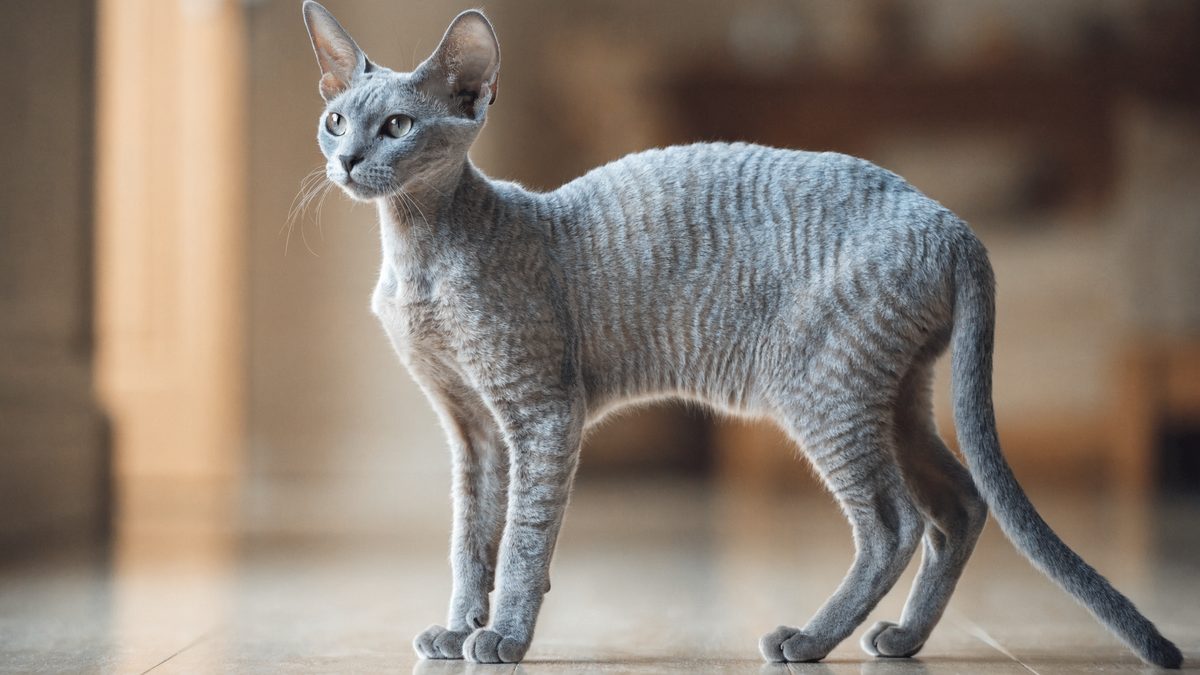
A Cornish Rex is a small to medium, fine-boned domestic cat whose coat is short, extremely soft, silky and completely free of guard hairs, laid in a tight, uniform marcel wave that runs from the top of the head across the back, sides and hips to the tip of the tail. It carries a naturally arched back, a greyhound tuck-up, an egg-shaped head, a Roman nose with a high prominent bridge and large ears set high on the skull. It is not a Devon Rex with a tighter curl. It is a different gene on a different chromosome, and the difference is visible without a laboratory.
Start with the coat, because both breed standards do. In CFA's 100-point score the coat carries 40 points, more than the head at 25 and more than the whole body at 30, and the wave alone carries 20 of them. TICA splits the points differently but reaches the same conclusion, giving coat, colour and pattern 32 points of which texture alone takes 26, against 29 for the head and 29 for the body. In both systems a cat with the wrong coat cannot win, however good it looks.
The one structural fact that defines the breed
A normal feline coat contains three distinct hair types, the long coarse guard hairs, the somewhat finer awn hairs and a downy undercoat, and the Cornish Rex coat should completely lack the guard hairs. That single absence produces everything else. It is why the coat feels like chenille rather than fur, why the waves lie flat against the body instead of standing up, why the breed sheds so little, and why a Cornish Rex sunbathing on an Indian balcony is at real risk while a street cat beside it is not.
Sources disagree on whether the awn hair survives, and Bonbeno prints the disagreement rather than picking the tidy version.
| Source | What it says the coat contains | Type of source |
|---|---|---|
| CFA breed standard | Short, extremely soft, silky and completely free of guard hairs. Relatively dense. Says nothing about awn hair | Registry show standard |
| CFA breed article | Names all three hair types and states only that the coat should completely lack guard hairs | Registry breed article |
| GCCF | Short, dense and silky without guard hairs, with neat, even, well-defined Marcel waves | Registry breed profile |
| Cats.com | Very short down hair and awn hair, lacking the outer guard hairs | Breed encyclopedia |
| Catster | Only a down or undercoat that is extremely fine and short | Cost guide |
| Supertails, India | Only a downy undercoat, no guard hairs or awn hairs | Indian climate and price guide |
Read that table before anything else about this breed. The registries commit only to the absence of guard hair. The consumer pages strip the awn hair too. Both land in the same practical place for an Indian owner, a cat wearing far less coat than it looks like it is wearing, but only one of them is what a judge measures. When a seller tells you their Cornish Rex has a rich double coat, they have described a fault.
CFA penalises a sparse coat or bare spots and disqualifies any coarse or guard hairs outright, along with a kinked or abnormal tail, an incorrect number of toes, any signs of lameness in the hindquarters and any signs of poor health. TICA withholds all awards for the presence of coarse hairs, and penalises bareness on a large portion of the body, with an explicit exception for the ears and tail. Read that exception carefully, because TICA's standard also describes the ears as usually naked on the outer surface and applies no penalty for baldness on the upper surface of the tail. A Cornish Rex is therefore expected to have bare ears. In India that is not a show detail, it is the sunburn risk covered in the climate section.
Size, and why the photographs mislead Indian buyers
A Cornish Rex is smaller than the pictures suggest. TICA gives females 5 to 7 pounds and males 8 to 10 pounds, roughly 2.3 to 3.2 kg and 3.6 to 4.5 kg. GCCF gives a single band of 5 to 10 pounds, Cats.com puts adult weight at 6 to 9 pounds and height at 12 to 14 inches, and Royal Canin's India page files the breed as medium in size. In practice you are buying a cat that will settle between 2.5 kg and 4.5 kg, on very long legs, with enormous ears that make the head read far bigger than it is.
The body is the second half of the signature. The torso is long and slender rather than tubular, the back is naturally arched and evident when the cat stands naturally, and the underline curves upward from the ribcage into a tucked-up waist, over very fine boning and hard muscle The International Cat Association. TICA compares the outline to a greyhound and repeats the nickname the fancy uses, the feline version of a whippet. Hips and thighs feel heavy in proportion to the rest, which is what lets a cat this light launch itself at a curtain rail.
Kallibunker, Bodmin Moor and the parts the registries do not agree on
Every Cornish Rex alive descends from one kitten born on 21 July 1950 on a farm in a small village on Bodmin Moor, Cornwall, to a tortoiseshell and white shorthair female named Serena belonging to Mrs Nina Ennismore. Four of the five kittens in that litter were ordinary farm kittens. The fifth had a fine, curled, wavy coat, a slender body on long legs, a narrow head, enormous bat ears and a long whippy tail, and was named Kallibunker The Governing Council of the Cat Fancy. GCCF records the sire as unknown but probably Serena's own litter brother Ginger, a shorthaired red tabby, which is exactly the close mating a recessive needs to surface.
The registries disagree on what colour he was, and the difference is not trivial for anyone reading old pedigrees.
| Source | Colour given | Other detail |
|---|---|---|
| CFA breed article | A little cream-coloured male | Covered with tight rows of tiny curls, giving him the appearance of a miniature lamb |
| GCCF | A cream male | Litter of five, four normal-coated, born 21 July 1950 |
| TICA | One red and white coloured kitten | Litter of five born to Serena, owned by Mrs Nina Ennismore |
What nobody disputes is what happened next. Mrs Ennismore took the odd kitten to be neutered, her veterinarian recognised that the cat was unusual and sent her to the British geneticist A.C. Jude, and Jude identified a genuine mutation and advised mating Kallibunker back to his own mother The Governing Council of the Cat Fancy. That litter of three produced two curly kittens and one straight, including a fertile male named Poldhu The International Cat Association. Kallibunker was then test bred to Burmese, Siamese and other British domestic shorthairs, the mutation was shown to be recessive, and further test breedings among his offspring confirmed that two curly-coated cats produce only curly kittens. Mrs Ennismore had bred and shown Rex rabbits and recognised the same coat type, which is how the breed got its name.
Nina Ennismore ran short of funds and had a number of cats destroyed that year, including Kallibunker and his dam Serena, leaving only two breeding male Rex in all of England, and one of those two was then accidentally castrated during a research tissue sampling. The breed survived because Frances Blancheri of California had already imported a blue granddaughter named Lamorna Cove in 1957, pregnant by her own father Poldhu when she shipped. Her first American litter of four contains the foundation of virtually every Cornish Rex line in the United States.
Because the American gene pool started that narrow, the early US breeders outcrossed hard, to Siamese, American Shorthairs, Burmese and Havana Browns, and TICA's account adds domestics, Russian Blues and British Shorthairs. That deliberate widening is why CFA can describe the modern breed as beginning with a sound genetic base.
The two registries have since taken different views on whether to keep the door open, and a buyer comparing pedigrees needs to know which rulebook a cat was bred under. CFA's breed page lists no allowable outcross breeds, and its registration rules restrict the allowance to American Shorthairs born before 1 January 1984, which means the CFA gene pool has been closed for four decades. TICA's breed standard still lists permissible outcrosses to the American Shorthair, British Shorthair and European Shorthair. Neither position is wrong. They are different answers to the same trade-off between type and diversity, and a TICA pedigree may legitimately contain a shorthair outcross that a CFA pedigree cannot.
The gene, and why it is not the Devon gene
The Cornish curl is a four-base-pair deletion, c.250_253delTTTG, in exon 5 of the lysophosphatidic acid receptor 6 gene, LPAR6, on cat chromosome A1. The deletion causes a frameshift and a premature stop codon at amino acid position 92, truncating the protein before its third trans-membrane domain. Thirty-nine unrelated Cornish Rex cats were genotyped and every one was homozygous for the deletion, which the paper's abstract describes as absent in every straight-haired cat analysed, and which is present in only one other breed, the German Rex Gandolfi B, Alhaddad H, Affolter VK. That abstract wording overstates the paper's own results, and the correction matters for anyone reading across the two breeds: the results section reports the deletion heterozygous in two straight-haired German Rex among the four genotyped, so it is absent from every straight-haired cat in the Cornish sample rather than from every straight-haired cat in the study. The variant reached fixation in the breed within roughly 75 years, with complete penetrance and a consistent, clearly defined presentation. UC Davis sells the confirmation as a $47 genetic test that reports N/N, N/CR or CR/CR.
Bonbeno's Devon Rex page establishes the other half of this story and it is not repeated here. In short, the Devon curl is a recessive allele of a completely different keratin gene, KRT71, the Sphynx hairless allele sits in that same gene and is dominant to the Devon curl, and the Selkirk Rex is defined by a third KRT71 splice variant that is autosomal dominant rather than recessive Gandolfi B, Alhaddad H, Joslin SE, Khan R. Breeders proved the Cornish and Devon curls were separate genes in 1961, before anyone could sequence anything, by mating a curly Devon to a curly Cornish and getting a litter of entirely straight-coated kittens. The Cornish line was designated Gene I and the Devon line Gene II, and CFA kept the two competing in one class under a standard that favoured Gene I until 1984, when they were finally split and renamed.
The finding no Indian page carries: this coat is a mild hypotrichosis
The paper that identified the Cornish mutation says something the breed pages never quote. LPAR6 mutations in humans cause autosomal recessive woolly hair, reported in Pakistani, Turkish and Indian families, and disruption of the same gene can cause hypotrichosis, meaning sparse or short hair. The authors then describe the cat directly: although the alteration to the Cornish Rex LPAR6 protein is severe, the breed presents mild hypotrichosis compared with humans, where point mutations affecting the receptor can be associated with complete hair loss.
Say that plainly to an Indian buyer. The Cornish Rex coat is a mild, fixed, hereditary hypotrichosis that the fancy selected for and named a marcel wave. Everything practical in this guide, the sunburn risk, the ear wax, the greasy feel, the warm bed in a Bengaluru January, follows from that one sentence.
Recognition, and availability in India
CFA's own registration rules put the dates on record: registration effective April 1962, championship effective 1 July 1964, a five-generation pedigree requirement, and colourpointed cats accepted in October 1980. GCCF granted recognition in 1967 with immediate championship status and files the breed as Section 4, Foreign, Group 2. One line in CFA's breed notes confirms the genetics from the paperwork side. The Cornish Rex is listed in Germany as the German Rex, which is precisely the one other breed in which the LPAR6 deletion has been found.
In India the breed barely exists. GCCF lists it as a minority breed even in its home country. Supertails marks its Indian availability as very rare. VetScan's 20-breed Indian roundup, which ranks fourth for this exact search, does not contain a Cornish Rex entry at all. Top Pet Products lists 28 breeds with Indian prices and omits it too. A curly-coated cat offered to you cheaply in an Indian city is far more likely to be something else than it is to be a genuine Cornish Rex, which is the reason the price section that follows spends as much time on verification as on rupees.
Cornish Rex cat price in India
The Cornish Rex cat price in India runs Rs 40,000 to Rs 4,00,000 in 2026, and only two Indian publishers quote a number at all. Those two disagree by a factor of ten at the extremes and by nearly four times at the floor, for what is described as the same cat. Three more Indian pages that rank or are widely read for cat prices list the breed with no price, or do not list the breed at all.
Read the table down the first column before you read the numbers. The most useful fact in it is how many rows say nothing.
| Indian source | Published price | What else it publishes | SERP position for this query |
|---|---|---|---|
| Happy Pet | Rs 1,50,000 to Rs 4,00,000, cost of buying, no quality split | Life expectancy 12 to 15 years, monthly expenses Rs 2,800 to Rs 4,200, ideal weather 20 to 25 degrees Celsius | 1 |
| Supertails | Rs 40,000 to Rs 80,000, no quality split | Climate rating Good, coat fine and curly, lifespan 11 to 15 years, availability very rare | 6 |
| Heads Up For Tails | No price published | Suitable for the Indian climate, life expectancy 11 to 14 years, origin England | 3 |
| VetScan | No entry. The breed is absent from the list | Prices published for 20 other breeds including the Devon Rex | 4 |
| Top Pet Products | No entry. The breed is absent from the list | Prices published for 28 breeds including the Sphynx and the Munchkin | Not on page one |
Three numbers matter here. The floor moves from Rs 40,000 to Rs 1,50,000 depending purely on who is publishing, which is a multiple of 3.75 for the same animal Happy Pet, Cornish Rex Cat Breed Guide. The ceiling moves from Rs 80,000 to Rs 4,00,000, a multiple of five Happy Pet, Cornish Rex Cat Breed Guide. And the two bands do not overlap anywhere. Supertails' entire range sits below Happy Pet's starting price. That is not a market with a spread. That is two publishers describing different things and calling them the same breed.
Why the two Indian bands do not overlap
Neither page explains its number, so the honest answer is that Bonbeno does not know which is closer to reality, and neither does anyone else writing in English about this breed in India. What can be checked is the context each page sits in, and that context points in opposite directions.
- Supertails prices the Cornish Rex inside a 40-breed climate table. Its Rs 40,000 to Rs 80,000 sits between the Devon Rex at Rs 40,000 and above, and the British Shorthair at Rs 35,000 to Rs 60,000. The band is internally consistent with the rest of its own table, which is a point in its favour. It is also the band you would expect if the cats being sold in India as Cornish Rex are locally bred and locally priced against other rare shorthairs.
- Happy Pet prices the Cornish Rex as a luxury import. Its Rs 1,50,000 to Rs 4,00,000 is the highest Indian band Bonbeno has recorded for any Rex-type cat. For scale, the third Rex breed in the same market, the Selkirk Rex, is quoted at Rs 50,000 to Rs 1,00,000 and above by Supertails, and the Devon Rex at Rs 40,000 and above. Happy Pet's Cornish Rex therefore starts above where the other two Rex breeds finish. That is a deliberate positioning, not a rounding difference, and the page offers no reason for it.
- Nobody in India is selling enough of them to set a market price. The breed is a minority breed in its country of origin and very rare in India. Two of the biggest Indian price lists omit it entirely Top Pet Products, Cat Price in India. When supply is that thin, a published band is a guess dressed as data, and the direction of the guess follows the publisher's business model.
What an established foreign cattery actually charges, for comparison
Here is a check no Indian page offers. If an Indian seller quotes you Rs 4,00,000 for an imported Cornish Rex, compare that with what registered catteries and cost guides publish in their home markets, in their own currency, with the inclusions itemised.
| Source and country | Published price | What is included |
|---|---|---|
| Txcornbred Cattery, Texas, USA | $2,500 and up, depending on eye colour or rarity of coat colour | Kitten goes home at 18 to 20 weeks, pet-only sales contract with health guarantee, microchip, CFA and TICA pet registration, spay or neuter by their own veterinarian, vaccinations and deworming with a rabies tag, veterinary records covering 4 to 5 visits, lifetime support and a 30-day insurance trial. A $200 non-refundable deposit reserves a kitten |
| Petful cost guide, USA | $800 to $1,500 pet quality, $1,500 to $2,500 and up show quality, $75 to $300 rescue, $300 to $700 for a retired breeding adult | Registered pet-quality placements include full CFA or TICA registration, age-appropriate vaccines, a health guarantee, a spay or neuter agreement and a microchip |
| Catster cost guide, USA | $1,500 to $2,000 from a breeder, $10 to $100 through adoption | Initial setup and supplies quoted separately at $200 to $600 |
| Cats.com breed profile | $800 to $1,300 | Quoted as a flat breed price with no tier split |
Convert at any plausible rate and the top of Happy Pet's Indian band sits well above what a working American cattery charges for a fully vetted, registered, neutered, microchipped kitten that has already had four or five veterinary visits Happy Pet, Cornish Rex Cat Breed Guide. That does not prove any particular Indian quote is wrong. It does mean an import premium of that size is not explained by foreign prices, and you are entitled to ask what the extra buys before you pay it.
Petful states the rule plainly for its own market: a Cornish Rex advertised at $200 to $500 with no registration papers cannot cover genetic health testing, vaccines, deworming and initial veterinary workups, and the price point is the red flag. The same logic transfers to India even though the currency does not. A curly kitten offered at Rs 15,000 with no paperwork has not been blood typed, has not had a coat genetic test, and has almost certainly not been examined by a veterinarian more than once. What you are buying at that price is an unverified cat.
Four checks that cost less than the mistake
Because there is no reliable Indian price signal for this breed, verification does the work that price normally does. Run these four checks in order before any money moves.
- Check the profile, not the curl. A Cornish Rex has a Roman nose with a high prominent bridge, a profile of two convex arcs, and ears set high on the head. A pixie face with low, side-set ears is a Devon Rex, which Bonbeno covers separately at /cats/devon-rex/.
- Check the back and the waist. The Cornish back is naturally arched and evident when the cat stands naturally, with the underline curving upward into a tucked-up waistline over very fine boning. A broad, flat-backed curly cat is not this breed.
- Check the wave for uniformity, then discount it. The standard asks for a tight, uniform marcel wave from head to tail tip, but coats are at their best only once the cat is fully mature, so a kitten's wave proves little either way.
- Buy the genetic test if the money is large. UC Davis runs a Cornish Rex Coat test on cheek swabs for $47, and because the variant is fixed in the breed a genuine Cornish Rex must return CR/CR. On a Rs 1,50,000 purchase that is roughly three percent of the price and the only check that cannot be argued with.
Ask which gene their cat carries. The Cornish curl is a four-base-pair deletion in LPAR6 on chromosome A1. The Devon curl is a recessive allele of KRT71. A breeder who cannot tell you which one they are working with is not breeding Cornish Rex, whatever the price list says.
Monthly cost of owning a Cornish Rex in India
The only published Indian monthly cost for a Cornish Rex is Rs 2,800 on a basic lifestyle and Rs 4,200 on a premium one, split as Rs 1,500 to Rs 2,000 on food, Rs 500 to Rs 700 on veterinary care and Rs 800 to Rs 1,500 on grooming. Two of those three lines are wrong for this breed in a way that costs you money, and a fourth line that belongs in every Indian cat budget is missing from the list entirely.
Take the published Indian budget apart line by line, against what the breed actually needs.
| Line | Published Indian figure | What the breed evidence says |
|---|---|---|
| Food | Rs 1,500 to Rs 2,000 | Plausible, and likely to sit at the top of that band. Both CFA and the US cost guides describe an elevated metabolic rate and a legendary appetite, with an expected intake roughly 10 to 20 percent above a comparably sized domestic shorthair |
| Grooming | Rs 800 to Rs 1,500 | The largest single error in the Indian budget. Professional grooming is not needed for this coat, the down coat does not mat, and the US cost guide puts the grooming line at nearly zero. GCCF says hand grooming is normally sufficient |
| Veterinary | Rs 500 to Rs 700 | Too low once the breed-specific items are added. Ear cleaning supplies are a standing monthly line, and a professional ear flush is quoted at each annual visit |
| Litter | Absent from the published Indian budget | A real and unavoidable monthly cost. The US guide puts it at $15 to $40 a month, second only to food |
| Ear care | Absent from the published Indian budget | Breed-specific. TICA states plainly that Cornish Rex tend to get greasy ears and toes, and the US cost guide carries ear cleaning as its own budget line at $5 to $10 a month plus a flush at each annual visit |
The correction is not that the Indian figure is too high or too low overall. It is that the money is in the wrong buckets. Move the grooming allocation into ear care, litter and veterinary and the total lands in roughly the same place, but it now buys the things that prevent an ear infection rather than a salon appointment the cat does not need.
The ear-wax line, and why it is the recurring cost that surprises people
Ear wax is the running cost of owning a coat with no guard hair. TICA lists the tendency to greasy ears and toes as a breed characteristic, in the same sentence in which it says the breed requires little grooming. The US cost guide is more specific and treats it as a scheduled task, recommending cleaning every one to two weeks with a vet-approved solution, budgeting $5 to $10 a month for solution and cotton, adding a professional flush at each annual visit, and warning that skipping the routine leads to ear infections requiring treatment.
In an Indian monsoon that schedule is not optional. Humidity plus a naturally oily ear is the combination that turns routine wax into an infection, and the cat gives you almost no warning because a Cornish Rex holds its ears upright and open, which makes the buildup easy to see and easy to ignore. Budget the supplies, learn the technique from your vet once, and clean on a fixed day rather than when you notice a smell.
The US cost guide attributes the breed's ear wax accumulation to the CFA breed standard. It is not in the standard. Bonbeno read the CFA Cornish Rex standard in full and it says nothing about ears beyond size, shape and set. The registry that actually documents greasy ears is TICA. The observation is real. The source given for it is not, and a claim you cannot trace is a claim a seller can wave away.
First-year cost, and the two setup items nobody in India budgets for
The first-year cost of a Cornish Rex is the purchase price plus setup plus twelve months of running costs, and setup is where this breed diverges from every other cat in an Indian home. Catster puts one-time setup and supplies at $200 to $600. The more detailed US breakdown runs $590 on a budget build to $1,510 mid-range, excluding the cat itself, and two of its line items exist only because of the coat.
- A warm sleeping place. The US guide calls a heated bed near-essential in any home kept below 68 degrees Fahrenheit, about 20 degrees Celsius, and quotes $30 to $80. In most of India for most of the year that item is unnecessary, which is a genuine saving. In Bengaluru, Pune, Shimla, Srinagar, Dehradun or anywhere at altitude in December and January it is not, and a fleece-lined covered bed away from the floor does the same job for far less.
- Vertical space. CFA describes a cat that truly lives in three dimensions, requiring lots of vertical space to play in addition to plenty of running room, and states directly that when Cornish Rex pet sales do not work out it is usually because the new owners were not prepared for the intensity of this cat's activity. A tall cat tree is not a luxury purchase for this breed. It is the thing that keeps the cat off your curtain rail.
- Sun management. Blockout curtains or a UV film on a west-facing window cost less than one veterinary consultation and address the breed's single biggest environmental risk in India. That risk is covered in the climate section below.
- Neuter, microchip and the first vaccination course. A registered foreign cattery includes spay or neuter, microchip, deworming, a rabies tag and four to five veterinary visits in the purchase price. An Indian seller usually does not. Ask which of these are included in writing, because each one you have to arrange yourself is a real first-year line item.
Lifetime cost, honestly bounded
No Indian lifetime figure exists for this breed. The one published lifetime estimate is American, running $27,430 over 11 years to $39,580 over 16 years and assuming no major hereditary illness, with pet insurance at roughly $40 a month and routine veterinary care at $450 a year including a cardiac echocardiogram every three years from age four. Strip the insurance, which most Indian owners will not buy, and the Indian equivalent is still a five-figure annual commitment in rupees for fifteen years.
One published range should be ignored rather than adapted. Catster quotes a total monthly cost of $20 to $5,475, a band so wide it carries no information. Use the tighter figure instead, $108 to $268 a month with most owners landing at $150 to $180, and read it as a structure rather than a number.
Grooming. A Persian or a Himalayan in an Indian city needs regular professional attention and daily brushing. A Cornish Rex needs neither, because the down coat does not mat and no professional grooming is required. GCCF says hand grooming is normally sufficient, with a soft bristle brush or fine-toothed comb only for the longer or woollier coats. Against a long-coated breed the Cornish Rex is a relative bargain over a lifetime, and that is the honest version of the low-maintenance claim.
Can a Cornish Rex handle the Indian climate
A Cornish Rex handles Indian heat better than any double-coated or long-coated breed, and both Indian publishers that rate breeds for climate mark it favourably, Supertails calling it one of the more heat-practical options and Heads Up For Tails calling it suitable for the Indian climate Heads Up For Tails. That is true and it is also not the risk. The Cornish Rex problem in India is not overheating. It is ultraviolet light falling on skin that has almost nothing covering it, and one page on the first page of this very search tells Indian owners to put the cat outside.
Take the thermal facts in order, because the coat cuts both ways.
- Thin insulation sheds heat faster. A coat that is short, close-lying and free of guard hair traps far less warm air against the skin than a Persian's or a Maine Coon's, which is why the breed genuinely copes with a warm room better than most pedigree cats.
- Thin insulation also lets heat in faster. The same physics that makes the cat comfortable in a cooled room makes it vulnerable on a sunlit windowsill at two in the afternoon in May.
- The cat feels hot to hold, and that is normal. TICA reports that Cornish Rex bodies often appear warmer to the touch than the average cat and actually run a slightly higher than normal temperature. New owners in India sometimes read that warmth as fever. It usually is not.
- The instinct points the wrong way in an Indian summer. TICA describes a cat that loves warm places, whether a heat vent, a sunspot, a warm lap or the space under the blankets. Every one of those sentences was written for a British or North American home. In an Indian May, a cat that reliably chooses the warmest surface in the room is a cat that will choose the one patch of direct sun on the floor.
The 20 to 25 degree problem
The one India-facing Cornish Rex page that publishes a target temperature gives an ideal weather band of 20 to 25 degrees Celsius. Set that against what India actually recorded in the most recent hot season. On 24 May 2026 the maximum at Delhi's Safdarjung station was 43.6 degrees, and maximum temperatures were frequently exceeding 45 degrees in many parts of the country, with active heat wave warnings across Delhi, Rajasthan, Punjab, Haryana, Uttar Pradesh, Madhya Pradesh, Vidarbha, Chhattisgarh, Bihar and Telangana.
Delhi recorded its warmest May night in almost 14 years on the morning of 25 May 2026, with a minimum of 32.4 degrees Celsius, 5.7 degrees above normal, and the risk is worse in closed, poorly ventilated spaces that trap hot air indoors for hours. Council on Energy, Environment and Water analysis quoted in the same report found that nearly 70 percent of Indian districts experienced an additional five very warm nights per summer over the last decade, and that 35 of 36 states and union territories are seeing rising nighttime temperatures. A cat sleeps most of the day. If your flat never drops below 32 degrees overnight, no recovery window exists and the afternoon is harder than the thermometer suggests.
The sunburn risk, stated as a medical problem rather than a caution
CFA puts it in the breed's own future notes: the lack of guard hairs makes the coat fragile and it may not provide sufficient protection from the sun, and yes, cats can get sunburned. Cats.com goes further and says the coat is sparse enough that a Cornish Rex can get sunburned if it goes outdoors, and that the breed should live indoors because the coat offers little protection from ultraviolet rays. The US cost guide calls indoor-only non-negotiable for the same reason.
What none of them describes is the disease at the end of that road, so here it is. Solar dermatitis is a skin disease caused by sun exposure, occurring mainly on white or pale, non-pigmented skin, most commonly on the ears but also the nose and the eyelids. Early on the skin looks pink and scaly with some hair loss. As it progresses the area becomes crusted and ulcerated, the cat shakes its head or scratches at the ears, the ear margins bleed, and sometimes a malignant tumour called a squamous cell carcinoma develops at the site.
Now put that next to what the breed standard says the ears are supposed to look like. TICA describes Cornish Rex ears as large, set high, and usually naked on the outer surface, and penalises bareness elsewhere on the body while explicitly excepting the ears and tail. In other words, the site that solar dermatitis most commonly attacks is the site this breed is bred to have bare. Add pale skin under a white, cream, calico or bi-colour coat, all of which the standard permits because every colour and pattern is recognised The International Cat Association, and the risk profile is complete.
The clinical advice is specific and easy to follow in an Indian home: keep the cat indoors between 10am and 4pm on sunny days, and if that is impossible, apply sun block to the affected and thinly-haired areas, remembering that many cats lick it straight off and that some products are toxic to cats, so never use a human sunscreen preparation without checking with your veterinarian first. Treatment at the far end exists but it is neither quick nor cheap. In one published case a cat with actinic keratoses and squamous cell carcinoma of the ear flaps needed topical 5 percent imiquimod three times a week for 82 days before the lesions cleared. Twelve weeks of daily management against a pair of closed curtains is not a close contest.
Royal Canin's India page lists among its key facts that the Cornish Rex requires an outdoor enclosure, and says in the body text that the breed loves to be outdoors in pens or in the garden. That guidance is sourced from the World Cat Congress and it makes sense in a temperate climate. Applied to India it is the opposite of what the breed needs. A cat with no guard hair, in a country where maximums frequently exceed 45 degrees and where solar damage concentrates on exactly the thinly haired ears this breed has the most of, does not belong in a garden pen between March and October Williams K, Hunter T The Cat Fanciers' Association. Bonbeno's position matches the veterinary sources rather than the brand page: this is an indoor cat in India, with supervised shaded outdoor time at most, and never in the middle of the day.
Monsoon, and the rain rule the registries actually publish
GCCF gives one piece of care advice that no Indian page repeats and that matters for four months of the Indian year. A Cornish Rex should not be left out in the rain without shelter, because the lack of guard hairs means the coat can quickly become saturated. Guard hair is what makes a normal cat's coat shed water. Remove it and the coat behaves like a sponge.
Two consequences follow. A soaked Cornish Rex chills fast because there is no dry underlayer left, and a damp cat in Mumbai or Kochi humidity stays damp for hours, in a country where veterinary guidance already flags humidity as a trigger for skin infections and asks owners to check for redness, scratching or bald patches after the first heavy rains. Keep the balcony door shut when it is raining, towel the cat dry if it does get wet, and do not leave it on a wet floor.
City by city, where the risk changes shape
| Climate type | Cities | The dominant Cornish Rex risk |
|---|---|---|
| Dry extreme heat | Delhi NCR, Jaipur, Nagpur, Ahmedabad, Lucknow | Direct sun on the ears, plus warm nights that remove the recovery window. Block west-facing windowsills from March to October and cool one room Williams K, Hunter T |
| Hot and humid coastal | Mumbai, Chennai, Kochi, Kolkata | Ears and skin. Humidity plus a naturally greasy ear is the combination that turns routine wax into infection Petful, Cornish Rex Price |
| Milder plateau | Bengaluru, Pune, Hyderabad | The easiest Indian cities for this breed. The 20 to 25 degree target is reachable for much of the year without heavy cooling. Add a warm covered bed for December and January, because this cat chills easily |
| Cold winters and altitude | Shimla, Srinagar, Dehradun, Gangtok | Cold, not heat. CFA notes the breed is easily chilled and suggests a sweater, and TICA says the lack of a thick coat tends to make them cold more often |
| Monsoon months, everywhere | All of the above, June to September | Saturation and damp. The coat soaks through quickly without guard hair, and humidity drives skin infection Supertails, Cat Breeds In India |
What actually works in an Indian home
- Give the cat one cool default room. A fan or air conditioner, an uncovered tile or stone floor, and a shaded resting spot the cat can reach without your help.
- Remove the tempting hot spots. Close curtains on sun-facing windows during peak hours and keep the cat off the top of the fridge, the modem and the set-top box, because those are exactly the warm surfaces TICA says this breed seeks.
- Treat the ears as sun-exposed skin, not fur. Check the ear margins every week for pink, scaly or crusted patches, which are the first stage of solar dermatitis. A white or bi-colour Cornish Rex needs that check most.
- Watch water, not weather. Place the water bowl at least three feet away from any food, because a strong food smell reduces how much cats drink, and consider a filtered fountain.
- Learn what heat stress looks like. Panting in a cat is a heat stress signal that needs immediate veterinary attention, not a phase to wait out.
Rate the Cornish Rex a 4 out of 5 on heat tolerance among pedigree cats and a 3 out of 5 against an Indian shorthair. It is the most heat-tolerant curly cat you can buy in India, the insulation is genuinely favourable, and Supertails is right to mark the breed Good on climate. The exposure is the problem, not the temperature, and exposure is something curtains and a closed balcony door fix for free. The hardy cat for Indian conditions is still the Indian shorthair, which has lived through this heat and this monsoon for thousands of years without climate control VetScan, 20 Best Cat Breeds in India.
Temperament, household fit and who should not buy one
A Cornish Rex is an intensely social, affectionate, athletic cat that follows its people from room to room and does not cope well with being left alone all day. Cornish Rex owners call them Velcro kitties, not because of the coat but because of the need to stay in physical contact with one particular person. GCCF puts the flip side of that bluntly: close human contact is important to the Cornish, and without his people this cat would soon decline. Buy this breed for the personality or do not buy it at all.
The registries describe the same animal in near-identical language, which is unusual and worth trusting.
| Source | The description |
|---|---|
| CFA | Extremely intelligent, adaptable, adventurous and fond of travel, devoted to their people and often called Velcro kitties. Exuberant natures and high activity levels, in constant search of new things to play with, which may not be appropriate things |
| TICA | Outstanding and enthusiastic personality, highly social, likes to be in the middle of everything, retains a kitten-like personality throughout adulthood, a good choice for families with children, other pets or frequent guests |
| GCCF | Aristocratic in appearance, extremely intelligent, very affectionate and gentle while still getting up to mischief, never seeming to grow old. Even cats in their mid-teens will still be playful. Requires companionship |
| Royal Canin India | Active, playful, sociable, vocal and affectionate. A loving, sociable cat known to remain playful even into old age. Perfect for an owner who wants an active cat to participate in family life |
The one trait the sources disagree on, and it decides Indian apartment fit
Vocality is the disagreement, and for a flat in a shared building it is the trait that matters most.
| Source | Verdict |
|---|---|
| CFA | Will engage in conversation but are not given to unnecessary or loud vocalizing |
| TICA | Usually quiet, but can express themselves with a pat on the cheek, a kiss on the cheek or a turned back and flip of the tail |
| GCCF | Not usually a very vocal cat. Communicates with expressive eyes and body language |
| Royal Canin India | Lists Vocal among the breed's five defining traits |
| Cats.com | Rates vocality at 70 out of 100 |
Three registries say quiet, one brand page and one encyclopedia say vocal. Bonbeno's reading is that the registries are describing volume and the others are describing frequency, and both can be true of the same cat. A Cornish Rex talks to you often and does not shout. If you have shared walls and a neighbour who complains, this is a materially better bet than a Siamese, and a materially worse bet than a British Shorthair that will not follow you around asking things.
Who this cat fits in an Indian home
- A household with someone usually at home. GCCF says the Cornish would be unhappy and bored if left without people for too long, and TICA advises a companion if the family works long hours. A joint family or a work-from-home household suits this breed unusually well. A flat that is empty from 9 to 8 does not.
- Families with children. TICA calls the breed a good choice for families with children and frequent guests, and CFA says Cornish Rex antics amuse children and adults alike. Cats.com rates the breed 100 out of 100 for kid-friendliness. The caveat is the cat's build, not its temper. This is a fine-boned animal of 2.5 to 4.5 kg with long slender legs, so supervise small children the way you would with a kitten rather than a Maine Coon.
- Homes with a friendly dog. CFA says dogs will find them ready playmates and TICA reports that they get on with cat-friendly dogs. Cats.com rates pet-friendliness at 90 out of 100.
- Owners who want interaction. Independence is rated 10 out of 100 by Cats.com, the lowest of every trait it scores for this breed. Read that number as a warning label, not a selling point.
Anyone who wants a cat that will ignore them. The US cost guide says it plainly: owners who want a low-maintenance cat that ignores them will find the Rex exhausting. Add three more Indian disqualifiers. A household where nobody is home on weekdays. A home with breakables on open shelves, because CFA says owning a Cornish Rex calls for thoroughly child-proofing the house and keeping fragile objects behind closed doors. And a family buying the cat for its looks, because the coat is the least demanding thing about this animal.
The food obsession is a personality trait, not a nutrition problem
CFA is unusually candid here. When a Cornish Rex is not seeking attention, providing affection or playing, it is most likely looking for food, and despite their slim builds and fine bones these cats have enormous appetites and will often consume vegetables, fruits and other edibles unlikely to appeal to most cats. The breed article expands on it: nearly all are omnivores, most having a favourite vegetable, usually beans, peas, corn or broccoli, and many a penchant for fruit, usually apples and bananas.
In an Indian kitchen that behaviour changes what you have to lock away. Onion and garlic in any form are toxic to cats and are in almost every Indian dish. A cat that will genuinely eat vegetables is a cat that will genuinely eat a tadka. Counter surfaces, cooling dishes and the vegetable basket all need managing in a way they would not for a fussy Persian.
Litter training, handling and enrichment for a Cornish Rex
To train a Cornish Rex, use its two strongest traits, high intelligence and a permanent interest in food. Cats.com rates the breed 100 out of 100 for intelligence and describes it as highly trainable, enjoying games of all kinds. GCCF records the dog-like habits directly, following owners around and retrieving favourite toys. Nothing about litter training is breed-specific. Everything about handling training is, because this is the one cat breed where you have to teach an ear-cleaning routine before you need it.
Litter training, which is the easy part
Litter training a Cornish Rex kitten works the way it works for any kitten, because the breed brings no anatomical or behavioural obstacle to it. Standard clumping clay litter is fine for this breed, with premium crystal, pine pellet or walnut shell options costing more without adding function. Place the tray away from food and water, keep it in a low-traffic corner, scoop daily, and do not move it during the first month.
One Indian variable is worth naming. In small flats the tray often ends up in a bathroom that gets washed down daily. A wet floor around a tray teaches a cat to go elsewhere, and it also puts a coat that saturates fast into standing water. Keep the tray on a dry raised mat.
The handling training that is specific to this breed
Two routines have to be taught early because both become weekly jobs for fifteen years, and a cat that has never been taught to accept them at twelve weeks will fight you at three years.
- Bathing. The Cornish Rex needs bathing more often than most cats because the coat does not absorb skin oils the way an ordinary coat does, and most Cornish Rex need a warm bath every week or two. TICA advises bathing regularly and notes that the thin coat dries quickly once wet. Cats.com is explicit that if you choose one of these cats it is important to introduce them to bathing from a very young age, and that you need to keep them warm until the coat has dried completely.
- Ear cleaning. Greasy ears are a breed characteristic, not a fault of care, and the recommended interval is every one to two weeks with a vet-approved solution. Ask your vet to demonstrate once on your own cat, then repeat it on a fixed day. A cat that will let you clean its ears without a fight has saved you an infection and a consultation fee.
- Nails and teeth. TICA gives the standard routine, keep the nails trimmed, the ears cleaned and the teeth brushed regularly with a vet-approved pet toothpaste. Cats.com adds daily teeth brushing at home and annual dental checks, with nails trimmed every few weeks.
Spend the first fortnight after the kitten settles pairing three handling routines with food. Touch the ears, then treat. Wet a paw with warm water, then treat. Hold the cat in the bathing position for five seconds, then treat. You are not bathing or cleaning anything yet, you are building tolerance. A Cornish Rex is intelligent enough to learn the sequence quickly and food-motivated enough to want to The Cat Fanciers' Association.
Enrichment, and why it is not optional
Enrichment for this breed replaces exercise, correction and boredom management at the same time. Without it, Cats.com says, the Cornish Rex will find its own fun, climbing furniture and stealing small objects to bat about the house. CFA describes the same behaviour from the breeder's side: anything not nailed or glued down is likely to become a Rex toy, and you will recover said objects far from their previous locations and in the most unusual places.
- Teach fetch, because the breed offers it. TICA lists fetch among the favourite games and notes that a Cornish Rex will even throw the toy for itself with its paws, which it uses like hands. GCCF attributes that dexterity to the breed's distinctively long toes. Ten minutes of fetch does more for this cat than an hour of a laser pointer.
- Rotate rather than accumulate. CFA notes that a Rex usually does not tire of a particular toy, it just finds something else more interesting. Keep three toys out and the rest in a box, and swap weekly.
- Budget one new item a month. The US guide recommends at least one new interactive toy or puzzle feeder per month to prevent boredom behaviours. A puzzle feeder does double duty in this breed by slowing down a cat that will otherwise clear the bowl.
- Give it a tall scratching post. TICA asks for a nice tall scratching pole to serve the natural scratching instinct. Tall matters more than wide for a cat that stands high on its legs.
- Harness work is realistic but not for an Indian summer afternoon. The intelligence and trainability are there, but any outdoor time has to sit outside the 10am to 4pm window and in shade.
Set expectations on timeline honestly. Litter habits are usually solid within a week or two of a kitten arriving. Bathing tolerance takes a month of short sessions. Fetch, if the cat is inclined, often appears on its own without training at all. Ear cleaning without restraint is the slowest of the four and is worth six weeks of patience, because you will do it several hundred times over the cat's life.
How much exercise a Cornish Rex actually needs
A Cornish Rex needs 30 to 60 minutes of active play a day, split into short bursts, and it needs vertical space more than it needs floor space. The one India-facing breed panel that publishes a figure gives an exercise routine of 30 to 60 minutes and an energy level of high. Royal Canin's India page lists needs a lot of exercise among its three key facts and says the breed loves to run and climb, so needs space. Cats.com rates activity level at 100 out of 100.
CFA describes the requirement in a way that translates directly into furniture. This is a cat that truly lives in three dimensions, requiring lots of vertical space to play in addition to plenty of running room. TICA calls the breed athletic and says Cornish Rex can appear limitless in their love of running, jumping and playing. The build backs it up, with muscular hips and thighs that feel heavy in proportion to the rest of the body and legs long enough that the cat stands high off the ground.
What happens without it, according to the people who sell the kittens
CFA publishes the failure mode plainly, and it is the most useful sentence in the whole breed article for an Indian buyer. When Cornish Rex pet sales do not work out, it is usually because the new owners were not prepared for the intensity of this cat's activity. Not the coat. Not the cost. The activity.
The visible symptoms of an under-exercised Cornish Rex are specific rather than vague. Furniture climbing, small objects going missing and turning up in odd places, and night-time zoomies are the ones every source describes The Cat Fanciers' Association. Add the Indian complication that a cat with nothing to do in a 2BHK will find the one open window, and this breed is a jumper.
The Indian apartment version of enough exercise
| When | What | Why |
|---|---|---|
| Early morning, before the heat | 10 to 15 minutes of wand or fetch play | The cat is naturally most active at dawn and the room is at its coolest |
| Midday | Puzzle feeder or food-dispensing toy, no active play | Keeps the mind working without raising body temperature during peak heat |
| Evening, after sunset | 15 to 20 minutes of climbing and chase play | The main session. Use vertical routes so the cat works its hind legs |
| Before bed | 5 to 10 minutes of quiet fetch | Ends the day tired rather than wired, which reduces night activity |
- Build height, not distance. A cat tree, a window perch and two or three cleared shelf runs turn a small flat into a large one for this breed. Cats.com recommends a cat tree, a window seat and a wide selection of toys as the baseline.
- Make the window perch a shaded one. A sunlit perch is exactly what the cat will choose and exactly what its ears cannot afford in an Indian summer.
- Secure balconies and windows before the cat arrives. A breed this athletic, this curious and this light needs mesh, not good intentions.
- Do not use exercise to control weight alone. The breed's appetite is the bigger lever, and portion control is covered in the feeding section.
GCCF says even cats in their mid-teens will still be playful, Royal Canin's India page says the breed remains playful into old age, and CFA reports that cats well into their teens often play like kittens several times each week and never lose their zest for life. Plan for a fifteen-year commitment to daily play, not a three-year kitten phase.
Grooming a Cornish Rex in Indian humidity, and the two jobs that replace brushing
To groom a Cornish Rex you barely brush it and you bathe it far more often than any other cat you have owned. GCCF says hand grooming is normally sufficient to keep the coat in good condition, with a soft bristle brush or fine-toothed comb needed only on the longer or woollier coats to coax the coat into neat waves. What replaces the brushing is a warm bath every week or two and an ear clean every one to two weeks Petful, Cornish Rex Price. Nobody in India tells buyers that, and the Indian budget for this breed allocates money to professional grooming the cat does not need.
Why a low-shedding cat needs more baths, not fewer
The reason is mechanical. A normal cat's guard hairs wick skin oil away from the body and distribute it along the hair shafts, where grooming and shedding carry it off. Remove the guard hair and that transport system is gone. Cats.com states the consequence directly: Cornish Rex require bathing because their coats do not absorb the oils from their skin the same way the average cat's coat does, and most need a warm bath every week or two. TICA gives the same instruction in one line, bathe your Cornish Rex regularly, and adds the compensating fact that once wet, their thin-haired coat dries quickly.
Two practical rules follow for an Indian bathroom. Use a cat-safe shampoo and warm, not hot, water, and keep the cat warm until the coat has dried completely. In a Delhi January or a Bengaluru December that second rule matters, because this is a breed CFA describes as easily chilled in cold weather. In a Chennai August it barely matters at all.
CFA notes that the lack of guard hairs makes the coat fragile, and the standard penalises a sparse coat or bare spots. A slicker brush or a de-shedding tool designed for a double coat will damage this one. Hand grooming, meaning stroking with a slightly damp palm, is the default, and a soft bristle brush is the most aggressive tool this coat should ever meet.
Greasy ears and greasy toes, the two places the oil actually goes
TICA names both sites in one sentence: Cornish Rex require little grooming, although they have a tendency to get greasy ears and toes. The toes are the part nobody warns Indian owners about. Oil collects between the pads and around the nail beds on a cat whose paws are dainty, oval and constantly in contact with floors, and in monsoon humidity that residue picks up dust and holds it.
- Ears, every one to two weeks. Use a vet-approved ear cleaning solution and cotton, budget for it as a standing monthly line, and add a professional flush at the annual veterinary visit. Never push anything into the canal.
- Toes, at nail-trim time. Wipe between the pads and around each nail bed with a damp cloth when you trim, every few weeks.
- Chin, whenever you bathe. Use stainless steel food and water bowls rather than plastic, because plastic can contribute to chin acne, and a greasy-skinned breed is the wrong candidate for a scratched plastic bowl.
- Teeth, daily if you can manage it. Cats.com recommends daily brushing at home plus annual dental checks, and TICA asks for regular brushing with a vet-approved pet toothpaste.
Shedding, moulting and the one thing that varies between individual cats
The Cornish Rex is genuinely low-shedding. TICA says the short coat does not shed much, Supertails calls the breed one of the lowest-shedding options available in India, the Indian breed panel rates shedding as low, and CFA links the two facts, saying that with the lack of guard hairs there is virtually no shedding problem.
GCCF adds the variation that matters if you are choosing between two kittens. Coats do vary within the breed, with some cats moulting out all at once while others have such a gradual moult it is hardly noticeable. Ask the breeder which pattern the parents show. A once-a-year full moult in a hot Indian flat is a very different housekeeping experience from a continuous invisible one.
The hypoallergenic claim, handled with the actual allergen evidence
A Cornish Rex is not hypoallergenic and no cat is. TICA states it in capitals in its own breed copy: there is NO hypo-allergenic cat, although the Cornish is considered a good choice for people with allergies as they do not seem to aggravate them as much as other cats. Cats.com is blunter, listing the belief that Cornish Rex do not shed as a common misconception and saying they do shed and are not hypoallergenic.
The reason the low-shedding coat does not deliver a low-allergy cat is that the allergen is not in the hair. Fel d 1, the protein responsible for allergic reactions in up to 95 percent of cat-allergen-sensitised people, is produced primarily in the salivary and sebaceous glands, and it reaches the hair and skin during grooming before dispersing on dander. A cat with less coat still has saliva and still has sebaceous glands. The Purina Institute names this breed specifically when making the point, stating that even cats like the Cornish Rex and the Sphynx produce allergens, and that neither hair colour nor hair length influences Fel d 1 production.
The number that settles the argument comes from a year-long study of 64 domestic shorthair cats, sampled twice daily every other day in Missouri and Ontario. Salivary Fel d 1 varied significantly both within and among cats. Individual yearly averages ran from 0.4 to 35 micrograms per millilitre, a difference of more than 80-fold between the lowest-producing and the highest-producing cat, and sex, coat colour and body size showed no relationship to a cat's average production.
The gap between individual cats is far larger than any gap between breeds, so choosing a Cornish Rex on breed reputation is choosing on the weaker variable. Supertails, which does list the Cornish Rex among the lower Fel d 1 breeds, says the same thing in its own words: individual variation matters more than breed averages, so spend meaningful time with the specific cat before committing. Bonbeno's advice is the same and one step firmer. Sit in a room with the individual cat you intend to buy, for at least an hour, twice, on different days, before any money moves. That single test is worth more than every hypoallergenic claim on the Indian internet.
Monsoon grooming, four months a year
Indian humidity attacks this coat from two directions. A coat with no guard hair saturates quickly in rain and stays wet longer than it looks, and Indian veterinary guidance flags humidity as a trigger for skin infections, advising owners to check for redness, scratching or bald patches after the first heavy rains. Dry the cat properly if it gets wet, keep bedding dry and changed, keep the ear routine on schedule rather than letting it slip, and treat a greasy, itchy, smelly cat as a veterinary problem rather than a bathing problem.
Show-going owners have one extra job. GCCF notes that white and bi-coloured cats with a high degree of white usually need bathing before shows because of the discolouration that occurs on their paws, tails and hind legs. That discolouration is the same skin oil, and in a dusty Indian city it appears faster.
Cornish Rex health issues, life expectancy and the registry contradiction nobody resolves
Two registries describe this breed's health in flatly incompatible terms. CFA calls the Cornish Rex a sturdy, vigorous breed with no inherited health issues, and its breed article says there are no breed-related health problems The Cat Fanciers' Association. TICA calls it generally healthy but names hypertrophic cardiomyopathy and patellar luxation, and adds that dermatological issues are possible, including sunburn. Bonbeno checked both of TICA's named conditions against the peer-reviewed literature. Neither claim is supported by the breed lists that veterinary specialists actually publish, and neither is disproved either. Here is exactly what is known and what is not.
How to read two registries that contradict each other
International Cat Care supplies the framing that resolves this without calling either registry a liar. It is impossible to say that some breeds are genetically healthier than others, because in some breeds a variety of inherited diseases have been identified, and that is often due to more monitoring and testing within those breeds rather than to a higher frequency of disease. Apply that to the Cornish Rex and the picture clarifies. This is a numerically small breed with no large screening programme behind it, which is exactly the situation that produces a short disease list, and a short disease list is not the same thing as a healthy breed.
One important qualifier belongs here. The same organisation lists deafness, hypertrophic cardiomyopathy, progressive retinal atrophy, patellar luxation and hip dysplasia among the inherited or breed-predisposed conditions it tracks in cats generally. None of those entries names the Cornish Rex. Absence of evidence is what you are actually looking at, in both directions.
1. Hypertrophic cardiomyopathy, and the breed list the Cornish Rex is not on
The ACVIM consensus statement on feline cardiomyopathies lists the pedigree breeds believed to be at increased risk of hypertrophic cardiomyopathy as the Maine Coon, Ragdoll, British Shorthair, Persian, Bengal, Sphynx, Norwegian Forest cat and Birman, and states that comprehensive prevalence data are lacking for pedigree cats. The Cornish Rex is not on that list. That absence is not proof of safety, since the same statement admits the data are thin, but it does mean TICA's mention is a breed-club observation rather than a specialist finding.
The genetic testing question has a clean answer. Only two mutations have been identified in cats, both in the myosin binding protein C gene, and the ACVIM statement is explicit that testing for the A31P and R820W MYBPC3 mutations in non-Maine Coon or non-Ragdoll cats is not recommended because those mutations are almost completely specific to those two breeds. Bonbeno's Birman page already establishes that those variants must not travel. A DNA certificate clearing a Cornish Rex of HCM does not mean what the seller is telling you it means. What applies is an echocardiogram by a veterinary cardiology specialist, on the parents before mating and on the cat from middle age, quoted at $150 to $350 per test every two to three years after age four.
| Measure | Figure | What it means for your cat |
|---|---|---|
| HCM prevalence in apparently healthy cats | 14.7 percent, 95% CI 12.3 to 17.4, in 780 cats screened by echocardiography in rehoming centres | Roughly one in seven ordinary cats, before any breed effect. A Cornish Rex diagnosis is not automatically a breed diagnosis |
| Heart murmur prevalence | 40.8 percent of the same cats, of which 70.4 percent were considered functional | A murmur in your cat is more likely to be innocent than not |
| Predictive value of a murmur | Positive predictive value 17.9 to 42.6 percent, negative predictive value 90.2 to 100 percent | No murmur is reassuring. A murmur is a reason to scan, not a diagnosis |
| Factors associated with an HCM diagnosis | Male sex, increased age, increased body condition score, and a murmur of grade 3 out of 6 or louder | Body condition is the only one of the four you control. Keeping this greedy breed lean is a cardiac intervention |
2. Patellar luxation, where the published overrepresentation list does not include this breed
TICA describes patellar luxation as a condition in which both kneecaps may slide out of place and cause difficulty walking, and lists it among the breed's possible problems. The largest prospective orthopaedic screening study of pedigree cats found patellar luxation in 32.7 percent of 107 pedigree cats, bilateral in 91.4 percent of affected cats and grade 1 or 2 in most. That is a high background rate in pedigree cats generally.
The same paper's literature review names the breeds actually overrepresented for patellar luxation, and they are the Devon Rex, Siamese, British Shorthair and Abyssinian. The Cornish Rex is not among them, and none was included in the Czech cohort either. So Bonbeno will not print a Cornish Rex patellar luxation prevalence, because none exists, and any page that transfers the 32.7 percent figure onto this breed is inventing data.
CFA disqualifies any signs of lameness in the hindquarters. That is the visible presentation of a luxating patella and it is written into the breed standard as a disqualification, which means the fancy has been selecting against it for decades whether or not the literature has quantified it. Ask your vet to examine both stifles at the kitten check and at every annual visit. It takes thirty seconds and it is the only screening available.
3. Blood type B, the risk that kills kittens and that no Indian page mentions
This is the one health item where the Cornish Rex has a hard, published, breed-specific number, and it is the one item every Indian page omits. In the reference table used by veterinary reviewers of feline blood typing, the Cornish Rex is 67 percent type A and 33 percent type B, the second highest type B frequency of the Rex breeds after the Devon Rex at 41 percent. UC Davis names the Cornish Rex directly among the breeds with a high frequency of the blood type B alleles, alongside the Exotic Shorthair, British Shorthair and Devon Rex.
GCCF publishes the corresponding instruction from inside the breed. If you want to breed your Cornish Rex, the recommendation of the Rex Breed Advisory Committee is to blood type test your cat, because Cornish Rex can have either blood type A or B, and the cats should be compatible to avoid problems with fading kittens.
The mechanism is feline neonatal isoerythrolysis. It occurs when a type B queen is mated to a type A or AB tom, because type B cats carry naturally occurring anti-A antibodies at high concentration and the kittens absorb those antibodies from the colostrum when they first nurse, and the resulting haemolytic disease can be lethal Silvestre-Ferreira AC. In a UK survey of kitten mortality from birth to 16 weeks, the majority of deaths in the perinatal period, meaning under one day of age, were due to neonatal isoerythrolysis, and breeds presenting type B frequencies between 10 and 60 percent carry a great risk from random mating. The Cornish Rex sits squarely inside that band.
Ask for the blood type of both parents. UC Davis runs the DNA blood group test on a cheek swab for $47, reporting the b1, b2 and b3 type B variants and the c variant for type AB. If the seller does not know what you are asking, the test was not done, which means roughly one queen in three in their programme is type B and no precautions were taken. That is also the most likely explanation for a breeder who quietly loses kittens in the first 48 hours and calls it fading kitten syndrome Silvestre-Ferreira AC.
4. Progressive retinal atrophy, the genetic test Indian sellers never mention
The Cornish Rex appears on UC Davis's list of breeds appropriate for testing for the CEP290 rdAc form of progressive retinal atrophy, alongside the Abyssinian, American Curl, Bengal, Devon Rex, Munchkin, Ragdoll, Siamese, Singapura and Somali among others. It is also on the VGL's own Cornish Rex breed test page. The condition is autosomal recessive. Affected cats have normal vision at birth, degeneration is first detected at about seven months of age, and vision loss progresses slowly and variably with most cats becoming blind at about three to five years. There is no treatment.
Because the mutation is recessive, two normally sighted parents can produce an affected kitten, and matings between two carriers are expected to produce 25 percent affected offspring. The test costs $47 and reports N/N, N/rdAc or rdAc/rdAc. Two procedural points from International Cat Care are worth insisting on: a vet should collect the sample so identity can be verified, and the result should be linked to a permanent identification such as an internationally recognised microchip number. No Indian page for this breed mentions any of this.
5. Skin, sunburn and bald patches
TICA groups these together, noting that due to their short coat dermatological issues are possible, including sunburn. Cats.com adds that skin conditions can develop without proper care and that some of these cats are prone to developing bald spots. The CFA standard penalises exactly that presentation, a sparse coat or bare spots.
Solar damage is covered in the climate section above and it is the one skin risk with a documented endpoint, progressing from pink scaly skin with hair loss, through crusting and ulceration, sometimes to squamous cell carcinoma at the site. Read a persistent pink or crusty ear margin on a Cornish Rex as a reason to see a vet, not as a cosmetic issue.
One further claim deserves labelling rather than repeating. Cats.com reports that some genetic lines have a predisposition toward deafness, more prevalent in pure white Cornish Rex than in other colours. International Cat Care lists deafness among inherited disorders in cats generally and does not attach it to this breed. Treat it as a white-cat question to raise with your vet rather than a Cornish Rex inherited disease, and ask for a hearing check if you are buying a white kitten.
Life expectancy, and the widest published spread Bonbeno has recorded for any cat
Published life expectancy for the Cornish Rex runs from 9 years to 23 years depending entirely on who is writing. No responsible page presents that as a single number.
| Source | Figure | Type of source |
|---|---|---|
| CFA breed article | A Rex should live to 15 years and it is not unusual to surpass 20. One named cat, CH Blu Sprs Susannah, lived to 23 | Registry breed article |
| GCCF | Around 16+ years, and not unusual to live up to 20 | Registry breed profile |
| Royal Canin India | 12 to 16 years | Brand breed page, key facts sourced from the World Cat Congress |
| Petful | 11 to 16 years | US cost guide |
| Happy Pet, India | 12 to 15 years | Indian breed panel |
| Supertails, India | 11 to 15 years | Indian climate and price guide |
| Heads Up For Tails, India | 11 to 14 years | Indian breed listing |
| TICA | 9 to 13+ years | Registry breed panel |
| Cats.com | 9 to 13+ years | Breed encyclopedia |
Look at the two ends. CFA, the registry that also says the breed has no inherited health problems, puts a normal life at 15 and an unremarkable one at 20. TICA, the registry that names two diseases, gives 9 to 13. Two registry panels describing the same breed, six years apart at the bottom. Every figure in that table is an estimate, not a measurement.
The only large primary-care measurement of cat lifespan is the UK VetCompass life table study, which modelled 7,936 confirmed deaths in cats under primary veterinary care in 2019 and produced a life expectancy at age 0 of 11.74 years for UK companion cats overall. It analysed the 12 breeds with 15 or more recorded deaths, running from the Burmese at 14.42 years and the Birman at 14.39 down to the Bengal at 8.51 and the Sphynx at 6.68. The Cornish Rex does not appear anywhere in that study. There were not enough recorded Cornish Rex deaths in the dataset to model one. Anyone quoting you 16 to 20 years is quoting a registry panel. Anyone quoting 9 to 13 is quoting a different registry panel. Bonbeno will not print a number nobody has measured.
Two findings from that study do apply to your cat regardless of breed, and both are actionable. Crossbred cats lived 11.89 years against 10.41 years for purebred cats, a gap of more than 1.5 years, and being entire, being purebred and carrying a non-ideal body weight were each significantly linked to a decreased lifespan. Neuter your cat, and keep it lean. For a breed TICA says tends to overeat, the second instruction is the harder one and the more valuable.
| Item | Test type | Whose job |
|---|---|---|
| Blood type A or B | DNA blood group test on a cheek swab, or a blood test | Breeder, both parents, before mating The Governing Council of the Cat Fancy |
| Coat genotype, LPAR6 | DNA, reported N/N, N/CR or CR/CR. Order from UC Davis, because the UK laboratory that lists a Devon Rex Coat test and a Sphynx Hairless Coat test does not offer a Cornish Rex one | Breeder, and any buyer verifying the breed |
| PRA rdAc, CEP290 | DNA, reported N/N, N/rdAc or rdAc/rdAc | Breeder, both parents |
| Hypertrophic cardiomyopathy | Echocardiogram by a cardiology specialist. Not a DNA panel | Breeder for parents, owner from middle age Petful, Cornish Rex Price |
| Patellar luxation | Orthopaedic examination of both stifles | Vet, at the kitten check and at annual visits The Cat Fanciers' Association |
| Ear health | Otoscopic check at the annual visit, plus your own two-weekly clean | Owner weekly to fortnightly, vet annually Petful, Cornish Rex Price |
| Ear margins and nose for solar damage | Visual check | Owner, weekly, especially on white and bi-colour cats |
| Body condition | Physical scoring at every visit | Owner and vet, every visit |
This guide is general information and is not a diagnosis. Take laboured breathing, sudden hind limb weakness or pain, collapse, a persistently crusted or bleeding ear margin, or any sudden change in appetite in a Cornish Rex to a veterinarian the same day.
Feeding a Cornish Rex in India, and the appetite problem
Feed a Cornish Rex measured portions rather than a full bowl, because this breed's defining nutritional trait is that it will keep eating. TICA says Cornish Rex tend to overeat and that special care should be taken with their nutrition and the amount of food provided, to control their weight and prevent them from becoming overweight. CFA calls the appetite legendary. The one Indian panel that publishes calorie figures gives 300 kcal a day for kittens and 250 kcal a day for adults. Those two facts together are the whole feeding plan.
The sources disagree about free feeding, and the disagreement is worth reading
| Source | Position |
|---|---|
| CFA | Many breeders permit their Rex to free feed without the cats ever having a weight problem, because the activity level is so high that they require a large amount of fuel. Other Rex view a bowl of food as a personal challenge to be vanquished and will not stop eating until every crumb is gone |
| TICA | Cornish Rex tend to overeat, so special care should be taken with the amount of food provided to control their weight |
| Petful | Use measured portions to prevent overfeeding, as this food-motivated breed will eat past satiety if allowed free-choice feeding, and expect it to eat 10 to 20 percent more than a comparably sized domestic shorthair |
CFA's own text contains both halves of the argument, and it also contains the reason to side with the cautious version. The breed article recounts an incident in which a Texas breeder's Rex got into the closet where the bags of cat food were stored and was later found unconscious and gorged in the top of a food bag, with half-chewed and unswallowed food still in her mouth. A breed that produces that anecdote is not a breed to free feed in an Indian flat where the cat gets far less exercise than a cattery cat.
Carrying a non-ideal body weight was significantly linked to a decreased lifespan in the UK life table study of 7,936 confirmed feline deaths, and increased body condition score was one of only four factors associated with a hypertrophic cardiomyopathy diagnosis in 780 apparently healthy cats screened by echocardiography. For a breed that will eat past satiety, portion control is the single highest-value thing you do all week.
A workable Indian feeding structure
- Weigh the food, do not eyeball it. Use the calorie target as the anchor, roughly 300 kcal a day for a growing kitten and 250 kcal a day for an adult, and adjust against body condition rather than against the packet.
- Split into three or four small meals. A cat that treats a bowl as a challenge does better with several small portions than with one large one.
- Use a puzzle feeder for one meal a day. It slows the eating and covers part of the enrichment requirement at the same time.
- Lead with real meat. The Indian panel recommends premium food with real meat as the first ingredient, listing chicken, turkey, salmon and eggs among suitable foods, and advises avoiding corn, wheat and soy fillers.
- Feed a mix of wet and dry. The US guide describes a quality high-protein diet of wet food plus limited dry kibble as the working default.
- Buy in cases, not singles. Case pricing on wet food cuts per-meal costs by roughly 15 to 25 percent, which matters on a breed that eats more than average.
Water, which this breed makes easy and Indian summers make urgent
TICA gives the specific placement instruction. Give fresh clean water daily, and place the water bowl at least three feet away from any food, because cats' noses are sensitive and an overwhelming smell of food may cause them to drink less. Consider a filtered drinking fountain in place of a water bowl. Supertails' Indian summer guidance is compatible and adds volume, advising fresh water at two or three points in the home and noting that a fountain reduces dehydration risk because cats drink more from moving water.
For a cat with thin insulation in a 43 degree Indian May, hydration is not a comfort item. Put a second bowl in the room the cat actually sleeps in.
The omnivore problem in an Indian kitchen
CFA reports that Cornish Rex appetites are not limited to cat food, that nearly all are omnivores, each having a favourite vegetable, usually beans, peas, corn or broccoli, and that many have a penchant for fruit, usually apples and bananas. The breed profile says the same in one line, that these cats will often consume vegetables, fruits and other edibles unlikely to appeal to most cats.
That behaviour makes the standard toxic-food list more urgent for this breed than for a fussy one. The Indian panel names onions and garlic, caffeine, alcohol, bones, raw eggs, grapes and raisins, chocolate and, in some cases, dairy. Onion and garlic are the ones that matter most in an Indian kitchen, because they are in nearly every dish and in most leftovers. A cat that genuinely likes vegetables will help itself to a cooling sabzi. Cover food, keep the vegetable basket closed, and treat the kitchen counter as out of bounds from the first week.
Measure every meal, keep a body condition check in your monthly routine, and treat any Cornish Rex that has stopped looking for food as a cat that needs a vet, because in this breed a lost appetite is a genuine change in character The International Cat Association.
Cornish Rex kitten timeline, month by month through the first year
A Cornish Rex kitten weighs about 100 grams at birth, opens its eyes by five days, stands at ten days and has its face in its mother's food bowl at one month. The one milestone every Indian buyer needs and nobody publishes is the coat. The waves are visible as soon as a newborn dries, often disappear within a week or so, and then return anywhere between three and nine months of age. A twelve-week Cornish Rex kitten can legitimately look almost straight-coated.
Because the curl vanishes and returns, a genuine Cornish Rex kitten viewed at ten weeks may look wrong, and a straight-coated kitten of some other breed can be sold on the promise that the wave will come. GCCF adds that coats are at their best only once the cat is fully mature. There is exactly one way to settle it before the coat arrives, and it costs $47: the UC Davis Cornish Rex Coat test, which must return CR/CR because the variant is fixed in the breed Gandolfi B, Alhaddad H, Affolter VK.
| Age | What happens | What you should be doing |
|---|---|---|
| Birth to 1 week | About 100 grams at birth. Waves visible as soon as the kitten dries, then often gone within a week. Queens generally need no assistance delivering | Breeder's job. If the queen is type B and the tom is type A, kittens must be hand-fed until the gut closes, because this is the window in which neonatal isoerythrolysis kills |
| 5 to 10 days | Eyes usually open by 5 days. Standing on wobbly legs at 10 days | Breeder's job. Ask for dated photographs if you are buying remotely |
| 4 weeks | Faces in the mother's food bowl at the one-month mark | Breeder's job. Weaning begins |
| 6 to 8 weeks | Core vaccination begins | First dose of a vaccine containing modified live FHV1, FCV and FPV, repeated every 3 to 4 weeks |
| 8 to 12 weeks | Personality is fully visible. Coat may look almost straight | FeLV course can start as early as 8 weeks, two doses 3 to 4 weeks apart. Ethical breeders will not ship a kitten under 12 weeks |
| 12 to 16 weeks | The kitten becomes portable | Rabies as a single dose at 12 to 16 weeks, with the final core dose given no sooner than 16 weeks |
| 16 to 20 weeks | The go-home window a registered cattery actually uses | One US cattery sends kittens home at 18 to 20 weeks, already neutered, microchipped, vaccinated, dewormed and with 4 to 5 veterinary visits on record. Use that as your benchmark for what a complete handover looks like |
| 3 to 9 months | The marcel wave returns, somewhere in this window | Do not panic before nine months and do not judge the coat before then either |
| 6 months | Booster point | Next core vaccine at 6 months, to cover any cat that still had maternal antibody at 16 weeks. Neuter around now, since being entire is linked to a shorter life |
| 9 to 12 months | Adult weight is reached, roughly 2.3 to 3.2 kg for a female and 3.6 to 4.5 kg for a male | Switch to adult portions at roughly 250 kcal a day and start monthly body condition checks |
| 12 months onward | Coat continues improving toward maturity | Annual veterinary visit, otoscopic ear check, both stifles examined, revaccination every 3 years thereafter for low-risk indoor cats Cerna P, Timmermans J, Komenda D |
The vaccination schedules disagree, and one of them is not a veterinary schedule
The Indian breed panel publishes a schedule of feline panleukopenia at 6 to 8 weeks, rhinotracheitis and calicivirus at 10 to 12 weeks, feline leukaemia virus at 14 to 16 weeks and rabies at 18 to 20 weeks, with its own disclaimer that the list is for reference only. The UC Davis teaching hospital guidelines, built on AAHA and WSAVA recommendations, give a different structure: one combined dose of modified live FHV1, FCV and FPV every 3 to 4 weeks from 6 to 8 weeks with the final dose no sooner than 16 weeks, rabies as a single dose at 12 to 16 weeks, and FeLV as two doses 3 to 4 weeks apart from as early as 8 weeks.
Follow your own veterinarian, who knows Indian product availability and local disease pressure. But take one point from the teaching hospital version that the Indian panel omits entirely. Feline vaccination guidance is shaped by the appearance of injection site sarcomas in cats, which is why the core combination is given on the right thoracic limb as distally as possible, rabies on the right pelvic limb and FeLV on the left pelvic limb, so that any later mass can be traced to a product. Ask your vet to record the product, expiry date, lot number, route and injection site every time.
What to check at each viewing before you pay
- First viewing. Profile and ear set, because a Roman nose with a high prominent bridge and high-set ears separate this breed from the Devon Rex before the coat does.
- Second viewing. The parents, in person. Ask to see both, and ask for their blood types in writing.
- Before payment. Written confirmation of what is included, measured against a complete handover: neuter, microchip, registration paperwork, vaccination record, deworming and the veterinary visit history.
- Before collection. The genetic test results you asked for, coat genotype and PRA rdAc at minimum.
- Within 72 hours of collection. Your own veterinarian's wellness check, which is the standard a registered cattery makes a condition of sale.
A quality Cornish Rex kitten carries a waitlist of 3 to 12 months even in the United States, where the breed is established. In India, where GCCF's minority breed is rated very rare by the one Indian source that tracks availability, an immediately available kitten is a fact that deserves an explanation rather than a deposit.
Cornish Rex vs Devon Rex vs Selkirk Rex vs Sphynx, compared properly
Four curly or hairless cat breeds exist and they carry four different genetic stories, so shortlisting them as one category is not a harmless simplification. The Cornish curl is a deletion in LPAR6 on chromosome A1. The Devon curl and the Sphynx hairlessness are two recessive alleles of KRT71, with the hairless allele dominant to the curly one. The Selkirk Rex is a third KRT71 variant that is autosomal dominant rather than recessive, mapped to chromosome B4. Different genes, different chromosomes, different inheritance.
| Breed | Gene and variant | What that means for a mating |
|---|---|---|
| Cornish Rex | LPAR6, a 4 bp deletion c.250_253delTTTG in exon 5 on chromosome A1, causing a premature stop codon at amino acid 92. Fixed in the breed at 39 of 39 homozygous, and also segregating in the German Rex, where the paper's results report it heterozygous in two straight-haired cats despite the abstract calling it absent in all straight-haired cats | Autosomal recessive. Two carriers produce 25 percent curly kittens. Two Cornish Rex produce all Cornish Rex |
| Devon Rex | KRT71, the recessive DR allele. A completely separate gene from the Cornish curl | Autosomal recessive, and non-allelic with the Cornish curl. Cross a Devon to a Cornish and you get straight-coated kittens, which is how breeders proved the two were different genes in 1961 |
| Sphynx | KRT71, the recessive HR hairless allele, which is dominant to the Devon curly allele | An HR/DR cat is hairless but will not breed true, producing normal, hairless or Devon curly offspring depending on the mate |
| Selkirk Rex | KRT71, a splice site variant producing an autosomal dominant woolly rexoid hair abnormality with tightly curled hair shafts, mapped to chromosome B4 | Dominant, not recessive. One copy is enough, which changes what every mating produces |
One line from the KRT71 study makes the point sharper than any table can. When the Sphynx and Devon Rex mutations were identified in that gene, roughly 200 cats were genotyped, every Devon Rex was homozygous for the Devon allele, most Sphynx were either homozygous for the hairless allele or compound heterozygotes carrying the Devon allele, and the authors proposed the allelic series normal, then hairless, then curly. In the same work, no causative mutation was found in KRT71 for eight other rexoid and hairless cat phenotypes. The Cornish Rex was one of those eight, and it took another three years and a different chromosome to explain it.
Bonbeno's Devon Rex page sets out the 1961 test mating in full, along with CFA's seven visible tells for separating a Devon from a Cornish, and that work is not repeated here. What follows is the same question answered from the Cornish side, using the Cornish standard rather than the Devon one.
The four things the Cornish standard asks for that a Devon Rex does not have
| Feature | What the Cornish standard says | Why it separates the breed |
|---|---|---|
| Guard hair | Short, extremely soft, silky and completely free of guard hairs. Any coarse or guard hairs is a disqualification | This is the hard line. A Devon Rex has guard hair, sparse and rexed but present. A Cornish Rex is disqualified for having any |
| Wave | A tight, uniform marcel wave lying close to the body, from the top of the head across the back, sides and hips to the tip of the tail. Wave carries 20 of 100 points | Uniform and tight. TICA compares the effect to a washboard. Soft, open, irregular waviness reads Devon |
| Profile | A curve of two convex arcs, with a rounded forehead, a smooth mild nose break and a Roman nose with a high prominent bridge. Nose length is one third the length of the head | A Roman nose reads Cornish. A definite stop below the eyes reads Devon |
| Ear set | Large and full from the base, erect and alert, set high on the head. GCCF describes them as mussel shell shaped with rounded tips, set rather high but not vertically | High reads Cornish. Set low and extending sideways reads Devon |
| Body line | A naturally arched back evident when the cat stands naturally, with the underline curving upward into a tucked-up waist, standing high on long slender legs | TICA calls it greyhound-like. A broad, flat-backed curly cat with no tuck-up is not a Cornish Rex |
| Whiskers | Both breeds share short, curled, brittle whiskers. The majority of Cornish and German Rex have bent and twisted vibrissae | Useless as a separator between the two Rex breeds, but useful against a straight-coated cat sold as a Rex |
Look at the nose in profile and the back in profile. A high Roman bridge with no stop, on a cat with a visible arch and a tucked-up waist, is a Cornish Rex. Everything else can be argued about in a WhatsApp photograph. Those two cannot.
The head-to-head that decides most Indian shortlists
| Breed | Published Indian price | Type B blood | Indian climate rating | The deciding difference |
|---|---|---|---|---|
| Cornish Rex | Rs 40,000 to 80,000, or Rs 1,50,000 to 4,00,000 | 33 percent | Good, very rare in India | No guard hair at all, so the lowest shedding and the highest sunburn risk of the group. Not on the ACVIM cardiac risk list |
| Devon Rex | Rs 40,000 and above | 41 percent, the highest of any Rex breed | Good, very rare in India | Keeps sparse guard hair, so slightly more coat protection, but the highest neonatal isoerythrolysis risk and a documented patellar luxation overrepresentation |
| Selkirk Rex | Rs 50,000 to 1,00,000 and above | Not published in the reference table | Moderate, needs partial cooling, very rare | A dominant curl on a plush, dense coat, which is the wrong coat for Indian heat and needs grooming the other two do not |
| Sphynx | Not published by Supertails as a rupee band | 17 percent | Moderate, special care needed | The only breed of the four with a measured life expectancy, 6.68 years at age 0 in UK primary care, the shortest of the 12 breeds studied, and it is on the ACVIM cardiac risk list |
| British Shorthair | Rs 35,000 to 60,000, widely available | 36 percent | Good, but the dense plush coat needs cooling in peak Indian summer | Calm and undemanding rather than interactive. On the ACVIM cardiac risk list and overrepresented for patellar luxation Cerna P, Timmermans J, Komenda D |
| Persian | Rs 10,000 to 35,000 | 14 percent | Not ideal for the Indian climate | 10.93 years in UK primary care. A flat face and a long double coat is the worst combination for Indian heat, and grooming costs are permanent |
| Indian shorthair | Rs 1,000 to 5,000, and often free | Not applicable, non-pedigree | Suitable for the Indian climate, life expectancy 10 to 18 years | Crossbred cats lived 11.89 years against 10.41 for purebreds in UK primary care. Free, adapted to this climate, and the honest default |
Want the tightest, most uniform curl on the most athletic frame, and can you keep it out of direct sun? That is the Cornish Rex. Want a softer, more open wave on a rounder cat, and can you handle the highest blood type B frequency of the group? That is the Devon Rex. Want a dense, dominant curl and are you prepared to groom it in Indian humidity? That is the Selkirk Rex. Want the same personality with no coat, more skin management and the shortest measured lifespan of any breed studied? That is the Sphynx. Want a cat adapted to this climate, at no purchase cost, with a longer measured life expectancy than the average purebred? That is the Indian shorthair, and the adoption section below is where to start.
Ten common mistakes Indian Cornish Rex owners actually make
The most common mistakes Indian Cornish Rex owners make come from applying either a normal cat's care routine or a foreign country's advice to a cat that suits neither. These ten are the ones the evidence in this guide points at directly, ordered by how much each one costs you.
- Letting the cat sunbathe. The single most expensive mistake in India. A coat with no guard hair may not provide sufficient protection from the sun and cats can get sunburned, and solar dermatitis on the ears progresses through crusting and ulceration and sometimes to squamous cell carcinoma. Keep the cat indoors between 10am and 4pm on sunny days and check the ear margins weekly.
- Following the outdoor-enclosure advice. A brand page on the first page of this very search tells Indian owners the breed requires an outdoor enclosure and loves to be outdoors in pens or in the garden. Two US sources say the opposite, that Cornish Rex should live indoors and that indoor-only is non-negotiable Petful, Cornish Rex Price. In a country recording 43.6 degrees at Delhi Safdarjung in May, follow the veterinary sources.
- Paying for professional grooming. The Indian budget for this breed allocates Rs 800 to Rs 1,500 a month to grooming. The coat needs none of it. Hand grooming is normally sufficient and the professional grooming line in the US cost breakdown is nearly zero. Spend that money on ear care and litter instead.
- Skipping the ears. Greasy ears are a breed characteristic, not neglect, and the recommended interval is every one to two weeks. Missing it in an Indian monsoon is how you buy an ear infection.
- Never bathing the cat. This coat does not absorb skin oils the way an ordinary coat does, and most Cornish Rex need a warm bath every week or two. An unbathed Cornish Rex gets greasy, and a greasy cat in humidity gets skin problems.
- Brushing it like a normal cat. The lack of guard hairs makes the coat fragile and the standard penalises bare spots. A soft bristle brush is the strongest tool this coat should meet.
- Free feeding. TICA says the breed tends to overeat and the US guide warns it will eat past satiety on free-choice feeding. Non-ideal body weight is linked to a shorter life and increased body condition score is one of only four factors associated with an HCM diagnosis.
- Leaving the cat alone all day. GCCF warns that without his people this cat would soon decline, and TICA advises a companion if the family works long hours. Cats.com rates independence at 10 out of 100. This is a breed for a home with people in it.
- Under-exercising it and blaming the cat. CFA states that failed Cornish Rex pet placements usually happen because owners were not prepared for the intensity of this cat's activity. Thirty to sixty minutes of active play a day is the published requirement, and vertical space is part of it.
- Buying without a blood type or a coat genotype. The Cornish Rex is named among the breeds with a high frequency of type B alleles at 33 percent, and the Rex Breed Advisory Committee recommends blood typing before breeding to avoid fading kittens. The coat test costs $47 and is the only proof that the cat is the breed you paid for.
Three more that are specific to buying in India
- Judging the coat on a young kitten. The waves disappear within about a week of birth and return anywhere between three and nine months, and coats are at their best only at full maturity. Neither a straight-looking kitten nor a promise about the future coat proves anything. The genetic test does.
- Accepting a DNA certificate that clears the cat of HCM. Only two feline HCM mutations have been identified, both in MYBPC3, and testing non-Maine Coon or non-Ragdoll cats for them is explicitly not recommended. What applies here is an echocardiogram by a cardiology specialist.
- Treating an immediately available kitten as good luck. The breed is a minority breed at home and very rare in India, with waitlists of 3 to 12 months even in the United States. Instant availability is a question, not an opportunity.
Reading this breed as a low-maintenance cat because it does not need brushing. The coat is the easiest part of a Cornish Rex. The cat is not low maintenance, it is differently maintained: less brushing, far more bathing, far more ear cleaning, far more play, far more company and far more sun management than any ordinary Indian house cat The International Cat Association Petful, Cornish Rex Price The Cat Fanciers' Association.
Adopting a Cornish Rex in India, and how to verify a seller
Adopt rather than buy where you can, and expect the Cornish Rex route to run through rescue and rehoming rather than through a local shelter. Purebred rescue fees where they exist run $75 to $300 and typically include spay or neuter surgery, vaccines, a microchip and a veterinary examination, services that would cost $400 to $700 separately. Catster quotes adoption at $10 to $100 and notes that a rehomed purebred sometimes carries no fee at all. In India the realistic version of adoption for this breed is a rehomed adult, not a rescue kitten.
Why adoption looks different for a rare breed in India
Cats.com states the structural problem plainly: the Cornish Rex, like other purebred cats, is seldom seen in shelters and rescues, and many shelters incorrectly label non-purebred cats as purebreds. In India that second half is the bigger issue. A curly-looking cat in a shelter is far more likely to be a domestic shorthair with an unusual coat than a Cornish Rex, and a shelter has no incentive and no budget to run a $47 genetic test to find out.
The three routes that actually exist in India are worth naming honestly.
- Rehoming an adult from an owner who cannot keep the cat. The most likely genuine route. Ask for the original purchase paperwork, the vaccination record and the microchip number, and take the cat to your own veterinarian within 72 hours.
- A retired breeding adult from a breeder. Priced at $300 to $700 in the US market and described as a good fit for buyers who want a mature, calm companion without kitten energy. This route also gives you a cat whose health history is documented.
- Adopting an Indian shorthair instead. Free to nominal, adapted to this climate, and with a longer measured life expectancy than the average purebred, 11.89 years for crossbred cats against 10.41 for purebred cats in UK primary care. Supertails makes the same case in its own guide, arguing for going desi first. Bonbeno agrees, and says so on a page about buying a rare imported breed because it is true.
How to verify a Cornish Rex seller in India
There is no Indian breed registry for the Cornish Rex and no Indian price benchmark worth checking against, so verification has to be done cat by cat. TICA publishes its own ten-point buyer checklist for exactly this problem, and four of its points transfer directly to an Indian transaction: know the average price range for the breed so you can spot unusually high or low prices, avoid sellers who communicate only by email or text, never pay by wire transfer or gift card, and be wary of any seller who requires full payment before you have chosen a specific kitten. It also asks a question Indian buyers rarely think to ask, which is whether the breeder has their cats independently evaluated at cat shows and whether any have earned titles.
Work through this list in order and stop at the first refusal.
- Visit in person and see both parents. No reputable breeder refuses a physical visit. Look for the Roman profile, the high ear set and the arched back on the adults, because a kitten's coat will not tell you anything before nine months The Cat Fanciers' Association.
- Ask which gene the cattery works with. The correct answer is the LPAR6 deletion, not KRT71. A breeder who cannot answer is not breeding this breed.
- Ask for both parents' blood types in writing. This is the Rex Breed Advisory Committee's own recommendation and it exists because of dead kittens, not paperwork.
- Ask for the PRA rdAc result on both parents. The Cornish Rex is on the list of breeds appropriate for that test, the condition is untreatable, and two carriers produce 25 percent affected kittens.
- Ask what the price includes, itemised. Benchmark it against a registered cattery's published list: pet sales contract with a health guarantee, microchip, registration, spay or neuter by their own veterinarian, up-to-date vaccinations and deworming with a rabies tag, and veterinary records covering four to five visits.
- Ask when the kitten goes home. Ethical breeders will not ship a kitten under 12 weeks, and the registered cattery benchmark is 18 to 20 weeks.
- Ask for registry paperwork and check it. TICA's own site is the only place to find TICA member breeders who have signed its code of ethics, and CFA publishes a Find a Cornish Rex breeder directory. Supertails' Indian guidance is to look for breeders registered with TICA, WCF or CFA and to walk away from anyone who ships kittens without a vet check or will not let you visit.
- Run the coat test yourself if the price is large. $47 on a cheek swab, at least 15 business days, and a genuine Cornish Rex must return CR/CR.
First, a seller who cannot name the gene, produce a blood type or explain why the kitten's coat is straight at ten weeks. Second, a price far below the published Indian floor of Rs 40,000 with no paperwork, because a price that low cannot cover genetic health testing, vaccines, deworming and initial veterinary workups, and the price point itself is the red flag.
What to do on the first day
- Book the wellness check. A registered cattery makes a veterinary wellness check within 72 hours a condition of sale. Do the same whether or not anyone asks you to.
- Hand over the vaccination record. Give your vet the product, dates and injection sites so the schedule continues correctly and any later mass can be traced.
- Set up the cool room before the cat arrives. Curtains closed on sun-facing windows, a shaded resting place, water in two rooms.
- Put the cat tree up on day one. Vertical space is a requirement for this breed, not a reward.
- Start the handling routine immediately. Ears, paws and the bathing position, five seconds at a time, paired with food.
Bonbeno does not broker sales, does not recommend individual breeders and does not link kitten listings. Every price on this page is reported from a published source as editorial content and none of it is an offer.
Cornish Rex questions Indians actually search
How much does a Cornish Rex cat cost?
A Cornish Rex costs Rs 40,000 to Rs 80,000 according to Supertails and Rs 1,50,000 to Rs 4,00,000 according to Happy Pet, and those two Indian bands do not overlap anywhere. Outside India, registered breeder prices run $800 to $2,500 depending on quality, and one Texas cattery publishes $2,500 and up.
Are Cornish Rex cats expensive?
Yes, relative to every other cat available in India. The lowest published Indian band starts at Rs 40,000, above the British Shorthair at Rs 35,000, and the highest starts at Rs 1,50,000, which is above where Supertails puts the Selkirk Rex and the Devon Rex combined. Rarity, not cost of production, drives it.
Is a Cornish Rex cat hypoallergenic?
No. TICA states in its own breed copy that there is no hypoallergenic cat, and the Purina Institute names the Cornish Rex specifically when explaining that even cats with very little coat produce allergens. Fel d 1 comes from saliva and sebaceous glands, not hair, and varies more than 80-fold between individual cats.
Are Cornish Rex cats rare?
Yes, and in India they are very rare. GCCF lists the Cornish Rex as a minority breed in its country of origin, Supertails rates Indian availability as very rare, and two of the largest Indian all-breed price lists omit the breed entirely. Expect a waitlist of 3 to 12 months even in established markets.
Are Cornish Rex cats healthy?
The registries disagree. CFA calls it a sturdy breed with no inherited health issues, while TICA names hypertrophic cardiomyopathy and patellar luxation. Neither condition lists the Cornish Rex on the ACVIM cardiac risk breeds or the published patellar luxation overrepresentation list, which means the evidence is thin rather than reassuring.
Are cornish rex and sphynx related?
Only distantly. The Sphynx hairless allele and the Devon Rex curly allele are both in the KRT71 gene, but the Cornish curl is a four-base-pair deletion in LPAR6 on a different chromosome entirely. Cross a Cornish Rex with a Devon Rex and you get straight-coated kittens, which is how breeders proved it in 1961.
How long do Cornish Rex cats live?
Nobody knows. Published figures run from 9 to 13 years at TICA to 16 and beyond at GCCF, with CFA naming one cat that reached 23. The UK VetCompass life table study, the only large veterinary-records measurement, does not include the Cornish Rex at all because too few deaths were recorded.
Do Cornish Rex cats shed?
Yes, but very little. CFA says the lack of guard hairs means there is virtually no shedding problem, and Supertails calls it one of the lowest-shedding breeds available in India. GCCF adds that some individuals moult out all at once while others moult so gradually it is hardly noticeable, so ask about the parents.
Are Cornish Rex cats indoor or outdoor cats?
Indoor, in India especially. Cats.com says they should live indoors because the coat offers little protection from ultraviolet rays, and the US cost guide calls indoor-only non-negotiable. Royal Canin's India page says the breed requires an outdoor enclosure, which is the wrong advice in a country recording 43.6 degrees in May.
Do Cornish Rex cats need special care due to their thin coat?
Yes, three things. A warm bath every one to two weeks because the coat does not absorb skin oils, an ear clean on the same interval because the ears run greasy, and sun management, since TICA's standard describes the ears as usually naked on the outer surface and solar dermatitis attacks the ears first.
Are Cornish Rex cats high maintenance?
The coat is not, and everything else is. No professional grooming and no matting, but daily interactive play of 30 to 60 minutes, weekly bathing, fortnightly ear cleaning, and a household where somebody is usually home, because Cats.com rates this breed's independence at 10 out of 100.
What is the 3-3-3 rule for cats?
The 3-3-3 rule is a rescue guideline holding that a newly rehomed cat needs about 3 days to decompress, 3 weeks to learn the household routine and 3 months to settle fully and show its real personality. It applies to a rehomed Cornish Rex adult as much as to any shelter cat.
Which cat breed is best for an Indian apartment?
For a flat with somebody usually home, the Cornish Rex works well, being small, quiet and low-shedding, provided you add vertical space and manage sun exposure. For a flat empty all day the honest answer is an adopted Indian shorthair, which crossbred life table data credits with 11.89 years against 10.41 for purebreds.
Do Cornish Rex cats make good pets?
Yes, for a household where someone is usually home. A Cornish Rex is an intensely social, affectionate, athletic cat that follows its people from room to room, and owners call them Velcro kitties because of the need to stay in physical contact with one particular person. TICA calls it a good choice for families with children, other pets or frequent guests, and GCCF describes a cat that never seems to grow old, with cats in their mid-teens still playful. The flip side, in GCCF's words, is that without his people this cat would soon decline, so it does not cope with being left alone all day.
Compare with similar breeds
Cornish Rex sits in 1 Bonbeno group. Each one compares it directly against the breeds it is genuinely an alternative to, on the same figures.