
Breed profile
Lykoi Cat: The Werewolf Coat, the HR Gene and What It Means in India
A partially haired cat whose coat is caused by loss-of-function variants in Hairless, not by any rex gene.
Quick answer
The lykoi cat is a partially haired breed whose sparse black-and-white roan coat comes from recessive loss-of-function variants in the Hairless gene, HR, not from any rex mutation. Six variants are published. The breed reaches championship status in CFA, TICA and the GCCF but holds only time-boxed preliminary recognition at FIFe. No Indian breeder, price or listing exists, and every rupee figure attached to the name online belongs to merchandise.
This page reports published veterinary and genetic research about the Lykoi. It is not veterinary advice and it cannot diagnose your cat. The skin condition described here has been reported in only eleven cats worldwide, so no page can tell you what a lump, a comedone or a bald patch on your own cat means. If your cat develops skin lesions, hair loss or any change you did not expect, see a registered veterinary practitioner in person before acting on anything you read here.
Lykoi at a glance
What a Lykoi cat actually is
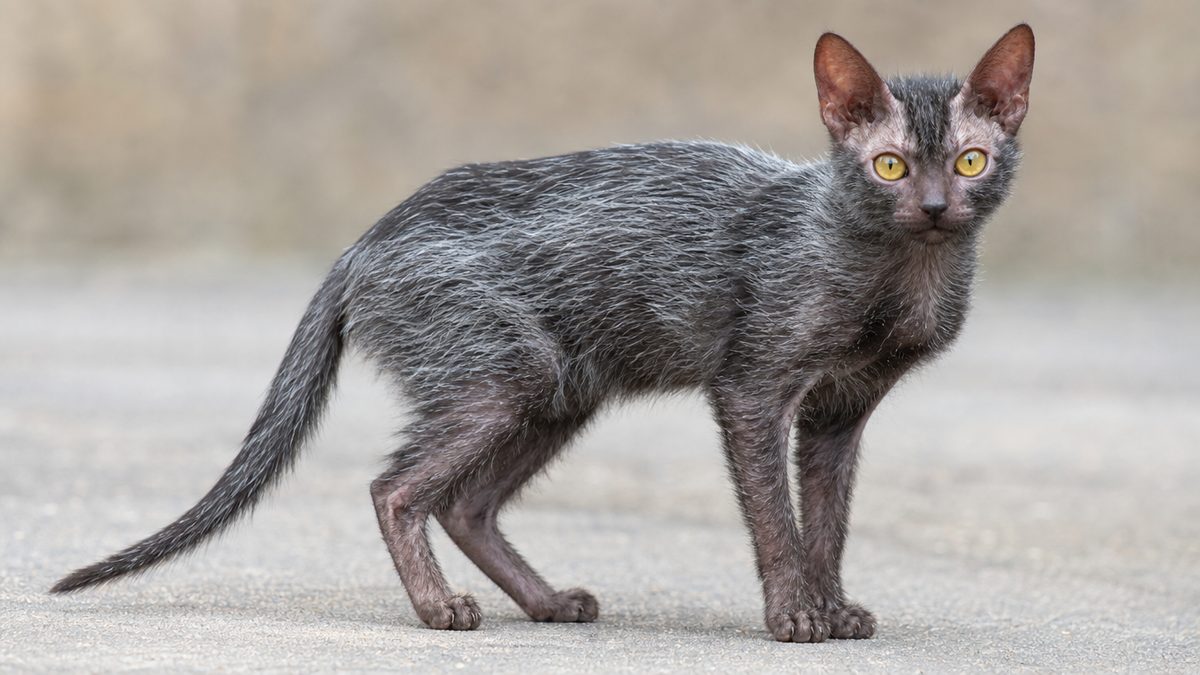
A Lykoi is a partially haired domestic cat whose sparse, white-flecked coat comes from recessive loss-of-function variants in the Hairless gene, HR. It is not a rex, it is not a Sphynx cross, and it is not a sick cat. Six causal variants are published, all in the same gene, all found in independently ascertained founder lines.
The breed name comes from the ancient Greek for wolf, and the look that earned it is a hairless mask across the nose, muzzle, chin, eyes and the backs of the ears, set against a thin body coat scattered with white hairs. FIFe's standard puts the same feature at 15 of 100 points and makes absence of the naked mask a fault that precludes the certificate.
The roan coat, defined by the registries themselves
The roan pattern is a mixture of coloured and unpigmented white hairs spread evenly through the coat, and two registries put the same numbers on it. FIFe requires between 30 and 70 percent white hairs with an ideal near 50, giving what its standard calls a salt-and-pepper look. GCCF's Standard of Points repeats the 30 to 70 band and the 50 percent ideal, and adds that the contrast is stronger on darker base colours. Those figures agree exactly, which is what you expect when two registries write from one founding club rather than from two independent observations, so treat them as one description rather than as two confirmations.
A useful detail no ranking page carries: TICA reports that Lykoi kittens are born solid black, and that the hairlessness and the roan colour pattern emerge only in the first one to two weeks.
The gene, and why it is not a rex gene
The Lykoi coat is a form of hypotrichosis, a reduction in hair rather than an absence of it. Whole genome sequencing of one Lykoi at 48.4x coverage, compared against the 99 Lives dataset of 194 non-Lykoi cats, identified roughly 558 coding-region variants unique to the cat, of which 17 were loss of function. Only one gene carried variants with highly severe effects, and it was HR, the cat homologue of Hairless, on chromosome B1.
GCCF puts the range in one sentence that is worth keeping in mind before you look at any photograph. The Lykoi has a reduced coat volume compared with normal-coated cats, and that volume can vary from partial hairlessness to almost completely coated depending on the cycle of hair. Two Lykoi photographed a year apart can look like two different breeds.
The sequenced cat was a compound heterozygote for two loss-of-function variants: an exon 3 duplication, c.1255_1256dupGT, predicted to stop translation at amino acid 420, and an exon 18 insertion, c.3389insGACA, predicted to stop it at position 1130. Fourteen further cats from founder lines in Canada, France and several parts of the USA carried four more loss-of-function HR variants, giving six in total.
| Allele | Exon | Variant | Protein effect | Named for |
|---|---|---|---|---|
| hrTN | 3 | c.1255_1256dupGT | Frameshift, stop at 420 | Tennessee |
| hrFr | 3 | c.1404+2delTinsCAG | Splice | France |
| hrTX | 8 | c.2112G>A | Splice | Texas |
| hrNC | 10 | c.2243C>T | Stop at 748 | North Carolina |
| hrCa | 11 | c.2593C>T | Stop at 865 | Canada |
| hrVA | 18 | c.3389insGACA | Frameshift, stop at 1130 | Virginia |
One allele dominates. The exon 8 hrTX variant appears in eight of the sixteen founder lines the paper tabulates, from Texas, two Californian lines, France, Georgia, South Carolina, Utah and Vermont, and the authors note it is not yet known whether those eight are identical by descent or represent repeated new mutations at the same site.
The abstract gives the genomic positions as chrB1:36040783 and chrB1:36051555; the results section of the same paper gives 36040784 and 36051556. Both readings were taken independently, one from the PubMed record and one from the full text. The variant names are unaffected and are what a laboratory would test, but quote the c. notation rather than the coordinates.
Where the breed came from
The breed history is short and unusually well documented. GCCF records that the breed began from four kittens, two sibling pairs, in 2011. TICA names the founders as Johnny Gobble, Brittney Gobble and Patti Thomas, and records that Johnny Gobble bred two unrelated cats together to prove the trait was genetic. FIFe's standard dates the founding mutation to a black domestic shorthair in the USA in 2010 and says new mutations later appeared in France and Italy.
FIFe's standard names France and Italy as sources of later mutations. The 2020 genetics paper ascertained cats from 14 regions across the USA, Canada and France, and no Italian line appears in its table of founder lineages. The registry and the study are not describing the same evidence base, and the Italian claim has no published genotype behind it that we could find.
Which registries recognise the Lykoi, and one that has a deadline
Four registries give the Lykoi full championship status and one gives it a deadline. CFA, TICA and the GCCF all show it in championship competition, while FIFe holds it in a preliminary class stamped 2023-2027, which is a status that can simply expire.
CFA's own registration rules print the ladder with dates. Registration became effective in February 2018, Miscellaneous in May 2018, Provisional in May 2021 and Championship in May 2023, with a longhair division added effective May 2026. The breed code is 78, the only permitted outcross is the Domestic Shorthair, and CFA accepts a three-generation pedigree with unknown ancestry permitted, which is a deliberate concession to a founder population still being assembled.
| Registry | Status | Code | Document read |
|---|---|---|---|
| CFA | Championship, effective 1 May 2023 | 78 | Registration Rules, revised 05/26 |
| TICA | Championship, in the 73-breed index | n/a | Browse All Breeds |
| GCCF | Recognised, Section 4 Group B | LYL and LYS | Standard of Points, June 2026 |
| FIFe | Preliminary only, category 4, 2023-2027 | LYO | Breeds page and LYO standard |
| WCF | Recognised | LYS | WCF EMS code table |
| LOOF | Registered, with two required DNA tests | n/a | Grille de Qualification |
FIFe's breeds page stamps the Lykoi and the Bombay alike as preliminary recognised breeds for 2023-2027, and its LYO standard is headed 'Preliminary recognized breeds'. That window closes next year. Any page telling you FIFe recognises the Lykoi without saying until when has told you half the fact. Read on the date above; check it again before you rely on it.
CFA's own committee structure confirms the championship reading from a second direction. Its declared-candidates list, updated on 31 July 2026, files the Lykoi in the Shorthair Breeds block, which holds full breed councils, while the separate block for Miscellaneous and Provisional breeds carries a single entry, the Khao Manee.
TICA's ladder tells the same story by being empty. Its Preliminary New Breeds class returned no matches at all when read on 8 September 2026, so nothing is currently waiting at the bottom of that ladder and the Lykoi's place in the 73-breed championship index is not provisional The International Cat Association.
Three registries, three different codes
The Lykoi has picked up a code collision in its first decade. FIFe files it as LYO, WCF as LYS, and GCCF splits it into LYL for the longhair and LYS for the shorthair The Governing Council of the Cat Fancy. If you are searching a pedigree database, the code you need depends on which registry issued the paper.
The WCF cross-registry map is useful for knowing where to look and is not an authority on what it finds. Its Lykoi row lists the breed as recognised by WCF, CFA, TICA, ACF, CCCA and LOOF, and omits both FIFe and the GCCF, although FIFe holds it under LYO and GCCF prints a full standard for it Federation Internationale Feline, Breeds The Governing Council of the Cat Fancy. Use the map as an index, then confirm in the registry's own document.
Colour rules disagree, and it matters at a show
TICA states that Lykoi come in many colours but only solid black roan is allowed to show. GCCF permits all colours and patterns except white self and bicolours. FIFe's LYO standard lists dozens of recognised colour varieties from black through golden, smoke, silver and pointed, and judges them all in one class. Those are three genuinely different rules for one breed.
France requires more of a breeding Lykoi than of a Sphynx, which is worth noticing. The LOOF's qualification grid asks a Lykoi for PKDef and PRA-rdAc results at levels 3 and 4 and clear results at level 5, while the Sphynx row is blank at every level.
Lykoi price in India, and why every figure you find is wrong
There is no Lykoi price in india, because there is no Indian supply. Bonbeno found no Indian breeder, no Indian cattery and no Indian classified listing for the breed, and every rupee figure attached to the name in an Indian search result belongs to merchandise rather than to a live animal.
Google's own top Indian result for the breed's price query is an Etsy market page titled 'Buy Lykoi Cat Online In India', served with og:locale en_IN. Its rupee figures run from Rs 115 to Rs 3,292, and reading the listing titles settles what they are: T-shirts, mugs, wall posters, SVG cut files, acrylic keychains, Christmas ornaments, 2027 wall calendars, metal street signs and needle-felted figurines.
Several listings on that page are cat clothes sold as apparel 'for Sphynx, Devon Rex, Lykoi'. The one physical Lykoi-related item an Indian shopper can order is a garment for the cat, sold on the assumption that the cat needs covering. That is a marketing inference, not a veterinary one, and no study of the breed supports it.
What the breed costs where it exists
Overseas figures circulate at roughly USD 2,000 to 3,000, quoted in Indian search results without a source we could open. Bonbeno publishes no rupee conversion of them. Converting a foreign price and printing it in rupees is how a fabricated Indian price enters circulation, and this site has documented the practice repeatedly on other breeds. If you want the number, take it in dollars from the page that printed it.
How rare the breed really is, measured rather than asserted
France's national studbook is the only register that publishes a live per-breed count, and it makes the scale plain. The LOOF issued 237 Lykoi pedigrees in the twenty years from 2003 to 2022, with the first arriving in 2017 and the yearly figure never exceeding 58. Its 2024 breakdown gives 27 pedigrees in 2023 and 37 in 2024, against 24,160 for the Maine Coon in the same year.
| Breed | 2023 | 2024 |
|---|---|---|
| Maine Coon (scale comparator) | 25,837 | 24,160 |
| Lykoi | 27 | 37 |
| LaPerm Longhair | 4 | 4 |
| European Shorthair | 0 | 0 |
Read that against the twenty-year table and the picture sharpens. The Lykoi went from zero French pedigrees before 2017 to 37 in 2024, so it is genuinely growing, and it is still rare enough that a country with an active cat fancy registers about three a month.
What an Indian buyer is actually being offered
Nothing, on the evidence we could gather. A search for Indian listings returned merchandise, a YouTube segment about a cattery in Cape Town, and an Indian cat-show post whose only connection to the breed is a hashtag. A hashtag is not a cat. Before you treat any Indian advertisement as real, ask the seller for a pedigree from CFA, TICA, FIFe, the GCCF or the LOOF, and ask which of the six HR variants the cat carries. A seller who cannot answer the second question is not selling a Lykoi.
No Indian price exists for this breed, and Bonbeno will not print one. That is not a gap in this page. It is the most useful thing the page can tell an Indian reader, because the alternative on offer is a converted dollar figure or a poster.
Monthly cost of ownership in India
The cost of ownership for a Lykoi in India is the cost of any indoor cat plus a skin budget, because the breed's only documented condition is dermatological. Purchase price cannot be estimated; recurring care can, from published Indian rate cards.
Vetic, a chain running 15 clinics reachable from its Mumbai page, publishes cat vaccination prices openly. Its kitten course across days 60, 90 and 120 starts at Rs 3,999 against a list price of Rs 5,065, its adult annual booster starts at Rs 1,899 against Rs 1,908, anti-rabies is from Rs 699 and the CRP combination from Rs 1,249. Those are one chain's promotional floors on one city page, not a national average, so treat them as a floor.
| Item | Published price | Frequency | Source read |
|---|---|---|---|
| Kitten vaccination course, 3 visits | From Rs 3,999 (list Rs 5,065) | First year only | Vetic, Mumbai page |
| Adult annual booster | From Rs 1,899 (list Rs 1,908) | Yearly | Vetic, Mumbai page |
| Anti-rabies, single | From Rs 699 | Yearly | Vetic, Mumbai page |
| CRP combination, single | From Rs 1,249 | Yearly | Vetic, Mumbai page |
| Professional bath or groom | Page headline reads 'starts under 500' | As needed | Vetic, 13 Delhi clinics |
Grooming is where a Lykoi budget differs from a Persian's, and it differs downward on brushing and upward on skin. Vetic's Delhi grooming page advertises 13 clinics and four service blocks covering haircut, bathing, complete bath with styling, and add-on enhancements, with a page headline of prices starting under Rs 500. A Lykoi needs no haircut at all.
The line item nobody budgets for
Add a dermatology consultation to your monthly cost planning, at least once in the cat's third or fourth year. In the only published series, lesions began between one and four years of age, and seven of ten cats developed visible signs only from mid-adulthood onward, with a median onset of 3.25 years. A cat that looks perfect at eighteen months is not a cat that has been cleared.
Costs that do not apply to a cat
Two figures repeated across Indian pet-cost articles are for dogs and should not be in your cat budget. Municipal registration in Delhi is a dog scheme, so no cat licence fee applies there. And under the Prevention of Cruelty to Animals (Pet Shop) Rules, 2018, the microchipping requirement in rule 7(16) reads 'Every puppy shall be micro-chipped by a veterinary practitioner ... only micro-chipped puppies shall be sold', which leaves kittens outside it entirely. You may still choose to microchip a cat; Indian law does not require it.
- Budget the vaccination course in the first year, then a single annual visit after it.
- Budget a skin check yearly from age two, earlier if you see a black comedone.
- Budget nothing for haircuts, which this coat neither needs nor tolerates well.
- Budget for indoor enrichment, because the registries describe an active hunter and the breed should not roam.
Can a Lykoi handle the Indian climate
Nobody knows, and that is the honest answer. Neither peer-reviewed paper on the breed uses the word thermoregulation, so a confident heat tolerance rating for the Lykoi would be invention. What can be said is what the coat physically is, what the homeland climate measures, and what Indian law requires of anyone selling one here.
Start with the coat. FIFe's standard describes it as sparse with the undercoat almost absent, and records that the quantity varies from cat to cat and by season. GCCF adds that the greatest reduction sits on the underparts and legs, which may at times carry only a light down. So a Lykoi has less insulation than an ordinary shorthair and more than a Sphynx, and where any individual sits on that range changes through the year.
The homeland is more humid than most of India, not less
The reflex claim about an imported breed is that Indian humidity will finish it. For the Lykoi that is simply false. NASA POWER, queried by explicit latitude and longitude for the Tennessee founding area, returns an annual mean relative humidity of 76.31 percent. Chennai reads 72.39, Kolkata 73.93, Bengaluru 67.94, Mumbai 67.39, Pune 66.80 and Delhi 45.56. The founding climate is damper than every Indian city on that list.
The gap is heat, and it is large.
| Place | Annual mean | Hottest month | Annual RH | Cell elevation vs real |
|---|---|---|---|---|
| Vonore, Tennessee (founding area) | 14.97 C | 25.66 C (Jul) | 76.3% | 361 m vs ~250 m, +111 m |
| Delhi | 25.60 C | 35.88 C (Jun) | 45.6% | 206 m vs ~216 m, -10 m |
| Kolkata | 25.81 C | 31.53 C (May) | 73.9% | 7 m vs ~9 m, -2 m |
| Mumbai | 26.77 C | 31.19 C (May) | 67.4% | 97 m vs ~14 m, +83 m |
| Chennai | 27.95 C | 31.51 C (May) | 72.4% | 49 m vs ~6 m, +43 m |
| Pune | 23.86 C | 28.93 C (Apr) | 66.8% | 636 m vs ~560 m, +76 m |
| Bengaluru | 23.74 C | 28.37 C (Apr) | 67.9% | 842 m vs ~920 m, -78 m |
Delhi runs 10.6 C warmer than the founding area across the year and its hottest month is 10.2 C hotter than Tennessee's. Pune and Bengaluru are the mildest Indian options on the table and both peak in April rather than May, which is worth knowing because most breed pages assume every Indian city peaks together.
NASA POWER returns a grid cell, not a point, and in hilly terrain the cell can sit a kilometre away from the town vertically. Every Indian cell above is within 83 m of the real elevation, so the figures describe the cities. The elevations are printed so you can check that rather than take it on trust.
Heat tolerance, stated as a question rather than a rating
Bonbeno rates heat tolerance on every breed page because it is the single most decision-relevant trait in India. For the Lykoi the rating carries a caveat the number cannot express: it is inferred from coat structure, not measured. What is documented is that a Lykoi's coat thins seasonally on its own, and that the direction of that change is not under the owner's control.
Indian law turns that uncertainty into somebody's legal duty. Rule 6(5) of the Pet Shop Rules, 2018 requires that the temperature where animals are housed for sale be comfortable, states that this 'may vary from animal to animal, and from breed to breed', and makes it 'incumbent upon the pet shop owner to familiarise himself with the requirements of the breeds or species that he intends to deal in'. For a breed with no published thermoregulation data, no seller in India can discharge that duty from evidence.
Two errors point in opposite directions and both come from treating the Lykoi as a Sphynx. It is not hairless, so it does not need clothing indoors in Chennai. It is also not fully coated, so it should not be left on a sunny balcony on the theory that cats regulate themselves. Keep it indoor, keep the room ventilated, and judge the individual cat rather than the breed name.
Temperament and household fit
The Lykoi temperament is confident, busy and people-focused, and it is the only aspect of the breed on which every registry agrees. GCCF's Standard of Points states plainly that the Lykoi is a very friendly cat that demands attention from people.
TICA's description adds the working detail. It reports a cat that stalks its toys, other pets and even people before pouncing, that bonds strongly with its household, and that loves a warm lap but would rather be playing. GCCF's breed index gives the same picture in two words, active and outgoing.
Who this cat suits in an Indian home
A Lykoi suits a household that is home a lot and does not mind being followed. It is affectionate in the demanding sense rather than the decorative one, and a cat described by two registries as a hunter will find something to hunt in a flat whether or not you provide it.
- Suits a family that wants an interactive cat and will play with it daily.
- Suits a household that keeps its cats indoor, which this breed needs anyway.
- Struggles in a home empty ten hours a day with no second cat.
- Struggles as an ornament, because the coat is the least interesting thing about the animal.
The claim to be careful with
Search results describe the Lykoi as dog-like, loyal and clingy, and those descriptions come from owner reports and breeder pages rather than from any behavioural study. Bonbeno reports them as what they are. There is no published behavioural research on this breed at all, which is unsurprising for a population registering 37 pedigrees a year in France.
The single most common reaction to a Lykoi is that it looks unwell or unfriendly. It is neither. The wolf-like face is a hairless mask, not an expression, and every registry standard that describes the cat behind it describes a sociable animal.
Training a Lykoi, and what it resists
Train a Lykoi the way you would train any high-drive shorthair, with short reward-based sessions built around its hunting sequence. The breed's own registries describe a cat that stalks and pounces, which is the behaviour you shape rather than suppress.
Use food or play as the reward and keep sessions to a few minutes. TICA describes a very intelligent cat with a limitless supply of energy that prefers active searching to sitting. That is a trainable profile, and it is also a profile that invents its own games when bored.
The one lesson that matters more here than in other breeds
Teach handling early, and teach it specifically for the skin. The published skin syndrome is diagnosed by looking at and feeling the skin, and the study's own cats tolerated manipulation of their lesions without pain or itching, scoring zero across the board on the Glasgow pain scale. A cat that accepts being turned over, having its legs examined and having its belly touched is a cat whose comedones you will find in month one rather than month twelve.
- Pair handling with food from the first week home, thirty seconds at a time.
- Work through the body in a fixed order so you notice what changed.
- Stop before the cat objects, every time, so consent is never spent.
- Repeat weekly for life, because onset is typically in adulthood.
What the breed resists
It resists confinement and it resists boredom. A cat this active kept indoor in a small Indian flat needs vertical space, puzzle feeders and a second animal or a present human. It does not resist a carrier, a harness or a nail trim if you introduce them early; nothing about the HR variants changes a cat's trainability.
By six months, your Lykoi should let a stranger in a clinic hold it, lift each leg and look at its belly without restraint. That single skill is worth more to this breed than any trick, because it is how a dermatologist will examine it.
Daily exercise and what happens without it
Give a Lykoi two or three structured play sessions a day, ten to fifteen minutes each, built around chase and pounce. Both registries that describe activity call this a high-energy hunter, and an under-exercised one redirects that drive at the household.
The requirement is behavioural rather than metabolic. Nothing published about the HR variants suggests any difference in energy expenditure, so the Lykoi's exercise need is the need of an active shorthair. What is different is that this cat should not meet that need outdoors.
Why an indoor life is the right default in India
Two arguments support keeping a Lykoi indoor and only one of them is about the coat. The first is common to all pedigree cats in Indian cities: traffic, dogs, theft and infectious disease. The second is specific: a cat whose coat thins on its own schedule can be at its sparsest exactly when the weather is worst, and neither of the two papers on the breed offers any guidance on what that means outdoors Burnouf T, Muller A, Husson JC, Abitbol M.
- Provide vertical space, because climbing substitutes for territory in a flat.
- Rotate toys weekly so the hunting sequence stays worth completing.
- Feed part of the daily ration from a puzzle feeder rather than a bowl.
- Schedule the longest session before your own bedtime to shift night activity.
In Delhi through May and June, and in Chennai and Kolkata through the pre-monsoon weeks, move play to early morning and late evening. Delhi's hottest month averages 35.88 C and Chennai's 31.51 C at 65 percent humidity, and an indoor cat in an unventilated afternoon room is warmer than either figure suggests.
If a normally busy Lykoi stops playing, do not put it down to the weather. Reduced activity is one of the few general signs an owner can notice in a cat, and in a breed whose only documented condition is a skin syndrome that can carry secondary bacterial infection, a flat cat earns a vet visit rather than a fan.
Grooming and skin care in Indian humidity
Grooming a Lykoi is mostly skin care rather than coat care. There is very little to brush, the undercoat is almost absent, and the work that matters is a weekly inspection of the skin plus an occasional bath when the coat feels greasy.
Handle the coat gently and rarely. FIFe describes the texture as soft and the undercoat as almost absent, and GCCF adds that the coat is flat to the body and surprisingly soft to the touch The Governing Council of the Cat Fancy. There is no matting risk and no undercoat to rake out, so aggressive brushing removes coat you want to keep. Note that FIFe faults too much undercoat and GCCF states that more coat is desirable over less, so nobody is trying to make this cat balder.
The weekly skin check, which is the real grooming routine
Look for black comedones, small white nodules and any raised lump, on the body first and then the limbs. In the published series the severe cases showed black comedones larger than 5 mm with numerous furuncles, the moderate cases showed small white nodules on the extremities, and the mild cases only a few medium nodules under 4 mm. Every one of those is something an owner can see.
- Run your fingertips over the trunk, then the limbs, in the same order each week.
- Photograph anything new against a ruler or a coin so change is measurable.
- Bathe only when the skin feels oily, using a plain cat shampoo, never a human one.
- Dry the cat fully rather than letting it air-dry in a humid Indian room.
- Book a vet visit for any lesion that ulcerates, spreads or weeps.
Five of the six severely affected cats in the 2026 study grew Pasteurella multocida on deep swabs taken from ulcerated black comedones, and two also grew Staphylococcus species. Squeezing a blocked follicle at home is how a cosmetic lesion becomes an infected one.
What Indian humidity changes
Humid air keeps skin damp for longer after a bath, and a humid coat that never fully dries is a poor environment for skin that is already prone to blocked follicles. Kolkata sits at 87 to 89 percent relative humidity from July to September, Mumbai and Pune at 89 to 91 percent, and Chennai at 77 to 82 percent from September to December. Towel the cat, then finish the job with a fan on a low setting rather than leaving it to dry itself.
Grooming services in Indian metros are widely available and cheap by international standards. Vetic alone lists 13 clinics offering grooming in Delhi, with bathing, complete bath and styling, and add-on services, at a page-advertised starting point under Rs 500. A Lykoi needs the bath and none of the styling.
Shedding, and the allergy question
Owners ask whether a Lykoi will shed less than an ordinary cat, and the honest answer is that it sheds less hair because it grows less hair, which is not the same as shedding less allergen. The major cat allergen, Fel d 1, is a salivary and sebaceous protein rather than a property of hair volume, and the feline literature on breed-level allergen differences is one paper deep.
That paper sequenced the two Fel d 1 genes in Siberian cats, a breed said by some breeders to be low-allergen, found variants that could in principle affect the allergen, and concluded that further investigation was needed to establish whether they reduce allergen synthesis at all. No equivalent work exists for the Lykoi. Anyone selling one as hypoallergenic is selling an assumption.
Health risks, the 2026 cyst study, and what is still unknown
The Lykoi has exactly one documented breed-specific health problem, and it was named in January 2026, after every page currently ranking for the breed was written. It is a skin condition, it appears not to hurt the cat, and it was present even in the study's clinically normal control.
A prospective study recruited eleven privately owned Lykoi through the French Lykoi Breed Club, the LOOF, TICA and a veterinary dermatology mailing list, of which ten were affected and one served as a control. The cats were aged 1.5 to 7 years at diagnosis, seven males and four females, and every one was FIV and FeLV negative.
| Finding | Count | Note |
|---|---|---|
| Severe generalised form | 6 of 10 | Black comedones over 5 mm, furuncles, near-total alopecia |
| Moderate regional form | 2 of 10 | Small white nodules, mostly on the extremities |
| Mild scattered form | 2 of 10 | A few medium nodules under 4 mm |
| Sebaceous gland duct cysts | 10 of 10 | Present in every affected cat |
| Infundibular follicular cysts | 9 of 10 | Blocked hair follicle openings |
| Sweat gland cysts | 5 of 10 | Apocrine, with mild inflammation in three |
| Pasteurella multocida on deep swab | 5 of 6 severe cases | All broadly antibiotic-susceptible |
| Glasgow pain scale score | 0 in every cat | No systemic signs, no pain, no itching |
The finding that changes what breeders can promise
Small cysts were also found in clinically unaffected skin and in the clinically normal control cat, which led the authors to question whether truly unaffected Lykoi exist. Genotyping of the six known HR variants found five of them among the eleven cats, with the NC variant absent, and no genotype predicted severity: the control was a TX/VA heterozygote and so was one mildly affected cat.
WebMD's Lykoi profile, dated 15 September 2024, calls the breed exceptionally healthy and easy to care for. TICA's own page states the Lykoi has no prevalent genetic diseases. Both were accurate when written. The study naming this syndrome was accepted on 17 December 2025 and published on 3 January 2026, and the authors say the syndrome had never been described before.
How the follicle is actually built
The underlying change is in the hair follicle groups themselves. Lykoi have a significant reduction in the average number of follicles per hair follicle group compared with domestic shorthair cats, a mild to severe perifollicular to mural lymphocytic infiltration in 77 percent of observed groups, and follicles that are often miniaturised, dilated and dysplastic. The 2020 paper's summary of the breed's health is one sentence: no health concerns had been identified other than the lymphocytic mural folliculitis.
OMIA, the reference catalogue of inherited traits in animals, files the phene as HR-related hypotrichosis, autosomal recessive, and flags it as disease-related. That flag is a classification, not a prognosis, and it sits beside the authors' own view that these coat mutations are innocuous in the cat while the same genes cause ectodermal dysplasias in humans.
Feeding a Lykoi in India
Feed a Lykoi the way you would feed any active indoor shorthair, on a complete life-stage food with fresh water and controlled portions. No published research shows that the HR variants change energy requirements, and no study of Lykoi nutrition exists.
The temptation is to reason from the Sphynx. Hairless cats are often said to eat more because they lose more heat, and that logic is then transferred to any coat-mutation breed. It should not be transferred here. A Lykoi is partially haired rather than hairless, its coat volume varies through the year, and nobody has measured its metabolic rate.
What the evidence actually supports
The strongest feeding evidence relevant to any cat in India is about weight rather than breed. The UK life-table study found that non-ideal body weight was significantly associated with a shortened lifespan, alongside being entire and being purebred. Entire cats carried 4.29 times the odds of dying before three years, and purebred cats 1.83 times the odds of crossbred cats.
- Feed a complete kitten diet to twelve months, then an adult maintenance diet.
- Weigh the cat monthly and record it, because a coat this thin hides less than a Persian's but a spreadsheet hides nothing.
- Split the daily ration into a bowl portion and a puzzle-feeder portion.
- Neuter at the age your veterinarian advises, on the evidence above.
Availability in India
Complete cat foods from international manufacturers are widely stocked in Indian metros, so a Lykoi presents no sourcing problem that any other pedigree cat does not. What matters more than the brand is that the food is complete and that the portion matches a monthly weight record.
Skin supplements marketed for coat conditions have no published evidence in this breed. The 2026 study describes a structural problem in the follicle and its glands, not a nutritional one, and it does not test any dietary intervention. Discuss supplements with your veterinarian rather than with a retailer.
Kitten care month by month through the first year
A Lykoi kitten changes appearance faster than almost any other breed. TICA records that Lykoi are born solid black and that the hairlessness and roan pattern emerge in the first one to two weeks, so the cat you collect looks nothing like the newborn.
Weeks 0 to 8, at the breeder
Indian law sets the floor for kitten care here even though no Lykoi is bred in India. The Prevention of Cruelty to Animals (Pet Shop) Rules, 2018 define an un-weaned animal to include 'kittens and pups below eight weeks', and rule 7(15) prohibits any pet shop selling un-weaned or underage animals. Eight weeks is a legal minimum, not a target.
Months 2 to 4, vaccination and handling
Vaccinate on a clinic schedule rather than a breeder's word. Vetic's published kitten course runs CRP at day 60, anti-rabies plus CRP at day 90, and CRP plus anti-rabies at day 120, from Rs 3,999. Use these same weeks to build the handling habit described in the training section, because it is the skill this breed most needs.
Months 4 to 8, the coat does what it likes
Expect the coat to thin and thicken without warning. GCCF's standard states that the greatest reduction in coat volume occurs on the underparts and legs, which may at times be covered only with a light down, especially in kittens. FIFe adds that the quantity varies by cat and by season. A kitten going bald on the belly in month six is behaving normally for the breed.
Months 8 to 12, and the years after
Nothing in the published skin syndrome shows up this early in most cats. Onset in the study ranged from one to four years, with a median of 3.25 years and seven of ten cats first showing signs from mid-adulthood. That is why the weekly skin check has to become a lifetime habit in year one rather than a response to a lesion in year four.
| Age | What happens | What you do |
|---|---|---|
| Birth to 2 weeks | Born solid black; roan and bare mask emerge | Nothing. This happens at the breeder |
| 8 weeks | Legal minimum age for sale in India | Refuse any kitten offered earlier |
| Day 60 to 120 | CRP and anti-rabies course | Book the full three visits, from Rs 3,999 |
| 3 to 6 months | Coat thins and thickens unpredictably | Start the weekly skin check and the handling habit |
| 6 to 12 months | Adult activity level arrives | Set up vertical space and puzzle feeding |
| Year 2 onward | Typical window before lesions appear | Continue weekly checks; photograph anything new |
Lykoi against the cats buyers cross-shop
Buyers comparing a Lykoi are usually comparing coat mutations, and the four breeds they look at sit on four different genes. Getting that straight settles most of the questions at once, because a coat test for one of them says nothing about the others.
| Breed | Gene | Chromosome | Inheritance | Commercial coat test |
|---|---|---|---|---|
| Lykoi | HR (Hairless) | B1 | Recessive | No test at UC Davis VGL |
| Cornish Rex and German Rex | LPAR6 | A1 | Recessive | Yes, Cornish Rex Coat |
| Devon Rex | KRT71 | not stated here | Recessive | Yes, with the Sphynx |
| Sphynx | KRT71 (hr allele) | not stated here | Recessive to normal, dominant to Devon | Yes, with the Devon |
| Selkirk Rex | KRT71 splice variant | B4 | Dominant | Yes, Selkirk Rex Coat |
| LaPerm | Not mapped | Unknown | Dominant | None exists |
The Cornish and German Rex share one four-base-pair deletion, c.250_253delTTTG in exon 5 of LPAR6 on chromosome A1, which is fixed in the Cornish and segregating in the German. The Devon Rex and Sphynx sit on KRT71, with an allelic series in which the hairless allele is dominant to the Devon curly allele. The Selkirk carries a third KRT71 splice variant, autosomal dominant, mapped to chromosome B4.
The Lykoi belongs to none of that. Lykoi owners had already genotyped their cats for every known cat fur-type mutation, including the KRT71 variants, and none of them was present.
The oldest of these entries has no gene attached at all. OMIA still carries a 1956 phene called simply Curly coat, symbol r, listing the Cornish rex and German rex as its species-specific names and citing Searle and Jude's original description in the Journal of Genetics. The gene behind that symbol was not identified until 2013, fifty-seven years later, which is a useful sense of how long a coat mutation can sit in the literature named but unmapped.
The comparison that matters for a buyer
The Sphynx is the only one of these breeds with a published UK life expectancy, and it is the shortest in its table at 6.68 years from 18 deaths, against 11.74 years for UK cats overall. That figure belongs to the Sphynx and to no other breed here. It is quoted because it is the nearest available comparator and because it shows what a coat mutation with a large enough population looks like when someone finally counts.
Every breed above except the Lykoi and the LaPerm is called a rex or a Sphynx in ordinary speech, and three separate genes sit behind those names. A DNA test sold as a Cornish Rex coat test detects an LPAR6 deletion and will return a clean result on a Lykoi, a Devon, a Selkirk and a Sphynx alike.
Mistakes Indian buyers actually make with this breed
The commonest Lykoi mistake in India is treating the breed as a Sphynx with fur. That single assumption produces four separate errors, and the sources that encourage it include Google's own AI Overview and the English Wikipedia article.
Mistake one: importing the Sphynx's sunburn risk
Google's AI Overview for this breed states that Lykoi must stay indoor to protect sensitive skin from sunburn, cold and injury. Wikipedia states that Lykoi are susceptible to several of the same concerns as Sphynx and other hairless cats, naming sensitivity to climate and temperature, sunburn and increased skin cancer risk. Neither peer-reviewed paper on the Lykoi contains the word sunburn, and neither contains thermoregulation Burnouf T, Muller A, Husson JC, Abitbol M. Keeping the cat indoor is sound advice; the reason given for it is borrowed.
Mistake two: transferring canine hairless findings
Hairless dogs are a tempting analogy and a false one. Hairless Chinese Crested dogs are heterozygous for a FOXI3 mutation and present with hypotrichosis and dentition abnormalities. That is a different gene, a different species and a different clinical picture. The same canine study found that FOXI3 mutants had only simple primary hair follicles where normal dogs had compound follicles, and that their apocrine skin glands and respiratory mucous glands were present and normal.
Set that beside the cat and the contrast is instructive rather than transferable. Lykoi retain hair follicle groups but with fewer follicles in each, and the 2026 study found cysts in all three adnexal structures including the sweat glands Burnouf T, Muller A, Husson JC, Abitbol M. The dog keeps its glands and loses its compound follicles; the cat keeps a depleted follicle group and develops glandular cysts. No published work links the two.
Mistake three: buying a black cat with a bare face
Verify the pedigree and the genotype, not the photograph. A patchy coat and a bare face can be ringworm, demodicosis, a self-inflicted alopecia or a domestic shorthair with skin disease. The only way to distinguish a Lykoi is a pedigree from a registry that holds the breed plus a genetic testing result naming one of the six HR variants. The French team's genotyping was done at a specialist laboratory in France, because UC Davis's VGL, which sells coat tests for the Cornish, Devon, Sphynx and Selkirk, sells none for the Lykoi.
Mistake four: reading a merchandise price as a cat price
Rs 3,292 buys a Lykoi wall calendar, not a Lykoi. Any Indian page quoting a four-figure rupee price for this breed is either quoting merchandise or converting a foreign figure. Ask what the number describes before you ask whether it is fair.
Ask any Indian seller for the registry that issued the pedigree, the HR variant the cat carries, and a photograph of the parents' skin. A genuine breeder anywhere in the world can answer all three. Nobody selling you a mislabelled domestic shorthair can answer the second.
Adoption and responsible sourcing
Adopt an Indian cat if what you want is a cat, and treat the Lykoi as a breed you may never meet in India. That is not a consolation line. It follows from the numbers: France issues about three Lykoi pedigrees a month and India issues none at all.
Indian shelters and municipal facilities rehome cats continuously, and a rescued shorthair will be as affectionate and as playful as any pedigree. The GCCF itself frames the question this way for hairless breeds, recording its Genetics Committee's standing position that it has no intention of recognising further hairless breeds, citing reported health problems associated with hairlessness, and offering an alternative breed on every such row.
If you still want this specific breed
There is no lawful route to import a Lykoi into India for breeding or sale, and the only route for an individual is as a personal pet with the correct paperwork. Anyone offering to source one commercially should be asked to show that paperwork before money changes hands.
- Ask which registry issued the pedigree, and check the breed is held by that registry under the code it uses.
- Ask which of the six HR variants the cat and both parents carry.
- Ask for the parents' skin history, including any comedones, nodules or cysts.
- Ask what the cat has been screened for; the French studbook requires PKDef and PRA-rdAc of breeding Lykoi.
- Refuse any kitten under eight weeks, which Indian law treats as un-weaned.
The adoption argument, made from the data
The strongest reason to adopt rather than import is in the UK life tables. Purebred cats had 1.83 times the odds of dying before three years compared with crossbreds, and crossbred cats reached 11.89 years at age zero against 11.74 for cats overall. Those figures cover 7,936 confirmed deaths and they are the largest such dataset in existence.
An adopted Indian cat costs nothing to acquire and comes into the same care pathway as any pedigree. Vaccination, the one recurring cost that genuinely matters, runs from Rs 1,899 a year for the adult booster on a published Indian rate card, whatever the cat's ancestry.
Bonbeno does not recommend breeders, link kitten listings or quote a live price as an offer. If a Lykoi is the cat you want, the honest advice is to wait, to learn the genetics on this page, and to buy nothing until a seller can name a variant.
Lykoi cat questions Indian readers actually ask
Are Lykoi cats friendly?
Yes. Every registry that writes a standard for the breed says so in its own words. GCCF's Standard of Points calls the Lykoi 'a very friendly cat that demands attention from people', and TICA describes a loyal cat that bonds closely with its household. Friendliness is the least contested claim about this breed, and it is the one thing the ranking pages get right.
Do Lykoi cats have health problems?
Yes, one is now documented. In January 2026 a prospective study of eleven Lykoi named cutaneous adnexal polycystic syndrome, finding sebaceous duct cysts in all ten affected cats, infundibular follicular cysts in nine and sweat gland cysts in five. No cat showed systemic signs, pain or itching, and all scored zero on the Glasgow pain scale, but five of six severe cases grew Pasteurella multocida on deep swabs.
What is the most misbehaved cat breed?
Google asks this alongside the Lykoi, and there is no published answer, because no peer-reviewed study ranks cat breeds by misbehaviour. What is documented is activity: GCCF and TICA both describe the Lykoi as a high-drive hunter that stalks toys, other pets and people. That reads as naughtiness in a flat with nothing to hunt, which is a housing problem rather than a breed defect.
Do high IQ people prefer cats?
This question sits in the Lykoi box because Google fills a thin breed result set with generic cat questions, and it has no bearing on the breed. Bonbeno has no data on it and will not invent any. Its presence is itself the finding: the Lykoi is searched so little in India that half its People Also Ask box is not about the Lykoi at all.
Is the Lykoi a rex breed?
No. The Lykoi is not a rex and does not carry a rex variant. The Cornish and German Rex carry a four-base-pair deletion in LPAR6 on chromosome A1; the Devon Rex, the Selkirk Rex and the Sphynx carry three different KRT71 alleles. The Lykoi's coat comes from loss-of-function variants in Hairless on chromosome B1, and owners had already excluded the KRT71 variants by genotyping before the gene was found.
How much does a Lykoi cat cost in India?
There is no Indian price, because there is no Indian supply. Bonbeno found no Indian breeder, no Indian classified listing and no Indian cattery for the breed. Google's own top Indian result for the price query is an Etsy page titled 'Buy Lykoi Cat Online In India' whose rupee figures, from Rs 115 to Rs 3,292, are all T-shirts, mugs, posters and digital cut files.
Do Lykoi cats get sunburn?
Nobody has shown that they do. Google's AI Overview states the breed must live indoor to avoid sunburn and Wikipedia extends the Sphynx's skin-cancer risk to it, but the word sunburn appears zero times in both peer-reviewed papers on the breed, and so does thermoregulation. A Lykoi is partially haired, not hairless, and the Sphynx's risks belong to a different gene in a different coat.
How long do Lykoi cats live?
No published life expectancy exists for the Lykoi. The largest UK study, covering 7,936 confirmed deaths in 2019, reports life tables only for the 12 breeds with 15 or more deaths, and the Lykoi is not among them. UK companion cats overall reached 11.74 years and purebreds 10.41. Any 12 to 15 year figure you read for the Lykoi is a breeder estimate, not a measurement.
Why does a Lykoi lose its coat and grow it back?
Because the coat cycles, and the registries say so in their own standards. FIFe records that the quantity of coat varies from cat to cat and by season, and GCCF that it varies with season, maturity and the cycle of hair growth. Owners call it 'wolfing out'. The one research mention is a personal communication in the 2020 paper that some variants cause more periodic hair loss, suspected to track sex hormone levels.
Can I import a Lykoi into India?
Only as your own pet under the personal baggage route, never to breed or sell. A Lykoi arriving in India would also fall under the Prevention of Cruelty to Animals (Pet Shop) Rules, 2018 if offered for sale, whose rule 6(5) makes it the seller's duty to learn the temperature requirements of the breed dealt in. For a breed with no published thermoregulation data, nobody can discharge that duty honestly.
Compare with similar breeds
Lykoi sits in 1 Bonbeno group. Each one compares it directly against the breeds it is genuinely an alternative to, on the same figures.