
Cat breed profile
Sphynx Cat Price in India, Heat, Skin Care and Health
What a Sphynx cat actually costs in India, why published prices disagree by ten times, the 6.68 year life expectancy figure no Indian seller publishes, and why the country that helped create this breed made it illegal to keep one in January 2026.
Quick answer
The Sphynx cat price in India runs Rs 25,000 to Rs 5,00,000 in 2026, and the published sources disagree by roughly ten times at the extremes. Two facts change the decision and no ranking page carries either. UK veterinary records give the Sphynx a life expectancy at age 0 of 6.68 years, the shortest of twelve breeds studied, and since 1 January 2026 it has been illegal to keep a hairless cat in the Netherlands.
This guide is general information for Indian pet owners and is not a diagnosis. Always consult a registered veterinarian near you before acting on anything you read here, and treat any sudden change in your cat's condition as urgent.
Sphynx cat at a glance
What a Sphynx cat actually is
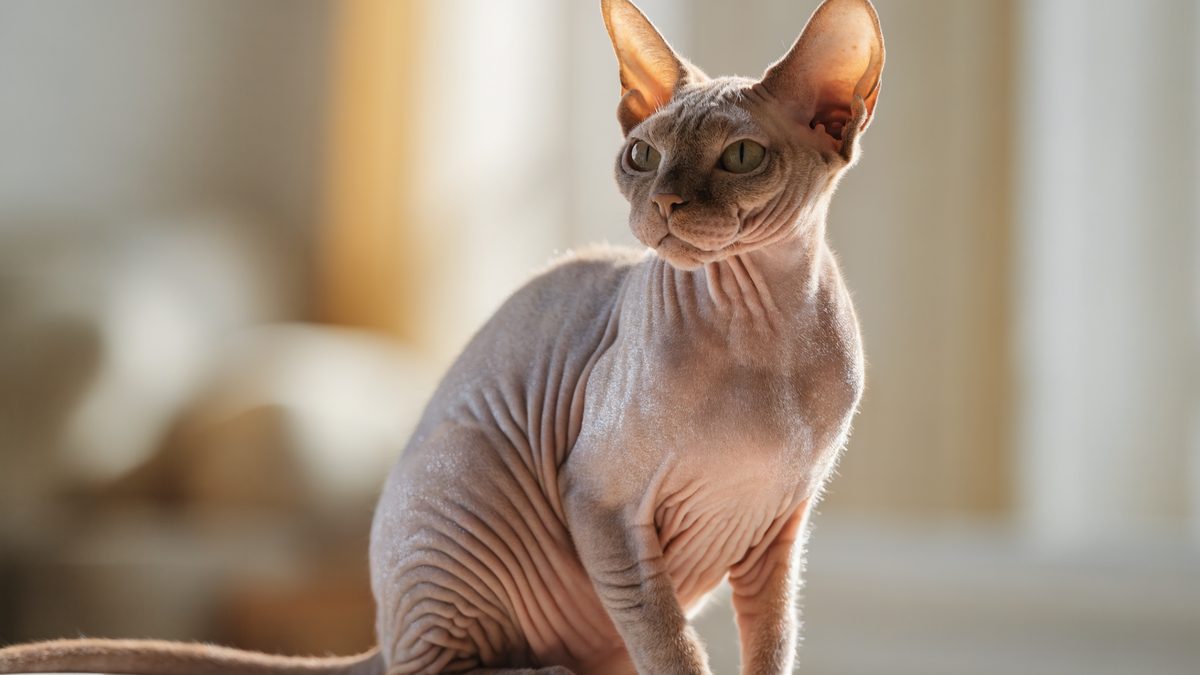
A Sphynx is a medium-sized domestic cat that looks hairless but is not. It carries a fine down over chamois-textured skin, it has the same number of hair follicles as a coated cat, and every practical thing about owning one, including the price, the bathing, the heart screening and the Indian summer problem, traces back to the fact that the follicles are present but the hair shafts are defective.
The International Cat Association states it plainly. The Sphynx appears to be a hairless cat although it is not truly hairless, the skin should have the texture of chamois, and it may be covered with very fine down which is almost imperceptible to both the eye and the touch. Short, soft, fine hair is allowed on the ears, muzzle, tail, feet and scrotum. The Cat Fanciers' Association goes further and makes hair a requirement, specifying that there should be some evidence of hair on the bridge of the nose and the ears, with a skin texture akin to either a soft peach or a smooth nectarine. A render or a photograph showing a completely bald, rubber-skinned cat is not showing you the breed standard.
That distinction is not pedantry. It is the first free check an Indian buyer can run, and it takes about ten seconds.
The genetics, and why the skin behaves the way it does
Hairlessness in the Sphynx comes from a single recessive allele in the keratin 71 gene. Researchers sequenced KRT71 in randomly bred and pedigreed domestic cats with different coat mutations and identified a single-nucleotide polymorphism altering a splice site in the Sphynx breed, proposed as the hairless allele, with a separate complex alteration in the Devon Rex producing the curly allele. The two breeds are genetic neighbours, which matters later when this page reaches the inherited muscle disease they share.
A separate study biopsied 14 Sphynx cats against five cats with normal coats and examined 11 Sphynx and six controls by dermatoscopy. The result contradicts almost everything written about this breed in the Indian market. Follicular density was similar for both Sphynx cats and control animals. The follicles are all there. What is wrong is what comes out of them. Sphynx hair follicles were often small, curved and kinked and demonstrated infundibular hyperkeratosis and dilatation, and Sphynx hair shafts were misshapen, smaller in diameter and rarely medullated. The authors concluded that the breed shows hair follicle dysplasia, with abnormal shaft production but without a decrease in follicle quantity, similar to murine KRT71 mutants.
Hold on to the phrase infundibular hyperkeratosis and dilatation. The infundibulum is the top of the follicle where the sebaceous oil drains out. Hyperkeratosis and dilatation there is the histological description of a blocked, widened pore. That single finding explains the blackheads on the chin, the greasy claw folds, the waxy ears and the yeast, and it is why the grooming section of this page looks nothing like the grooming section of a coated breed.
| Attribute | What the record shows | Source |
|---|---|---|
| Coat | Appears hairless, not truly hairless. Chamois texture, may carry very fine down. Hair allowed on ears, muzzle, tail, feet, scrotum | TICA standard |
| Nose bridge | Should show some evidence of hair. Some degree of fuzz on the bridge of the nose | CFA and TICA standards The International Cat Association |
| Follicle density | Similar to coated control cats. The shafts are defective, not the follicles | Genovese et al., 14 Sphynx and 5 controls |
| Gene | Recessive splice-site variant in KRT71, the same gene that carries the Devon Rex curly allele | Gandolfi et al. |
| Adult weight, TICA | Medium-sized, 6 to 12 pounds. Females 7 to 10, males 8 to 12 | TICA |
| Adult weight, GCCF | Females 6 to 8 pounds, males 8 to 11 pounds. Males generally 25 percent larger | GCCF |
| Adult weight, Indian listing | 3 to 6 kg, height 9 to 11 inches | Puppiezo |
| Ears | Large to very large, broad at the base, open and upright, interior naturally without furnishing | CFA standard |
| Body | Medium length, hard and muscular, broad rounded chest, full round abdomen with the appearance of having eaten a large meal | CFA and TICA standards The International Cat Association |
| Life expectancy at age 0, UK primary care | 6.68 years (95% CI 4.53 to 8.83), 18 recorded deaths, range 0.13 to 14.67 years | VetCompass life tables |
| Lifespan claimed by breed bodies and Indian pages | 7 to 15 years (TICA), 15 years or more (GCCF), 8 to 15 years (Indian pages) | TICA, GCCF, Wrapinfur The Governing Council of the Cat Fancy Wrapinfur, Sphynx Cat Price in India 2026 |
| Allowable outcross breeds, CFA | American Shorthair, Devon Rex, Domestic Shorthair. Sphynx born on or after 31 December 2033 may have only Sphynx parents | CFA registration note |
Seven checks that take ninety seconds before any money moves
Indian buyers pay five figures for a cat they have usually seen only on WhatsApp, in a market with almost no pedigree infrastructure. The two published breed standards hand you a free physical checklist. Run it in daylight, on the actual animal, before you pay.
- Look at the bridge of the nose for hair. CFA requires some evidence of hair there and TICA specifies some degree of fuzz on the bridge of the nose. A completely bare nose bridge is a departure from both standards.
- Stroke the skin and feel for resistance. TICA describes the texture as chamois-like and notes that a feeling of resistance may be felt when stroking the skin of some cats. Skin that feels slick and frictionless like a shaved animal is a warning, not a feature.
- Check for clipping. TICA disqualifies any evidence of depilation, plucking, shaving or clipping, or any other means of hair removal. Look for stubble at the base of the tail, an even blunt cut over the flanks, and any line where two hair lengths meet. In a market where a genuine kitten is quoted above Rs 50,000, a shaved domestic shorthair is the obvious fraud.
- Check for wave or curl. TICA withholds all awards for any indication of wavy hair or suggestion of the Devon Rex, or a Cornish Rex in molt. A wavy, patchy fuzz is a Rex, not a Sphynx.
- Run a hand down the tail. A kinked or abnormal tail is an outright disqualification under the CFA standard, and any form of shortened tail length or tail structural change disqualifies too.
- Press gently along the breastbone. Depression of the sternum or an unusually small diameter of the rib cage is a mandatory disqualification under TICA show rules. This is not a cosmetic point. It describes pectus excavatum, a real chest-wall defect, and you want to find it before you buy rather than at the first echocardiogram.
- Look at the ears and the belly. The ears must be large to very large, broad at the base, open and upright, with the interior naturally without furnishing. The abdomen should be full and round with the appearance of having recently eaten a large meal, but not fat, and both standards penalise a delicate, frail or thin-looking animal The International Cat Association.
A pet-quality Sphynx kitten is quoted in India at Rs 50,000 to Rs 80,000 and one Kolkata retailer quotes pet quality at Rs 1,00,000 to Rs 2,50,000. A clipped domestic shorthair costs the seller nothing. None of the seven checks above needs a document, a laboratory or a vet, and none of them can be done from a photograph.
Where the breed came from, in four dates
The Sphynx is a young breed built from a handful of spontaneous mutations, and the founding story explains both its charm and its narrow gene pool. In 1966 a black and white domestic shorthair cat in Ontario, Canada gave birth to a hairless kitten, named Prune for his wrinkled skin, and he was bred back to his own mother, producing both coated and naked kittens The Governing Council of the Cat Fancy. Between 1975 and 1978 several further natural mutations appeared in Minnesota and Toronto, and those kittens, named Epidermis, Punkie and Paloma, were bred to the Devon Rex, another breed with very little body hair. Punkie and Paloma were found in 1978 by the breeder Shirley Smith and sent to Dr Hugo Hernandez in the Netherlands, where they were mated to a white Devon Rex called Curare van Jetrophin. The first Sphynx to reach the United Kingdom, a four-year-old female called Tulip, came from Holland and lived to be over fifteen years old.
CFA still permits outcrossing to the American Shorthair, the Devon Rex and the domestic shorthair, and has set a closing date: Sphynx born on or after 31 December 2033 may have only Sphynx parents, with coated Sphynx registered for breeding only. Read that as a registry deliberately keeping the gene pool open for another seven years because it is not yet wide enough to close.
One more fact belongs in the overview because it reframes everything that follows, and no page ranking in India for this query mentions it. The Netherlands, where two of the breed's founding cats were sent in 1978, made it illegal to keep a hairless cat from 1 January 2026. The adoption, care and health sections below deal with what that means for an Indian buyer in 2026.
Sphynx cat price in India
A Sphynx cat costs Rs 25,000 to Rs 5,00,000 in India in 2026 depending entirely on which published source you read. Bonbeno compared seven Indian sources currently visible for this query. Their pet-quality floors range from Rs 25,000 to Rs 1,00,000, a fourfold gap for the same described animal, and one publisher contradicts itself across two of its own pages.
Read the table across, not down. The disagreement is the finding.
| Source | Pet or standard quality | Show or premium | Imported bloodline |
|---|---|---|---|
| Supertails, Sphynx page | Rs 20,000 to Rs 50,000 | Rs 50,000 to Rs 1,50,000 purebred, Rs 80,000 to Rs 2,00,000 rare black | Not stated |
| Supertails, all-breeds page | Rs 50,000 to Rs 1,50,000 overall, no quality split | Not stated | Not stated |
| Wrapinfur | Rs 50,000 to Rs 80,000 | Rs 90,000 to Rs 1,20,000+ | Rs 1,50,000+ |
| PetIndiaOnline | Rs 1,00,000 to Rs 2,50,000 | Not stated | Rs 2,50,000 to Rs 5,00,000+ |
| Happy Pet | Rs 25,000 to Rs 50,000 | Not stated | Not stated |
| VetScan | Rs 50,000 to Rs 1,00,000+ | Not stated | Not stated |
| The Times of India | 1,500 to 3,000 US dollars, given as Rs 1,25,577 to Rs 2,51,155 | Not stated | Not stated |
Every one of those pages lists the same factors affecting price, namely lineage, breeder reputation, colour, age and city Wrapinfur, Sphynx Cat Price in India 2026, and none of them explains how those factors produce a fivefold gap in the floor price. Three things in that table deserve saying out loud. The floor for a pet-quality Sphynx moves from Rs 20,000 to Rs 1,00,000 depending purely on who is publishing, a factor of five for an animal described in the same words. The ceiling moves from Rs 50,000 to Rs 5,00,000, a factor of ten PetIndiaOnline, Sphynx Cat in India. And one publisher gives two different answers on two of its own pages, quoting Rs 20,000 to Rs 2,00,000 on its dedicated Sphynx article and Rs 50,000 to Rs 1,50,000 or more on its all-breeds guide, where it also calls the Sphynx typically the most expensive domestic breed in India.
When Bonbeno pulled this SERP from India on 16 August 2026, Google's AI Overview stated that imported or champion bloodline Sphynx kittens often exceed Rs 15,00,000, and cited Wrapinfur as a source. The Wrapinfur page it cited says Rs 1,50,000 and above. A missing digit in an automated summary turned one and a half lakh into fifteen lakh at the top of page one. Check the source page, not the summary, and that applies to this page as much as to any other.
Price by city, where two sources disagree in the same direction
Two Indian sources publish a Sphynx price by city and they disagree on every city, in the same direction, by roughly two and a half times at the top end. Neither states a sample size, a method or a collection date.
| City | Supertails | Wrapinfur |
|---|---|---|
| Delhi | Rs 20,000 to Rs 50,000 | Rs 55,000 to Rs 1,20,000 |
| Mumbai | Rs 20,000 to Rs 50,000 | Rs 60,000 to Rs 1,25,000 |
| Bangalore | Rs 20,000 to Rs 50,000 | Rs 55,000 to Rs 1,20,000 |
| Chennai | Rs 20,000 to Rs 50,000 | Rs 50,000 to Rs 1,05,000 |
| Kolkata | Rs 20,000 to Rs 45,000 | Rs 50,000 to Rs 1,00,000 |
| Hyderabad | Not stated | Rs 50,000 to Rs 1,10,000 |
| Pune | Not stated | Rs 50,000 to Rs 1,10,000 |
| Ahmedabad | Not stated | Rs 50,000 to Rs 1,00,000 |
| Kerala | Rs 25,000 to Rs 50,000 | Not stated |
| Tamil Nadu | Rs 20,000 to Rs 40,000 | Not stated |
Look at Mumbai. One source puts the ceiling at Rs 50,000, the other at Rs 1,25,000 Wrapinfur, Sphynx Cat Price in India 2026. Bonbeno is not going to average those into a fake consensus, because an average would produce a number no seller in Mumbai has ever quoted anyone. The honest position is that city variation probably exists, driven by how few breeders there are, but no published Indian source states a method that would let you trust its city figures. Notice also that neither table has a row for a city outside the eight largest markets, which tells you something real about availability.
What an established foreign cattery charges, and what it says it spends
Here is a check no Indian page offers. A TICA and CFA registered cattery in Mobile, Alabama publishes both its prices and its costs. Pet-quality kittens are listed at 2,000 to 5,000 US dollars, breeding rights at 4,000 to 7,000, and show-quality kittens at 4,000 to 10,000 or more. More usefully, it itemises what it spends on each breeding cat before a kitten exists.
| Line item | Published cost |
|---|---|
| HCM screening by a cardiologist | 300 to 1,000 US dollars annually |
| Genetic testing, every breeding cat | 200 to 400 US dollars |
| PCR health panels | 500 to 800 US dollars annually |
| Reproductive monitoring | 1,000+ US dollars annually |
| Veterinary wellness visits | 300 US dollars annually |
| Stated total per breeding cat | 2,000 to 4,000 US dollars in health screenings |
That is the entire argument for paying a premium, written out as line items by someone who charges one. Convert at any plausible rate and the Indian pet-quality band of Rs 50,000 to Rs 80,000 sits below the bottom of the US pet band, while the Indian imported-bloodline band of Rs 2,50,000 to Rs 5,00,000 sits at or above the top of the US show band before shipping, quarantine and paperwork are added. Neither observation proves any particular Indian quote is wrong. Both mean the premium is a claim you are entitled to see documented.
What the price should buy, stated as documents
Indian pages name breeder reputation as a top price factor without ever defining it Wrapinfur, Sphynx Cat Price in India 2026. Define it yourself as a list of pieces of paper, because paper is checkable and reputation is not. Ask for these five before any money moves.
- An echocardiogram report on both parents, signed by a veterinary cardiologist, dated within the last twelve months. TICA states that it is of paramount importance that breeders diligently screen for hypertrophic cardiomyopathy via echocardiogram performed by a veterinary cardiologist. A cardiologist echo is the single most expensive thing an honest Sphynx breeder does, and it is the first thing a dishonest one skips.
- An ALMS1 DNA result on both parents. The test costs 40 US dollars per cat at North Carolina State University, or 25 per kitten with a litter discount, and runs off a cheek swab or 1 to 2 ml of blood in an EDTA tube. Read the health section before you treat a clear result as a clean bill of health, because three studies since 2024 have failed to reproduce the association.
- A registration certificate from a named registry, with the registry's name on it. CFA and TICA both publish their Sphynx standards openly. Ask which body issued the paper and look the body up.
- A vaccination record naming the products and dates. Core vaccines for cats protect against feline parvovirus, feline calicivirus and feline herpesvirus-1. Anything vaguer than product names and dates is not a record.
- A written statement of what happens if the kitten is diagnosed with a heart problem. The Indian market has no standard on this, so it has to be negotiated in writing, in advance, or it does not exist.
This is the breed where the low end of the price range should worry you most. A kitten sold below the pet-quality floor has almost certainly not had a cardiologist echocardiogram on either parent, and the New Zealand screening cohort found hypertrophic cardiomyopathy in 40 percent of apparently healthy Sphynx cats at a median age of 5.8 years, with three of them dying of congestive heart failure during the study. Saving Rs 40,000 on the purchase does not save you anything if the cat needs cardiac medication from year three.
Monthly cost of owning a Sphynx cat in India
Published Indian monthly costs for a Sphynx run from roughly Rs 2,600 to Rs 20,000, a spread of nearly eight times. Only one Indian source itemises the line that actually separates this breed from a coated cat, which is cooling, and nobody at all budgets the annual echocardiogram. Build your own number from the four Sphynx-specific lines further down this section rather than trusting any published total.
Four Indian sources publish a monthly maintenance cost for this breed. None states a sample size or a collection method. Bonbeno publishes all four rather than averaging them.
| Line item | Happy Pet | Wrapinfur | PetIndiaOnline |
|---|---|---|---|
| Food | Rs 1,500 to Rs 2,000 | Rs 2,500 to Rs 6,000 | Rs 4,000 to Rs 7,000 |
| Litter | Not itemised | Rs 800 to Rs 2,000 | Not itemised |
| Grooming and skin care | Rs 600 to Rs 1,125 | Rs 800 to Rs 2,500 | Rs 2,000 to Rs 5,000 |
| Veterinary care | Rs 500 to Rs 700 | Rs 500 to Rs 2,500 | Rs 2,500 to Rs 6,000 |
| Toys and accessories | Not itemised | Rs 400 to Rs 2,000 | Not itemised |
| Cooling and heating | Not itemised | Not itemised | Rs 2,000 to Rs 5,000 |
| Stated monthly total | Rs 2,600 to Rs 3,825 | Rs 5,000 to Rs 15,000 | Rs 10,000 to Rs 20,000+ |
A fifth source, the same publisher that produced two different purchase prices, puts general Indian cat ownership at Rs 2,500 to Rs 6,000 a month, with premium diets and professional grooming pushing it to Rs 8,000 to Rs 10,000. Set all five side by side and the spread on a single month is close to eight times. That tells you these are estimates written to fill a table rather than measurements taken from anybody's bank statement.
One number in that table deserves defending. PetIndiaOnline is the only Indian page that puts cooling and heating on the invoice as a Sphynx line item, at Rs 2,000 to Rs 5,000 a month, and it is right to. The same page states that a Sphynx receives about 1.5 times the medical care of an average breed, which is unsourced and should be read as an impression rather than a measurement, but which points where the veterinary evidence also points.
One-time setup costs, from the only Indian source that lists them
| Item | Published cost |
|---|---|
| Vaccinations and health check-ups, initial | Rs 5,000 to Rs 10,000 |
| Spaying or neutering | Rs 8,000 to Rs 15,000 |
| Pet insurance | Rs 5,000 to Rs 12,000 annually |
| Essentials: food, litter, toys | Rs 3,000 to Rs 5,000 per month |
Add those to the lowest credible purchase price and a first year lands near Rs 1,00,000. Add them to the highest published purchase band and it lands above Rs 5,50,000. Bonbeno will not narrow that for you, because the underlying price data does not support a narrower answer.
The four Sphynx-specific lines nobody in India budgets for
- The echocardiogram, and it is annual, not once. TICA states that because hypertrophic cardiomyopathy does not always show up in the first years of life, it is important for pet owners to proactively screen for this disease as well. NC State recommends that cats positive for the ALMS1 variant have annual evaluation by echocardiogram, and the New Zealand cohort found disease at a median age of 5.8 years in cats that looked healthy. A US cattery publishes 300 to 1,000 US dollars a year for cardiologist screening on its own breeding cats. In India that means a referral clinic in a metro and a four-figure rupee bill every year for the life of the cat, and it appears on none of the Indian cost tables above.
- The DNA test, one payment of roughly forty dollars. North Carolina State University charges 40 US dollars per cat for the Sphynx HCM test, or 25 per kitten with a litter discount, on a cheek swab or 1 to 2 ml of EDTA blood. It is the cheapest genuinely useful thing you will buy for this cat, and the health section below sets out exactly what a clear result does and does not mean.
- Skin and ear consumables, every week for life. A gentle cat shampoo, an ear cleaner, cotton pads and skin wipes are a recurring monthly line, not a one-off purchase. Ears in this breed lack hair, so wax build-up needs to be cleaned out gently each week, and the Dutch government's stated reason for banning hairless cats includes that the lack of ear hair lets dirt reach the ears faster, which can lead to inflammation. Budget Rs 600 to Rs 1,500 a month for consumables and expect it to rise through the monsoon.
- Food volume, because the metabolism is genuinely higher. TICA states that due to their high metabolism, high-quality food is extremely important, that Sphynx have hearty appetites and a higher daily caloric intake than the average coated cat. GCCF says the same and explains why, noting they usually require a slightly higher caloric intake than other breeds because their bodies are constantly working hard to keep them warm. One Indian panel puts an adult Sphynx at 350 kcal a day and a kitten at 400. You will feed more than a British Shorthair owner at the same body weight.
The cooling line, priced honestly
Every Sphynx page in India tells you the cat must live indoors in a temperature-controlled room Wrapinfur, Sphynx Cat Price in India 2026. Only one of them puts a number on it. The reason it matters in India rather than in Canada is that the room has to be cooled in April and warmed in a Delhi January, and the target band Indian sources give is narrow. PetIndiaOnline names 20 C to 25 C as the comfortable indoor range and Happy Pet names 18 C to 25 C as the ideal weather band. Holding a room inside a five to seven degree window for twelve months is an electricity decision, and in a Chennai or Nagpur summer it is a large one.
When we publish cost figures we state the sample size, the cities covered and the collection date. Where we cannot verify a number we say so rather than repeating an unsourced estimate. Every rupee total above is somebody else's figure, reproduced so you can see how far apart they sit. The only costs on this page that come from the organisation actually charging them are the 40 US dollar DNA test published by the university laboratory that runs it and the screening spend a cattery publishes on its own breeding cats.
Can a Sphynx cat handle the Indian climate
A Sphynx handles Indian ambient heat better than a Persian and worse than an Indian shorthair, and the reason is counterintuitive enough that both halves need saying. Removing the coat removes the insulation problem that makes Indian summers dangerous for double-coated breeds. It replaces that problem with three different ones: bare skin sunburns, the cat loses heat faster than a coated cat so it needs a warmer room, and hot humid skin grows yeast. Rate heat tolerance in the middle of the scale, not at either end.
Start with what the absence of a coat actually removes
Bonbeno's Siberian Husky, Chow Chow and Samoyed pages all rest on the same mechanism. A dense double coat is an insulating layer, insulation works in both directions, and in a 43 C afternoon it traps metabolic heat against the skin while the animal has almost no sweating capacity to shed it. Hair is a physical barrier that intervenes in heat loss or heat retention, and that is exactly why coat structure decides which breeds struggle in the tropics.
A Sphynx has no such barrier. It is classified with the Xoloitzcuintli and the Chinese Crested as an animal with glabrous skin, and in animals with glabrous skin, vascular responses are more important in regulating temperature because thermal exchange occurs more quickly than in animals with protective layers. Faster thermal exchange in a hot room is not automatically bad. It is the reason a Sphynx will not cook inside its own coat the way a Samoyed can. The same review notes that because of the bare skin, insensible perspiration is higher in Sphynx cats than in animals with hair or a full coat.
The only measurement Bonbeno could find that touches this directly is thin, and the honest thing is to say so. A Thai study of 184 cats measuring infrared skin temperature at five body sites reported the highest infrared temperature in non-haired cats, followed by short-haired and then long-haired cats. That is consistent with heat leaving a Sphynx faster at the skin surface, but the study enrolled exactly two Sphynx cats out of 184, and its own discussion notes that another study found no significant effect of coat type on body surface temperature. Treat it as a hint, not a finding. Nobody has published a controlled study of heat tolerance, heatstroke incidence or core temperature regulation in Sphynx cats under tropical conditions, in India or anywhere else.
One correction to a very common Indian claim. A Sphynx is not hotter than other cats. GCCF states that their bodies are warmer to the touch than other cats but their temperature is no higher. You are feeling skin instead of feeling fur.
Now the three problems the missing coat creates
Summer care and winter care therefore pull in opposite directions in the same Indian home, and the living conditions this breed needs are narrower than for any coated cat you could buy instead.
- Sunburn, and behind it skin cancer. Hairless animals are more sensitive to extreme temperatures and are predisposed to consequences such as sunburn when exposed to direct solar radiation. TICA instructs owners that special care should be taken to protect a Sphynx from sunburn and skin damage as well as from cold temperatures. GCCF is blunter, stating that Sphynx are indoor cats because they can easily get burnt by the sun. The Dutch government, setting out its reasons for a national ban, states that their skin is vulnerable to sunlight, which increases the risk of skin cancer. The CFA standard supplies the quiet corroboration: exposure to sun will intensify all colours in this breed. Ultraviolet light is reaching pigment cells that no coat is shading.
- Cold, which is a real Indian problem and not only a Himalayan one. A cat that loses heat faster needs a warmer ambient than a coated cat does. Indian sources converge on a narrow comfort band of 20 C to 25 C or 18 C to 25 C. A Delhi or Lucknow January night sits below that, and so does an air-conditioned Mumbai bedroom set to 18 C in May. The Netherlands cites difficulty regulating body temperature as a founding reason for its ban.
- Humidity on bare skin, which is where the yeast lives. In a study of 32 Sphynx cats and 10 domestic shorthair controls, Malassezia species were isolated from 26 of the 32 Sphynx, or 81 percent, and from none of the 10 controls, with 21 of the Sphynx positive at multiple sites. The sample sites that mattered were the axillae, the groin and the claw folds. Those are warm, occluded, humid folds on an animal with no coat to wick moisture away, in a country where coastal relative humidity sits high for four months a year. The Dutch ban notice names yeast infections explicitly among its reasons.
| Condition | Where and when | What it means for a Sphynx |
|---|---|---|
| Dry extreme heat | Delhi, Rajasthan, UP, MP, March to June | Better placed than any coated breed on insulation, since there is none to trap heat. Delhi's Safdarjung recorded 43.3 C and Banda 47.6 C in May 2026, so the room still needs cooling. Zero direct sun on the skin. |
| Humid heat | Mumbai, Chennai, Kolkata, Kerala coast | The genuinely difficult one. Ambient heat is survivable, humid skin folds are not. Expect Malassezia in the claw folds, axillae and groin. |
| Monsoon | Most of India, June to September | Peak yeast season. Increase the frequency of drying folds and cleaning claw folds rather than the frequency of full baths. |
| Indoor air conditioning | Any Indian metro flat, April to July | A specific risk nobody warns about. A room at 18 C is below the comfort band Indian sources give for this breed. Give the cat a covered bed and a warm corner it can choose. |
| North Indian winter | Delhi NCR, Punjab, UP, December to February | Needs warmth. GCCF cautions against adding external heat sources and recommends an ordinary cat bed with a blanket the cat can wrap up in. |
| Hill cold | Himachal, Uttarakhand, Northeast winter | The worst Indian posting for this breed. Bare skin plus sustained cold is the combination the standards warn about. |
| Any balcony, terrace or window ledge in direct sun | Everywhere, year round | Off limits. Sunburn and skin damage are documented consequences of direct solar radiation on glabrous skin Government of the Netherlands. |
The heating question, where two authorities disagree
Indian pages tell you to buy a heated bed and pet clothing for winter. GCCF says the opposite in writing. Sphynx are not delicate and, contrary to popular belief, do not require extra heat, and adding it will make them sweat more, so an ordinary cat bed with a blanket they can wrap up in is perfectly acceptable. Bonbeno is not going to pick a winner between an Indian retailer's blog and a national registry, but the mechanism favours GCCF. A cat that can choose a blanket regulates itself. A heat pad the cat cannot escape does the regulating for it, badly. Give a Sphynx choices, at several temperatures, in several rooms, and let it pick.
On 1 January 2026 the Netherlands made it illegal to keep, breed, buy or sell a hairless cat, and the reasons the Dutch ministry published are precisely the ones this section covers: no coat makes body temperature hard to regulate, the cats suffer yeast infections more readily, the missing whiskers and tactile hairs limit sensory perception, the lack of ear hair lets dirt reach the ears and cause inflammation, and the skin is vulnerable to sunlight, raising the risk of skin cancer. Cats born before that date and microchipped may live out their lives, and the fine for a breach is 1,500 euro. The Union of European Veterinary Practitioners welcomed the ban. Bonbeno reports this as a fact about one country's law and one veterinary body's position, not as Indian law, of which there is none on this breed. But a buyer in Pune weighing a Rs 90,000 kitten in a 40 C city is entitled to know that a European regulator looked at the same biology and reached that conclusion.
What actually reduces the risk in an Indian home
- Keep it strictly indoor, permanently. Both registries reach the same conclusion from opposite directions, sun damage and physical vulnerability. If you want outdoor time, GCCF's version is supervised, weather permitting, on a harness, in an enclosed safe garden or a purpose-built run.
- Aim for 22 C to 25 C, not 18 C. Both Indian sources that give a band top out at 25 C and bottom out at 18 C to 20 C Happy Pet, Sphynx Cat Breed Guide. Set the air conditioner higher than you would for yourself and give the cat blankets.
- Move the cat away from every glass window that gets afternoon sun. This is the single most common Indian layout mistake for this breed, because a sunny window is where a cat naturally goes to get warm.
- Dry the folds after every bath and after every humid day. Armpits, groin, claw folds and neck. This is the specific routine that keeps the 81 percent yeast carriage figure from becoming a clinical seborrhoea.
- Feed for the metabolism, not the size. A body constantly working to hold its temperature burns more, which is why both TICA and GCCF flag a higher caloric requirement than a coated cat of the same weight.
If you have talked yourself out of a Persian on climate grounds, the Sphynx is not the obvious replacement. It is a different trade, not a better one. You give up a coat that traps heat and mats in the monsoon, and you take on a skin that burns in sunlight, chills in air conditioning and grows yeast in humidity. The lowest-risk cat for an Indian climate remains the Indian domestic shorthair, which UK life tables put at 11.89 years against 6.68 for the Sphynx.
Temperament, household fit and the second-cat rule
A Sphynx suits a household where somebody is home most of the day and where a second cat is affordable. Both governing registries state, in writing, that this breed should not live alone, and one of them says it should never be the only cat in a household. That single sentence changes the Indian purchase decision more than any price table on this page, because it doubles the budget.
The personality descriptions across every authority are unusually consistent, which is rare. The Cat Fanciers' Association describes Sphynx as curious, outgoing, very intelligent and anything but shy, communicating their needs very clearly and keeping up a stream of steady chatter as they follow you from room to room. TICA calls the Sphynx one of the most affectionate breeds of cats, so often labelled a Velcro cat, with a strong desire to be with their owners all the time, frequently sleeping with their owners under the covers and sometimes sitting on human shoulders like parrots. GCCF, which summarises the temperament as affectionate, sociable and intelligent, puts it in the language an owner would use, saying they are in your face 24 hours a day, very much people cats, and vocal almost to the point where you find yourself having a two-way conversation.
CFA adds the physical explanation for the clinginess, and it is the most Indian-relevant sentence in the breed literature. These cats are body heat magnets, and they will spend hours glued to your side absorbing it. A cat that seeks a warm body all day is a delight in a Shimla winter and a complication in a Chennai May, which is why the climate section above tells you to give it several temperature choices rather than one.
The second-cat rule, and what it does to your budget
Read these two statements together, because no Indian page carries either. CFA states that this is one breed that thrives on the companionship of other cats, especially other Sphynx, and does not do well if left alone for long, and that prospective owners may want to consider a pair instead of a single cat. GCCF is stronger, stating that as they are so gregarious they should never be kept as the only cat in a household but should have some form of feline company, ideally another Sphynx. An Indian page confirms the behaviour without drawing the conclusion, noting simply that Sphynx cats hate being alone.
| Line | One Sphynx | Two Sphynx |
|---|---|---|
| Purchase, pet-quality band | Rs 50,000 to Rs 80,000 | Rs 1,00,000 to Rs 1,60,000 |
| Neutering | Rs 8,000 to Rs 15,000 | Rs 16,000 to Rs 30,000 |
| Monthly running cost, mid estimate | Rs 5,000 to Rs 15,000 | Rs 9,000 to Rs 26,000, since litter and cooling partly share |
| Annual echocardiogram, per cat | One | Two |
That is the calculation an Indian buyer should be running, and no ranking page presents it. If your honest budget stretches to one Sphynx, your budget does not stretch to a Sphynx. A companion does not have to be another Sphynx, since GCCF says some form of feline company and TICA notes that most Sphynx get along well with dogs, children and other pets, so an adopted Indian shorthair is a legitimate and far cheaper answer that also improves the household.
The whisker problem, which nobody discusses
Sphynx cats often have no whiskers, and whiskers are not decoration. The CFA standard states that there are usually no whiskers, but if whiskers are present they are short and sparse. TICA allows whiskers and eyebrows to be present whole, broken, or totally absent, and describes whiskers as sparse and short. The Dutch government names this as one of the harms behind its national ban, stating that these cats lack whiskers and tactile hairs, which limits their sensory perception, and the European veterinary body summarising the ban puts it as the absence of whiskers handicapping their sensory experience.
In practice that means a cat navigating a cluttered Indian flat with less spatial information than a normal cat has. It is an argument for keeping furniture arrangements stable, for not leaving open buckets or cooking vessels at floor level, for lighting corridors at night, and for taking gentle care during the first fortnight in a new home. It is also a reason to be sceptical of anyone who tells you this breed is just a normal cat without fur.
Who should buy one, and who should not
- Good fit. A household where somebody works from home or is present most of the day, since the breed does not do well if left alone for long.
- Good fit. A home that already has a confident cat or a cat-friendly dog, because most Sphynx get along well with dogs, children and other pets.
- Good fit. People who actively want an interactive, trainable, talkative animal. They can learn to play fetch and love to play.
- Good fit. Families with children old enough to be careful. CFA notes Sphynx are very popular with children, with the condition that the children should be old enough to understand that the skin of a Sphynx is delicate and not suited to rough play.
- Poor fit. Anyone who wants a quiet flat. CFA notes that while they are not necessarily loud cats, they should not be considered quiet.
- Poor fit. A household out for ten hours a day, unless a second cat is part of the plan from day one.
- Poor fit. A first-time owner buying on appearance. VetScan puts it accurately in one line: the lack of fur does not make them hypoallergenic, and it certainly does not make them low-maintenance.
- Poor fit. Anyone who cannot commit to a fifteen-year medical routine of weekly skin and ear care and an annual cardiac scan.
The page ranking first for this query tells Indian buyers that Sphynx cats are a fantastic choice for first-time pet owners. Its own care section, three screens further down, lists weekly baths, ear cleaning and hypertrophic cardiomyopathy. Both things cannot be true at once. This is a rewarding breed and a demanding one, and a first-time owner can absolutely succeed with it, but only after reading the health and grooming sections below rather than the introduction.
Litter training, handling and enrichment for a Sphynx
To train a Sphynx, put handling first and everything else second. In this breed the training that matters is teaching a kitten to accept a bath, an ear clean, a nail trim, a cheek swab and lying still on one side, because it will need all five for the rest of its life. TICA states the principle directly: most Sphynx breeders train their kittens to accept regular cleaning, so professional grooming is not necessary.
The window, and why it is shorter than Indian buyers assume
The sensitive socialisation period for new experiences, people and other animals begins as early as 2 to 3 weeks and may be closing by 9 to 10 weeks, and the quality of the experience matters more than the exact timing. An Indian kitten sold at 8 to 12 weeks therefore arrives with most of that window already spent by the breeder. Ask what handling the breeder did, specifically. A breeder who has already bathed the litter twice and cleaned their ears has handed you a completely different animal from one who has not, and that difference is worth more than any pedigree paper.
Litter training, and the one Sphynx-specific complication
Litter training a Sphynx is ordinary cat husbandry. Provide one more tray than the number of cats, keep the trays away from food and away from the noisiest corner of the flat, use an unscented clumping litter and scoop twice a day. Because the second-cat rule above means most Indian Sphynx households will have two cats, plan for three trays from the start rather than two.
The complication is mechanical rather than behavioural. A coated cat walks out of a litter tray and the fur keeps most of the dust off the skin. A Sphynx has oil sitting directly on skin with no coat to absorb it, so fine litter dust sticks to it, particularly between the toes and in the claw folds. Bonbeno found no study measuring this, so treat it as mechanism rather than evidence, but the claw folds are exactly where Malassezia was most reliably isolated in the Swedish study of 32 Sphynx cats, and keeping them clean and dry is the cheapest preventive step available. A low-dust clumping litter and a weekly wipe of the paws are the practical answer.
Handling training, in the order it pays off
| Skill | Start | Why it matters in this breed |
|---|---|---|
| Standing calmly in shallow warm water | Week 1 home | Bathing is the core grooming task, and most Sphynx seem to enjoy it if introduced early |
| Ear handling | Week 1 home | Hairless ears need wax cleaned out gently each week, and dirt reaches the ear faster without ear hair |
| Paw and claw-fold handling | Week 1 home | TICA recommends weekly nail trimming, and claw folds are a primary Malassezia site |
| Cheek swabbing | Week 2 home | The ALMS1 test runs off a cheek swab |
| Toothbrushing | Week 2 home | TICA advises brushing teeth with a pet toothpaste, and CFA lists periodontal disease among breed concerns |
| Carrier entry without a fight | Week 2 home | Annual cardiac screening means an annual clinic visit for life |
| Lying still on one side | Month 2 | An echocardiogram needs a calm cat in lateral recumbency |
| Standing on a kitchen scale | Month 2 | Body weight, body condition score and muscle condition score should be recorded at every life stage to catch trends early |
Work in five-minute sessions, twice a day, and stop while the cat still wants more. Pair every handling step with food. The goal is not obedience, it is a cat that does not need sedation for a routine scan at age eight.
Trick training and enrichment, which is where the energy goes
Sphynx are alert, agile and highly active cats whose lively antics are a constant source of entertainment, and their long dexterous toes make them skilled at opening doors, cupboards and anything else that sparks their curiosity. Take that literally in an Indian kitchen. Child-locks on the lower cabinets, a latch on the masala drawer and nothing hot left unattended on a low counter are Sphynx-specific household changes, not general cat advice.
- Charge a clicker first. Click then treat, twenty times, asking for nothing. The sound becomes the marker you use for every handling task above.
- Teach a nose touch to a target. This is how you later move a cat onto a scale, into a carrier, or off the kitchen counter without lifting it and without a fight.
- Add fetch. Sphynx can learn to play fetch and love to play, and it delivers more running per minute of your attention than any other indoor game.
- Introduce a harness indoors for two weeks before any door opens. GCCF's outdoor guidance is supervised, weather permitting, ideally on a harness, in an enclosed safe garden or a purpose-built run. In an Indian flat the realistic version is a shaded balcony after sunset, never in direct sun.
- Build vertical space and warm resting spots at different heights. A cat that seeks body heat all day needs somewhere warm to go that is not your keyboard.
Teach the bath before you need it. A Sphynx that fights water at twelve weeks will fight it at six years, and by then you are managing a greasy, yeast-prone skin with a cat that has learned the bathroom means a struggle. Warm water, a non-slip mat, four minutes, food afterwards, twice a month from the first fortnight home. Everything else in this breed's care routine is easier once that one habit exists.
How much exercise a Sphynx cat actually needs
A Sphynx needs 30 to 45 minutes of genuine interactive play a day at minimum, and the two Indian sources that publish a number disagree by a factor of two. One Indian marketplace quotes 30 to 45 minutes daily and one Indian breed panel quotes 60 to 90 minutes. Treat 45 minutes across at least two sessions as the working figure, and understand that all of it has to happen indoors.
TICA describes Sphynx as alert, agile, highly active cats, with kittens and young adults quite playful and goofy and able to entertain themselves for hours on end. Indian sources agree on the direction if not the number, with one rating energy level as high and another as moderate to high. That combination, a genuinely active cat that can never go outside, is the whole exercise problem in one sentence, and it is why exercise and activity planning matters more here than the square footage of your flat.
Why the indoor constraint is stricter here than for any other breed
Most Indian cat pages treat indoor living as a preference. For a Sphynx it is a medical requirement, and two registries say so. GCCF states that Sphynx are indoor cats because they can easily get burnt by the sun and have little protection should they come across a feisty neighbourhood cat. TICA instructs owners to take special care to protect them from sunburn and skin damage. Direct solar radiation on glabrous skin causes sunburn, and the Dutch ban notice cites skin-cancer risk from sunlight as one of its reasons. So the forty-five minutes cannot move to a sunny terrace at four in the afternoon, which is exactly where most Indian owners would put it.
What 45 minutes looks like in an Indian flat
Apartment living suits this breed better than it suits most, precisely because everything has to happen inside anyway. One Indian page rates the Sphynx as adapting exceptionally well to apartment living, provided it gets enrichment through toys, climbing structures and regular interaction, and that is fair. Here is what the daily forty-five minutes looks like in practice.
- Two wand sessions of 12 to 15 minutes, morning and after dark, in the coolest room. Move the toy away from the cat and into cover like prey, rather than waving it in the cat's face.
- One fetch session of 10 minutes. Sphynx learn fetch readily and it produces more running per minute of your attention than anything else available indoors.
- Food puzzles instead of a bowl for one meal a day. This delivers foraging activity without your involvement and slows eating, which matters in a breed described as food driven with hearty appetites.
- Free vertical access all day. Cleared wardrobe tops, wall shelves and a tall post let the cat work while you are at the office. Put a folded blanket on at least one high perch, because a cat that seeks body heat will otherwise pick the warmest spot rather than the best one.
- Ten minutes of clicker or trick work. Mental effort tires an intelligent cat faster than physical effort, and in this breed it doubles as the handling training the health routine depends on.
Water play, which is a real option here
One Indian breed panel lists water play among the activities this breed enjoys, and GCCF notes that most Sphynx seem to enjoy bathing. That combination is useful in an Indian April. A shallow tray of room-temperature water, a floating toy and a towel afterwards is genuine enrichment for a cat that already has to tolerate baths, and it doubles as bath desensitisation. Dry the skin folds afterwards, every time, because damp folds are where the yeast problem starts.
What happens without it
Without an outlet you get the ordinary consequences of an under-stimulated intelligent cat, and one specific Sphynx consequence. TICA notes their long dexterous toes make them skilled at opening doors, cupboards and anything else that sparks their curiosity, so a bored Sphynx in an Indian kitchen is not shredding a sofa arm, it is inside the cupboard. The other consequence is weight. TICA warns that because they are so food driven it is important to always keep an eye on their weight, and Indian sources list obesity among the breed's common problems where the cat is overfed Happy Pet, Sphynx Cat Breed Guide. Body weight, body condition score and muscle condition score should be recorded at every life stage so trends are caught early.
One Indian listing rates the Sphynx as apartment-suitable and high-energy in the same panel, with a 30 to 45 minute daily exercise routine. Both halves are true only if you deliver the forty-five minutes, indoors, twice a day, in a cooled room, for fifteen years. An apartment with a present owner beats a large house with an absent one every time in this breed, because the animal that hates being alone is not measuring your floor area.
Grooming a Sphynx in Indian humidity, and the bathing advice that is wrong
Grooming and care for a Sphynx means cleaning rather than brushing, and bathing far less often than the Indian internet tells you to. Five Indian pages instruct owners to bathe this breed weekly or fortnightly. The breed's own registry states in writing that weekly washing is one of the biggest misconceptions about the breed, and explains the mechanism by which over-bathing makes the skin greasier rather than cleaner. That disagreement is the most useful thing on this page for anyone who already owns a Sphynx.
The disagreement, printed in full
| Source | Stated bathing frequency |
|---|---|
| TICA, the breed's registry | Every few months with a natural, gentle shampoo. Weekly washing named as one of the biggest misconceptions of the breed |
| GCCF | Regular bathing, frequency not specified. Listed under high maintenance |
| Supertails | Weekly baths to prevent build-up |
| Happy Pet | Once a week with a mild, cat-specific shampoo |
| VetScan | Weekly baths to remove oil buildup |
| PawsIndia | Weekly |
| PetIndiaOnline | Once every one to two weeks |
Here is TICA's reasoning in its own terms. Sphynx cats should be bathed regularly, however one of the biggest misconceptions of the breed is that they need to be washed weekly, because over-bathing can disrupt the natural pH balance of the skin, causing an over-production of sebum to self-regulate, and bathing with a natural, gentle shampoo every few months to remove the build-up of body oils is sufficient to keep the skin healthy and the furniture clean.
Bonbeno cannot resolve this from a controlled trial, because none exists for Sphynx bathing frequency. What can be said is that TICA is the only source of the seven that states a mechanism, that the mechanism is plausible, and that every source instructing weekly bathing is either selling pet products or summarising other pages that do. The practical answer for India is a middle position with a feedback loop: start at once every three to four weeks, feel the skin between baths, and adjust. Skin that feels tacky and marks the bedsheet needs a bath sooner. Skin that feels dry, flaky or tight is being over-washed.
Why the skin is oily at all, in one paragraph of anatomy
Two facts explain the entire routine. First, the oil has nowhere to go. As GCCF puts it, the Sphynx lacks a coat, so body oils cannot be absorbed by the fur. Second, the follicles themselves are abnormal. Biopsies of 14 Sphynx cats found hair follicles that were often small, curved and kinked, with infundibular hyperkeratosis and dilatation, meaning the upper part of the follicle where sebum drains is thickened and widened. That is the histology of a blocked, oversized pore repeated across the whole body, which is why this breed gets comedones on the chin and tail base and why the oil surfaces rather than dispersing.
The yeast problem, with the number attached
In a study that sampled seven sites on each of 32 Sphynx cats and 10 domestic shorthair controls, Malassezia species were isolated from 26 of the 32 Sphynx and from none of the 10 controls. Twenty-one of those Sphynx were positive at multiple sites, 68 of the 73 isolates were Malassezia pachydermatis, and all five Sphynx with greasy seborrhoea had M. pachydermatis isolated from their skin at multiple sites. The sampled sites were the axillae, the groin, the ear, the claw fold and the interdigital web. Those are warm, folded, poorly ventilated areas, and India spends four months a year making them warmer and wetter. The Dutch government names yeast infections among its reasons for banning hairless cats.
The practical consequence is that Indian Sphynx care should be weighted toward frequent targeted cleaning of folds and claw folds rather than frequent whole-body baths. Dry between the toes. Wipe the armpits and groin. Those two habits do more in an Indian monsoon than a fourth bath in a month.
| Task | Frequency | Note |
|---|---|---|
| Full bath, gentle shampoo | Every 3 to 4 weeks, adjusted to how the skin feels | TICA warns weekly is a misconception and over-bathing drives sebum production |
| Wipe skin folds, armpits, groin | Twice a week, daily in the monsoon | The three sites where Malassezia was most reliably isolated |
| Clean claw folds and dry between toes | Weekly, more in humid months | A primary yeast site and a litter-dust trap |
| Clean ears | Weekly | Ears lack hair, so wax build-up needs cleaning out gently each week. GCCF suggests cotton buds, never into the canal |
| Trim nails | Weekly | TICA specifies weekly nail trimming. Happy Pet says every 2 to 3 weeks |
| Clean eyes | Weekly | TICA lists weekly eye cleaning alongside nails and dental care |
| Brush teeth | Daily if possible | TICA advises pet toothpaste and CFA lists periodontal disease as a breed concern |
| Wash bedding | Weekly | Body oil transfers to fabric. This is the real reason people bathe too often |
Are Sphynx cats hypoallergenic, answered from the allergy literature
No. All cats produce Fel d 1 regardless of breed, age, hair length, sex, housing or body weight, and there are no allergen-free or hypoallergenic cats. Fel d 1 is the major allergen responsible for symptoms, it is a secretoglobin rather than a lipocalin, and cats are the second largest source of indoor inhalant allergens after house dust mites. Ten cat allergens have been identified, so removing the coat cannot remove the problem, because the coat was never the problem.
Three further findings decide the practical answer. Fel d 1 production varies widely between individual cats and can vary widely across the year in the same cat, with one study observing an 80-fold difference in salivary Fel d 1 between the lowest and highest producers in a group of 64 cats. Up to 60 percent of airborne Fel d 1 is carried on particles under 5 microns across. And although immersion bathing does lower allergen levels on the cat, the effect is transient, with allergen levels returning to baseline within 24 hours of the bath.
That last figure kills the most attractive theory about this breed, which is that you can bathe the allergen away. You cannot, unless you intend to bathe daily, which the registry warns against for the skin's sake. GCCF states the conclusion for the breed directly. The Sphynx is not a hypoallergenic cat despite the claims of some people, and if you are allergic to the proteins in a cat's saliva you will be allergic to the Sphynx as well, although some people who are allergic to cats do tolerate the breed better than normal coated cats. TICA is careful in the same direction, noting that while some individuals with allergies find they are not allergic to Sphynx, others discover they are but usually to a lesser extent, and that there are no scientific studies on the question.
If allergy is the reason you are considering this breed, the only method with any value is spending several hours in a room with an adult Sphynx before you commit, and being prepared to walk away.
Sun protection, handled carefully
One Indian source recommends applying a pet-safe sunscreen if the cat is exposed to direct sunlight. Bonbeno's position is that the exposure is the thing to remove, not to mitigate. Both registries say keep the cat indoors and out of the sun The Governing Council of the Cat Fancy, and glabrous skin under direct solar radiation burns. If you believe topical protection is necessary for a specific situation, ask a registered veterinarian which product, because a cat grooms everything you put on it and Bonbeno could not verify a veterinary-approved feline sunscreen available in the Indian market.
Greasy, waxy, crusted or reddened skin is not dirt that a bath will fix. Five of 32 Sphynx cats in the Swedish study had greasy seborrhoea and every one of them had Malassezia pachydermatis on the skin at multiple sites, which is a diagnosis and a treatment, not a wash. Separately, raised pink or brown spots, wheals or crusted papules on the head, shoulders, neck or armpits may be maculopapular cutaneous mastocytosis, a condition in which Sphynx made up 9 of the 13 cats in the only published case series. Both need a veterinarian, and both are cheaper to treat early.
Sphynx health, lifespan and the heart test explained properly
The Sphynx has the shortest recorded life expectancy of any cat breed in the largest published UK life-table study, at 6.68 years at age 0 against 11.74 years for UK companion cats overall. It also has a named DNA test for its signature heart disease, and three studies since 2021 disagree about whether that test predicts anything. This section sets out both, plus the four other conditions the registries themselves name, and finishes with a screening plan you can hand to an Indian vet.
Life expectancy, the figure no Indian page publishes
A VetCompass study built life tables from 7,936 confirmed deaths of cats under primary veterinary care in the United Kingdom. Life expectancy at age 0 for UK companion cats overall was 11.74 years, with a 95 percent confidence interval of 11.61 to 11.87. Sphynx cats had the shortest life expectancy at age 0 among the twelve breeds analysed, at 6.68 years with a 95 percent confidence interval of 4.53 to 8.83, drawn from 18 recorded deaths, and the narrowest lifespan range of any breed studied at 0.13 to 14.67 years.
State the caveat as clearly as the headline. Eighteen deaths is a small number, which is why the confidence interval is wide, and this is a UK population rather than an Indian one. What the study does establish is that the true figure is very unlikely to sit at the 15 years GCCF publishes or the 8 to 15 years Indian pages publish Happy Pet, Sphynx Cat Breed Guide, because the upper bound of the confidence interval is 8.83 years. Buy this breed on the assumption of a shorter life than a mixed-breed cat, not a longer one.
| Breed | Life expectancy at age 0 (95% CI) | Deaths recorded |
|---|---|---|
| Burmese | 14.42 years (12.91 to 15.93) | 45 |
| Birman | 14.39 years (12.87 to 15.91) | 38 |
| Crossbred | 11.89 years (11.75 to 12.03) | 7,117 |
| All UK companion cats | 11.74 years (11.61 to 11.87) | 7,936 total |
| Siamese | 11.69 years (10.56 to 12.82) | 88 |
| Persian | 10.93 years (9.63 to 12.23) | 80 |
| Ragdoll | 10.31 years (8.86 to 11.76) | 69 |
| Maine Coon | 9.71 years (8.42 to 11.00) | 69 |
| Bengal | 8.51 years (7.12 to 9.90) | 73 |
| Sphynx | 6.68 years (4.53 to 8.83) | 18 |
Hypertrophic cardiomyopathy, the condition that defines the breed
Hypertrophic cardiomyopathy is the most common heart disease of cats, it is more prevalent in certain breeds including the Sphynx, and it is diagnosed by echocardiography. The best baseline figure for cats generally comes from the CatScan study, which screened 780 apparently healthy cats aged six months or older in UK rehoming centres and found an HCM prevalence of 14.7 percent, with a 95 percent confidence interval of 12.3 to 17.4 percent. Congenital heart disease in that same population ran at 0.5 percent and other cardiomyopathies at 0.1 percent. Hold 14.7 percent in mind as the number an ordinary cat carries, then read the Sphynx figures below, which come from three separate screening studies on three continents.
| Study | Population | HCM prevalence | ALMS1 finding |
|---|---|---|---|
| Chetboul et al., France | 114 Sphynx, 147 echocardiograms, mean age 2.62 years | 23 with HCM plus 16 with congenital heart disease, 34.2 percent of examinations abnormal | Pedigree analysis of a family of 81 suggested autosomal dominant inheritance with incomplete penetrance |
| Seo et al., New Zealand | 55 apparently healthy Sphynx, median age 5.8 years | 40 percent, 20 of 55. Three died of congestive heart failure during the study | Variant present in 70.9 percent, but not associated with HCM in this population |
| Sussadee et al., Thailand | 47 Sphynx, median age 24 months | 8.51 percent, 4 of 47, in a much younger cohort | Variant present in 44.68 percent. Odds ratio 1.26, 95% CI 0.16 to 9.82, p = 0.823 |
Read the age column before the prevalence column. Chetboul found a significant increase in HCM prevalence with age, the Thai cohort had a median age of two years and found 8.51 percent, and the New Zealand cohort had a median age of 5.8 years and found 40 percent. This is a disease that arrives in middle age. A clear scan on a kitten tells you almost nothing about the cat at seven.
The ALMS1 test, and what a clear result is actually worth
In 2021 a North Carolina State University team identified a G to C variant in exon 12 of the ALMS1 gene, positively associated with hypertrophic cardiomyopathy at p less than 0.0001. The variant was found in 62 of 71 affected Sphynx, comprising 27 heterozygotes and 35 homozygotes, and in only 2 of 214 non-Sphynx cats without known heart disease. The authors calculated a penetrance of 77 percent and a relative risk of 13.6, and the affected cats ranged from 1 to 14 years of age with a mean of 5. That is a strong finding, and it is why the test exists.
Three things have happened since, and an Indian buyer needs all three.
- Two independent screening studies could not reproduce the association. In New Zealand the variant was frequently detected but was not associated with HCM in that population, and there was no association at either time point. In Thailand the odds ratio was 1.26 with a 95 percent confidence interval spanning 1, none of the three homozygous cats had the HCM phenotype, and the authors concluded that the variant is unlikely to be a major determinant of HCM in that population.
- The variant is common in healthy Sphynx everywhere. Reported frequencies run at roughly 50 to 70 percent across New Zealand, Japan, the USA and Europe, 70.9 percent in the New Zealand cohort, and above 0.50 in 136 Italian Sphynx. A marker that most healthy members of a breed carry is a weak individual predictor by construction.
- Genotyping it is technically fiddly. An Italian group reported having to build a dedicated real-time TaqMan assay that avoided all surrounding single-nucleotide variants in order to genotype the position accurately, and published the work under the title of allele drop-out and frequency. Allele drop-out means a laboratory can read a heterozygote as a clear cat. Ask which assay a laboratory uses.
NC State, which sells the test, states the honest position on its own page. The mutation has been identified in 60 percent of affected Sphynx, other factors likely contribute, and a negative result does not rule out the presence of a different mutation that could cause a similar disorder. It adds that in Sphynx the age of presentation is variable, with many cats developing disease between 2 and 3 years of age and some not until 8 to 10 years. The Thai authors put the conclusion in one sentence: at present, analysis of the ALMS1 variant cannot replace echocardiographic examination.
A DNA-clear certificate on a Sphynx is worth having and is not worth much on its own. It costs 40 US dollars, the variant appears in only 60 percent of affected cats, most healthy Sphynx carry it anyway, and two national cohorts found no link between it and disease Sussadee M, Jarudecha T, Muikaew R. The document that actually matters is a recent echocardiogram report on both parents signed by a veterinary cardiologist, which is what TICA asks breeders to do. Ask for the echo. Take the DNA result as a bonus.
The other five conditions the registries name
CFA lists the breed's health problems in one paragraph, and every item on the list is checkable: respiratory issues in kittens due to lack of hair, hypertrophic cardiomyopathy, hereditary myopathy affecting muscle function, sensitive digestive systems, urticaria pigmentosa and periodontal disease.
- Congenital myasthenic syndrome, the muscle disease. The Sphynx and Devon Rex hereditary myopathy is caused by a homozygous c.1190G to A missense variant in exon 15 of the COLQ gene, producing a C397Y substitution and impairing the clustering of acetylcholinesterase at the neuromuscular junction. It is autosomal recessive, appears to descend from a single founder mutation shared between the two related breeds, and the authors proposed renaming the disease the congenital myasthenic syndrome of Devon Rex and Sphynx cats. Affected kittens show generalised muscle weakness. Because it is recessive, two clear-looking parents can produce an affected kitten, which is the argument for testing rather than for trusting appearance.
- Urticaria pigmentosa, or maculopapular cutaneous mastocytosis. In the only retrospective case series, 13 affected cats drawn from 14 years of a referral dermatology practice comprised 9 Sphynx, 2 Devon Rex and 2 Sphynx or Devon Rex crossbreeds. Females were over-represented at 9 of 13, and the median duration of clinical signs before diagnosis was 8 months. Three clinical forms are described, and the response to antihistamines, steroids and ciclosporin was variable. Eight months of undiagnosed skin disease in an Indian summer is the version of this you want to avoid.
- Malassezia-driven seborrhoea. Yeast was isolated from 81 percent of studied Sphynx and none of the shorthair controls, and every seborrhoeic cat in that study carried Malassezia pachydermatis at multiple sites. Treat greasy skin as a possible infection, not as poor hygiene.
- Pectus excavatum and chest-wall defects. TICA show rules make depression of the sternum or an unusually small diameter of the rib cage a mandatory disqualification. Run a hand along the breastbone of any kitten you are considering.
- Periodontal disease and digestive sensitivity. Both are on CFA's list, which is why daily toothbrushing with a pet toothpaste and a stable diet are on the routine rather than being optional extras.
A screening plan to hand to your Indian vet
| When | What | Why |
|---|---|---|
| Before purchase | Cardiologist echocardiogram report on both parents, dated within 12 months | TICA calls breeder echo screening of paramount importance |
| Before purchase | ALMS1 result on both parents, and ask which assay the laboratory used | Allele drop-out is documented for this position |
| First week home | Full physical, chest palpation, ear cytology if the ears are waxy | Chest-wall defects and yeast are both breed-typical Ahman SE, Bergstrom KE. Cutaneous carriage… |
| Kittenhood | Core vaccination course against feline parvovirus, calicivirus and herpesvirus-1 | WSAVA core vaccines for cats |
| Age 1 onward | Annual examination, with body weight, body condition score and muscle condition score recorded | AAHA and AAFP recommend a minimum of annual examinations with BCS and MCS recorded |
| Age 2 onward | Annual echocardiogram | NC State recommends annual echo evaluation for variant-positive cats, and many Sphynx develop disease at 2 to 3 years |
| Age 10 onward | Examination every 6 months | Senior cats should be seen at least every 6 months |
| Any sudden hind-limb pain or weakness | Emergency, same day | In cats with HCM, clots most commonly block blood flow to the hind limbs, causing acute hind limb pain or paralysis |
One last note on prognosis, because it is not all bad. Cats with HCM that do not display clinical signs are often able to survive for years with only mildly compromised heart function, and the findings that suggest a worse outcome are congestive heart failure, thromboembolism and hypothermia. Early detection is genuinely worth something in this disease, which is the whole argument for the annual scan.
Feeding a Sphynx cat in India
Feed a Sphynx more calories than a coated cat of the same weight, in two to three measured meals a day, and weigh it monthly. Every authority agrees the metabolism runs higher. Nobody agrees on the number, and the two Indian sources that publish a daily calorie figure differ by 40 percent, so measure the cat rather than trusting a table.
TICA states the principle. Due to their high metabolism, high-quality food is extremely important, Sphynx have hearty appetites and a higher daily caloric intake than the average coated cat, and because they are so food driven it is important to always keep an eye on their weight. GCCF supplies the mechanism, noting they usually require a slightly higher caloric intake than other breeds because their bodies are constantly working hard to keep them warm. An Indian source repeats the same point, that because their bodies are constantly working to keep themselves warm their metabolism is higher than other cats so they need to be fed more at meal times.
Notice that the mechanism is thermal. A cat losing heat faster through bare skin burns more to hold its temperature. That has a direct Indian consequence nobody states. In a properly cooled 23 C room the requirement is real. In an uncooled 34 C Chennai flat the thermal load runs the other way, and a Sphynx fed to a Canadian calorie chart in an Indian summer gets fat. Feed to body condition, not to a printed number.
Neither source states a body weight to go with the figure, which makes both close to unusable, and they differ by 40 percent. Treat them as the outer edges of a plausible range for a 4 kg adult and let your vet set the actual number.
Meal frequency and the digestive sensitivity
TICA recommends feeding two to three times a day on a regular schedule with fresh clean water available daily. An Indian source splits it by life stage, at three to four meals a day for kittens and two to three for adults. Both are workable. What matters more in this breed is consistency, because CFA lists sensitive digestive systems among the breed's health concerns and an Indian page lists digestive sensitivity alongside obesity as the two commonest feeding problems. Change food over seven to ten days, one protein at a time, and keep a note of what was fed when a loose stool appears.
Body condition, which is the only measurement that settles the argument
The AAHA and AAFP guidelines instruct that evaluation and recording of body weight, body condition score and muscle condition score are important components of the physical examination at all life stages, to allow early detection of changes and identification of trends, and recommend taking dorsal and lateral photographs of the cat to help owners recognise subtle changes over time. Do exactly that with a Sphynx, because this is the one breed where you cannot hide behind the coat and cannot blame the coat either. You can see the ribs and the waist directly.
One caution the standards themselves supply. The abdomen should be full and round with the appearance of having recently eaten a large meal, but not fat, and CFA describes a full round abdomen and a rounded rump as correct. A correct Sphynx looks like it has just eaten. Do not diet a cat into the shape of a Siamese because the breed standard does not ask for it. Use ribs, spine and the view from above, not the belly.
What to actually feed, in the Indian market
Indian diet and nutrition advice for this breed is directionally sensible, with one revealing tell. Wrapinfur recommends a high-quality diet rich in animal-based protein, PetIndiaOnline recommends a high-protein diet with premium cat food or a vet-approved home diet, and Supertails recommends a high-protein, low-carb diet with premium cat food or a vet-designed homemade plan. Happy Pet then names its three best foods for Sphynx cats as Purina Cat Chow Naturals Original, Blue Buffalo Tasteful Adult Indoor and Wellness Complete Health Grain-Free Kitten, which are three American products on an Indian breed page. Wrapinfur, which sells food, promotes Indian-available products alongside its article at Rs 333, Rs 312 and Rs 120.
Bonbeno does not sell food and will not name a brand. The specification is what matters, and it is short.
- A complete and balanced diet appropriate to the life stage, meaning kitten food until 12 months, since the kitten stage runs from birth up to 1 year.
- Named animal protein first, since every source that offers a specification asks for high animal protein.
- Wet food in the daily rotation, for water intake, which matters in an Indian summer whatever the breed.
- Measured portions rather than free feeding, because a food-driven cat with a high metabolism will eat to the size of the bowl.
- Fresh clean water changed daily so the cat does not hesitate to drink.
Published Indian monthly food estimates for this breed run from Rs 1,500 to Rs 2,000 through Rs 2,500 to Rs 6,000 to Rs 4,000 to Rs 7,000. The middle band is the realistic one for a cat eating a complete premium diet at a higher intake than its body weight suggests. If you are running the second-cat rule the registries recommend, double it before you decide.
Sphynx kitten timeline, month by month through the first year
A Sphynx kitten's first year runs on three clocks at once: the socialisation clock, which is nearly closed by the time an Indian kitten reaches its new home; the vaccination clock, which is where Indian schedules diverge most from international guidance; and the handling clock, which decides whether cardiac screening at age five is a routine visit or a sedation. Work all three deliberately.
Before the kitten arrives, weeks 2 to 10 at the breeder
The sensitive socialisation period for new experiences, people and other animals begins as early as 2 to 3 weeks and may be closing by 9 to 10 weeks, and the guidelines stress that the period is fluid and that what truly matters is the quality of the experience. Most of that window belongs to the breeder, not to you. In this breed the specific question to ask is whether the litter has been bathed, whether their ears have been cleaned and whether their nails have been trimmed, because TICA notes that most Sphynx breeders train their kittens to accept regular cleaning so professional grooming is not necessary. A breeder who cannot answer that has not done the work that makes this breed manageable.
One kitten-specific risk belongs here. CFA lists respiratory issues in kittens due to lack of hair among the breed's health concerns. Ask about the litter's respiratory history and ask what the room temperature was.
| Age | What is happening | What you do |
|---|---|---|
| Weeks 2 to 10, at the breeder | Socialisation window open then closing. Kittens are very wrinkly at this stage | Visit if you can. Ask about baths, ear cleaning, nail trims and respiratory history The Cat Fanciers' Association |
| Weeks 6 to 16 | Core vaccination course against feline parvovirus, calicivirus and herpesvirus-1 | Get the product names and dates in writing. Confirm the schedule with your own vet rather than the seller |
| Week 1 at home | New environment, and a cat with few or no whiskers navigating it Government of the Netherlands | Keep furniture stable, light the corridors, cover buckets and cooking vessels, and set the room to 22 C to 25 C |
| Weeks 1 to 4 at home | Handling habits form | Start warm-water baths, weekly ear cleaning, weekly nail trims and toothbrushing |
| Month 2 to 3 | First independent vet relationship | Full examination, chest palpation for sternal depression, baseline weight and body condition score |
| Month 4 to 6 | Neuter window discussion, and a booster decision | WSAVA allows the kitten booster to be given at 6 months, 26 weeks, rather than 12 months. Indian neutering is quoted at Rs 8,000 to Rs 15,000 |
| Month 6 to 9 | Adolescent energy peak. Kittens and young adults are quite playful and goofy | Lock the kitchen cupboards. Their long dexterous toes make them skilled at opening doors and cupboards |
| Month 9 to 12 | Wrinkles redistribute as the kitten grows into its skin. Adult size approaching 6 to 12 pounds | Switch from kitten to adult food at 12 months, since the kitten life stage runs birth to 1 year |
| Month 12 | First adult year begins. Young adult stage runs 1 to 6 years | Annual examination with body weight, body condition score and muscle condition score recorded. Plan the first echocardiogram |
| Year 2 to 3 | The window in which many Sphynx first develop hypertrophic cardiomyopathy | Annual echocardiogram from here on, whatever the DNA result says |
The vaccination schedule, where Indian pages and WSAVA diverge
One Indian breed page publishes a kitten vaccination table with six FVRCP doses between 6 and 28 weeks plus two rabies doses, and prints its own disclaimer that the list is for reference and that a qualified veterinarian should guide the actual schedule. WSAVA's guidance is different in emphasis. Core vaccines for cats are those that protect against feline parvovirus, feline calicivirus and feline herpesvirus-1, vaccines should not be given needlessly, non-core vaccines should be given no more frequently than deemed necessary, and the recommendation for adult low-risk cats is revaccination with modified live core vaccines at intervals of three years or longer. WSAVA also strongly supports regular, usually annual, health checks precisely so that the emphasis moves away from annual revaccination.
The practical instruction for an Indian owner is to take the schedule from a registered veterinarian who has examined your kitten, in your city, with local disease pressure in mind, and to treat any printed table on a retail website as a starting point for that conversation rather than an instruction.
One thing that changes in India and nowhere else in the literature
GCCF makes a small observation with a large Indian consequence. The degree of coat on a Sphynx depends on several factors including climate, hormones and hereditary predispositions. That means the amount of visible down on your cat can change with the season, and an Indian owner may see more fuzz in a cool December than in a hot May on the same animal. It is not a health problem and it does not mean the cat is the wrong breed. Take a photograph in the first week home so you have a baseline for comparison, and take dorsal and lateral photographs for body condition anyway.
Spend one hour with a veterinarian in the first fortnight and ask three specific questions. Which clinic in this city has a cardiologist or a working echocardiography machine, what does a feline echo cost here, and how do I get a cheek swab to a laboratory that runs the ALMS1 test. Answer those three at twelve weeks and the next fifteen years of this cat's care becomes an appointment in a diary rather than an emergency.
Sphynx compared with the breeds Indian buyers cross-shop
Indian buyers shortlist the Sphynx against the Persian, the British Shorthair, the Bengal and the Devon Rex, and in almost every case one axis decides it. Compare on documented life expectancy first, because that is the one axis where the published Indian pages are silent and the evidence is unambiguous.
The table below uses a single consistent source for life expectancy, a UK life-table study of 7,936 confirmed cat deaths, so the numbers are comparable with each other rather than assembled from different breed pages. Where an Indian page states a lifespan it is usually a breeder estimate, not a mortality study, and it is usually higher.
| Breed | Life expectancy at age 0 | Coat and grooming load | The deciding factor for an Indian home |
|---|---|---|---|
| Sphynx | 6.68 years, shortest of the twelve breeds studied | No coat. Bathing, weekly ear and claw-fold cleaning, high yeast carriage | Strictly indoor and sun-free, with an annual cardiac scan. Choose it for the temperament, not the low shedding |
| Devon Rex | Not separately reported in this study | Short wavy coat, and higher Malassezia carriage than ordinary cats | The closest relative. Shares the KRT71 gene locus, the COLQ myopathy founder mutation and urticaria pigmentosa, but keeps a coat |
| Persian | 10.93 years | Long dense coat, daily brushing, mats in humidity | Four years longer on average than a Sphynx, and Cornell also lists it among HCM-predisposed breeds. The grooming problem is real but it is not a medical routine |
| British Shorthair | 9.58 years, reported as British cats | Dense short coat, weekly brush | The low-effort option. Also on Cornell's HCM-predisposed list, so echo screening applies here too |
| Bengal | 8.51 years | Short close coat, weekly brush | Higher exercise demand, lower care demand. Also HCM-predisposed |
| Siamese | 11.69 years | Short fine coat, minimal | Similarly vocal and people-focused for far less medical maintenance |
| Indian domestic shorthair | 11.89 years, reported as crossbred | Short coat, essentially none | The longest-lived option in the study, free to adopt, and already adapted to the climate you live in |
Sphynx or Devon Rex, the comparison that actually matters
If you want the Sphynx personality without the Sphynx skin, the Devon Rex is the honest alternative and almost nobody in India presents it that way. The two breeds share a gene. Researchers sequencing KRT71 identified the splice-altering variant proposed as the Sphynx hairless allele and a separate complex alteration proposed as the Devon Rex curly allele, in the same gene. TICA itself lists the Devon Rex among breeds similar to the Sphynx, and the Devon Rex is one of only three outcrosses CFA still permits.
They also share two diseases. The congenital myasthenic syndrome caused by the COLQ c.1190G to A variant was identified in both breeds and is presumed to descend from a single founder mutation shared between them. Maculopapular cutaneous mastocytosis affected 9 Sphynx, 2 Devon Rex and 2 crossbreeds in the only published case series. What the Devon Rex has that the Sphynx does not is a coat, and with it a functioning barrier against sun, abrasion and evaporative water loss, plus lower Malassezia carriage than the Sphynx in the study that compared them.
Sphynx or Persian, the comparison Indian buyers actually run
This is usually framed as coat versus no coat, and framed that way the Sphynx wins on paper. Framed on outcomes it does not. The Persian lives roughly four years longer in the same UK dataset, at 10.93 years against 6.68. Both are on Cornell's list of breeds in which hypertrophic cardiomyopathy is more prevalent. The Persian's problems, matting and flat-faced breathing, are visible and constant. The Sphynx's problems, cardiac and dermatological, are invisible and periodic, which is exactly why they get missed.
Set the Sphynx against the Indian domestic shorthair on the four axes an Indian buyer actually cares about. Life expectancy: 6.68 years against 11.89. Purchase price: Rs 50,000 to Rs 80,000 against free from a rescue. Climate fit: strictly indoor and sun-free against evolved for the city you live in. Routine medical load: weekly skin and ear care plus an annual echocardiogram North Carolina State University Veterinary… against ordinary annual checks. The Sphynx wins on exactly one axis, which is the one you cannot get anywhere else: a genuinely dog-like, shoulder-riding, under-the-blanket companion animal. That is a real reason to choose one. It is the only one this page can support with evidence.
Ten mistakes Indian Sphynx owners actually make
Most Sphynx problems in India come from applying coated-cat logic to a cat with no coat, or from following advice written for a Canadian winter in a Chennai June. These ten common mistakes are the ones the evidence on this page contradicts directly.
- Bathing weekly because five Indian pages say so. The breed's own registry names weekly washing as one of the biggest misconceptions of the breed and warns that over-bathing disrupts the skin's pH balance and drives an over-production of sebum. If your Sphynx feels greasier the more you wash it, that is the mechanism, not a coincidence. Move to every three to four weeks and clean the folds instead.
- Buying one cat. GCCF states that a Sphynx should never be kept as the only cat in a household and CFA suggests considering a pair. Budgeting for one and discovering this at month three is the most expensive mistake on this list.
- Believing the hypoallergenic marketing. One Indian marketplace advertises Sphynx kittens as allergy-friendly and one ranking page states outright that their lack of fur makes them hypoallergenic. All cats produce Fel d 1 regardless of breed, age, hair length, sex, housing or body weight, and there are no allergen-free or hypoallergenic cats. GCCF says the same thing in plainer words: if you are allergic to the proteins in a cat's saliva, you will be allergic to the Sphynx as well.
- Letting the cat sit in a sunny window. It is the warmest spot in an Indian flat, so a heat-seeking cat will choose it, and glabrous skin under direct solar radiation burns. The Dutch ban notice cites skin-cancer risk from sunlight as a founding reason. Block the ledge, do not just discourage the cat.
- Setting the air conditioner to 18 C in May. Indian sources put the comfortable band at 20 C to 25 C or 18 C to 25 C. A cat that loses heat faster than a coated cat sits at the wrong end of that band in a hard-cooled bedroom. Set 23 C to 25 C and provide blankets.
- Buying a heat pad for winter. GCCF states that Sphynx do not require extra heat and that adding it will make them sweat more, recommending an ordinary cat bed with a blanket they can wrap up in. Choice beats a fixed heat source.
- Accepting a DNA-clear certificate instead of an echocardiogram. The ALMS1 variant appears in only 60 percent of affected Sphynx and a negative result does not rule out disease, two national cohorts found no association at all Sussadee M, Jarudecha T, Muikaew R, and the Thai authors concluded that the variant analysis cannot replace echocardiographic examination. Ask for the echo report on both parents.
- Not running a hand over the kitten. Depression of the sternum or an unusually small rib-cage diameter is a mandatory disqualification under TICA show rules, a kinked or abnormal tail disqualifies under CFA, and evidence of shaving, plucking or clipping disqualifies too. Thirty seconds of touching the animal catches all three.
- Treating greasy or crusted skin as a hygiene failure. Every seborrhoeic Sphynx in the study of 32 cats carried Malassezia pachydermatis at multiple sites, and raised papules or pigmented plaques may be maculopapular cutaneous mastocytosis, where the median time to diagnosis was 8 months. Both are veterinary problems, and both get worse in an Indian monsoon.
- Budgeting the purchase and not the routine. The published Indian monthly totals disagree by eight times, none of them contains an annual echocardiogram, and only one contains the cooling bill. Build your own number from the four Sphynx-specific lines in the cost section above.
Assuming a fifteen-year cat. GCCF publishes a lifespan of 15 years or more, Indian pages publish 8 to 15 and 10 to 14, and the only life-table study of UK cats gives a life expectancy at age 0 of 6.68 years with an upper confidence bound of 8.83. Plan the veterinary budget for a cat that may need serious cardiac care in its middle years rather than its old age, because in this breed the middle years start at two.
Adopting a Sphynx in India, and how to verify a seller
Adopt rather than buy where you can, and where you cannot, verify. Adoption of this breed in India is possible but uncommon, published rehoming bands sit at Rs 10,000 to Rs 30,000, and the single most useful verification tool available in 2026 is a date on a Dutch statute. This section gives you the adoption routes, the verification checklist and the two claims that are now impossible to make honestly.
The adoption routes that exist
Wrapinfur publishes an adoption band of Rs 10,000 to Rs 30,000 alongside its purchase bands, and Supertails lists adoption centres as one of three sourcing routes while conceding that Sphynx cats are only occasionally available for adoption. Both are accurate. In practice an Indian adopter has four routes worth trying, in this order.
- Breed-specific rescue and rehoming, through the clubs. TICA maintains regional clubs and rescues and publishes a directory, and the UK breed clubs listed by GCCF are the equivalent structure elsewhere. India has no Sphynx club that Bonbeno could verify, so start with the international clubs and ask.
- Owner surrenders, which this breed generates. A cat that hates being alone, needs a companion cat and requires weekly skin care is a cat some households discover they cannot keep. Ask metro veterinary clinics and dermatology referral practices, not only shelters.
- Bonded pairs, which are the bargain nobody spots. Because the registries recommend keeping two, surrendered Sphynx often come as pairs, and a pair is what you needed anyway.
- An Indian domestic shorthair as the companion. GCCF asks only for some form of feline company and TICA notes most Sphynx get along well with other pets. Adopting the second cat locally halves the cost of following the rule.
The Dutch date, and the two claims it kills
From 1 January 2026 it is prohibited in the Netherlands to buy, sell, breed and keep a hairless cat, with an exemption only for cats born before that date and provably microchipped before it, and a fine of 1,500 euro for a breach. Cats born on or after 1 January 2026, and cats without a chip, fall under the keeping ban. The Dutch notice also records that breeding folded-ear and naked cats had already been prohibited in the Netherlands for some time before the keeping ban took effect. Hairless cats are additionally barred from competitions, exhibitions and judging from that date, even where the cat is chipped and covered by the transitional right.
The other side of that argument deserves printing too, and it comes from the same federation. The FVE and FECAVA position paper on selective breeding states that banning a breed is not the solution, because breeders are merely responding to consumer demand, a ban affects the good-willing breeders most, look-alike animals are then likely to be bred outside the official breeding organisations with no standards or supervision, and the banned breed is likely to be replaced by another problem breed. The paper is written about dogs and states in its own footnotes that the health and welfare of other companion species including cats can also be affected by selective breeding. So the profession that welcomed the Dutch ban through its practitioner arm has also published a considered argument against bans as a mechanism. Bonbeno reports both, because an Indian reader deserves the argument rather than the verdict.
One line from that paper travels directly into an Indian buying decision. Veterinarians have a duty to speak out and to ensure breed-related health and welfare problems are not normalised or accepted as being typical for the breed. Greasy skin, waxy ears, a heart murmur at four and an early death are not typical for a cat. They are typical for this breed, which is a different sentence.
Two seller claims therefore fail on their face in 2026. First, a Sphynx kitten described as bred in the Netherlands this year. Second, a Sphynx described as a Dutch show winner from a 2026 show. Neither is possible under the published rules. Ask any seller quoting the imported-bloodline premium of Rs 2,50,000 to Rs 5,00,000 to name the country and the cattery, and then check what that country's law says.
The third organic result on Google in India for this query, logged in this page's SERP block, is a video offering free-adoption Sphynx cats with all-India free home delivery and a phone number. Bonbeno does not recommend breeders, does not link kitten listings and does not broker sales, and we are not naming that seller. We are naming the pattern. A rare pedigree breed, given away free, delivered anywhere in the country, from a phone number, is not how a registry-affiliated rescue works. The seven physical checks in the overview section of this page cost nothing and are the fastest defence available.
The verification checklist, whether you adopt or buy
| Ask for | A good answer | Why it matters |
|---|---|---|
| Echocardiogram report on both parents | A dated report from a veterinary cardiologist within the last 12 months | TICA calls breeder echo screening of paramount importance |
| ALMS1 genotype on both parents | A laboratory report naming the assay used | Allele drop-out at this position is documented |
| Registry papers | A certificate naming the issuing registry | CFA and TICA both publish their standards openly The International Cat Association |
| Vaccination record | Product names and dates for the core vaccines | Core feline vaccines cover parvovirus, calicivirus and herpesvirus-1 |
| The kitten's handling history | Bathed, ears cleaned, nails trimmed before leaving | TICA notes most breeders train kittens to accept cleaning |
| Country of origin for any import claim | A named country and cattery you can look up | Dutch-bred 2026 kittens cannot exist lawfully |
| A written health undertaking | Specific terms covering cardiac diagnosis | There is no Indian market standard, so it exists only if written |
Where Indian law stands, stated plainly
No Indian statute or notification that Bonbeno could find names the Sphynx breed, restricts hairless cats or sets any breed-specific condition on keeping one. A Sphynx in India is an ordinary domestic cat in law. The Dutch ban described above is Dutch law and has no force here. What it does supply is evidence, in the form of a regulator and a national veterinary association reaching a published conclusion about the same biology an Indian buyer is being sold. Weigh it as evidence. Nothing on this page is legal advice.
That is a legitimate outcome and this page is written to make it possible. If what drew you to the Sphynx was the personality rather than the skin, the Devon Rex shares the temperament and keeps a coat, the Siamese is similarly vocal and people-focused with a life expectancy of 11.69 years against 6.68, and an adopted Indian domestic shorthair lives longest of all the groups in that study at 11.89 years and costs nothing to bring home.
Sphynx cat questions Indians actually search
Why is a sphinx cat expensive?
Sphynx cats are expensive in India because the breed is uncommon here, because sellers price on lineage, colour and claimed imports, and because an honest breeder spends heavily before a kitten exists. A US cattery publishes 2,000 to 4,000 US dollars per breeding cat in health screenings, including 300 to 1,000 a year for cardiologist echocardiograms and 200 to 400 for genetic testing.
How much do sphinx cats cost?
Published Indian prices run from Rs 20,000 to Rs 5,00,000 depending on the source. Pet-quality bands are quoted at Rs 25,000 to Rs 50,000, Rs 50,000 to Rs 80,000 and Rs 1,00,000 to Rs 2,50,000 by three different Indian publishers, and imported bloodlines are quoted above Rs 2,50,000. Bonbeno publishes all seven bands rather than averaging them, because they disagree by ten times.
What is the top 1 expensive cat?
Bonbeno cannot verify a single most expensive cat breed from a primary source and will not repeat an unsourced ranking. What is verifiable for India is that Supertails calls the Sphynx typically the most expensive domestic breed in India at Rs 50,000 to Rs 1,50,000 or more, while a Kolkata retailer quotes pet quality alone at Rs 1,00,000 to Rs 2,50,000.
How old is a 1 kg kitten?
Bonbeno cannot answer this from a primary source, because published growth curves for Sphynx kittens do not exist and weight at a given age varies with litter size, nutrition and health. What is documented is adult size. TICA puts adult females at 7 to 10 pounds and adult males at 8 to 12 pounds, and the kitten life stage runs from birth up to 1 year. Ask your vet to plot your own kitten's weight rather than reading age off a number.
Are Sphynx cats hypoallergenic?
No. All cats produce Fel d 1 regardless of breed, age, hair length, sex, housing or body weight, and there are no allergen-free or hypoallergenic cats. GCCF states that if you are allergic to the proteins in a cat's saliva you will be allergic to the Sphynx as well. Bathing lowers allergen levels only briefly, with airborne Fel d 1 returning to baseline within 24 hours.
How long do Sphynx cats live?
Sphynx cats had a life expectancy at age 0 of 6.68 years, with a 95 percent confidence interval of 4.53 to 8.83, in a UK study of 7,936 confirmed cat deaths under primary veterinary care. That was the shortest of the twelve breeds analysed, against 11.74 years for UK companion cats overall. Breed bodies and Indian pages state 8 to 15 years, none of which comes from a mortality study.
Can Sphynx cats tolerate Indian summers?
Yes, indoors and out of direct sunlight, and better than a long-coated breed, because there is no coat to trap heat against the skin. The real Indian constraints are three. Bare skin sunburns under direct solar radiation, humid skin folds grow yeast, and the comfortable indoor band Indian sources give is a narrow 20 C to 25 C, so hard air conditioning at 18 C is as wrong as no cooling at all.
Do Sphynx cats need regular bathing?
Yes, but far less often than weekly. TICA states that one of the biggest misconceptions of the breed is that they need to be washed weekly, and that over-bathing disrupts the natural pH balance of the skin, causing an over-production of sebum. Five Indian pages nonetheless recommend weekly or fortnightly baths. Start at every three to four weeks and clean the skin folds, claw folds and ears more often instead.
What genetic test should I ask for before buying a Sphynx in India?
Ask for the ALMS1 hypertrophic cardiomyopathy test, which costs 40 US dollars per cat at North Carolina State University on a cheek swab. Then ask for something more important, a recent echocardiogram on both parents by a veterinary cardiologist, because the variant is found in only 60 percent of affected Sphynx and two national cohorts found no association between the variant and disease at all.
Are Sphynx cats banned anywhere?
Yes. Since 1 January 2026 it has been prohibited in the Netherlands to buy, sell, breed or keep a hairless cat, with an exemption only for cats born before that date and microchipped before it, and a fine of 1,500 euro for a breach. The published reasons are difficulty regulating body temperature, yeast infections, missing whiskers and tactile hairs, ear inflammation and skin-cancer risk from sunlight. No Indian statute names the breed.
Do Sphynx cats shed?
Very little, because the hair shafts are defective rather than absent. Biopsies of 14 Sphynx cats found follicular density similar to coated control cats, with hair shafts that were misshapen, smaller in diameter and rarely medullated. What replaces shed hair as the household problem is skin oil, which has no coat to absorb it and transfers to bedding and furniture instead.
Are Sphynx cats good for apartments in India?
Yes, better than most breeds, because a Sphynx has to live indoors anyway. Two conditions apply. It needs 30 to 45 minutes of interactive play a day indoors, and both governing registries say it should not be the only cat in the household, with GCCF stating it should never be kept alone. Budget for two cats or choose a different breed.
How do I tell a real Sphynx from a shaved cat?
Look at the bridge of the nose, which both standards require to carry hair or fuzz, then stroke the skin for the chamois-like resistance the standard describes. TICA disqualifies any evidence of depilation, plucking, shaving or clipping, so check for stubble at the tail base and for any line where two hair lengths meet. Then run a hand along the tail for kinks and along the breastbone for a depressed sternum.
What does a Sphynx cat cost per month in India?
Published Indian monthly estimates run from Rs 2,600 to Rs 20,000 and disagree by nearly eight times. None of them includes the annual echocardiogram this breed needs, and only one includes the cooling bill, at Rs 2,000 to Rs 5,000 a month. Build your own figure from food, litter, skin and ear consumables, cooling and one cardiac scan a year.
black sphynx cat price in india
Supertails prices rare black Sphynx cats at Rs 80,000 to Rs 2,00,000 in India and says they are hard to find here. Note what the breed standard says about colour before paying that premium. CFA states that colour and pattern are difficult to distinguish in this breed and should not affect the judging of the cat, and that exposure to sun will intensify all colours.
Compare with similar breeds
Sphynx sits in 1 Bonbeno group. Each one compares it directly against the breeds it is genuinely an alternative to, on the same figures.