
Cat breed profile
Munchkin Cat Price in India, the Short-Leg Gene and Full Breed Guide
What a Munchkin cat actually costs in India, why published prices differ by forty times, what the UGDH gene does to the legs, what four registries and four governments decided, and the DNA test no Indian seller offers.
Quick answer
The Munchkin cat price in India runs Rs 15,000 to Rs 6,00,000 in 2026, a forty-fold spread across published sources. Two facts change the decision and no ranking page carries either. The short legs come from a UGDH variant that a commercial DNA test can confirm, and no Indian seller offers it. FIFe, the GCCF and International Cat Care all decline to accept the breed, while TICA recognises it.
This guide is general information for Indian pet owners and is not a diagnosis. Always consult a registered veterinarian near you before acting on anything you read here, and treat any sudden change in your cat's condition as urgent.
Munchkin cat at a glance
What a Munchkin cat actually is
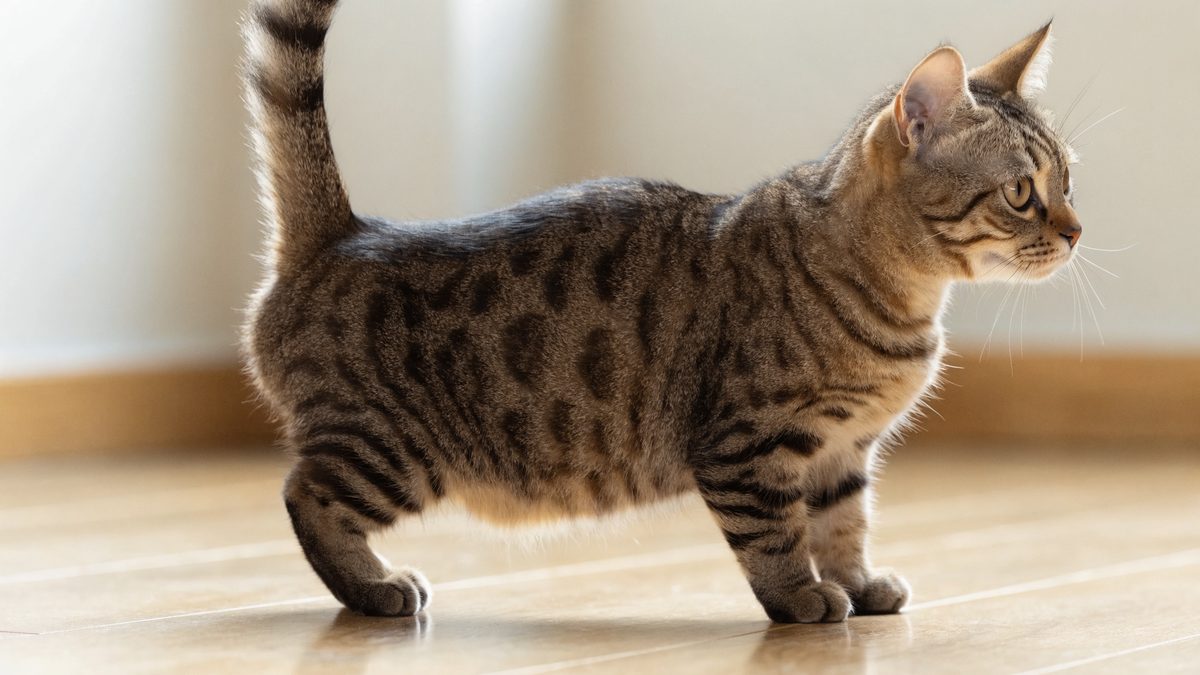
A Munchkin is an ordinary domestic cat carrying one copy of a single mutation that stops the long bones of the legs growing to normal length. The mutation sits in a gene called UGDH, it is inherited as an autosomal dominant with a homozygous form that does not survive to birth, and it is the only thing that defines the breed. Everything else about a Munchkin, the coat, the colour, the face and the character, comes from whatever ordinary cats were bred into the line.
The condition has a name and a catalogue number. It is a disproportionate dwarfism, or chondrodysplasia, in which all four legs are short while the head and trunk grow to normal size, and it is registered as OMIA:002541-9685 in the Online Mendelian Inheritance in Animals database at the University of Sydney, with the mode of inheritance recorded as autosomal dominant plus recessive lethal and the key variant first reported in 2020.
Two independent research groups found the same variant in the same year. A German team at the University of Veterinary Medicine Hannover ran whole genome sequencing on a Munchkin family plus controls and identified a 3,303 base pair deletion inside UGDH, the gene for UDP-glucose 6-dehydrogenase, with a 108 base pair insertion sitting between the break points. An American team building a new domestic cat reference genome from long sequence reads independently flagged the same region, describing a complex deletion with a nearby potential duplication shared privately across three unrelated cats with dwarfism, inside a known dwarfism-associated region on cat chromosome B1. Two labs, two methods, one answer. That is about as settled as feline genetics gets.
The German validation is the number worth remembering. The variant was present in all 42 standard Munchkin cats tested, absent from all 15 non-standard Munchkins, and absent from all 203 cats of 17 other breeds including British Shorthair, Bengal, Ragdoll, Persian, Maine Coon and Scottish Fold. Perfect segregation across 260 cats means the short leg is not a look, a size or a line. It is one testable variant.
Standard and non-standard, and why half a Munchkin litter is not a Munchkin
Breeders split the breed in two. Short-legged cats are called standard Munchkins and long-legged cats born in the same litters are called non-standard Munchkins. A non-standard Munchkin carries no copy of the variant, has ordinary legs, and is physically an ordinary domestic cat with a pedigree certificate. Utrecht University's veterinary faculty made the point sharply in a formal expert statement written for the Dutch food safety regulator, noting that breeders of short-legged cats define the short leg as the standard and describe cats with naturally proportioned limbs as non-standard.
This matters commercially in India, because a buyer paying a Munchkin premium can end up with a cat that is genetically not short-legged at all, or with an ordinary short-statured street cat sold as one. There is no cat equivalent of the Kennel Club of India, cat breeding here is effectively unregulated, and the buyer carries the whole verification burden.
What the breed standard actually says
TICA is the only major registry with a published Munchkin standard, and reading it is more useful than reading any seller's description. The standard describes the short legs as coming from a spontaneous autosomal dominant mutation that has occurred several times in the domestic cat, states that Munchkins exhibit shortening and may have slight bowing of the long bones, and asserts that the spine is unaffected and similar in form and flexibility to that seen in other domestic cats, and that the short legs do not hamper mobility or survival ability.
The standard also carries a defect list that a buyer can use as a checklist. It disqualifies sway back, excessive bowing, and the appearance of being a recognised breed miniaturised. It penalises cowhocking, a protruding sternum, a snub or excessively long nose, round eyes and a round head. It withholds all awards for a short cobby body or a curly coat.
TICA's Munchkin standard lists the permissible outcrosses in one line: domestic longhair or shorthair, not a member of a recognised breed. Read that slowly. Under the breed's own governing standard, a Persian, a Scottish Fold, a Bengal or a Sphynx is not a permitted outcross into the Munchkin. Every Munchkin cross being sold in India as a premium variant sits outside that clause. Those crosses are separate breeds or nothing, and the section on Munchkin-derived crosses below sets out which is which.
Size, weight and what the numbers disagree about
Sources agree that a Munchkin is a small to medium cat and disagree about the exact band. TICA gives adult females 5 to 7 pounds and adult males 7 to 10 pounds, and states elsewhere on the same page that they weigh between 5 and 9 pounds when fully grown. Vetic, an Indian veterinary chain, gives 4 to 9 pounds, or 1.8 to 4.1 kg, and a height of roughly 6 to 9 inches. Mr n Mrs Pet gives males 3 to 4.5 kg and females 2 to 4 kg, with males 7 to 9 inches and females 6 to 8 inches.
| Source | Weight | Height | Note |
|---|---|---|---|
| TICA breed page | Females 5-7 lb, males 7-10 lb | Not given | Same page also says 5 to 9 lb fully grown |
| Vetic, India | 1.8-4.1 kg (4-9 lb) | 6-9 inches | Indian veterinary chain with clinics in 11 cities |
| Mr n Mrs Pet | Males 3-4.5 kg, females 2-4 kg | Males 7-9 in, females 6-8 in | Marketplace listing figures |
| Supertails | 1.8-4.1 kg | 15-23 cm | Veterinary-reviewed Indian guide |
| Happy Pet | Not given | Not given | Lists the Munchkin under size 'Large Breed', which is plainly a template error |
One published height figure is not a range at all. Guinness World Records named Lilieput, a tortoiseshell Munchkin from Napa, California, the world's shortest living cat in 2013, at 5.25 inches from the bottoms of her paws to the top of her shoulders.
The history, which is older than the breed
Short-legged cats were reported long before anyone bred them deliberately. A British veterinary report in 1944 described four generations of short-legged cats including an eight-year-old black female that had an extremely healthy life, whose dam, grand-dam and progeny were all similar with the only difference from normal cats being the short legs. The peer-reviewed literature dates the earliest reports to the same year, describing short forelimbs with long hind limbs, a forelimb micromelia that is not the same thing as today's four-legged Munchkin. That line disappeared during the Second World War, and the trait reappeared in Stalingrad in 1956, New England in 1970 and Louisiana in the 1980s.
The modern breed starts in 1983, when Sandra Hockenedel found a pregnant short-legged female in Louisiana. She named her Blackberry and gave a short-legged male from one of her litters, Toulouse, to Kay LaFrance. Those two cats founded the breed, with ordinary domestic cats used as outcrosses to keep the gene pool diverse. The name comes from the inhabitants of Munchkin City in L. Frank Baum's Oz stories.
TICA accepted the Munchkin into its New Breed development programme in September 1994 and granted championship status effective May 2003. Indian pages get this wrong in both directions. Vetic gives official recognition as 1991 and the Utrecht statement gives TICA recognition as 1995. TICA's own dates are the ones to use.
Munchkin cat price in India, and why the published figures differ by forty times
The Munchkin cat price in India runs from Rs 15,000 to Rs 6,00,000 across the sources currently ranking on Google in India, a spread of roughly forty times for the same breed in the same month. That is not a market with a price. It is four different businesses describing four different products and calling all of them a Munchkin. This section prints every published band, names who published it, and explains what actually drives the difference.
Start with the raw disagreement, because averaging it would destroy the only useful information in it.
| Source | Type of source | Published range | Top of range |
|---|---|---|---|
| Supertails | Pet pharmacy blog, veterinary-reviewed | Rs 25,000 to Rs 70,000 | Rs 70,000 |
| Happy Pet | Pet app breed database | Rs 30,000 to Rs 60,000 | Rs 60,000 |
| Wrapinfur | Pet products store blog | Rs 80,000 to Rs 4,00,000+ | Rs 6,00,000+ for imported bloodline |
| Mr n Mrs Pet | Kitten marketplace with listings | Rs 2,40,000 to Rs 5,50,000+ | Rs 5,50,000+ |
The pattern is not random. The two sources that do not sell cats give the low bands, and the two that either sell cats or sell to cat buyers give the high ones. Supertails, which sells food and medicine rather than kittens, tops out at Rs 70,000. Mr n Mrs Pet, which lists live kittens with a booking flow, starts at Rs 2,40,000. Its floor is more than three times the other's ceiling. Treat the low bands as the reported market for an ordinary short-legged pet kitten and the high bands as asking prices for imported or documented animals in a market where supply is genuinely thin.
Munchkin cat price by city in India
City pricing exists in both bands and moves in the same direction. Metro demand and transport push prices up, and both marketplace and blog sources agree on the ranking even though they disagree on the level.
| City | Supertails band | Wrapinfur band | Mr n Mrs Pet band |
|---|---|---|---|
| Mumbai | Rs 40,000 - 70,000 | Rs 1,20,000 - 4,00,000+ | Rs 2,45,000 - 5,50,000 |
| Delhi NCR | Rs 40,000 - 70,000 | Rs 1,00,000 - 3,50,000+ | Rs 2,40,000 - 5,50,000 |
| Bengaluru | Rs 35,000 - 60,000 | Rs 1,00,000 - 3,50,000+ | Rs 2,50,000 - 5,50,000 |
| Hyderabad | Rs 30,000 - 55,000 | Rs 90,000 - 3,00,000+ | Rs 2,60,000 - 5,50,000 |
| Pune | Rs 30,000 - 55,000 | Rs 1,00,000 - 3,50,000+ | Rs 2,45,000 - 5,50,000 |
| Chennai | Rs 30,000 - 50,000 | Rs 90,000 - 3,00,000+ | Rs 2,65,000 - 5,50,000 |
| Kolkata | Rs 30,000 - 50,000 | Rs 90,000 - 3,00,000+ | Not listed |
| Tier-2 cities | Rs 25,000 - 40,000 | Not listed | Lucknow Rs 2,40,000 - 5,50,000 |
Sources: Supertails, Wrapinfur and Mr n Mrs Pet. Bonbeno reports these as published editorial figures. They are not offers, and Bonbeno does not broker kitten sales.
The registration premium, and what it is a premium for
Mr n Mrs Pet charges in three tiers in Bengaluru: Basic quality at Rs 2,40,000 to Rs 3,00,000, FCI Registered at Rs 3,00,000 to Rs 4,00,000, and Champion Bloodline at Rs 4,00,000 to Rs 5,50,000 and above. So the registration tier alone carries a premium of roughly Rs 60,000 to Rs 1,00,000. The same page defines FCI as the Feline Club of India and describes it as India's largest and most trusted cat registry, listing CFA, WCF and TICA alongside it.
Before you pay that premium, check what each of those bodies has actually published about this breed. TICA recognises the Munchkin, granted it championship status in May 2003, and permits only one outcross, a domestic longhair or shorthair that is not a member of a recognised breed The International Cat Association. Munchkin…. FIFe refuses to register or recognise it and bars from breeding, registration, shows and advertising any cat with pseudo-achondroplasia or with such a cat in its ancestry. The CFA's public breed directory carries no Munchkin entry, and cfa.org/breed/munchkin/ returns an HTTP 404. Google's own AI Overview for this query told Indian searchers that kittens with official registry certification like CFA or FCI cost significantly more, which for CFA is not a certification that appears to exist.
Ask which body issued the paper, and get the registry's full name, not an acronym. Ask for the registration number and check it against that registry's own published rules for this breed, because FIFe's rules make a FIFe-registered Munchkin impossible by definition. Ask what the outcross was, because TICA's standard permits only a domestic longhair or shorthair that is not a member of a recognised breed, so a Persian, Sphynx, Bengal or Scottish Fold parent puts the kitten outside the Munchkin standard entirely. A seller who cannot answer all three in writing is charging you for a document that does not do what you think it does.
What genuinely drives the price
- Leg length itself. Kittens showing the signature short-legged look cost more than longer-legged littermates, and breeders distinguish standard, super-short and rug hugger types, with the extremes priced higher for novelty while carrying higher health risk. You are paying a premium for a more severe expression of the same variant.
- Genuine scarcity. Roughly a quarter of conceptions from a short-legged pair are homozygous and do not develop, which shrinks litters, and Utrecht names that lethal mutation as a factor limiting the population. Scarcity here follows from the biology rather than from marketing.
- Import and bloodline claims. Imported bloodline Munchkins are listed at Rs 3,00,000 to Rs 6,00,000 and above. Ask which country. If the answer is the Netherlands and the cat is any Munchkin-Sphynx cross, Dutch rules prohibit breeding it and the claim fails on its face.
- Colour and age. Common brown tabby and black sit at Rs 80,000 to Rs 1,80,000 against Rs 1,00,000 to Rs 2,50,000 for white or silver, though the same source notes pedigree and health testing matter far more than colour. Kittens of two to four months cost most, and adults are cheaper. For this breed an adult is arguably the safer buy, because limb deformity and gait problems are visible by then rather than pending.
The one thing worth paying for that almost nobody sells
A DNA test for the Munchkin variant exists commercially. LABOGEN, the genetics arm of Laboklin, offers a chondrodysplasia test for the UGDH variant, listing the inheritance as autosomal dominant with the homozygous form presumed embryonically lethal, and citing the OMIA record. The German research team that identified the variant closed its paper by noting that a diagnostic test is now available for breeders to prove whether their animals carry the standard Munchkin mutation in order to get recognition by TICA.
So a real, checkable answer to the question of whether a kitten is genetically a Munchkin has existed since 2020, and no Indian seller Bonbeno could find offers one. If you are being asked for Rs 3,00,000 and the seller cannot produce a genotype, you are buying a phenotype, an appearance, and you are trusting a photograph. In a market where an ordinary short-statured domestic kitten can be photographed to look identical, that is the gap the price should be closing and is not. Be realistic about availability too: the test is not universally offered, and the feline genetics menu at Langford Vets, one of the UK's main laboratories, lists tests for Sphynx hairless coat, Devon Rex coat, polydactyly and polycystic kidney disease but carries no Munchkin or chondrodysplasia test.
One more anchor tells you what the import premium is charged against. In the United States a Munchkin from a breeder usually costs USD 1,000 to USD 2,000, with show quality higher, and adoption runs USD 40 to USD 300. At any plausible exchange rate, the top Indian asking prices sit well above the American breeder band.
Wrapinfur lists adoption and rehoming of Munchkin cats in India at Rs 15,000 to Rs 50,000. That is the cheapest published route to this breed by a wide margin, it takes a cat that already exists rather than commissioning another litter, and the adoption section at the end of this page covers how to find one. If your reason for wanting a Munchkin is that you like the cat rather than the paperwork, start there.
Monthly cost of owning a Munchkin cat in India
Budget Rs 3,200 to Rs 8,000 a month for an ordinary healthy Munchkin in an Indian city, and add a genuine orthopaedic contingency on top, because this is the one breed where the joint line item is not optional. Published monthly estimates run from Rs 2,800 to Rs 15,000, and the spread comes down to whether the source counted premium imported food and pet insurance.
Four sources publish monthly running costs for this breed in India, and their numbers are close enough at the bottom to be usable and far apart at the top.
| Source | Monthly total | What the figure includes |
|---|---|---|
| Happy Pet | Rs 2,800 to Rs 4,200 | Basic to premium lifestyle. Food Rs 1,500-2,000, vet Rs 500-700, grooming Rs 800-1,500 |
| Supertails | Rs 3,200 to Rs 6,000 | Food, litter, grooming supplies, routine vet, toys. Rises to Rs 3,500-6,500 over a full lifespan |
| Mr n Mrs Pet | Rs 3,000 to Rs 8,000 | Premium food and supplements, vet and vaccination, grooming and hygiene |
| Wrapinfur | Rs 5,000 to Rs 15,000 | Food Rs 2,500-7,000, litter Rs 800-2,500, vet Rs 500-2,000, toys Rs 500-2,000, misc Rs 500-1,500 |
The honest reading is that Rs 3,200 to Rs 6,000 covers a healthy adult cat on good Indian-market food in a metro, which is where three of the four sources overlap. Wrapinfur's ceiling of Rs 15,000 assumes premium diets, imported litter, pet insurance and frequent professional grooming, and its own text says so.
First-year setup costs
Supertails publishes the only itemised first-year table Bonbeno could find for this breed in India, and the items are the ones any cat needs plus two that this breed needs specifically.
| Item | Cost |
|---|---|
| Litter box and litter setup | Rs 1,500 - 3,000 |
| Cat carrier | Rs 1,500 - 3,500 |
| Cat bed or sleeping area | Rs 1,000 - 3,000 |
| Kitten vaccination course | Rs 2,000 - 4,000 |
| Spay or neuter surgery | Rs 3,000 - 8,000 |
| Toys, scratchers, cat tree | Rs 1,500 - 4,000 |
| First-year total beyond purchase | Rs 10,500 - 25,500 |
Figures from Supertails. Two of those lines need a Munchkin-specific adjustment. Buy a low-sided litter tray rather than a standard covered one, because getting in and out of a high-sided tray is exactly the movement a short-limbed cat finds hardest, and Vetic lists low litter boxes as a specific requirement for the breed in India. Buy ramps and low furniture instead of a tall cat tree, which Vetic also names, because a tall tree in this house is a fall risk rather than enrichment.
The line item the other pages leave out
Set aside an orthopaedic contingency from year one. Nothing about this is scaremongering, and the reasoning is arithmetic rather than alarm. Osteoarthritis is common in ordinary cats already, with radiographic osteoarthritis found in at least one joint in 61 percent of 100 client-owned cats aged six and over, and in more than one joint in 48 percent. The published welfare assessment for this breed says affected animals may experience abnormal stresses and loads on their joints, that animals experiencing abnormal joint stresses are predisposed to osteoarthritis, and that it therefore seems likely Munchkin cats may be particularly at risk. That is a probability, not a diagnosis, but it is the right thing to budget against.
What that contingency buys, in Indian practice, is four specific things rather than a vague reserve.
- Baseline limb radiographs, once, in the first year. Every limb of every dwarf cat radiographed carried measurable deformity, so a baseline gives your vet something to compare against when the cat is nine and slowing down.
- An analgesia trial rather than an argument. Detecting osteoarthritis and assessing its severity may require radiography or trial treatment, and a trial converts a question about temperament into an observation about behaviour.
- Chest imaging if the kitten has any visible sternal dip. Every cat in a 25-case splinting series was under 20 weeks old. Waiting costs you the window.
- Stone analysis if there is ever blood in the urine. Routine urinalysis was insufficient to diagnose xanthinuria in any of the related Munchkin cats in an Australian case series. Ask for the stone to be analysed rather than discarded.
Anti-nerve growth factor therapy is now a licensed option for feline osteoarthritis pain, and it is a monthly injection rather than a one-off. In the pivotal randomised, placebo-controlled, double-blind trial, 275 client-owned cats received frunevetmab or placebo on days 0, 28 and 56. If your cat ever needs it, that is a recurring cost for the rest of its life, and availability in India should be checked with your own veterinarian rather than assumed. The health section below gives the effect sizes honestly.
Can a Munchkin cat handle the Indian climate
A Munchkin handles Indian heat about as well as any other short-coated domestic cat, because the mutation affects limb bones and not thermoregulation. The breed has no flat face, no missing coat and no respiratory compromise, so it carries none of the structural cooling problems that make a Persian or a Sphynx genuinely risky in an Indian summer. Climate adaptation here is really about the floor, the humidity and the monsoon rather than the temperature.
Take the heat question first, because it is the one Google actually asks. India Meteorological Department recorded a highest maximum temperature of 48.2 C at Banda in Uttar Pradesh on 19 May 2026, with maximum temperatures across northwest, west, central and adjoining east and north peninsular India in the 40 to 47 C band. FIFe's own housing rules state that for cats unused to extreme temperatures a range between 10 C and 35 C is acceptable, and that temperatures either below or above that necessitate heating or cooling assistance. A May afternoon in most of north and central India sits well outside that band, which means a cooled room is a requirement rather than a luxury, for any cat.
Indian sources converge on a comfort target. Happy Pet gives an ideal weather band of 20 C to 25 C for this breed. Google's own answer module for the question of whether Munchkin cats survive in India, drawing on Vetic, told Indian searchers that they can live comfortably here but strictly as indoor pets in cool air-conditioned rooms during peak summer heat, with constant hydration.
Why indoor-only is stricter for this breed than for most
The case for keeping a Munchkin indoors is not really about heat. Utrecht's veterinary faculty set out the mechanism: short legs restrict the cat's natural movement, give it a waddling gait and mean it cannot jump as high as a cat with natural leg length, and because it cannot get away easily outdoors, including in territorial confrontations with normally proportioned cats, owners restrict its freedom as a precaution and the cat is thereby restricted in its natural behaviour. The same statement notes that keepers of Sphynx and Munchkin cats generally never let them outside unsupervised, one because it cannot hold body heat and the other because it cannot manage unexpected situations as easily.
That argument lands hard in India. Free-roaming community cats and dogs are a feature of most neighbourhoods, and a cat that cannot climb a wall at speed is at a plain disadvantage in a chase.
The Indian floor problem, which is specific and fixable
Polished granite, vitrified tile and marble are the default surfaces in Indian flats, and they are the worst surfaces for a cat whose forelimbs carry an external torsion in every radius measured. A cat with normal limb geometry compensates on a slippery floor. A cat with radii bent to a high degree in the longitudinal axis and incongruity in the ulnocarpal and radiocarpal joints has less margin to compensate with Nicholas FW, Tammen I.
- Rugs or runners on the routes the cat uses most. The corridor between the food bowl, the litter tray and the sleeping spot matters more than the drawing room.
- Ramps or a low step to the bed and sofa. Vetic names low cat trees and scratchers, and ramps, as breed-specific requirements for keeping a Munchkin comfortable in India.
- A low-sided litter tray, always. This is the single highest-value purchase on the list and costs almost nothing.
- Raised food and water bowls, so the cat is not folding compromised forelimbs to reach the floor. TICA's own nutrition guidance for this breed says a bowl with low sides is best due to their short legs, or a fountain to encourage drinking.
Monsoon, humidity and the belly nobody dries
A Munchkin's underside sits closer to the floor than any other cat's, and in an Indian monsoon that is a practical grooming problem rather than a theoretical one. A wet balcony, a mopped floor and four humid months mean the chest, belly and inner forelegs stay damp longer on this cat than on a normally proportioned one. Dry the underside after any wet-floor contact, check the skin between the front legs weekly, and treat persistent damp-skin irritation as a vet visit rather than a bath.
The second monsoon issue is self-grooming reach. Some Munchkins cannot fully groom their own lower back, tail base and hindquarters. In a dry climate that is cosmetic. In Chennai or Kolkata in July it is where mats and skin infections start, which is why the grooming section treats owner brushing as care rather than pampering.
| Zone | The real constraint | What to do |
|---|---|---|
| Delhi, Lucknow, Jaipur | 48.2 C recorded in Uttar Pradesh, May 2026, plus cold January nights | Cooled room April to June, warm bed in January. FIFe's 10-35 C band is breached at both ends |
| Mumbai, Chennai, Kolkata | High humidity for four months rather than extreme heat | Dry the underside, brush the lower back and tail base weekly, watch skin folds |
| Bengaluru, Pune | The mildest Indian option for this breed | Standard care. Floors matter more than weather here |
| Hyderabad, Nagpur, Vidarbha | Heat wave to severe heat wave forecast across multiple days, May 2026 | Treat cooling as equipment rather than comfort |
| Hills and the north in winter | Cold below the FIFe band | A short coat is not insulation. Warm bed at floor level, reachable without jumping |
A Munchkin has a normal muzzle and a normal airway. It is not brachycephalic, so it has none of the panting and heat-dissipation problems that make flat-faced cats a poor fit for Indian summers, and the Dutch breeding ban that covers short-muzzled cats for exactly that reason does not touch the plain Munchkin. On heat tolerance alone, a Munchkin is a better choice for an Indian home than a Persian or an Exotic Shorthair. The trade-off this breed asks you to accept is in the legs, not the lungs.
Temperament, household fit and who should not buy one
A Munchkin behaves like an ordinary friendly domestic cat, because temperament has nothing to do with the leg gene. Every source that describes the character independently lands in the same place: sociable, playful well into adulthood, curious, people-oriented and easy to handle. The honest caveat is that this is the one thing about the breed with no controlled evidence behind it, because nobody has run a behaviour study on Munchkins.
TICA's standard requires an unchallenging temperament and describes Munchkins as outgoing, intelligent and responsive to handling. Its breed page adds that they are extremely spirited, love to run, chase and play with toys, will sit up on their hind legs like a rabbit to get a better view, and are a good choice for families with children and other pets. Indian sources agree without exception. Vetic lists friendly and sociable, playful and energetic, highly intelligent and affectionate. Happy Pet's top five traits are playful, curious, friendly, affectionate and independent. Supertails describes them as curious, social, playful well into adulthood, and bonding like little roommates with opinions.
Take that consensus for what it is. It is breed-community and commercial description, not measurement. There is no Munchkin behavioural study, no validated temperament survey and no owner-reported dataset comparable to what exists for some other breeds. The right way to read it is that nothing in the record suggests a difficult cat, and nothing in the record proves a uniquely easy one either.
The one behavioural quirk with a physical cause
The hoarding habit is real and widely reported. TICA notes that Munchkin cats will beg, borrow and steal small shiny objects and stash them away, which is why some people call them magpies. In an Indian home that is mildly funny until it is earrings, medicine strips or a SIM tray. Keep small objects off low surfaces, because low surfaces are precisely the ones this cat reaches easily.
The rabbit sit is the second one, and it is worth understanding rather than filming. A Munchkin rises onto its hind legs to see over things, because its default eye level is lower than a normal cat's. It is a compensation for a shortened forelimb, not a trick.
Household fit, honestly
| Household | Verdict | Why |
|---|---|---|
| Apartment, adults at home part of the day | Strong fit | Low vertical demand, sociable, adapts well to indoor life with enrichment |
| Families with children | Good fit with supervision | TICA rates the breed good with children and other pets. Teach children not to lift the cat under the chest |
| Home with a resident dog, or a duplex | Usually fine, with work | TICA notes Munchkins keep up with canine companions. In a split-level home, put ramps and low steps on every route |
| Home with free outdoor access | Poor fit | Restricted escape ability in confrontations with normally proportioned cats |
| Buyer who wants a permanently kitten-sized cat | Wrong expectation | TICA states plainly that Munchkins do not remain kitten-sized; the legs stay short but adult body size is average |
| Buyer who will not budget for orthopaedic care | Do not buy | The joint risk is the specific trade-off of this breed |
What quiet actually means in a short-limbed cat
This part is for someone who already owns one. A cat that stops jumping onto the bed has not become calmer. Slingerland's study of 100 cats found decreased mobility and decreased grooming both statistically associated with radiographic osteoarthritis, and so was increased inappropriate elimination at p equals 0.046. Those are exactly the three changes an owner is most likely to read as personality.
So if your Munchkin becomes noticeably more settled between the ages of six and nine, do not congratulate yourself on a well-adjusted cat. Book a mobility assessment. In a breed where every limb carries measurable deformity, a behaviour change in the direction of less movement deserves a look before it gets an explanation.
Do not buy a Munchkin if you want a cat that can use the whole vertical space of your home unaided, if you cannot commit to indoor-only living, if you plan to breed and have not read the registry positions further down this page, or if the short legs are the entire reason for the purchase. That last one matters. Buying for the leg is buying for the trait that the GCCF, FIFe and the published welfare assessment all object to, and paying a premium for a more extreme version of it is what pushes breeders toward extremes Federation Internationale Feline. FIFe… Godfrey R, Godfrey D. Munchkin. Wanting an affectionate, playful, apartment-suited cat is a good reason. Wanting the shortest legs available is the reason that makes the next generation worse.
Litter training, handling and enrichment for a Munchkin
To litter train a Munchkin, start with a tray the cat can walk into rather than climb into, and the rest follows the ordinary feline pattern. This breed is not harder to train than any other domestic cat, and TICA reports Munchkins learn to walk on a lead quickly and retrieve small objects in games of fetch. What changes is the equipment, because almost every default cat product in an Indian pet shop is sized for a cat with normal leg length.
Get the tray right first, because litter-box failure in this breed is usually a hardware problem misread as a behaviour problem. Vetic's breed guidance for India names low litter boxes as a specific requirement, because short legs make a standard high-sided tray hard to access. A kitten that has to haul itself over a 15 cm lip several times a day will eventually find somewhere easier, and you will conclude it is stubborn.
- Buy a tray with one low side, under about 8 cm at the entry point, and skip covered or top-entry designs entirely. A top-entry tray requires a vertical jump in and a controlled drop out, which is the exact movement pattern to avoid.
- Place one tray per floor level, plus one, on a non-slip surface. In a duplex, a cat that must use a staircase to reach the only tray will eventually not reach it, and digging on polished tile with compromised forelimbs is unpleasant enough to put a cat off the tray.
- Treat any new accident as a health question first. Increased inappropriate elimination was significantly associated with radiographic osteoarthritis in 100 cats, so in this breed a tray accident in a previously clean adult is a reason to check joints, not a reason to scold.
Handling, and the one lift to unlearn
Munchkins respond well to being handled, which the breed standard requires, and this makes early handling training easy and worth doing properly. Support the whole body when you lift, with one hand under the chest and the other under the hindquarters, and never lift by the forelimbs or under the armpits. The reason is specific to this breed rather than general good practice: in the German computed tomography work, the humerus showed a slight internal rotation along its longitudinal axis producing a moderate incongruity in the elbow joint with axial deviation, and the radius was bent to a high degree in the longitudinal axis at about 43 degrees, producing incongruity in the ulnocarpal and radiocarpal joints. Those joints are already carrying a load they were not shaped for. Do not hang the cat's body weight off them.
Teach children the same lift explicitly. In a household where the cat is visibly small and endlessly picked up, this is the single most useful five-minute training session you will run.
Enrichment when the cat cannot use the top half of the room
An ordinary cat gets most of its enrichment vertically. A Munchkin gets less of it that way, so you have to put it back horizontally and at low height. TICA's own description is useful here: Munchkins may not jump from the floor to the top of the refrigerator in a single bound, but they will find a path that takes them there in smaller steps. Your job is to build the smaller steps.
- Stepped platforms rather than a tall tree, at roughly 20, 40 and 60 cm, giving the same destination with none of the drop. Add ramps to the sofa and bed, which Vetic names for this breed in India. A carpeted plank works as well as anything sold as a pet ramp.
- Floor-level tunnels, puzzle feeders and fetch. These use the horizontal speed the breed genuinely has. TICA describes Munchkins running fast, similar to squirrels, cornering tightly, and retrieving small objects in games of fetch, which also channels the hoarding habit into something you control.
- Lead training, started young. TICA states they can learn to walk on a lead in no time, and Utrecht records owners of short-legged and hairless cats using a harness to give outdoor freedom safely. For a cat that should not free-roam in an Indian neighbourhood, that is the compromise.
This breed will need its limbs handled by a stranger more often than the average cat, whether for a gait assessment, a radiograph or a joint palpation. Spend the kitten months making paw handling, elbow flexion and carrier entry boring and rewarded. A Munchkin that tolerates limb handling calmly at eight years old is a cat whose osteoarthritis gets caught early, and that is worth more than any trick.
How much exercise a Munchkin cat actually needs
Give a Munchkin 30 to 60 minutes of active play a day, split into short sessions, and keep all of it horizontal. The breed is genuinely energetic and fast over the ground, and the reason to structure its exercise is not that it needs less, but that a cat which burns energy climbing in a normal home cannot burn it that way here. Without a substitute, the energy goes nowhere and the weight goes on.
Happy Pet puts the daily exercise routine at 30 to 59 minutes with a medium energy level, and that band matches what the breed descriptions imply. TICA describes Munchkins as highly active, running very fast and capable of keeping up with canine companions and children, with their lower body height letting them slide under objects without stopping to bend down. Nothing about this cat is sedentary by temperament.
The constraint is mechanical rather than motivational. Utrecht's assessment states plainly that short legs restrict the cat in its natural movements, producing a waddling gait and meaning it cannot jump as high as a cat with natural leg length. TICA's standard takes the opposite view, asserting that the short legs do not hamper mobility or survival ability. Both are on the record and the health section below sets them side by side. For exercise planning, the practical middle ground is uncontroversial: a Munchkin runs well and jumps less well, so build the routine around running.
A workable daily routine for an Indian flat
Split it into four short sessions. Ten to fifteen minutes with a wand toy along a corridor early, before the heat. Five minutes of puzzle feeder or scattered kibble at midday. Fifteen to twenty minutes of fetch, tunnel work and ramp circuits in the evening. Five to ten minutes of wind-down play ending in a food reward, which reduces night activity.
Keep the wand toy low. The instinct with any cat is to lift the toy and make it leap, and with this cat that repeatedly loads a forelimb geometry that already carries external torsion in every radius measured. Drag the toy along the floor instead. You will get the same chase, the same intensity and none of the landing impact.
What happens without it
Weight is the failure mode, and it compounds every other risk on this page. Supertails names the mechanism directly: Munchkins are less agile jumpers than standard cats and expend less energy on vertical movement, and combined with a social, food-motivated personality that makes weight gain a genuine risk which compounds every joint and spinal issue. TICA's own nutrition note for the closely related Minuet says the same thing from the other side, warning that a breed at the lower end of the activity scale should be watched for excess body fat.
The arithmetic is unforgiving. Excess body mass loads joints whose alignment is already abnormal in every limb, and animals experiencing abnormal joint loading are predisposed to osteoarthritis. Weight control is the only preventive intervention available to you that costs nothing and works every day.
Reluctance to attempt a jump the cat used to make. A stiff or stilted first few steps in the morning. Sitting out a play session it would normally start. Swelling around any joint. Objecting when a paw or elbow is handled. Grooming less over the lower back and tail base. Any of these in a Munchkin is a reason for a mobility assessment, because reduced mobility and reduced grooming were both significantly associated with radiographic osteoarthritis in 100 client-owned cats. Detection may require radiography or a trial of treatment, and both are reasonable things to ask your vet for.
Grooming a Munchkin coat in Indian humidity
To groom a Munchkin, brush a shorthair once a week and a longhair twice a week, and check the lower back, tail base and hindquarters yourself every week regardless of coat length. That last instruction is the breed-specific part. A short-limbed cat with a proportionally long back cannot always reach its own hindquarters, so the areas it misses are the ones that mat and infect first in Indian humidity.
TICA's grooming guidance for the breed is short because the coat itself is easy. Shorthair Munchkins should be combed once a week with a fine-tooth comb to remove dead hair, and longhairs combed twice a week with a wide-tooth comb or pet brush to remove dead hair and prevent tangles or mats. The longhair has no heavy undercoat, which keeps it manageable. Nails trimmed, ears cleaned, teeth brushed with a vet-approved pet toothpaste, and a scratching post for the natural scratching instinct complete the routine.
Indian cost sources put grooming supplies at Rs 400 to Rs 800 a month and monthly grooming expenses at Rs 800 to Rs 1,500. Happy Pet rates shedding as moderate, which for a cat with an all-weather coat in a humid climate is about right.
The reach problem, which is the only real difference
Because their legs are short and their backs are proportionally long relative to their height, some Munchkins cannot fully groom themselves, particularly the lower back, tail base and hindquarters, which makes regular grooming by the owner a non-negotiable part of care rather than a nice-to-have. That single sentence is the whole grooming difference between this breed and any other short-coated cat.
Two things make it worse in India. Coastal humidity holds moisture in exactly the fur the cat cannot reach, and reduced grooming is itself an early sign of joint pain, which was significantly associated with radiographic osteoarthritis in 100 client-owned cats aged six and over. So an ungroomed patch over the lower back has two possible causes, one mechanical and one clinical, and both point at the same place on the cat.
- Comb the lower back and tail base weekly, by hand, on a fixed day so you notice the week it changes.
- Dry the underside after any wet-floor contact, and check the skin between the front legs and in the groin through the monsoon. Warm, occluded, humid folds are where trouble starts on a low-slung cat.
- Trim nails monthly. A cat that scratches less because a joint hurts stops wearing its claws down, and overgrown claws then change how it loads the paw.
- Treat a sudden increase in matting as a health signal rather than a grooming failure. In this breed the coat is often the first place joint pain shows up.
Mr n Mrs Pet's Bengaluru page tells buyers that Munchkin cats have long, dense coats needing daily brushing plus professional grooming or bathing every four to six weeks, and separately that their curly coat offers natural insulation from heat and cold. The Munchkin has no curly coat. TICA's standard withholds all awards from a Munchkin with a curly coat, and describes the shorthair coat as medium-plush and the longhair as semi-long and silky. A page that describes the coat of a different breed is a page running a template, and the price on it deserves to be read with that in mind.
Bathing is optional rather than scheduled. TICA suggests an occasional bath for hygiene even though the cat cleans itself, and notes that a few drops of traditional dish soap in 8 ounces of water will remove dirt or grease from the coat. In Indian conditions, bathe when the cat is genuinely dirty and dry it thoroughly afterwards. A damp low-slung cat in July humidity is a skin problem waiting to happen.
Munchkin cat health, the UGDH gene and what the studies actually found
Every short-legged Munchkin carries one copy of a UGDH variant that stops the long bones of the legs growing normally, and researchers, registries and welfare bodies do not agree about which health issues follow. This section prints what each study actually measured, with its sample size and its sampling bias stated in both directions, rather than picking the conclusion that suits either the seller or the critic.
The disorder is a disproportionate chondrodysplasia. Cartilage formation in the long bones is disturbed, so no normal growth plate develops, and the result is shortened upper and lower limb segments with a normal-sized trunk and a proportionate head. The causal variant is a 3,303 base pair deletion with a 108 base pair insertion inside UGDH, the gene for UDP-glucose 6-dehydrogenase, catalogued as OMIA:002541-9685 with the inheritance recorded as autosomal dominant plus recessive lethal.
UGDH matters because of what it makes. The enzyme converts UDP-glucose into UDP-glucuronic acid, a step in building the heparan sulfate proteoglycans that regulate growth factors and morphogens including fibroblast growth factor, hedgehog, transforming growth factor beta and Wnt, all of which are required for normal limb formation. The researchers were careful about what remains unknown, writing that whether the standard Munchkin fits a model of disturbed proteoglycan signalling and aberrant morphogen signals requires further studies.
Homozygous versus heterozygous, and what the breeding data show
Nobody disputes the basic architecture. One copy gives a short-legged cat, no copies gives a normal-legged cat, and two copies appears not to survive to birth. The evidence for that last part used to be anecdotal and is now not. Takanosu and Hattori wrote in 2020 that there is an anecdote that dominant homozygous Munchkin cats are embryonically lethal but no report based on genetic examination, and that inheritance of skeletal abnormalities in Munchkins could not therefore be confirmed as dominant or recessive. Within months, two genetics groups closed that gap.
The German group observed no homozygous mutant individual in a study population of 42 standard Munchkins, supporting lethality at an early embryonic stage, and recorded three repeated matings between a standard Munchkin tomcat and a standard Munchkin queen producing seven standard and two non-standard kittens Nicholas FW, Tammen I. The American group tested it statistically. Genotypes across their sample were not in Hardy-Weinberg equilibrium, at a chi-squared of 23.4 and a p-value below 0.001, and of 11 individuals with two heterozygous affected parents, 7 were heterozygous and 4 were homozygous reference, which the authors called consistent with the expected ratio of genotypes for a recessive lethal allele.
The expected ratio from a short-legged pair is therefore one third normal-legged and two thirds short-legged, with a quarter of conceptions lost in utero, and Utrecht's expert statement for the Dutch regulator sets that Punnett arithmetic out explicitly. TICA's own breed history offers a different figure, recording the breed founder's recollection that even when two short-legged cats are bred together there will always be approximately 50 percent long-legged cats that do not carry the gene. Both statements are published. The 2020 genotyping data are the ones with a chi-squared attached to them.
What each study measured, and where they disagree
Five sources have looked at what the short leg does to the cat. They used very different designs, some of them are extremely small, and they did not all land in the same place.
| Source | Design | Cats | Finding |
|---|---|---|---|
| Struck et al., BMC Genetics, 2020 | Whole genome sequencing and case-control validation, plus computed tomography of the limbs | 42 standard and 15 non-standard Munchkins plus 203 cats of 17 other breeds for genotyping. CT on one 4-year-old standard Munchkin tomcat against one adult domestic cat control | The variant segregated perfectly. On CT the single Munchkin showed shortening of all proximal and distal long bones with metatarsals of normal length, higher diaphyseal diameters (humerus plus 14 percent, femur plus 29 percent), a humerus internally rotated producing moderate elbow incongruity with axial deviation, and a radius bent about 43 degrees producing incongruity in the ulnocarpal and radiocarpal joints. The hind limbs showed no rotation or structural effects. The authors nonetheless concluded that heterozygous standard Munchkins exhibit reduced leg length without impaired health |
| Buckley et al., PLOS Genetics, 2020 Nicholas FW, Tammen I | New long-read cat reference genome plus PCR genotyping of the deletion breakpoints | 109 cats genotyped, 41 normal and 68 affected dwarf cats | Independently identified the same UGDH structural variant. Genotypes departed from Hardy-Weinberg equilibrium, consistent with a recessive lethal allele. One exception was recorded: a non-standard, normal-legged Munchkin and Selkirk mix appeared to carry the mutant allele, which the authors attributed to an alternate causal gene or sampling error |
| Anderson et al., Vet Comp Orthop Traumatol, 2021 | Observational cross-sectional study. Radiographic joint orientation angles measured and compared against skeletally normal cats, plus spinal MRI in a subset | 10 thoracic and 10 pelvic limbs from 5 dwarf cats, compared with 24 thoracic and 100 pelvic limbs from normal cats. MRI of the spine in 2 dwarf cats | All limbs from dwarf cats possessed deformities. Humeri showed procurvatum proximally and recurvatum distally, radii showed varus proximally and valgus distally with external torsion in every radius, femurs showed varus proximally and distally, tibiae showed proximal valgus and distal varus. No spinal pathology was detected. The authors concluded that dwarfism results in significant appendicular deformity in all limbs and that the incidence of intervertebral disc degeneration is inconclusive |
| Takanosu and Hattori, J Vet Med Sci, 2020 | Case report of two Scottish Fold cross-breeds, with a review of what is established about the Munchkin | 2 cats, one of them a Scottish Fold and Munchkin cross | Stated that the Munchkin appears prone to degenerative joint disease, pectus excavatum and spinal lordosis on the authority of a pathology textbook, and then wrote plainly that no academic evidence supports this. Also noted that no molecular marker for the Munchkin was available at the time, so external appearance was the only marker |
| UFAW genetic welfare assessment, Godfrey and Godfrey | Narrative welfare assessment by two veterinary surgeons, updated 6 May 2026 | No new cats examined. Assessment of the published record | States that the welfare aspects of this abnormality have not been evaluated in the scientific literature as far as the authors are aware and are hard to assess, that affected animals may experience abnormal stresses and loads on their joints, that animals experiencing such stresses are predisposed to osteoarthritis, and that it therefore seems likely Munchkin cats may be particularly at risk. All Munchkin cats are affected, and there appear to be no symptomless carriers |
| De Gier and van Hagen, Utrecht University, 2018 | Formal expert statement prepared for the Dutch food safety authority | No cats examined. Expert opinion grounded in cat biology and the welfare framework of the veterinary faculty | Short legs restrict natural movement, produce a waddling gait and reduce jump height. Names patellar luxation, rapid joint wear and neck and back disc herniation as conditions described as possible consequences of short-leggedness, associated with chronic pain |
| TICA breed standard and breed page The International Cat Association. Munchkin… | Registry standard and breed committee guidance, standard revised December 2009 | Not a study | States that the spine is unaffected and similar in form and flexibility to other domestic cats, that the short legs do not hamper mobility or survival ability, that Munchkins are not prone to arthritis and do not have trouble walking or moving any more than other breeds as they get older, that many years of research have validated that there are no debilitating genes associated with the breed, and that a pedigreed Munchkin should not need testing for any breed-related disease unless it is a Munchkin hybrid |
| Purina India breed library | Commercial breed reference published for Indian pet owners | Not a study | Takes the opposite view to TICA on both points at issue. Describes the Munchkin as a medium sized cat with extremely short legs and a long spine, states that its movements are like that of a ferret so it has not the feline grace of longer legged cats, and states that the short leggedness of this breed is a deformity that is linked to bone and spinal problems, adding that dog breeds with similar conformation are known to have problems with arthritis and it is feared that some will occur in the Munchkin |
Three things are true at once. First, the limb evidence is consistent and it is not reassuring: every limb of every dwarf cat radiographed carried measurable deformity, and the one Munchkin scanned by computed tomography had joint incongruity at the elbow, the ulnocarpal joint and the radiocarpal joint Struck AK, Braun M, Detering KA. Second, the spine evidence points the other way: MRI in two dwarf cats found no spinal pathology, and the authors called intervertebral disc degeneration inconclusive rather than absent. Third, the link from deformed limbs to clinical pain has never been measured in this breed. UFAW says so in as many words, and Takanosu and Hattori say so about lordosis and pectus excavatum specifically. Anyone who tells you that every Munchkin is in pain, or that the breed is demonstrably as sound as any other, is arguing past the evidence in opposite directions.
Sample size is the reason to be careful both ways. Anderson studied five cats and imaged two spines. Struck's computed tomography section rests on one cat against one control, which is why the striking bone-length percentages in that paper are best read as a description of an individual rather than a breed average. On the other side, TICA's assertion that many years of research have validated that there are no debilitating genes associated with the breed is not supported by a citation anywhere on its page, and the only research that exists found deformity in every limb it measured.
Lordosis, and where the evidence actually stands
Lordosis is the claim you will read on almost every Indian page, and it is the claim with the least evidence behind it. Vetic tells Indian buyers that Munchkins are prone to lordosis, an excessive inward curvature of the spine, while adding that not all Munchkins develop it. Supertails describes moderate to severe cases compressing the chest cavity, reducing cardiac and respiratory function, causing pain and in extreme instances leading to paralysis, and states that lordosis is more prevalent in Munchkins than in standard cat breeds.
Here is what sits behind that. Takanosu and Hattori cite a veterinary pathology textbook for the proposition that Munchkins are likely to be predisposed to lordosis and pectus excavatum, and then write that no academic evidence supports this. Bonbeno could locate no prevalence study, case series or cohort giving a lordosis rate in Munchkin cats. The nearest thing to a measurement is Anderson's spinal MRI in two dwarf cats, which found no spinal pathology, and TICA's standard, which disqualifies sway back from the show ring while simultaneously asserting that the spine is unaffected.
The honest statement is that no measured prevalence of lordosis in Munchkin cats exists in the literature, that the figures in circulation are inherited from a textbook rather than from data, and that the only imaging evidence is two spines. That cuts both ways. There is no published evidence that Munchkins commonly develop lordosis, and no published evidence that they are protected from it either. What you can do is look. A visibly sunken back or any difficulty breathing in a Munchkin warrants an immediate veterinary examination.
Pectus excavatum, which has no breed figure but does have a treatment window
Pectus excavatum is a congenital deformity of the sternum and ribs producing a concave, caved-in chest, present at birth and ranging from cosmetic to life-limiting, with severe cases compressing the lungs and heart and producing reduced exercise tolerance, frequent respiratory infections and lethargy. As with lordosis, there is no published prevalence figure for the Munchkin breed, and the source that names the association also states that no academic evidence supports it.
What does exist is a clear, recent treatment picture, and it is the most actionable thing on this page for anyone buying a kitten. In a retrospective series of 25 cats treated by sternal splinting between 2010 and 2024, every cat was younger than 20 weeks of age. Nineteen of the 25 presented with tachypnoea or exercise intolerance and all 25 had a palpable defect on examination. Survival was 24 of 25. The frontosagittal index fell from a mean of 5.44 to 2.09 and the vertebral index rose from 4.45 to 8.47, both at p below 0.001, and clinical signs resolved in all cases by recheck. Splints stayed on for a median of 28 days, with a range of 21 to 43 days, and complications included pneumothorax, suture breakage, dermatitis, persistent defect and death.
Run your hand along the underside of any Munchkin kitten's chest before you buy it, and again the day it comes home. A palpable dip in the sternum is not a cosmetic quirk to monitor. Every cat in the largest published external-coaptation series was corrected before 20 weeks of age, and Indian kittens frequently reach a new home at 10 to 14 weeks. That leaves a window of roughly six to ten weeks to get imaging and a surgical opinion. Waiting to see whether the kitten grows out of it spends the window.
Osteoarthritis, and the baseline it has to be read against
Degenerative joint disease is common in ordinary cats, which is both the strongest argument against panic and the reason the breed question is hard to answer. Slingerland and colleagues radiographed 100 client-owned cats aged six and over and found osteoarthritis in at least one joint in 61 percent and in more than one joint in 48 percent, most often in the shoulders, elbows, hips and tarsal joints. Age was related to osteoarthritis at p equals 0.002, decreased mobility and grooming at p equals 0.008 and increased inappropriate elimination at p equals 0.046.
Against that baseline, two positions face each other squarely. UFAW's assessment holds that these cats may be predisposed to painful osteoarthritis because abnormal stresses and loads act on their joints, that this is common in older cats of all breeds anyway, and that Munchkins may therefore be particularly at risk. TICA's breed page states that Munchkins are not prone to arthritis and do not have trouble walking or moving any more than other breeds as they get older. Happy Pet, an Indian source, splits the difference, telling buyers that Munchkins tend not to have the spinal problems short-legged dogs have but are more prone to joint problems such as arthritis.
No study has ever compared osteoarthritis prevalence between Munchkins and normal-legged cats. That comparison is the single most useful piece of missing evidence about this breed, and until someone runs it, the mechanism argument and the registry's denial will both remain assertions. What is not an assertion is that every limb measured in a dwarf cat carried deformity, with joint incongruity documented at the elbow, ulnocarpal and radiocarpal joints Struck AK, Braun M, Detering KA. Abnormal joint alignment is the established route to osteoarthritis in cats and dogs, and it is present here by measurement.
Xanthinuria, the Munchkin finding nobody in India reports
One condition has been documented in a family of Munchkin cats specifically, and no Indian page mentions it. An Australian case series described four confirmed cases of xanthinuria in Munchkin pedigree cats plus one unrelated domestic shorthair, with all four Munchkins related, three of them full siblings and the fourth a half-sibling. Clinical signs began between three and eight months of age and included haematuria, pollakiuria, dysuria, and urethral and ureteral obstruction, and every cat had upper urinary tract stones.
Three details matter for an Indian owner. Routine urinalysis was insufficient to reach the diagnosis in any of the cats, and infrared mass spectrometry of the stones or urine was needed. Four of the five cats were males, and the authors noted male anatomy may increase the risk of urethral obstruction from xanthine stones. A protein-restricted diet reduced clinical signs in all cats in the medium to long term. This was one family, so it is not a breed prevalence, but if your Munchkin passes blood or strains in the tray, ask for the stone to be analysed rather than discarded.
The cross-breeding finding that should stop a designer purchase
Takanosu and Hattori published two cross-breed cases in 2020, and the first one is directly relevant to Indian buyers, because Scottish Fold Munchkin cat price in India is a live Google related search. Case 1 was registered as a Munchkin on its pedigree certificate. Its limbs resembled a Munchkin, but its ear pinnae folded forward like a Scottish Fold, and Sanger sequencing showed it was dominant homozygous for TRPV4 c.1024G greater than T, the variant responsible for osteochondrodysplasia in the Scottish Fold. At five months no severe exostosis was visible on radiographs. At twelve months there was severe exostosis in the hind legs, at the bottom of the calcaneus and the metatarsal bones, with the proximal ends of the phalanges fused to each other.
The authors' conclusion was unambiguous. Cross breeding with Scottish Fold cats could produce unknown phenotypes and should be avoided, and it is necessary to avoid breeding Scottish Folds with cat strains associated with skeletal abnormalities so that a cat which might develop an unknown abnormality is not produced. A pedigree certificate saying Munchkin did not protect that cat, and it will not protect yours.
What four registries and four governments decided
Registry recognition is split, and the record is specific, dated and checkable, which is exactly why it belongs on a page about buying one.
| Body | Position | Detail and date |
|---|---|---|
| GCCF (United Kingdom) | Does not recognise, and discourages ownership | In 1991, shortly after television programmes featuring the Munchkin, the GCCF stated it would strongly discourage anyone from importing such a cat and that there was no intention of recognising this or any other new breed based on abnormal structure or development. Its current welfare statement records, under cats with foreshortened limbs, that there is no intention to recognise Munchkins or any other dwarf breed, and that the GCCF takes a stance against random mutations altering a cat's naturally occurring morphology in any way that could impair welfare, strongly discouraging anyone from owning or breeding such cats |
| FIFe (Federation Internationale Feline) | Refuses registration, breeding, showing and advertising | Its Health and Welfare Rules, last modified 20 February 2025, state that FIFe will not register or recognise any breed showing achondroplasia or pseudo-achondroplasia as a breed characteristic, described as an autosomal dominant gene resulting in dwarfism, shortened limbs and legs and other physical defects, naming the Munchkin as the example. Rule 3.6.2 goes further: cats suffering from it, or with such a cat in their ancestry, are not allowed for breeding, cannot be registered, cannot be exhibited and cannot be promoted or advertised. Its show rules list dwarf cats among the cats not admitted |
| TICA (international) | Recognises the breed | Accepted into the New Breed development programme in September 1994 and granted championship status effective May 2003. Its standard permits only one outcross, a domestic longhair or shorthair that is not a member of a recognised breed, and disqualifies sway back and excessive bowing The International Cat Association. Munchkin… |
| CFA (United States) | No Munchkin entry | The CFA Recognized Breeds directory carries no Munchkin page, and cfa.org/breed/munchkin/ returns HTTP 404 as of 16 August 2026 |
| BSAVA (United Kingdom) | Named extreme anatomical features as a welfare concern | In March 1995 the GCCF Veterinary Sub-committee and Executive Committee supported a British Small Animal Veterinary Association statement that breeding animals for extreme anatomical features could have serious health and welfare implications, and agreed to join the BSAVA in strongly urging that the fashion for the extreme should not be allowed to give rise to health problems in cats. Its current position statement, reviewed February 2026, recommends that animals showing extremes of conformation that negatively affect their health and welfare should not be used for breeding, that where health schemes do not exist breeders should preferentially breed from individuals showing less extreme morphologies, and that purchasers should discuss breed-associated health problems and pre-purchase test results with a veterinary surgeon before buying |
| International Cat Care | Names short-legged cats specifically | Its inherited disorders guidance, updated 18 December 2025, lists traits deliberately bred for that compromise health or welfare and which it believes should not be continued through further breeding. The three examples it gives are severe brachycephaly in Persians and similar breeds, hairless cats, and short-legged cats |
| World Cat Federation | Prohibits stacking mutations | Its breeding and registration rules for all member clubs state that cats with a congenital anomaly may not be bred and may not be sold for breeding, and that cats with different mutations must not be bred together to produce kittens with two different or more mutations in the same kitten. That second rule covers every Munchkin designer cross discussed further down this page |
| Netherlands, keeping ban | Does NOT cover the Munchkin | The keeping ban in force from 1 January 2026 applies to folded-ear cats and hairless cats. The plain Munchkin is not named in it and is not covered |
| Netherlands, breeding ban | Covers the Munchkin-Sphynx cross by name | The breeding prohibition set out by the Netherlands Enterprise Agency, page content checked 15 December 2025, covers folded-ear cats, hairless cats, short-muzzled cats and the Bambino Sphynx, which it defines explicitly as a cross between the Munchkin cat, a cat with short legs, and the Sphynx, a hairless cat. Its stated reason names both characteristics, saying the cat has short legs which mean it cannot move as it would want to, and that this limits the cat's natural behaviour. Enforcement is by the Landelijke Inspectiedienst Dierenwelzijn with fines up to 1,500 euro per breach |
| Germany | General statutory prohibition, breed not named | Section 11b of the Tierschutzgesetz prohibits breeding vertebrates where breeding knowledge gives reason to expect that offspring will hereditarily lack body parts or organs for species-appropriate use, or have them rendered unsuitable or reshaped, with resulting pain, suffering or damage, or where keeping is only possible with pain or avoidable suffering. The statute does not name the Munchkin. Utrecht's expert statement records that breeding cats with achondroplasia such as the Munchkin is treated as Qualzucht under that provision |
| Switzerland | General statutory restriction, breed not named | Article 25 paragraph 2 of the Tierschutzverordnung permits breeding aims that result in restricted organ and sensory functions and deviations from species-typical behaviour only where these can be compensated for without measures burdening the animal in care, housing or feeding, without interventions on the animal and without regular medical care measures. Animals bred contrary to that rule may not take part in events. The ordinance does not name the Munchkin |
| Austria | Cited as prohibiting the same practice | Utrecht's statement records that Austrian Tierschutzgesetz section 5.1 prohibits breeding where it is predictable that offspring will suffer lifelong, naming nakedness, movement abnormalities and lameness specifically. Bonbeno has not verified this against the Austrian statute directly and reports it as the expert statement records it |
| India | No restriction | No Indian statute or notification that Bonbeno could find names the Munchkin, restricts short-legged cats or sets any breed-specific condition on keeping one. There is no cat equivalent of the Kennel Club of India and cat breeding here is effectively unregulated. Nothing on this page is legal advice |
It is worth being precise, because both overstatement and understatement circulate. The Netherlands has not banned the Munchkin. Its keeping ban from 1 January 2026 covers folded-ear and hairless cats only. What it has done is prohibit breeding the Bambino Sphynx, a Munchkin and Sphynx cross, and the government's published reason names the short legs as one of the two harmful characteristics, stating that they mean the cat cannot move as it would want to and that this limits its natural behaviour. So a European government has put the short leg in writing as a welfare-limiting trait in a breeding prohibition, without banning the parent breed. Both halves of that sentence are true and a buyer deserves both.
Life expectancy, and why the number you keep reading is not a measurement
Indian pages converge on 12 to 15 years. Supertails, Vetic, Wrapinfur and Happy Pet all give that band Vetic. Everything You Need to Know about… Wrapinfur. Munchkin Cat Price in India… Happy Pet Care. Munchkin Cat Breed Guide. TICA gives 15 to 18 years and more, which is well above the range every other source publishes and above what is typical for cats generally.
Every one of those is a community estimate. Bonbeno could locate no published life table, mortality study or veterinary records analysis giving a life expectancy for the Munchkin from any database, and the large feline life-expectancy work that exists does not report this breed separately. So the honest statement is that no measured life expectancy for the Munchkin exists in the literature. Read 12 to 15 years as an expectation rather than a finding, and treat TICA's 15 to 18 years with more caution still, because it is the highest figure published by the body with the strongest interest in the breed.
Pain, and what actually helps
This part is written for someone who already owns one of these cats. Chronic pain in cats is quiet, and the three signs owners most often reinterpret as good behaviour are the three that Slingerland's data associated with radiographic osteoarthritis: less movement, less grooming and more accidents outside the tray. Four approaches have published evidence behind them, and none of them reverses the underlying limb geometry.
- A pain-relief trial, first. Detecting osteoarthritis and assessing its severity may require radiography or trial treatment. A trial is the cheapest and most informative step, because a cat that becomes more active on analgesia has answered the question that no imaging can answer on its own.
- Anti-nerve growth factor therapy, with the effect size stated plainly. Frunevetmab is a felinised monoclonal antibody licensed for osteoarthritis pain in cats. In the pivotal randomised, placebo-controlled, double-blind superiority study, 275 client-owned cats received frunevetmab at a nominal 1.0 mg/kg subcutaneously or placebo on days 0, 28 and 56, with 182 on drug and 93 on placebo. It beat placebo on owner-scored outcomes at days 28 and 56 and on veterinarian-assessed joint pain at days 56 and 84, with a number needed to treat of 9 and a standardised effect size of 0.3 at day 56, and an effect size of 0.18 for veterinarian-assessed joint pain. Skin disorders occurred significantly more often on drug, in 32 of 182 cats against 8 of 93 on placebo. That is a real but modest effect in general feline osteoarthritis rather than in Munchkins specifically, and availability in India should be checked with your vet rather than assumed.
- Conventional analgesia, with its trade-off named. Osteoarthritis can be treated with painkillers, but side effects from the drugs are quite common, especially when concurrent disease is present. In an older cat with kidney disease, which is common in Indian practice, that trade-off is the whole conversation.
- Weight control and floor management, every day, free. Excess weight loads joints already carrying abnormal alignment, and rugs on polished Indian floors give a cat with externally rotated radii something to grip.
Reluctance to jump onto a surface the cat used to reach. A stiff or stilted walk, particularly first thing in the morning. Swelling around any joint. Objecting when a paw, elbow or hock is handled. Reduced grooming over the lower back and tail base. Eliminating beside the litter tray rather than in it. A visibly sunken back or any difficulty breathing. Blood in the urine or straining in the tray. The first six map onto findings significantly associated with radiographic osteoarthritis in 100 cats, the seventh is the lordosis and pectus excavatum warning, and the eighth is how xanthinuria presented in four related Munchkins from three months of age. In this breed none of these is a phase.
One closing point on severity. Your cat is one animal rather than a percentage. The deformity is measurable and present in every limb of every dwarf cat imaged so far, and whether and when it hurts any individual has never been measured. UFAW's assessment says affected cats can adapt and may learn to minimise the impact on their movement to some extent, while noting that when joint degeneration occurs it is likely to cause pain and further disability. The only way to know which end of that range your cat sits at is to look, deliberately, on a schedule.
Feeding a Munchkin in India, diet and nutrition by life stage
To feed a Munchkin, use a complete commercial cat food appropriate to the life stage, weigh the portion rather than eyeballing it, and treat body condition as the single most important number in this breed. TICA states that Munchkins have no particular nutritional needs beyond good quality food, and that is correct as far as it goes. What is specific to this breed is not what goes in the bowl. It is how much, how the bowl is positioned, and one uncommon condition where protein restriction is the treatment.
TICA's nutrition guidance for the breed is plain. Munchkins do not have any particular nutritional needs other than good, quality dry kibble, a wet diet is not required although they enjoy canned food occasionally, and fresh clean water should be available daily with the water bowl placed at least three feet from any food because an overwhelming smell of food may cause cats to drink less. It adds one breed-specific instruction that is worth following: due to their short legs, a bowl with low sides is best to avoid spilling, or a fountain to encourage drinking.
Indian sources give workable numbers. Happy Pet puts monthly food expenses at Rs 1,500 to Rs 2,000 and calorie targets at roughly 250 kcal a day for kittens and 200 kcal a day for adults, with a macronutrient split of about 40 percent protein and 15 percent fat. Supertails budgets Rs 1,500 to Rs 2,500 a month for premium dry and wet food combined and Wrapinfur, at the premium end, budgets Rs 2,500 to Rs 7,000. Treat the calorie figures as starting points to adjust against body condition rather than fixed rations, because a 2 kg female and a 4.5 kg male do not eat the same amount.
Why portion control matters more in this breed
Weight is the one variable an owner fully controls that changes the joint outcome. Munchkins are less agile jumpers than standard cats and expend less energy on vertical movement, and combined with a social, food-motivated personality that makes weight gain a genuine risk which compounds every joint and spinal issue. Every extra 200 grams is loaded onto limbs where deformity has been measured in every bone examined, and abnormal joint loading is the established route to osteoarthritis.
TICA's own guidance for the Persian-crossed Minuet is instructive here, because it warns that a breed at the lower end of the activity scale should be watched to make sure there is a minimum of excess body fat, that the cat should feel firm and solid rather than flabby, and that treats should be occasional goodies rather than a significant part of the diet. That applies to the plain Munchkin too, and more so in an Indian household where table scraps and milk are the default expressions of affection.
- Weigh the food, weekly at minimum, and the cat monthly. A measuring cup filled by eye drifts upward over months, and a 300 gram gain on a 3 kg cat is a ten percent increase in the load its limbs carry.
- Feed to body condition rather than to the bag. Feeding guidelines on Indian kibble packs are generous, and a cat that cannot burn energy climbing does not need the top of the range.
- Split the ration into three or four small meals, using a puzzle feeder for part of it. That suits a grazer, slows intake and does the horizontal enrichment work this breed needs anyway.
- Raise the bowls slightly, or use low-sided ones. A cat folding compromised forelimbs to reach a floor-level bowl three times a day repeats that movement roughly 1,000 times a year.
Life stages, and what changes at each
| Stage | Food | The breed-specific point |
|---|---|---|
| Kitten, 8 weeks to 4 months | Complete kitten food, three to four meals a day | Growth is where the skeleton is laid down. Do not restrict, and do not supplement calcium without veterinary advice |
| Kitten, 4 to 12 months | Kitten food, reducing to three meals | Watch for straining or blood in the urine. Xanthinuria signs in four related Munchkins began between three and eight months |
| Young adult, 1 to 6 years | Adult maintenance, two to three meals | The years when weight quietly accumulates. Monthly weighing is the whole intervention |
| Mature adult, 7 to 10 years | Adult or light formulation to body condition | Osteoarthritis prevalence in ordinary cats aged six and over is 61 percent in at least one joint. Keep this cat lean |
| Senior, 11 years and older | Senior food, plus whatever a renal or joint workup indicates | Analgesia side effects are more common when concurrent disease is present, so the diet and the pain plan have to be designed together |
The one diet that is a treatment rather than a preference
Xanthinuria is the exception to the rule that this breed eats like any other cat. In the Australian case series of four related Munchkin pedigree cats plus one unrelated domestic shorthair, all the cats were young when signs started and all were on a high-protein diet, and a protein-restricted diet appeared to reduce clinical signs as part of long-term management, with signs reducing in all cats in the medium to long term after it was introduced.
That is one family of cats, so it is not a reason to put every Munchkin on a restricted-protein diet. It is a reason to know the option exists. If your Munchkin forms urinary stones, ask specifically whether they have been analysed by infrared spectrometry, because routine urinalysis was insufficient to diagnose any of the five cats in that series and crystal morphology alone did not do it either.
Cow's milk is not a cat food and is a common cause of loose stools in Indian households, and Happy Pet lists dairy among the ingredients to avoid for this breed along with onions, garlic, chocolate, caffeine, grapes and raisins. The second habit is free-feeding a full bowl of kibble all day. TICA's guidance for the Minuet notes that many cats do well on self-feed dry because it stops gorging, and that is true for an active cat. For a short-legged cat in a flat with no vertical exercise, an always-full bowl is the fastest route to a weight problem that its joints will pay for.
Munchkin kitten timeline, month by month through the first year
A Munchkin kitten's first year has four checkpoints that no ordinary kitten timeline includes: a chest check before 20 weeks, a urinary check between three and eight months, a baseline limb assessment, and a hard look at whether the kitten is genetically a Munchkin at all. Everything else follows the standard feline schedule of vaccination, deworming, socialisation and neutering.
Before the timeline, one rule about when the kitten should come home. FIFe's breeding rules require that kittens not go to a new owner before 14 weeks of age and after full vaccination against feline panleucopenia, calicivirus and herpesvirus. Dutch law sets a floor of 7 weeks. Indian practice is frequently earlier than either. A seller offering an 8-week Munchkin kitten is below every published standard, and early separation is a reasonable reason to walk away.
| Age | What is happening | What you do |
|---|---|---|
| 6 to 8 weeks | First FVRCP and FeLV vaccinations due on the schedule Indian clinics follow | Still with the breeder. Ask for the vaccination card, deworming record and photographs of both parents side-on |
| 10 to 12 weeks | Second vaccination round. Litter habits forming | Visit in person. Run a hand along the sternum for any dip, and watch the kitten walk on both a non-slip and a slippery floor |
| 14 to 16 weeks | Third vaccination round. FIFe's earliest rehoming age reached | Bring the kitten home. Set up the low-sided tray, ramps and floor rugs before it arrives |
| Under 20 weeks | The pectus excavatum correction window | If there is any palpable sternal defect, get imaging and a surgical opinion now. This window does not reopen |
| 3 to 8 months | The range in which xanthinuria signs began in four related Munchkin cats | Watch the tray. Straining, blood or frequent small urinations mean a urinalysis, and ask for stone spectrometry |
| 4 to 6 months | Rapid growth. Play gets rougher and higher | Redirect jumping down from height and keep the wand toy low. Landing habits form now |
| 5 to 7 months | Neutering window in most Indian practice, Rs 3,000 to Rs 8,000 | Combine the anaesthetic with baseline limb radiographs if your vet agrees, avoiding a second sedation |
| 6 to 9 months | Adolescent weight gain begins as growth slows but appetite does not | Start monthly weighing and write the numbers down |
| 9 to 12 months | Adult gait established. In the Scottish Fold cross case, exostosis invisible at 5 months was obvious at 12 | Book a 12-month orthopaedic check. Ask about elbow, carpus and hock, where incongruity is documented |
| 12 months | Adult body size reached. Legs stay short, body does not stay kitten-sized | Switch to adult food, set the portion by body condition, and file the baseline radiographs |
The kitten-buying checks specific to this breed
- Watch the kitten walk, twice. Once on carpet and once on tile. A waddling gait is expected in this breed. A limp, a head bob or a dragged limb is not.
- Feel the chest. A palpable defect was present in all 25 cats in the largest pectus excavatum series, so this is a check you can do with your hands in ten seconds.
- Look at the back from the side. TICA's standard disqualifies sway back, and a visibly sunken back warrants a veterinary opinion before purchase rather than after.
- Check the ears. If the ear tips fold forward at all, you may be looking at a Scottish Fold cross regardless of what the pedigree says. The cat in Case 1 of the 2020 Japanese report was registered as a Munchkin and was dominant homozygous for the Scottish Fold TRPV4 variant.
- Ask for the parents' leg status in writing. A standard by standard mating loses roughly a quarter of the litter in utero. A standard by non-standard mating does not. A breeder who cannot tell you which mating produced the litter is a breeder who is not tracking it.
- Ask for a UGDH genotype. The test exists commercially and the researchers who found the variant noted a diagnostic test is available for breeders to prove their animals carry the standard Munchkin mutation. Almost nobody in India will produce one. Asking still tells you who you are dealing with.
Short-statured domestic cats exist everywhere, including in India, and a young ordinary kitten photographed from the right angle looks exactly like a Munchkin kitten. The breed has no molecular marker in routine Indian use, so external appearance is effectively the only marker a buyer has, which is precisely the limitation Takanosu and Hattori flagged in the veterinary literature. Every Munchkin litter also contains long-legged non-standard kittens that carry no copy of the variant and are physically ordinary domestic cats. Between those two facts, a large share of what is sold as a Munchkin in India at Rs 2,00,000 and above is an ordinary domestic cat with a story attached. The genotype is the only thing that settles it.
Munchkin versus the Minuet, the crosses and the breeds Indian buyers cross-shop
Compare the Munchkin against three different things before you buy: the Munchkin-derived designer crosses sold in India as premium variants, the ordinary short-statured domestic cat that is frequently sold as one, and the other imported breeds at a similar price. Only one of the crosses is recognised by any registry, and knowing which is the cheapest protection a buyer has.
The Munchkin-derived crosses, and which registry recognises any of them
The Munchkin has been crossed with almost everything, and the results carry names that sound like breeds. The German validation study alone sampled standard Munchkins of the subtypes Genetta, Napoleon, Dwelf, Bambino, Lambkin, longhaired and shorthaired. Indian sellers list several of these at a premium. Here is what each one actually is and where it stands.
| Name | What it is | Registry status |
|---|---|---|
| Minuet, formerly Napoleon | A cross of the Persian breed group, meaning Persian, Himalayan and Exotic, with the Munchkin breed group | Recognised. TICA renamed it from Napoleon in 2015 and its board voted unanimously to promote it to full championship status on 23 January 2016. TICA lists Minuet, Minuet Longhair, Minuet Talls and Minuet Talls Longhair among its recognised breeds The International Cat Association. Browse… |
| Genetta | A cross of the standard Munchkin with the Bengal, producing a spotted short-legged cat | Not in any TICA show class. The 2020 study describes it as recognised by TICA as an experimental breed, but it appears in none of TICA's championship, Advanced New Breed or Preliminary New Breed lists as of 16 August 2026 |
| Bambino, or Bambino Sphynx | A cross of the Munchkin with the Sphynx, stacking short legs on hairlessness | Not in any TICA show class. Breeding it is prohibited in the Netherlands, where the government names it explicitly and gives the short legs as one of its two reasons |
| Kinkalow | A cross of the Munchkin with the American Curl, giving short legs and curled ears | Not in any TICA show class. The relevant caution is the 2020 case report in which a Scottish Fold and American Curl cross carried the folded-ear variant while looking like an American Curl, so the ear shape alone did not reveal the lineage |
| Lambkin, Dwelf and other subtypes | Munchkin crossed with the Selkirk Rex, and Munchkin crossed with Sphynx and American Curl lines respectively, both sampled in the 2020 genetics study | Not in any TICA show class |
| Scottish Fold Munchkin, sometimes sold as Scottish Kilt | A cross of the Munchkin with the Scottish Fold, stacking short legs on the TRPV4 cartilage disorder | Not in any TICA show class. Breeding folded-ear cats is prohibited in the Netherlands and keeping them has been banned there since 1 January 2026 Government of the Netherlands. Vanaf 1…. The published case report on this exact cross found severe hind-leg exostosis by twelve months in a cat registered as a Munchkin |
Three rules cut through that table. First, TICA's Munchkin standard permits exactly one outcross, a domestic longhair or shorthair that is not a member of a recognised breed, so every cross above is by definition not a Munchkin under the standard the seller is invoking. Second, FIFe bars from breeding, registration, showing and advertising not only cats with pseudo-achondroplasia but any cat with such a cat in its ancestry, which sweeps in every one of these crosses and their normal-legged offspring too. Third, the World Cat Federation, which Indian marketplaces list as a registration option, states in its own breeding rules that cats with different mutations must not be bred together to produce kittens carrying two or more different mutations. Stacking short legs onto hairlessness, folded ears or curled ears is exactly what that rule forbids.
If you are looking at a Scottish Fold Munchkin, ask for a TRPV4 genotype before anything else. The Japanese case report describes a cat sold and registered as a Munchkin whose ears folded forward, which turned out to be dominant homozygous for the Scottish Fold variant and which developed severe exostosis at the calcaneus and metatarsals with fused phalanges by twelve months of age. The authors concluded that cross breeding with Scottish Folds could produce unknown phenotypes and should be avoided. The ear no longer tells you anything in a cross. Only a DNA test does.
Munchkin versus the ordinary short-statured Indian domestic cat
This is the comparison that saves the most money and the fewest people make. India's street and house cat population includes plenty of small, low-slung, short-legged-looking cats, and a non-standard Munchkin from a genuine litter is genetically one of them.
| Standard Munchkin | Non-standard Munchkin | Ordinary short-statured domestic cat | |
|---|---|---|---|
| Carries the UGDH variant | Yes, one copy | No Struck AK, Braun M, Detering KA | No |
| Limb deformity on imaging | Documented in every limb of every dwarf cat imaged | Not expected | Not expected |
| Eligible for TICA registration as a Munchkin | Yes | Registrable but not the show phenotype | No |
| Published Indian price | Rs 25,000 to Rs 5,50,000 and above Mr n Mrs Pet. Munchkin Kitten For Sale… | Sold at Munchkin prices in practice | Free to Rs 3,000 adoption fee |
| Only way to tell them apart with certainty | UGDH genotype | UGDH genotype | UGDH genotype |
Munchkin against the imported breeds at a similar Indian price
| Breed | Heat tolerance in India | Structural risk | Where the Munchkin wins or loses |
|---|---|---|---|
| Munchkin | Good. Normal muzzle, normal airway, short or semi-long all-weather coat | Limb deformity in every limb imaged. Osteoarthritis risk plausible but never measured against normal cats | Reference point for this table |
| Scottish Fold | Similar | Osteochondrodysplasia caused by the same TRPV4 variant that folds the ear. Keeping banned in the Netherlands from 1 January 2026 | The Munchkin wins. Its skeletal disorder has a normal spine on the imaging that exists; the Fold's is progressive by definition |
| Persian | Poor. Short muzzle plus a heavy coat | Brachycephaly. Dutch breeding rules prohibit short-muzzled cats outright | The Munchkin wins clearly on climate. Breathing is a daily problem in an Indian summer; joints are a problem later |
| Sphynx | Mixed. No coat means sunburn risk and poor temperature regulation | Skin and thermoregulation. Keeping banned in the Netherlands from 1 January 2026 | The Munchkin wins on regulatory standing and daily care load |
| British Shorthair | Good | No breed-defining structural mutation. One of the 17 control breeds in which the UGDH variant was absent | The Munchkin loses. The honest comparison for anyone wanting a calm, apartment-suited cat without a skeletal trade-off |
If what you want is a friendly, playful, apartment-suited, heat-tolerant cat, the British Shorthair row is the one to read twice. It gets you almost everything the Munchkin offers with no breed-defining structural mutation. Choosing the Munchkin anyway is a legitimate decision, and plenty of people who love theirs would make it again. Making it with the table above in front of you is the difference between a choice and a purchase.
Common mistakes Indian Munchkin owners actually make
Most Munchkin problems in India come from furniture, floors and expectations rather than from the cat. These are the eleven mistakes that show up repeatedly, each with what to do instead, ordered roughly by how much damage they do.
- Buying a tall cat tree. It is the default pet-shop purchase and the wrong one here. Vetic names low cat trees and scratchers as a requirement for this breed in India, precisely so the cat can play without a fall risk. Build stepped platforms at 20, 40 and 60 cm instead. TICA says a Munchkin will find a path to the top in smaller steps. Give it the steps.
- Using a standard high-sided or top-entry litter tray. Low litter boxes are a named requirement for this breed, and a cat that struggles into a tray several times a day will eventually stop using it. The owner then treats a hardware problem as a behaviour problem.
- Reading a slowing-down cat as a maturing cat. In 100 client-owned cats aged six and over, decreased mobility and decreased grooming were significantly associated with radiographic osteoarthritis at p equals 0.008, and increased inappropriate elimination at p equals 0.046. In a breed where every limb imaged carried deformity, those three changes deserve an appointment rather than an explanation.
- Leaving polished floors bare. Granite, vitrified tile and marble are the standard Indian flat surfaces and the worst possible ones for a cat whose radii carry external torsion in every limb measured. Rugs on the routes between the food, the tray and the bed cost a few hundred rupees and change the cat's daily experience more than any supplement.
- Free-feeding a full bowl. A cat that cannot burn energy climbing gains weight quietly, and Supertails names this exact mechanism, noting that Munchkins expend less energy on vertical movement and that weight gain compounds every joint and spinal issue. Weigh the ration and weigh the cat monthly.
- Paying a premium for shorter legs. Breeders distinguish standard, super-short and rug hugger types, and the extreme variants are priced higher for visual novelty while carrying higher health risk. Paying more for a more severe expression of the variant is the market signal that produces the next, more extreme generation.
- Paying a registration premium without checking the registry. Mr n Mrs Pet charges Rs 3,00,000 to Rs 4,00,000 for an FCI Registered Munchkin against Rs 2,40,000 to Rs 3,00,000 for basic quality. FIFe will not register one at all and bars any cat with such a cat in its ancestry, and the CFA has no Munchkin breed page. A second Indian seller ranking on page one advertises KCI-registered Munchkin kittens, and the Kennel Club of India is a dog registry, which is why Supertails states there is no equivalent of KCI certification for cats in India. Ask which body, get the full name, and check the rule.
- Accepting a kitten that is too young. One Indian seller advertises pets available from 45 days old, which is about six and a half weeks. FIFe requires 14 weeks and full vaccination before rehoming and Dutch rules set a floor of 7 weeks.
- Buying a designer cross on the assumption it is a recognised variant. Of the Munchkin-derived crosses, only the Minuet holds TICA championship status, granted on 23 January 2016. Genetta, Bambino, Kinkalow, Lambkin and Dwelf appear in none of TICA's championship, Advanced New Breed or Preliminary New Breed lists.
- Letting the cat out unsupervised. It cannot get away easily, including in territorial confrontations with normally proportioned cats, so its freedom ends up restricted as a precaution anyway. A harness is the compromise, and TICA notes Munchkins learn to walk on a lead quickly.
- Skipping the chest check on a new kitten. Every cat in the largest pectus excavatum correction series was under 20 weeks, and Indian kittens often arrive at 10 to 14 weeks. A ten-second hand check on arrival is the difference between using that window and missing it.
- Assuming a pedigree certificate settles what the cat is. The cat in Case 1 of the 2020 Japanese report was registered as a Munchkin and was dominant homozygous for the Scottish Fold TRPV4 variant. Paperwork records what the seller wrote. A UGDH genotype describes the cat.
Most Indian Munchkin owners bought one because it was charming and nobody told them any of this. The Indian pages ranking for this query carry no veterinary literature, no gene name, no registry rule and no DNA test, and the one that does carry a veterinary reviewer still does not name the paper, the gene or the test. If you already own a Munchkin and are reading this with a sinking feeling, the useful response is not guilt. It is a low-sided tray, some rugs, a monthly weight log and a twelve-month orthopaedic check. Those four things are most of what this page can do for a cat that is already in your house.
Legal status in India, responsible sourcing and adopting a Munchkin
Adopt where you can and verify where you cannot. Owning a Munchkin is entirely legal in India, published rehoming bands start at Rs 15,000, and the verification checklist below is short because most of it comes down to three documents and one DNA test that almost no Indian seller will produce.
Take the legal question first, because it is simple. No Indian statute or notification that Bonbeno could find names the Munchkin, restricts short-legged cats or sets any breed-specific condition on keeping one. A Munchkin in India is an ordinary domestic cat in law, and there is no cat registry equivalent to the Kennel Club of India, which means cat breeding operates in an entirely unregulated space here. Nothing on this page is legal advice.
The foreign rules described in the health section have no force in India. The Dutch breeding prohibition on the Bambino Sphynx, the Dutch keeping ban on folded-ear and hairless cats and the German prohibition on breeding animals with reshaped body parts causing suffering are not restrictions on you. What they supply is evidence, in the form of regulators reaching published conclusions about the same biology an Indian buyer is being sold.
Adoption, which is the cheapest and least discussed route
Wrapinfur lists adoption and rehoming of Munchkin cats in India at Rs 15,000 to Rs 50,000, and notes that rehomed Munchkins occasionally become available through rescue groups, private owners and breed enthusiasts. Against a marketplace floor of Rs 2,40,000 in Bengaluru, that is a difference of an order of magnitude for the same breed.
Adoption also sidesteps the ethical question this breed raises rather than answering it. A cat that already exists needs a home regardless of how it was bred, and taking one does not commission another litter in which roughly a quarter of conceptions are lost in utero. Even the sources most critical of the breed are clear that their objection is to breeding rather than to owning. UFAW's recommendation is that cats with the Munchkin abnormality should not be used for breeding, and the GCCF discourages breeding and importing rather than caring for the cats that exist.
- Ask local rescues and feline-only clinics to flag one. Vetic runs more than 50 clinics across eleven Indian cities, and clinic staff hear about rehoming before any website does. Breed-owner groups are the other real source, usually after a move or a new baby.
- Consider the non-standard littermate. A long-legged Munchkin from a genuine litter is an ordinary healthy domestic cat with the same temperament and none of the limb deformity. Breeders often place them cheaply.
- Consider an adult rather than a kitten. Limb deformity, gait and any sternal defect are visible by adulthood rather than pending, and adults are cheaper.
If you are buying, the verification checklist
| Ask for | A good answer | Why it matters |
|---|---|---|
| The UGDH genotype for the kitten or at least the sire and dam | A laboratory report naming the UGDH chondrodysplasia variant | Breeders who screen can prove their animals carry the variant, which is why the test exists Struck AK, Braun M, Detering KA. International Cat Care's position is that a gene test result should be linked to permanent identification such as a microchip number, with the sample collected by a vet |
| Which registry issued the pedigree, by full name | TICA, with a registration number you can check against the Munchkin standard | FIFe will not register one and bars any cat with such a cat in its ancestry. The CFA has no Munchkin breed page. An acronym alone is not an answer |
| What the outcross was | A domestic longhair or shorthair that is not a member of a recognised breed | That is the only outcross TICA's Munchkin standard permits. A Persian, Sphynx, Bengal or Scottish Fold parent means the kitten is a cross, not a Munchkin |
| Photographs of both parents' heads and legs | Ears neither folded nor curled, and a stated leg status for each parent | A cat registered as a Munchkin proved dominant homozygous for the Scottish Fold TRPV4 variant and had severe exostosis by twelve months. Standard to standard matings also lose roughly a quarter of conceptions in utero |
| Age at rehoming, vaccination record and a chest and gait note | 14 weeks or older, fully vaccinated, with the sternum and gait named in the examination | 14 weeks is FIFe's published minimum and Indian practice is often earlier. A palpable sternal defect was present in all 25 cats in the largest pectus excavatum series |
First, a Munchkin described as FIFe registered, or as a European show winner from a FIFe show. FIFe's rules state that cats with pseudo-achondroplasia, naming the Munchkin as the example, cannot be registered, cannot be exhibited and cannot be promoted or advertised, and its show rules list dwarf cats among those not admitted. Second, a Bambino Sphynx or any Munchkin and Sphynx cross described as bred in the Netherlands in 2026. Dutch rules prohibit breeding it, with enforcement by the Landelijke Inspectiedienst Dierenwelzijn and fines up to 1,500 euro per breach. Ask any seller quoting an imported-bloodline premium of Rs 3,00,000 to Rs 6,00,000 to name the country and the cattery, then check what that country's rules actually say.
European veterinary bodies publish a short buyer checklist that applies cleanly here. Consult a vet before you buy, do not buy a dog or cat online or from an uncertain source, always ask to see the mother and sign a contract, check that the animal is identified and registered, and do not buy pets with extreme breeding features. Three of those five are difficult to satisfy in a market built on marketplace listings and pan-India doorstep delivery, which is itself worth knowing before you transfer a deposit.
One last thing, said plainly and without a lecture attached. The bodies that have looked hardest at this breed do not agree about how much the short leg costs the cat, and this page has printed that disagreement rather than resolving it. What they do agree on is narrower and more useful: that the trait is deliberate, and that a cat already living in someone's house deserves a low tray, a rug, a lean body and a vet who looks at its elbows. If you own a Munchkin, that is your list. If you are deciding, the adoption route above gets you the same cat for a fraction of the price and commissions nothing.
Munchkin cat questions Indian buyers actually ask
What is the cost of a Munchkin cat?
Published Indian prices run from Rs 15,000 for adoption or rehoming to Rs 6,00,000 for an imported bloodline, a spread of roughly forty times. Supertails gives Rs 25,000 to Rs 70,000, Wrapinfur gives Rs 80,000 to Rs 4,00,000 and Mr n Mrs Pet starts at Rs 2,40,000. In the United States the breeder band is USD 1,000 to USD 2,000.
Can I get a Munchkin cat in India?
Yes. Munchkins are legal to own and are listed by marketplaces and breeders across Delhi NCR, Mumbai, Bengaluru, Hyderabad, Chennai, Pune, Kolkata, Jaipur and Lucknow, usually with doorstep delivery. Availability is genuinely thin because the mutation is homozygous lethal, which shrinks litters, so verify carefully rather than buying on urgency.
Can Munchkin cats survive in India?
Yes, comfortably, as indoor cats. A Munchkin has a normal muzzle and a normal airway, so it carries none of the heat-dissipation problems that make flat-faced breeds risky here. Provide a cooled room in summer, since India Meteorological Department recorded 48.2 C at Banda in May 2026, and keep the cat indoors year round.
Which cat is low price?
Adoption is the lowest-price route to any cat in India, and Indian shelters rehome healthy domestic cats for a nominal fee or free. For this breed specifically, published rehoming bands start at Rs 15,000, which is roughly a sixteenth of the cheapest marketplace kitten price of Rs 2,40,000.
Is there a 3-3-3 rule for cats?
The 3-3-3 rule is a rehoming rule of thumb rather than a veterinary standard, describing three days of hiding, three weeks of settling and three months of feeling at home. For a Munchkin, use the settling period to set up the low-sided litter tray, floor rugs and ramps, because the equipment matters more than the timetable.
What is the 3 most expensive cat?
Bonbeno does not publish a most-expensive-breed ranking, because Indian asking prices vary too widely to rank reliably. For context on this breed alone, published Indian figures span Rs 15,000 to Rs 6,00,000, and the highest tier at one marketplace is Rs 4,00,000 to Rs 5,50,000 and above for a champion bloodline.
Are Munchkin cats healthy, and do they get arthritis?
The evidence disagrees. TICA states Munchkins are not prone to arthritis, while the UFAW welfare assessment holds that abnormal joint loading predisposes to osteoarthritis and that Munchkins may be particularly at risk. A 2021 study found deformity in every limb of every dwarf cat radiographed. No study has ever compared osteoarthritis rates between Munchkins and normal-legged cats.
Do Munchkin cats have spinal problems like lordosis?
No measured prevalence exists. Spinal MRI in two dwarf cats detected no spinal pathology and the authors called intervertebral disc degeneration inconclusive. The lordosis claim traces to a pathology textbook, and the veterinary paper that repeats it states plainly that no academic evidence supports it. Purina India nonetheless describes the breed as having a long spine linked to bone and spinal problems.
How long do Munchkin cats live?
Indian sources give 12 to 15 years and TICA gives 15 to 18 years and more, but no published life table, mortality study or veterinary records analysis reports a measured life expectancy for this breed. Treat every figure in circulation as a community expectation rather than a finding.
Which registries recognise the Munchkin?
TICA recognises it, granting championship status in May 2003. FIFe refuses to register or recognise it and bars from breeding, shows and advertising any cat with such a cat in its ancestry. The GCCF has stated since 1991 that it has no intention of recognising Munchkins or any dwarf breed. The CFA has no Munchkin breed page.
Is the Munchkin banned in the Netherlands?
No. The Dutch keeping ban from 1 January 2026 covers folded-ear and hairless cats only. However, Dutch rules do prohibit breeding the Bambino Sphynx, defined by the government as a Munchkin and Sphynx cross, and the stated reason names the short legs as limiting the cat's natural behaviour.
Is a Scottish Fold Munchkin a good idea?
No. A published case report describes a cat registered as a Munchkin whose ears folded forward, which proved dominant homozygous for the Scottish Fold TRPV4 variant and developed severe hind-leg exostosis with fused phalanges by twelve months. The authors concluded cross breeding with Scottish Folds should be avoided. Ask for a TRPV4 genotype before anything else.
Is there a DNA test to prove a kitten is really a Munchkin?
Yes. The causal variant is a 3,303 base pair deletion-insertion in the UGDH gene, identified independently by two groups in 2020 and catalogued as OMIA:002541-9685, and a commercial chondrodysplasia test exists. It is the only way to tell a standard Munchkin from a non-standard littermate or an ordinary short-statured domestic cat.
Are Munchkin cats good for Indian apartments?
Yes, with three changes. Use a low-sided litter tray, put rugs on polished granite or vitrified tile, and replace a tall cat tree with stepped platforms or ramps. Vetic names low litter boxes, low cat trees and ramps as specific requirements for keeping this breed comfortable in India.
Compare with similar breeds
Munchkin sits in 1 Bonbeno group. Each one compares it directly against the breeds it is genuinely an alternative to, on the same figures.