
Breed profile
Kinkalow Cat in India: Two Mutations, One Registry Rule Written to Stop It
A cross between the Munchkin and the American Curl that stacks a short-leg mutation on an ear-cartilage mutation, that TICA tracks only in an unpublished experimental record, and that TICA wrote a rule in 2014 to stop other people creating.
Quick answer
No kinkalow cat price in India exists, and no Indian site publishes one. Every Indian result for the term is about the Munchkin or the Persian instead. The Kinkalow combines two structural mutations, and TICA's own registration rules bar breeds carrying a structural mutation from being used as source breeds for a new hybrid.
This page reports what registry rules and the peer-reviewed literature establish about two separate mutations and about the consequences of combining them. It is not veterinary advice and it is not a diagnosis of any individual cat. Consult your nearby vet about any short-legged or curl-eared cat, particularly about limb conformation, joint comfort and ear hygiene.
Kinkalow at a glance
What a Kinkalow actually is
A Kinkalow is a Munchkin crossed with an American Curl, so it carries two separate structural mutations at once, disproportionate dwarfism from one parent and a backward-curling ear from the other. TICA's own board papers describe the parentage in exactly those terms, the Kinkalow, Munchkin and American Curl.
Take the two features apart, because they come from different places and behave differently. The short legs are chondrodysplasia, caused by a structural variant in the UGDH gene that a 2020 case-control study of 89 cats found perfectly associated with the short-legged standard Munchkin phenotype. The curled ears come from a separate dominant trait described in 1989 as monogenic and given the gene symbol Cu, whose causal variant has still not been identified.
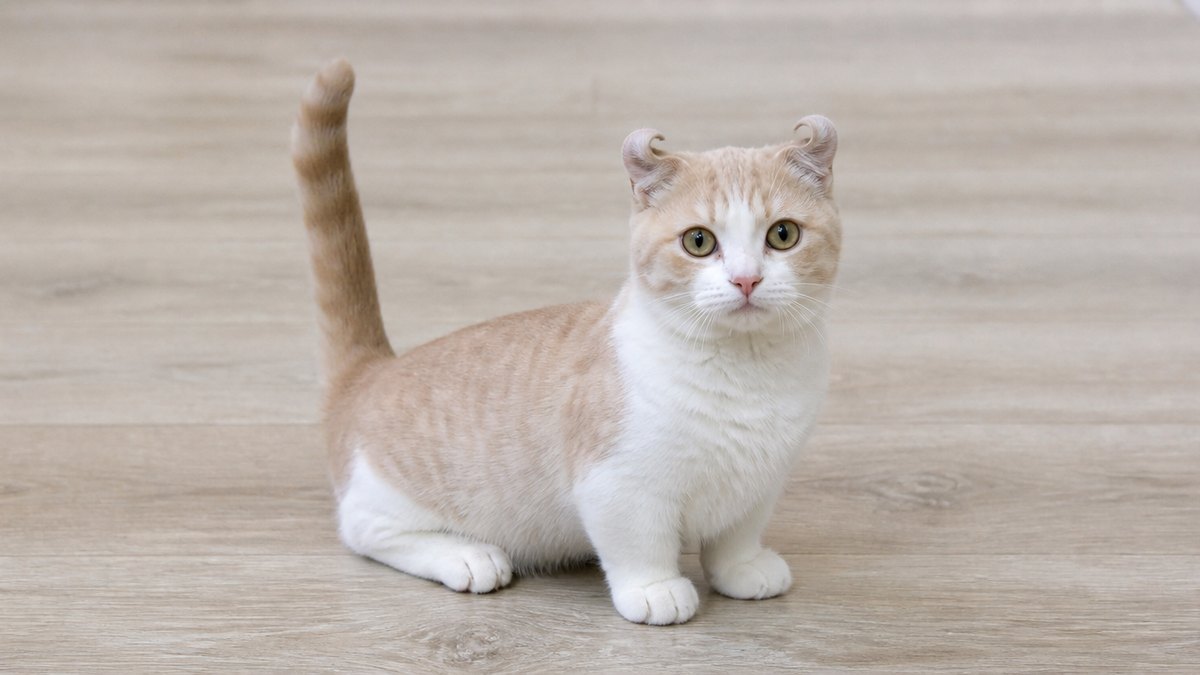
The rest of the cat is ordinary. Expect a small to medium body of normal proportions on very short legs, a normal full-length tail, a modified wedge head, and ears that curl backward at the tips rather than folding forward. Coat comes in short and semi-long. Weight ranges quoted by breed guides sit around 1.5 to 3.5 kg, and none of those figures comes from a registry, because no registry publishes a standard for this breed.
Why there is no breed standard to quote
No cat registry anywhere holds the Kinkalow at any competitive class, so there is no breed standard, no scale of points and no disqualification list. TICA's Registration Rules name every breed in each of six registration categories and the Kinkalow appears in none of them. What exists instead is a pair of registration codes, XKI and XKL, in TICA's Experimental Record.
Rule 31.6 of TICA's Registration Rules, added in 2014, defines a structural mutation verbatim as appearance of the skeletal and/or cartilage expression different from the average domestic cat such as, but not limited to, folded ears, shortened legs, shortened or absent tail, etc. The difference in expression may or may not affect the physical abilities of the cat. Short legs and curled ear cartilage are both squarely inside that definition. Rule 33.2.1 then states that breeds which have a structural mutation as a breed characteristic must not be used as source breeds for a new domestic hybrid breed. The Kinkalow's two source breeds are the Munchkin and the American Curl.
Registry recognition, and what experimental status actually means
No registry recognition exists. The Kinkalow holds no championship, provisional, advanced or preliminary status anywhere, and it appears in none of TICA's six registration categories. What it has is a place in an unpublished experimental record under the codes XKI and XKL.
That distinction is the single most misused fact about this breed, and TICA said so itself more than a decade ago. Its 2014 board agenda records the complaint verbatim: just because their cats are listed as Experimental by TICA, many breeders are promoting their cats as being recognized and/or registered by TICA, and this reflects very badly on us. Every Indian and international breed guide that says the Kinkalow has experimental breed status with TICA is repeating the thing TICA's own board flagged as misleading.
| Registry | Kinkalow | Munchkin | American Curl |
|---|---|---|---|
| TICA | Experimental Record only, codes XKI and XKL, in none of the six registration categories The International Cat Association | Championship, Category I | Championship, Category III |
| CFA | Absent. No breed council | Absent. No breed council | Breed council under Longhair Breeds |
| WCF | No row in the 198-row EMS table | MNS and MNL, recognised | ACS and ACL, recognised |
| FIFe | Absent | Absent | ACL and ACS, fully recognised |
| LOOF | Absent from both lists | Championship, 126 pedigrees in 2025 | Championship, 64 pedigrees in 2025 |
| CCA-AFC | Absent | Absent | Standard AC, reissued 12 June 2026 |
| GCCF | Not named, but two Red grounds reach it | Red. Ineligible due to reported health problems | Name recognition only, may attend shows |
The rule TICA wrote in 2014, and the deadline it set in 2024
TICA's 2014 board agenda carries a rule-change proposal whose stated purpose is, verbatim, to stop the creation of new breeds based on combining structural mutations simply because it's possible, adding that way too little is known about the side effects that the combination of structural mutations may cause, and that in the best interest of the cats we have to stop this practise. It names three breeds as already considered Experimental in TICA, and the Kinkalow is the second of the three. TICA's own index of rule changes records that in 2014 rule 31.6 was added and rules 33.2 and 33.9 were amended.
Two current rules came out of that. Rule 33.2.1 bars breeds carrying a structural mutation as a breed characteristic from being used as source breeds for a domestic hybrid breed. Rule 33.9.4 goes further, stating that structural mutations are owned by the first breed establishing championship status that displays them, naming folded ears for the Scottish Fold, short legs for the Munchkin and curled ears for the American Curl, and requiring a majority vote of the owning breed section before a new breed may use one. A Kinkalow would need permission from two breed sections rather than one.
Rule 33.1.2.3, added to TICA's Registration Rules in 2024, applies specifically to breeds on the Experimental Record as of 16 November 2021 that are in violation of registration Rule 33.2.1. It required an application for extension of experimental status, with justification, to be submitted to both the Rules Committee and the Genetics Committee at least 90 days before the Spring 2025 board meeting, and states verbatim that at that meeting the TICA Board may determine a date upon which to terminate the Experimental status. A breed built from two structural-mutation source breeds is exactly the case that rule describes. We could not establish what the board decided, and this page does not guess, but a buyer should know the rule exists and should ask any breeder what happened at that meeting.
The French studbook adds a detail nobody quotes and it is the most practical registry fact on this page. LOOF registers long-legged Munchkins and straight-eared American Curls as auxiliaires d'elevage, breeding auxiliaries that may not be shown. A national registry formally maintaining the non-mutant siblings of both parent breeds is telling you something about how these breeding programmes actually have to run.
Where the Kinkalow came from
The Kinkalow was created in the United States in the 1990s by deliberately crossing the Munchkin with the American Curl, and it has never advanced out of experimental status in the thirty years since. The earliest registry document we could open that names it is TICA's 2014 board agenda, which lists it among breeds already considered Experimental at that date.
The wider context is the more useful history, because the Kinkalow is one of a family. TICA's own 2015 registration code list carries a cluster of experimental Munchkin derivatives side by side: XKI and XKL for the Kinkalow, XDW for the Dwelf, XTK for the Scottish Kilt, XBM for the Bambino and XEF for the Elf. Each takes the same short-leg mutation and adds a second one, curled ears, hairlessness, folded ears, or two of those at once.
| Breed | Cross | Mutations combined | Status |
|---|---|---|---|
| Munchkin | Foundation breed | 1, short legs | Championship at TICA, WCF, LOOF, CCCA, SACC |
| Minuet | Munchkin and Persian | 1, short legs plus a face type | Championship at TICA, and in the WCF table |
| Kinkalow | Munchkin and American Curl | 2, short legs and curled ear cartilage | Experimental Record only, XKI and XKL |
| Bambino | Munchkin and Sphynx | 2, short legs and hairlessness | Experimental Record, XBM |
| Scottish Kilt | Munchkin and Scottish Fold | 2, short legs and folded ears | Experimental Record, XTK |
| Dwelf | Munchkin, Sphynx and American Curl | 3 | Experimental Record, XDW |
That family is the reason this page can say anything at all about risk. The Kinkalow itself has no literature, but the Dwelf, which is the same idea taken one mutation further, has a published case report, and the Munchkin and the American Curl each have a small literature of their own Struck AK, Braun M, Detering KA Robinson R. The American curl cat. Journal….
Kinkalow cat price in India, and why even the fabricators skip it
No Kinkalow cat price in India exists, and unusually for a rare cat, no Indian site invents one either. Both of the Indian pages that publish invented rupee bands for rare breeds return a not-found page for this one. Every result on page one of an Indian search is about a different cat.
What comes back instead is a clean substitution. A Kinkalow price search on Google India returns no image block at all, and every web result is about the Munchkin or the Persian, with India's biggest cat-price guide ranking first at Rs 25,000 to Rs 70,000 for the Munchkin Supertails, Cat price in India. Google's own related searches offer Munchkin cat price in India and Napoleon cat price in India, which are this breed's parent and its closest sibling.
| Source type | Quoted band | Ratio to the lowest floor |
|---|---|---|
| India's leading cat-price guide | Rs 25,000 to Rs 70,000 | 1x |
| A pet-content site, first band | Rs 25,000 to Rs 80,000 | 1x |
| The same site, second band on the same page | Rs 80,000 to Rs 2,50,000 | 3.2x |
| A social listing | Rs 40,000 to Rs 1,50,000 | 1.6x |
| A pet marketplace | Rs 2,40,000 to Rs 5,50,000 | 9.6x, and 22x at the ceiling |
| A breed-template site | Rs 30,000 to Rs 60,000 | 1.2x |
A twenty-two-fold spread on one breed on one day is not a market. It is what a set of pages looks like when none of the writers has sold or bought the animal. Treat any Indian dwarf-cat price with that in mind, including the ones this page quotes.
A Munchkin, or a Persian, depending on which result they click. There is no identified Indian Kinkalow breeder, no classified listing and no cattery. If someone in India offers you a Kinkalow, there is no registry anywhere that can issue a pedigree for it, because no registry holds the breed. What you would be buying is an unregistered short-legged, curl-eared cat of undocumented parentage, and the two questions that matter are which cats were mated to produce it and whether either parent has ever been examined by a vet for limb conformation.
Import is not a shortcut. India's import policy for pet cats is restricted under ITC(HS) 01061900, and the only route without a DGFT authorisation is moving your residence to India permanently with a cat that is already yours, under the Customs Baggage Rules. And the documentation problem compounds it: a breed with no registry status cannot be presented as a pedigree animal anywhere.
Monthly cost of a short-legged cat in India, and the costs nobody prints
Budget as you would for a small ordinary cat, then add two lines no breed guide includes, orthopaedic veterinary attention and home modification. Neither is optional for a chondrodysplastic cat and neither appears in any Indian monthly cost table.
- Licence, Rs 50 in Chennai. The Greater Chennai Corporation licenses pet animals generally rather than dogs only, so a cat is covered.
- Free municipal treatment and anti-rabies vaccination in Chennai. The corporation's veterinary clinics provide both free of cost.
- Ramps and steps, a one-time cost most owners meet twice. A cat that cannot jump comfortably needs a route onto the sofa, the bed and the windowsill, and the second set usually gets built after you watch the first attempt.
- Radiographs, if your vet recommends them. The one published case report of a chondrodystrophic cat with limb deformity involved elbow subluxation diagnosed on imaging. Budget for the possibility rather than assuming it away.
- No statutory microchip cost for a kitten. Rule 7(16) of the Pet Shop Rules, 2018 makes microchipping mandatory for puppies only.
- One genetic test worth asking about. A 2026 Japanese survey found the Scottish Fold's TRPV4 variant in both American Curls and Munchkins, so a TRPV4 genotype on the parents is a real and answerable question, unlike anything specific to this cross. It is the only locus you can screen for in this cat.
- No allergy claim to pay for. Dwarf and hairless crosses are often sold on an allergy story, and a 2024 review states flatly that there is no scientific evidence for a hypoallergenic cat breed. Do not budget a premium for it.
The Indian pages that publish a monthly cost for rare cats use a preset row: food Rs 1,500 to Rs 2,000, health Rs 500 to Rs 700, grooming Rs 800 to Rs 1,500 and a monthly total of Rs 2,800 to Rs 4,200, with the three component lines summing exactly to the totals. Those same four lines appear byte-identically across cats of different sizes on both Indian sites. This breed has no row at all. Build your own monthly cost from your vet's rate card and your own food brand, and treat the veterinary line as the one most likely to be larger than a normal cat's.
Heat tolerance and the Indian climate
Neither of this breed's mutations touches thermoregulation, so a Kinkalow is about as heat-tolerant as any short-coated cat of its size. The Indian-specific issues are ground contact and ear hygiene rather than cooling.
Plan against your own city's real peak rather than a generic Indian summer, because the most common error in Indian climate tables is naming May as the hottest month everywhere, which is wrong for three of the six cities most Indian cat owners live in.
| City | Hottest month and mean | Coolest month and mean | Cell elevation |
|---|---|---|---|
| Delhi | June, 35.88 C | January, 13.61 C | 206.37 m, matches the city |
| Nagpur | May, 36.73 C | December, 19.97 C | 282.60 m, matches the city |
| Chennai | May, 31.51 C | January, 24.09 C | 48.95 m, matches the city |
| Kolkata | May, 31.53 C | January, 17.31 C | 7.35 m, matches the city |
| Mumbai | May, 31.19 C | January, 23.19 C | 97.15 m, matches the city |
| Bengaluru | April, 28.37 C | December, 20.22 C | 841.72 m, matches the plateau |
| Pune | April, 28.93 C | December, 19.62 C | 635.99 m, matches the city |
Two Indian details that follow from the two mutations
- Ground contact cuts both ways. A cat whose belly sits close to the floor spends more of its day touching whatever surface it is on. On Indian tile that is a free cooling surface and a genuine advantage in a Chennai May. On a sun-warmed balcony floor or a rug over a west-facing slab it is the opposite, and the cat cannot get its body clear of it as easily as a long-legged cat can.
- A curled ear holds moisture a straight ear sheds. The pinna's shape changes the opening of the canal, and an Indian monsoon is when that matters. A weekly ear check is the whole intervention, and it should not wait for a smell.
- Floor-level dust and damp reach this cat first. Sweeping and mopping schedules matter more when the animal lives two inches from the floor, particularly during a Kolkata or Mumbai monsoon.
- Cooling by finding a cool surface still works. Cats thermoregulate by moving before they pant, so give shaded tile and a fan rather than assuming air conditioning is required.
The honest summary is that climate is not this breed's problem in India. Conformation is. A cat that struggles to get onto a high windowsill will also struggle to get away from a hot floor, so the practical work is giving it easy routes to cool places rather than managing a coat.
Temperament, household fit and who should not get one
Kinkalows are described as affectionate, playful and people-oriented by every breed guide that covers them, and by none of those guides with any measurement behind it. Both parent breeds have friendly reputations, so the claim is plausible.
The useful part of this section is not temperament, which is largely individual, but household fit, which follows directly from the conformation. A cat that cannot jump comfortably lives a different life in a flat than one that can, and the difference is invisible in a photograph.
- Vertical access must be built, not assumed. Ramps, steps and stacked low platforms replace the single tall cat tree that suits an ordinary cat.
- Toddlers and short-legged cats are a poor mix. A cat that cannot leap out of reach relies on you to manage the room.
- Larger resident cats change the calculation. In a multi-cat household, escape routes upward are how cats defuse conflict, and this cat has fewer of them.
- Balconies need railing guards regardless. A cat that jumps badly is a cat that falls badly, and Indian high-rise balconies are the commonest emergency in urban cat practice.
Skip this breed if you want a cat that climbs, if your flat's furniture is high and unmodifiable, if you have very young children, or if you are not prepared to have a vet assess the animal's limbs rather than take a breeder's word. And skip it if you are buying because the cat looks permanently kitten-like, because that appearance is produced by two skeletal and cartilage mutations rather than by youth. The GCCF's stated position on dwarf cats is Red Status with an owner note reading risk of suffering as they age, possible heart problems.
Training a Kinkalow, and the handling that matters
To train a Kinkalow, spend the first month teaching the cat routes rather than tricks, because a chondrodysplastic cat's biggest daily problem is getting where it wants to go. Everything else is ordinary cat training.
- Build and teach ramps before the kitten arrives. A kitten that learns a ramp at ten weeks uses it for life. One that learns to launch itself at furniture keeps doing that.
- Handle the forelimbs weekly from day one. Gentle handling makes a veterinary limb examination routine rather than a fight, and this is a cat that may need one.
- Train a weekly ear check into the grooming session. Two minutes with a cotton pad, no probe, and the curled pinna gently lifted rather than unfolded.
- Teach the carrier before you need it. Feed meals in an open carrier for two weeks so the first vet visit is not the first closed door.
- Monitor weight monthly on a kitchen scale. Extra body weight on short limbs loads joints that are already differently shaped, and body condition is far easier to correct early.
Litter training is usually trivial and the tray is the thing to get right. Choose a large tray with a very low entry, because stepping over a high lip is a genuine daily obstacle for a cat with short legs, and a cat that finds the tray hard will find somewhere easier.
Do not train jumping. Some short-legged cats jump surprisingly well and some do not, and encouraging a cat to leap onto a high surface it can barely reach is how a landing goes wrong. Give the route instead of the challenge.
How much exercise a Kinkalow actually needs
Budget 30 to 45 minutes of interactive play a day, kept horizontal. A short-legged cat can run, chase and pounce perfectly well on the level, and the exercise plan should use that rather than testing what it cannot do.
- Play along the floor rather than upward. Wand toys dragged along a corridor suit this cat far better than a toy dangled above head height.
- Use corridors. A straight run is the single best exercise resource in an Indian flat and costs nothing.
- Split the time. Two sessions of 15 to 20 minutes beat one long one, because cats hunt in bursts.
- Watch the landing, not the leap. If the cat is repeatedly landing heavily off furniture, lower the furniture or add a step rather than admiring the effort.
- Move play to early morning and after sunset in summer. A closed Nagpur flat at 3 pm in May, where the monthly mean is 36.73 C, is not a place to run any cat.
Weight control is the real purpose of the exercise plan here. On a normal skeleton, a slightly heavy cat is a slightly heavy cat. On short, differently proportioned limbs, extra load falls on joints whose published case literature is about deformity and subluxation. Keeping this animal lean is the highest-value thing an owner does.
Grooming a Kinkalow in Indian humidity
Grooming a Kinkalow takes ten to fifteen minutes a week for the shorthair and twice that for the semi-long, and the ears take longer than the coat. The curled pinna is the part of this cat that a normal grooming routine handles wrongly.
- Groom the coat weekly with a rubber mitt or a comb. Nothing about the coat is unusual, so any ordinary short or semi-long coat routine works.
- Lift the curled ear gently, never straighten it. The curl is cartilage. Wipe only the visible part with a soft cotton pad, and never put anything into the canal.
- Do the ear check weekly, and twice weekly in the monsoon. A curled pinna shelters the opening from air, which is exactly the wrong property in a Kolkata or Mumbai wet season.
- Keep the belly and lower legs clean. A cat that lives close to the floor picks up more from it, and in India that means dust in summer and damp in the monsoon.
- Trim nails every two to three weeks. Short-legged cats often use scratching posts differently, so nails can outgrow their wear.
Bathing, and drying properly
Bathe rarely, and dry completely. Air drying in a humid Indian flat leaves a damp coat against skin for hours, and on a cat that lies flat against floors it also leaves damp fur in contact with the surface. Towel first, then a low cool dryer, and finish by drying the visible part of both ears with a dry pad.
Nothing here is difficult. The point is that the ear routine is not optional on this cat in the way it is on an ordinary shorthair, and that it is the only part of grooming where getting it wrong causes a veterinary problem rather than a tangle.
Kinkalow health, and what stacking two mutations actually means
No study has ever examined a Kinkalow, so everything below is evidence about its two parent mutations and about a closely related three-mutation cross. That is the honest structure of the question, and it is more informative than the breed guides' unsourced line about possible joint discomfort.
Mutation one, the short legs
The Munchkin's chondrodysplasia is caused by a structural variant within UGDH on feline chromosome B1, identified in a case-control study of 89 cats where it was perfectly associated with the short-legged standard phenotype. A separate 2020 genome study found a complex deletion with a nearby duplication interrupting the same gene, shared privately across three unrelated dwarf cats, and noted that UGDH has not yet been associated with human dwarfism.
The breeding consequence is the part that matters and it is stated plainly by the authors. Verbatim: the lack of homozygous mutant phenotypes and reduced litter sizes in standard Munchkin cats suggest an autosomal recessive lethal trait in the homozygote state, alongside an autosomal dominant mode of inheritance for the short legs. In practice that means mating two short-legged cats predicts losing a quarter of the embryos, and it is why responsible dwarf programmes mate short-legged to normal-legged. The French studbook's registration of long-legged Munchkins as breeding auxiliaries is that same arithmetic written into a registry rule.
Mutation two, the curled ears
The American Curl's ear is the older and thinner file. A 1989 report established from breeding data that the curled pinna is a monogenic autosomal dominant trait, designated Cu. Thirty-two years later, a 63K SNP array study across 26 breeds could only propose candidate genes, MCRIP2 and PBX1, inside a candidate region, and its authors say plainly that the assessment is empiric and that detailed analyses are needed. So the causal variant is still unidentified, there is no genetic test, and there is no published disease associated with the trait.
A 2026 survey genotyped 8,610 cats across 14 breeds in Japan for TRPV4 c.1024G>T, the variant that causes the Scottish Fold's folded ear and its osteochondrodysplasia. It reports verbatim that the variant was identified primarily in Scottish Folds but was also detected in American Curls, Norwegian Forest Cats, Munchkins, and Minuets. Both of this breed's parent breeds are on that list. That does not mean any particular Kinkalow carries it, and it does mean the question is answerable, because a TRPV4 test exists and the Fold variant is the one feline cartilage mutation with a well-described disease attached. Ask a breeder for parental TRPV4 genotypes, and ask your nearby vet whether testing is worth doing for a cat you already own.
What happens when a cross goes one mutation further
The nearest published case to a Kinkalow is a Dwelf, which is a Munchkin crossed with a Sphynx and an American Curl, so it stacks three mutations rather than two. A 10-month-old neutered male presented with bilateral thoracic angular limb deformity secondary to chondrodystrophism and an acute lameness caused by elbow subluxation with radial head displacement. Surgery resolved the lameness but a degree of subluxation persisted. The authors' framing is what makes this citable rather than anecdotal, verbatim: chondrodystrophism is not common in cats, inbreeding and chondrodystrophism is likely to result in the diagnosis of musculoskeletal diseases that have not previously been reported in this species, and to their knowledge this is the first case report of a developmental radial head subluxation in a chondrodystrophic cat.
Read that carefully in both directions. It is a single case in a different cross, so it is not a prevalence figure and nobody should tell you a quarter of Kinkalows get elbow subluxation. And it is a peer-reviewed warning that novel musculoskeletal problems are what to expect when chondrodystrophy meets a small closed breeding population, which is exactly the situation a two-mutation experimental breed is in.
| Question | Status | Source |
|---|---|---|
| Munchkin short-leg variant identified? | Yes, a structural variant in UGDH | Struck 2020 |
| Homozygous short-legged cats observed? | None, with reduced litter sizes. Read as a homozygous lethal | Struck 2020 |
| American Curl ear variant identified? | No. Candidate region only, 37 years on | Robinson 1989 and Alhaddad 2021 Alhaddad H, Abdi M |
| Any disease attributed to the curled ear? | None published | Same two papers |
| Does the Scottish Fold variant occur in the parent breeds? | Yes, detected in both American Curls and Munchkins in Japan | Ukawa 2026 |
| Any published case in a chondrodystrophic cat? | Yes, one, in a three-mutation Dwelf | Lunde 2025 |
| Any disease studied in the Kinkalow itself? | None. No paper names the breed | PubMed audit, 10 September 2026 |
| Breed lifespan measured? | No, and neither parent breed reached the threshold either | Teng 2024, Table 6 |
One reported condition in the dwarf parent, stated at its real size
A 2024 case series described xanthinuria in a familial group of Munchkin cats. Four confirmed cases and one suspected, four of the five Munchkin pedigree cats all related, with signs starting at 3 to 8 months and every cat carrying upper urinary tract uroliths, and clinical signs reducing on a protein-restricted diet. A candidate variant proposed for an unrelated domestic shorthair was excluded in the Munchkin family, so the cause in these cats is unknown. That is a small related family, not a breed prevalence, and it should be quoted as such.
A 2020 case report describes two Scottish Fold mixed cats. Case 1 was a mixed Scottish Fold and MUNCHKIN whose extremities resembled the Munchkin while the ear pinnae folded forward like the Fold. Case 2 was a mixed Scottish Fold and AMERICAN CURL whose ear pinnae curled caudally like the Curl. Both cats showed severe exostosis in the hind leg on radiographs taken around one year of age, and both were dominant homozygous for TRPV4 c.1024G>T. The authors conclude verbatim that cross breeding with Scottish Fold cats could produce unknown phenotypes, and should be avoided. A Kinkalow carries no fold gene by design, so this is not a paper about this breed. It is cited because its two cases are exactly a Munchkin cross and an American Curl cross, which is what makes the 2026 finding of the fold variant inside both of those breeds worth testing for rather than ignoring. Verify the parents' genotypes rather than assuming.
Life expectancy has never been measured for this breed or for either parent. The largest UK feline life-table study required 15 or more deaths for a breed row, twelve breeds reached that threshold, and neither the Kinkalow nor the Munchkin nor the American Curl is among the 12. What that study does establish and what does apply here is that entire cats had 4.29 times the odds of death before three years compared with neutered cats, and purebred cats 1.83 times the odds compared with crossbreds. Talk to your nearby vet about neutering timing.
The bottom line for a buyer is neither reassurance nor alarm. Each of the two mutations is individually contested rather than individually catastrophic, the combination has never been studied, and the registry that tracks the breed wrote a rule against making breeds this way and gave breeds like it a deadline to justify themselves The International Cat Association. Anyone who tells you the Kinkalow is a healthy breed is describing the absence of studies rather than the state of the cats. Ask your nearby vet before you buy, and ask again about any joint pain in a cat you already own.
Feeding a short-legged cat in India
Feed a Kinkalow to hold it lean, because weight control is the single largest health lever available to the owner of a chondrodysplastic cat. Everything else about the diet is ordinary.
- Weigh the daily ration and portion it once each morning. In a household where several people feed the cat, a single labelled container is the whole solution.
- Monitor body condition every month by hand. Feel the ribs under a thin fat cover without pressing, and look for a waist from above.
- Raise the bowl slightly if the cat's posture looks strained. Some short-legged cats eat more comfortably from a bowl an inch or two off the floor, and it costs nothing to test.
- Keep wet food in the mix in Indian summers. Water intake matters, and the Munchkin family's one reported urinary condition responded to dietary management.
- Do not free feed. A cat that cannot exercise vertically has fewer natural outlets for surplus calories.
Kitten food through 12 months is the standard advice and it holds here. Availability in India is not a constraint, since every major wet and dry line sold in Indian metros carries a complete and balanced formula.
If your vet ever recommends a protein-restricted diet, follow the vet rather than a breed page. The Munchkin xanthinuria series improved on exactly that, and the decision belongs to somebody who has the individual cat's urinalysis in front of them.
Kitten timeline, month by month through the first year
A Kinkalow kitten follows the ordinary feline timeline with two additions, an early orthopaedic look and an ear routine from month two. Kitten care here is mostly about building the habits a two-mutation cat will need for life.
- Weeks 0 to 8, with the breeder. Indian law treats kittens below eight weeks as un-weaned and prohibits their sale, so a kitten offered before eight weeks is an illegal sale.
- Before you commit, watch both parents walk. Ask to see them cross a floor and step up onto something. This costs nothing and tells you more than any certificate could, since no registry issues one for this breed.
- Month 2, home, with ramps already built. The kitten should never learn to launch at furniture in the first place.
- Month 2 to 4, core vaccination course. Follow your nearby vet's schedule rather than any breed page's table.
- Month 3, first orthopaedic look. Ask your vet specifically to assess forelimb alignment and elbow comfort, because angular limb deformity in chondrodystrophic cats is a described presentation.
- Month 3, carrier training and weekly ear checks begin. Both are lifelong routines and both are easiest to teach now.
- Month 4, weight baseline. Record it and repeat monthly.
- Month 6 to 9, neutering discussion. Entire cats carry 4.29 times the odds of death before three years compared with neutered cats.
- Month 8, first monsoon. The wet season is when the ear routine is actually tested.
- Month 12, adult health check. Ask for limb alignment, joint comfort and a body condition score to be written into the file, so there is a baseline to compare against at five years.
One thing not to do is treat a slow-developing jump as something to train. If a twelve-month-old cat still avoids a height, that is information about the animal rather than a training gap, and the answer is a ramp.
Kinkalow versus the cats it is cross-shopped against
Indian buyers reach the Kinkalow through the Munchkin, and the comparison worth making is against its own two parents and against the two dwarf crosses that did get registry status.
| Breed | Mutations | Highest registry status | Genetics | Available in India |
|---|---|---|---|---|
| Kinkalow | Short legs plus curled ears | None. TICA Experimental Record only | Neither combination studied | No |
| Munchkin | Short legs | Championship at TICA, WCF, LOOF, CCCA, SACC | UGDH structural variant, no homozygotes seen | Yes, at wildly inconsistent prices |
| American Curl | Curled ears | Championship at CFA, TICA, FIFe, WCF, LOOF, CCA | Dominant Cu, causal variant unidentified | Rare |
| Minuet | Short legs plus a Persian face type | Championship at TICA, held by WCF | Same UGDH variant as the Munchkin | Very rare |
| Bambino | Short legs plus hairlessness | TICA Experimental Record, XBM | UGDH plus KRT71 | No |
| Indian domestic shorthair | None | None, and none needed | Not applicable | Free, from any shelter |
The American Curl gives you the ears with no skeletal mutation, and six registries hold it, which means a real breed standard, a real breed council and cats bred under published rules. That is a genuinely better-documented animal than a Kinkalow, and in India it is only marginally harder to find, since neither is common. If the short legs are the point, the Munchkin at least has a mapped variant, a known breeding rule and championship status in five registries.
Mistakes Indian buyers make with the Kinkalow
Five mistakes account for most of what goes wrong, and the first one is repeating a phrase that TICA itself flagged as misleading twelve years ago.
- Reading experimental status as recognition. TICA's own 2014 board agenda records that breeders promote experimental cats as recognised or registered by TICA and that this reflects very badly on us. Experimental Record tracking is not registration in any of the six categories.
- Buying from a short-to-short pairing. No homozygous short-legged cat has ever been observed and litter sizes are reduced, which reads as a homozygous lethal. Ask which pairing produced the litter and get the answer before you pay.
- Confusing curled ears with folded ears. An American Curl ear curls backward and has no published disease attached. A Scottish Fold ear folds forward and is caused by a TRPV4 variant with a documented cartilage disease. A cat sold as a Kinkalow with forward-folded ears is not a Kinkalow.
- Paying a Munchkin price for a cat with no registry. Indian Munchkin quotes on one day spanned Rs 25,000 to Rs 5,50,000, and a Kinkalow has no pedigree available anywhere to justify any of it.
- Furnishing the flat for an ordinary cat. High furniture with no ramps is the daily cost this breed imposes, and it is the one nobody prices.
A sixth mistake belongs to writers rather than buyers, and it is worth naming because it shapes what a buyer reads. Every ranking page in the Indian index says the breed may be prone to joint discomfort or spinal curvature, and not one of them names a condition, a study or a document. The evidence that does exist is specific and citable: a mapped UGDH variant with no living homozygotes, an unidentified ear variant, a Scottish Fold variant found in both parent breeds, and one published case of elbow subluxation in a chondrodystrophic cat Alhaddad H, Abdi M Ukawa H, Akashi A, Hayashi H Lunde K, Langley-Hobbs SJ. Radial head….
Finally, do not read the absence of studies as a clean bill. A breed nobody has examined is a breed whose problems have not been described yet, which is a different thing from a breed that has been examined and cleared.
Adoption, responsible sourcing and the honest answer for India
Adopt, because in India there is no Kinkalow to buy and no registry to document one. The wider question, whether to seek out a two-mutation cat at all, is one this page will put to you plainly rather than decide for you.
- Adopt an Indian domestic shorthair. Hardy, climate-adapted, free from any shelter, and free of both mutations.
- Adopt a short-legged cat if one comes into a shelter. Chondrodysplastic cats do turn up in rescue, and rehoming one is a straightforwardly good act that creates no demand.
- Refuse any kitten under eight weeks. Indian law defines kittens below eight weeks as un-weaned and prohibits their sale.
- Ask a vet, not a breeder, about the limbs. For any short-legged cat, an independent examination of forelimb alignment and joint comfort is worth more than any assurance.
- Ask about parental TRPV4 genotypes. Both parent breeds have been found carrying the Scottish Fold variant in a large survey, and it is the one testable question available.
On the ethical question, this page will state the positions rather than moralise. TICA's board was asked in 2014 to stop the creation of breeds combining structural mutations, on the stated grounds that too little is known about the side effects and that the intentions behind such designer breeds are often focused on money rather than the physical wellbeing of the animals. The GCCF grades dwarf cats Red, defined as breeds where scientific evidence exists of links to serious health problems. FIFe holds neither the Munchkin nor any dwarf cross. Against that, the Munchkin holds championship status in five registries and the American Curl in six, so neither parent mutation is universally rejected.
What follows for a reader in India is simple enough. There is no lawful, documented route to a Kinkalow here, there is no registry that would issue papers for one, and there is no study of the combination. If you want the look, the American Curl gives you the ears with a real standard behind it. If you want a cat, a shelter in your own city has one today.
Kinkalow questions Indian buyers actually ask
Are Kinkalow cats good pets?
Individual Kinkalows are affectionate and playful, and the honest answer has to include what the cat is made of. It carries two separate structural mutations, short legs from the Munchkin and curled ear cartilage from the American Curl. TICA's own 2014 board agenda records a proposal aimed at stopping the creation of new breeds based on combining structural mutations simply because it is possible, and names the Kinkalow among the three breeds it had in mind. That is a judgement from inside the registry that tracks the breed, and a buyer deserves to weigh it.
What is the lifespan of a Kinkalow cat?
Nobody has measured it, and the 12 to 15 years that breed guides print has no study behind it. The largest UK feline life-table study built its breed table from 7,936 confirmed deaths and required 15 or more deaths before a breed got a row. Twelve breeds reached that threshold and this one is not among them, nor is either parent breed. The study's own figures are 11.74 years for all cats and 11.89 years for crossbreds, and those are the only defensible numbers to plan around.
What is the most misbehaved cat breed?
No breed is, and this question appears in the Kinkalow's own results box because the Indian index for the breed is about 186 results deep and Google fills the space with generic cat listicle questions. Behaviour in cats varies far more between individuals than between breeds, and almost every breed temperament description, including the ones in this batch, comes from breeders rather than from measurement. Judge the individual animal and its early socialisation.
What is the #1 cutest cat breed?
There is no answer, and for this breed the question is the problem rather than the trivia. Both of the Kinkalow's defining features are selected because people find them cute, and both are changes to skeleton and cartilage. The GCCF's stated position on dwarf cats is Red Status, defined as breeds where scientific evidence exists of links to serious health problems, with the owner-facing note reading risk of suffering as they age, possible heart problems. Cuteness that is built from a mutation is worth thinking about differently from cuteness that is built from a coat colour.
How much does a Kinkalow cost in India?
No Indian price exists, and unusually, no Indian site even invents one. Both of the Indian sites that publish invented rupee bands for rare cats return a not-found page for this breed. Every result on page one of an Indian search is about the Munchkin or the Persian, and Google's own related searches offer Munchkin cat price in India and Napoleon cat price in India. For scale on how unreliable the substitute is, six Indian sources quoted Munchkin prices on the same day ranging from Rs 25,000 to Rs 5,50,000, a twenty-two-fold spread.
Is the Kinkalow recognised by TICA?
No, and the word recognised is doing a lot of work in that question. TICA's Registration Rules list six registration categories and name every breed in each, and the Kinkalow appears in none of them. What TICA does is track it in an Experimental Record, which is not a published list and does not require board approval, under the codes XKI and XKL. TICA's own 2014 board agenda notes the problem in as many words: because their cats are listed as Experimental by TICA, many breeders promote them as being recognised or registered by TICA.
Why do Kinkalows have short legs?
Because they inherit the Munchkin's chondrodysplasia, which is a structural variant in the UGDH gene. The 2020 study that identified it tested 89 cats and found the variant perfectly associated with the short-legged standard Munchkin phenotype. Its conclusion carries the part that matters for breeding: the lack of homozygous mutant phenotypes and reduced litter sizes in standard Munchkin cats suggest an autosomal recessive lethal trait in the homozygote state, with an autosomal dominant mode of inheritance for the short legs themselves.
Do curled ears hurt a cat?
There is no published evidence that they do, and there is very little published evidence about them at all. The American Curl's ear was described genetically in 1989 as a monogenic autosomal dominant trait given the gene symbol Cu, and the causal variant has still not been identified. A 2021 array study could only propose candidate genes in a candidate region. What is certain is that a curled pinna changes the shape of the ear opening, which is a hygiene consideration in a humid Indian monsoon rather than a disease.
Is a Kinkalow the same as a Munchkin?
No. A Munchkin is a short-legged cat with ordinary ears, and it is held at championship by TICA, the World Cat Federation and the French studbook among others. A Kinkalow is a Munchkin crossed with an American Curl, so it carries the short legs plus the curled ear, and it holds no competitive status anywhere. TICA's own board papers describe the parentage in exactly those terms: the Kinkalow, Munchkin and American Curl.
Can two Kinkalows be bred together?
The genetics say that is the mating to avoid. The Munchkin's short-leg variant behaves as an autosomal dominant whose homozygous state has never been observed in a living cat, alongside reduced litter sizes, which the authors read as an autosomal recessive lethal in the homozygote. Mating two short-legged cats therefore predicts the loss of a quarter of embryos before birth. Responsible dwarf-cat breeding programmes mate a short-legged cat to a normal-legged one for exactly this reason. Ask any breeder which pairing they use and check the answer against that arithmetic.
Can I import a Kinkalow into India?
Only as your own pet when you move to India permanently, and there is a second obstacle. India's import policy for pet cats and dogs is restricted under ITC(HS) code 01061900, and import without authorisation is allowed only for persons shifting residence permanently to India under the Customs Baggage Rules. Beyond that, a cat with no registry status anywhere cannot be documented as a pedigree animal, because there is no registry to issue the pedigree.
What should I ask a breeder about a short-legged kitten?
Ask five things and get the answers in writing. Ask which pairing produced the litter, short-legged to normal-legged or short to short. Ask whether either parent has been tested for the TRPV4 fold variant, which a 2026 Japanese survey of 8,610 cats detected in both American Curls and Munchkins. Ask to watch both parents walk across a floor. Ask whether any kitten has been radiographed. And ask your own vet, not the breeder, to examine the forelimbs, because the published case literature on chondrodystrophic cats is about angular limb deformity and joint subluxation.
Compare with similar breeds
Kinkalow sits in 1 Bonbeno group. Each one compares it directly against the breeds it is genuinely an alternative to, on the same figures.